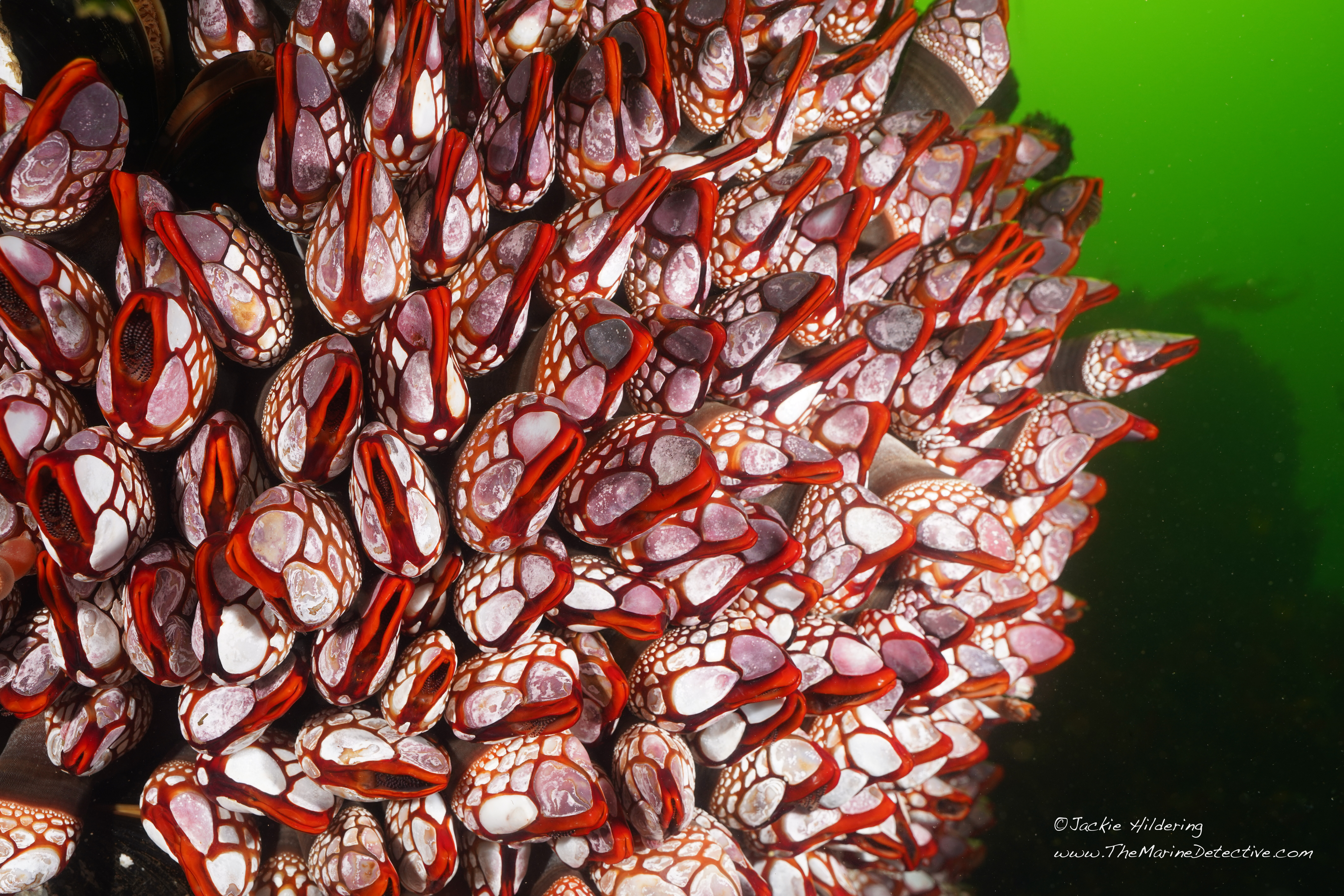
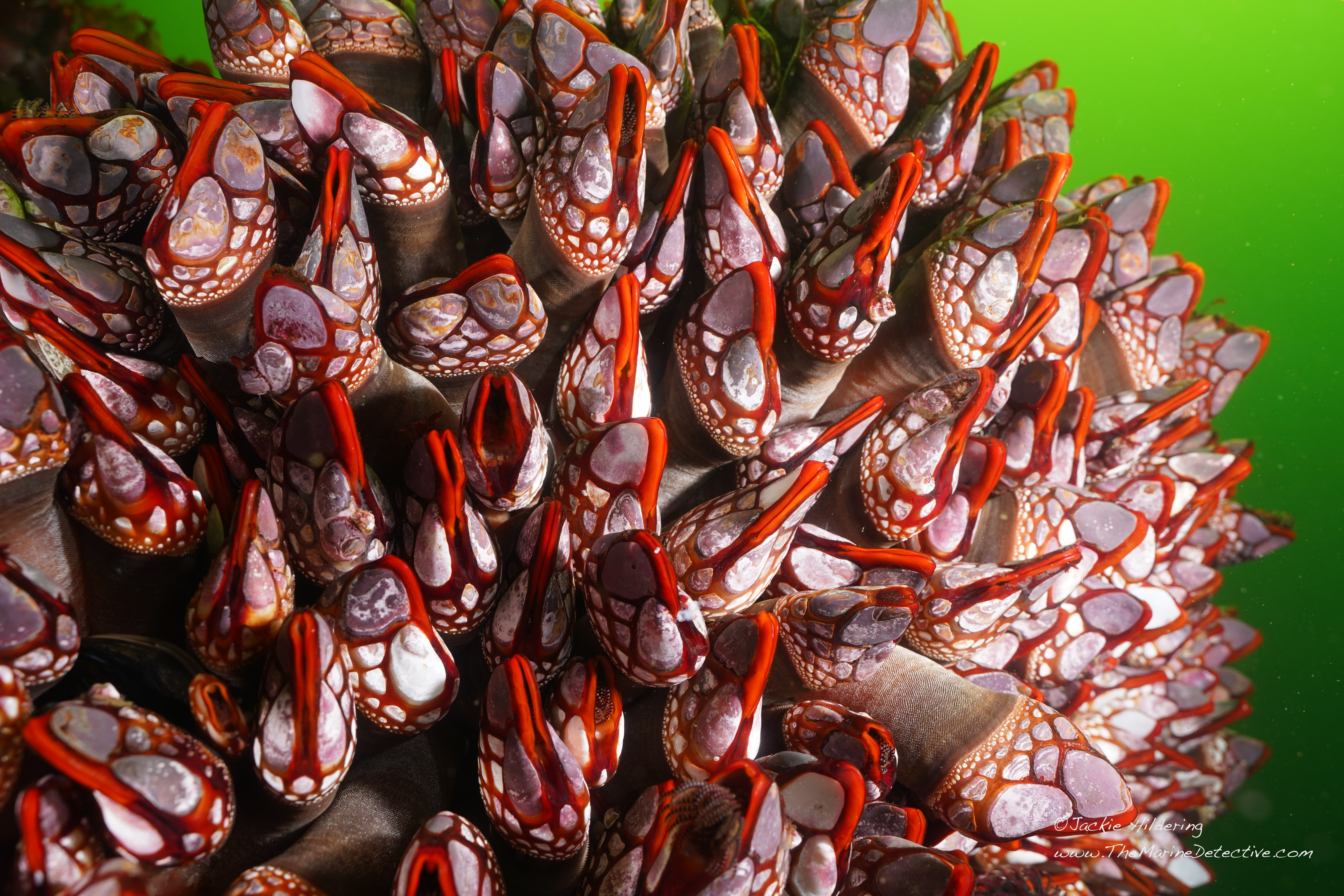
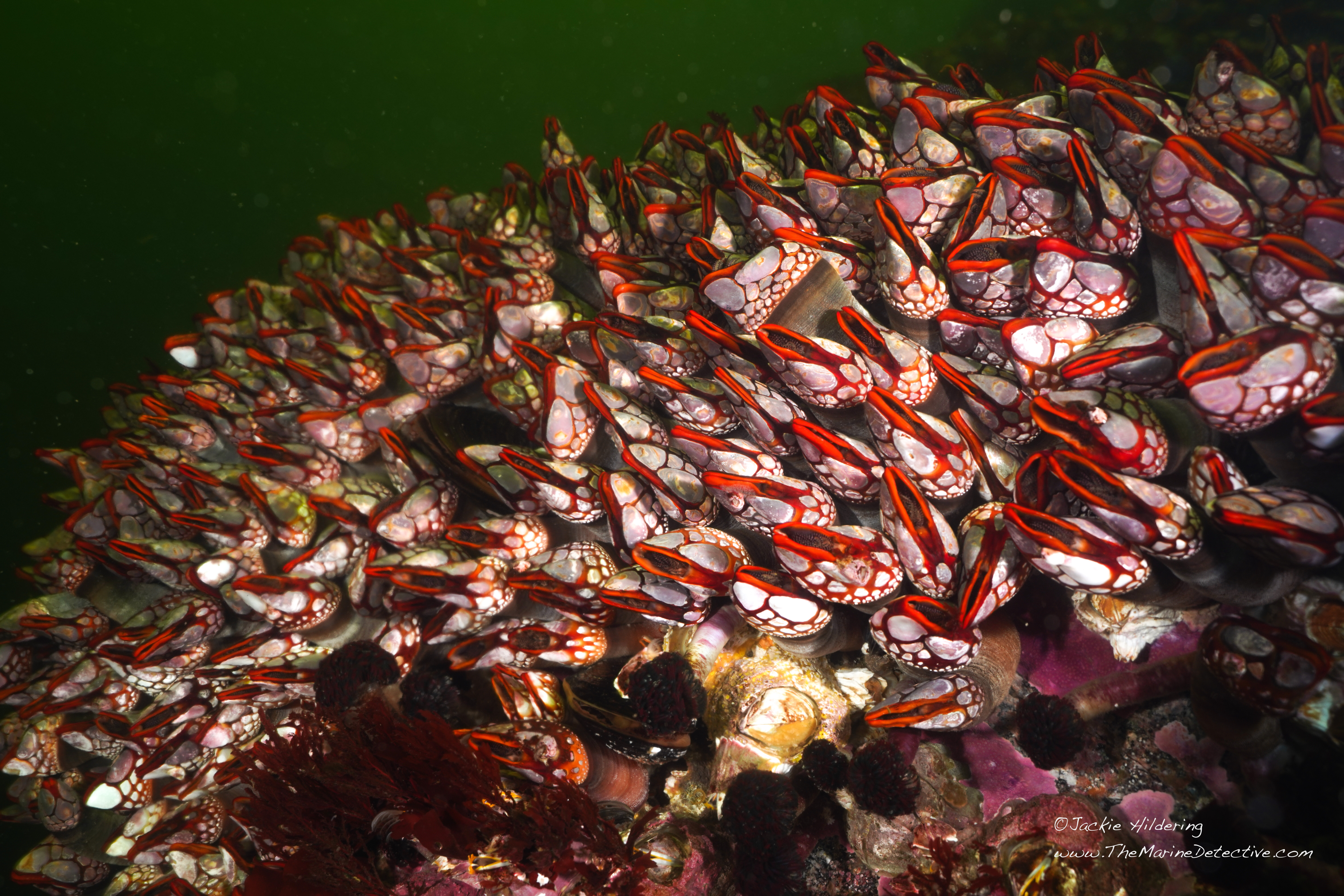
These are barnacles that live in only a very few places on the planet. The most are at Nakwakto Rapids, north of Port Hardy. The red is hemoglobin!
I think these are one of the most achingly and extraordinarily beautiful animals I have ever seen.
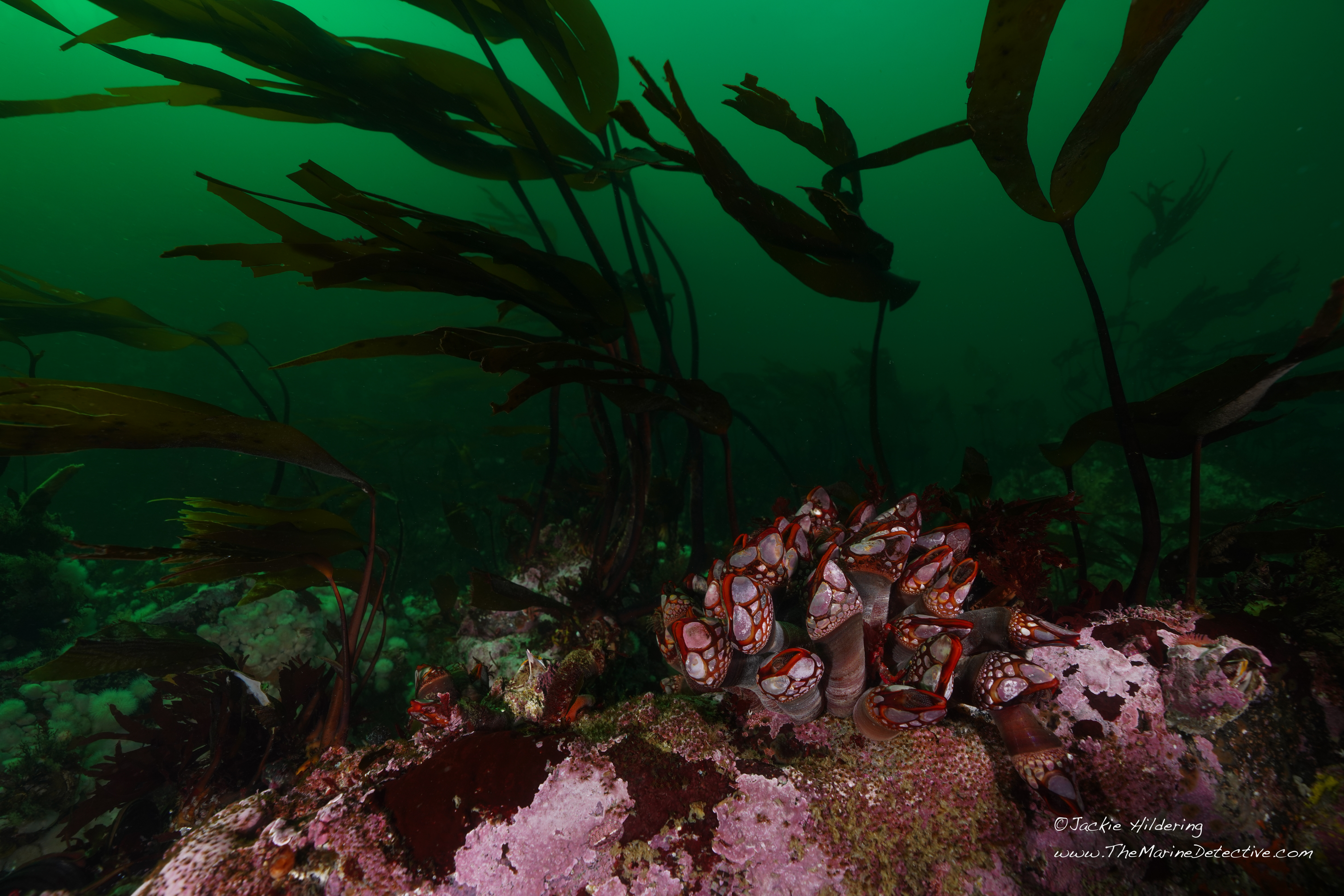
They are Nakwakto Barnacles. They need really strong current and that was very clear during the dive where I photographed these, even on a small tidal exchange). The dive site was Turret Rock, also known as Tremble Island because of the appearance that the island shakes in the tidal exchange (apparently up 39 kilometers per hour during its largest tidal exchanges).
Nakwakto Goose-neck Barnacles with Split Kelp wafting behind.
The next photo shows you the SAME species but in shallow water where you can’t see the hemoglobin because, near the surface, the gooseneck barnacles need a protective black pigment against sun exposure. How’s that as a metaphor for how your environment influences your beauty?
These barnacles are perceived to be a variant of Gooseneck Barnacles with the same species name, which is Pollicipes polymerus.
The barnacles’ stalk can be 15 cm long and body to 4.5 cm long.
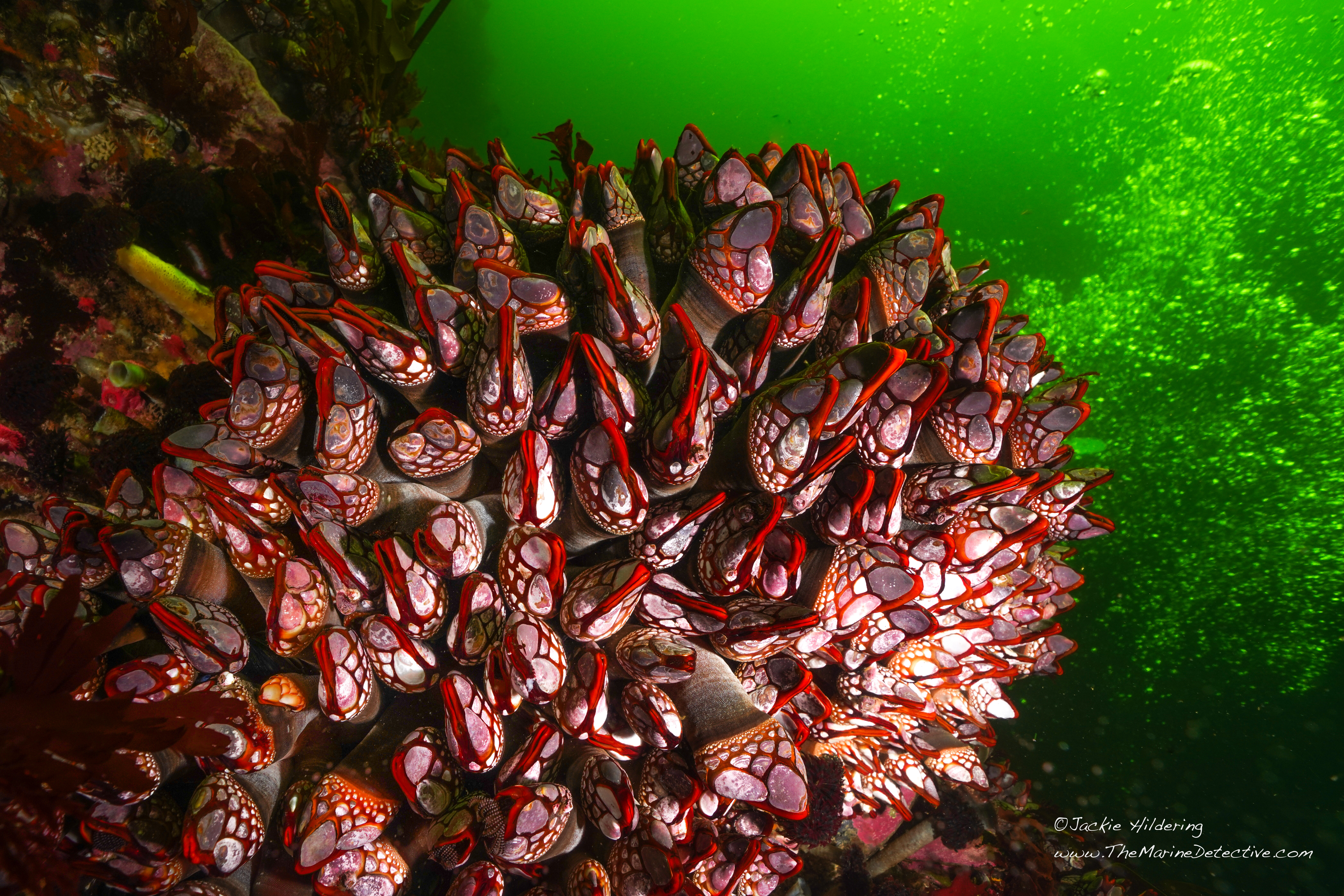
An attempt to show you the density of this species in this extraordinarily high current area.
From Hanby and Lamb’s Marine Life of the Pacific Northwest: ” . . . the spectacular formations of the Nakwakto goose-neck barnacle, a large and colourful variation of the goose-neck barnacle – found in Nakwakto Rapids, Slingsby Channel, c. BC. The glorious red colour is actually the hemoglobin in the barnacle’s blood. The blood is obvious in subtidal specimens like these, which do not have the black pigment that protects the sun-exposed populations inhabiting shallow or intertidal zones . . . this unique and isolated population must be preserved via a No-Take Marine Protected Area.“
From Rubidge et al 2020; “A unique subtidal variety of the Gooseneck Barnacle, Pollicipes polymerus, forms large aggregations at Nakwakto Rapids (Lamb and Hanby 2005). The “Nakwakto variety” of P. polymerus, is bright red as the hemoglobin in the barnacles’ blood is visible. Subtidal populations do not need the black pigment found in the sun-exposed intertidal populations (Lamb and Hanby 2005). The red “Nakwakto variety” of P. polymerus has been recently reported in other subtidal areas including a sea cave on Calvert Island on the central coast and Race Rocks near Victoria. Because of its slow recovery rate after perturbations and its ecological role as a habitat-forming species, P. polymerus was identified as an Ecologically Significant Species and conservation priority for the Marine Protected Area network planning process in the Northern Shelf Bioregion (DFO 2017).“
Information provided by Greg Jensen (pers. comm. 2024-02-01) about gooseneck barnacles’ being in high current areas: “[they are in] high current and wave-exposed areas because they are passive filter feeders relying on water movement (as opposed to active filterers like acorn barnacles). Goosenecks likely survive subtidally in these ultra-high current areas because predators like red rock crabs can’t withstand the current.”
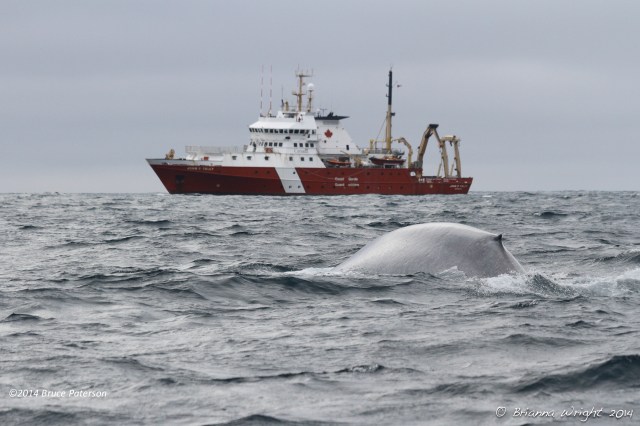
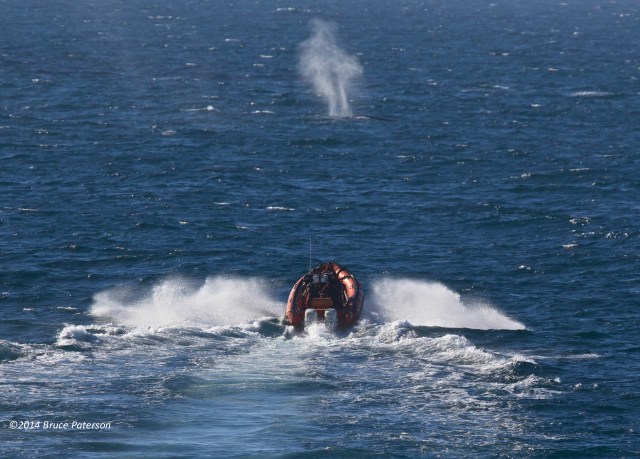
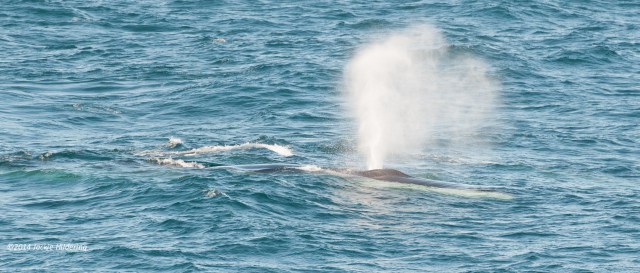
Having finally recovered from having a crashed computer hard drive, I can now share with you some of the wonder and discovery from being on DFO’s offshore survey to aid the recovery of whales.
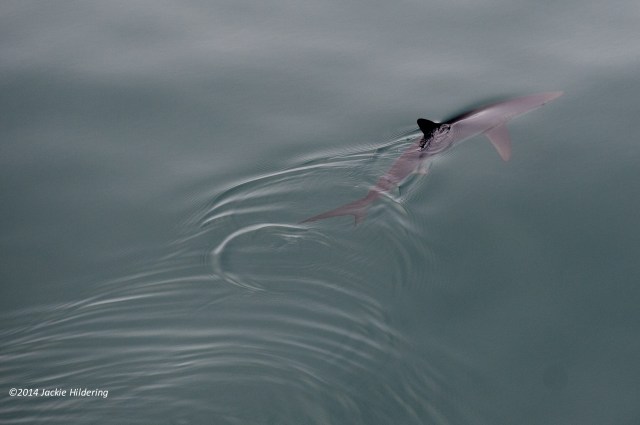
This past July, the Cetacean Research team went as far as 200 nm (370 km) off BC’s shore and it was a great success. The team sighted over 3,000 cetaceans including two endangered Blue Whales (the biggest animal that ever lived).
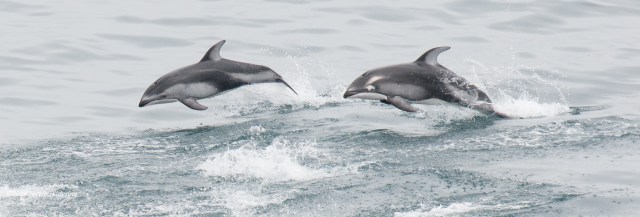
There were so many Dall’s Porpoises out there; some Northern Right Whale Dolphins (I promise that, one year, I will get a good photo) and even a Pacific White-Sided Dolphin with very unique markings.
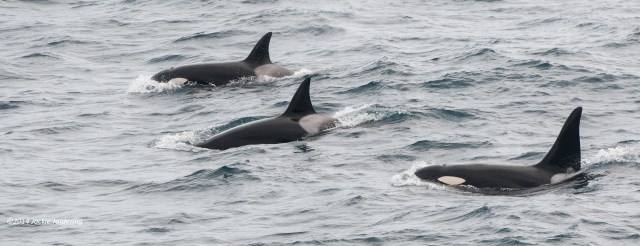
We had many sightings of threatened populations of Killer Whales – Offshore Killer Whales (offshore fish-eaters); Resident Killer Whales (inshore fish-eaters); and Bigg’s/Transient Killer Whales (mammal-eaters). There was even data collected on some pelagic Bigg’s/Transients that have never before been identified in BC.
To see the big marine animals was astounding especially considering how at-risk many of the species are due to past whaling/hunting and current threats like vessel-strike, prey-availability, and entanglement.
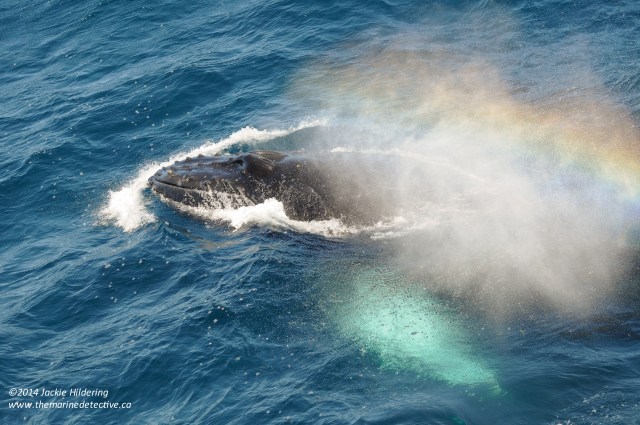
Seeing +/- 60 Humpback Whales flick-feeding together, birds all around them, made me go quiet in sheer wonderment at the beauty of it . . . blows as far as the eyes could see. To think that we could have lost them due to whaling . . . .
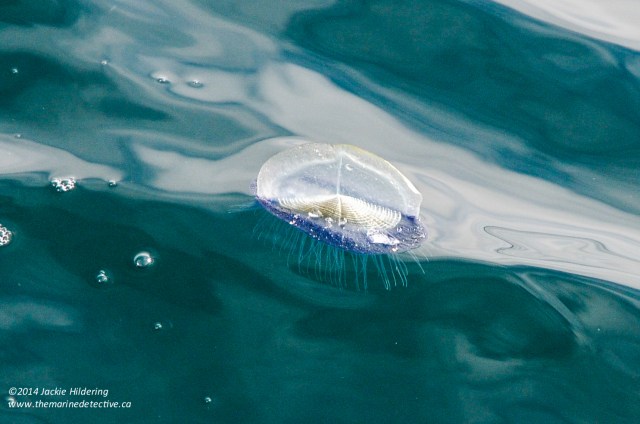
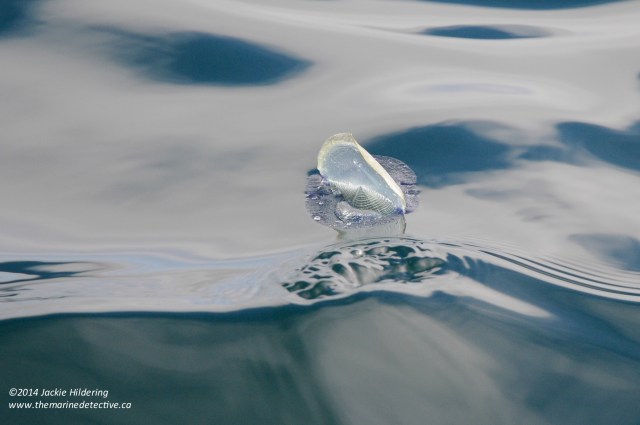
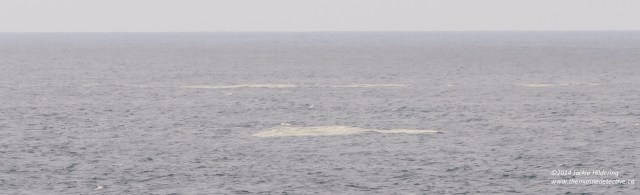
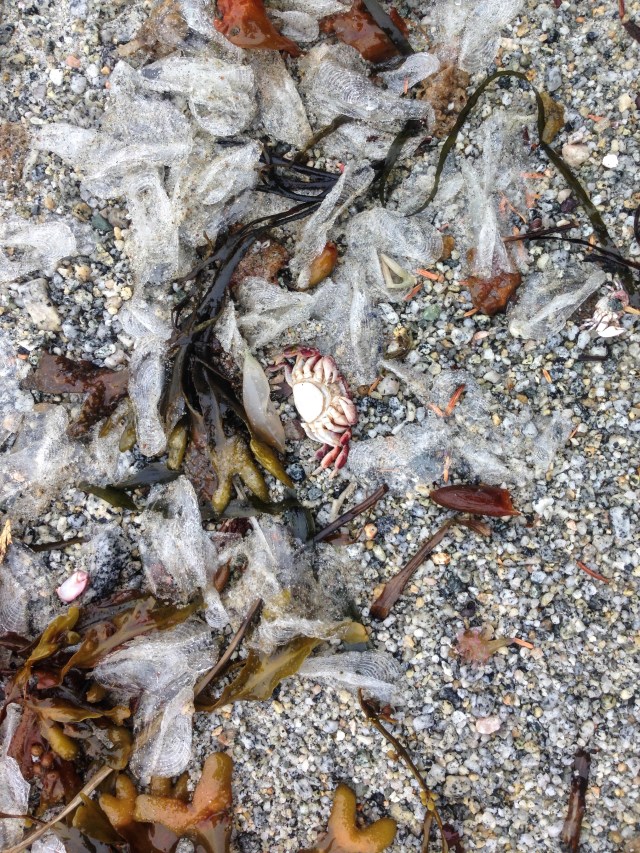
But look closely at the image below. Yes, it’s a humpback with a rainbow blow (rain-blow?) but look more closely. See the little white circles? This is one of the little guys that put me in the same state of rapturous awe as seeing the giants. All around the humpbacks, in fact, over almost ever square meter of ocean out there, there were sailed jellies known as “By-the-Wind Sailors” (Velella velella).
This species of hydroid has a buoyant air-filled float and a triangular, stiff sail. It is a colonial animal with a central mouth under the floats. The tentacles trap fish and invertebrate eggs, small crustaceans (copepods) and species of free-swimming tunicates.
To add to how remarkable this species is, some have the sail facing one way where others in the population have their sail facing the other way – so that they get blown in different directions. (For more species information see the JelliesZone).
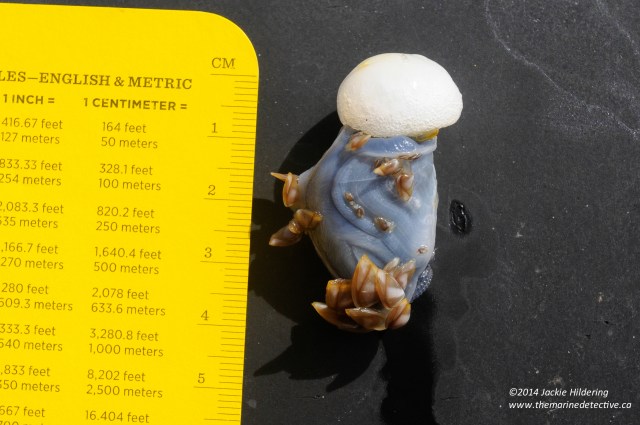
But there was another smaller organism way out there that is even more other-worldly, surreal and absolutely mind-blowing – the Buoy Barnacle (Dosima fascicularis).
This species of barnacle is the only one in the world known to secrete its own float. This allows the barnacle to hang downward feeding on plankton, drifting along in the high seas. The float is gas filled and looks like polystyrene.
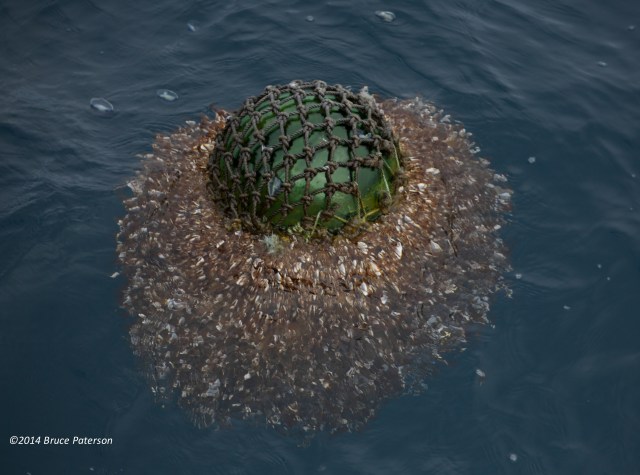
The little barnacles you see on the outside of the Buoy Barnacle in the above image are another species. They are juvenile Pelagic Gooseneck Barnacles (Lepas anatifera). This species attaches to anything that drifts. See below for a good example of that.
Imagine, imagine learning about this species out on the open sea while helping to take ID photos of threatened Fin Whales, Velella velella EVERYWHERE their sails glistening in the sun as they are propelled over the swell, and among them, these upside down barnacles travelling even faster by wind and current.
Imagine my further delight when, while still at sea, just after I had observed this species for the first time, I got an email from children back home in Telegraph Cove (via the wonderful interpreters at the Whale Interpretive Centre) wanting to know what the mystery organism was that they had found. It was the Buoy Barnacle. They had even found two attached to one buoy.
Here is the video of their find.
From Blue Whales to Buoyed Barnacles, the biodiversity, mystery and fragility of this Coast is simply staggering.
When we saw Jigger in 2009, we noted the barnacle growing on the right top of her dorsal fin. Such barnacles are a distinct species only found on Humpback Whales. The Humpback Whale Barnacle is Coronula diadema (to 5 cm tall and 6 cm wide.
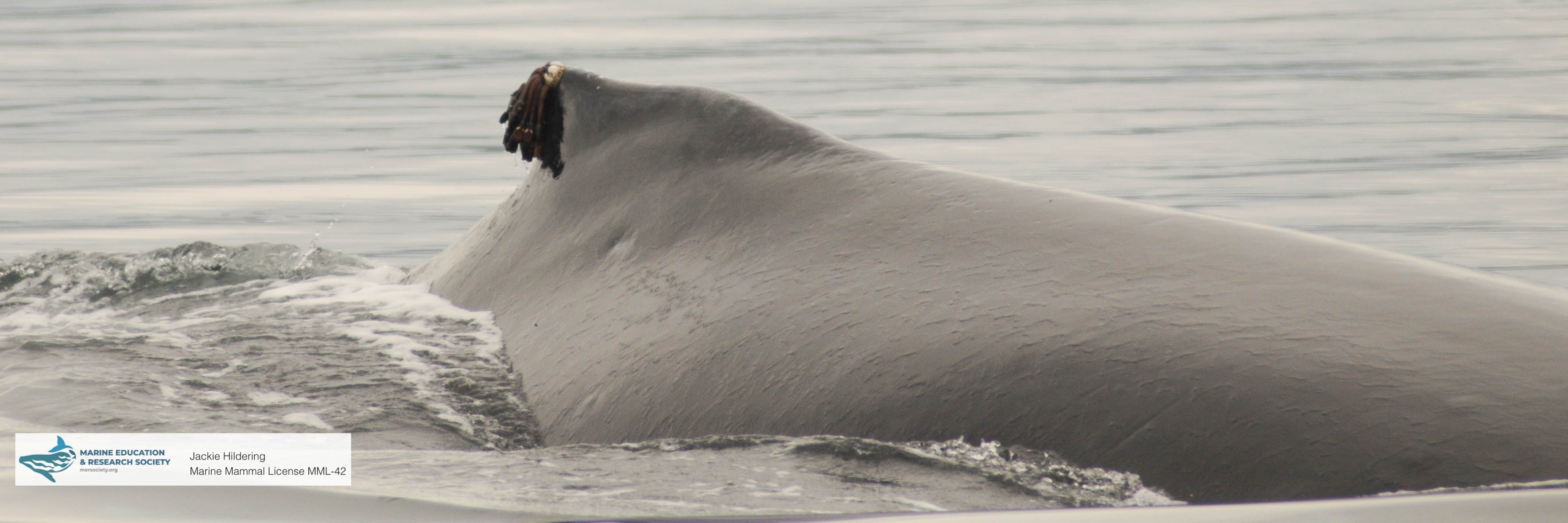
Then, when we saw Jigger in August of 2010, we noted that her dorsal fin looked very different. My research partner from the Marine Education and Research Society, Christie McMillan, and I were worried that it might be an injury so we tried to get a better photo of the dorsal fin.
Here’s what the dorsal fin looked like from behind (photo taken with a telephoto lens and cropped) When I had this perspective, I thought that what we were looking at might be seaweed growing on the Humpback Whale Barnacle we had seen the year before (note that the barnacles often do fall off between years).
But, it didn’t quite look like seaweed. With patience and good camera lenses, we got a better look.
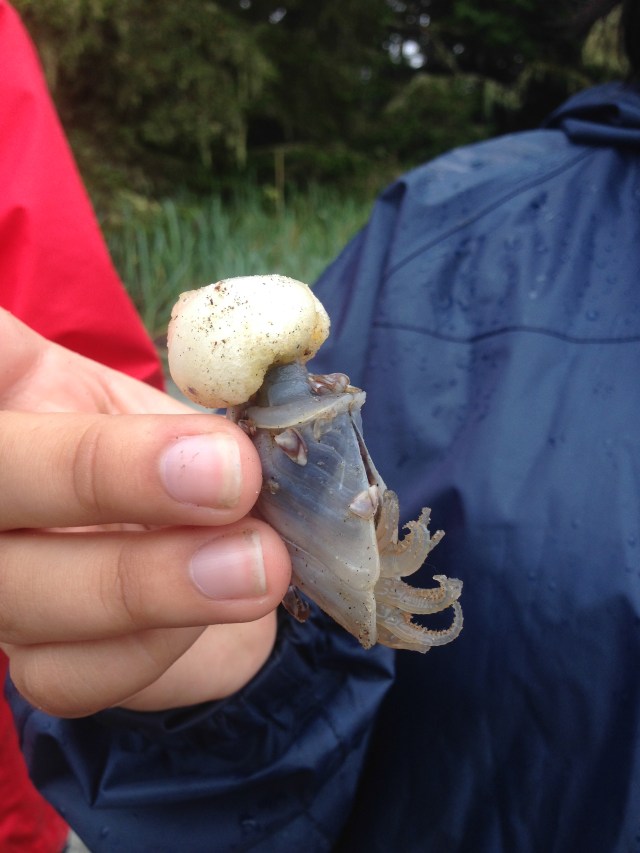
What on Earth?! They’re gooseneck barnacles growing on the Humpback Whale Barnacle!
Gooseneck barnacles are an order of barnacles that are attached to a hard surface by a long stalk that looks like a goose’s neck. They depend on the motion of the water to feed on plankton as they do not have the “foot” (cirri) that rakes in plankton in many other barnacle species.
That’s when I learned that there is a species of gooseneck barnacle that, in the North Pacific Ocean, most often grows on the Humpback Whale Barnacle!! The species is the Humpback Whale Gooseneck Barnacle, also known as the Rabbit-eared Whale Barnacle (Conchoderma auritum (to 11 cm long).
This is the kind of discovery that causes wonder and euphoria in my world.
To be able to identify a Humpback as an individual is already something of great scientific and educational value.
That this attention to an individual whale leads me to learn that there is a species of gooseneck barnacle that grows almost exclusively on a species of barnacle that only grows on Humpback Whales = sheer wonder.
I can’t wait to find out what else the Humpbacks are going to teach me!
Image from Fertl, Dagmar & Newman, William. (2018). Barnacles.
Update: January 2022. Oh and by the way, when Jigger returned to the feeding grounds around northeastern Vancouver Island the next year, she did not have the two barnacle species on her dorsal fin. But she did have . . . a calf. The calf is “Quartz” and has returned to northeast Vancouver Island every year from 2011 to 2021. From our Marine Education and Research post from January 2022: There are two species here on Dapple’s chin and these barnacle species are very often also on the tips of Humpback Whales’ tails.
1) The big, round barnacles are “Humpback Whale Barnacles” (Coronula diadema to 5 cm tall and 6 cm wide) and they ONLY grow on Humpbacks. When they fall off, they leave those round white marks. The barnacles that grow on Grey Whales are a different species that ONLY grow on Grey Whales (Cryptolepas rhachianecti).
2) Growing atop the Humpback Whale Barnacles are “Humpback Whale Gooseneck Barnacles” (Conchoderma auritum to 11 cm long) aka “The Rabbit-Eared Gooseneck Barnacle” which, in the North Pacific Ocean, MOST OFTEN ONLY GROW ON TOP of Humpback Whale Barnacles! There can be up to 50 Humpback Whale Gooseneck Barnacles on one Humpback Whale Barnacle and each gooseneck barnacle is usually oriented with the opening facing the direction the whale swims allowing for better feeding on plankton. (Source: EFauna BC). With that long, fleshy “neck” it certainly is clear why they are called GOOSENECK barnacles.
That’s two layers of specificity made all the more thought-provoking when you realize that barnacles start off as plankton drifting in the ocean, attach to the correct surface, and then grow a shell. The amount and position of these barnacle species can change quickly. For example, there were no Humpback Whale Gooseneck Barnacles to be seen on Dapple’s chin on August 18th but there they are by September 25th. Thereby, barnacles often cannot help identify individual Humpbacks between years but . . those scars from Humpback Whale Barnacles DO persist.
Please know that barnacles are NOT thought to be a hinderance to the whales. It is believed that there’s symbiosis. The barnacle species have good positioning to feed on plankton and the Humpback Whale and Grey Whale Barnacles are believed to offer defence to these slower moving big baleen whales. Grey Whales and Humpback Whales are built for fight rather than flight from mammal-hunting Orca (Bigg’s Killer Whales) and will posture, trumpet and lash out. The barnacles are likely also of use when the males fight for females in the breeding grounds. Hey, when you don’t have teeth, it helps to have something similar to brass knuckles.
More detail
From E-FAUNA BC: ELECTRONIC ATLAS OF THE WILDLIFE OF BRITISH COLUMBIA “Conchoderma auritum is most often found attached to the shells of Coronula on the humpback whale; sometimes more than fifty are attached to one shell. “Rarely a specimen is found attached to the base of the teeth of an old sperm whale” (Sheffer, 1939). Gordon C. Pike reports finding specimens of C. auritumon sperm and fin whales taken in British Columbia. In each case the barnacles were associated with a deformation or an apathological condition of the jaws, baleen, or teeth. Each barnacle is usually oriented with the opening facing in the direction the whale swims. The food-laden water passes through the opening and over the feeding appendages, then out through the two “ears” which have tubular openings.”
From the Marine Species Identification Portal: Species is “attached to the whale barnacle Coronula diadema and sometimes Coronula reginae. It seems to be a rule that no Coronula is without a Conchoderma. Whether this is a form of symbiosis has been discussed by Broch (1924b). Specimens from northern waters have been taken from humpback whales (Megaptera novaeangliae ) or from teeth of bottle-nosed whales (Hyperodon spp.). In the Antarctic C. auritum has also been found on baleen plates of whales and on their tails. In tropical and subtropical parts of the oceans it can also be found attached to ships’ hulls and other floating objects, to slow moving fishes or to the tail of a large eel, but never on soft objects.” From Mike Horan (pers. com January 2022) “I have also seen the stalked barnacle [Conchoderma auritum] on Bottlenosed Dolphins during the die off of 1987 in New Jersey.”
“Individual whales have been known to collect up to 450 kilograms of barnacles. That’s an enormous mass, but relative to a 30-tonne humpback, it would weigh only about as much as an extra layer of clothes. And as far as scientists can tell, the hangers-on don’t particularly bother a healthy whale. They may slightly increase drag as the whale swims, but they may also be helpful as a set of brass knuckles when adult males battle each other over the chance to mate [and when dealing with mammal-hunting Bigg’s Killer Whales]
Here’s what we don’t know about whale barnacles, at least with any certainty: just about everything else. Like, how do their larvae, no bigger than a grain of salt, find a migratory whale to grab onto in the first place? Once they locate one, how do they navigate around its gargantuan body—hundreds of thousands of times larger than theirs—to find their permanent homestead? “It just seems preposterous,” says John Zardus, a marine biologist at the Citadel in Charleston, South Carolina. He specializes in studying barnacles that live on other living things.
Studying those symbiotic barnacles that live on sea turtles, dolphins, crabs, and other marine animals has given Zardus some idea of how whale barnacles might hack it. Adults mate on the whale, but rather than take their chances during their host’s oceanic migrations, they likely wait to release their larvae until the whales gather in coastal areas to breed. The larvae then go through several developmental stages, which can take up to two weeks, before they’re ready to settle. “It’s not like the larva is being released from a whale and it’s going to [immediately] attach to the whale next door,” Zardus says.
When a larva is ready, a chemical signal is most likely what tips it off that it’s in the presence of whale skin. This could be a pheromone emitted by already settled adult barnacles—a strategy commonly used by other barnacle species—or it could be some molecule that wafts off the surface of the skin itself. If other barnacles are any indication, the larva probably reaches out with its sensitive antennules to familiarize itself with the epidermis. It squeezes a drop of sticky polymer out of one antennule to adhere itself temporarily, then sticks down a second antennule and releases the first one, swinging it over to another spot. By repeating this process, a larva “ends up walking around on the surface, leaving little gluey footprints,” says Zardus. “These larvae can possibly crawl all over the host until they find the right location where they want to be.”
Where they want to be is generally on the whale’s forehead, its tail, or the leading edges of its flippers. Those are the places on a whale’s body that water flows over most efficiently. That gives the barnacle a front-row seat when the whale swims through a cloud of plankton, which the barnacle also gets to eat. When the larva finds a good place to settle down, it exudes a stronger glue onto the skin and cements itself for the rest of its life, which may last about one to three years.
Much of this is informed speculation, Zardus stresses, because living whale barnacles and their larvae are extremely hard to come by. Collecting them from a living whale is out of the question, since it would require cutting into the whale’s flesh. A dead whale that washes up has to be discovered before its barnacles die of hunger, desiccation, or predation . . ..
Other than whale barnacles, nothing else reliably recorded the month-to-month movements of ancient whales, says Taylor. Bone tissue doesn’t care about the chemistry of the water it grew in; baleen does, but it’s hardly ever fossilized. But a well-preserved whale barnacle is the perfect time-traveling tracking device. “We won’t be able to tell you, ‘This whale hung a left at Malibu,’” says Taylor, “but [we can] get a general sense of where animals might have been moving.” . . .
Jigger bulking up before the migration, near Sayward in British Columbia, in November 2021.






 The Marine Detective