Latest Entries »

Before you read further, a reminder:  There is no “good” or “bad” in Nature. There is only perfection. Animals do what they do for a reason. We humans may not understand their behaviour but to impose judgement is ridiculous. There is always a net gain for some of the animals involved.

Yes, this is me making very clear that to either typify dolphins as “good” (the Flipper phenomena) or “bad” is sheer anthropomorphism and does nothing to enhance the understanding of animal behaviour.

Dolphins are dolphins and they do what dolphins need to do.

Dall's porpoise calf hit from below by Pacific white-sided dolphin.

Dall's porpoise calf hit from below by Pacific white-sided dolphin.

Okay, now that I have made that very clear, I dare share the exceptional encounter I stumbled upon today. I found two adult (likely male) Pacific white-sided dolphins negatively interacting with a Dall’s porpoise calf.

I know there were only two dolphins as they had distinct dorsal fins allowing me to track them as individuals. I think they were adult males since the fins of adult males tend to be chunkier. I perceive that it was a negative interaction since the two dolphins were corralling the Dall’s porpoise calf; hitting it with their tails at the surface; pushing down on the calf’s head and hitting it from below.  It was an encounter that I witnessed for 10 minutes and was very persistent and intense.

I also saw what I think was only two adult Dall’s porpoise repeatedly surface some 30 to 40 metres away from the interaction between the calf and the two Pacific white-sided dolphins.

In years past, I have seen this species of dolpin kill a harbour porpoise and a seal pup. It is quite a regular occurrence for these dolphins to interact with fish-eating (“resident”) killer whales in such a way that the killer whales dive longer, go silent and group up. Their interactions with humpback whales most often lead to the humpbacks “trumpeting”, rolling on the surface and slapping with their long pectoral fins.

Dolphins are smart. Very smart.

I put forward that interactions like this allow them to learn, to feed their hungry brains.  If this does not sound plausible to you then you don’t have a younger sibling! Any of us who do know how “provoking” also allows young humans to learn. It allows them to find out “What happens when I do this?” “How about this?” “And when I do this?”

Dolphins are extremely social animals too. I believe such interactions allow the dolphins to exercise social bonds and strategize. The males of some well-studied dolphin species (e.g. spotted dolphins and bottlenose dolphins) have been found to have “coalitions” / “alliances”; social units that allow them to group defend, group feed and group mate.  The Pacific white-sided dolphins are only beginning to be studied as individuals so science has yet to confirm what sort of social structures they might have.  My hypothesis is that the two Pacific white-sided dolphins from today’s interaction have an alliance.

I cannot give you a conclusion to the interaction I witnessed today. When I last saw the porpoise calf, it was alive. However, as fate would have it, I had boat engine difficulty and therefore “lost” the animals as I dealt with my boat woes.

I have annotated the photos at the following link, leaving them in chronological order so that you can see how the interaction developed. I have also provided notes that will help you discern the two dolphins as individuals. Photography was challenging due to wind and the speed of the action.

Remember, no judging Nature for what wild animals do is Natural.

Click here for the photos.

“Some of nature’s most exquisite handiwork is on a miniature scale, as anyone knows who has applied a magnifying glass to a snowflake.

I was reminded of this Rachel Carson quote today when diving but found myself changing the ending to ” . . . as anyone knows who has seen sea slug egg masses.”

The image here is the egg mass of the Pacific sea lemon (Peltodoris nobilis), a sea slug up to 20+ cm; it’s egg mass up to some 20 cm as well.

The egg mass is the result of the sea lemons lining up right-side-to-right-side and both becoming fertilized. Being a hermaphrodite is of course a good design when you are a slow-moving slug that relies on smell to find its way.  More detailed information about sea slug mating can be found at this previous TMD blog entry.

Looking like rich, textured crocheting, the egg mass is indeed Nature’s exquisite handiwork.  It’s intricacy rivals that of any spider’s web and, in my perception, surpasses any human nanotechnology.

Seeing such beauty serves as testimony of Nature’s perfection and complexity. How we humans are newcomers to it all, unable to truly grasp the billions of years of design that proceeded our walking upright on earth. It should further motivate us all to walk with much smaller footprints so that we do not blunder and crush the systems that are Nature’s exquisite handiwork.

Follow the link below for images showing a close-up on the egg mass allowing you to see the individual eggs; the mating of the sea lemons; the egg laying and predation by a leather star. Click here.

Note: The sea lemon is often mistaken for other dorid species such as the Monterey dorid.  The easiest way to ID them correctly is to know that sea lemons have white gills.

We’ve been incredibly fortunate to have about 60 fish-eating (“resident”) killer whales in the Straits these last days.

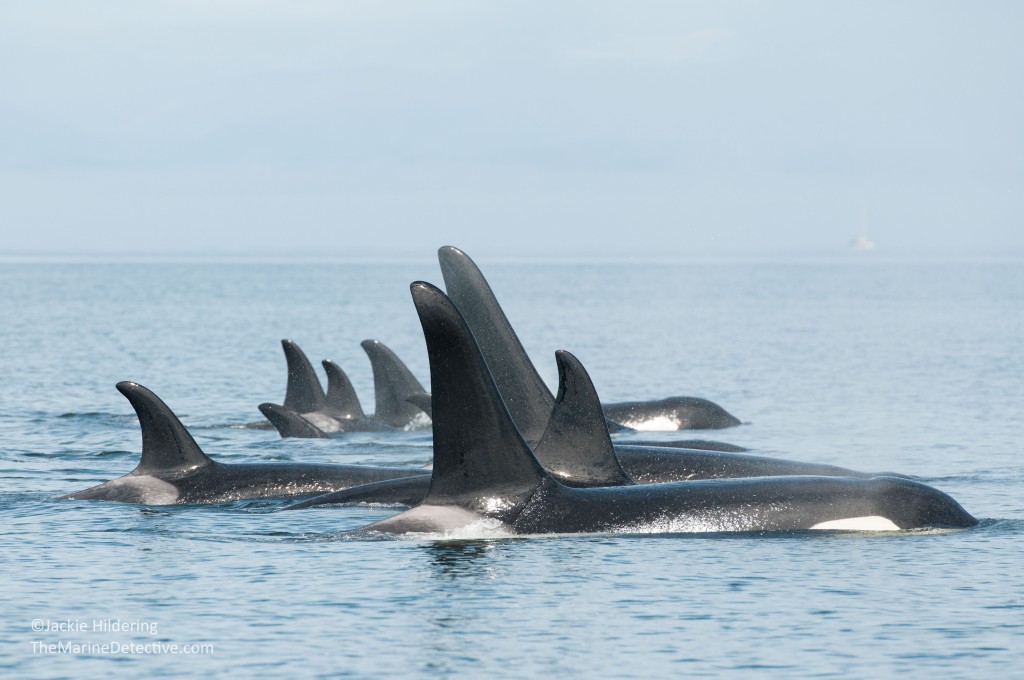
Today - a resting line of members of the A23, A25 and A8 matrilines.

Today, we saw +/-28 of them in two resting lines. The A30s matriline (family group) was in one resting line and the A23s, A25, A8s and possibly the A24s were together in another.

Of all the behaviours of the killer whales I have been privileged to see, this is one of the most striking. Seeing them in resting lines makes very clear how socially bonded these animals are and how coordinated their behaviours can be.

Science has determined that killer whales do not sleep but only “rest”, shutting off one brain hemisphere at a time. They have to maintain this level of brain activity since they are voluntary breathers and must therefore consciously come to the surface to inhale and exhale.

Occasionally, killer whales rest alone – floating on the surface, motionless, blowhole exposed, “logging” for only a few minutes.

Far more often the killer whales rest together as they did today, uniting in very tight groups, fin to fin, in a resting line. This can happen at any time of day and I have witnessed resting line behaviour for up to 8 hours.

It is apparent that degree of relatedness (genealogy) is highly significant in how the animals group up with only very closely related animals resting together in one line. Within the line, the order in which the whales are positioned also appears significant. The youngest calves are right beside their mothers and are never positioned on the outside of the line.

It would be fascinating to know which whale literally makes the call to unify in this resting behaviour. It is most likely one of the oldest females.

Once in resting line formation, the whales are usually silent (although there are a couple of matrilines that do occasionally make calls) and move slowly forward, undertaking a remarkably synchronous and regular dive pattern. They take short, shallow dives for around 2 minutes and then they all take a longer dive that often lasts around 3 minutes. When they resurface, their breaths are incredibly coordinated and their dorsal fins often line up perfectly.

“We are one” the behaviour seems to display and I certainly believe that this resting ritual is of great social and cultural importance to the killer whales.

At it’s most simple level though, a resting line of killer whales is truly  . . . breath-taking beauty.

I have never been able to photograph this beauty to my satisfaction but share my best attempts with you at this link.

Come on. You know you want to, just for 3 minutes.

Come on the dives I did today.

The little slide show I have put together, is a testimony to the grand, jaw-dropping biodiversity of this area (Northern Vancouver Island, B,C., CANADA).

The Minke whale we saw, the fish using a sponge as a hammock, the bald eagle chick that took one of its first flights – all these are animals that I have learned from by knowing a small part of the world’s ocean well enough to be able to recognize individual animals.

Such a privilege and such a joy to share with you.

Come away with me . . . . click here.

On July 16th, I saw sperm whales off the coast of British Columbia and my world rocked.

This whale species is unlike any other and is extreme in so many ways.

Sperm whales:

  • Make very long and very deep dives
  • Have the biggest brains
  • Are the largest toothed animals
  • Make the loudest sounds
  • Have a very strange common name reflecting great misunderstanding
  • Were hunted intensely
  • And are so very, very unique looking.

I saw the sperm whales while having the joy of being a spotter on the DFO Cetacean Research Program’s offshore survey. We saw them in the area where I have put the blue star on the map below. You’ll note from this image that this area off the continental shelf is where many sperm whales were “taken” by whalers. It is in deep waters like this that sperm whales find their prey of deep ocean fishes and squid (from medium-sized squid species to the giant squid).


Our first clue that we might be sighting sperm whales was the very unique blows that veer sharply off to the left. Through binoculars we could confirm the species ID by seeing the animals’ colossal heads and wrinkly skin and, when they descended for a long and deep dive, it was indisputable that we were seeing sperm whales. The distinctly shaped tails came high out of the water, straight up and down and the animals descended as if slowly going down in an elevator. I found myself screaming in amazement when I first saw this. (Note that the images below showing the sperm whale’s dive and blow are not from the research trip in B.C.)

Down he went. Down, down, down. The dive could take up to 90+ minutes and could be to a depth of 3 km. That’s 300 atmospheres of pressure!  (One weblink I provide below provides video of a sperm whale at this depth.)

Apparently an average sperm whale dive profile is to slowly descend for 10 minutes, hunt at depth (more often at 300 to 800 m) for approximately 25 minutes, then slowly ascend for 10 minutes. The whales then stay at the surface for some 8 minutes, taking up to 90 breaths to offload carbon dioxide and reload oxygen into their blood and muscles.

This long period at the surface is when they were an easy target for the whalers. Yes, Moby Dick was a sperm whale but the ferociousness portrayed by Herman Melville in this classic novel is pure fiction.  Were sperm whales to attack and swallow people whole, they may not have been so terribly exploited. We humans wanted their blubber, their spermaceti and their ambergris. Ambergris is found in the intestines (see previous blog item) and “spermaceti” is a semi-liquid wax found in the sperm whales’ huge heads. Early whalers thought it was a reproductive material which is why the species has its strange common name. Science now believes that this material has a role in buoyancy by being cooled and contracting to become more dense when the whale is diving and then becoming heated and expanding to allow the whale to ascend from such great depths. It may also have a role in sound production.

In the dark world to which the sperm whales descended, they find their prey through echolocation. These clicks act like an “acoustic flashlight”. They go out from the whale’s huge head and, when they bounce off an object and “echo” back, this allows the sperm whale to form an image of its surroundings and prey. (I provide a weblink below that provides amazing, but very worrying, video of a sperm whale using echolocation to take fish off a longline).

As well as these slow and regular echolocation clicks, sperm whales also make really loud clicks called “codas”. Codas are believed to allow the sperm whales to communicate with one another, maybe in a way like we humans use Morse code.

I don’t know that anyone can be quite the same after an enormously privileged experience like seeing a sperm whale. I was left stunned with a cocktail of emotion surging through me that included wonder, joy, passion and resolve. More passion for conservation and more resolve to share these experiences to make them count.

Male adult sperm whale going of a deep dive. Image by Peter Jucker; taken in the St. Lawrence.www.juckiwildlifephotography.com

Typical sperm whale blow = low, bushy, explosive and at a sharp left angle.Image by Peter Jucker; taken in the St. Lawrence.www.juckiwildlifephotography.com

Sperm whale tooth. Image by Louisa Bates of Telegraph Cove's Whale Interpretive Centre.www.killerwhalecentre.org

Many thanks to Peter Jucker and Uko Gorter for their great generousity in sharing images for the purpose of education and conservation.

Links to sperm whale sound and video:

Sharks Among Us #1 – The Blue Shark

The image below is of a Pacific blue shark (Prionace glauca) being rescued by Lindsey Pattinson of Tiderip Grizzly Tours on July 15th in Glendale Cove, British Columbia.

Lindsey Pattinson rescuing a blue shark. Photo: Nick and Sue Spiller.

Many British Columbians are unaware that we have at least 12 species of shark among us, ranging from the smaller species such as the spiny dogfish up to the 6-gill shark (5 m+) and the very, very rare basking shark (9 m+). The beautiful blue shark reaches a maximum of 3.8 meters and is distinct in its deep blue colouration and slender shape.

The blue shark is common in B.C. and is, in fact, extremely far ranging and widespread. It is found from Alaska to Chile in the Pacific but is also present in the Atlantic and Indian Oceans.  It has been found in waters from 7 to 16°C, latitudes of 60°N to 50°S and from the shallows to depths of 350 m (being more often at depth in warmer waters).

In researching the species after Lindsey’s find, I discovered that blue sharks undertake very large migrations, reportedly up to 9,200 km, moving north in the summer months.  More females than males move to the higher latitudes.

But, of course a sighting like this in Glendale Cove is an enormous rarity. Even with the blue shark being common in B.C., they are more often oceanic, on the continental shelf . . . not on the beach in Glendale!

For whatever reason, the animal stranded there and Lindsey cared enough to do what he could to save it.  Many shark species need to keep swimming in order to have oxygen-rich water pass over their gills. Knowing this, Lindsey moved the stranded shark back and forth in the water, forcing water over its gills and indeed, he revived it. He and the tourists he was guiding on the Grizzly Bear (and shark) watching trip had the joy of watching the animal swim to depth.

Thanks to Lindsey, this blue shark will be able to have more days of feeding on anchovy, mackerel, salmon, hake, dogfish, crustaceans and squid. It may also scavenge here and there and even feed on aggregations of krill by straining the water in the way a baleen whale would.

I suspect the Glendale Cove shark was a female and with blue sharks being a very prolific species, now saved, she could go on to bear 25 to 50 pups at a time (apparently even as many as 135)!  These young would grow inside her as the blue shark is “viviparous”, meaning they bear fully formed young. The pups are 35 to 44 cm at birth.

I was fascinated to learn that blue shark females can apparently “get pregnant” up to 20 months AFTER mating. They can store sperm packets in special glands in their reproductive tract called “shell glands” (aka nidamental glands) and pass their eggs through these glands to get fertilized.

If the rescued blue shark was indeed female, she may not have been able to feel much of Lindsey’s caring touch since the females are up to 3 times thicker skinned that the males! This adaptation is believed to allow the females to deal with the males since there is a lot of biting during courtship.

Unfortunately, the fate of blue sharks can also be to become the bycatch of longline and driftnet fisheries. One source reported that in one year alone (1990) “it is conservatively estimated that by-catch of blue sharks taken by the Japanese squid fleet in the North Pacific totaled 700,000.”

Further life history: Males sexually mature at 4–6 and females at 5–7 years. Believed to live to age 20.

For more photos of the blue shark rescue, click here.
Great thanks to Nick and Sue Spiller for sharing these photos.

Sources include:

This week’s case is the result of Stacey Hrushowy bringing a unique jelly-like marine creature to my attention.

Forgive the sensationalist blog title but truly, this animal is like the stuff of science fiction.

It’s a 15 cm pulsing, translucent, rainbow-flashing blob that has a fascinating diet!

Mystery creature (15 cm). Photo by Stacey Hrushowy.

I’ve narrated a slideshow with video to share this with you. Please see the link below.

Click here for the The Case of the Killer Plankton! (6 min)

I would not have been able to identify this species without Dave Wrobel and his site jellieszone.com .


Of Humpbacks and Waterfalls

This comes to you from the Coast Guard ship the J.P. Tully where I have the great good fortune to serve as a marine mammal spotter for the next days.

BCY0057 nicknamed "Niagara".

We have been recording many humpbacks sightings but today, while the larger ship was being fuelled in Port Hardy, we were able to do some work from a zodiac, allowing for a better opportunity to ID the humpbacks as individuals.

I share with you the experience of seeing one of these individuals, the humpback carrying the DFO (Department of Fisheries and Oceans) ID number BCY0057.

It is the easiest to ID humpbacks as individuals by using the unique markings of their tails. This particular humpback was one that we very quickly were able to recognize due to a very distinctly shaped white spot near the centre of its tail. The marking is in the shape of a waterfall so, since “BCY0057″ is not an easy name to remember, locally this whale is known by the nickname . . . Niagara.

We know that Niagara is about 10 years old due to Dr. Alexandra Morton having taken a picture of the whale in 2000 when it was travelling with its mother.  As a further result of these photo records, we also know that Niagara’s mother is BCX0022 (aka “Houdini”), one of the most prolific humpbacks known to research. She had 5 calves in 7 years, quite the feat considering that humpbacks are pregnant for about a year.

Today’s experience of seeing Niagara again was quite moving.  It was also ideal from a research perspective since we were able to get good ID shots of the tail and both sides of the animal and, since Niagara was feeding at the surface, it was possible to collect scale samples of the fish being fed upon. DNA testing of these scales will confirm what species of fish Niagara was eating.

At the link below, I share with you an image of Niagara “lunge feeding” so that you can get a sense of how far the throat pleats of humpbacks distend to allow huge volumes of food and water to be engulfed. Reportedly up to 20,000 litres is taken in per mouthful. The water is then pushed out through the baleen.

The image also shows you the “beard” of barnacles on Niagara’s throat pleats. These species specific barnacles will surely be a topic of a future blog.

And, if you look very carefully, you’ll see Niagara’s right eye with lids closed.

Duty calls  . . . .

Click here for the image of Niagara (BCY0057) lunge feeding and for a larger ID photo.

A12, Scimitar, July 3rd, 2010.

I saw A12 swim by today. A12, also known as Scimitar, is an old female killer whale of the “Northern Resident” population of fish-eating, inshore killer whales. She is about 69-years-old (known as the result of the photo-identification work of Dr. John Ford, Graeme Ellis and the late Dr. Michael Bigg).

A12 is the grand dame of the first family of killer whales I ever saw; an experience that had an impact on me that I will never fully be able to explain. It led me to make a radical career change, moving back to Canada to work as a marine educator on the very waters where I first saw A12.

Seeing her today was as powerful an experience for me as it was the first time I saw her but  . . . there was sadness too and, there was anger.

Last year her son A33 “Nimpkish” went missing. He was around 38-years-old. Mother fish-eating killer whales never leave their sons so we knew there was very little chance of ever seeing him again. Indeed, no one ever has.

With A33 gone, A12 would still sometimes travel with her daughter A34 and A34′s calves and grand-calves but she was also often on her own. Then, as of July 22nd, she was frequently seen with “the three brothers” (the A36s); three mature male killer whales whose mother went missing in 1997. As the only surviving offspring, these males were always together. A12 is closely related to them and it was remarkable to see how the mother with no son, interacted with the sons with no mother.

A33, Nimpkish, last photo I took of him, late September 2008.

Today, there were only two of the three brothers near A12. The eldest, A32 (aka “Craycroft”) who was around age 46, is now missing.

Another male killer whale gone.

And this is what laced my experience today with anger. But why?  Whales, like everything else, die.

I assure you I am not being overly sentimental. It will never be conclusive what made these whales die but, but, BUT we humans definitely had an influence. Their health, in fact, is an accurate mirror of how our actions impact the environment.

The whales, with their position high in the marine food chain, are full of chemicals like fire retardants and pesticides (the work of Dr. Peter Ross). Despite the many lessons learned with the likes of chemicals like PCBs and DDT, which were banned in 1977, we still do not appropriately test new chemicals and we use chemicals with reckless abandon. The toxic reality is that the ocean is a soup of chemicals – including the old and new (e.g. PBDEs) “persistent organic pollutants” that do not break down; “travel” to the colder areas of the world; build up in the food chain (bioaccumulate and biomagnify), and reduce animals’ ability to fight disease and reproduce.

A32 was above average age for a male killer whale but “average age” has been determined from the data available only after our use of these chemicals. It is not believed to be natural that male killer whales (and the males of many other marine mammal species) die at a much younger age than the females. Their earlier demise has to, at least in part, be due to their toxin loads being much higher than the loads in the females. The females’ toxin levels are lower because females download these fat-soluble toxins in the fatty mother’s milk, to their calves (of course with negative impacts to the calves).

A32, Craycroft, last picture I took of him, October 2009.

These chemicals had to have an impact on the missing mature males and, the situation literally becomes all the more toxic, when coupled with lack of food. When the whales do not have enough food and use up their fat reserves, the toxins become more concentrated. And 2008 was an appalling year for Chinook salmon, the salmon species essential to the survival of killer whales of the “resident” populations. The work of Dr. John Ford has shown that there is a direct correlation between the survival of these killer whales and the availability of Chinook salmon and, of course, we humans impact the survival of salmon  . . . by habitat loss, over-harvesting, climate change, current open net-cage salmon farming practices, etc.

So today, as I witnessed A32 no longer being with his brothers, I felt the wave of rage come up inside me. Missing whales causes reflection on the state of the environment due to human over-consumption, lack of precaution and disconnect from Nature.

But the wave passed shortly after the whales did. For there is still every reason for hope. As long as people care enough to change, there is hope. The potential for change is endless and there is ample evidence of humanity, increasingly, moving in a direction that considers the link between our daily actions and whales like A12, A33 and A32.

Indeed, there is ample reason for hope as long as there are people like you who read to the end of a lengthy blog entry like this.

Take one further step and click on this link to find out how easy it is to help the whales, and ourselves.

Thank you.

Sea Spiders?!

Yes – there are spider-like animals in the ocean!

Globally, more than 1300 species have been identified.

But, even though they are jointed-legged invertebrates (arthropods) and most do have 8 legs, they are not true spiders. They are a special group of arthropods called the Pycnogonida. They have a mouth part called a probisis, a flexible tube that they use to mix digestive chemicals with their food and then suck it up.

Some species have additional leg-like appendages near their mouths. Often only the male has these structures so that they can take care of the eggs by carrying them.

"Sea spiders" grazing on red soft coral

The species in the image to the right is one of these locals and these animals are only about  about 1 cm across.  They have been given the common name “yellow hairy sea spider” (Tanystylum anthomasti).  The hairy parts are believed to help the animals feel and sense chemicals.

I have only ever seen this sea spider on red soft coral colonies (Gersimia rubiformis), as you see in this picture. They appear to feed (graze) on the bushy polyps of the soft coral.

One of the things I find fascinating about sea spiders is that they have a very thin external skeleton (exoskeleton) and as a result don’t need a respiratory system; they can “breath” through their skins.

The pictures at the following link let you get a better look at them and at how the soft coral is grazed - click here!