Hooded Nudibranchs and their eggs

[Last updated on January 2, 2022]
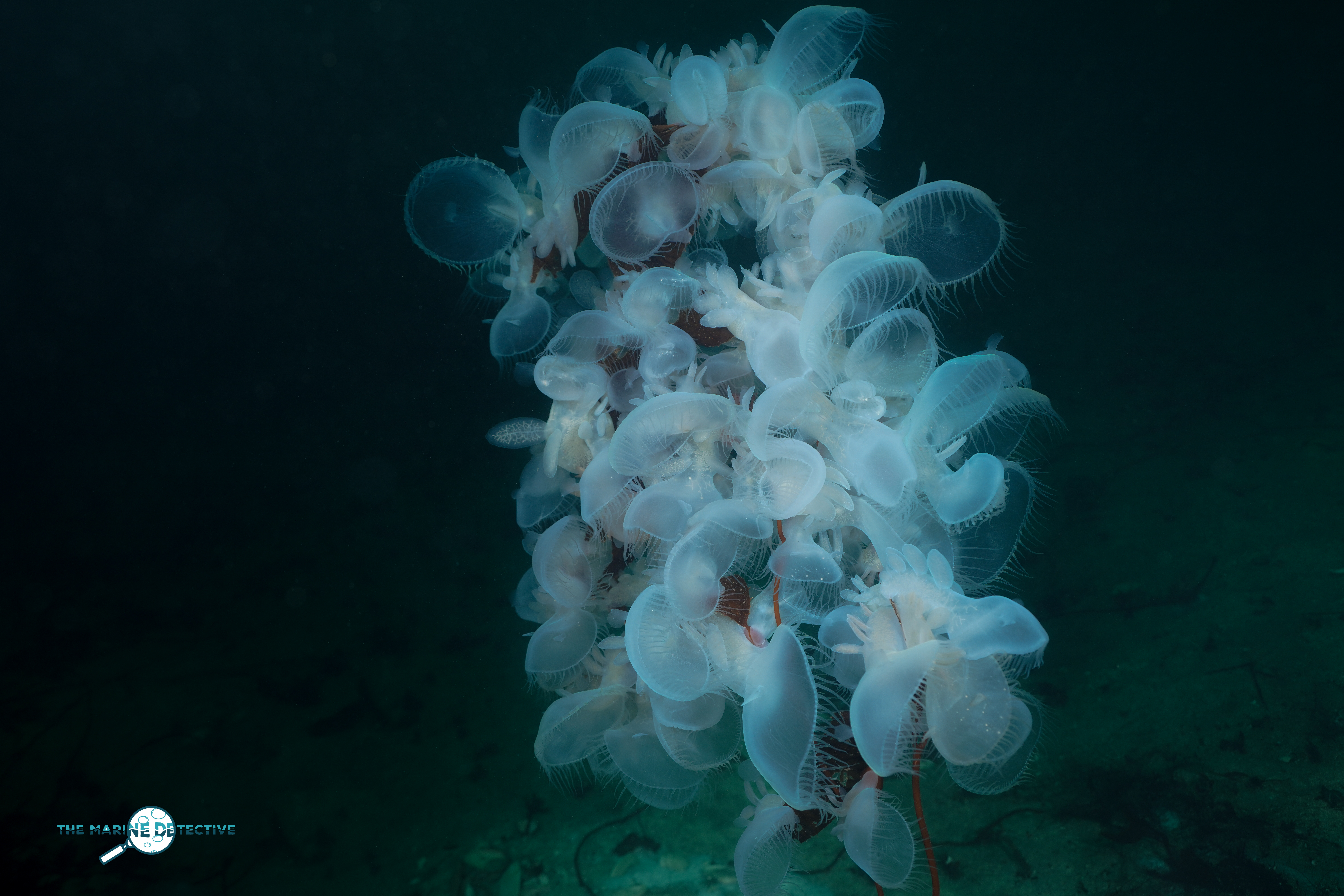
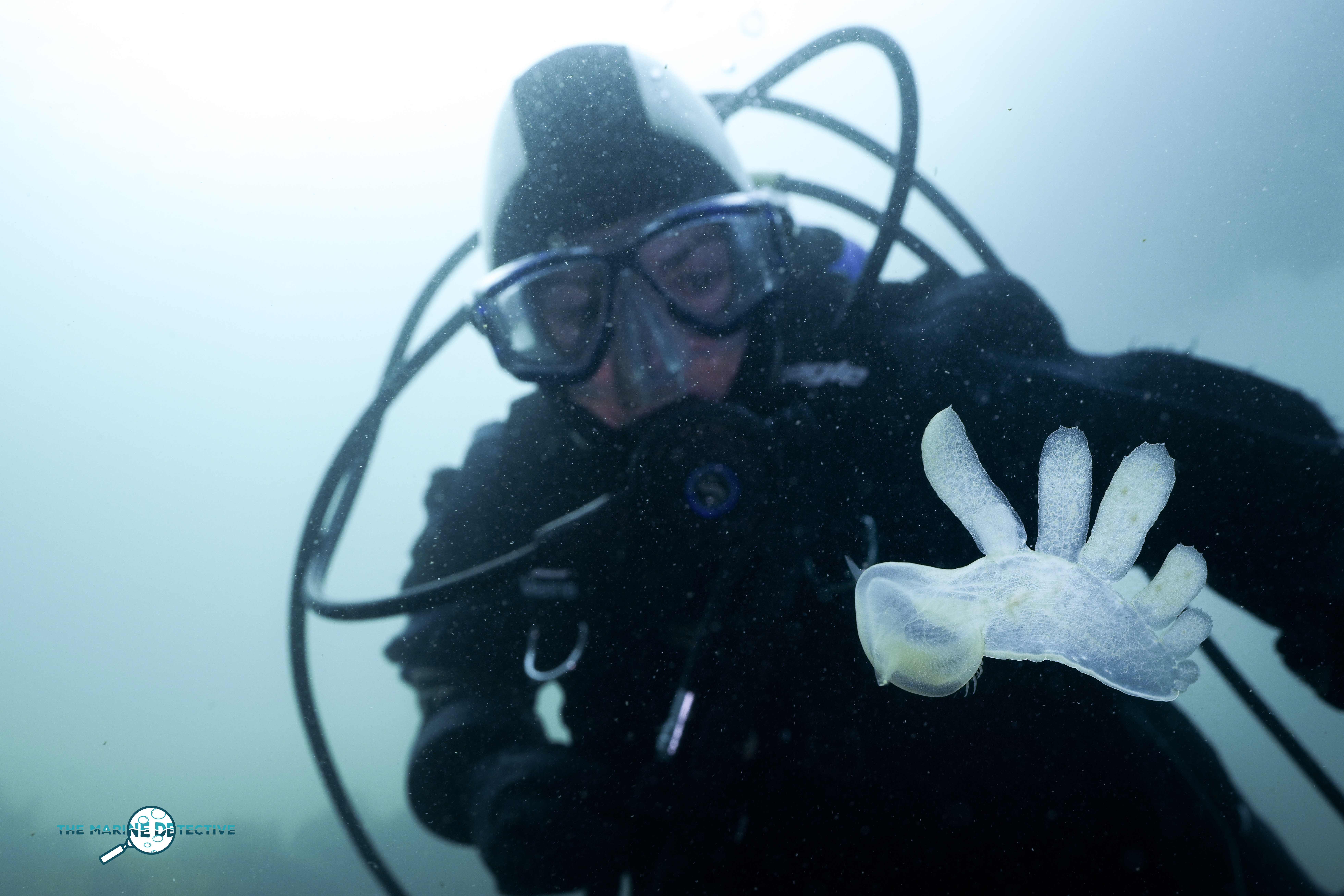
The remarkable-looking animals to the right are Hooded Nudibranchs (Melibe leonina up to 17.5 cm). A nudibranch is subgrouping of sea slugs whose characteristics include having naked (“nudi”) gills (“branchs”).
Typically, starting in the fall, around northeast Vancouver Island, Hooded Nudibranchs come together in the hundreds. It is awe-inspiring to see them clustered together just below the surface, delicate and ghost-like, clinging to kelp. Most are translucent white but some individuals are more green or orange.
Often, you can see them swimming on the surface and many people mistake them for jellyfish. But no, they are sea slugs.

The large oral hood (disc-like head) is used to feed on plankton and small crustaceans. The lobed structures on the animals’ backs are the naked gills (cerata). The cerata can pop off if the Hooded Nudibranch is threatened e.g. pinched by a crab. This “ceretal autonomy” and the ability to swim, are believed to be distractors for predator (Bickell-Page, 1989).
The two structures on the Hooded Nudibranch’s oral hood are their rhinophores by which they smell their way around. Hooded Nudibranchs are believed to signal one another by emitting a fruity scent. My personal experience after having picked up a dead Hooded Nudibranch on the beach, is that the smell is something like a mix of watermelon and grapefruit. The scent stayed on my hand for more than an hour.

The secretion is reported to serve as a repellent for predators but does not deter Northern Kelp Crabs.
After mating, as is the way with sea slugs, both individuals lay eggs and then, they die. You can find additional information about sea slugs being reciprocal hermaphrodites in this past blog posting.

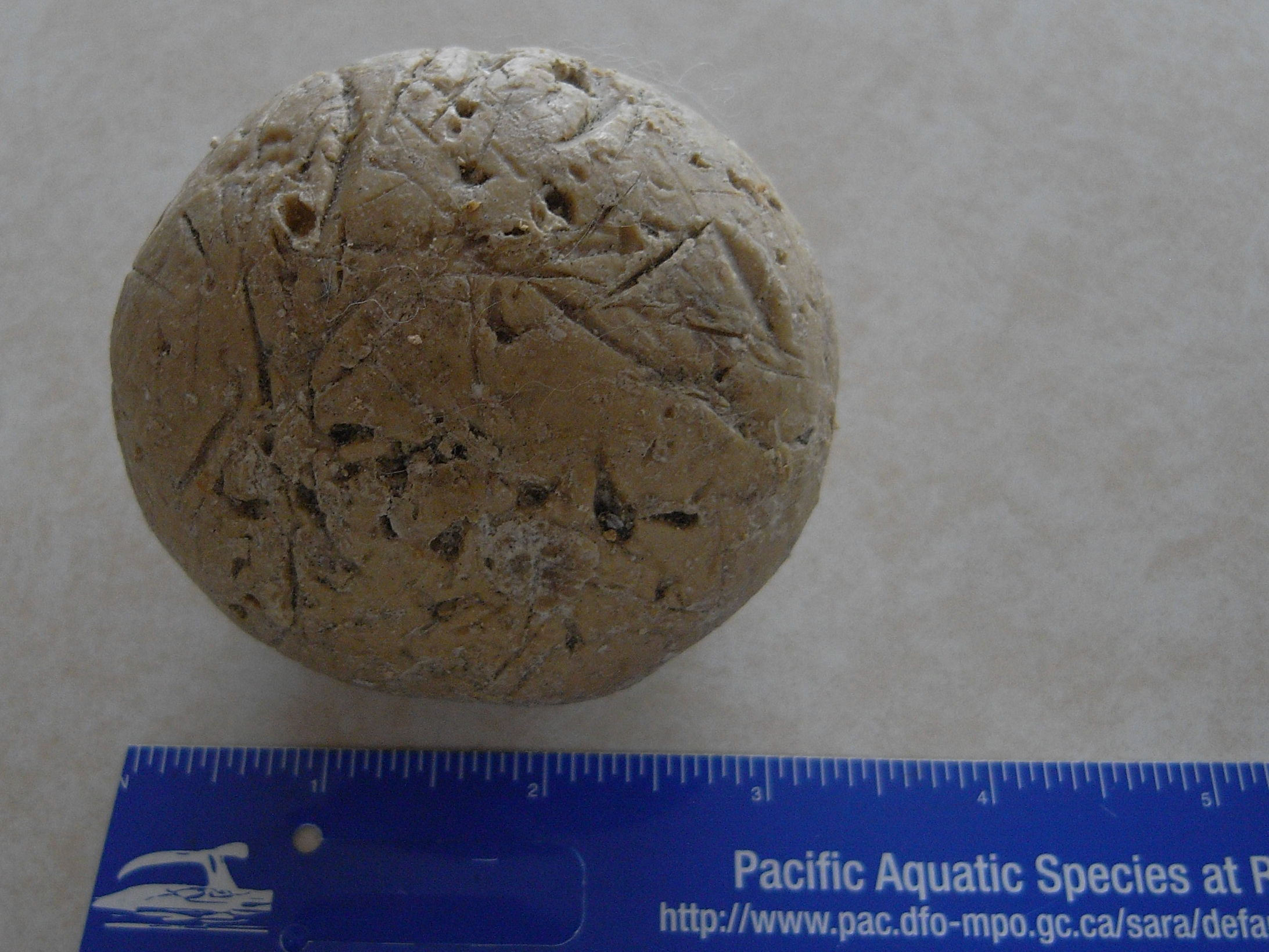
In the area around northeast Vancouver Island, I have observed that they lay their egg masses between January and April. Each ribbon of eggs is only about one centimetre wide. Every dot is an egg capsule containing 15 to 25 eggs. After about 10 days, depending on temperature, the eggs will hatch into larvae that will be part of the zooplankton soup of the Ocean.
After 1 to 2 months, they settle to the ocean bottom and change body shape and even digestive tract to become small adult Hooded Nudibranchs
Hooded Nudibranchs do not have the rasping mouth structure of many other sea slugs (the radula). They feed by opening their oral hood to capture prey while standing on kelp or Eelgrass.

From Invertebrates of the Salish Sea: ” . . . diet includes copepods, amphipods, and ostracods, as well as small post-larval mollusks. The animal stands attached to the substrate and expands the oral hood. It then sweeps the hood left and right or downward. When the ventral surface of the hood contacts a small animal the hood rapidly closes and the fringing tentacles overlap, holding the prey in. The whole animal is then forced into the nudibranch’s mouth.”
For more information:
Biodiversity of the Central Coast: Hooded Nudibranch
Deep Sea News: “This sea slug is like a cross between a dinosaur, a jellyfish, and a watermelon”
Lawrence, K. A. and Winsor H Watson. “Earth , Oceans , and Space ( EOS ) 10-1-2002 Swimming Behavior of the Nudibranch Melibe leonina.” (2017).
Newcomb, James M., et al. “Homology and Homoplasy of Swimming Behaviors and Neural Circuits in the Nudipleura (Mollusca, Gastropoda, Opisthobranchia).” Proceedings of the National Academy of Sciences of the United States of America, vol. 109, National Academy of Sciences, 2012, pp. 10669–76, http://www.jstor.org/stable/41601654.



 The Marine Detective