With a song in my heart, I can announce, the 2025 WILD Calendar is now available. Such great thanks to all who helped by voting on the selection of photos. They can be ordered at this link.
My WILD Calendar is aimed at creating awareness about the diversity and fragility of life hidden in the cold, dark, life-sustaining northeast Pacific Ocean. It is the waters dark with plankton that have more life, produce more oxygen, and buffer more carbon dioxide.
It’s the 16th year I have made a WILD Calendar. I am so grateful to all who put these calendars into the world. You are helping increase connection and understanding of our reliance on the Ocean. That’s needed to make the decisions, day-by-day, that consider future generations. 💙
Each month’s photo has a detailed descriptor included about the featured marinelife. The calendars are $27.50 + tax.
They are large and printed on sturdy paper on Vancouver Island, coil bound with a hole to hang them. 33 x 26.5 cm closed and 33 x 53 cm open (13 x 10.5″ closed /13 x 21″ open).
There are BIG spaces to write your daily adventures.
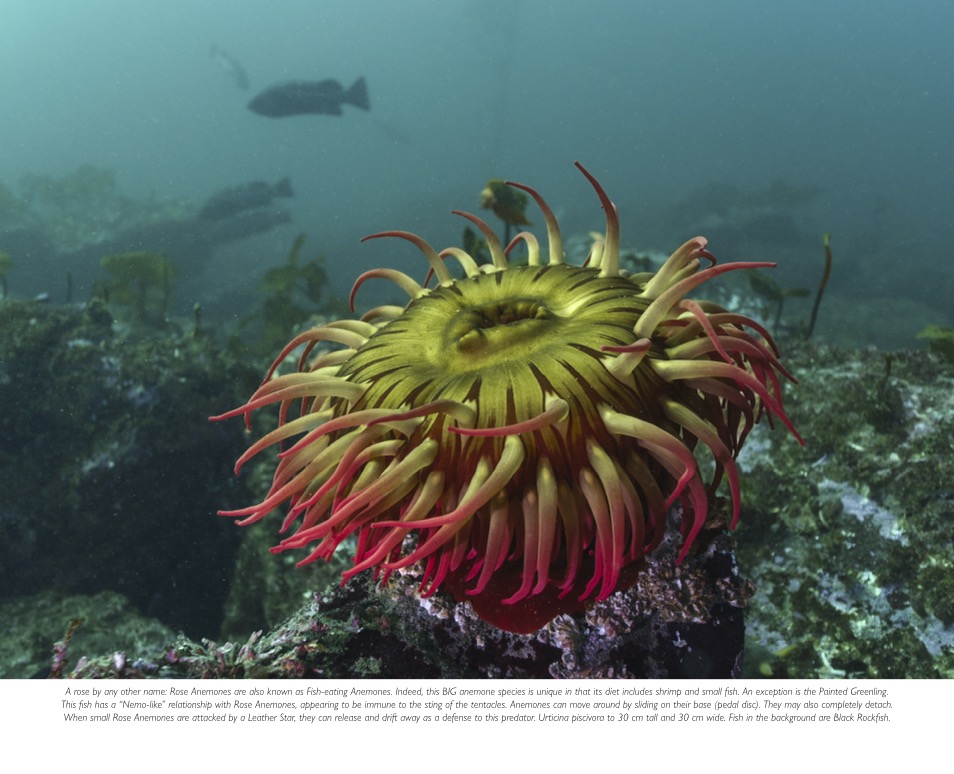
A rose by any other name: Rose Anemones are also known as Fish-eating Anemones. Indeed, this BIG anemone species is unique in that its diet includes shrimp and small sh. An exception is the Painted Greenling. This sh has a “Nemo-like” relationship with Rose Anemones, appearing to be immune to the sting of the tentacles. Anemones can move around by sliding on their base (pedal disc). They may also completely detach. When small Rose Anemones are attacked by a Leather Star, they can release and drift away as a defense to this predator. Urticina piscivora to 30 cm tall and 30 cm wide. Fish in the background are Black Rocksh.
February 2025 image and text
The embrace: Bull Kelp intertwined in water thick with plankton. Love the ocean and the algae. They sustain life above and below the surface. From the microscopic to giant kelps, algae photosynthesize – absorbing climate-changing carbon dioxide and producing food and oxygen. At least 50% of the oxygen on Earth comes from marine algae and there is more productivity where the water is cold and there is high current. Kelp forests are also essential habitat to so many species. Kelp is impacted by changes in climate and the plight of Sunower Stars (which feed on Green Urchins which graze on kelp). Bull Kelp is Nereocystis luetkeana to 36 m long.
March 2025 image and text
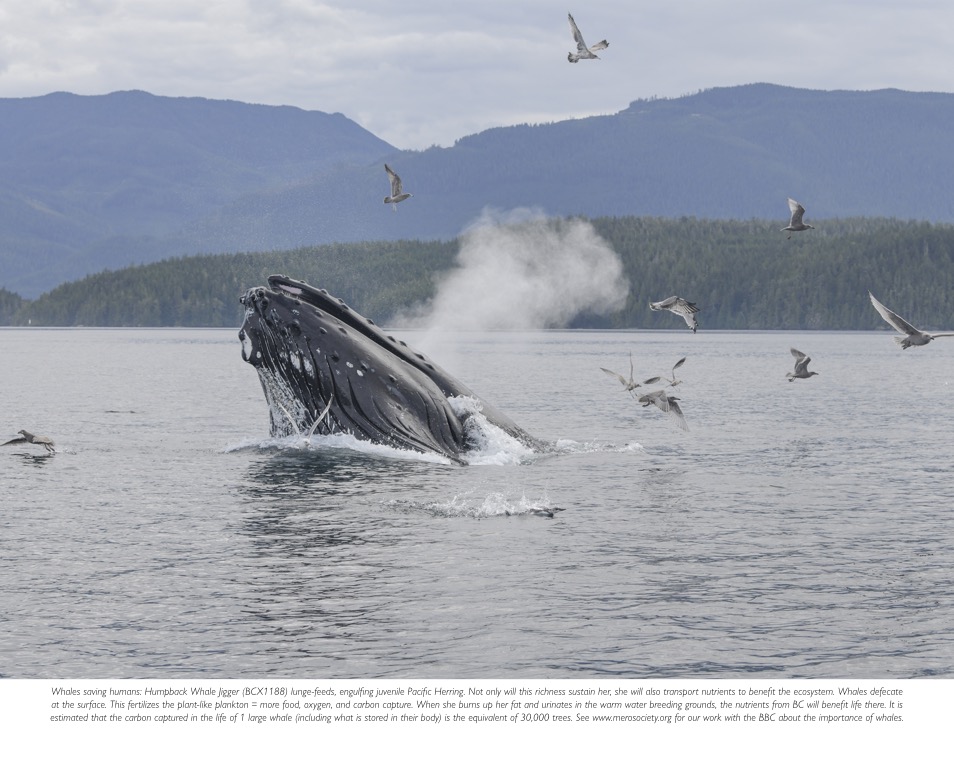
Whales saving humans: Humpback Whale Jigger (BCX1188) lunge-feeds, engulfing juvenile Pacific Herring. Not only will this richness sustain her, she will also transport nutrients to benefit the ecosystem. Whales defecate at the surface. This fertilizes the plant-like plankton = more food, oxygen, and carbon capture. When she burns up her fat and urinates in the warm water breeding grounds, the nutrients from BC will benefit life there. It is estimated that the carbon captured in the life of 1 large whale (including what is stored in their body) is the equivalent of 30,000 trees. See http://www.mersociety.org for our work with the BBC about the importance of whales.
April 2025 image and text
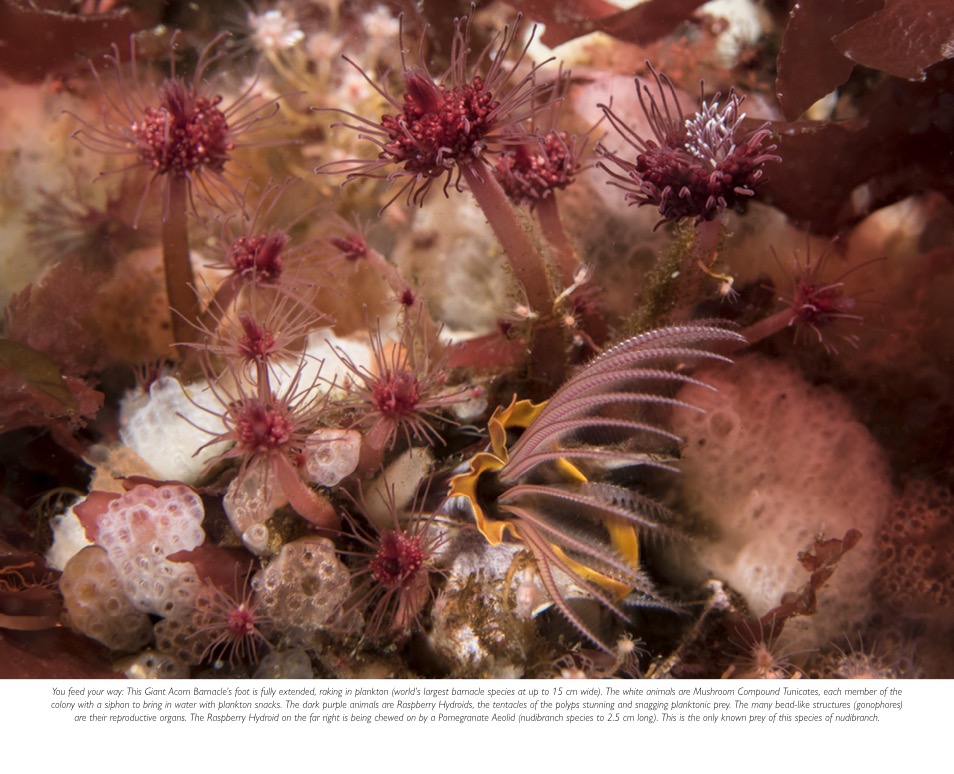
You feed your way: This Giant Acorn Barnacle’s foot is fully extended, raking in plankton (world’s largest barnacle species at up to 15 cm wide). The white animals are Mushroom Compound Tunicates, each member of the colony with a siphon to bring in water with plankton snacks. The dark purple animals are Raspberry Hydroids, the tentacles of the polyps stunning and snagging planktonic prey. The many bead-like structures (gonophores) are their reproductive organs. The Raspberry Hydroid on the far right is being chewed on by a Pomegranate Aeolid (nudibranch species to 2.5 cm long). This is the only known prey of this species of nudibranch.
May 2025 image and text
Pulsing with life: Lion’s Mane Jelly reflected against the surface. Cyanea capillata can be over 2 m across with 8 clusters of 70 to 150 tentacles which can be more than 9 m long. One is reported to have been 2.3 m across with 36.6 m long tentacles (was in the North Atlantic and may be classfied as a different species, McClain et al., 2015). The jelly in this photo was ~50 cm wide and tentacles were retracted. Jellies know which way is up. Small organs (“rhopalia”) sense gravity and light. Lion’s Mane Jellies have 1 between each of the 8 lobes of their bell. This species is among the very few in BC waters that have a sting that can cause human discomfort.
June 2025 image and text
Infinite wonder: 1. Sea star is a Leather Star (Dermasterias imbricata to 30 cm across). You can see some tube feet, their gills, and the “madreporite” – circular structure that is the opening to the water vascular system. Water enters to allow locomotion, respiration, and feeding. 2. Nudibranch is a Cockerell’s Dorid (Limacia cockerelli to 3 cm long). See the high surface area of the two “rhinophores” to detect chemicals/smell. 3. Species of encrusting coralline algae. Has a hard layer of calcium carbonate. They photosynthesize, making food and oxygen, and taking in carbon dioxide. 4. Snail is a Variegated Amphissa (Amphissa versicolor to 1.9 cm long).
July 2025 image and text
Bountiful biodiversity: This is just below the surface in so many areas off our coast. This is what we are connected to in many of our daily decisions . . . a dark ocean sustaining life in an intricate web, from anemones to nudibranchs, from plankton to people. The species here include: White-spotted Rose Anemone (to 25 cm tall / 15 cm wide); Monterey Dorid (nudibranch species to 15 cm long); Whitecap Limpet (to 5 cm across) with a Crenate Barnacle on its shell (to 2 cm); juvenile Bering Hermit Crab (to 2.5 cm) in a shell once made and inhabited by a Threaded Snail (to 2 cm); and species of crustose coralline algae (pink).
August 2025 image and text
Another living gem: Longfin Sculpins are powerful ambassadors for the colour in these cold waters. Just look at the patterns, the texture, and the gossamer fins. They crawl with their pectoral fins and can hold on vertically, head oriented downward, like Spider-Man. They rarely swim more than 0.5 m off the bottom and are most often solitary (except when mating and egg guarding). They are reported to be very territorial of areas that are 0.3 to 0.5 metres squared (source: Love, 2011). They darken at night to match their surroundings = “nocturnal protective colouration”. The males are also darker when courting females. Jordania zonope to 15 cm long.
September 2025 image and text
Symbionts: Ochre Stars and Giant Green Anemones in the shallows. This anemone species is vibrant green when the symbiotic algae living in their guts receive a lot of sunshine. More sun = more food through photosynthesis. The anemones benefit from the nutrients made by the algae. The algae benefit by being where their predators can’t get them (grazers like limpets, chitons, and snails). This anemone species is Anthopleura xanthogrammica to 30 cm high / 30 cm wide. The symbiotic algae are zoochlorellae (green algae) and zooxanthellae (dinoflagellates). There is also a green pigment in the skin of the anemones.
October 2025 image and text
Eight-armed teacher: For a little levity, here are some lessons I’ve learned from Giant Pacific Octopuses. (1) Do not fear what looks different. (2) Respect alternative intelligences. (3) Blend in to escape detection when necessary. (4) Trust your ability to squeeze through tight spaces and come out the other side. (5) Ink out the negative and jet away, leaving it behind you. (6) Know where your home is and keep the garbage outside. (7) Be big-hearted (octopuses have 3 hearts) and guard the next generation. (8) Use your beak when needed. Enteroctopus dofleini to 7.3+ metres from arm tip to arm tip. Of course there’s an octopus photo for October!
November 2025 image and text
Pretty little predators: These Red-gilled Nudibranchs are feeding on Bushy Pink-mouth Hydroids – colonies of animals with stinging cells (nematocysts). The white coils are the nudibranchs’ egg ribbons. The bushy structures on the backs of the nudibranchs are the cerata. These function as gills and also have a role in defence. The stinging calls from their prey end up at the tips of the nudibranchs’ cerata. Yes, they “steal” the weapons of their prey and lay their eggs on top of them. Bushy Pink-mouth Hydroids are Pinauay crocea to 15 cm tall. The flabellina nudibranchs have undergone much reclassification. I believe these are Coryphella verrucosa to 10 cm long.
December 2025 image and text
No two alike: Rose Stars are also known as Snowflake Stars because there is so much diversity in pattern and colour. Even the number of arms varies, ranging from 8 to 16 (most often 11). They are fast at 50 cm/minute (source: McDaniel, 2018). You can see 3 structures on the surface of the sea star: (1) spines; (2) pedicellaria = structures that can nip off the tube feet of other species of sea star e.g. the predatory Morning Sun Star; and (3) papulae = the tufts that are the gills / respiratory organs. Crossaster papposus to 34 cm but in BC maximum size is believed to be ~17 cm. One species. So many colours. That’s beauty. That’s biology.
Gosh, so glad I voted at pictures selection. Iâm in Nanaimo. Would it be possible to tell me where in Nanaimo I might be able to purchase the calendar to avoid shipping charges?
Thank you. I will need to have one of there calendars. When will they be ready for shipping? (Or did I miss that info?)
I will reblog and see if I can get you a few more sales. Marine life is just so fascinating!
Hello lovely Jackie,
Looking forward to receiving my copy of your latest version of the WILD calendar (ordered today). As always your beautiful photos make me feel I’m in the cool clear water observing with you. The descriptions attached to each image are so valuable enlightening me about the marvels of life under the surface of the Salish sea.
Thank you for all that you do and share.
I do. Depending on what they would be used for, I might provide them at no charge. For example, there is one wonderful human who makes journals from them which supports our Marine Education and Research Society work.







 The Marine Detective
7 Responses to “2025 WILD Calendar”
Gosh, so glad I voted at pictures selection. Iâm in Nanaimo. Would it be possible to tell me where in Nanaimo I might be able to purchase the calendar to avoid shipping charges?
~ Â Paula (paulab4me@gmail.com)
Thank you. I will need to have one of there calendars. When will they be ready for shipping? (Or did I miss that info?)
I will reblog and see if I can get you a few more sales. Marine life is just so fascinating!
Thank you so much for your interest. They will be ready for shipping at the beginning of August. https://the-marine-detective.myshopify.com/collections/wild-calendar/products/wild-calendar
Hello lovely Jackie,
Looking forward to receiving my copy of your latest version of the WILD calendar (ordered today). As always your beautiful photos make me feel I’m in the cool clear water observing with you. The descriptions attached to each image are so valuable enlightening me about the marvels of life under the surface of the Salish sea.
Thank you for all that you do and share.
Thank you so much dear Margaret. It makes me so happy that the calendar will be on your wall. Order received. Thank you BP!
Hi Jackie,
I’m just wondering if you have any old calendars hanging around, and what you would want for them?
I do. Depending on what they would be used for, I might provide them at no charge. For example, there is one wonderful human who makes journals from them which supports our Marine Education and Research Society work.