Survivors
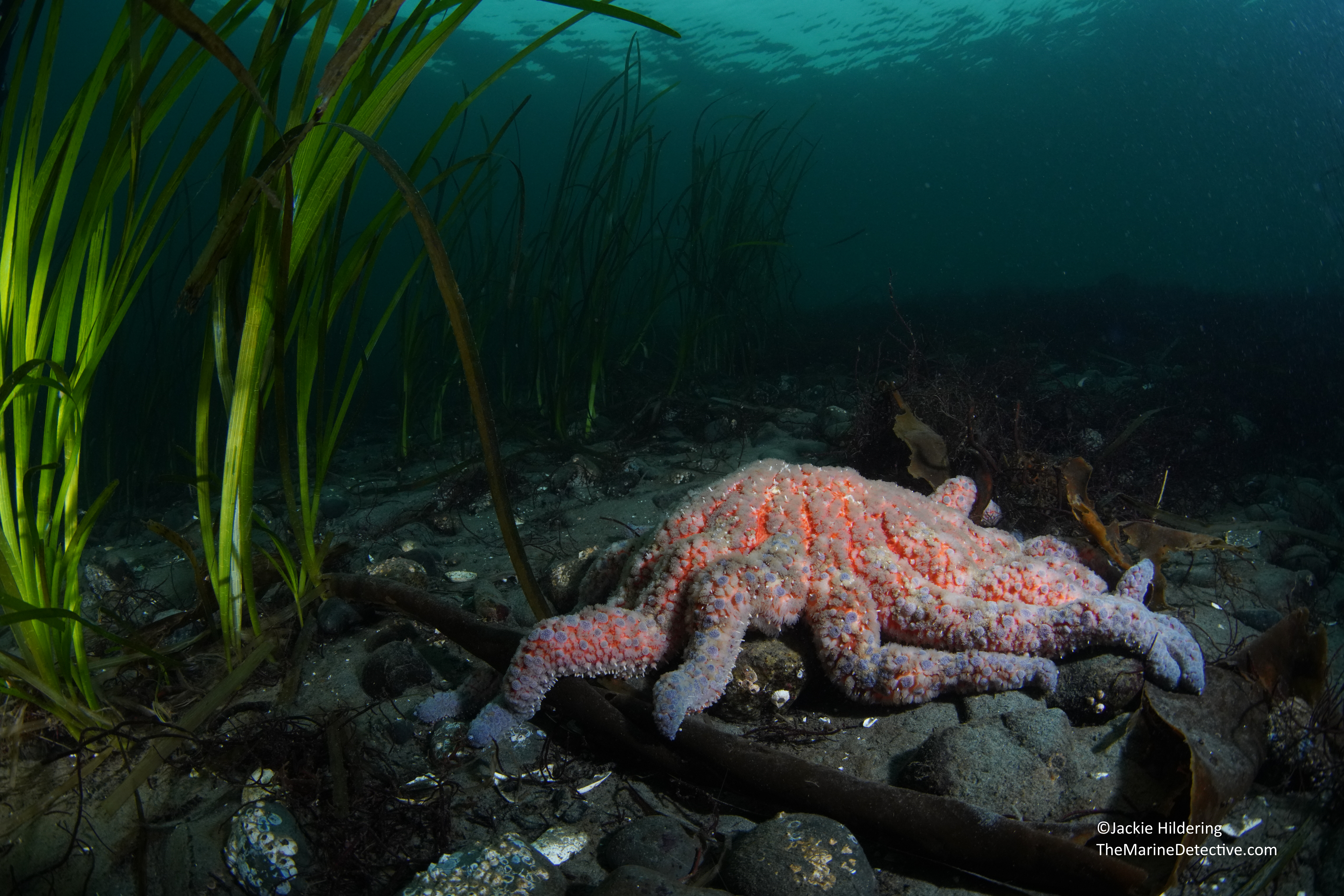
Look at this HUGE Sunflower Star.
It’s the same sea star in the above two images. Dive buddy is Janice Crook.
I screamed underwater in sheer euphoria the other day upon seeing the Sunflower Star in the above two images. It’s the largest one I have seen in years. Dive buddy Janice Crook and I found a total of seven relatively large Sunflower Stars and one juvenile during this dive. These sightings have been reported to researchers.
Why Euphoria?
Because Sunflower Stars are in terrible trouble and somehow at this site conditions are such that some adults are surviving. I regularly document “waves” of juveniles but have seen so very few large ones. To see seven relatively large ones at one shallow site in British Columbia is truly exceptional.
Why Does It Matter?
Sunflower Stars are the world’s largest sea star species at up to 1 metre across (Pycnopodia helianthoides). Before 2013, were you to look down from a dock in BC and Washington, you would likely see them . . . icons of our coast, common giants, and often what children would draw in seascapes.
That is no more.
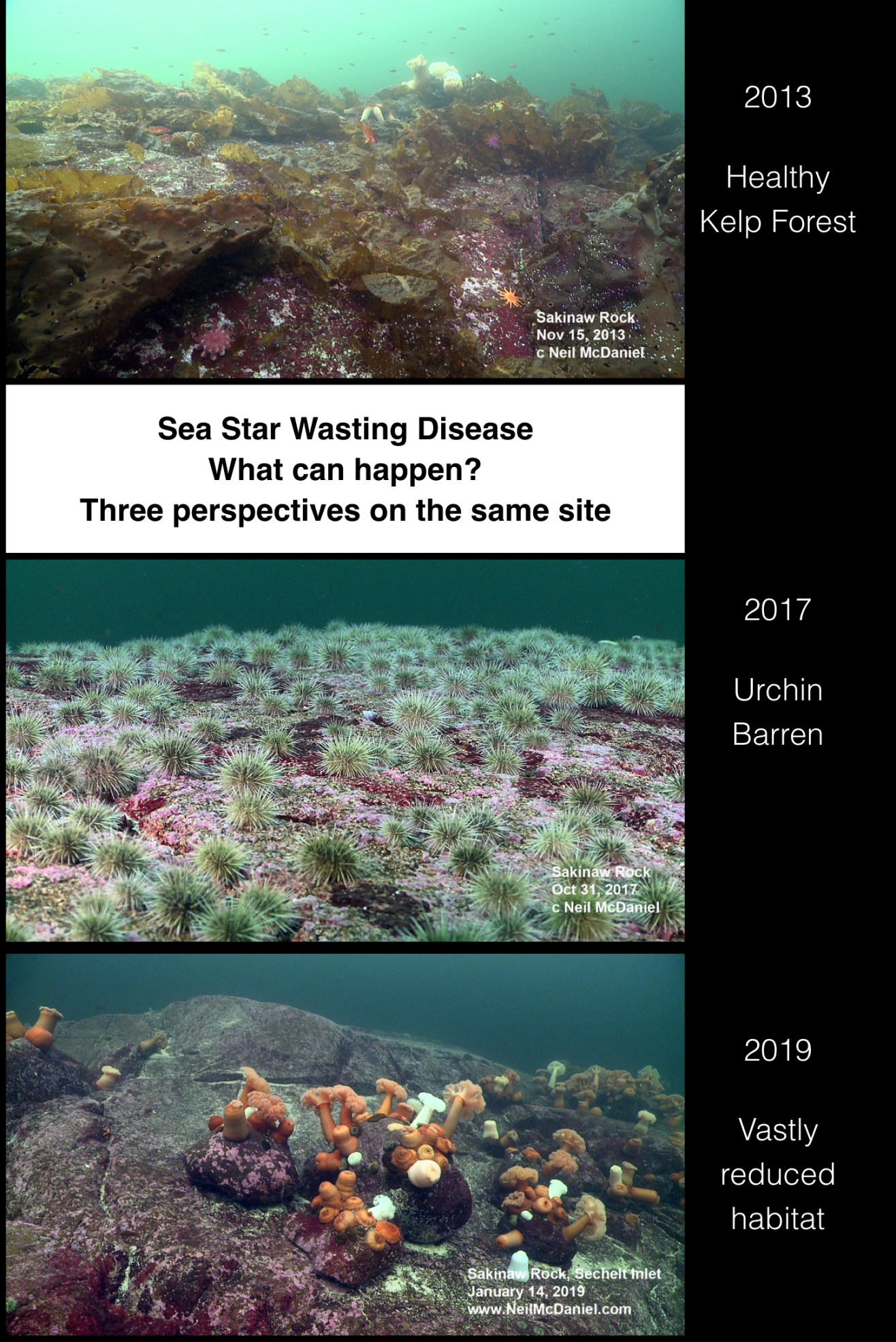
What happened to 20 sea star species in the Northeast Pacific Ocean has been referenced as “the largest epidemic ever recorded in a wild marine species.” Sunflower Stars were the most impacted and there are far-reaching impacts due to their ecological role.
Still many people do not know about their plight despite over 12 years of disease (and a horrific progression of symptoms). You can bet that if a whole lot of Sea Otters (which have similar ecological roles) died there would have been almighty public outcry. But this happened below the surface, in the dark, to species without eyes and fur.
What Happened?
Sea Star Wasting Disease (SSWD) began in 2013 and yes, recently Canadian researchers concluded what the pathogen / causative agent is. It’s the bacterium Vibrio pectenicida. But of course this does not mean that Wasting Disease is “solved”.
Why would this bacterium be able to have the impact it has? What changed?
From the research by Prentice et al. (2025) “Vibrio spp. have been coined ‘the microbial barometer of climate change’, because of the increasing prevalence of pathogenic species associated with warming water temperatures. Given that existing evidence indicates a relationship between increasing seawater temperature and SSWD incidence . . . ”
Where Are Things at Now?
In May 2025, the Committee on the Status of Endangered Wildlife in Canada (COSEWIC) recommended to the Government of Canada that Sunflower Stars be protected as an endangered species under Canada’s Species at Risk Act. It can be years before there is a decision.
This is not only important in Canada but the survivors in BC might be a reservoir for Washington State too where things appear to be even worse for the species.
What To Do?
Celebrate survivors – yes. Know that the plight of Sunflower Stars is not an additional problem. SSWD is a symptom of the same changes that impact our own species which means, there are common solutions regarding energy use, how we vote, and consumerism generally.
If you have read to this point in the blog, you are particularly important. You clearly care about life below the surface, in the dark. Help others know the importance of this coast. Help work against “ocean blindness” where the cold, dark waters full of plankton are devalued because it is more difficult to see the life living there. (Warm, clear waters are often perceived to be “better” because you can see far more easily see below the surface. But, if you can see through the water, there is far, far less plankton – the fuel of the marine food web.)
Children should know Sunflower Stars and their place on this glorious coast.
_________
Since the onset of SSWD in 2013, I have tracked research and developments at this link. Includes where to report sightings.
_________
Above photos: December 30th near Malcolm Island and northeastern Vancouver Island in the traditional territories of the Kwakwakw’akw. ©Jackie Hildering @The Marine Detective.
 The Marine Detective
7 Responses to “Survivors”
This makes my heart so happy!!! 😎Sent from my iPhone
Thank you for this reminder about the continuing plight of sea stars Jackie. May these survivors you show make us all think about how we can contribute to saving these and other species being damaged by human inaction on the devastating climate change we have caused.
Margaret (aka BP)
Exactly. It helps to know how much you understand dear BP.
Thanks again for your eyes in the water!
Appreciate the comment Ian!
Thank you for this bit of good news (great news!). To see big sunflower stars doing ok somewhere again is uplifting. Hopefully they can hang on and perhaps be progenitors of their species that are resistant to Vibrio…. Though ochre stars and some other species are back, sunflower stars are still sorely lacking here on the northcoast of Calif. since sea star wasting disease took hold.
Thank you Sabra. I hypothesize that the Sunflower Stars at this site may never have been impacted; that the conditions are such that the bacteria did not get a hold like some of the reservoirs in the research here by Gehman et al., 2025. https://royalsocietypublishing.org/rspb/article/292/2044/20242770/234419/Fjord-oceanographic-dynamics-provide-refuge-for?