Join me in the cold, dark, life-sustaining NE Pacific Ocean to discover the great beauty, mystery and fragility hidden there.

Posts by The Marine Detective

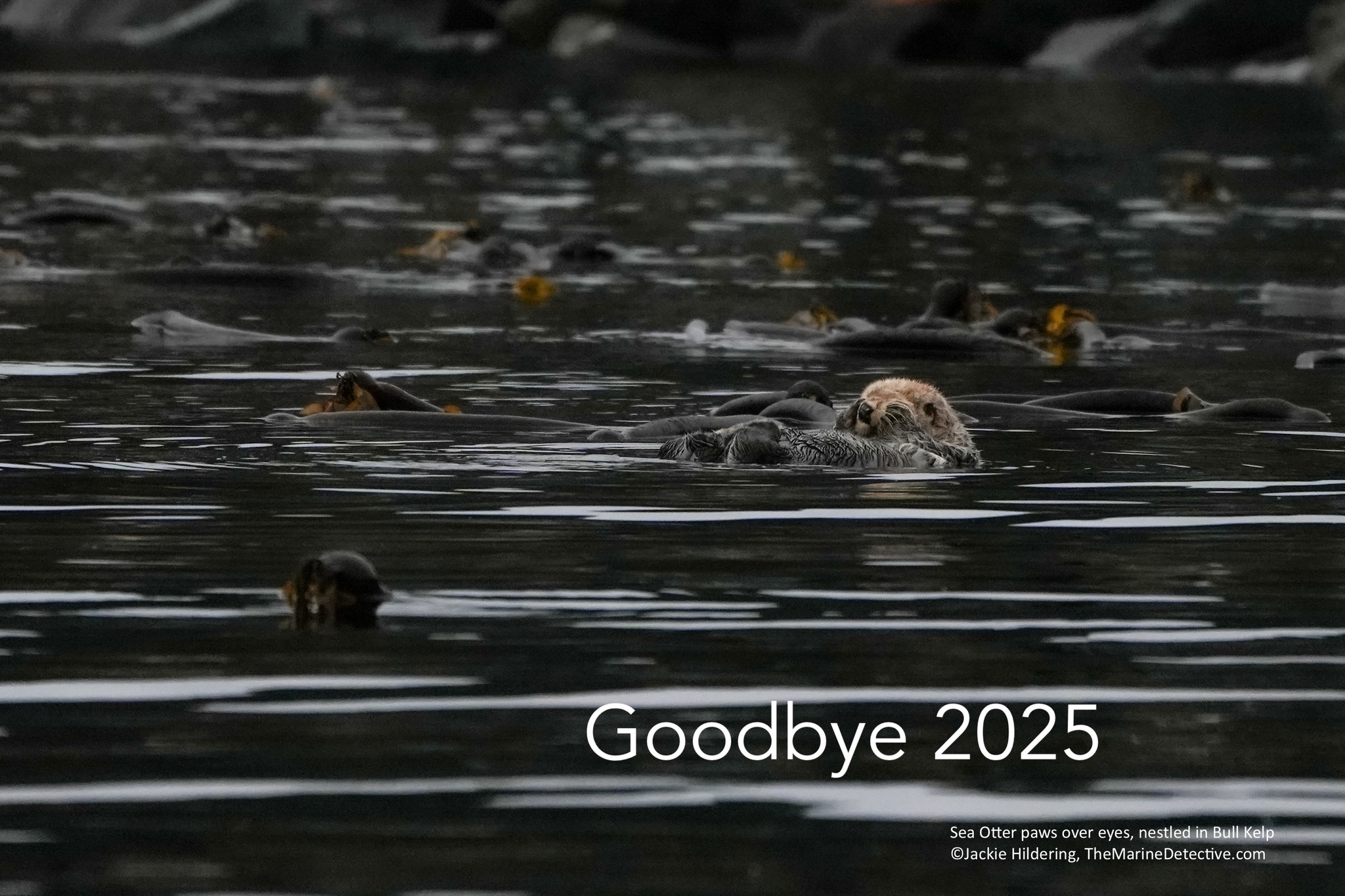
I Hurt. Goodbye 2025.

Er, why would I make a blog with “Goodbye 2025” on January 4th, 2026?
Why would I include “I hurt”?

Male Sea Otter covering his eyes with his paws, nestled in Bull Kelp as the world blurs by.
Photo ©Jackie Hildering taken near NE Vancouver Island, traditional territories of the Kwakwa̱ka̱’wakw.

The following is what I posted on my social media channels just before 2025 turned into 2026. The posts have resonated with so many that I considered if I should share the content in a blog too. The deal I made with myself is that if the “reach” on social media was over 15,000, I would dare to do so. It’s well over that now so, here goes.

What you read below is what I posted on the cusp of January 1, 2026. May the words land where they affirm, heal, and fortify.


I hurt.
Maybe you hurt too.
I believe in good, and truth.
Maybe you believe too.

_________

As it goes with such posts where I have to dig deep, I need to write this for myself. But, I anticipate I do not hurt alone. So, here goes in the belief that these words will be of use to others too.

In these final hours of 2025, I can’t bring myself to just post a pretty picture and type the words “Happy New Year!” for you. That somehow feels dishonest and as if I am contributing to blind hope. Yo, shake the dice and maybe rolling from December 31 to January 1 will somehow bring better order to the world.

It’s going to take more than that.

Many of us are acutely aware of the forces aimed solidly and so effectively at increasing overwhelm, fear, disengagement, and distortion of reality. The game plan is for it to be “too much”.

But are we aware of our reaction to it all? Are we among the fallen? Have we shut down, gone dark, or numb? Do we “hope” without action? Do we have to carry the weight of it all?

I rawly know the answer to that last question. We can’t carry the weight of it all nor dizzy ourselves with the details of all the insanity and inhumanity. Again, that’s the game plan… bury them.

But, I do need to have my eyes open enough to feel my way forward among the assaults on truth, facts, integrity, and equality. To know these assaults are aided by the misuse of artificial intelligence, reduced scientific literacy, conspiracy theories, the manufacturing of divisiveness, the erosion of journalistic integrity and the capacity for fact-checking, etc.

The chaos over our border has fed patriotism that favours short-term economic gain over potential long-term devastation. I think something broke in me when the rhetoric began anew about pipelines and tankers. We’ve been here before.

How to have a Happy New Year? How will I have a Happy New Year? Stand for truth. Put good into the world. Know the good and beauty around you. And protect the good in yourself, and others.

Onward.

It feels vulnerable as hell to hit “post” on this. May the words land where they may be of use.”

Survivors

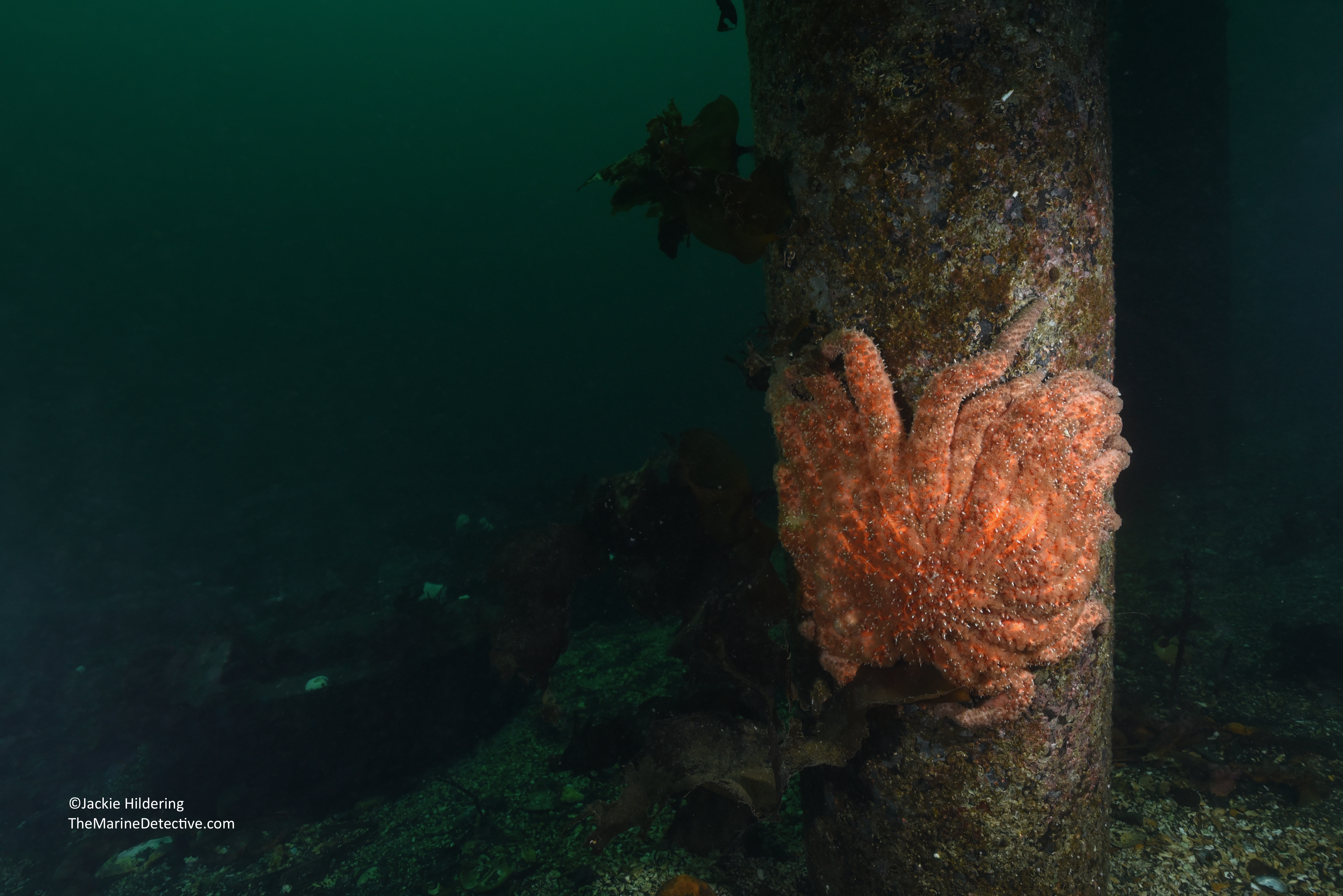
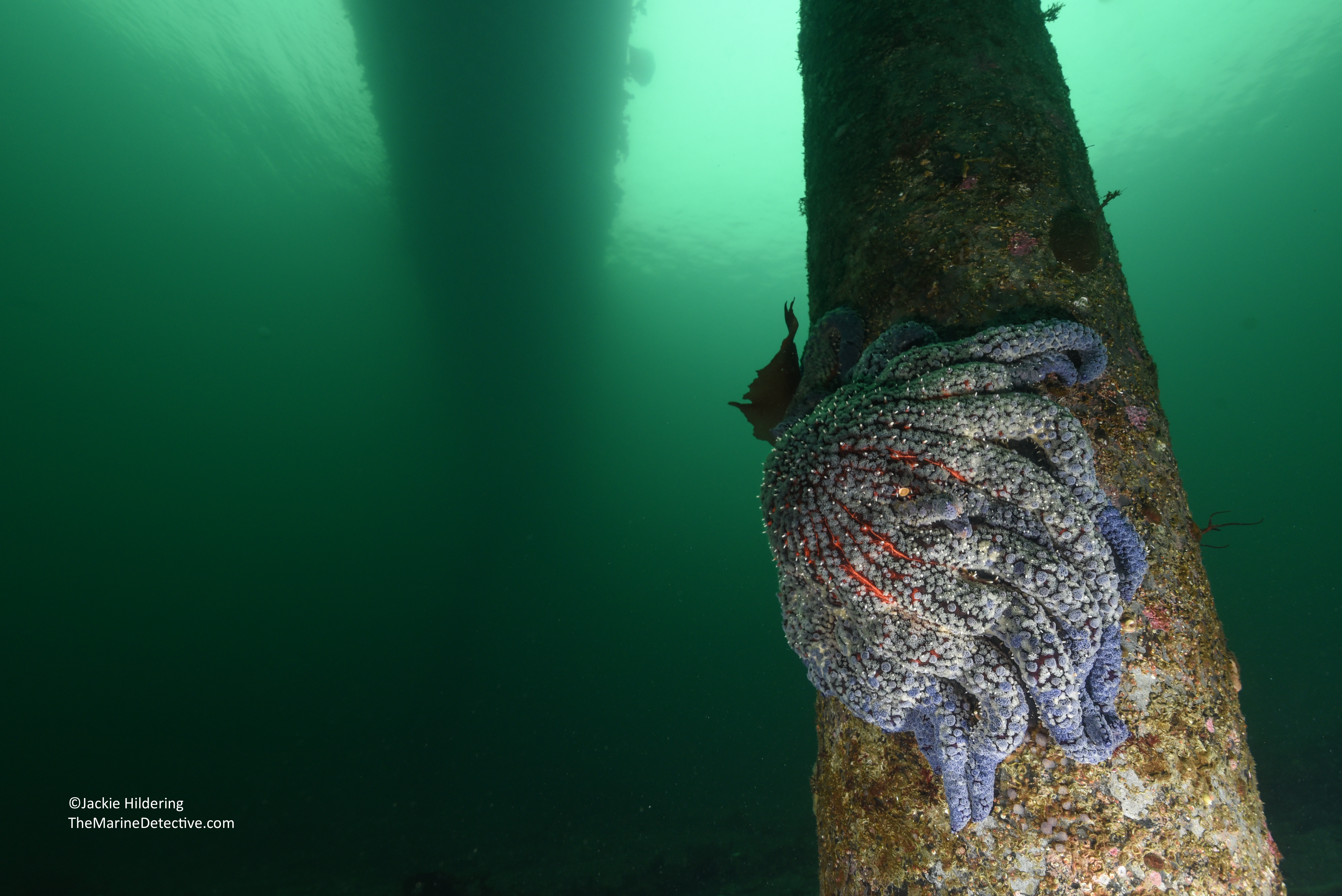
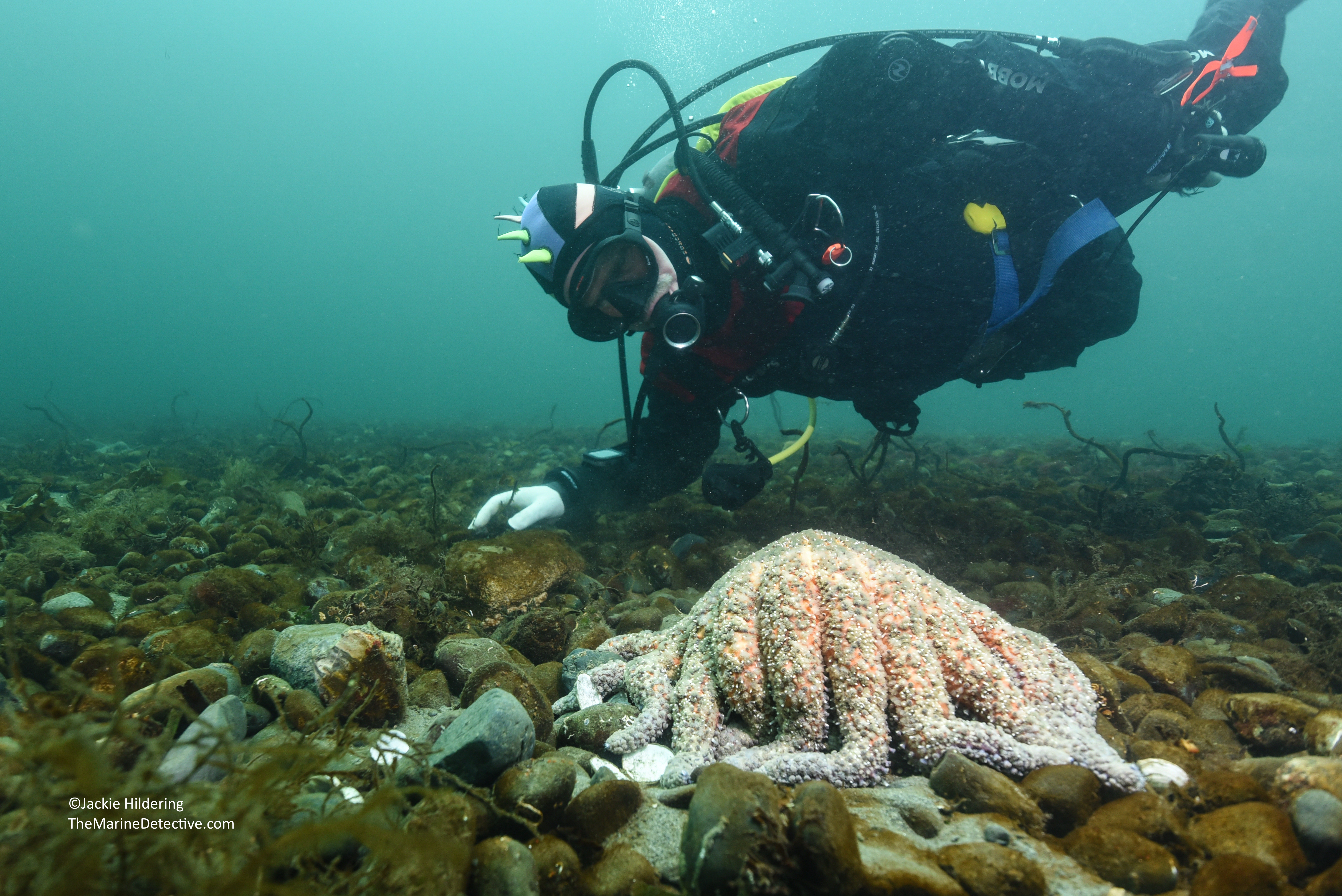
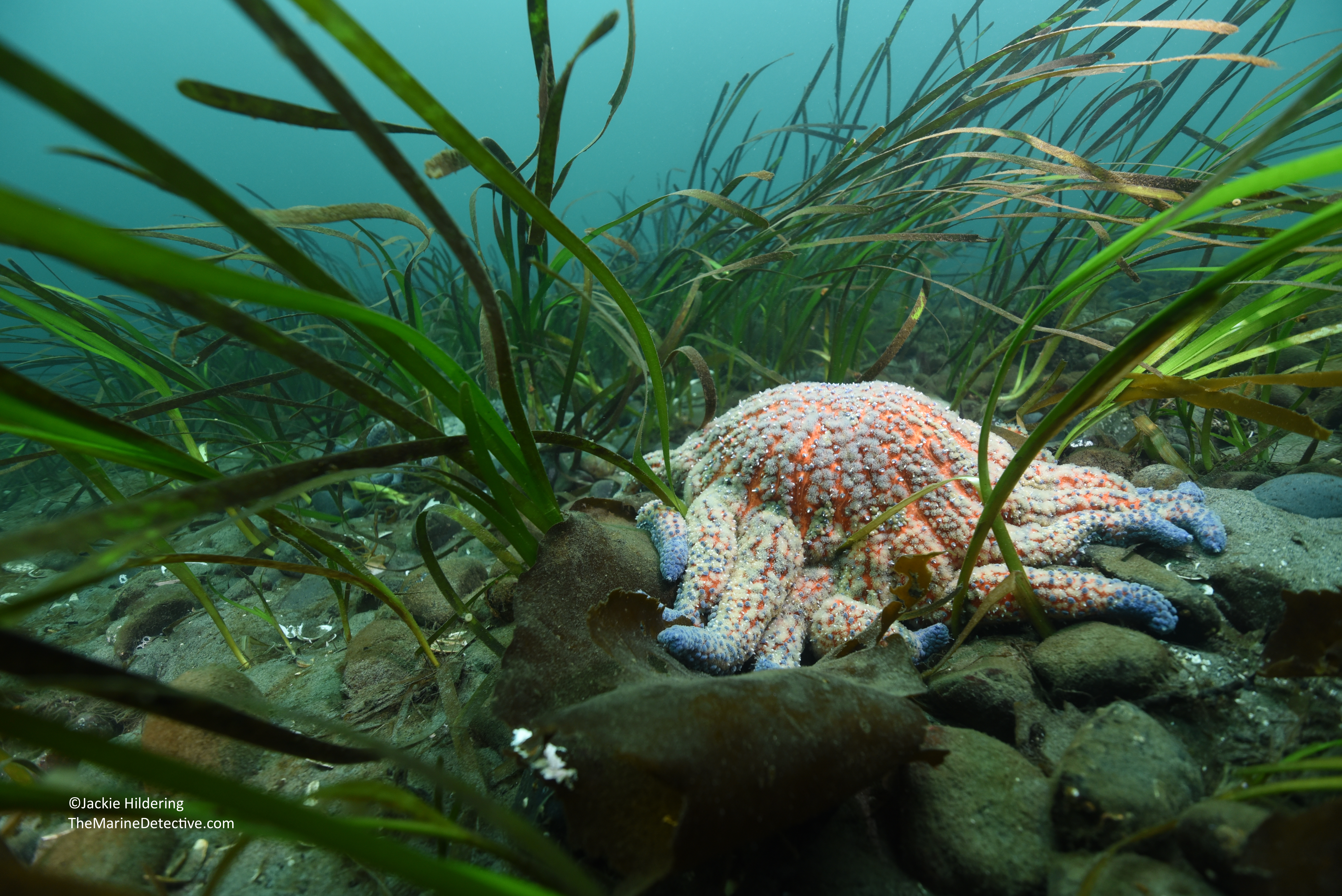
Look at this HUGE Sunflower Star.

This Sunflower Star is ~1 metre across.
It’s the same sea star in the above two images. Dive buddy is Janice Crook.

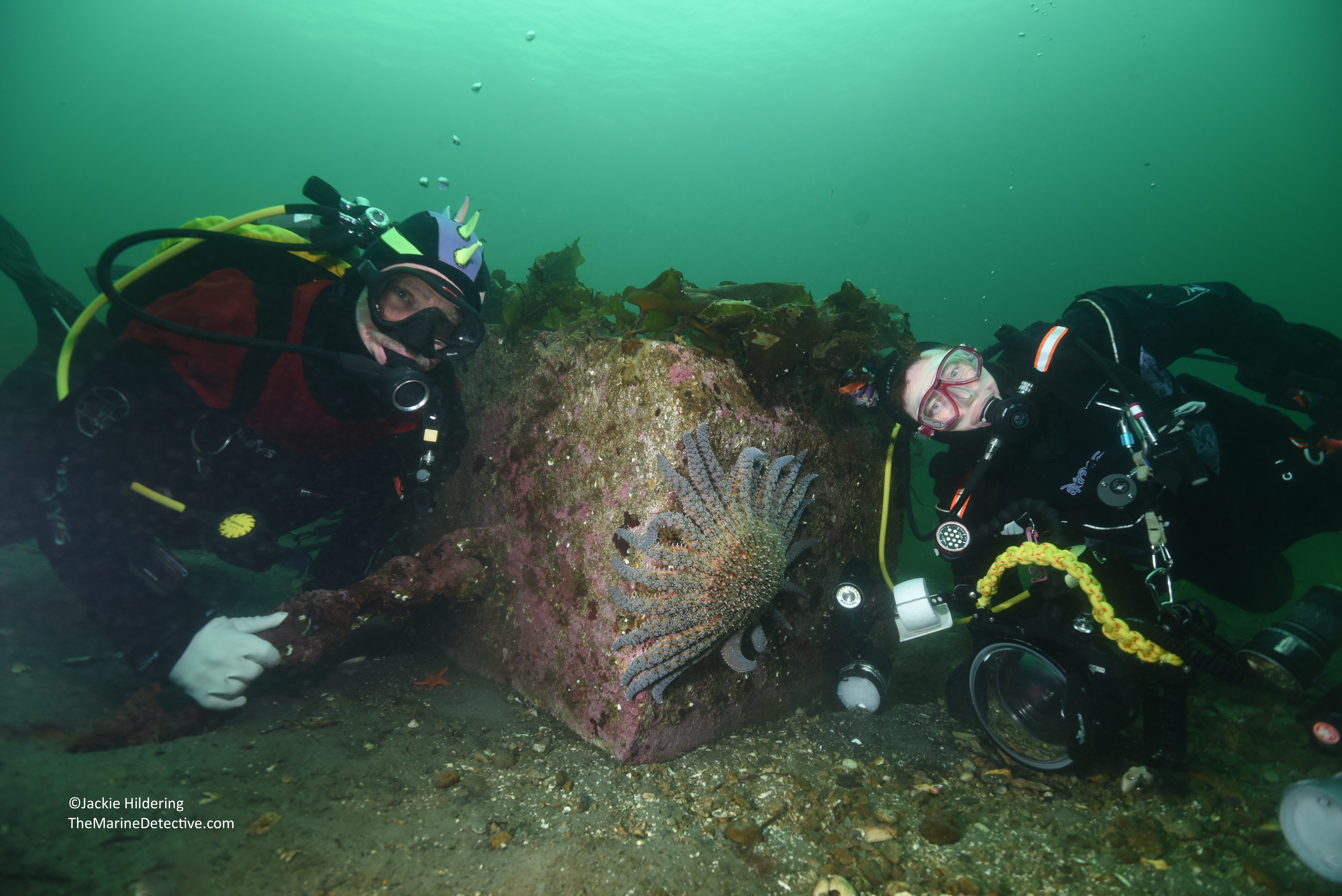
I screamed underwater in sheer euphoria the other day upon seeing the Sunflower Star in the above two images. It’s the largest one I have seen in years. Dive buddy Janice Crook and I found a total of seven relatively large Sunflower Stars and one juvenile during this dive. These sightings have been reported to researchers.

Why Euphoria?

Because Sunflower Stars are in terrible trouble and somehow at this site conditions are such that some adults are surviving. I regularly document “waves” of juveniles but have seen so very few large ones. To see seven relatively large ones at one shallow site in British Columbia is truly exceptional.

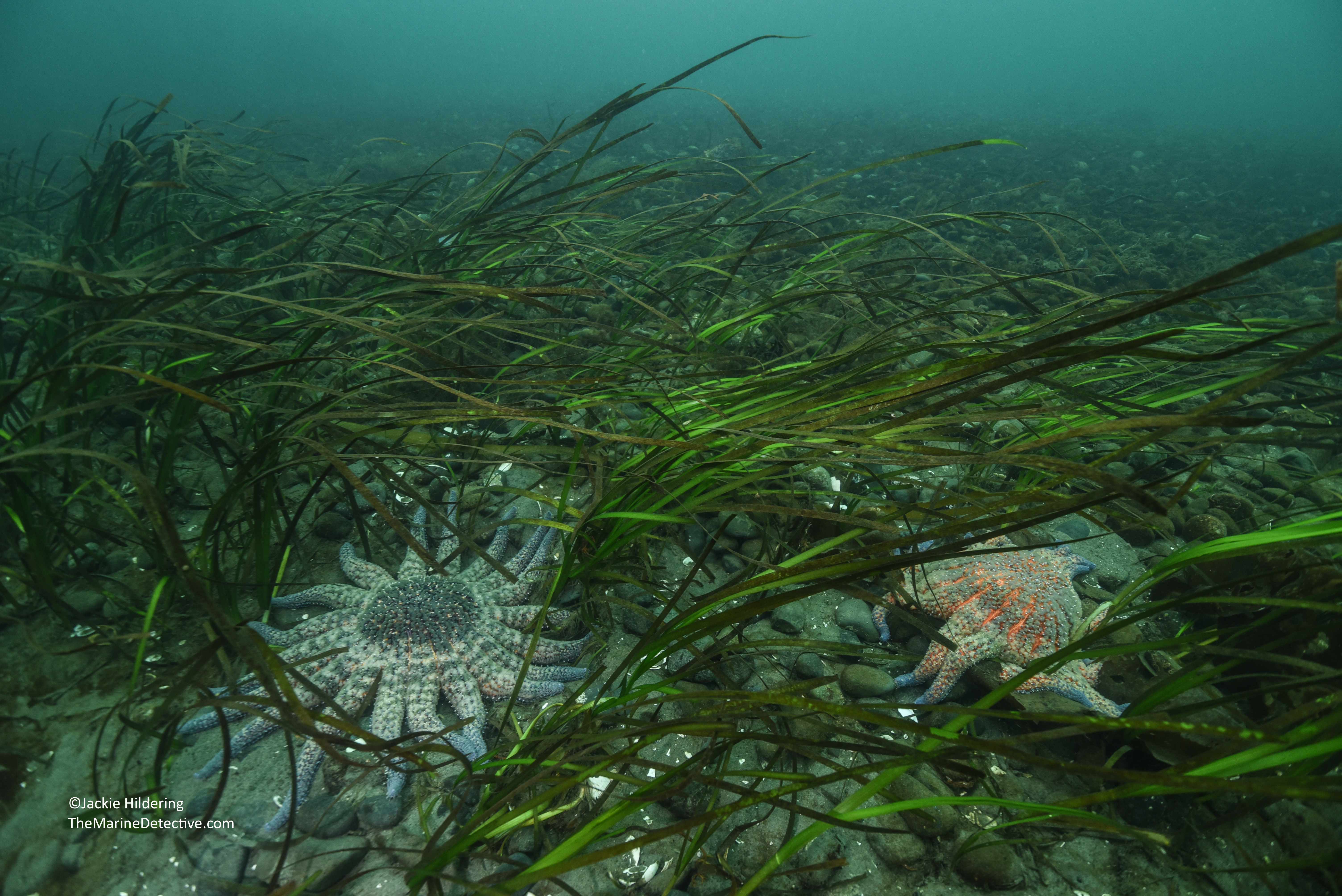
Another two large Sunflower Stars on the same dive. There was a third on the other side of the cement block.

Why Does It Matter?

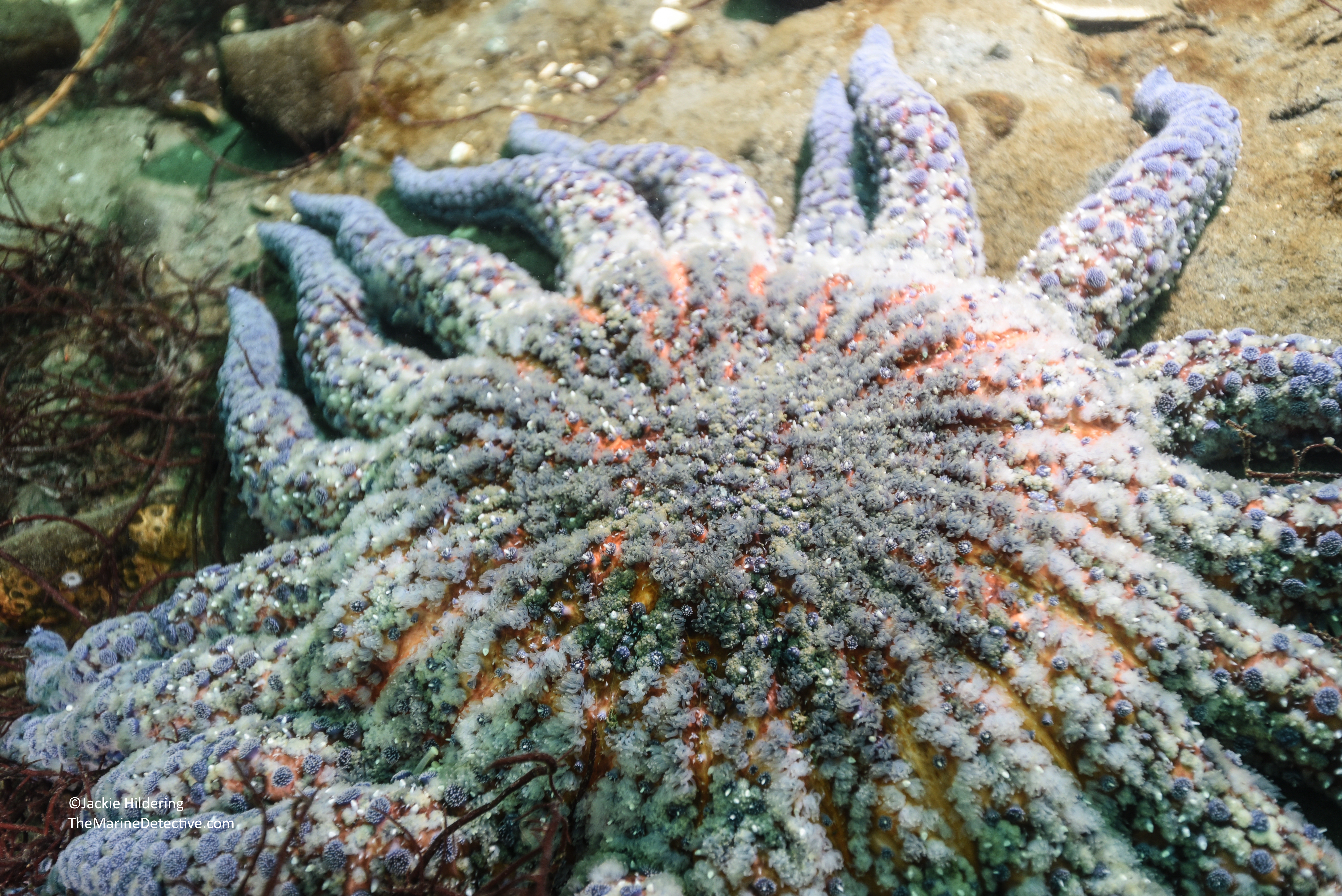
Sunflower Stars are the world’s largest sea star species at up to 1 metre across (Pycnopodia helianthoides). Before 2013, were you to look down from a dock in BC and Washington, you would likely see them . . . icons of our coast, common giants, and often what children would draw in seascapes.

That is no more.

What happened to 20 sea star species in the Northeast Pacific Ocean has been referenced as “the largest epidemic ever recorded in a wild marine species.” Sunflower Stars were the most impacted and there are far-reaching impacts due to their ecological role.

Still many people do not know about their plight despite over 12 years of disease (and a horrific progression of symptoms). You can bet that if a whole lot of Sea Otters (which have similar ecological roles) died there would have been almighty public outcry. But this happened below the surface, in the dark, to species without eyes and fur.

What Happened?

Sea Star Wasting Disease (SSWD) began in 2013 and yes, recently Canadian researchers concluded what the pathogen / causative agent is. It’s the bacterium Vibrio pectenicida. But of course this does not mean that Wasting Disease is “solved”.

Why would this bacterium be able to have the impact it has? What changed?

From the research by Prentice et al. (2025)Vibrio spp. have been coined ‘the microbial barometer of climate change’, because of the increasing prevalence of pathogenic species associated with warming water temperatures. Given that existing evidence indicates a relationship between increasing seawater temperature and SSWD incidence . . .

Where Are Things at Now?

In May 2025, the Committee on the Status of Endangered Wildlife in Canada (COSEWIC) recommended to the Government of Canada that Sunflower Stars be protected as an endangered species under Canada’s Species at Risk Act. It can be years before there is a decision.

This is not only important in Canada but the survivors in BC might be a reservoir for Washington State too where things appear to be even worse for the species.
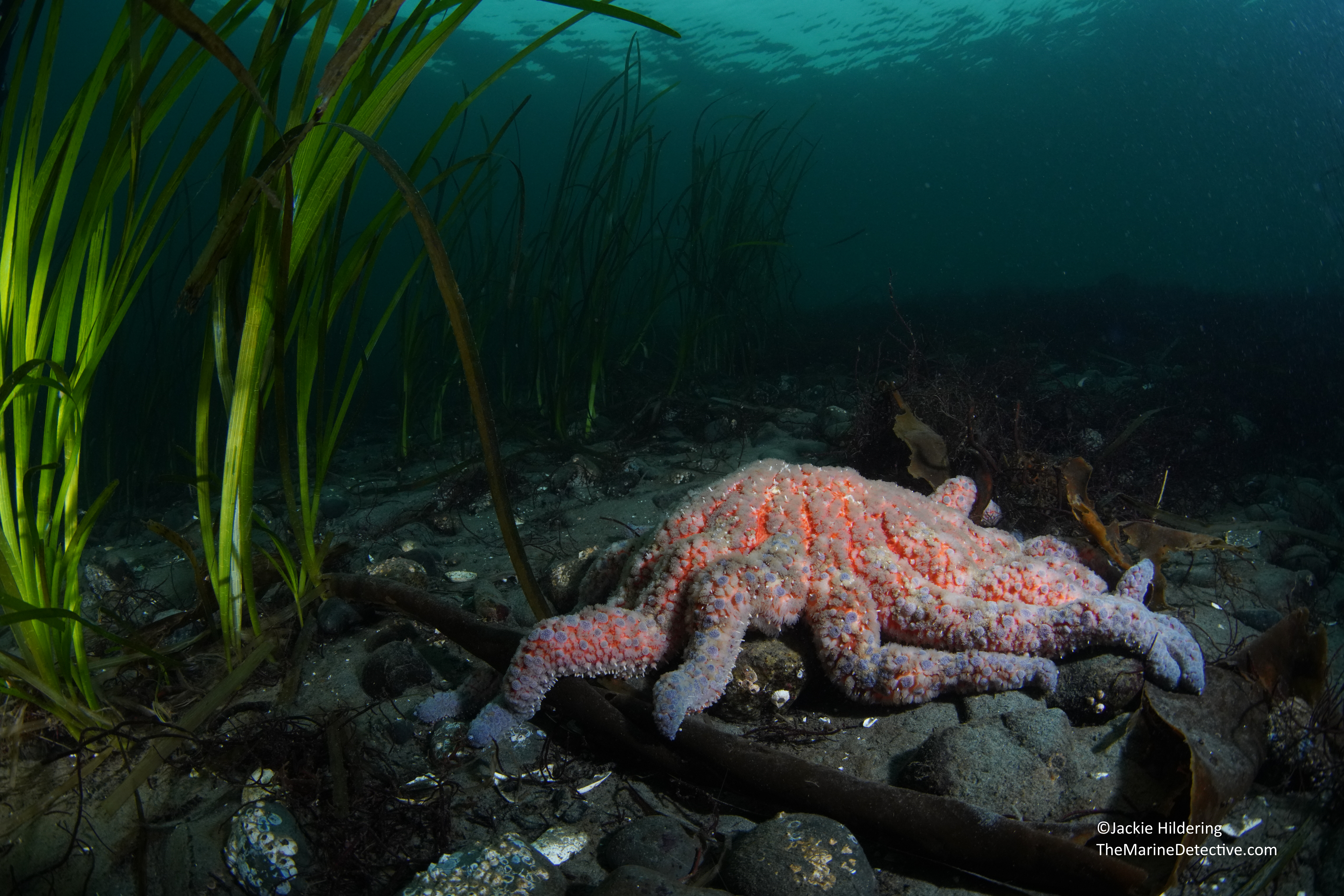
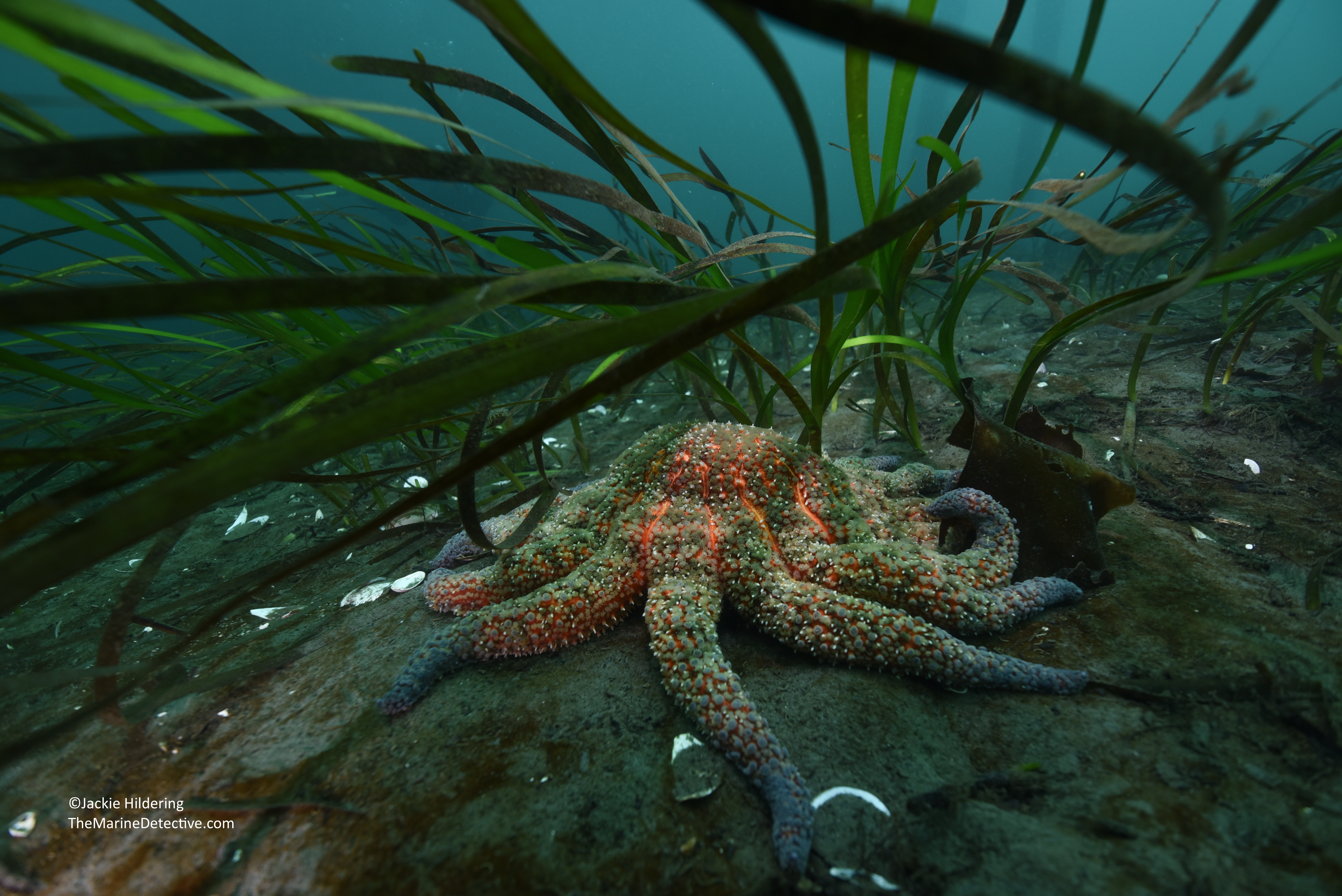
Another large Sunflower Star – you can see how shallow some of them were, indicated here by the presence of the Eelgrass and being able to see the surface of the water

What To Do?

Celebrate survivors – yes. Know that the plight of Sunflower Stars is not an additional problem. SSWD is a symptom of the same changes that impact our own species which means, there are common solutions regarding energy use, how we vote, and consumerism generally.

If you have read to this point in the blog, you are particularly important. You clearly care about life below the surface, in the dark. Help others know the importance of this coast. Help work against “ocean blindness” where the cold, dark waters full of plankton are devalued because it is more difficult to see the life living there. (Warm, clear waters are often perceived to be “better” because you can see far more easily see below the surface. But, if you can see through the water, there is far, far less plankton – the fuel of the marine food web.)

Children should know Sunflower Stars and their place on this glorious coast.

_________

Since the onset of SSWD in 2013, I have tracked research and developments at this link. Includes where to report sightings.

_________

Above photos: December 30th near Malcolm Island and northeastern Vancouver Island in the traditional territories of the Kwakwakw’akw. ©Jackie Hildering @The Marine Detective.

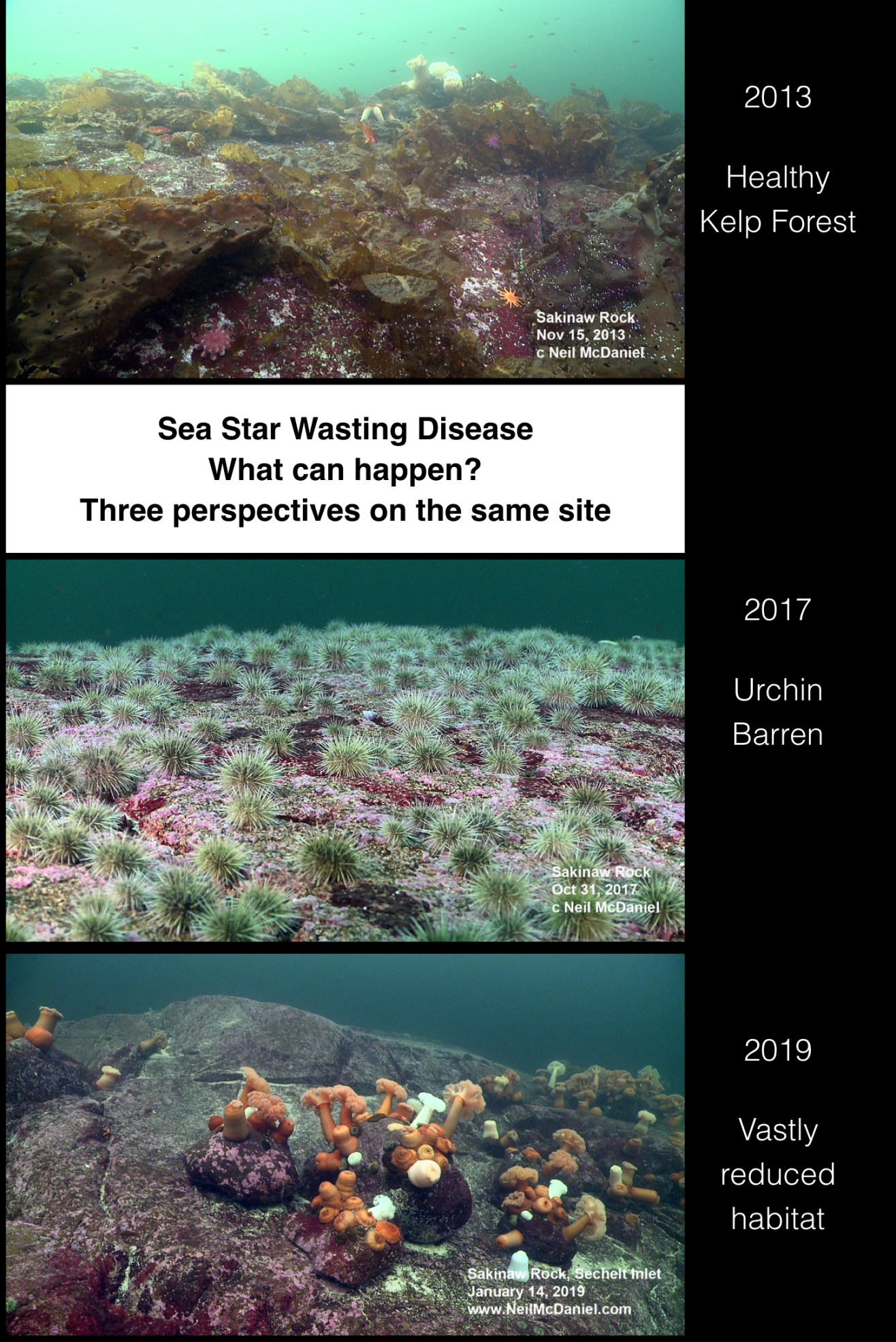
Sunflower Stars eat Green Urchins which graze on kelp. With fewer Sunflower Stars, there is more grazing on kelp by Green Urchins. Research suggests that Sunflower Stars can be 15 metres away and still help with deterring urchins (red urchins in the research by Mancuso et al., 2025).

Ode to Algae

Ever feel like you want to drift away for a while?
Here you go, a slideshow featuring my photos of kelp and other seaweeds/algae.

Maybe watch it while listening to your favourite calming songs?

I put this slideshow together for an upcoming workshop on seaweed. It’s full, but you can sign up for alerts about future workshops.

Photos are from near northeast Vancouver Island taken by yours truly in the Traditional Territories of the Kwakwa̱ka̱’wakw (the Kwak̕wala-speaking Peoples). Final photo of me photographing kelp is by dive buddy, Don Gordon.


The Importance of Algae
The Ocean’s algae, from the microscopic to the giant kelps:

  • Produce at least 50% of the Earth’s oxygen.
  • Another result of their photosynthesis is that they absorb very significant amounts of carbon dioxide – a very significant climate-changing gas.
  • The algae / seaweeds are producers, converting sunlight to food to fuel the food web. They offer we humans so much nutrition too.
  • Kelps are habitat for hundreds of species.

Kelp in Trouble
Where every species lives is, of course, because the conditions are right. For example, the temperature is not too cold. It’s not too hot. It’s just right. Yes, this is referenced as the Goldilocks Principle. Changing temperatures are impacting the health of kelp forests, as are other variables involved with climate change such as more frequent and stronger winds ripping away more kelp.

Also, there are far fewer Sunflower Stars due to Sea Star Wasting Disease which is believed to be associated with climate change. Sunflower Stars are predators of Green Urchins. Green Urchins graze on kelp. With less Sunflower Stars, there are more Green Urchins. More urchins leads to more grazing on kelp. In the extreme, this leads to “urchin barrens” where the kelp forest has been grazed away. This is not the urchins’ fault, of course. It’s due to human activity.

Less kelp = less food, oxygen, habitat and buffering of carbon dioxide.

Common Solutions:
This is not an additional problem! There are common solutions for many socio/environmental problems. What is going on with kelp is another symptom of the same negative forces – disconnect, a focus on short-term economies, and a culture that perpetuates fear, misinformation, overwhelm and reduced empowerment. Whatever you do to reduce carbon dioxide (from your energy use, consumerism, to how you vote) will help the kelp and all that depends on them. 💙


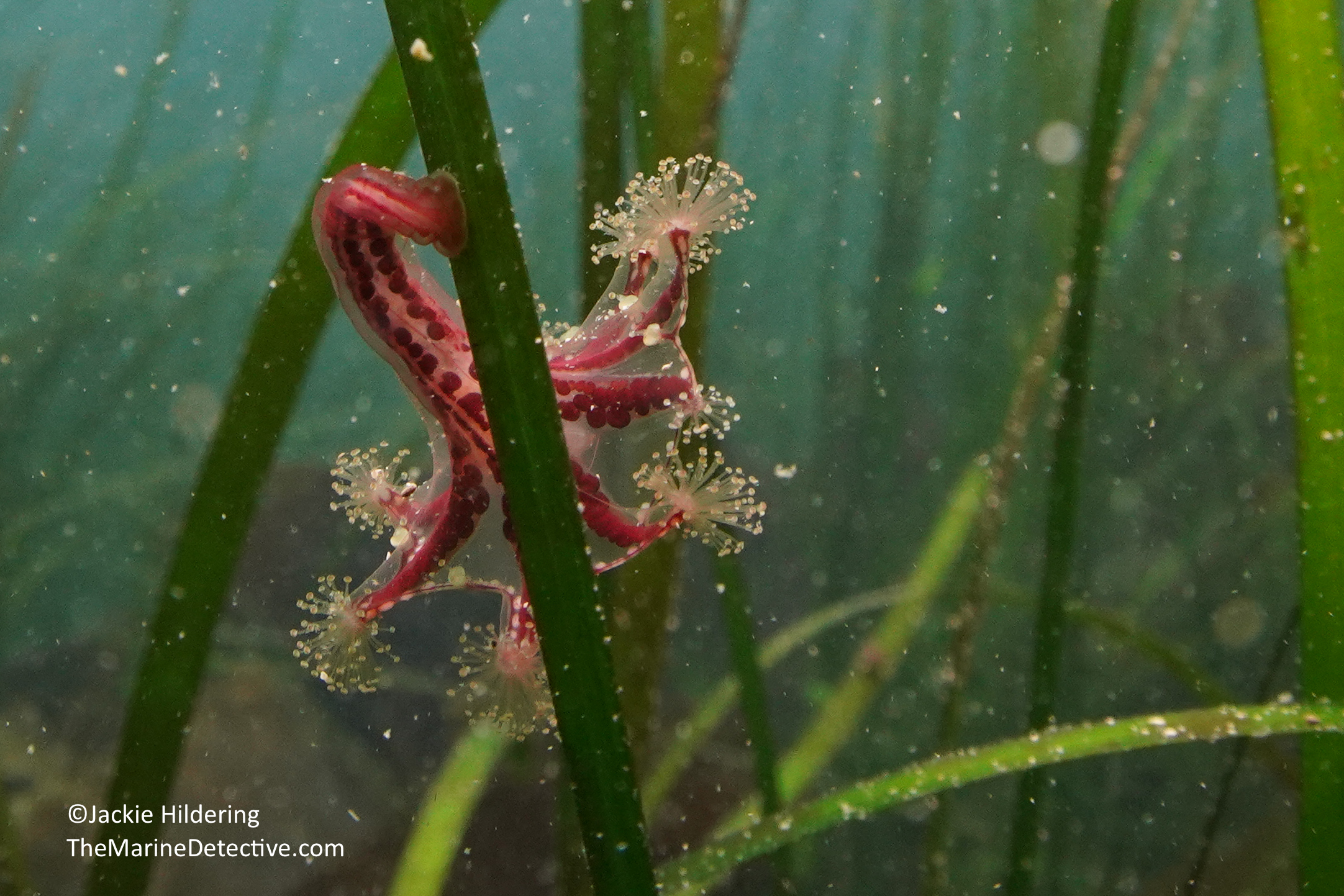
The rarest of the rare? Haliclystus californiensis in British Columbia? 

[Last updated on November 3, 2025.

Can a 2 cm stalked jelly make you feel small? Yes.
Can it fill you with awe, wonder, affirmation, purpose, and drive? Yes.
Does it make it feel like all the immersion, the cold, and the learning from this little bit of the planet, somehow makes a positive difference? In a quiet voice, I say . . . yes.

It has been confirmed by Claudia Mills that I have the identification of this stalked jelly correct as Haliclystus californiensis. Note that:

  • It has only been recognized as a distinct species in 2010 (Kahn et al., 2010). At the time of that publication, only 10 individuals had been found and only “from southern to northern California in coastal waters” (hence the species name “californiensis“).
  • There are only two other known sightings in British Columbia. One in 2017 as a result of a collaboration including the Smithsonian Institution’s Marine Global Earth Observatory and the Hakai Institute. Additionally, I learned from Claudia Mills that one was sighted near Bamfield by Ron Larson in October 1983.
  • This would be only the 25th global documentation to be included on the Global Biodiversity Information Facility, which, since the research of Kahn et al. in 2010, includes findings of the species in Sweden and Denmark. Note that there is doubt about whether the individuals documented in the Atlantic are indeed the same species.


Are they deep-dwelling? No. In the research I reference above, it is stated that they are known from depths of 10 to 30 metres. I found this one at about 6 metres depth.

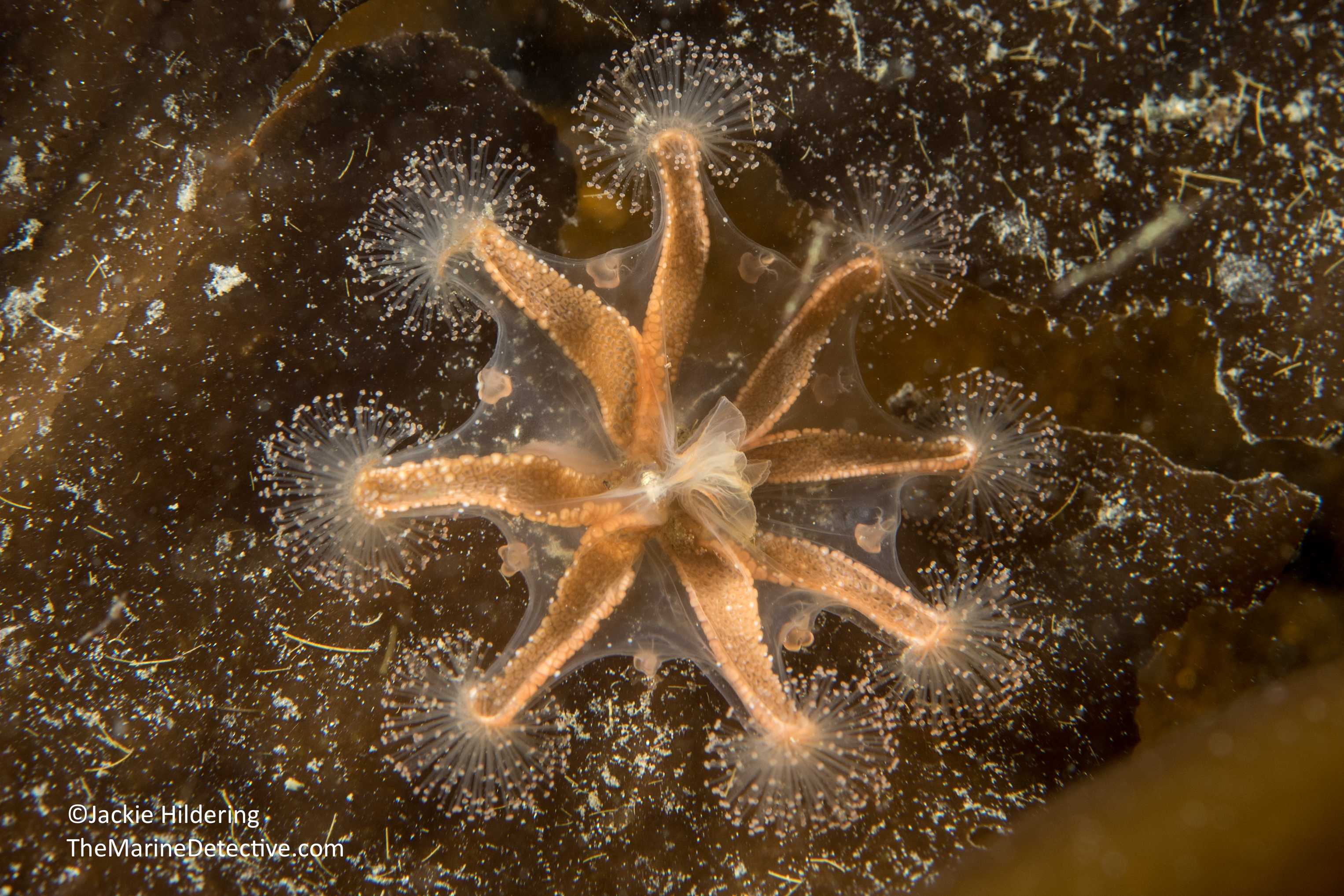
What are stalked jellies? They never become free-swimming, bell-shaped medusae like other jellies. They attach by their sticky stalk and have 8 arms with pom-pom-like clusters of tentacles at the ends. These tentacles have stinging cells to catch small crustaceans, which are then moved to the mouth at the centre of the 8 arms. If detached, stalked jellies can grip a surface with their tentacles and quickly reattach their stalk.


Above image from Kahn et al., 2010. Their description includes: martini glass shaped; 2.1 cm tall; 15.5 mm wide; 8 arms with 60 to 80 capitate secondary tentacles, and the red structures are gonadal sacs.


How did I find this one? There was fortuitousness involved. But also, I was looking when many would not. I was looking because of what I have been able to learn previously.

The sighting was on October 30, 2025, when diving with a group I organized to go to God’s Pocket Resort. It was our last dive of the trip and the last dive for the God’s Pocket Team for 2025. It had already been an astounding morning, which included documenting Humpbacks and Bigg’s Killer Whales while on the boat. Captain Bryan had been considering another dive site in Browning Pass, but the current and the potential for him to get more opportunistic whale IDs (with telephoto lens) while we were diving, led him to choose this location.

We had dived this site earlier in the week, and then too I had rushed to the “end” where I know there is a little patch of Eelgrass. I was looking for another species of Haliclystus I have found there before, for which a species name has NOT been assigned. This does not mean in any way that I discovered it, but rather that researchers have not yet published the research describing how it is morphologically and genetically distinct. See photo below.

This is the unnamed / undescribed species of Oval-anchored Stalked Jelly I have found at this site previously (and in a multitude of other locations around northeastern Vancouver Island).


I reached the Eelgrass bed and watched a school of Tubesnout (fish) swim around. Then, I focused on the Eelgrass to see if, maybe this time, I could find the undescribed species. Later, my photos would reveal just how intent I had been. See below for a photo of the school of fish with the flipper of a mature Steller Sea Lion in the frame. I had noticed he had passed so close to me. Yes, I can find 2 cm stalked jellies, and miss a ~3 m, 1,000 kg Steller Sea Lion.


And then, there it was. My brain started screaming immediately, knowing this was a unique species. Does it matter? It does to me. And maybe, it does to you.

May this add to wonder, appreciation, and the appropriate humility that we humans know so little about even the marine species that live in the shallows. May that foster care, and actions that benefit all of us connected by water and air on this ocean planet.

Photo gives you a better sense of how small this species is.

Sources:

Photos above and below: Divers and crew on my October 2025 trip with God’s Pocket Resort.

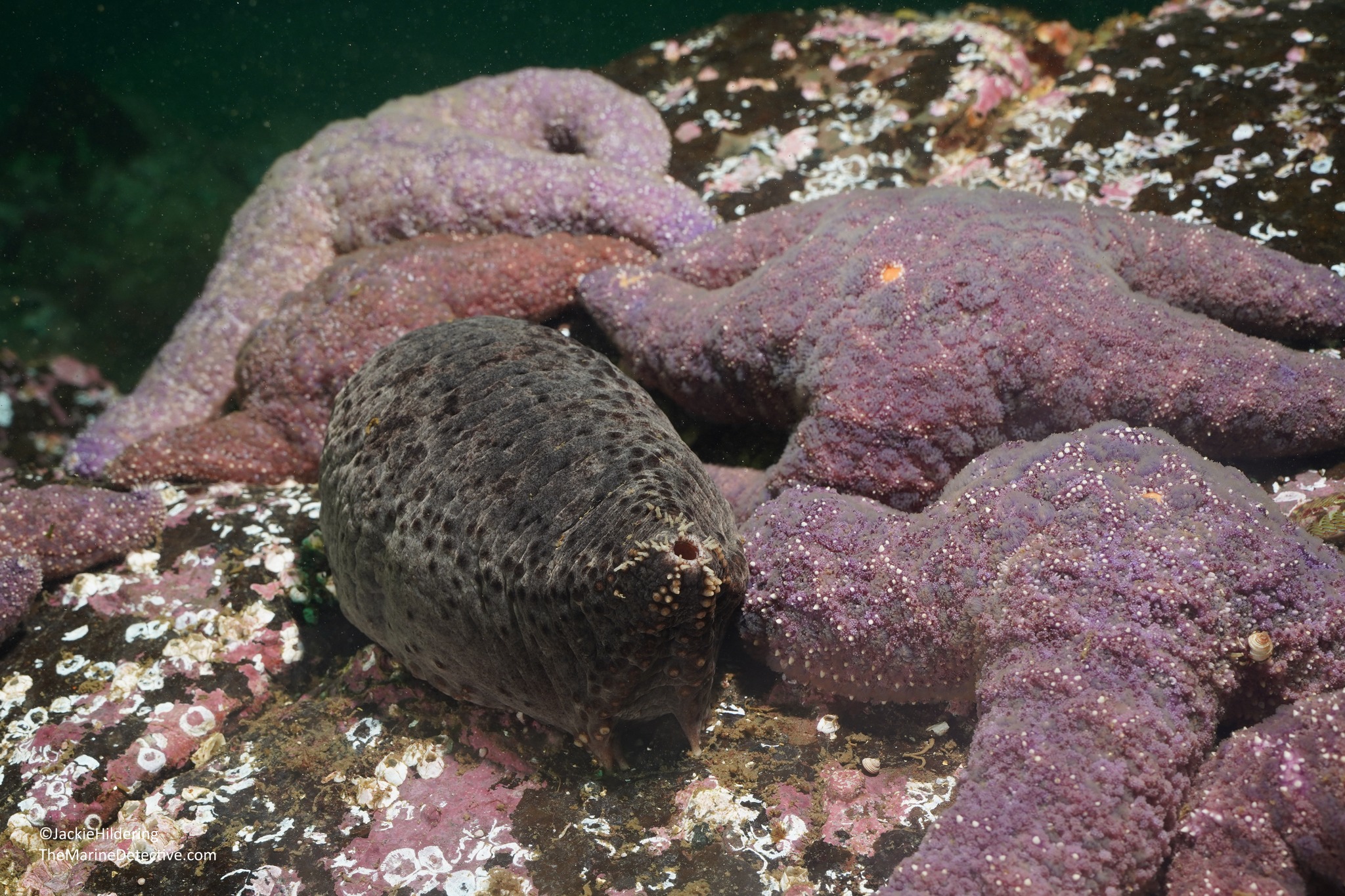
Giant Black Cucumaria – feeding!

What’s a “Giant Black Cucumaria”? It’s an extraordinary species of sea cucumber that has a football-shaped body and can be up to 30 cm long. Below I have a video of one feeding.

The Giant Black Cucumaria I documented for 4 months. Photographer here with my dive buddy, Natasha Dickinson.


I had never seen one before January of this year. I was able to document that one it in the same place over a period of 4 months. I never saw that individual with its feeding tentacles out.


But then, in April, I chanced upon another individual in a different location near northeast Vancouver Island. This one was feeding! In my video below, see how the Giant Black Cucumaria collects plankton on 10 bushy tentacles, sticks one in its mouth, and scrapes off food. Then, repeat with another tentacle. Yum!

This is also how some other species of sea cucumber feed e.g. Orange Sea Cucumbers (Cucumaria miniata).


More about Giant Black Cucumaria:

The two individuals I documented were near northeast Vancouver Island.

From “Sea Cucumbers of British Columbia, Southeast Alaska and Puget Sound” by Phil Lambert, I learned that the species is known to be more abundant further to the north along British Columbia’s Central Coast into Alaska and the Arctic Ocean.

The Giant Black Cucumaria has been assigned the scientific name “Cucumaria frondosa japonica” but its species status is not resolved. It’s believe to be closely related to Cucumaria japonica found near Japan.

The individual I documented for 4 months. May have been there longer. But when I returned after 5 months, it was no longer there.

Photos and video here were taken in the Traditional Territories of the Kwakwa̱ka̱’wakw ©Jackie Hildering, The Marine Detective.


You can find more information about this species in the Electronic Atlas of the Wildlife of British Columbia

Seven-armed Octopus – but has eight arms!

Oh how I’ve been eager to share this with you.

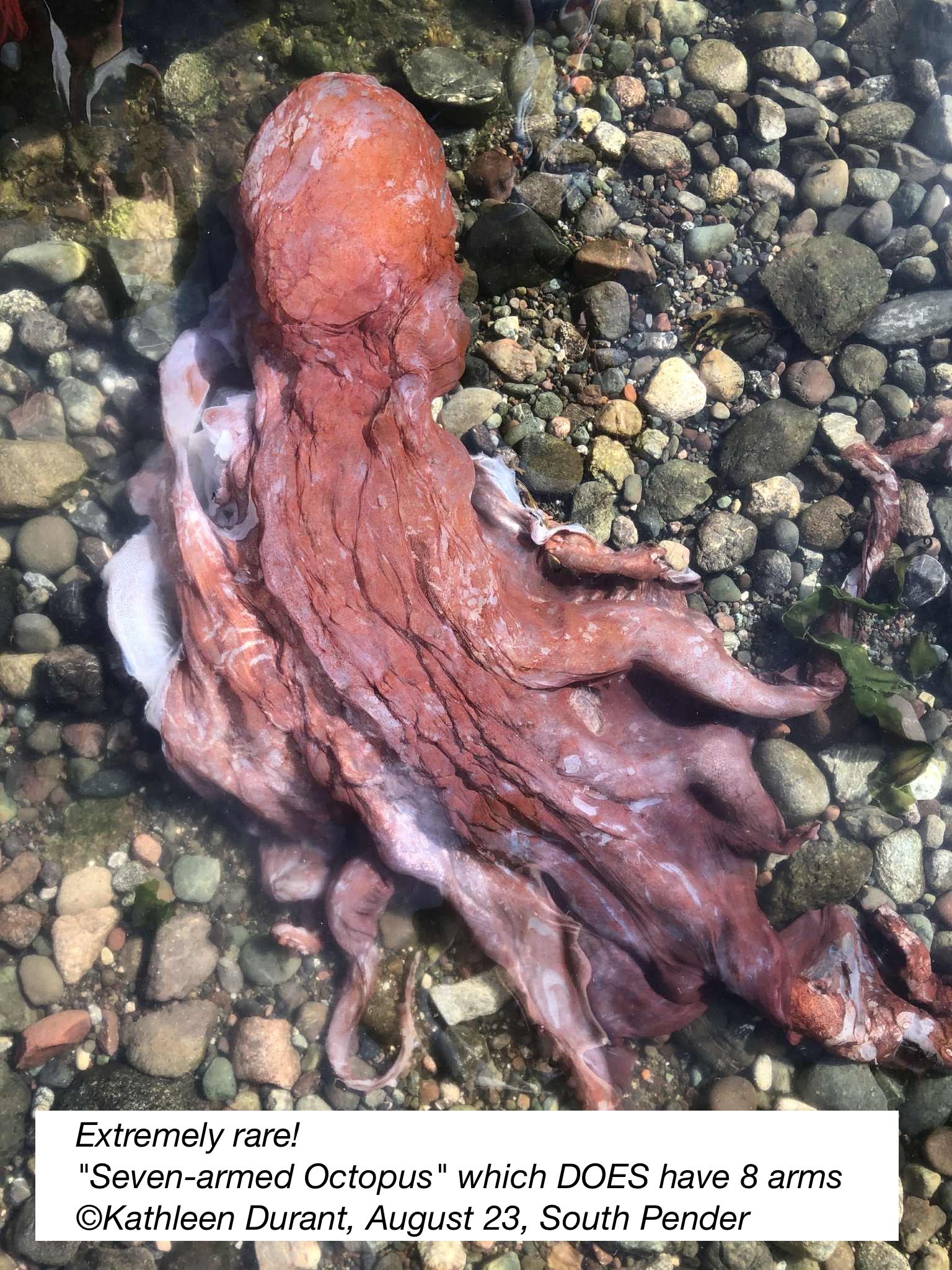
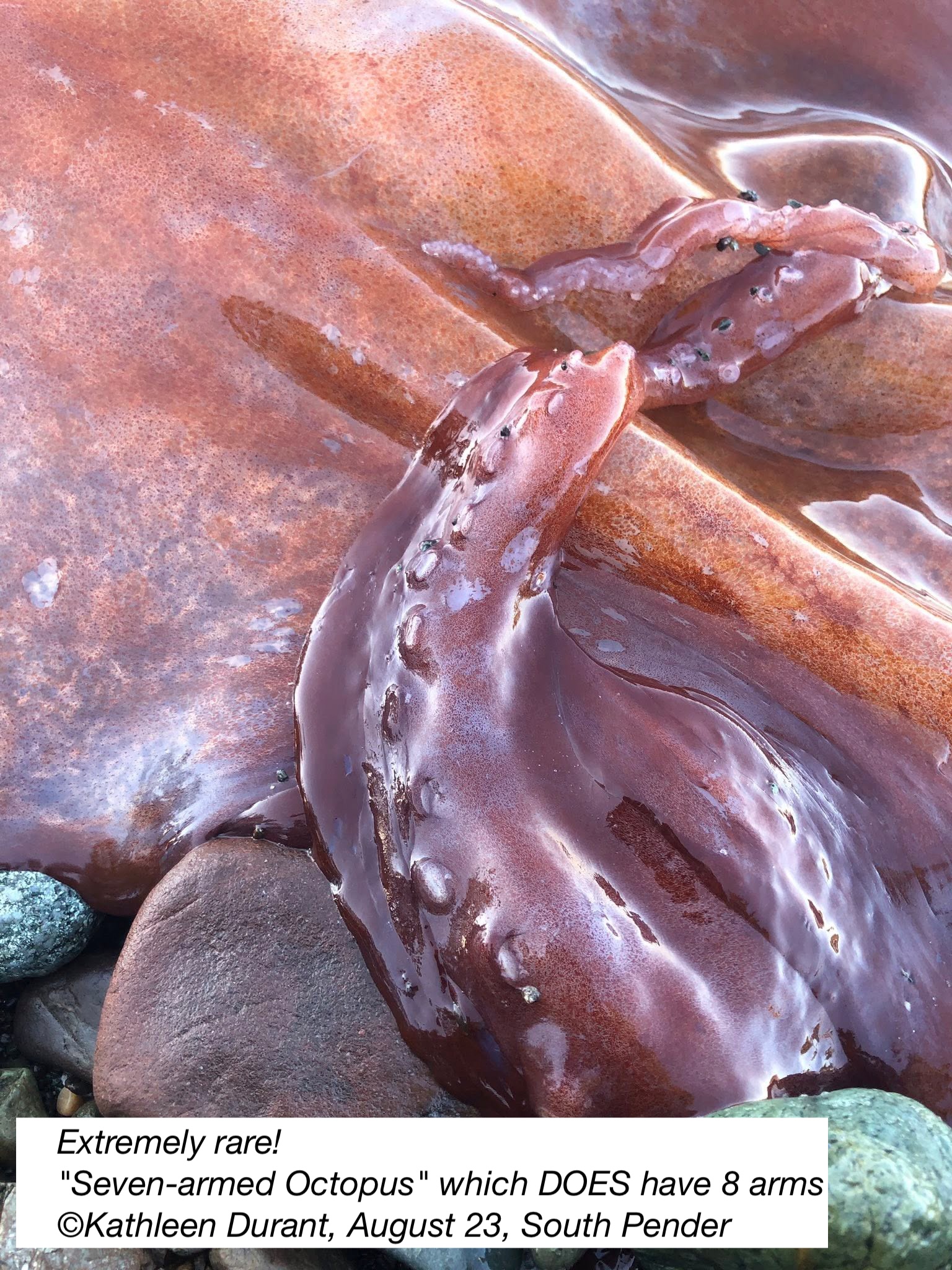
Extremely rare find – Seven-armed Octopus (Haliphron atlanticus)! This is a deep sea species which DOES have 8 arms, but the males do something that has led to this name. Read on!


Females are HUGE at up to 4 metres long and 75 kg. Males are SO MUCH smaller at only up to 30 cm long. This one was about 120 cm long and was juvenile female.

She was found dead by Kathleen Durant on South Pender Island, British Columbia on August 23, 2025. Thankfully, Kathleen knew this was unique and potentially important, took photos, and gathered the individual before it was lost to the tide.

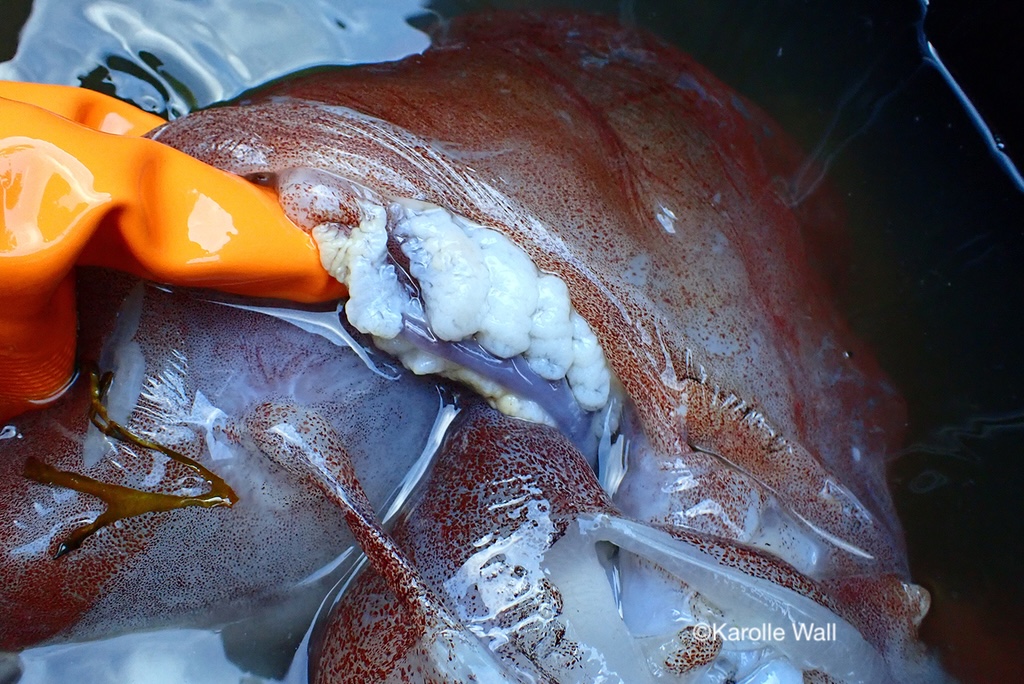
Dissection and photos by Karolle Wall documented the presence of “tiny teardrop eggs”, confirming this was a juvenile female.

She was initially identified as a Seven-armed Octopus by Casey Cook on the Field Naturalists of Vancouver Island (FNVI) Facebook page and confirmed by experts at the Royal BC Museum (in which I has a small role in connecting people). The Museum is where this extremely rare individual is now stored to contribute to knowledge/science.

Why the “Seven-armed Octopus” (also “Septopus” and “Blob Octopus”) when the species has 8 arms? Male octopuses have one specialized arm for reproduction which has no suckers at the tip called the “hectocotylus arm”. The section at the top which has the spermatophore. This section does not have the cells that allows colour and texture to change (the chromatophores). So, because it is not camouflaged, male octopuses hide it. In Giant Pacific Octopuses, the males usually curl up this arm. But, in THIS species, the males tuck away the arm . . . in a sac beneath their right eye! The arm is so well hidden that it looks like they have seven arms.

How rare are they? As an indicator, in an article from 2017 the Monterey Bay Aquarium Research Institute (MBARI) researchers with use of deep sea ROVs (remotely operated vehicles) had only seen three live H. atlanticus in 27 years.

Two truly extraordinary sightings of live individuals in the shallows were by divers Eric Askilsrud and Cam Polglase, both in September 2023. Eric took photos of one near Salt Creek, Washington and Cam videoed one near Ogden Point, British Columbia. Yes, I wish I was those divers.

I also learned from Gregory Jensen of the University of Washington that two other Seven-armed Octopuses are known to have washed up – one in south Puget Sound and the other by Whidbey Island, Washington.

Read the article from MBARI and watch the video above for how it was determined that this species feeds on gelatinous zooplankton – jellyfish, siphonphores and salps – and that the large females MAY use the jellies as defence!


You just never know how you could contribute to science, and wonder. As expressed by Casey Cook: “The ocean’s mysteries don’t always swim at six thousand feet! Sometimes they’re right at our feet.

Thank you so much Kathleen for making this count.


From the article referenced above by MBARI:

“Since female Haliphron atlanticus are so large, they are able to completely grasp and contain a large jelly within their webbed arms and still swim. They use their beak to bite through the bell of the jelly to access the digestive cavity to consume the food contained within and to have access to the more nutritious parts of the jelly. At this point the jelly is dead, but the bell and fringe are still intact. Hoving and Haddock [MBARI researchers] postulate that, given the way Haliphron is holding the bell with the fringe of tentacles dragging behind, the octopus could be using the sticky and stinging tentacles (which still sting after the jelly is dead) either for defense or to capture other more nutritious prey . .

ROVs enabled the first observations of this novel octopod species and its even more novel behavior that revealed an unexpected role in oceanic food webs. Researchers now know that Haliphron, a food resource for top predators such as sperm whales, blue sharks, and swordfish, distributes energy to its predators along a path that incorporates gelatinous species.”

Photo ©Karolle Wall from iNaturalist.
Information from the observation and dissection by the Royal BC Museum included: Total length 120 cm. Longest arm approximately 80 cm. Gonads and presence of tiny tear-drop shaped eggs determined sex as female. She was a juvenile (determined by her size being no where near the maximum of 4 metres for females).

Related TMD post:
Giant Pacific Octopuses – How do they mate?

2026 WILD Calendar

Dear Community, It’s the annual announcement that always gives me great joy while also feeling like a big relief. Next year’s WILD Calendar is now available. Thank you so much to all who helped by voting on the selection of my photos. The 2026 WILD Calendars can be ordered at this link.

My WILD Calendar is aimed at creating awareness about the diversity and fragility of life hidden in the cold, dark, life-sustaining northeast Pacific Ocean. It is the waters dark with plankton that have more life, produce more oxygen, and buffer more carbon dioxide.

It’s the 17th year I have made a WILD Calendar. It’s truly moving to feel the support from you who put these calendars into the world. You are helping increase connection and understanding of our reliance on the Ocean. That’s needed to make the decisions, day-by-day, that consider future generations – from whales, to octopuses, nudibranchs, sea stars, and our own very strange, two-legged species. 💙

Each month’s photo has a detailed descriptor included about the featured marine life. The calendars are $28.50 + tax.

They are large and printed on sturdy paper on Vancouver Island, coil bound with a hole to hang them. 33 x 26.5 cm closed and 33 x 53 cm open (13 x 10.5″ closed /13 x 21″ open).

There are BIG spaces to write your daily adventures. Text is included to indicate when there is a full moon (PDT). 

Photos were taken by yours truly in the Territory of the Kwakwa̱ka̱’wakw (the Kwak̕wala-speaking Peoples), Northern Vancouver Island ©Jackie Hildering, The Marine Detective.


January 2026 image and text

Beauty amid the debris: Mosshead Warbonnet living in a beer bottle. Natural habitat would be a crevice or a tube-worm tube. Glass is by far not the worst debris or pollutant in the ocean. But the ocean is not where any of our waste belongs. Up and down our coast, there is evidence of garbage purposely “deposited” as if it were a black hole into which waste disappears. This is testament to the extreme disconnect between human health and marine health, and ignorance about the marine life “hidden” in these dark waters thick with plankton. May a fish face make a difference. Chirolophis nugator to ~15 cm long.

February 2026 image and text

Candy Stripe Shrimp on a Crimson Anemone: They must be immune to the anemone’s stinging cells (nematocysts). The shrimp benefit from snacks (anemone poop and sloughed tissues) and the anemone may get protection. Greg Jensen of “Crabs and Shrimps of the Pacific Coast” observed in his aquarium that Candy Stripe Shrimp would share space on an anemone with Kincaid’s Shrimp but immediately attacked Snyder’s Blade Shrimp – a species believed to harm the anemone. Candy Stripe Shrimp (Lebbeus grandimanus) to 4.5 cm long. Crimson Anemone (Cribrinopsis rubens) to 30 cm tall and only described as a distinct species in 2018.

March 2026 image and text

Flowing underwater forest: Young Bull Kelp growing toward the sun — providing habitat, refuge, oxygen, carbon buffering, food for many species, and even serving as a navigation aid. Bull Kelp is an annual species. Most of what you see here (the sporophyte) dies off in winter. The sporophyte results from the reproduction of a completely different version of Bull Kelp — the very small gametophyte. The stipe (stem-like structure) can grow up to 36 m in length. The stipe has to grow an average of 17 cm per day over the ~210-day growing period (source: Druel) to drink in the sunlight, photosynthesize, and help sustain life on Earth — above and below the surface.

April 2026 image and text

Magnificent acrobats: Northern Opalescent Nudibranch feeling their way over Eelgrass. The structures extending upward from the head are the rhinophores by which they “smell” their way around. At the base of each rhinophore is an eye with 5 photoreceptor cells to sense light and dark. Species is up to 8 cm long and was reclassified as Hermissenda crassicornis in 2016. Where the ranges of 2 Hermissenda species overlap, this one is now often referenced as the Thick-horned Nudibranch. But, as I have stated previously, who wants to be called “thick” when you can be called “opalescent”?! Let’s go with Northern Opalescent Nudibranch.

May 2026 image and text


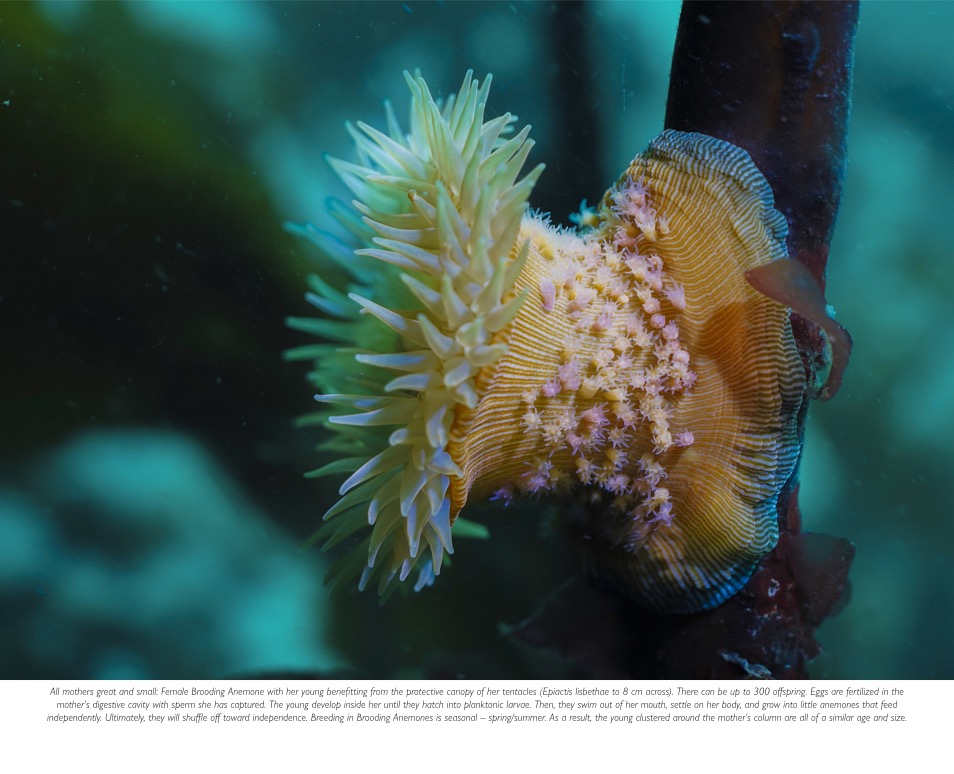
All mothers great and small: Female Brooding Anemone with her young benefitting from the protective canopy of her tentacles (Epiactis lisbethae to 8 cm across). There can be up to 300 offspring. Eggs are fertilized in the mother’s digestive cavity with sperm she has captured. The young develop inside her until they hatch into planktonic larvae. Then, they swim out of her mouth, settle on her body, and grow into little anemones that feed independently. Ultimately, they will shuffle off toward independence. Breeding in Brooding Anemones is seasonal – spring/summer. As a result, the young clustered around the mother’s column are all of a similar age and size.

June 2026 image and text

Sea Otter and Geoduck: Sea Otters were wiped out (extirpated) in BC. From 1969 to 1972, ~89 were translocated to NW Vancouver Island as a mitigation measure for nuclear testing in Alaska. Now, there are 8,100+ (Nichol et al. 2020). Even with incredibly dense fur – which made them so desirable in the fur trade – they need to eat up to 25% of their body mass per day to be warm in this cold ocean. Diet includes urchins which eat kelp. So, with more Sea Otters there is more kelp (with the many benefits). This may be a female. Males often bite females’ noses during mating. Geoducks are the world’s largest burrowing clam and can live for 140+ years.

July 2026 image and text

Red Irish Lord: This fish’s face says a lot about how I have felt about “developments” in the world. You too? Red Irish Lords are powerful ambassadors for the vivid colour in these cold waters (Hemilepidotus hemilepidotus to 51 cm). They are variations/combinations of red, orange, yellow, pink, purple, and white. How could such a colourful fish be camouflaged? Because the life around them has this intensity and diversity of colour. Even their eyes are camouflaged. This Red Irish Lord is on top of Red Soft Coral and Bushy Pink-mouth Hydroids – motionless, waiting for prey to come near. See my blog “Crabs Making Bad Choices” for what happens.

August 2026 image and text

Life in sand: Tube-dwelling Anemone (Pachycerianthus fimbriatus crown to 30 cm wide) and Northern Moonsnail (Neverita lewisii shell to 14 cm across). These anemones retract into their long tube in the sand (up to 1 m long) when pounced on by their predator, the Giant Nudibranch. Moonsnails need a big foot to dig for clams, which they drill into with their radula. The foot of a Northern Moonsnail can inflate with seawater to be 4 times the size of what it is when in the shell. They also rely on sand for their egg masses. Females embed 1000s of eggs between 2 layers of sand bound with mucus. Then, they push the collar-shaped egg mass above the sand.

September 2026 image and text

Humpback Inukshuk (BCZ0339): Nickname is for the marking on the centre of his fluke that looks like a pile of rocks. He is known to migrate to the breeding grounds of Mexico and return (skinny) to the feeding grounds of NE Vancouver Island every year since 2008. Sometimes still here in November. Some Humpbacks leave even later. They have staggered migrations – leaving and returning at different times whereby there can be Humpbacks in BC at any time of year. Inukshuk often rests at the surface during the day and can be so difficult to detect. There is great concern about vessel strike. For whale and boater safety, please see http://www.WhaleSafeBoating.org.

October 2026 image and text

Veiled octopus: I now carry this experience with me. I want you to carry it too – knowing about this Giant Pacific Octopus and feeling at least some of what I felt. I had my head down, slowly moving along in awe of a little species of sea cucumber that was spawning. I looked up from my focus on the small, and there, looking in my direction, was this Giant Pacific Octopus. I backed off. The octopus backed up, into the filamentous brown algae. And then, for some 5 minutes, we looked at one another. The octopus veiled in the algae. Me, wrapped in wonder. One of us a brief, and light-flashing visitor. The other, royalty among the invertebrates.

November 2026 image and text

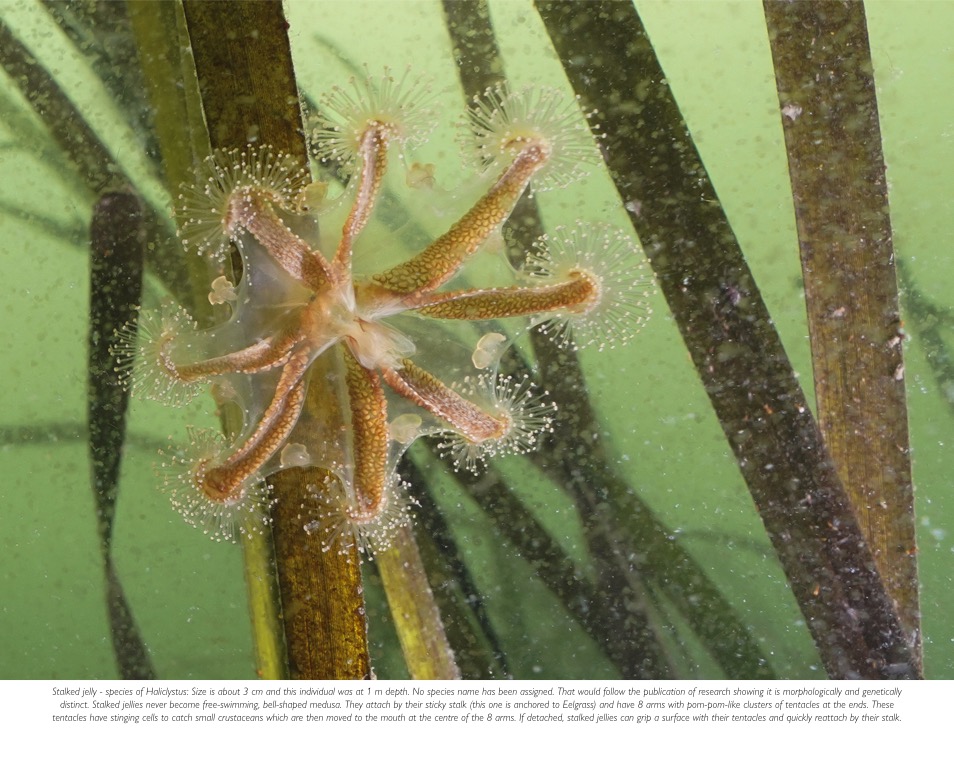
Stalked jelly – species of Haliclystus: Size is about 3 cm and this individual was at 1 m depth. No species name has been assigned. That would follow the publication of research showing it is morphologically and genetically distinct. Stalked jellies never become free-swimming, bell-shaped medusa. They attach by their sticky stalk (this one is anchored to Eelgrass) and have 8 arms with pom-pom-like clusters of tentacles at the ends. These tentacles have stinging cells to catch small crustaceans which are then moved to the mouth at the centre of the 8 arms. If detached, stalked jellies can grip a surface with their tentacles and quickly reattach by their stalk.

December 2026 image and text

Shut the door: The species in the centre is a Red-trumpet Calcareous Tubeworm with its crown (radioles) of high surface area to snare plankton. The colourful, trumpet-like structure on the animal’s lower right is their operculum. It functions like a door, pulling closed after the tubeworm retracts, giving further protection to the worm in its hard, shell-like tube of a home. Serpula columbiana to 6.5 cm long. The other species near the worm are tunicates – our closest invertebrate relatives. In their larval stage, tunicates have a backbone-like structure (notochord). Here, the Broadbase Tunicate is red, and the Mushroom Compound Tunicates are white.

Backcover

Photo of yours truly by Kendra Parnham-Hall.

Example of one of the month pages.

Twelve Minutes With a Giant

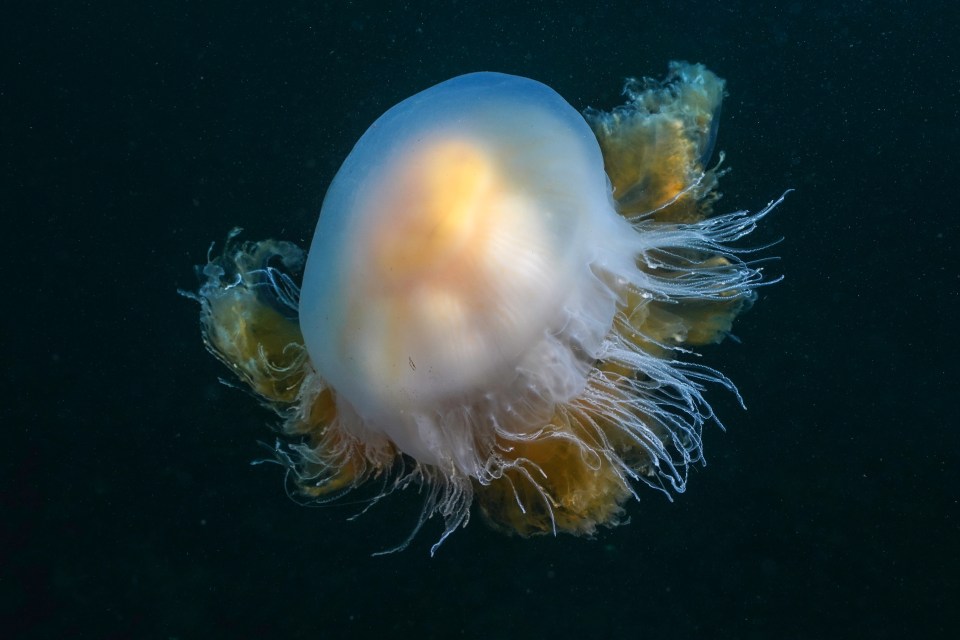
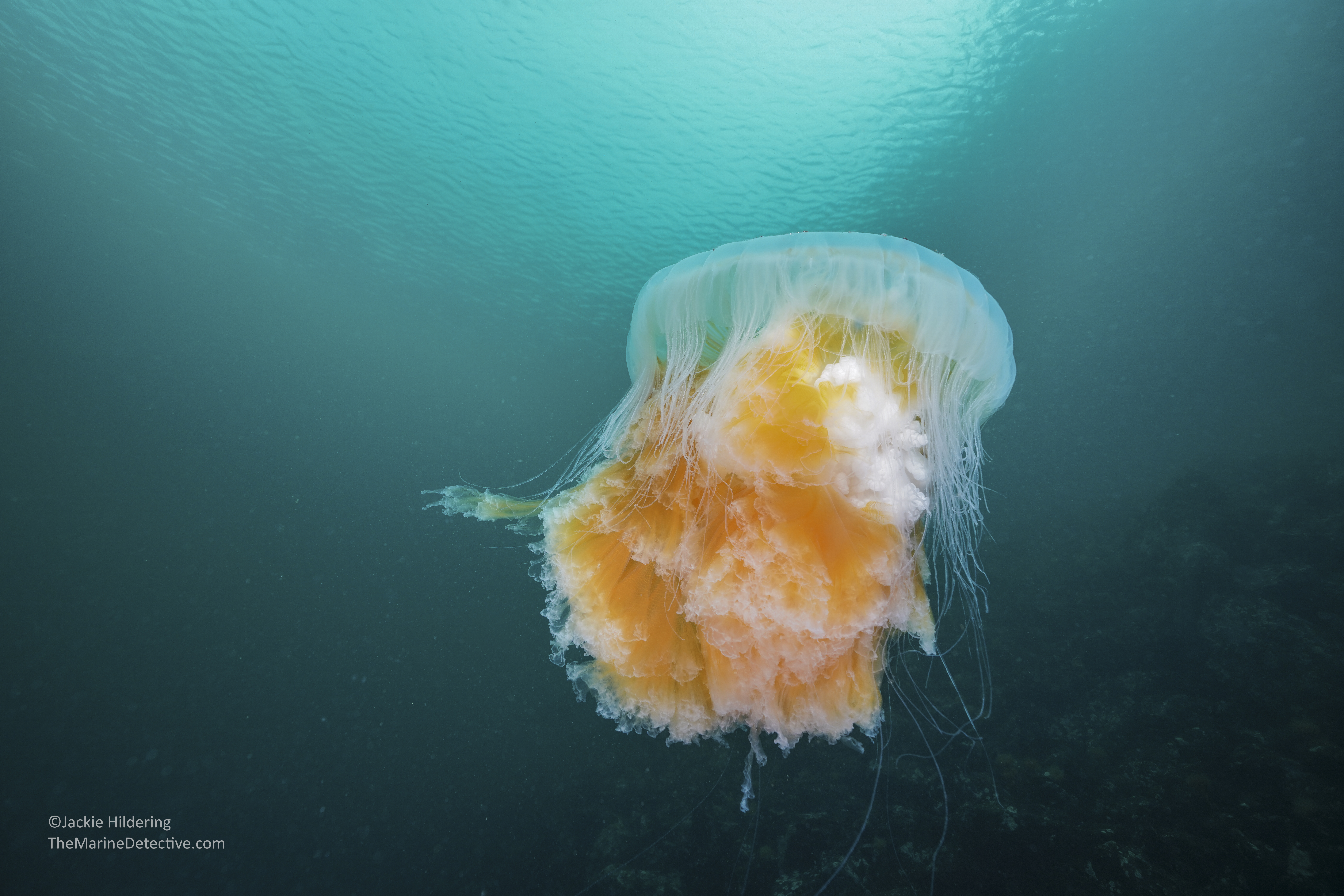
In April, there were quite a few Egg Yolk Jellies around northeast Vancouver Island. I dedicated one dive to trying to find at least one and watch it for a while. You never know what you’ll learn from a species that has survived on Earth for ~500 million years.


Egg Yolk Jellies are also known as Fried Egg Jellies. Gee, I wonder how this species got their common names? 😉 Their scientific name is Phacellophora camtschatica.

They are big at up to 60 cm across the bell. But that’s no where near as big as the other common giant jelly species off our coast, the Lion’s Mane Jelly. They can be 2.5 m across the bell (the bigger Lion’s Mane Jellies are usually not near the coast).

The yellow centres in Egg Yolk Jellies are the gonads. They can be much lighter coloured than the individuals you see here. Egg Yolk Jellies have 16 large lobes that alternate with much smaller lobe-like structures giving the bell a scalloped edge. Each lobe has clusters of up to 25 tentacles making for up to 400 tentacles (25 x 16) and they can be 6 metres long.

Egg Yolk Jelly and dive buddy Linnea Flostrand on a previous dive. ©Jackie Hildering.

I was more than 30 minutes into the dive when I saw the white, slow pulsing through the soup of plankton. The jelly was swimming in my direction. I swam toward the jelly.

For twelve minutes, I watched, photographed, and learned.

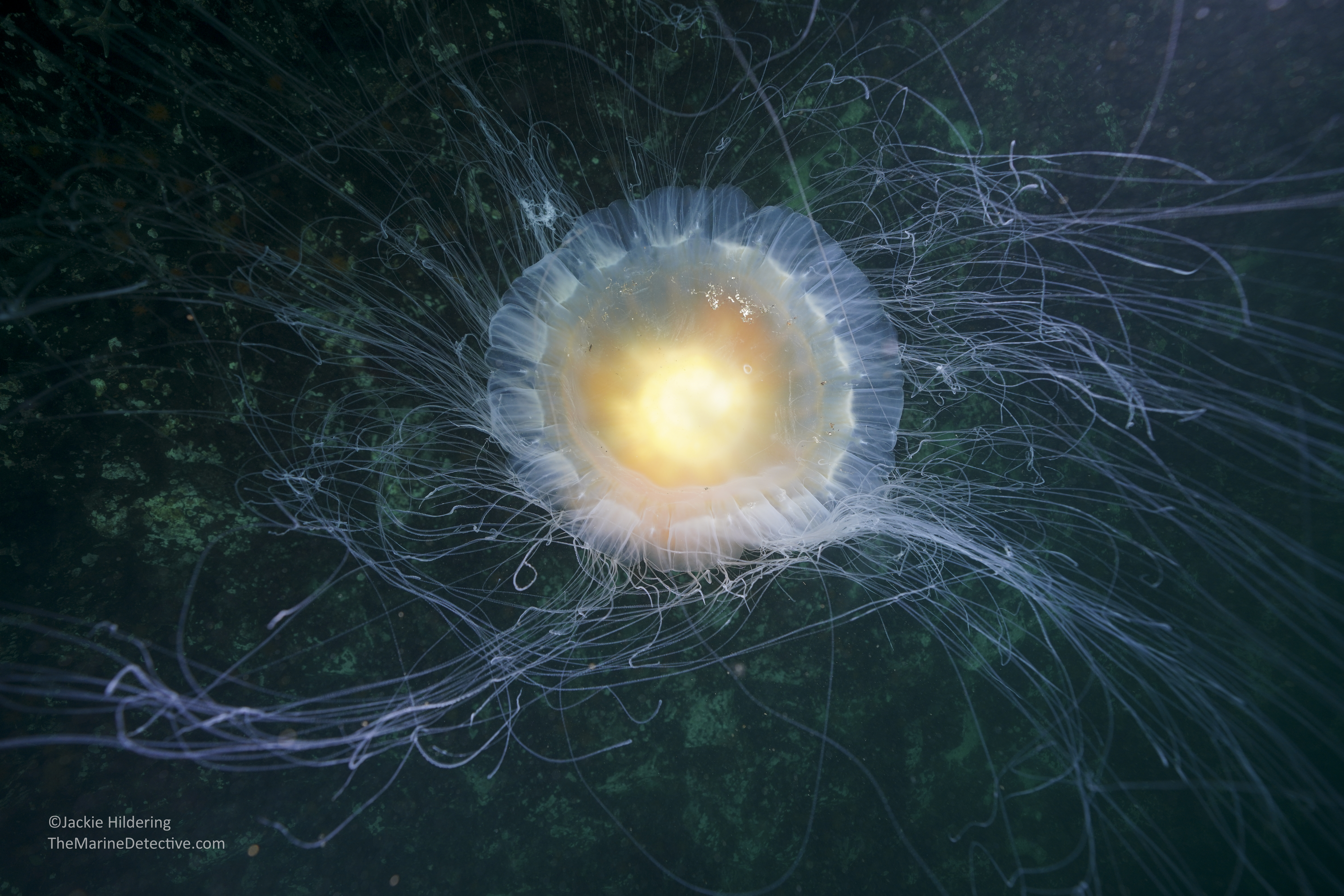
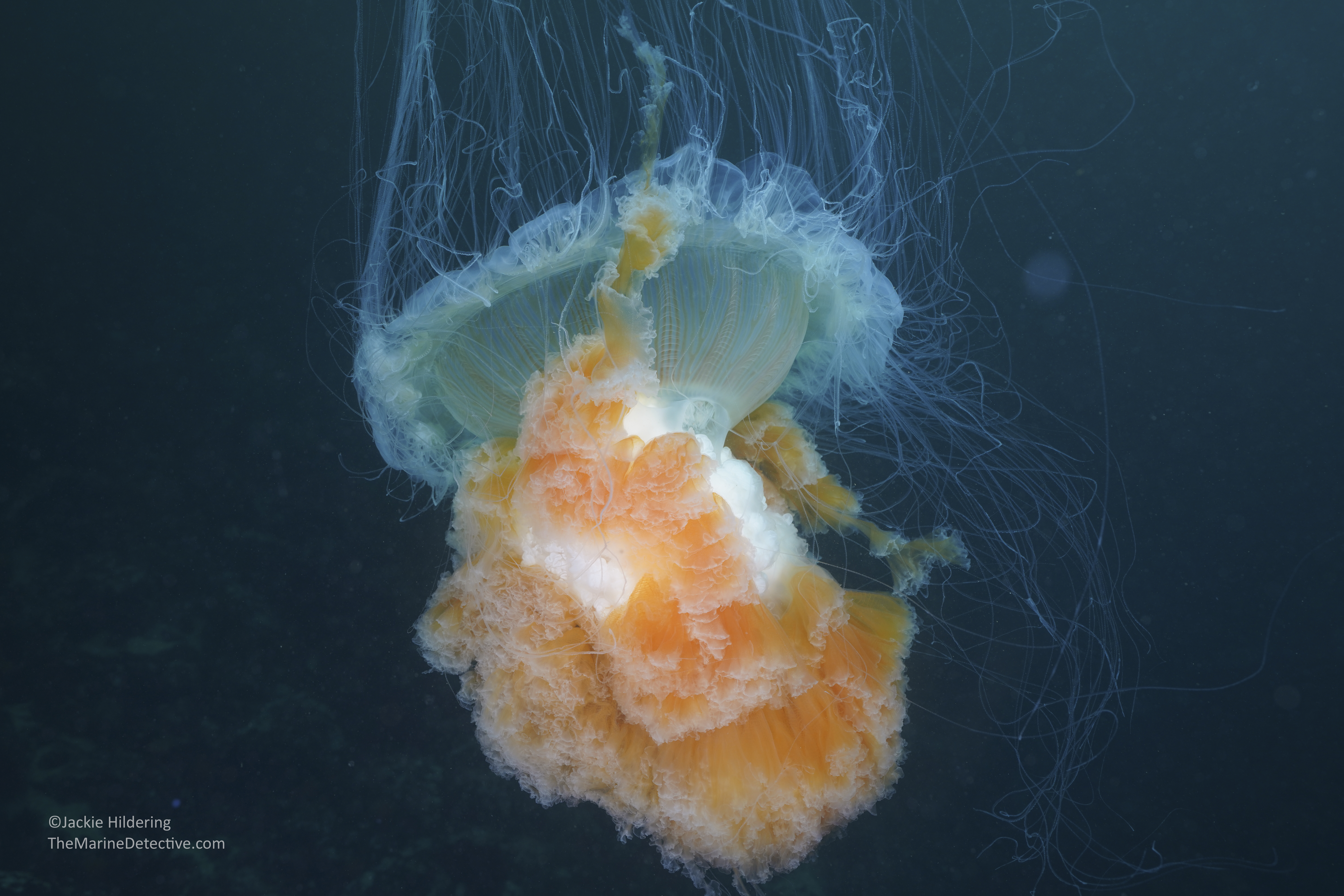
I saw how the tentacles became longer and that the jelly stopped pulsing. Motionless in the water column, the tentacles spread out like a net. See that in the series of photos below?

I don’t think there was a “catch” (they feed on zooplankton, including ctenophores and other jellies). Had there been, the tentacles with the prey would have moved toward the jelly’s mouth.

I now have a much better appreciation for how they are not “passively planktonic”. They are active swimmers responding to cues in the environment. Moriarty et al., 2012 used acoustic transmitters to tag them and noted differences in swimming speed and vertical migration dependent on time of day and tidal cycle.

Jellies have sensory structures called rhopalia.

From Rebecca Helm, 2018:
Each ropalium . . . is packed with microscopic crystals at its tip. These crystals help the jelly sense up and down, by bending in the direction of gravity, similar to our inner ear. They also have a small pigment spot, which likely helps the jelly sense basic light and dark. So far, we’ve got an animal that can tell which way it’s pointing in space, and see rough light and shadow. Next we’ve got a few mystery structures, like the little bonnet-like structure surrounding the rhopalium above, which may act like a jelly nose, helping it sense chemicals in the water . . . Each rhopalium also acts like a pacemaker, helping coordinate jelly movement, similar to the way our cerebellum coordinates ours.”

And you thought they were just “going with the flow”. 💙


All photos in the above series are of the same individual.
April 19, 2025 north of Port Hardy in the Traditional Territories of the Kwakwa̱ka̱’wakw (the Kwak̕wala-speaking Peoples). ©Jackie Hildering.


For more information about the diversity of jellies on our coast, see my previous blog post “Gob Smacked” at this link. From that blog:

Lion’s Mane Jellies and Egg Yolk Jellies. are the only two common jelly species in our waters that can create a sting that irritates human skin, even when the jellies are dead. The stinging cells (nematocysts) work even when the jelly is dead or you get a severed tentacle drifting by your face. The sting from a Lion’s Mane Jelly is reported to be worst than that of an Egg Yolk Jelly.

I’ve been stung by both and clearly it’s not been enough to deter me from striving to get photos of them. But if you have far more skin exposed or are a fisher grabbing nets with many of the tentacles wrapped in them, it is reported to be very uncomfortable.

The solution to the irritation is vinegar (acid), meat tenderizer (enzyme) and I know that many fishers swear by Pacific canned milk as well. Research puts forward that vinegar is the only real solution and that urine does not work at all.


Sources:


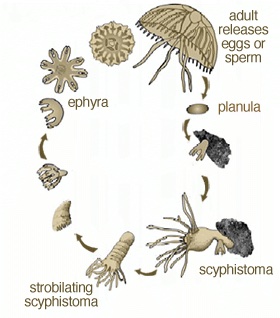
Generalized lifecycle of a jelly from Lucas, 2001 via “A Snail’s Odyssey”.
There is alternation between a polyp with asexual reproduction and a medusa with sexual reproduction.
I have not been able to find specifics about the lifespan of Egg Yolk Jellies other than “species can have a lifespan of several years.” I have questions about why we saw quite a few dead on the ocean bottom around the same time in different locations, and what that may suggest about the lifecycle.
Dead Egg Yolk Jelly in April 2025 with dive buddy, Brenda Irving. ©Jackie Hildering.

Browning Pass Hideaway – fire

The Browning Pass Hideaway in Clam Cove burned today.

There has been a file from the BC Ministry of Forests regarding the tenure of this dive lodge dating back to 2016 (see notice below). There were very significant concerns about long-term neglect (see photos below) and resulting environmental impacts.

The fire was discovered and reported by a dive group from God’s Pocket Resort. No one was injured. Documentation is by Bryan Hillyer.

“At approximately 11:15am, our group of divers noticed smoke billowing out of Clam Cove, located on the north end of Browning Passage. We took the boat into the cove to check for danger and found The Hideaway, a scuba dive lodge, burning. We notified Coast Guard and stayed to monitor the flames to ensure the surrounding forest did not catch on fire. Once the flames receded and the majority of the floating structure had burned, we notified Coast Guard of the status of the fire and took our leave.”

There is no information currently about the cause of the fire, and speculation is not welcome.

Why am I sharing this information?

Because many of us in the BC dive community have a connection to this site be it because of concerns about the neglect and/or because of knowing the owner. Also, it provides insight into how there can be these realities of long-term neglect from those who lease sites, all the way up and down our coast. Who pays? The environment in astoundingly beautiful and important places that, of course, are connected to millennia of First Nations culture.


3D model resulting from photos of the site from Gaël via SketchFab.

Tariffied

Tomorrow, as so many of you know and feel, is Canada’s federal election. And, I’m tariffied. That’s not a typo.

The Canadian election has been dominated by the results of the election on the other side of the border. So many of us are left thinking HOW and WHY did our neighbours ever make that choice?

We feel the global shock waves that are the result – from finance, to human decency, to national security, to consideration of the environment that sustains us.

How and why? Dear Canadian neighbours, now we are there ourselves.

Tomorrow will mirror back to us who we are and what we value (acknowledging and deeply feeling the realities of our non-proportional voting system).

The ugly in the world is not in the shadows.

This is how it began on the other side of the border. He who “says it like it is” – an invitation for more of the ugly to creep out from the dark.

I sense in myself the want to disengage; that I feel disoriented, wounded and even targeted. The leader on the other side of the border is the embodiment of what I have stood against since, as a child, I stepped between a bully and his target.

The gag-inducing hairball, the recoil, the violations of attempted autocracy come together with technology that creates further vertigo about reality, truth, and even who we are.

What to do?

To swing far to the right, is wrong. To create a party that invites and fosters violations of humanity/equality and the environment is wrong.

Feel what you feel and identify your response to it – fading, disengaging, hurting, despairing, scrolling away?

And then say, hell no.

Hell no to the bullying, the attempts to overwhelm, violate, disorient, disempower.

Hell no to handing over our power, identity, values, and the further resources that sustain life (which is exactly the attempted strategy of using the blunt tools of fear and lies).

Tomorrow we vote.

And then we live with the reality, in all cases putting good into the world, having empathy for those who are being sucked under in this vortex of ugly and their inability to see clearly.

Stay afloat, know the way forward, guided by the values that will serve future generations.


I have struggled with whether I will share who I am voting for.

We in the riding of North Island-Powell River have the following reality:

  • A candidate that has attracted and emboldened the far right.
  • The alternative choices of three other candidates.
  • Having to consider strategic voting because the vote for those who do not want the Conservative candidate, will be split three ways.
  • This has led to the decision to vote for the NDP candidate despite the Liberal candidate being someone I know.

Background on the quote I present here from Rita Leon, Sts’ailes, Nation.

It was provided as a comment on a social media post I made by Wendy Burton: “A dear friend, who is an Indigenous elder, told me many years ago, when knowledge of the Residential school system began to seep into my world: Despair is a position of the privileged. I have no time for despair. It stops me from doing my part to heal this magnificent world. Do I sit in the dark and weep sometimes? Yes. Do I rise up? Always.”


Photo: The epicentre of the place I love, learn, and work in the Territory of the Kwakwa̱ka̱’wakw (the Kwak̕wala-speaking Peoples).©Jackie Hildering