Join me in the cold, dark, life-sustaining NE Pacific Ocean to discover the great beauty, mystery and fragility hidden there.

Posts by The Marine Detective

Journey Through Kelp

Bull Kelp is so beautiful, especially now in the early spring when the young “sporophyte” stage is growing at an insanely fast rate. The stipe (stem-like structure) of this kelp species, Nereocystis luetkeana, can grow to be up to 36 m long. The stipe would have to grow an average of 17 cm a day to reach this length in the 210-day growing period (source: Druel). 

The growth rate of the stipe and fronds together (the leaf-like structures) has been documented to reach an average of 25 cm per day (source: Duncan). 

Baby bull kelp

Baby Bull Kelp

It is at this early stage of growth too that Bull Kelp is an intense colour green unlike anything else I know. When older, the colour darkens to an olive green. 

Kelp is an alga, not a plant. However, like plants, algae also photosynthesize, converting the sun’s energy into food. Algae have simpler structures and different chemical pathways than plants.

Young Bull Kelp grows so fast to allow the leaf-like parts, called “fronds”, to be closer to the sun so that more food can be made.  

Sun streaming through a Bull Kelp forest.

The round, floating part of the kelp, is the “pneumatocyst”. This bladder-like structure is completely hollow and is filled with carbon monoxide (NOT carbon dioxide), allowing the long fronds to drift at the surface to catch the sun’s rays. 

Apparently, there is enough carbon monoxide in Bull Kelp to kill a chicken! Now that’s valuable information. See my blog “Enough Carbon Monoxide to Kill a Chickenat this link. 

The stipe is also hollow. I’m sure it is not what Nature had intended, but this allows we humans to play the stipe of Bull Kelp like a trumpet or didgeridoo! The stipe gets thinner and whip-like near the holdfast which is why Bull Kelp likely got its name because the stipe is shaped like a “bull whip”.

Bull Kelp does not have roots. Rather it is a “holdfast”, a tangle of  woody structures, that anchors Bull Kelp onto rocks. However, if rocks are too light to counter the floatation of the pneumatocyst, the kelp will actually change the ocean bottom by carrying away smaller rocks, likely ending up washed onto the shore. 

Bull kelp holdfast. No roots.

Bull Kelp holdfast. No roots. See my blog on holdfasts at this link. 

Bull Kelp always grows in patches, truly forming an underwater forest that is life-giving for the same reasons as terrestrial forests: kelp forests buffer the climate change gas carbon dioxide; produce oxygen; and provide food and habitat for so many other organisms. Bull Kelp forests are, in fact, estimated to provide habitat for some 750 species of fish and invertebrates (animals without backbones).

Sea urchins are one of those invertebrates, living in the forest and grazing on a lot of Bull Kelp. If Sea Otters, Mink, Wolf-Eels and other predators of urchins did not keep urchins in check, there would be further reduced kelp forests. Sea Star Wasting Syndrome has devastated the world’s largest sea star species, the Sunflower Star (Pyncopodia helianthoides) which is a predator of Green Urchins. This has led to too many of these urchins and an increase in the number of urchin barrens. Please see my blog here for information on urchin barrens and Sea Star Wasting Syndrome. 

Kelp forests are not what they used to be for reasons far beyond our foolishness in over-harvesting Sea Otters. There used to be such dense forests that it is theorized “Ancient humans from Asia may have entered the Americas following an ocean highway made of dense kelp.

All coastal boaters still benefit from kelp. It is a navigational aid since, where it grows, you know you there is shallower water.

We divers have yet an additional reason to value kelp.  Since it is so strong,  we can hold onto it if we need to during our safety stop (3 minutes at 5 metres depth) or if needing to gradually pull ourselves down into the depths or back to the surface.   

Oh – and you can eat it. (I love pickled young Bull Kelp!) 

And yes, you could do puppet shows with Bull Kelp, cutting a face into the bladder like you would into a jack-o-lantern. The fronds even look like two pig-tails! 

THEN there is how Bull Kelp reproduces. The offspring look nothing like their parents. Please see here for my blog on the remarkable phenomena that is “alternation of generations”. 

But for now, come underwater with me. Come into the forest, breath in, breath out and worship the kelp!


My additional blog items on kelp include:


Sources:

Sea Slug Easter Eggs For You!


Giant nudibranch's eggs laid at the base of its food, the tube-dwelling anemone. Each dot is an egg. © Jackie Hildering

Giant nudibranch’s eggs laid at the base of its food, the tube-dwelling anemone. Each dot is an egg. © Jackie Hildering

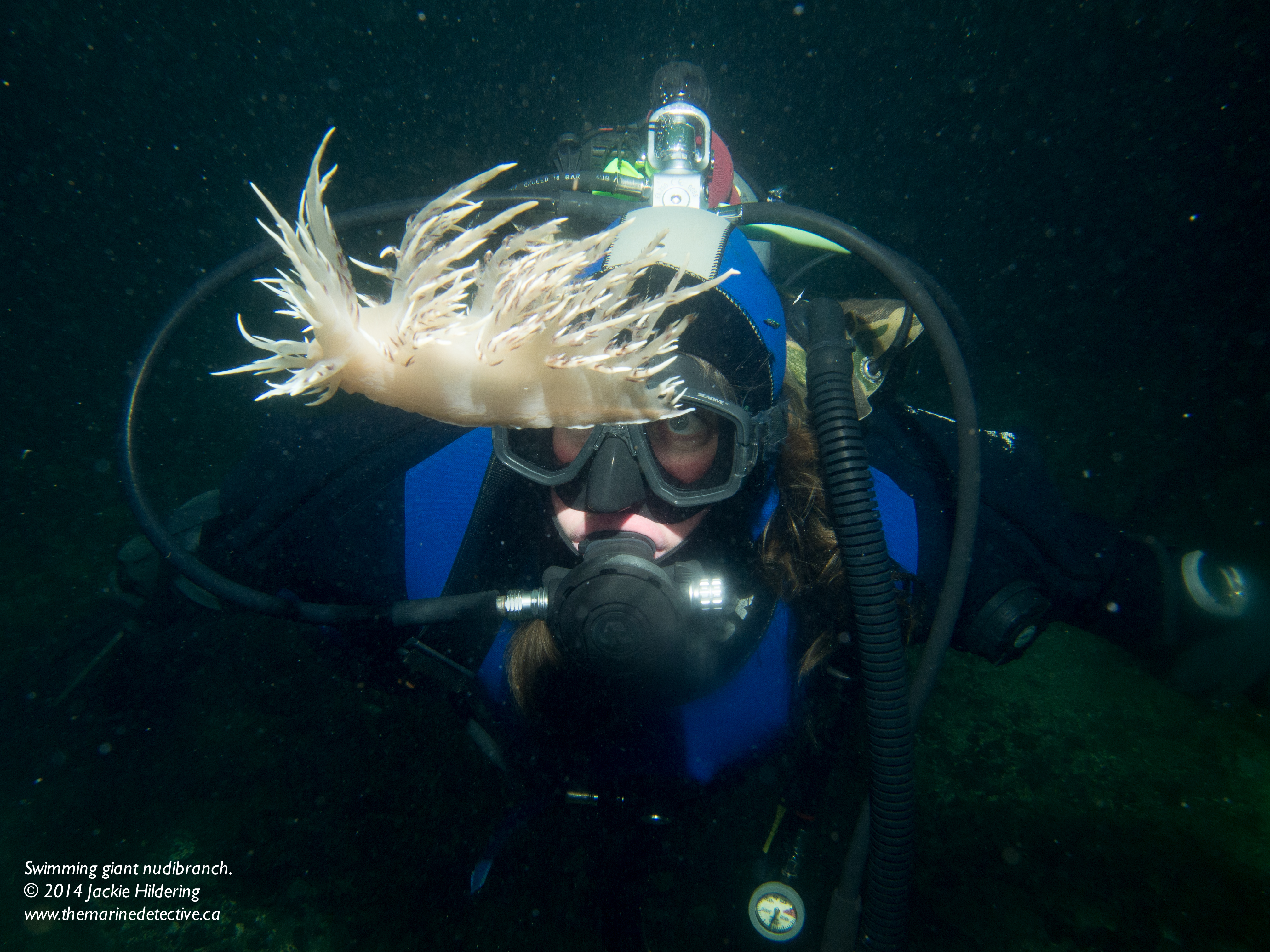
To follow up on last week’s posting about the feeding of giant nudibranchs, “Who’s eating who”, I now share images of the giant nudibranch swimming and of its egg-laying behaviour.

I know that these are the strangest eggs you will see this Easter!

The story of how the eggs come to be is pretty unique too.

There are no girl or boy sea slugs. They are both male and female; they are hermaphrodites. This means that when sea slugs mate, both animals “get pregnant” and lay eggs.

Sea slugs need this adaptation because it is really difficult for them to find another of their kind.  They are relatively slow moving animals that depend on feel and smell to get around.

They don’t search around aimlessly for a mate though. That would be a waste of energy. The chances of finding a member of their own kind are greater near their favourite food.  To make this clearer, imagine that you were someone who really loved eating pizza and you wanted to find someone else who loved pizza.  The best place to find them would be at  . . . a pizza parlour!

For the giant nudibranch, you know from last week’s posting that they love to eat tube-dwelling anemones so they are likelier to meet a mate around this prey.  They also may give off chemical signals (pheromones) to announce that they are in the area and “looking for love”.

Compared to faster animals that can see though, the chances of sea slugs finding one another are much smaller.  So when they do meet, it is important that they really make it count and have as many babies as possible especially since the eggs will hatch into plankton. This means that many baby sea slugs will become dinner for filter feeders like anemones and barnacles.

How to have as many babies as possible?  Both should lay eggs! This is why they are hermaphrodites; not just a male or female.  The sea slugs line up right side to right side and exchange cells so that they can both lay eggs.

I will share much more about the love life of sea slugs in future postings. Every sea slug species lays eggs that look very different. One of the “cases” I have worked on the longest is to figure out what each species’ eggs look like. A great clue in trying to figure this out is that sea slugs most often lay eggs on their food.

You can imagine my delight when I found a big mass of eggs at the base of a tube-dwelling anemone!  Knowing that the giant nudibranch preys on this species, the chances were very, very good that these were its eggs.

When you follow the link, you can see a larger picture of the eggs mass and get an idea of just how many eggs are in this string (each dot is an egg).

I have also included video of the giant nudibranch swimming for your Easter weekend pleasure.  You’ll see that the nudibranch swims upwards but, when it wants to go down, it just stops moving and gently drifts back down to the ocean bottom. You’ll also see that I am pointing my dive light at the animal and how this makes colours look different underwater.


Who’s Eating Who?

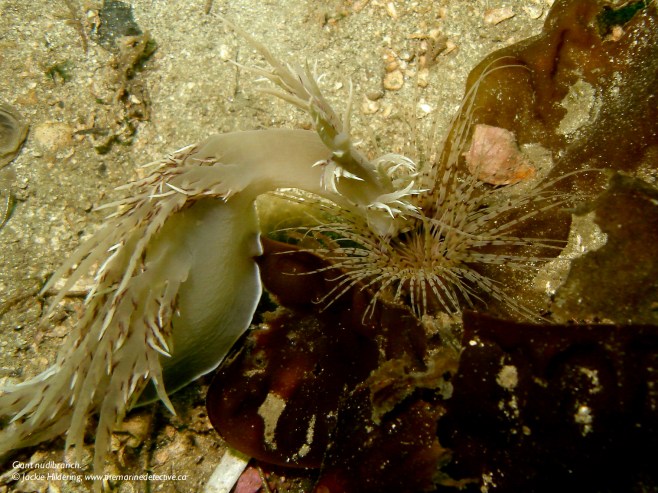
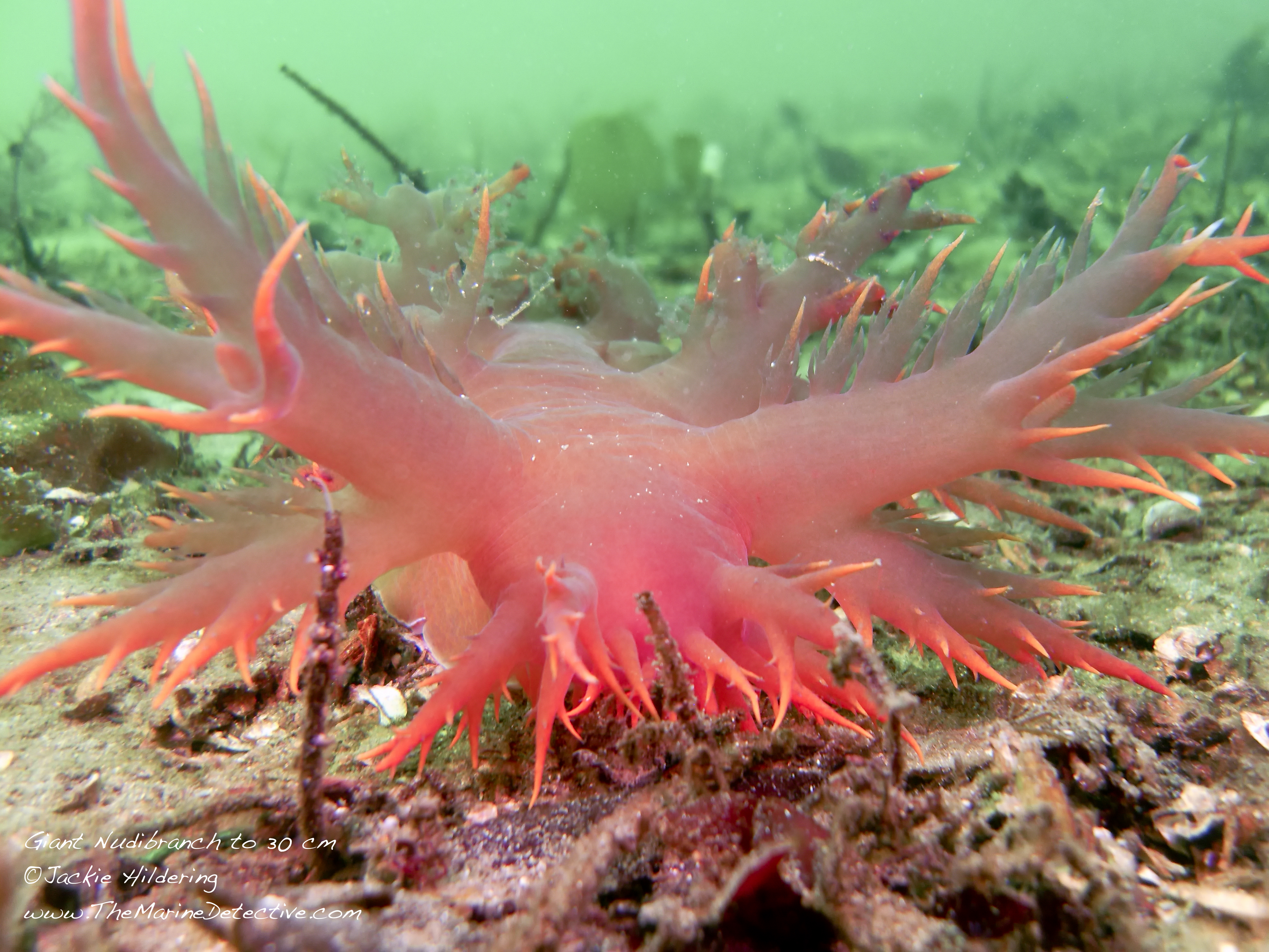
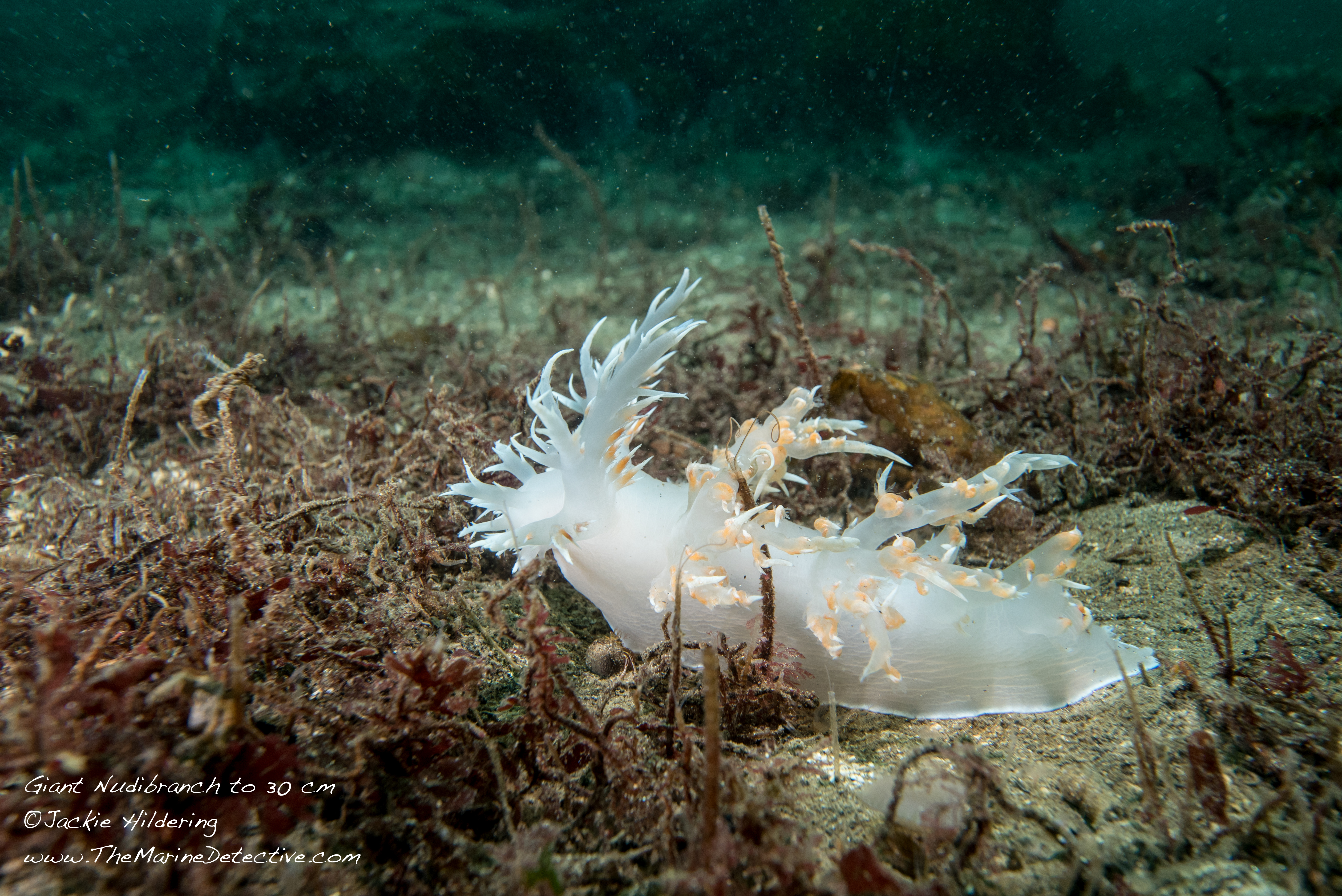
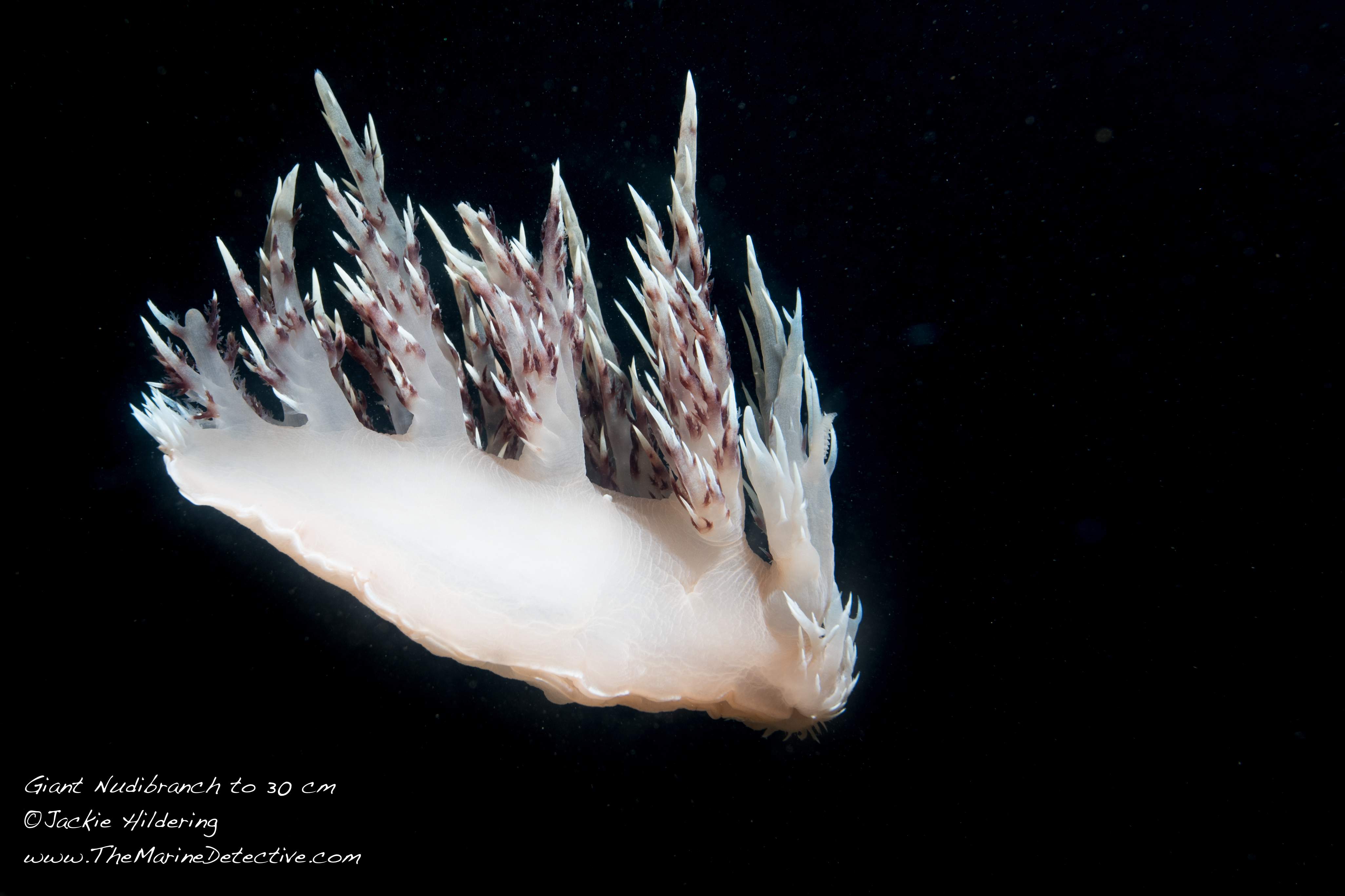
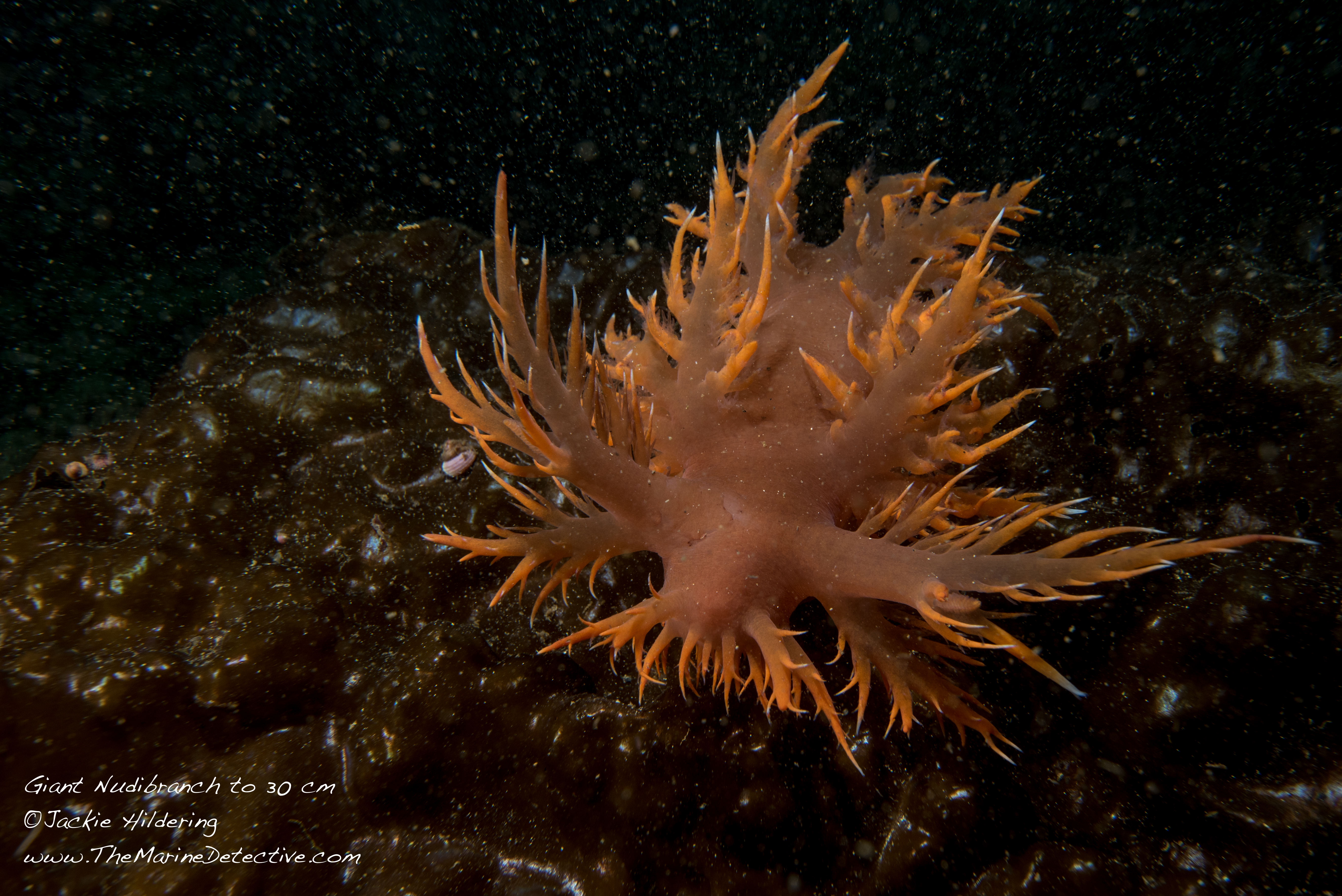
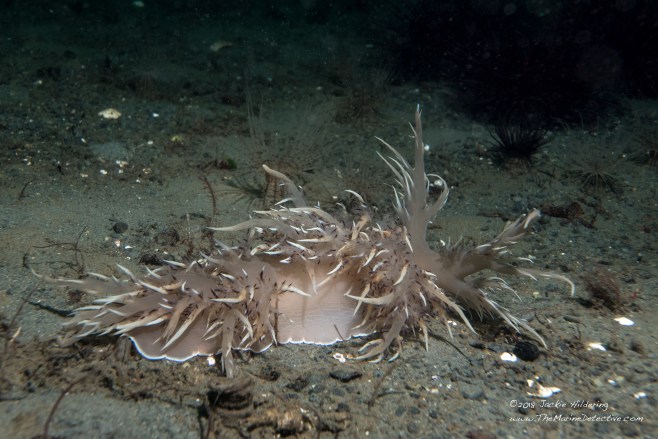
Giant Nudibranch (Dendronotus iris) on the prowl for tube-dwelling anemones. This species of nudibranch has great variation in colour. © Jackie Hildering

Giant Nudibranch on the prowl for Tube-Dwelling Anemones. This species of nudibranch has great variation in colour. See photos at end of blog. ©Jackie Hildering

This “case” features the Giant Nudibranch (Dendronotus iris to 30 cm long) and the Tube-Dwelling Anemone (Pachycerianthus fimbriatus).

The Giant Nudibranch’s favourite snack is this anemone species. It is not impacted by the anemone’s stinging cells (nematocysts). 

Giant nudibranch launching into a tube-dwelling anemone. © Jackie Hildering

Giant Nudibranch launching into a Tube-Dwelling Anemone. © Jackie Hildering

The Tube-Dwelling Anemone is therefore adapted to be able to withdraw into its tube (which can be up to 1 m long)  in an attempt to get away from the predator sea slug.

And the battle is on! The Giant Nudibranch patrols the sandy ocean plains “looking” for the Tube-Dwelling Anemone. When it finds one, it rears up and pounces, mouth parts extended in the hopes of grabbing onto the anemone. When the anemone senses the nudibranch’s attack, it withdraws into its tube.

Wait till you see what happens to the Giant Nudibranch!

See below for a short clip of such an attack.

[

But that’s not all, this nudibranch species also swims.

By lifting off, it may land somewhere with better chances for feeding and mating. See video below. 

OLYMPUS DIGITAL CAMERA

As is also generally the way with sea slugs, they also lay their eggs on their prey.

And oh the diversity in colour among Giant Nudibranchs. See photos below.


And here are a few more pouching on their prey.


Interspecies interaction: When this Giant Nudibranch touched the Leather Star, it touched it again and then recoiling with an acute change in direction. The diet of Leather Stars (Dermasterias imbricata) is omnivorous. From Neil McDaniel: “Eats a wide variety of prey, depending on the locale. On the open coast it consumes plumose anemones and tunicates; in sheltered areas it eats orange sea pens, sea vase tunicates, encrusting sponges and bryozoans.” So, Leather Stars are not likely to eat a Giant Nudibranch, especially because Leather Stars are not particularly fast sea stars (15 cm/min) and Giant Nudibranchs can swim away (yes, that’s right they swim). Leather Stars’ skin is known to contain a unique chemical “imbricatine” that does elicit an escape response form Swimming Anemones so . . . whether the Leather Star felt or “tasted” odd to the Giant Anemone, it did “decide” that distancing was the better way to go.

Note: Dendonotids are not known to utilize the stinging cells (nematocysts) of their prey. From the Sea Slug ForumThere has been some confusion in the literature concerning the presence of branches of the gut in the ‘gills’ or ‘cerata’ of species of Dendronotus. Firstly there is no evidence to suggest that any species of Dendronotus has cnidosacs at the tip of its dorsal processes in which to store nematocysts. In fact there is no evidence that they store nematocysts from their prey anemones in any part of their body.

Manta Ray Magic – Fiji


In December of 2009, I had the extraordinary privilege of seeing manta rays while diving off Kaduva Island with the dive crew from the Matava Eco-Resort. It is thanks to the environmental ethic of this team that these dives are very controlled to make sure the animals are disturbed as little as possible.

The video allows us to share all the observations listed below as well as giving you the chance to laugh when you hear my underwater screams of joy when the mantas break from their feeding behaviour, get into a formation of 5 animals and swim by us 4 times!  I didn’t even realize I was making these sounds but my dive buddy was there behind me, capturing it on video.


The video shows:

  • Holy manta rays are big!  They are the biggest rays in fact; up to almost 7 m across and more than 1,000 kg.  The ones we saw are probably about 4 m across.
  • They are very “alien” looking animals.  They feed on plankton and small fish and can scoop more food using the two big paddle-shaped flaps (“cephalic lobes”) that are just to the inside of their eyes. You will see from the murkiness of the water that it is thick with plankton.  The circular diving pattern of the mantas is believed to help them concentrate the plankton.
  • That manta rays have a relatively short tail for a ray, no stinging spine and you’ll see one animal in the video that has had their tail shredded off, likely by a tiger shark.
  • That sometimes there are remoras attached to the manta rays. These fish may help in removing parasites and have the benefit of transportation, being less visible to predators and possibly getting some scraps as snacks.
  • That mantas are incredibly graceful, having very flattened bodies and big wing-like fins.
  • They can be told apart as individuals. Of course the one with the shark injury is easy to tell apart from the others. There is also one that has had its left fin tip bitten off.  But if you look even more closely, you’ll see that each animal has unique markings on their upper and undersides. We passed on our photographs and video for research but, even though they are easy to tell apart, so little is known about them.
  • They are intelligent and coordinate their movements. This is what I found the most fascinating of all, how they knew to all get into a line at the same time and as each of them came by, they were observing me.  They pivoted their eyes back to get the longest look possible at the strange creature who couldn’t stop from screaming out in sheer amazement.

California Sea Lions Barking Underwater – video!

This posting is typical for why I set up this blog (and the identity of “The Marine Detective”). I want to share what I learn from my marine adventures.

I was diving off Northern Vancouver Island when my buddy and I had a “swim-by” from several male California Sea Lions and one male Steller Sea Lion. 

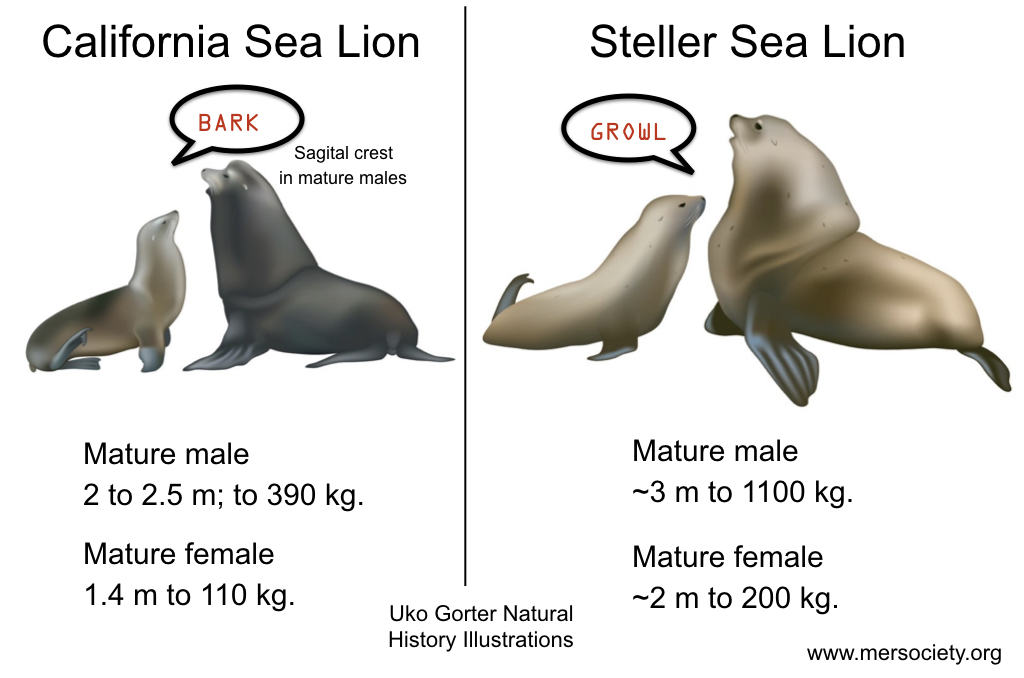
Many of you know that the two species can be discerned very easily because California Sea Lions bark and Steller Sea Lions growl. Yep, you could  be blind and determine which sea lions species is present. 

You can’t miss the barking of California Sea Lions when they are on land. 

What I hadn’t fully realized was . . . you can hear them bark underwater too!

See my video below./strong>


Please note that it is against my ethics (and the law) to target seal and sea lion haulouts for the purposes of diving with them. This certainly constitutes “disturbance” of marine mammals and also leads to the animals losing their wariness and becoming habituated to humans. This has led to significant human injury. It definitely does not help the seals and sea lions either to be habituated to people as there are those who believe there are “too many” and that they should be killed. 

However, sometimes, as a result of being in their ocean, we have unexpected encounters like the one videoed here.

Update 2018: The amended Marine Mammal Regulations (federal law) now specifically include: “No person shall approach a marine mammal to, or to attempt to: (b) swim with it or interact with it.”