I’ve wanted to write a blog about chitons for so long because, they are wondrous and . . . we need wonder.
If you are fortunate enough to live near the Ocean, chitons are there, on rocks right in the intertidal zone, descendent from ancestors that date back ~500 million years. Chitons are in fact referenced as living fossils since their body design has not changed significantly for more than 300 million years.
Other members of this class are found at great depth. There are about 1,000 species worldwide with 50 known to live in the range from Baja California, Mexico to the Aleutian Islands, Alaska.
What makes them unique among molluscs (the soft-bodied invertebrates) is that while some molluscs have no shell (octopuses, squid and sea slugs); and some molluscs have one shell (snails, abalone and limpets); and some molluscs have two shells (clams and oysters) . . . chitons went their own way to all have EIGHT shells, known as plates.
This is reflected in the name of the class to which they belong – the “Polyplacophora” which translates into “many plates” in Greek. Oh and “chiton” also reflects that they have multiple shells. Chiton is Greek for “coat of mail”. Chiton is pronounced “ky-ton” by the way.
Chiton anatomy – diagram retrieved from this source.
But all the preceding information about chitons is what you could read in a field book. Let me share the wonder of chitons with you as it has awakened in me, taking my appreciation far beyond the limits of drawings and words in biology textbooks.
Chitons are THIS.
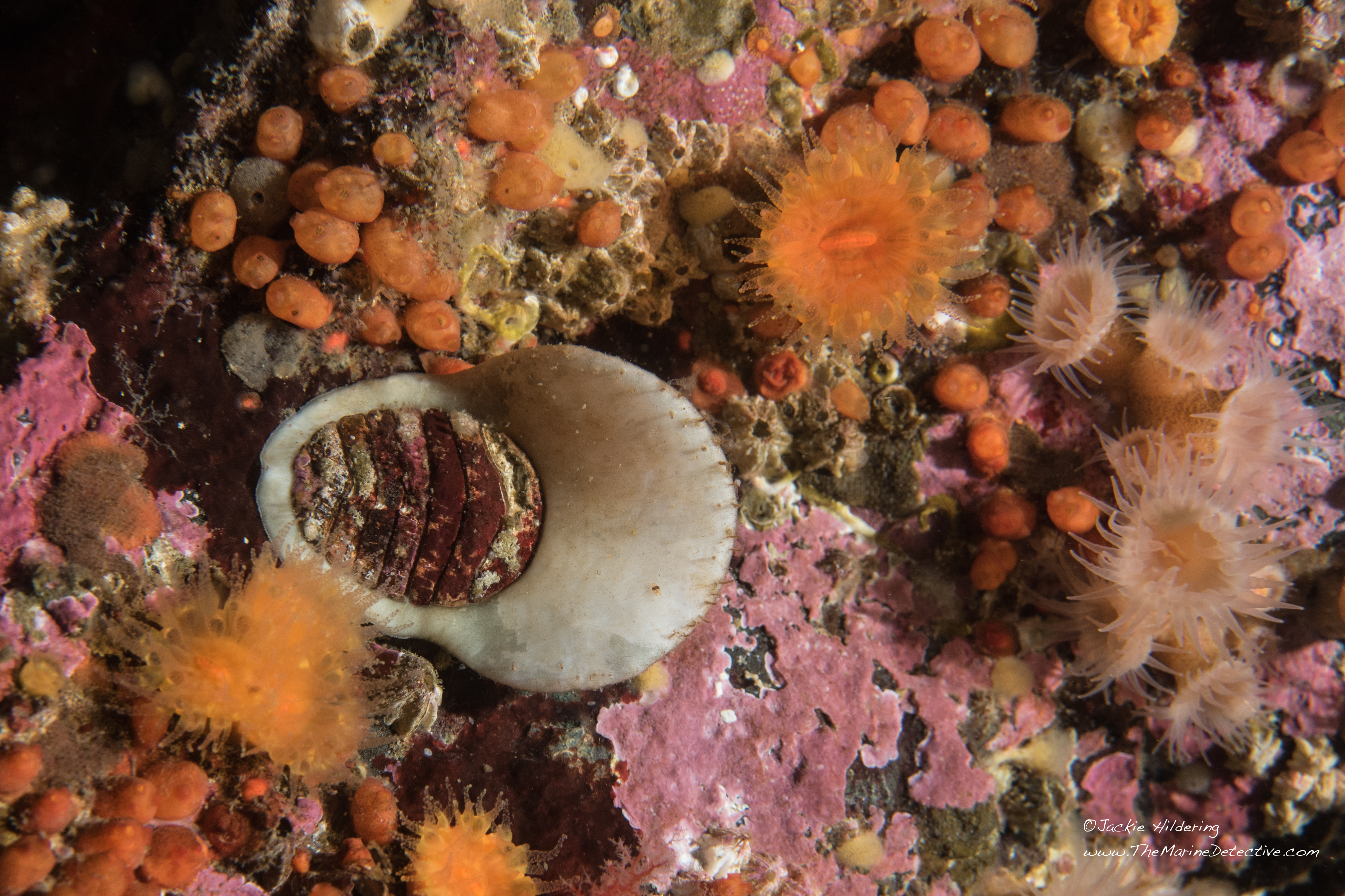
Lined Chiton – Tonicella lineata to 5 cm long. This is also the species in the photo at the top of this blog item. There’s such diversity in the colour of this species!
And THIS
Believe this one is a Blue-line Chiton – Tonicella undocaerulea to 5 cm long.
And THIS
Woody Chiton – Mopalia lignosa to 8 cm long.
And THIS
Black Katy Chiton aka Black Leather Chiton – Katharina tunicata to 15 cm long.
And THIS
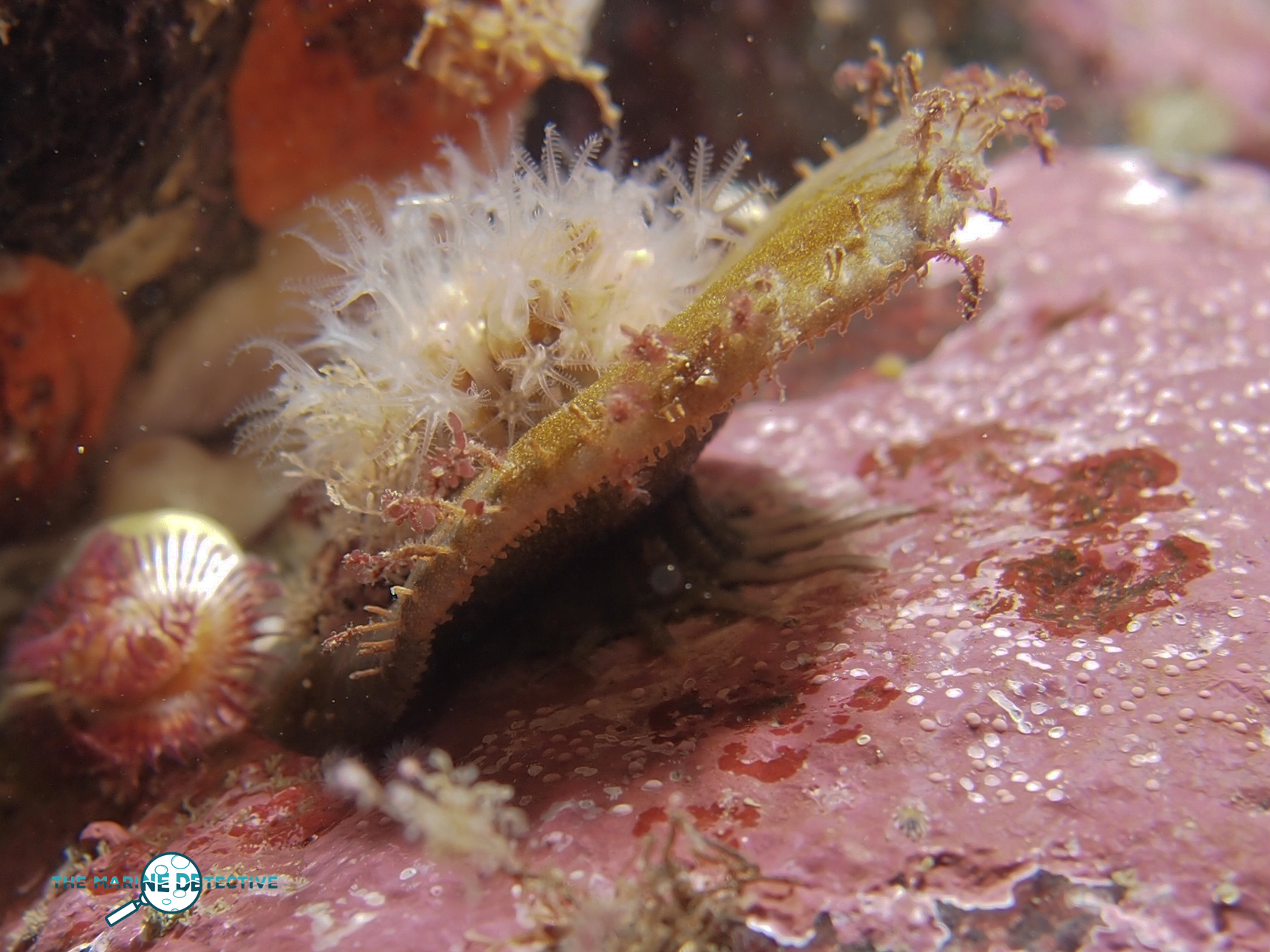
Red Veiled-Chiton (Placiphorella rufa to 5 cm long) – unique amongst chitons in how it feeds. Most chitons graze, scraping algae off rocks with their radula (see video at the end of this blog). However, Veiled Chitons are carnivores! When an animal wanders under their veil, this triggers the veil to drop and then . . . lunch. You can see how quickly that happens in the video at the end of this blog.
Veiled Chiton – Placiphorella velata to 6 cm. Soft coral is growing on top of the Chiton.
By having eight plates and a band of muscle (the girdle) chitons are flexible and can secure themselves really well to uneven or curved surfaces. This is very different from molluscs like limpets. With their single shell, they have to be on a very flat surface to be secure, and therefore safe from predators.
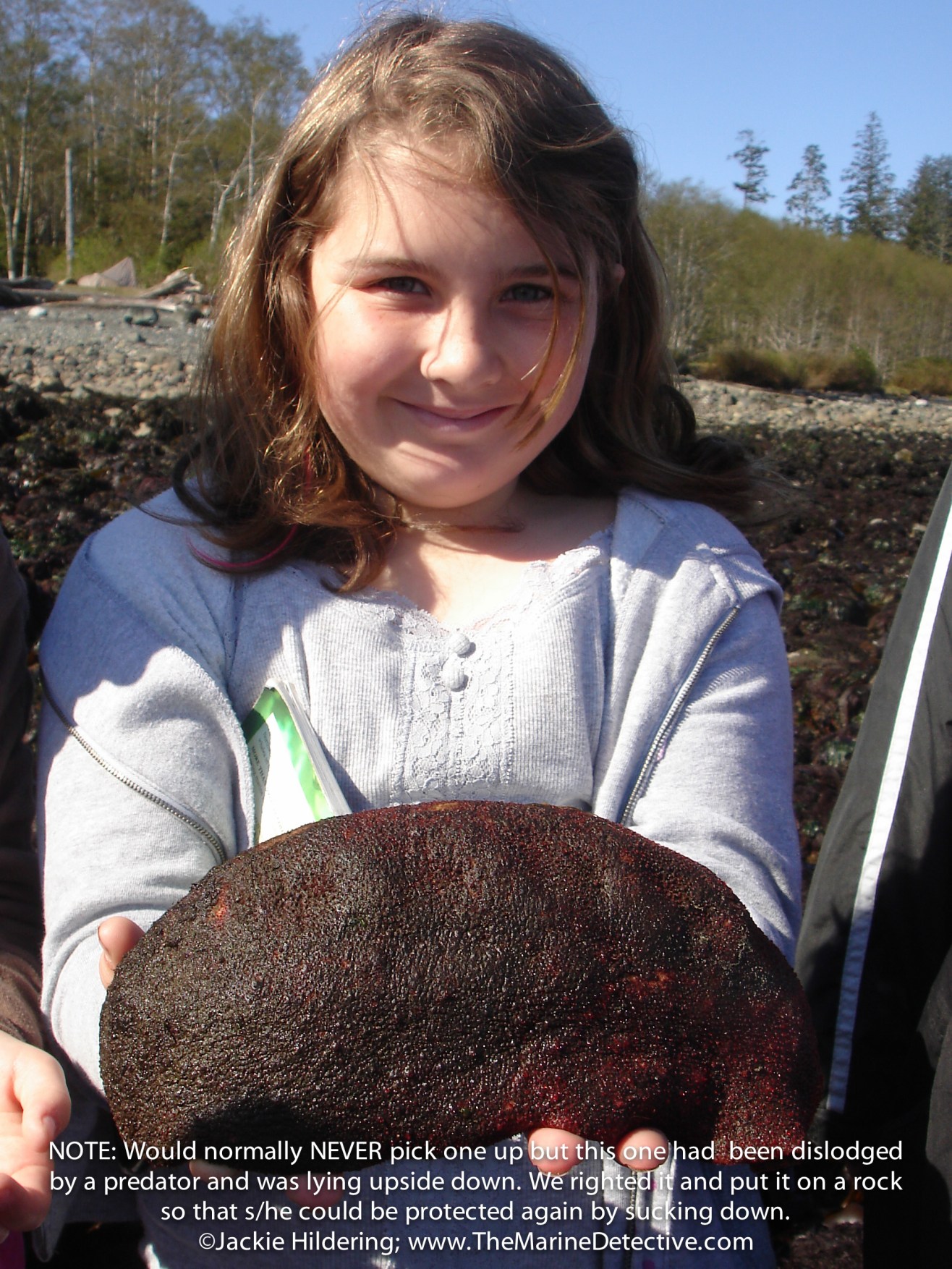
In most species of chiton, you can see the eight plates. The exception is the giant in the group – the Gumboot Chiton aka the Giant Pacific Chiton. In this species, the girdle fully covers the plates.
See the photo below and my blog dedicated to Gumboot Chitons at this link. That blog includes photos of their “butterfly shells” and video of Gumboot Chitons spawning. Yes, you can then discern males from females!
Gumboot Chitons are another species in these rich waters that are the “biggest of their kind in the world”. The maximum size of Cryptochiton stelleri is reported to be 35 cm!
The plates on the right are from a Gumboot Chiton.
Nature once presented me with the following opportunity to take a picture that shows the diversity of molluscs. I did not move the species into the positions you see in my photo below.
Mollusc biodiversity 1. Keyhole Limpet, protected by its single-shelled cap and by sucking down on flat surfaces. This individual is in a precarious position for predation because it is not secured to a flat surface. 2. Wrinkled Amphissa Snail, protected by its single shell and a keratinous “trapdoor” (operculum) that seals the shell. 3. Pomegranate Aeolid (nudibranch species), with no shell but protected by the stinging cells obtained from its prey – the Raspberry Hydroid. 4. Blue-Line Chiton protected by its eight shell plates and a strong band of muscle that lets it solidly adhere to non-flat surfaces.
These extraordinary animals are not jellyfish. In fact, they are more closely related to you than they are to jellyfish.
These are salps. They are planktonic tunicates with an astounding lifecycle and whose importance includes cycling of nutrients and reducing carbon.
Natasha Dickinson and aggregate form of Salpa aspera. Natasha was my dive buddy on the dives I reference here. We were diving with God’s Pocket in Browning Pass. Photo: Jackie Hildering.
When diving this past April, we happened to be in a bloom of the salp species “Salpa aspera“.
It was truly mind-rupturingly, staggeringly astounding to be carried in the current with so many chains of clones snaking by (they are jet propeled). Yes, I had to make up a new adverb just for this experience!
The stomach is the dark, circular organ you see in each individual in the chain (aggregate).
We also saw an individual break from the chain and move independently! More on that below.
Male Kelp Greenling nipping at Salp aspera. We also saw multiple rockfish species feed on them. Seastar species here is a Striped Sun Star. Photo: Jackie Hildering
Which species of salp?
I did not know which species of salp was all around me. Thankfully, I was able to tap into expertise far greater than my own. Moira Galbraith, Zooplankton Taxonomist with the Institute of Ocean Sciences, very generously shared her knowledge when I sent her my photos, euphoric observations, and request for an ID.
Moira’s answer to my ID request: “By the size of the stomach and placement (red/green ball), the shape of the ganglion (the c-shape you can see at opposite end from the stomach) and the short projections along where the individuals are attached to each other; I would say that this is Salpa aspera. These have been washing up on beaches off the west coast of Vancouver Island. . ..
Each individual takes in water through the front and channels it out the back. There are muscles bands along the body which create a pulse or pump. Food is taken from the incoming stream and diverted to the stomach. The water going out the back allows the animal to propel itself through the water. Chains work together making it look like a snake or an eel moving through the water.”
Importance?
Salps can grow and reproduce VERY quickly when conditions are right. They are one of the fastest growing multicellular animal on Earth.
Salps are also big zooplankton.
As a result of their size and number, a whole lot of water gets filtered and the poop that comes out is bigger than the plankton that got consumed. These big “fecal pellets” sink and transport nutrients.
If the fecal pellets make it to the bottom of the ocean, they could carry carbon away from where it will enter the atmosphere. Further, when salps die, their bodies also sink quickly and could thereby remove more carbon from entering the atmosphere.
Source: Nereus Program
Lifecycle:
The chains are the “aggregate” form of the salp lifecycle. They are all female clones.
A male individual fertilizes the aggregate.
The females break-off from the aggregate and release a single embryo. The solitary females then go on to develop testes, become males and fertilize the aggregates.
Whoa! Imagine how astoundingly it was for us to watch an individual break from the aggregate and then move independently. If I understand the lifecycle properly, this would have been a female with an embryo.
Salp lifecycle. – alternation of generations where the asexually reproducing form makes the sexually reproducing form. Source: Henschke et al. Salpa aspera aggregate and the individual in the video (on the bottom left). All the pink animals on the ocean bottom are Great Winged Sea Slugs and their egg masses!
Range: Salpa aspera is “circum-(sub)tropica”l between 45° north and 45° south.
More information:
Madin et al., 2006: “Development of such large populations is presumably made possible by the high rate and efficiency of filter feeding by salps, their rapid growth and their alternation of sexual and asexual reproduction. These characteristics permit a rapid population response by salps to favorable food availability, such as may result from seasonally high phytoplankton productivity in oceanic regions of water mass intrusions and mixing along fronts. In some locations, high population densities of salps can be produced in as little as a few weeks.”
Woods Hole Oceaonographic Institute: “From their clear, blob-like appearance, you’d be forgiven for mistaking the salp for a jellyfish. But it turns out that these gelatinous zooplankton actually are more closely related to humans than to brainless jellyfish. Unlike the jellyfish, salps (and humans) boast complex nervous, circulatory and digestive systems, complete with a brain, heart, and intestines.
Salps use jet propulsion to efficiently glide through the ocean. They’re great at multitasking: while expanding and contracting their muscles to move, they’re also pumping phytoplankton-rich water through their feeding filters, taking in the nutrients they need to survive . . . .
When food is plentiful, they can quickly create more chains, and each salp can increase rapidly in size. This superpower makes them one of the fastest-growing multicellular animals on Earth. Like all good things, the salp bloom comes to an end when all their available food is consumed.
Found throughout the world ocean, salps play an essential role in the ocean’s biological pump. Because they feed on phytoplankton—which grow in the presence of sunlight and carbon dioxide—salp poop is extremely rich in carbon. When these fecal pellets (and dead salps) fall to the seafloor or are snapped up by other twilight zone creatures, it’s like putting carbon into a bank vault.
The carbon remains at the bottom of the ocean for years, if not centuries, helping regulate our climate. Scientists don’t yet have an accurate assessment of how changes in salp numbers and distribution could affect the ocean’s carbon cycle—and impact climate change—but it’s clear that these critters play an important role.”
New York Times article about the research of Sutherland and Welhs (2017).
[Note that this research was on two different species of salp.]
“Meet the salp. It typically lives in deep waters, where its barrel-shaped body glides around the ocean by jet propulsion, sucking in water from a siphon on one end and spitting it back though another. It swims alone for part of its life. But it spends the rest of it with other salps, linked together in chains arranged as wheels, lines or other architectural designs . . .
Over years of watching them swim in chains, she [Dr. Sutherland] made a surprising discovery. They synchronize their strokes when threatened by predators or strong waves and currents. But while linked together in day-to-day life, each salp in the chain swims at its own asynchronous and uncoordinated pace. Counterintuitively, this helps salps that form linear chains make long nightly journeys more efficiently.
The life story of the sea salp is peculiar. Each one starts life as a female, then switches to male . . .
Making chains is part of their life cycle, and if these chains break, they don’t link back together. Each salp lives only a few days or a month in two stages: solitary, and in a colonial chain. A solitary salp gives rise to a colony of genetically identical salps asexually. The salps are connected in a chain that starts as a coil around the solitary salp’s gut. It grows over time and eventually breaks free, the beginning of the colony phase. Each individual within the chain will reproduce sexually. Through spawning, a male’s sperm reaches a female’s egg, forming a baby solitary salp that eventually swims out of its parent. “That solitary will make a chain and so on,” said Dr. Sutherland. It’s a chicken-or-the-egg kind of situation.
Perhaps to enhance a salp’s reproductive success, many salps migrate vertically, from the deep sea toward its top at night and back down during the day. At the surface, they can congregate with a greater chance that the sperm of one hits an egg of the same species.
And salps in linear chains are particularly skilled at this migration, traveling thousands of feet each night, at speeds around 10 body-lengths a second. “That’s like running a marathon every day,” said Dr. Sutherland.
You might think that fast synchronized, coordinated swimming strokes would be the way to make that happen. But each salp in the chain pumps to the rhythm of its own built-in pacemaker.
The resulting swim isn’t as fast, but it’s smooth and sustainable, with less interference from the wakes made by individuals. It’s like the difference between a Porsche and a Prius, said Dr. Sutherland. A Porsche can accelerate quickly to top speeds, but a Prius is more fuel-efficient.”
Sources: Henschke N, Everett JD, Richardson AJ, Suthers IM. Rethinking the Role of Salps in the Ocean. Trends Ecol Evol. 2016 Sep;31(9):720-733. doi: 10.1016/j.tree.2016.06.007. Epub 2016 Jul 18. PMID: 27444105.
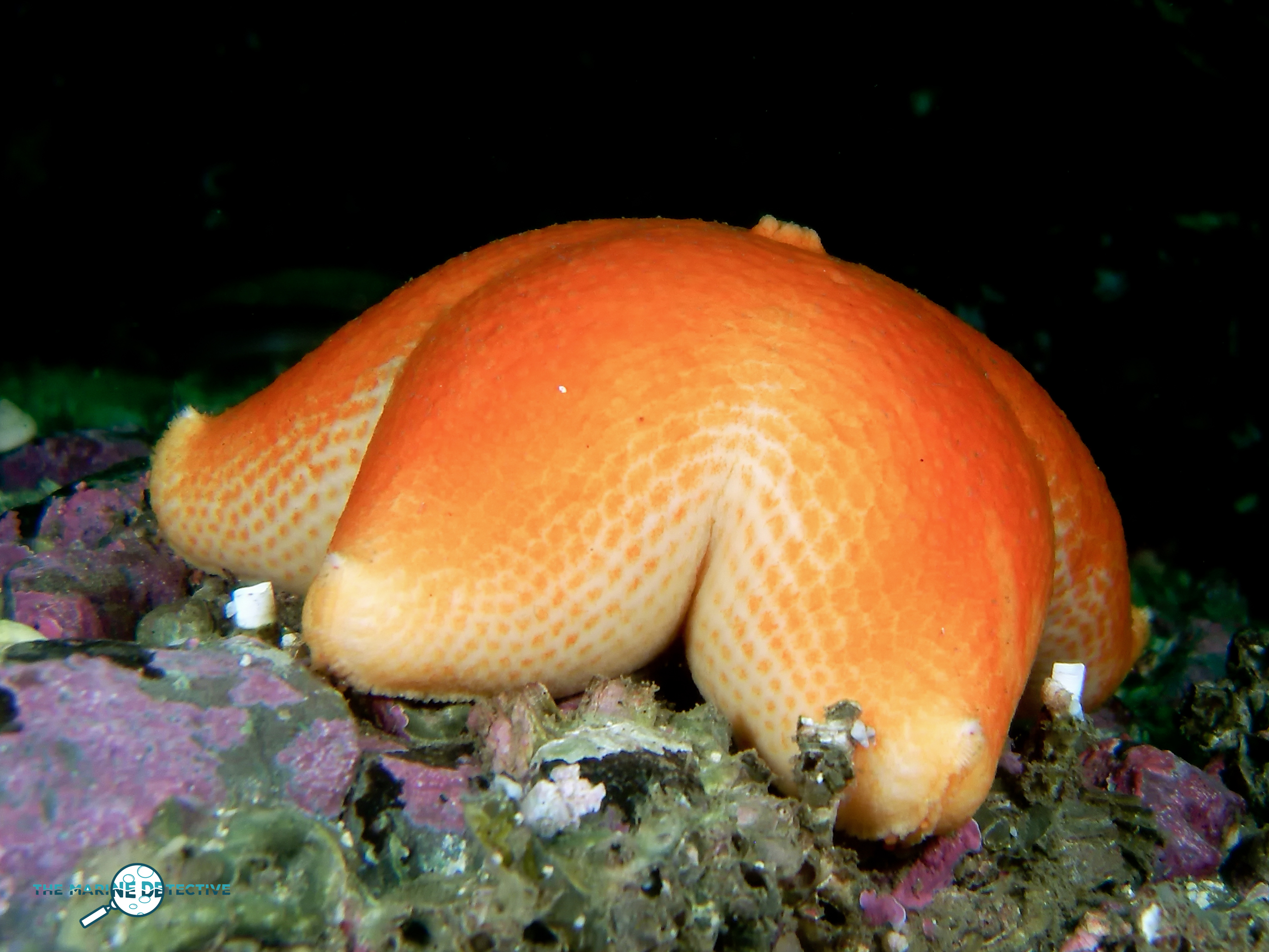
Did you know about the species of sea star in our waters that releases slime to deter predators?
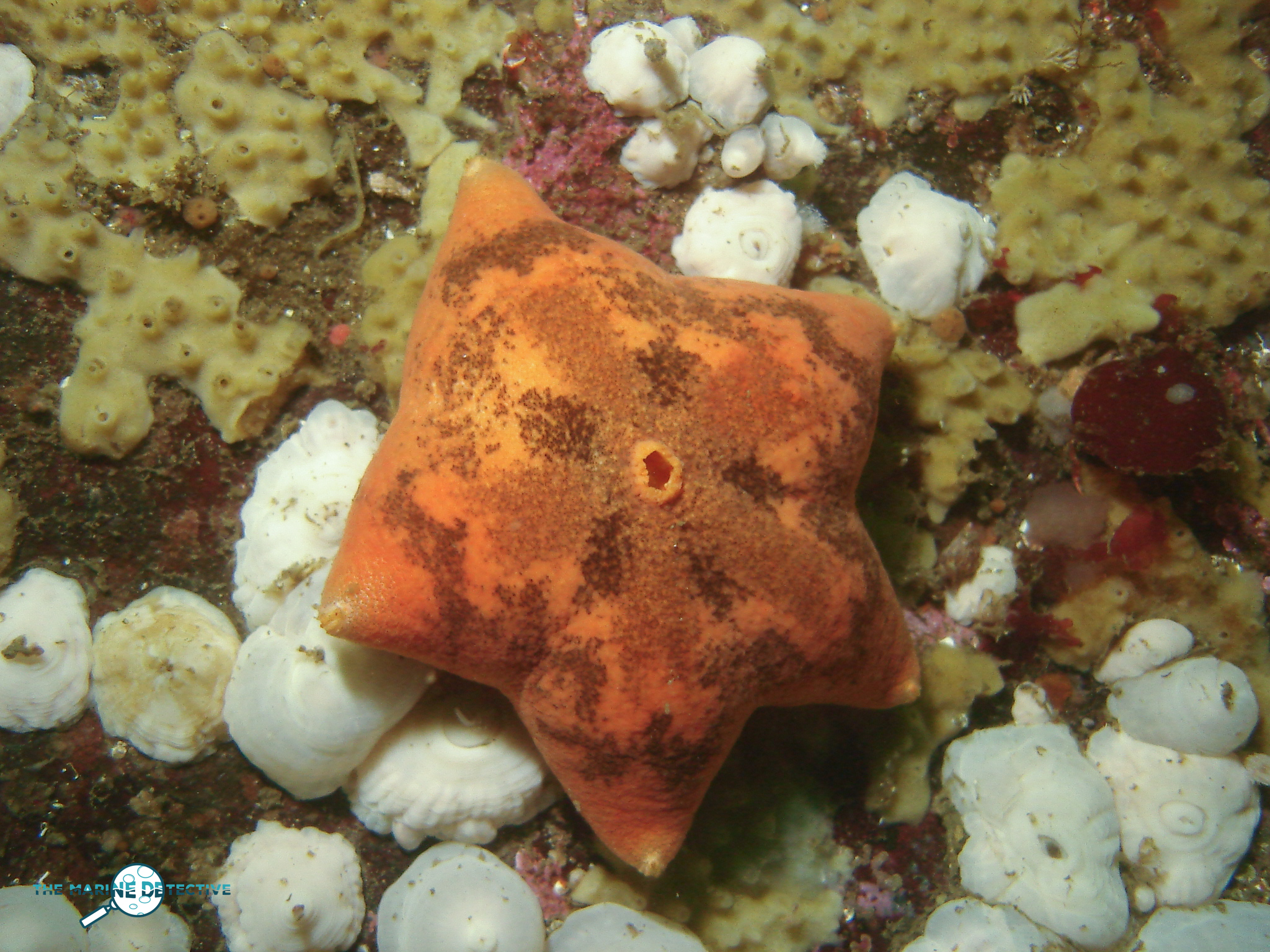
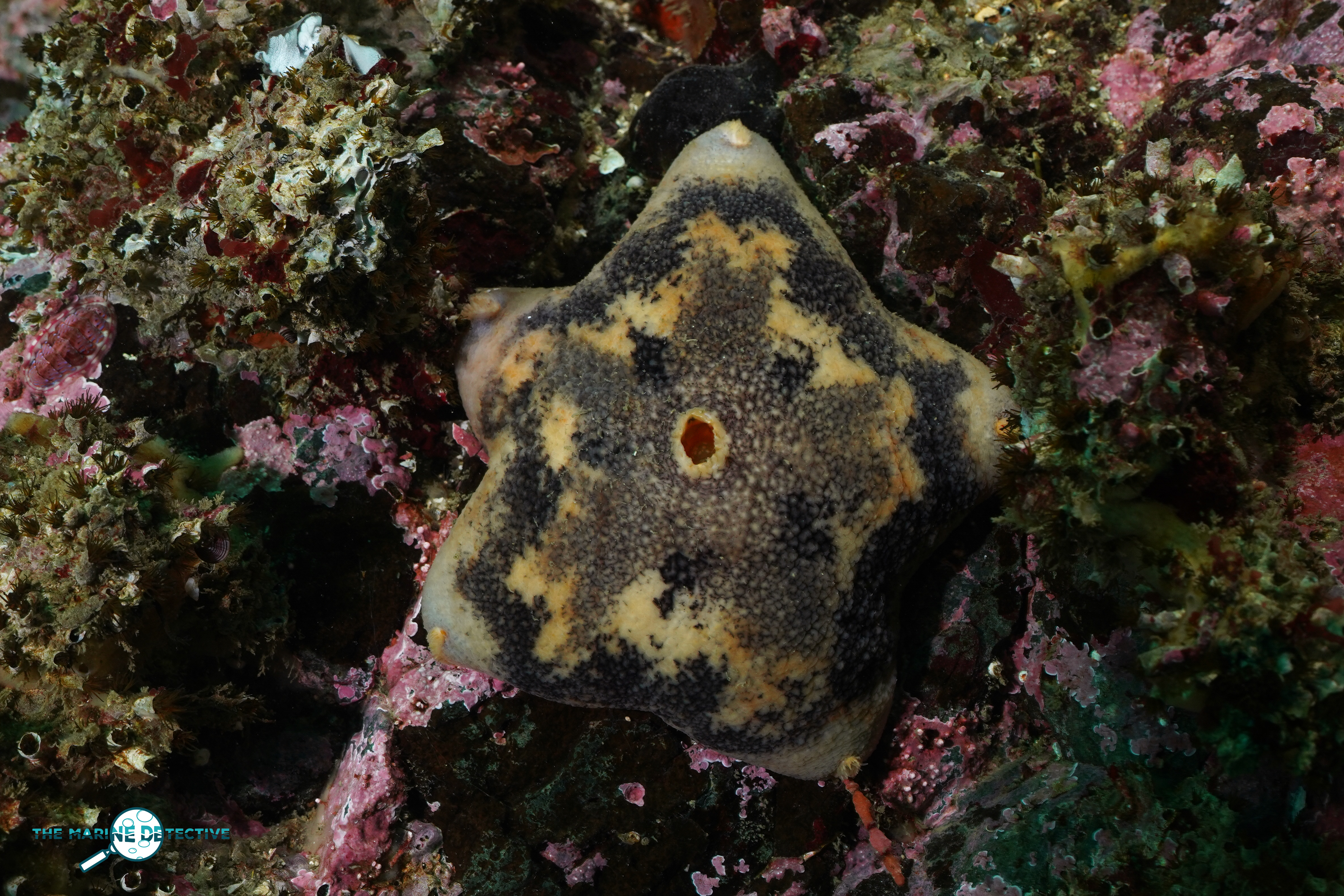
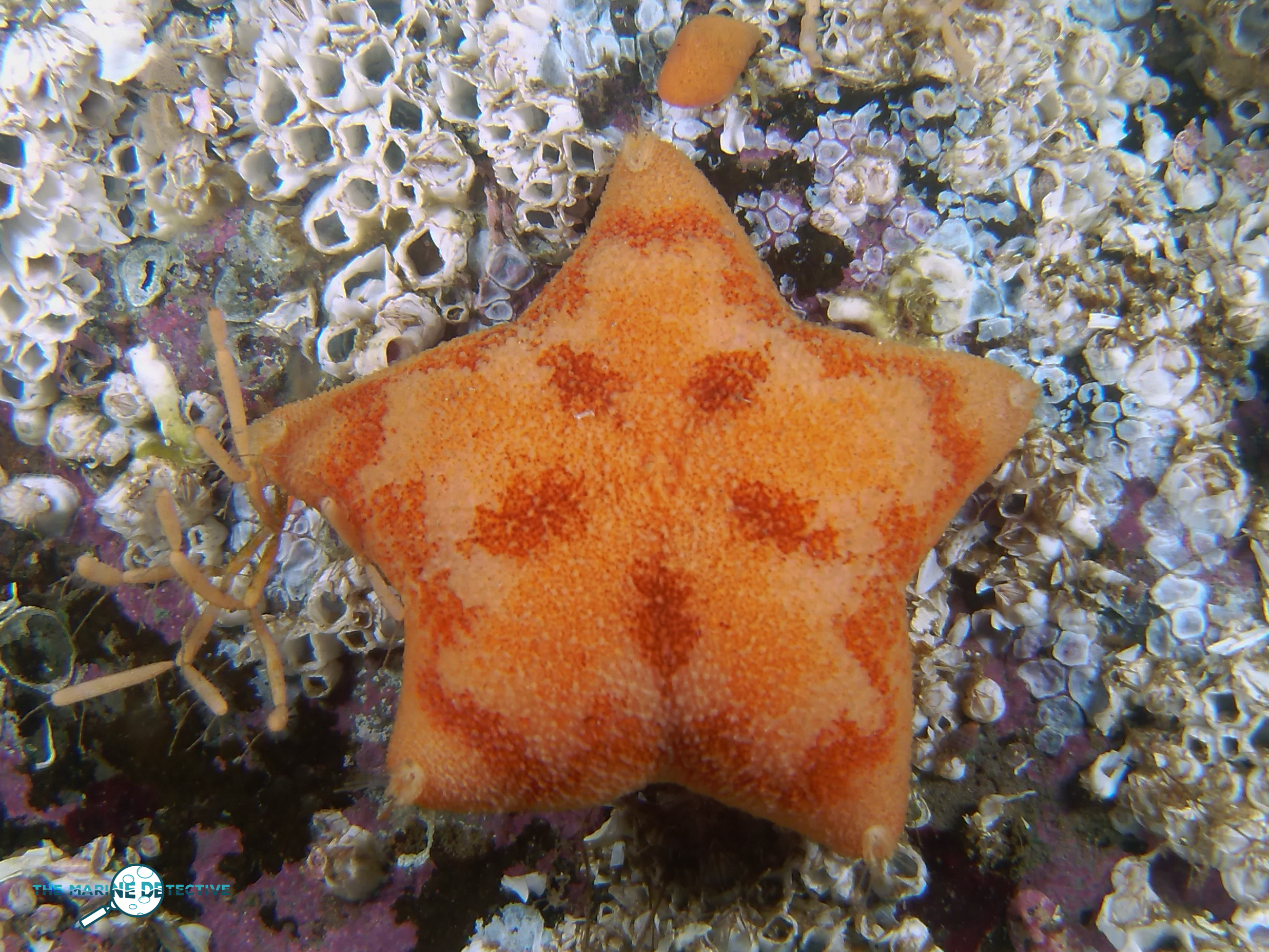
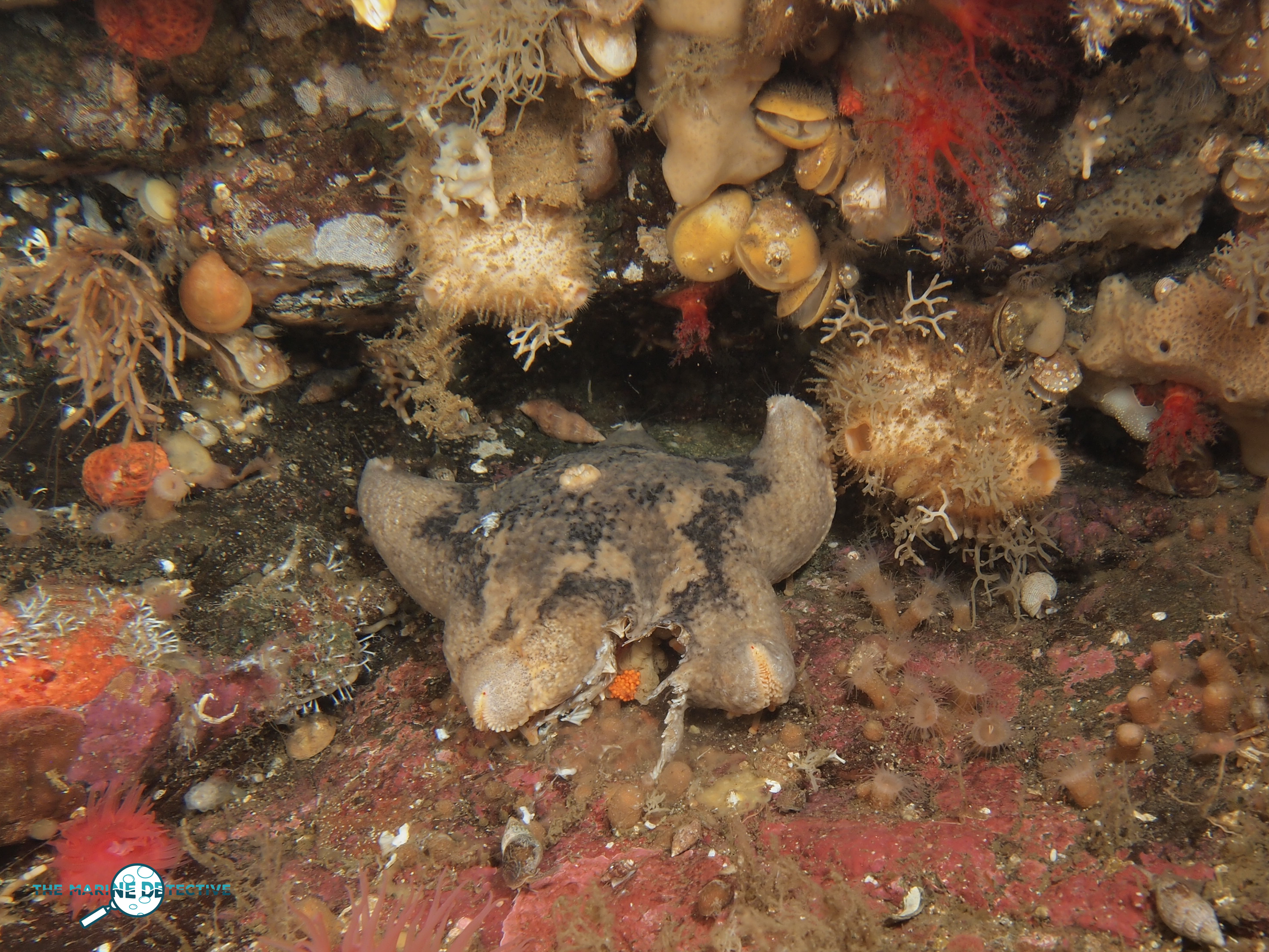
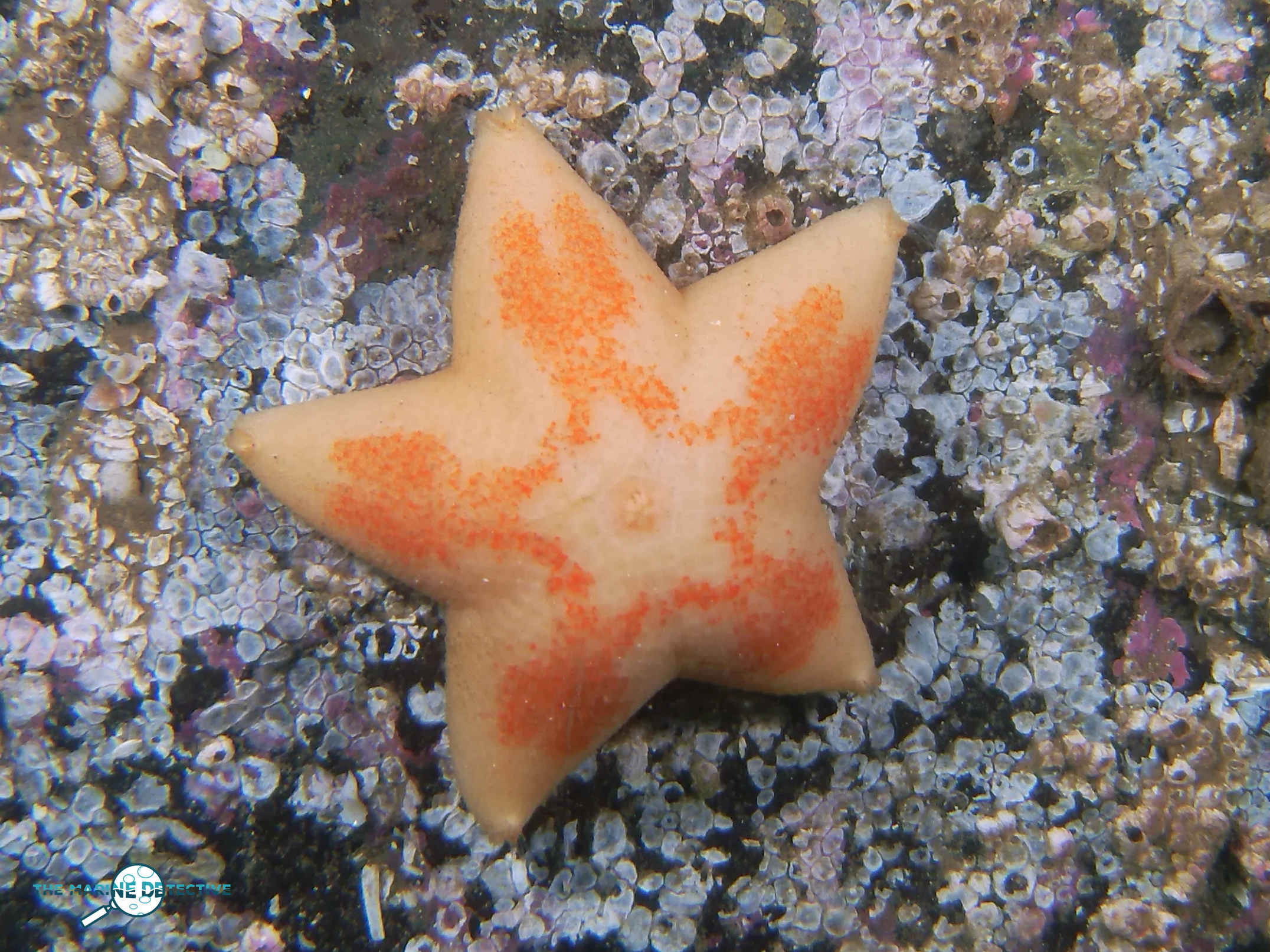
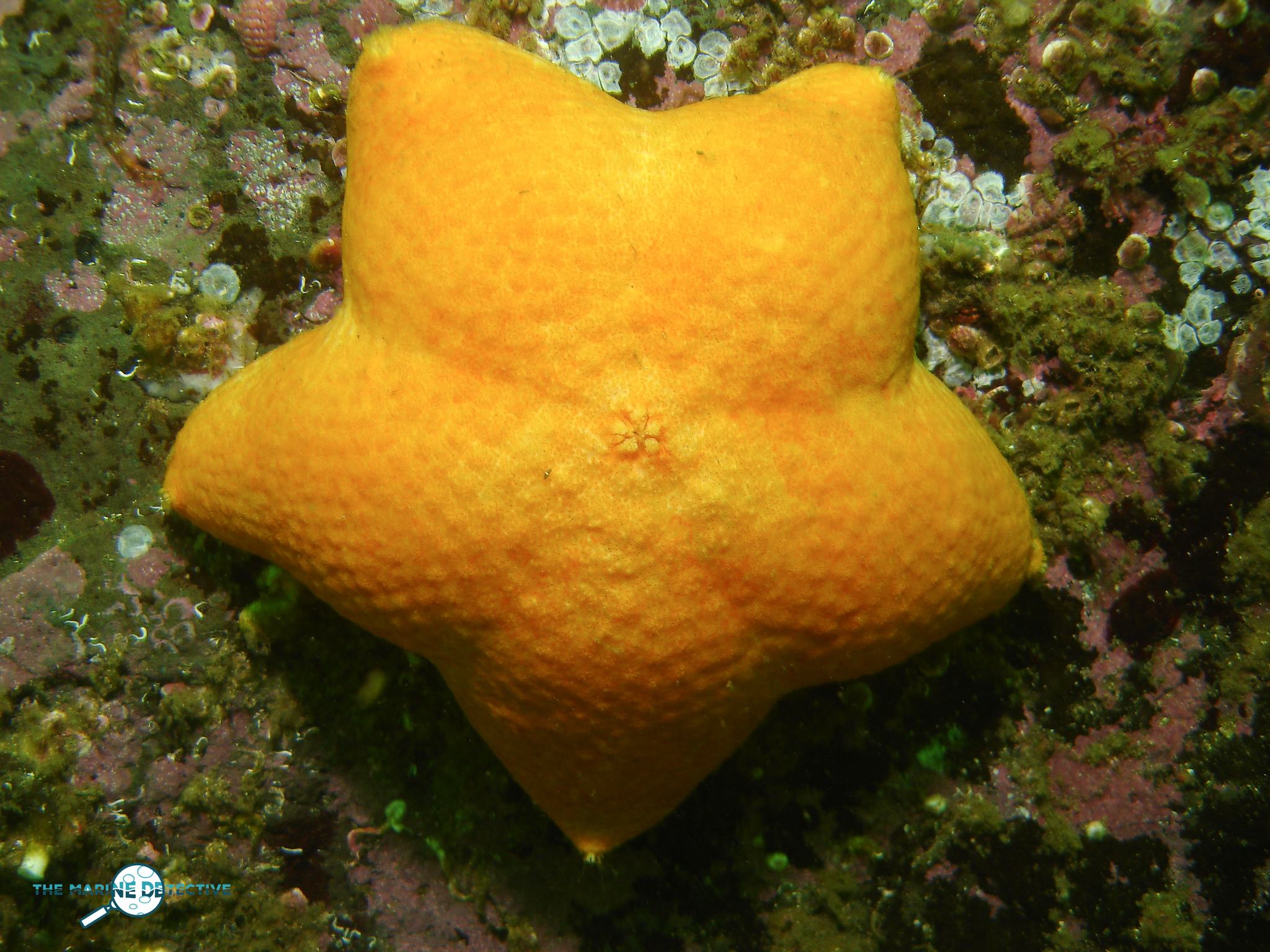
Slime stars are so wickedly adapted! Their distinctive puffy bodies have led to them also being known as Cushion Stars.
They release a LOT of thick, transparent goo from their upper surface when disturbed.
Disturbance constitutes rough handling, temperature shock or when other sea star species try to eat them. Sunflower Stars and Morning Sun Stars are known to trigger the slime production and get a mouthful of goo. The mucus is reported to be toxic to other invertebrates if they are immersed in it for 24 hours.
How much mucus do Slime Stars produce? See the Hakai Institute’s video below.
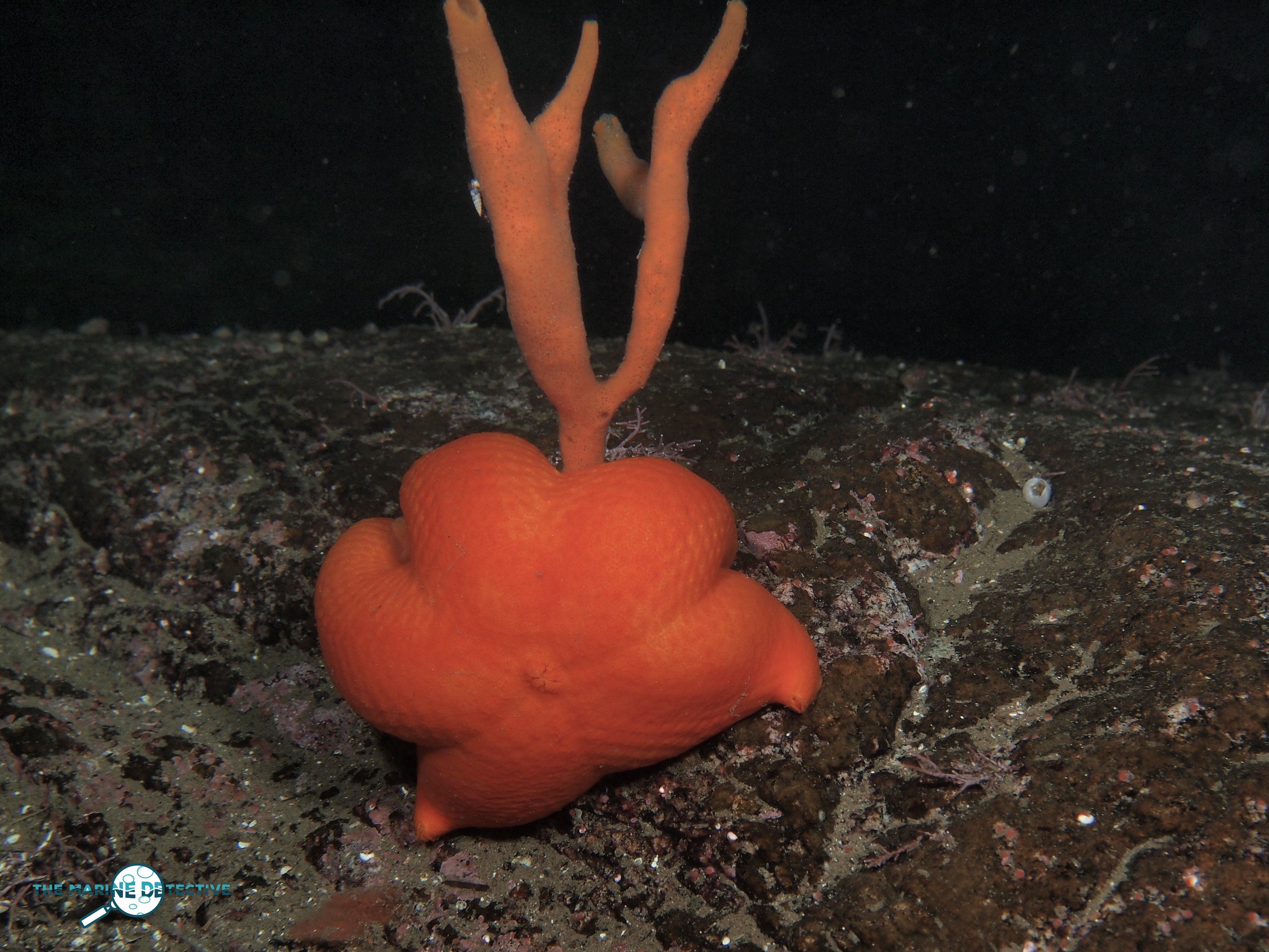
What is also so unique about Slime Stars is that they “exhale” water through that big pore in their upper surface every few minutes (the osculum). The full “exhalation” of the water takes about 5 seconds. You can see in the photos and video below how wide the hole opens. Water enters the sea star on the underside (through ambulacral grooves).
The tips of the arms / rays of Slime Stars are also distinctive. See how they curl upward? That is believed to be an adaptation to hold the mucus on the upper surface of the sea star.
See how the tips of the rays are curled upward?
As a result of genetic research, it has been put forward that the individuals with dark markings may be a distinct species from the solid-coloured ones. Currently, they are all classified as Pteraster tesselatus.
– Maximum size: 24 cm across. – Known range: Bering Sea to Washington State; from 6 to 436 meters. – Diet: Sponges, tunicates, and bivalves such as the False Jingle.
Giving it to you straight! This was my most exciting “find” for April.
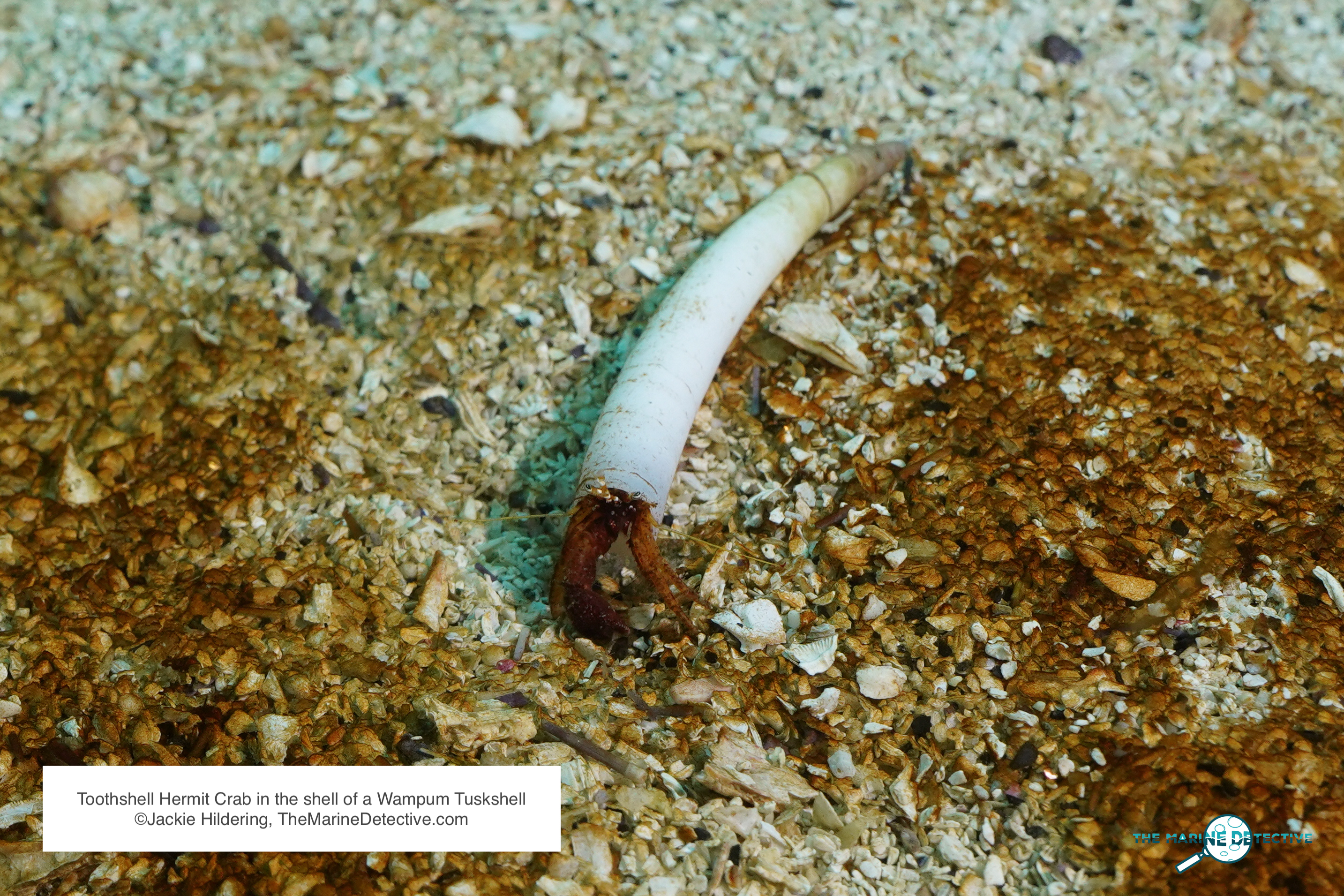
This is a Toothshell Hermit Crab in the shell of a Wampum Tuskshell. The shells were used as currency by First Nations. Read on!
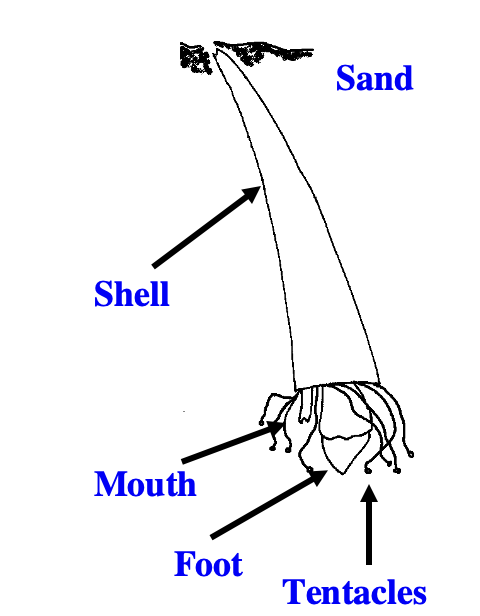
THIS species of hermit crab does not have curled body to hook and hold a snail shell home (like most hermit crabs).
THIS hermit crab species’ body is straight which means that it can’t live in a shell made by a marine snail. Its niche is to fit into the straight shells of Tuskshells or, if need be, the tube of calcareous tubeworm species* which is also straight.
Toothshell Hermit Crabs are only up to 0.8 cm long (Orthopagurus minimus).
Wampum Tuskshells are to only 5 cm long (Antalis pretiosa). They are molluscs belonging to the Tuskshell class (Scaphopoda).
My excitement is about this hermit crab species’ adaptations and that it is so rare to see a Tuskshell because they are usually burrowed deep in the sandy or shell bottom. The best chance of seeing one is as the home of a Toothshell Hermit. But then, there’s ALSO the great cultural significance of Tuskshells!
Wampum Tuskshells burrow themselves into the ocean bottom with their foot and use their sticky tentacles to trap microscopic food particles and move them to their mouths. Specifically, they are reported to feed on single-celled amoeboid protists called forminifera. Crappy sketch is by yours truly.
Tuskshell species (also known as Dentalia and Toothshells) are of great importance to First Nations. They were used as currency and are still used in regalia in some areas.
The shells of these snails were used for over 2,500 years from what is now known as the Arctic to Baja California and across to the Great Lakes. The most important species of tuskshell is reported to have been the one I chanced upon recently, the Wampum Tuskshell.
One of the most important areas for harvesting these animals for their shells (know as hiqua / haiqua) was Quatsino Sound off northwest Vancouver Island.
The snail’s previous scientific name even translates into “valuable tooth” = Dentalium pretiosum. In part what made tuskshells so valuable was that they were difficult to get. But, not only were they scarce, they were also great as currency because of their beauty, being easy to transport, and because they could not be counterfeited.
The snail is often found in deeper water (between 9 to 75 m), burrowed in the sand. The Quatsino People engineered a way of catching them with an apparatus that looks like the head of a broom. To get this down to the shells, stick extensions were added a length at a time to get as deep as 21 m. All this while working from a canoe!
I hope this little hermit crab, in this little shell, adds to a BIG world of connection for you.
Photo from the Plains Indian Museum at the Buffalo Bill Center of the West. Accompanying text: “Tooth or tusk shells commonly referred to as #dentalium is a scaphopod mollusk. Dentalium was harvested off the coast of Vancouver Island, Canada by tribes. Today, most commercial dentalium is harvested and sold from Asia. In the Plains, dentalium was a highly sought after trade product from the Plateau Tribes. Beautiful hues of smooth pink and white were prized and revered by Lakota, Dakota, and Nakoda women. Artists created dress capes, earrings, hair ornaments, and chokers to wear during times of ceremony and celebration. Dress detail, #Lakota Northern Plains, ca. 1885. Selvage wool, dentalium shells, glass beads, silk ribbon, cotton thread. NA.202.40.” From Money from the Sea: A Cross-cultural Indigenous Science Problem-solving Activity by Gloria Snively. Left: “The Dentalium “broom” was lowered to the shell beds by adding extensions to the handle. Illustration by Laura Corsiglia (2007).” Right: [In 1991, Phil Nuytten reconstructed the broom and submerged in his “Newt Suit” to observe how the broom worked.] “Phil Nuytten’s dentalia-harvesting broom outfitted with a weighted board. Loosening the ropes lowers the weighted board, an action that partially closes the broom head for grasping the shells. Illustration by Laura Corsiglia (2007).“From Money from the Sea: A Cross-cultural Indigenous Science Problem-solving Activity by Gloria Snively. “Extent of dentalium trade. Illustration by Karen Gillmore.” Another perspective on the same Toothshell Hermit Crab I chanced upon on April 8, 2023 while diving north of Port Hardy in the Territory of the Kwakwa̱ka̱’wakw (the Kwak̕wala-speaking Peoples) with God’s Pocket Resort. Depth was around 13 meters. Dive buddy Natasha Dickinson.
“For 2,500 years, until the early 20th century, North American Indigenous peoples used the dazzling white cone-shaped shell of a marine mollusk as currency. Dentalium pretiosum [note that the species was reclassified to Antalis pretiosa] is a . . . mollusk of the class Scaphopoda, a group also known as tusk shells because of their slightly curved, conical shape . . . Dentalia inhabit coarse, clean sand on the surface of the seabed in areas of deep water, and are often found in association with sand dollars and the purple olive snail (Olivella biplicata).
As predators, they use their streamlined shape and muscular foot to move surprisingly quickly in pursuit of tiny single-celled prey called forminifera. Aboriginal peoples used many substances as trade goods, but dentalia were the only shells to become currency. Harvested from deep waters off the coast of Vancouver Island, they were beautiful, scarce, portable, and not easily counterfeited.
In 1778, Captain James Cook of the British Royal Navy visited the village of Yuquot (Friendly Cove) on Nootka Island off the west coast of Vancouver Island, BC. The island’s fur trading potential led the British East India Company to set up a trading post at Yuquot, which became a focal point for English, Spanish, and American traders and explorers.
Trade between Euro-Americans and Aboriginal peoples was initially conducted under the watchful eye of a powerful chief named Maquinna who acted as middleman, purchasing sea otter pelts using dentalia as currency and then reselling the pelts to white traders in exchange for other goods.
Once the white traders realized that shells were used as money, they began trading directly with dentalia harvesters among the Nuu-cha-nulth and Kwakwaka‘wakw people. The center of the fur trade subsequently moved to Nahwitti, a Kwakwaka‘wakw village on the northern tip of Vancouver Island (Nuytten, 2008b, p. 23), and dentalium shell money became a currency of cross-cultural trade, called Hy‘kwa in Chinook Jargon—a trade language spoken as a lingua franca in the Pacific Northwest during the 19th and early 20th centuries. The currency was used throughout Alaska, down the Pacific coast as far as Baja California, and across the prairies of the United States and southern Canada to the Great Lakes.
In addition to their use as currency, the pearly white dentalium shells also served as decorative wealth. They were fashioned into necklaces, bracelets, hair adornments, and dolls. The shells also decorated the clothing of both men and women.
It is generally agreed that the best dentalium shells were those harvested by the Ehattesaht and Quatsino people from shell beds off the west coast of Vancouver Island. These beds lay deep underwater—too deep for divers to hold their breath, too dark for them to see, and too cold to sustain a diving operation—so the Quatsino people designed specialized gear to harvest the money shells. Historical records indicate that a device with a very long handle and a bottom end resembling a “great, stiff broom” was used to pluck live dentalia from the seabed . . . Three of these implements still exist in museums in Victoria, British Columbia and Seattle, Washington.”
4-minute video from December 2022: “Hunter Old Elk, Assistant Curator of the Center of the West’s Plains Indian Museum, shows us a Dakota dress cape adorned with 1,500 – 2,000 dentalium shells”
Please note that dentalia / tuskshells do not move from one shell to the other. Their shell grows.
Tuskshells / Dentalia ” . . . were of great value prized mark of wealth and status, typically displayed as ornaments in clothing and headdresses, used as jewelry, and even used in some places as a type of currency.
Most dentalium entering the indigenous trade network of the Pacific Northwest originated off the coast of Vancouver Island. Chicklisaht, Kyuquot, and Ehattesaht communities of the Northern Nuu-chah-nulth, inhabitants of the west coast of the island, were the primary source of the shells. However, the Kwakwaka’wakw of Quatsino Sound and Cape Scott, on the eastern coast, were also large producers. Harvesters would work from their ocean-going canoes, extending specially-constructed long poles to the dentalium beds on the ocean floor. At the end of the long poles were large brushes that were pushed into the mollusk beds, ensnaring dentalium in the process.”
*Note that there is another straight-bodied species of hermit crab in the northeast Pacific Ocean whose home is almost always the tubes of calcareous Tubeworms; the Tubeworm Hermit (Discorsopagurus schmitti).
One of the services I like to provide here on The Marine Detective, is to share words you can try to randomly drop into conversations and annoy your friends. You’re welcome. It’s a task I take very seriously.
Yes, there really is an animal with the scientific name Zyzzyzus rubusidaeus and to me, they look like they have been designed by Dr. Seuss himself. Their common name is the Raspberry Hydroid and they have beautiful predators too.
The common name for Zyzzyzus rubusidaeus is the Raspberry Hydroid. They were only described as a new species in 2013 by northern Vancouver Island’s own Anita Brinckmann-Voss who lived in Sointula. The research paper is at this link.
Their specific nudibranch prey are Pomegranate Aeolids. To my knowledge, the only documentations for both species, to date, are near Telegraph Cove (Weynton Pass) and Quadra Island (Discovery Passage). I can certainly attest to how fortunate we are to see them so predictably near Telegraph Cove.
What you see here, in addition to Raspberry Hydroids and a Pomegranate Aeolid nudibranch, are Mushroom Compound Tunicates, and a feeding Giant Acorn Barnacle.
See below for more information about both species. Oh, and if you ever are able to use the word “Zyzzyzus” in a word game because of this post, I expect a thank you! 😉
Descriptor for the above photo:
Trifecta!
(1) Nudibranch species the Pomegranate Aeolid (Cuthonella punicea to 2.5 cm).
(2)Their only known prey, the stinging celled animals Raspberry Hydroids (Zyzzyzus rubusidaeus to 5 cm tall).
(3) The nudibranchs’ egg masses / strings. As is the way with sea slugs, they most often lay their eggs on their prey. Talk about adding insult to injury. I eat you and I lay my eggs on you so there will be more of my kind to prey on your kind.
More Pomegranate Aeolids feeding on Raspberry Hydroids. The round structures are gonophores reproductive organs that may contain sperm, eggs, or embryos.
More about hydroids:
Almost all hydroid species are colonial. They are carnivores. Hydroids are related to jellies, anemones, and corals (phylum Cnidarian).
The reproduction of hydroids is remarkable. Colonies are male or female. They start by reproducing asexually by budding off hydromedusa – tiny free-swimming, jellyfish-like versions of themselves. These produce either eggs or sperm. Fertilization of the eggs leads to larvae that may settle on the ocean bottom and form colonies.
Hydroids catch drifting prey with their polyps aided by their nematocysts (stinging cells). None of the hydroid species off our coast deliver a sting that we humans can feel (no matter how sensitive you are 😉).
The food gets distributed throughout their single-sex colony.
And who loves to eat species of hydroids? Nudibranchs! Specifically, the aeolid kinds of nudibranchs – they have those bushy structures on their backs (cerata). Many of these nudibranch species not only rely on the hydroids for nutrition but also make use of their prey’s stinging cells! The nematocysts get incorporated into the ends of the cerata.
I’ve saved my favourite 2022 marine mystery for you until now.
It’s from Poppy who was in British Columbia visiting from England with her father, sister Maya, grandpa and grandma.
Poppy found these on a beach on Malcolm Island and they were photographed on the back of a cell phone.
It actually hurt my head to try to figure this out. I knew that I SHOULD know what they were but just not make the ID take shape. In wanting to get the answer to Poppy as soon as possible, I reached out to expertise greater than my own. I suspected I would have a big face-palming moment of “but of course” when the shells were identified.
And indeed that happened.
Take a moment to try to determine the ID yourself? Then scroll down for the answer.
Are you sure you want to see the answer?
Here goes!
Of course! 🤦♀️ They are the parts of the shell of a barnacle that open and close!
The answer that came from naturalist supreme Bill Merilees was: “What you have here is a barnacle valve – one of the ‘flaps’ that opens to allow the feeding tentacles to strain food from the water column.Great photo of this unusual shell exoskeleton!”
This led me to try to figure out what barnacle species these might come from and what the names of the structures were.
I believe the most specific ID is that these are the opercular plates of a Thatched Acorn Barnacle. The two parts are the tergum and scutum.
Below are some of my photos of another barnacle species, the Giant Acorn Barnacle (Balanus nubilus) which might help in recognizing the shells. Isn’t it wondrous? All barnacle species start off a plankton and then form their own intricate shells so that their foot can extend out to rake in food.
Happy New Year to you. May the next year be filled with happy mysteries, wonder, and empowerment for positive change.
Sources of illustrations:
Coletti, Giovanni & Bosio, Giulia & Collareta, Alberto & Buckeridge, John & Consani, Sirio & El Kateb, Akram. (2018). Palaeoenvironmental analysis of the Miocene barnacle facies: Case studies from Europe and South America. Geologica Carpathica. 69. 573-592. 10.1515/geoca-2018-0034.
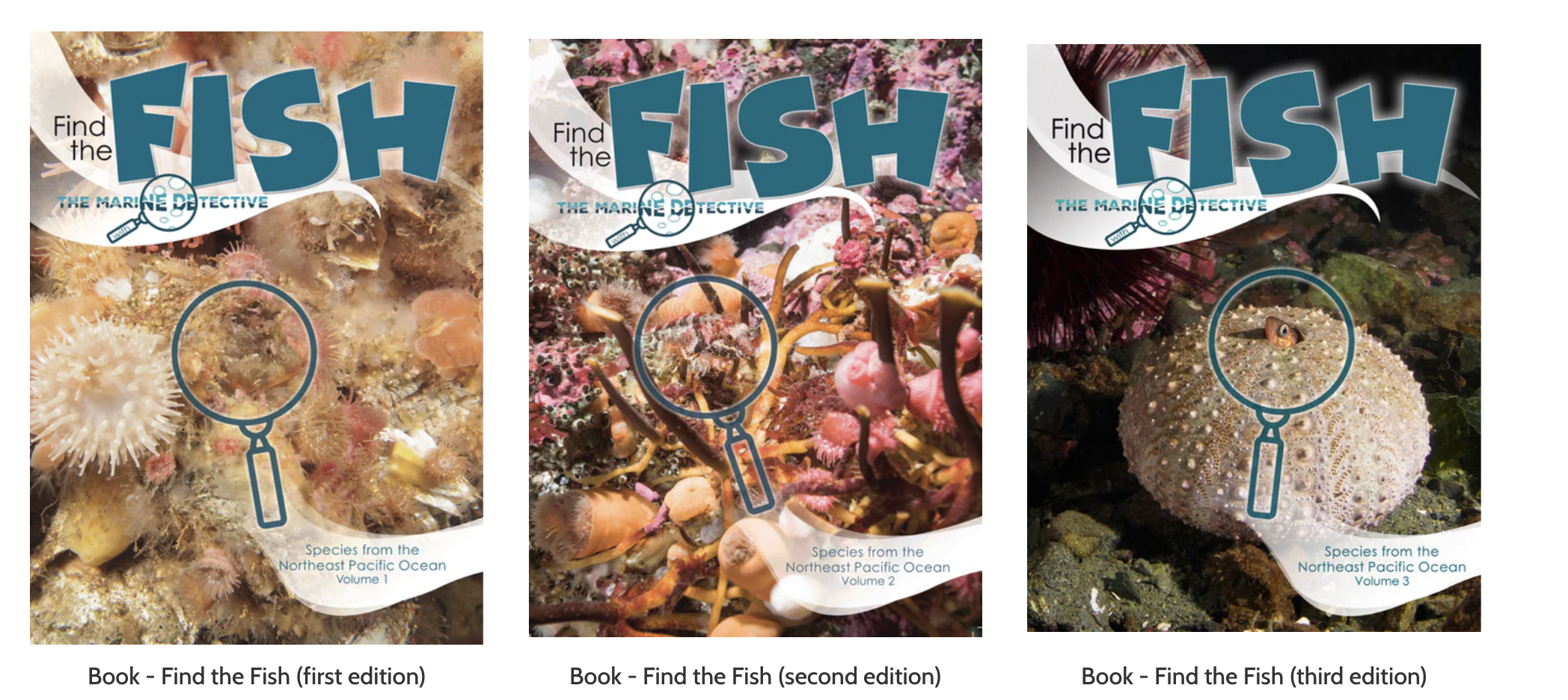
Here’s the cover of my latest book, now available at this link.
I loved that the online “The Marine Detective” community overwhelmingly chose this image for the cover showing a juvenile Yellowtail Rockfish hiding in the shell of a Red Urchin. The urchin may have lived to be more than 100 years old.
As many of you know from my weekly “Find the Fish Friday” posts, these are eye-spy challenges.
The books are the “Where’s Waldo” of the marine world. In addition to being fun, they are aimed and increasing knowledge about how diverse and colourful the life is in these cold, dark waters. The text provides information about the species in the images and invites children (and the adults who love them) to look for other species as well as the featured fish.
The trifecta! The books are soft-cover and answer pages are included showing the locations of the fish. The books are self-published as Marine Matters Publishing.
It gives me much joy that this third book in particular allows the facets of my life to come together – diving, photography, whale research and teaching. I dare say Find the Fish – Volume Three is the only children’s book that gives insight into the diversity of life off our coast while ALSO providing empowering scientific content about Sea Star Wasting Syndrome and our Marine Education & Research Society research into a new Humpback Whale feeding strategy.
And hey, the featured wildlife includes a Pacific Spiny Lumpsucker, Wolf-Eels, Scalyhead Sculpins (of course) and three of my beloved dive buddies!
Please see the sample pages below. There are 12 challenges with answer pages, an introductory page and a final page about “The Marine Detective”.
[To jump directly to providing your input into the public consultation survey,click here. Below I provide background and my answers to the survey in case that is helpful to you.]
The first Fin Whale I ever saw was killed by a large vessel. Please don’t stop reading.
There’s urgency about what will happen with the protection of Fin Whales in British Columbian waters. And, there is something Canadians can do to take a stand that takes very little time.
Right now, it is being put forward that the protection of Fin Whales be REDUCED under Canada’s Species at Risk Act. This is being considered when so little is known about them and their threats are increasing.
– We whaled them up to 55 years ago and it is not known how many there are now or if there is more than one population.
– It is known that their threats are increasing. Fin Whales are particularly vulnerable to being hit by boats. They feed where there will be increased large vessel traffic, including LNG tankers. This will also increase disturbance from noise. Further, the changing climate will impact their prey. There has also already been an “Unusual Mortality Event” where is it is believed that warmer water led to more toxins being in the whales’ prey (domoic acid from Red Tide Algae).
The process determining if the protection of Fin Whales will be reduced in Canada or not involves an opportunity for public comment. This is not a petition. It is using YOUR voice to be part of the federal process that will determine the fate of Fin Whales. The deadline for comment is December 2nd, 2022. It is a short survey.
I share the above graphic showing the fate of that first Fin Whale I saw because I think it helps make clear how the second biggest animal in the world can be so vulnerable. Nature versus human technology, efficiency, ingenuity and, disconnect.
The reality of that first Fin Whale I ever saw is known because he got hooked up on the bulbous bow of the cruise ship after being hit. Apparently, no one on the vessel felt the impact. The fate of the whale was only known when the cruise ship came into the harbour in Vancouver.
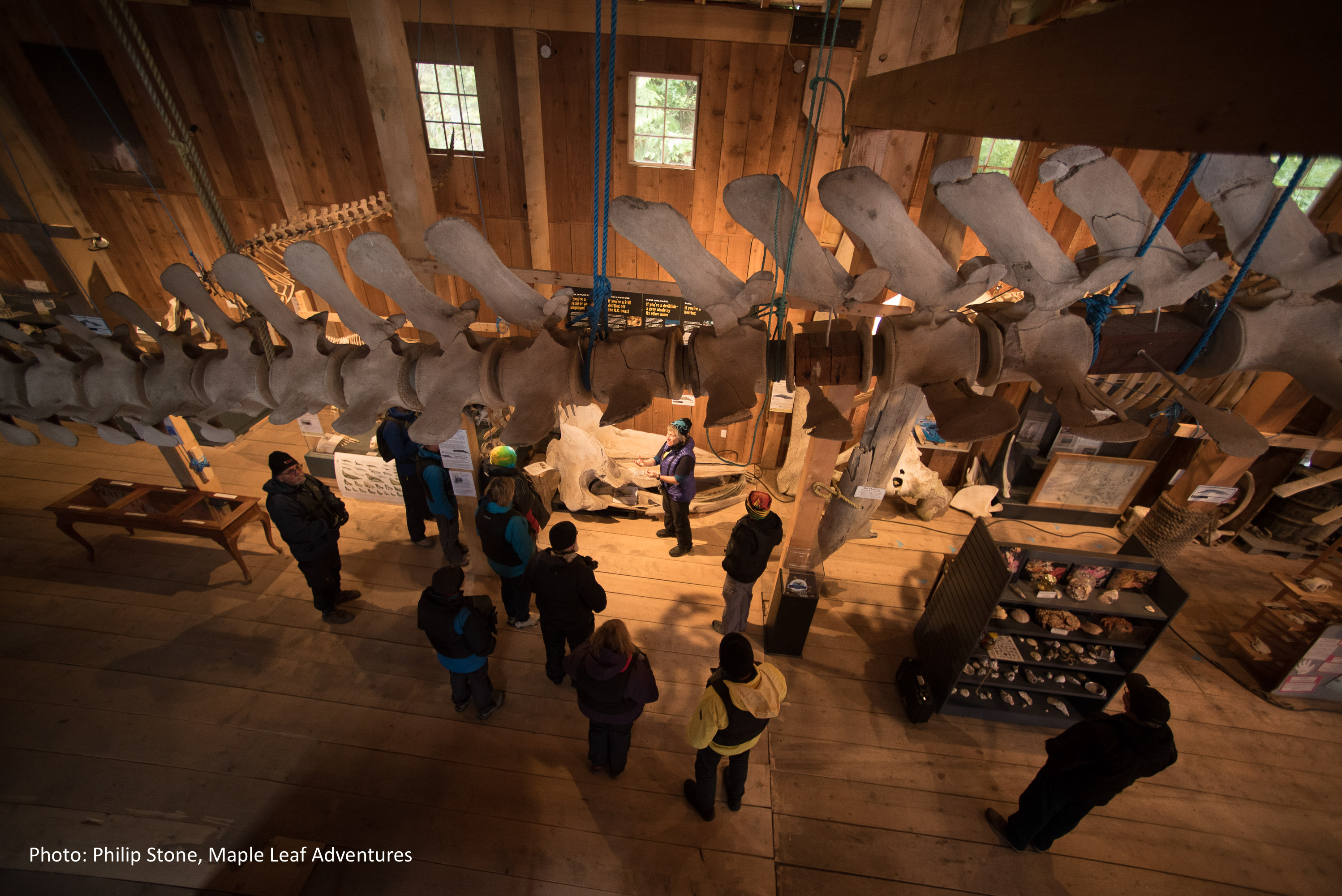
It must have been the same Fin Whale we saw that day near Telegraph Cove because Fin Whales are such a rarity on the inside of Vancouver Island. We first saw the Fin Whale, and then we saw the cruise ship. And yes, this is the Fin Whale whose skeleton with shattered vertebrae now hangs in the Whale Interpretive Centre in Telegraph Cove.
Standing under the skeleton of the first Fin Whale I ever saw. Photo by Phil Stone Photography.
It’s so important to understand that the evolution (or creation) of toothed whales like Orca, required them to have biosonar / echolocation to detect their prey, etc. Baleen whales like Fin Whales and Humpback Whales do not have this biosonar. So often these giants are oblivious of boats, and many boaters are oblivious to how different these whales are.
You may never have seen a Fin Whale. In fact, the only one known to be in the Salish Sea this year was killed by a boat. I’ll spare you the photos of him but you can see more detail at this link.
Fin Whales are more often off the Central and North Coast, Haida Gwaii, or in BC’s vast offshore waters. In having the privilege of doing surveys in these areas, I’ve seen them, and the overlap with large vessel traffic.
If the protection of Fin Whales is reduced, one of the most dire consequences is that there will be no determination nor protection of their habitat needs. There will also be far less priority for research into how many there are and how to reduce threats.
The questions in the survey are simple. Below, I provide the three main questions and answers that may be of use to you.
For more detail, see this link for the media release we did as the Marine Education and Research Society and the North Coast Cetacean Society.
The survey for public consultation is at this link.
My answers are below.
You will note that the survey only allows for brief answers which is why I have pointed to our media release which provides detail about the concerns.
1. Do you think the reclassification of Fin Whale (Pacific Population) from Threatened to Special Concern under the Species at Risk Act would have economic, environmental, cultural and/or social BENEFITS for you or your group/organization?
No. There would be no benefits to reducing protection for a species for whom threats are increasing and for which too little is known to justify reducing protection.
2. Do you think the reclassification of Fin Whale (Pacific Population) from Threatened to Special Concern under the Species at Risk Act would have economic, environmental, cultural and/or social COSTS for you or your group/organization?
Yes. There are significant societal costs to choosing to reduce protection for a species for which not enough is known about their population while threats are known to be increasing. This includes that it is acknowledged how vulnerable Fin Whales are to being hit by boats; that it is not known how many there are; and that it is certain that there will be increased vessel traffic and that increasing temperatures can impact their prey.
3. Should the Government of Canada reclassify the Fin Whale (Pacific Population) from Threatened to Special Concern under the Species at Risk Act?
No. It is the antithesis of precaution to reduce the protection of Fin Whales when there is so much that is not known about their population and when threats are increasing due to climate change, noise, and risk of collision.
I wrote the following in my role with the Marine Education and Research Society to accompany the graphic below. Our efforts include workshops on Marine Mammal Regulations and the ethics of imagery and language used by mainstream and social media.
It is so jarring and unfortunate when wildlife encounters are described with language like “the whales put on a show for us”. No, they didn’t.
How I hope my words resound with you.
“It’s not a show.
Wildlife does not perform for humans. Whales do not “put on a show” for us.
Words matter. Words reflect, and perpetuate, our values and actions.
Thankfully, society has come a long way in understanding our connection to the natural world.
May our words reflect that we know the privilege of observing wild animals, living wild lives.
Not “for us”. Not “up close and personal”.
Rather, may we value most that what we observe in the wild happens . . . as if we weren’t there.”
The graphic is available as a sticker or card at our MERS Ocean Store. The card includes the above text. All sales support our research and education efforts.
Illustration made by friend Dawn Dudek based on a photo I took of Humpback Whale Inukshuk (BCZ0339) while conducting research for the Marine Education and Research Society (MERS) under Marine Mammal License MML-57.
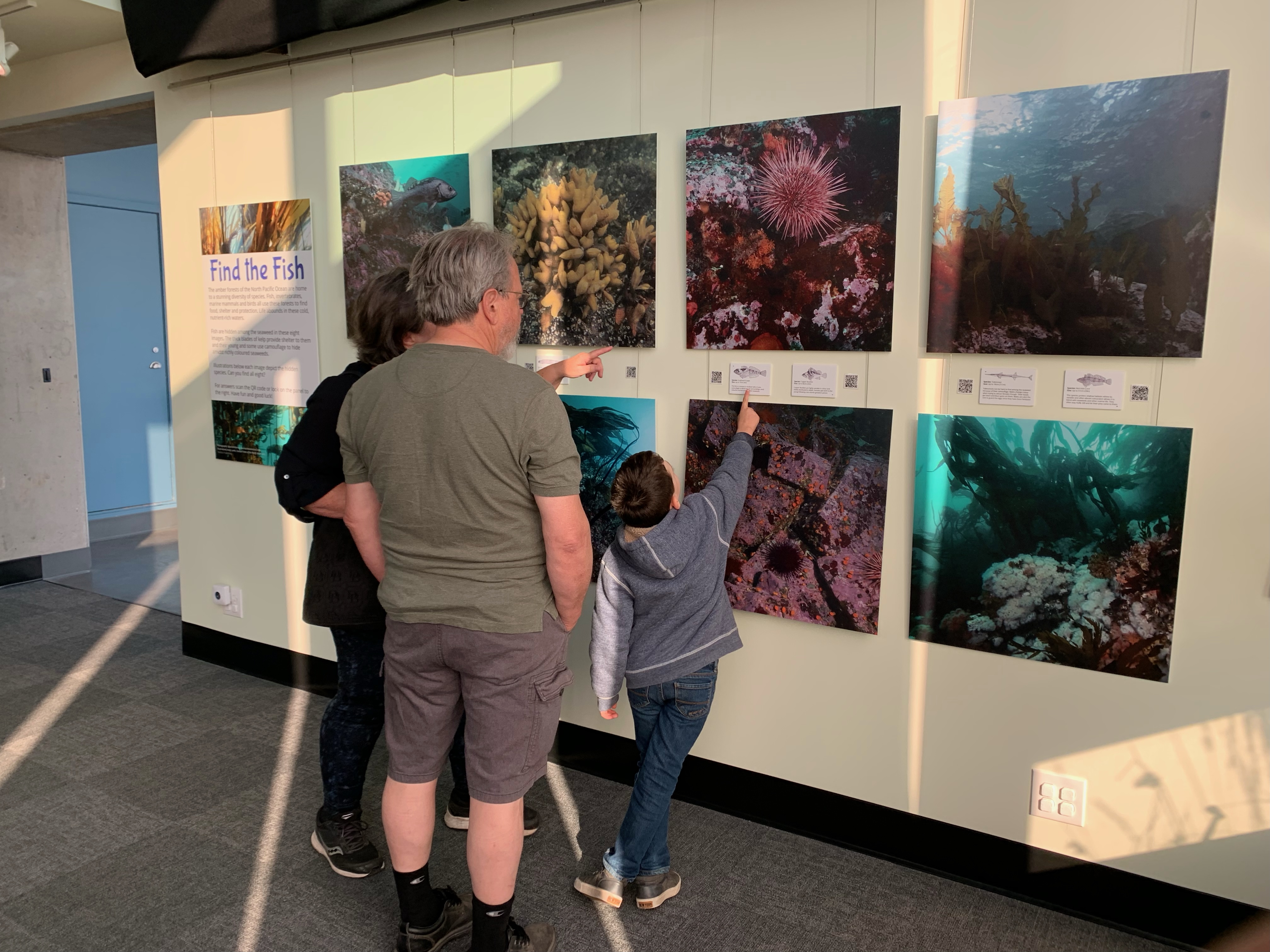
The photos you see here are from the new exhibit “Seaweed: Mysteries of the Amber Forests” at the Shaw Centre for the Salish Sea. Those are my kelp photos.
I am choking up at typing that. I have never seen my photos printed that big and am massively moved that they are part of this education aimed at increasing awareness and action for algae.
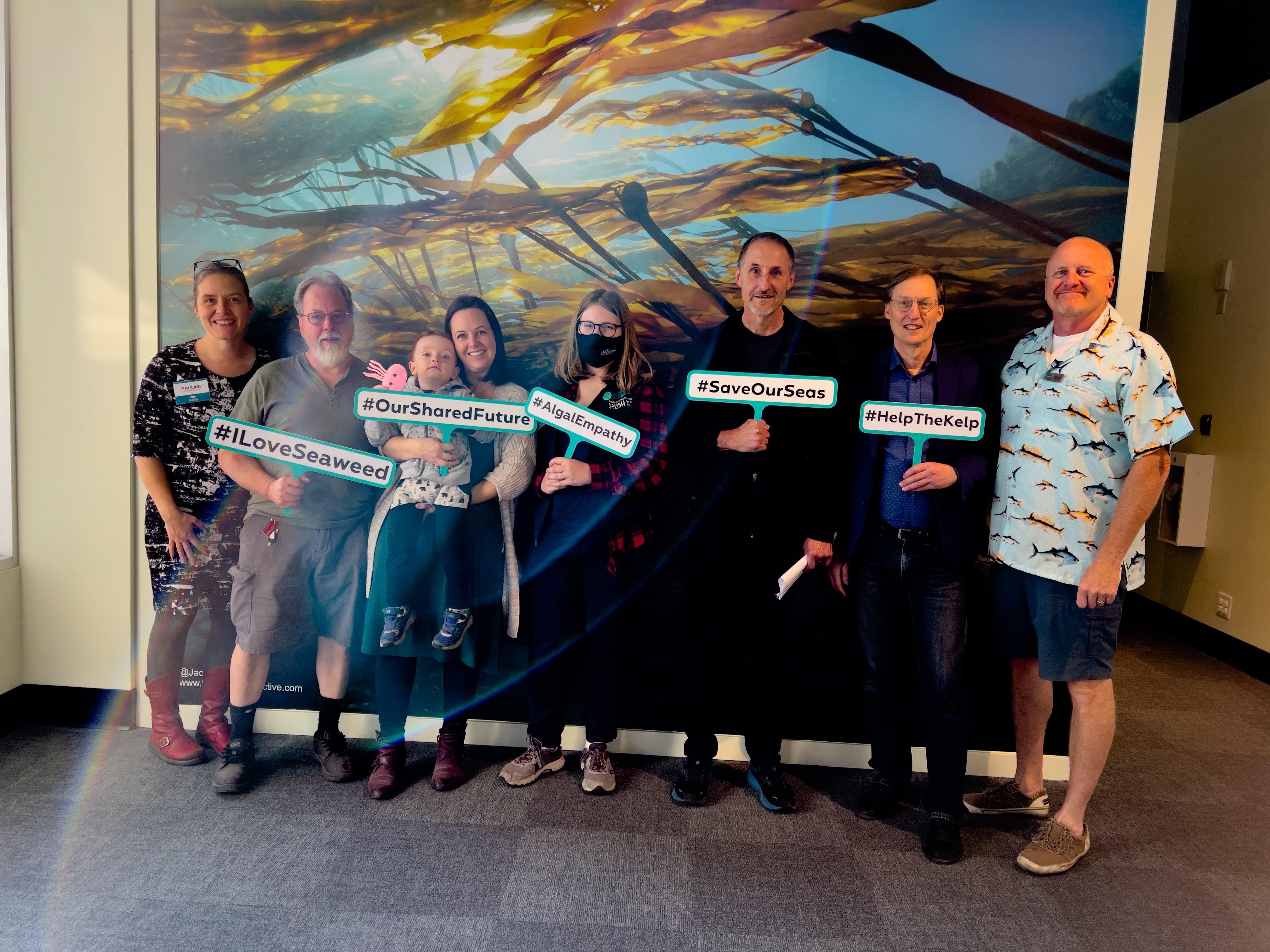
Mayor Cliff McNeil-Smith cutting the Bull Kelp stipe to open the exhibit yesterday . In green – friend and Director of Exhibits & Engagement, Leah Thorpe. On right, Executive Director of the Centre, Pauline Finn. On left, Director Allan Lane.
Also featured is the art of Josie Iselin. She scans seaweeds with her flatbed scanner and then often places the photos atop historical images from when that species of seaweed was first described.
Executive Director Pauline Finn pointing to some of Josie Islelin’s art.
I am so grateful to Leah Thorpe, Director of Exhibits & Engagement, for all of her work to make this real.
I have NOT seen the exhibit in person but am now strangely compelled to go to 9811 Seaport Pl, Sidney, southern Vancouver Island. How about you? Show me photos when you go?
You will be thrilled to see there are also some my Find the Fish challenges in the exhibit but in BIG photos WITH answers.
Yep, choking up at seeing this. That’s my photo associated with all this vital messaging.
How to Help the Kelp, and Why? The Ocean’s algae, from the microscopic and to the giant kelps:
The algae / seaweeds are producers, converting sunlight to food to fuel the food web. They offer we humans so much nutrition too.
Kelps are habitat for hundreds of species.
Kelp Is in Trouble Where every species lives is, of course, because the conditions are right. For example, the temperature is not too cold. It’s not too hot. It’s just right. Yes, this is referenced as the Goldilocks Principle. Changing temperatures are impacting the health of kelp forests, as are other variables involved with climate change such as more frequent and stronger winds ripping away more kelp.
Also, there are far fewer Sunflower Stars due to Sea Star Wasting Disease which is believed to be associated with climate change. Sunflower Stars are predators of Green Urchins. Green Urchins graze on kelp. With less Sunflower Stars, there are more Green Urchins. More urchins leads to more grazing on kelp. In the extreme, this leads to “urchin barrens” where the kelp forest has been grazed away. Less kelp = less food, oxygen, habitat and buffering of carbon dioxide.
Green Urchins grazing on kelp.
Don’t Despair! This is not an additional problem. It’s another symptom of the same problem. Whatever you do to reduce fossil fuel use (from consumerism to how you vote), will help the kelp and all that depends on them.
May the knowledge motivate, not lead to fear and paralysis which perpetuates the problem. It truly is the case that if you are not contributing to solutions, you are part of the problem. Care more. Connect more. Consume less.
Finding Fish at the Exhibit! ☺️
The exhibit “Seaweed: Mysteries of the Amber Forests” will be at the Salish Sea Centre for about a year.
See my other blogs about the importance of kelp at this link.