Join me in the cold, dark, life-sustaining NE Pacific Ocean to discover the great beauty, mystery and fragility hidden there.

Humpback Whale Gooseneck Barnacles?!

Come on a journey of discovery with me – from identifying the very big, to the small. 

I’ll tell my tale of through the images below. 

Meet the Humpback Whale BCX1188 nicknamed “Jigger” for the now faint fish-hook shaped scar on her right fluke.

Jigger in 2008. Photo ©Martin Burri.

When we saw Jigger in 2009, we noted the barnacle growing on the right top of her dorsal fin. Such barnacles are a distinct species only found on Humpback Whales. The Humpback Whale Barnacle is Coronula diadema (to 5 cm tall and 6 cm wide.

Jigger in 2009. Photo ©Jackie Hildering.
Humpback Whale Barnacle Cornula diadema.

Then, when we saw Jigger in August of 2010, we noted that her dorsal fin looked very different. My research partner from the Marine Education and Research Society, Christie McMillan, and I were worried that it might be an injury so we tried to get a better photo of the dorsal fin.

Here’s what the dorsal fin looked like from behind (photo taken with a telephoto lens and cropped)  When I had this perspective, I thought that what we were looking at might be seaweed growing on the Humpback Whale Barnacle we had seen the year before (note that the barnacles often do fall off between years).
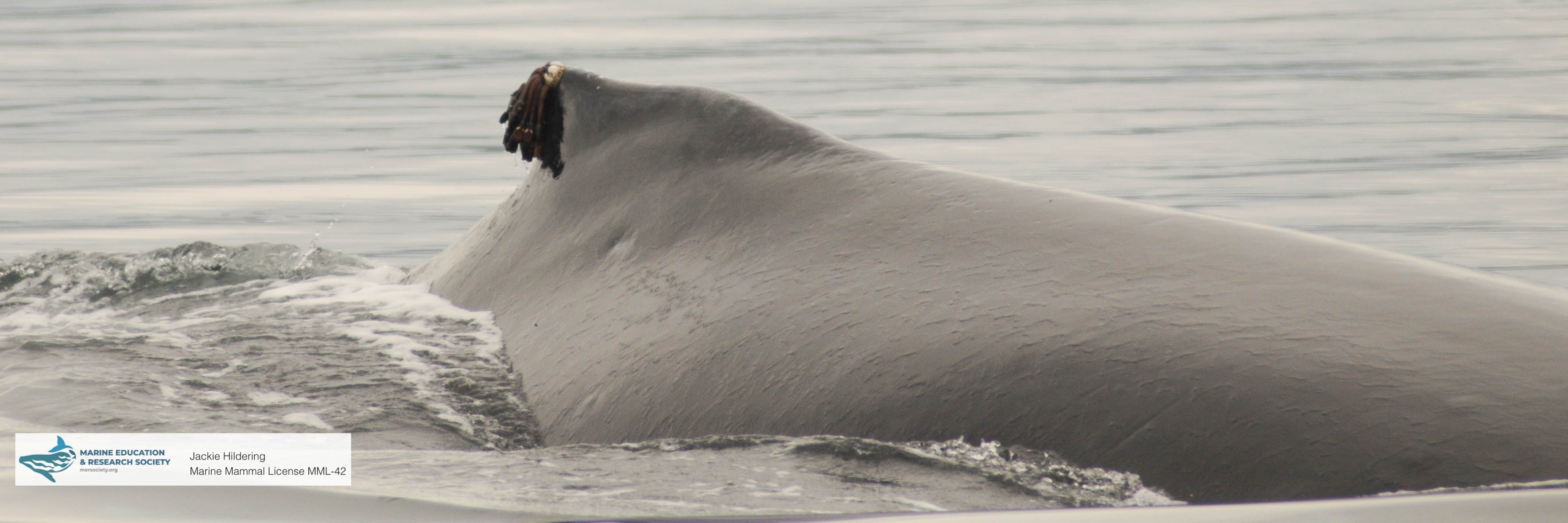
But, it didn’t quite look like seaweed. With patience and good camera lenses, we got a better look.

What on Earth?! They’re gooseneck barnacles growing on the Humpback Whale Barnacle!

Gooseneck barnacles are an order of barnacles that are attached to a hard surface by a long stalk that looks like a goose’s neck. They depend on the motion of the water to feed on plankton as they do not have the “foot” (cirri) that rakes in plankton in many other barnacle species.

That’s when I learned that there is a species of gooseneck barnacle that, in the North Pacific Ocean, most often grows on the Humpback Whale Barnacle!! The species is the Humpback Whale Gooseneck Barnacle, also known as the Rabbit-eared Whale Barnacle (Conchoderma auritum (to 11 cm long).

This is the kind of discovery that causes wonder and euphoria in my world.

To be able to identify a Humpback as an individual is already something of great scientific and educational value.

That this attention to an individual whale leads me to learn that there is a species of gooseneck barnacle that grows almost exclusively on a species of barnacle that only grows on Humpback Whales  = sheer wonder.

I can’t wait to find out what else the Humpbacks are going to teach me!


Image from Fertl, Dagmar & Newman, William. (2018). Barnacles.
Update: January 2022.
Oh and by the way, when Jigger returned to the feeding grounds around northeastern Vancouver Island the next year, she did not have the two barnacle species on her dorsal fin. But she did have . . . a calf. The calf is “Quartz” and has returned to northeast Vancouver Island every year from 2011 to 2021.

From our Marine Education and Research post from January 2022:
There are two species here on Dapple’s chin and these barnacle species are very often also on the tips of Humpback Whales’ tails.

1) The big, round barnacles are “Humpback Whale Barnacles” (Coronula diadema to 5 cm tall and 6 cm wide) and they ONLY grow on Humpbacks. When they fall off, they leave those round white marks. The barnacles that grow on Grey Whales are a different species that ONLY grow on Grey Whales (Cryptolepas rhachianecti).

2) Growing atop the Humpback Whale Barnacles are “Humpback Whale Gooseneck Barnacles” (Conchoderma auritum to 11 cm long) aka “The Rabbit-Eared Gooseneck Barnacle” which, in the North Pacific Ocean, MOST OFTEN ONLY GROW ON TOP of Humpback Whale Barnacles! There can be up to 50 Humpback Whale Gooseneck Barnacles on one Humpback Whale Barnacle and each gooseneck barnacle is usually oriented with the opening facing the direction the whale swims allowing for better feeding on plankton. (Source: EFauna BC). With that long, fleshy “neck” it certainly is clear why they are called GOOSENECK barnacles.

That’s two layers of specificity made all the more thought-provoking when you realize that barnacles start off as plankton drifting in the ocean, attach to the correct surface, and then grow a shell.
The amount and position of these barnacle species can change quickly. For example, there were no Humpback Whale Gooseneck Barnacles to be seen on Dapple’s chin on August 18th but there they are by September 25th. Thereby, barnacles often cannot help identify individual Humpbacks between years but . . those scars from Humpback Whale Barnacles DO persist.

Please know that barnacles are NOT thought to be a hinderance to the whales. It is believed that there’s symbiosis. The barnacle species have good positioning to feed on plankton and the Humpback Whale and Grey Whale Barnacles are believed to offer defence to these slower moving big baleen whales. Grey Whales and Humpback Whales are built for fight rather than flight from mammal-hunting Orca (Bigg’s Killer Whales) and will posture, trumpet and lash out. The barnacles are likely also of use when the males fight for females in the breeding grounds. Hey, when you don’t have teeth, it helps to have something similar to brass knuckles. 🙂

More detail

From E-FAUNA BC: ELECTRONIC ATLAS OF THE WILDLIFE OF BRITISH COLUMBIAConchoderma auritum is most often found attached to the shells of Coronula on the humpback whale; sometimes more than fifty are attached to one shell. “Rarely a specimen is found attached to the base of the teeth of an old sperm whale” (Sheffer, 1939). Gordon C. Pike reports finding specimens of C. auritumon sperm and fin whales taken in British Columbia. In each case the barnacles were associated with a deformation or an apathological condition of the jaws, baleen, or teeth. Each barnacle is usually oriented with the opening facing in the direction the whale swims. The food-laden water passes through the opening and over the feeding appendages, then out through the two “ears” which have tubular openings.”

From the Marine Species Identification Portal: Species is “attached to the whale barnacle Coronula diadema and sometimes Coronula reginae. It seems to be a rule that no Coronula is without a Conchoderma. Whether this is a form of symbiosis has been discussed by Broch (1924b). Specimens from northern waters have been taken from humpback whales (Megaptera novaeangliae ) or from teeth of bottle-nosed whales (Hyperodon spp.). In the Antarctic C. auritum has also been found on baleen plates of whales and on their tails. In tropical and subtropical parts of the oceans it can also be found attached to ships’ hulls and other floating objects, to slow moving fishes or to the tail of a large eel, but never on soft objects.”
From Mike Horan (pers. com January 2022) “I have also seen the stalked barnacle [Conchoderma auritum] on Bottlenosed Dolphins during the die off of 1987 in New Jersey.”

Excerpt from Hakai Magazine’s What Whale Barnacles Know” (November 2021)

“Individual whales have been known to collect up to 450 kilograms of barnacles. That’s an enormous mass, but relative to a 30-tonne humpback, it would weigh only about as much as an extra layer of clothes. And as far as scientists can tell, the hangers-on don’t particularly bother a healthy whale. They may slightly increase drag as the whale swims, but they may also be helpful as a set of brass knuckles when adult males battle each other over the chance to mate [and when dealing with mammal-hunting Bigg’s Killer Whales]

Here’s what we don’t know about whale barnacles, at least with any certainty: just about everything else. Like, how do their larvae, no bigger than a grain of salt, find a migratory whale to grab onto in the first place? Once they locate one, how do they navigate around its gargantuan body—hundreds of thousands of times larger than theirs—to find their permanent homestead? “It just seems preposterous,” says John Zardus, a marine biologist at the Citadel in Charleston, South Carolina. He specializes in studying barnacles that live on other living things.

Studying those symbiotic barnacles that live on sea turtles, dolphins, crabs, and other marine animals has given Zardus some idea of how whale barnacles might hack it. Adults mate on the whale, but rather than take their chances during their host’s oceanic migrations, they likely wait to release their larvae until the whales gather in coastal areas to breed. The larvae then go through several developmental stages, which can take up to two weeks, before they’re ready to settle. “It’s not like the larva is being released from a whale and it’s going to [immediately] attach to the whale next door,” Zardus says.

When a larva is ready, a chemical signal is most likely what tips it off that it’s in the presence of whale skin. This could be a pheromone emitted by already settled adult barnacles—a strategy commonly used by other barnacle species—or it could be some molecule that wafts off the surface of the skin itself. If other barnacles are any indication, the larva probably reaches out with its sensitive antennules to familiarize itself with the epidermis. It squeezes a drop of sticky polymer out of one antennule to adhere itself temporarily, then sticks down a second antennule and releases the first one, swinging it over to another spot. By repeating this process, a larva “ends up walking around on the surface, leaving little gluey footprints,” says Zardus. “These larvae can possibly crawl all over the host until they find the right location where they want to be.”

Where they want to be is generally on the whale’s forehead, its tail, or the leading edges of its flippers. Those are the places on a whale’s body that water flows over most efficiently. That gives the barnacle a front-row seat when the whale swims through a cloud of plankton, which the barnacle also gets to eat. When the larva finds a good place to settle down, it exudes a stronger glue onto the skin and cements itself for the rest of its life, which may last about one to three years.

Much of this is informed speculation, Zardus stresses, because living whale barnacles and their larvae are extremely hard to come by. Collecting them from a living whale is out of the question, since it would require cutting into the whale’s flesh. A dead whale that washes up has to be discovered before its barnacles die of hunger, desiccation, or predation . . ..

Other than whale barnacles, nothing else reliably recorded the month-to-month movements of ancient whales, says Taylor. Bone tissue doesn’t care about the chemistry of the water it grew in; baleen does, but it’s hardly ever fossilized. But a well-preserved whale barnacle is the perfect time-traveling tracking device. “We won’t be able to tell you, ‘This whale hung a left at Malibu,’” says Taylor, “but [we can] get a general sense of where animals might have been moving.” . . .


Jigger bulking up before the migration, near Sayward in British Columbia, in November 2021.

Sources:

Hakai Magazine, November 2021, What Whale Barnacles Know

Mike Severns, The Life and Times of a Humpback Whale Barnacle

Würsig, Bernd G., J. G. M. Thewissen, and Kit M. Kovacs. 2018. Encyclopedia of marine mammals. Chapter: Barnacles.


Source: The Ocean World by Sam Hinton

Kaouk the Sea Lion – The Story Gets Better and Better!

Update to the April/May information below: June 16, 2011.

From Peter Olesiuk, DFO –  “I have not heard anything from Kaouk for over 2 days now, and I suspect his tag may have been moulted.  In our Steller studies the tags tended to fall off in July-August.  However, I checked the literature and the moult is 1-1/2 months earlier in juveniles, typically starting on 21 June.  In my experience, tags glued to the pelage [fur] tend to fall off when the hair follicles weaken early in or just before the actual moult.”

_______________________________

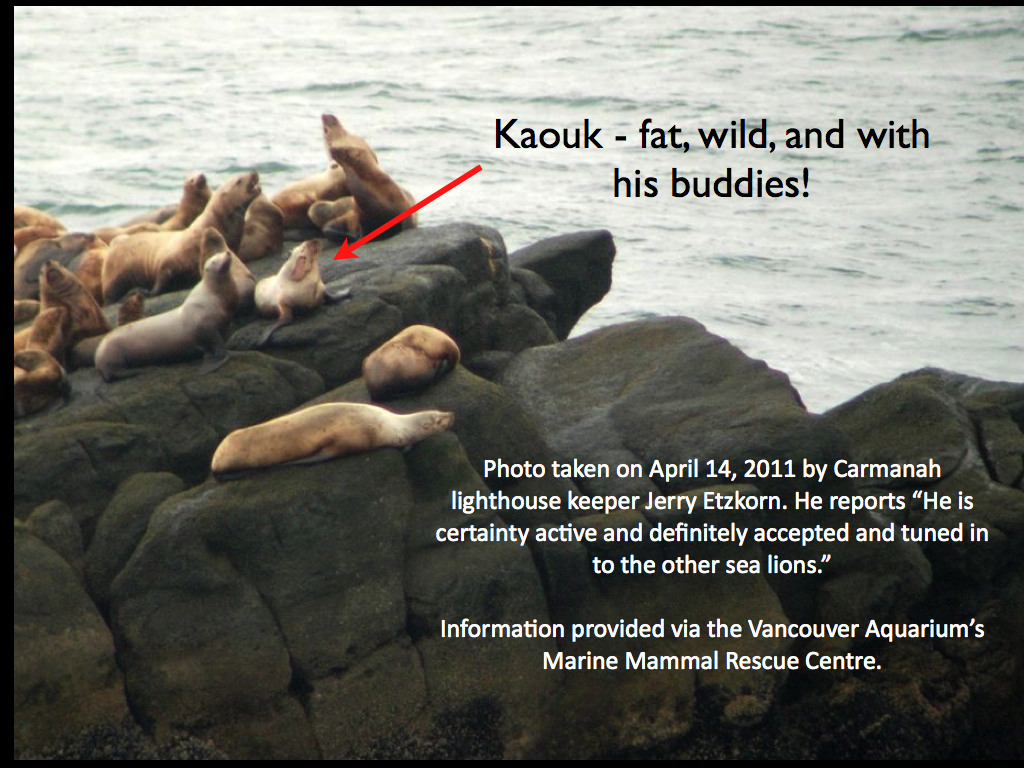
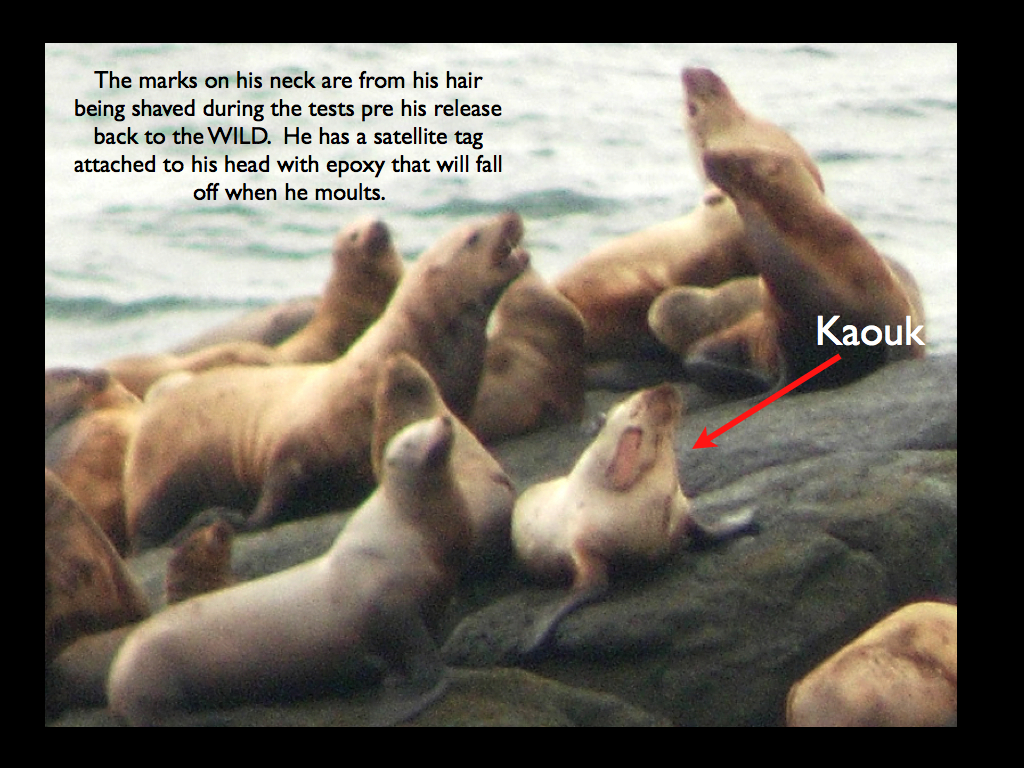
A picture is definitely worth a thousand words. See below for April 14th and May 8th images of Kaouk the Steller sea lion healthy, fat, WILD and with his peers!!

This photos and information has been provided by lighthouse keeper Jerry Etzkorn, via DFO and the Vancouver Aquarium’s Marine Mammal Rescue Centre (you can follow MMR on Facebook at this link).  

Kaouk, is the male Steller sea lion that walked into the Port Alice trailer park on December 16th and was flown to the Vancouver Aquarium’s Marine Mammal Rescue Centre. He inspired the students of Port Alice to write a children’s book and was released back into the wild on March 17th from southwestern Vancouver Island.

For background information on Kaouk, including how you can follow him via satellite tag, click this link for a previous blog posting.  

Click the images to see them at a larger size.

Another happy Kaouk update from May 8th, 2011. Thank you Peter Olesiuk.


Photo taken on April 14, 2011 by Carmanah lighthouse keeper Jerry Etzkorn. He reports “He is certainty active and definitely accepted and tuned in to the other sea lions.”

Mysterious Killer Whales Come Inshore

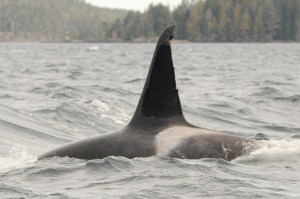
Mature male offshore killer whale photographed on March 27, 2011 for research purposes by J. Hildering (telephoto lens). Note ragged edge to the dorsal fin – damage from sharks?


Many Port McNeill (N. Vancouver Island, BC) residents were whale watching on the evening of March 30th and they didn’t have to leave their homes to do so!

A group of 12 offshore killer whales was extremely active right in front of the community; even repeatedly spyhopping (popping their heads out of the water). To have whales this visible near your home is a great gift but, all the more remarkable is that these were very mysterious, threatened whales.

“Offshores” are a distinct type of killer whale that does not mate with the killer whales that eat marine mammals (“transients”) nor with those that feed on fish, mostly salmon (“residents”).

About 300 individual northeastern Pacific offshores have been photographed but studying them is usually very difficult. As their name suggests, they are most often near the continental shelf and they are very wide-ranging. Offshores weren’t even identified till 1979 and weren’t confirmed to be a distinct population until 1989.

So little is known about them. Only very recently did the research of Dr. John Ford et al illuminate what the whales might be doing around the continental shelf and why their teeth are worn down so much more than the teeth of other killer whales. DNA analysis of prey samples confirmed that the diet of offshores includes Pacific sleeper sharks (4m+), a species with very abrasive skin that are found around the continental shelf.  In some cases the offshore killer whales’ teeth are so worn down by the the sharks’ skin that it is believed they become dependent on the help of other offshore killer whales to catch and eat this prey. The offshores’ scarred bodies served as a further hint that they may do battle with sharks.
Their diet is believed to also include other shark species (e.g. salmon sharks, blue sharks) and halibut.
Inshore sightings of these whales provide a very unique opportunity to learn more about them e.g. what they are eating when inshore and why they are so full of toxins.  It is puzzling that offshores killer whales appear to becoming inshore more often and this may be due to a shift in diet or range in their prey.

Luckily one of the world’s leading killer whale researchers, Graeme Ellis of the Pacific Biological Station, was able to join the offshores in front of Port McNeill for this research opportunity.  He was alerted to their presence by the superstars at the Orca Lab (Leah Robinson and Marie Fournier) who first heard these whales’ unique vocals in the Robson Bight area on March 25th.

I too was extraordinarily privileged to be able to contribute some ID photographs from sightings on March 27th and . . . I don’t think I’ll ever quite be the same after watching these mystery whales surfing in 3’ waves.

It all just goes to show that you never know who you’ll meet on Northern Vancouver Island!

[Great thanks to residents of Port McNeill and Angela Smith of Ocean Rose Adventures for helping get photos of a lone male offshore killer whale in Port McNeill Bay on March 27].

For more information on offshore killer whales see:


Kaouk – The Next Chapter of “The Steller Sea Lion That Flew”!

[Updates up to April 6th provided below. For more recent updates – including a photo of Kaouk hauled out with other wild Steller sea lions, click here. 

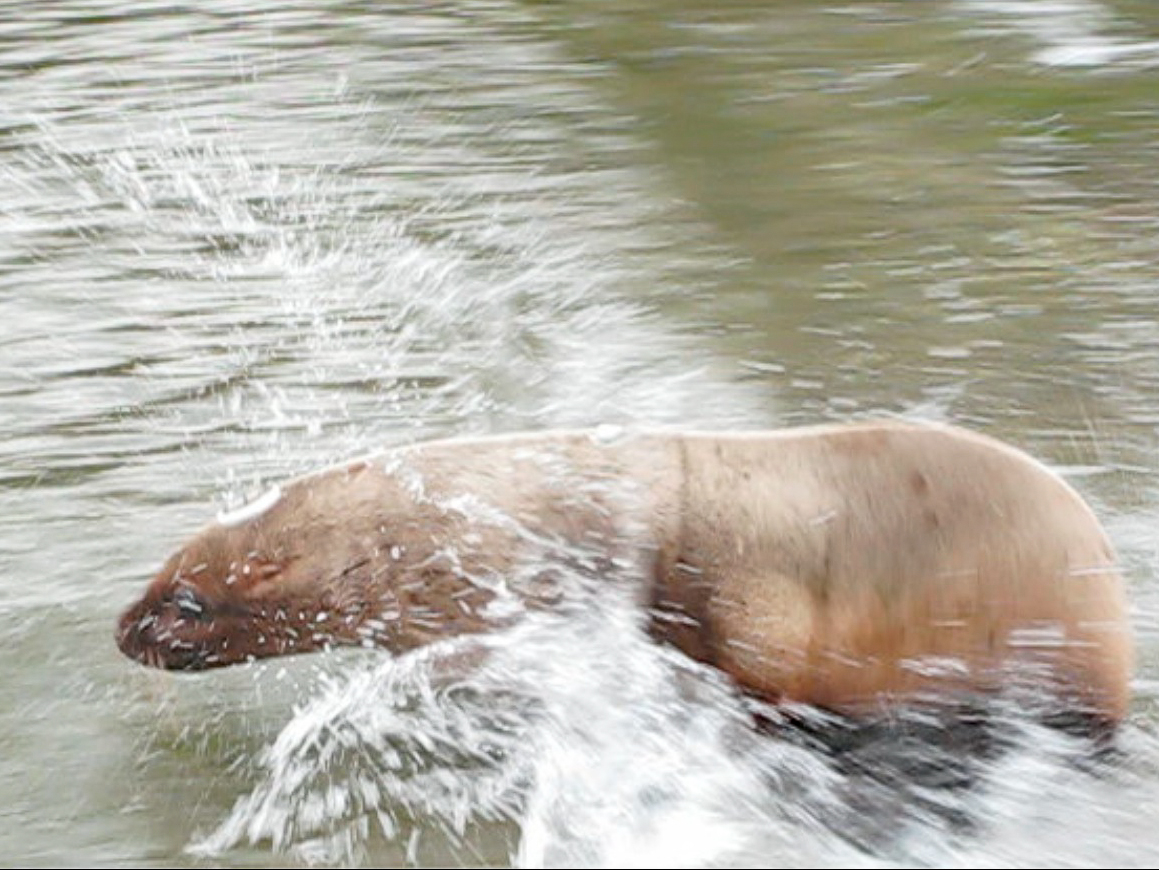
Kaouk bounding unhesitatingly back into the wild. Where is he now? See links below for links to the Vancouver Aquarium announcement and track data. Photo is a video grab by Peter Olesiuk (DFO)

Kaouk was released back into the wild on March 17th, from Toquart Bay on southwestern Vancouver Island (where the herring are bountiful) and  . . . now you can follow his progress!

Kaouk, is the male Steller sea lion that walked into the Port Alice trailer park on December 16th and was flown to the Vancouver Aquarium’s Marine Mammal Rescue Centre. He inspired the students of Port Alice to write a children’s book and will no doubt continue to be a charismatic marine ambassador to we humans; helping us understand his species, when to help wild animals, ad when to leave them be.

For the Vancouver Aquarium’s announcement of his release click here.

The announcement includes the link to where you can follow him via a satellite tag that was attached to Kaouk’s fur with epoxy and will fall off when he moults.

Click here for the direct link to the tracking data.

Click here for a previous blog posting giving background on Kaouk.

And click here for a 1-minute video of his enthusiastic return to the wild, made available by Peter Olesiuk (DFO).

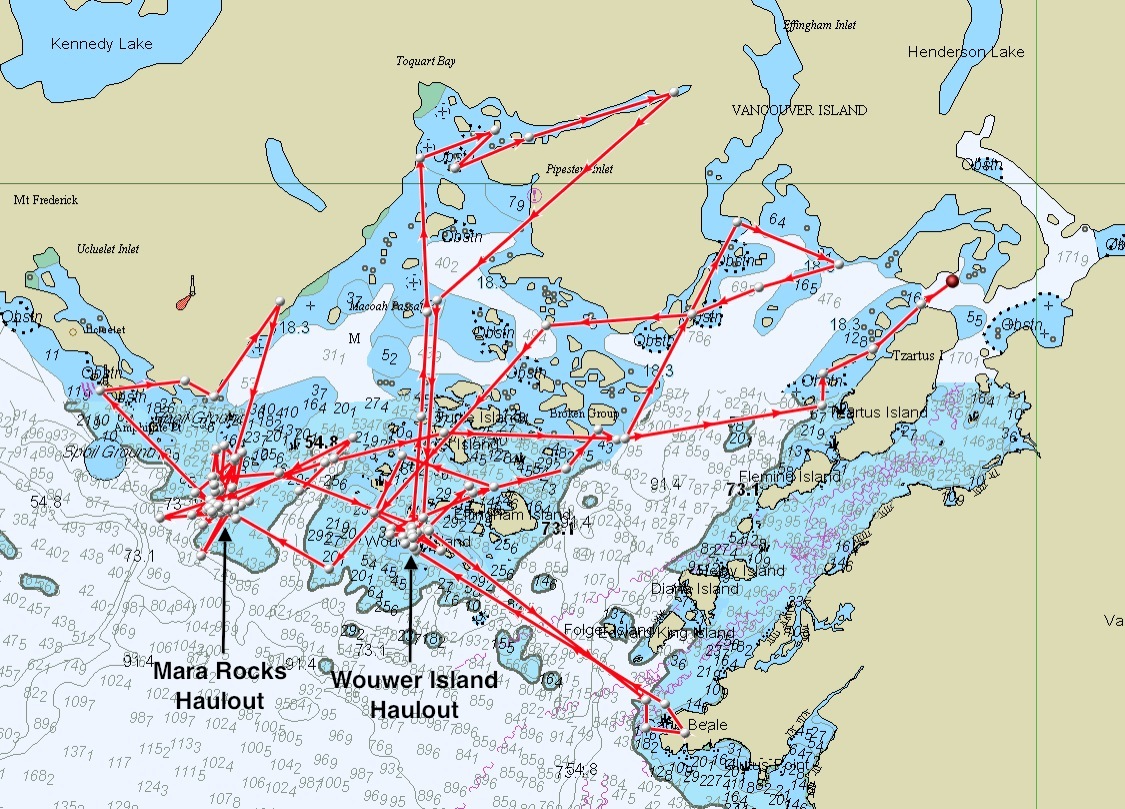
Kaouks wanderings to the morning of April 6, 2011. He has been exploring and hauling out a lot. See text for update.

Update April 6th, 2011.

See the image below – Kaouk has been exploring Barkley Sound and hauling out on a regular basis over the last 10 days, first at Mara Rocks (the largest and only year-round Steller haulout in Barkley Sound – see previous update) and more recently at Wouwer Island (a winter haulout occupied by Steller and California sea lions mainly outside of the May-August breeding season).  He has been frequenting areas knowing to be good herring spawn areas, and areas known to have concentrations of sardines).  Go Kaouk go – eat lots!  Scientist Peter Olesiuk of DFO reports that he needs to eat 15-20 kg per day, which is apparently a challenge. Scientist Peter Olesiuk of DFO reports that about 46% of sea lions don’t make it through their first year.

Click to enlarge. Mara Rock - the Steller sea lion haul out that Kaouk has been frequenting! Image provided by Peter Olesiuk (DFO).

Update March 30th, 2011

Kaouk is with his own kind!

Since the evening of March 25th, he has been hauling out and foraging around this haulout on Mara Rock. Peter Olesiuk of DFO kindly shared that Mara Rock is the largest Steller sea lion haulout in Barkley Sound and that it is the only site that is occupied year-round (600+ animals, including lots of juveniles like Kaouk, at this time of year). Images below provided by Peter Olesiuk show the Mara Rock haulout and, in the satellite tracking image, Mara Rock is in the bottom left corner (note how consistently he has been at this site). Most of his dives are reported to be between 20 to 50 m with a few in the 50 to 100 m range.

Click to enlarge. Satellite image from AM of March 30th. Note the concentrated activity in the bottom left of the image. This is Mara Rock - a large Steller sea lion haulout!!!

Update March 19th: If you have been looking at the satellite data for Kaouk, please note that the locations are only updated once a day (data is not real-time) and that locations are not very “refined”. The map below (provided via Marine Mammal Rescue) gives a far more accurate look at Kaouk’s adventures. It looks like he hasn’t even come ashore in his first days in the wild! He has been actively diving and hopefully filling himself up with herring.

Kaouk - March 17th to +/- 09:00 March 19th. Image via Vancouver Aquarium Marine Mammal Rescue.


Backyard Food Web

We had a backyard visitor today.

Click here for the tongue-in-cheek account of what brought him there (a 1-minute slide show).

Note that I do not make light of the fact that the visitor was likely hungry and appeared to be habituated to humans.

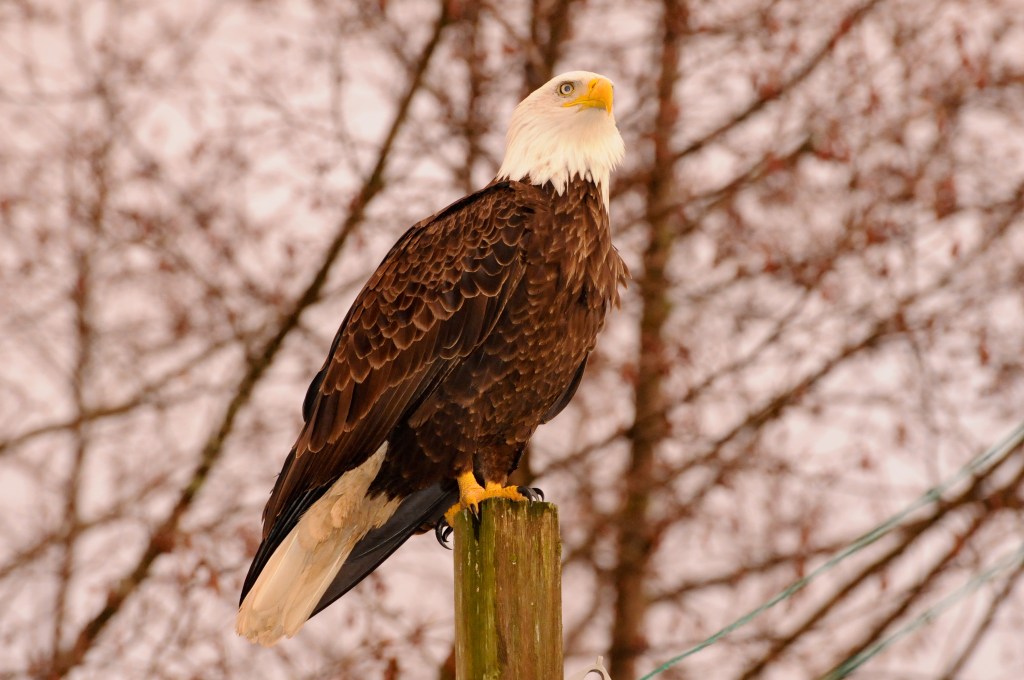
Mature male bald eagle. Photo: J. Hildering


The Need to Dive

The Marine Detective in a bull kelp forest. Photo: G. Miller

Due to weather and other circumstances, I did not go diving this weekend. As a result, I feel rather “undone” and out of sorts.

It has become essential to my well-being to submerge in the North Pacific at least once a week.  Is this because I am addicted to the nitrogen buzz? Do I need the rapture that comes with descending into such natural beauty and wonder?  Is it because I get to “check-out” of my terrestrial life for a little while?  Does diving move me into a meditative state?  Do I miss my fishy and sluggy friends? Do I need the inspiration and perspective on what it truly important in life?  Or is it because I was a sea lion in a past life and have not made the full transition to a human existence?

All of these factors may in part cause my desperate need to dive but Dr. Joseph MacInnis states it all so much more eloquently and powerfully in this excerpt from the introduction to his book “Saving the Oceans” (text which I wrote on the first page of my first dive log).

“Of all the acts that confirm our unconscious need to reconsider Nature, few are as symbolic as descending into the ocean. As scuba divers . . . we step off the land, leaving behind our urban alliance with concrete and asphalt. Underwater, our survival hinges on containers of portable air. Inside this strange inner space, we become weightless, drifting toward our aquatic origins.

As trespassers in this other world we are more susceptible to shifts in thinking and emotion. Our eyes are captured by unfamiliar colours and patterns of light and shadow. The pressurized air sliding in and out of our lungs reminds us of our mortality. And from this, it is not a large intuitive leap to consider the mortality of the planet.”

I need to dive!!


Lingcod – Fastidious, Fanged Fathers!


Last update: March 21, 2024.

Update November 2021: New research finds Lingcod replace ~2 of their 500 teeth every day.


Every year, our local dive club does several dives for the Lingcod Egg Mass Survey now curated by the Marine Life Sanctuaries Society.

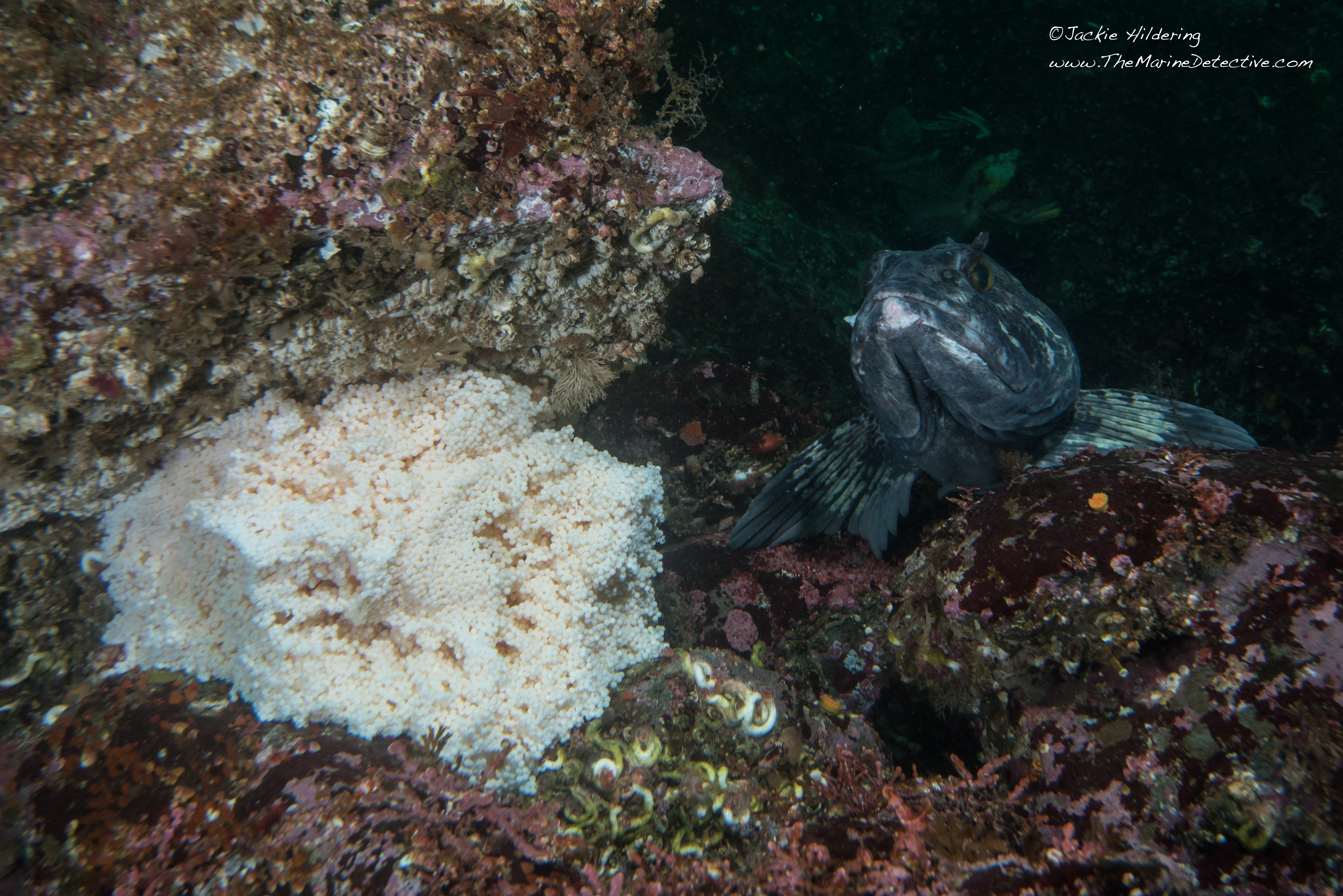
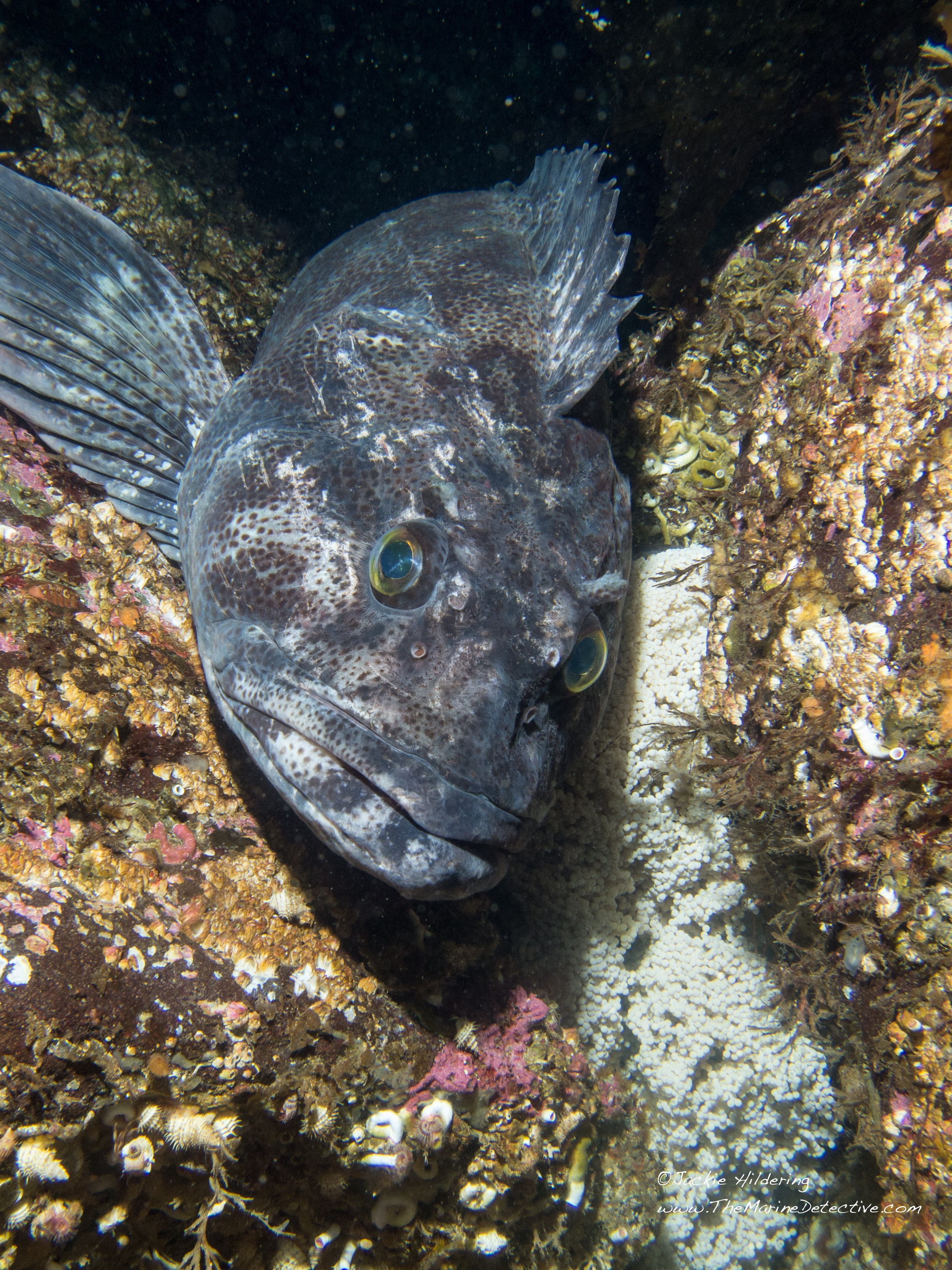
Lingcod male guarding eggs
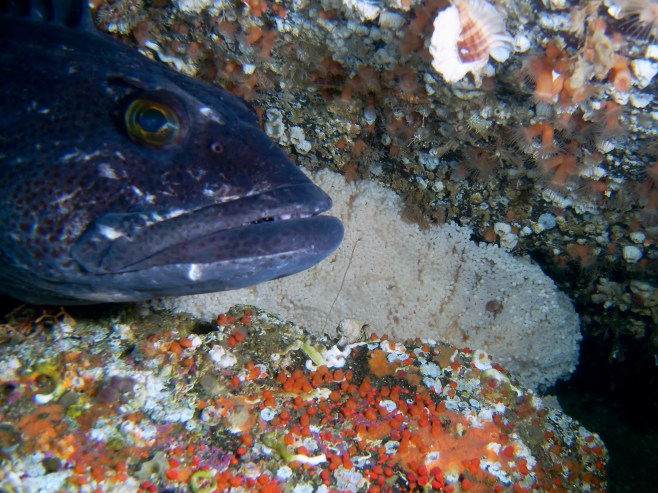
Lingcod male guarding an egg mass. Generally, the larger the egg mass, the older the female that laid it. Males guard the fertilized eggs from predation by other fish and sea stars until they hatch at 5 to 11 weeks. Photo: ©Jackie Hildering.

The survey is the result of concerns about the overfishing of this fish species and is conducted just after the spawn (January to February) when females leave the males to guard the egg masses from predation by species like sea stars. There are very few deadbeat dads in this species!

The data collected provide insight into the abundance and reproductive success of Lingcod in British Columbia and include: depth of the egg masses; their size (grapefruit, cantaloupe or watermelon sized); if the eggs are being guarded by a male; and their state of development (new, eyed or rotten). We are very fortunate that our area appears to have relatively abundant and large egg masses. At the end of this blog, you’ll find my 2.5 minute slide show of their life history. 

Male Lingcod with my buddy with her slate, having just recorded depth, size and condition of the egg mass. Buddy is Natasha Dickinson. ©Jackie Hildering.

But let me first take you on a wee retrospective journey.  

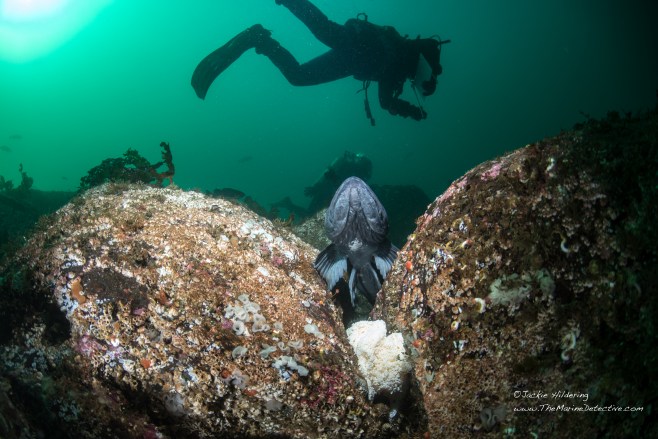
My understanding of the behaviour of these magnificent fish has now evolved  to where I now take photos of the extremely territorial males guarding their large orbs of fertilized eggs, but it certainly wasn’t always that way for me. The following is a much exaggerated perspective from when I was a very new diver doing their first Lingcod egg mass survey.

In 1999, I had only ever done 14 dives and had never even seen a Lingcod while diving. So, in preparation for the survey, I consulted my trusty field guide and felt well-prepared knowing the information below:

Lingcod male guarding egg mass (lower right). ©2015 Jackie Hildering
Lingcod male guarding egg mass (lower right). ©Jackie Hildering.

LINGCOD (Ophiodon elongatus)

  • Size: To 1.5 m and 37 kg.
  • Description: Large head, mouth and teeth; dark blotches on a slender, tapering, mottled body.
  • Habitat: Adults on rocky reefs and in kelp beds to 2,000 m; juveniles on sand and mud bottom.

However, nothing could have truly prepared me for meeting the awe-inspiring and highly dedicated Lingcod Fathers for Future Generations Club.

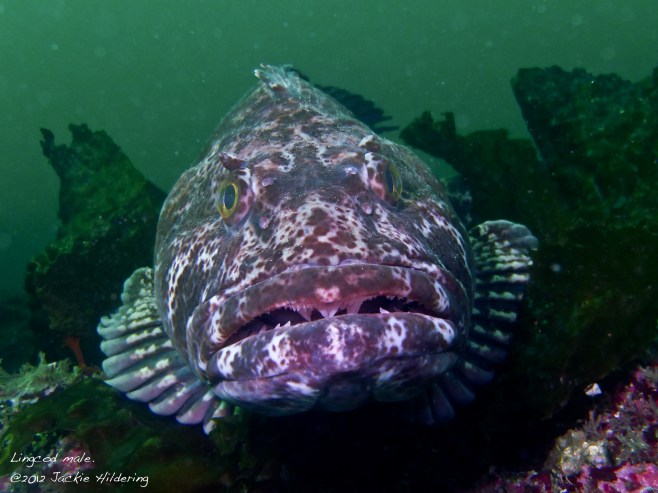
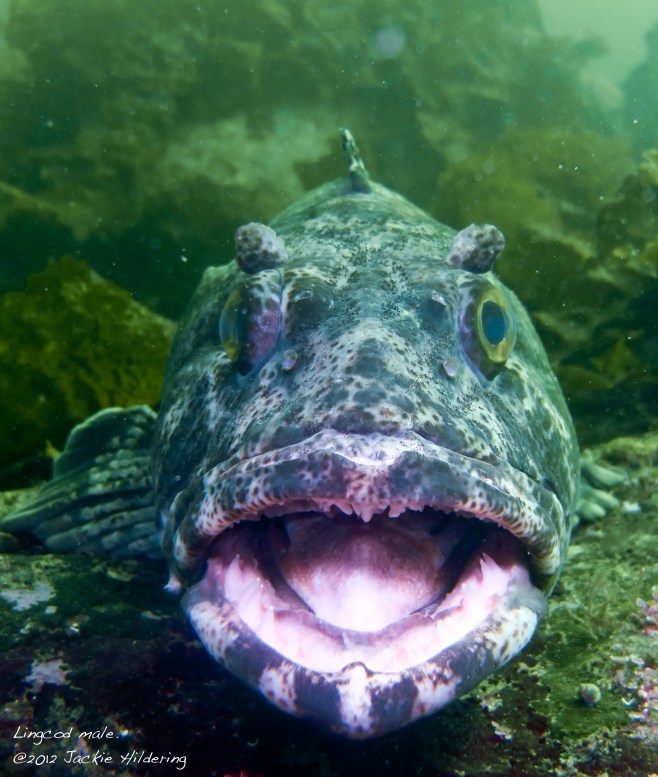
Serious teeth. ©2012 Jackie Hildering.
Serious teeth. ©Jackie Hildering.

That first experience with the survey in 1999 led me to writing the following tongue-in-cheek “updated” field guide information in my dive log.

LINGCOD (Megadontos fishious)

Size: &%$#@ huge!!!!!

Description: Teeth sharp, large and fear inducing; species camouflaged for added surprise value; ability to make themselves appear even larger and more menacing by fanning out huge gill plates (opercula). Note: Wise for divers to retreat if this behaviour is observed.

Habitat: Adult males found anywhere that groups of dive slate carrying divers like to congregate.

Comment: Egg masses are said to have eyes at some stage of their development but no living diver can confirm that this is the case!

This is an awe-inspiring fish species indeed. I have even had a male knock my dive slate out of my hands during a survey. Ironically, I was recording “absent” under the column for whether a male was guarding the egg mass!

Huge egg mass and male Lingcod with battle wounds. It is so meaningful to me that we are likely often documenting the same males year upon year. The males apparently court, mate and guard near the same rocks every year.  ©Jackie Hildering.
Huge female Lingcod. After age ~4, females grow twice as fast as males. By age 10 to 12, they are twice the size of males of the same age. Bigger females lay larger egg masses – up to 500,000 eggs! More on the life history in my slide show below. ©Jackie Hildering.

Note that the common name of Lingcod is confusing as they are not a cod nor a ling (another fish species).

For detailed information on the survey, survey reports and the biology of Lingcod click here for the Ocean Wise webpage. 

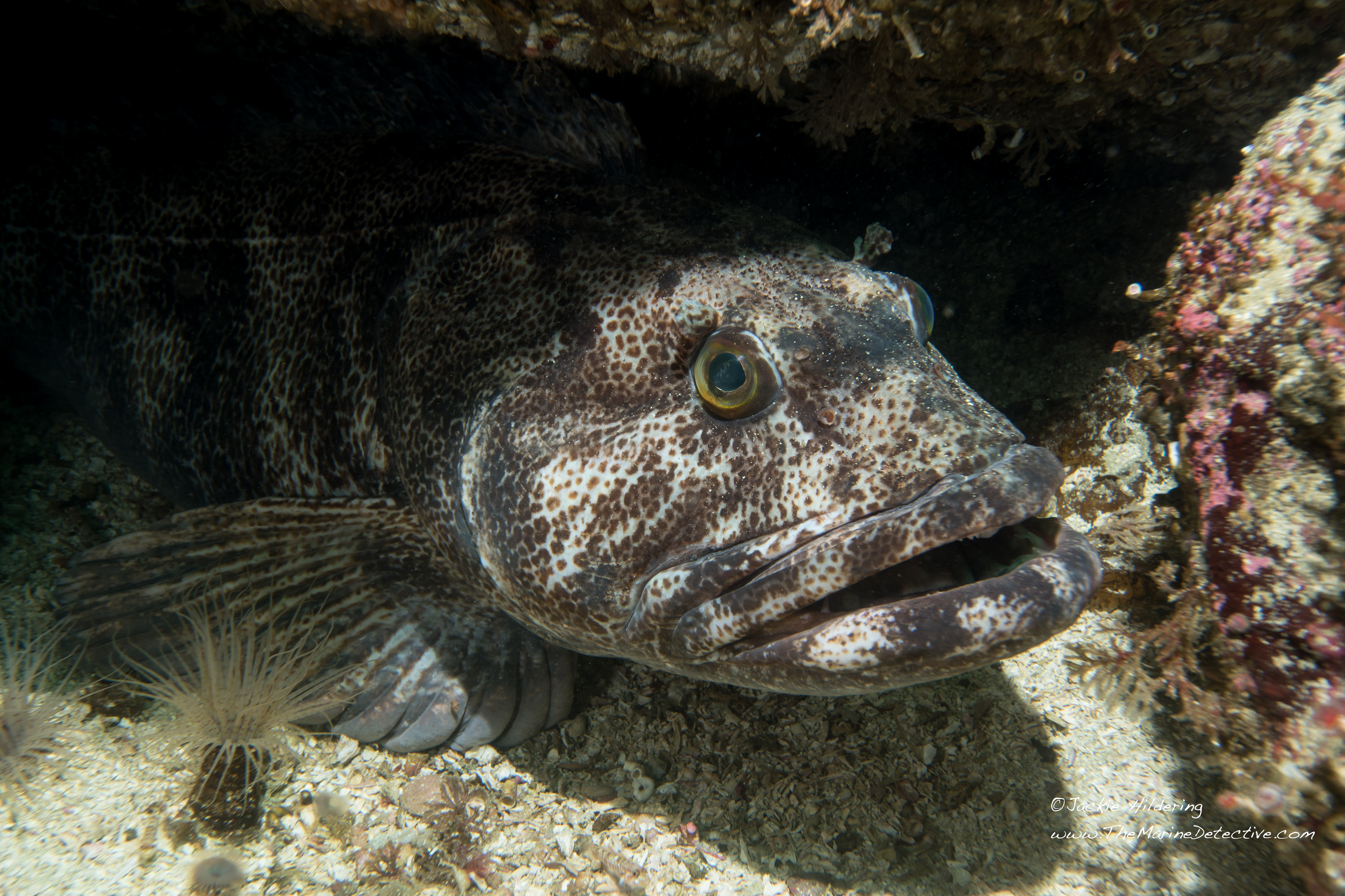
Okay, maybe not looking so serious here. :) ©2012 Jackie Hildering.
Okay, maybe not looking so serious here. ☺️
©Jackie Hildering.
Guarding egg mass. ©Jackie Hildering.
So much to protect. ©Jackie Hildering.

Sources:
Alaska Department of Fish and Game, Lingcod

Lamb, A., & Edgell, P. (2010). Coastal fishes of the Pacific Northwest. Madeira Park, B.C: Harbour Pub.

Love, M. S. (2011). Certainly more than you want to know about the fishes of the Pacific Coast: A postmodern experience. Santa Barbara, Calif: Really Big Press.

Sharks Among Us #2 – The Bluntnose Sixgill Shark

Update May 1, 2023: Original blog is from 2011. I have added photos of additional, known dead Sixgill Sharks at the end of this blog.

And yes, there is a personal connection to this species. While these huge sharks are often in very deep water, I have seen them while diving in at depths of even less than 10 metres. It’s difficult to express the wonder and connection that results from these privileged experiences. It’s somewhat like seeing a living dinosaur. Bluntnose Sixgill Sharks have been perfected by 200 million years of adaptation.

They are not a threat to us. We are a threat to them.


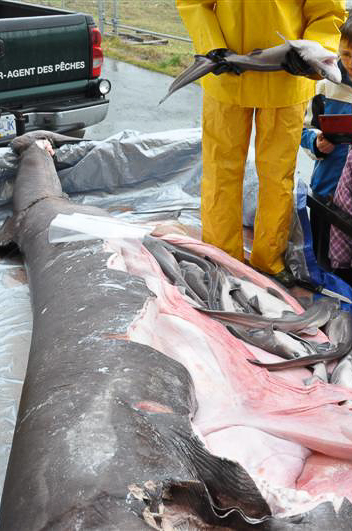
The awe-inspiring images below are of a pregnant female Bluntnose Sixgill Shark (Hexanchu griseus) who was found dead on a beach in Alberni Inlet on low tide in February of 2011. She was necropsied by Department of Fisheries and Oceans staff and there were no obvious indications of how or why she died.

The information below has been generously provided by shark biologist and friend, Romney McPhie. I am sharing in the hopes of increasing respect and understanding for these astounding, huge, deep-dwelling sharks who live off our coast.

4.2 m pregnant female Sixgill Shark – February 2011.

This female Sixgill was 4.2 metres and was estimated to weigh 569 kg (1,254 lbs).  As a viviparous shark species, she carried her embryos through the entire gestation period which is thought to be over 2 years long (species does not lay eggs / egg cases).

She may have given birth to some prior to her death and still had 28 pups inside her. The young hatch inside the female’s body before entering the ocean (these sharks are “yolk-sac viviparous”).

Sixgill Sharks have been reported to be up to 4.8 metres in length with females being larger than males (males to 3.5 metres). Age of sexual maturity is estimated to be between age 11 to 14 for males and between 18 to 35 years for females. It is believed that life expectancy may be up to 80 years of age. 

The Committee on the Status of Endangered Wildlife in Canada (COSEWIC) 2007 assessment report on the Bluntnose Sixgill puts into perspective how rare an opportunity it is to learn about a pregnant Sixgill.  It relates that the number of pups carried by females is known from only three previous credible accounts (ranging from 47 to 108 pups which were 61 to 73 cm in size).

The Bluntnose Sixgill Shark is an extremely cryptic species that can dwell at depts up to 2,500 m.  So little is known about them and (sigh)  they are “near threatened” globally and are a species of “special concern” in Canada.

I have had the incredible privilege of seeing Bluntnose Sixgill Sharks while diving and felt like I was in the presence of greatness. They are living fossils, perfected by 200 million years of adaptation. They are amazingly graceful with large, luminous and intensely green eyes.

They are of absolutely no threat to humans and, like all sharks, have an essential role in marine ecosystems.  As top-level predators, sharks strongly shape food webs and the loss of such predators has proven to have profound effects on the number and diversity of other species.

The unique teeth of Bluntnose Sixgill Sharks. Photo by Romney McPhie.

We, however, are a threat to them.

There were historical fisheries and bycatch remains a concern. From 2006 to 2009 there an estimated 1979 Bluntnose Sixgill Sharks were Commercial Hook and Line catch

There is no information on the survival rates from bycatch nor of the accuracy of bycatch reporting. Population size and reproductive rate are not known for this species.

The primary threats identified for these species are entanglement and bycatch.  Other threats identified include pollution, habitat loss or degradation, climate and oceanographic change, and harassment. Historic threats included directed fisheries and entanglement/bycatch. While these populations are migratory throughout the northeast Pacific, it is unknown whether threats occurring outside of Canadian Pacific waters have an impact on these populations.”

Further from the 2022 Fisheries and Oceans Canada Report on the Progress of the Management Plan for Bluntnose Sixgill Sharks:

“The present population size and abundance trends are not known. The only available abundance index (encounter rates with immature Bluntnose Sixgill Sharks at a shallow site in the Strait of Georgia) has decreased significantly (>90%) in the last five years. This index is not likely representative of the overall abundance trend because only immature Bluntnose Sixgill Sharks are encountered and the site is shallow relative to the preferred depth range. The principal known threat to the species is fishing.

The Bluntnose Sixgill Shark has been the focus of at least three directed fisheries in Canadian waters, most recently in the late 1980s and early 1990s. It continues to be caught as bycatch, but survival of released sharks is unknown. Bluntnose Sixgill Sharks observed by divers sometimes show scars from entanglement in fishing gear.

Because of its late age of maturity (18 to 35 years for females), it is likely susceptible to overfishing even at low levels of mortality. Little is known about the abundance and movement patterns of this species elsewhere in the world, so the potential for a rescue effect is unknown.

Sixgill Shark eye. This one died as a result of longline bycatch and was brought into Alert Bay in July of 2007. It was rumoured to be one of 12 sharks caught by only one local fishing boat. Photo: Jared Towers.

Sources for the biology, threats and conservation of Bluntnose Sixgill Sharks:

Fisheries and Oceans Canada. 2022. Report on the Progress of Management Plan Implementation for the Bluntnose Sixgill Shark (Hexanchus griseus) and Tope Shark (Galeorhinus galeus) in Canada for the Period 2012 to 2017. Species at Risk Act Management Plan Report Series. Fisheries and Oceans Canada, Ottawa. iv + 20pp

Fisheries and Oceans Canada, 2012. Management Plan for the Bluntnose Sixgill Shark (Hexanchus griseus) and Tope Shark (Galeorhinus galeus) in Canada [Final]. Species at Risk Act Management Plan Series. Fisheries and Oceans Canada, Ottawa. iv + 37 pp.

COSEWIC (Committee on the Status of Endangered Wildlife in Canada). 2007a. COSEWIC assessment and status report on the Bluntnose Sixgill Shark (Hexanchus griseus) in Canada. COSEWIC, Ottawa, Canada.

NOAA, 2017. Getting to know Sixgill Sharks.

Photo #1 April 2023 – Dead pregnant Bluntnose Six-gill Shark, Hornby Island.
Photo #2 April 2023 – Dead pregnant Bluntnose Six-gill Shark, Hornby Island.
From the Vashon Nature Center: in Puget Sound – 4 Bluntnose Sixgill Sharks washed between January and March 2023. Two could not be necropsied. One died after longline bycatch and one died by swallowing a crab bait trap Blog article about the first necropsy at this link.
Photo #1 Coles Bay, February 5th, 2019: Dead pregnant Bluntnose Sixgill Shark
©Ron DeVries.
Photo #2 Coles Bay, February 5th, 2019: Dead pregnant Bluntnose Sixgill Shark
©Ron DeVries.

Big Orange Love – The Orange Peel Nudibranch

Update November 2020: The Orange Peel Nudibranch has been reclassified. Now is Tochuina gigantea.


This blog is about Big Orange Love – the reproduction of Orange Peel Nudibranchs.

Two Orange Peel Nudibranchs mating – each about 30 cm long. Both will go on to lay the huge masses of eggs you see below. There is no male, or female.

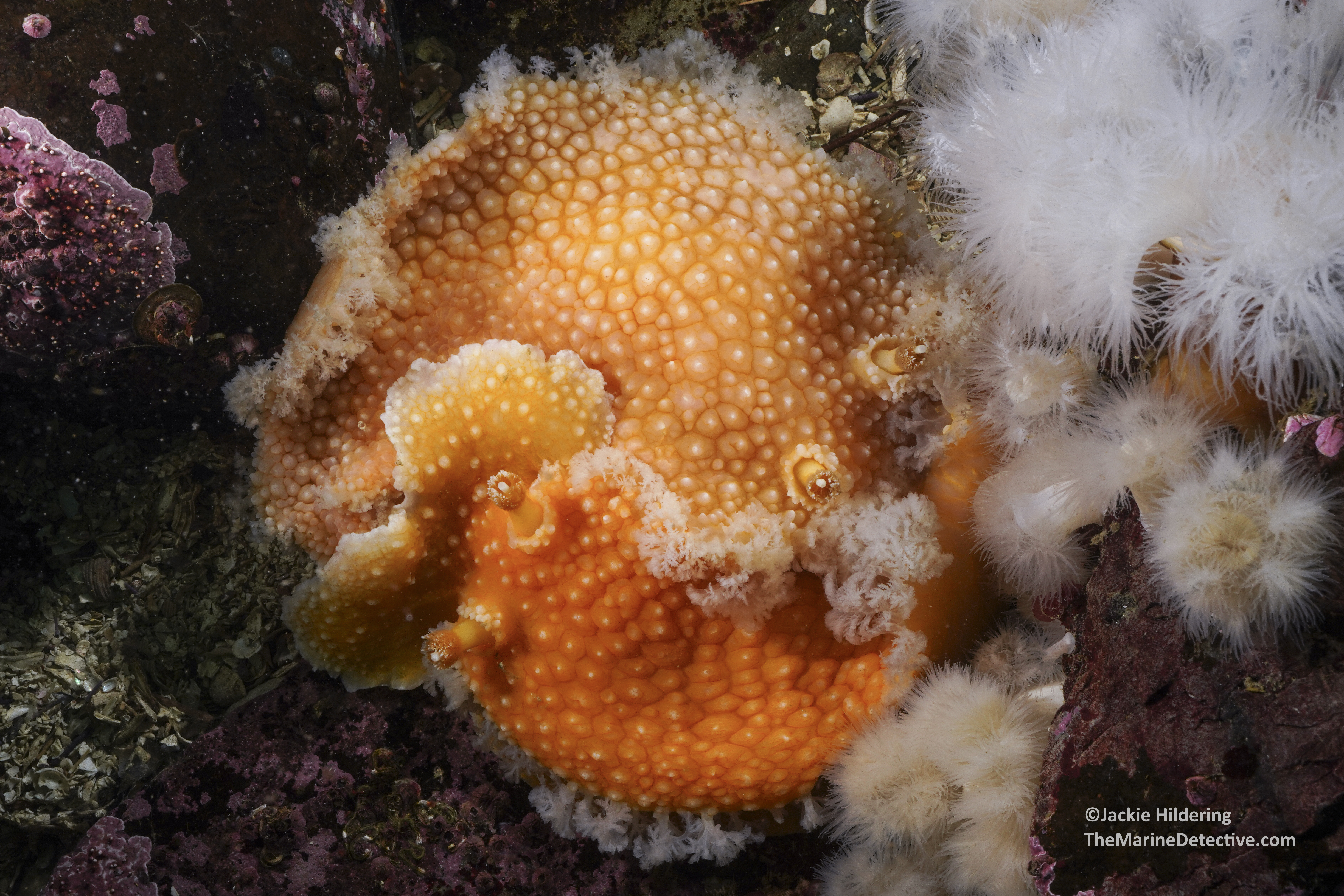
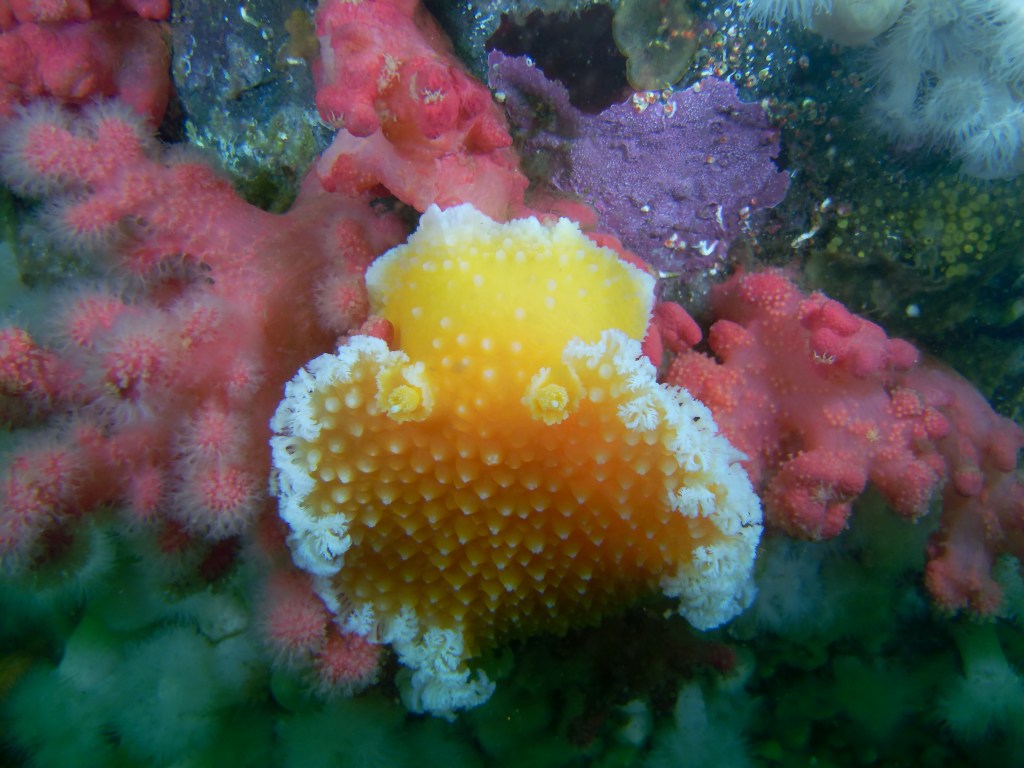
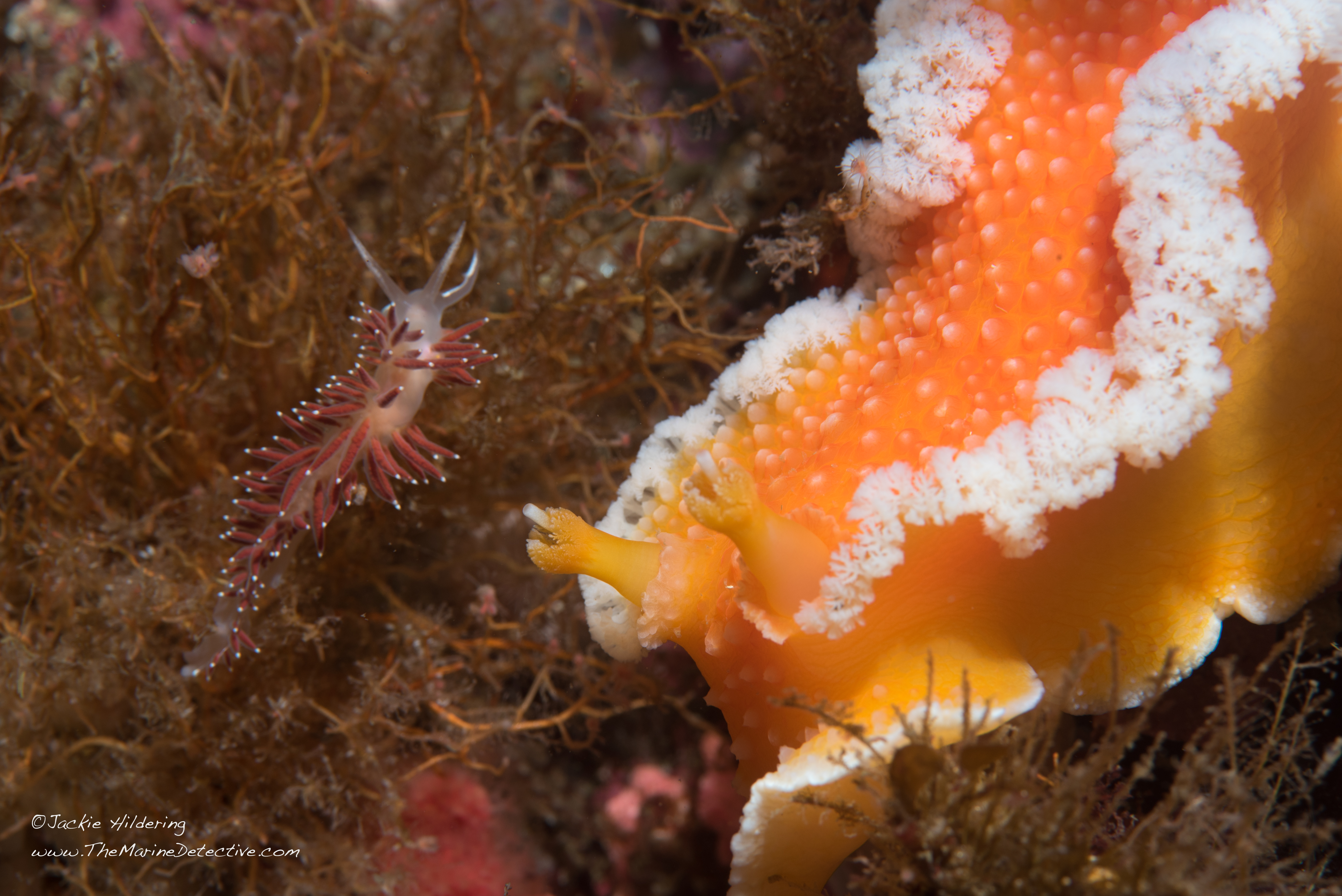
These sea slugs are very aptly named since their skin is reminiscent of both the texture and vibrant colour of an orange. But, the name does nothing to indicate the size to which these giants can grow. They are one of the world’s largest sea slugs with literature reporting them to lengths of up to 30 cm and weight to 1.4 kg. 

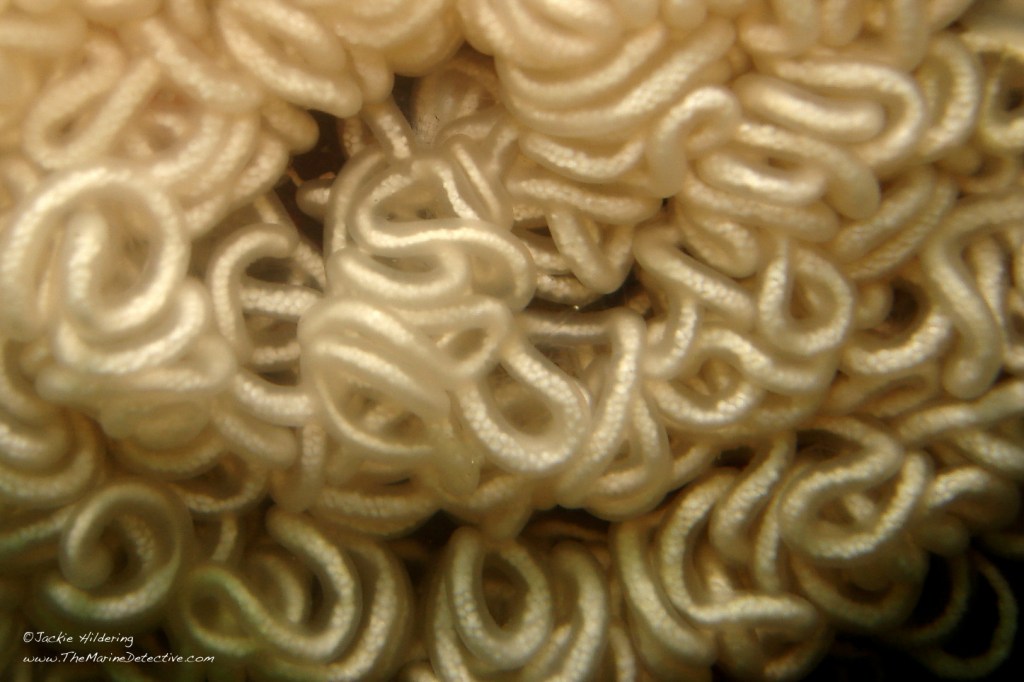
As if this sea slug species’ colour, size and beautifully intricate white gills are not enough to create awe, you should see their eggs! I will never forget the first time I saw the huge tubular mass that looked like udon noodles. I think my brain almost exploded and I was propelled all the more feverishly on my “The Marine Detective” path, wanting to be able to identify the egg masses of all sea slugs in our waters (each species’ eggs look different).

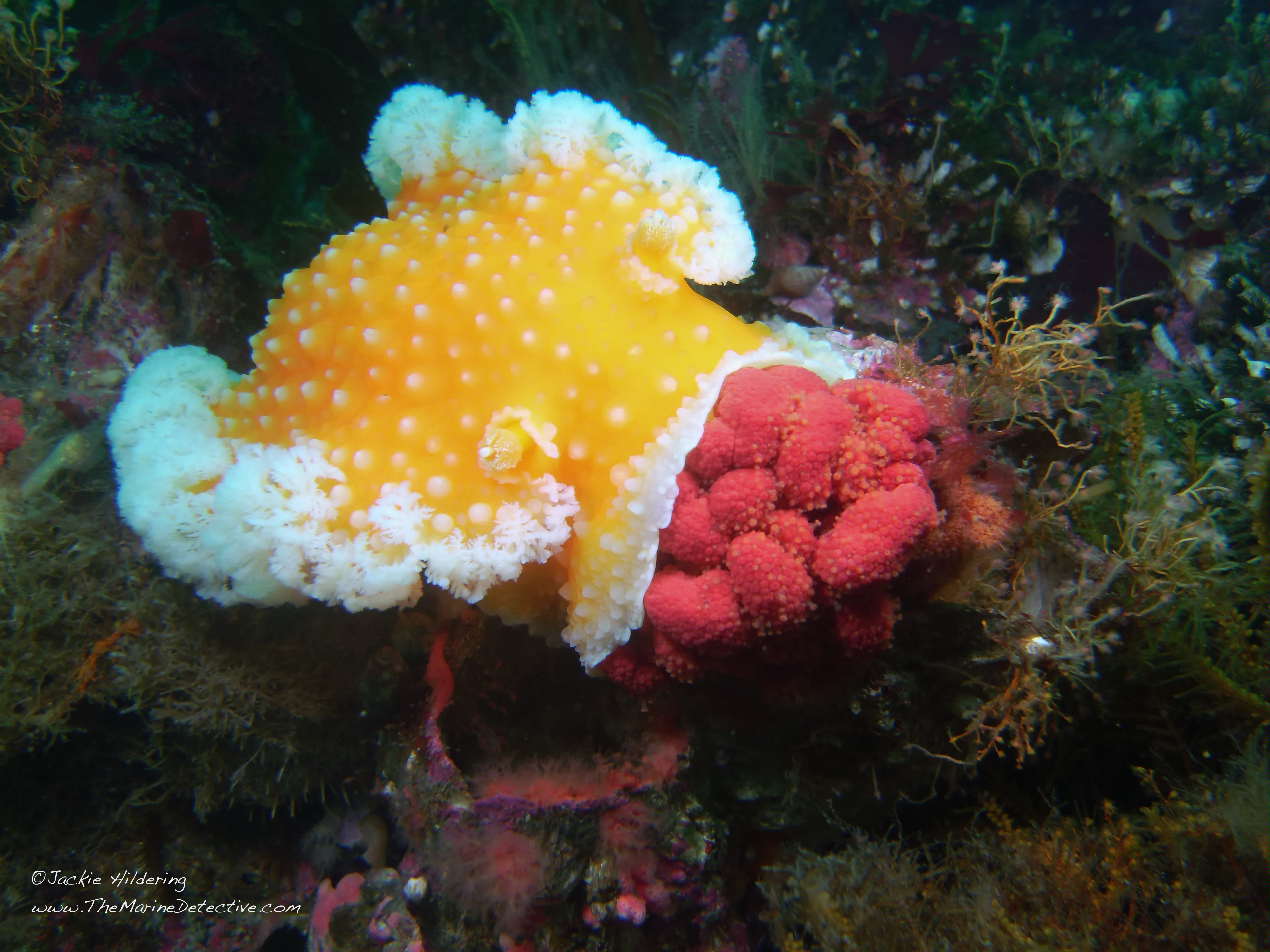
Orange Peel Nudibranch beside egg mass. ©Jackie Hildering.
Close-up on an Orange Peel Nudibranch egg mass. ©Jackie Hildering.
 ©Jackie Hildering.


More photos:

Please note that my slideshow below is from before the species was reclassified to be Tochuina gigantea.

DSC02592
Orange Peel Nudibranch feeding on Red Soft Coral ©Jackie Hildering. 
Orange Peel Nudibranchs moving into position to mate (always right-side-to-right-side) an lock gonophores. Both will become inseminated and lay eggs. ©Jackie Hildering
Sea slug amidst red soft coral.
Orange Peel Nudibranch feeding on Red Soft Coral. Photo: Hildering
Orange Peel Nuibranch and a Red-gilled Nudibranch. ©Jackie Hildering.
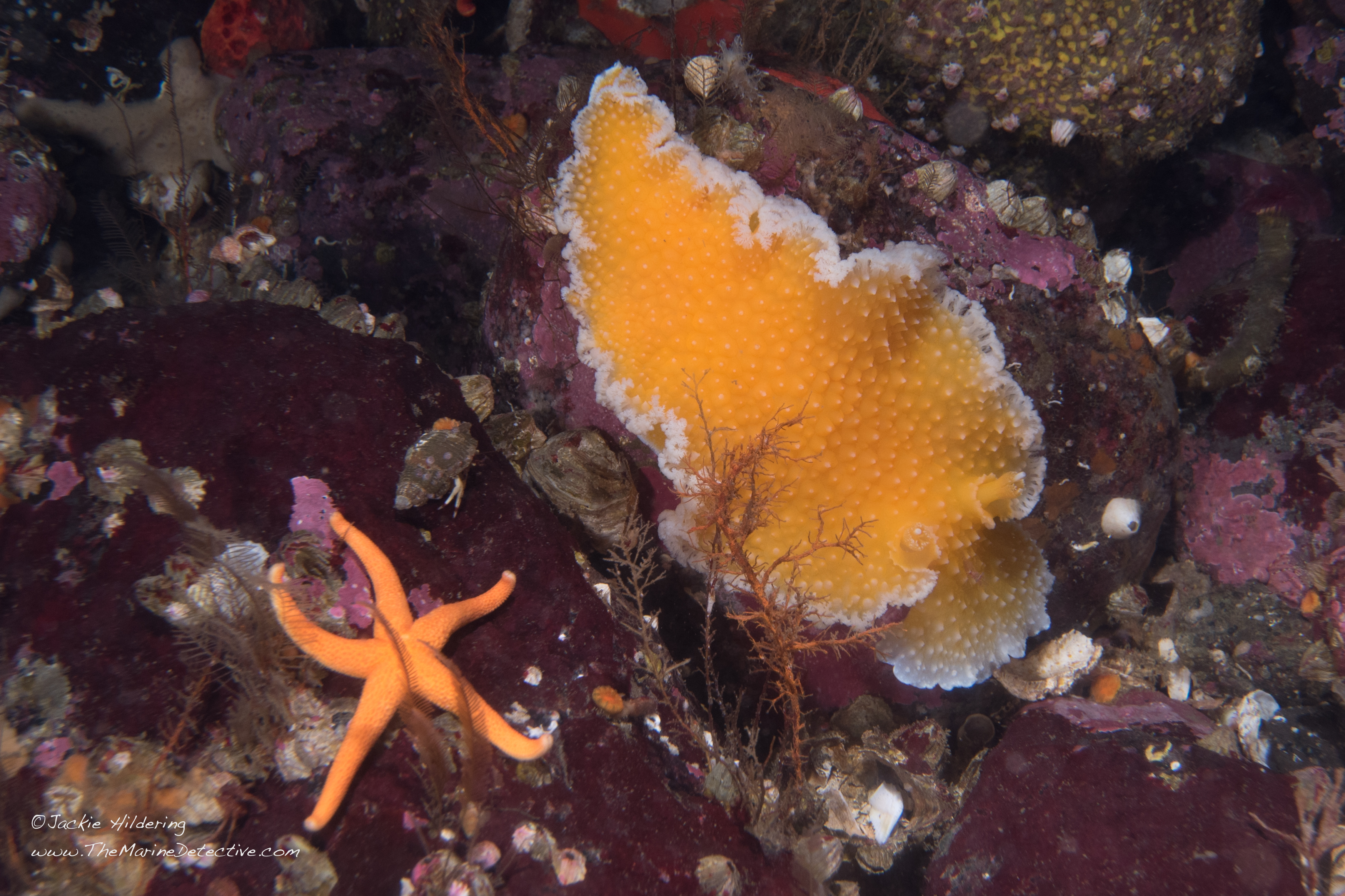
Orange Peel Nudibranch and a Blood Star ©Jackie Hildering.
Orange Peel Nudibranch and Proliferating Anemones (pink and orange) ©Jackie Hildering.
Two Orange Peel Nudibranchs in the kelp forest ©Jackie Hildering.
Orange Peel Nudibranch and Striped Sunstar ©Jackie Hildering.
Orange Peel Nudibranch feeding on Red Soft Coral ©Jackie Hildering.
And another hungry Orange Peel Nudibranch ©Jackie Hildering.

Sources: 

Korshunova T, Martynov A (2020) Consolidated data on the phylogeny and evolution of the family Tritoniidae (Gastropoda: Nudibranchia) contribute to genera reassessment and clarify the taxonomic status of the neuroscience models Tritonia and Tochuina. PLoS ONE 15(11): e0242103. https://doi.org/10.1371/journal.pone.0242103

Steller visits!

Screen grab from Steller encounter 2011-02-12

Screen grab from the video.

While diving yesterday, we had a visitation from two juvenile Steller sea lions.

I’ve put a 1-minute clip of the encounter on-line, in a gallery with other videos of when these magnificent mammals have chosen to do a swim-by.

Note that I do not “target” marine mammals while diving (this is in fact stipulated as being illegal in Canada’s draft marine mammal regulations)  i.e. I do not jump in near sea lion haul-outs as I do not want to put pressure on the animals nor contribute to their becoming habituated to humans.

Therefore, when we see them there is always an element of surprise and, of course, extreme privilege.

See this link for the video clips.

See this link for a previous blog posting that includes the natural history of Steller sea lions.

Note: “Steller” is for the nautralist Georg William Steller who was doctor and naturalist on Vitus Bering’s second Kamchatka Expedition that also sailed to Alaska and the Commander Islands (1740 – 1741?).