Recently, I noticed a lot of splashing in a tideline off Telegraph Cove, BC. I share my observations with you via the little video clip at the link below.
You’ll note that it looks like big rain drops are hitting the water.
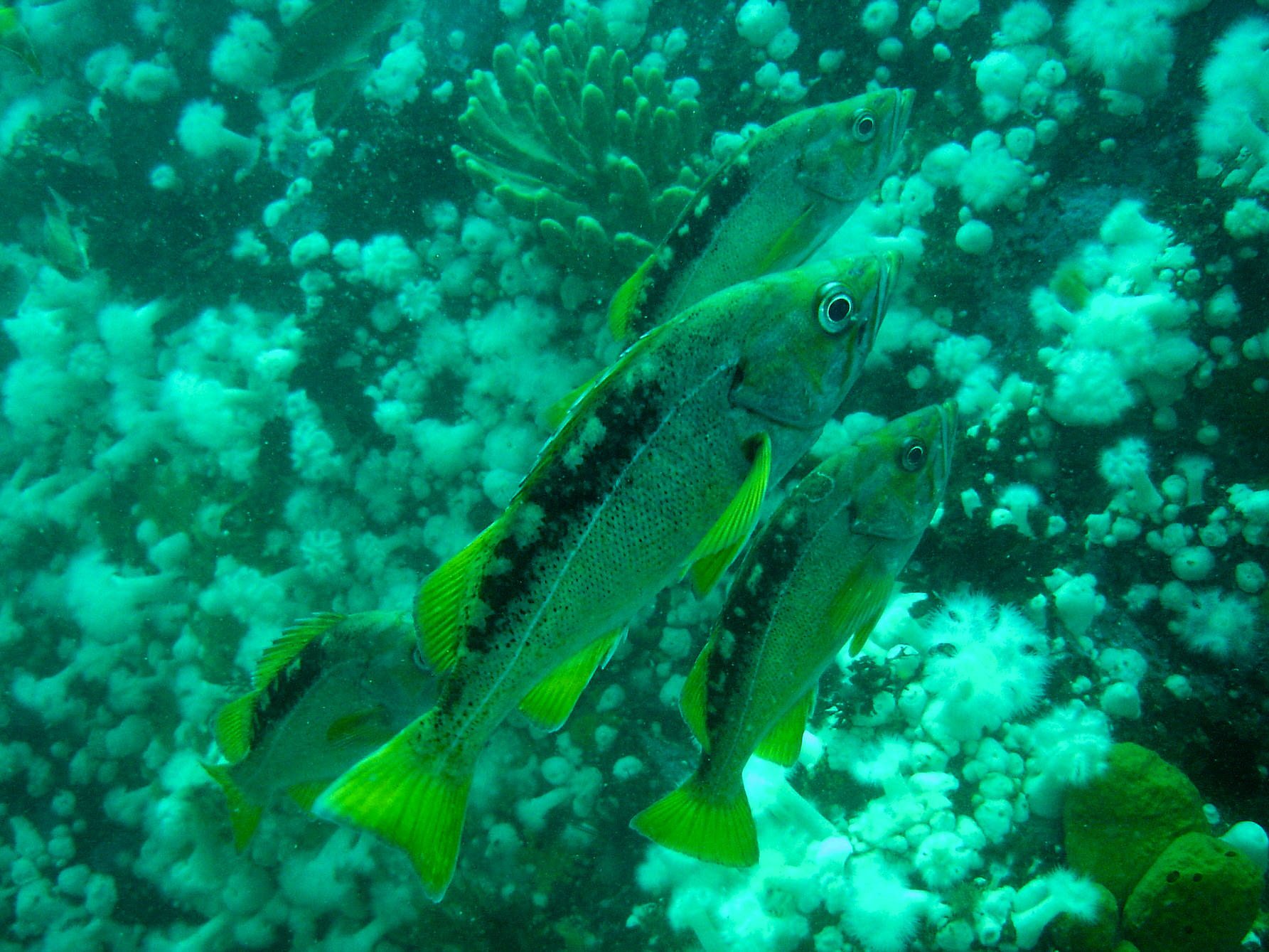
I discovered that what was creating the splashing were juvenile yellow-tail rockfish feeding on zooplankton. The zooplankton, including a small species of krill, had been concentrated at the surface by the big tidal exchange. There had been almost a 4 metre exchange between high and low tide (more than 12 feet).
I also discovered a very unique larval fish in the tideline that day but will share that discovery in a future “The Marine Detective”.
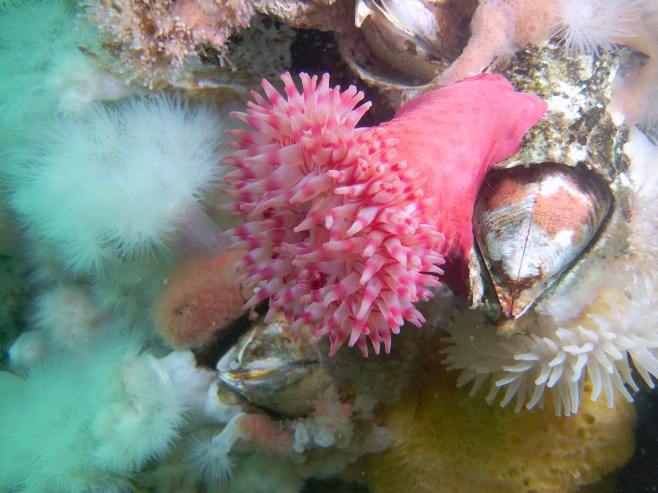
Swimming anemone at Stubbs Island, N. Vancouver Island, BC
Today there was quite a small tidal exchange which allowed us to dive a more challenging site, Stubbs Island.
On larger tides, this island receives so much current that eddies and big upwellings form. All this churning water means there is abundant oxygen and plankton delivery so the density of marine-life on Stubbs Island is truly mind-blowing. There isn’t a centimetre of rock that does not have something growing on it.
I would like to share my images from this dive today. I hope they give a sense of the awe-inspiring beauty and biodiversity of our Northern Vancouver Island marine “backyard”.
Scalyhead Sculpins are a tiny fish but the males have a giant parenting role (species Artedius harringtoni).
I found what I believe were this species’ eggs while guiding a recent beach study (Port Hardy, BC).
To share this information, and my photos, I’ve tried something new. Below, you’ll find a slideshow that I have narrated to explain how Scalyhead Sculpins are super dads.
Yes, that’s right, you get to hear my voice this week (oh-so-human stumbled speech and all!). Please realize I am speaking as I would to a +/- 10 year old.
The most valuable lessons I have learned about being female, I have learned from Killer Whales. For example, it is through my knowledge of these highly cultured whales that I know Nature’s plan for older females.
Let’s face it, human society does not generally help in this regard. As time etches lines into our interiors and exteriors – society does not tell us we are a-okay! No, the general messaging is about loss, faded youth and endings. Firm up! Dye that hair! Want some Botox baby? We’re sweeping you aside, ‘cause you’re old!
Thank goodness I believe in Mother Nature.
One of my teachers – A12 aka “Scimitar”; born around 1941 and now passed away. She was a Northern resident (fish-eating) Killer Whale who was the grand dame of the A12 matriline.
As I weather the physiological and psychological changes of this time of my life, I know there is purpose in all this. Humans and Killer Whales are among the very few animal species where the females go through menopause; where they can live beyond their child-bearing years as “post-reproductive females”.
In the case of Killer Whale females, they can give birth between the ages of around 12 to 40 but are believed to be able to live to at least age 80. Thereby, female Killer Whales may live almost twice as long as they have babies. On the face of it, this appears to violate one of Mama Nature’s great laws. That is, if you’re going to use our food, you better pass on our genes.
But Nature makes sense. Therefore, the role of post-reproductive females must be so valuable that it “justifies” their using the population’s resources.
Science in fact believes that the old female Killer Whales are the teachers and decision-makers. These grandmas, wizened by their years, are believed to teach mothering skills, how and where to hunt; and they are known to share food, especially with their eldest son. These activities would benefit the population by ensuring that the offspring are better able to survive and mate . . . passing on shared genes. Since first posting this blog a decade ago, there has been further science published on this. Please see sources below.
The likely role of the old females has been acknowledged in science with the convention being that each family group of Killer Whales is named for the eldest female (e.g. the A12s). Also, the collective name for a group of Killer Whales is “matriline” which loosely translates into “follow your mother”.
Female Killer Whales have taught me that I am not less as I age but rather that there is teaching to be done and leadership to be embraced.
These years are to be lived . . . as a killer female.
Typical shape of members of the kelp crab family. Species in this family are usually from 5 to 9 cm across the carapace.
This week I bring you the “Where’s Waldo?” of the marine invertebrates. There is a decorator crab in each of the images at the link below. But first, here are some clues for you.
Most of the species of crabs that decorate themselves to be masters of camouflage are in the spider crab family (Majidae family – also known as “kelp crabs”). The image to the right shows you an undecorated kelp crab with the typical long legs and distinctly shaped shell (“carapace”) of this family.
Some crabs only partially camouflage themselves, especially when they are juveniles. Others “plant” so many marine neighbours onto themselves that you can’t tell them apart from their environment until they move.
Although they look like walking gardens, the organisms they attach to the stiff, curved hairs on their legs and backs are algae and animals, not plants. The animals can be soft corals, sponges or unique creatures like “bryozoans” and “hydroids”.
Not only does this covering of life allow the crabs to hide from predators, it also changes the way the crabs feel and taste. For example, sponges taste bad or are even toxic to many predators so, if you cover yourself with sponges, predators be gone! The bonus of carrying other organisms on your back is that you also have a food supply within a pincher’s reach.
It is truly astounding how well the decorator crabs match their immediate surroundings which added another mystery to my list: Is the range of decorator crabs really small so that they always match their background OR do they know to “adjust” their camouflage when they move to an area where they no longer blend in?
I have learned that the latter appears to be the case. Experiments with captive decorator crabs have shown that, if moved to a background that no longer offers camouflage, the crabs will “adjust” their decorations!
Click here to find the decorator crabs in my images or view gallery below.
See last week’s post for Part 1 about Hooded Nudibranchs (Melibe leonina).
This week, I share video showing this remarkable sea slug when it is swimming.
When viewing the clip, try to identify the animal’s “rhinophores”, the structures coming off the animal’s head that allow it to smell its way around. These structures have the shape of mouse ears but they pick up on chemical signals, not sound. In last week’s posting I shared how the Hooded Nudibranchs come together to mate through being attracted by smell (pheromones).
Video from today of a swimming Hooded Nudibranch.
The lobed structures on the animal’s back are the naked (nudi) gills (branchs). They can detach if the hooded nudibranch is threatened and are sticky. Maybe this is so that the predator is distracted by the gills sticking to it allowing the hooded nudibranch to have a greater chance of getting away.
Hooded Nudibranchs (up to 17.5 cm) on Giant Kelp.
I have included a second clip this week too, taken on today’s dive. No Hooded Nudibranchs in it, but Bull Kelp forest visions while on my “safety stop”; a 3-minute rest at 15 feet to offload nitrogen before surfacing. Thought you might like to take a dip with me!
Click here for kelp forest video from today’s dive.
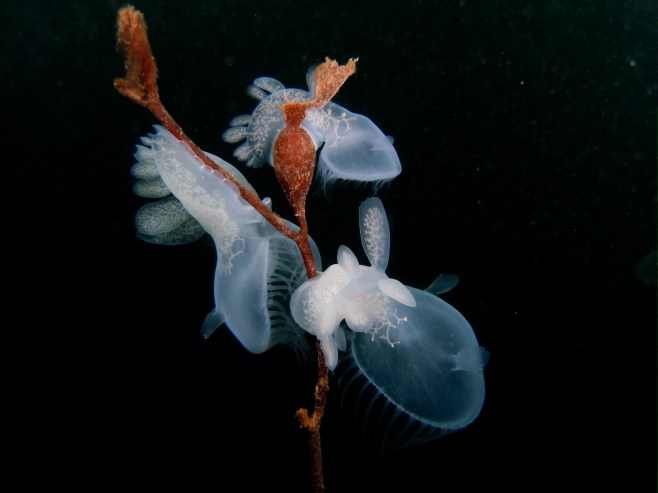
The remarkable-looking animals to the right are Hooded Nudibranchs (Melibe leonina up to 17.5 cm). A nudibranch is subgrouping of sea slugs whose characteristics include having naked (“nudi”) gills (“branchs”).
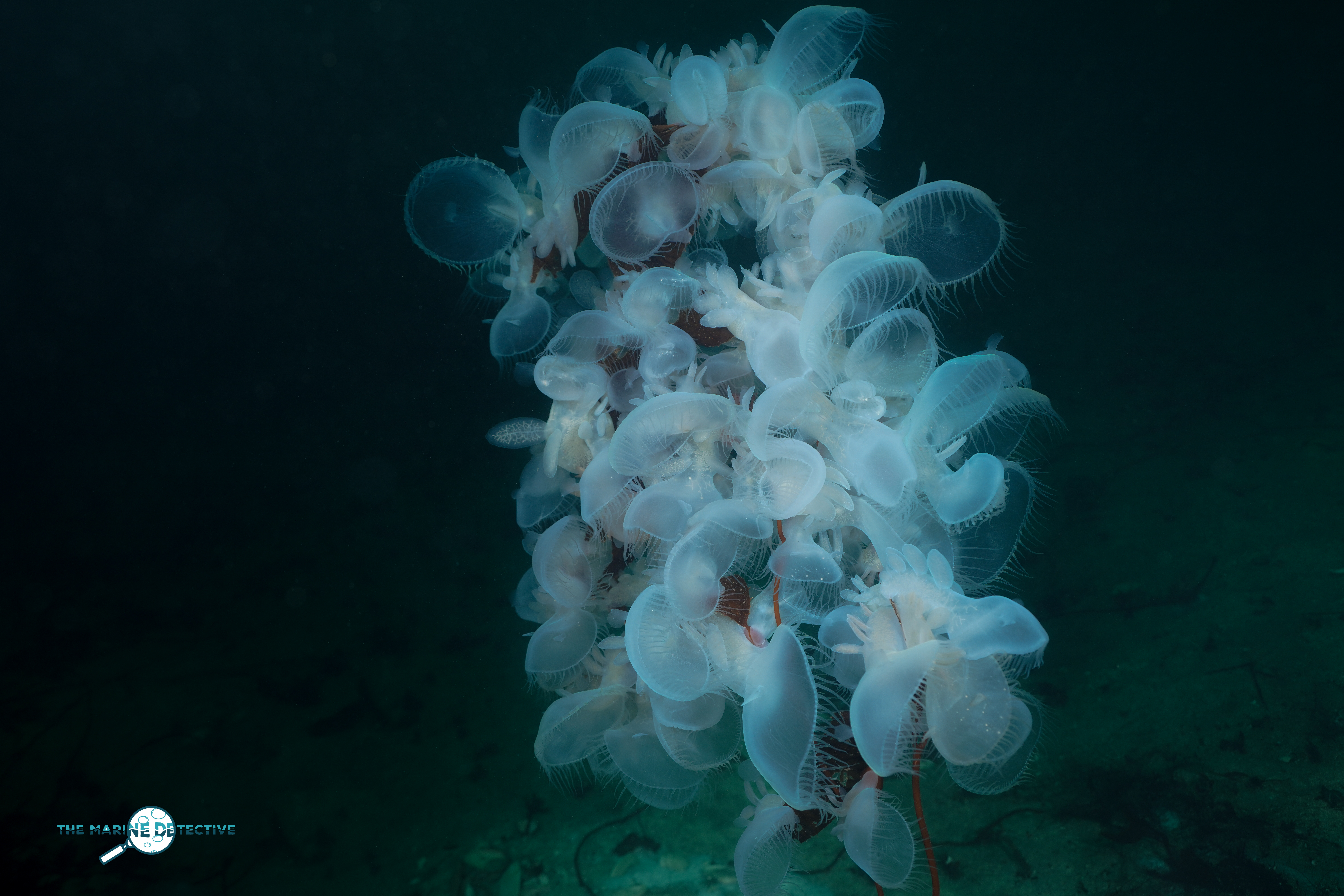
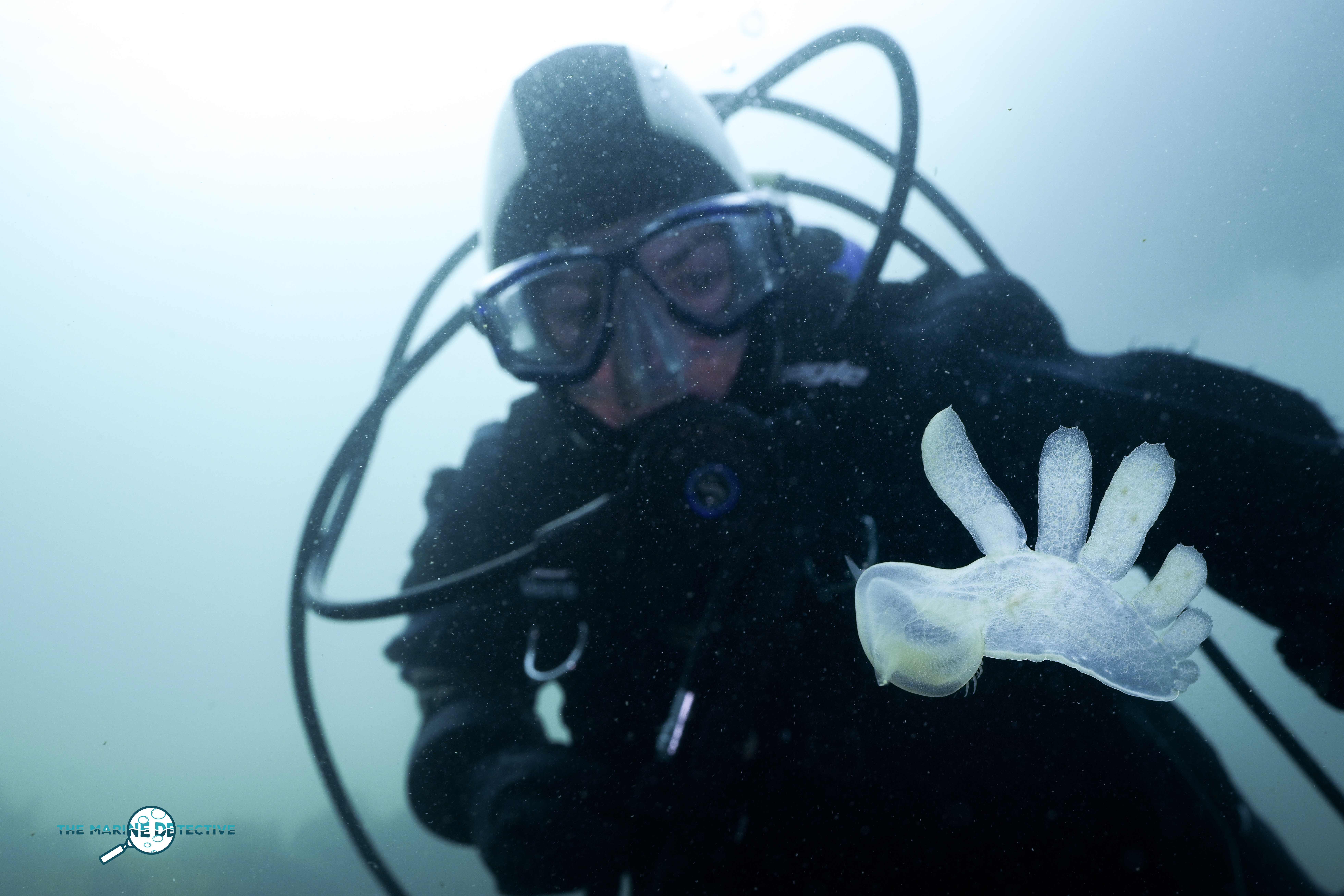
Typically, starting in the fall, around northeast Vancouver Island, Hooded Nudibranchs come together in the hundreds. It is awe-inspiring to see them clustered together just below the surface, delicate and ghost-like, clinging to kelp. Most are translucent white but some individuals are more green or orange.
Often, you can see them swimming on the surface and many people mistake them for jellyfish. But no, they are sea slugs.
The large oral hood (disc-like head) is used to feed on plankton and small crustaceans. The lobed structures on the animals’ backs are the naked gills (cerata). The cerata can pop off if the Hooded Nudibranch is threatened e.g. pinched by a crab. This “ceretal autonomy” and the ability to swim, are believed to be distractors for predator (Bickell-Page, 1989).
The two structures on the Hooded Nudibranch’s oral hood are their rhinophores by which they smell their way around. Hooded Nudibranchs are believed to signal one another by emitting a fruity scent. My personal experience after having picked up a dead Hooded Nudibranch on the beach, is that the smell is something like a mix of watermelon and grapefruit. The scent stayed on my hand for more than an hour.
The secretion is reported to serve as a repellent for predators but does not deter Northern Kelp Crabs.
After mating, as is the way with sea slugs, both individuals lay eggs and then, they die. You can find additional information about sea slugs being reciprocal hermaphrodites in this past blog posting.
In the area around northeast Vancouver Island, I have observed that they lay their egg masses between January and April. Each ribbon of eggs is only about one centimetre wide. Every dot is an egg capsule containing 15 to 25 eggs. After about 10 days, depending on temperature, the eggs will hatch into larvae that will be part of the zooplankton soup of the Ocean.
After 1 to 2 months, they settle to the ocean bottom and change body shape and even digestive tract to become small adult Hooded Nudibranchs
Hooded Nudibranchs do not have the rasping mouth structure of many other sea slugs (the radula). They feed by opening their oral hood to capture prey while standing on kelp or Eelgrass.
Hooded Nudibranch on Eelgrass and yes, those little snails are part of their diet.
From Invertebrates of the Salish Sea: ” . . . diet includes copepods, amphipods, and ostracods, as well as small post-larval mollusks. The animal stands attached to the substrate and expands the oral hood. It then sweeps the hood left and right or downward. When the ventral surface of the hood contacts a small animal the hood rapidly closes and the fringing tentacles overlap, holding the prey in. The whole animal is then forced into the nudibranch’s mouth.”
Recently, I was contacted by a local family about their very unique find on a beach on Southwest Vancouver Island. Their email had the entertaining subject line of “Whale Puke – Hopefully?” and contained pictures of what they had found.
I was amazed at how they had narrowed down what the strange looking masses might be . . . ambergris (pronounced “amber-grease”; from the French for gray amber), a substance produced in the intestines of sperm whales. And . . . ambergris is extremely valuable; apparently worth up to $20,000 USD per kg. It has a musky, very distinct odour and has been used in perfume as a fixative (to stop it all from evaporating quickly). It has also been used as food flavouring and medicine. Apparently it was even believed to cure the plague. Yes, sperm whales used to be intensely hunted and the hope of collecting ambergris was one of the reasons why.
The sperm whale is the largest toothed whale species. It has a head up to 1/3 of its body (Physeter macrocephalus = big head) and can dive to depths of 3,000 m. We humans have so much to learn about whales that are far less deep diving. You can imagine what knowledge gaps there are for an animal that dives to such great depths and for so long; up to about an hour. (Click here for a detailed “The Marine Detective” posting on the sperm whale).
So how and why do sperm whales create ambergris?
It is believed to be caused by the beaks of the giant squid irritating the sperm whale’s intestines. However, ambergris may not be “whale vomit” at all, but rather, it may come with “whale poop”. Apparently, when “fresh”, ambergris smells more like it comes from the anus. Some scientists believe it does get regurgitated (vomited up) if the piece is particularly large.
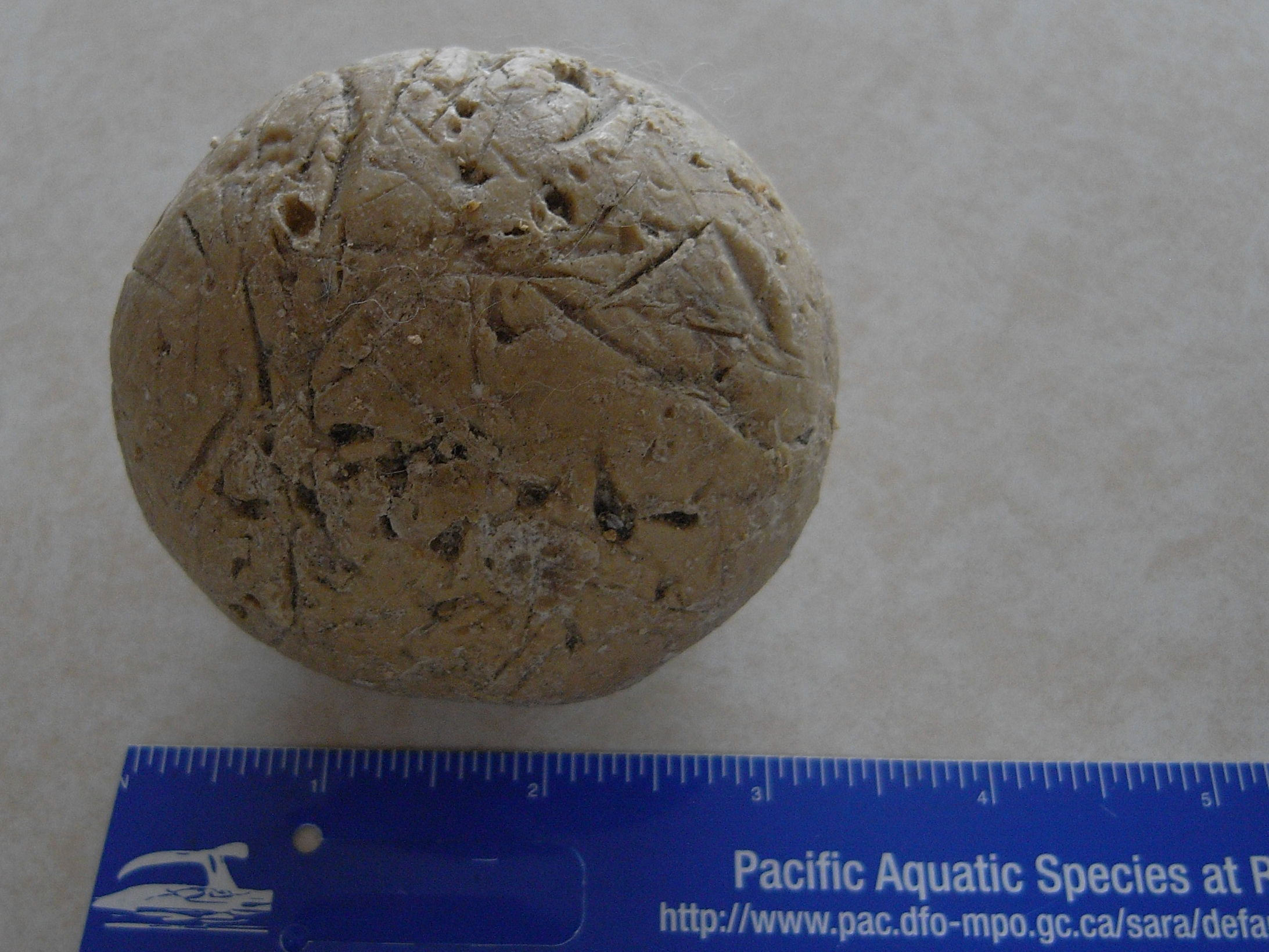
Was the family’s mysterious material the highly valuable ambergris? It seemed possible. We have sperm whales off the B.C. coast and the material was resinous, less dense than water and looked like some of the images of ambergris I could find online.
They found two masses, each about the size of a goose egg. They dropped one and it fragmented and crumbled, some pieces darker and clearer than others. But, there were no bits of squid beaks nor was there a really distinct musky odour.
I wanted to be sure, so I contacted the wonderful Dr. John Ford, DFO’s head of Cetacean Research at the Pacific Biological Station in Nanaimo. He very kindly relayed a test that would prove whether it was the highly prized ambergris – or not. If you heat a wire or needle to red hot and stick it into ambergris to about a centimetre’s depth, it melts into an opaque liquid the colour of dark chocolate and leaves a tacky residue on the wire/needle.
When I carried this out, the material did melt and leave a residue but it was a lighter brown material. It did not melt like chocolate. There was a distinct sizzling sound and a small puff of smoke. There was still no distinct musky odour.
So what could it be? I decided to take about a teaspoon of the crumbs and melt them down and, when I saw the result, I had an idea. The material was oily, it melted easily, it had small dark flecks in it. Why – it looked like used cooking oil!
Not ambergris but – cooking grease?!
It’s my best guess to date. That a boat somewhere out a sea, dumped cooking oil. It solidified and got rolled around on the beach, rounding it and pitting it. Why were there two masses of about the same size? I have absolutely no idea. Feel free to offer any hypotheses.
Click here for my bundling of links on B.C.’s sperm whales – includes video, sounds, information about the historical whaling of sperm whales and articles about ambergris.
Bull Kelp is so beautiful, especially now in the early spring when the young “sporophyte” stage is growing at an insanely fast rate. The stipe (stem-like structure) of this kelp species, Nereocystis luetkeana, can grow to be up to 36 m long. The stipe would have to grow an average of 17 cm a day to reach this length in the 210-day growing period (source: Druel).
The growth rate of the stipe and fronds together (the leaf-like structures) has been documented to reach an average of 25 cm per day (source: Duncan).
Baby Bull Kelp
It is at this early stage of growth too that Bull Kelp is an intense colour green unlike anything else I know. When older, the colour darkens to an olive green.
Kelp is an alga, not a plant. However, like plants, algae also photosynthesize, converting the sun’s energy into food. Algae have simpler structures and different chemical pathways than plants.
Young Bull Kelp grows so fast to allow the leaf-like parts, called “fronds”, to be closer to the sun so that more food can be made.
Sun streaming through a Bull Kelp forest.
The round, floating part of the kelp, is the “pneumatocyst”. This bladder-like structure is completely hollow and is filled with carbon monoxide (NOT carbon dioxide), allowing the long fronds to drift at the surface to catch the sun’s rays.
Apparently, there is enough carbon monoxide in Bull Kelp to kill a chicken! Now that’s valuable information. See my blog “Enough Carbon Monoxide to Kill a Chicken” at this link.
The stipe is also hollow. I’m sure it is not what Nature had intended, but this allows we humans to play the stipe of Bull Kelp like a trumpet or didgeridoo! The stipe gets thinner and whip-like near the holdfast which is why Bull Kelp likely got its name because the stipe is shaped like a “bull whip”.
Bull Kelp does not have roots. Rather it is a “holdfast”, a tangle of woody structures, that anchors Bull Kelp onto rocks. However, if rocks are too light to counter the floatation of the pneumatocyst, the kelp will actually change the ocean bottom by carrying away smaller rocks, likely ending up washed onto the shore.
Bull Kelp holdfast. No roots. See my blog on holdfasts at this link.
Bull Kelp always grows in patches, truly forming an underwater forest that is life-giving for the same reasons as terrestrial forests: kelp forests buffer the climate change gas carbon dioxide; produce oxygen; and provide food and habitat for so many other organisms. Bull Kelp forests are, in fact, estimated to provide habitat for some 750 species of fish and invertebrates (animals without backbones).
Sea urchins are one of those invertebrates, living in the forest and grazing on a lot of Bull Kelp. If Sea Otters, Mink, Wolf-Eels and other predators of urchins did not keep urchins in check, there would be further reduced kelp forests. Sea Star Wasting Syndrome has devastated the world’s largest sea star species, the Sunflower Star (Pyncopodia helianthoides) which is a predator of Green Urchins. This has led to too many of these urchins and an increase in the number of urchin barrens. Please see my blog here for information on urchin barrens and Sea Star Wasting Syndrome.
All coastal boaters still benefit from kelp. It is a navigational aid since, where it grows, you know you there is shallower water.
We divers have yet an additional reason to value kelp. Since it is so strong, we can hold onto it if we need to during our safety stop (3 minutes at 5 metres depth) or if needing to gradually pull ourselves down into the depths or back to the surface.
Oh – and you can eat it. (I love pickled young Bull Kelp!)
And yes, you could do puppet shows with Bull Kelp, cutting a face into the bladder like you would into a jack-o-lantern. The fronds even look like two pig-tails!
THEN there is how Bull Kelp reproduces. The offspring look nothing like their parents. Please see here for my blog on the remarkable phenomena that is “alternation of generations”.
But for now, come underwater with me. Come into the forest, breath in, breath out and worship the kelp!
To follow up on last week’s posting about the feeding of giant nudibranchs, “Who’s eating who”, I now share images of the giant nudibranch swimming and of its egg-laying behaviour.
I know that these are the strangest eggs you will see this Easter!
The story of how the eggs come to be is pretty unique too.
There are no girl or boy sea slugs. They are both male and female; they are hermaphrodites. This means that when sea slugs mate, both animals “get pregnant” and lay eggs.
Sea slugs need this adaptation because it is really difficult for them to find another of their kind. They are relatively slow moving animals that depend on feel and smell to get around.
They don’t search around aimlessly for a mate though. That would be a waste of energy. The chances of finding a member of their own kind are greater near their favourite food. To make this clearer, imagine that you were someone who really loved eating pizza and you wanted to find someone else who loved pizza. The best place to find them would be at . . . a pizza parlour!
For the giant nudibranch, you know from last week’s posting that they love to eat tube-dwelling anemones so they are likelier to meet a mate around this prey. They also may give off chemical signals (pheromones) to announce that they are in the area and “looking for love”.
Compared to faster animals that can see though, the chances of sea slugs finding one another are much smaller. So when they do meet, it is important that they really make it count and have as many babies as possible especially since the eggs will hatch into plankton. This means that many baby sea slugs will become dinner for filter feeders like anemones and barnacles.
How to have as many babies as possible? Both should lay eggs! This is why they are hermaphrodites; not just a male or female. The sea slugs line up right side to right side and exchange cells so that they can both lay eggs.
I will share much more about the love life of sea slugs in future postings. Every sea slug species lays eggs that look very different. One of the “cases” I have worked on the longest is to figure out what each species’ eggs look like. A great clue in trying to figure this out is that sea slugs most often lay eggs on their food.
You can imagine my delight when I found a big mass of eggs at the base of a tube-dwelling anemone! Knowing that the giant nudibranch preys on this species, the chances were very, very good that these were its eggs.
When you follow the link, you can see a larger picture of the eggs mass and get an idea of just how many eggs are in this string (each dot is an egg).
I have also included video of the giant nudibranch swimming for your Easter weekend pleasure. You’ll see that the nudibranch swims upwards but, when it wants to go down, it just stops moving and gently drifts back down to the ocean bottom. You’ll also see that I am pointing my dive light at the animal and how this makes colours look different underwater.







 The Marine Detective