Join me in the cold, dark, life-sustaining NE Pacific Ocean to discover the great beauty, mystery and fragility hidden there.

Posts from the ‘Environmental Issues’ category

Humpback Comeback Project – Worth the Vote

Update: See this link for the results of the Humpback Comeback Project in the AVIVA competition.

________________________

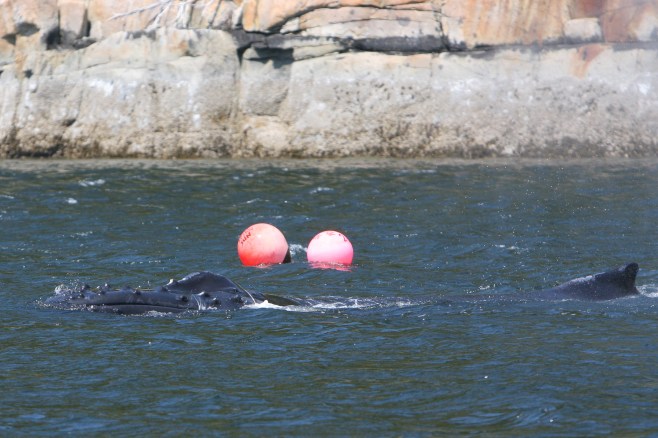
In recognition of how important the information was to our Humpback Comeback Project, Jim Borrowman provided us with his photos of a humpback whale entanglement dating back to September 23rd, 1994. This was a time when it was very rare to see humpbacks around N. Vancouver Island (B.C., CANADA) since they had been whaled intensely into the 1950s.

I include one of these images below but be warned that it is very upsetting.  I share it with you as it shows how devastating the threat of getting entangled in fishing gear can be. The photo provides insight into how necessary research into the threat of entanglement is and  . . . how valuable your voting is for the Humpback Comeback Project. (Please click here to place your daily vote so that $25K could be won for humpback entanglement research).

Christie McMillan (colleague in the Project who has expertise in judging the severity of entanglement injuries), concluded that the whale must have been entangled for a considerable time before these images were taken. The evidence of this is that the whale is very thin (emaciated) and its skin condition is very poor, being heavily covered in cyamids (whale lice).

Whale with severe entanglement injuries, 1994. Photo by Jim Borrowman; Stubbs Island Whale Watching; http://www.stubbs-island.com/


Jim Borrowman, Mike Durban and Dave Towers worked together and succeeded in freeing this whale from the lines. This heroic effort served as the inspiration for the children’s book “The Rescue of Nanoose” by Mary Borrowman and Chloe O’Loughlin; illustrated by Jacqueline Wang.

More, larger photos showing the severity of this entanglement at this link.

If you need more background on how to vote for the Humpback Comeback Project , please click here.

Looks Like We Made It – Humpback Comeback Project

Update: See this link for the results of the Humpback Comeback Project in the AVIVA competition.

_______________

Thank you so much!

Our  small, Northern Vancouver Island project has withstood whale-sized odds and, with your continued support, may now win $25,000 for humpback conservation research.

The Humpback Comeback Project competed against community projects from across Canada in the AVIVA Community Fund’s contest that operates very much like an “Idol” for charities.

So many people voted for Humpback Comeback that it has advanced to the final round of the voting, finishing in the top 30 of 528 projects in the funding category.  But now the going gets really tough since our Project is up against many (wonderful) community projects that are championed by large population bases in urban Ontario.

Our Project may not originate from a densely populated area, but the community of people who recognize the importance of this research is very large indeed.

So, please, in true Idol style, from December 2nd to 15th,  click here to find out how to vote for the Humpback Comeback Project, #5773!

You have one vote a day for ten days in this time period.

Please too could you promote the Project by sharing this blog item with your social networks? Demanding, I know – but a great deal is at stake.

BCY0710

BCY0710 "Twister" who was entangled in prawn trap lines and anchored to the bottom, twice in a 3 week period in 2009 (May 18th and June 10th). Photo: Jared Towers.


If you would like a daily reminder, I would be very happy to provide you with one. Please click here.

If you would like to follow along on Facebook, join at this link.

If you’ve not registered in the prior round of voting, you will have to do so and then click the link that gets sent to you in an email.

Click here for the direct link to the Project.

After the final voting round, a jury will decide which of the top scoring Projects will be funded.

What a SPLASH it would create if this included the Humpback Comeback Project!

From team MERS – again, thank you so much.


Humpback Comeback Project – Please Vote!

Update: See this link for the results of the Humpback Comeback Project in the AVIVA competition.

____________________________

I have a whale-sized favour to ask . . . I need your votes.

To be exact, I need one vote a day for the next 10 days and your support in spreading the word to generate more votes for our “Humpback Comeback” research project.

It is of huge importance to me and the others in our small group of dedicated whale researchers on the Northern Vancouver Island (British Columbia) who, for the past 7 years, have been using our own boats, fuel, and equipment to try to learn more about humpbacks.

We have a chance of getting support through the Aviva Community Fund for an essential study to determine the rate of entanglement of humpbacks in B.C.  (whales getting caught in fishing gear). In a well-studied area of the North Atlantic ocean, about 75% of humpback whales have been tangled up in fishing gear at some point in their lives but there has been very little research into this threat to humpbacks in British Columbia.

Our motivation for this project is a direct result of what we have observed locally. See below for a very recent example of the severity of entanglement injury to a local humpback. The shocking images are of the before-and-after-entanglement of a whale we have nicknamed “Sharktooth” (no DFO catalogue number yet).

Please start voting today and up to November 26th, so that we might move on to the semi-finals.

Everyone has 10 votes (one vote a day), and you can vote for the same idea all 10 times.

So use your votes, tell your friends, and use Facebook or other social networks to spread the word! Please.

You need to register to vote at this link.

Then, please click the link in the email that is sent to you. You can then vote for the “Humpback Comeback Project” every day by clicking here.

Great thanks.

"Sharktooth" on June 20, 2010 - no injuries. Photo: Jackie Hildering. Click to enlarge.

"Sharktooth" on October 2nd, 2010 - with entanglement scarring. Photo: Bruce Paterson. Click to enlarge.

"Sharktooth" on October 2nd, 2010 - with entanglement scarring. Photo: Bruce Paterson.

"Sharktooth" on October 2nd, 2010 - with entanglement scarring. Photo: Bruce Paterson.

Depths of Depression – Dead Zones

Added January 2022:
The Economist: January 6, 2022 Dead zones: how chemical pollution is suffocating the sea

Update December 2019 – See the International Union for Conservation of Nature’s  (IUCN) report “Ocean deoxygenation: everyone’s problem“. If the Ocean is warmer – there is less oxygen dissolved in it. If there is more runoff (sewage, fertilizers, fossil fuels), there are more algae using up the oxygen (eutrophication). Warmer surface layers mean less circulation of nutrients as well and less oxygen exchange with the atmosphere.


Original post from October 2010:

Dear Readers,

There is currently an area of ocean in Hood Canal, Washington with very little oxygen (“hypoxic” = very low levels of oxygen; “anoxic” = no oxygen).  Too little oxygen means that marine life cannot breathe.

These ocean “dead zones” appear to becoming more common in the Pacific Northwest.  As I type there are fish and other marine life that have suffocated in Hood Canal.

The lack of oxygen in the ocean water is the result of increased winds and/or too much nitrogen.

The specific event now in Hood Canal is most likely caused by the accumulation of nutrients like nitrogen (from agricultural run-off and human sewage) “fertilizing” phytoplankton (plant-like plankton / algae).  The phytoplankton thrive, increase in number, causing a “bloom” and using up the oxygen. This is called eutrophication. In this case, wind could alleviate the situation as it would cause mixing and oxygenation of the water.

However, increased winds due to climate change can also cause “dead zones”. If the winds bring oxygen-poor and nutrient rich water from the ocean’s depths to the surface, this fertilizes phytoplankton at the surface, creating a bloom. The phytoplankton use up what little oxygen there is and when they die and decay at the ocean bottom, more oxygen is used up. The dynamic is very well illustrated in the Oregon State University image above.

The situation in Hood Canal was painfully captured in images by diver Janna Nichols at Sund Rock (Southern Hood Canal) on September 27th, 2010.

From Janna: “While some of this may appear normal to non-Pacific NW divers, it is most certainly NOT normal. Fish are out of their usual depth ranges (usually found deeper) and all clustered within 15 feet of the surface of the water. They are up so high in the water column because this is the only area that contains oxygen. There are also freakishly huge schools – we don’t usually see that many at once. Fish that normally hide were found out in the open, lethargic and “panting”.

Caption: “The top three feet under the surface are occupied by hundreds of small silvery Shiner Perch. Under them are hundreds of schooling Black and Copper Rockfish – densely packed and hardly moving. (to conserve energy). It is very unusual to see SO MANY of these fish together. All of this is in 9 feet of water or less. (The top number you see on my dive computer is the depth).”

She watched a Giant Pacific Octopus die; finds 4 Wolf-Eels and multiple Decorator Warbonnets out in the open, panting (these are cryptic species that are usually not out in the open and do not “breathe” like this); and she films dense schools of fish attempting to conserve energy to lower their oxygen demands. [I think these images may be all the more painful for fellow divers as you will fully know how aberrant these behaviours are.]

How to solve the problem? Don’t become despondent. Take this for what it is, an additional symptom of the same disease and therefore the solutions are the same – less fossil fuel use, less disposables, less consumerism.
Care more. Consume less. 

Help empower change.