Join me in the cold, dark, life-sustaining NE Pacific Ocean to discover the great beauty, mystery and fragility hidden there.

Posts from the ‘FISH – NE Pacific Ocean’ category

A Pacific Spiny Lumpsucker – and a Lump in My Throat

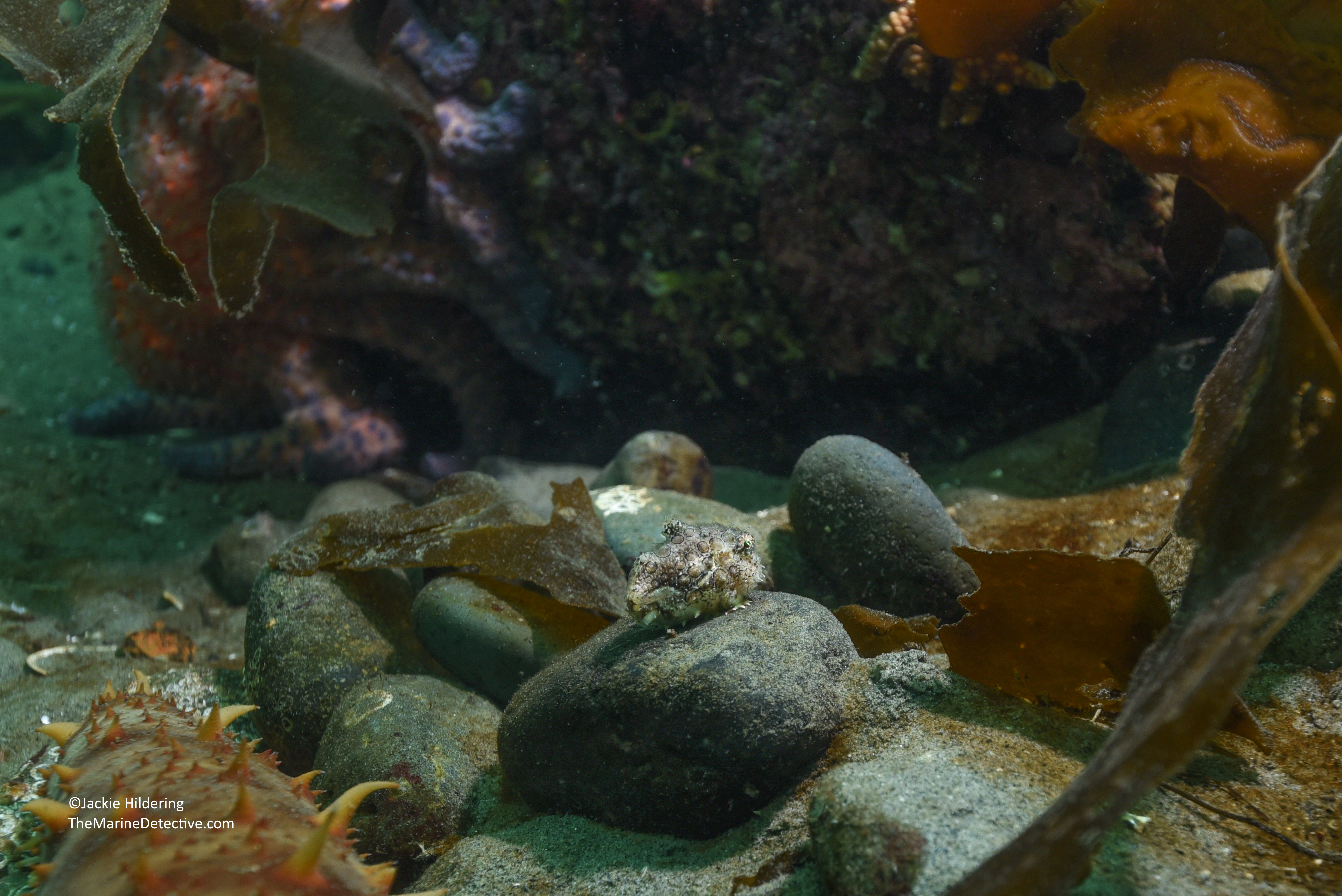
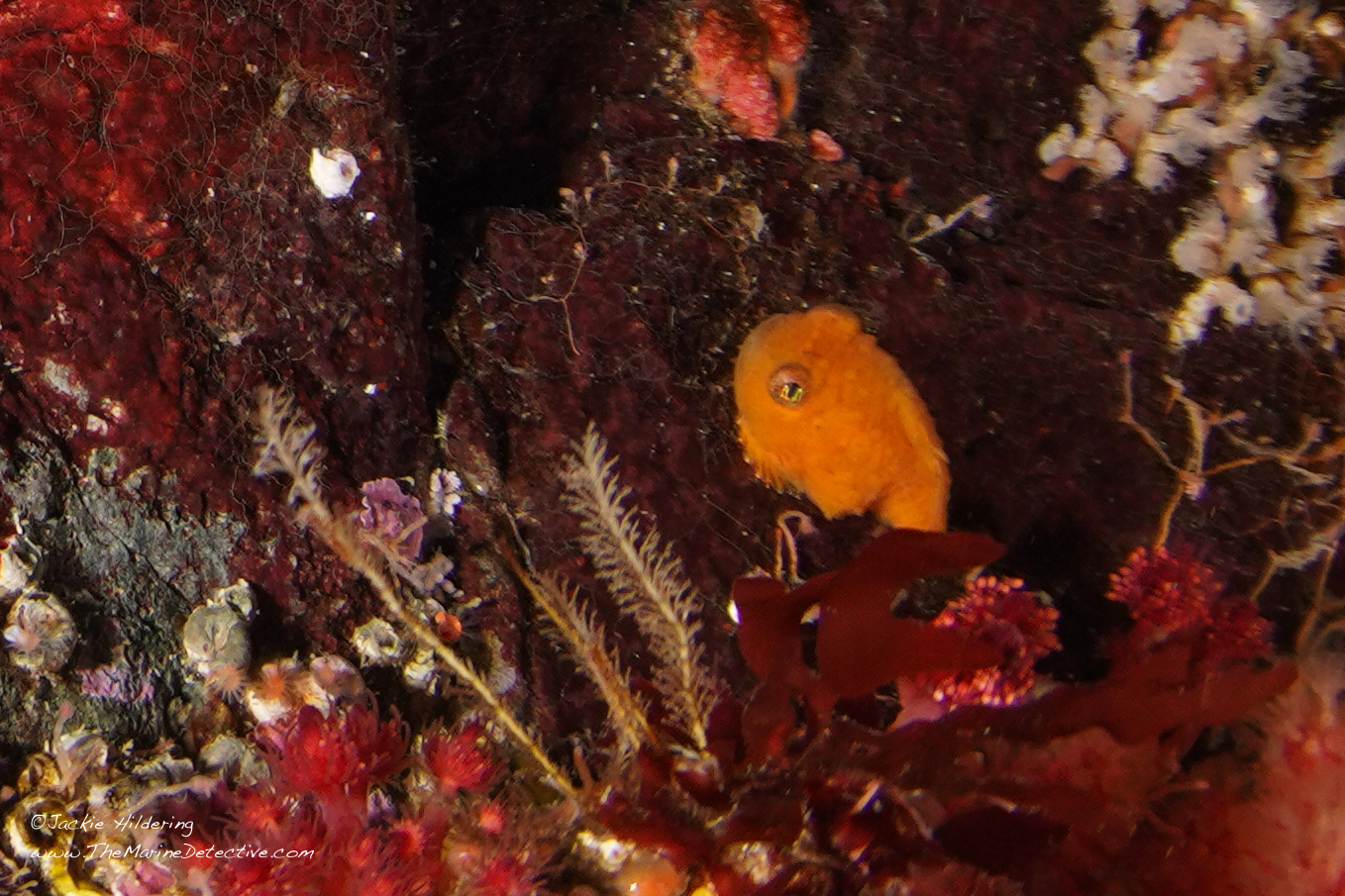
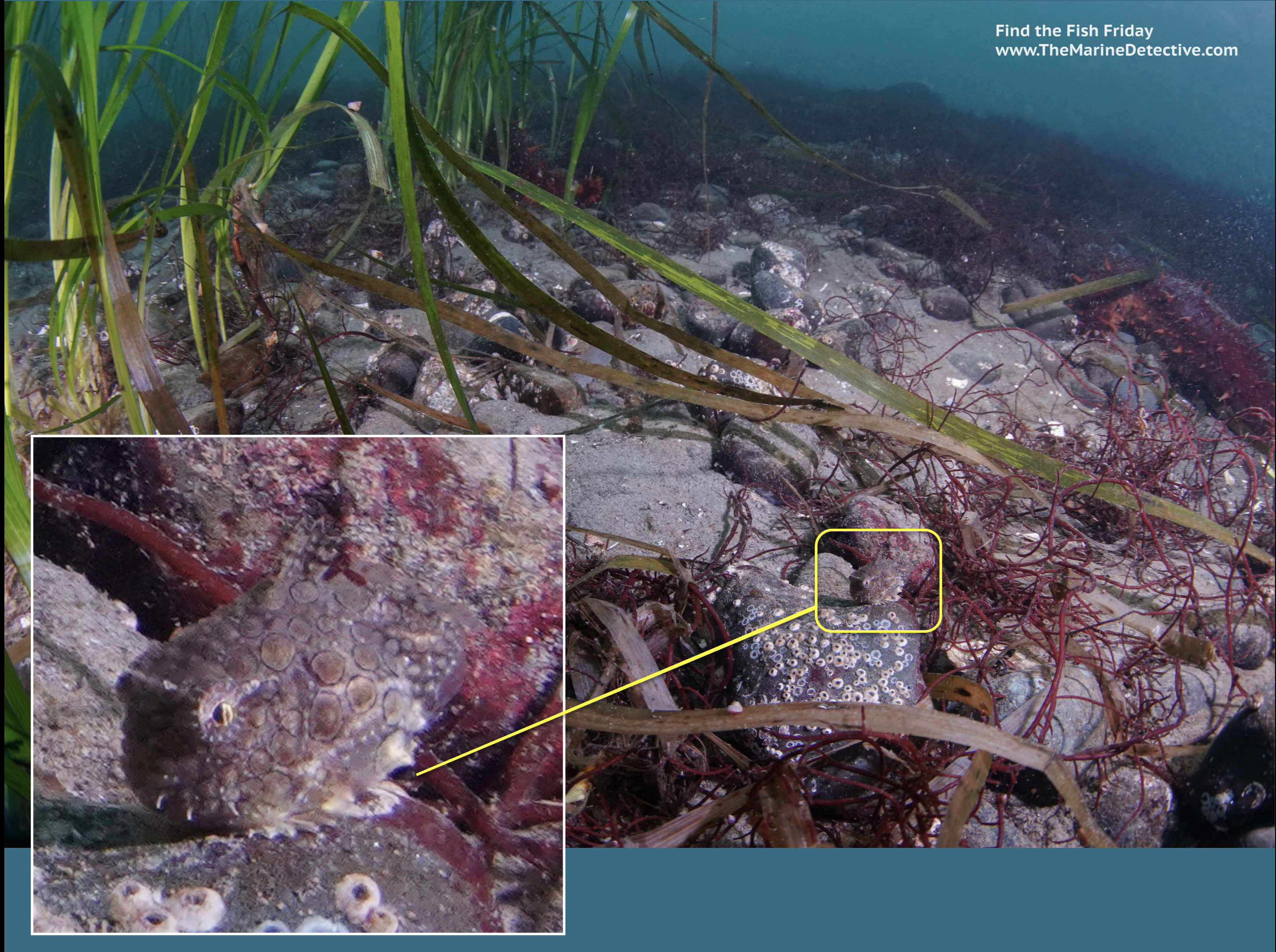
See him?
The Pacific Spiny Lumpsucker?
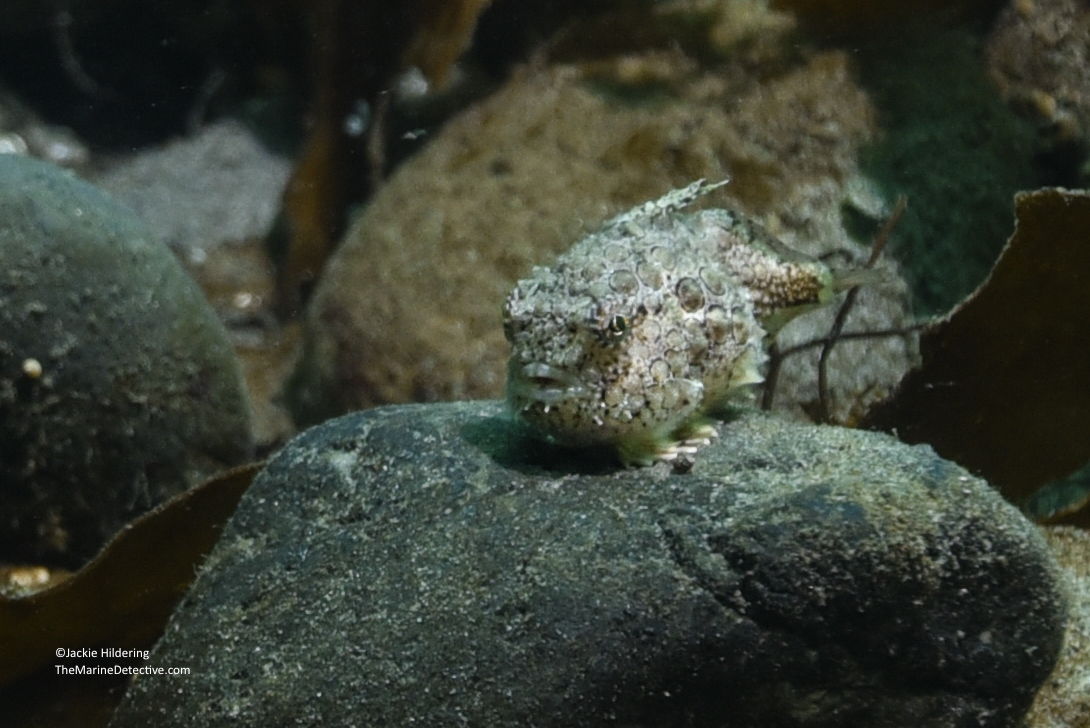
Male Pacific Spiny Lumpsucker ©Jackie Hildering.


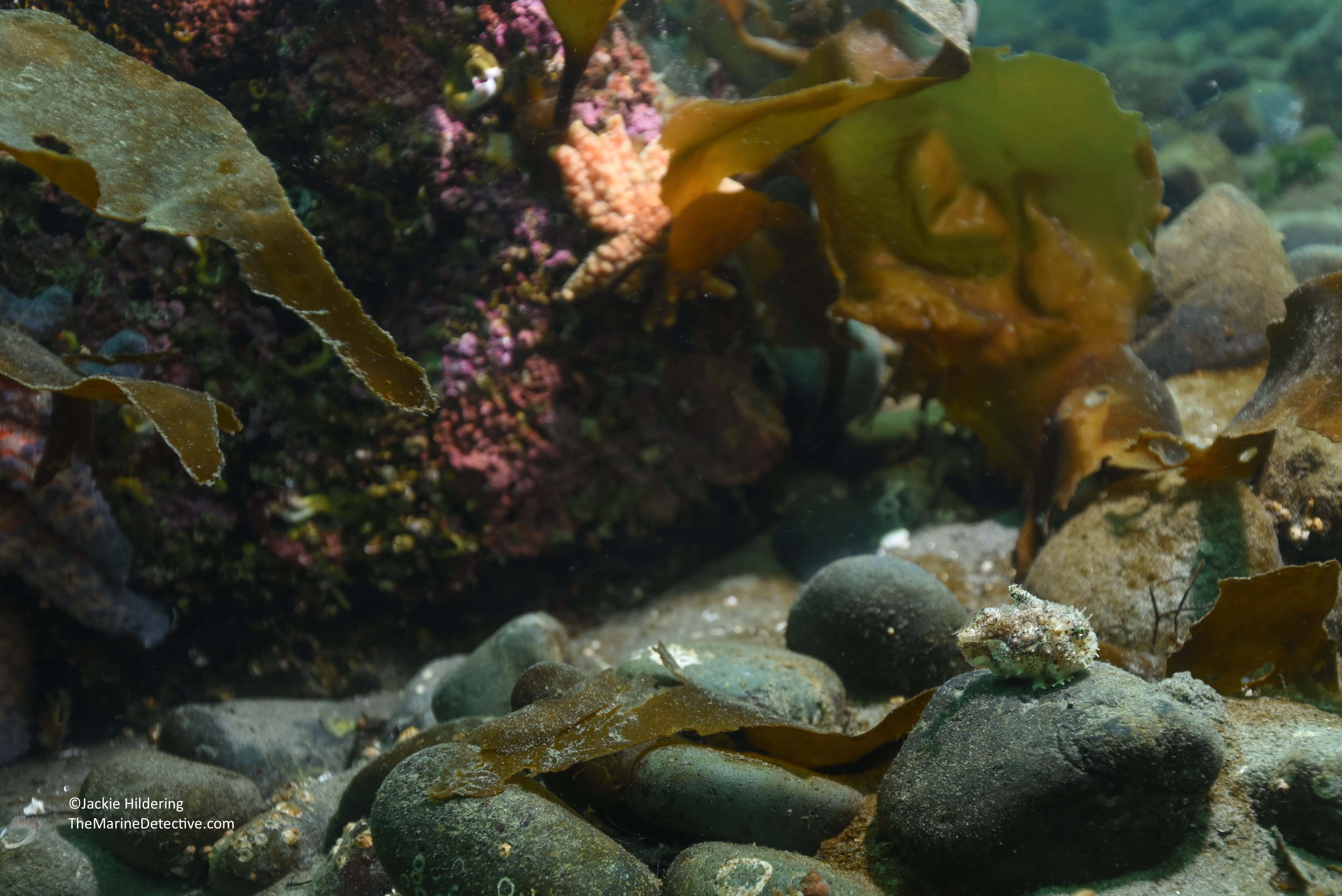
See them?
The Sunflower Stars AND the Pacific Spiny Lumpsucker?
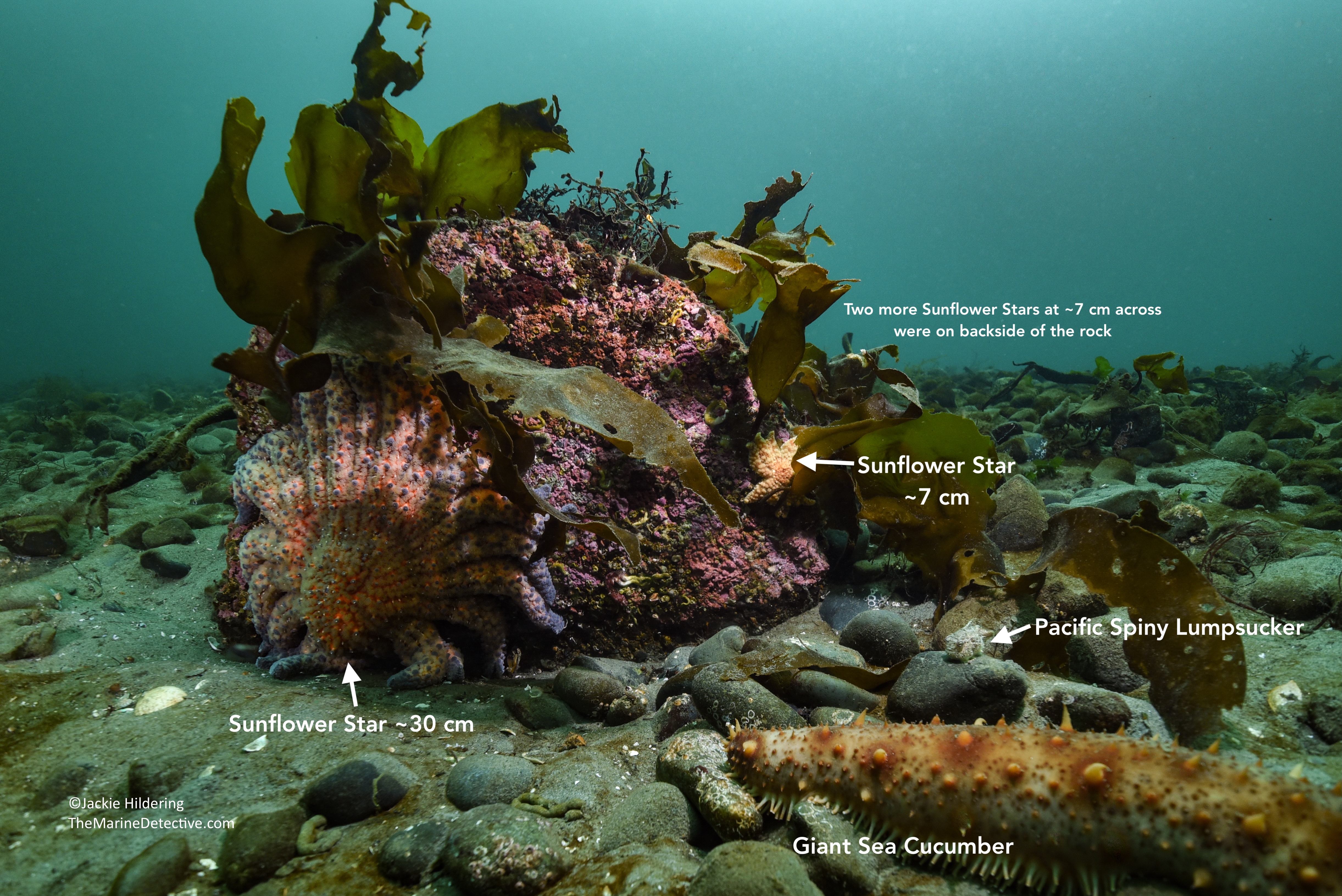
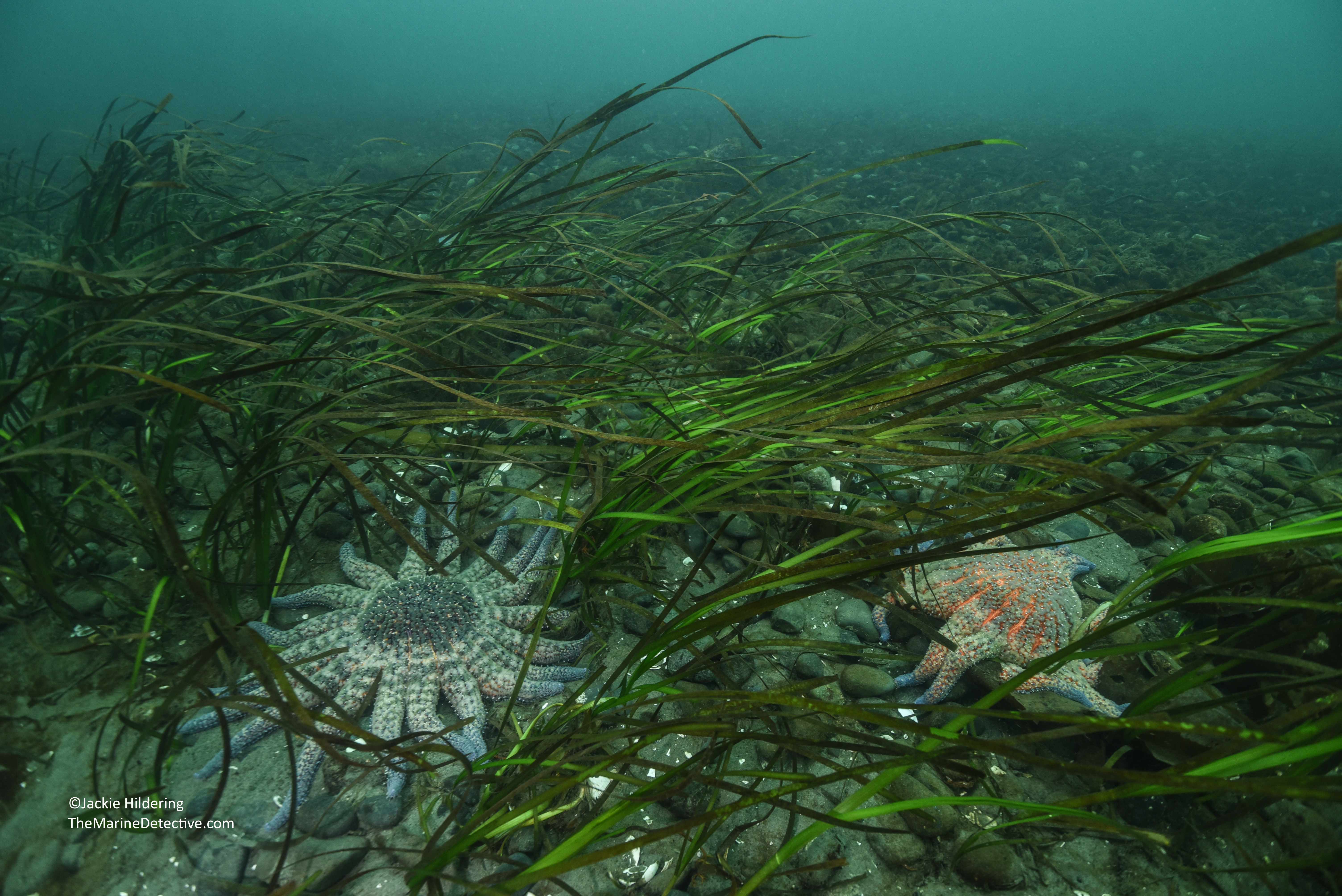
Above photos: the male Pacific Spiny Lumpsucker with Sunflower Stars in the background ©Jackie Hildering.

It brought a lump to my throat to see both these species at the same time. The Pacific Spiny Lumpsucker because this species is so cryptic and extraordinarily adapted (please read more about them in my blog “Pacific Spiny Lumpsucker – the fish, the disc, the marvel”). The Sunflower Stars because they are in such trouble due to Sea Star Wasting Disease. Sunflower Stars (Pycnopodia helianthoides) are the biggest sea star species in the world at up to 1 metre across.

But, somehow the conditions are such at this location that some adults appear to be surviving. I regularly document “waves” of juveniles but have seen so very few large ones since the onset of Sea Star Wasting Disease (SSWD) in 2013. I report all Sunflower Star sightings to researchers.

We would document thirteen Sunflower Stars during this dive – four at around seven cm across and nine at over 20 cm across.

And with that lump in my throat, I thought of sharing the photos of the Sunflower Stars with you and what the reaction might be. When I share photos of Sunflower Stars, some reactions suggest that I am diluting concern about them rather than educating about their plight and how this is believed to be related to a changing climate (which means there are common, and well known solutions that benefit life on earth).

Yes, there is hope. There certainly is. But, as I find myself stating and feeling so often, hope without action is paralysis. I recently came across the following quote which captures this so powerfully:

“People speak of hope as if it is this delicate, ephemeral thing made of whispers and spider’s webs. It’s not. Hope has dirt on her face, blood on her knuckles, the grit of the cobblestones in her hair, and just spat out a tooth as she rises for another go.” Source Matthew @CrowsFault on X

So here’s to the action that is Hope in all her power – for the stars, the lumpsuckers, and for all of us too.

The photos below show more Sunflower Stars documented on this dive, and how shallow some were. Please see the additional text below for details about the plight of Sunflower Stars.
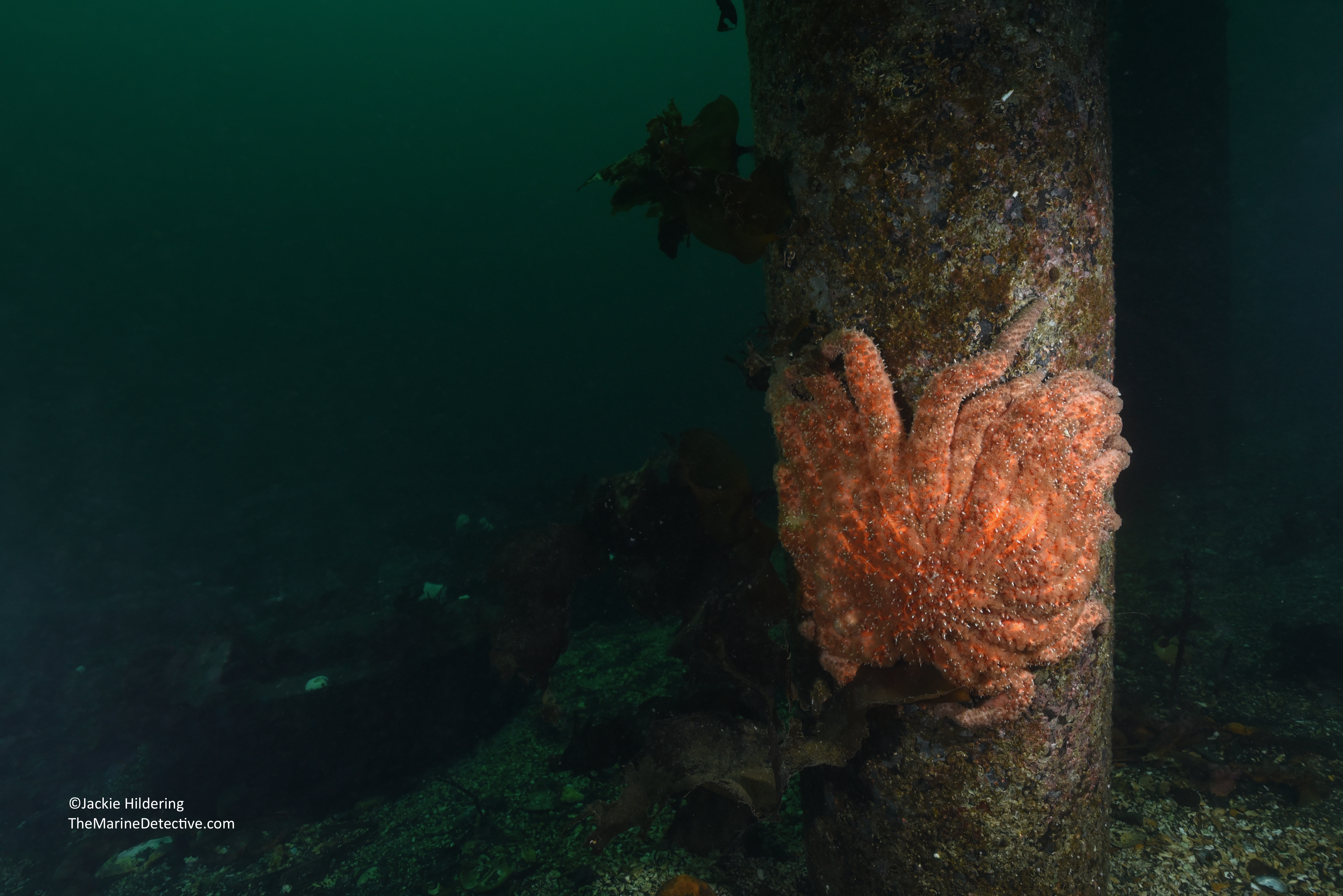
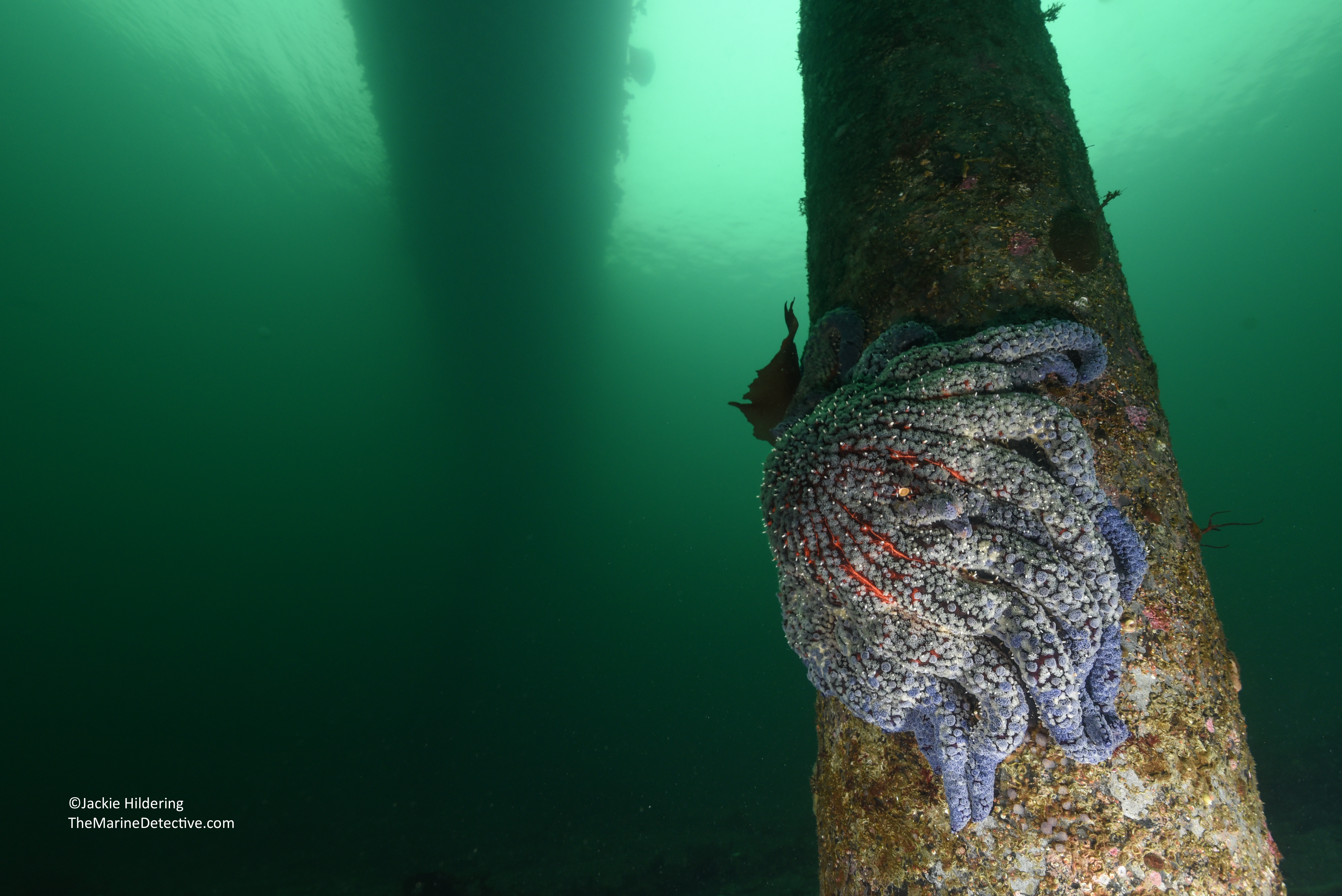
Sunflower Star on dock piling, February 16, 2026, ©Jackie Hildering.
Another Sunflower Star on a dock piling, February 16, 2026 ©Jackie Hildering.
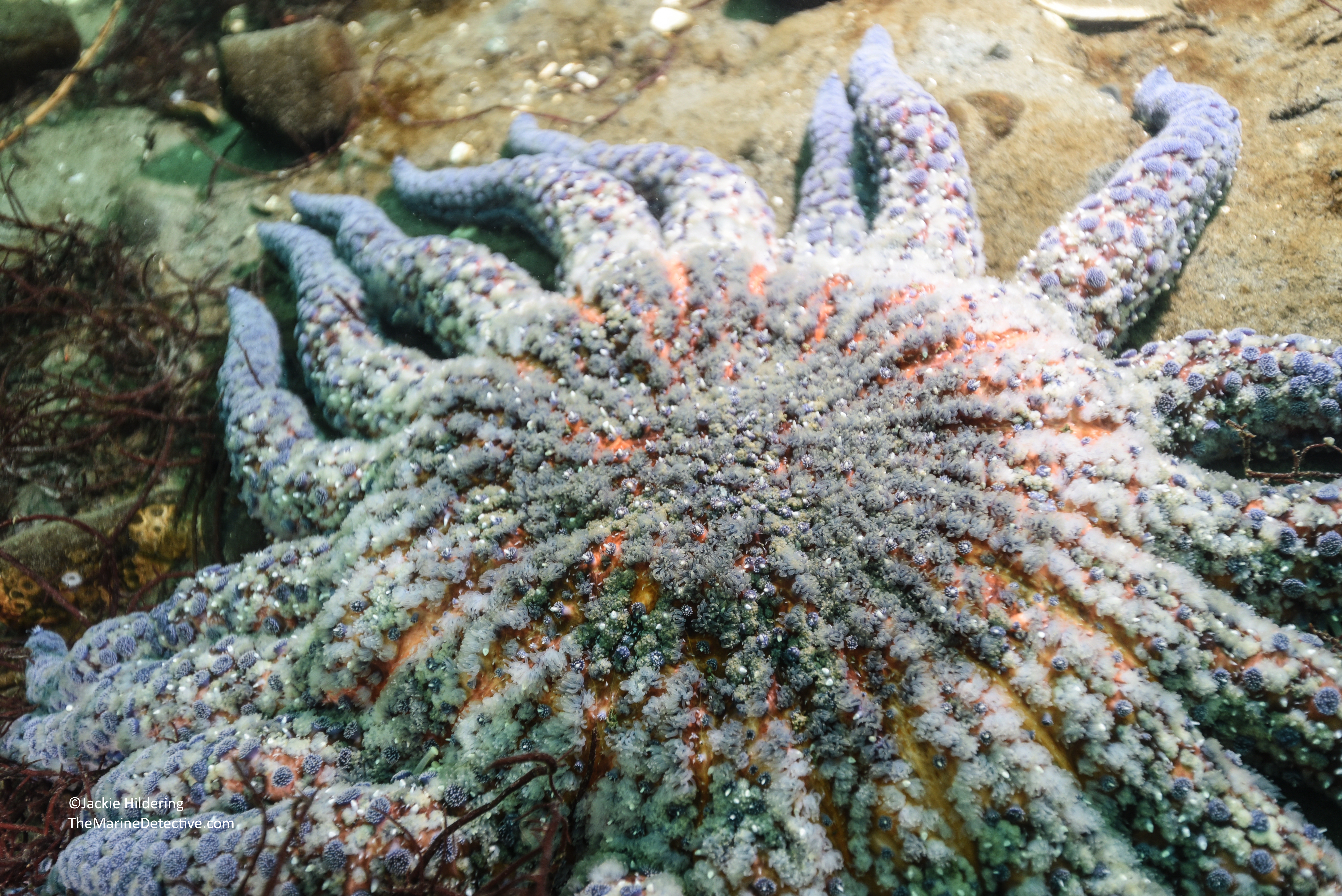
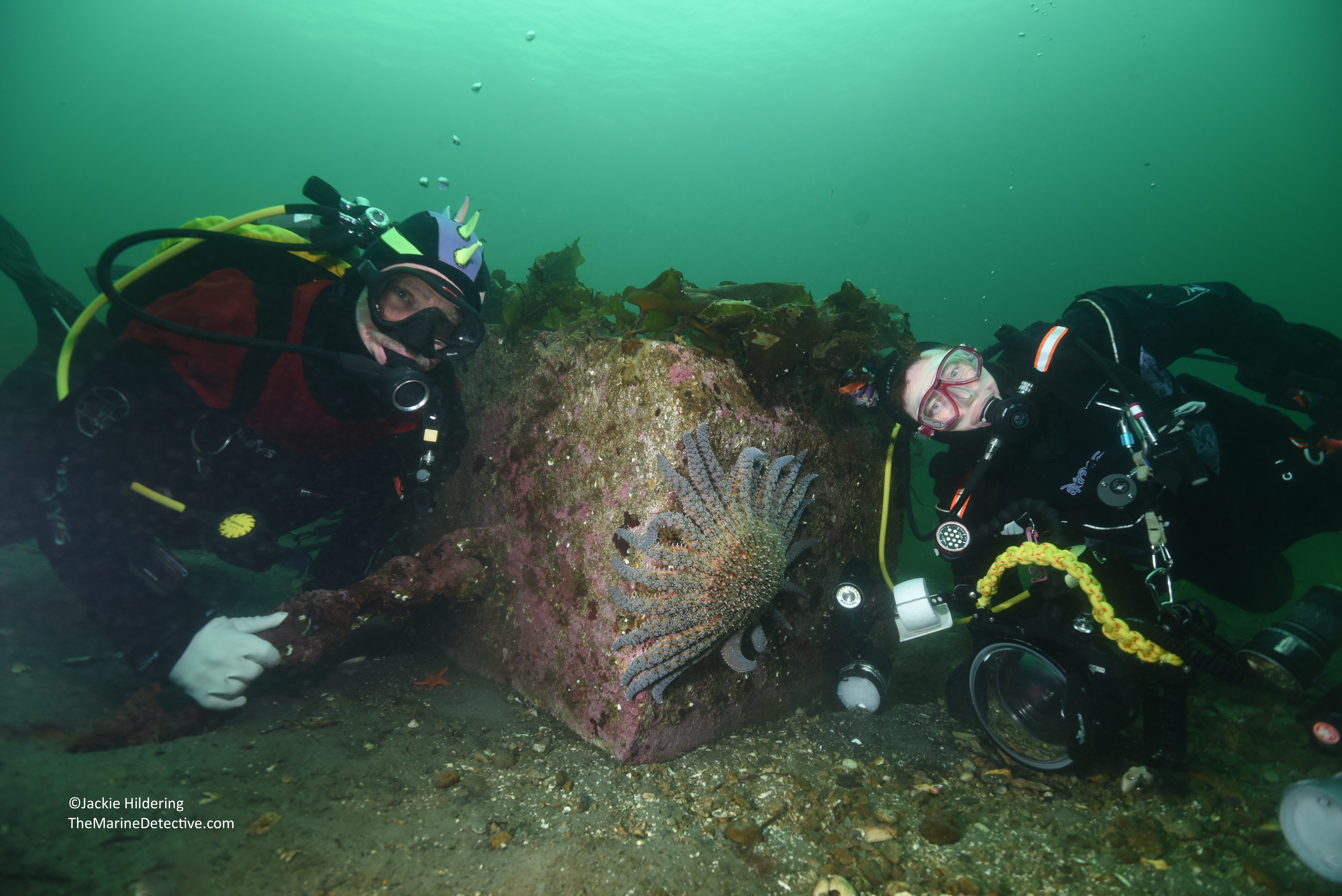
Dive buddies John Congden and Janice Crook posing to help give a sense of how large this Sunflower Star is.
February 16, 2026 ©Jackie Hildering.
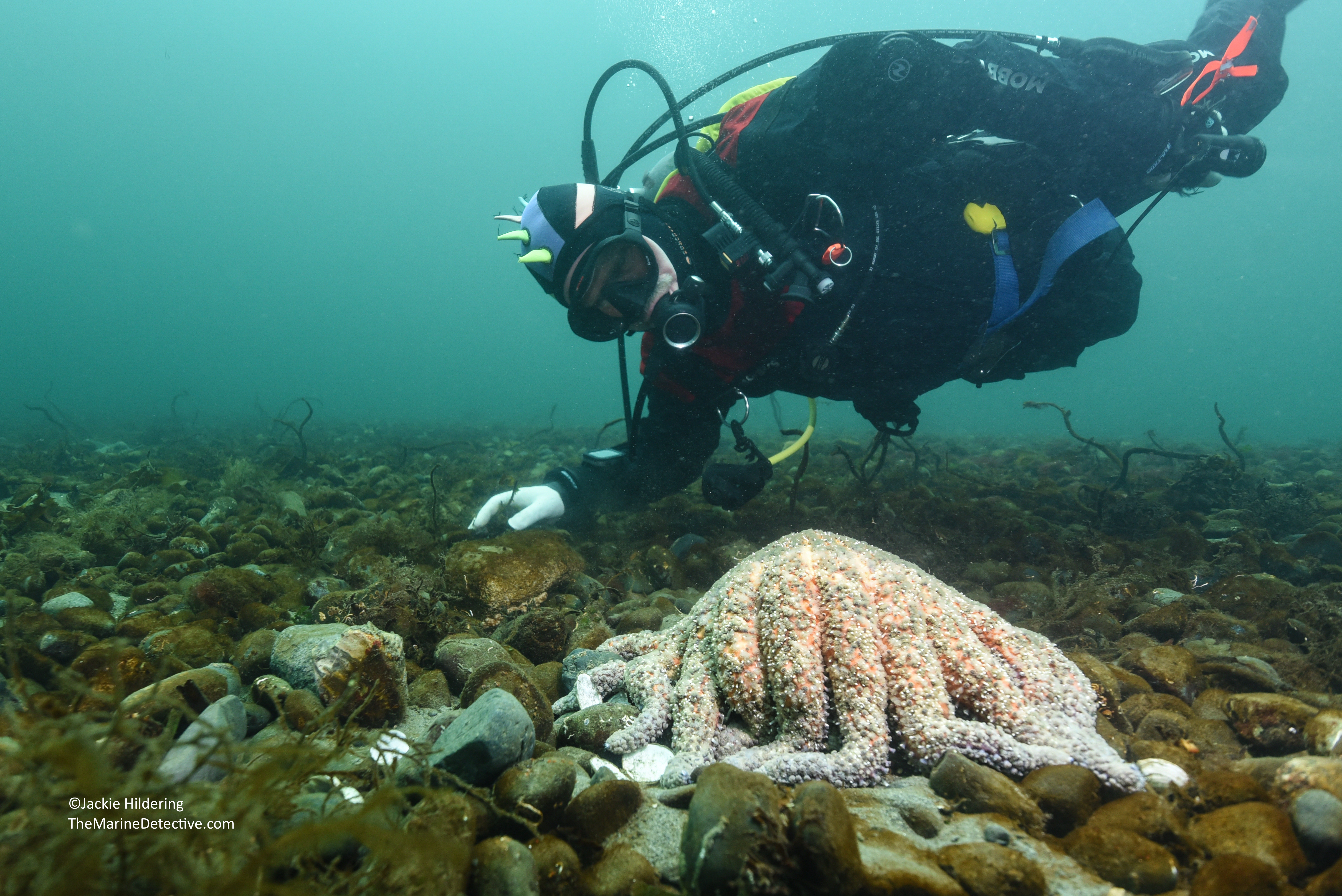
Another large Sunflower Star, February 16, 2026, ©Jackie Hildering.
John Congden with another Sunflower Star (at about 6 metres depth), February 16, 2026, ©Jackie Hildering.
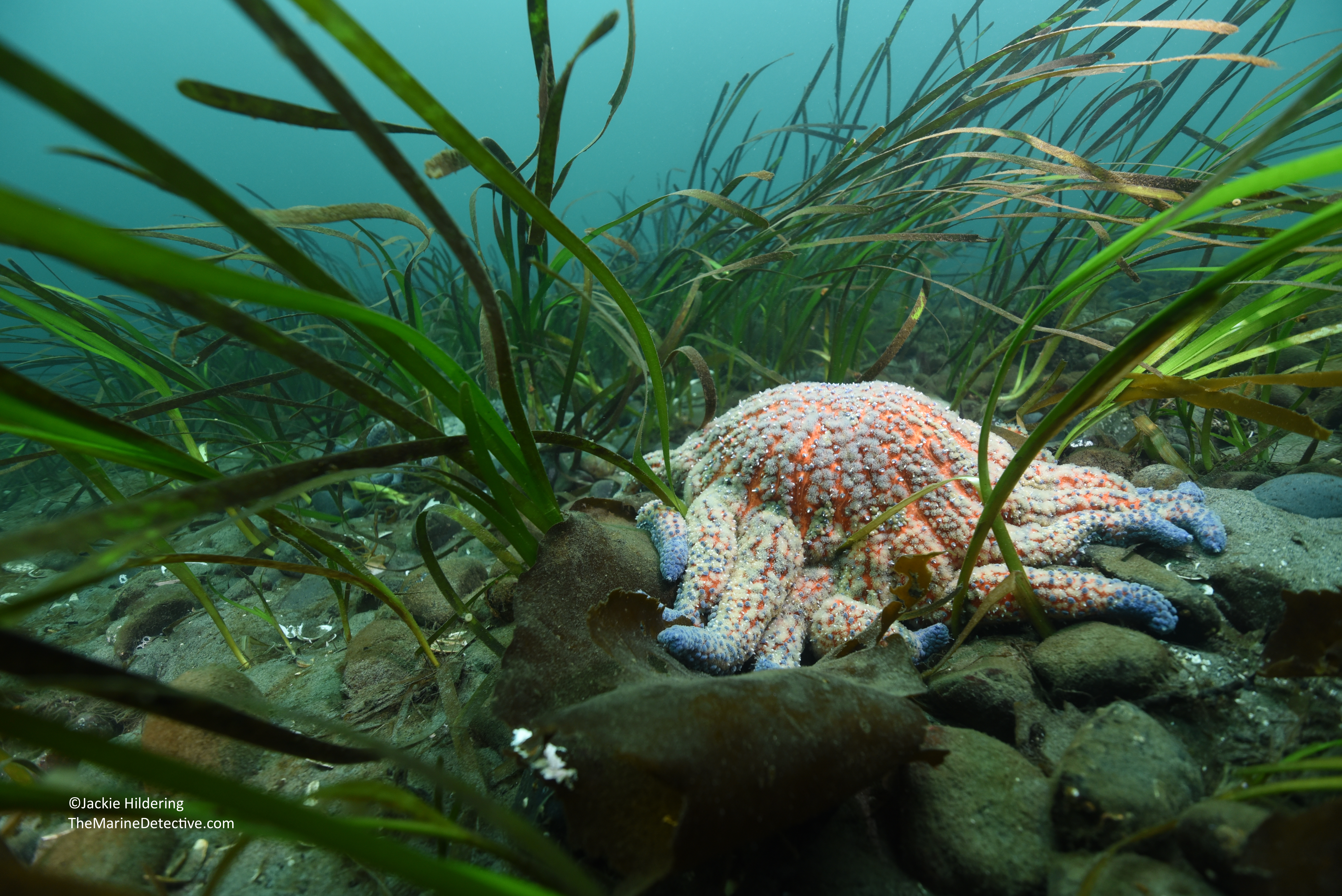
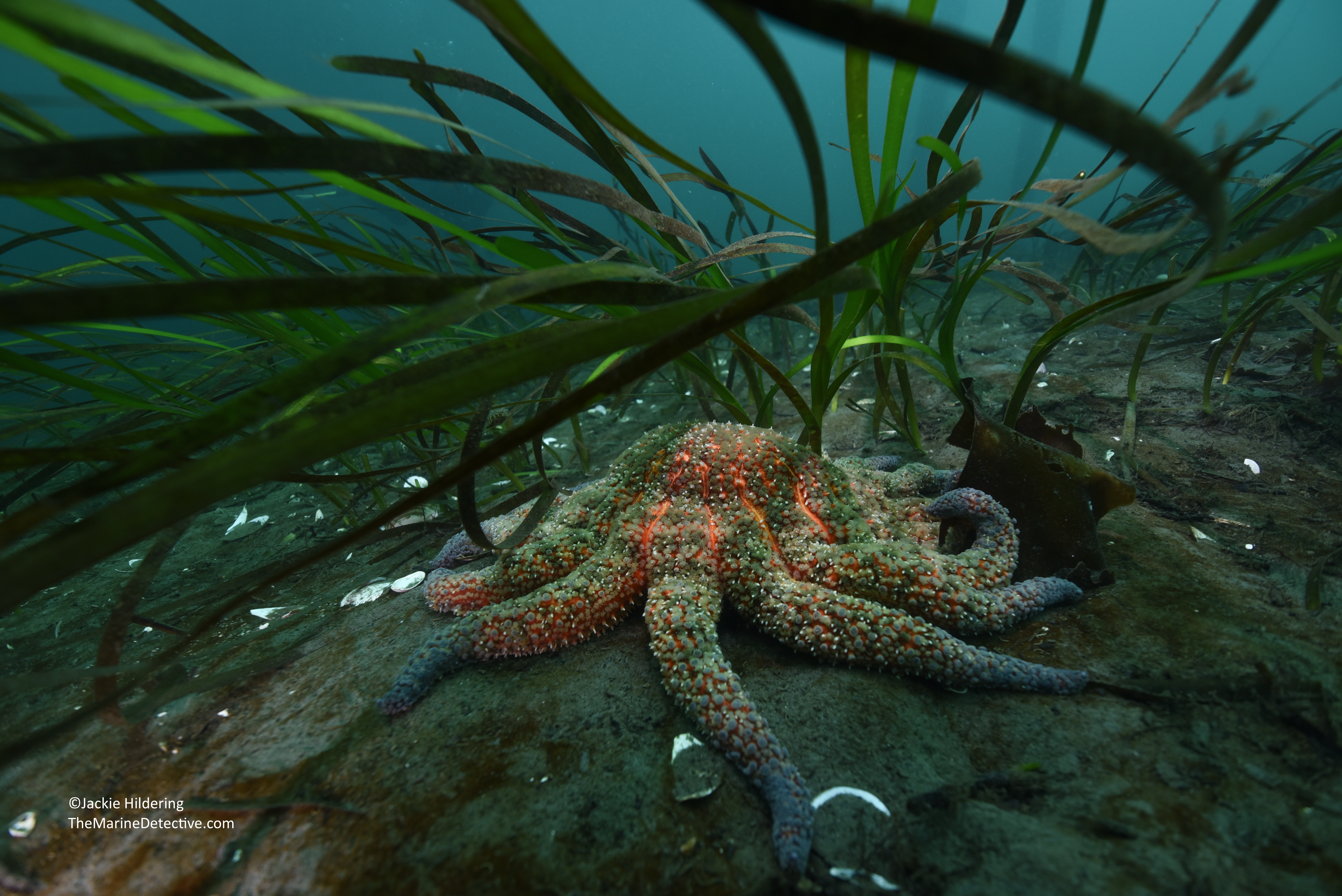
Large Sunflower Star in Eelgrass in the shallows, February 16, 2026, ©Jackie Hildering.
Two additional large Sunflower Stars in Eelgrass, February 16, 2026, ©Jackie Hildering.
And another one! February 16, 2026, ©Jackie Hildering.

Survivors

The text below is from my December 31, 2025 blog “Survivors” providing detail about the plight of Sunflower Stars and why, tragically, it is has become exceptional to see them (especially large individuals). The Sunflower Stars documented in the photos are from the same location as those in the above photos. Yes, some of them may be the same individuals. 💙
This Sunflower Star is ~1 metre across, December 30, 2025. Dive buddy is Janice Crook.
Believed to be the same Sunflower Star in the exact same spot on January 3rd, 2026.
Another two large Sunflower Stars on the same dive on December 30, 2025. There was a third on the other side of the cement block.

Why Does It Matter?

Sunflower Stars are the world’s largest sea star species at up to 1 metre across (Pycnopodia helianthoides). Before 2013, were you to look down from a dock in BC and Washington, you would likely see them . . . icons of our coast, common giants, and often what children would draw in seascapes.

That is no more.

What happened to 20 sea star species in the Northeast Pacific Ocean has been referenced as “the largest epidemic ever recorded in a wild marine species.” Sunflower Stars were the most impacted and there are far-reaching impacts due to their ecological role.

Still many people do not know about their plight despite over 12 years of disease (and a horrific progression of symptoms). You can bet that if a whole lot of Sea Otters (which have similar ecological roles) died there would have been almighty public outcry. But this happened below the surface, in the dark, to species without eyes and fur.

What Happened?

Sea Star Wasting Disease (SSWD) began in 2013 and yes, recently Canadian researchers concluded what the pathogen / causative agent is. It’s the bacterium Vibrio pectenicida. But of course this does not mean that Wasting Disease is “solved”.

Why would this bacterium be able to have the impact it has? What changed?

From the research by Prentice et al. (2025)Vibrio spp. have been coined ‘the microbial barometer of climate change’, because of the increasing prevalence of pathogenic species associated with warming water temperatures. Given that existing evidence indicates a relationship between increasing seawater temperature and SSWD incidence . . .

Where Are Things at Now?

In May 2025, the Committee on the Status of Endangered Wildlife in Canada (COSEWIC) recommended to the Government of Canada that Sunflower Stars be protected as an endangered species under Canada’s Species at Risk Act. It can be years before there is a decision.

This is not only important in Canada but the survivors in BC might be a reservoir for Washington State too where things appear to be even worse for the species.
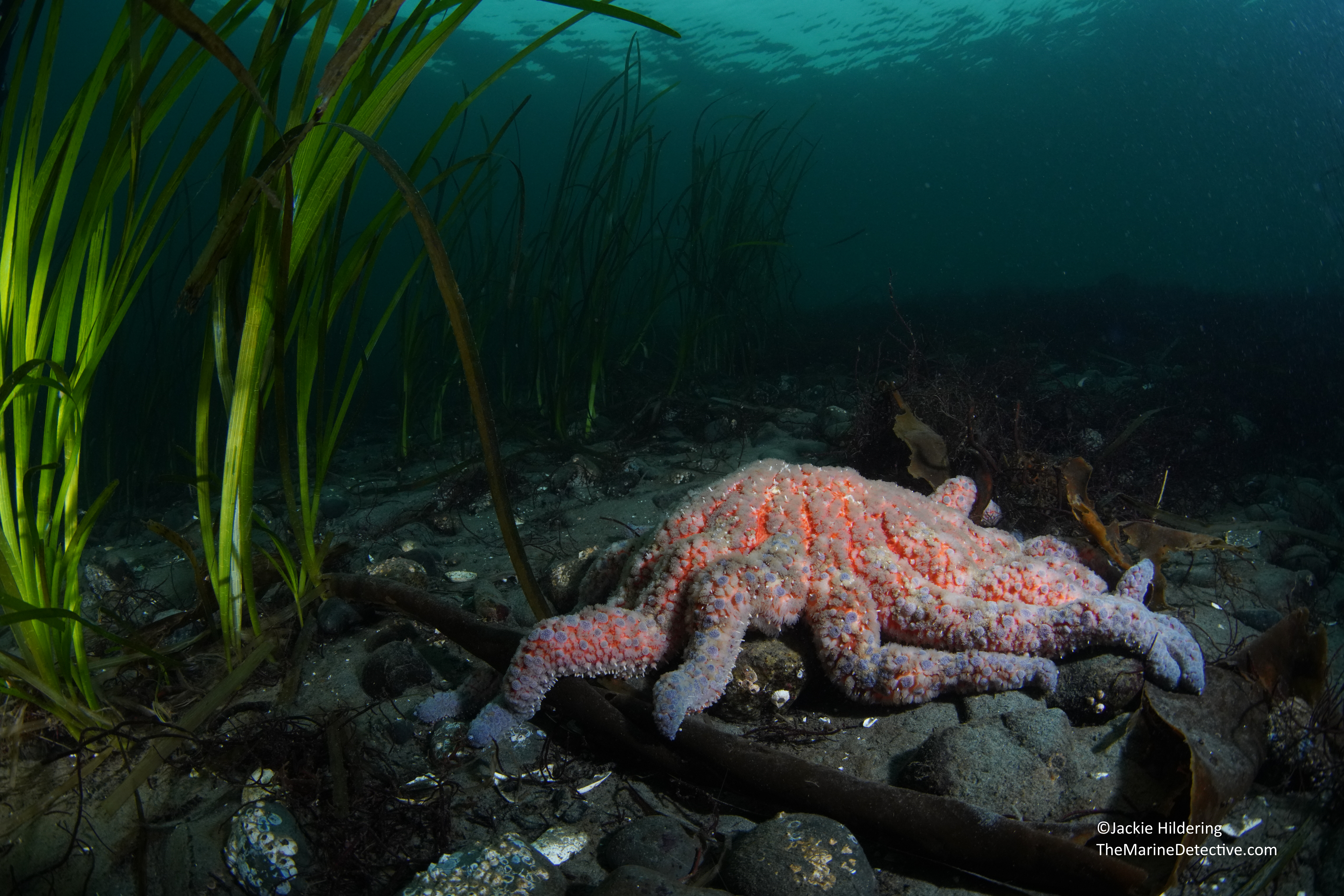
Another large Sunflower Star on December 30, 2025. You can see how shallow some of them were, indicated here by the presence of the Eelgrass and being able to see the surface of the water.

What To Do?

Celebrate survivors – yes. Know that the plight of Sunflower Stars is not an additional problem. SSWD is a symptom of the same changes that impact our own species which means, there are common solutions regarding energy use, how we vote, and consumerism generally.

If you have read to this point in the blog, you are particularly important. You clearly care about life below the surface, in the dark. Help others know the importance of this coast. Help work against “ocean blindness” where the cold, dark waters full of plankton are devalued because it is more difficult to see the life living there. (Warm, clear waters are often perceived to be “better” because you can see far more easily see below the surface. But, if you can see through the water, there is far, far less plankton – the fuel of the marine food web.)

Children should know Sunflower Stars and their place on this glorious coast.


Since the onset of SSWD in 2013, I have tracked research and developments at this link. Includes where to report sightings.


All photos near northeastern Vancouver Island in the traditional territories of the Kwakwakw’akw. ©Jackie Hildering @The Marine Detective. Dive buddies on the dives referenced here: Janice Crook, John Congden and Ruxton Pitt.
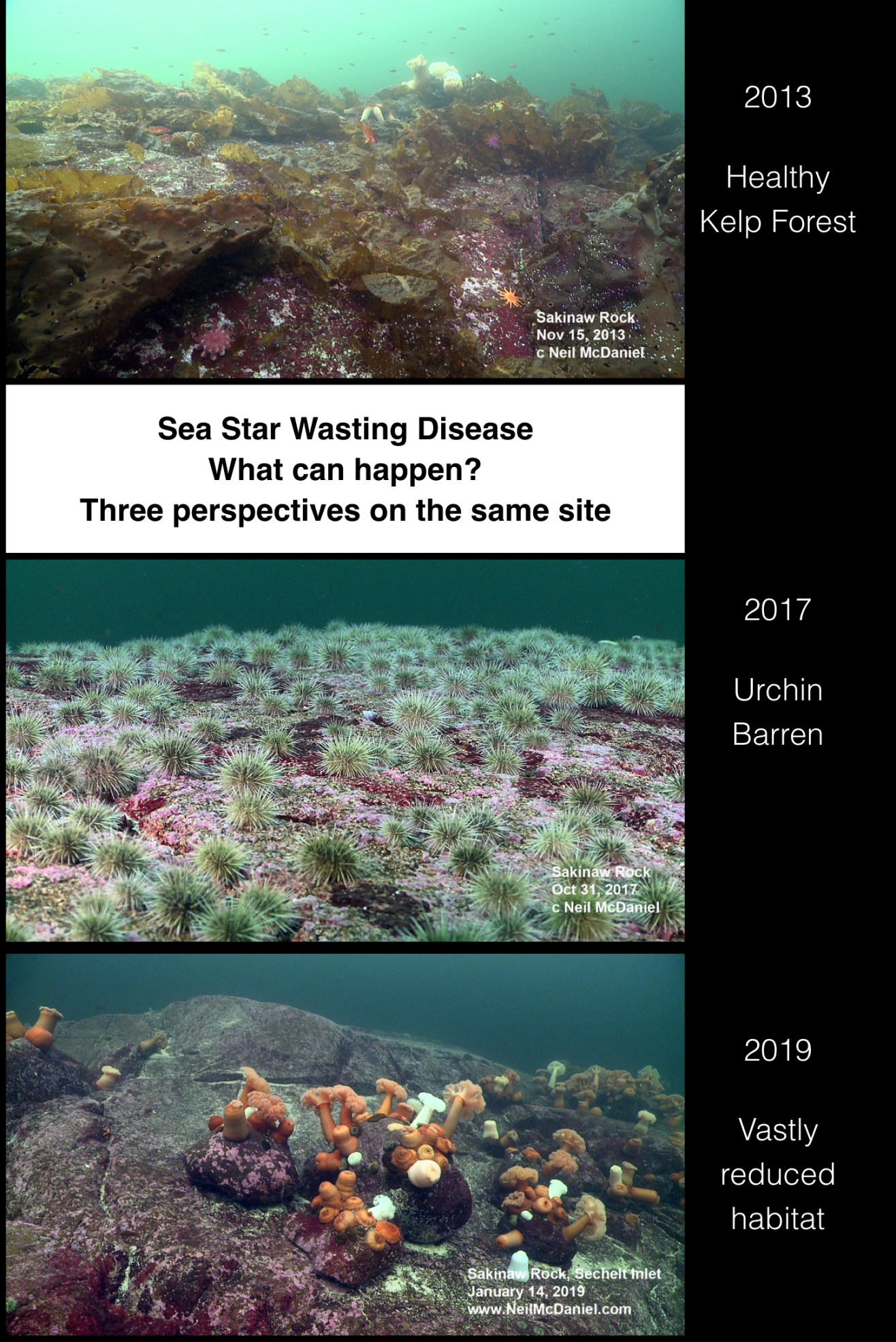
Sunflower Stars eat Green Urchins which graze on kelp. With fewer Sunflower Stars, there is more grazing on kelp by Green Urchins. Research suggests that Sunflower Stars can be 15 metres away and still help with deterring urchins (red urchins in the research by Mancuso et al., 2025).

Rockfish vocalizations: “Knock knock, who’s there?”

I feel compelled to share this new research by Lancaster et al., 2025 with you because:
1. It is about a non-destructive / non-invasive way to study fish. Using Passive Acoustic Monitoring (PAM) to determine wild fish presence in the same way one would identify birds by their calls.

2. It is yet another example of how little we know about even common marine species. Among the eight species of fish near Vancouver Island for which vocalizations were documented by the researchers, this is the first time ever that the sounds of Canary and Vermillion Rockfish have been identified.

3. The title of the research paper is so clever: Knock knock, who’s there? Identifying wild species-specific fish sounds with passive acoustic localization and random forest models”.

4. I know you want to see the video below and listen to the sounds!


Excerpts from the University of Victoria’s media release about the research:

“University of Victoria (UVic) biologists have discovered that even closely related fish species make unique and distinctive sounds and determined that it’s possible to differentiate between the sounds of different species. The discovery opens the door to identifying fish based on sound alone.  

Using passive acoustics, the researchers identified unique sounds for eight different Vancouver Island fish species in their natural habitats. They then developed a machine learning model that can predict which sounds belonged to which species with up to 88 per cent accuracy. This could have positive implications for marine conservation efforts and allow scientists to monitor specific fish species using acoustics, says Darienne Lancaster, a PhD candidate in biology who led the project. 

The research, published in the Journal of Fish Biology, is part of the larger fish sounds project run out of the Juanes Lab at UVic


While researchers have been identifying fish sounds for years, these sounds were typically recorded in a laboratory setting, rather than in the wild and whether different species made unique sounds had never been tested.  

Lancaster identified unique sounds for eight different species of fish commonly found on the coast of British Columbia: the black rockfish, quillback rockfish, copper rockfish, lingcod, canary rockfish, vermillion rockfish, kelp greenling and pile perch. This was the first time, in the lab or the wild, that sounds had been identified for the canary and vermillion rockfish

“It has been exciting to see how many different species of fish make sounds and the behaviours that go along with these calls,” says Lancaster. “Some fish, like the quillback rockfish, make rapid grunting sounds when they’re being chased by other fish, so it’s likely a defensive mechanism.  Other times, fish, like copper rockfish, will repeatedly make knocking sounds as they chase prey along the ocean floor.” 

The black rockfish make a long, growling sound similar to a frog croak and the quillback rockfish make a series of short knocks and grunts

Lancaster used a technique called passive acoustic monitoring to identify the fish sounds. She collected underwater audio and video using a sound localization array designed by former UVic PhD student and project collaborator, Xavier Mouy, and then used sound characteristics to identify differences in species calls.  

Her machine learning model used a set of 47 different sound features, such as duration and frequency, to detect small differences in each species’ sounds that can be used to tell them apart. The model used these small differences in sound features to group species calls together. 

“The ability of passive acoustics to identify specific fish by sound could be an important new tool for conservationists and fisheries managers,” says Francis Juanes, UVic biology professor and principal investigator on the project. “Passive acoustics could allow us to estimate population size, monitor activity, and assess the overall health of a fish population in a way that is minimally invasive to vulnerable marine animals.”

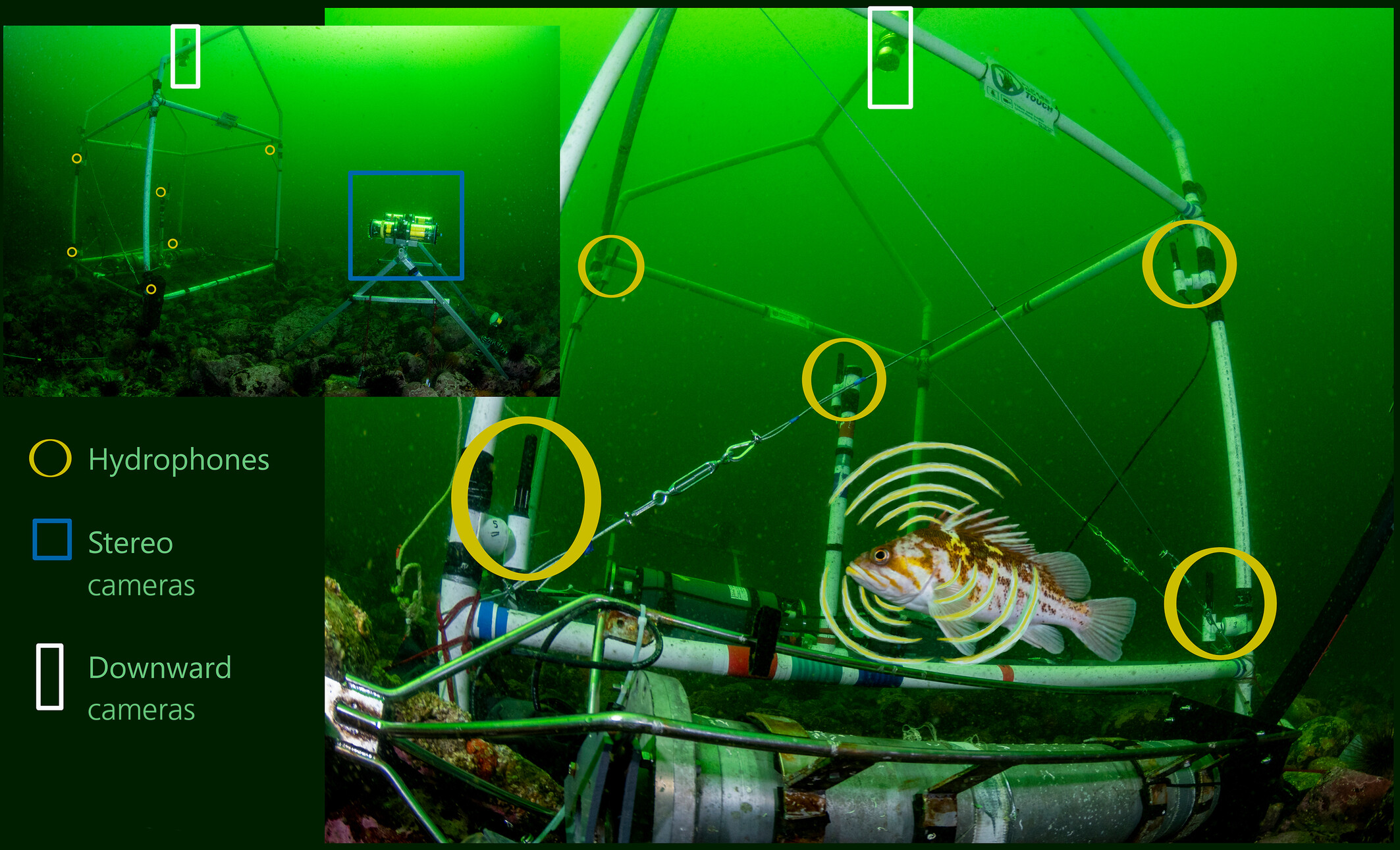
Figure 2 in the research paper: “Localization array with visualization of copper rockfish (Sebastes caurinus) calling near hydrophones. (images, Shane Gross; graphics, Darienne Lancaster).”

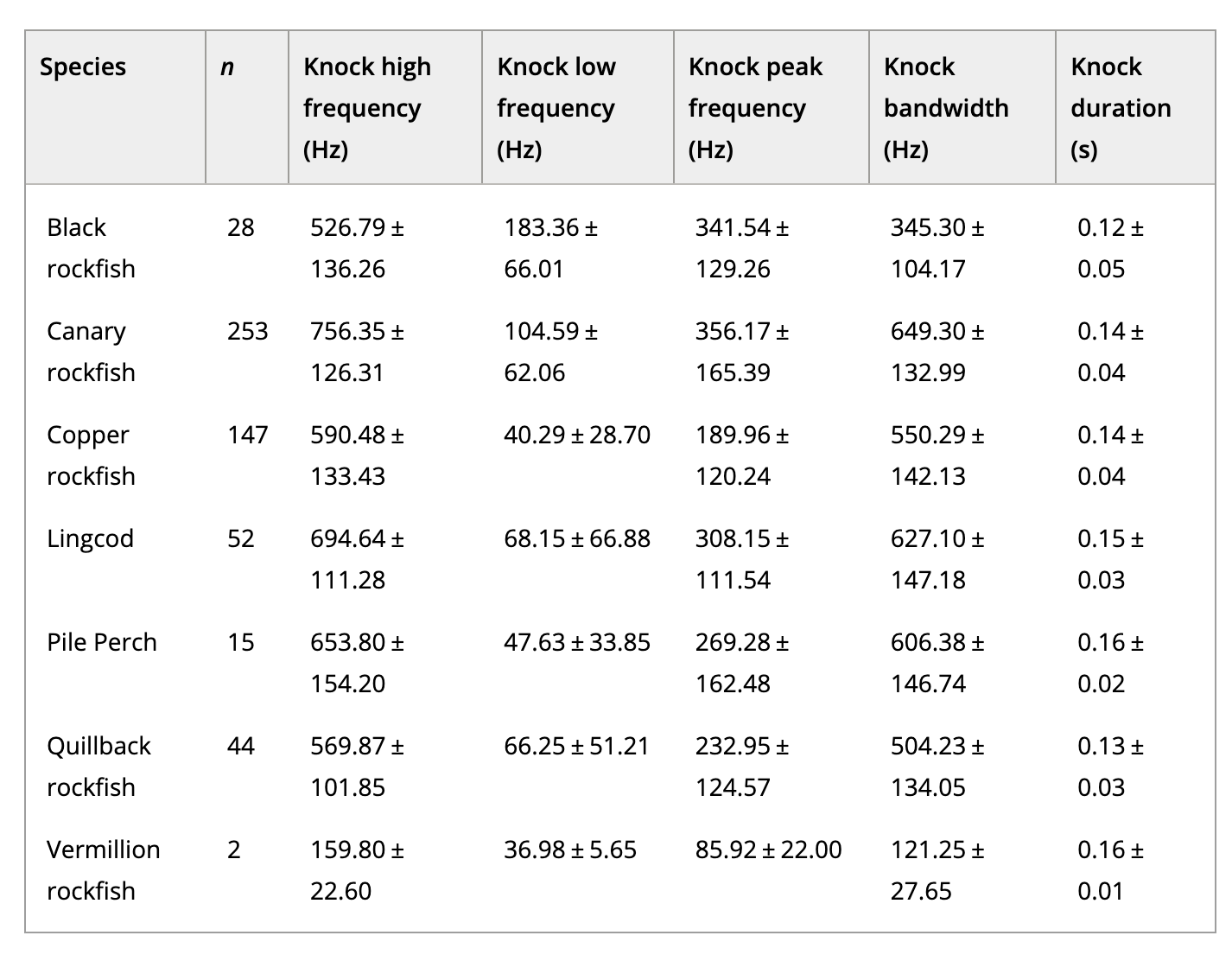
Table 2 from the research paper: “Summary of knock features (mean and standard deviation) for each species. Note: Only sounds with an ID confidence of 1 (high) were included for most species. Sounds with ID confidence 2 (moderate) were included for lingcod as no high confidence knocks were recorded. Kelp greenling (Hexagrammos decagrammus) knocks were not included as ID confidence for all knocks was low. Full species scientific names: black rockfish (Sebastes melanops), canary rockfish (Sebastes pinniger), copper rockfish (Sebastes caurinus), lingcod (Ophiodon elongatus), pile perch (Rhacochilus vacca), quillback rockfish (Sebastes maliger), vermillion rockfish (Sebastes miniatus).”

Excerpts from the research paper’s discussion:
We documented knocks and/or grunts for eight species of rocky reef fish. Two species—canary and vermillion rockfish—have never been documented as soniferous, and pile perch sounds have not been documented since 1966 (Meldrim & Walker, 1966). Black rockfish sounds have never been described or presented in spectrogram form (Fletcher, 1969). We provide summaries of species sound features in Tables S3–S5 and audio of species sounds are available on our data repository. We also demonstrate the importance of analysing field rather than aquarium recordings to determine if fish are soniferous and to characterize species calls. Aquarium-based studies can struggle to determine sonifery and the range of sounds in fishes’ repertoires. For example, an aquarium study by Nichols (2005) failed to elicit sounds from canary, black, and vermillion rockfish through prodding, but our study in fish habitat found that all three species are soniferous…

It was not possible to determine if kelp greenling are soniferous during this study. Kelp greenling were frequently present in videos, and we identified 25 possible kelp greenling calls with low ID confidence. Kelp greenling were typically interacting with other soniferous fish during calling activities so it was impossible to confidently determine which fish was calling. Further studies on kelp greenling calling would be useful to determine if they are soniferous.

Copper and quillback rockfish showed similar sound feature characteristics and were sometimes misclassified in the random forest knock model. This similarity is unsurprising as these two species can hybridize (Schwenke et al., 2018). However, quillback rockfish knocks and grunts had higher peak frequencies than copper rockfish sounds. We are unsure if this is a species-specific trait or an artefact of size differences across species. Higher frequency sounds often occur in smaller conspecifics (Kasumyan, 2008; Mann & Lobel, 1995; Myreberg et al., 1993; Rountree & Juanes, 2020), and larger copper rockfish are typically found at the same depth range as smaller quillback rockfish (Love et al., 2002). Future work will use our stereo-camera length information to examine size impacts on call characteristics.

This study expands the utility of PAM for assessing species richness and presence/absence, which are cornerstones of conservation and fisheries monitoring. We outline a novel method for collecting wild fish sounds and identifying species-specific sound features for use in fish sound detectors. Our study results can be used to detect the presence of specific fish species based on our documented sound parameters, which provide much greater precision than acoustic indices like ADI (Dimoff et al., 2021; Minello et al., 2021). Our work also contributes to the growing library of marine fish sounds required for PAM abundance estimation, but more localization studies are required to document the diversity of soniferous fish sounds. Future research should focus on localizing sounds for more species as well as collecting additional sound samples for underrepresented species. Further research into regional differences in species-specific calls is also recommended to determine the transferability of sound characteristics.”


You could be lucky enough to get BC researchers to provide education on fish bioacoustics: “FishSounds Educate is a free educational program that aims to use the topic of bioacoustics (biological sounds) to encourage future conservation leaders and enhance ocean literacy across Canada.” See this link.


Sources:


Note: I will try to get/find the sound samples of the Canary and Vermillion Rockfish. They have not yet been uploaded to Fishsounds.net. From that resource I did find the samples of the vocals of these species referenced in the research:


And for more vocals from fish (and other species) go to the “Discovery of Sounds in the Sea (DOSITS)” website. You do NOT want to miss the sounds of the Plainfin Midshipman, another common species off our coast. Then also go to this Nature of Things clip featuring this species with expert input from Sarika Cullis-Suzuki who did her PhD research on Plainfin Midshipman.

Not a Gremlin – many fish also have teeth in their throats

Let me start by saying . . . no one looks good when they are this dead.

Also, Halloween is nigh so that may have sparked some “spooky” speculations.

These photos of a dried up little fish created a lot of interest on the Field Naturalists of Vancouver Island Facebook page recently. Kendra Lukow found the fish at Race Rocks.

I think what led to confusion, misinterpretation, and maybe a few nightmares is that people may not realize that bony fish species have teeth in their throats. And, with this fish being so dried out, and thereby contorted, these teeth appear to be the main teeth in the “oral jaw”. But many of the teeth you see in these images are the “pharyngeal teeth”.

You may have noticed that fish do not have hands 😉 so how to hold onto your prey, chew it into smaller parts, and move it into your stomach? Evolution’s solution: the teeth you are more familiar with (in the oral jaw) hold onto the prey, while the secondary set of teeth in the throat (the pharyngeal jaw) chew and/or pull on the prey.

Even the fish species you are really familiar with, like salmon, have this second set of teeth. These teeth just look far more prominent in this dried up individual.

So which fish species did Kendra find? Even in having consulted some super fish experts, there is no certain ID. Some experts have put forward that the teeth and head shape look more like a large sculpin species e.g. Cabezon or Great Sculpin. Other experts reference that some photos show scales on the dry skin. Sculpins don’t have scales so that would make the ID of a greenling species more likely e.g. Lingcod or Rock Greenling.

Please note that motivation to make this blog is not to ID the very dry and dead fish. It’s to add to the awareness about this adaption in so many fish – the pharyngeal teeth. It’s to shift the “ew” to awe.

With great thanks to Andy Lamb, Dr. Milton Love and Gavin Hanke for their insights into the fish ID.


See below for a great TedEd animation explaining fish pharyngeal jaws.


Sources:

What I Didn’t See . . .

This blog contains a wee bit of self-mockery as well as a LOT of joy at what others saw during the most recent dive trip I organized to God’s Pocket Resort.

The October 2023 gang at God’s Pocket. Yes, that’s me gracefully gliding into the image after setting the timer on my camera.

There is so much I DID see and learn from when on this dive trip about 40 km north of my home on northern Vancouver Island. But there are three sightings by others that led to an unfamiliar upwelling of emotions for me and strange contortions near my jaw line. I think I may have been pouting. Not a good look!

Why? Let’s look at this case by case.

Sighting Number 1 – Mola / Sunfish documented by Timothy Manulides
I had a brilliant dive and was back on the dive boat. Timothy walked over and said, “I think I saw Sunfish.” I am sure my initial reaction. was to blank-stare him. I thought he was joking and poking a little bit of fun, knowing how much I would be happy for him, but sad for me.

Super biologist Isabelle Cote was also on this trip and said, “I saw them too!”.

It’s not that it’s impossible to see Mola (aka Sunfish) in this area. This year in particular has been remarkable for how many sightings there have been by scuba divers in the Browning Pass area (with possible repeat sightings of the same Mola).

Timothy may also have said: “I’ve never seen one before” to which there may have been the response: “Neither have I and I live here and we study them!”

We at the Marine Education and Research Society are involved with a study into the two species of Mola off the coast. While I have seen them while doing surveys from a boat, I have never seen one while diving.

I was on the same dive and very near to where Timothy and Isabelle sighted them! Thank goodness Timothy managed to get this video.

Here’s what I posted about this sighting on our Marine Education and Research Society social media:

“So thrilled that Timothy did see and document them so that we know (thanks to Dr. Marianne Nyegaard) that these are most likely juvenile Mola mola (Ocean Sunfish), not the other Mola species found in these waters Mola tecta (Hoodwinker Sunfish).

From Dr. Nyegaard about this sighting: ” . . . they look to me like very young Mola mola – the belly curve still has that angular look to them, which is the last remnant of the babyness.”

You may note that the Mola on the right has an injury on their tail. These juveniles were about 60 cm across.

The video also gives you a sense of how fast Mola are. They are often erroneously thought to be slow because, when at the surface, they are “sunning” to warm up from being in colder, deeper water. They can also be fairly stationary at the surface to present themselves for parasite removal by birds like albatross.

The other fish species in this video are Widow Rockfish and Yellowtail Rockfish.

This year it is extraordinary that we know of about 7 sightings of Mola in the Browning Pass area by scuba divers. We will be reporting on the other sightings once we have some more information. We will try to determine if they are repeat sightings of the same fish.

To report a sighting (with photo and/or video) and read about the differences between the two species, see www.mersociety.org/mola.

As the name “Hoodwinker” suggests, Mola tecta was hiding in plain sight. (“tecta” also means “hidden” in Latin).

It was only in 2017 that research was published on the very existence of the species and it was thought to only range in the temperate waters of the southern hemisphere. Only since 2019 has it been questioned whether they are found in colder waters and – they sure are! They’ve been mistaken as being Mola mola, the Ocean Sunfish.

We are collaborating and collecting the data for Ocean Sunfish Research.


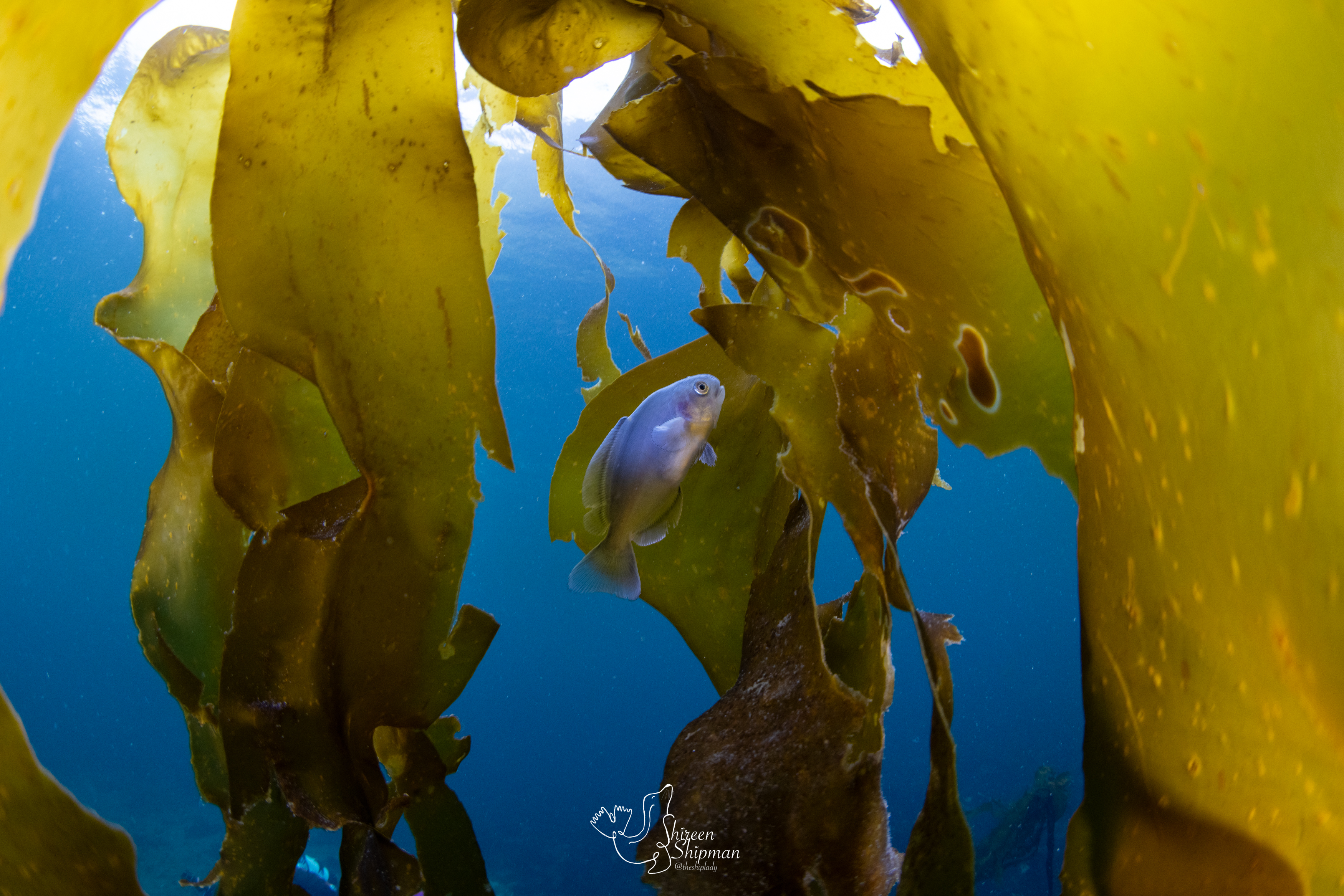
Sighting Number 2 – Medusafish seen by Shireen Shipman.
On one day of our dive trip, the wind was howling so fiercely that we could not get out in the boat. Thankfully, we could dive in the bay right in front of God’s Pocket. After one of these dives, Shireen showed me her stunning pictures and asked me if I knew the species.

My jaw may have dropped. Yes, my face got a good workout on this trip.

I thought this may be a Medusafish (Icichthys lockingtoni to 46 cm). But I had to check with expert Andy Lamb. I have never, knowingly, seen one. Their range does include where I often dive but sightings and photos of them by divers are rare. As the reference to “Medusa” suggests, these fish often are in amongst the tentacles of large jelly species. Even in Andy Lamb and Phil Edgell’s fish ID book, the only photo of a Medusafish is of a dead individual at the surface.

Andy confirmed this was a juvenile Medusafish and I am sure he is keen to use Shireen’s photo in future to help others ID the species.

Diver in the background is Shireen’s buddy, Melissa Foo.

The known range of Medusafish is the North Pacific Ocean: Japan and Gulf of Alaska to central Baja California, Mexico.

How wonderful that Shireen noticed that this was a unique fish and took beautiful photos. You can see how shallow they were. Oh and did I mention? I was on this dive.


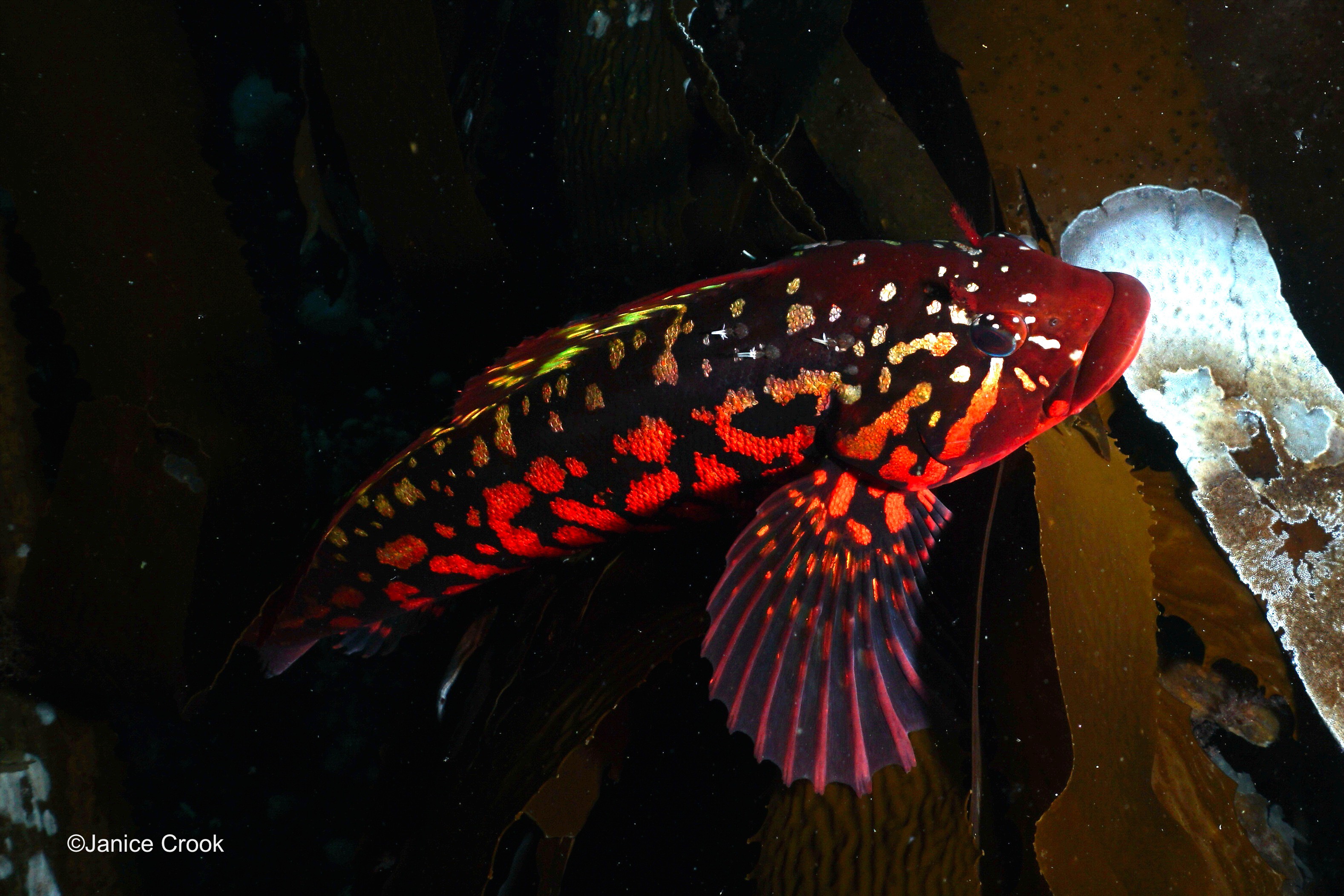
Sighting Number 3 – Male Rock Greenling seen by John Congden and Janice Crook
I was to dive with Janice and John but I could not clear my one ear. So I dived very near the surface telling myself that a byproduct could be . . . seeing a male Rock Greenling (Hexagrammos lagocephalus to 61 cm)! One had repeatedly been seen at this site. They are highly territorial AND in the shallows in sites with high surge like this.

There appears to be little known about Rock Greenlings and there is even scientific debate if the Rock Greenlings seen in Russia are the same species as those along the North American side of the North Pacific Ocean. Dr. Milton Love discusses how observations of this species from eastern Kamchatka and the Sea of Okhotsk are that they are in schools. While over on this side, they are observed to be solitary and very territorial.

Back to me diving . . . in the surge. I spend an hour at no more than 6 metres depth and looked, and looked for the male Rock Greenling. I was back on the dive boat when my beloved dive buddies, Janice and John, surfaced from their dive ecstatic because . . . the fish was where they had done their safety stop. Janice and John’s photos of the male Rock Greenling follow.


You can see how astoundingly, flamboyantly coloured mature male Rock Greenlings are and yet, also despite their territoriality, they can clearly be so difficult to spot.

I was so lucky to later see a mature female Rock Greenling on another dive, darting in and out of the Surfgrass. My photos of the female Rock Greenling are below.

There is much discussion about how territorial mature male Rock Greenlings are. But the mature females sure seem territorial too (based on my sample size of exactly ONE observation of a mature female Rock Greenling). 🙂


So why the pouty face?

Why indeed did my face do something similar to pouting upon not being part of these 3 sightings? The important things are:

  • Timothy’s video of the Mola was contributed to research.
  • Shireen’s photos of the Medusafish will help others ID the species.
  • Janice and John’s sighting of the male Rock Greenling was something they too had tried so hard for, dedicating many dives to being in the shallows, rocking back and forth in the surge. Between them, they have 59 years of diving, much of it in British Columbia’s marine waters and they have never before seen a Rock Greenling. Until this sighting, they had been referencing the species as the “mythic unicorn fish” of the northwest Pacific Ocean.
  • By being able to use their photos, I can still educate and hopefully increase care, understanding and action for the fragility the life in dark water. Thank you, dive buddies!

I actually looked up the definition of “to pout” for greater insight into what neural wiring leads to such a facial expression. I was gifted with: “to push one’s lips or one’s bottom lip forward as an expression of petulant annoyance or in order to make oneself look sexually attractive.” I assure you it was not the latter! Nor was it the former actually.

My inner 8-year-old is alive and well in this 60-year-old body. She’s the one who pouted, wanting to be filled with wonder too.

The more adult me loves the wonder of NOT seeing these fish. You can be on the same dive, at the same time, and not have the same experience. Isn’t that the truth! I love the metaphor it gives for life. I love how much more there is to marvel at, and to share.

It tests me too. Can we care and take action for species we have never seen, or may ever see? Can we do so with the understanding of how little is known about them and how that too threatens their survival? You, dear reader, know that answer to that in how YOU feel right now.

YES we can and yes, we must. 💙

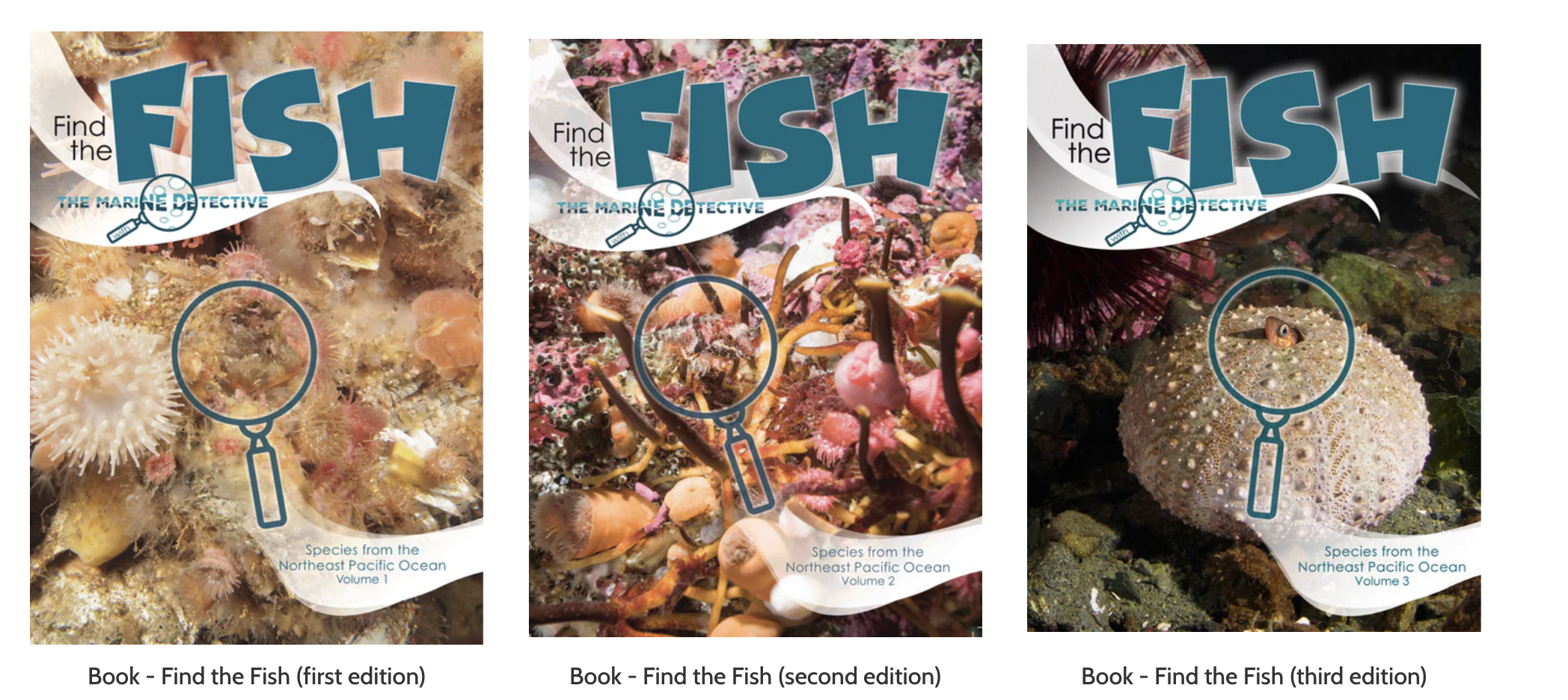
Find The Fish – Volume Three!

There are now THREE Find the Fish books.

Here’s the cover of my latest book, now available at this link.

I loved that the online “The Marine Detective” community overwhelmingly chose this image for the cover showing a juvenile Yellowtail Rockfish hiding in the shell of a Red Urchin. The urchin may have lived to be more than 100 years old.

As many of you know from my weekly “Find the Fish Friday” posts, these are eye-spy challenges.

The books are the “Where’s Waldo” of the marine world. In addition to being fun, they are aimed and increasing knowledge about how diverse and colourful the life is in these cold, dark waters. The text provides information about the species in the images and invites children (and the adults who love them) to look for other species as well as the featured fish.

All photos and text are by yours truly with fish illustrations generously provided by Andy Lamb of Coastal Fishes of the Pacific Northwest. 

The trifecta! The books are soft-cover and answer pages are included showing the locations of the fish.  
The books are self-published as Marine Matters Publishing. 

It gives me much joy that this third book in particular allows the facets of my life to come together – diving, photography, whale research and teaching. I dare say Find the Fish – Volume Three is the only children’s book that gives insight into the diversity of life off our coast while ALSO providing empowering scientific content about Sea Star Wasting Syndrome and our Marine Education & Research Society research into a new Humpback Whale feeding strategy.

And hey, the featured wildlife includes a Pacific Spiny Lumpsucker, Wolf-Eels, Scalyhead Sculpins (of course) and three of my beloved dive buddies!

Please see the sample pages below. There are 12 challenges with answer pages, an introductory page and a final page about “The Marine Detective”.

To order or see more information about the books, please click here.  

Silver strands of salmon

Salmon – shiny, silvery threads of life.
Take a few minutes to marvel at the role of wild salmon in holding together the fabric of life on our coast?

June 1st is #BCWildSalmonDay.

See the salmon in Surf’s mouth?
Surf is A66, a mature male Orca belonging to the inshore fish-eating (clearly) population of threatened Northern Residents. He was born to Sonora (A42) in 1996. While “Resident” populations of Orca also eat other fish species, their well-being is correlated to availability of salmon (especially Chinook Salmon).

Whales do not randomly blunder about looking for food. Nor are salmon flailing about arbitrarily. The fabric is so much finer than that.

For thousands of years, generation-upon-generation, families of Orca have depended on the same lineages of salmon. In these dark waters, the fish-eating Orca can literally sound out location, size and species of their prey with biosonar / echolocation. Females almost always share the catch with their family (Wright et al).

Salmon fight to return to the exact rivers of their birth by some pull we human have yet to fully understand. This flow is predictable and essential. This predictability provides ease of hunting for the many who depend on the silver flow – from fish-feasting Orca to human fisherfolk. Less energy is needed because the prey SHOULD be easy to find.

The salmon are guided to spawn so that, in death, they deliver nutrients from the Ocean back to the freshwater where they were born, even hundreds of kilometres inland. That is, if transit is not impeded by drought, siltation and slides, parasites and/or disease, or by lack of cold refuges.

The rich bodies of salmon will nourish the ecosystem so that enough of their young may survive to hold the fabric together. Their bodies feed trees, bears, eagles, song birds, insects, deer, wolves, and so much more.

By spawning and dying, the salmon also ensure their diseases and parasites die with them. Nutrients remain.

This web is made of a fabric of exquisite beauty and perfection, shaped by vast expanses of time. Weathered, refined, and adapted by slow change.

But, now, change comes far too fast through the actions, and insufficient reactions, of those who do blunder and act arbitrarily. We, the humans without sufficient understanding of the intricacy of it all, nor how we are attached to the threads.

Know that what helps salmon, herring, whales – is the fabric that holds we clumsy bipeds together too.

Not disparate problems.
But the same life-enhancing solutions.

Care more. Consume less.

Photo: ©Jackie Hildering taken in 2014 in Kwakwak’wakw Territory, northeast Vancouver Island.


Related blog but with me applying Seussian style: A World Without Salmon

Pacific Spiny Lumpsucker – the fish, the disc, the marvel

Last updated: January 11, 2026.
I have now righted a great wrong. Because how can it be I did not have a blog featuring the Pacific Spiny Lumpsucker? This is one of the most cryptic and astoundingly adapted fish in the north Pacific Ocean.

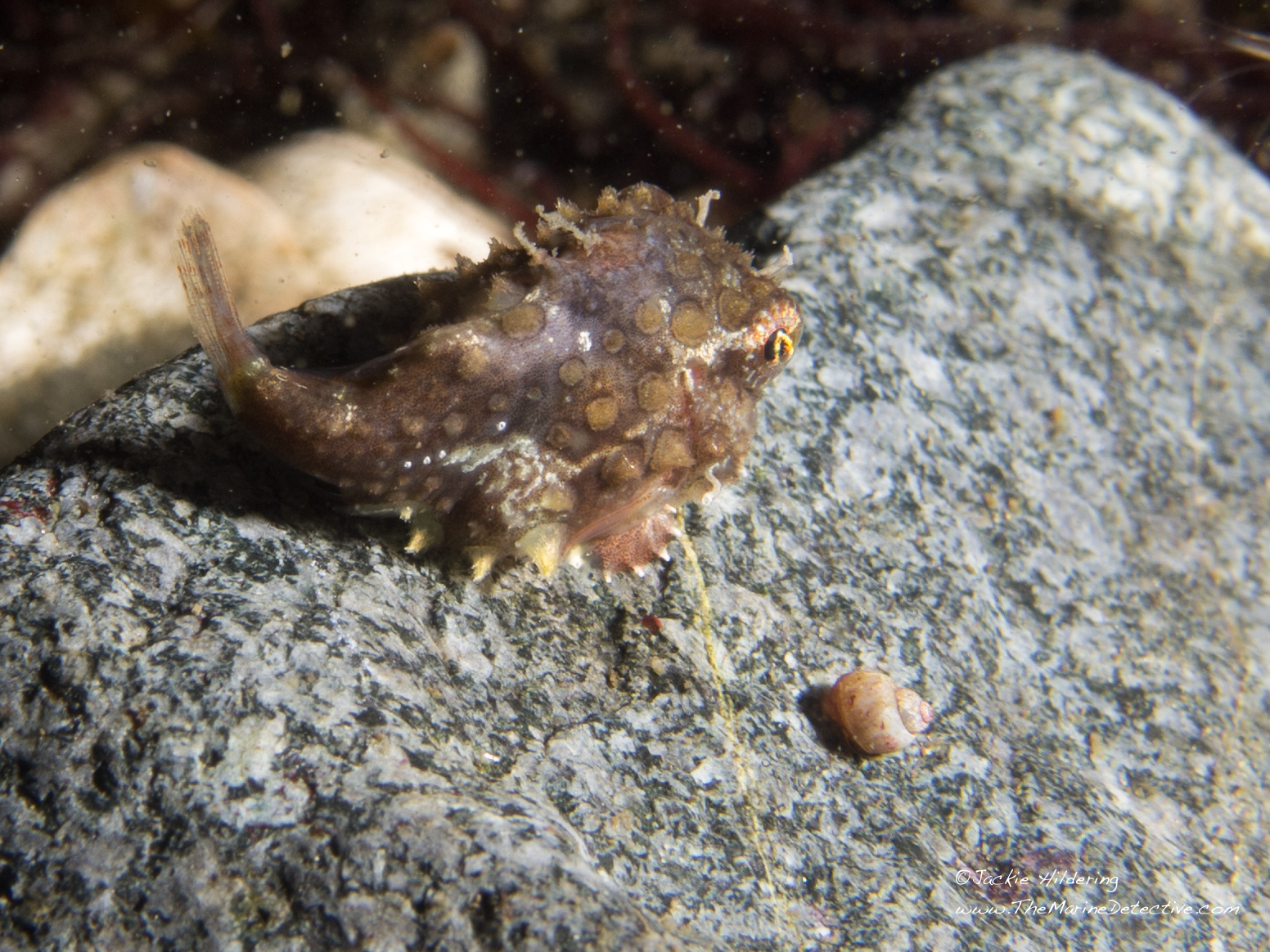
Yesterday, I chanced upon the individual in the photo below and he is what finally catalyzed this blog. Just look at him! He is only about 2 cm long. I noticed him because he was swimming / hovering around like a minuscule zeppelin. Then he alighted on a rock, securing with the pelvic disc this species relies upon.

Pacific Spiny Lumpsucker who lives in Kwakwaka’wakw Territory near Telegraph Cove.
Photographed November 6, 2021

To be a little, round fish like this, nature had to do something to make sure you don’t roll over. You need to be able to secure, not only to rock, but to seaweeds and Eelgrass. The “solution” is that Pacific Spiny Lumpsuckers are among the fish species in which the pelvic fins have evolved into a sucker on their bellies.

This species has very small pectoral fins (even relative to body size) and does not have a swim bladder to help with buoyancy. All the more need to have the disc to be able to hold on between short hovering swims.

My video of a Pacific Spiny Lumpsucker from 2015.

Pacific Spiny Lumpsuckers don’t have scales but rather have lumpy, bony plates known as “tubercles”. Maybe these are what the “lump” in their common name refers to.

There have been many creative attempts to describe the overall appearance of Pacific Spiny Lumpsuckers from simply “cute” to “pingpong ball with fins”, to “swimming strawberries”, “underwater bumble bees”, “gum balls with eyes”, and . . . “a fish that has quietly come to terms with looking idiotic”. Thanks Dr. Milton Love for that last descriptor. You can imagine the many jokes and allusions made about their name which “sounds like a Shakespearean insult” (comment made by Angela Flute on YouTube).

The species name Eumicrotremus orbis references their rotundity and size. Maximum known length is 12.7 cm but they are more often much smaller, around 2.5 cm.

I believe the Pacific Spiny Lumpsucker we saw yesterday was a male because mature males are reported to be dull orange to reddish brown. Mature females are pale green and have more and larger tubercles.

Another male and you can see part of the pelvic disc. ©Jackie Hildering


The one in Paul Wright’s video below is most definitely a male. See the egg-guarding? Male Pacific Spiny Lumpsuckers guard the eggs after fertilizing them, oxygenating them by wafting water over them and protecting them from predators. It’s reported that males die after the eggs hatch and that the females die after egg laying (average of 202 eggs, size of each egg is ~2.2 mm). Outside of when they are breeding, this is a solitary species. Appear to have a life expectancy of around 1 year in aquariums (Casey Cook, pers. com).

It is normal that Pacific Spiny Lumpsucker’s mouths are almost always open and that they appear to be panting (as you see in the video).

Video by W. Paul Wright from 2014with descriptor: “Video taken in Gibsons British Columbia. Male lumpsucker tending to newly laid eggs in discarded Ponds jar.”
Video by Ricky Belanger from 2018.
Video by Victoria High School from 2009 from their aquarium.

2025 compilation by “All Things Marine Life”


Further species information:

Range: Northern Washington to the Bering Sea, along the Aleutian Islands to Siberia and northern Japan. Intertidal to 575 m. Source: Lamb and Edgell, 2010.

Diet: “Small crustaceans such as gammarid andy hyperiid amphipods, along with caprellid amphipods, isopods, and cumaceans” [hooded shrimp species]. Source: Love, 2011.

He’s not smiling. YOU’RE smiling.
©Jackie Hildering

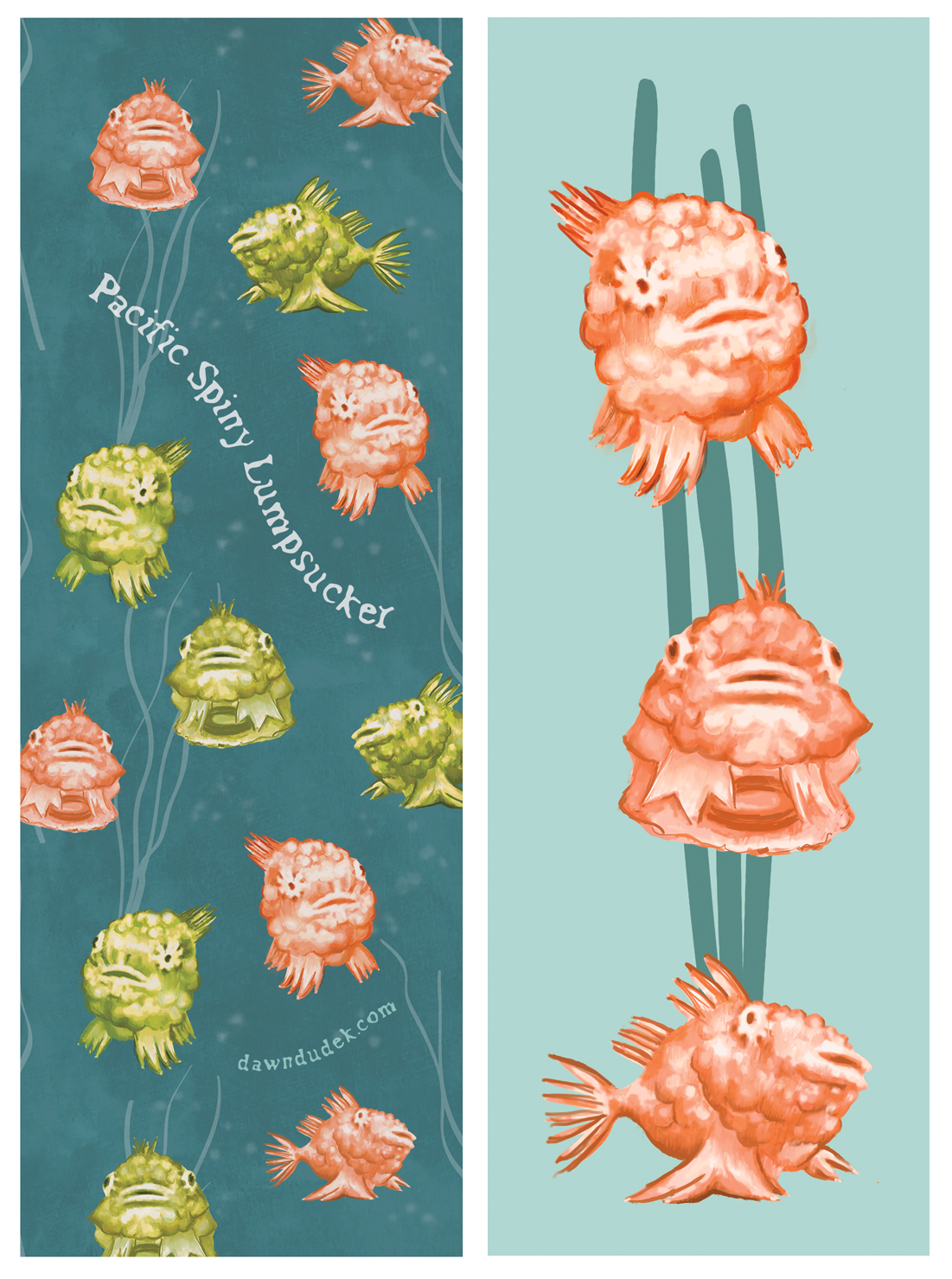
Pacific Spiny Lumpsucker art by dear friend Dawn Dudek. She has bookmarks available through our Marine Education and Research Society Ocean Store at this link.

Sources:

Arita, G. S. (December 01, 1969). Sexual Dimorphism in the Cyclopterid Fish Eumicrotremus orbis. Journal of the Fisheries Research Board of Canada, 26, 12, 3262-3265.

Aquarium of the Pacific – Pacific Spiny Lumpsucker

Cook, Casey, personal communication November 7, 2021

FishBase – Eumicrotremus orbis

Lamb, A., & Edgell, P. (2010). Coastal fishes of the Pacific Northwest. Madeira Park, B.C: Harbour Pub.

Love, M. S. (2011). Certainly more than you want to know about the fishes of the Pacific Coast: A postmodern experience. Santa Barbara, Calif: Really Big Press.

New York Times, Feb. 25, 2022, The Pacific Spiny Lumpsucker Is Armed to the Teeth – The diminutive predator is a terrible swimmer but thrives in the intertidal zone thanks to odd evolutionary adaptation.

University of Washington – College of the Environment Feb. 8, 2022, , This tiny coastal fish wears a toothy coat of armor


Answers to some of my “Find the Fish Friday” challenges involving Pacific Spiny Lumpsuckers.

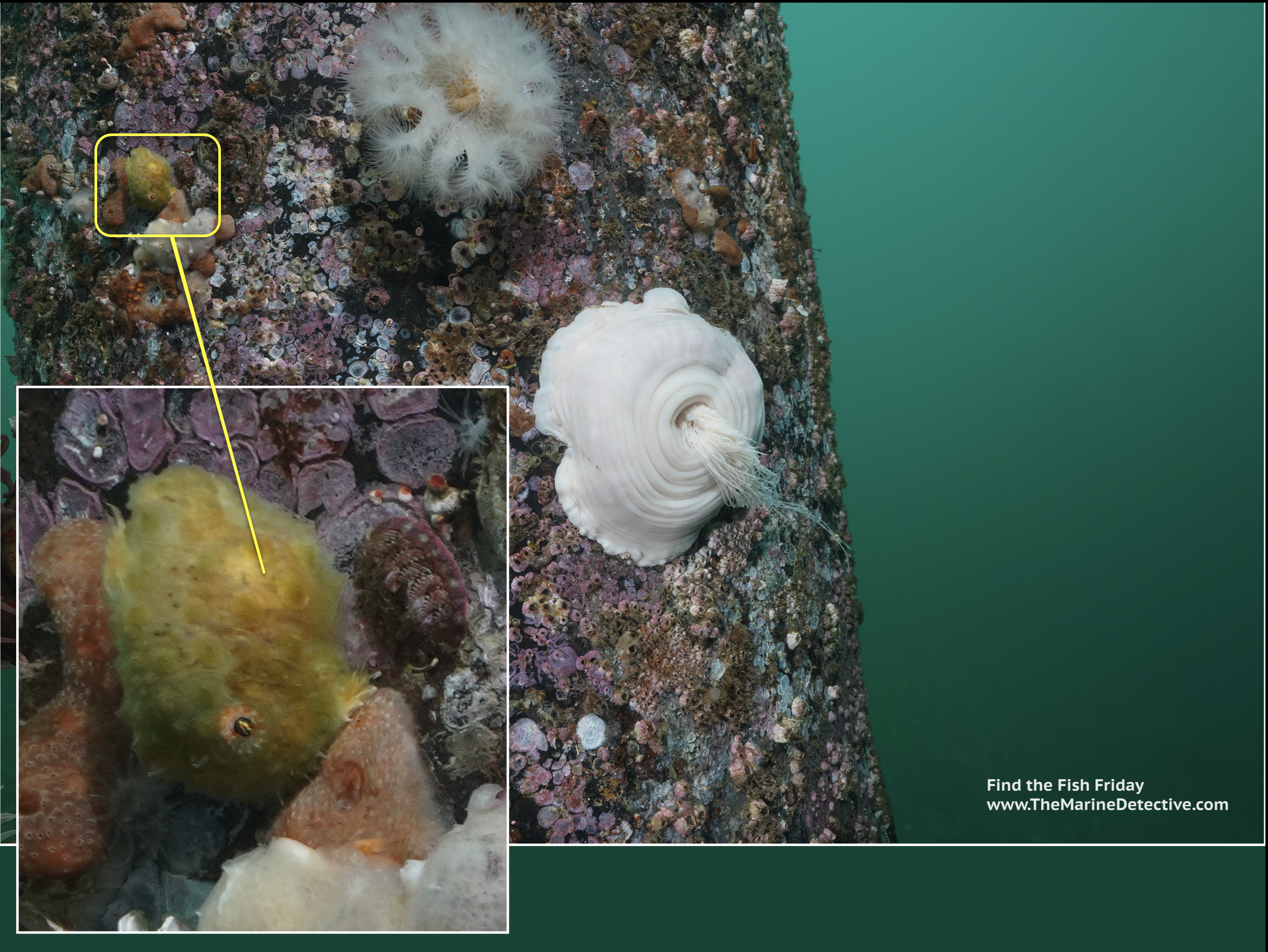
I am including these in the blog so you get as sense of the habitat of Pacific Spiny Lumpsuckers and how well-camouflaged they can be. All photos taken in the traditional Territories of the Kwakwa̱ka̱’wakw (the Kwak̕wala-speaking Peoples).

Took this photo because of the Plumose Anemone ejecting acontia. I did not know the Lumpsucker was there until I reviewed the photo on my computer screen. Acontia? These are defensive strands filled with stinging cells (nematocysts) that are ejected from an anemone’s mouth of through their bodies when irritated / threatened / stressed. These threads extend far beyond the anemone and provide longer distance defence than than the stinging cells in an anemone’s tentacles.

A Fish as Limp as a Rag?

The fish below was found in the mouth of a Lingcod recently and created quite a stir on social media when the photos by Rugged Point Lodge were shared on social media. What species of fish was this?

I did NOT know the ID of this fish but thankfully Andy Lamb shared his knowledge that this was a juvenile Ragfish. One of the remarkable things about this species is that it is really limp, hence RAGfish

Ragfish are Icosteus aenigmaticus and can be 2.13 meter long (7 feet).

From Andy’s “Coastal Fishes of the Pacific Northwest“:
“The Ragfish usually lives in deep water an is termed a bathypelagic species. However, this fish is often found shallower as a juvenile. It’s only an occassional Pacific Northwest visitor, usually during warm weather events . . . A very limp, flappy body supported by a cartilaginous skeleton.”

Andy confirmed that sightings are vrare. Then, another juvenile was sighted thanks to Heather Lord and Nick Felch. This one was live and in the area of Clayoquot Sound.


More about the species from Dr. Milton Love’s “Certainly More Than You Want to Know About the Fishes of the Pacific Coast“:
“Icosteus means “to yield” and “bone” in Greek, referring to the limp body and “aenigmaticus means “puzzling” in Greek. “Ragfish” comes from its Über-limpness 🙂 . . .

Ranges: Okhotsk Sea and Pacific Coast of Honshu to Bering Sea and Gulf of Alaska to Point Loma (Southern California). Larvae have been taken further southwards, off northern most Baja California . . . .

Salient characteristics: Oh so flabby is the ragfish; that’s the character you do wish; but if, by chance, you’re satisfied – not; we’ll tell you other things they have got. The juvies: spotted, scaled, and rounded; have pelvic fins to keep them grounded; adults lack pelvics, spots and scales; are brown and purple, both fems and males.”


With thanks too to Dr. John Ford for relaying the second juvenile Ragfish sighting.

Gunnel, Gunnel, Gone!

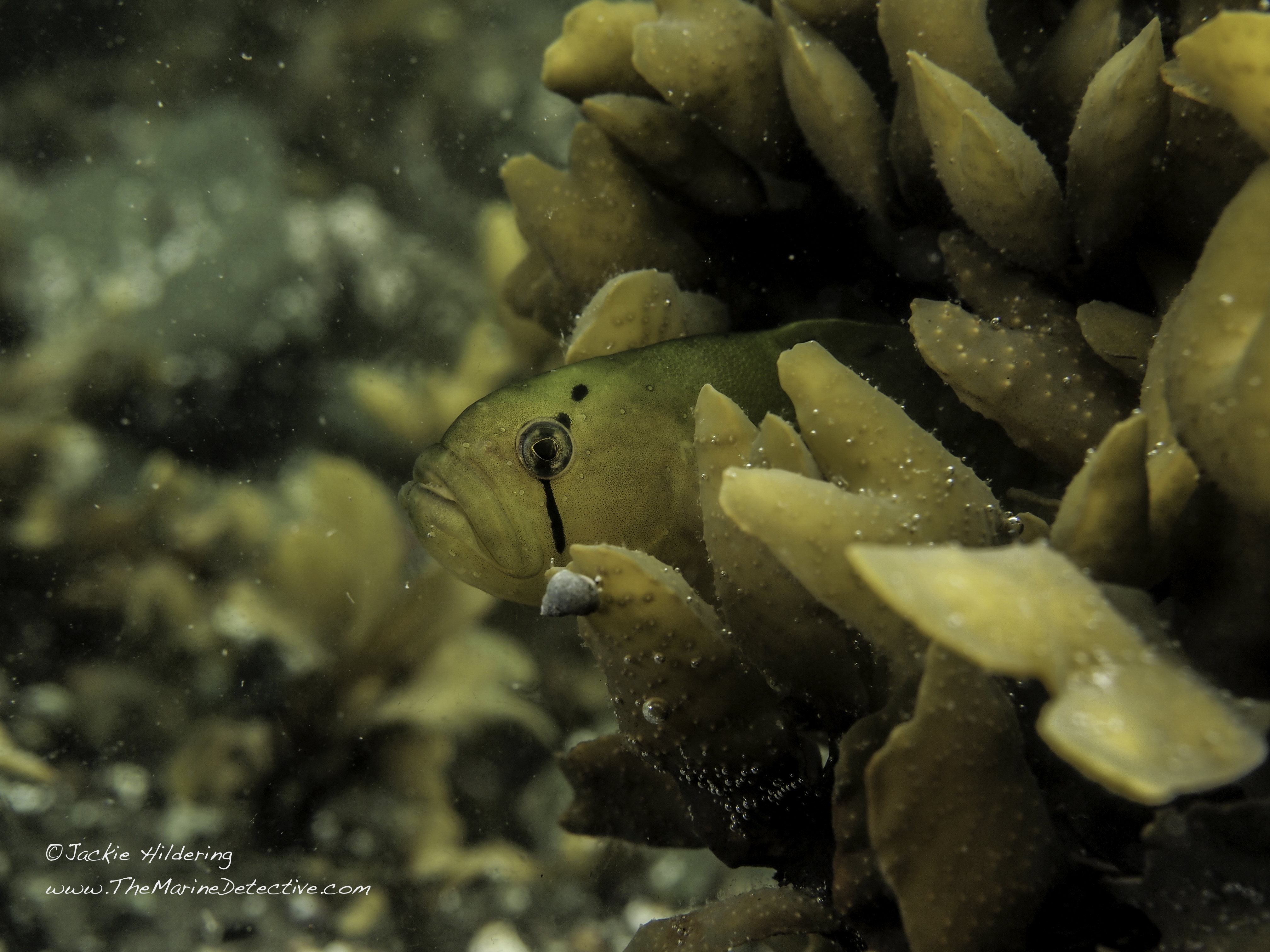
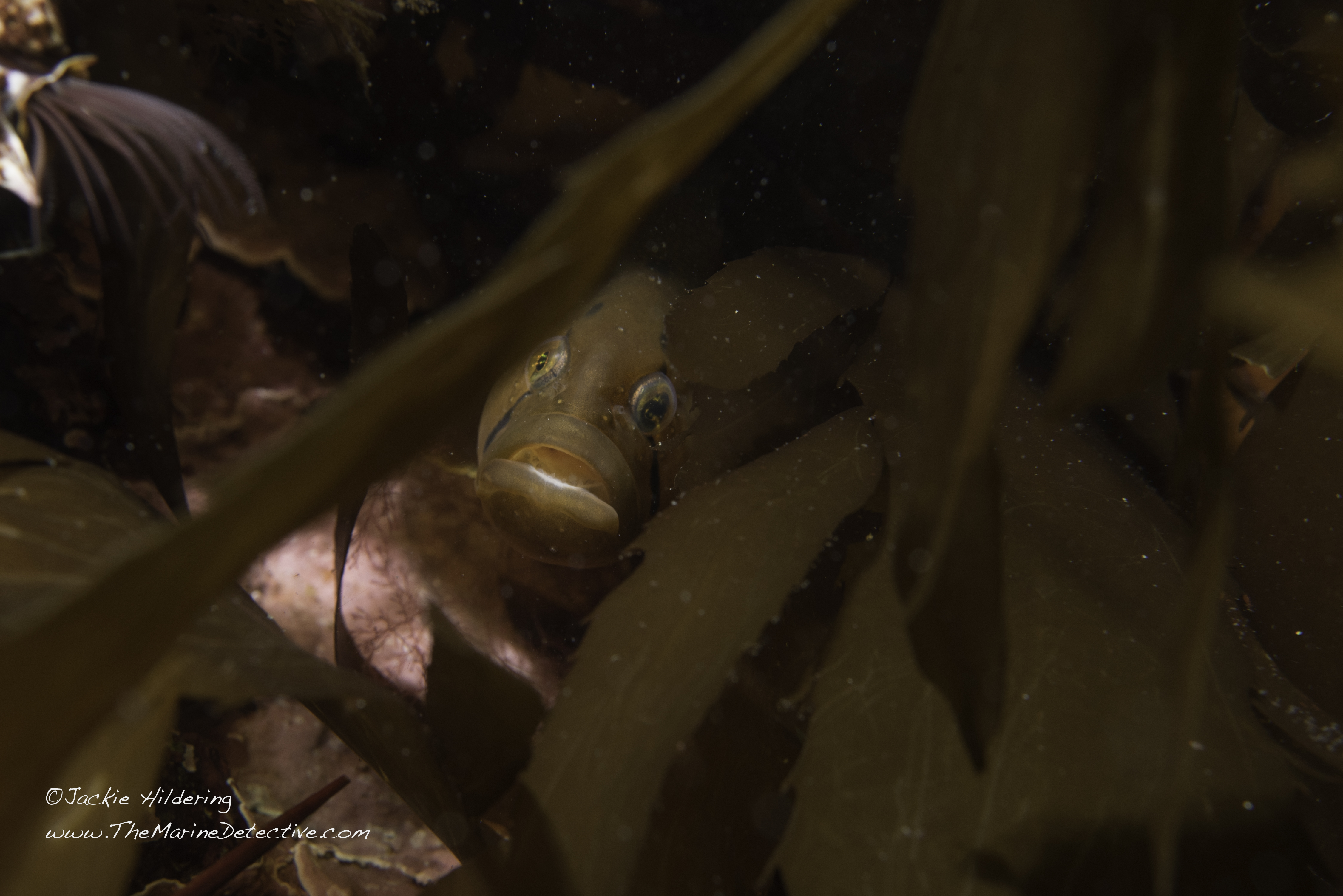
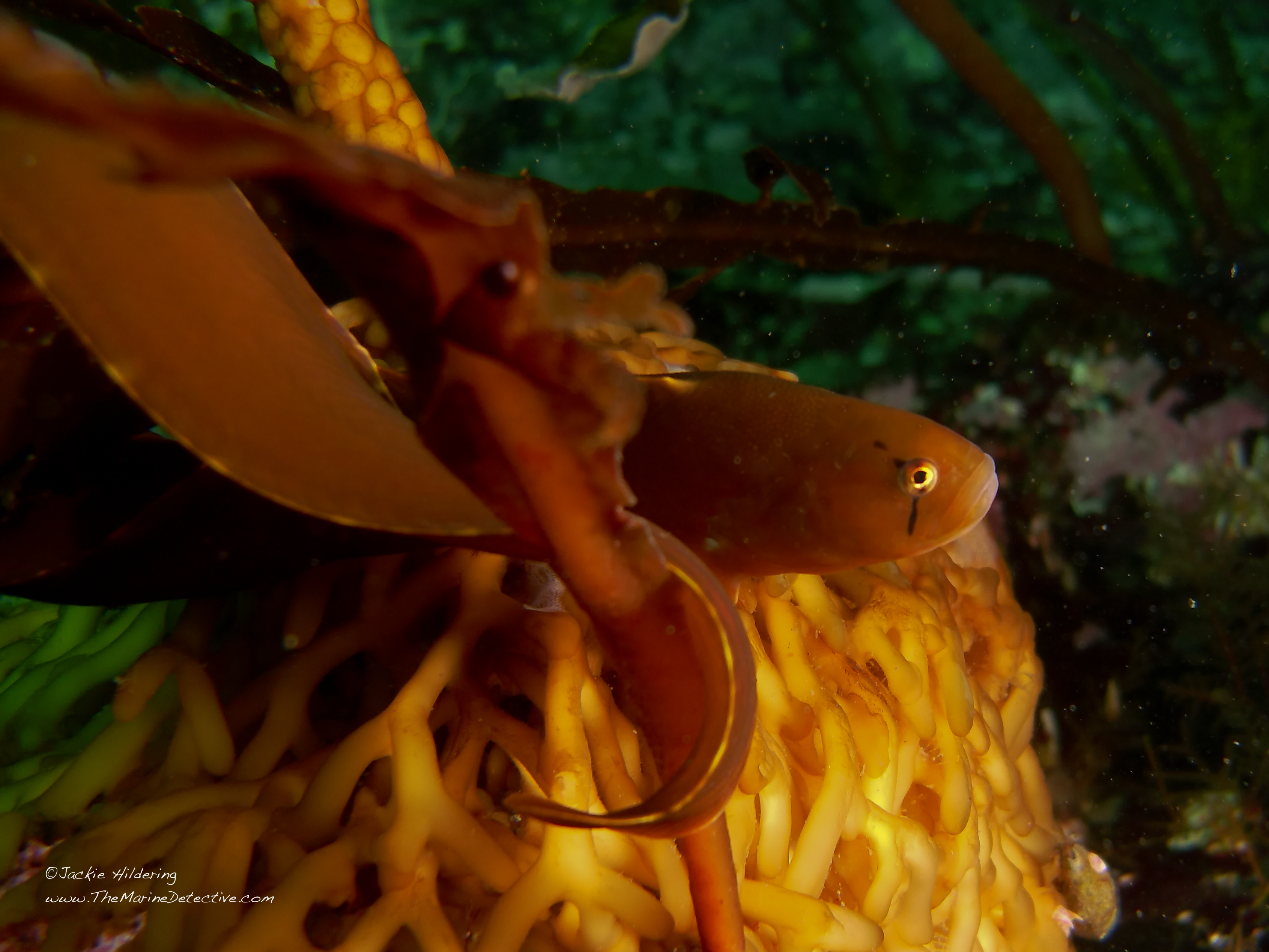
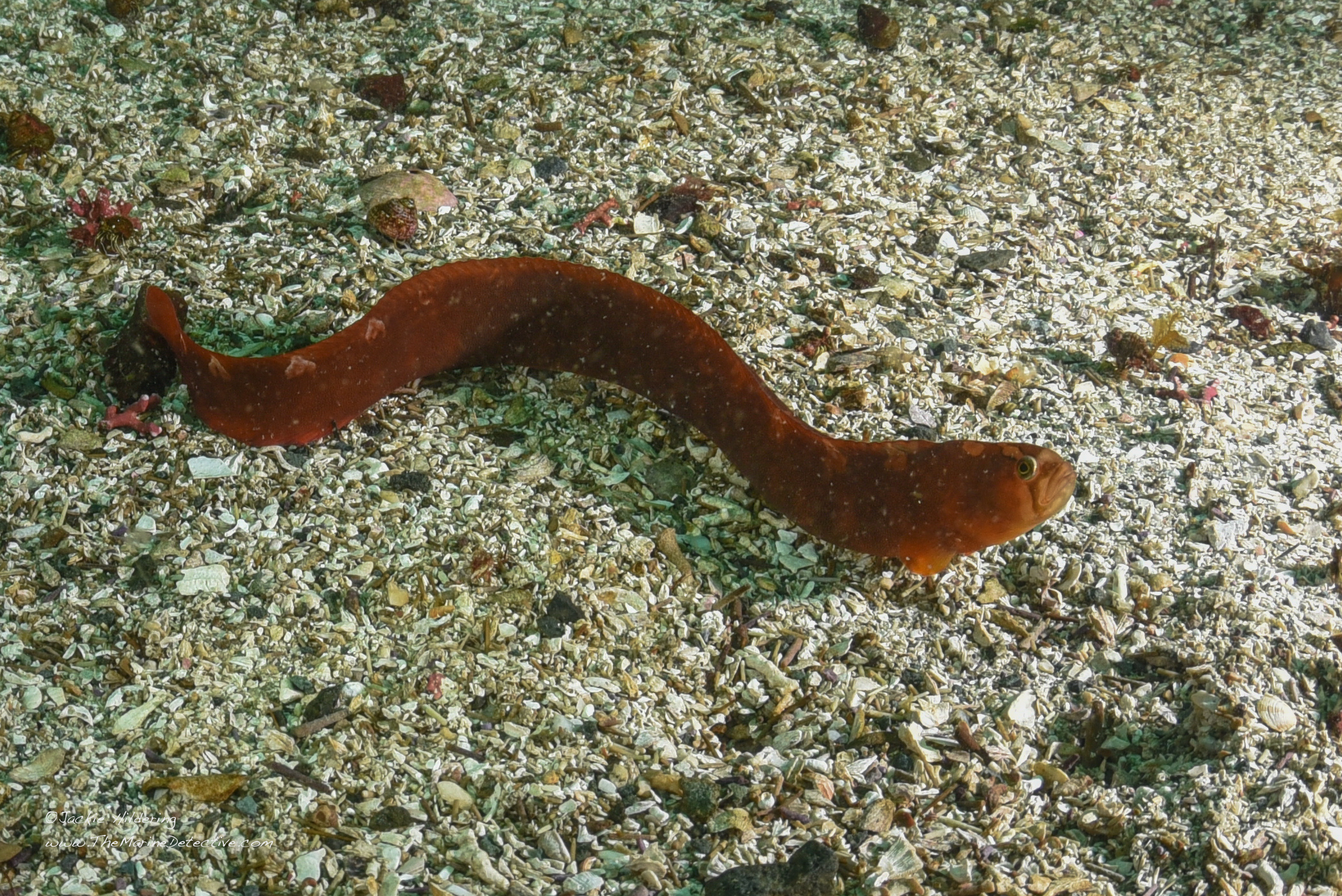
Meet the Penpoint Gunnel, another fabulous fish face and master of camouflage.

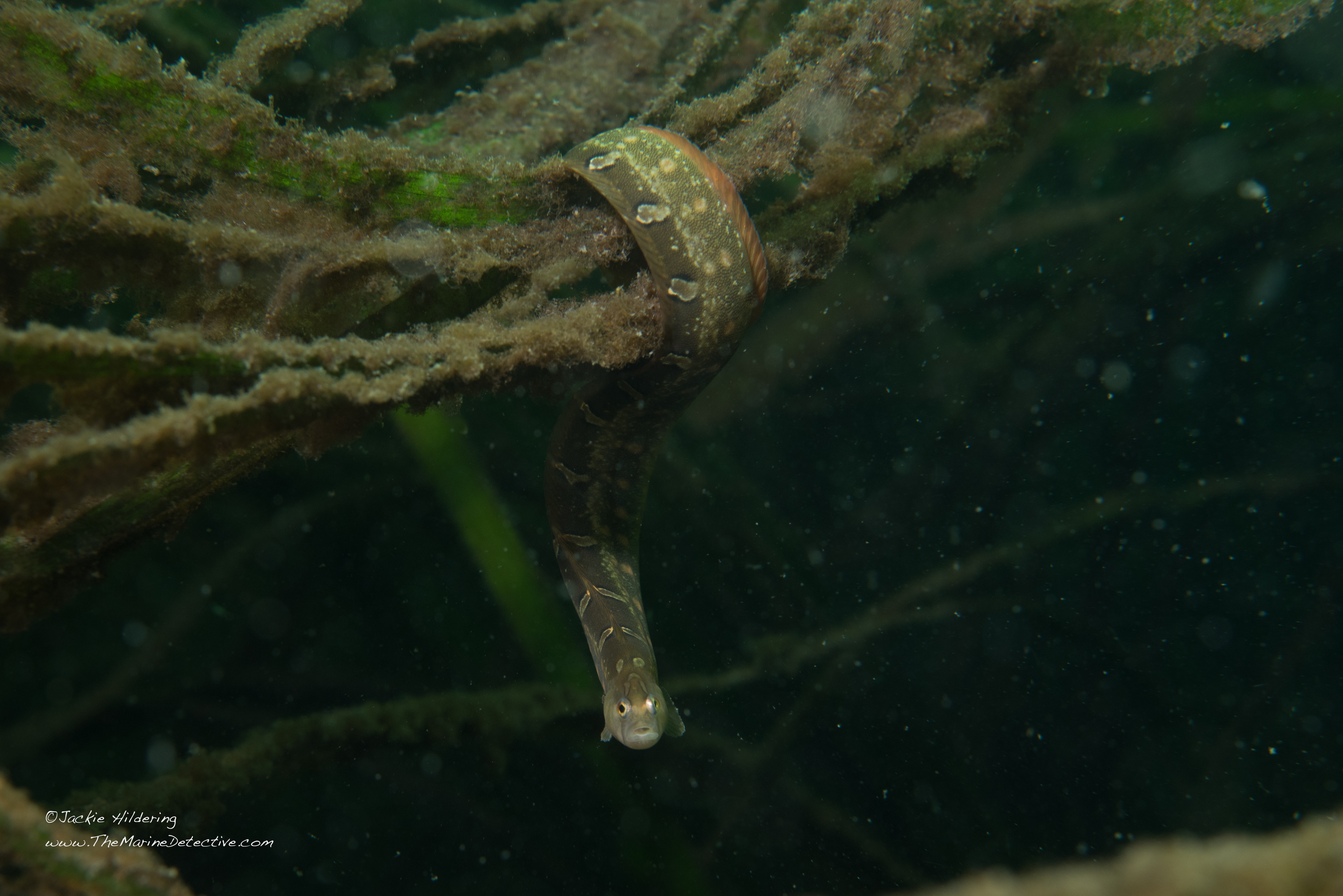
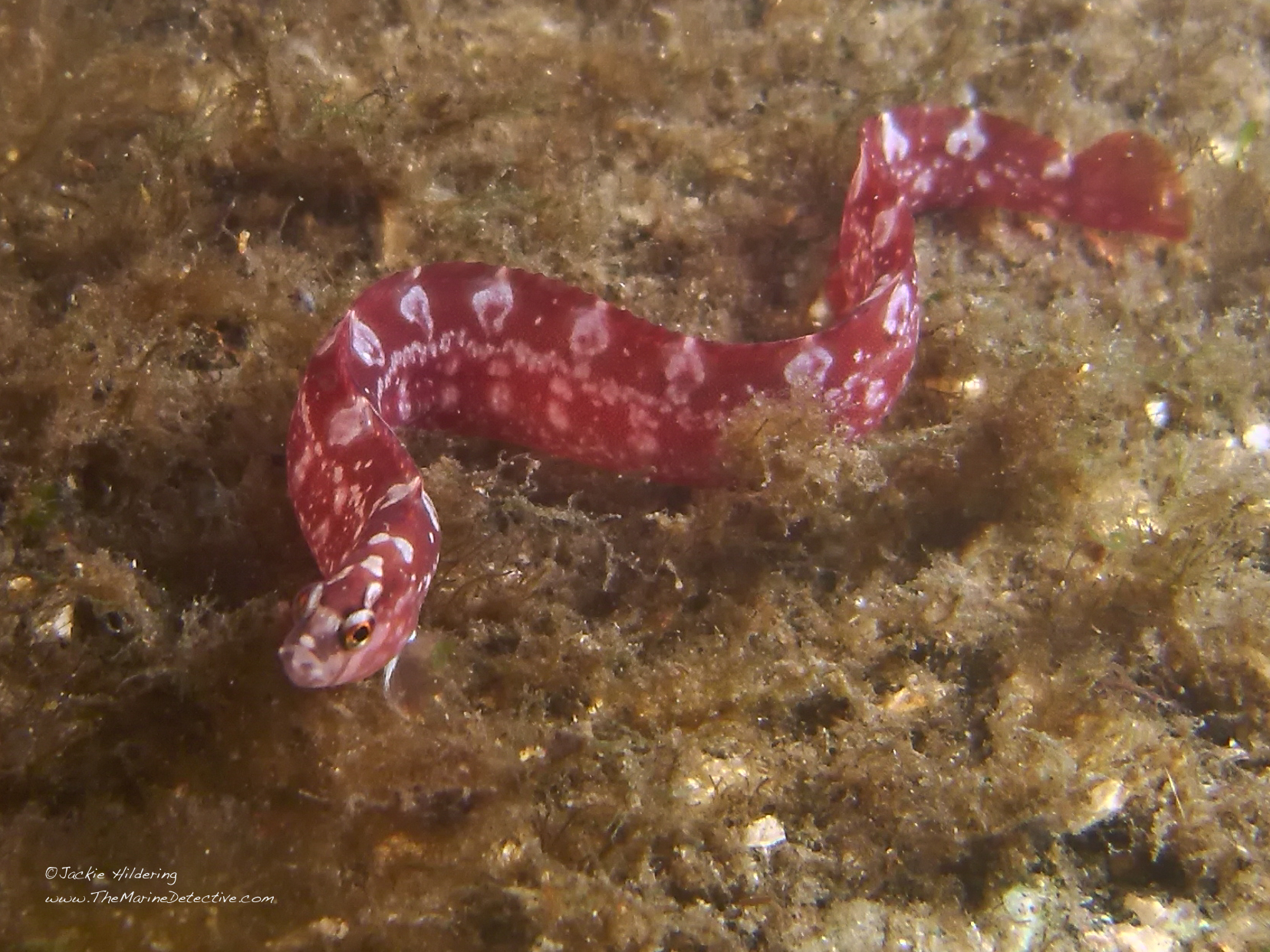
The colour of Penpoint Gunnels varies as much as the colour of seaweed . . . from olive green, to golden brown to red. In fact, the colour of Penpoint Gunnels is generally such a perfect match to their seaweed habitat, that they sometimes seem to disappear into it. Presto – gone!

I recently met the individual in the photo above. We were in the surf zone at about 3 metres depth, the water above our heads crashing against the rocks. One of us was way better adapted to go with the flow. It wasn’t me. Penpoint Gunnel is Apodichthys flavidus to 48 cm long.

There’s a great paper from 1966 by Don Wilkie on the colour of Penpoint Gunnels. An interpretation of the paper by FISHBIO includes: “The coloration of adult penpoint gunnels typically matches the dominant algal community of their habitat. Green individuals are found in the upper intertidal zone where green algae (and eelgrass) is most common, brown specimens most frequently occur in the mid-to-lower intertidal zone where brown algae mainly occurs, and in deeper water where red algae become increasingly prevalent, penpoint gunnels tend to be red as well.”

Here’s a mystery. Penpoint Gunnels CAN’T change their colour to match their surroundings. So how can they have the variety of colour and be so well-matched to their habitat, as is evident in my photos below? Read on!


How can they be such a match to the algae when they cannot change their colour? Is colour determined through the genetics of their parents? Research suggests not! Is it determined by their diet when they are adults? Also no!

It appears that the colour is determined by (1) the vegetation upon which the transparent / colourless larvae settle and/or (2) by which amphipods the larvae eat.

From Wilkie: “Field and laboratory studies were undertaken to examine the ecological role of colouration in the penpoint gunnel Apodichthys flavidus . . . A. flavidus was found to prefer cover under rocks to that within vegetation, but when provided with vegetation alone chose that which it matched. The colour phases observed in A. flavidus were found to be determined directly by the pigments they contained not by differences in stages of chromatophore expansion . . . . Colour change experiments showed that A. flavidus cannot undergo complete changes of colour phase in response to environment alone. Diet has an influence on colour, but complete colour changes were not produced experimentally.

Larvae were reared from the eggs of green and brown individuals. All developed colouration more similar to that of the Artemia [brine shrimp] upon which they were fed than to their parental type . . . It is suggested that the colouration of A. flavidus has a cryptic function which is of importance primarily during food seeking. It is hypothesized that the vegetation upon which A. flavidus larvae settle in conjunction with early diet primarily determines the colouration of individuals.

So, while Penpoint Gunnels cannot change colour, they appear to be able to recognize and select the vegetation for which their colour is a good match. What this also suggests is that the depth where an individual started of his/her life as a larva, will be the depth where they would/should live out their life.

As described above, because of the limits of how deep wavelengths of light can travel, there are zones of seaweeds / algae. Green seaweeds are in the shallows, then there are brown seaweeds, and then red seaweeds are the deepest (their pigment can best absorb the blue-green light that can penetrate to greater depths). If a Penpoint Gunnel started off as a larvae feeding on amphipods that are well-matched to green seaweed, the research supports this is what would make them green coloured. If that individual moved deeper into the brown or red zone, they would not have the appropriately coloured seaweed to match their colour.

ID Challenges

It can be wonderfully difficult to discern Penpoint Gunnels from the other gunnel species off the coast of British Columbia (6 species total).

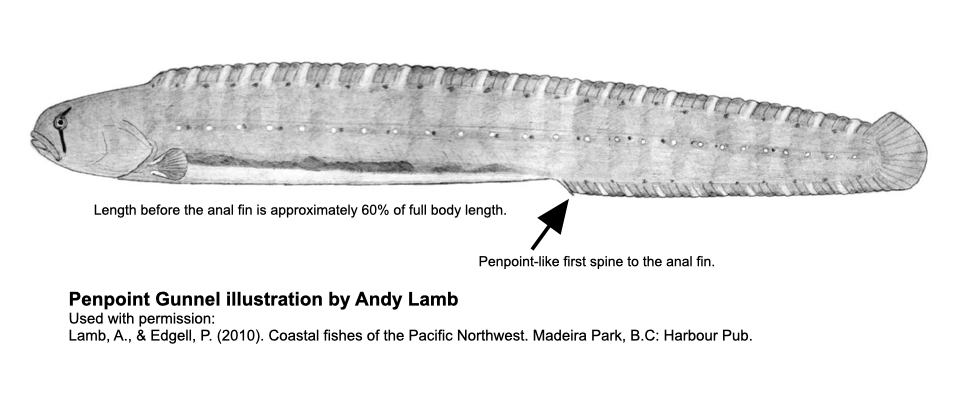
If you get a really good look at the back end of a Penpoint Gunnel, that really helps in IDIng the species. The “penpoint” refers to the first spine of the anal fin. It’s large and grooved like a fountain pen point. Yes, I know that most often that ID tip is not really going to help with a live individual. 🙂

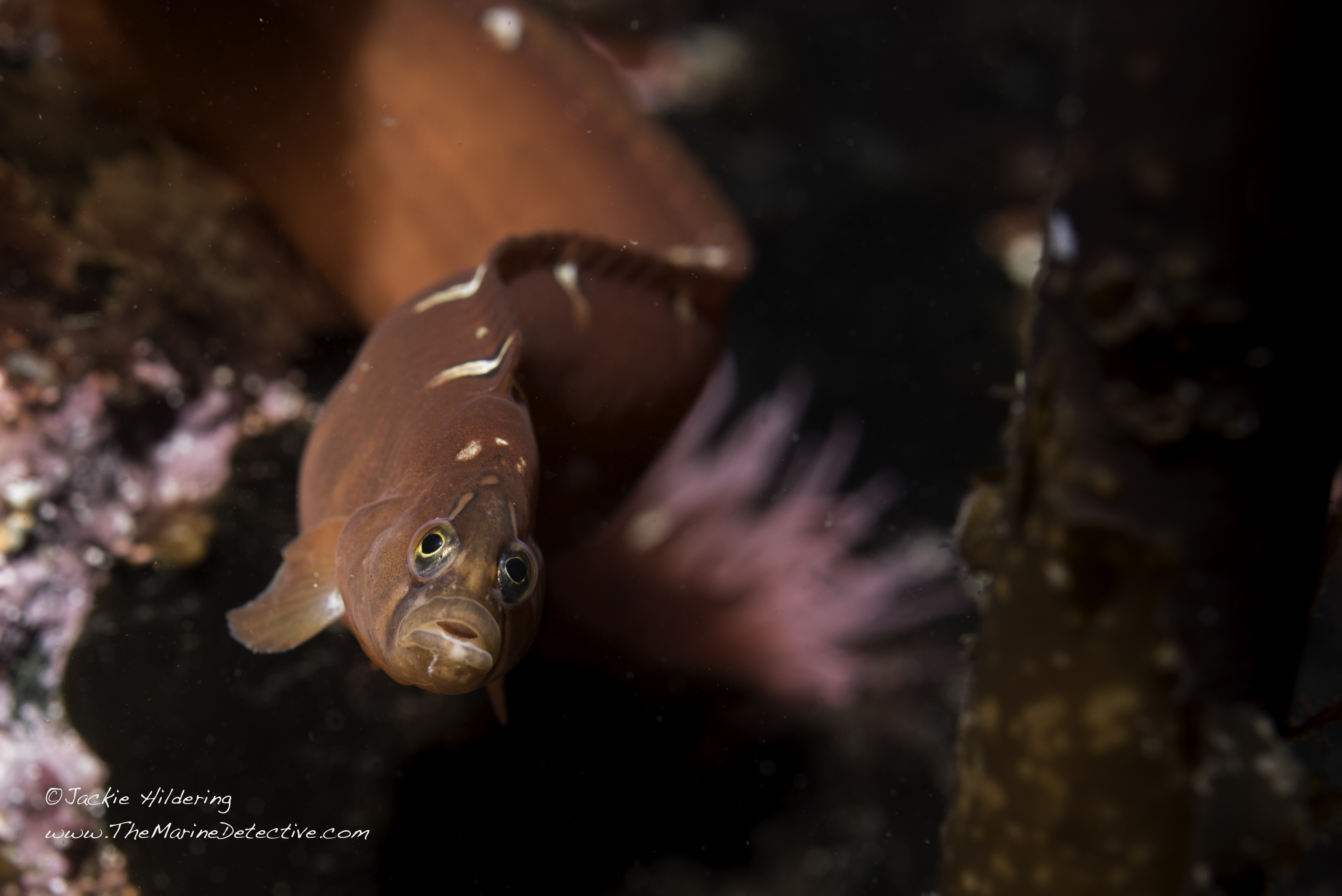
I find it the most difficult to discern Penpoint Gunnels from Crescent Gunnels (Pholis laeta to 25 cm) and Saddleback Gunnels (Pholis ornata and 30 cm). Those species also have a wide variety in colour and have the black bar by their eye and, Penpoint Gunnels also can have markings along their backs. I don’t believe it is known how their colour of Crescent and Saddleback Gunnels is determined.

Then there are also Rockweed Gunnels, Longfin Gunnels, and Red Gunnels off the coast of British Columbia. Oh, and there are other elongate fish found in similar habitats, like species of prickleback and cockscomb!

The next six photos are included to maybe help with IDing gunnels. They are all NOT Penpoint Gunnels.

Then, at the end of the blog, there’s a fun fishing finding venture for you.

Who goes there? I initially had this individual identified as a Penpoint Gunnel but was thankfully corrected by Andy Lamb. He pointed out that this is either a Crescent or Saddleback Gunnel because there are pale bands adjacent to the dark ones through the eyes.
Crescent Gunnel – common name is for the crescent-like markings along the back.
Another Crescent Gunnel. You can see the crescent-like markings better with this perspective.
Ths is another Crescent Gunnel and here you can see that there are very tiny pelvic fins in front of the pectoral fins (that little bump). Penpoint Gunnels do not have those.
This is NOT a Crescent Gunnel. Andy Lamb let me know this is a Saddleback Gunnel because Saddleback Gunnels have darker stretches between the markings along their backs and because these markings are more saddle-shaped than crescent-shaped. Sure, that should help! You say saddle. I say crescent!
Er sorry – things are even more fun. This is not a Penpoint Gunnel, nor Saddleback Gunnel, nor Crescent Gunnel. It’s a Longfin Gunnel (Pholis clemensi to 13 cm long). How to know when colour and the markings along the back are similar to other species? There are those little dots along the midline of the fish. Yes, it’s often a combination of features that help determine the ID.

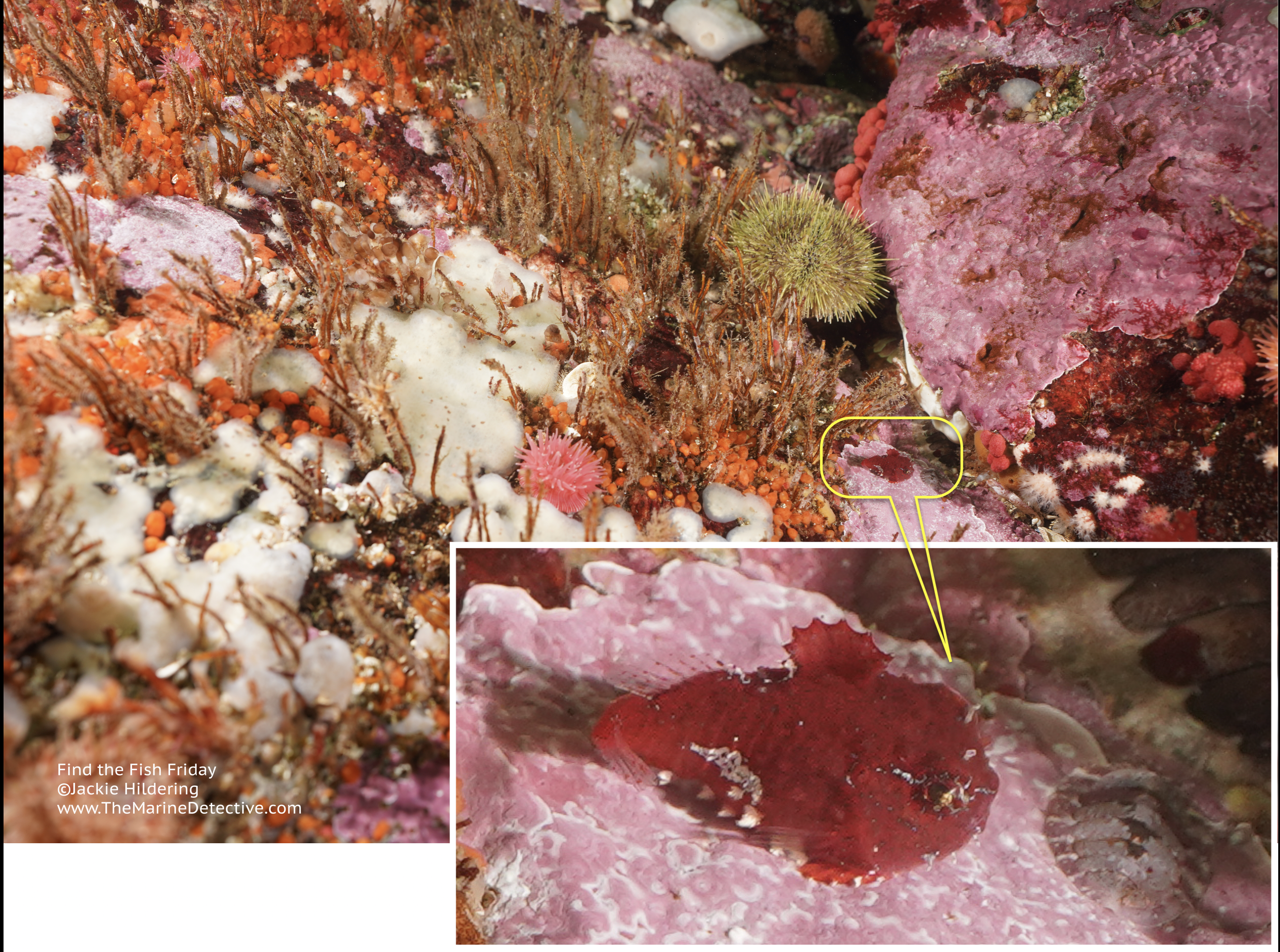
Find the Fish!

Many of you may know that every Friday I do a “Find the Fish Friday’ challenge and have two children’s books by the same name. These are the “Where’s Waldo” of the fish world with the intent being that, when people search for the fish in my images, they are also absorbing what the life looks like in the dark, rich Northeast Pacific Ocean.

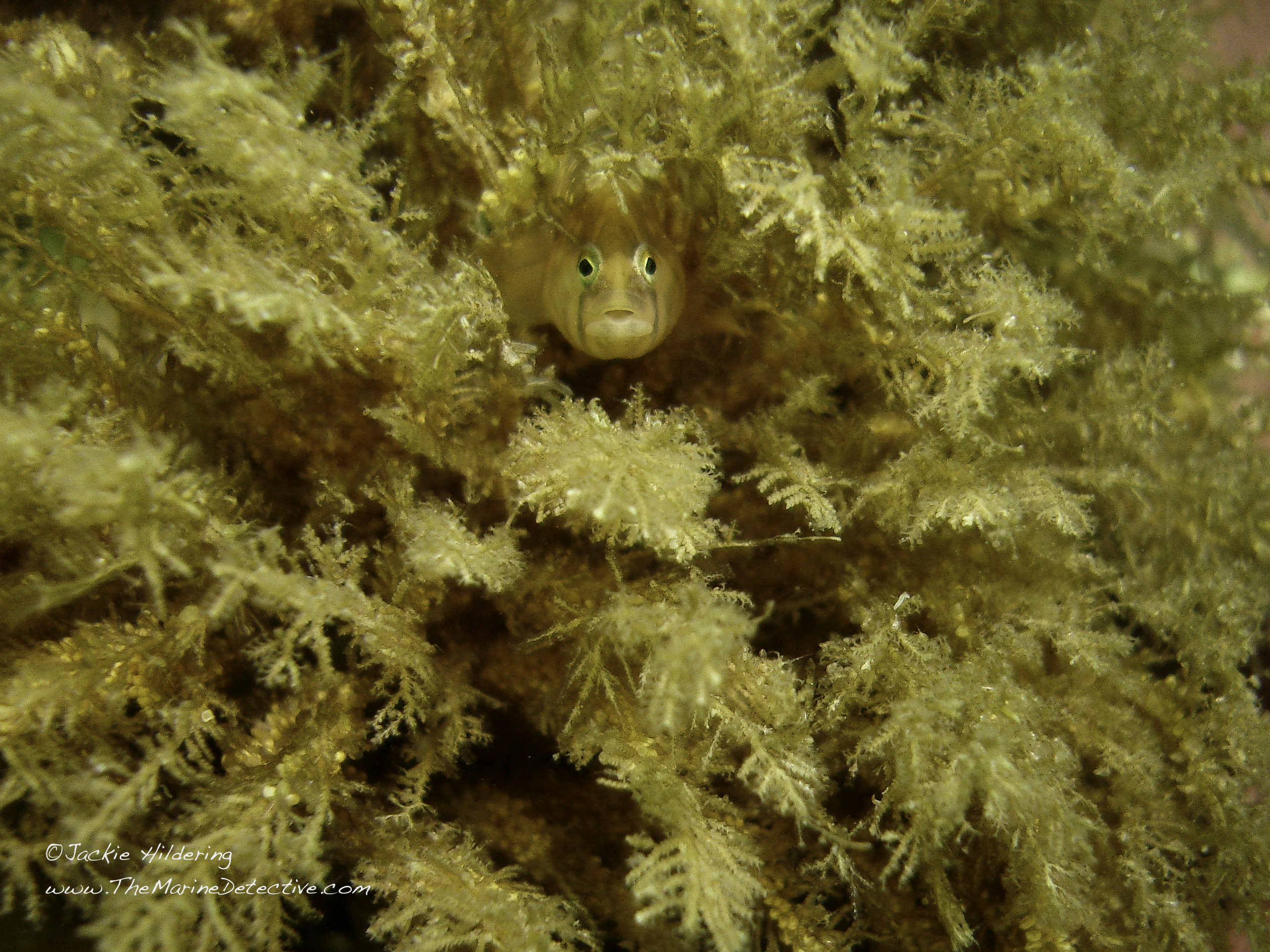

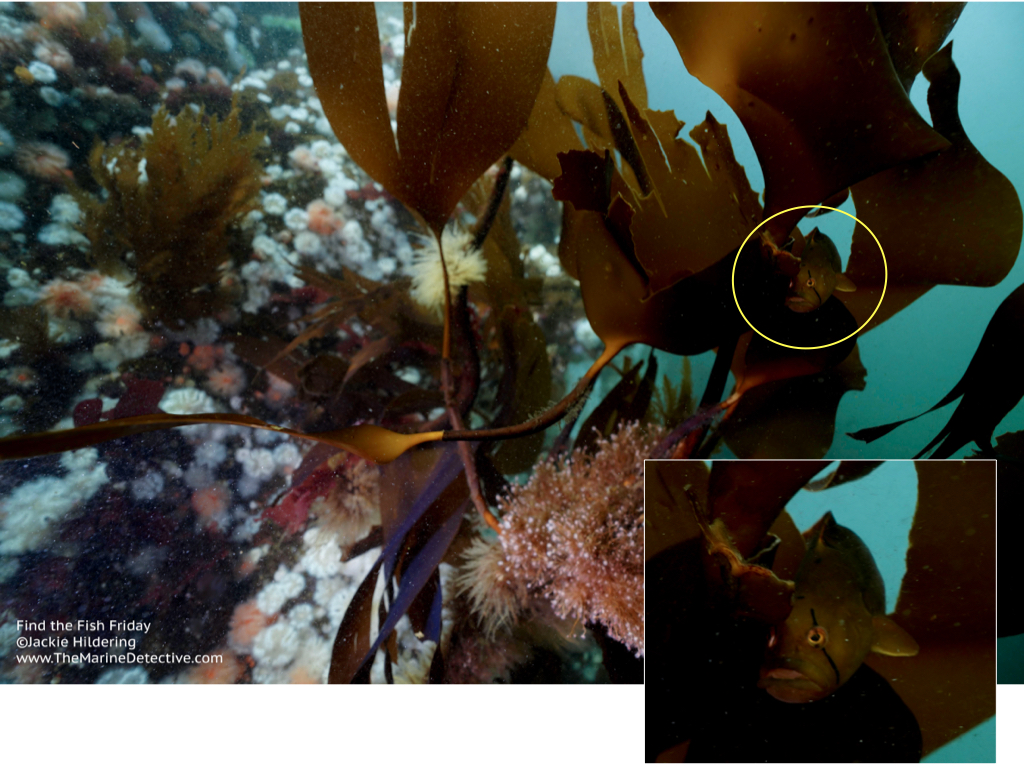
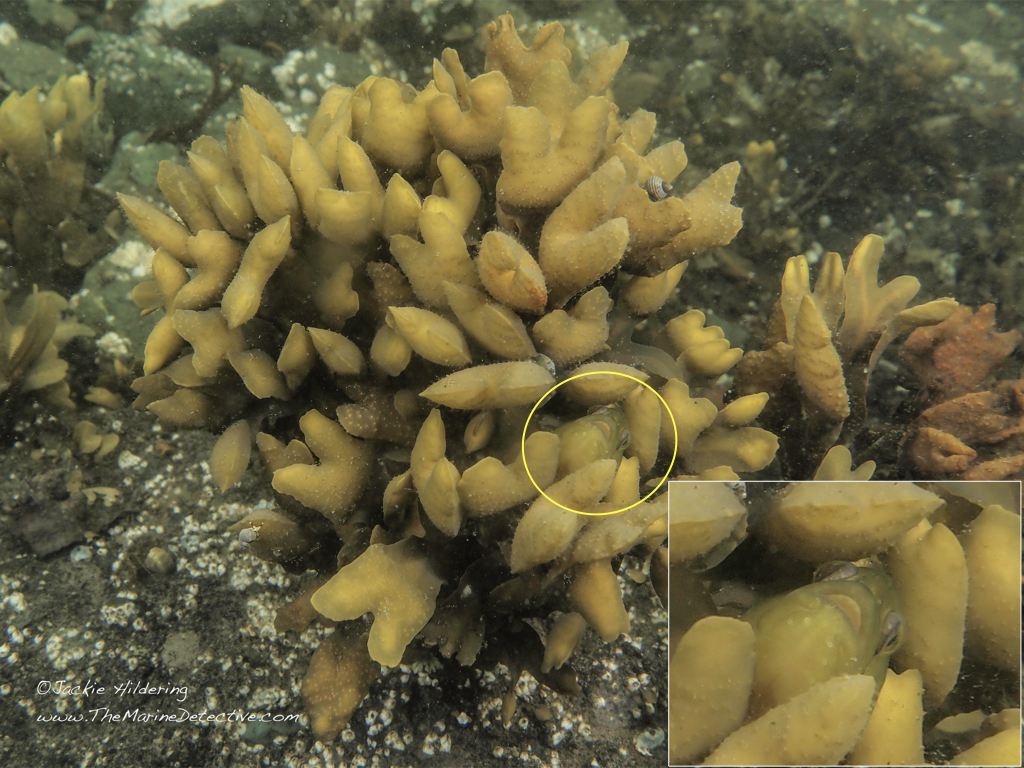
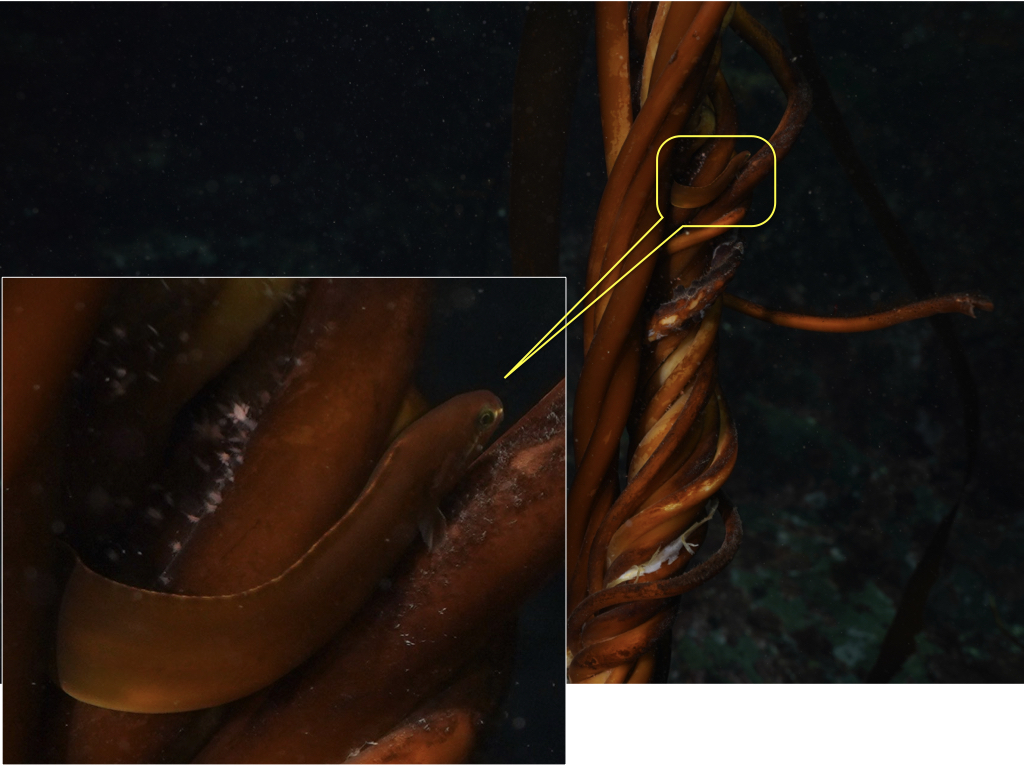
Below are three such challenges where there is one fish to be found in each photo and it is a Penpoint Gunnel. At the very end of the blog I reveal the location of the fishes. Enjoy!


Summary for Penpoint Gunnels

Species information from “Certainly More Than You Want to Know About the Pacific Coast” by Dr. Milton Love includes:

Maximum length to 46 cm. The Ranges: Kodiak Island to Santa Barbara and Gaviota (Southern California). They are abundant from at least Prince William Sound (northern Gulf of Alaska) to Central California. Intertidal to 8, including tide pools. Most fish live int he intertidal or barely subtidal . . .

Penpints are long, thin, and eel-like, distinguished by a deeply grooved spine on the front of the anal fin (hence the name “penpoint”), a line extending downward through the eyes, and no pelvic fins. The body colour is highly variable: orange, red, and magenta, bright green, olive, or bronze. While usually a solid colour, the body can be highly mottled, with a row of dark or light spots along the midline . . .”


Answers to the three Find the Fish challenges above

This was the very same fish as in the first photo in this blog. I photographed him/her in April 2021 in Browning Pass.
This little guy/gal was in only about 2 metres depth beside a boat ramp in Port Hardy. This is one of the challenges included in my first Find the Fish book.


Sources

Crabs Making Bad Choices

How do crabs make bad choices?

Let me show you via my photos and a “conversation” with the crab in the next three photos.

Oh hello mature male Sharpnose Crab. I almost didn’t see you there!

Please may I take a photo of how you have fabulously decorated yourself to camouflage against predators, using bits of algae, sponges, tunicates and hydroids?

It’s fascinating how your species, and others who decorate themselves, have little hooks (setae) on your exoskeleton to which attach life from around you AND that you change outfits when your change backgrounds. Do you sometimes also use the camouflage as easy-to-reach snacks?

Oh, oh! Wait!

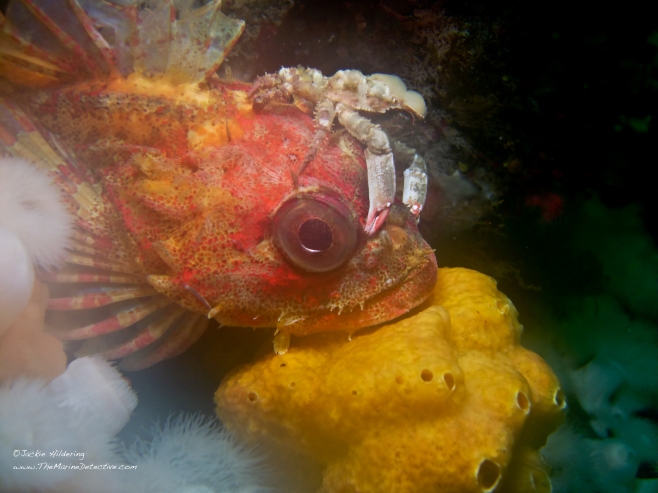
You don’t know you are walking onto the head of a Red Irish Lord, an ambush hunter who is extraordinarily camouflaged too.

Careful! You are on the menu for this fish species.

The Red Irish Lord will try to grab you, ideally from the back of your shell. That’s what happened to the crab in the next two photos.

Indeed, that’s the same species of fish. Red Irish Lords have incredible diversity in colour to blend in so that you, and I, have great difficulty detecting them.

When the fish does not have the advantage of a sneak attack, you can defend yourself by spreading out your claws really wide. Like what you see below.

Then, it’s difficult for the Red Irish Lord to fit you into his / her mouth.

Yes, I too imagine the Sharpnose Crab in the above two photos saying, “You want a piece of me?!”

It’s said of your species that you “put little effort into decoration”. Such judgement!

In another species, the Moss Crab (Loxorhynchus crispatus), a correlation has been found between size and how much decoration there is. Once big, especially with claws spread wide, mature crabs cannot easily be gulped up whereby there may be less need for camouflage. Mature males are up to 12.3 cm across the carapace/shell and mature females are up to 7.9 cm across the carapace.

For your species, the Sharpnose Crab (Scyra acutifrons) there can be a HUGE difference in pincher size between mature males and females.  Size across the carapace can be up to 4.5 cm but mature males have a far greater reach with their claws than mature females.

By the way what’s with the posturing with mature males of your kind when they do what is shown in the photo below?

Yours is NOT the only crab species that can be gulped up. I think it might be a Graceful Kelp Crab who has been engulfed by the Red Irish Lord below.

Below is another crab in danger of making a fatal choice as it advances down the face of the Red Irish Lord. See how precarious this is? The fish will remain motionless, waiting, waiting till you are in the ideal position to ambushed from behind. Then your claws are of little use to you.


There you go dear human readers.

I do not know the fate of either of the crabs on the heads of the Red Irish Lords. I had to return to the world where we humans can also make really bad choices.

Why no, my referencing human bad choices on November 4th 2020 is purely coincidental. Insert innocent eye batting here. What choices could I POSSIBLY be referencing? ☺️

Be kind. Be colourful. Be careful. Be truthful. Be safe.  💙

Regarding the photo above, see the Red Irish Lord and the two crabs with outstretched claws?


Related TMD Blogs:


Sources: 

Drake, Catherine Anne, “Decorating Behavior and Decoration Preference in the Masking Crab, Loxorhynchus Crispatus” (2016). Capstone Projects and Master’s Theses. 74.

Jensen, Gregory. (2014). Crabs and Shrimps of the Pacific Coast: A guide to shallow-water decapods from southeastern Alaska to the Mexican border.

Wicksten, M. (1978). Attachment of Decorating Materials in Loxorhynchus crispatus (Brachyura: Majidae)Transactions of the American Microscopical Society, 97(2), 217-220. doi:10.2307/3225595