Join me in the cold, dark, life-sustaining NE Pacific Ocean to discover the great beauty, mystery and fragility hidden there.

Posts from the ‘FISH – NE Pacific Ocean’ category

Sharks Among Us #3 – Meet the gang – From Rat Fish to Sixgills! (Video)

Great thanks to Rendezvous Dive Adventures for sharing this video with me! 

It’s a fantastic (7.5 minute) interview with Dr. Chris Harvey-Clark of the University of British Columbia and the Greenland Shark and Elasmobranch Education and Research Group (GEERG).

He discusses the shark species found in our cold-rich waters in the Pacific Northwest: “We have some of the largest species of sharks in the world swimming in these waters”.

Great video of sharks and I particularly appreciated Dr. Harvey-Clark’s explanation of the ecological link between rat fish and bluntnose sixgill sharks and, related to this, the latest research on the “ocean wanderings” of sixgills. 

I learned too about the Shark Observation Network where divers’ observations can help research. 

Basking in History – The Story of B.C.’s Basking Sharks

Last updated: August 5, 2024
If you ever see a Basking Shark in British Columbia: call 1-877-50-SHARK (1-877-507-4275), or email sharks@dfo-mpo.gc.ca, or fill in the reporting form at this link. Please see info below about how to identify a Basking Shark.  

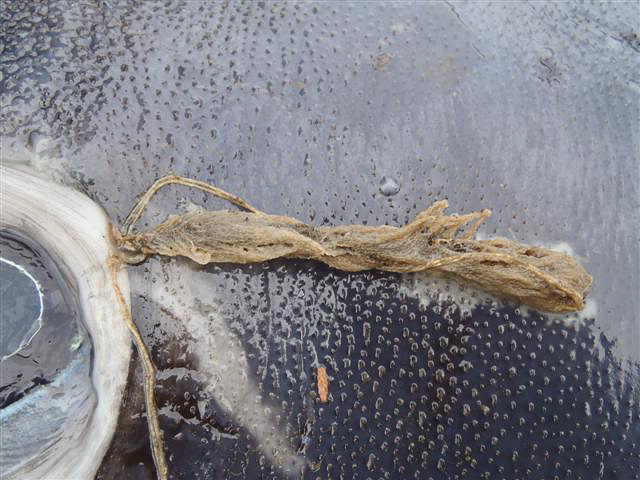
Photo by Chris Gotschalk
(Wikimedia Commons)

It’s a first. Canada has now (2011) acknowledged the endangerment of a marine fish species – the Basking Shark (Cetorhinus maxiumus). 

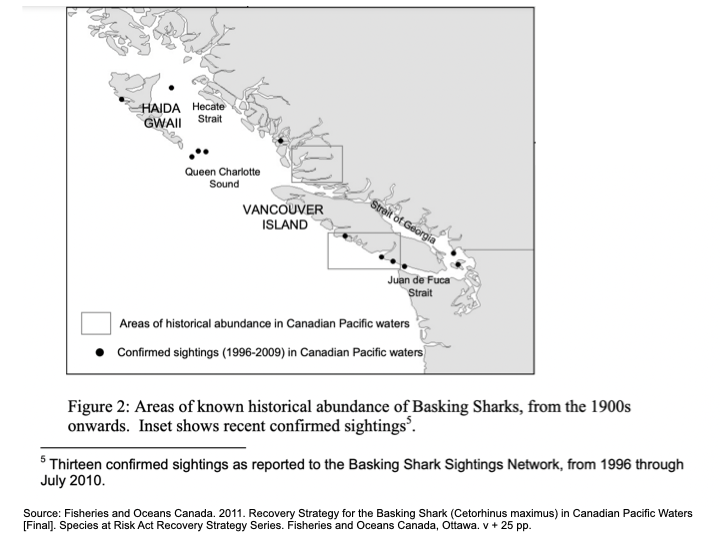
Basking Sharks used to be common in the coastal waters of British Columbia.  As the second largest fish species in the world, they could be half the size of a city bus (12 m and 4 tonnes) and could be seen at the surface of the ocean, “basking” there to feed on plankton. It’s a long-lived species too, believed to be able to reach 50 years of age.

However, even the most seafaring fisher is now unlikely to ever see one off the B.C. coast. There have been less than 25 sightings of Basking Sharks since 1996. So what happened?

We slaughtered them.

These sharks were put on the Canadian fisheries “Destructive Pests” list in 1949, and from 1955 to 1969 there was a federal eradication program directed at these benign, plankton-eating giants. In these years, the federal fisheries patrol vessel, the Comox Post, even had a blade mounted on its bow, designed specifically to slice Basking Sharks in half.

This species of shark has only the tiniest of teeth and does not compete for a commercial fishery like the sea lions, seals and Killer Whales that were also culled in that time period. The motivation for the “pest control” of these gentle giants was that they got trapped in gill nets, causing damage to fishing gear.

Who we used to be. Blade on the front of the Comox Post. Source: Popular Mechanics 1956.

As an indicator of how far we have come since then, imagine the social outrage today if a magazine celebrated the ingenuity of the Comox Post’s blade, illustrating how the executioner’s tool was used accompanied by the text “Huge 30-foot basking shark is almost cut in two by sharp-edged ram. The sharks, floating lazily near the surface of the water, are no match for this skillfully handled vessel, which heads directly into a school and catches an individual shark before it is aware of its plight”.  November 1956’s edition of Popular Mechanics featured just that and the June 22,1955 front page of the Victoria Times included a photo with the text “This is a basking shark, basking and leering. But the smirk will soon be wiped off its ugly face by the fisheries department, which is cutting numerous sharks down to size” (from The Slaughter of B.C.’s Gentle Giants by Scott Wallace and Brian Gisborne).

Further: “After the initial flurry of press commentary on the shark blade in 1955 and 1956, the Comox Post went about its daily job, firing bullets into the occasional sea lion, seal, or merganser and slicing sharks when seasonally abundant. At the end of each fishing season an annual report was written, and over the years the entries for basking sharks appear to diminish. The blade was used over a period of 14 years in the Barkley Sound region, during which time 413 kills were recorded.” In 1956 alone, 105 Basking Sharks were reported to have been killed.”

Basking Sharks survived as a species for at least 30 million years but have been pushed to the brink extinction in B.C. by just a couple of decades of human intolerance, misunderstanding and mismanagement.

But as a testament to how quickly human social evolution can occur, we have gone from being executioners to acknowledging the species’ endangerment in just over 40 years.  In February 2010, the Pacific population received legal protection by being listed as “endangered” under Canada’s Species at Risk Act. The Recovery Strategy was finalized at the end of July, 2011. 

Only history will tell if our evolved enlightenment is enough or if it came too late for the Basking Shark and many other marine species. The fact that you care enough to read this blog item is every reason for hope.

Above: Basking Shark sighting July 17, 2024 near East Sooke by Island Magic Experiences.


Above: Basking Shark sighting July 17,2017 in Caamano Sound, BC. Video by Archie Dundas of the GitGa’at Guardians via Fisheries and Oceans Canada.


Presentation about Basking Sharks by yours truly and Romney McPhie of Fisheries and Oceans Canada for Ocean Day 2022.

Click here for this annotated Basking Shark colouring sheet by Romney McPhie who is not only a shark scientist but clearly also an artist (and very skilled educator)!

Sources:

Fisheries and Oceans Canada. 2011. Recovery Strategy for the Basking Shark (Cetorhinus maximus) in Canadian Pacific Waters [Final]. Species at Risk Act Recovery Strategy Series. Fisheries and Oceans Canada, Ottawa. v + 25 pp.

Fisheries and Oceans Canada. 2019. Action Plan for the Basking Shark (Cetorhinus maximus) in Canadian Pacific waters [Proposed]. Species at Risk Act Action Plan Series. Fisheries and Oceans Canada, Ottawa. iii + 16 pp.

Species at Risk Act (SARA) Species Profile 

The Tyee, December 7, 2016, How BC Killed All the Sharks – Hysteria and a knifelik ram helped us slaughter the benign basking giants by Scott Wallace and Brian Gisborne

Wallace, Scott, and Brian Gisborne. 2006. Basking sharks: the slaughter of BC’s gentle giants. Vancouver: New Star Books.


Basking distribution.001

In the Eye of the Lord (the Red Irish Lord that is!)

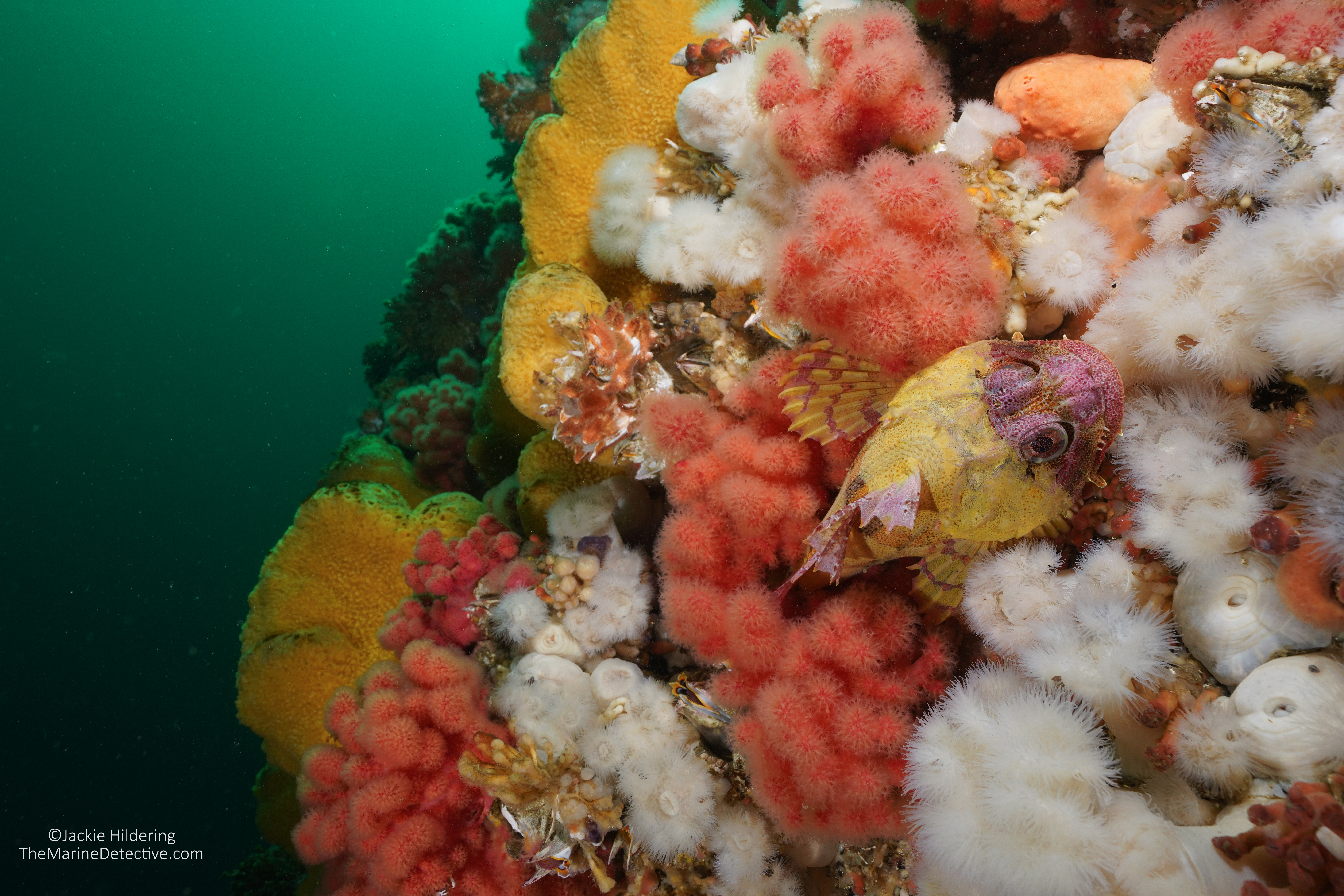
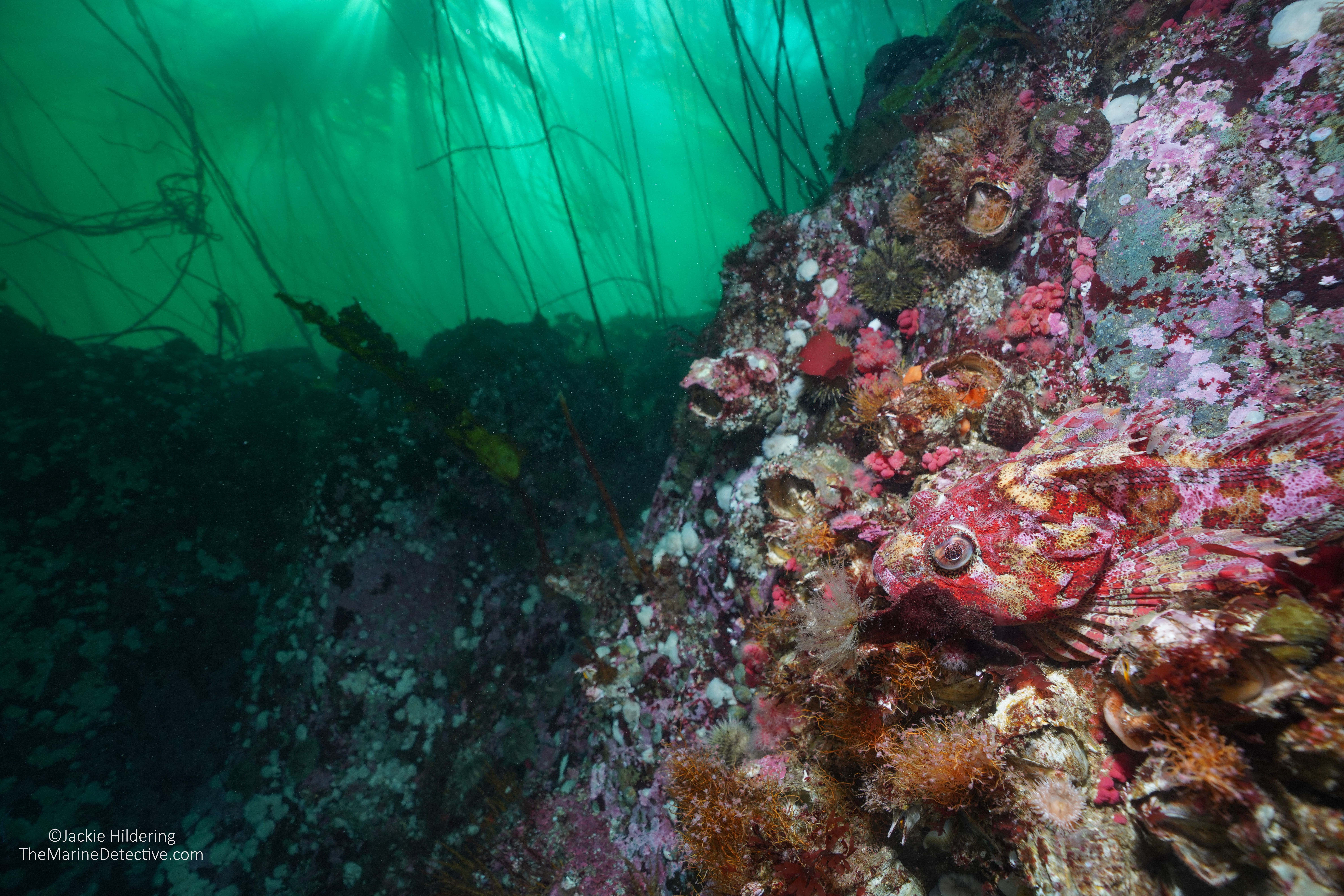
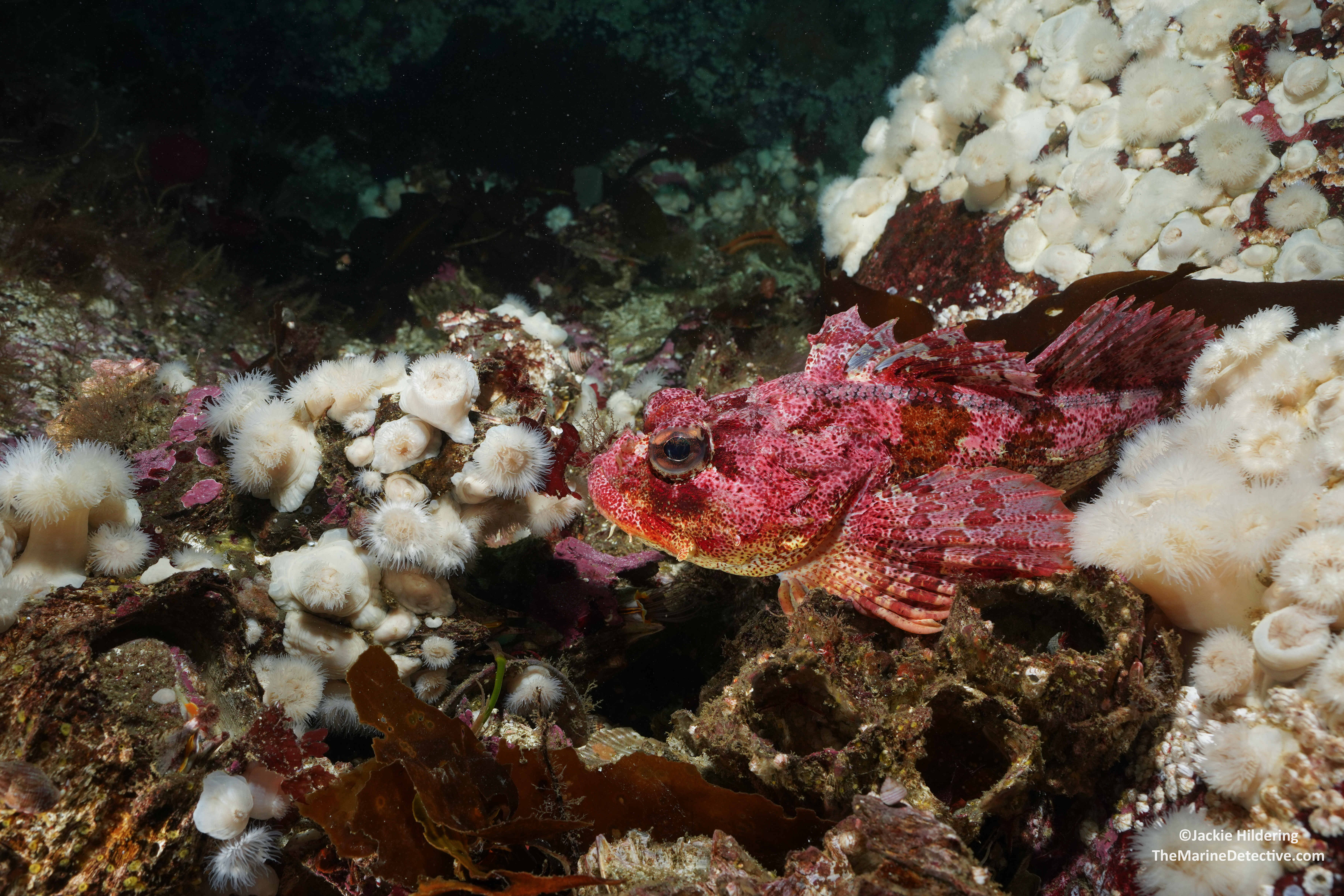
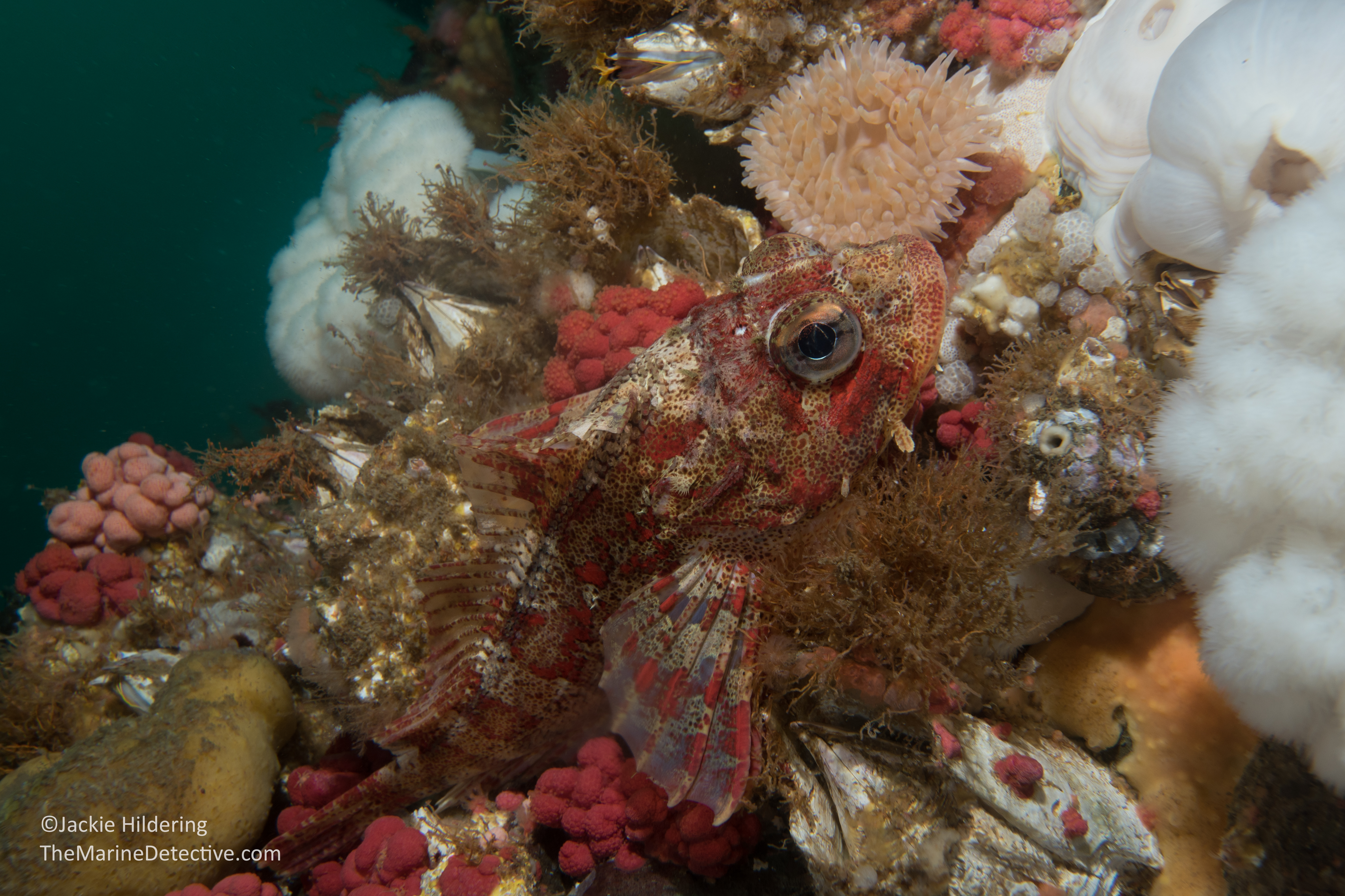
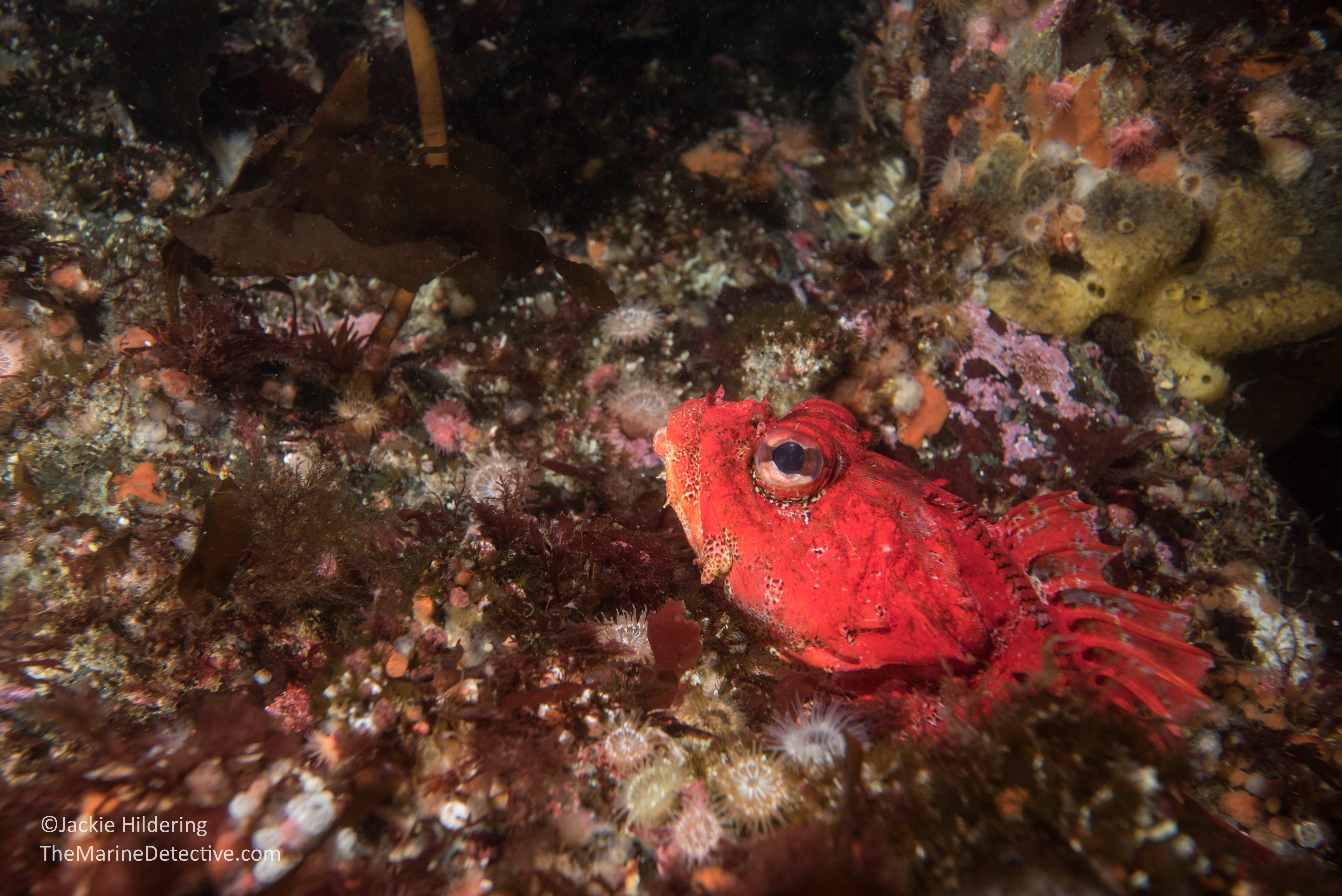
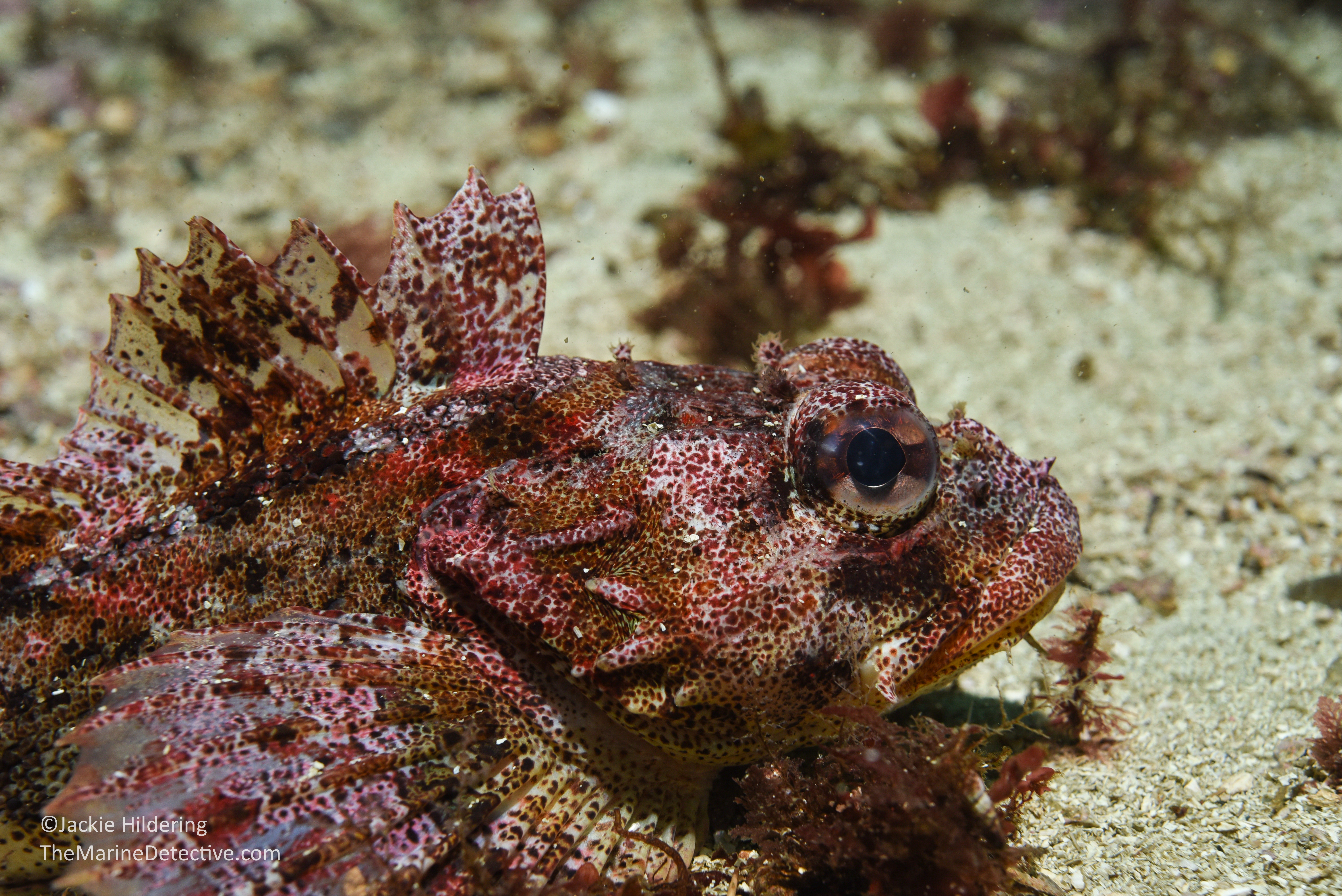
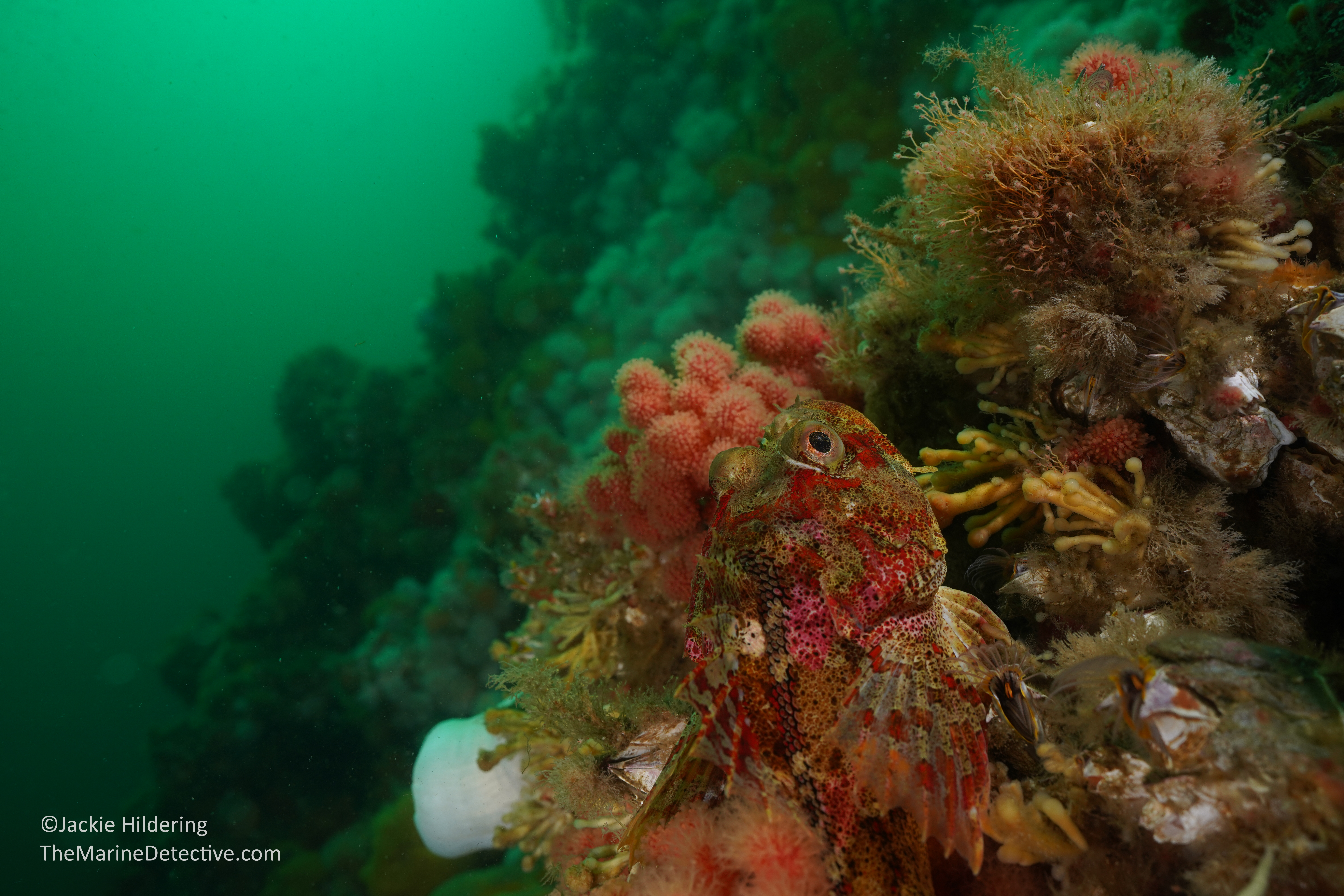
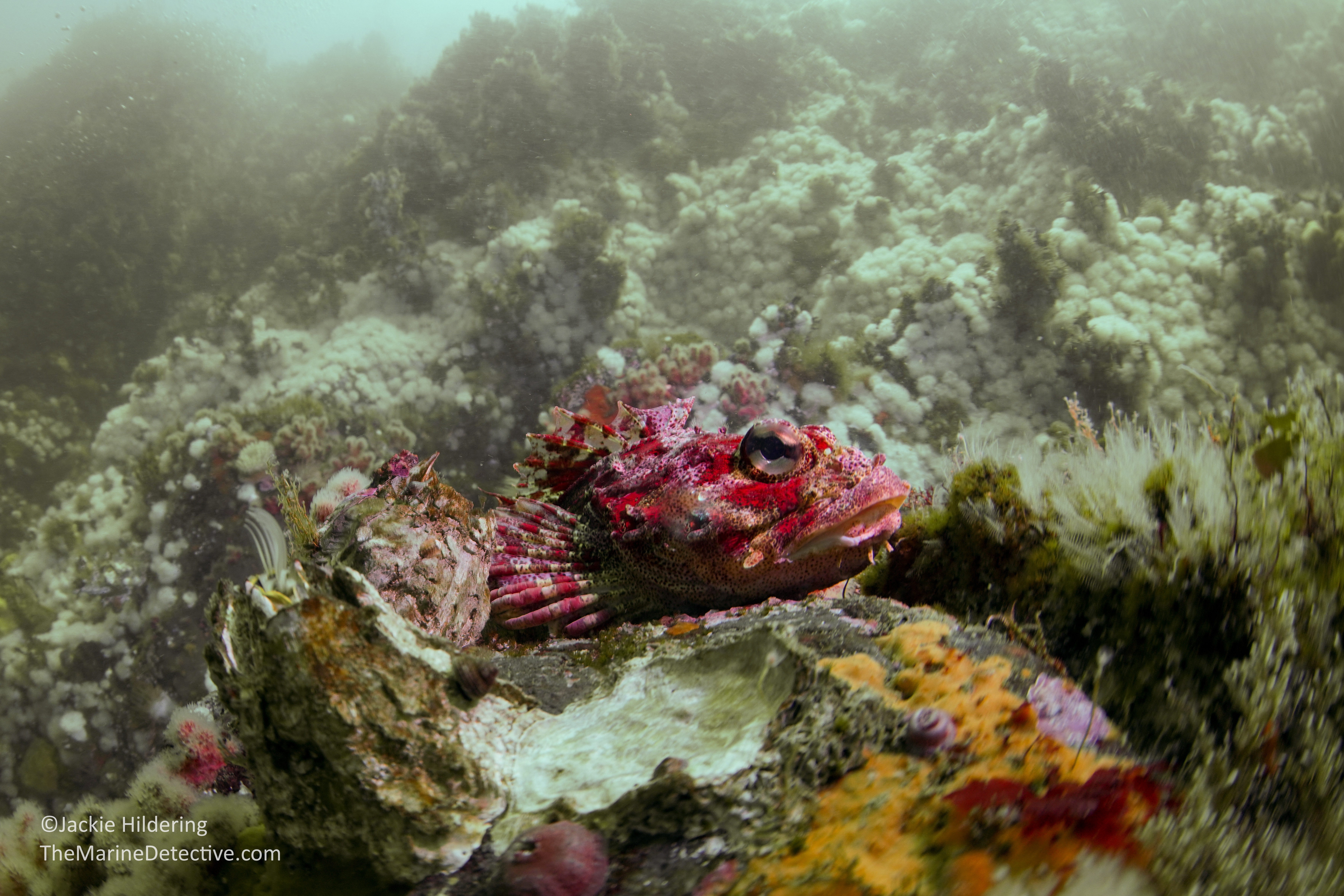
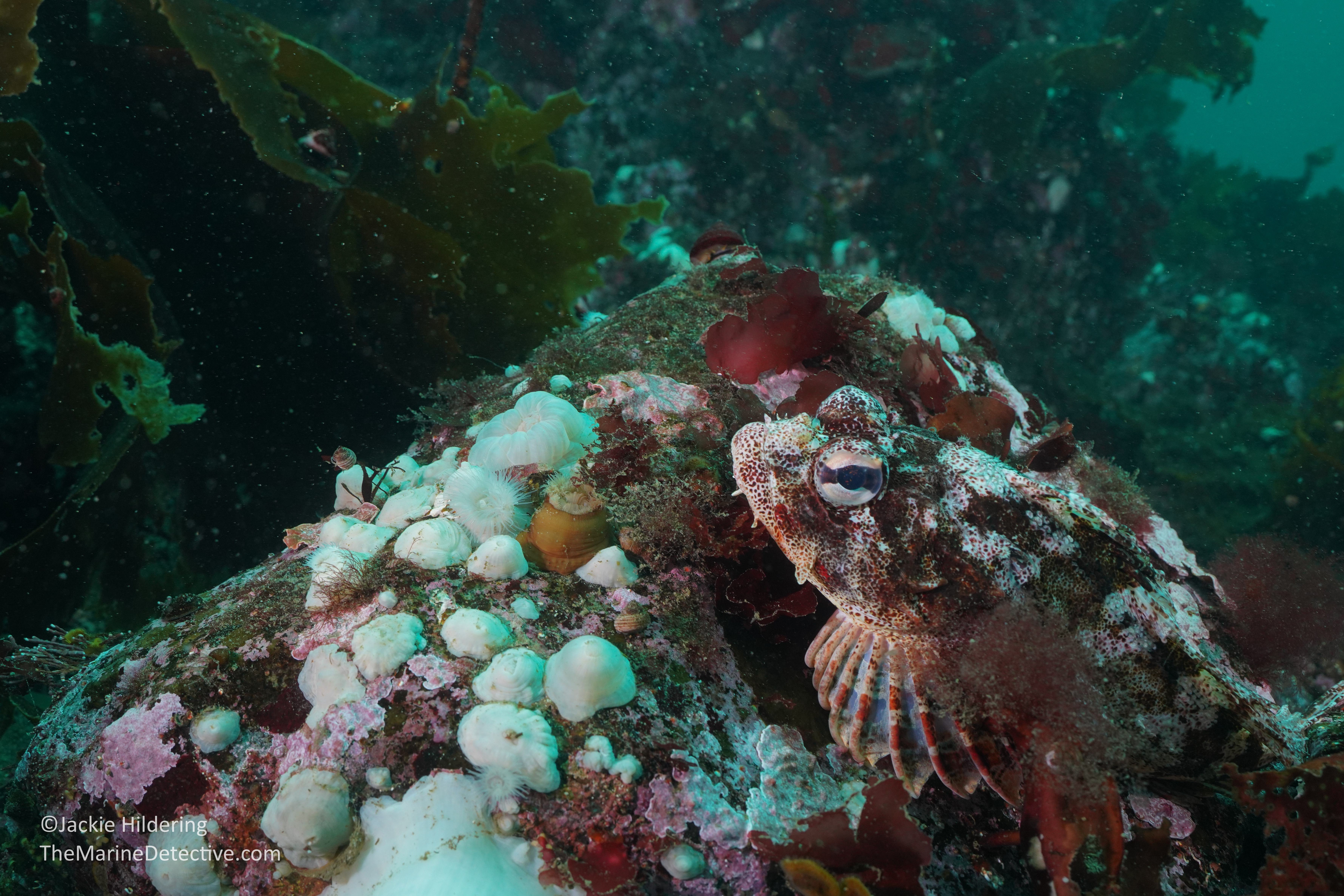
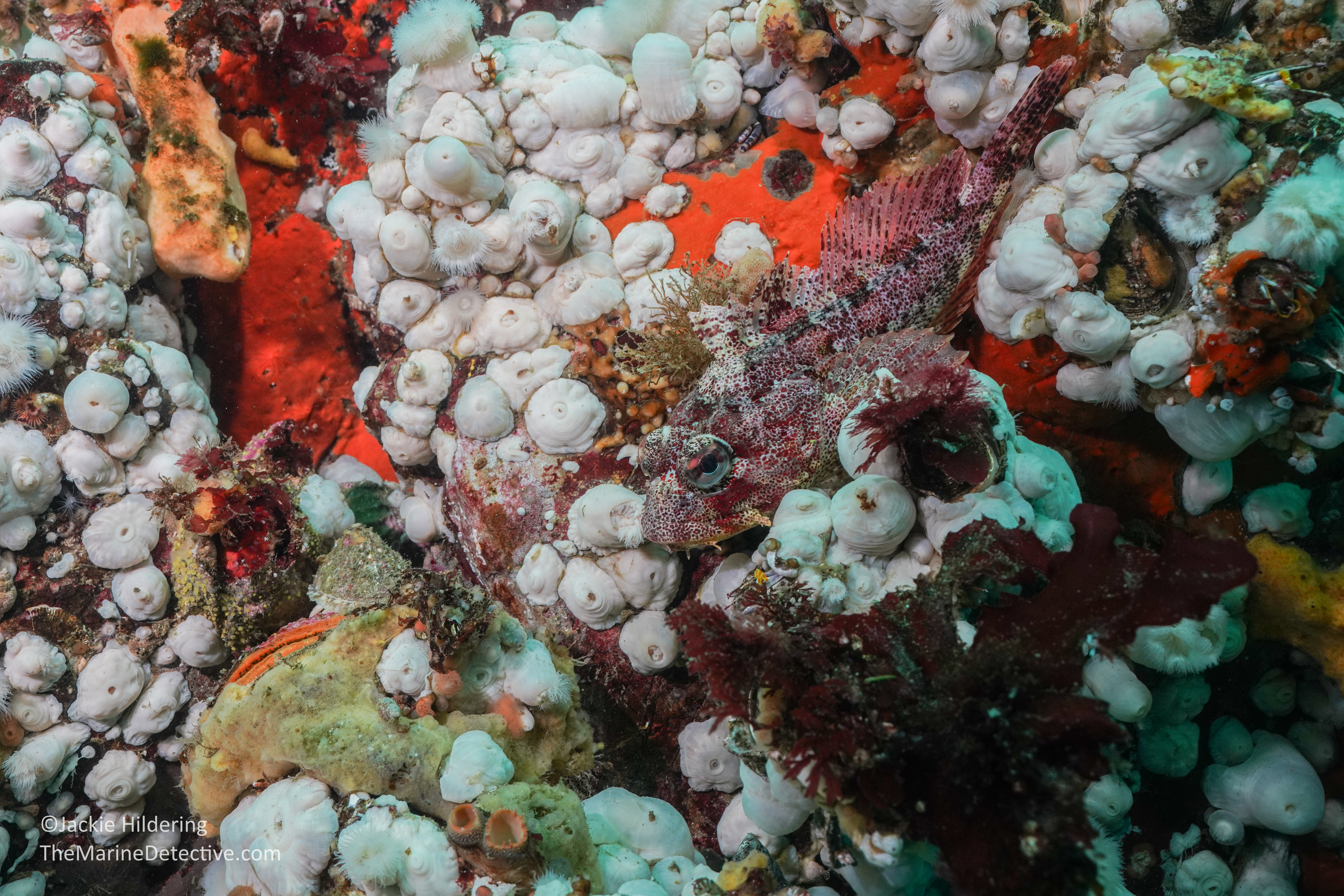
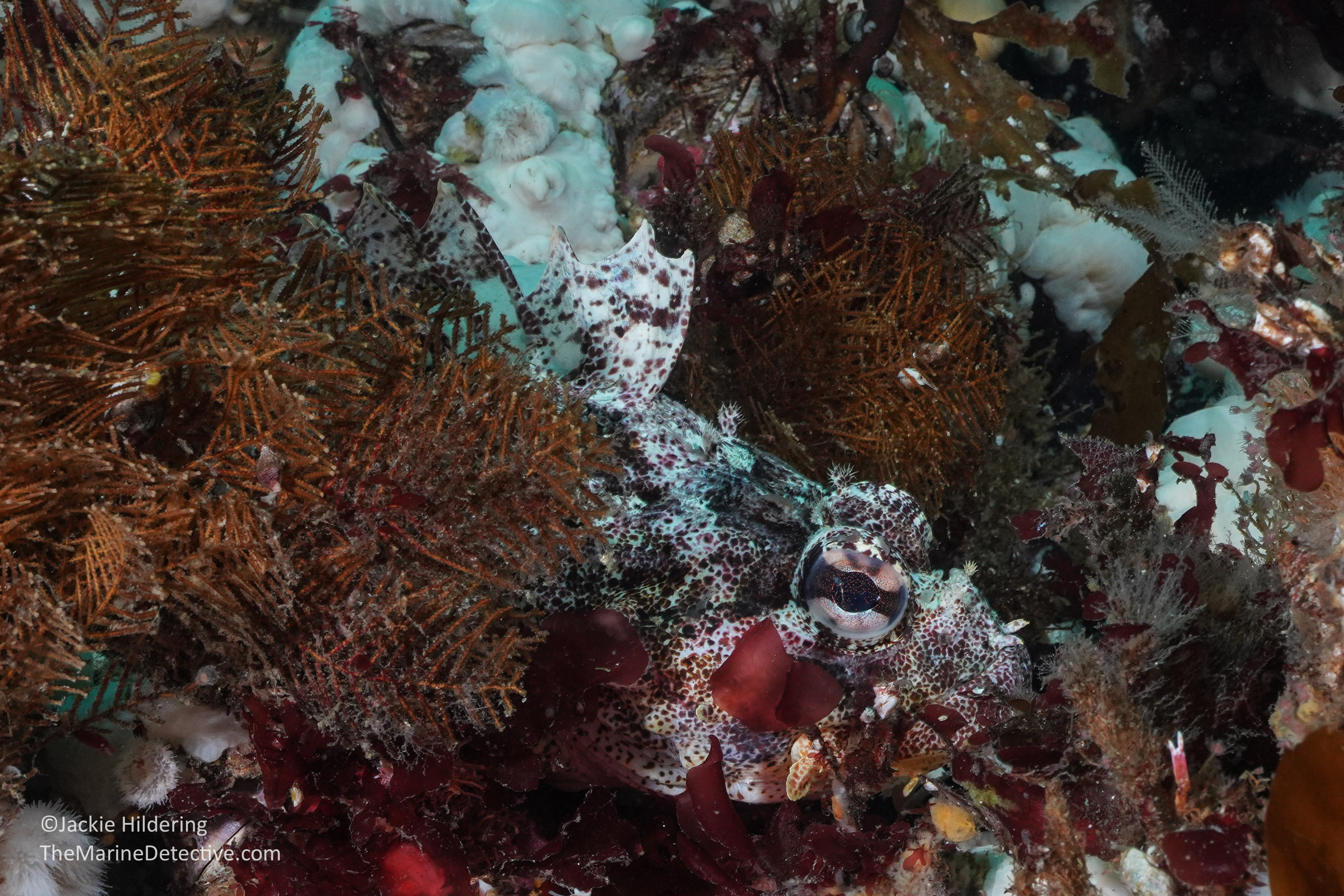
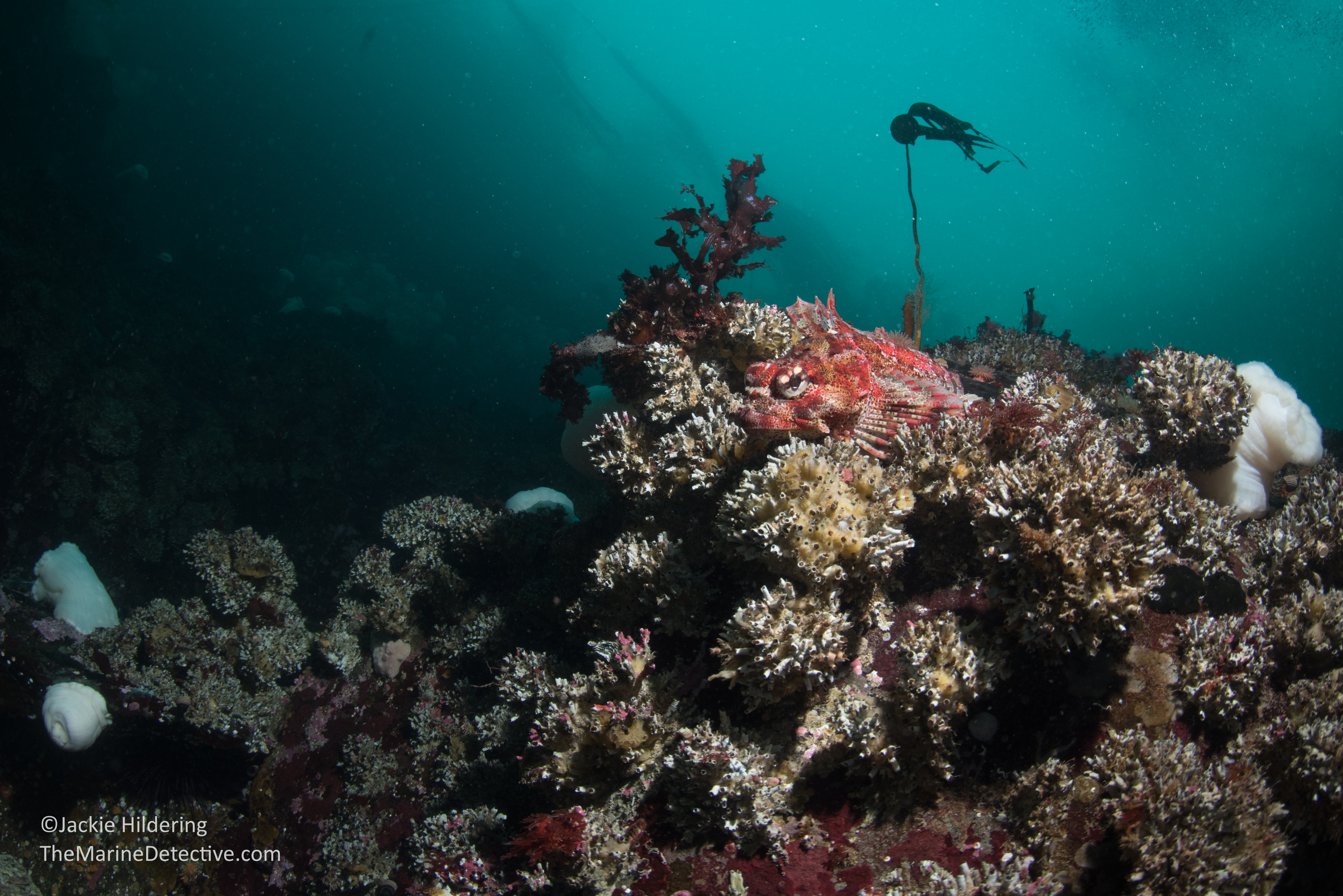
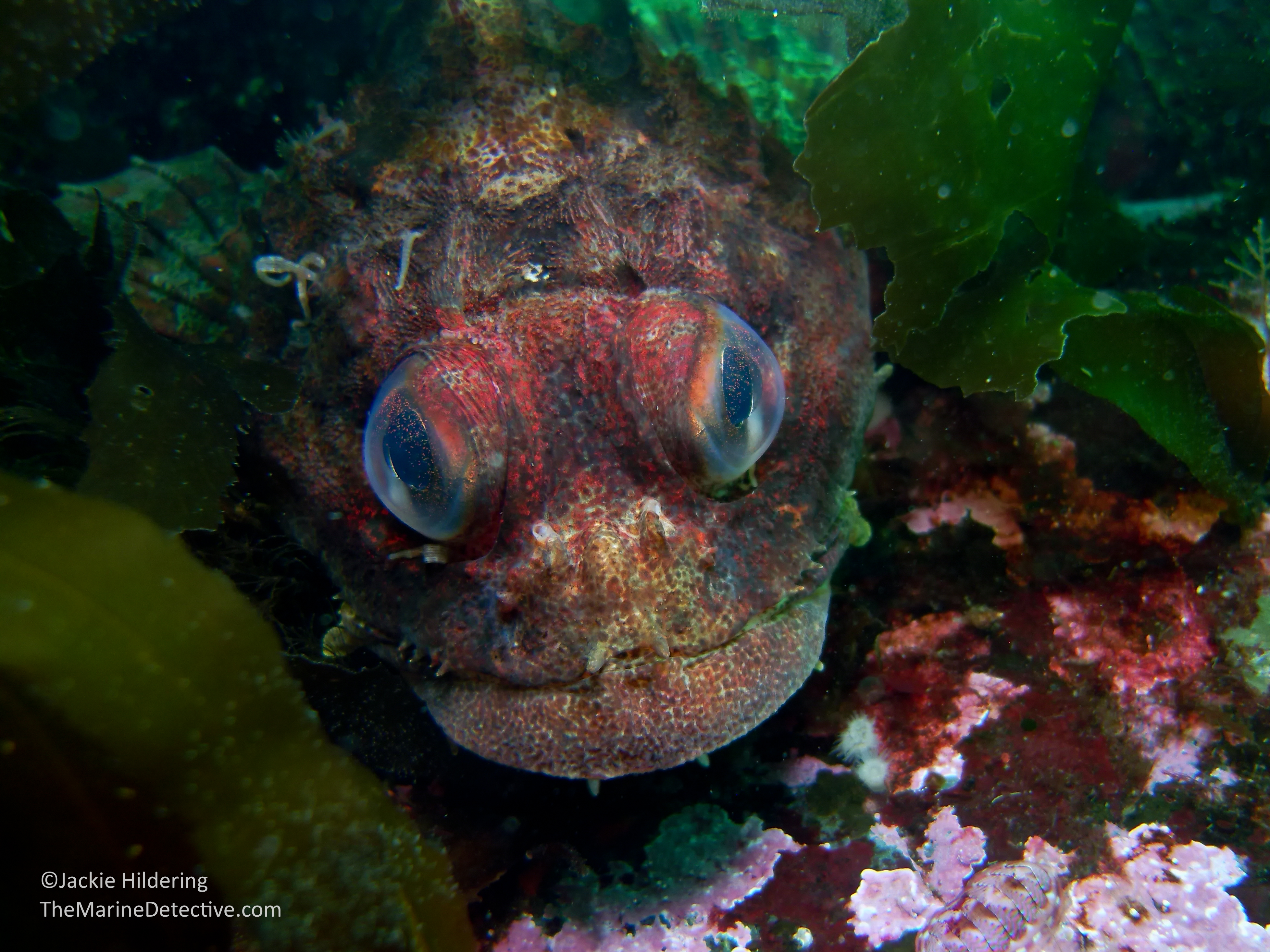
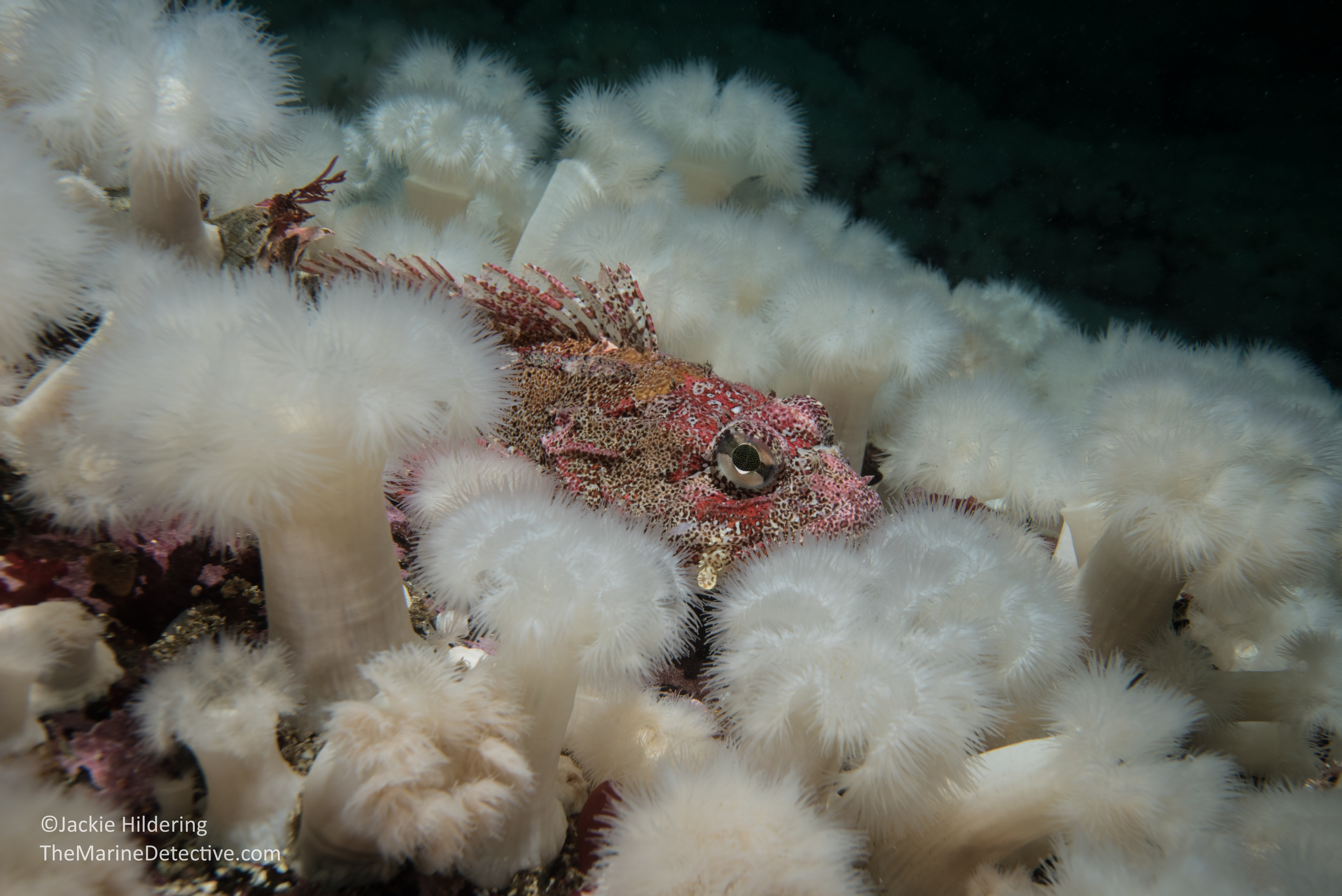
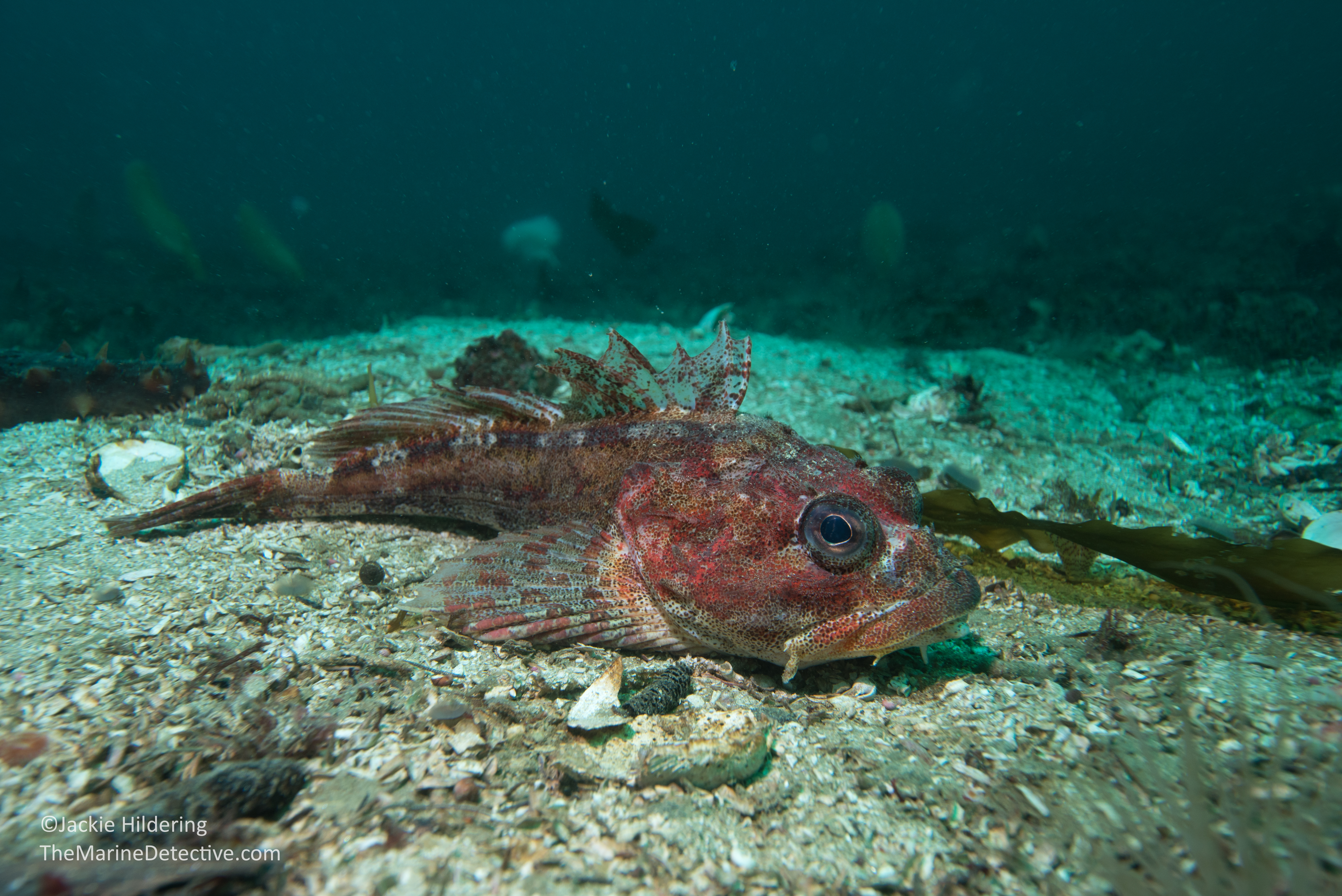
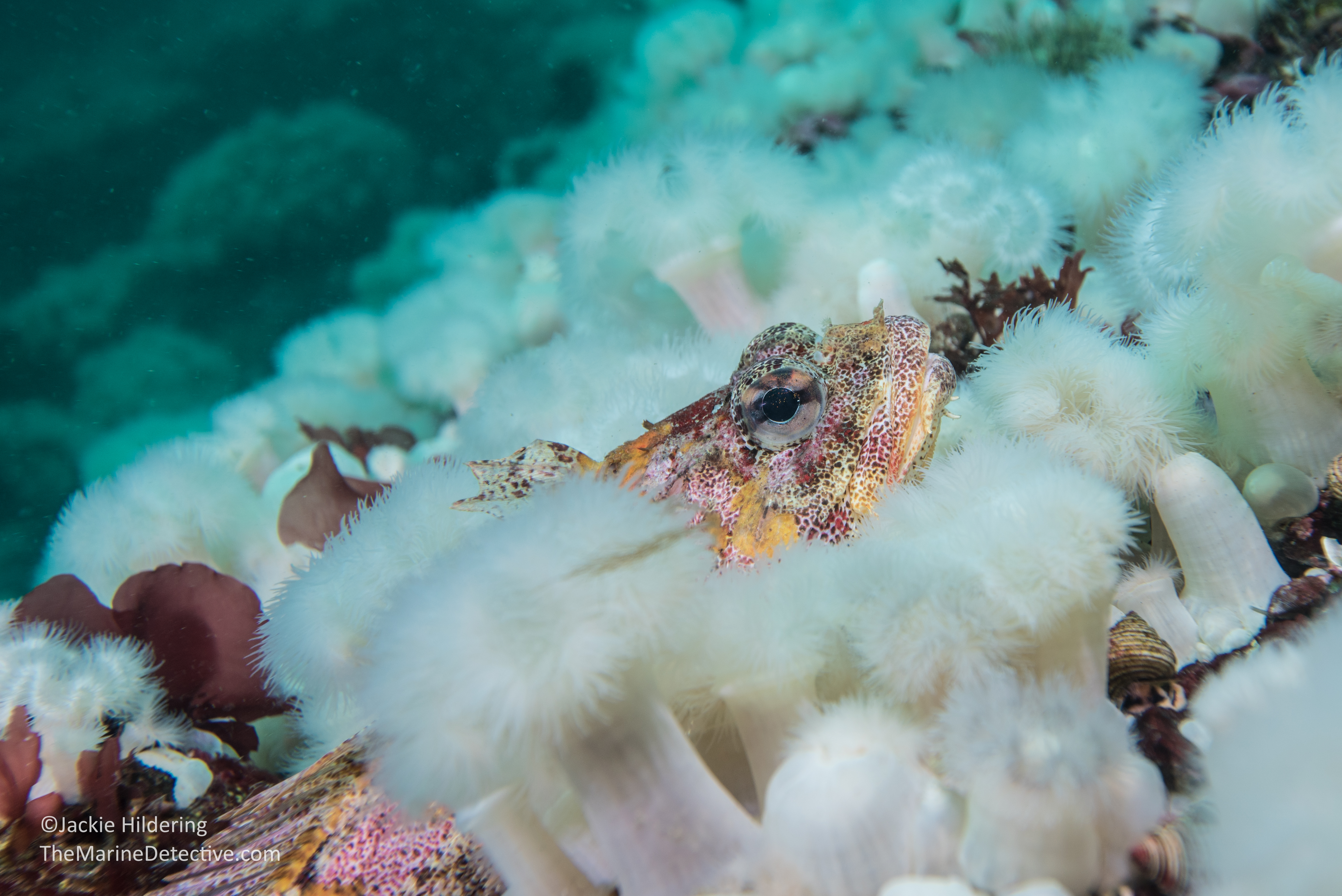
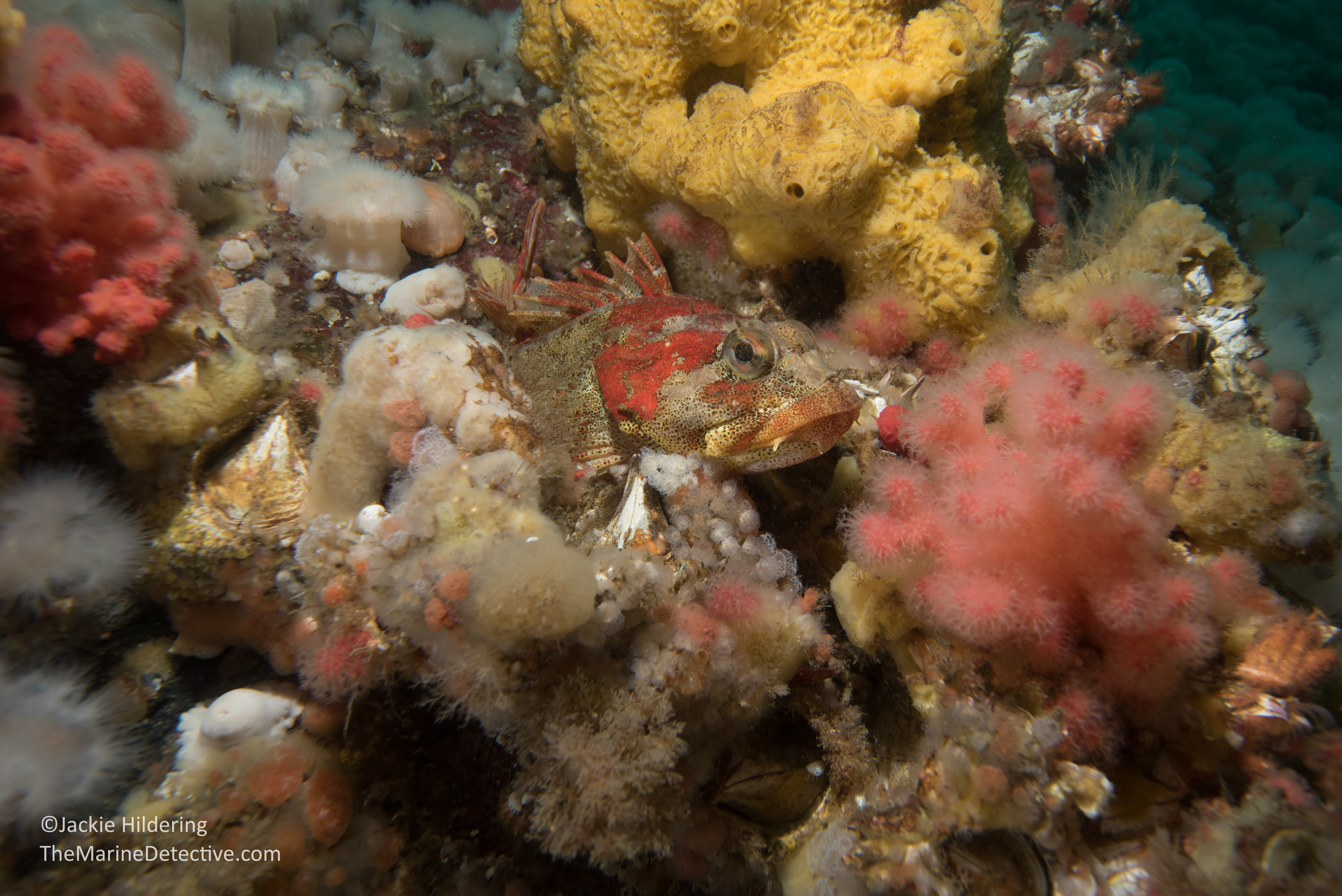
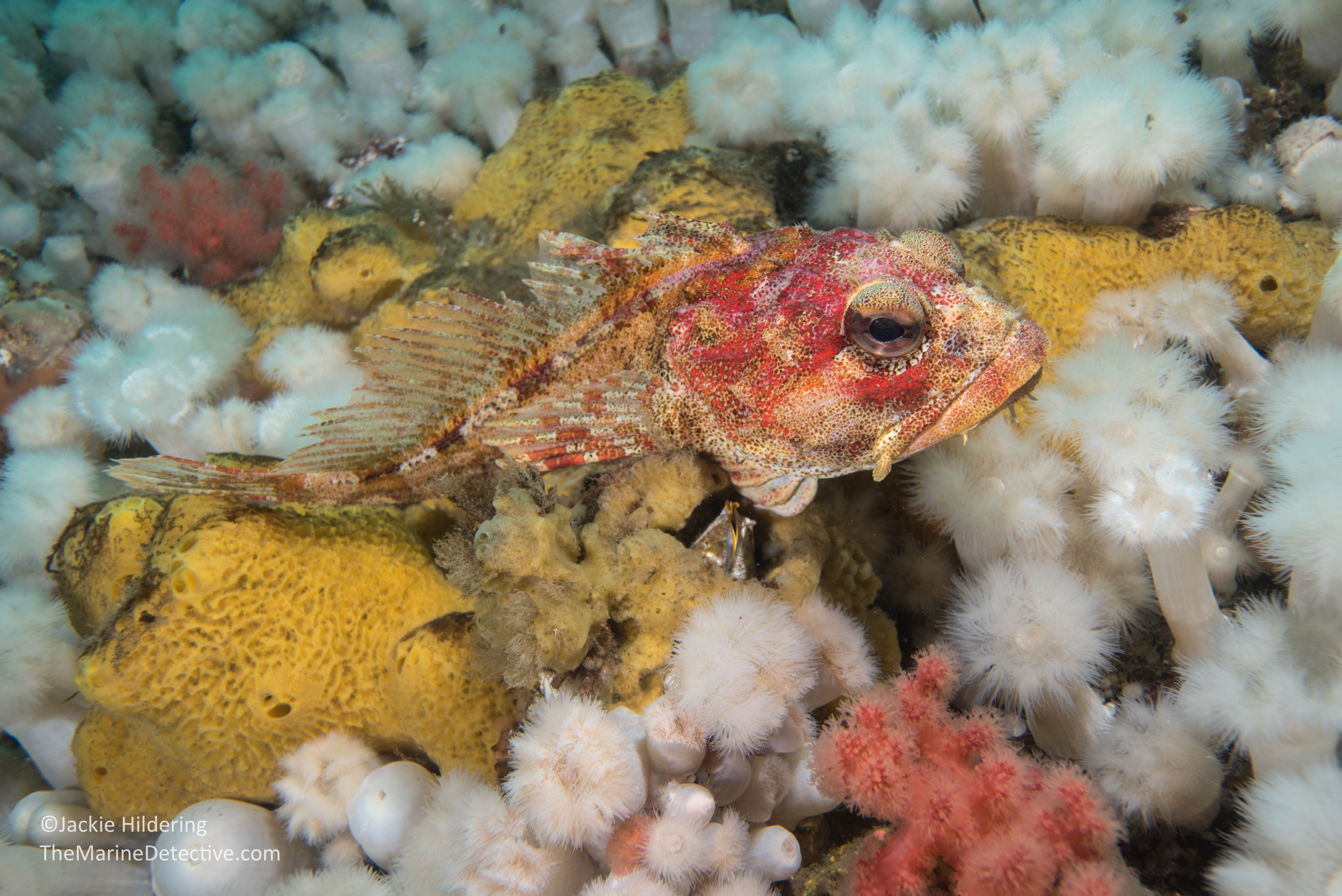
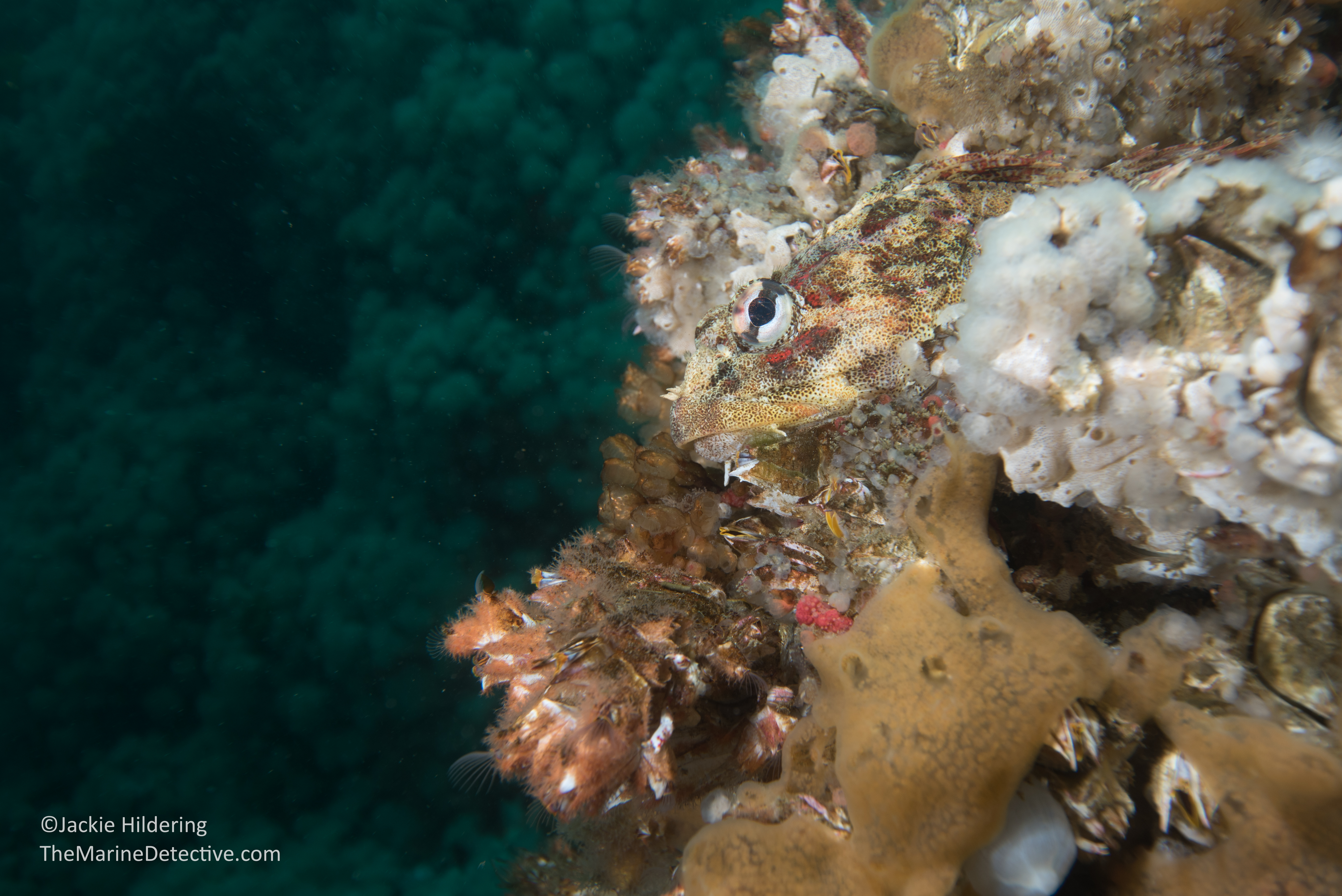
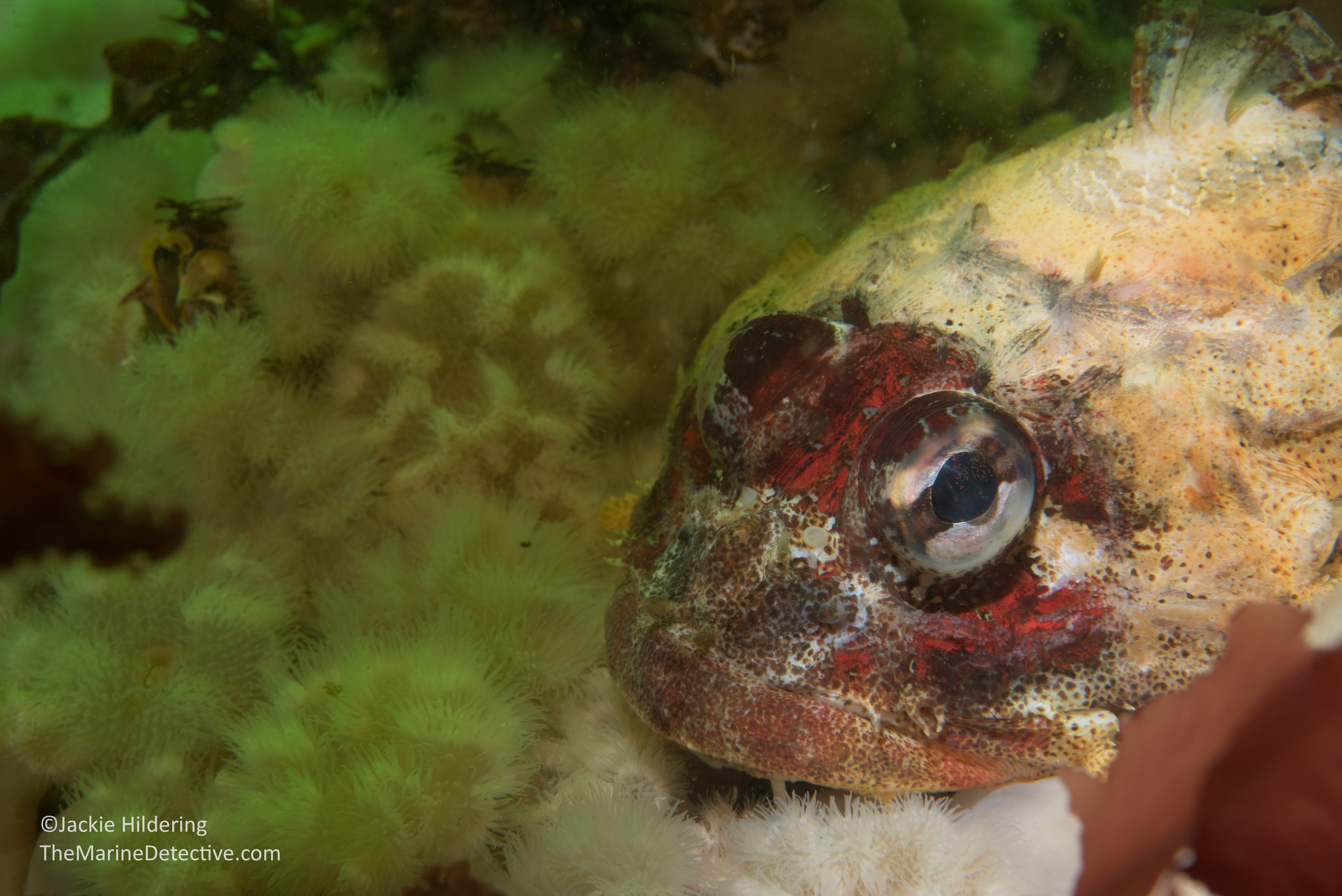
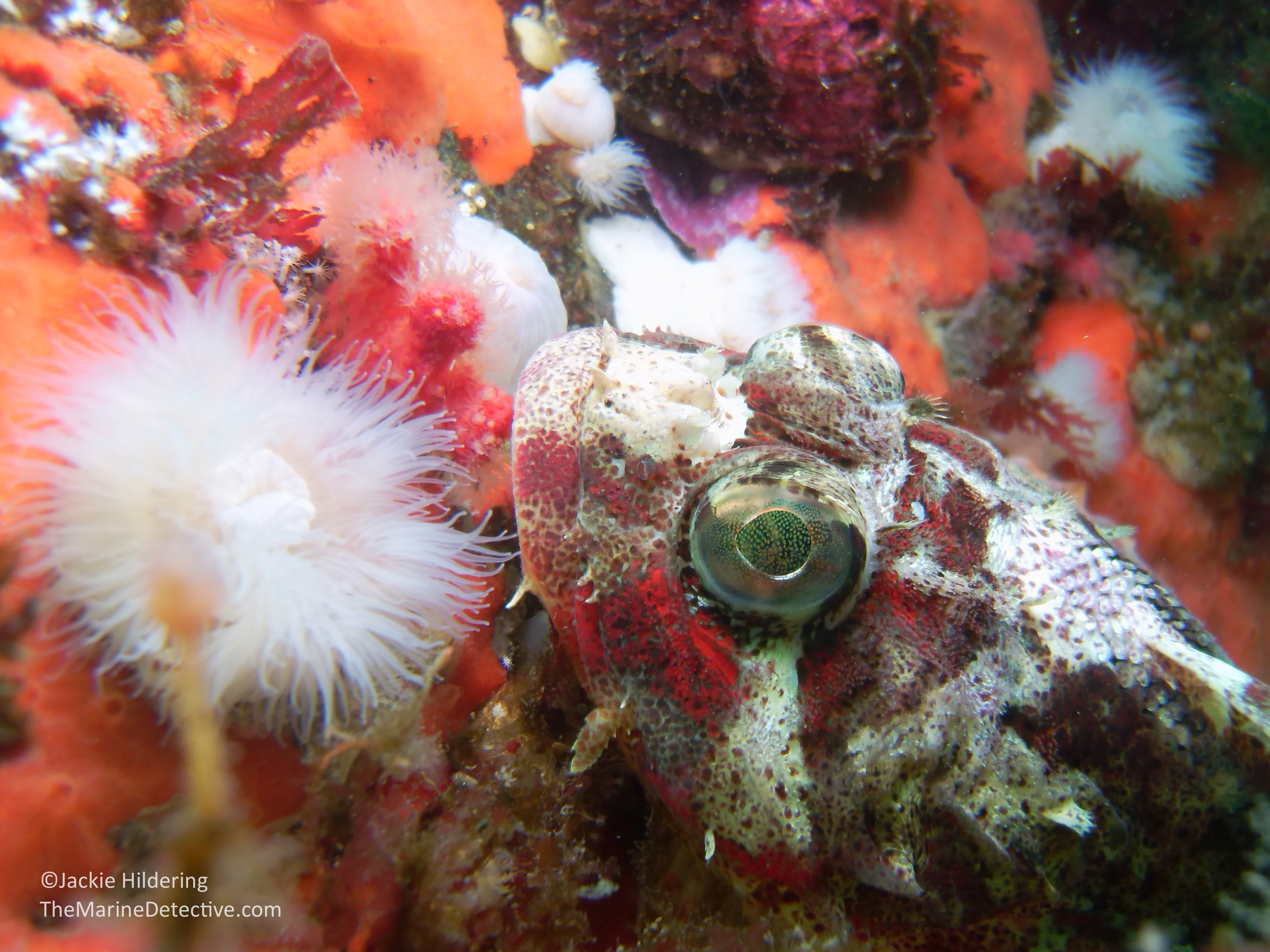
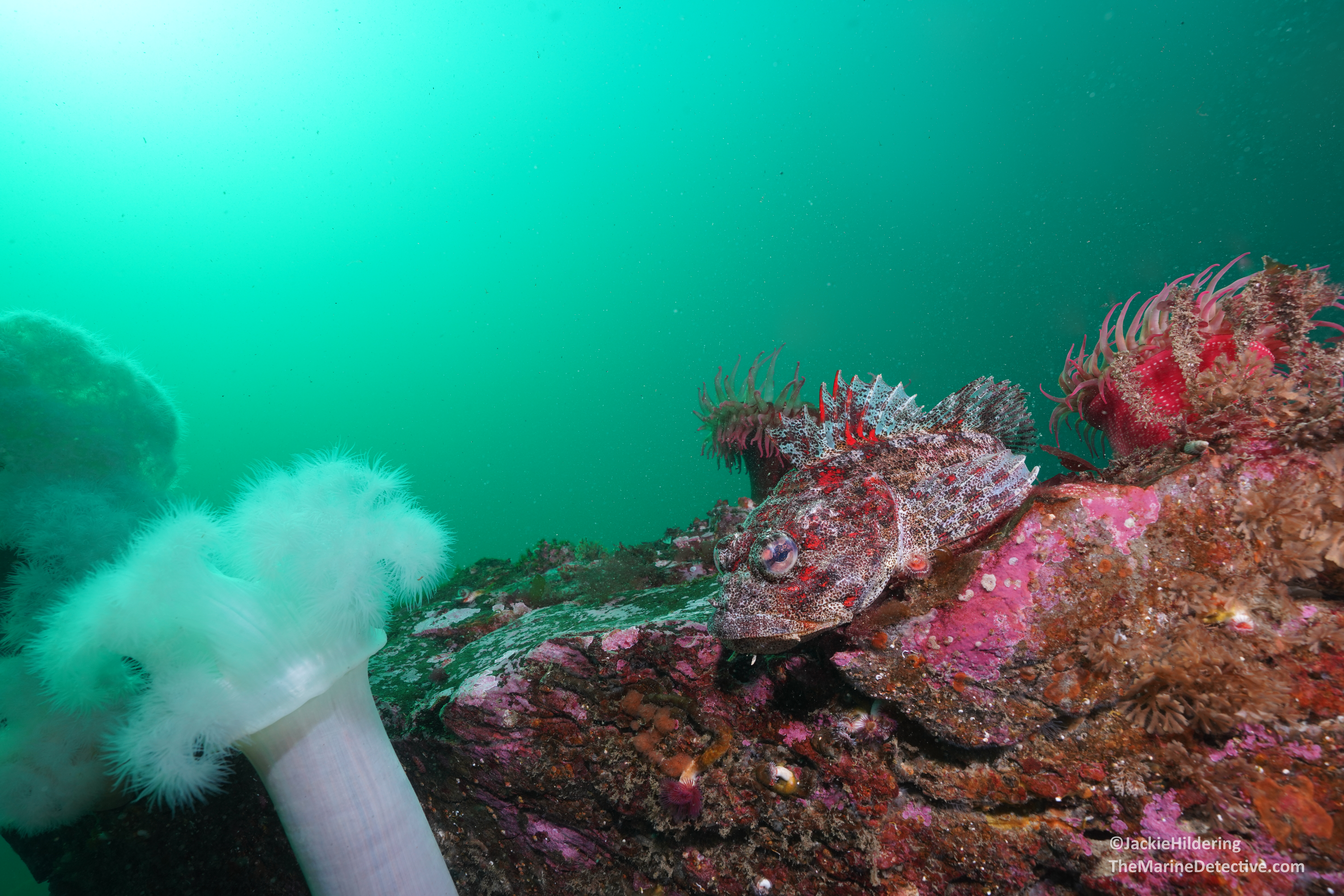
The Red Irish Lord (Hemilepidotus hemilepidotus; up to 51 cm) is a fish of incredibly stunning diversity of colour. Right down to its flecked, bulging eyes, this ambush predator is a master of camouflage. 

But how can you be camouflaged when you’re a fish of insane red and/or orange colouring? When you live in the rich, cold waters of the Northeast Pacific where Nature has doled out colour so liberally, you fade into the background even when so vibrantly coloured.  

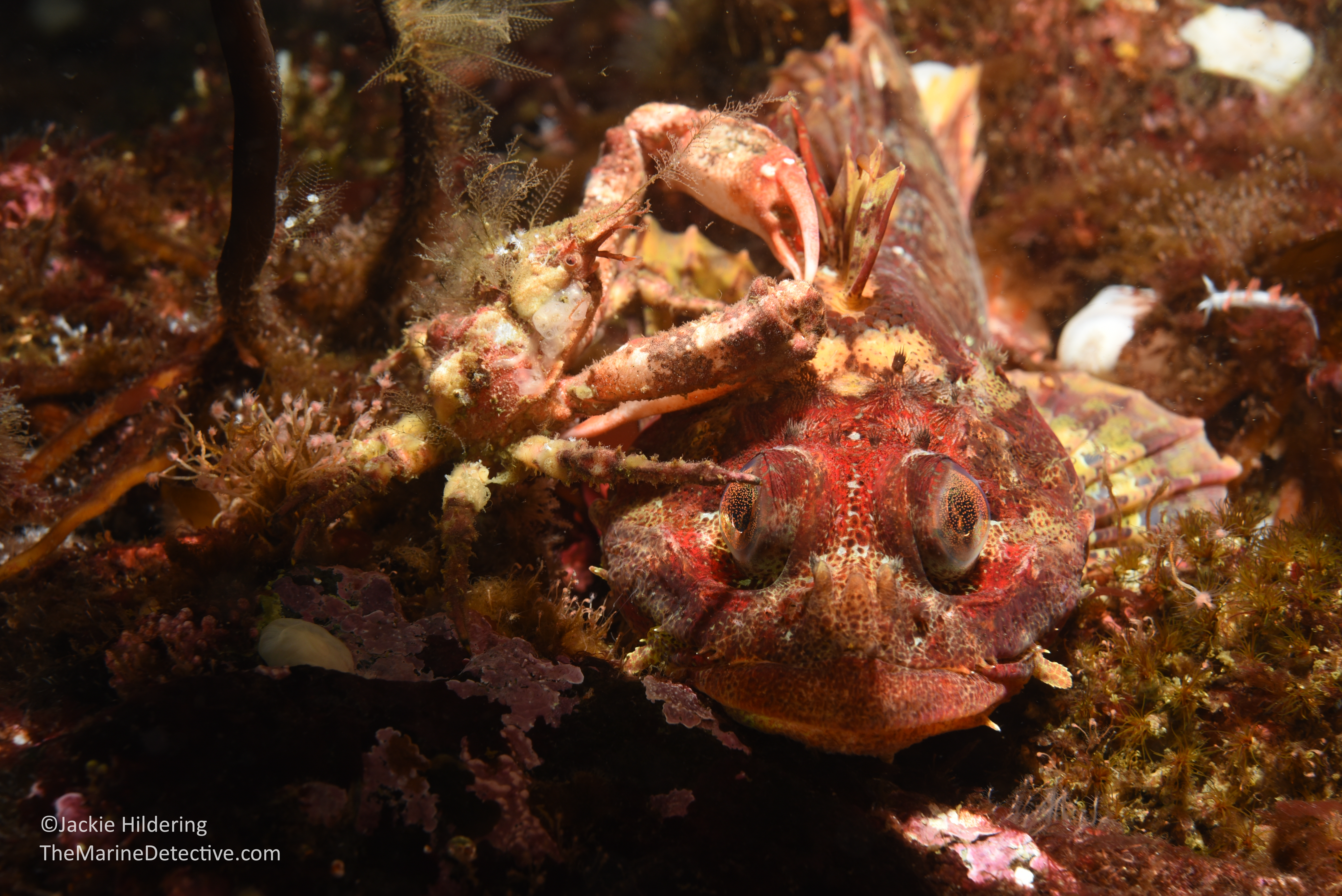
They are a favourite species for we underwater photographers since, as ambush hunters, they remain still even when annoying divers are flashing lights in their eyes or when a crab is sitting on their heads (see below).

The diversity of colour in this species is awe-inspiring. See below for examples of the diversity of colour and pattern and their ability to camouflage. You will even see that there are crabs that walk on their heads. I have a whole blog entitled “Crabs Making Bad Choices” dedicated to that at this link.

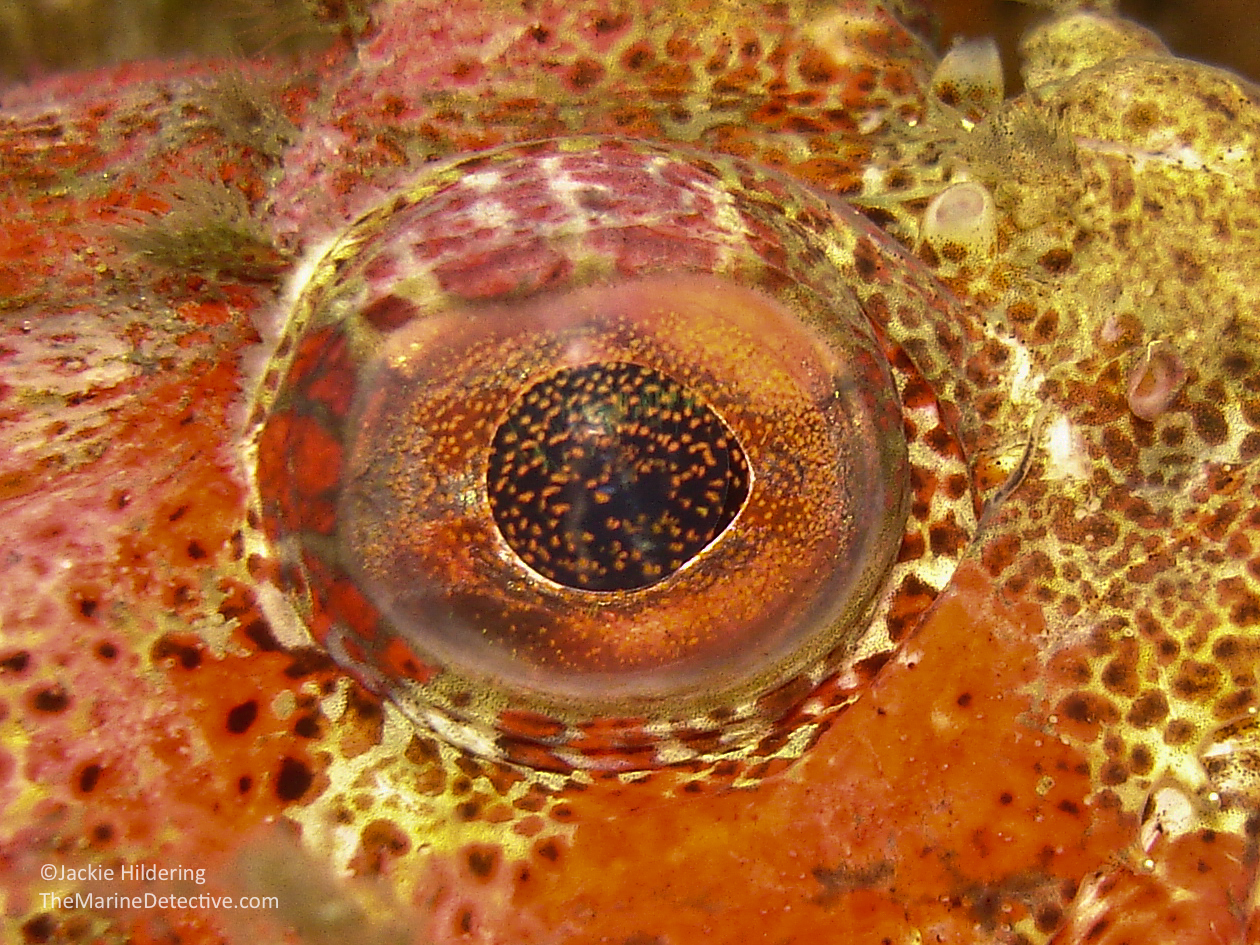
I hope that your sense of wonder is further stimulated in realizing that the Red Irish Lords are able to change even the colour of the flecks in their eyes to match their surroundings! 

The remarkable eyes of the Red Irish Lord. The flecks you see are corneal chromatophores which can change colour to add the to species’ ability to camouflage.

See too how Red Irish Lords are among the fish who guard their fertilized eggs.

Both male and female Red Irish Lords guard the eggs. More information in my blog at this link.

A Red Irish Lord who is hoping the Sharpnose Crab inches down just a bit further so that s/he can feed (and that the annoying photographer would go away!). See my blog “Crabs Making Bad Choices” for more photos of such interactions at this link.
Another Red Irish Lord and a mature male Sharpnose Crab making bad choices.

Slide show and gallery of photos below give a further sense of the diversity of colour and camouflage in this species. 

Lingcod – Fastidious, Fanged Fathers!


Last update: March 21, 2024.

Update November 2021: New research finds Lingcod replace ~2 of their 500 teeth every day.


Every year, our local dive club does several dives for the Lingcod Egg Mass Survey now curated by the Marine Life Sanctuaries Society.

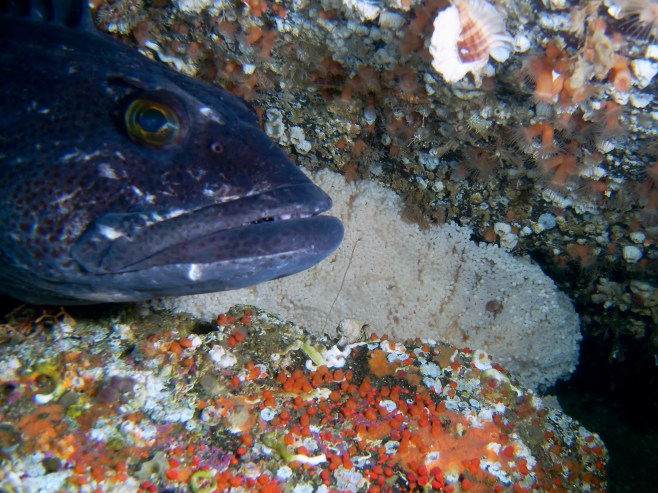
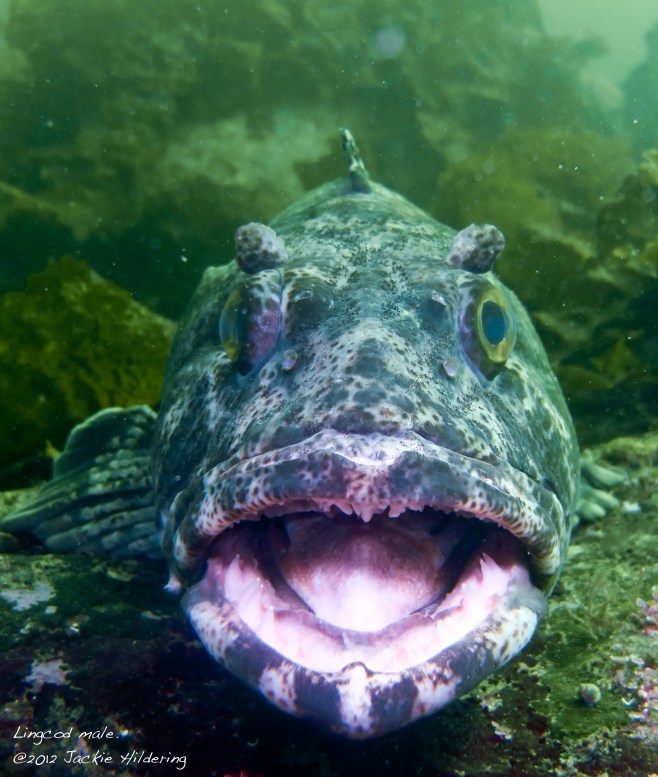
Lingcod male guarding eggs
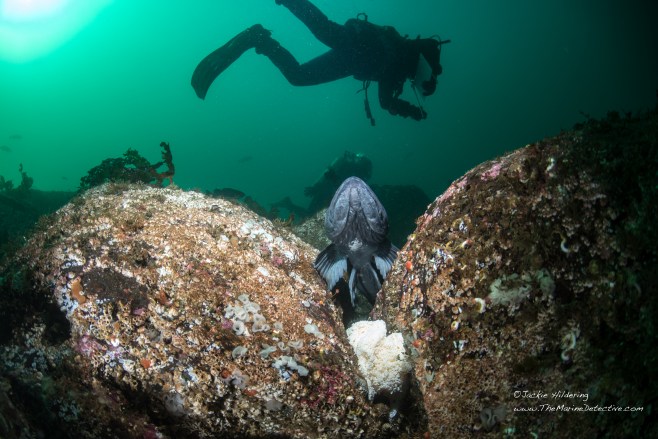
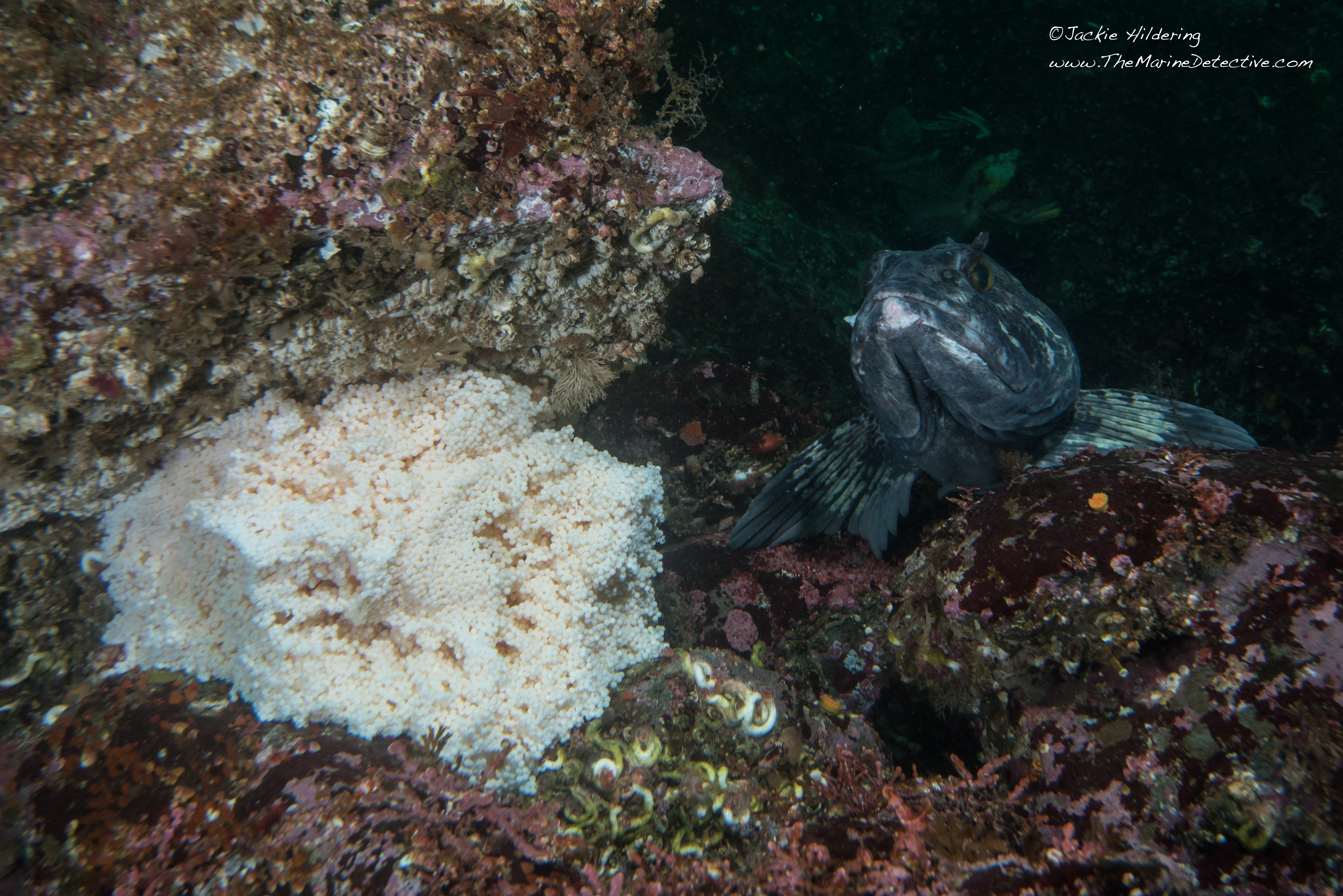
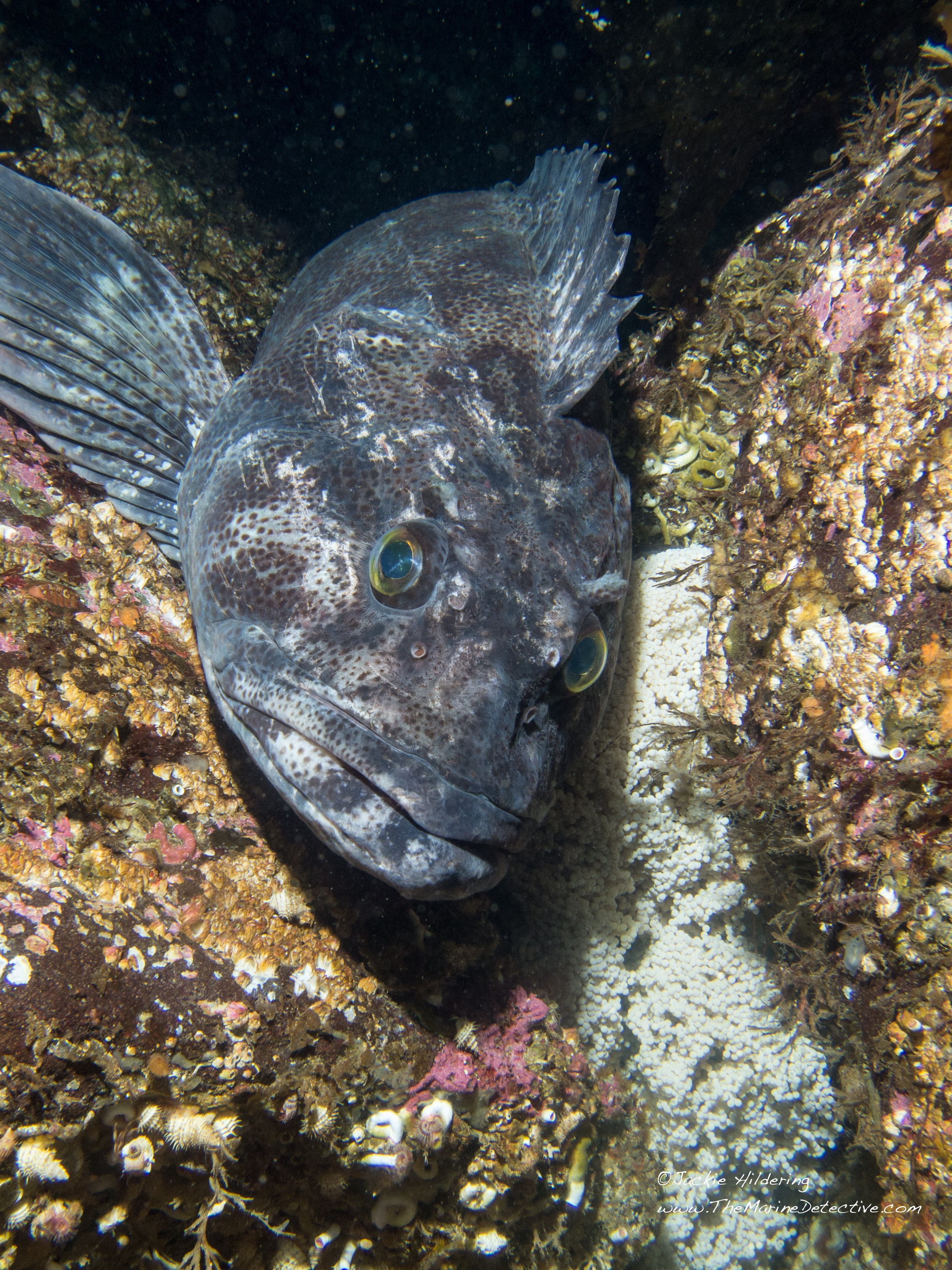
Lingcod male guarding an egg mass. Generally, the larger the egg mass, the older the female that laid it. Males guard the fertilized eggs from predation by other fish and sea stars until they hatch at 5 to 11 weeks. Photo: ©Jackie Hildering.

The survey is the result of concerns about the overfishing of this fish species and is conducted just after the spawn (January to February) when females leave the males to guard the egg masses from predation by species like sea stars. There are very few deadbeat dads in this species!

The data collected provide insight into the abundance and reproductive success of Lingcod in British Columbia and include: depth of the egg masses; their size (grapefruit, cantaloupe or watermelon sized); if the eggs are being guarded by a male; and their state of development (new, eyed or rotten). We are very fortunate that our area appears to have relatively abundant and large egg masses. At the end of this blog, you’ll find my 2.5 minute slide show of their life history. 

Male Lingcod with my buddy with her slate, having just recorded depth, size and condition of the egg mass. Buddy is Natasha Dickinson. ©Jackie Hildering.

But let me first take you on a wee retrospective journey.  

My understanding of the behaviour of these magnificent fish has now evolved  to where I now take photos of the extremely territorial males guarding their large orbs of fertilized eggs, but it certainly wasn’t always that way for me. The following is a much exaggerated perspective from when I was a very new diver doing their first Lingcod egg mass survey.

In 1999, I had only ever done 14 dives and had never even seen a Lingcod while diving. So, in preparation for the survey, I consulted my trusty field guide and felt well-prepared knowing the information below:

Lingcod male guarding egg mass (lower right). ©2015 Jackie Hildering
Lingcod male guarding egg mass (lower right). ©Jackie Hildering.

LINGCOD (Ophiodon elongatus)

  • Size: To 1.5 m and 37 kg.
  • Description: Large head, mouth and teeth; dark blotches on a slender, tapering, mottled body.
  • Habitat: Adults on rocky reefs and in kelp beds to 2,000 m; juveniles on sand and mud bottom.

However, nothing could have truly prepared me for meeting the awe-inspiring and highly dedicated Lingcod Fathers for Future Generations Club.

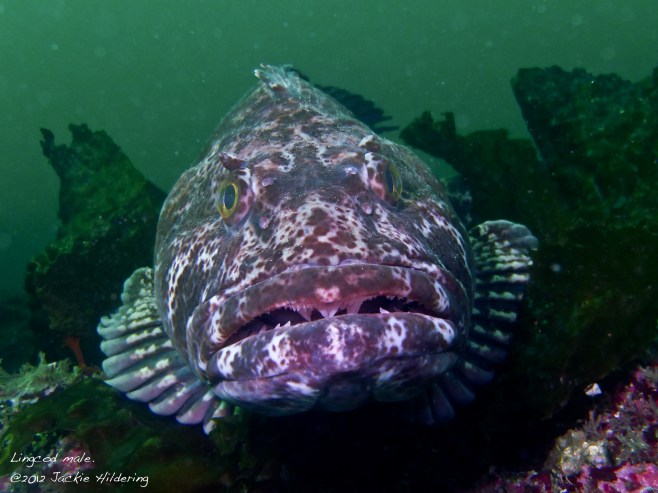
Serious teeth. ©2012 Jackie Hildering.
Serious teeth. ©Jackie Hildering.

That first experience with the survey in 1999 led me to writing the following tongue-in-cheek “updated” field guide information in my dive log.

LINGCOD (Megadontos fishious)

Size: &%$#@ huge!!!!!

Description: Teeth sharp, large and fear inducing; species camouflaged for added surprise value; ability to make themselves appear even larger and more menacing by fanning out huge gill plates (opercula). Note: Wise for divers to retreat if this behaviour is observed.

Habitat: Adult males found anywhere that groups of dive slate carrying divers like to congregate.

Comment: Egg masses are said to have eyes at some stage of their development but no living diver can confirm that this is the case!

This is an awe-inspiring fish species indeed. I have even had a male knock my dive slate out of my hands during a survey. Ironically, I was recording “absent” under the column for whether a male was guarding the egg mass!

Huge egg mass and male Lingcod with battle wounds. It is so meaningful to me that we are likely often documenting the same males year upon year. The males apparently court, mate and guard near the same rocks every year.  ©Jackie Hildering.
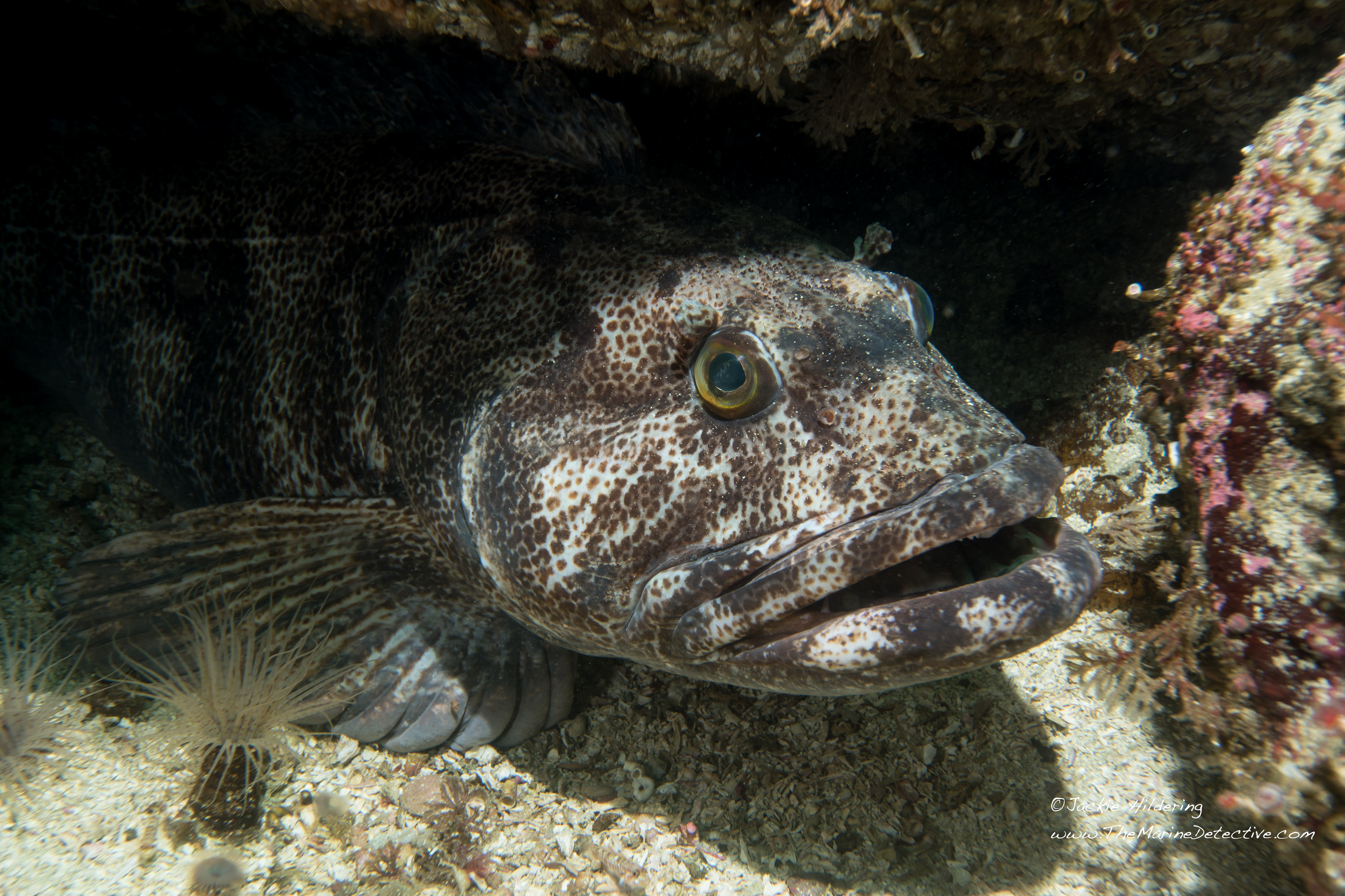
Huge female Lingcod. After age ~4, females grow twice as fast as males. By age 10 to 12, they are twice the size of males of the same age. Bigger females lay larger egg masses – up to 500,000 eggs! More on the life history in my slide show below. ©Jackie Hildering.

Note that the common name of Lingcod is confusing as they are not a cod nor a ling (another fish species).

For detailed information on the survey, survey reports and the biology of Lingcod click here for the Ocean Wise webpage. 

Okay, maybe not looking so serious here. :) ©2012 Jackie Hildering.
Okay, maybe not looking so serious here. ☺️
©Jackie Hildering.
Guarding egg mass. ©Jackie Hildering.
So much to protect. ©Jackie Hildering.

Sources:
Alaska Department of Fish and Game, Lingcod

Lamb, A., & Edgell, P. (2010). Coastal fishes of the Pacific Northwest. Madeira Park, B.C: Harbour Pub.

Love, M. S. (2011). Certainly more than you want to know about the fishes of the Pacific Coast: A postmodern experience. Santa Barbara, Calif: Really Big Press.

Sharks Among Us #2 – The Bluntnose Sixgill Shark

Update May 1, 2023: Original blog is from 2011. I have added photos of additional, known dead Sixgill Sharks at the end of this blog.

And yes, there is a personal connection to this species. While these huge sharks are often in very deep water, I have seen them while diving in at depths of even less than 10 metres. It’s difficult to express the wonder and connection that results from these privileged experiences. It’s somewhat like seeing a living dinosaur. Bluntnose Sixgill Sharks have been perfected by 200 million years of adaptation.

They are not a threat to us. We are a threat to them.


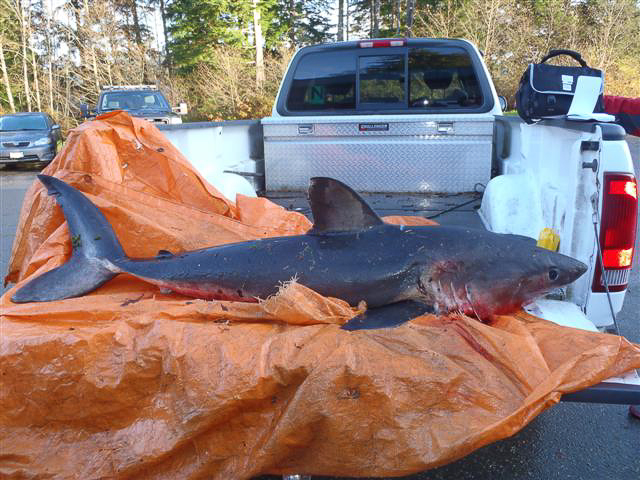
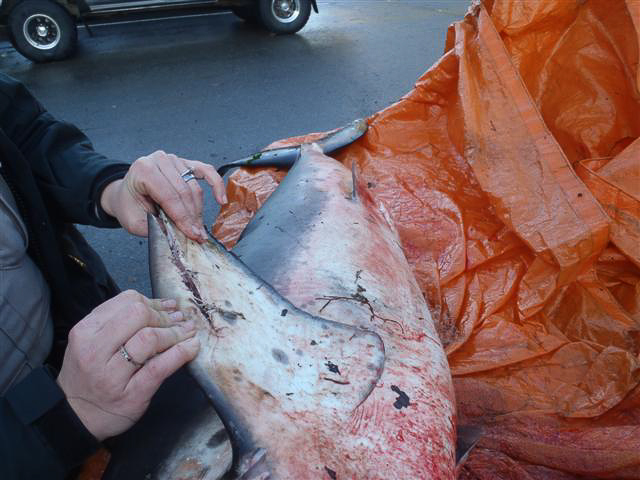
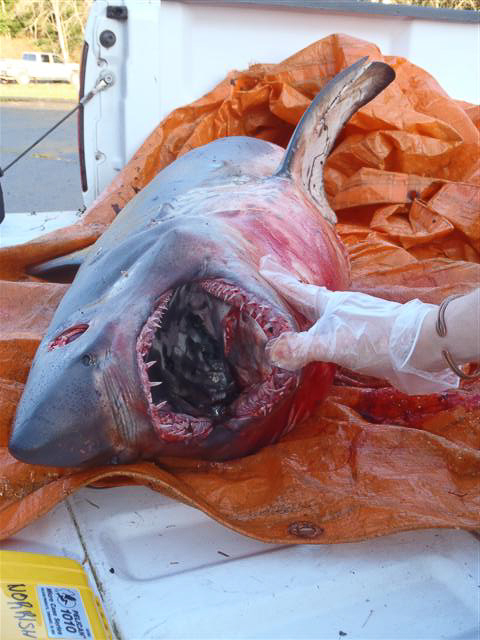
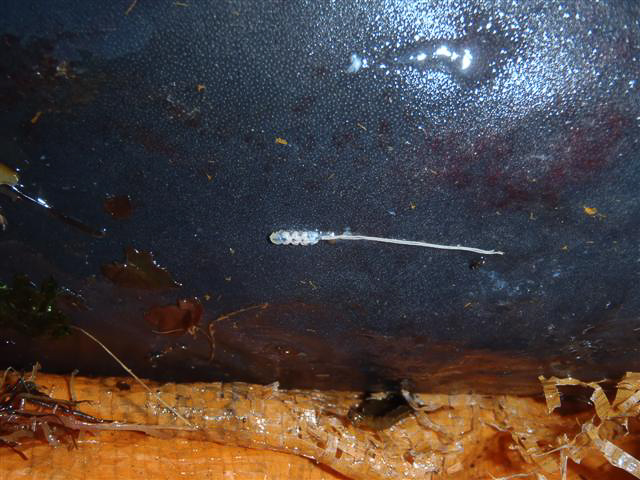
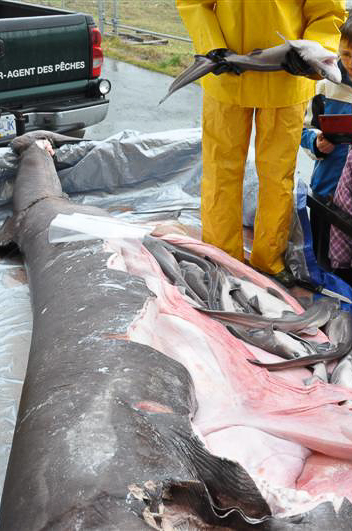
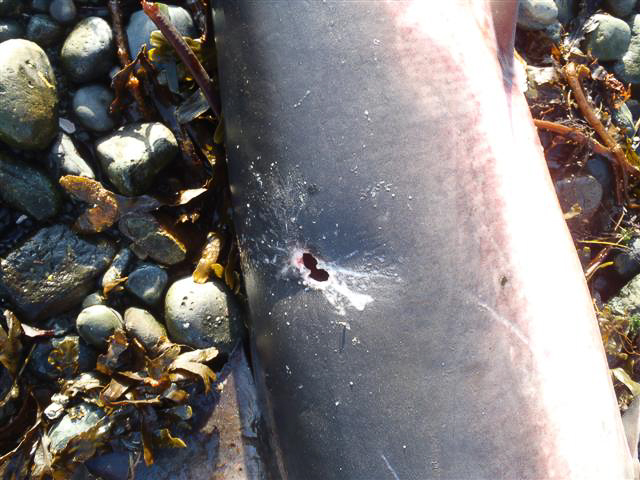
The awe-inspiring images below are of a pregnant female Bluntnose Sixgill Shark (Hexanchu griseus) who was found dead on a beach in Alberni Inlet on low tide in February of 2011. She was necropsied by Department of Fisheries and Oceans staff and there were no obvious indications of how or why she died.

The information below has been generously provided by shark biologist and friend, Romney McPhie. I am sharing in the hopes of increasing respect and understanding for these astounding, huge, deep-dwelling sharks who live off our coast.

4.2 m pregnant female Sixgill Shark – February 2011.

This female Sixgill was 4.2 metres and was estimated to weigh 569 kg (1,254 lbs).  As a viviparous shark species, she carried her embryos through the entire gestation period which is thought to be over 2 years long (species does not lay eggs / egg cases).

She may have given birth to some prior to her death and still had 28 pups inside her. The young hatch inside the female’s body before entering the ocean (these sharks are “yolk-sac viviparous”).

Sixgill Sharks have been reported to be up to 4.8 metres in length with females being larger than males (males to 3.5 metres). Age of sexual maturity is estimated to be between age 11 to 14 for males and between 18 to 35 years for females. It is believed that life expectancy may be up to 80 years of age. 

The Committee on the Status of Endangered Wildlife in Canada (COSEWIC) 2007 assessment report on the Bluntnose Sixgill puts into perspective how rare an opportunity it is to learn about a pregnant Sixgill.  It relates that the number of pups carried by females is known from only three previous credible accounts (ranging from 47 to 108 pups which were 61 to 73 cm in size).

The Bluntnose Sixgill Shark is an extremely cryptic species that can dwell at depts up to 2,500 m.  So little is known about them and (sigh)  they are “near threatened” globally and are a species of “special concern” in Canada.

I have had the incredible privilege of seeing Bluntnose Sixgill Sharks while diving and felt like I was in the presence of greatness. They are living fossils, perfected by 200 million years of adaptation. They are amazingly graceful with large, luminous and intensely green eyes.

They are of absolutely no threat to humans and, like all sharks, have an essential role in marine ecosystems.  As top-level predators, sharks strongly shape food webs and the loss of such predators has proven to have profound effects on the number and diversity of other species.
The unique teeth of Bluntnose Sixgill Sharks. Photo by Romney McPhie.

We, however, are a threat to them.

There were historical fisheries and bycatch remains a concern. From 2006 to 2009 there an estimated 1979 Bluntnose Sixgill Sharks were Commercial Hook and Line catch

There is no information on the survival rates from bycatch nor of the accuracy of bycatch reporting. Population size and reproductive rate are not known for this species.

The primary threats identified for these species are entanglement and bycatch.  Other threats identified include pollution, habitat loss or degradation, climate and oceanographic change, and harassment. Historic threats included directed fisheries and entanglement/bycatch. While these populations are migratory throughout the northeast Pacific, it is unknown whether threats occurring outside of Canadian Pacific waters have an impact on these populations.”

Further from the 2022 Fisheries and Oceans Canada Report on the Progress of the Management Plan for Bluntnose Sixgill Sharks:

“The present population size and abundance trends are not known. The only available abundance index (encounter rates with immature Bluntnose Sixgill Sharks at a shallow site in the Strait of Georgia) has decreased significantly (>90%) in the last five years. This index is not likely representative of the overall abundance trend because only immature Bluntnose Sixgill Sharks are encountered and the site is shallow relative to the preferred depth range. The principal known threat to the species is fishing.

The Bluntnose Sixgill Shark has been the focus of at least three directed fisheries in Canadian waters, most recently in the late 1980s and early 1990s. It continues to be caught as bycatch, but survival of released sharks is unknown. Bluntnose Sixgill Sharks observed by divers sometimes show scars from entanglement in fishing gear.

Because of its late age of maturity (18 to 35 years for females), it is likely susceptible to overfishing even at low levels of mortality. Little is known about the abundance and movement patterns of this species elsewhere in the world, so the potential for a rescue effect is unknown.

Sixgill Shark eye. This one died as a result of longline bycatch and was brought into Alert Bay in July of 2007. It was rumoured to be one of 12 sharks caught by only one local fishing boat. Photo: Jared Towers.

Sources for the biology, threats and conservation of Bluntnose Sixgill Sharks:

Fisheries and Oceans Canada. 2022. Report on the Progress of Management Plan Implementation for the Bluntnose Sixgill Shark (Hexanchus griseus) and Tope Shark (Galeorhinus galeus) in Canada for the Period 2012 to 2017. Species at Risk Act Management Plan Report Series. Fisheries and Oceans Canada, Ottawa. iv + 20pp

Fisheries and Oceans Canada, 2012. Management Plan for the Bluntnose Sixgill Shark (Hexanchus griseus) and Tope Shark (Galeorhinus galeus) in Canada [Final]. Species at Risk Act Management Plan Series. Fisheries and Oceans Canada, Ottawa. iv + 37 pp.

COSEWIC (Committee on the Status of Endangered Wildlife in Canada). 2007a. COSEWIC assessment and status report on the Bluntnose Sixgill Shark (Hexanchus griseus) in Canada. COSEWIC, Ottawa, Canada.

NOAA, 2017. Getting to know Sixgill Sharks.

Photo #1 April 2023 – Dead pregnant Bluntnose Six-gill Shark, Hornby Island.
Photo #2 April 2023 – Dead pregnant Bluntnose Six-gill Shark, Hornby Island.
From the Vashon Nature Center: in Puget Sound – 4 Bluntnose Sixgill Sharks washed between January and March 2023. Two could not be necropsied. One died after longline bycatch and one died by swallowing a crab bait trap Blog article about the first necropsy at this link.
Photo #1 Coles Bay, February 5th, 2019: Dead pregnant Bluntnose Sixgill Shark
©Ron DeVries.
Photo #2 Coles Bay, February 5th, 2019: Dead pregnant Bluntnose Sixgill Shark
©Ron DeVries.

When Pilchard Return

Ms. Henderson’s students in Port Alice, B.C. put me onto a case yesterday.

They had me check what was happening in the beautiful inlet in front of their community on north-western Vancouver Island and – what a fabulously noisy case it was!

Pilchard (aka “Pacific sardines”; Sardinops sagax; up to about 40 cm) have brought in a whole food chain of activity:  fishing boats, hundreds of gulls, many Steller and California sea lions and, that’s just what we could see on the surface!  Pilchard were absent from the Pacific Northwest for about 50 years, having been very intensely fished into the early 1940s. With their return, our Coast has become much more vibrant with these fish fuelling a food web that includes humpback whales and both the Steller and California sea lions.

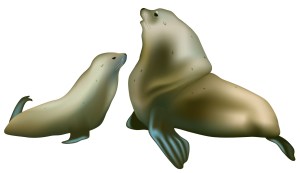
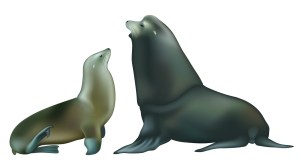
Steller sea lions - male on right. Image: Uko Gorter Natural History Illustration.


Having male Steller sea lions (Eumetopias jubatus) in our area is common. These giants (mature males up to 1,100 kg and 3.3 m) are the lighter coloured of the area’s two sea lion species.


In the last 7 years or so, we have also had some male California sea lion males (Zalophus californianus) around Northern Vancouver Island from the Fall into the Spring but they are far more common to the South.

California sea lions - male on right. Image: Uko Gorter Natural History Illustration.


The California sea lions are the darker and much smaller sea lion species (mature males to 390 kg and 2.4 m). The mature males have distinct light colouration on parts of their head and a very unique shape to their foreheads. However, beyond these very apparent physical differences, you could be blind and still tell California sea lions and Steller sea lions apart! California sea lions bark. Steller sea lions growl.

The sea lion activity I witnessed yesterday is really unique and all thanks to the return of the pilchard. I have never seen this many California sea lions anywhere around northern Vancouver Island and it is not often that I have seen mixed groups of both species hunting together. I checked with the locals in Port Alice and no one can recall ever seeing this many California sea lions in Neroutsos Inlet.

This phenomena has fortunately been captured on video for you to enjoy (video from the Village of Port Alice).  See below and look very carefully for the lighter coloured Steller sea lions among the barking Californians!  All these sea lions are likely to all be male. The smaller ones are the immature males.

Great thanks to the students of Seaview Elementary for caring and knowing as much as they do.  Psst, I would be watching the water very carefully because this pilchard driven food chain has transient killer whales at its top!


For locals: Added January 3rd, 2011

Update on the sea lion that crossed the road and entered the Port Alice trailer park on Dec 16th. Because he appeared to be underweight and lethargic, he was taken to the Vancouver Aquarium’s Marine Mammal Rescue Centre on Dec 18th (I think). It is a male Steller sea lion and was confirmed to be malnourished and dehydrated with no indication of what may have caused his condition. He has been named “Kaouk” after a mountain near Fair Harbour.

My great respect to the people of Port Alice for knowing to call DFO’s marine mammal response line (1-800-465-4336) and have the RCMP conduct crowd control. Ms. Henderson’s class even had made up info brochures on how to best behave around the sea lions.


Kelp Greenling Colour and Courtship

While diving this morning, I came across a kelp greenling couple while they were courting (Hexagrammos decagrammus to 60 cm).

In addition to being fascinated by the courtship behaviour, I was struck by the intense colouration, especially of the courting male.

Male kelp greenling. Normal colouration. ©2013 Jackie Hildering

Male kelp greenling. Normal colouration. ©Jackie Hildering

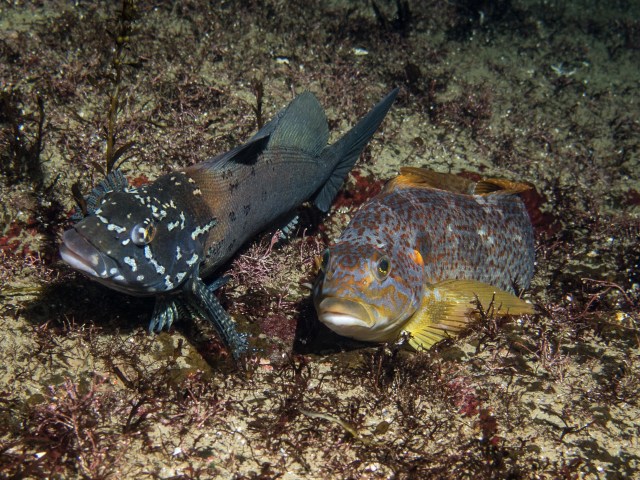
Mature male and female kelp greenlings look very different but I had never fully realized how the males’ gender specific colour intensifies during courtship.
Their bodies become much paler while the heads remain dark blue.

Courting male on left (note how much lighter the body is than the head); female on the right. © 2013 Jackie Hildering

Courting male on left (note how much lighter the body is than the head); female on the right. ©Jackie Hildering

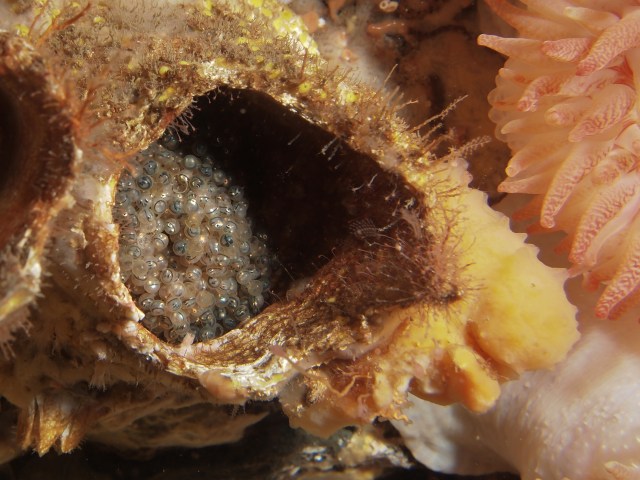
My 1.5 minute video below shows the courtship behaviour. After that there is a photo of eyed kelp greenling eggs.

Kelp greenling eggs in a giant barnacle shell. See the eyes?! © 2013 Jackie Hildering

Kelp greenling eggs in a giant barnacle shell. See the eyes?! ©Jackie Hildering

Fish Forever – The Wisdom of a Nine-Year-Old

Nature gave us sockeye salmon this year. A red-scaled, bounding life source, some 34 million fish strong.

This has led to human voices shouting out in all from gratitude to greed; from delight to denial.

Predictably, sadly, there have been far too many who have been at the “greedy denial” end of the spectrum. I will not tire you with that here though.

I want to fish out two voices of sanity from the ocean of opinions. One voice is that of reporter Stephen Hume from the Vancouver Sun. The other is nine-year-old Avery Walker who I am privileged to have as a member of my Northern Vancouver Island Young Naturalists’ Club.

Stephen Hume, award-winning author,  in The Vancouver Sun: “Columnists who apparently wouldn’t know the difference between a sockeye and a sculpin cluck and scold in a Toronto newspaper. One enthusiastically advances the argument that we should whack 30 million of the 34 million returning salmon . . . . . Instead of permitting a lust for instant gratification to derail a natural process for rebuilding small stocks, now is the time for restraint, for harvest restraint is a critical investment in future abundance. So enjoy your sockeye. Be grateful for this gift from nature. But don’t let the gong show of greed sway us from good stewardship.”

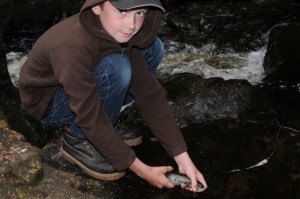
Avery Walker - Salmon Superstar. Photo by Larry Walker and Anna Marchand.

Avery Walker, 9-year-old Young Naturalist, with his prize-winning submission to the Wild Salmon Circle’s “Spawning Ideas” contest: “I fish only with barbless hooks, I’ve taken all the treble hooks from the all the buzzbombs I have and replaced them with single barbless hooks. I don’t jig the fish, I fish the ones who bite. Sometimes this is really hard to do, because not all of my friends fish like this, and so they sometimes take home more fish than I do. I abide by the regulations about which salmon I can keep and which ones I can’t. I never go over my limit. Or keep undersized fish. Most of the time, I catch and release. I love to fish, and I want to be able to do it forever.”

Thank you Avery. Thank you Stephen. Thank you all who make choices that may allow us to have  . . . fish forever.

For insights into the need for precaution in managing the harvesting and threats to the Fraser River sockeye, please click here for information from “Save Our Salmon”.

Sharks Among Us #1 – The Blue Shark

The image below is of a Pacific Blue Shark (Prionace glauca) being rescued by Lindsey Pattinson of Tiderip Grizzly Tours on July 15th, 2010 in Glendale Cove, British Columbia.

Lindsey Pattinson rescuing a blue shark. Photo: Nick and Sue Spiller. 

Many British Columbians are unaware that we have at least 13 species of shark among us, ranging from the smaller species such as the Spiny Dogfish up to the 6-gill shark (5 m+) and the very, very rare Basking Shark (9 m+). The beautiful Blue Shark reaches a maximum of 3.8 meters and is distinct in its deep blue colouration and slender shape.

The Slue Shark is common in B.C. and is, in fact, extremely far ranging and widespread. It is found from Alaska to Chile in the Pacific but is also present in the Atlantic and Indian Oceans.  It has been found in waters from 7 to 16°C, latitudes of 60°N to 50°S and from the shallows to depths of 350 m (being more often at depth in warmer waters).

In researching the species after Lindsey’s find, I discovered that Blue Sharks undertake very large migrations, reportedly up to 9,200 km, moving north in the summer months.  More females than males move to the higher latitudes.

But, of course a sighting like this in Glendale Cove is an enormous rarity. Even with the Blue Shark being common in B.C., they are more often oceanic, on the continental shelf . . . not on the beach in Glendale!

For whatever reason, the animal stranded there and Lindsey cared enough to do what he could to save it.  Many shark species need to keep swimming in order to have oxygen-rich water pass over their gills. Knowing this, Lindsey moved the stranded shark back and forth in the water, forcing water over its gills and indeed, he revived it. He and the tourists he was guiding on the Grizzly Bear (and shark) watching trip had the joy of watching the animal swim to depth.

Thanks to Lindsey, this Blue Shark will be able to have more days of feeding on anchovy, mackerel, salmon, hake, dogfish, crustaceans and squid. It may also scavenge here and there and even feed on aggregations of krill by straining the water in the way a baleen whale would.

I suspect the Glendale Cove shark was a female and with Blue Sharks being a very prolific species, now saved, she could go on to bear 25 to 50 pups at a time (apparently even as many as 135)!  These young would grow inside her as the blue shark is “viviparous”, meaning they bear fully formed young. The pups are 35 to 44 cm at birth.

I was fascinated to learn that blue shark females can apparently “get pregnant” up to 20 months AFTER mating. They can store sperm packets in special glands in their reproductive tract called “shell glands” (aka nidamental glands) and pass their eggs through these glands to get fertilized.

If the rescued Blue Shark was indeed female, she may not have been able to feel much of Lindsey’s caring touch since the females are up to 3 times thicker skinned that the males! This adaptation is believed to allow the females to deal with the males since there is a lot of biting during courtship.

Unfortunately, the fate of Blue Sharks can also be to become the bycatch of longline and driftnet fisheries. One source reported that in one year alone (1990) “it is conservatively estimated that by-catch of blue sharks taken by the Japanese squid fleet in the North Pacific totalled 700,000.”

Further life history: Males sexually mature at 4–6 and females at 5–7 years. Believed to live to age 20.

For more photos of the blue shark rescue, click here.

Great thanks to Nick and Sue Spiller for sharing these photos.

Sources include:

It’s Raining Fish?!

Juvenile yellow-tail rockfish.

Recently, I noticed a lot of splashing in a tideline off Telegraph Cove, BC. I share my observations with you via the little video clip at the link below.

You’ll note that it looks like big rain drops are hitting the water.

I discovered that what was creating the splashing were juvenile yellow-tail rockfish feeding on zooplankton. The zooplankton, including a small species of krill, had been concentrated at the surface by the big tidal exchange. There had been almost a 4 metre exchange between high and low tide (more than 12 feet).

I also discovered a very unique larval fish in the tideline that day but will share that discovery in a future “The Marine Detective”.

Click here for the video of the yellow-tail rockfish feeding in the tideline.

Enjoy!