Join me in the cold, dark, life-sustaining NE Pacific Ocean to discover the great beauty, mystery and fragility hidden there.

Posts from the ‘FISH – NE Pacific Ocean’ category

Sharks Among Us #1 – The Blue Shark

The image below is of a Pacific Blue Shark (Prionace glauca) being rescued by Lindsey Pattinson of Tiderip Grizzly Tours on July 15th, 2010 in Glendale Cove, British Columbia.
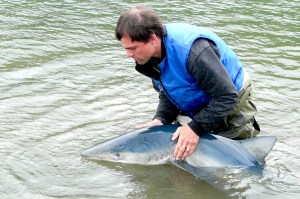
Lindsey Pattinson rescuing a blue shark. Photo: Nick and Sue Spiller. 

Many British Columbians are unaware that we have at least 13 species of shark among us, ranging from the smaller species such as the Spiny Dogfish up to the 6-gill shark (5 m+) and the very, very rare Basking Shark (9 m+). The beautiful Blue Shark reaches a maximum of 3.8 meters and is distinct in its deep blue colouration and slender shape.

The Slue Shark is common in B.C. and is, in fact, extremely far ranging and widespread. It is found from Alaska to Chile in the Pacific but is also present in the Atlantic and Indian Oceans.  It has been found in waters from 7 to 16°C, latitudes of 60°N to 50°S and from the shallows to depths of 350 m (being more often at depth in warmer waters).

In researching the species after Lindsey’s find, I discovered that Blue Sharks undertake very large migrations, reportedly up to 9,200 km, moving north in the summer months.  More females than males move to the higher latitudes.

But, of course a sighting like this in Glendale Cove is an enormous rarity. Even with the Blue Shark being common in B.C., they are more often oceanic, on the continental shelf . . . not on the beach in Glendale!

For whatever reason, the animal stranded there and Lindsey cared enough to do what he could to save it.  Many shark species need to keep swimming in order to have oxygen-rich water pass over their gills. Knowing this, Lindsey moved the stranded shark back and forth in the water, forcing water over its gills and indeed, he revived it. He and the tourists he was guiding on the Grizzly Bear (and shark) watching trip had the joy of watching the animal swim to depth.

Thanks to Lindsey, this Blue Shark will be able to have more days of feeding on anchovy, mackerel, salmon, hake, dogfish, crustaceans and squid. It may also scavenge here and there and even feed on aggregations of krill by straining the water in the way a baleen whale would.

I suspect the Glendale Cove shark was a female and with Blue Sharks being a very prolific species, now saved, she could go on to bear 25 to 50 pups at a time (apparently even as many as 135)!  These young would grow inside her as the blue shark is “viviparous”, meaning they bear fully formed young. The pups are 35 to 44 cm at birth.

I was fascinated to learn that blue shark females can apparently “get pregnant” up to 20 months AFTER mating. They can store sperm packets in special glands in their reproductive tract called “shell glands” (aka nidamental glands) and pass their eggs through these glands to get fertilized.

If the rescued Blue Shark was indeed female, she may not have been able to feel much of Lindsey’s caring touch since the females are up to 3 times thicker skinned that the males! This adaptation is believed to allow the females to deal with the males since there is a lot of biting during courtship.

Unfortunately, the fate of Blue Sharks can also be to become the bycatch of longline and driftnet fisheries. One source reported that in one year alone (1990) “it is conservatively estimated that by-catch of blue sharks taken by the Japanese squid fleet in the North Pacific totalled 700,000.”

Further life history: Males sexually mature at 4–6 and females at 5–7 years. Believed to live to age 20.

For more photos of the blue shark rescue, click here.

Great thanks to Nick and Sue Spiller for sharing these photos.

Sources include:
It’s Raining Fish?!

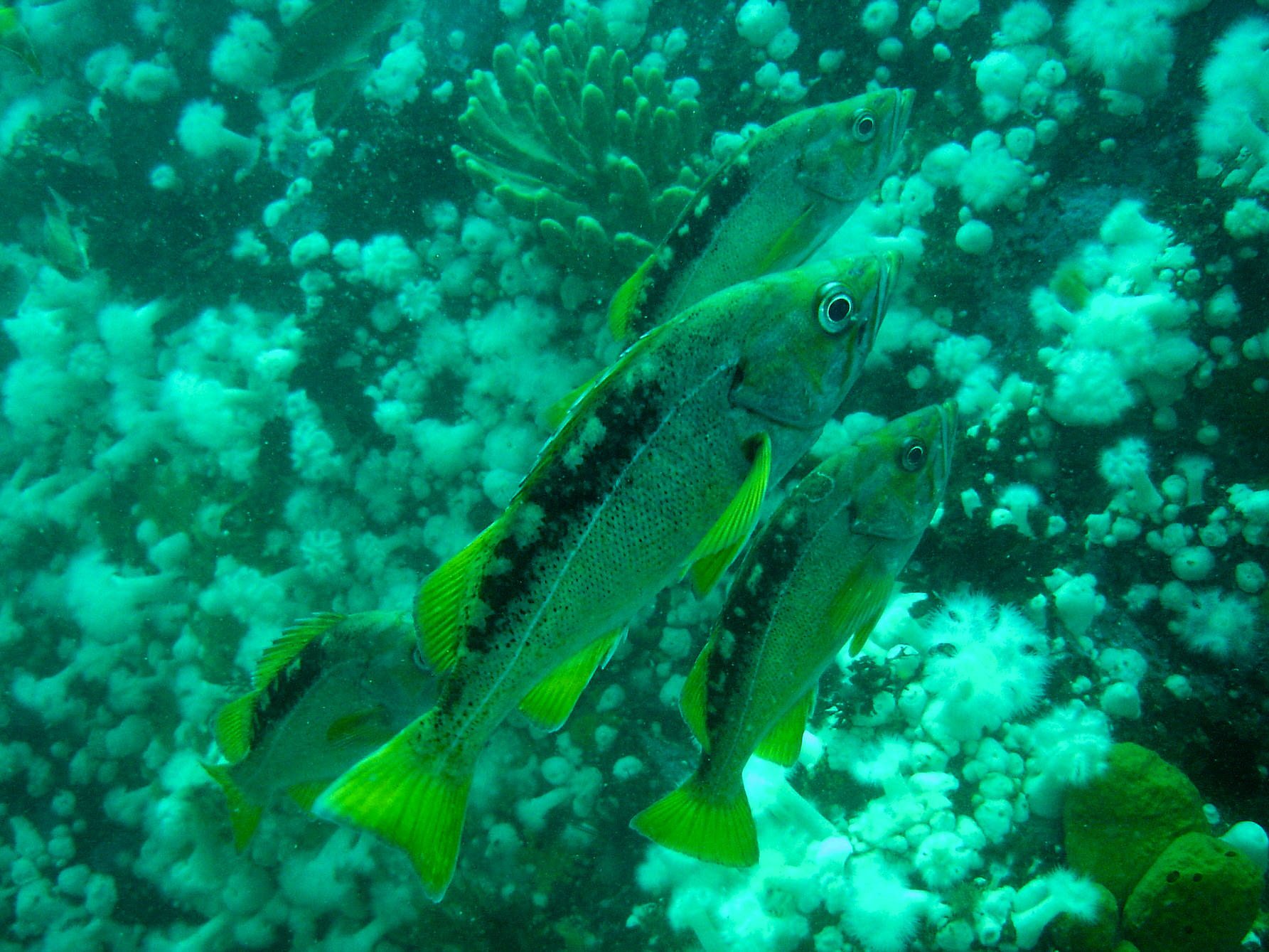
Juvenile yellow-tail rockfish.

Recently, I noticed a lot of splashing in a tideline off Telegraph Cove, BC. I share my observations with you via the little video clip at the link below.

You’ll note that it looks like big rain drops are hitting the water.

I discovered that what was creating the splashing were juvenile yellow-tail rockfish feeding on zooplankton. The zooplankton, including a small species of krill, had been concentrated at the surface by the big tidal exchange. There had been almost a 4 metre exchange between high and low tide (more than 12 feet).

I also discovered a very unique larval fish in the tideline that day but will share that discovery in a future “The Marine Detective”.

Click here for the video of the yellow-tail rockfish feeding in the tideline.

Enjoy!

Who’s Your Daddy?

Scalyhead Sculpins are a tiny fish but the males have a giant parenting role (species Artedius harringtoni).

I found what I believe were this species’ eggs while guiding a recent beach study (Port Hardy, BC).

To share this information, and my photos, I’ve tried something new. Below, you’ll find a slideshow that I have narrated to explain how Scalyhead Sculpins are super dads.

Yes, that’s right, you get to hear my voice this week (oh-so-human stumbled speech and all!). Please realize I am speaking as I would to a +/- 10 year old.

Manta Ray Magic – Fiji


In December of 2009, I had the extraordinary privilege of seeing manta rays while diving off Kaduva Island with the dive crew from the Matava Eco-Resort. It is thanks to the environmental ethic of this team that these dives are very controlled to make sure the animals are disturbed as little as possible.

The video allows us to share all the observations listed below as well as giving you the chance to laugh when you hear my underwater screams of joy when the mantas break from their feeding behaviour, get into a formation of 5 animals and swim by us 4 times!  I didn’t even realize I was making these sounds but my dive buddy was there behind me, capturing it on video.


The video shows:

  • Holy manta rays are big!  They are the biggest rays in fact; up to almost 7 m across and more than 1,000 kg.  The ones we saw are probably about 4 m across.
  • They are very “alien” looking animals.  They feed on plankton and small fish and can scoop more food using the two big paddle-shaped flaps (“cephalic lobes”) that are just to the inside of their eyes. You will see from the murkiness of the water that it is thick with plankton.  The circular diving pattern of the mantas is believed to help them concentrate the plankton.
  • That manta rays have a relatively short tail for a ray, no stinging spine and you’ll see one animal in the video that has had their tail shredded off, likely by a tiger shark.
  • That sometimes there are remoras attached to the manta rays. These fish may help in removing parasites and have the benefit of transportation, being less visible to predators and possibly getting some scraps as snacks.
  • That mantas are incredibly graceful, having very flattened bodies and big wing-like fins.
  • They can be told apart as individuals. Of course the one with the shark injury is easy to tell apart from the others. There is also one that has had its left fin tip bitten off.  But if you look even more closely, you’ll see that each animal has unique markings on their upper and undersides. We passed on our photographs and video for research but, even though they are easy to tell apart, so little is known about them.
  • They are intelligent and coordinate their movements. This is what I found the most fascinating of all, how they knew to all get into a line at the same time and as each of them came by, they were observing me.  They pivoted their eyes back to get the longest look possible at the strange creature who couldn’t stop from screaming out in sheer amazement.