Join me in the cold, dark, life-sustaining NE Pacific Ocean to discover the great beauty, mystery and fragility hidden there.

Posts from the ‘Sea Slugs / Nudibranchs’ category

Sea Slug Easter Eggs For You!


Giant nudibranch's eggs laid at the base of its food, the tube-dwelling anemone. Each dot is an egg. © Jackie Hildering

Giant nudibranch’s eggs laid at the base of its food, the tube-dwelling anemone. Each dot is an egg. © Jackie Hildering

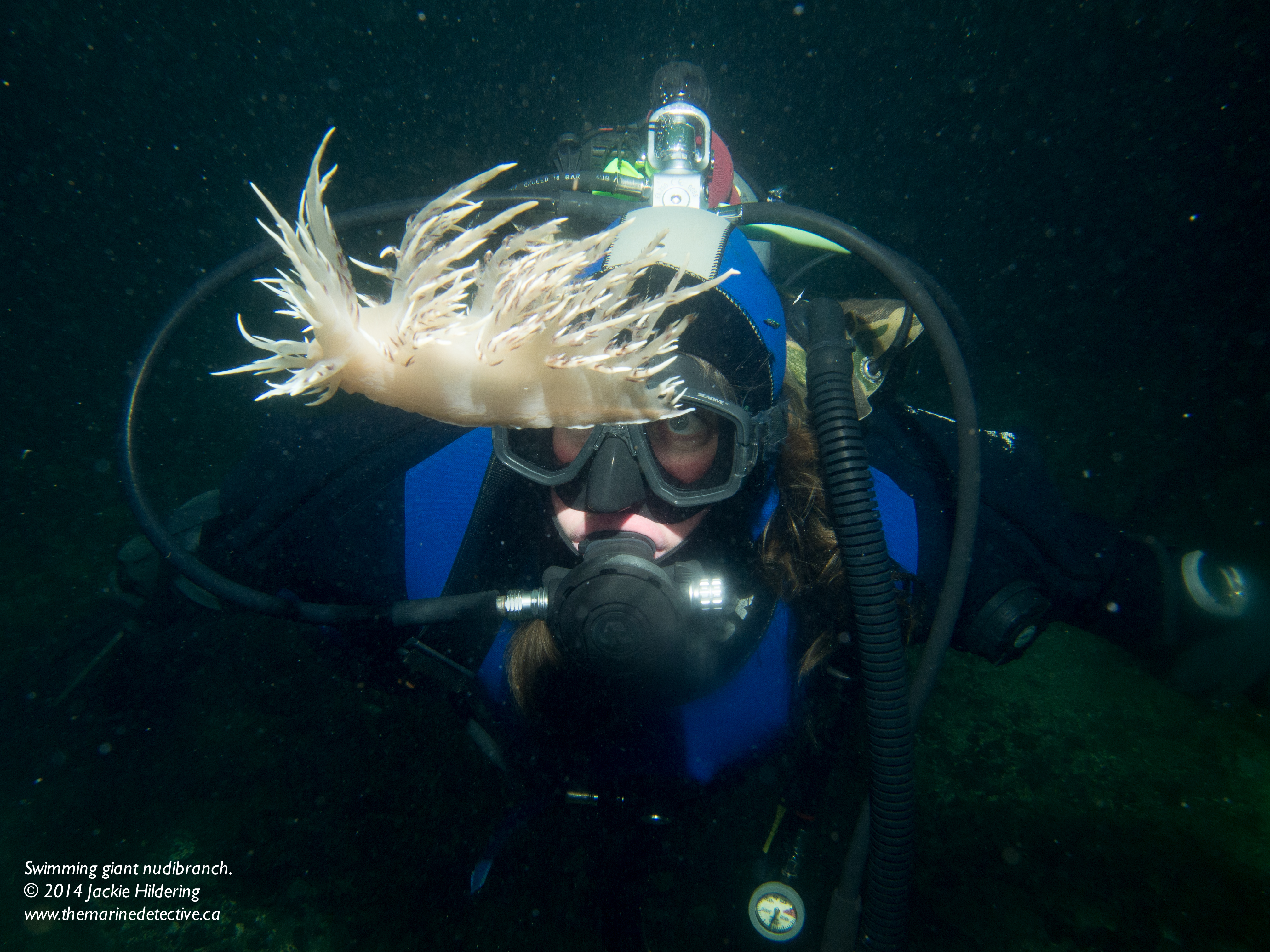
To follow up on last week’s posting about the feeding of giant nudibranchs, “Who’s eating who”, I now share images of the giant nudibranch swimming and of its egg-laying behaviour.

I know that these are the strangest eggs you will see this Easter!

The story of how the eggs come to be is pretty unique too.

There are no girl or boy sea slugs. They are both male and female; they are hermaphrodites. This means that when sea slugs mate, both animals “get pregnant” and lay eggs.

Sea slugs need this adaptation because it is really difficult for them to find another of their kind.  They are relatively slow moving animals that depend on feel and smell to get around.

They don’t search around aimlessly for a mate though. That would be a waste of energy. The chances of finding a member of their own kind are greater near their favourite food.  To make this clearer, imagine that you were someone who really loved eating pizza and you wanted to find someone else who loved pizza.  The best place to find them would be at  . . . a pizza parlour!

For the giant nudibranch, you know from last week’s posting that they love to eat tube-dwelling anemones so they are likelier to meet a mate around this prey.  They also may give off chemical signals (pheromones) to announce that they are in the area and “looking for love”.

Compared to faster animals that can see though, the chances of sea slugs finding one another are much smaller.  So when they do meet, it is important that they really make it count and have as many babies as possible especially since the eggs will hatch into plankton. This means that many baby sea slugs will become dinner for filter feeders like anemones and barnacles.

How to have as many babies as possible?  Both should lay eggs! This is why they are hermaphrodites; not just a male or female.  The sea slugs line up right side to right side and exchange cells so that they can both lay eggs.

I will share much more about the love life of sea slugs in future postings. Every sea slug species lays eggs that look very different. One of the “cases” I have worked on the longest is to figure out what each species’ eggs look like. A great clue in trying to figure this out is that sea slugs most often lay eggs on their food.

You can imagine my delight when I found a big mass of eggs at the base of a tube-dwelling anemone!  Knowing that the giant nudibranch preys on this species, the chances were very, very good that these were its eggs.

When you follow the link, you can see a larger picture of the eggs mass and get an idea of just how many eggs are in this string (each dot is an egg).

I have also included video of the giant nudibranch swimming for your Easter weekend pleasure.  You’ll see that the nudibranch swims upwards but, when it wants to go down, it just stops moving and gently drifts back down to the ocean bottom. You’ll also see that I am pointing my dive light at the animal and how this makes colours look different underwater.


Who’s Eating Who?

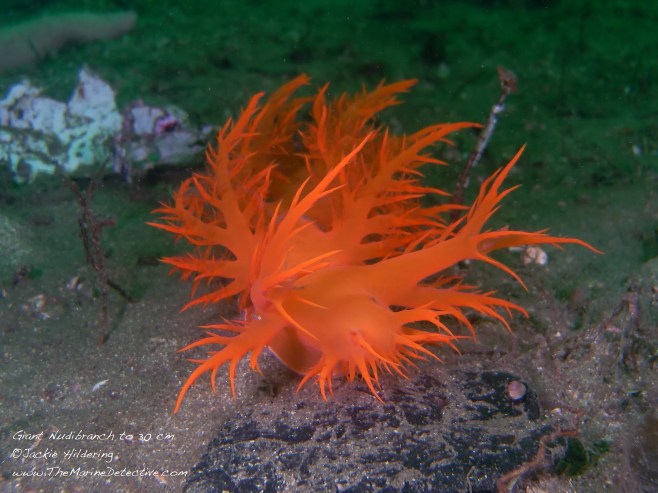
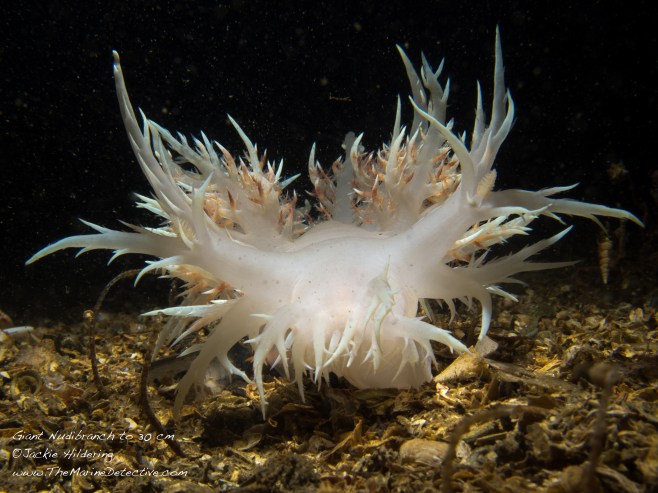
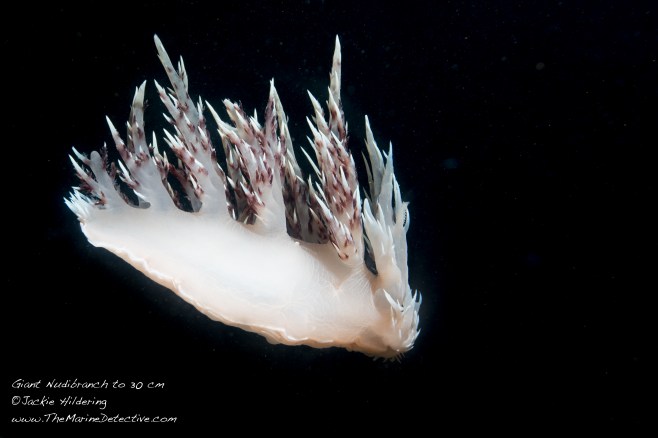
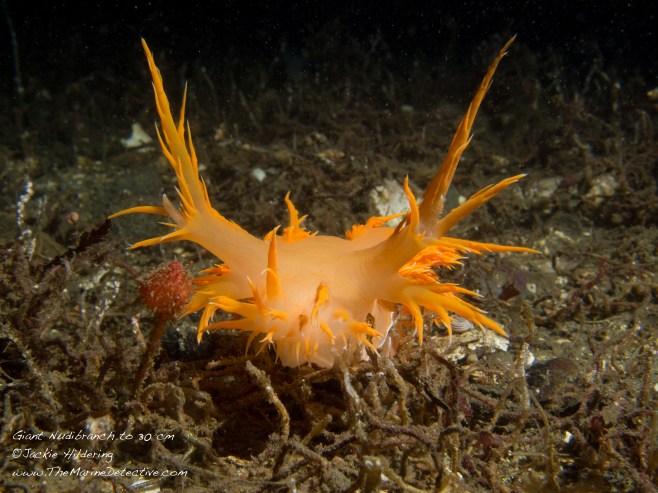
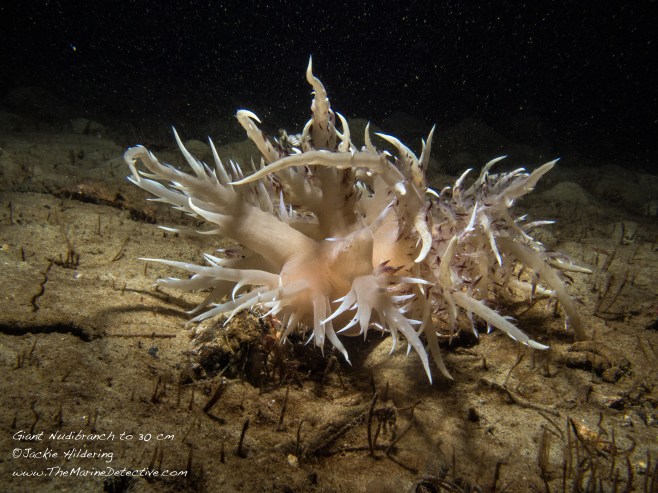
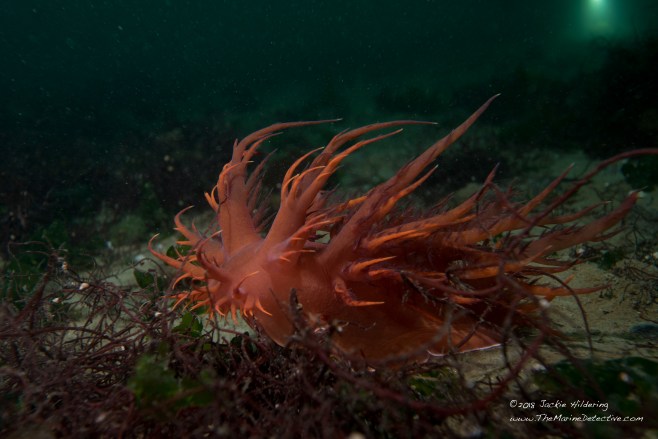
Giant Nudibranch (Dendronotus iris) on the prowl for tube-dwelling anemones. This species of nudibranch has great variation in colour. © Jackie Hildering

Giant Nudibranch on the prowl for Tube-Dwelling Anemones. This species of nudibranch has great variation in colour. See photos at end of blog. ©Jackie Hildering

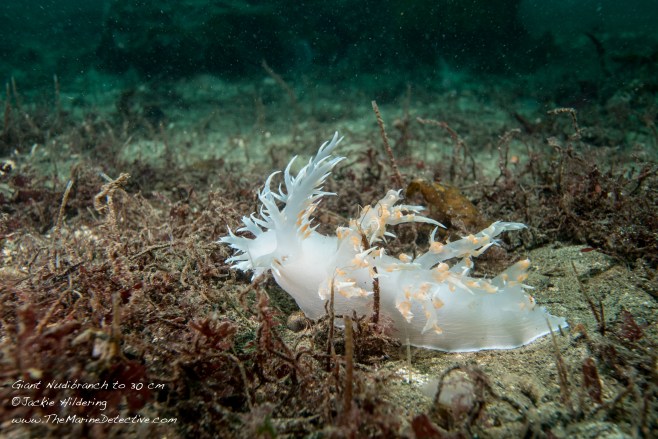
This “case” features the Giant Nudibranch (Dendronotus iris to 30 cm long) and the Tube-Dwelling Anemone (Pachycerianthus fimbriatus).

The Giant Nudibranch’s favourite snack is this anemone species. It is not impacted by the anemone’s stinging cells (nematocysts). 

Giant nudibranch launching into a tube-dwelling anemone. © Jackie Hildering

Giant Nudibranch launching into a Tube-Dwelling Anemone. © Jackie Hildering

The Tube-Dwelling Anemone is therefore adapted to be able to withdraw into its tube (which can be up to 1 m long)  in an attempt to get away from the predator sea slug.

And the battle is on! The Giant Nudibranch patrols the sandy ocean plains “looking” for the Tube-Dwelling Anemone. When it finds one, it rears up and pounces, mouth parts extended in the hopes of grabbing onto the anemone. When the anemone senses the nudibranch’s attack, it withdraws into its tube.

Wait till you see what happens to the Giant Nudibranch!

See below for a short clip of such an attack.

[

But that’s not all, this nudibranch species also swims.

By lifting off, it may land somewhere with better chances for feeding and mating. See video below. 

OLYMPUS DIGITAL CAMERA

As is also generally the way with sea slugs, they also lay their eggs on their prey.

And oh the diversity in colour among Giant Nudibranchs. See photos below.


And here are a few more pouching on their prey.


Interspecies interaction: When this Giant Nudibranch touched the Leather Star, it touched it again and then recoiling with an acute change in direction. The diet of Leather Stars (Dermasterias imbricata) is omnivorous. From Neil McDaniel: “Eats a wide variety of prey, depending on the locale. On the open coast it consumes plumose anemones and tunicates; in sheltered areas it eats orange sea pens, sea vase tunicates, encrusting sponges and bryozoans.” So, Leather Stars are not likely to eat a Giant Nudibranch, especially because Leather Stars are not particularly fast sea stars (15 cm/min) and Giant Nudibranchs can swim away (yes, that’s right they swim). Leather Stars’ skin is known to contain a unique chemical “imbricatine” that does elicit an escape response form Swimming Anemones so . . . whether the Leather Star felt or “tasted” odd to the Giant Anemone, it did “decide” that distancing was the better way to go.

Note: Dendonotids are not known to utilize the stinging cells (nematocysts) of their prey. From the Sea Slug ForumThere has been some confusion in the literature concerning the presence of branches of the gut in the ‘gills’ or ‘cerata’ of species of Dendronotus. Firstly there is no evidence to suggest that any species of Dendronotus has cnidosacs at the tip of its dorsal processes in which to store nematocysts. In fact there is no evidence that they store nematocysts from their prey anemones in any part of their body.