Join me in the cold, dark, life-sustaining NE Pacific Ocean to discover the great beauty, mystery and fragility hidden there.

Posts from the ‘Bivalves’ category

Who Goes There? Sea Otter feeding pits

Who goes there?!
Or should that be – who DIGS there?!

This is the pit resulting from a Sea Otter digging after a Pacific Geoduck – a very large, very long-lived clam species.
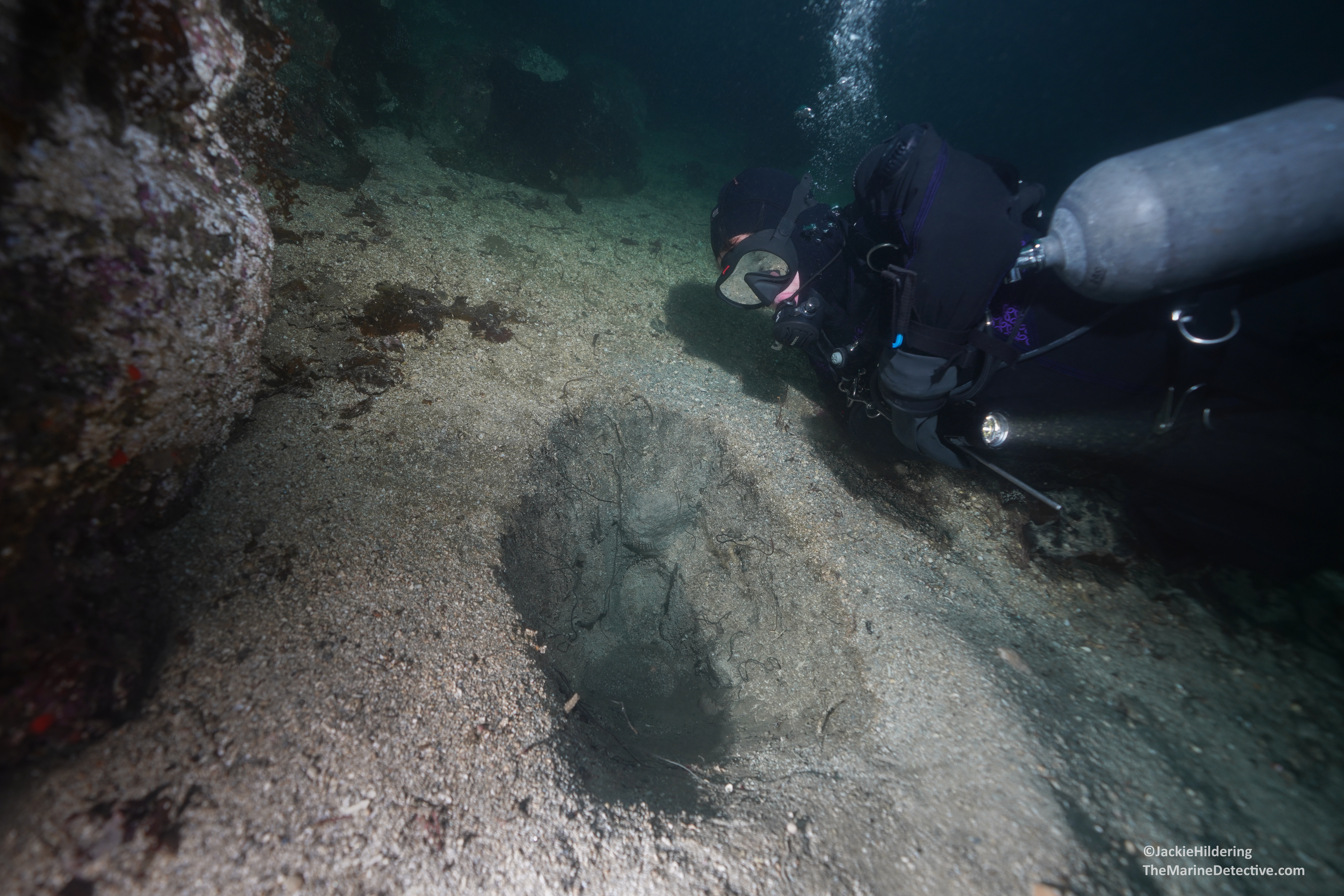
Dive buddy Natasha Dickinson posing beside the pit to give you a better indication of its size.
Photo: January 1st, 2025, ©Jackie Hildering.

If you see a Sea Otter going up and down in the same location without coming up with prey the first time (and breaking it open on their belly), this is likely what is happening.

Sea Otter with a Pacific Geoduck.
Photo: March 27, 2021, ©Jackie Hildering.

Geoducks have very long siphons (neck or shaft) and can be buried 1 metre below the surface. So it’s quite the endeavour when Sea Otters excavate Geoducks. My photo of the deep pit should aid in understanding why this is the case!
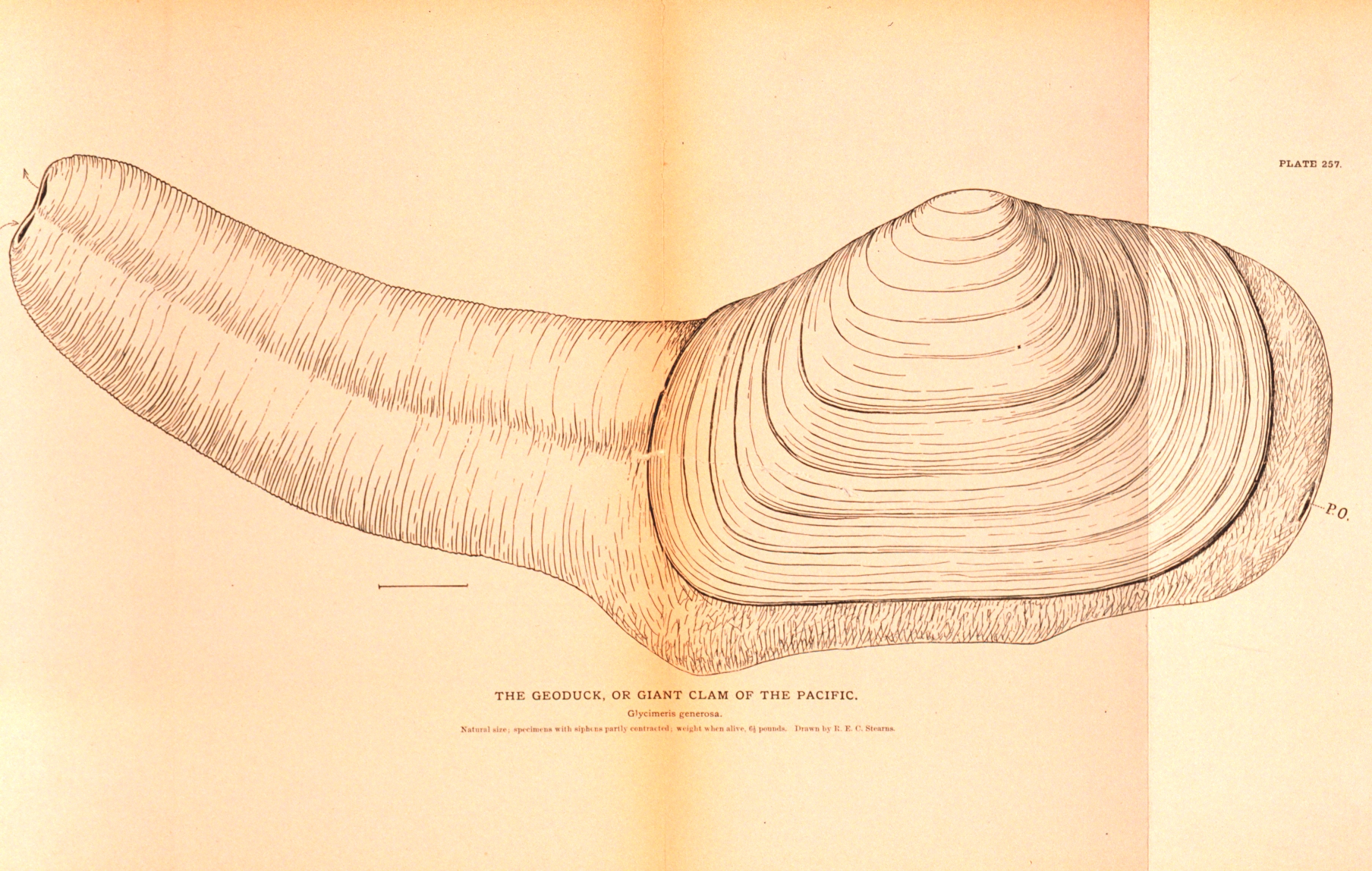
Pacific Geoduck (Panopea generosa) – World’s largest burrowing clam. Can live to ~160 years.
Source: Goode G. B. (1880). The Fisheries and Fisheries Industries of the United States via Wikimedia Commons.
Pacific Geoduck ©Fisheries and Oceans Canada

Sea Otters are reported to be able to dive up to 5 minutes (more often ~1 minute) but that’s unlikely when exerting themselves when digging like this.

Did the Sea Otter get this Geoduck? We don’t know for sure but there was an empty shell of a Geoduck near the pit.

Note that we did not dive in the presence of Sea Otters. Diving or swimming with marine mammals is illegal in Canada.

Geoduck shell near Sea Otter feeding pit.
Photo: April 20, 2019, ©Jackie Hildering.
Another Sea Otter feeding pit and dive buddy Natasha Dickinson.
Photo: January 9, 2021 ©Jackie Hildering

Background on Sea Otters in British Columbia

Sea Otters were completely wiped out (extirpated) with the last verified Sea Otter in Canada having been shot in 1929 near Kyuquot (NW Vancouver Island).

There are now over 8,100 Sea Otters off the coast of BC (Nichol et al. 2020). How did that happen? Around 89 Sea Otters were translocated to the outer coast of Vancouver Island from 1969 to 1972 (as a mitigation measure for nuclear testing in Alaska).

The population grew (and spread out) from there. And yes, they eat a lot. Even with their incredibly dense fur (which made them so “desirable” in the fur trade), they need to fuel their furnace by eating up to 1/4 of their body mass daily to survive in the cold ocean.

More Sea Otters = more kelp forests (since they eat the urchins that eat the kelp) = more habitat, more oxygen, more food, and more carbon sequestration.

Sea Otters are recognized as a species of Special Concern in Canada.


More Information

Sea Otters
– CBC, To oblivion and back – How sea otters are radically changing the West Coast ecosystem 50 years after their return to B.C.
– Nichol, L.M., Doniol-Valcroze, T., Watson J.C., and Foster, E.U. 2020. Trends in growth of the
sea otter (Enhydra lutris) population in British Columbia 1977 to 2017
. DFO Can. Sci. Advis.
Sec. Res. Doc. 2020/039. vii + 29 p.

Pacific Geoduck
– DFO, Geoduck clam
– IFLScience, What Is a Geoduck? The Ocean’s Giant Burrowing Clam
– iNaturalist.ca, Pacific Geoduck
Who Goes There? Dizzying tracks in the sand.

Let me take you on a little mystery that filled me with big wonder, inspiration and happiness.

It goes back to July of 2017 when I was naturalist around Haida Gwaii with Maple Leaf Adventures.

Let’s make it a photo essay.

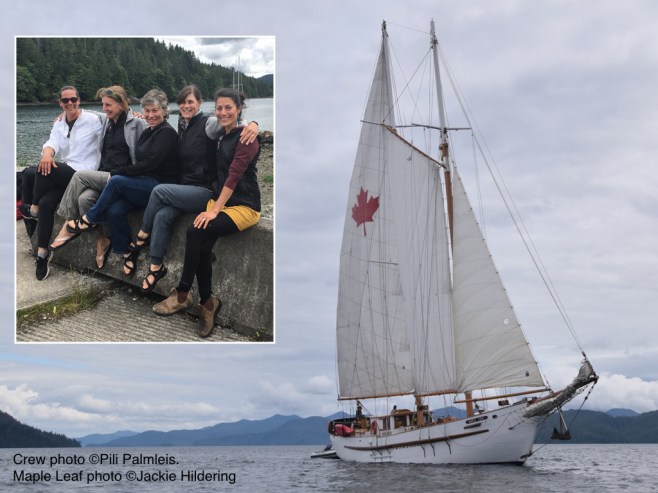
To set the stage, here’s the boat and the crew.

Crew from left to right: Mate -Lynsey Rebbetoy, Deckhand -Terese Ayre, Naturalist -You-Know-Who, Captain- Ashley Stokes, Chef -Yasmin Ashi.

You’ll note that the beautiful, historic sailing ship was operated by an all female crew on this trip. Important to note? Yes, but let me not digress.

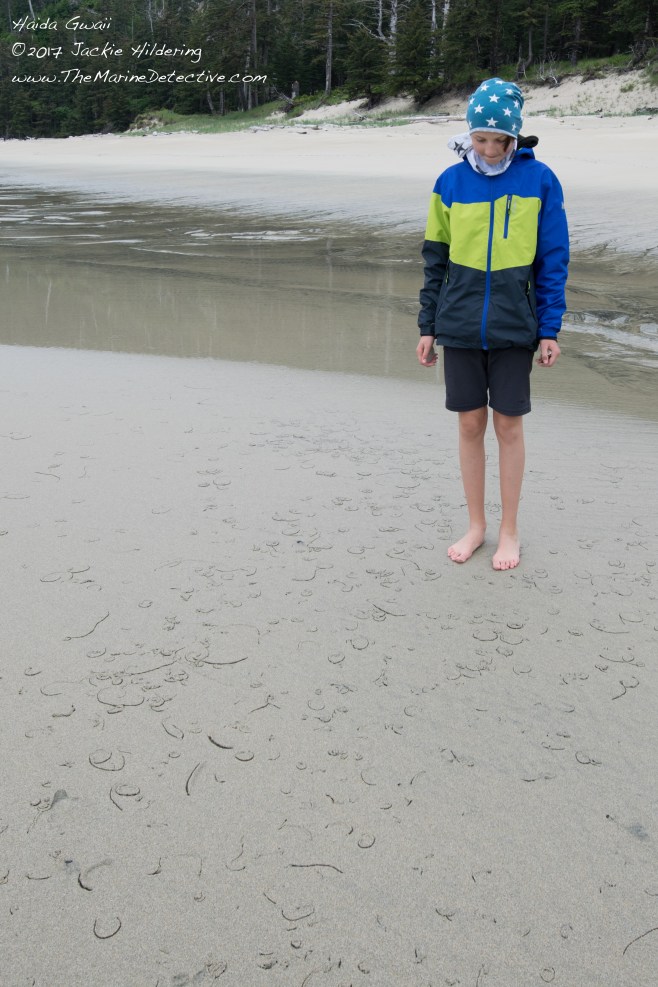
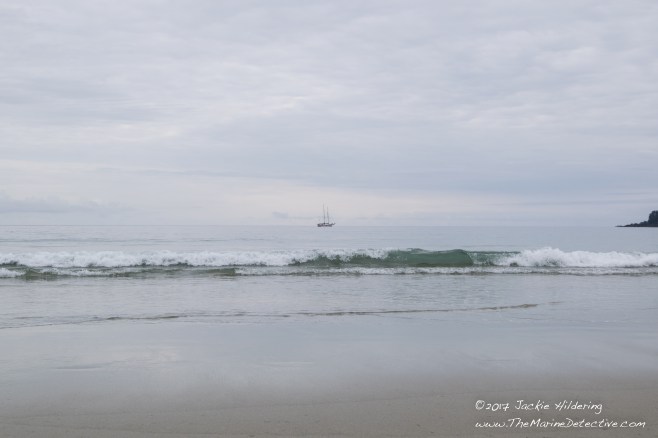
Here’s the beach at Woodruff Bay near Cape St. James.

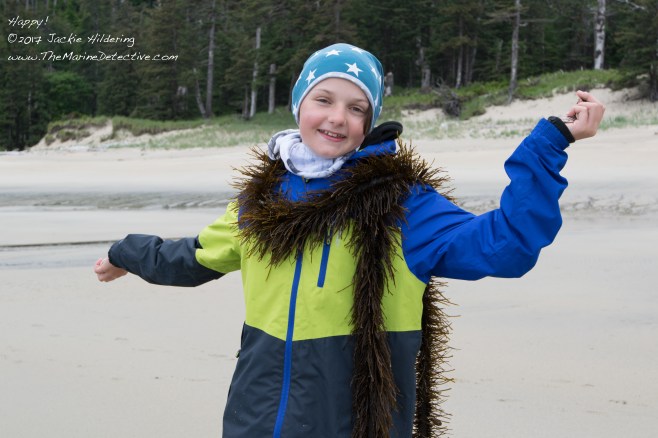
The discovery was made by the child I was so glad was on the trip.

Meet Kay from Germany.

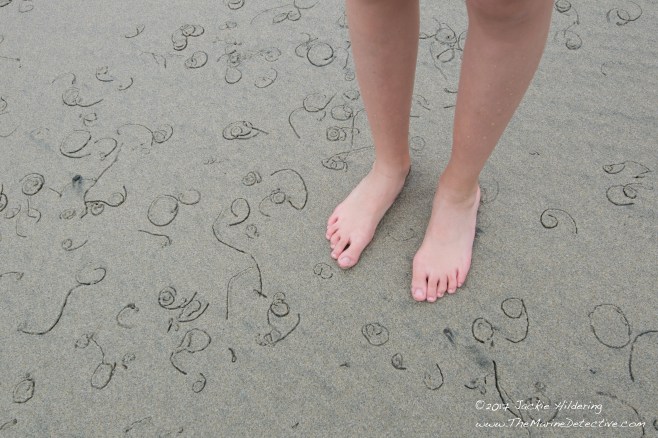
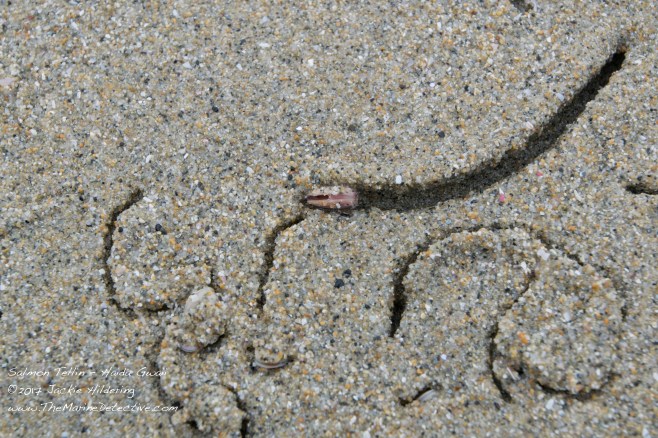
Like any smart, curious and observant young person would, she asked what had made the crazy, convoluted patterns in the sand.

Here’s a closer look . . .

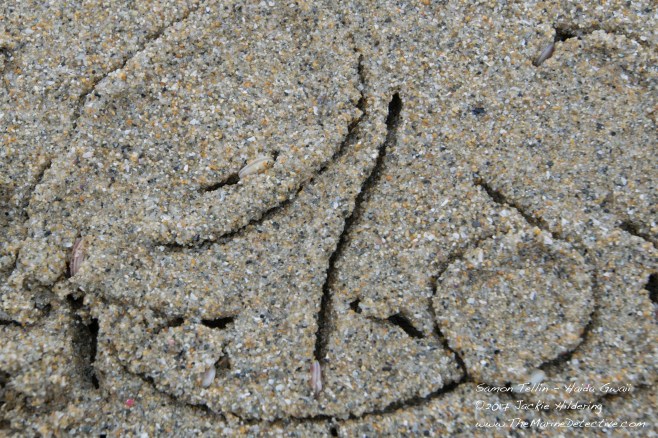
. . . and an even closer look.

I didn’t know what species had made those remarkable, dizzying tracks. But, the best things had come together – a mystery, a child, and the chance to discover the answer together.

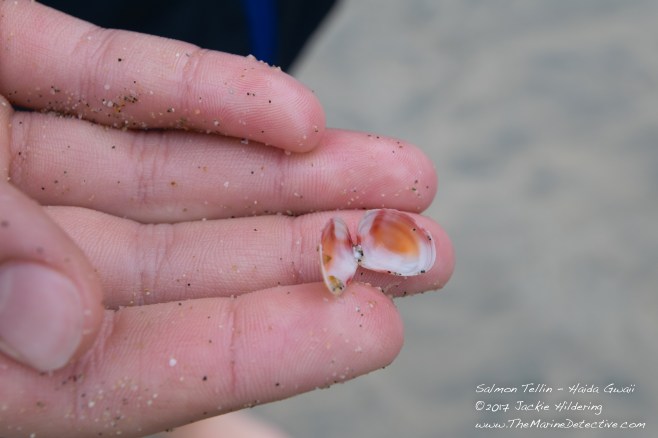
We struck out to solve the mystery and found lots of little clam shells near the tracks.


We looked more closely at the tracks.

And found the tiny clams IN the tracks.

And then we noted what they were doing. They were licking the sand!

We had found the animal that was making the tracks and concluded the tiny clams must be feeding on organic material in this way. It is known as “deposit feeding” whereby the bivalves use their inhalant siphons to sweep the sand for detritus and microbes = snacks.

We were in awe at thinking of how much sand they must process to leave such long individual tracks and that they must be doing this quite quickly.

Upon returning to the ship, I was able to use the resources there to determine that the tiny clam was some species a “Tellin”.

However, it took my emailing my mollusc expert friends to have the species of Tellin confirmed.

Naturalist supreme, Bill Merilees, let me know I had “met British Columbia’s most beautiful clam Tellina nuculoides, the Salmon Tellin.” He also shared the results of his work to study their growth rings (imagine the dedication needed to count the growth rings of a large sample of tiny clams.) Bill’s research suggests Salmon Tellins can live to age 11 or 12.

Armed with their species name, I was able to find out a bit more.Their maximum size is 2 cm and their range is from southern Alaska to northern California. I presume the “salmon” in their common name refers to their beautiful colour.

I became even more awe-inspired to learn that research supports that bivalves like Tellins select particles based on physical and/or chemical properties that are poorly understood! (Source: https://doi.org/10.1016/j.jembe.2004.03.002.)

Imagine THAT while you watch my blurry video of the Salmon Tellins licking the sand.

To conclude, I will resist all the puns I could be using to be “tellin” it like it is. (Oops, clearly I am not entirely successful in resisting.)

Rather, I will share the quote with which mollusc expert Rick Harbo responded when I asked him about the species and their tracks.

He reflected on the tracks made by mollusc species who feed in this way with the words of Gandalf from Lord of the Rings  . . .

“All who wander are not lost”.


The happiness that comes with connection to nature and making discoveries – Kay with a boa of “Feather Boa Kelp” that had washed onto the beach. Be on the lookout for Salmon Tellins on a fine sand beach from Alaska to California. Note that other mollusc species (and worms, some sea slugs, etc) also leave tracks in the sand. More on other trail-blazing species in the future.