Join me in the cold, dark, life-sustaining NE Pacific Ocean to discover the great beauty, mystery and fragility hidden there.

Posts from the ‘Sea Stars’ category

Survivors

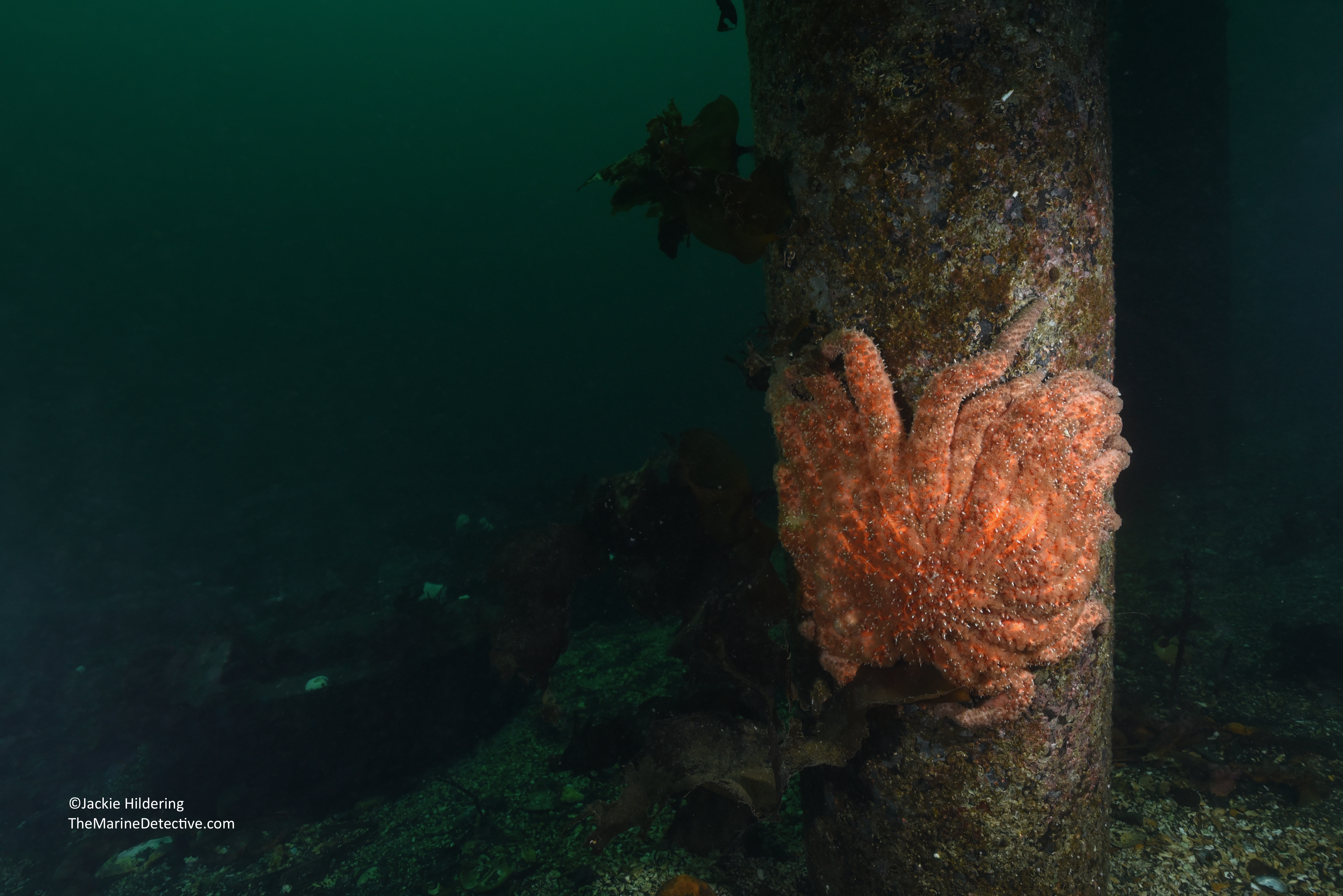
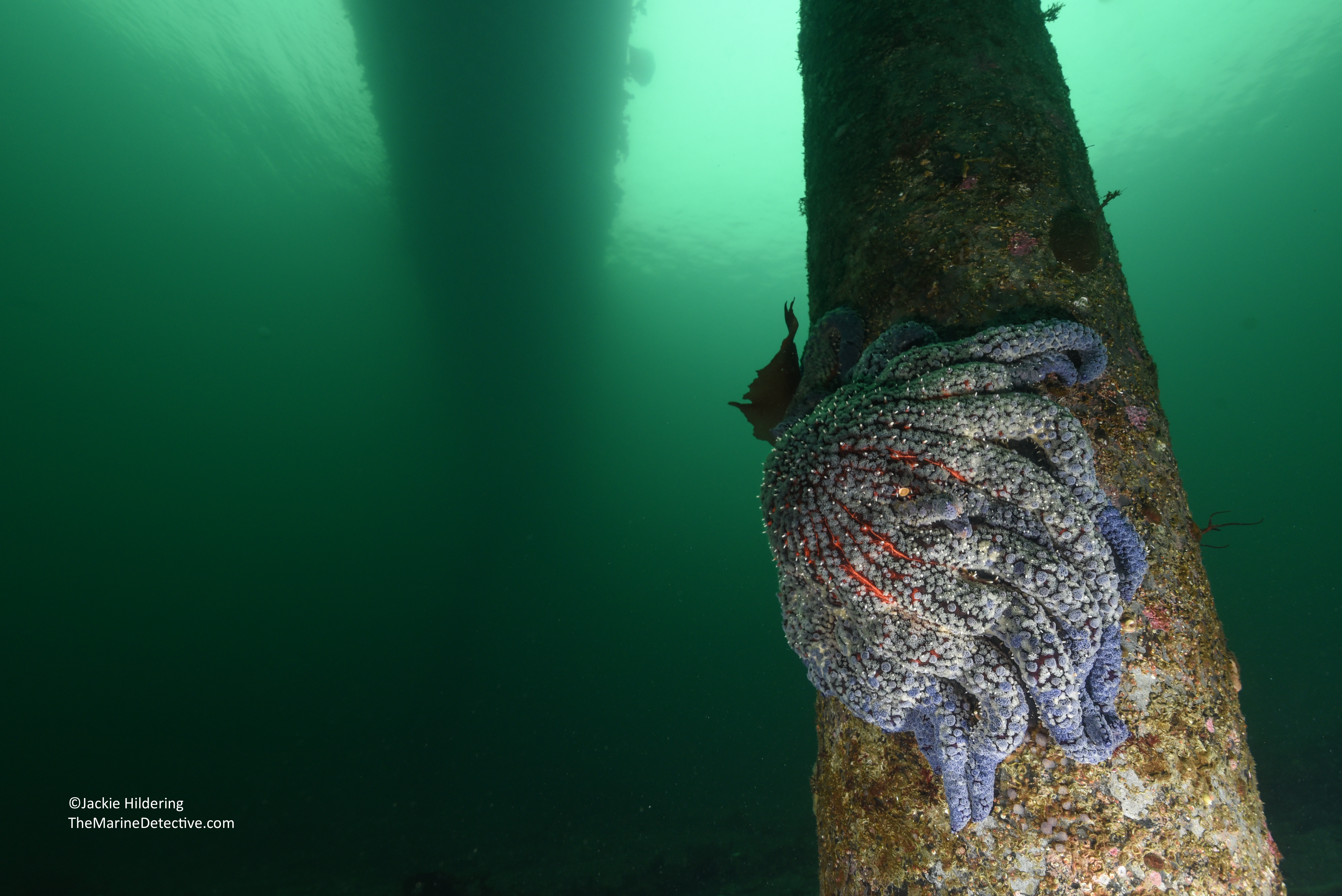
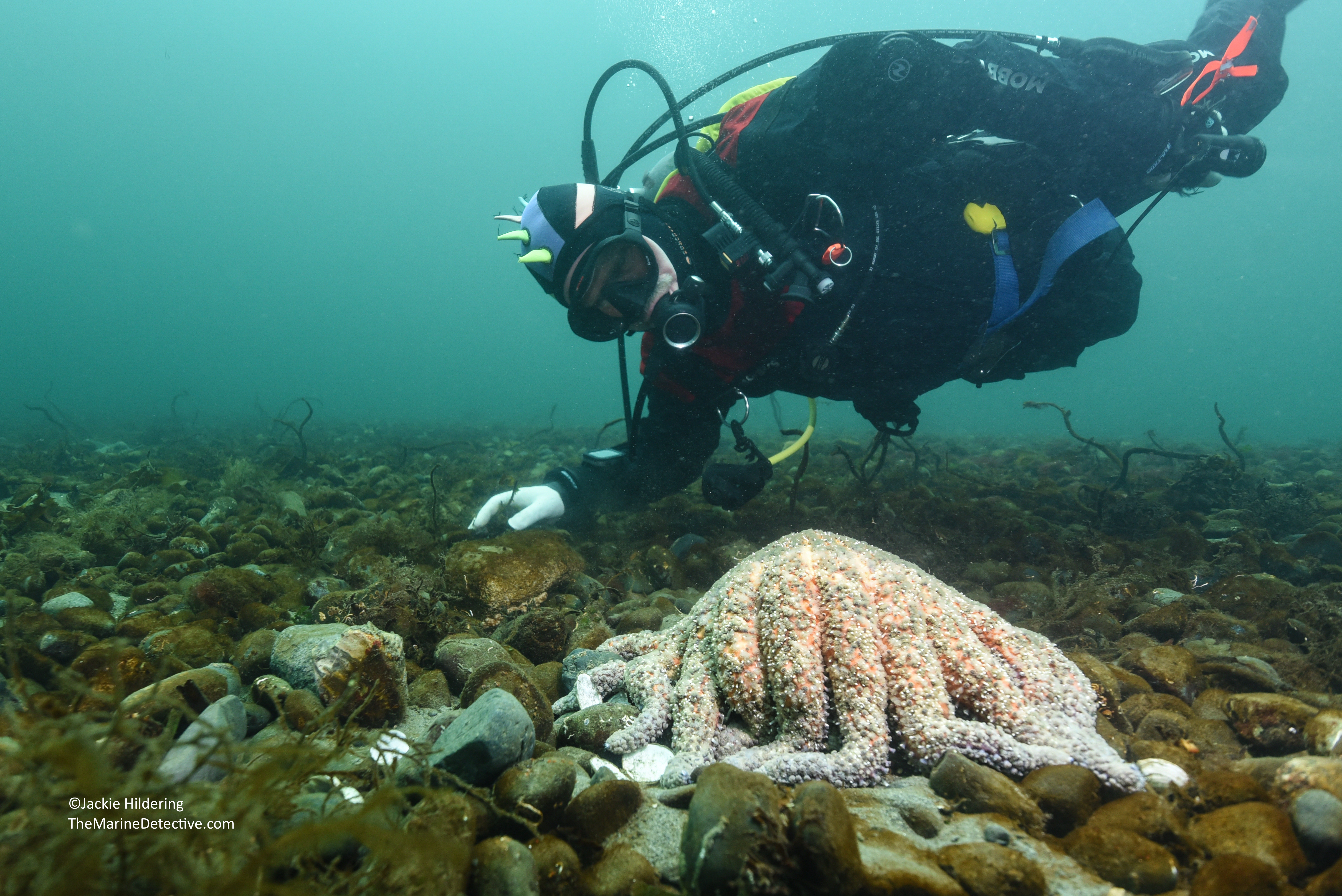
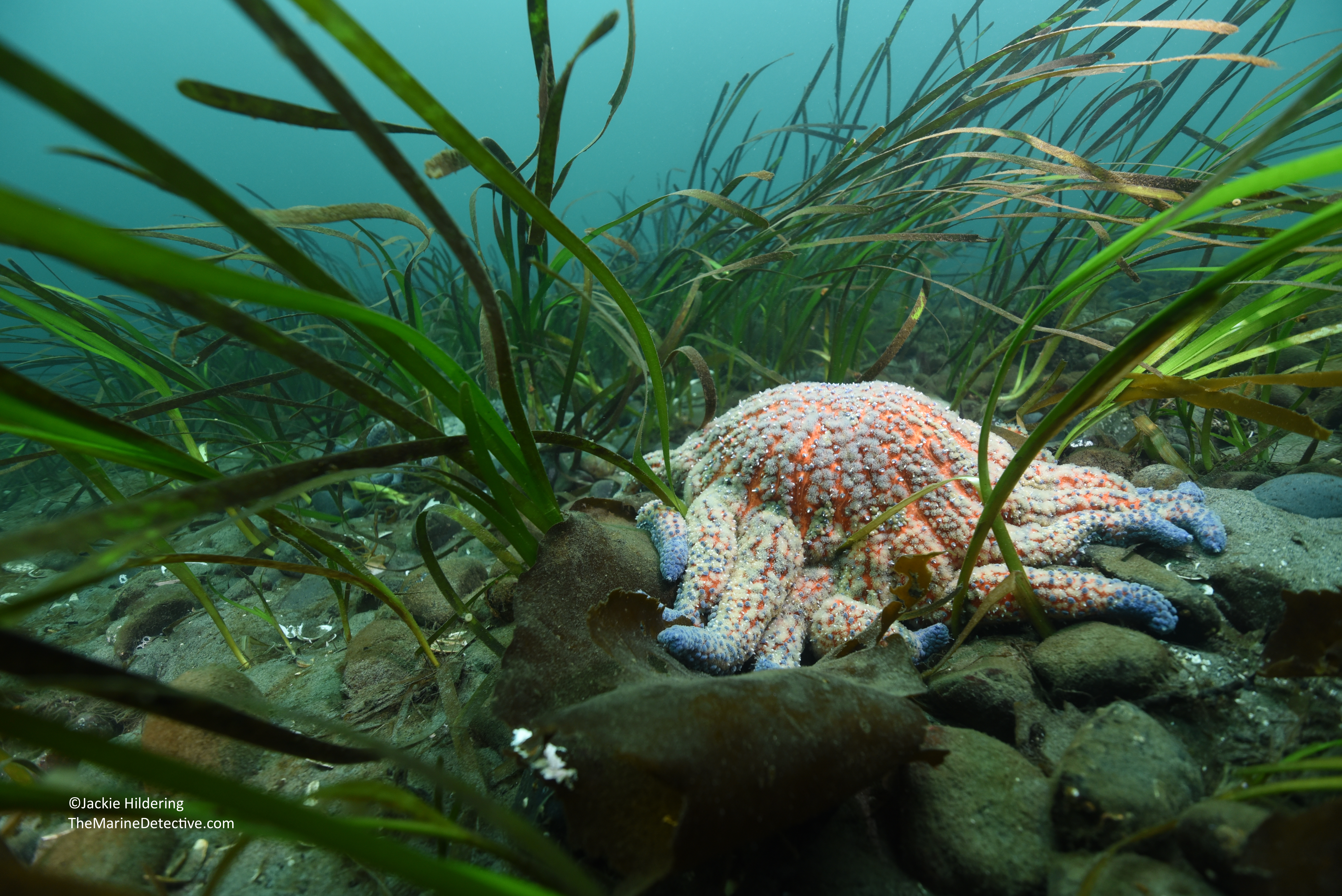
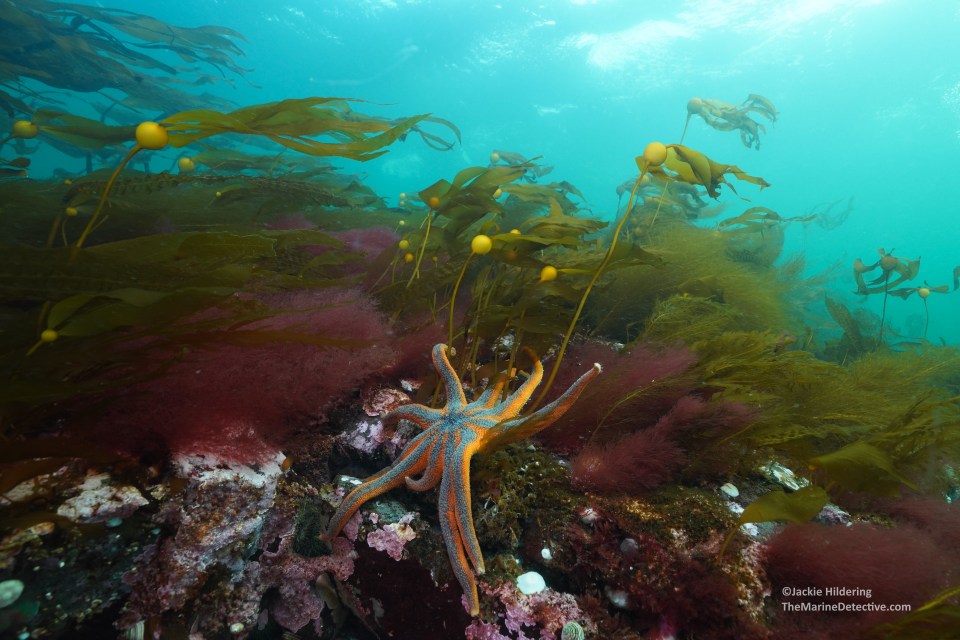


Look at this HUGE Sunflower Star.

This Sunflower Star is ~1 metre across.
It’s the same sea star in the above two images. Dive buddy is Janice Crook.

I screamed underwater in sheer euphoria the other day upon seeing the Sunflower Star in the above two images. It’s the largest one I have seen in years. Dive buddy Janice Crook and I found a total of seven relatively large Sunflower Stars and one juvenile during this dive. These sightings have been reported to researchers.

Why Euphoria?

Because Sunflower Stars are in terrible trouble and somehow at this site conditions are such that some adults are surviving. I regularly document “waves” of juveniles but have seen so very few large ones. To see seven relatively large ones at one shallow site in British Columbia is truly exceptional.

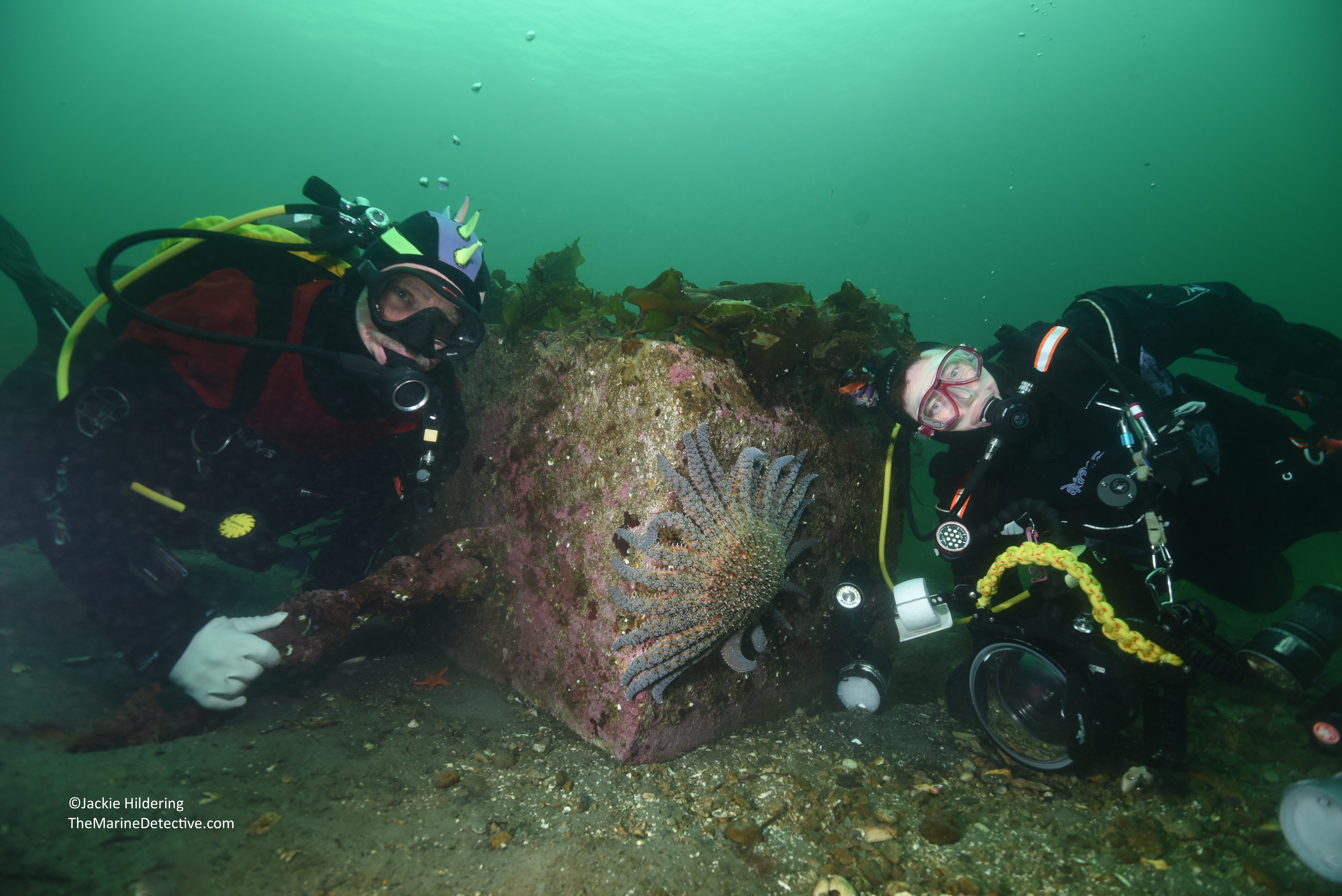
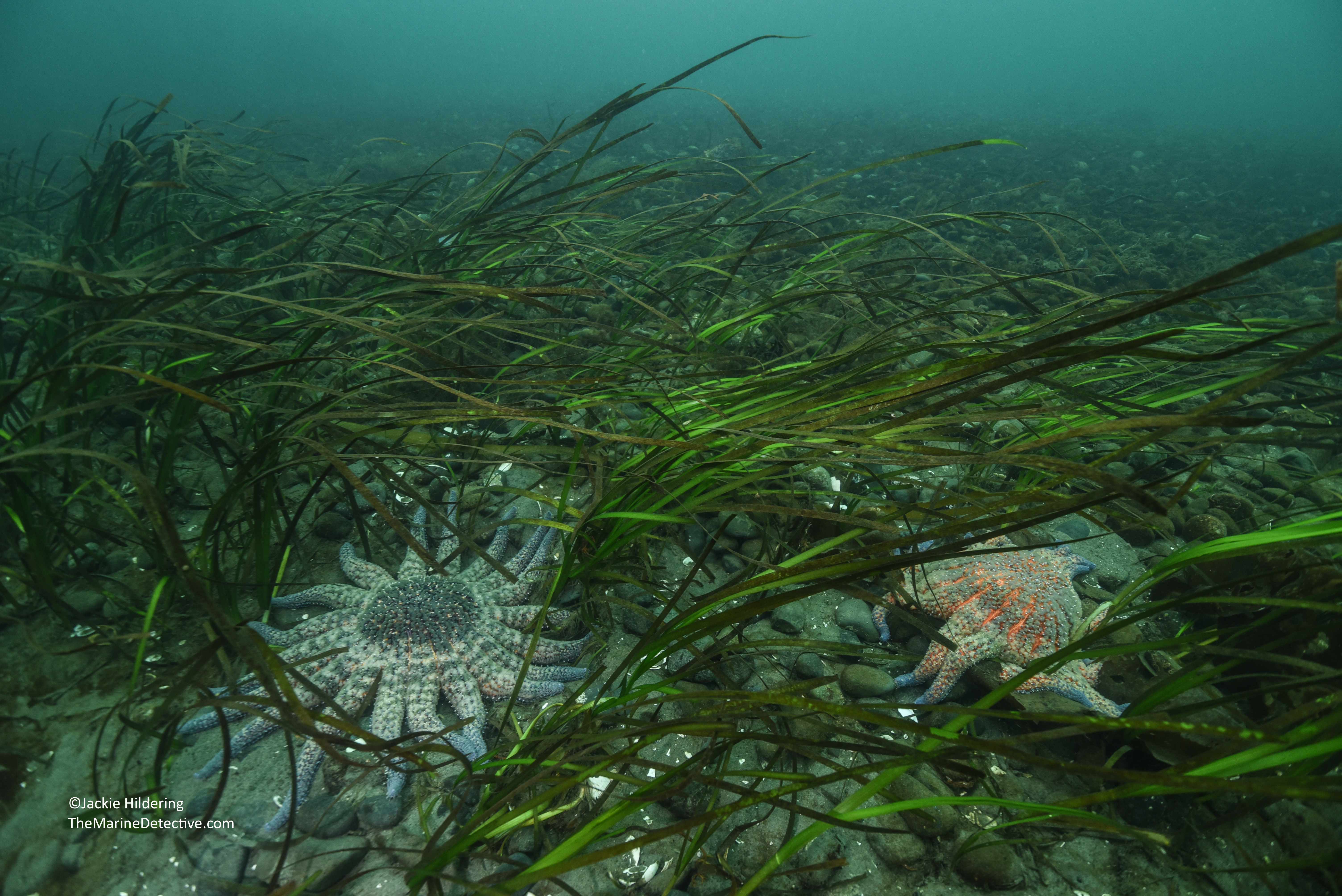
Another two large Sunflower Stars on the same dive. There was a third on the other side of the cement block.

Why Does It Matter?

Sunflower Stars are the world’s largest sea star species at up to 1 metre across (Pycnopodia helianthoides). Before 2013, were you to look down from a dock in BC and Washington, you would likely see them . . . icons of our coast, common giants, and often what children would draw in seascapes.

That is no more.

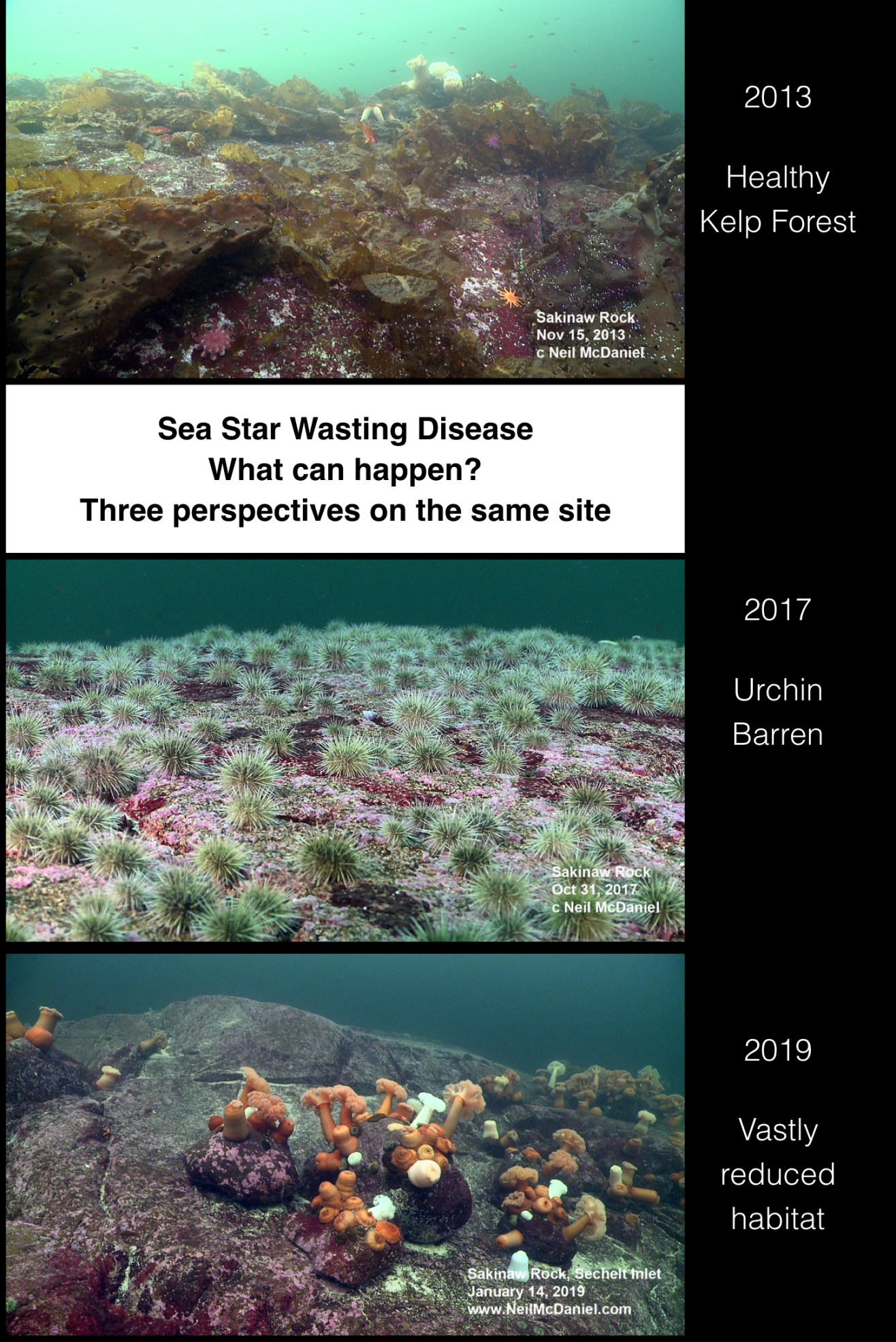
What happened to 20 sea star species in the Northeast Pacific Ocean has been referenced as “the largest epidemic ever recorded in a wild marine species.” Sunflower Stars were the most impacted and there are far-reaching impacts due to their ecological role.

Still many people do not know about their plight despite over 12 years of disease (and a horrific progression of symptoms). You can bet that if a whole lot of Sea Otters (which have similar ecological roles) died there would have been almighty public outcry. But this happened below the surface, in the dark, to species without eyes and fur.

What Happened?

Sea Star Wasting Disease (SSWD) began in 2013 and yes, recently Canadian researchers concluded what the pathogen / causative agent is. It’s the bacterium Vibrio pectenicida. But of course this does not mean that Wasting Disease is “solved”.

Why would this bacterium be able to have the impact it has? What changed?

From the research by Prentice et al. (2025)Vibrio spp. have been coined ‘the microbial barometer of climate change’, because of the increasing prevalence of pathogenic species associated with warming water temperatures. Given that existing evidence indicates a relationship between increasing seawater temperature and SSWD incidence . . .

Where Are Things at Now?

In May 2025, the Committee on the Status of Endangered Wildlife in Canada (COSEWIC) recommended to the Government of Canada that Sunflower Stars be protected as an endangered species under Canada’s Species at Risk Act. It can be years before there is a decision.

This is not only important in Canada but the survivors in BC might be a reservoir for Washington State too where things appear to be even worse for the species.
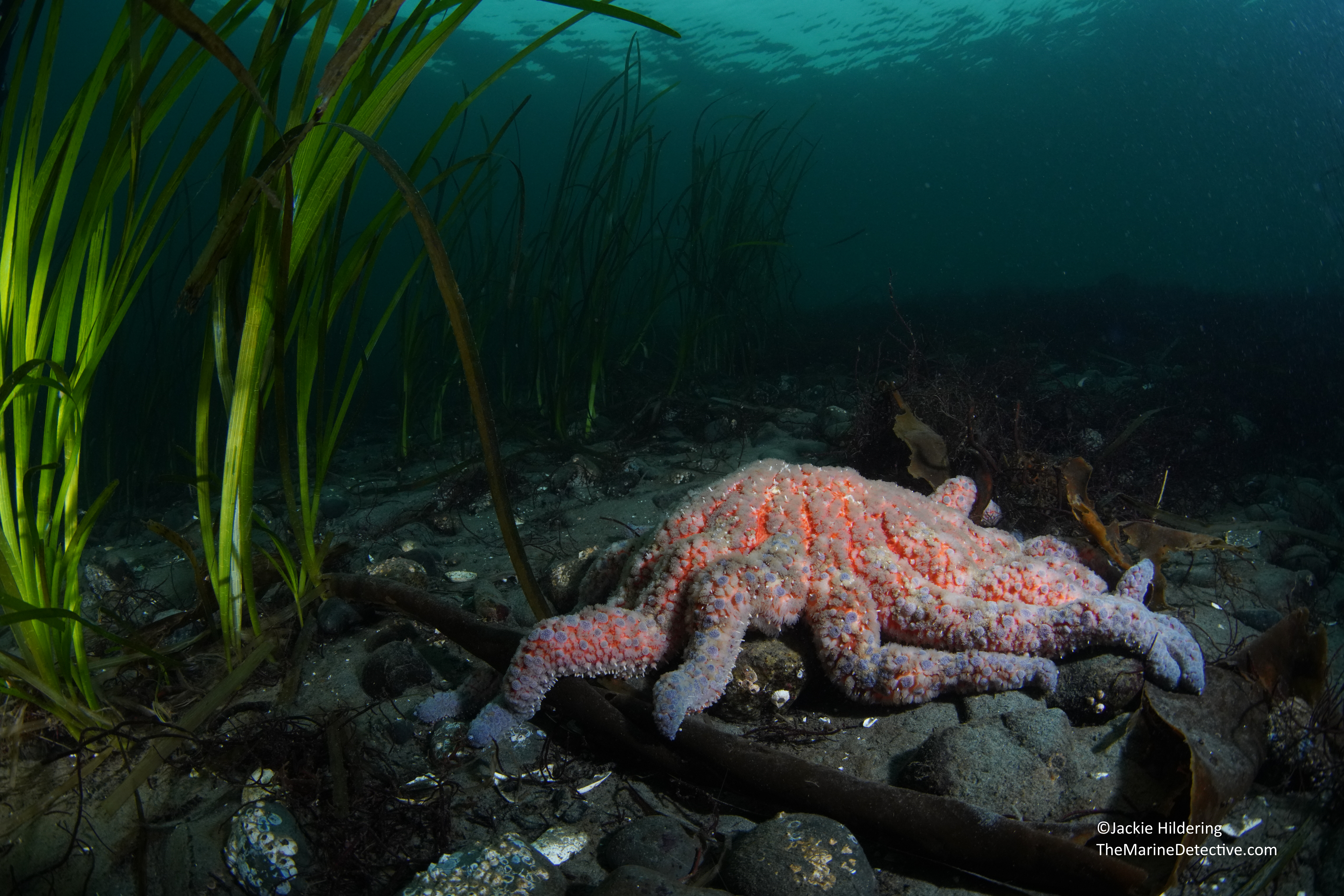
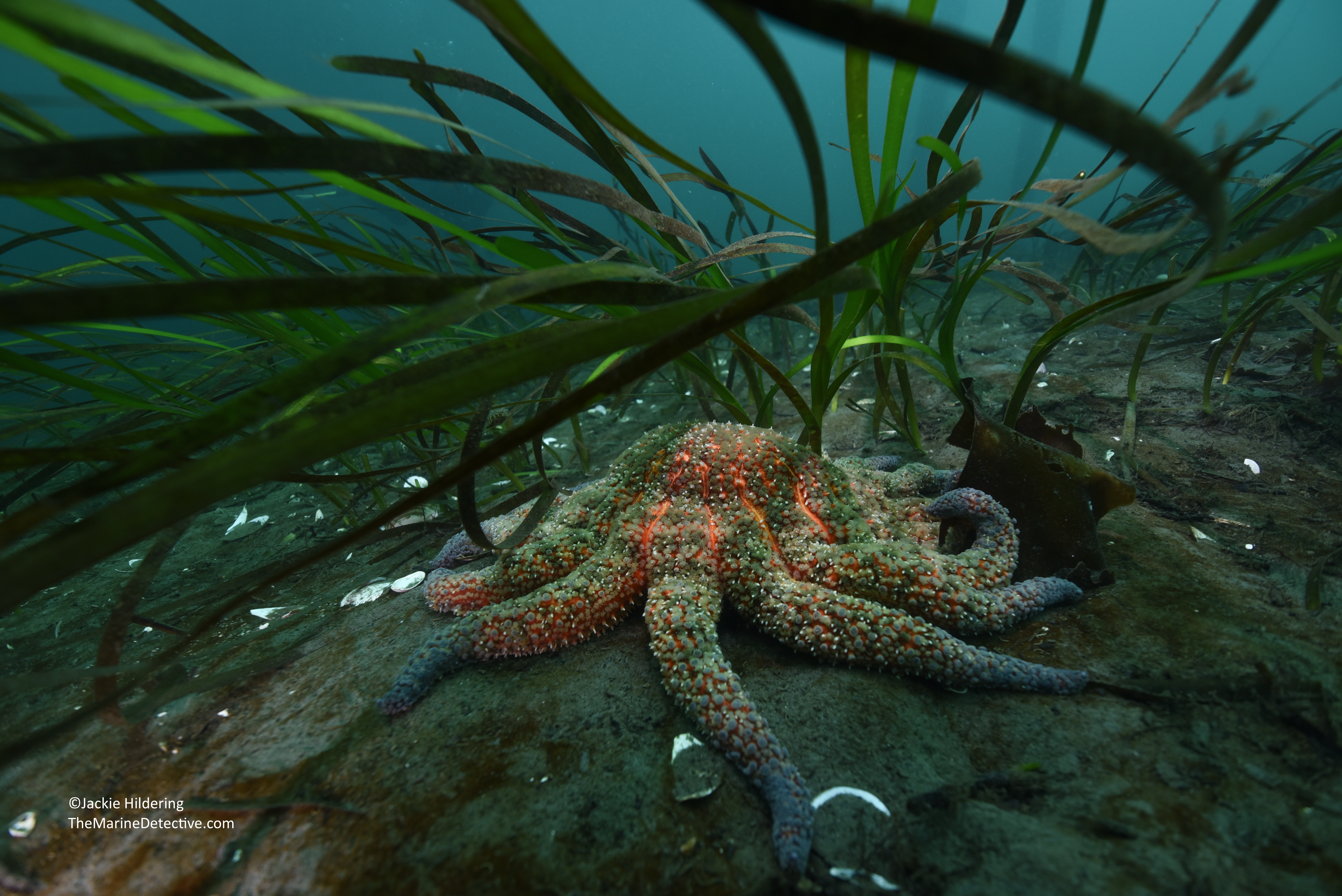
Another large Sunflower Star – you can see how shallow some of them were, indicated here by the presence of the Eelgrass and being able to see the surface of the water

What To Do?

Celebrate survivors – yes. Know that the plight of Sunflower Stars is not an additional problem. SSWD is a symptom of the same changes that impact our own species which means, there are common solutions regarding energy use, how we vote, and consumerism generally.

If you have read to this point in the blog, you are particularly important. You clearly care about life below the surface, in the dark. Help others know the importance of this coast. Help work against “ocean blindness” where the cold, dark waters full of plankton are devalued because it is more difficult to see the life living there. (Warm, clear waters are often perceived to be “better” because you can see far more easily see below the surface. But, if you can see through the water, there is far, far less plankton – the fuel of the marine food web.)

Children should know Sunflower Stars and their place on this glorious coast.

_________

Since the onset of SSWD in 2013, I have tracked research and developments at this link. Includes where to report sightings.

_________

Above photos: December 30th near Malcolm Island and northeastern Vancouver Island in the traditional territories of the Kwakwakw’akw. ©Jackie Hildering @The Marine Detective.

Sunflower Stars eat Green Urchins which graze on kelp. With fewer Sunflower Stars, there is more grazing on kelp by Green Urchins. Research suggests that Sunflower Stars can be 15 metres away and still help with deterring urchins (red urchins in the research by Mancuso et al., 2025).

Striped Sea Star

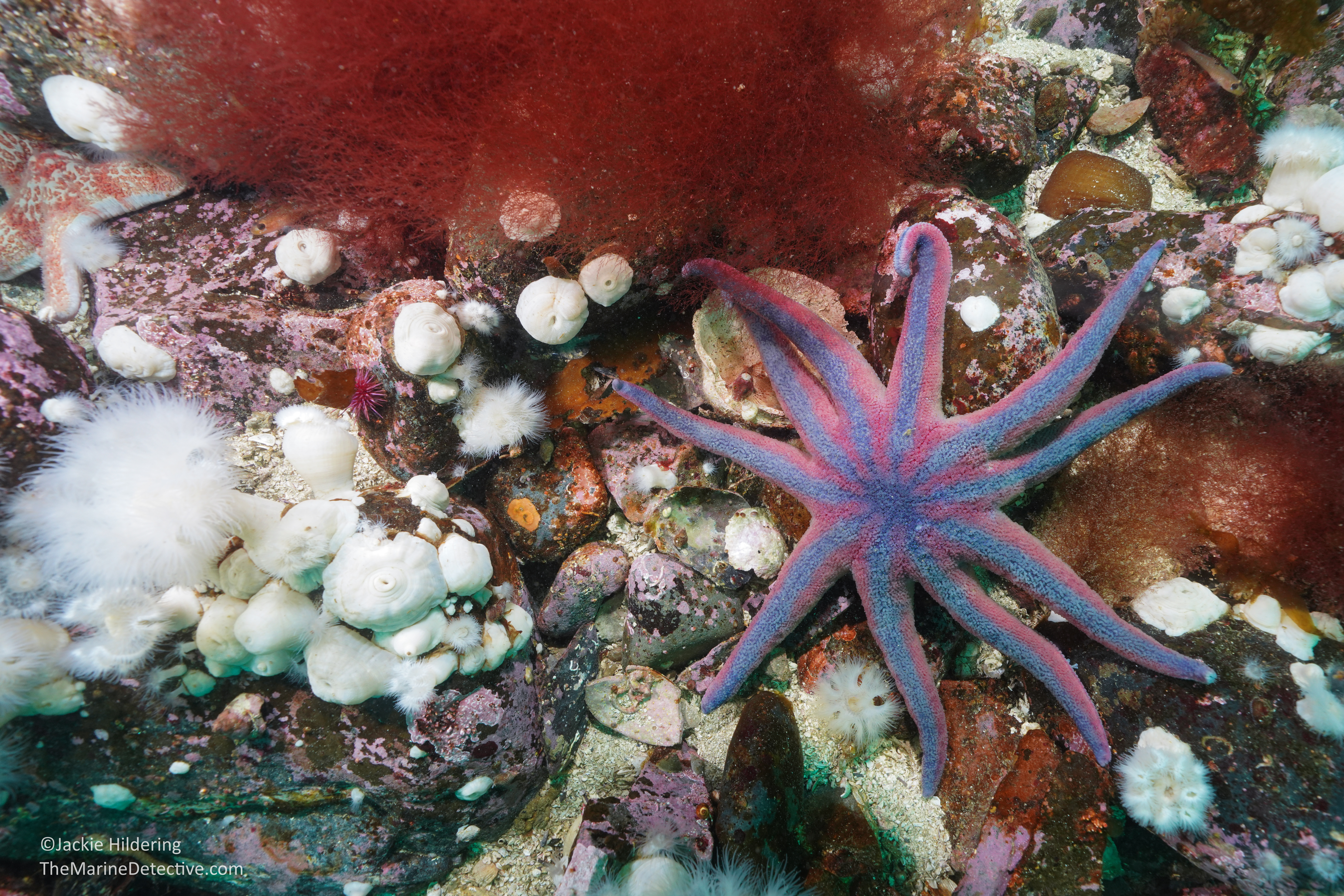
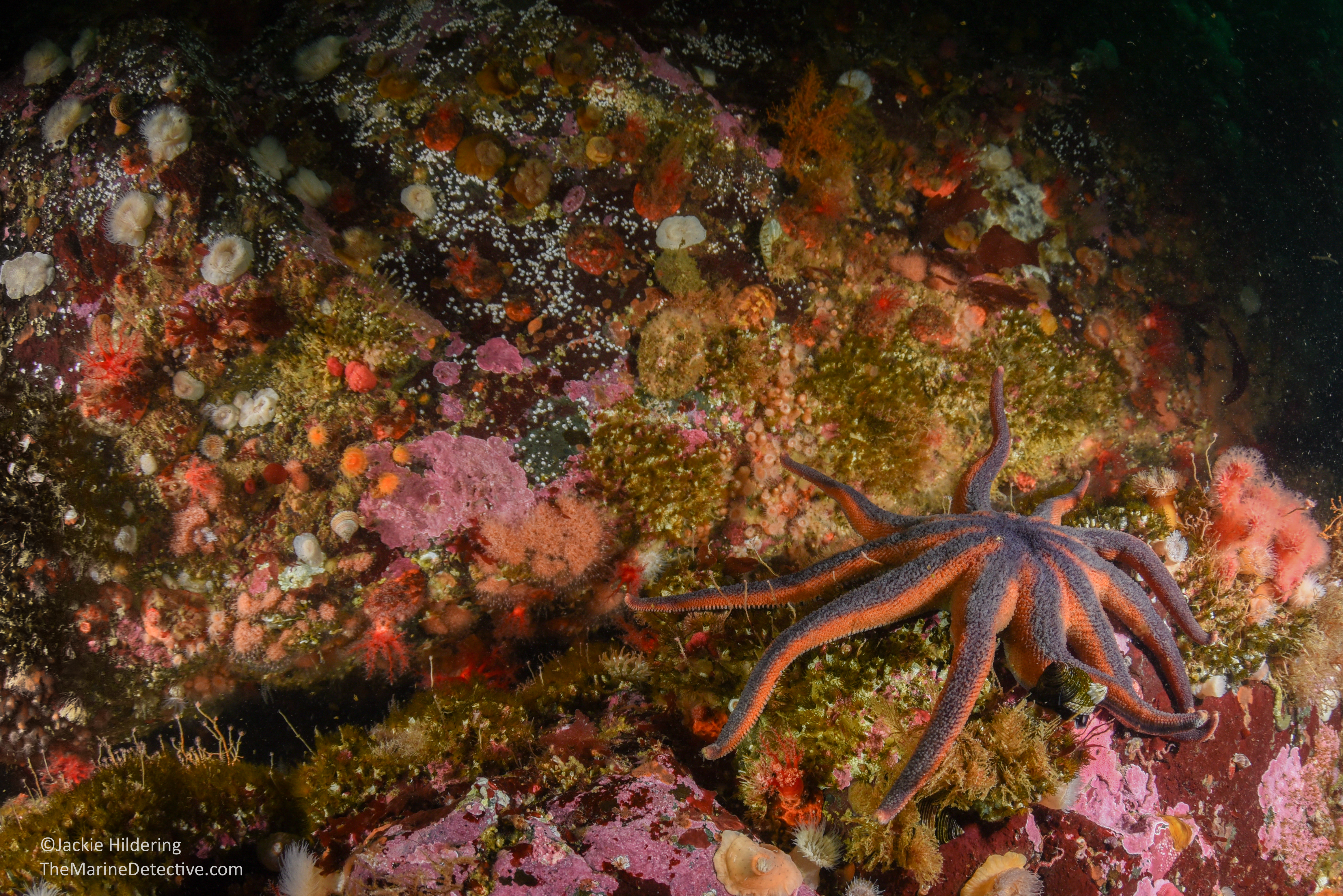
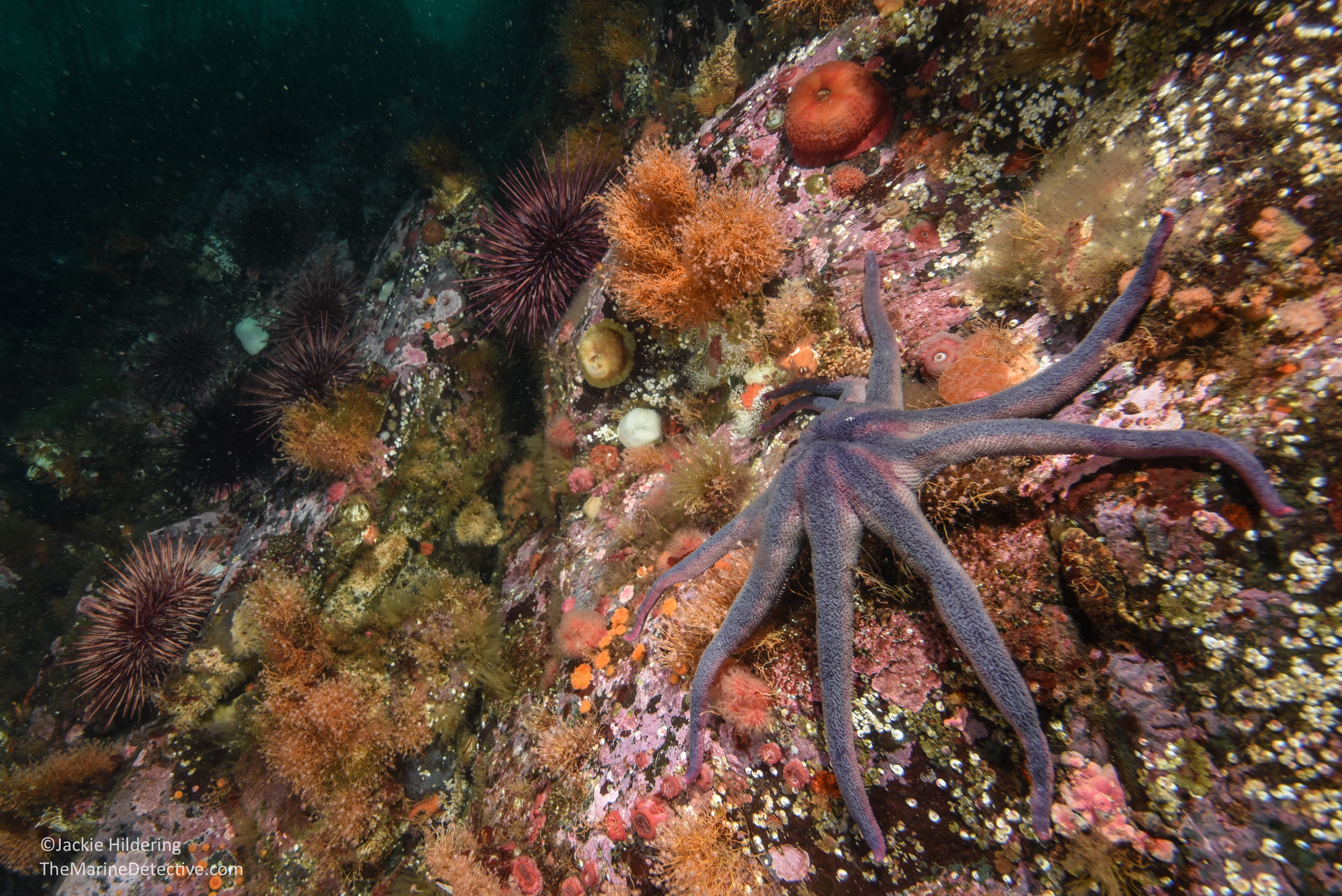
I found distraction from the darkness by making compiling these photos of one of the most diversely colourful sea star species off our coast – the gobsmackingly beautiful Striped Sea Star.

Note how Nature supports diversity. 💙

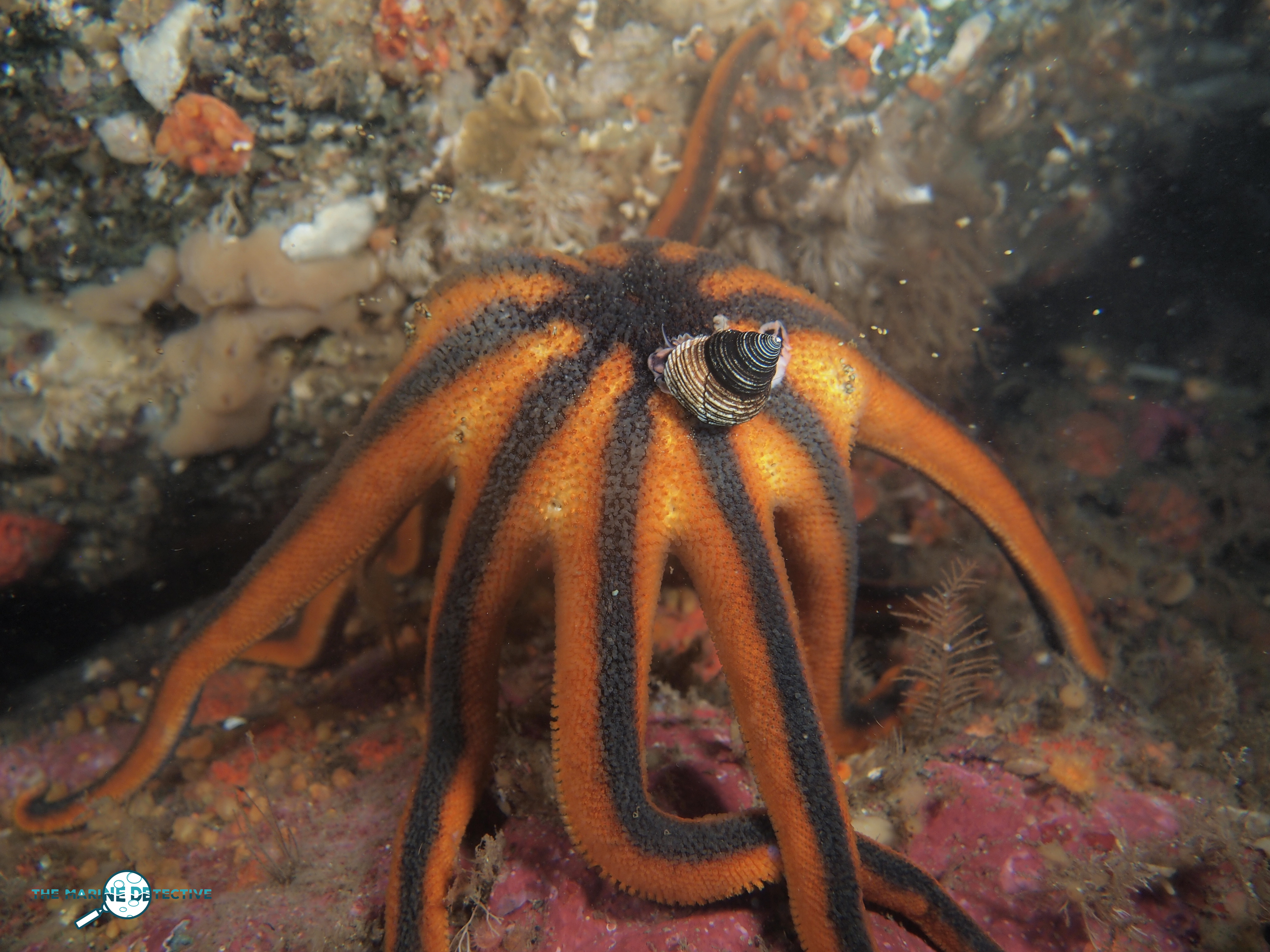
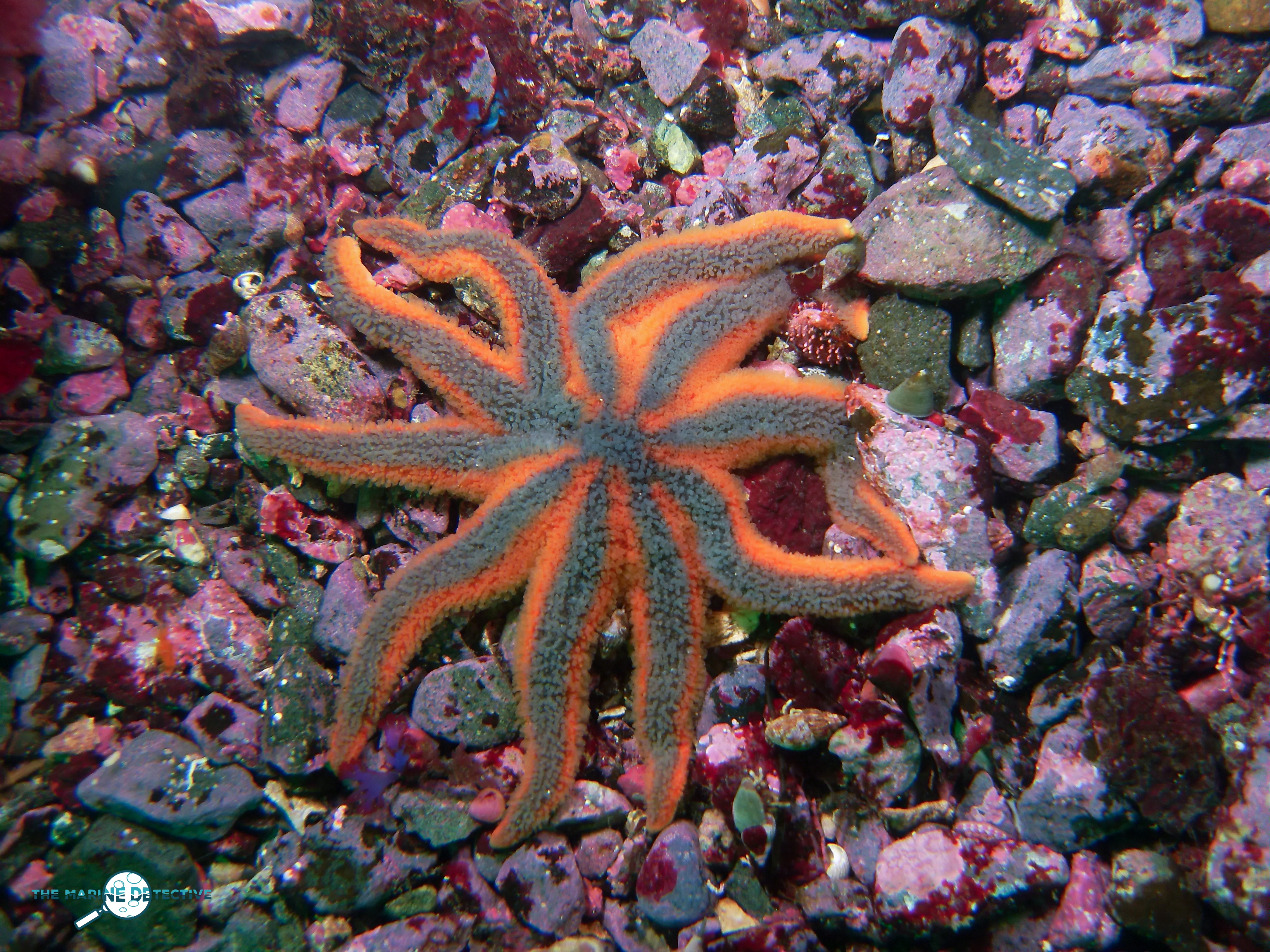
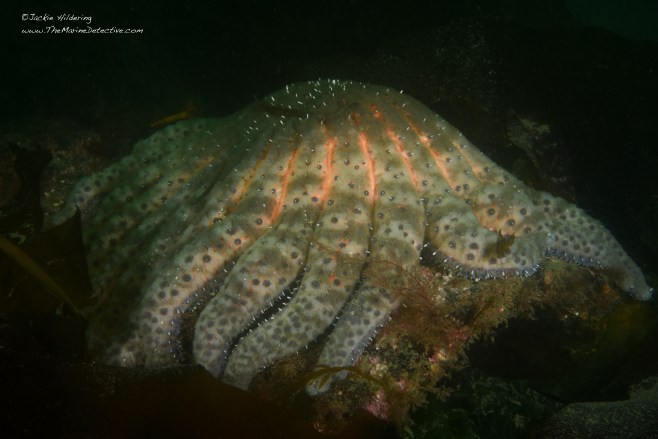
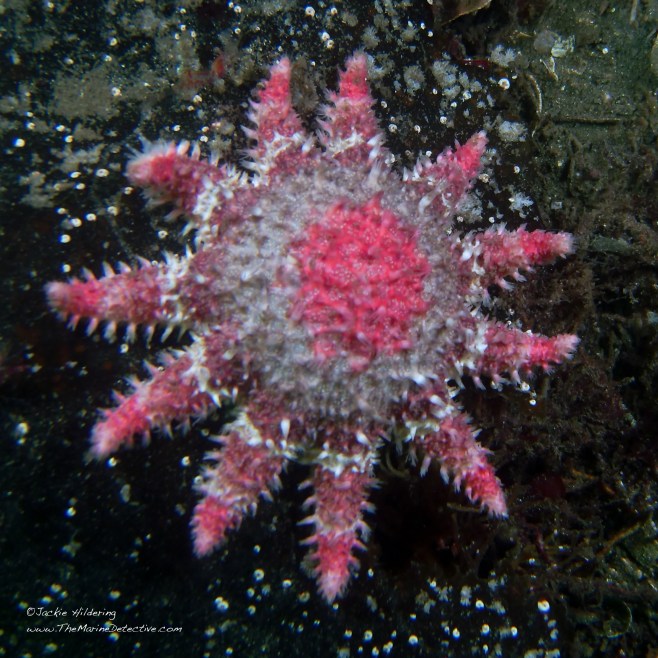
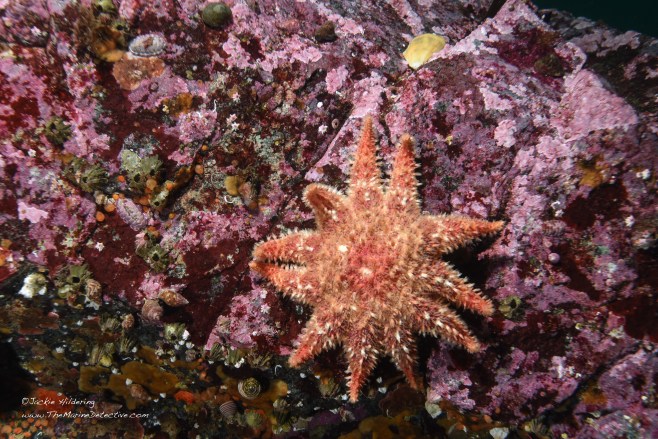
Striped Sun Stars (Solaster stimpsoni) can be up to 58 cm across. They most often have 10 arms with a blue line down the centre of each arm. Some individuals are entirely blue.

Underside of a Striped Sun Star.

Whenever I post photos of this species, they create a bit of a sensation. That’s likely because they are astoundingly colourful and usually live in really colourful neighbourhoods too.

But also, I think there is reduced awareness about the species because Striped Sun Stars are not often in the intertidal zone.

Oh, and then there’s that misunderstanding / underestimation of the colour and diversity of life in this cold ocean.

But LOOK! 🙂 Look at the diversity in colour of this sea star species and look at the density and colour of the life around them. This is the life off our coast in high current areas.

A completely blue individual. You can still see the blue stripe down each arm.
Blue Turban Snail atop a Striped Sun Star.

The diet of Striped Sun Stars includes various species of sea cucumber.

There are 6 species of sea star off our coast that have more than 10 arms. The other 5 many-armed sea star species do not have the blue stripes down the arms. They are Sunflower Stars, Rose Stars, Morning Sun Stars, Northern Sun Stars, Orange Sun Stars. There’s really good information about the diversity of sea stars off our coast on Neil McDaniel’s page at this link.

An individual succumbing to Sea Star Wasting Disease. This species is believed to be heavily impacted.
This individual is regrowing one arm which most likely got nipped off by a crab. Echinoderms are astounding in how they can regenerate body parts. In sea stars, as long as part of the central disc is intact, and the individual can avoid predation while handicapped, all arms will grow back even if they have just one left. Reportedly though, regrowth is slow and can take up to a year leaving the handicapped sea star more vulnerable.
Juvenile amidst Green Sea Urchins.

All photos on this page taken near NE Vancouver Island in the Territory of the Kwakwa̱ka̱’wakw (the Kwak̕wala-speaking Peoples).©Jackie Hildering,

Basket Stars

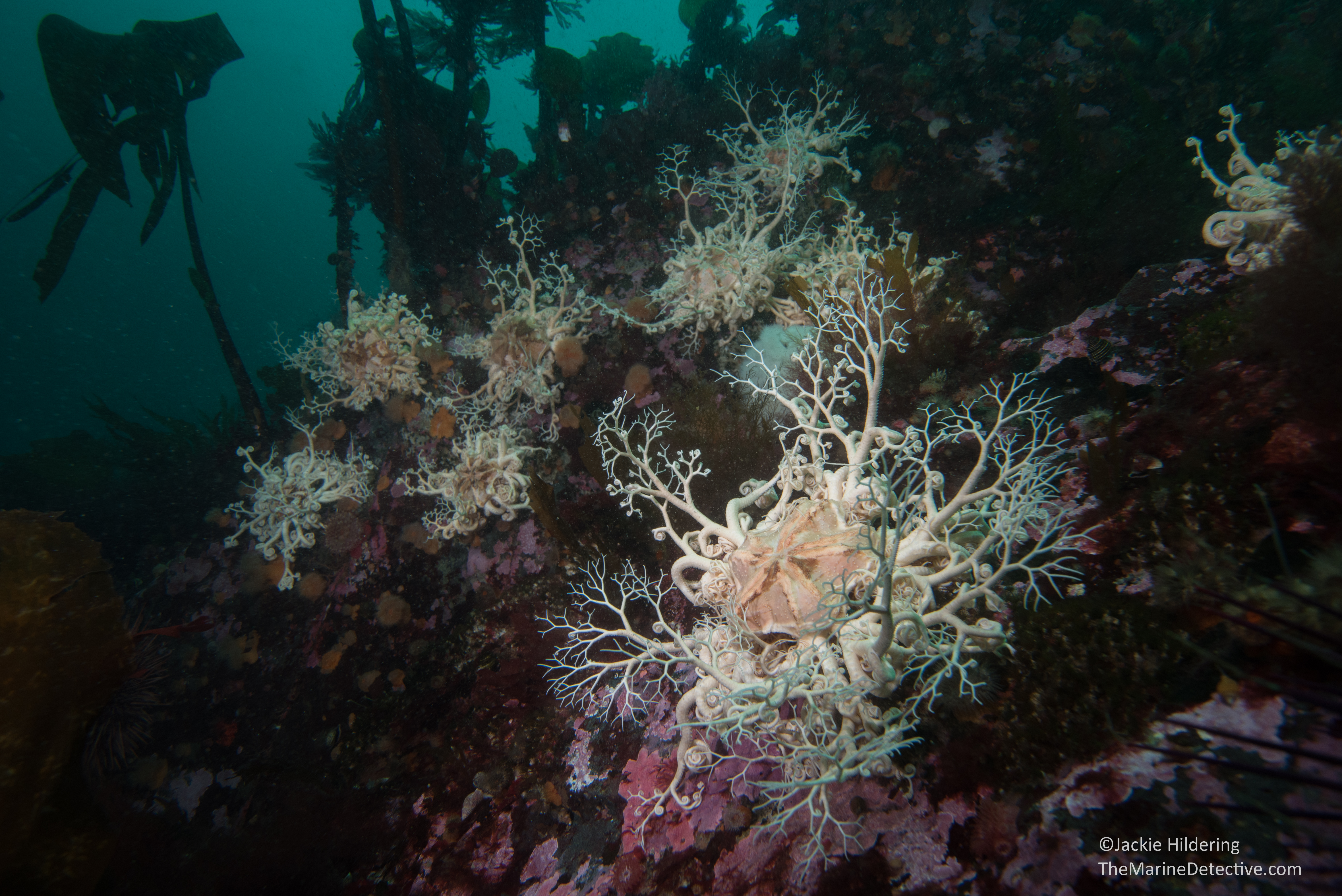
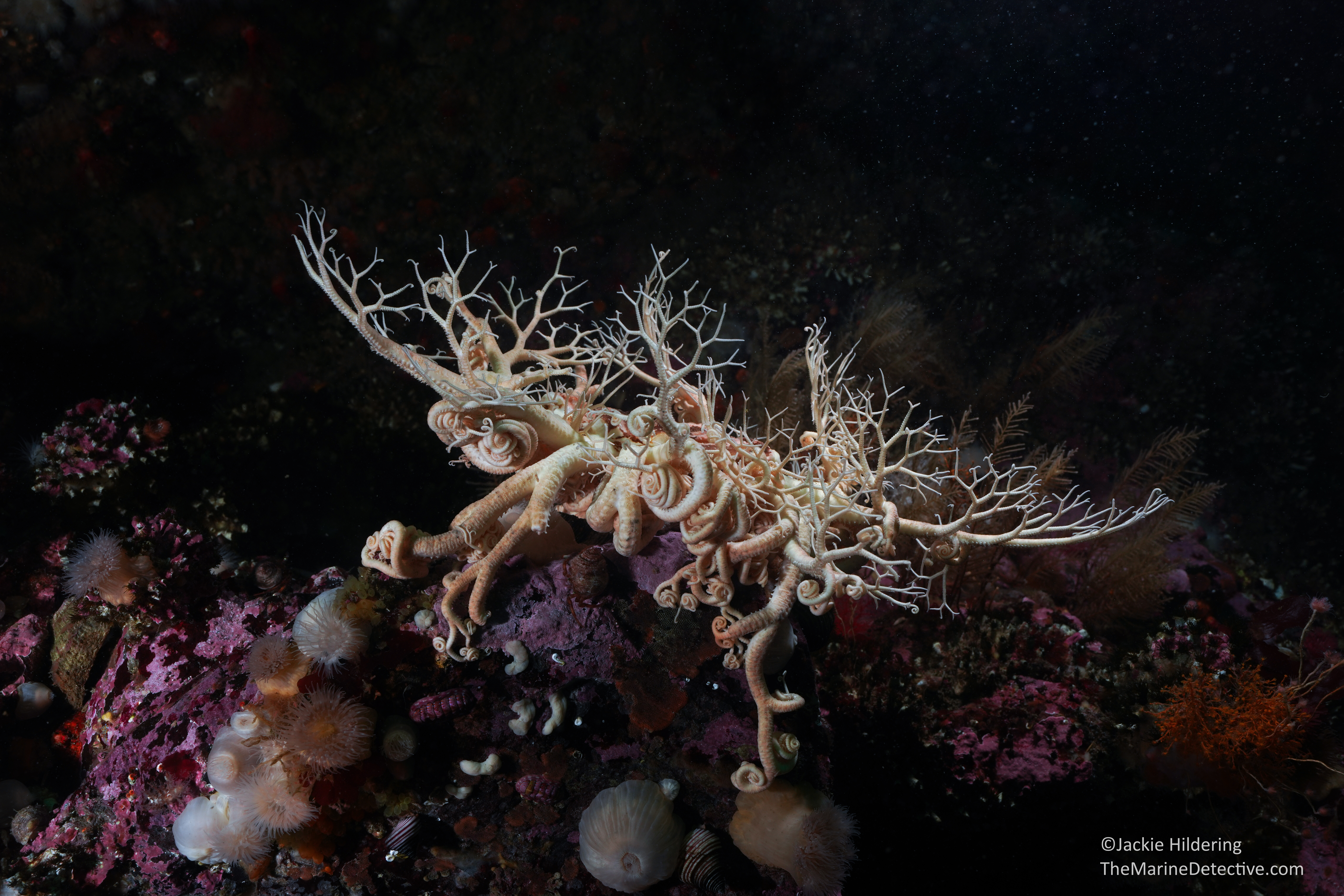
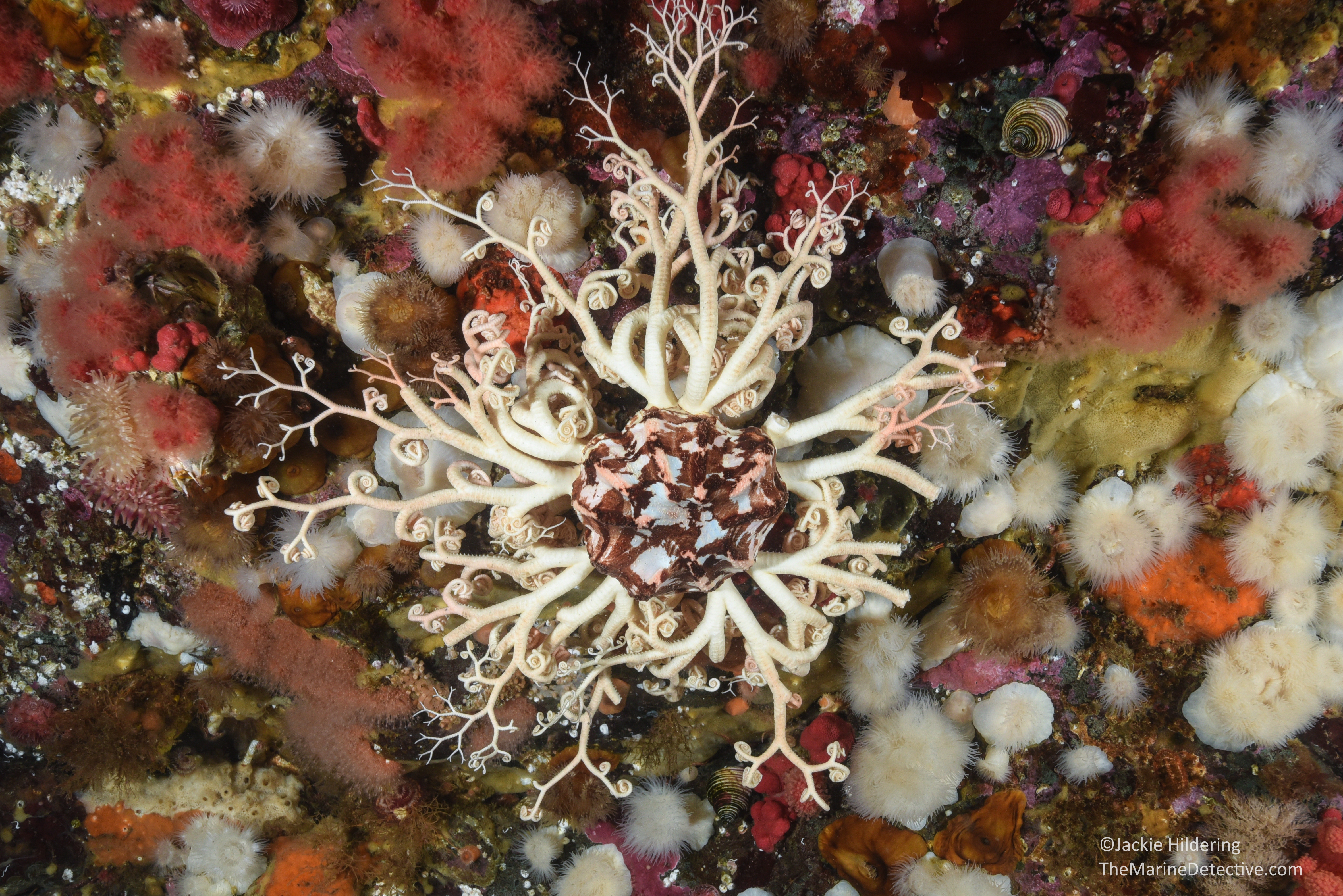
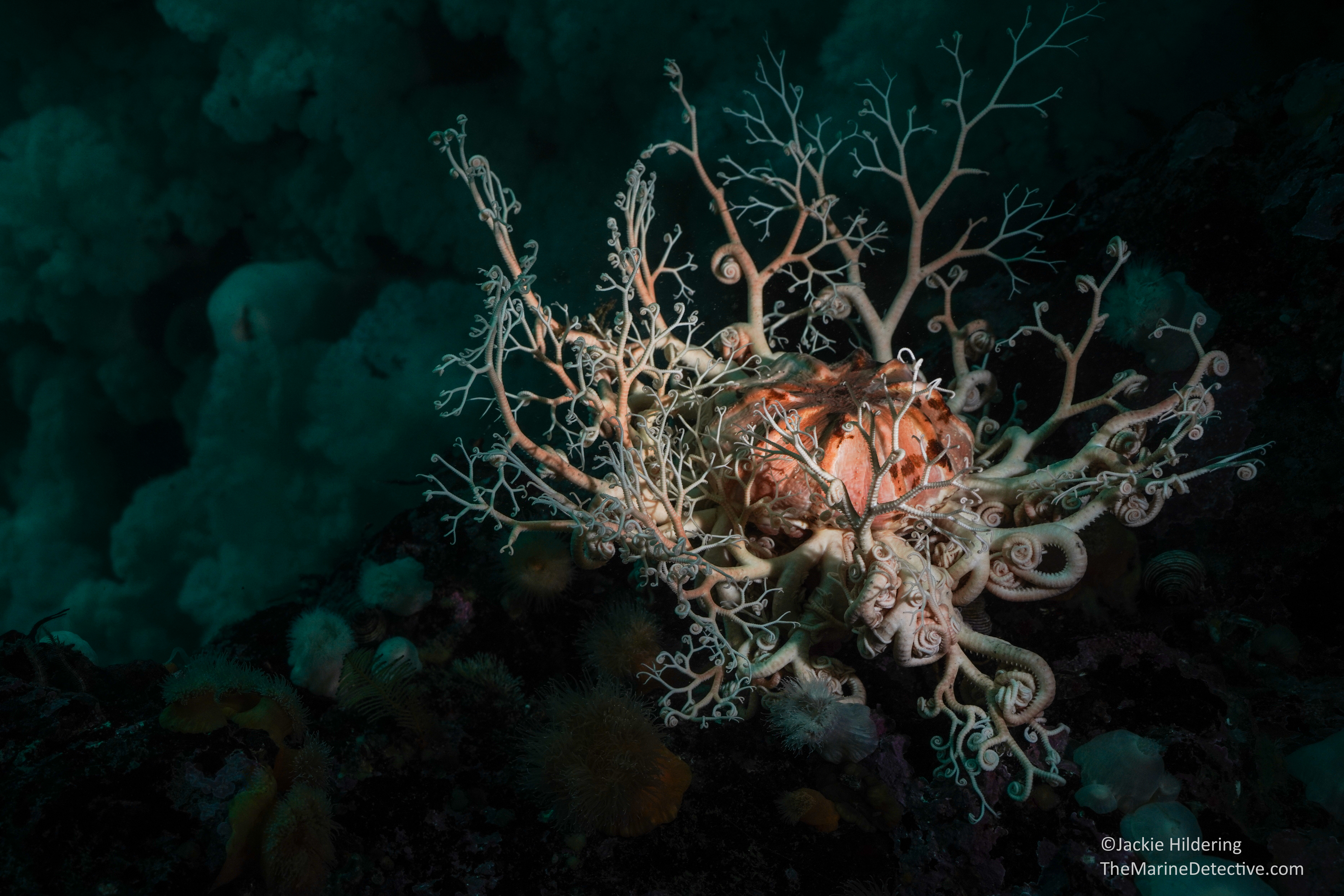
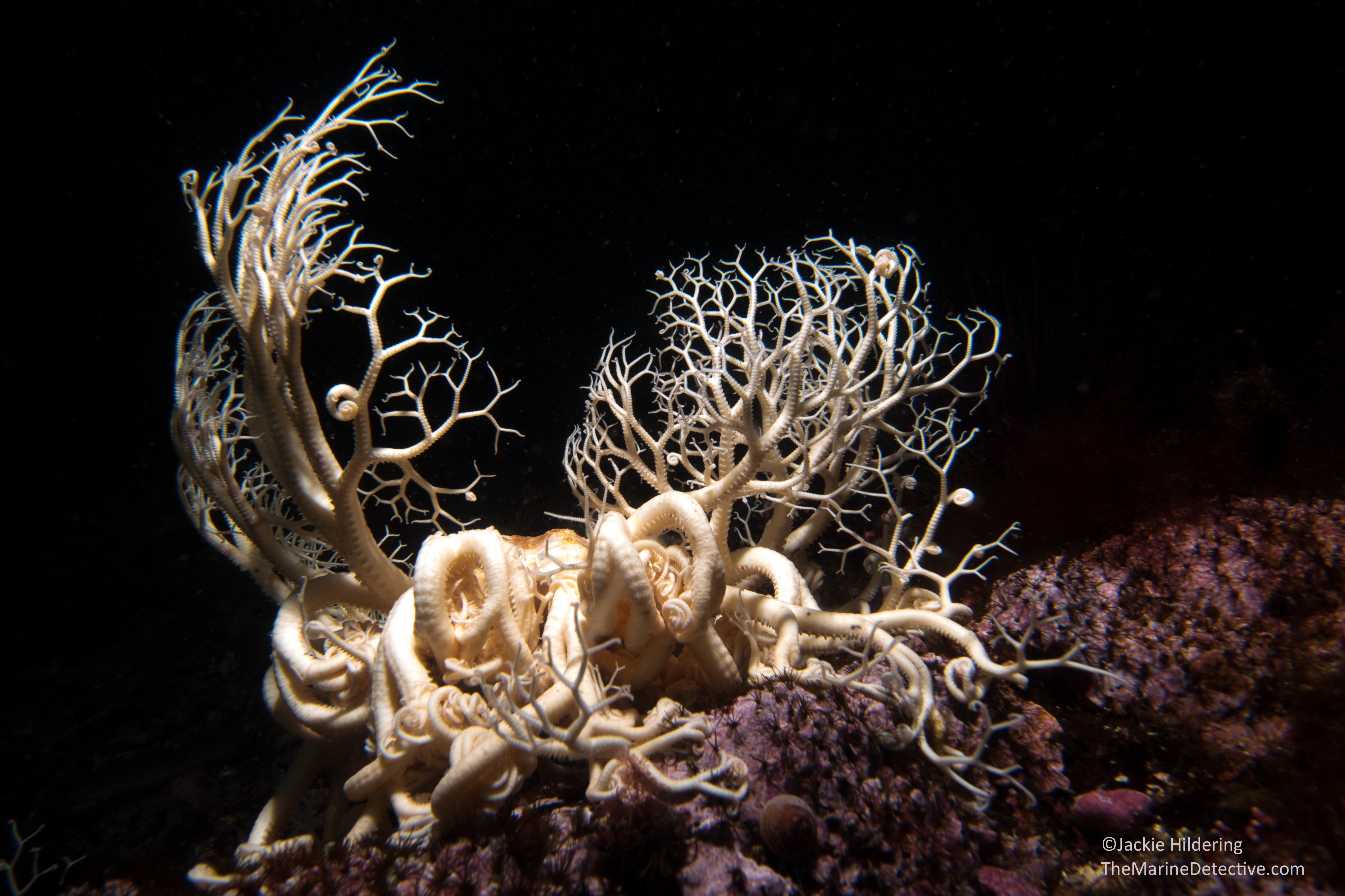
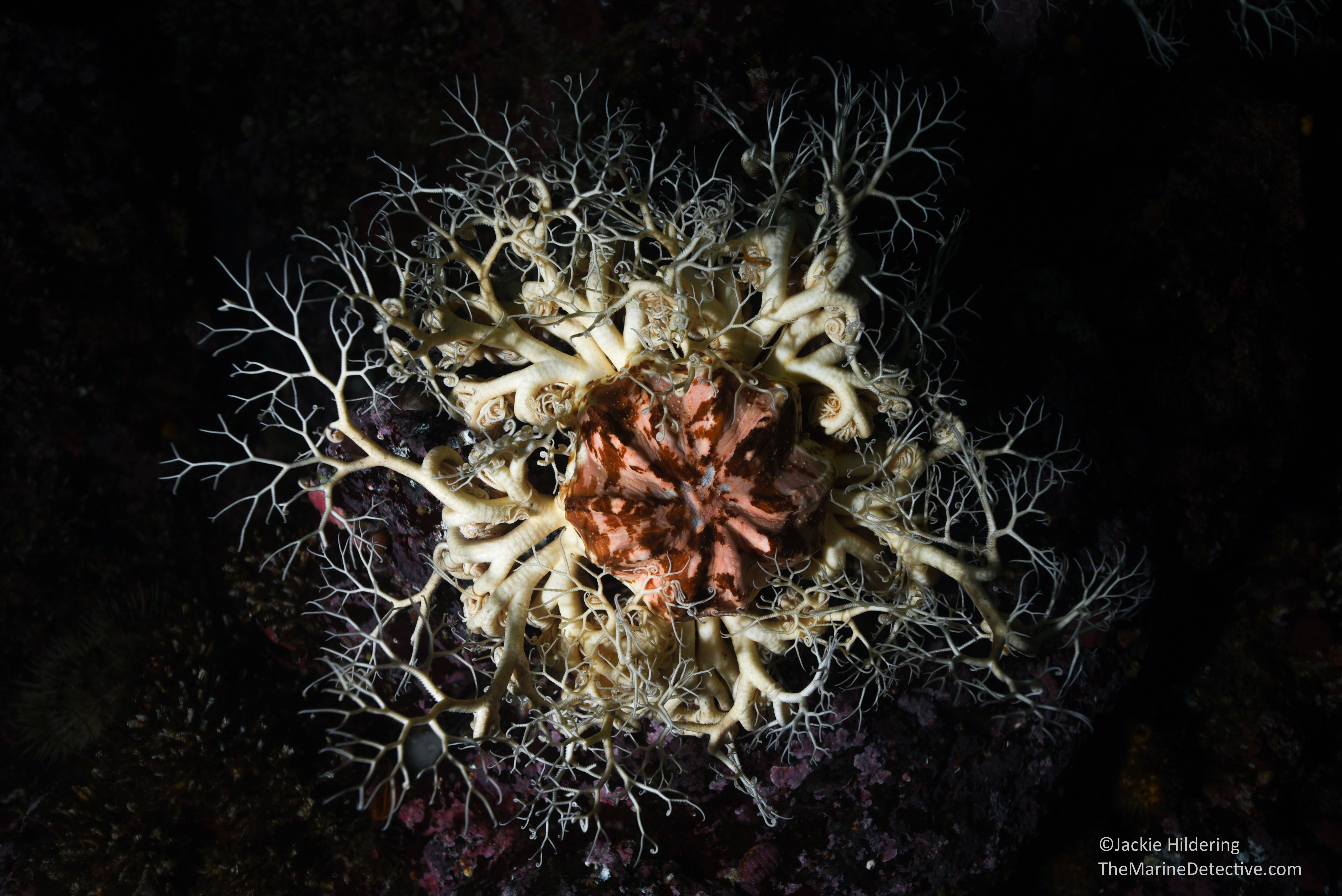
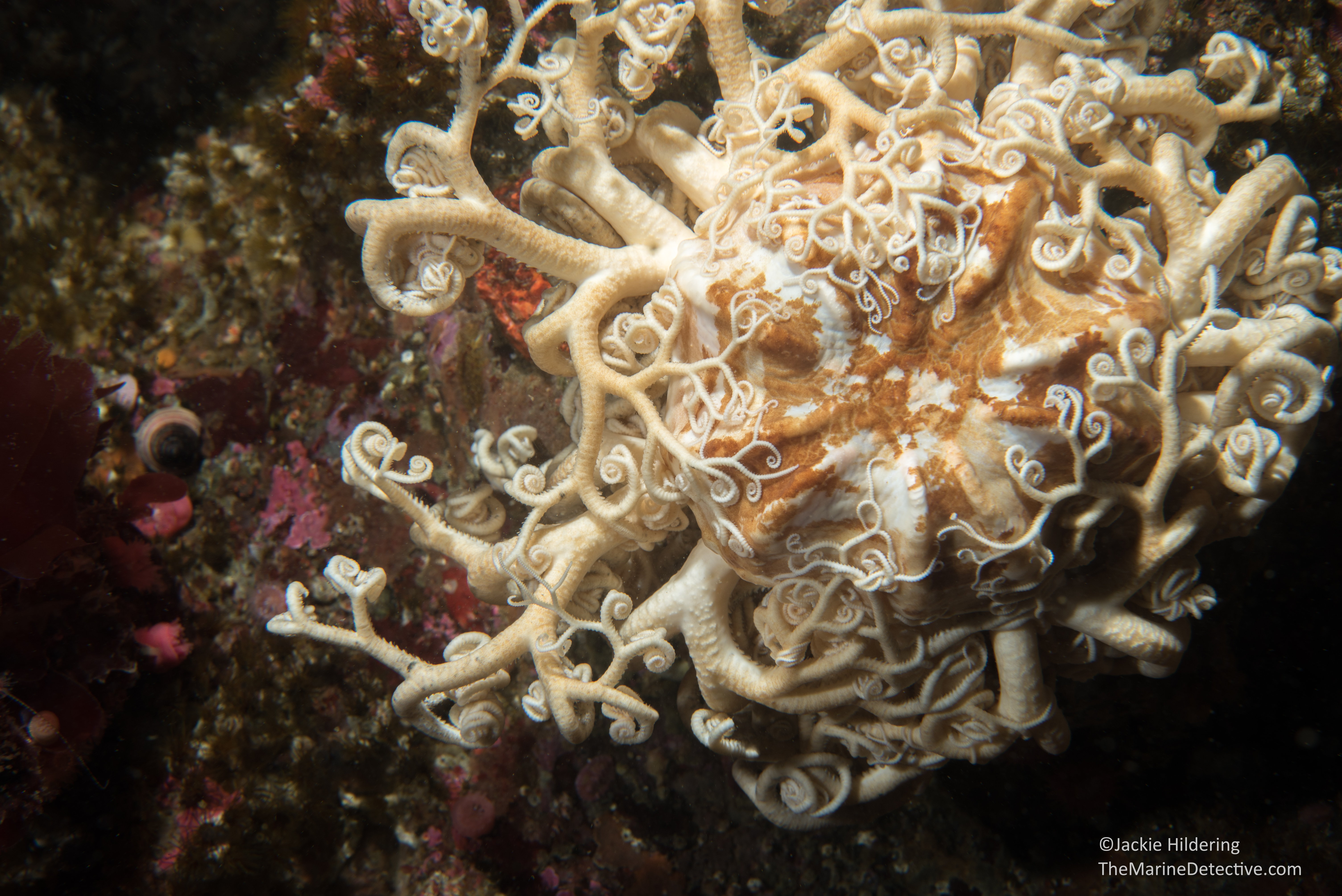
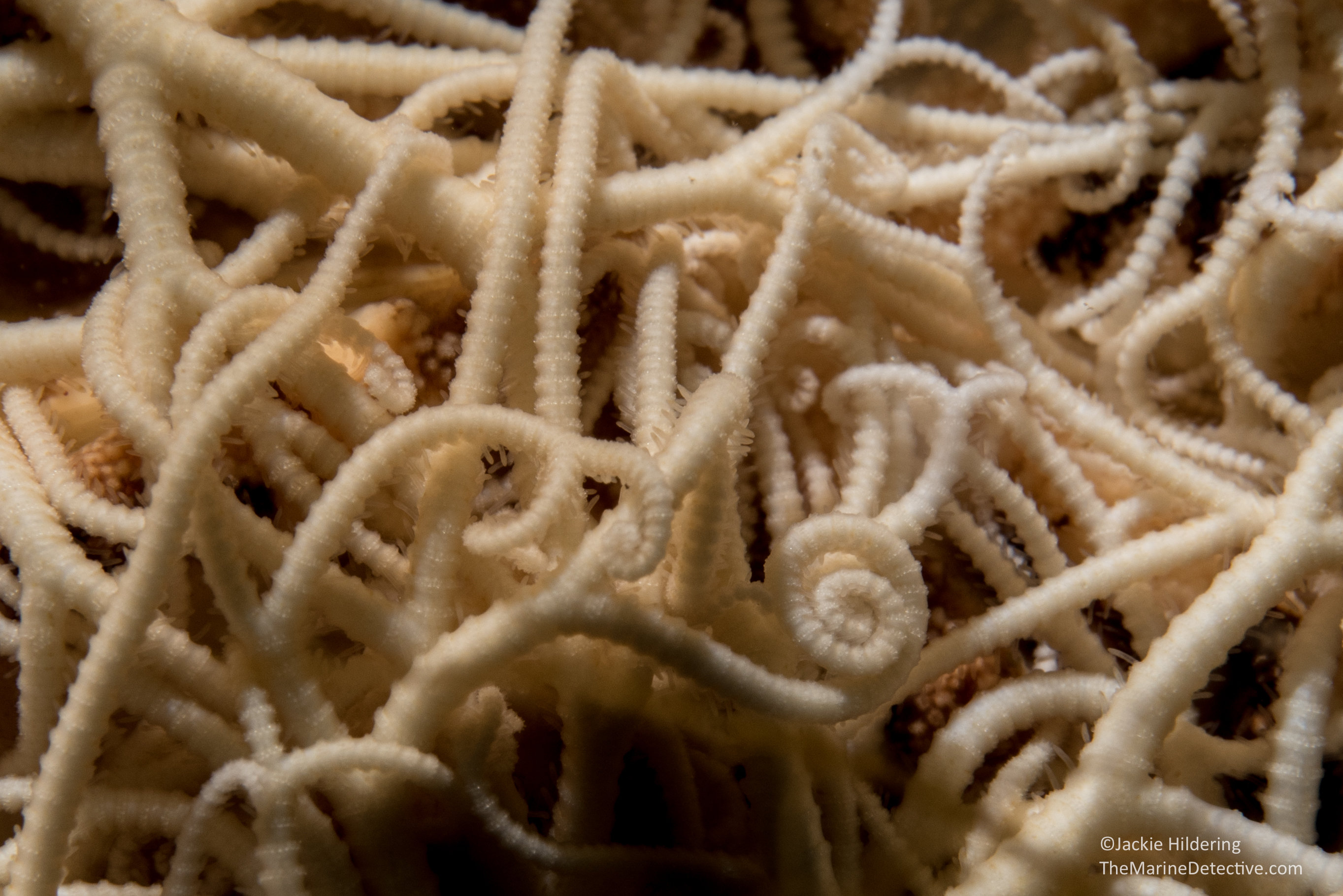
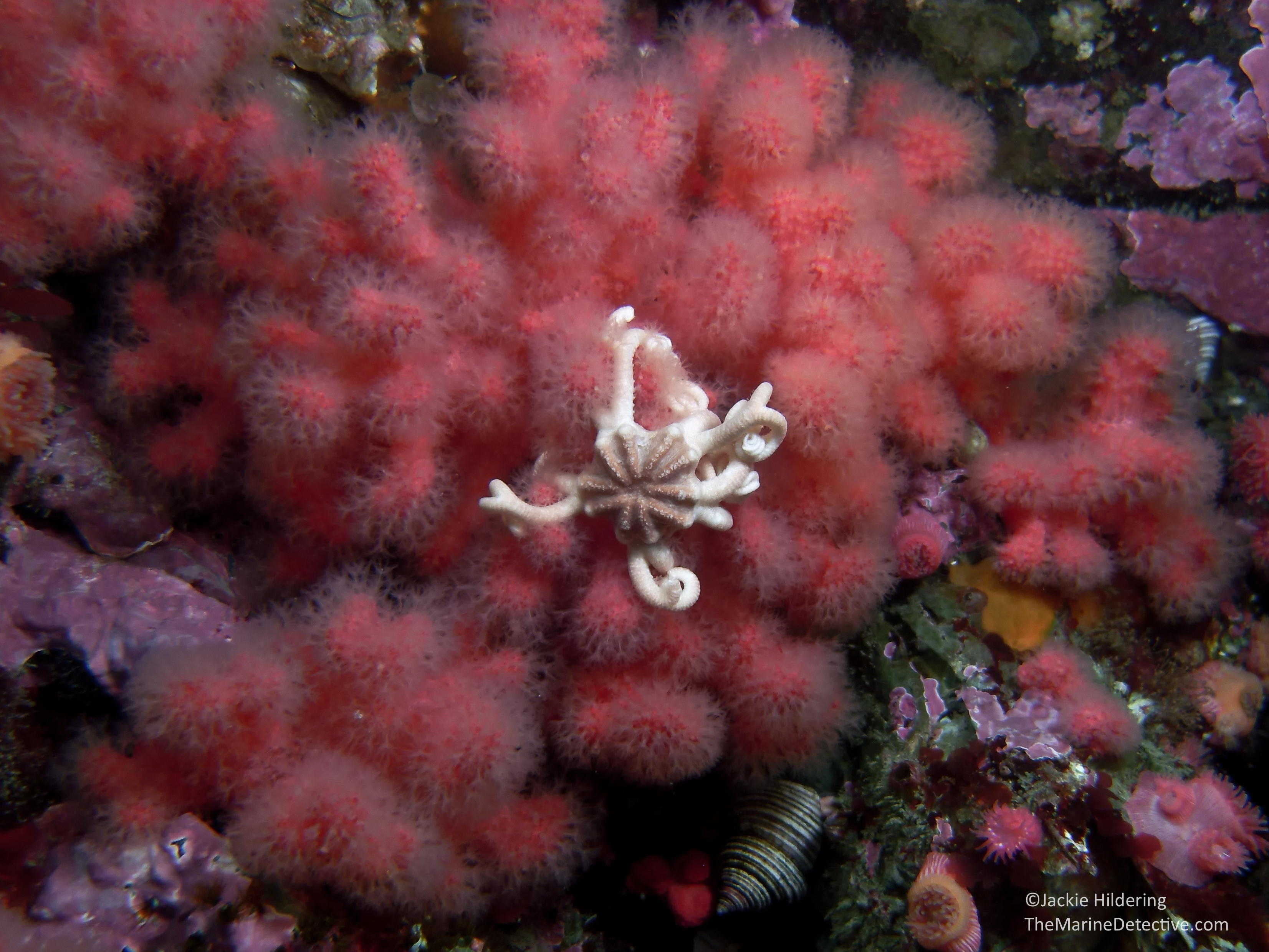
How can it be that I do not yet have a blog about Basket Stars? I am hereby correcting that and including a gallery of photos of this astoundingly beautiful species.

Prepare yourself for abundant superlatives!

They truly are stars of wonder.

Of all the photos I have taken, it is this one of a Basket Star that is centre stage in my home.

Basket Stars are brilliant ambassadors for the beauty and extraordinary life off this coast. It is my experience that when people learn about them, there’s often a hushed “They live here?”.

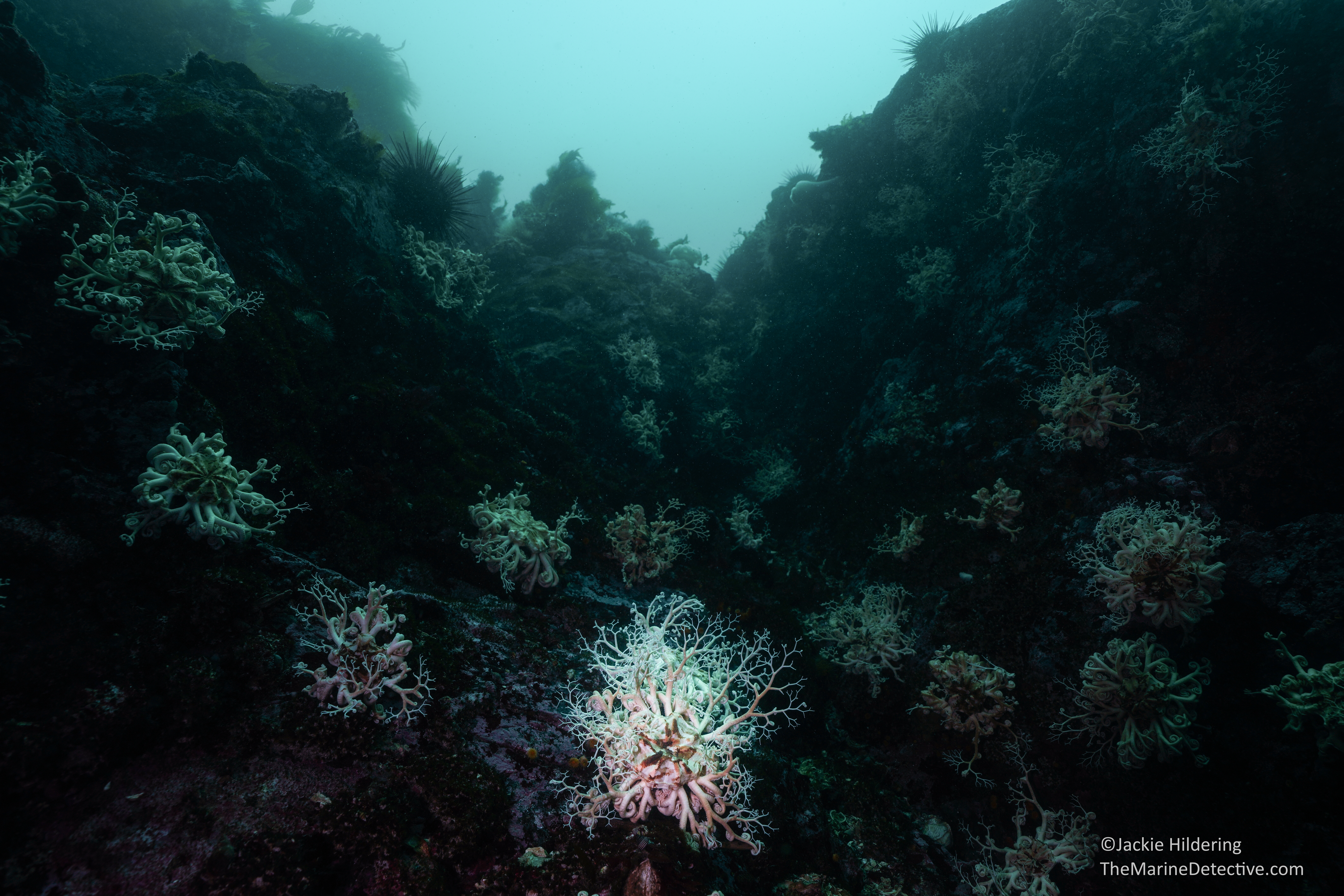
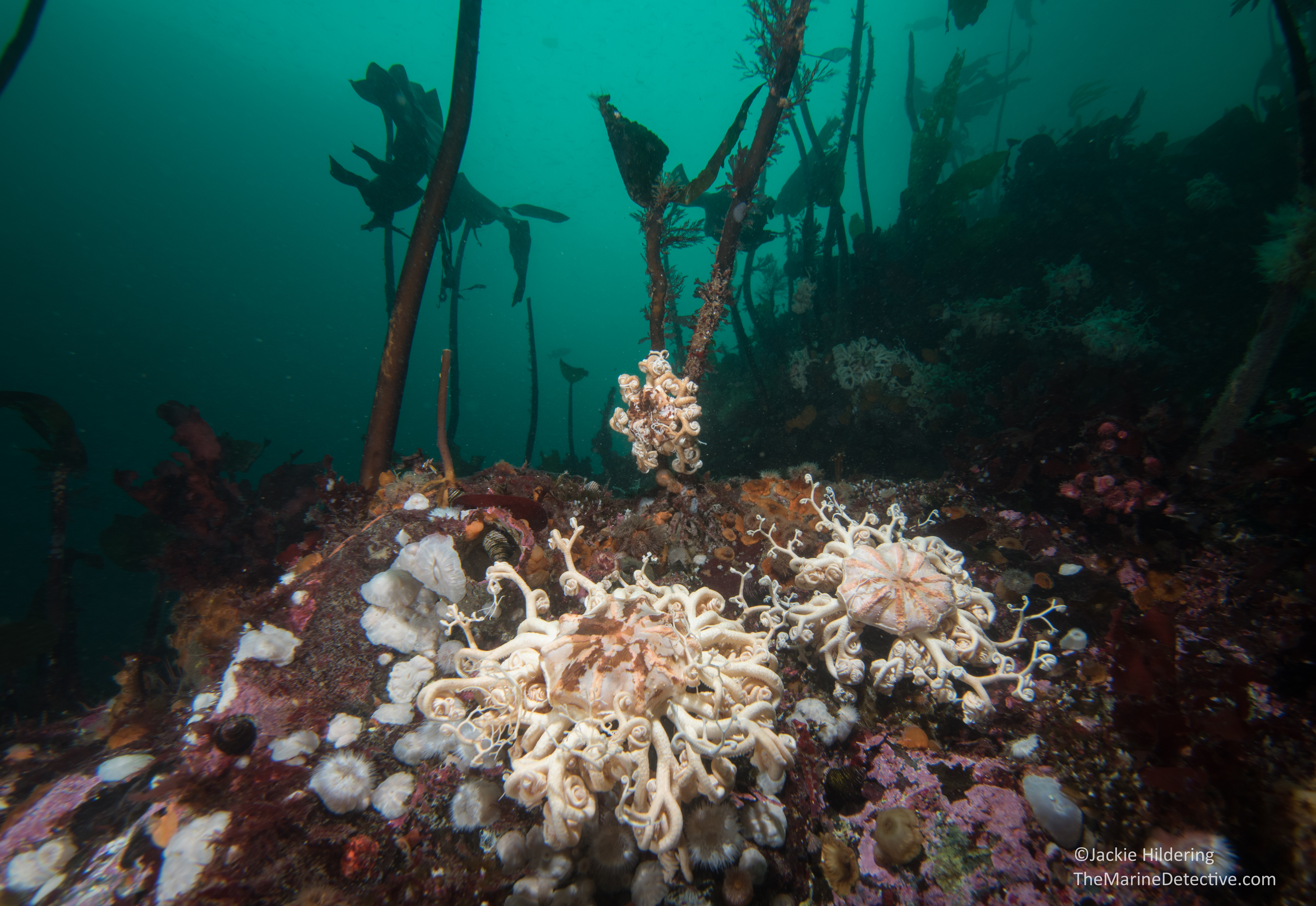
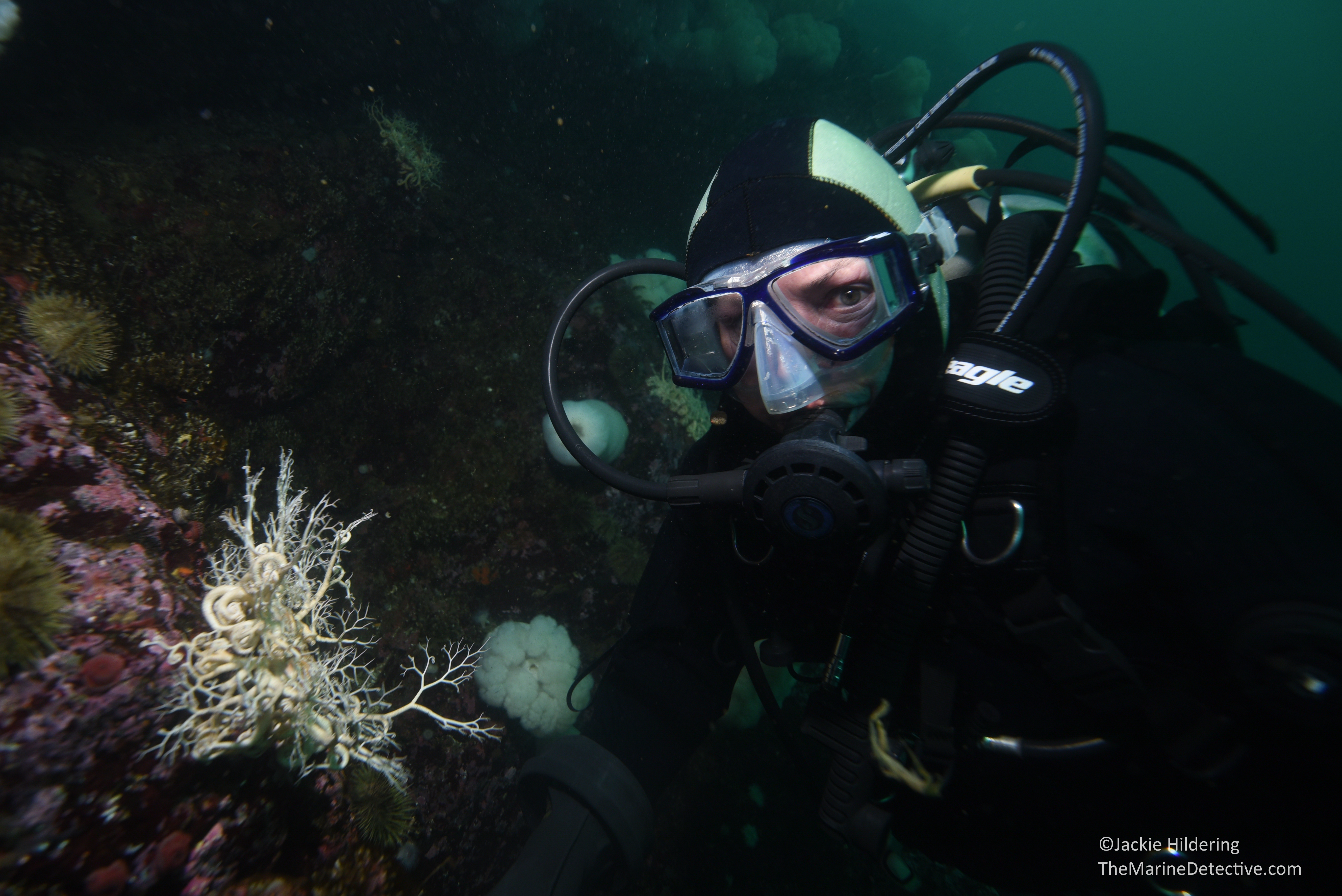
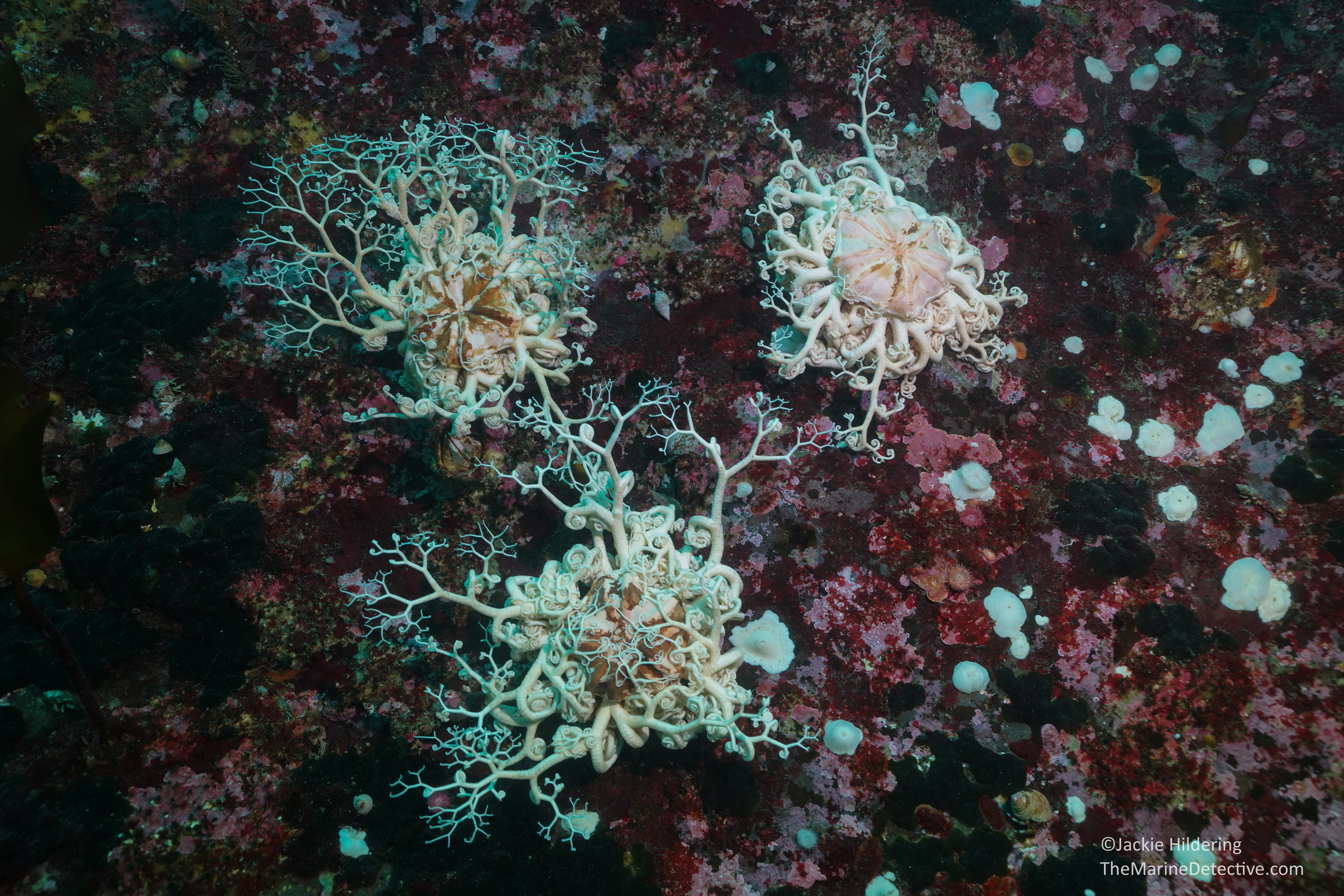
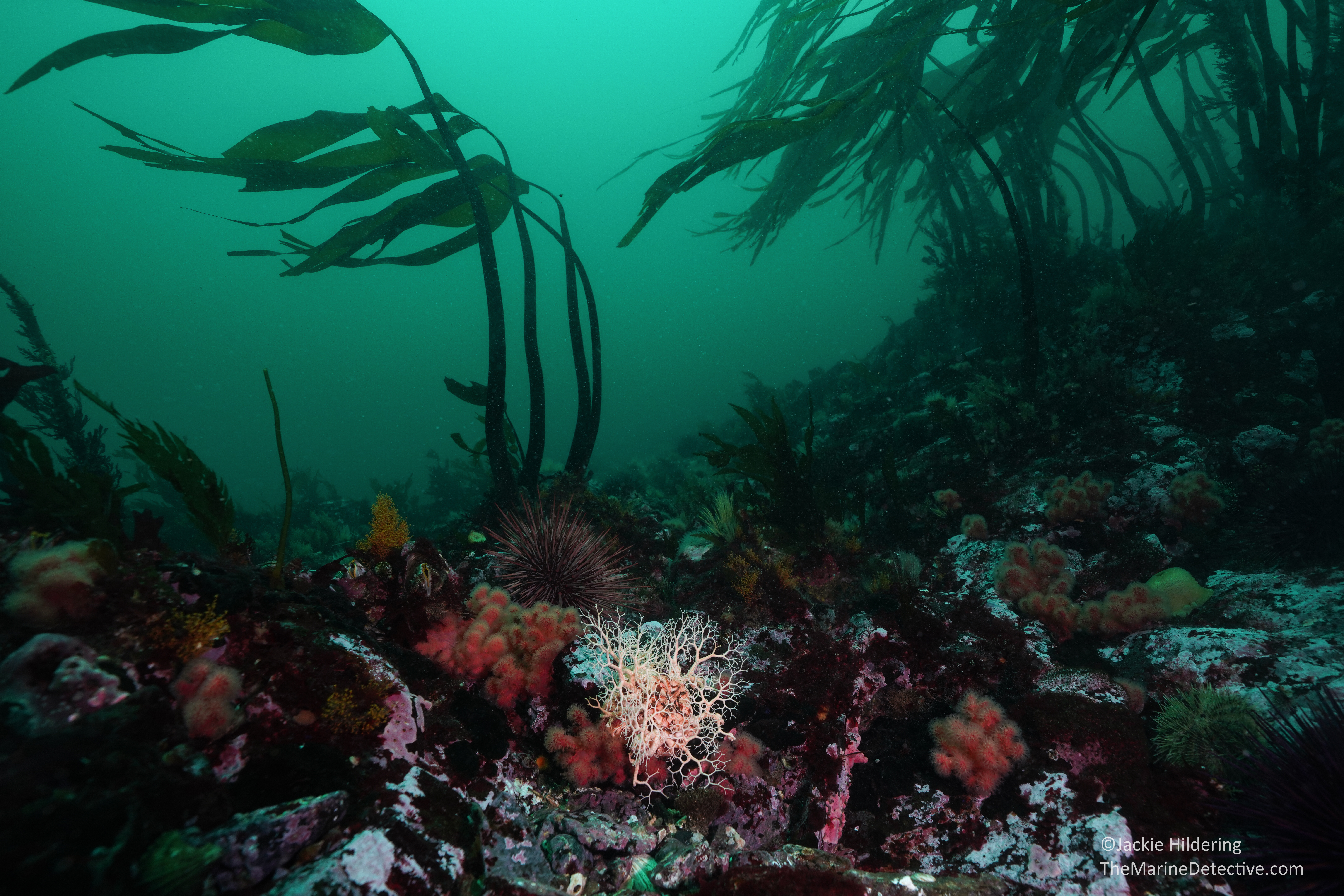
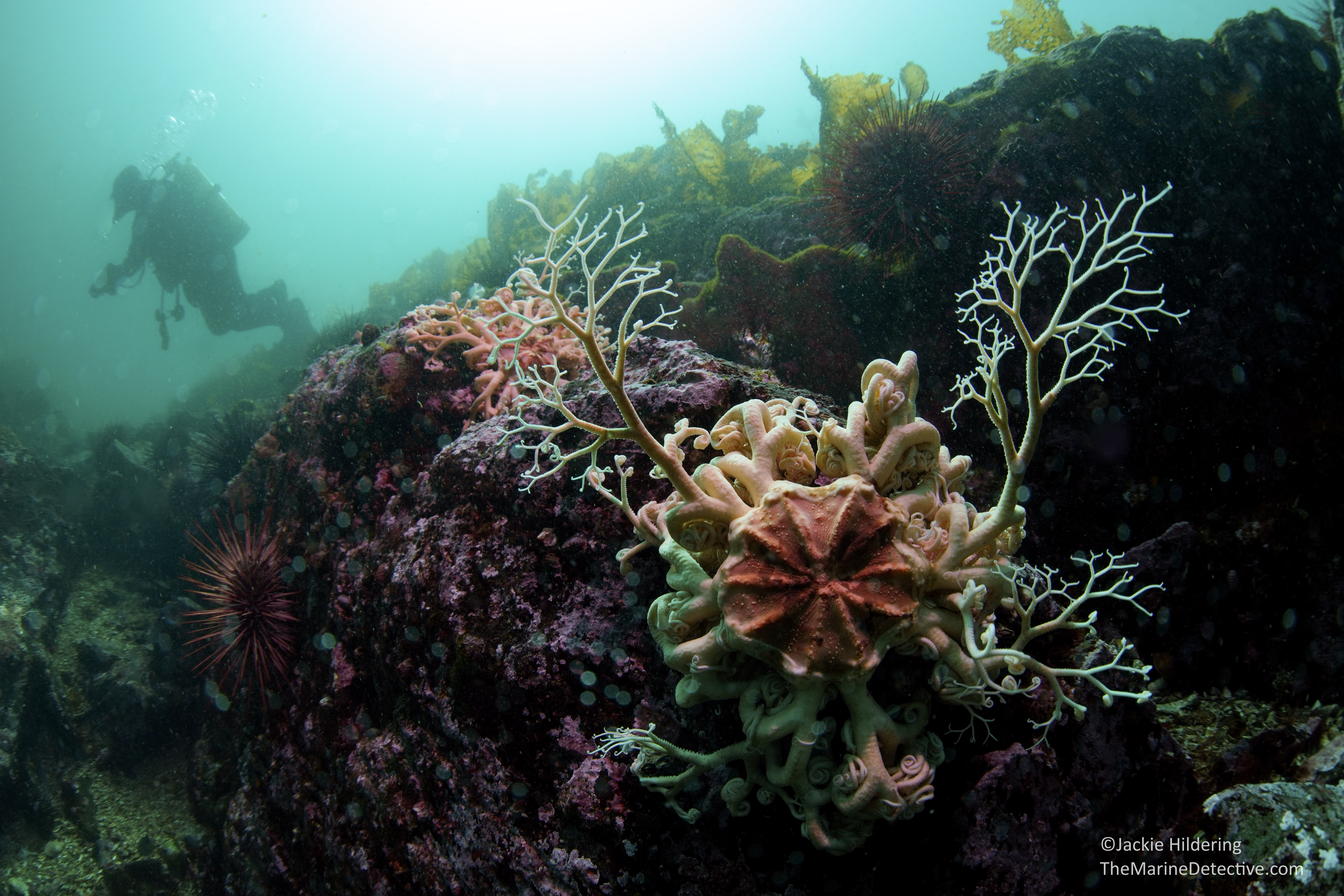
Valley of the Basket Stars. See how many there are?!

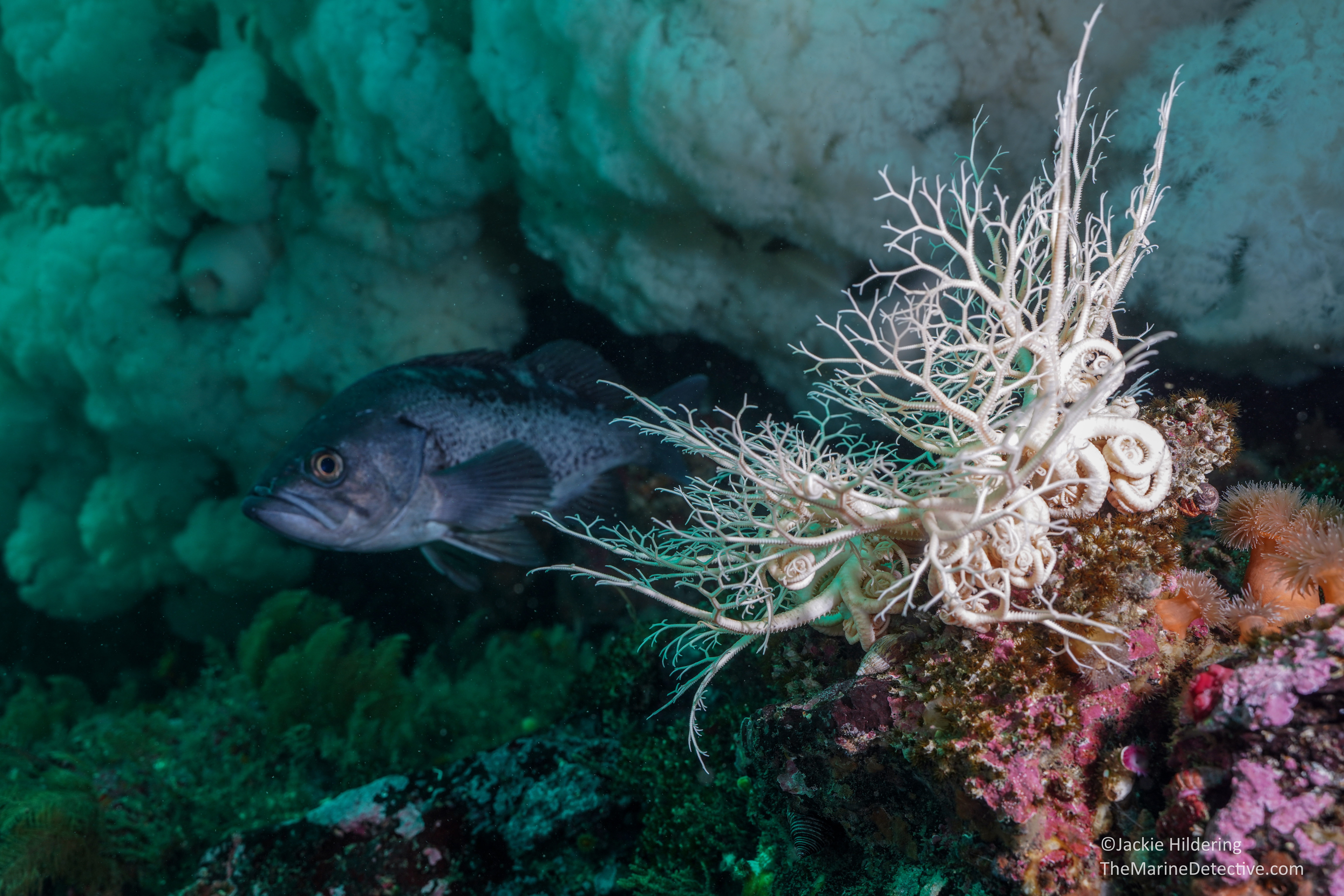
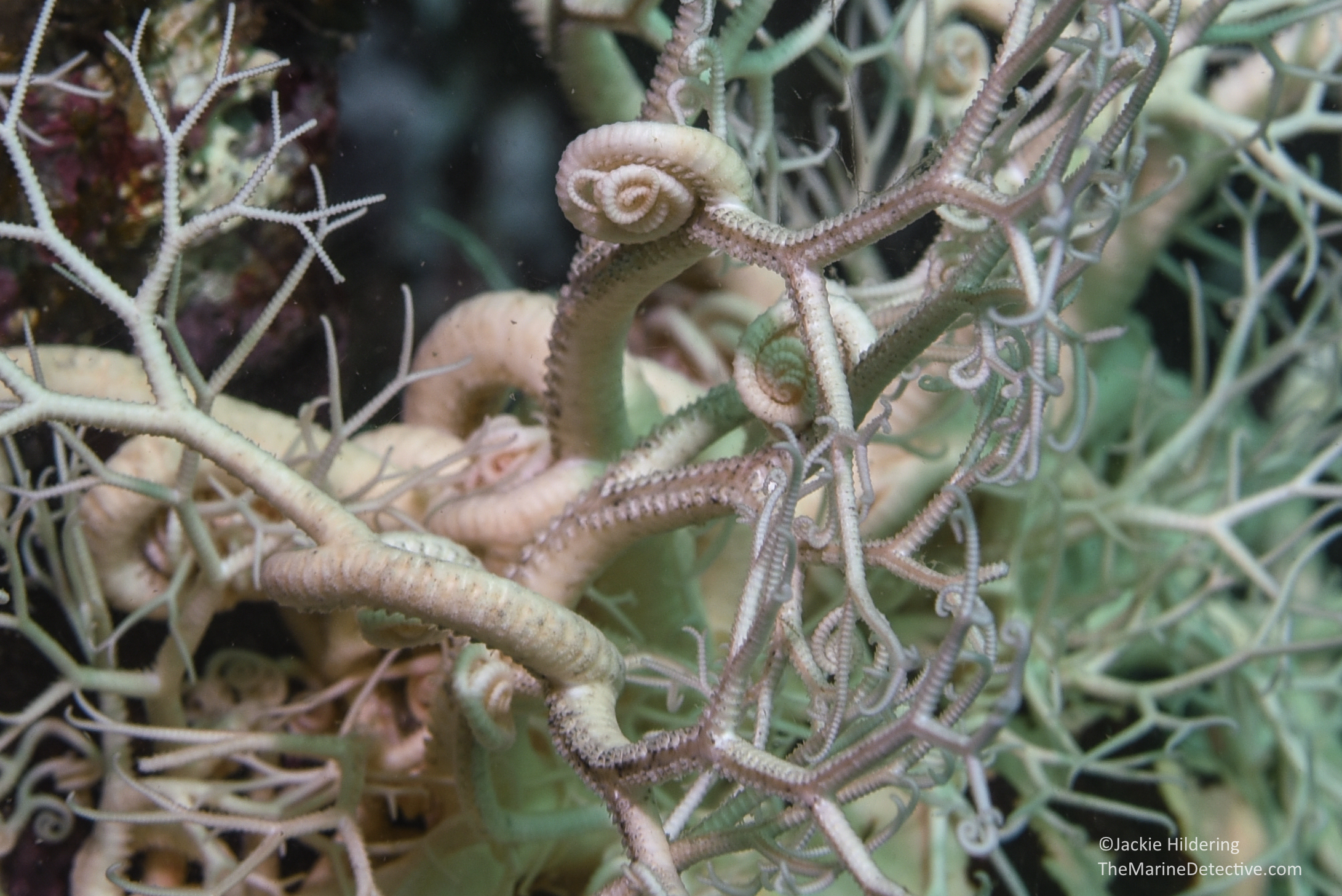
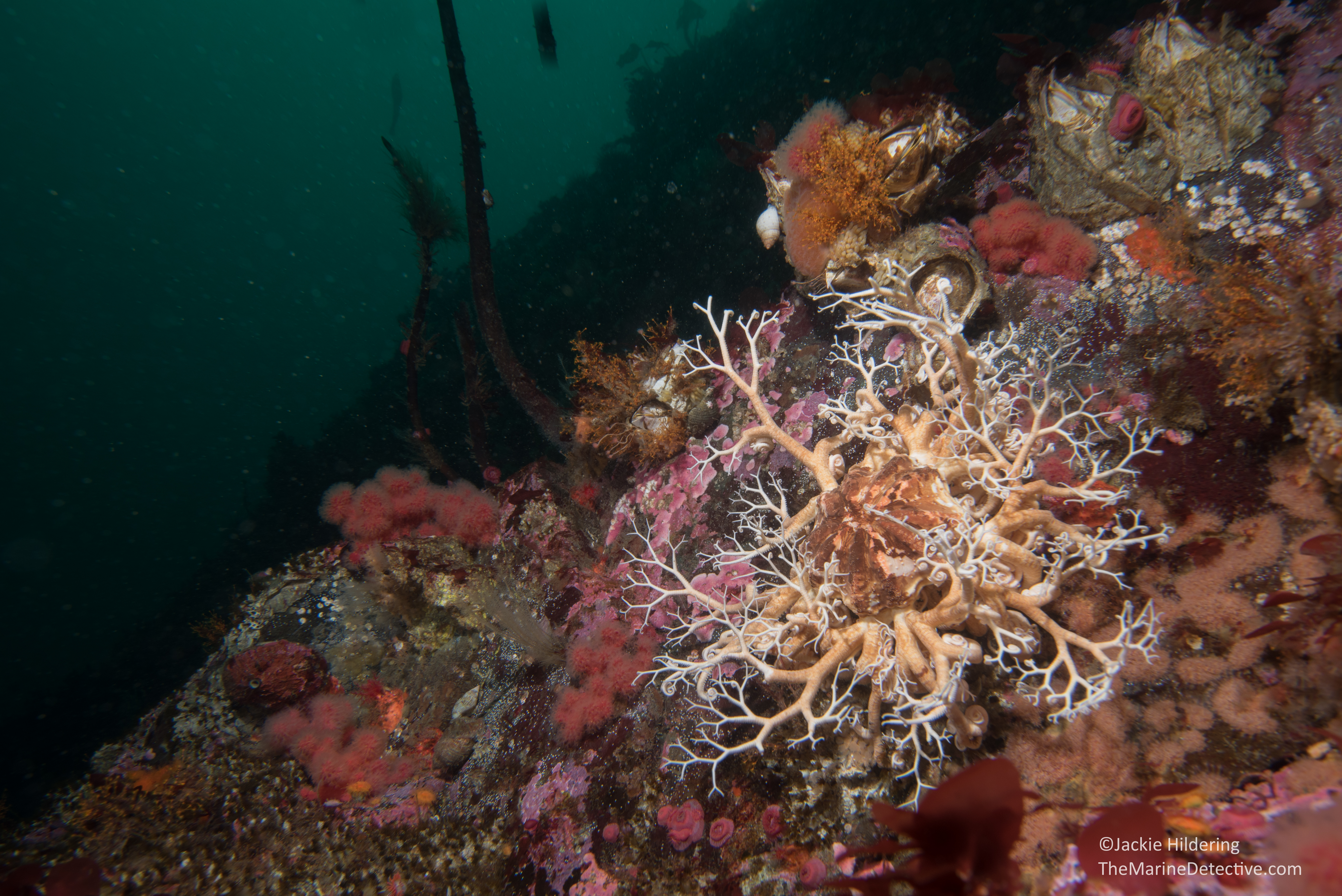
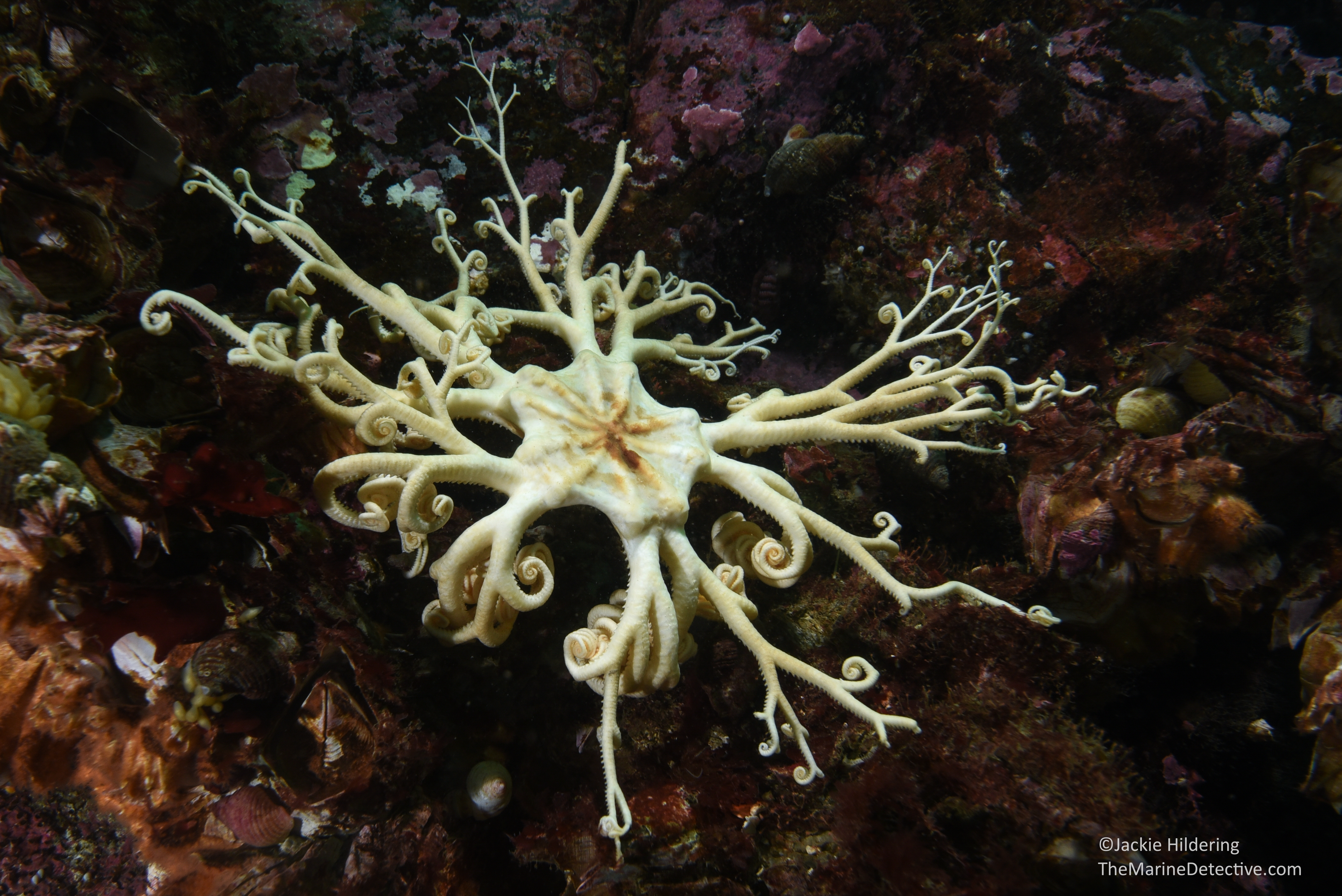
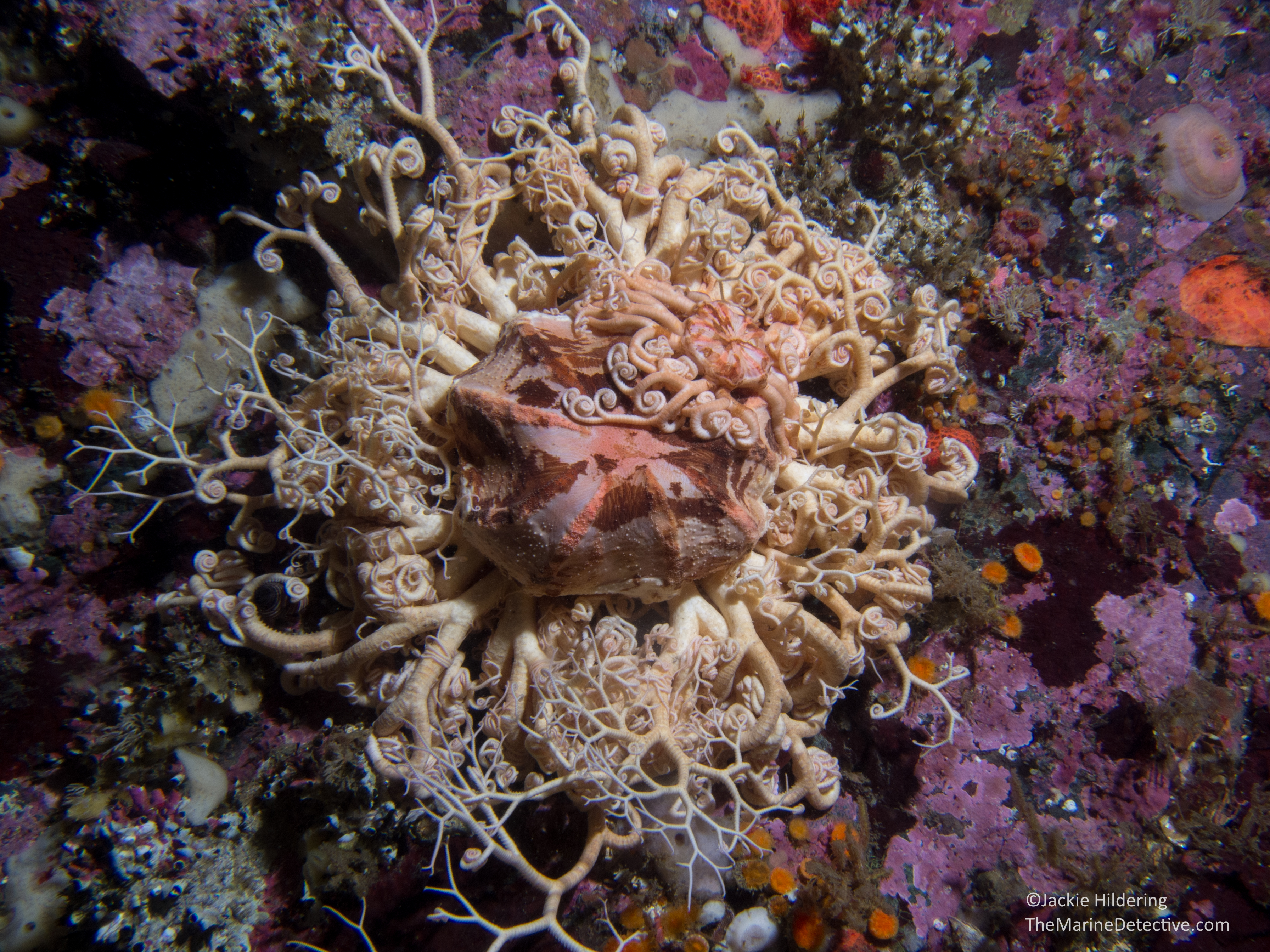
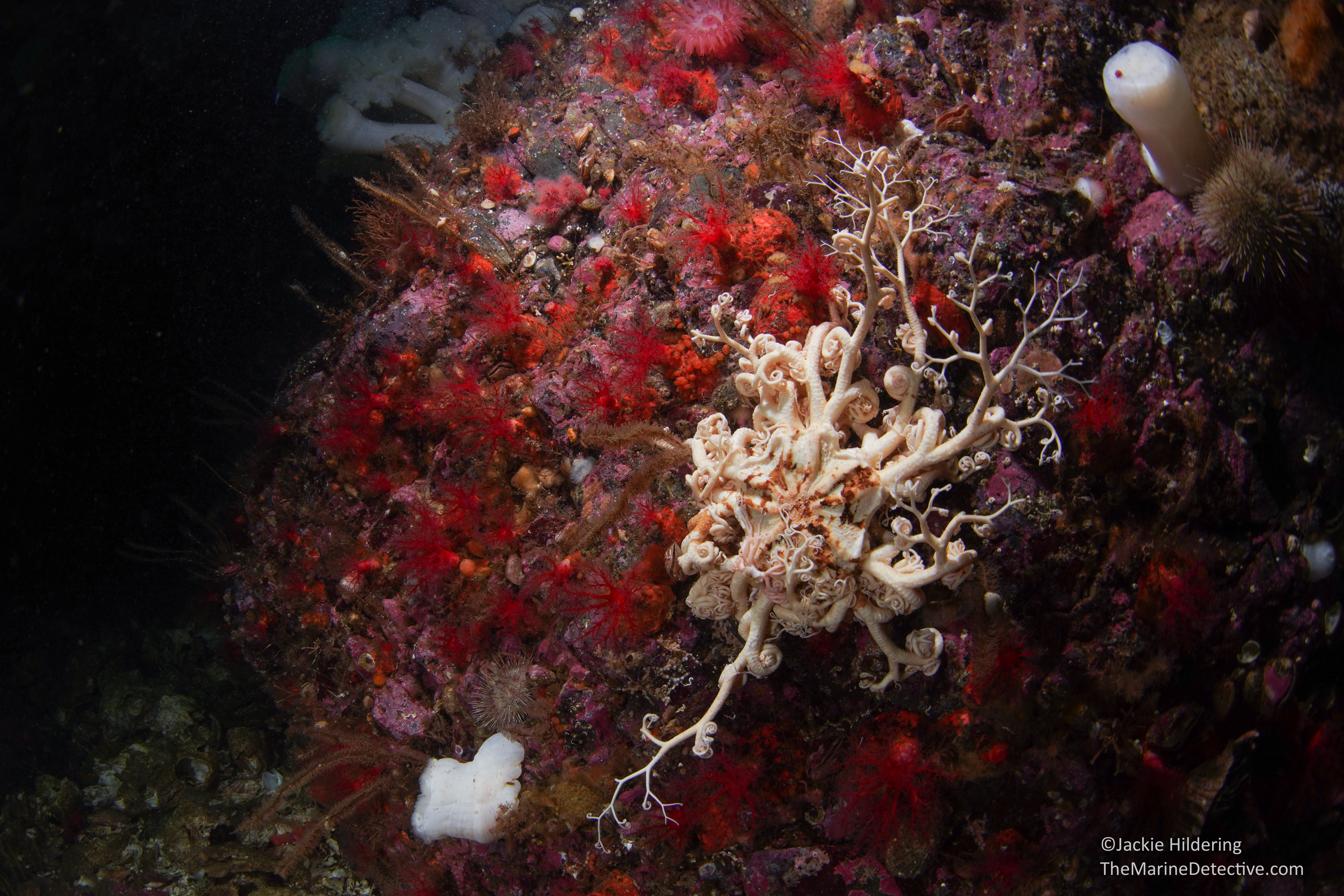
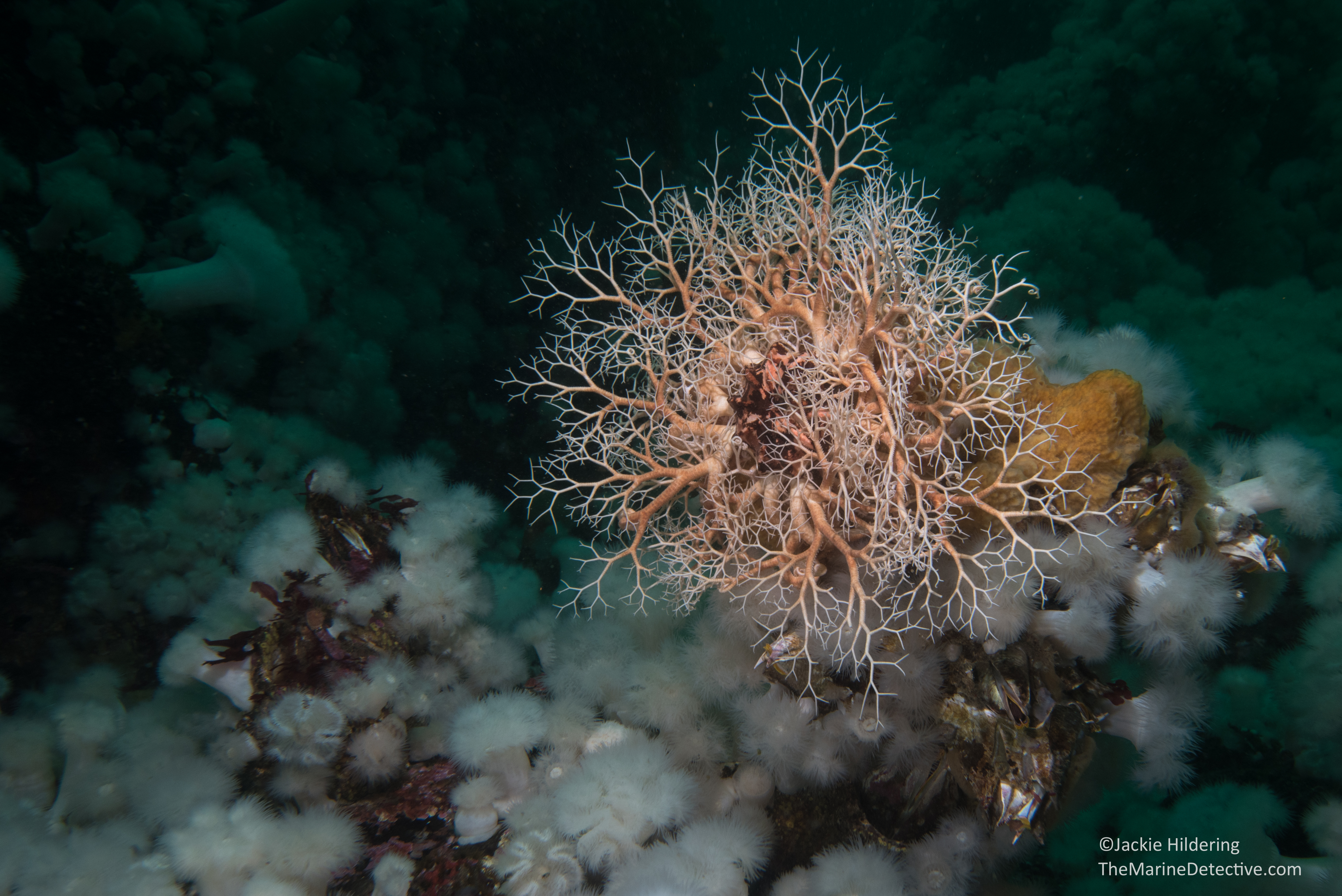
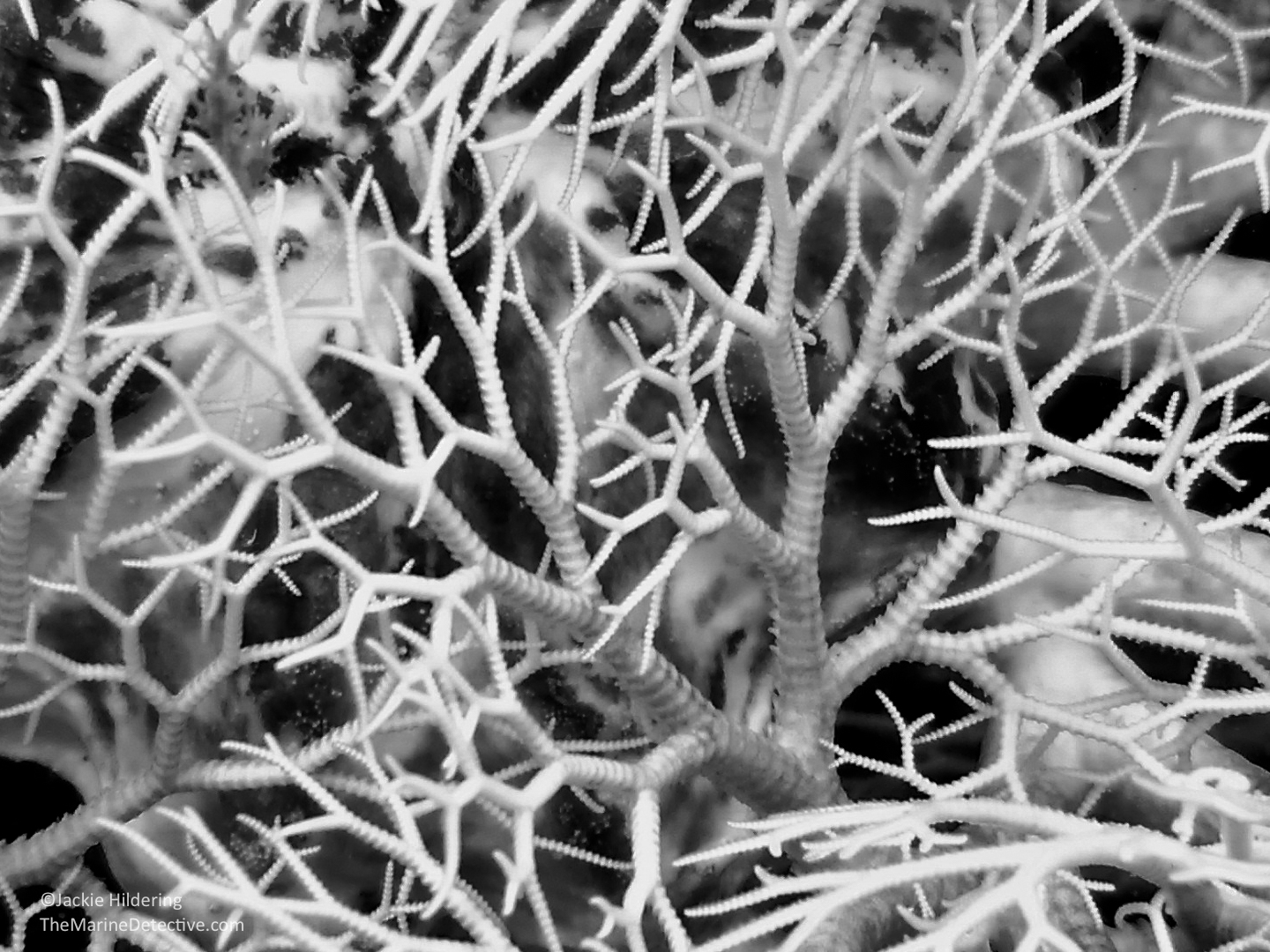
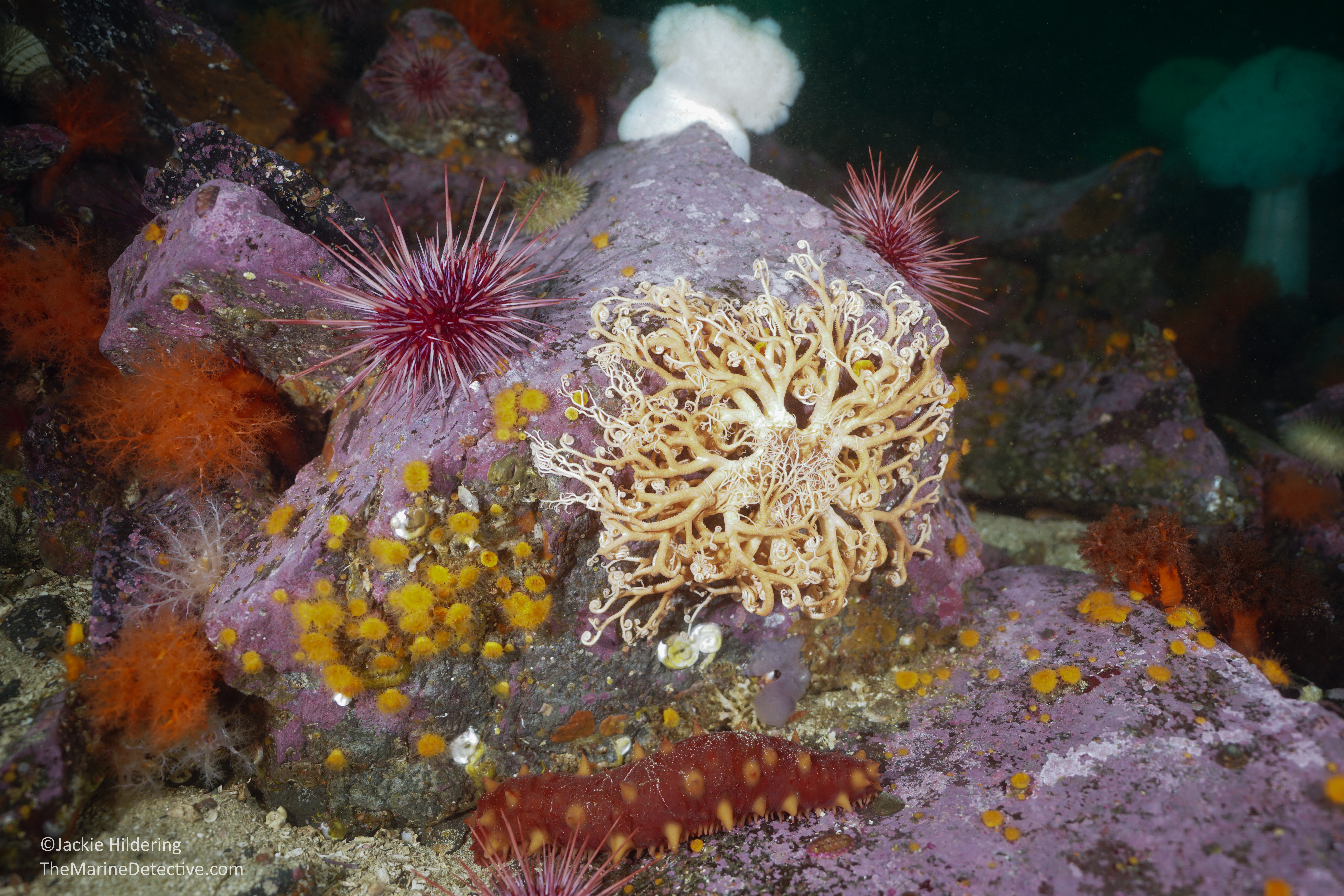
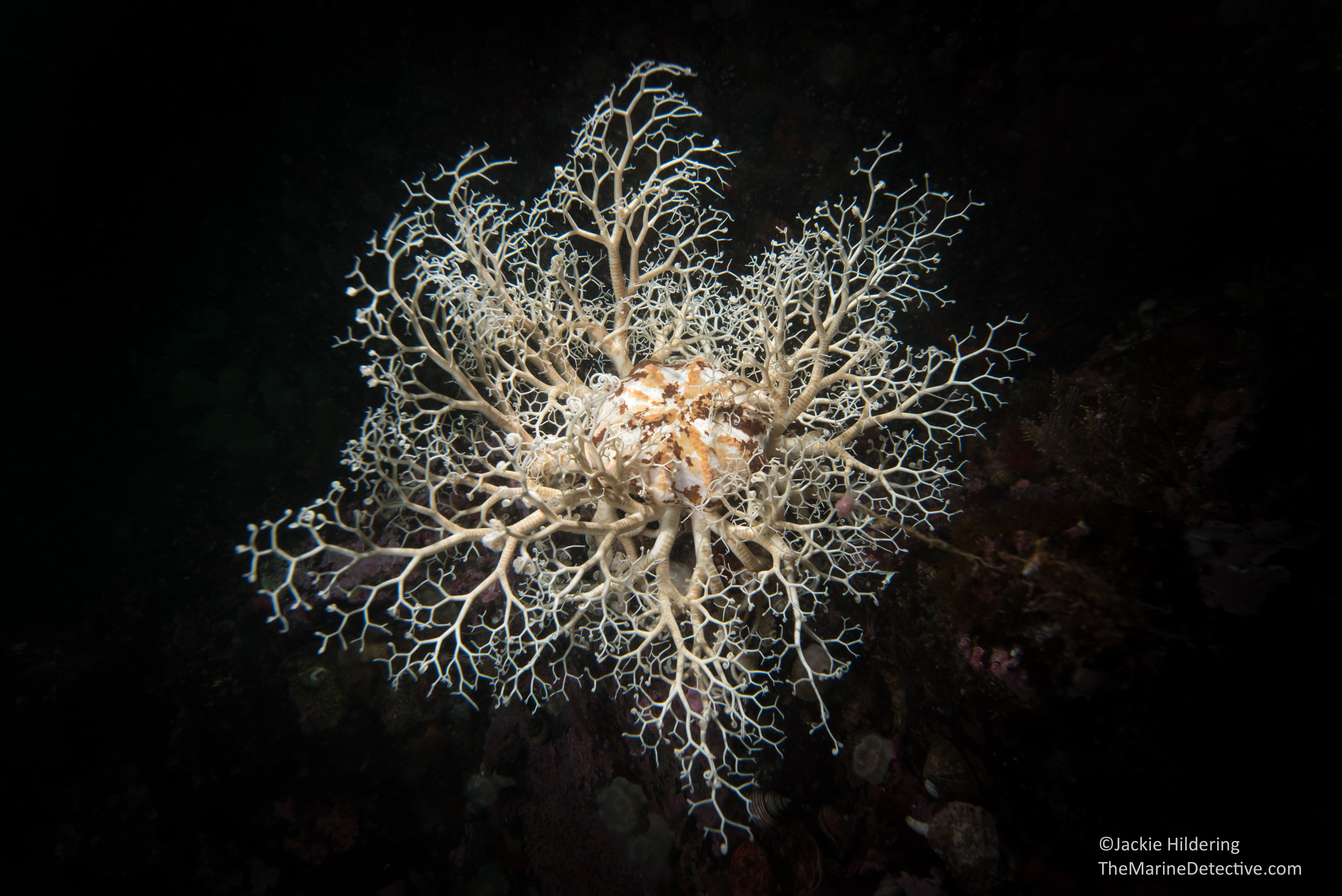
Yes, they are a common species here. They have 5 pairs of arms that seem to branch infinitely and they are big! When the branched arms of Gorgonocephalus eucnemis are fully outstretched, adults can be up to 80 centimetres wide (Source: Hainey).

Basket Star and Black Rockfish.


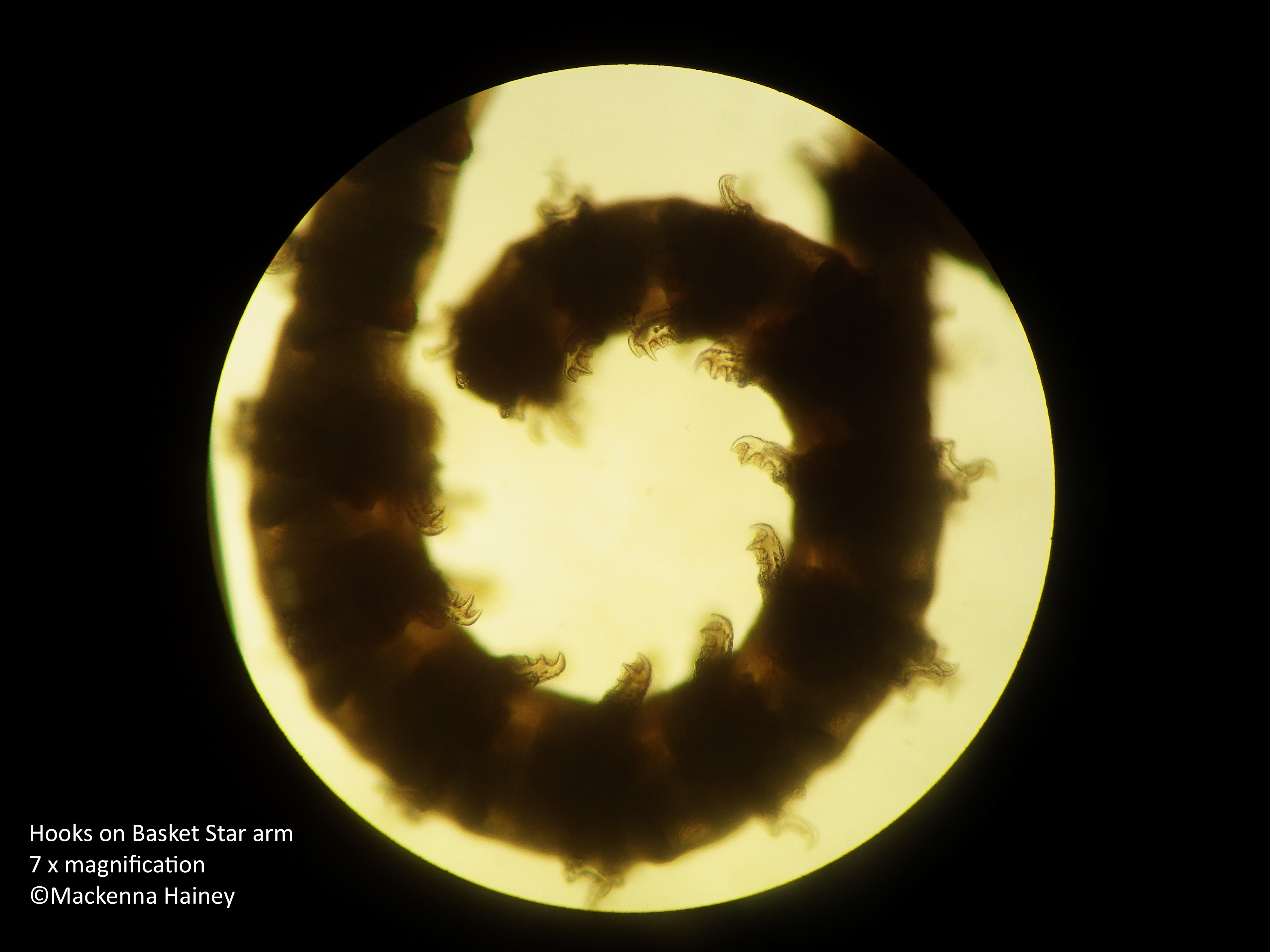

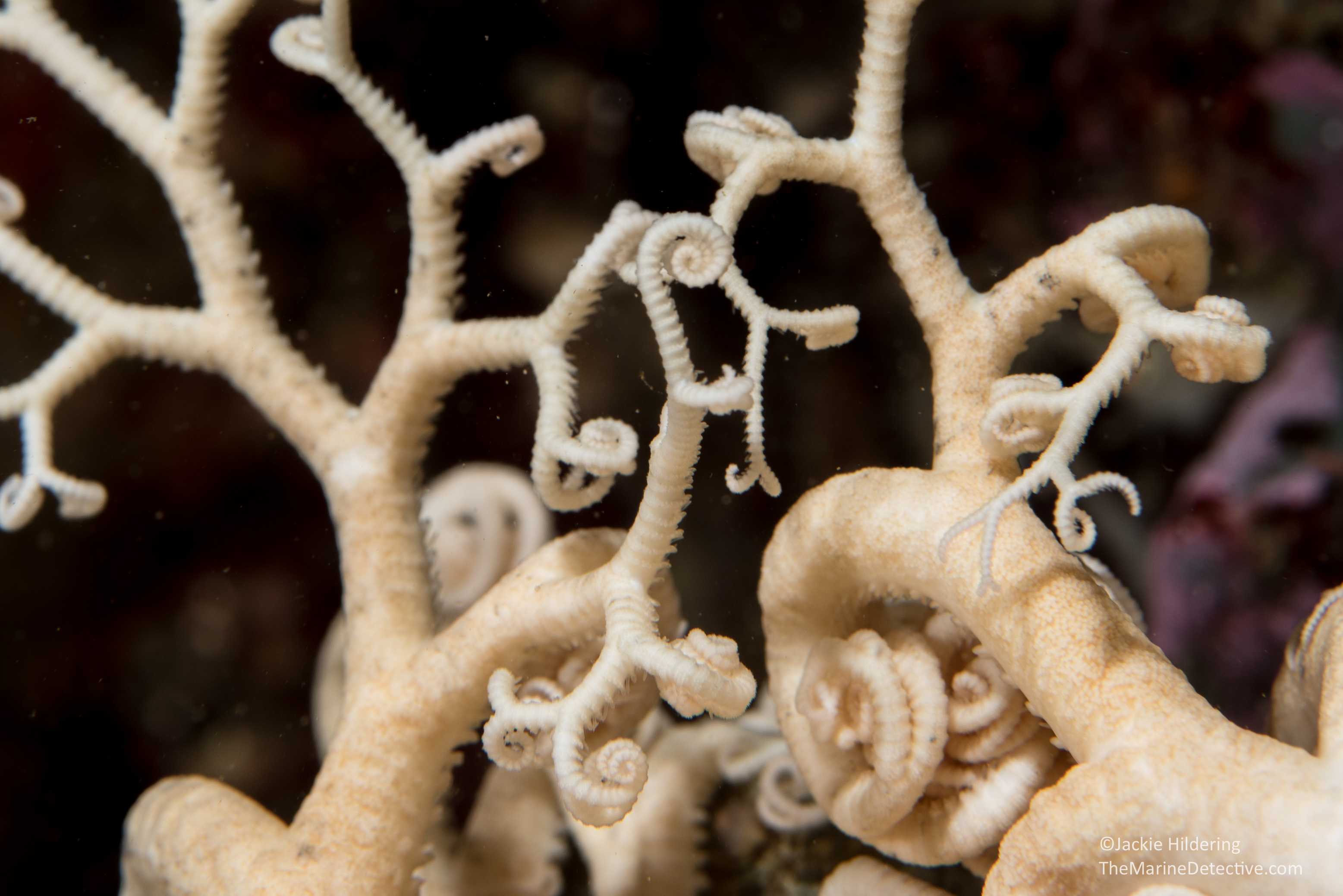
Imagine submerging and watching how, when the current increases, their arms unfurl into a basket to ensnare plankton. Through microscopic hooks and mucus, the snacks are moved to the Basket Star’s mouth which is on the underside of the central disc.


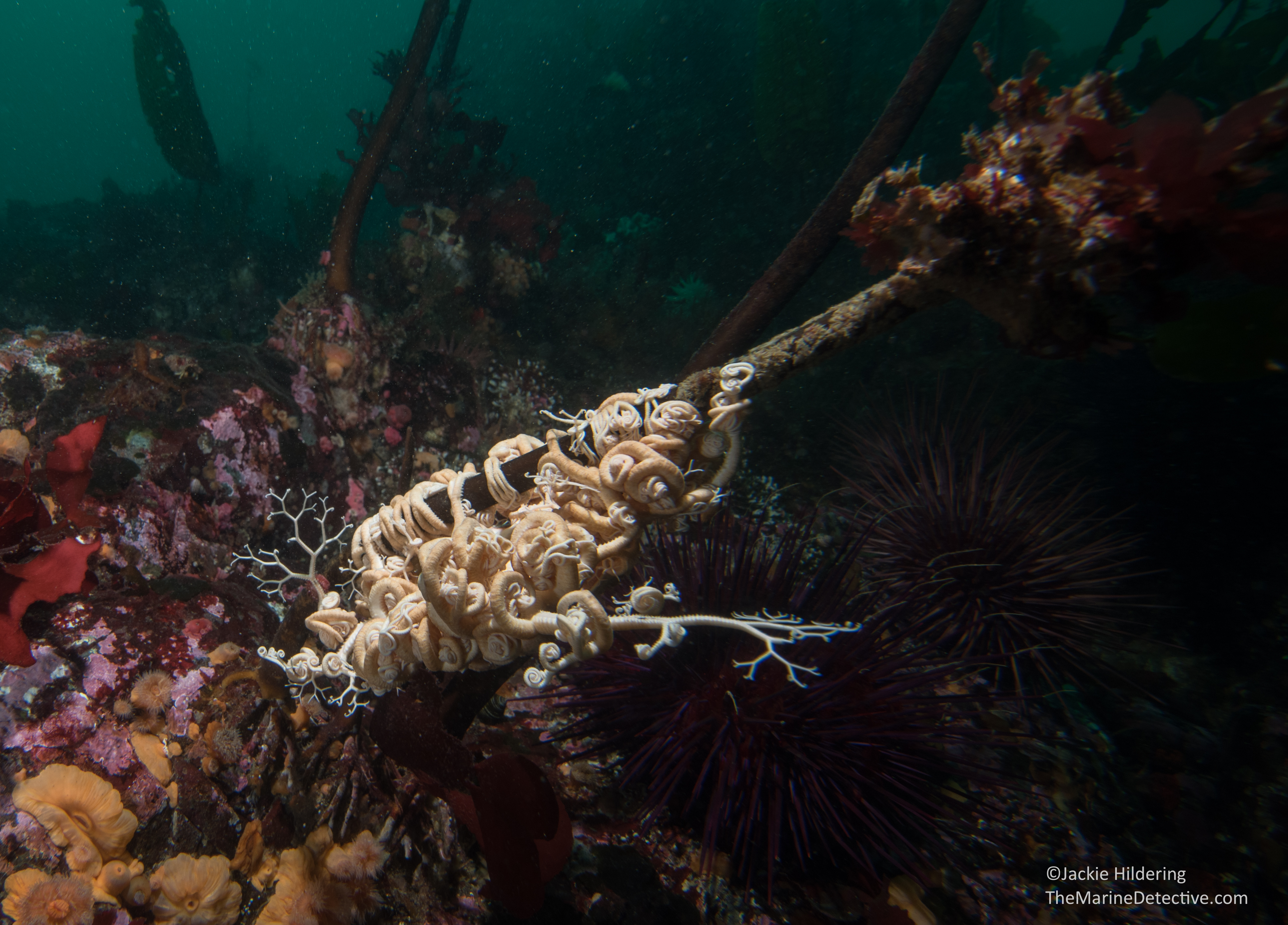
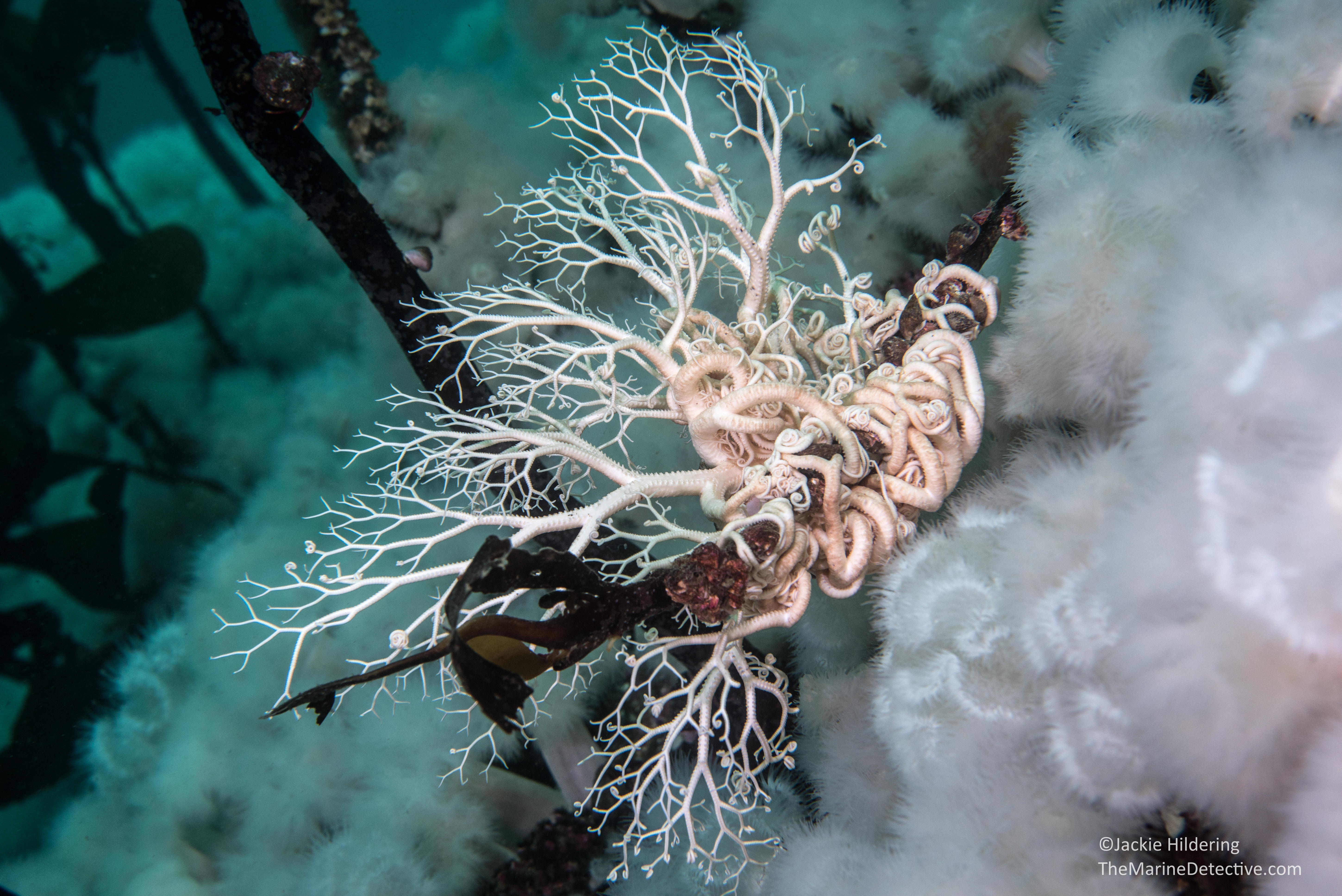
Basket Stars hold on and move about with their arms. They even climb kelp to position for more favourable feeding. They have tube feet, as do all echinoderms, but Basket Star tube feet do not appear to have a role in locomotion.

Basket Star climbing kelp.

This species is reported to be long-lived. Multiple online descriptions state that Basket Stars can live up to 35 years but I could not find the scientific source for this. Regardless, in having the joy of diving the same sites over and over again, I am marvelling at the same ones again and again, trying to capture their surreal beauty.

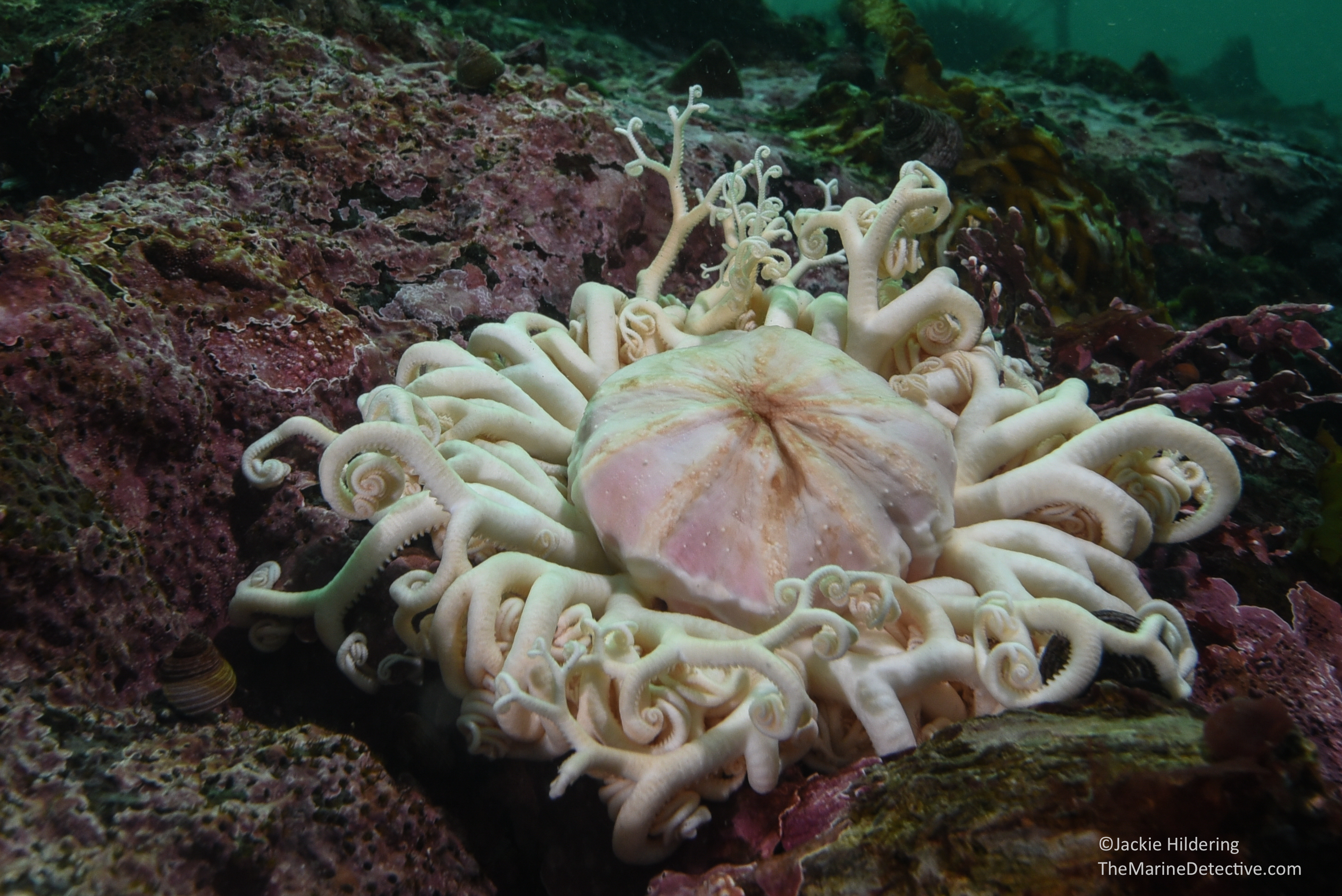
You’ll note from the photos how colour varies from beige to white and how the oral disc (the centre part) can have distinctive brown markings. Yes, I have thought about trying to identify and catalogue individuals. Please don’t encourage me!


You can see how their oral disc also varies from being very flat to very puffy. Some have hypothesized that this might be related to their reproductive stage but it could be due to food and/or oxygen availability. See the reference to Makenna Hainey’s research below.

Wickedly wild embryos:
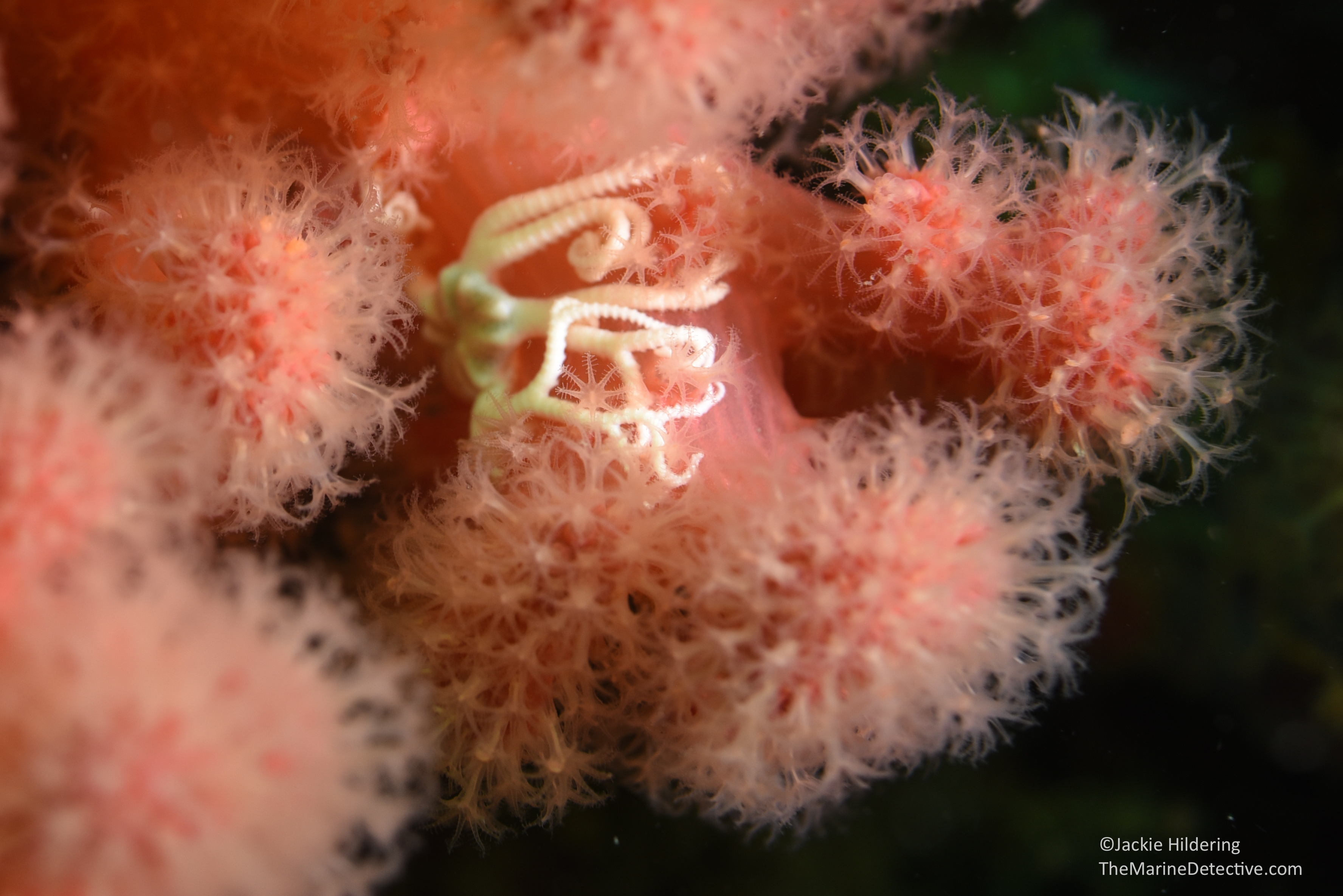
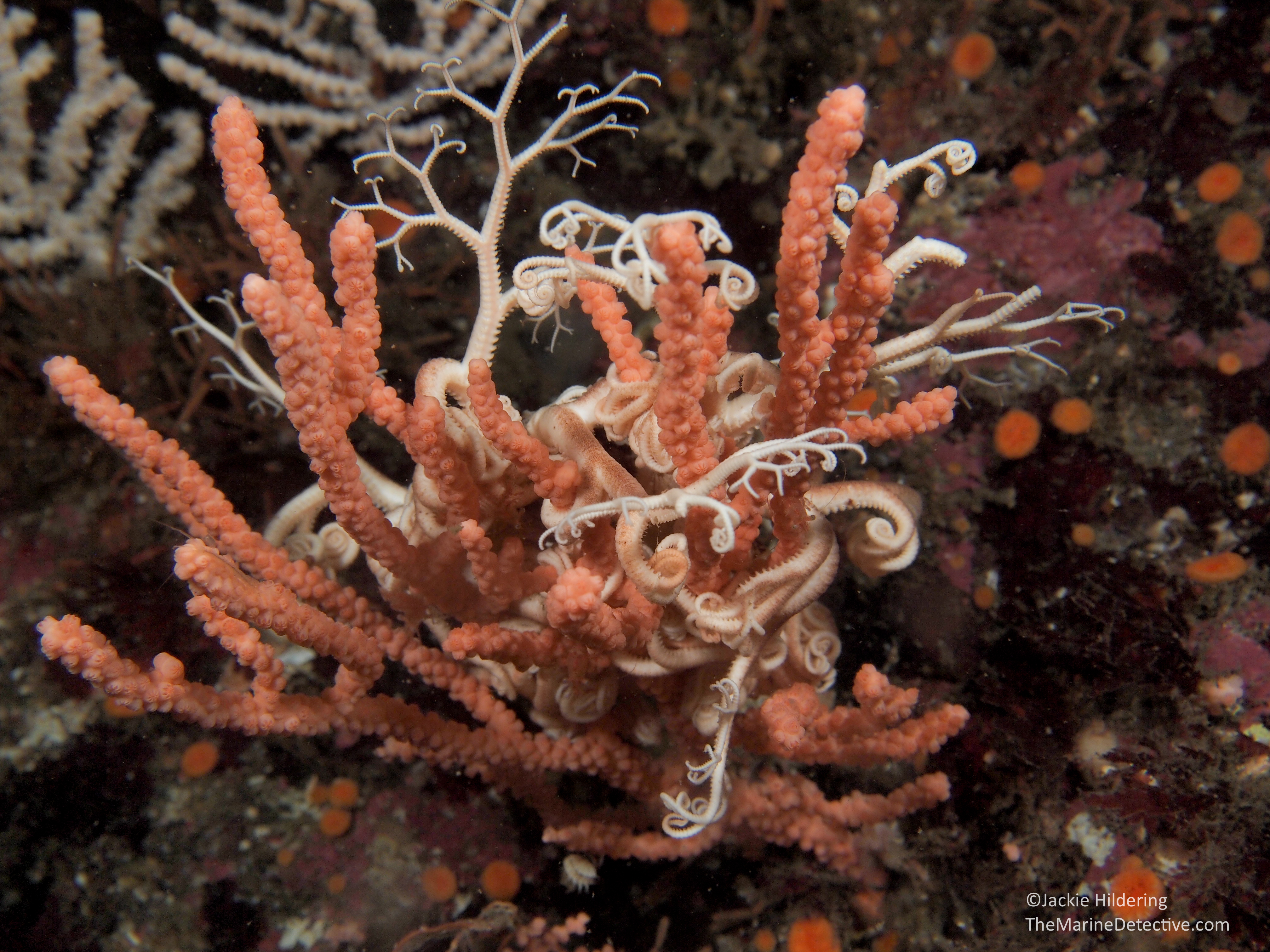
Basket Stars reproduce by broadcast spawning. Adult males and females release their gametes into the water. When they settle to the ocean bottom, the embryos are reported to develop INSIDE the polyps of Red Soft Coral. It’s thought the embryos feed on the soft coral’s eggs which brood inside the parent coral. Whoa!

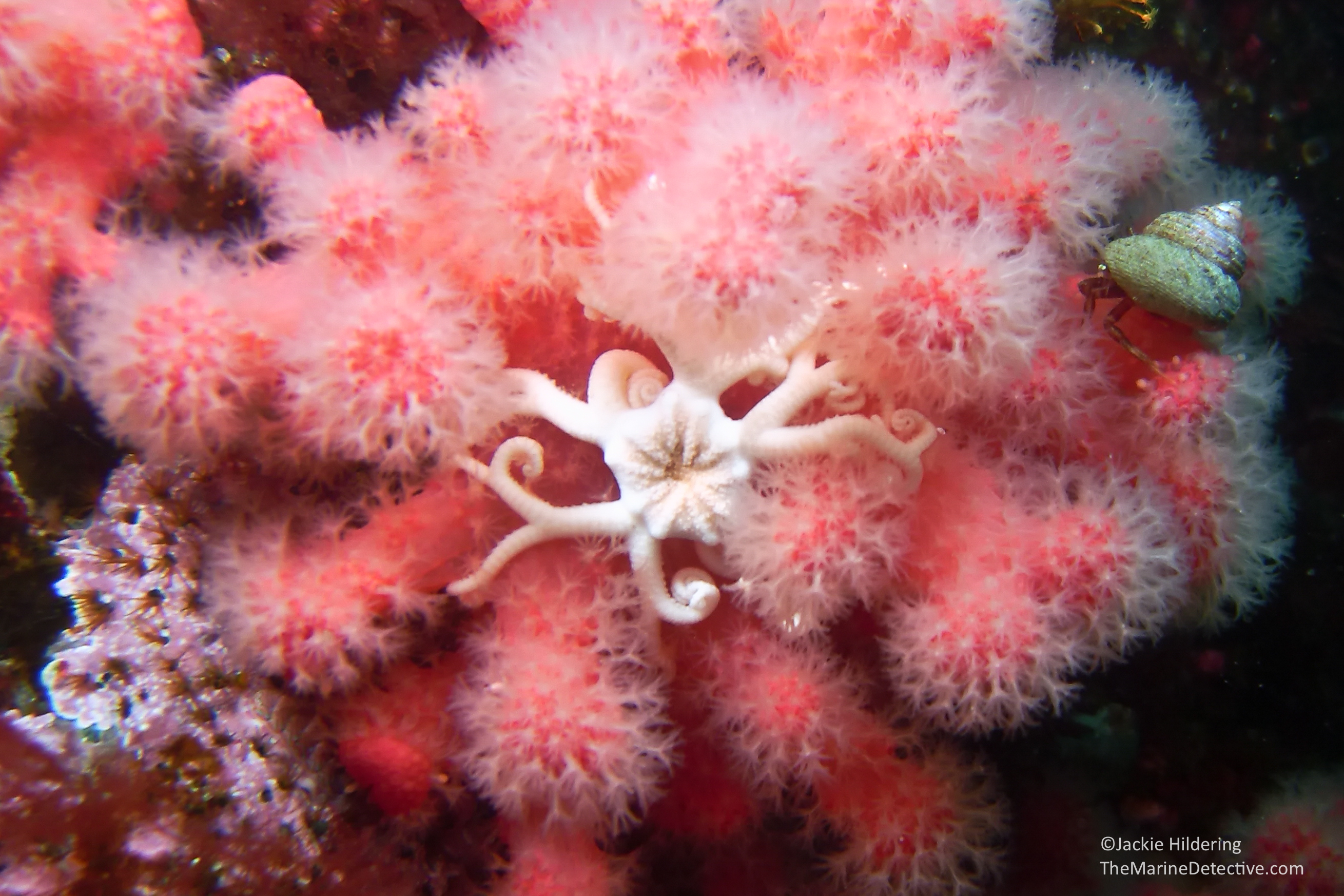
Baby Basket Star holding onto Red Soft Coral (Alcyonium sp.).


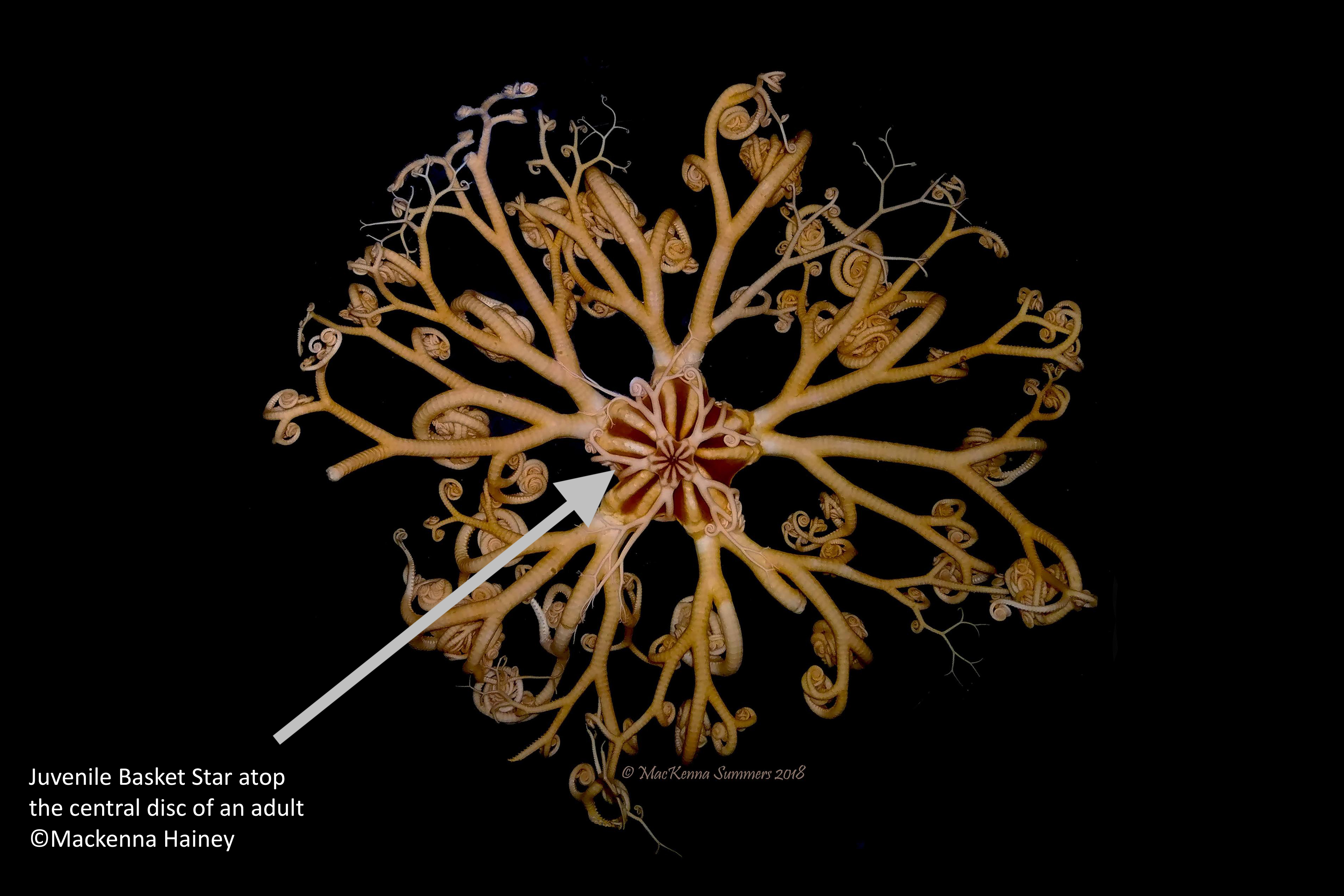
Then, when juvenile Basket Stars emerge from the coral’s polyps, they apparently hang onto the outside of the coral till about 3 millimetres in disk diameter. They shuffle off when approximately 5 centimetres in disk diameter and crawl onto an adult Basket Star.


From Makenna Hainey (personal communication, October 1, 2023): “No one really knows how the juveniles get onto the adults. But the leading theory is that they use Soft Corals as bridges.  From there, they will steal food bundles out of the mouths of the parents.”

See the smaller Basket Star atop the adult (top right)?


More on diet and feeding:
From Invertebrates of the Salish Sea: ” . . . feeds on suspended particles by spreading rays out like a fan, oriented mostly perpendicular to the current.  Macroscopic zooplankton such as copepods, chaetognaths, and jellyfish are caught by microscopic hooks on the rays.  The fine branchlet tips then curl around the object and slowly move it toward the mouth (exact method is unclear).  The prey of basket star species is said to range up to 3 cm (just over an inch) in size, and most basket stars capture prey mainly at night but may retain their prey until daytime to actually feed on them.  Mucus may also help to immobilize prey.  This species has also been reported to feed on the small benthic sea pen Stylatula elongata [Spiny White Sea Pen]”.


From Makenna Hainey (personal communication, October 1, 2023): “Basket Stars have tube feet. But, unlike asteroids [sea stars], echinoids , and holothurians [sea cucumbers], they don’t have suction cups on the tube feet. Thy have microscopic hooks that look and operate mechanically like cats’ claws to pin down prey while the tube feet secrete paralyzing mucus. They almost immediately bring food down to the mouth, insert the arm into the mouth, and wipe the food bundles off on the oral spines.”

Basket Star unfurling its arms when on Gorgonian Coral.
Basket Star and Creeping Pedal Sea Cucumbers (red) and Orange Social Tunicates.


Breathing:
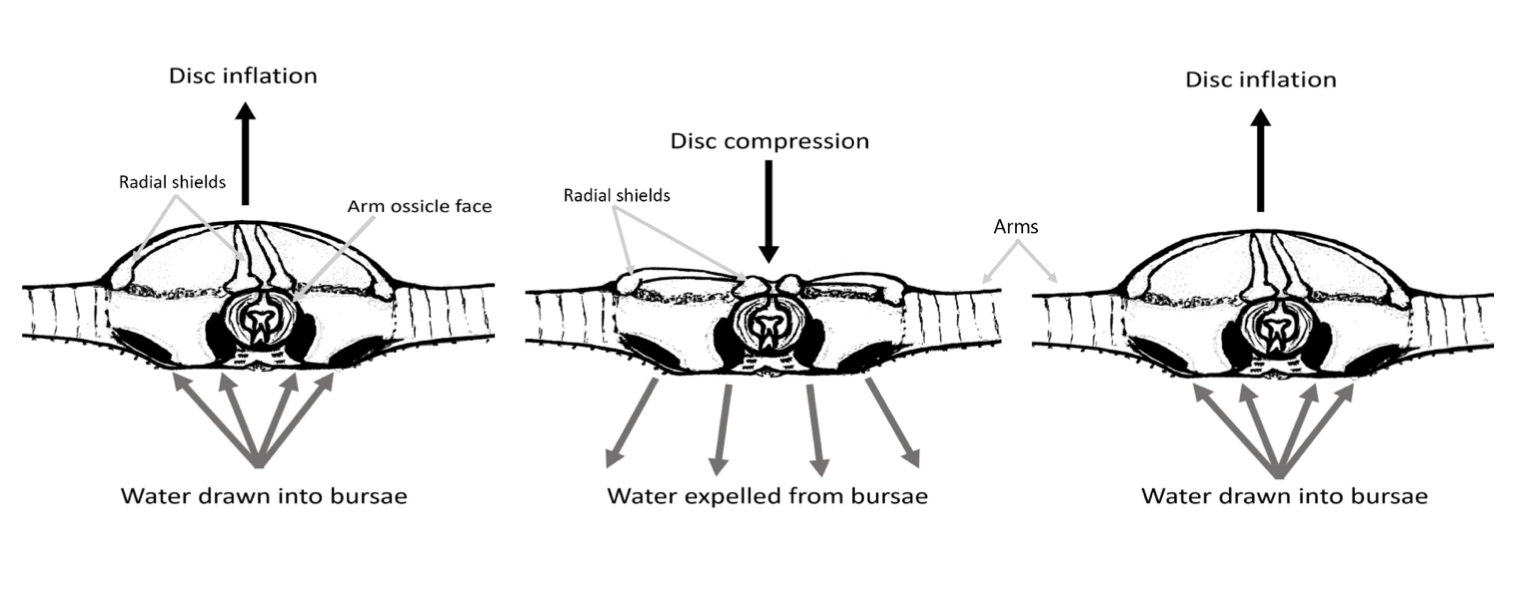
Really interesting research has been done by Mackenna Hainey to measure the breathing rate (bursal ventilation) of this species of Basket Star.

Part of her research was to see, in a laboratory setting, how Basket Stars changed their breathing when fed a slurpee of krill. She found their breathing changed from approximately 10 to 30 an hour to 30 to 45 an hour.

Figure 2 from Mackenna Hainey’s Master’s thesis.
Bursal ventilation of a Basket Star before and after food (krill slurpee) was added to the tank.


Mackenna reported: “Basket stars exhibited feeding behavior beginning a few seconds after food was introduced to the aquarium and lasted an average duration of 50 minutes . . . Once the food was detected by a basket star in the test aquarium, it quickly assumed a feeding position (some arms raised in a parabola, creating a basket shape with tendrils unfurled) and began to move 2-3 arms slowly through the water, looping arm tendrils as the arm hooks accumulated particles of krill. The rate of bursal ventilation increased rapidly once this feeding activity began.”

Breathing / ventilation rate also increased when the Basket Stars were exposed to reduced oxygen levels.


Range:
Basket Stars have been documented at depths from 8 to 1,850 metres. They are believed to be more common at depths between 15 to 150 metres.

Their range range was thought to be from the Bering Sea to San Diego until research published in 2014 reported that a Basket Star was documented from a submersible at Guadalupe Island, Mexico. That sighting extended their known range by over 400 kilometres.

Relatives:
Basket Stars are echinoderms, the phylum to which sea stars, urchins, feather stars, sand dollars, and sea cucumbers also belong. Basket Stars do not belong to the same class as sea stars such as Sunflower Stars, the Asteroidea. Basket Stars are in the Ophiuroidea class comprised of brittle stars and other basket star species. This class dates back 500 million years (give or take a million).


Photo gallery:
Because there can never be too many photos of Basket Stars.


Etymology of the scientific name Gorgonocephalus eucnemis
Gorgonocephalus = gorgós is Greek for dreadful and cephalus is Greek for head. “Dreadful head” is in reference to Basket Stars looking like the head of the Gorgon in Greek mythology.
Eucnemis = Greek for good or boot. A good dreadful head?! ☺️


Sources:
Emson, R.H., Mladenov, P.V., & Barrow, K. (1991). The feeding mechanism of the basket star Gorgonocephalus arcticusCanadian Journal of Zoology, 69

Hainey MAH, Emlet RB. Gorgonocephalus eucnemis (Echinodermata: Ophiuroidea) and Bursal Ventilation. Biol Bull. 2020 Jun;238(3):193-205. doi: 10.1086/709575. Epub 2020 Jun 11. PMID: 32597717.

Hainey, Mackenna (2018). Masters thesis – Behavior and Fundtional Morphology of Respiration in the Basket Star Gorgonocephalus ecunemis and Two Brittle Stars in the Genus Ophiothrix.

Herrero-Pérezrul, M., Granja-Fernández, R., Hoyos-Padilla, M., & Reyes-Bonilla, H. (2014). New record of the basket star Gorgonocephalus eucnemis (Ophiuroidea: Gorgonocephalidae) at the Pacific coast of Mexico. Marine Biodiversity Records, 7, E33. doi:10.1017/S1755267214000323

Inaturalist Canada – Common Basket Star

Invertebrates of the Salish Sea – Basket Star

Lambert, P. and Austin, W.C. (2007) Brittle stars, sea urchins and feather stars of British Columbia, southeastern Alaska and Puget Sound. Victoria, Canada: Royal British Columbia Museum

Patent, D.H. (1970). Life history of the basket star, Gorgonocephalus eucnemis (Müller & Troschel) (echinodermata; ophiuroidea)Ophelia, 8, 145-159.

University of Oregon (2020). Student’s curiosity catches basket stars breathing

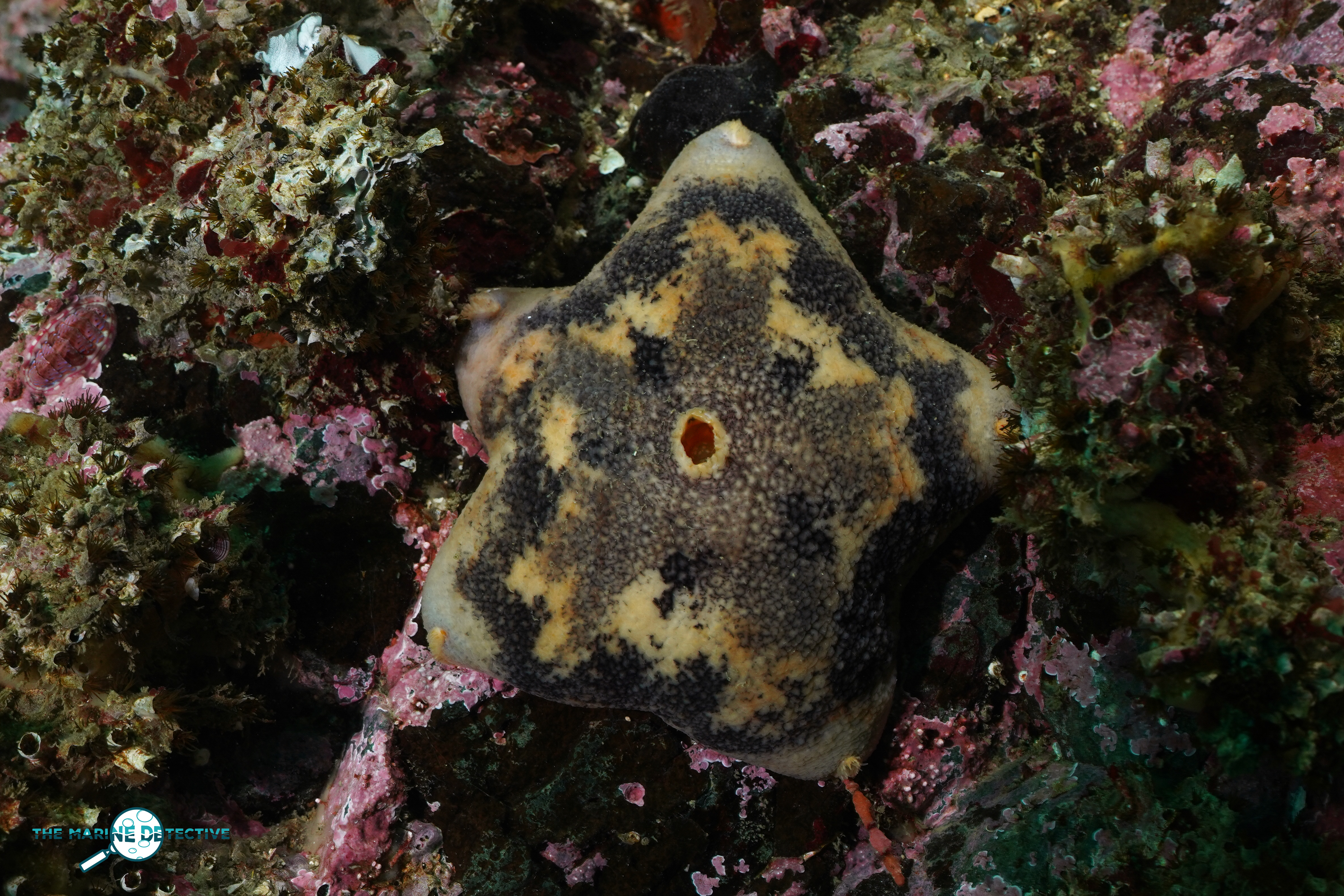
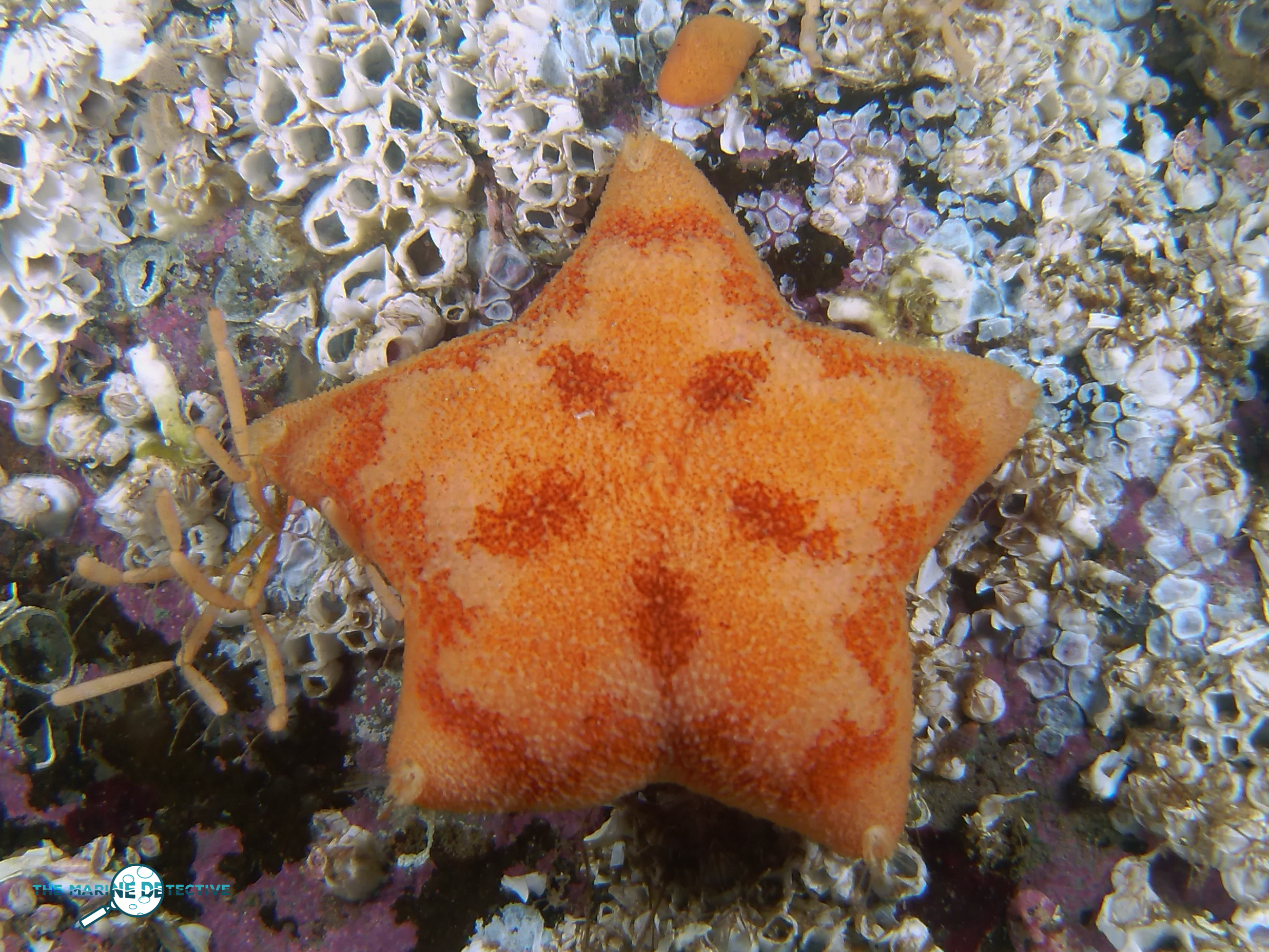
Slime Star!

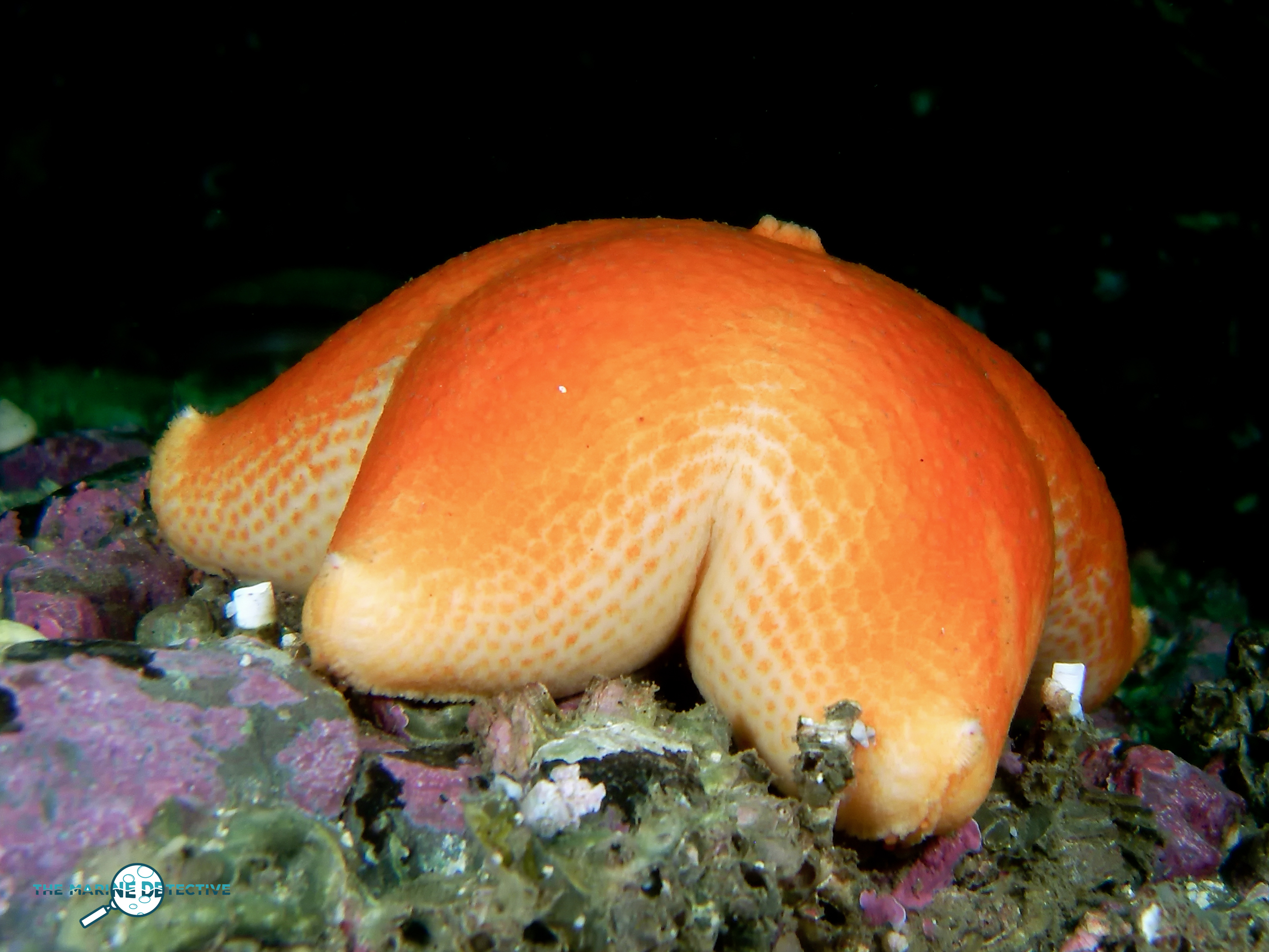
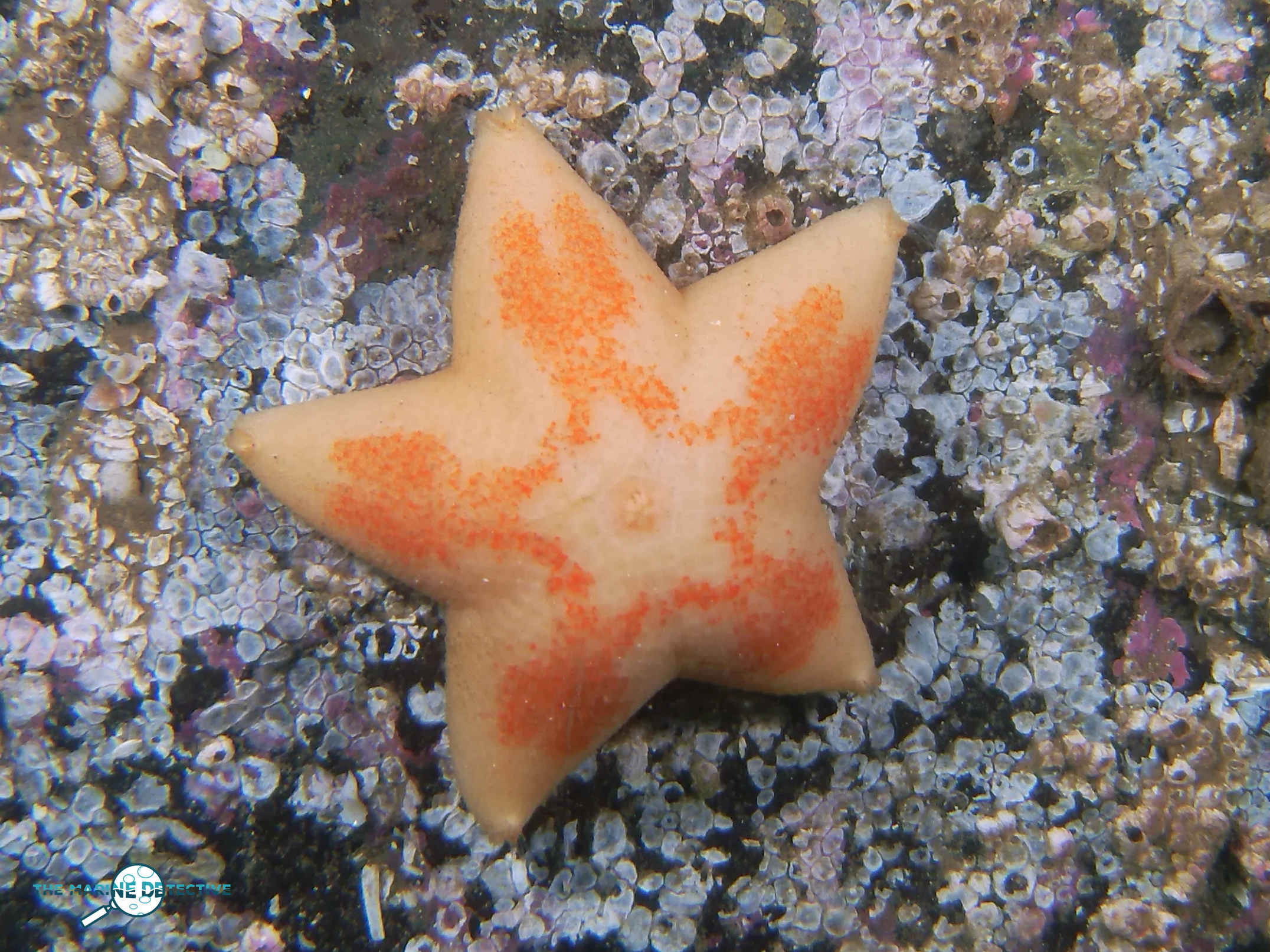
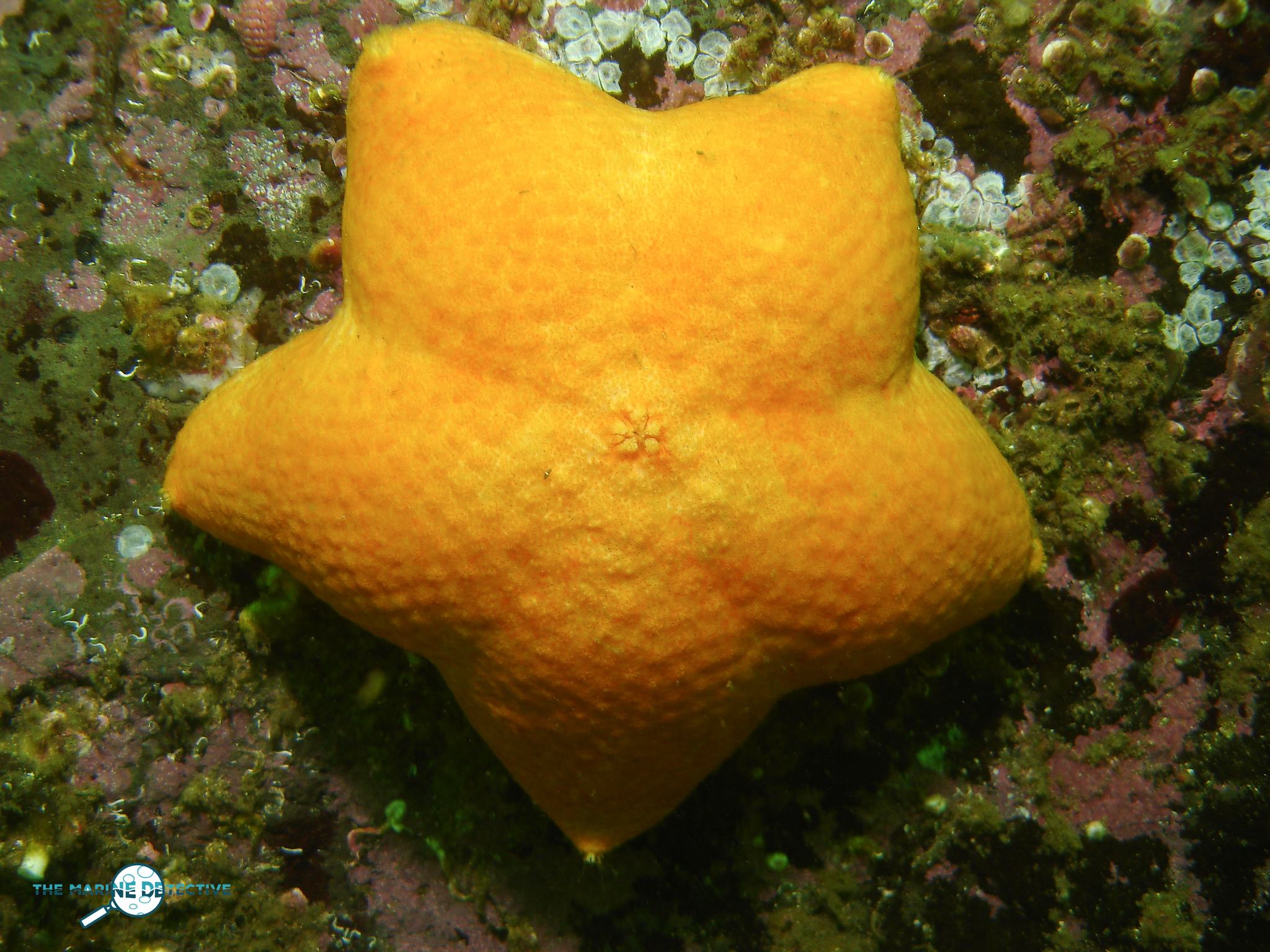
Did you know about the species of sea star in our waters that releases slime to deter predators?

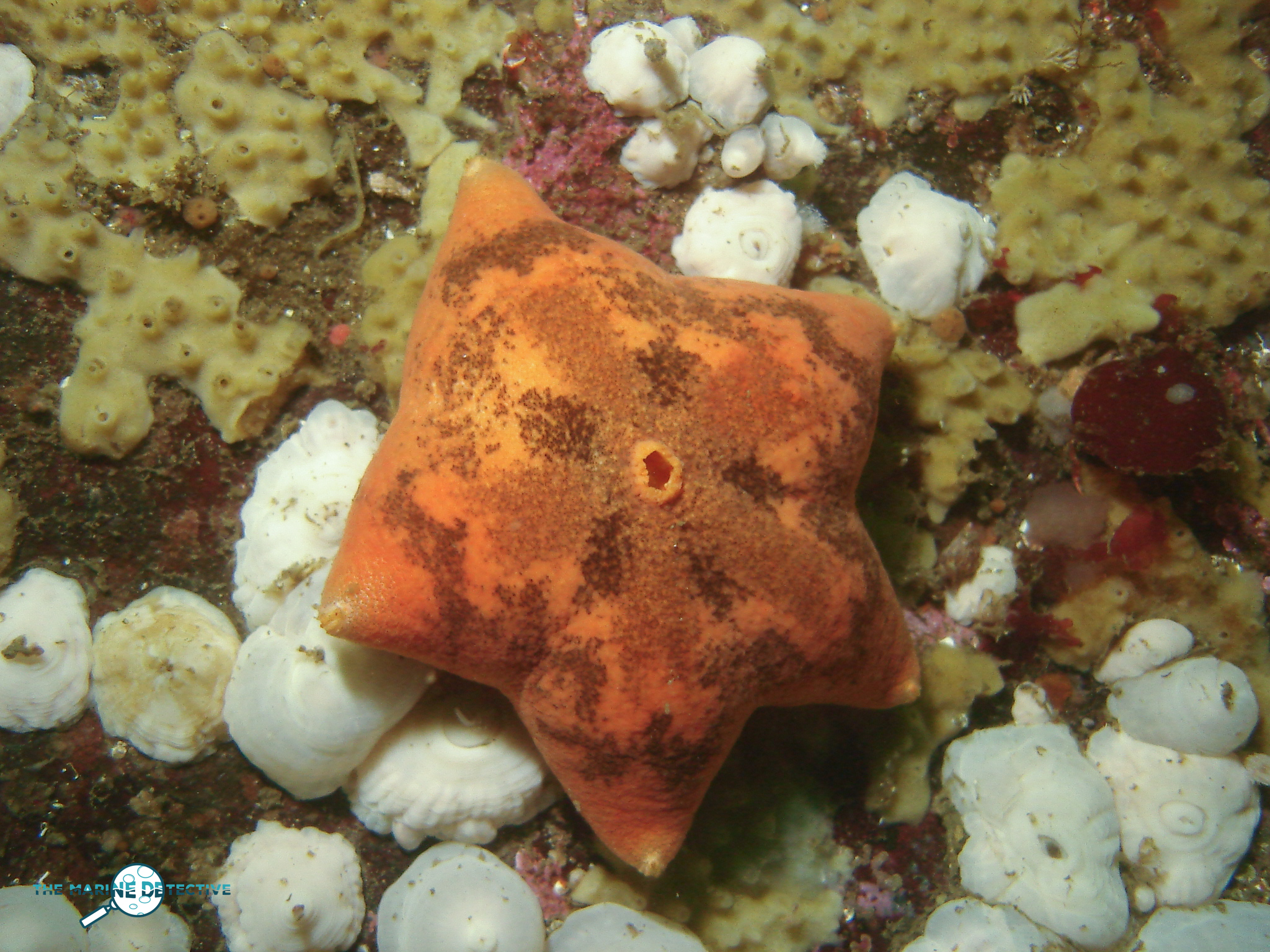
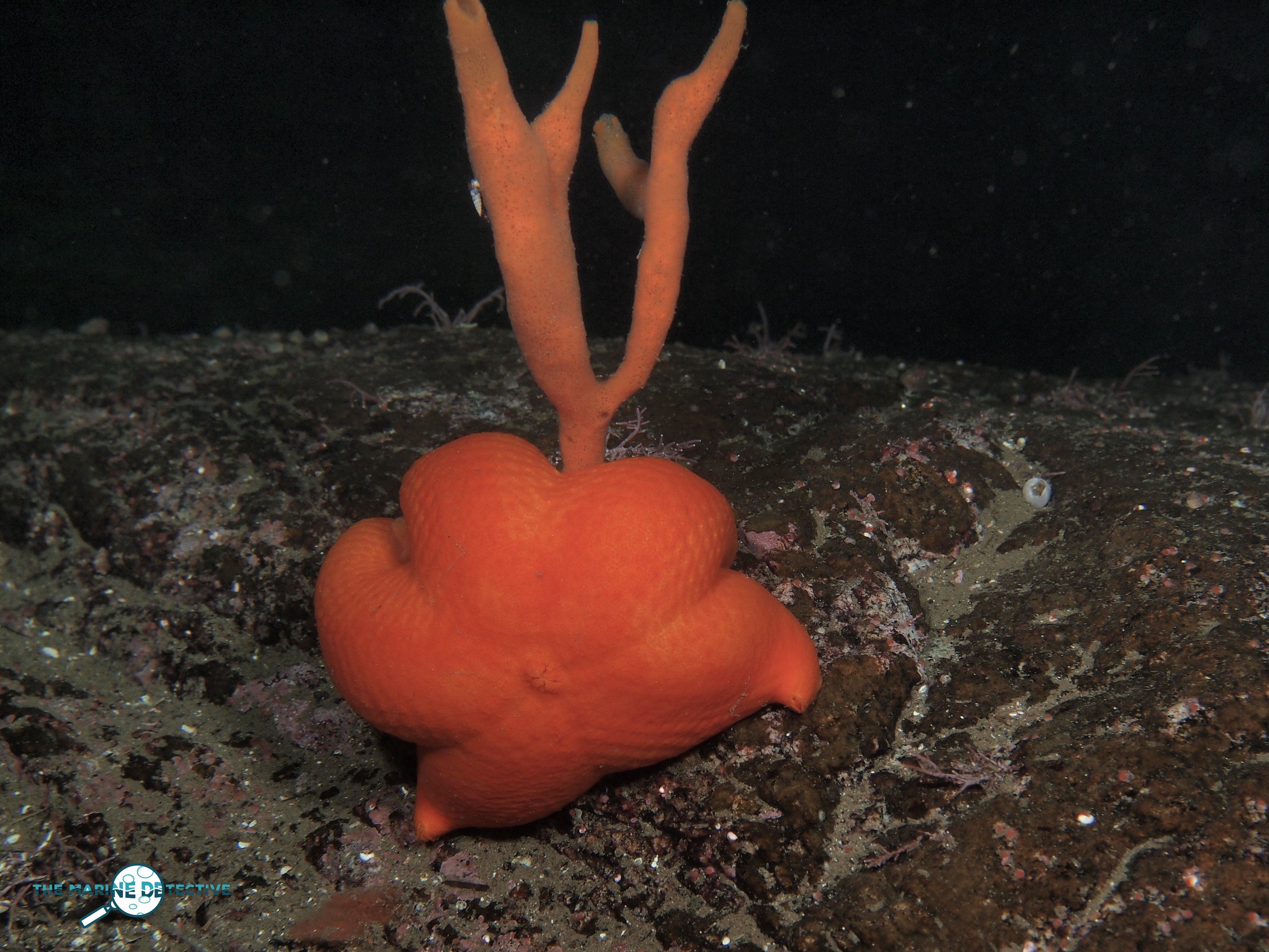
Slime stars are so wickedly adapted! Their distinctive puffy bodies have led to them also being known as Cushion Stars. 🙂

They release a LOT of thick, transparent goo from their upper surface when disturbed.

Disturbance constitutes rough handling, temperature shock or when other sea star species try to eat them. Sunflower Stars and Morning Sun Stars are known to trigger the slime production and get a mouthful of goo. The mucus is reported to be toxic to other invertebrates if they are immersed in it for 24 hours.

How much mucus do Slime Stars produce?
See the Hakai Institute’s video below.


What is also so unique about Slime Stars is that they “exhale” water through that big pore in their upper surface every few minutes (the osculum). The full “exhalation” of the water takes about 5 seconds. You can see in the photos and video below how wide the hole opens. Water enters the sea star on the underside (through ambulacral grooves).

Video from Invertebrates of the Salish Sea.
Slime Star exhaling.
The same Slime Star as in the previous photo.


The tips of the arms / rays of Slime Stars are also distinctive. See how they curl upward? That is believed to be an adaptation to hold the mucus on the upper surface of the sea star.

See how the tips of the rays are curled upward?

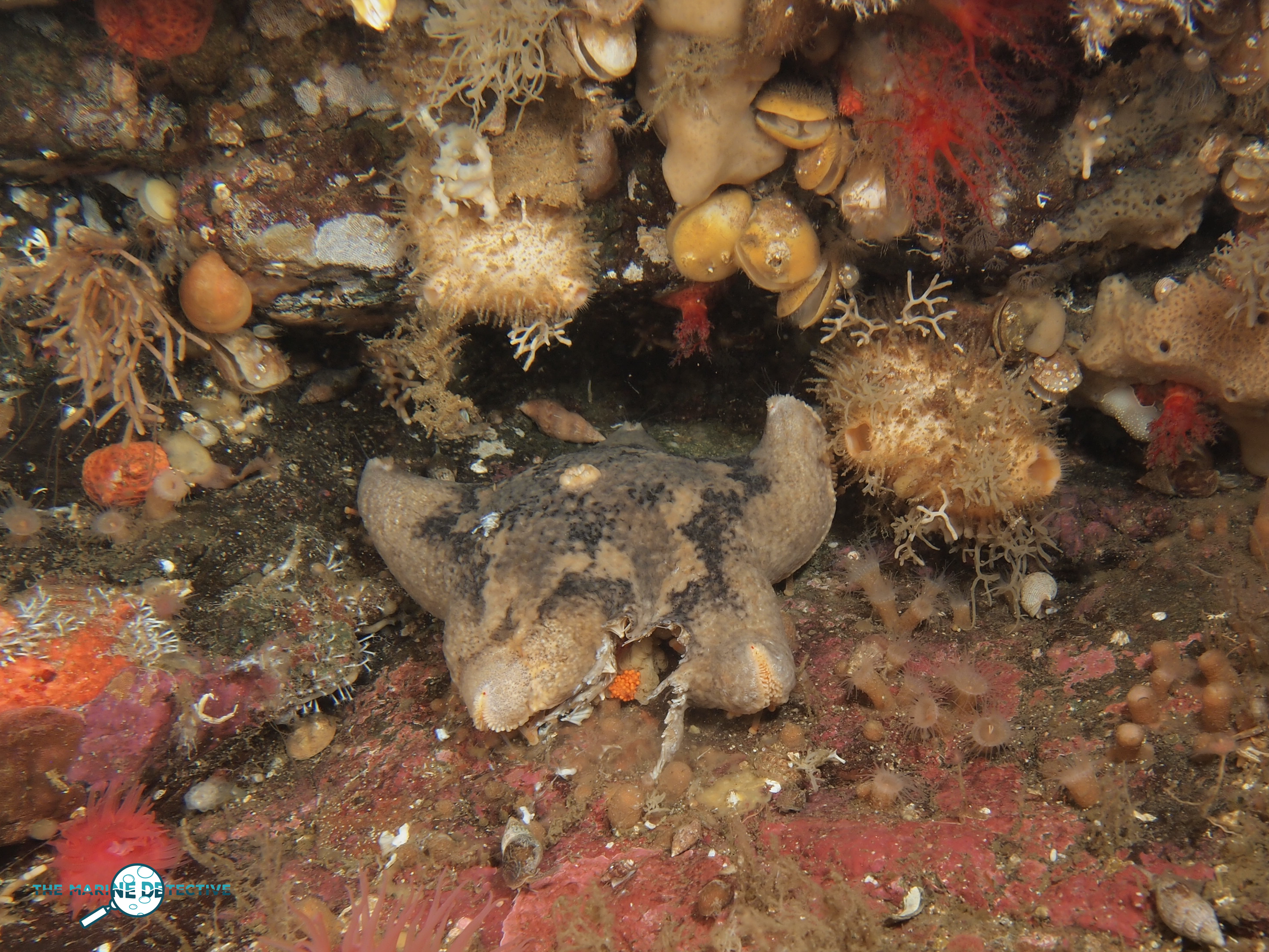
As a result of genetic research, it has been put forward that the individuals with dark markings may be a distinct species from the solid-coloured ones. Currently, they are all classified as Pteraster tesselatus.

– Maximum size: 24 cm across.
– Known range: Bering Sea to Washington State; from 6 to 436 meters.
– Diet: Sponges, tunicates, and bivalves such as the False Jingle.

Another exhaling individual.


Sources:

My photos in this blog are all from near northeastern Vancouver Island in the Territory of the Kwakwa̱ka̱’wakw (the Kwak̕wala-speaking Peoples) ©Jackie Hildering.

Injured Slime Star. Appears to have been bitten by a crab.

Feeding Slime Star.

It’s a Really Good Time to Be . . .

Yesterday, we found two Sunflower Stars!

See the juvenile here to the right of my buddy Natasha? There, right beside the mating Yellow-Rimmed Nudibranchs. This Sunflower Star was in just 5 metres of water.

Today’s two Sunflower Stars are the first I have seen in twelve hours underwater over the last three months and believe me, I have been looking. I only saw one before that. They are such a rarity now. Will these two survive? I have seen waves of juveniles before and then they disappear. Their plight appears to be linked to climate change.

Hope? With action . . . yes, there is shining hope.

Without action . . . no.

Please hang in there. Please read on.

I have been struggling too, looking for escape / reprieve from global realities as another “atmospheric river” is forecast to fall on parts of our province. It is so tempting to want to hide especially if we see the problems we are facing as disparate. They are not.

I have had to remind myself of the common solutions so that I see a way forward that is not guided by the faintness of blind hope; paralyzed by fear and overwhelm; and / or obfuscated by the din of values and voices that serve the few for a brief time.

Common solutions include: to know, live and share the GAINS that come from using LESS (fossil fuels, dangerous chemicals, disposables, less consumerism generally); to speak for truth and science and to have compassion for those who cannot; to exercise our power as voters and consumers to serve future generations; and to care and act on the knowledge of connection to others – across time, cultures, distance, and species.

In short, it’s a really good time to be a good human. 💙

I had to dig for these words for myself. As always, may they serve you too.


Photos: November 21 in Kwakwaka’wakw Territory near Port Hardy at a site where I have been monitoring sea star since 2013, ©Jackie Hildering.

The same juvenile Sunflower Star a few minutes earlier. Notice the fish? There’s a Painted Greenling on the left and a Blackeye Goby on the right.

For those who are not yet aware, I include the reality of Sea Star Wasting Disease (SSWD) below. A link to a summary of the research and where to report sightings is in my blog at this link.

The other Sunflower Star we saw yesterday.

Since 2013, more than 20 species of sea star have been impacted by SSWD from Mexico to Alaska. There is local variation in intensity of the disease and which species are impacted. It is one of the largest wildlife die-off events in recorded history. Sea stars contort, have lesions, shed arms, and become piles of decay.

Currently, some species of sea star appear to have recovered while others remain very heavily impacted. Sunflower Stars (Pycnopodia helianthoides) have been devastated and were added to the International Union for Conservation of Nature (IUCN) list as Critically Endangered. There are current efforts to have Sunflower Stars assessed by the Committee on the Status of Endangered Wildlife in Canada (COSEWIC) with hopes that they receive protection under Canada’s Species at Risk Act.

There is NOT scientific consensus about the cause. Current hypotheses focus on (i) a virus and (ii) low oxygen at the surface of the sea star’s skin maintained due to bacteria. What is consistent in is that changing environmental conditions appear to allow the pathogen (be it bacteria or viruses) to have a greater impact.

The best current source for a summary of the research is Hamilton et al (August, 2021). From that source: ” . . . outbreak severity may stem from an interaction between disease severity and warmer waters” and “Though we lack a mechanistic understanding of whether temperature or climate change triggered the SSWD outbreak, this study adds to existing evidence that the speed and severity of SSWD are greater in warmer waters”.

What I believe to be the reality off the coast of British Columbia is that there are refuges of Sunflower Stars at depth where it is colder. They spawn with some young then settling in the shallows where they may succumb to the pathogen if stressed by warmer water.

Close up on the second Sunflower Star. This one was at about 20 metres depth.

Sea Star Diversity

Diversity matters. Language matters. I suspect you agree. ☺️

In this case it’s about sea stars. I am sharing with you because you are an important audience to help increase understanding.

Just off our coast, there are 31 species of sea star in the Class “Asteroidea”. I hope my compilation below gives a sense of that diversity. The photos are all of different species photographed by yours truly off NE Vancouver Island.

Yet, even major news outlets have reported on sea stars as if they are all ONE species (includes CBS and Phys.org).


Thirteen species in the above compilation from left to right:
Top row: Vermillion Star (Mediaster aequalis), Morning Sun Star (Solaster dawsoni), Rose Star (Crossaster papposus). Second row: Leather Star (Dermasterias imbricata), Ochre Star (Pisaster ochraceus), Orange Sun Star (Solaster sp. A = undescribed species). Middle: Sunflower Star (Pycnopodia helianthoides). Third row: Bat Star (Patiria miniata), Painted Star (Orthasterias koehleri), Drab Six-Armed Star (Leptasterias hexactis). Bottom row: Spiny Red Star (Hippasteria phrygiana), Velcro Star (Stylasterias forreri), Striped Sun Star (Solaster stimpsoni).


Why does this matter?

Not only do different species of sea star have different ecological niches, but communication about them as if they are one species has greatly confounded the understanding of what is happening with Sea Star Wasting Disease (SSWD). When a few individuals of one species are seen, this has been extrapolated to text like “But now, the species is rebounding.”

Which species? Where? Did the individuals survive?

This sort of “collective” perception is also often reflected in comments on my social media posts. When I post about any sea star species, comments like the following often result: “Good to see “THE sea stars” are coming back.”

Yes, some species appear to be doing better since the onslaught of SSWD beginning in 2013 e.g. Ochre Stars. Other species do not appear to have been impacted much at all e.g. Blood Stars. But the world’s biggest species – the Sunflower Stars who help maintain kelp forests – are now recognized as Critically Endangered by the International Union for Conservation of Nature (see further information below).

The odds are already stacked against the appropriate learning about the conditions causing SSWD because it is happening in the dark, below the surface.

Blurring this group of extraordinary starred animals into all being the same, risks an even greater loss of understanding, colour, diversity . . . and action. 💙


Further content about the IUCN designation from my post on social media:


It’s official and so important to know. The iconic, world’s largest sea star species, the Sunflower Star, has now been added to the International Union for Conservation of Nature (IUCN) list as Critically Endangered.

This is no surprise to those of us who have been monitoring their health but to many, Sea Star Wasting Disease is unknown, even though it is one of the biggest known wildlife die offs in recorded history.

It has happened largely out of sight, beneath the Ocean’s surface. Further, there are many of us who do not have enough understanding / appreciation of (1) the connection between land and sea and; (2) the different sea star species and their ecological importance. Seeing sea stars of other species does not mean that all species are okay. Sunflower Stars (Pycnopodia helianthoides) definitely are not.

It is positive that they have been officially “listed”. With this recognition of how at risk they are, there is better potential for resources and action to find out what has caused the die off and what this might be indicating about changing environmental conditions. There is the hope that more people will care.

This is an international designation. The species also needs to be assessed in Canada to determine “status” and potential protection / action under the federal Species at Risk Act.

The December 10th Nature Conservancy media release includes:

Populations . . . experienced dramatic crashes in response to a marine wildlife epidemic event – referred to as sea star wasting syndrome – that began in 2013. Using over 61,000 surveys from 31 datasets, The Nature Conservancy and expert ecologists at Oregon State University calculated a 90.6% decline in the global population of sunflower sea stars due to the outbreak and estimated that as many as 5.75 billion animals died from the disease . . . “The rapid decline of this giant sea star, and of the sea kelp forests that it helps preserve, highlights the importance of every single species on the IUCN Red List of Threatened SpeciesTM. Its entry into the IUCN Red List in the highest threatened category emphasizes the need for urgent action to understand and combat the wasting disease that is sweeping through the population. We hope that this listing leads to positive action and recovery for this species and its ecosystem,” said Caroline Pollock, Programme Officer for the IUCN Red List Unit. Sunflower sea stars are now nearly absent in the contiguous United States and Mexico. No stars have been observed in Mexico since 2016, none in California since 2018, and only a handful in the outer coasts of Oregon and Washington since 2018. They are still present in Puget Sound, British Columbia, and Alaska, but only at a fraction of their former population in most places.”

Above video by the Hakai Institute.


See the full December 10th media release at: “Iconic Sea Star Listed Critically Endangered After Study Finds Marine Epidemic Event Nearly Wiped Out Global Population”

I’ve maintained a record of the research related to Sea Star Wasting Disease at this link.

Another related blog showing the diversity in just one species is “Rose Star – No Two Alike”.

An excellent resource to ID local sea stars is Neil McDaniel’s website at this link. 

A Lone Giant

[If you are coming here from Instagram, please see this link for background on Sea Star Wasting and where to report sightings.]


Endangered? I gasped when I saw this adult Sunflower Star on my last dive and hung nearby for a little while. I found myself thinking in a way that could be interpreted as prayer.

Did you realize Sunflower Stars are now so rare – these giants that should be abundant on the coast from Alaska to Mexico?


Endangered? Many of us who have been monitoring Sea Star Wasting Disease since 2013 certainly think so and there is a campaign in Washington State to have them recognized as such.

There has been such misunderstanding and “ocean blindness” about what has been going on. Even reputable news outlets have put into the world information about the Disease that speaks of sea stars as if they were one species and hence, if some sea stars are sighted, well then everything is fine.

It’s not fine. At least 20 species of sea star have been impacted by Sea Star Wasting Disease. Some are recovering well but . . . this the world’s largest sea star species, the Sunflower Star, Pycnopodia helianthoides, is NOT.

We sometimes see waves of juveniles, maybe resulting from more adults being at depth who are close together enough that when they broadcast spawn,  fertilization results (broadcast spawning is when males and females release their sex cells into the water on cue). But, ultimately these juveniles disappear.

Sea Star Wasting Disease (SSWD) is the largest wildlife die off in recorded history. That be truth. But because it is happening below the surface there is less engagement, funding, and knowledge.

Does it matter? Yes, it matters a lot, ecologically and with regard to what the Disease may teach us.

Sunflower Stars have a similar ecological niche to Sea Otters re. grazing on urchins and maintaining kelp forests (see video below). You know that if Sea Otters were dying en masse we would certainly be engaged, invest in research, and want knowledge.

A close-up of the same individual.

What is the cause? Specifically for Sunflower Stars, it is known that there is a virus that has been around for more than 70 years that, since 2013, is having an unprecedented impact .

Why would a virus that is not new be able to have a greater impact? Due to stressors and yes, these are believed to be related to climate change.

To those wonderfully engaged humans who have read all of this, please know this is not an additional problem that requires novel solutions. You are the last people who I wish to burden, you who care as you do. The plight of Sunflower Stars is a symptom of what is the same set of problems re. short term economies, absence of precaution, fossil fuel use, and consumerism.

Reporting sightings? I have reported the sighting of this lone, adult Sunflower Star to add to the knowledge of the impacts of SSWD. Citizen science is so important to understanding. Further information on the Disease and where to report sightings of sea stars can be in my blog at this link. 

And to you dear Sunflower Star,
May you find another of your kind for the sake of biodiversity, ecology, human learning and understanding, and so that your species will not disappear from children’s drawings of life on our coast.

May it not be that we continue on a path where Sunflower Stars slip away from our memories, or that we end up talking to children about “There used to be these giant, colourful sea stars . . .”

💙


Sighting was made on June 15th, near Port McNeill.

Video below re. Sea Star Wasting Disease and ecological impacts.


Rose Star – No Two Alike

One species. So many colours.

That’s beauty. That’s biology.

Rose Stars have such diversity in colour and pattern, that the species is also known as the “Snowflake Star”; a name suggesting that no two are alike.

Am I trying to make some sort of point as it applies much more broadly? Why, whatever would make you think that? 😉

Surely we humans rejoice in the beauty of diversity?

Notice that above this Rose Star, there is another local, marine ambassador for diversity of colour within a species.See the Blue-Line Chiton (Tonicella undocaerulea)?

Please see additional photos (and slideshow) below to get a further sense of the diversity, the beauty, and the perfection.

Species information:

  • Crossaster papposus to 34 cm but in British Columbia the maximum size is believed to be 17 cm.
  • They can live to at least age 20. Species is slow growing. Maximum size is reached around age 10.
  • Even the number of arms varies. Most Rose Stars have 11 arms but number ranges from 8 to 16. From personal communication with zoologist Neil McDaniel: ” I did counts of 63 images I had on file [all from British  Columbia’ and nearly 90% (87%) had 11 arms, about 10% had 10 and 3% had 12.”
  • They are SPEEDY! Zoologist Neil McDaniel clocked them at 50 cm/min. Larger individuals were documented to travel over 5 meters in 12 hours. They are serious predators but may also be speedy because they are known to be prey for Sunflower Stars and Morning Sun Stars.
  • Diet is known to include sea pens, nudibranchs, bryozoans, bivalves (e.g. clams), juvenile urchins and tunicates. Their diet is likely broader than this as they are not picky eaters. I often see them in rocky habitats covered by coralline algae species (see photo below) and believe that is, at least in part, because the prey there include Orange Social Tunicates. They are one of the few species of sea star known to feed on nudibranchs. They also are known to have attacked other sea star species – Mottled Stars and Six-rayed Stars
  • How they feed: When they feel their prey, and are hungry, they retract their sensory tube feet (tube feet at the tips of their arms), and then stretch up on their tippy toes (extending their terminal tube feet) to be higher and able to “pounce” on their prey when on the ocean bottom. Smaller prey are swallowed whole. Larger prey are held with the tube feet and, as is the case with other sea star species too, they evert their stomach OUT OF THEIR BODIES and into or over their prey.
  • Research supports that Rose Stars can sense potential prey and other sea stars by smell (distance chemoreception).
  • In the photos below you will also see the intricacy of the surface of sea stars. You will see:
    • Spines
    • Pedicellaria = amazing little structures that can nip off the tube feet of other species of sea star e.g. the predatory Morning Sun Star (Solaster dawsoni).
    • The tufts are “papulae”. They are the gills / respiratory organs of the sea star. They can retract into the surface of the sea star’s body.
  • Range: Bering Sea to Puget Sound; Arctic Ocean, North Atlantic Ocean, North Sea, western Baltic Sea.
  • Depth: Found from the shallows of the intertidal to ~1,200 m. Believed to more often be in low current areas.
  • I saw little impact on this species from Sea Star Wasting Disease around NE Vancouver Island BUT Rose Stars were hit very badly in 2014 in other areas e.g. Sechelt Inlet, British Columbia (McDaniel, pers. comm.). See photo at the end of the blog. The species seems to be rebounding, unlikely Sunflower Stars which remain devastated across their range.
Rose Star and retracted Orange Zoanthids. Some are likely being snacked upon.
Very typical habitat for where I find Rose Stars. I believe their prey on these coralline algae covered rocks include the small orange animals you see = Orange Social Tunicates. Notice too that there is another Blue-Line Chiton. 

The next 3 images are of the same individual.

Slideshow:

Sources: 

One of many Rose Star ravaged by Sea Star Wasting Disease near Sechelt, British Columbia.
Photo ©Neil McDaniel.
See Neil’s information about SSWD at this link.

Phenomenal Feather Stars

Phenomenal?  Yeah they are.

The lineage of “feather stars” (members of the crinoid class) goes back 485 million years, give or take a million. They crawl around. They swim in the most extraordinary way. You’ll see. 🙂

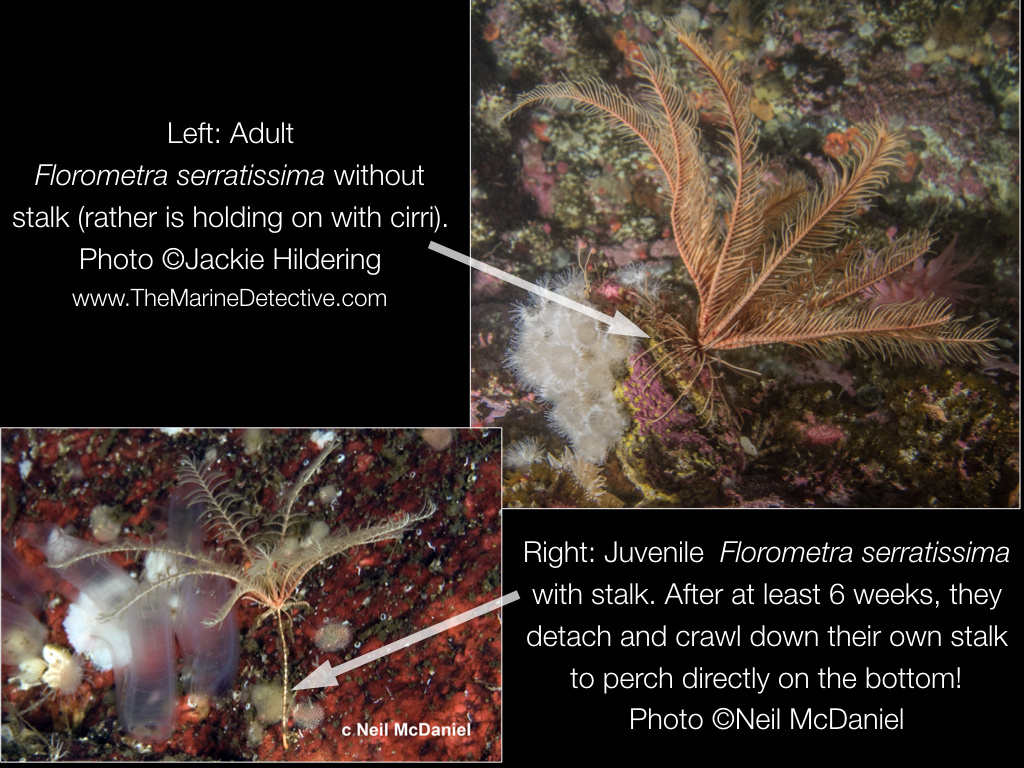
Another non-scientific name used for feather stars is “sea lilies” but I avoid that. As pretty as the name is, I believe it adds to confusion. These are animals, not plants. They are echinoderms, relatives to sea stars, brittle stars, sea urchins and sea cucumbers. Also “sea lily” is a name more often used for the crinoid relatives that have a stalk into adulthood. Only juvenile feather stars have a stalk. Then, get this . . .  they detach and crawl down their own stalk to perch directly on the bottom! (Source: A Snail’s Odyssey). See below.


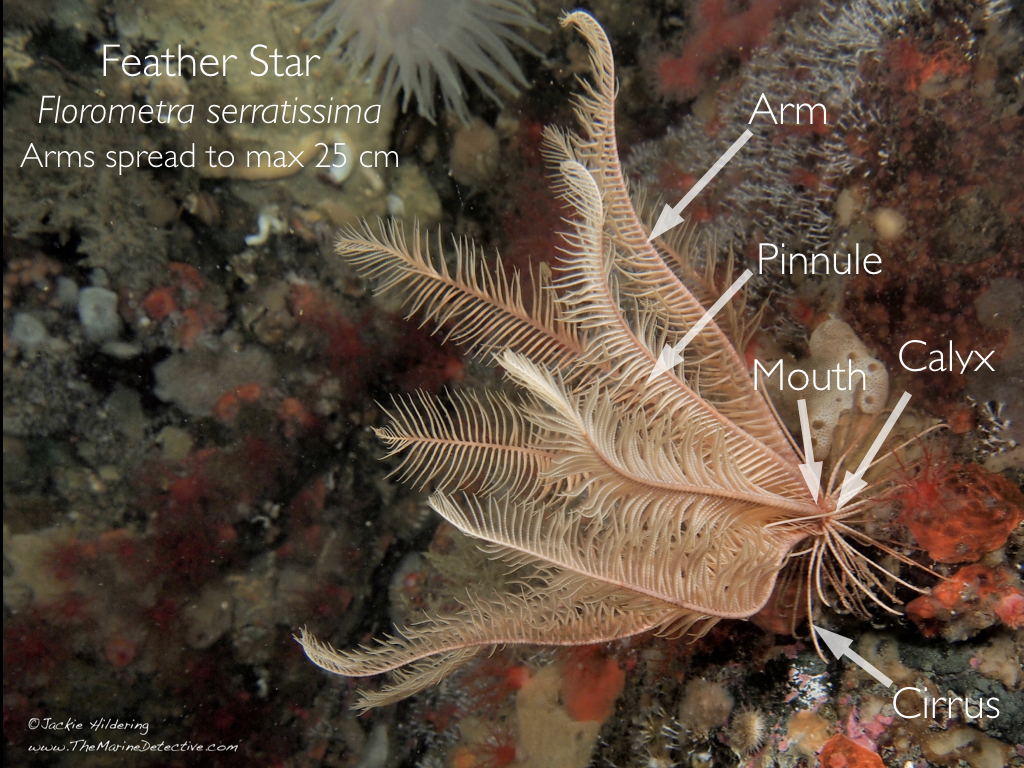
There are many feather star species in the world but the detail here is about the species commonly found in shallow water off the coast of British Columbia – Florometra serratissima (range is from the Aleutian Islands to Baja California).

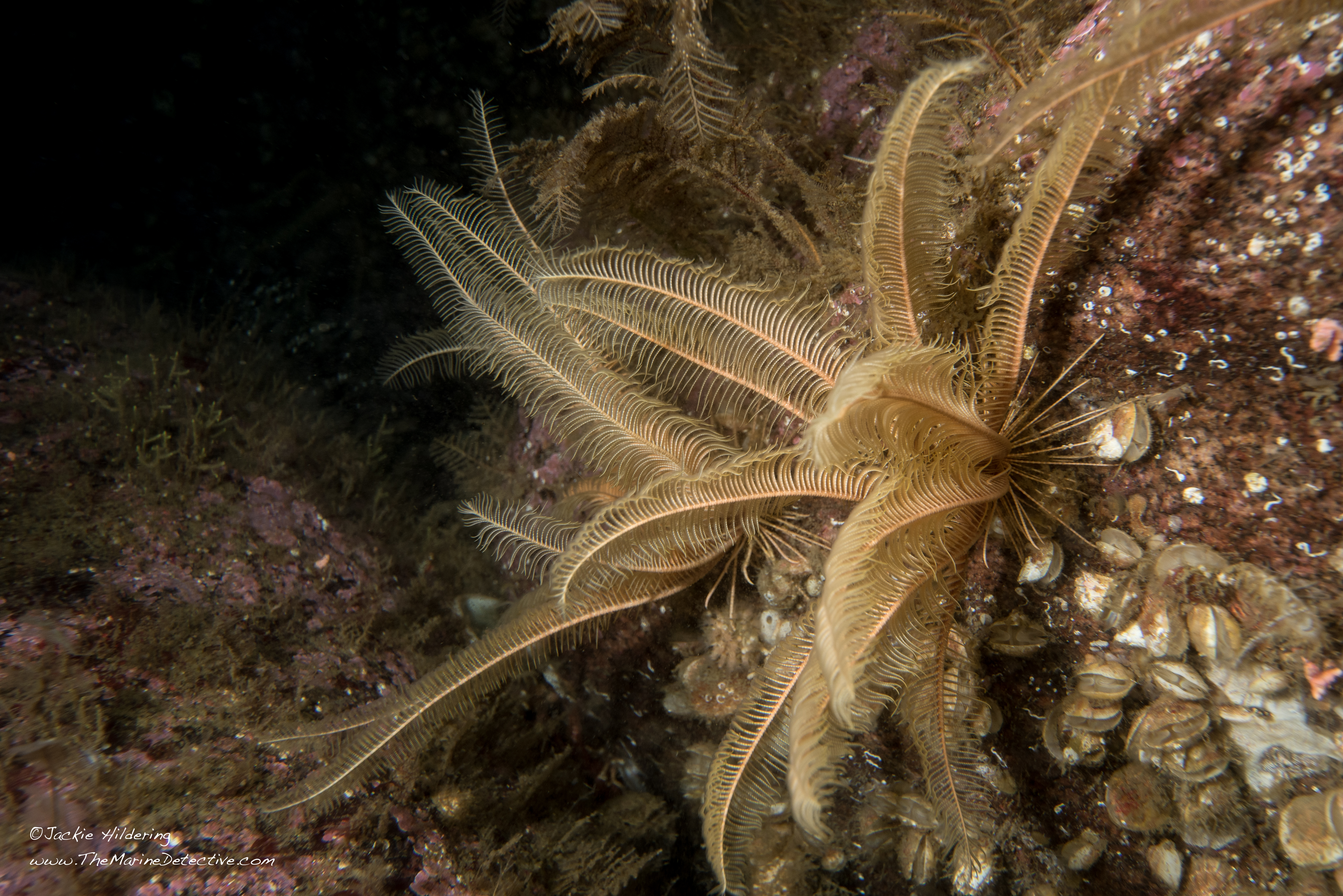
Feather stars have 5 feathery arms that split to form 10 or more arm branches that are used to gather bits of organic matter (snacks) out of the water. With arm’s outreached, Florometra serratissima is up to 25 cm wide and they are up to 31 cm tall. Feather stars also use their arms to swim as recently captured in this video by dive buddy, Brenda Irving. They swim as if “walking up an invisible staircase” (quote from Lamb and Handby).

Phenomenal – right?

The following detail on their locomotion is largely compiled from the brilliant resourceA Snail’s Odyssey by Tom Carefoot, Professor Emeritus, Department of Zoology, University of British Columbia.


How do they swim? 

“Florometra serratissima is the only swimming species of crinoid on the west coast of North America. It swims by graceful undulation of its arms in 3 sets, each set moving successively but overlapping. Thus, while about one-third of the arms are in power stroke, another third are in recovery, and the last third somewhere in between. During the power stroke the arms extend out maximally for greatest frictional resistance, while during the recovery stroke they bend inwards to minimise resistance.”

“The sets comprise two triplets and one quadruplet, are their composition with respect to specific arms is invariable (see sequence below). In the scenario shown, swimming is initiated by the blue triplet making a downstroke, followed 1sec later by the green quadruplet, and 2 seconds later by the orange triplet. An entire sequence is completed, then, in about 3 seconds, and the pattern may be repeated for up to 30 seconds.” (Source: A Snail’s Odyssey).

After several strokes to move vertically (to a mean height of 29 cm at an average speed of 5.4 cm/sec), individuals often turn 90 degrees and swim horizontally. If there is current, they will swim with the current. Horizontal swimming is achieved by the 5 arms furthest away from the bottom making stronger downward pulses than the arms closest to the bottom. (Source: Shaw and Fontaine. See Figure 3 at this link if you wish to better understand the horizontal movement).

Swim speed was found to occur in “short, repeatable bursts of 10 to 30 seconds. Continuous swimming beyond 4 minutes provokes a refractory period lasting 5 to 17 minutes during which individuals are incapable of swimming.” (Source: Shaw and Fontaine).

Feather stars end up back on the ocean bottom by stopping movement, and then “parachuting” down (as can be seen at the end of the video above).

Swimming and crawling can be stimulated by current and touch from predators such as Sunflower Stars (Pycnopodia helianthoides) and crabs. Research supports that if touched by a Sunflower Star, there is about a 5 second delay followed by “several power strokes carrying the stimulated individual 1 to 3 metres away.  This cycle can be repeated several times and capture by a sea star is actually thought to be rare.” (Source: A Snail’s Odyssey).

Particles of food are captured by the pinnules, moved by tube feet and cilia and form a bolus, which is moved down a “food grove” toward the mouth. This delicate looking animal has to be strong enough to be in high current areas as that’s where the feeding is good. The cirri hold on to surfaces and allow the Feather Star to crawl. ©2019 Jackie Hildering.


Yes, they also crawl! 

Crawling has been found to be feather stars’ main means of getting around with swimming being only in response to a predator or touch.

“Stalkless crinoids such as Florometra serratissima anchor to the substratum [ocean bottom] using flexible cirri [these have been described as holding on like bird’s feet do]. The cirri are jointed and can slowly bend and straighten. . . . ” (Source: A Snail’s Odyssey).

The arms are also involved in crawling around. The 10 arms attach to the bottom with small hooks, the central part of the feather star’s body (the calyx and cirri) is lifted. “The arms then contract and extend on opposite sides of the body, which moves it in one direction or the other. Repetition of this behaviour will gradually move the individual to a new location.” (Source: A Snail’s Odyssey)


What a remarkable species with relatives dating back 485 million years and defences including: (1) being able to regenerate arms; (2) having a body that has little nutritional content, is hard, and may taste bad AND; (3) is strong enough to withstand the current that delivers snacks, but light enough to allow swimming as an escape response.


Above: Feather star near Telegraph Cove at about 10 m depth. Species reported to be from 10 to 1252 m. Believe this to be a female! From A Snail’s Odyssey: “Studies on feather stars Florometra serratissima at Bamfield Marine Sciences Centre, British Columbia mostly have separate sexes, but a small percentage is hermaphroditic. Breeding is continuous throughout most of the year and “dribble” spawning is the norm. Gonads appear as swellings on special pinnules of the arms, known as genital pinnules. Genital pinnules occur on all 10 arms, but concentrate in the lower third of each arm. Male individuals can be recognised by the creamy white colour of their genital pinnules, and females by pink or orange-coloured pinnules.” More detail on reproduction of feather stars at this link. Photo ©2019 Jackie Hildering.

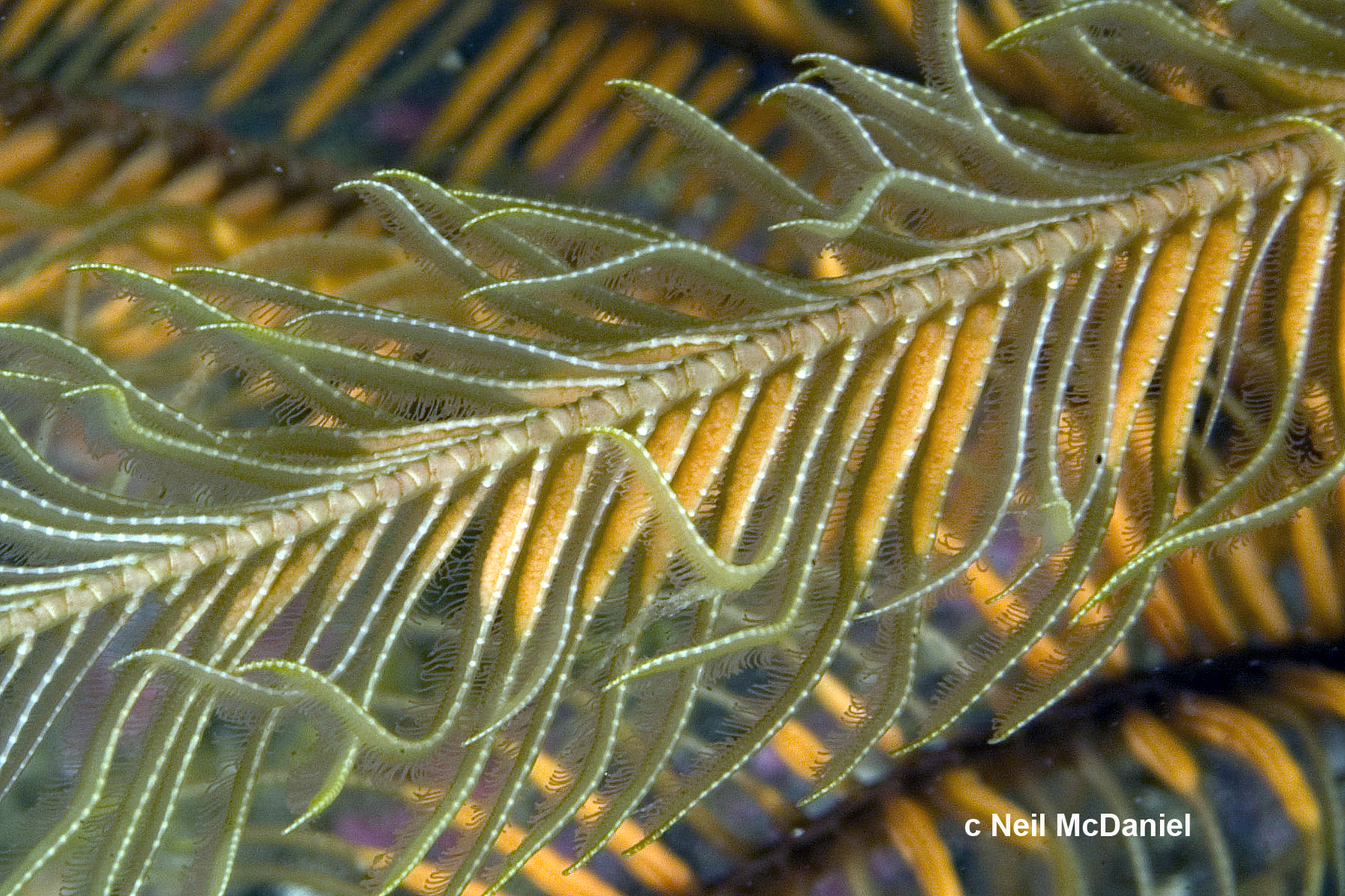
Above: This remarkable photo by Neil McDaniel shows an individual with eggs (orange) and allows you to see the incredible fine details of the “feathers” – the pinnules of Florometra serratissima. 

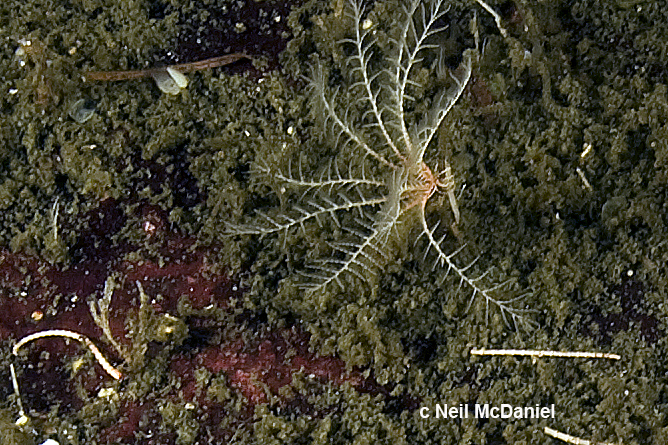
Above: Another fantastic capture by Neil McDaniel.  Florometra serratissima climbing down his/her stalk to live an an adult, moving around on its cirri and swimming.

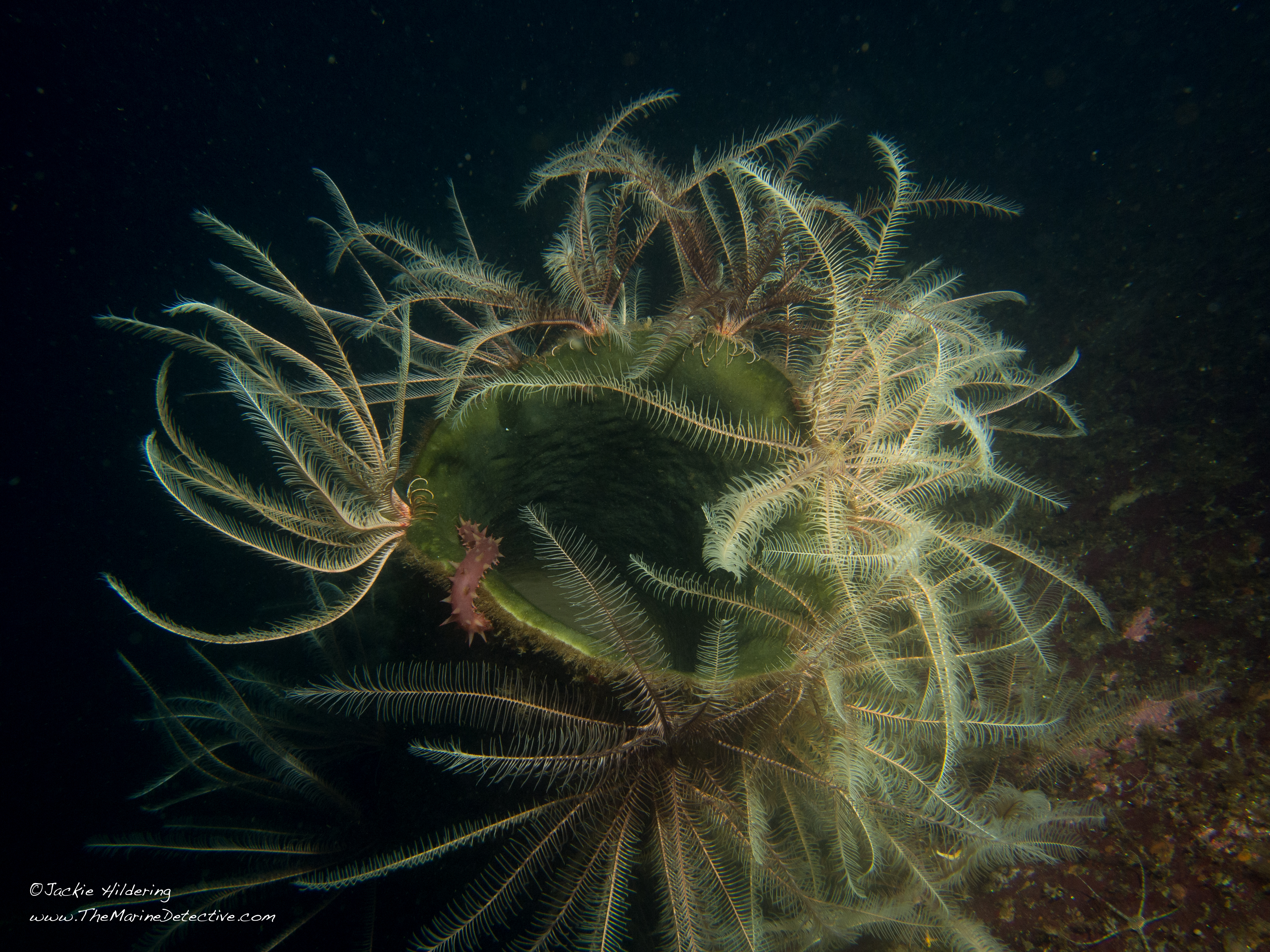
Round Lipped Boot Sponge (1 m tall) near Powell River, festooned with feather stars (Florometra serratissima). Also, see the juvenile Giant Sea Cucumbers?


Feather stars at the same site as the individual in the video – the Knight Inlet Sill. Animals to the right are brachipods. ©2019 Jackie Hildering.


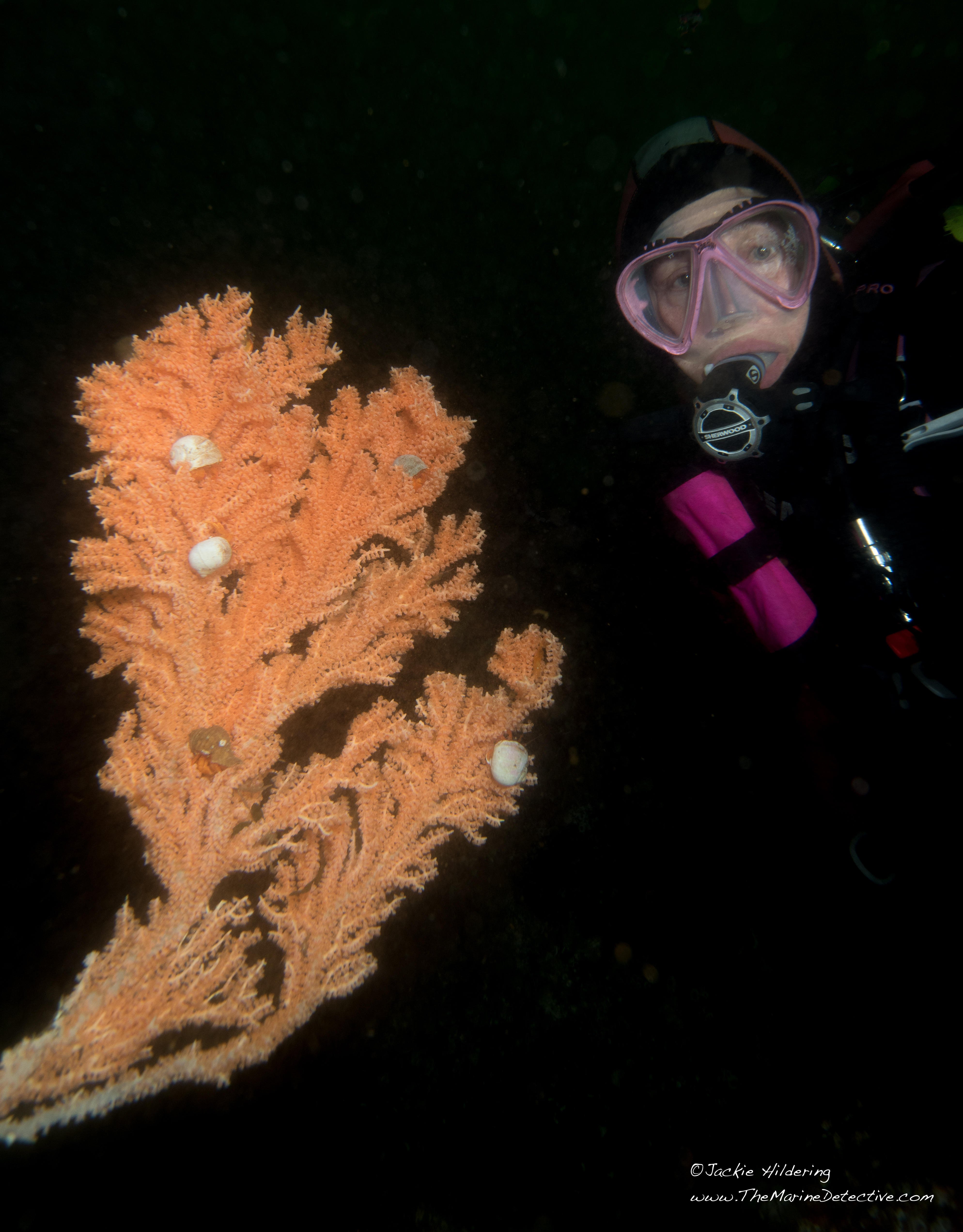
Above: Dive buddy, Brenda Irving, just before taking the video above. Here with the coral Primnoa pacifica which is usually found at great depth but the upwellings at this site in Knight Inlet lead to it occurring much shallower too, up to ~15 m. The animals on the coral in this image are Orange Hermit Crabs. Detail on this species of coral and this extraordinary site can be read at “A Proposal to Create a Marine Refuge at the Knight Inlet Sill, British Columbia to Protect Unique Gorgonian Coral Habitat” by Neil McDaniel. Click here.


Sources:

Sea Star Wasting Syndrome Now Documented on NE Vancouver Island

Giant pink sea star in final stages of sea star wasting syndrome. Bear Cove, Port Hardy; December 21, 2013. © 2013 Jackie Hildering

Giant pink sea star in final stages of sea star wasting syndrome. Bear Cove, Port Hardy; December 21, 2013. © 2013 Jackie Hildering

[Update: November 18, 2014 Study published today – cause of Sea Star Wasting Syndrome a densovirus that has been present for at least 72 years? Why has it led to mass mortality now? What makes sense is that, like any virus, the incidents of “pathogenicity” depends on stressors (e.g. temperature change) and proximity of individuals. The virus has also been found in other echinoderms like urchins and sand dollars and it persists in sediment = can be transmitted by those vectors and there is the potential that the other echinoderms are/will be affected. See the study by Cornell University at the link below (lead author Ian Hewson). Includes “If SSaDV is the cause of the current SSWD event, it is unclear why the virus did not elicit wide disease outbreaks in the past during periods in which it was detected; however, there are several possible reasons why the current SSWD event is broader and more intense than previous occurrences. SSaDV may have been present at lower prevalence for decades and only became an epidemic recently due to unmeasured environmental factors not present in previous years that affect animal susceptibility or enhance transmission.”
http://www.pnas.org/content/early/2014/11/12/1416625111.abstract

Good coverage in a 7-minute radio interview
Science Friday; December 5, 2014: “What’s Killing West Coast Starfish?”  http://www.sciencefriday.com/segment/12/05/2014/what-s-killing-west-coast-starfish.html#path/segment/12/05/2014/what-s-killing-west-coast-starfish.html


________________________________

Deepest of sighs.

I am very sad to report that Sea Star Wasting Syndrome is now on NE Vancouver Island.

I first detected symptoms of the Syndrome at Bear Cove in Port Hardy on December 13th. Please see table at the end of this blog for how the species affected appears to be quite different from further to the south. Leather stars seem particularly affected and the Syndrome appears to advance much more slowly.

Leather star with sea star wasting syndrome. (Click to enlarge). Bear Cove, Port Hardy; December 21, 2013. © 2013 Jackie Hildering

Leather star with sea star wasting syndrome. (Click to enlarge). Bear Cove, Port Hardy; December 21, 2013. © 2013 Jackie Hildering

I have tried to think up a terrestrial analogy for what is happening to the sea stars so that non-divers might better get a sense of the weight and ecosystem importance of it. However, I can’t come up with a good terrestrial equivalent of an abundant group of highly visible, apex predators. My best attempt is to suggest you think of sea stars like birds of prey. Imagine what you would feel like if you were to notice they were dying, bodies deflating . . . then melting away and that this would progress very quickly and spread like wildfire.

Mottled star with sea star wasting syndrome. (Click to enlarge). Bear Cove, Port Hardy; December 21, 2013. © 2013 Jackie Hildering

Mottled star with sea star wasting syndrome. (Click to enlarge). Bear Cove, Port Hardy; December 21, 2013. © 2013 Jackie Hildering

Please see my previous blog item, “Wasted, What is Happening to the Sea Stars of the NE Pacific Ocean?”, for great detail on the symptoms, species impacted further to the south, spread of the Syndrome, and how to help understand what is happening by relaying data to the Vancouver Aquarium. 

The short of it is:

  • The meltdown of sea stars was first detected in June 2013 in Washington State in ochre stars and in sunflower stars in Howe Sound (BC) in late August 2013 but has now been reported at sites from Alaska to the Mexican border.
  • Sunflower star in distress - potentially wasting syndrome. (Click to enlarge.) Photo from a week ago. Bear Cove, Port Hardy; December 13, 2013. © 2013 Jackie Hildering

    Sunflower star in distress – potentially wasting syndrome. (Click to enlarge.) Photo from a week ago. Bear Cove, Port Hardy; December 13, 2013.
    © 2013 Jackie Hildering

    The number of sea stars impacted is orders of magnitude greater than any previous known outbreak.

  • Most likely due to a pathogen (virus and or/bacteria). Cornell University is doing the genomic work. Toxins and environmental conditions have not been ruled out as the cause (or compounding factors).
  • If it is a pathogen, how quickly it spreads is influenced by the number of animals and if they are stressed. There are likely to be layers of stressors.
  • It has put forward by the scientific community that this could be a normal mechanism for overpopulation in sea stars.

The 1-minute time-lapse video below shows the progression of the Syndrome in a sunflower star over 7 hours.

Yep, it’s terrible.

However, I believe very strongly that, in attempting to raise awareness about marine environmental issues, I must always reflect on “what you can do”. If I do not, I contribute to the spread of a devastating human syndrome: Eco-paralysis. Symptoms include people becoming despondent, overwhelmed, and underactive in undertaking positive socio-environmental change, and often saying “It’s all hopeless”. The cause? This I do know. Eco-paralysis is the result of not seeing the common solutions between environmental problems.

Sea Star Wasting Syndrome is a solid indicator of how little we know about our life-sustaining oceans. It emphasizes the importance of humility and precaution in decision-making around the environment and how we are all empowered to reduce environmental stressors (with emphasis on reducing fossil fuel consumption and chemical use).

Having witnessed what I have over the last many weeks, I am all the more driven to assist others in (1) falling deeper in love with the NE Pacific Ocean by revealing the beauty below her surface and (2) feeling the joy that comes from creating change that is better for the environment and, therefore, ourselves.

What was once a sunflower star. (Click to enlarge). Bear Cove, Port Hardy; December 23, 2013. © 2013 Jackie Hildering

What was once a sunflower star. (Click to enlarge). Bear Cove, Port Hardy; December 23, 2013.
© 2013 Jackie Hildering

The progression of the Syndrome in 2 days in a giant pink star. (Click to enlarge.)© 2013 Jackie Hildering

The progression of the Syndrome in 2 days in a giant pink star. (Click to enlarge.)© 2013 Jackie Hildering

Table showing progression of SSWS at Bear Cove

Table showing a summary of my data re. progression of species impacted at Bear Cove, Port Hardy. Progression of symptoms in a leather star over 16 days at Bear Cove, Port Hardy. (Click to enlarge.) © 2014 Jackie Hildering

Progression of symptoms in a leather star over 16 days at Bear Cove, Port Hardy. (Click to enlarge.)© 2014 Jackie Hildering

Progression of symptoms in a leather star over 16 days at Bear Cove, Port Hardy. (Click to enlarge.)© 2014 Jackie Hildering