Basket Stars
How can it be that I do not yet have a blog about Basket Stars? I am hereby correcting that and including a gallery of photos of this astoundingly beautiful species.
Prepare yourself for abundant superlatives!
They truly are stars of wonder.

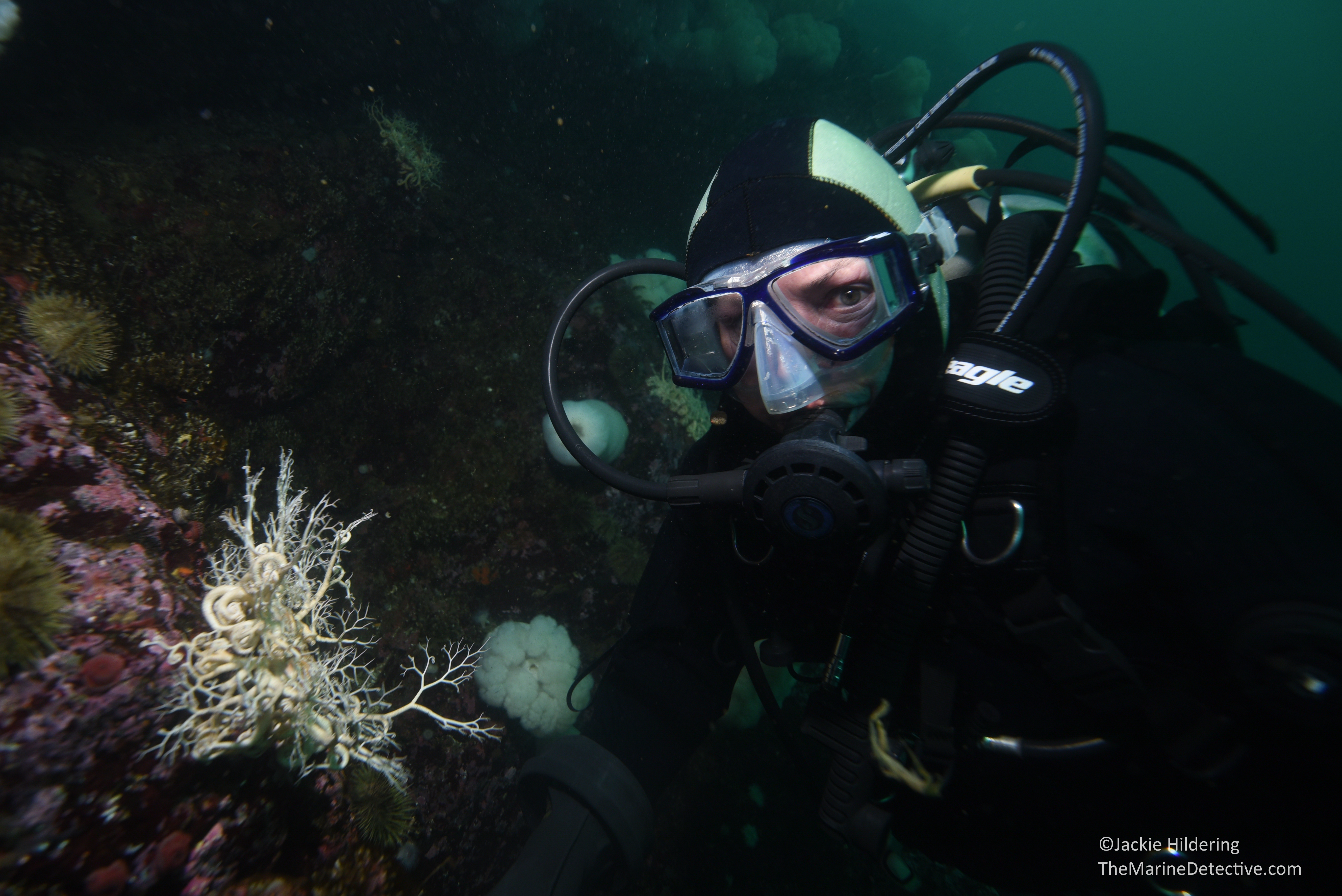
Basket Stars are brilliant ambassadors for the beauty and extraordinary life off this coast. It is my experience that when people learn about them, there’s often a hushed “They live here?”.
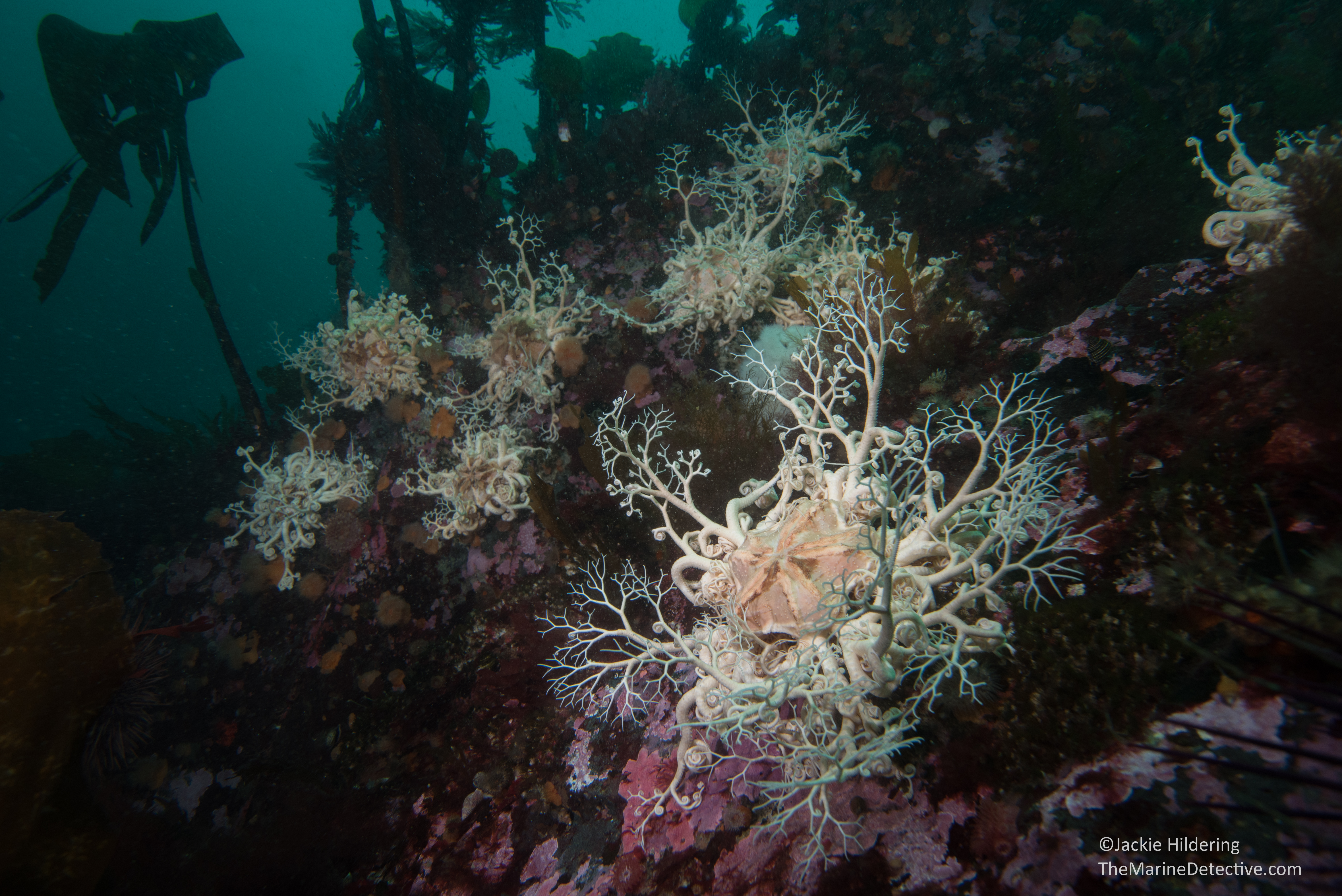
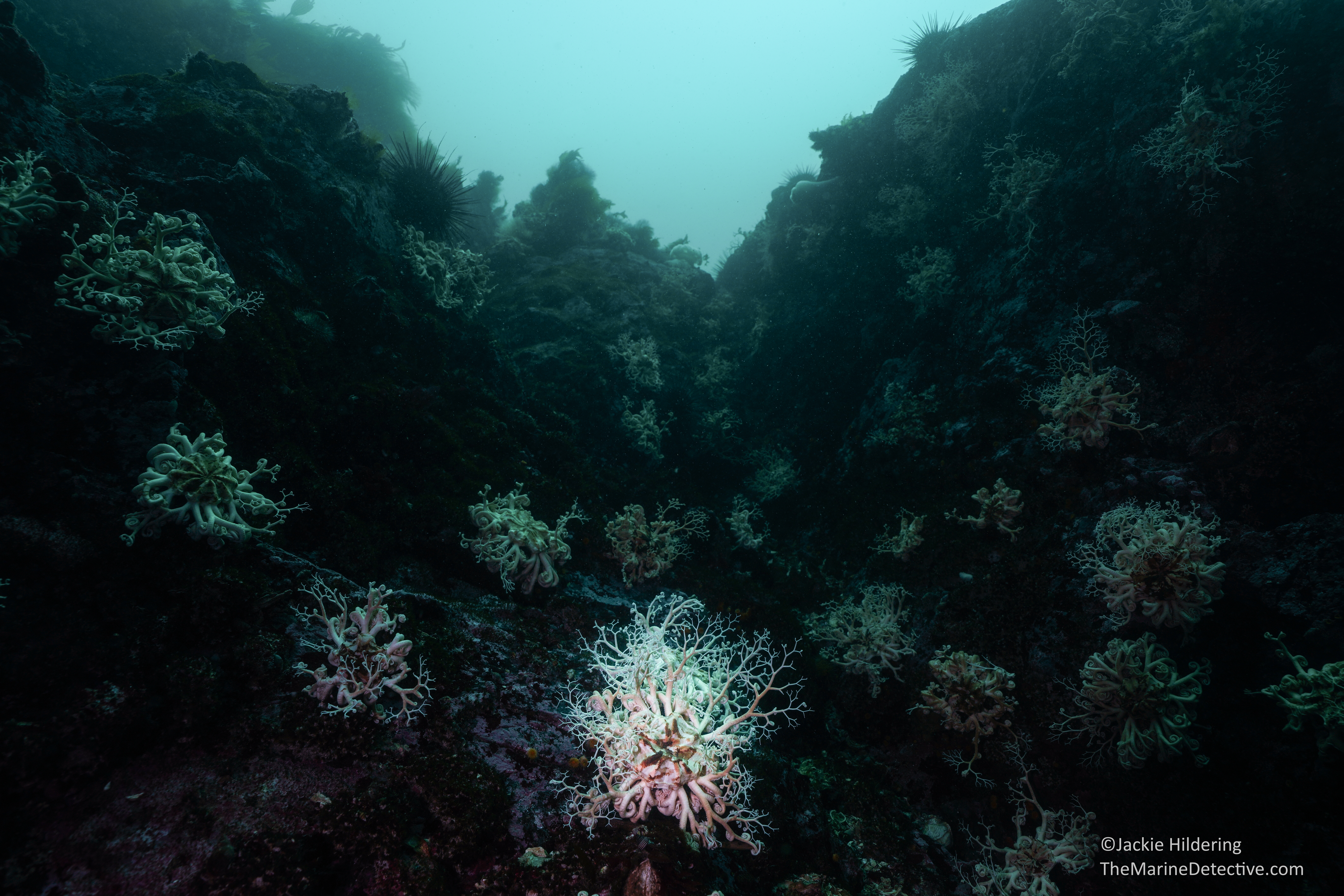
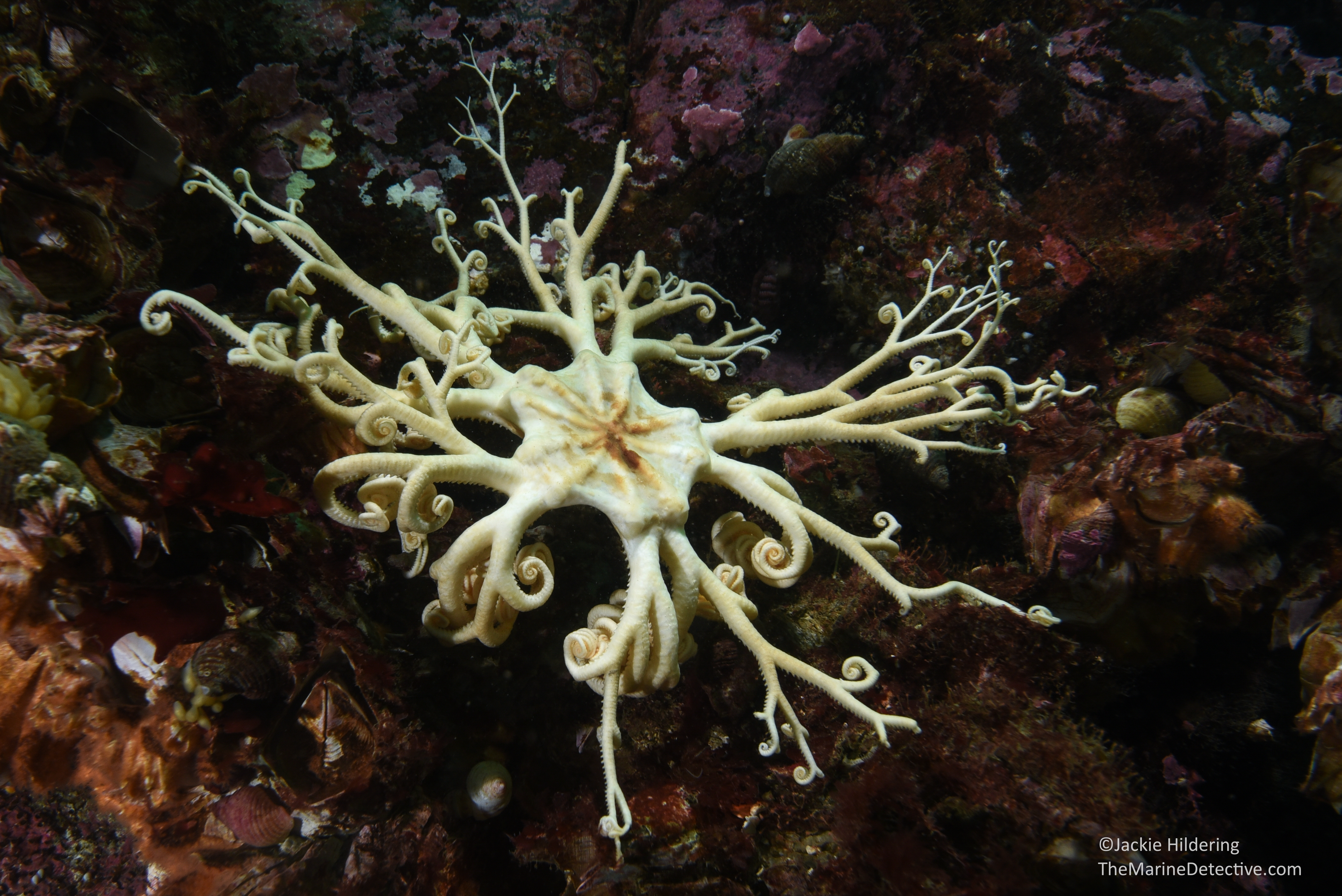
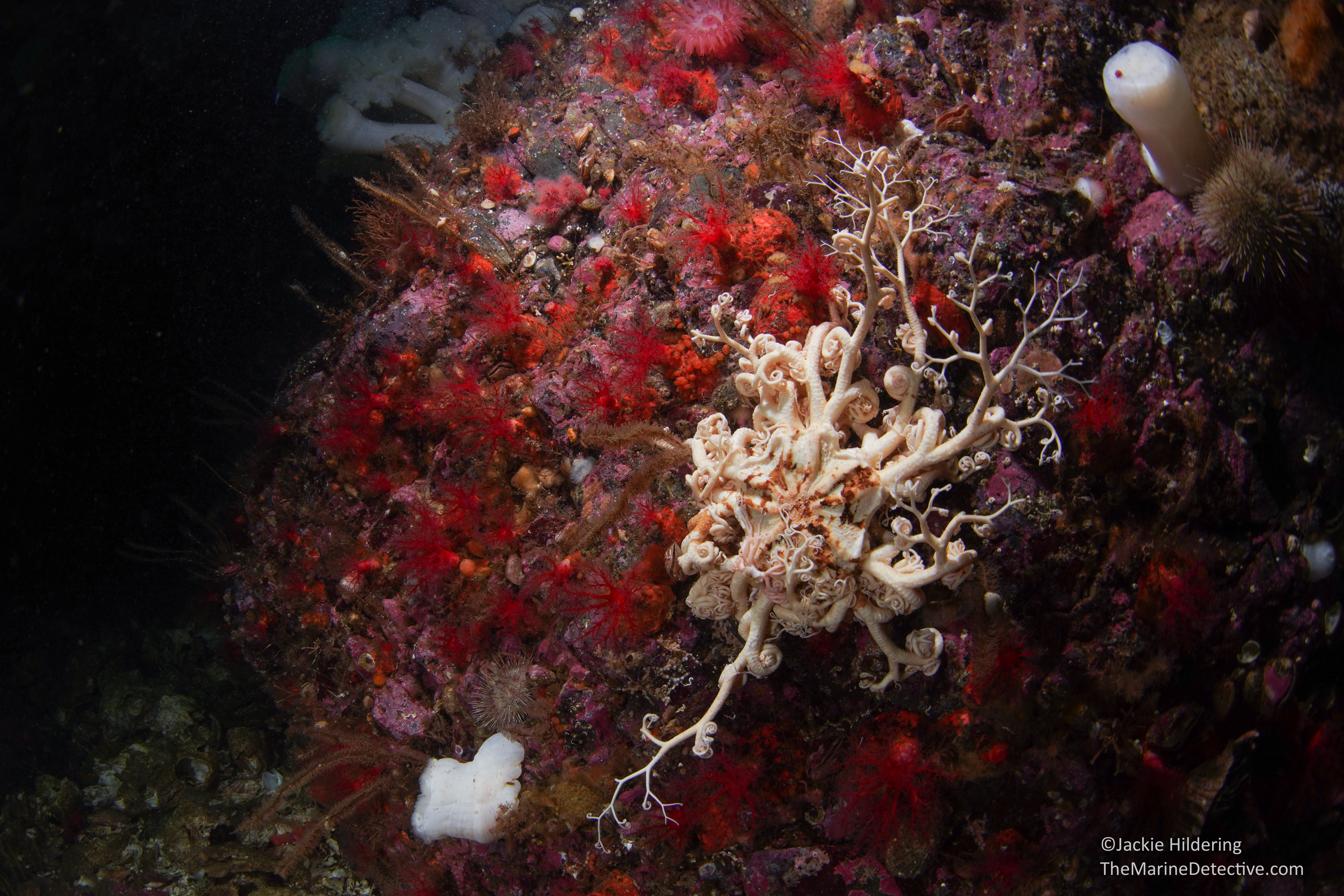
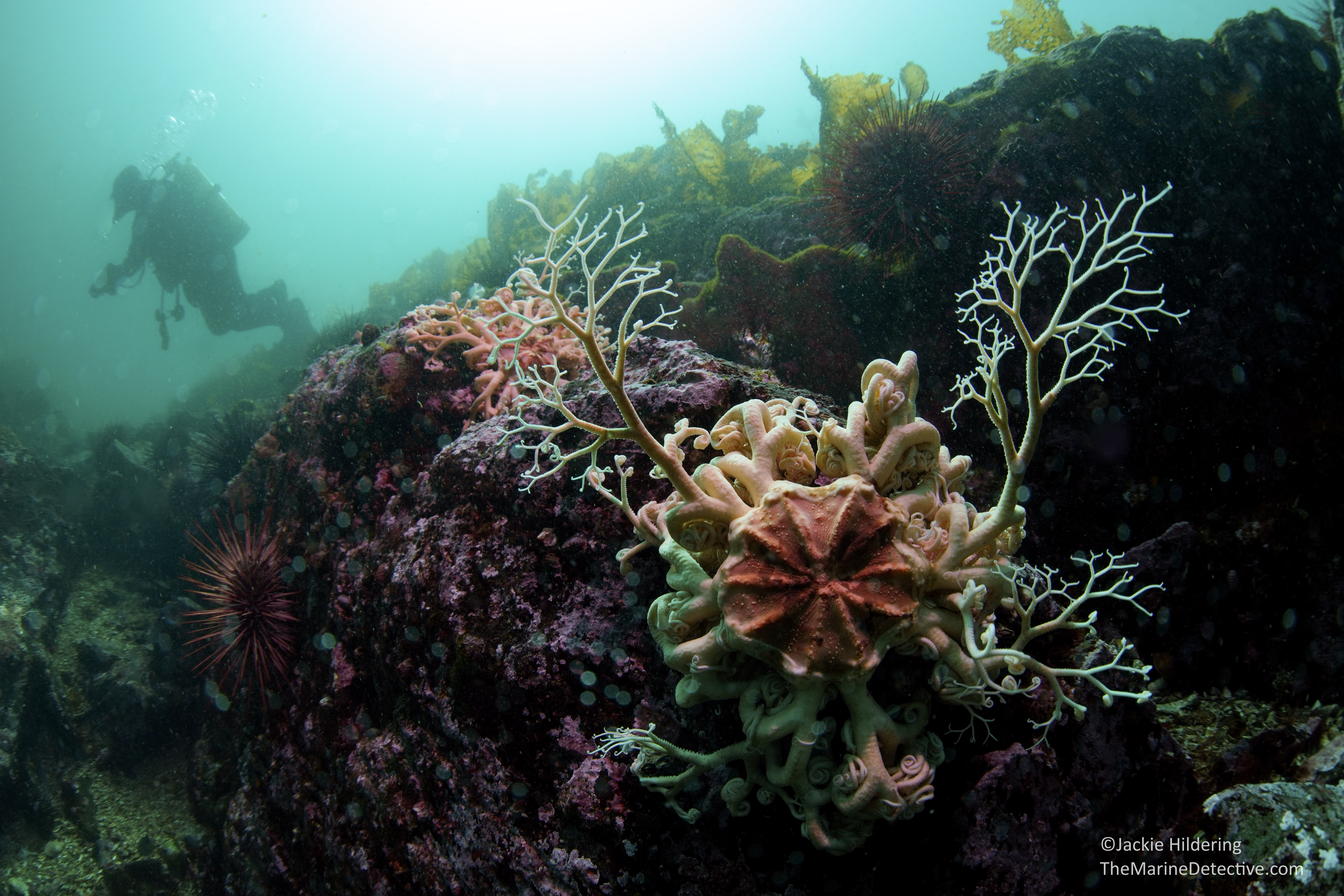
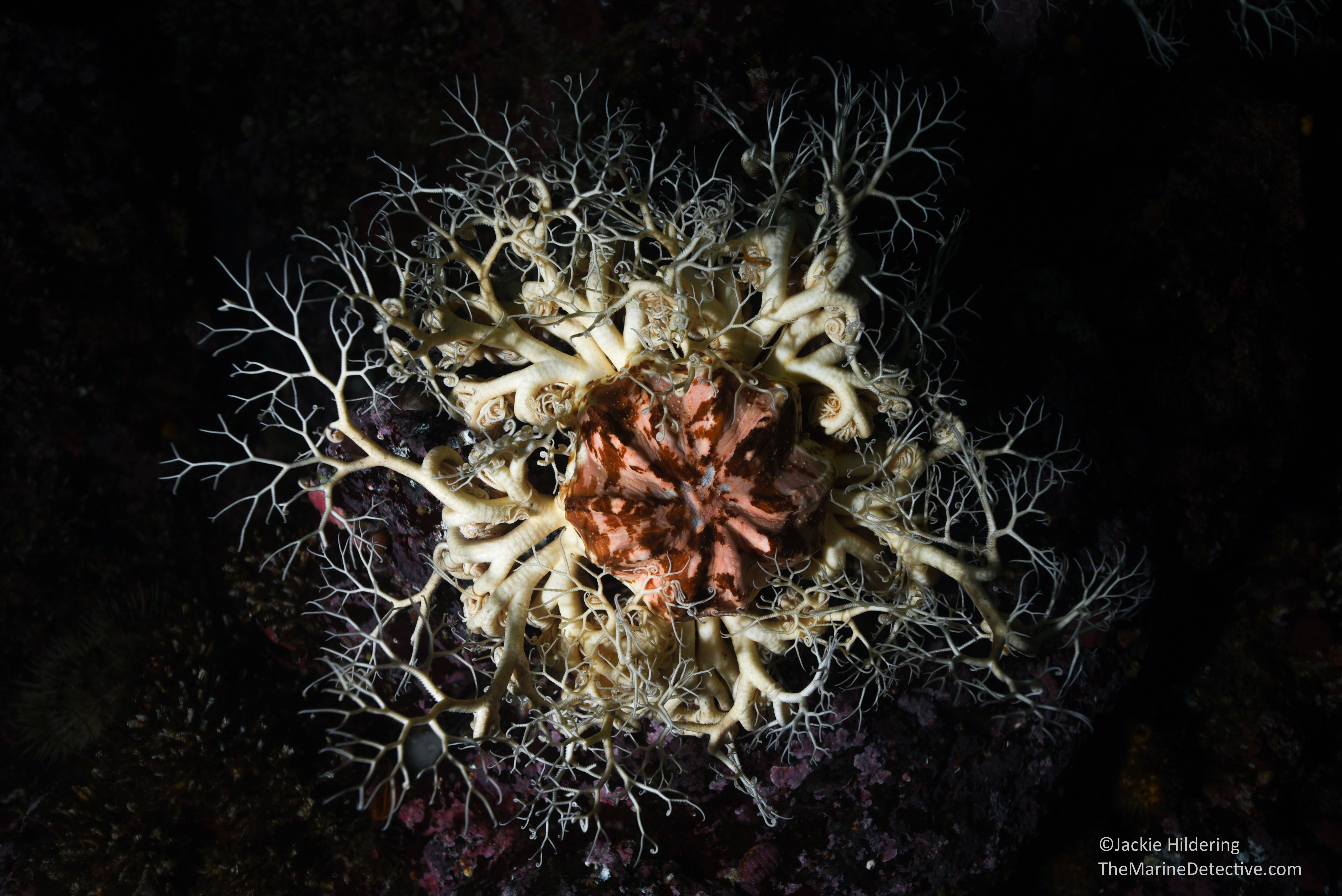
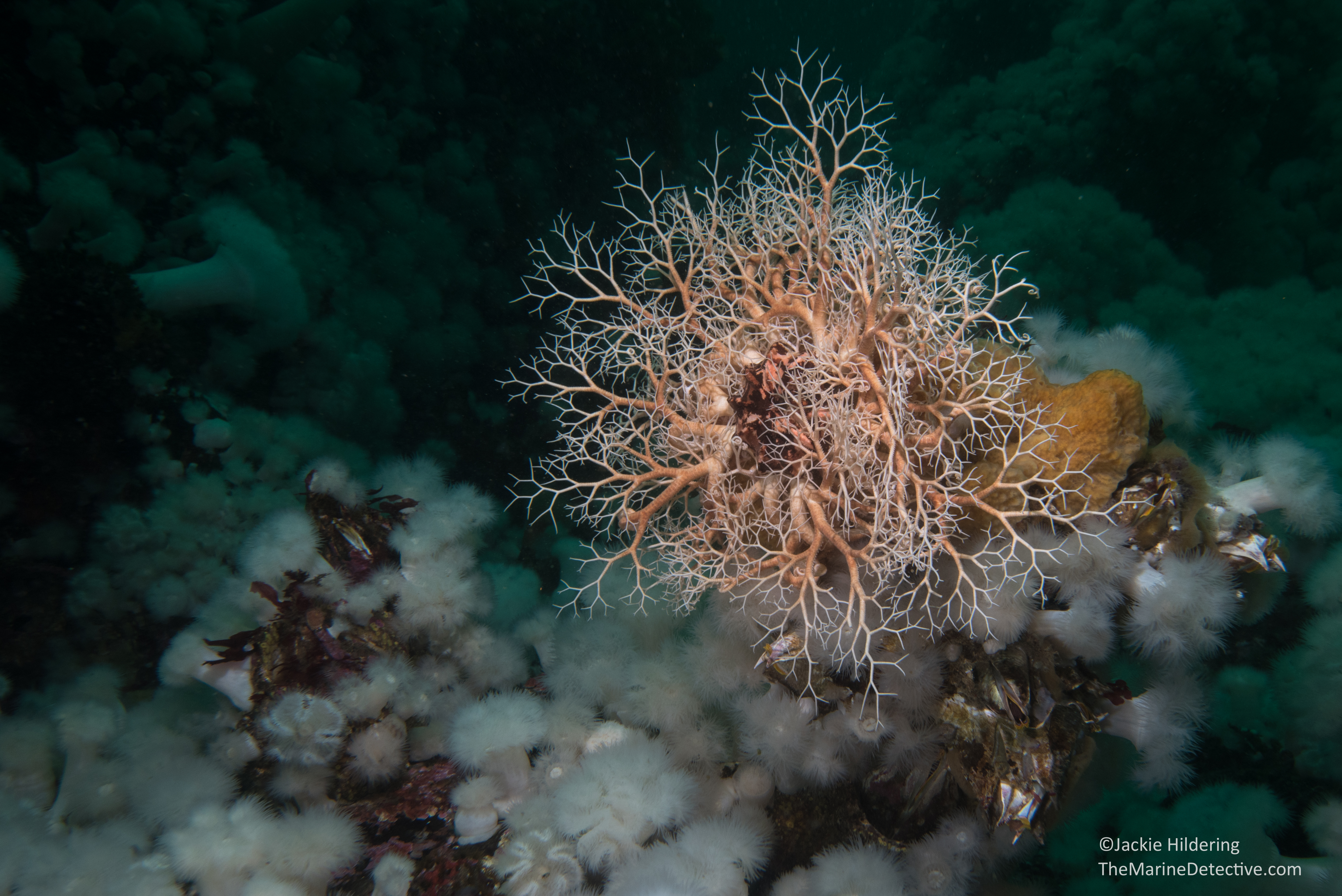
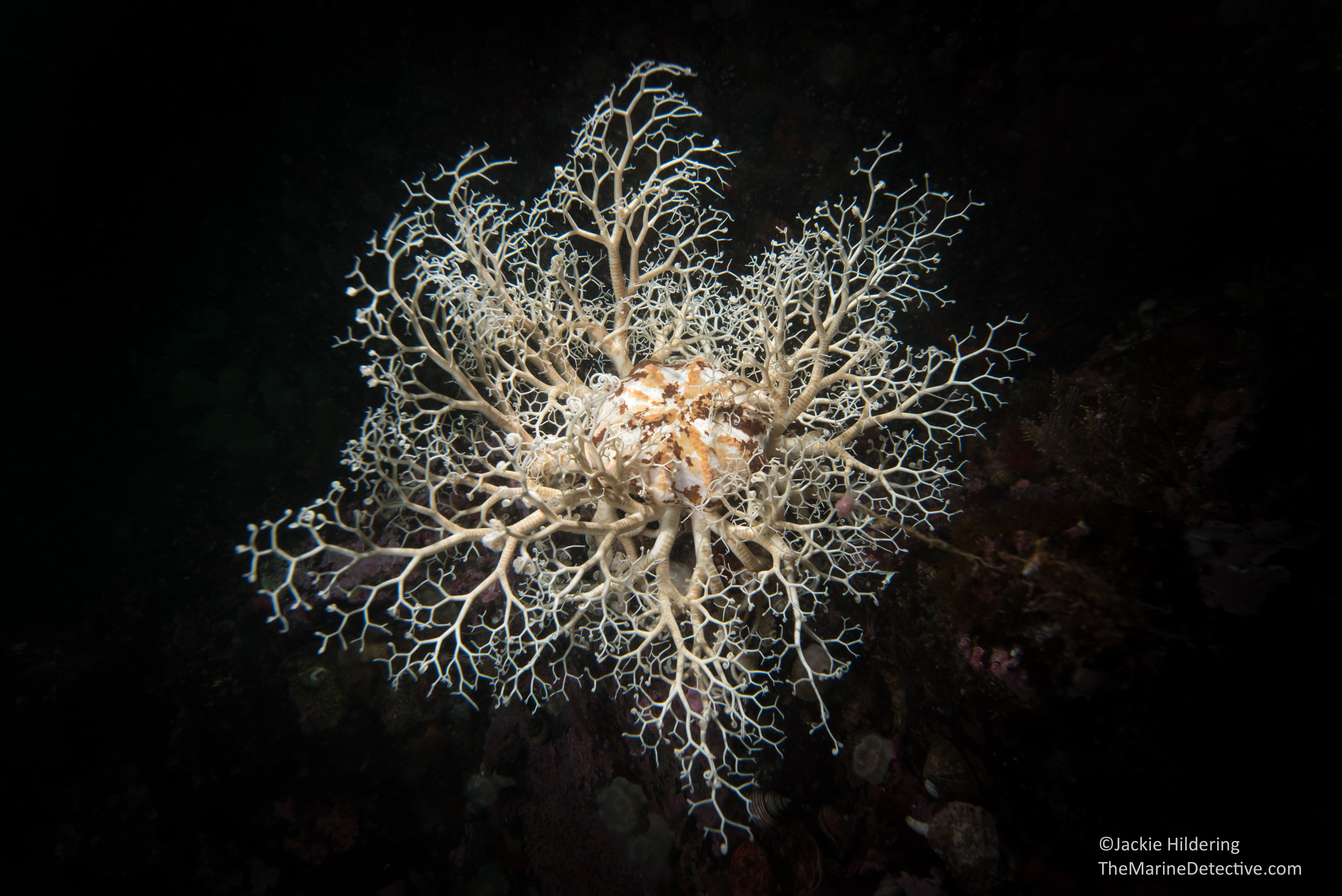
Yes, they are a common species here. They have 5 pairs of arms that seem to branch infinitely and they are big! When the branched arms of Gorgonocephalus eucnemis are fully outstretched, adults can be up to 80 centimetres wide (Source: Hainey).
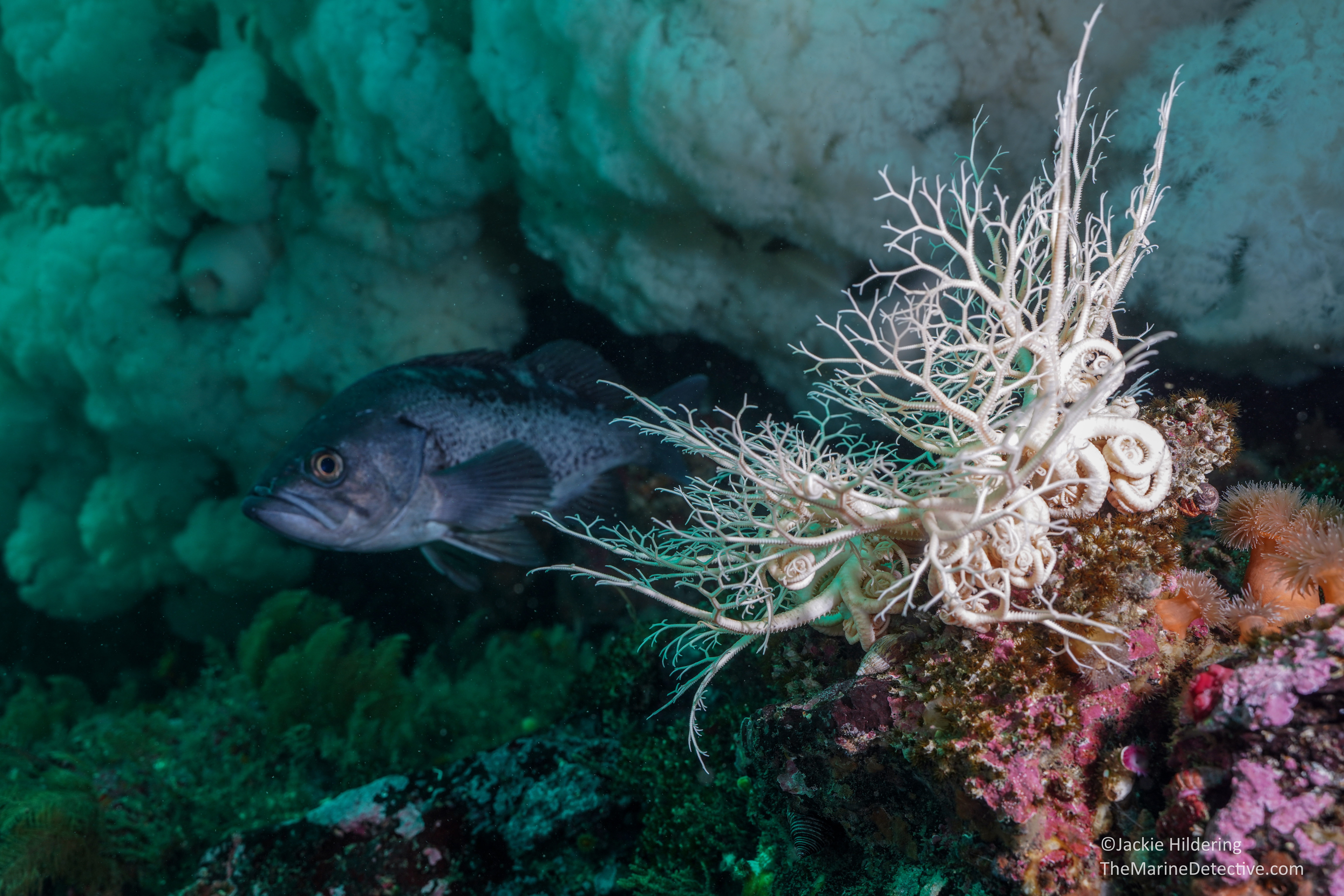
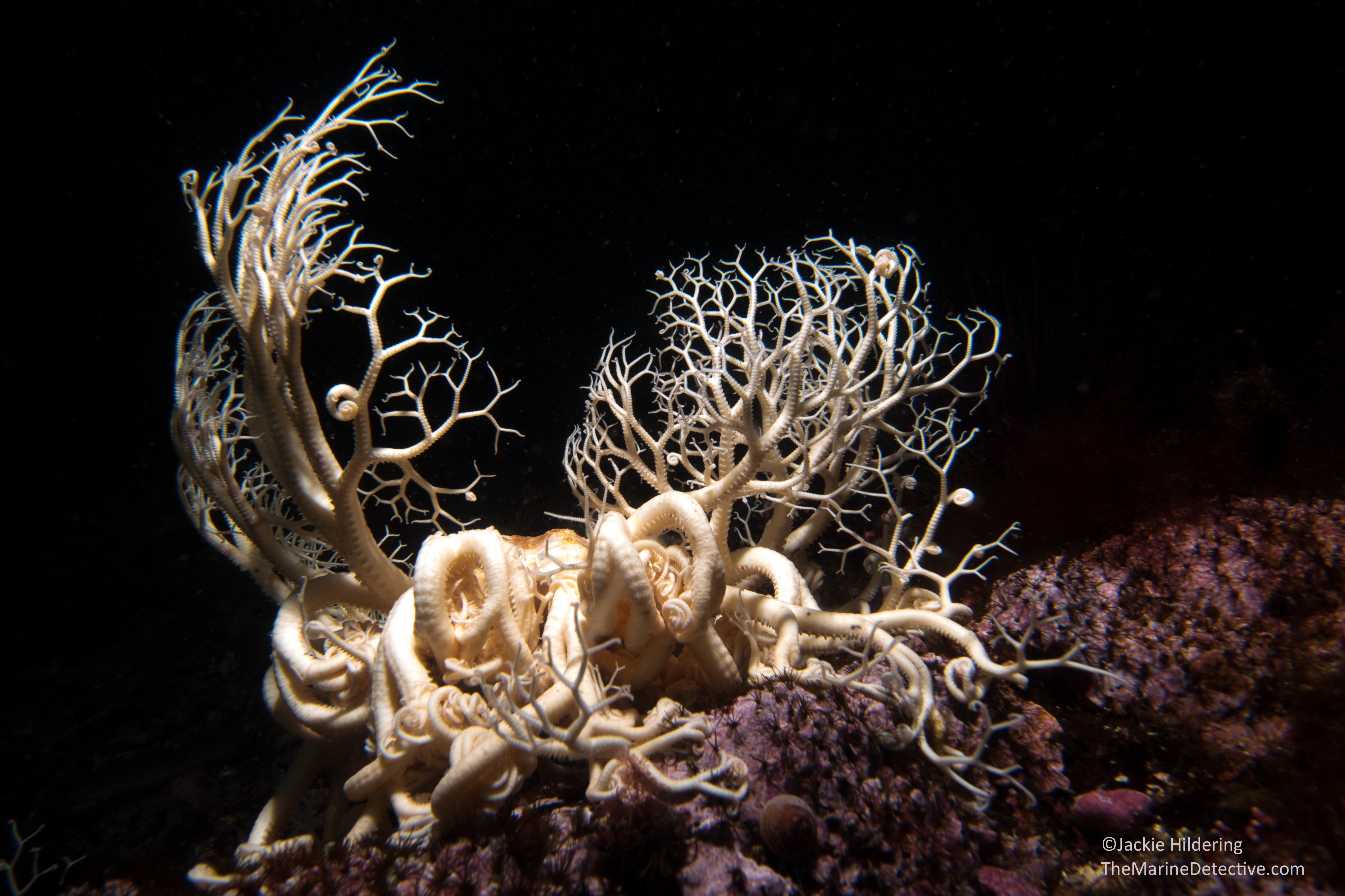
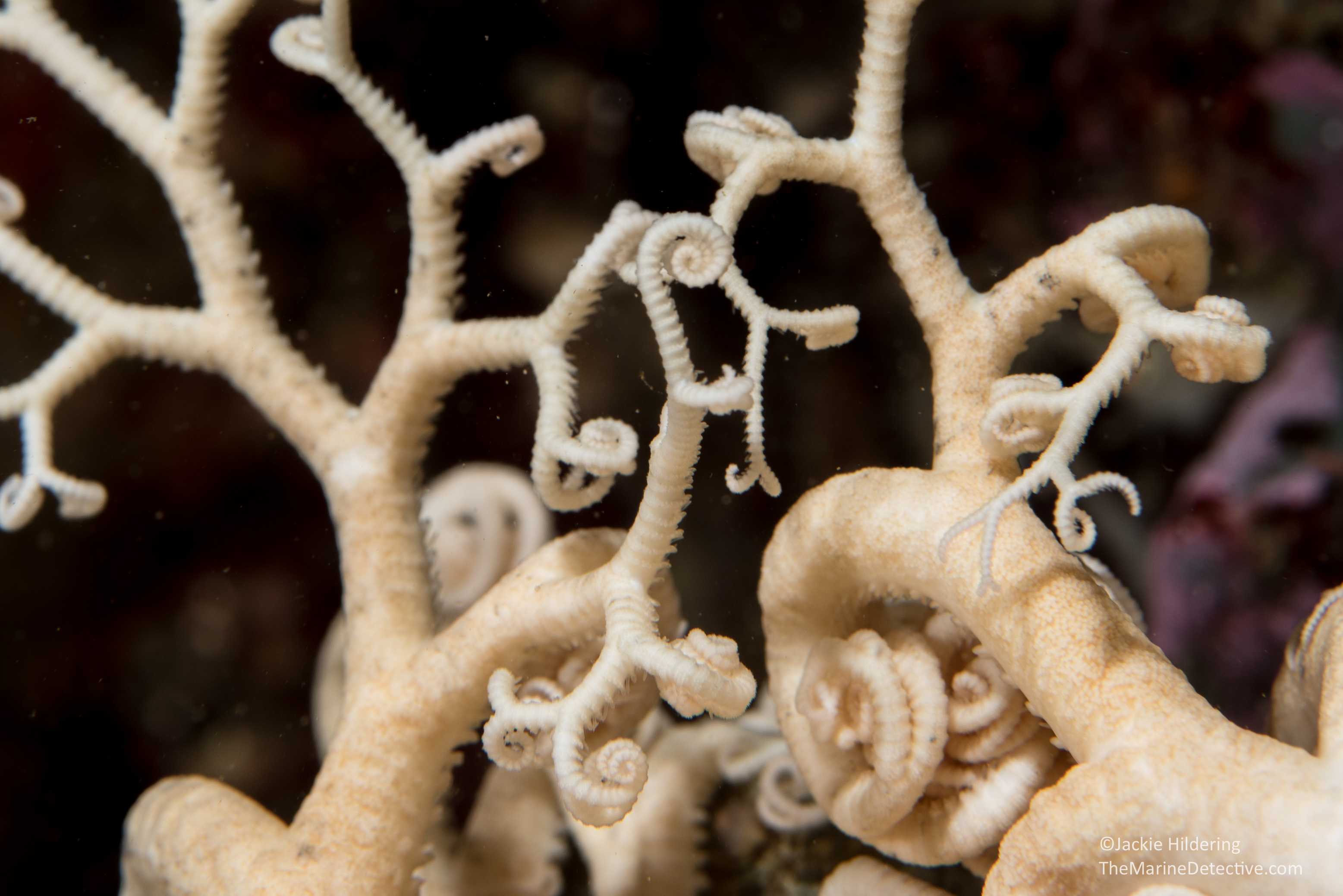
Imagine submerging and watching how, when the current increases, their arms unfurl into a basket to ensnare plankton. Through microscopic hooks and mucus, the snacks are moved to the Basket Star’s mouth which is on the underside of the central disc.
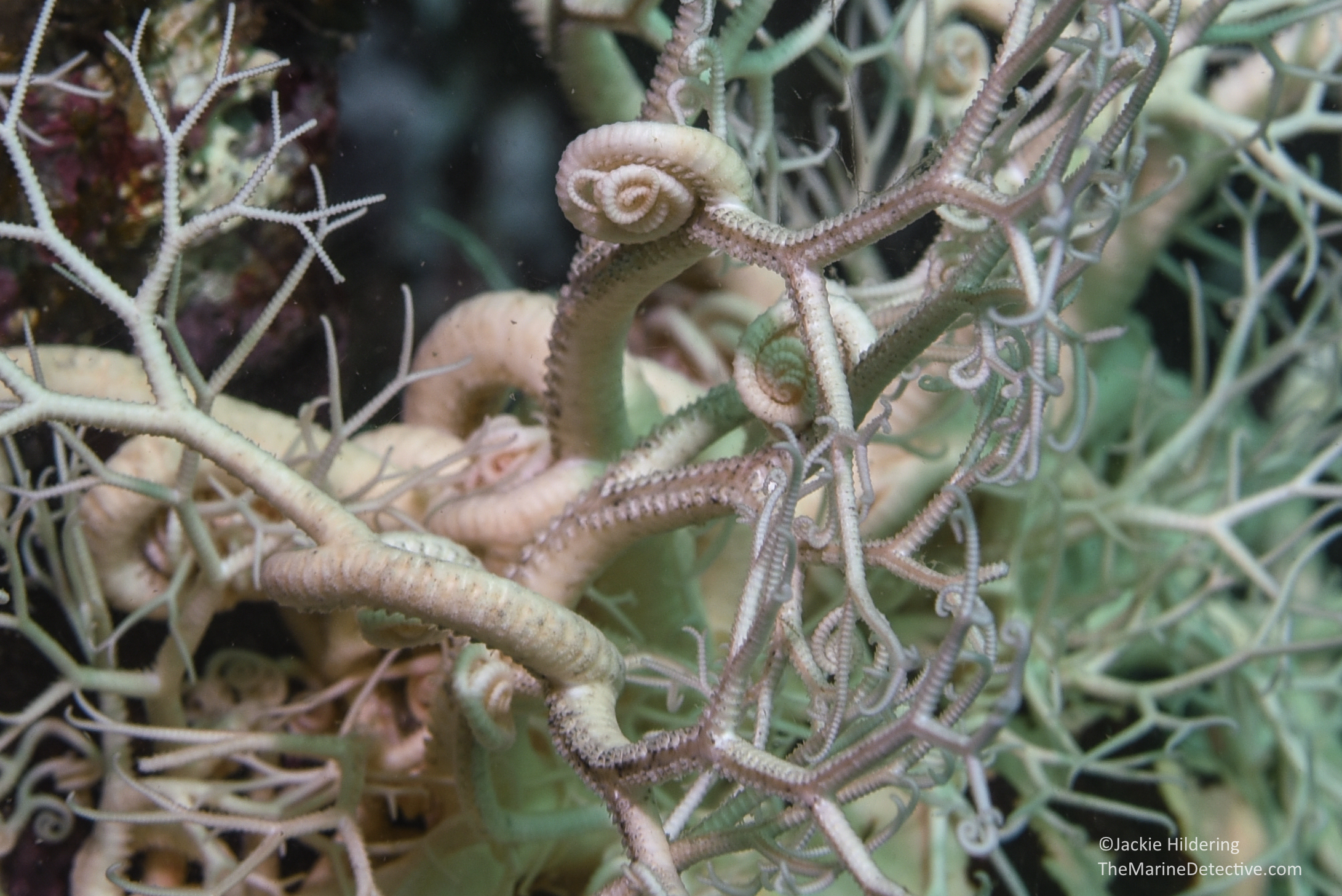
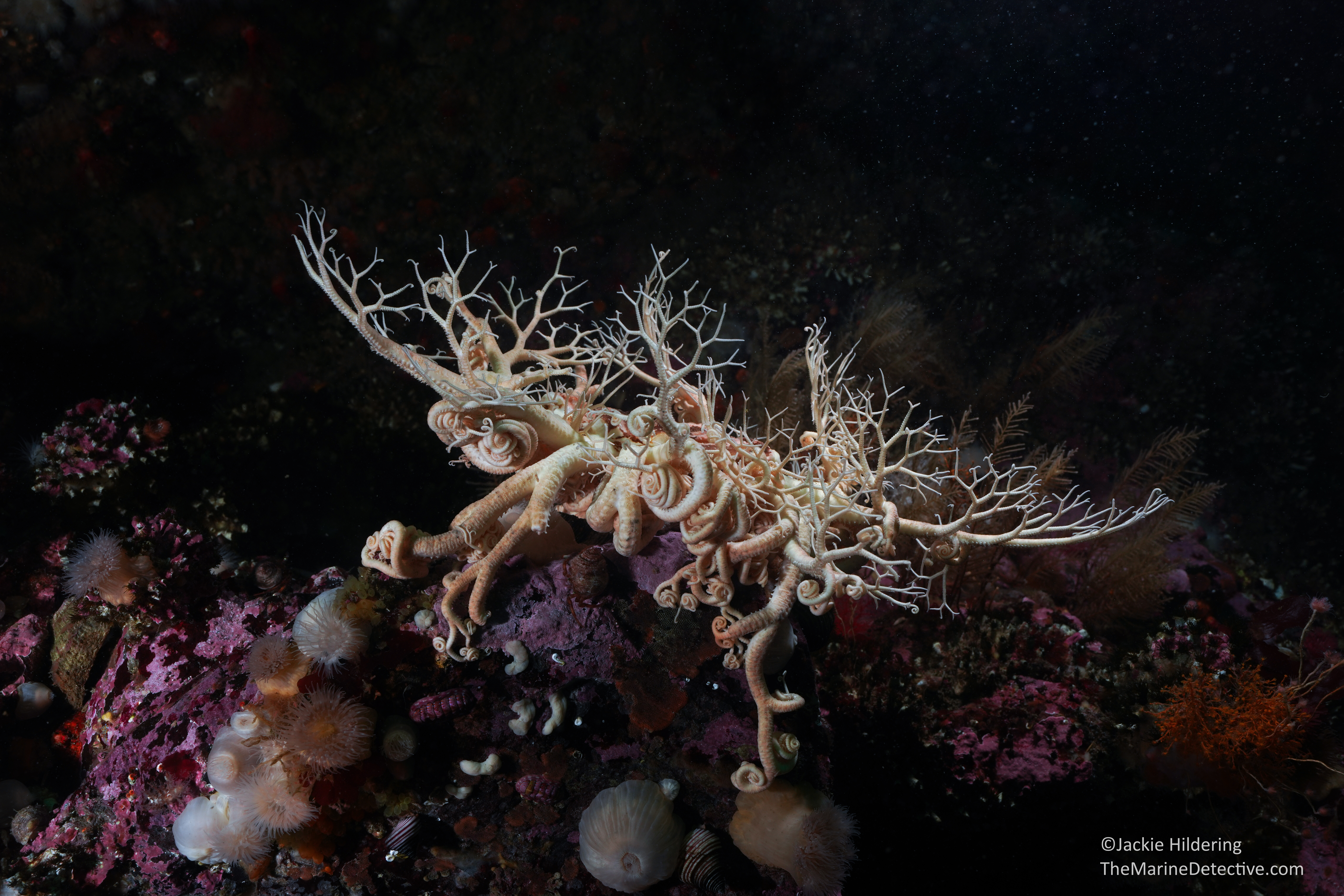
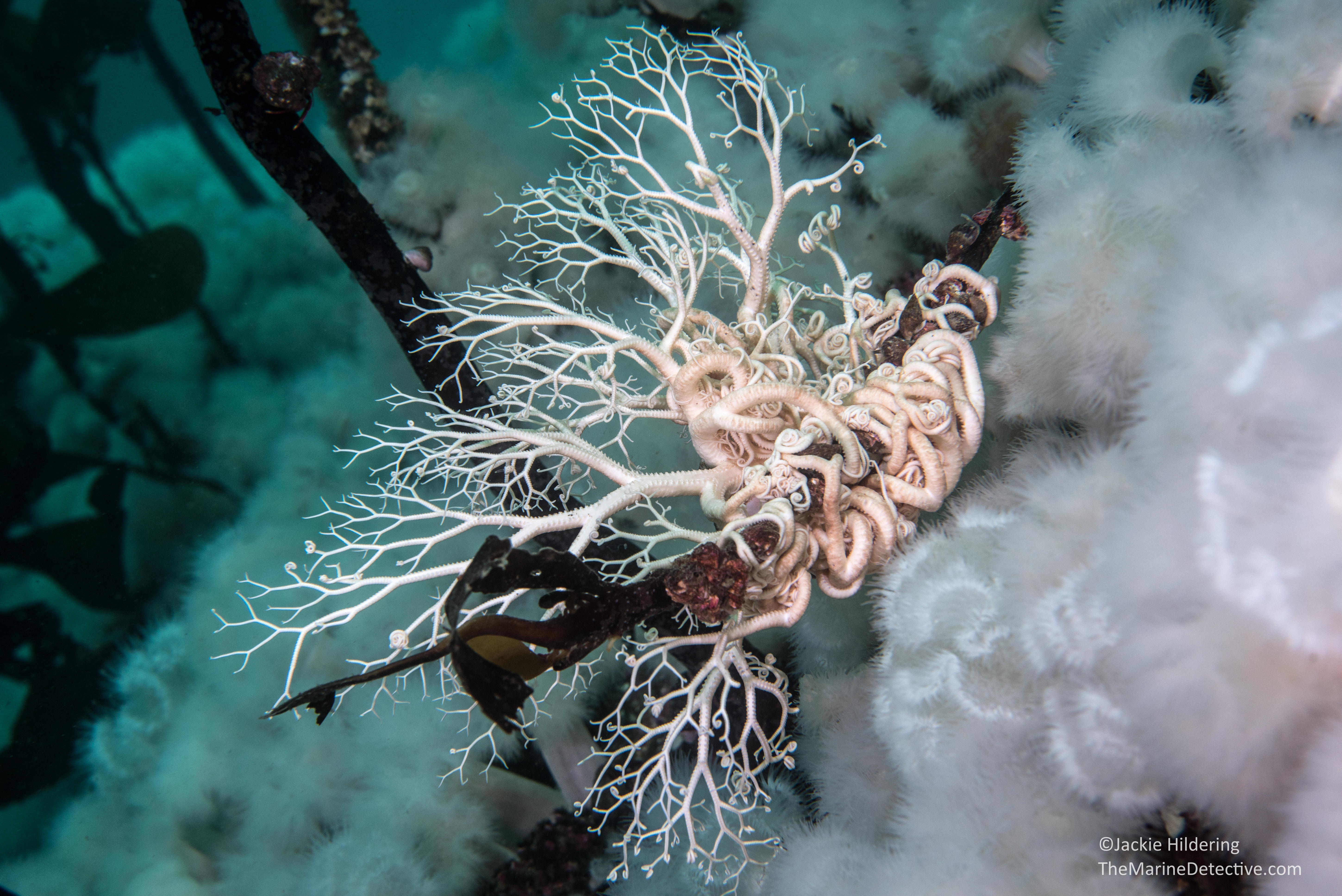
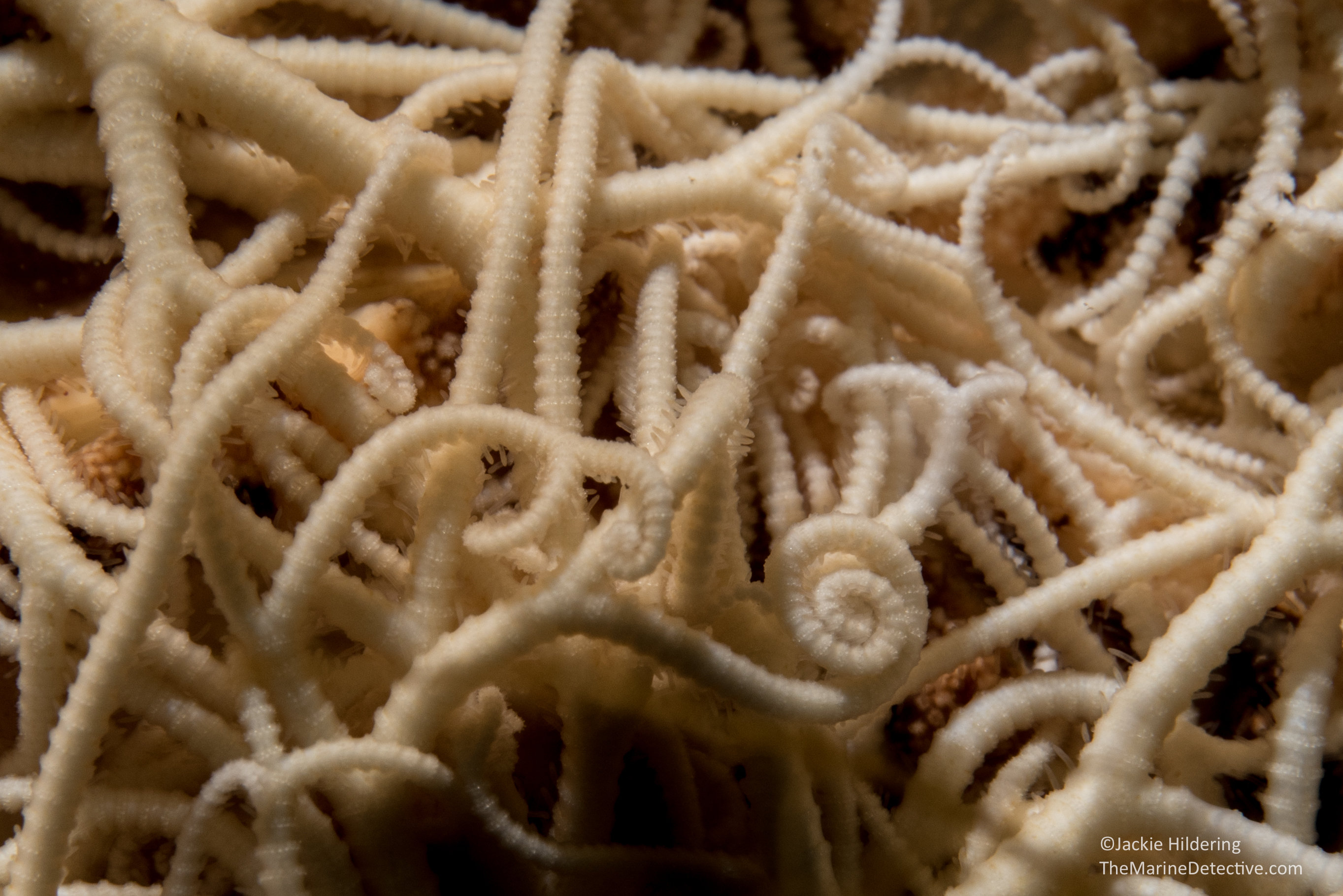
Basket Stars hold on and move about with their arms. They even climb kelp to position for more favourable feeding. They have tube feet, as do all echinoderms, but Basket Star tube feet do not appear to have a role in locomotion.

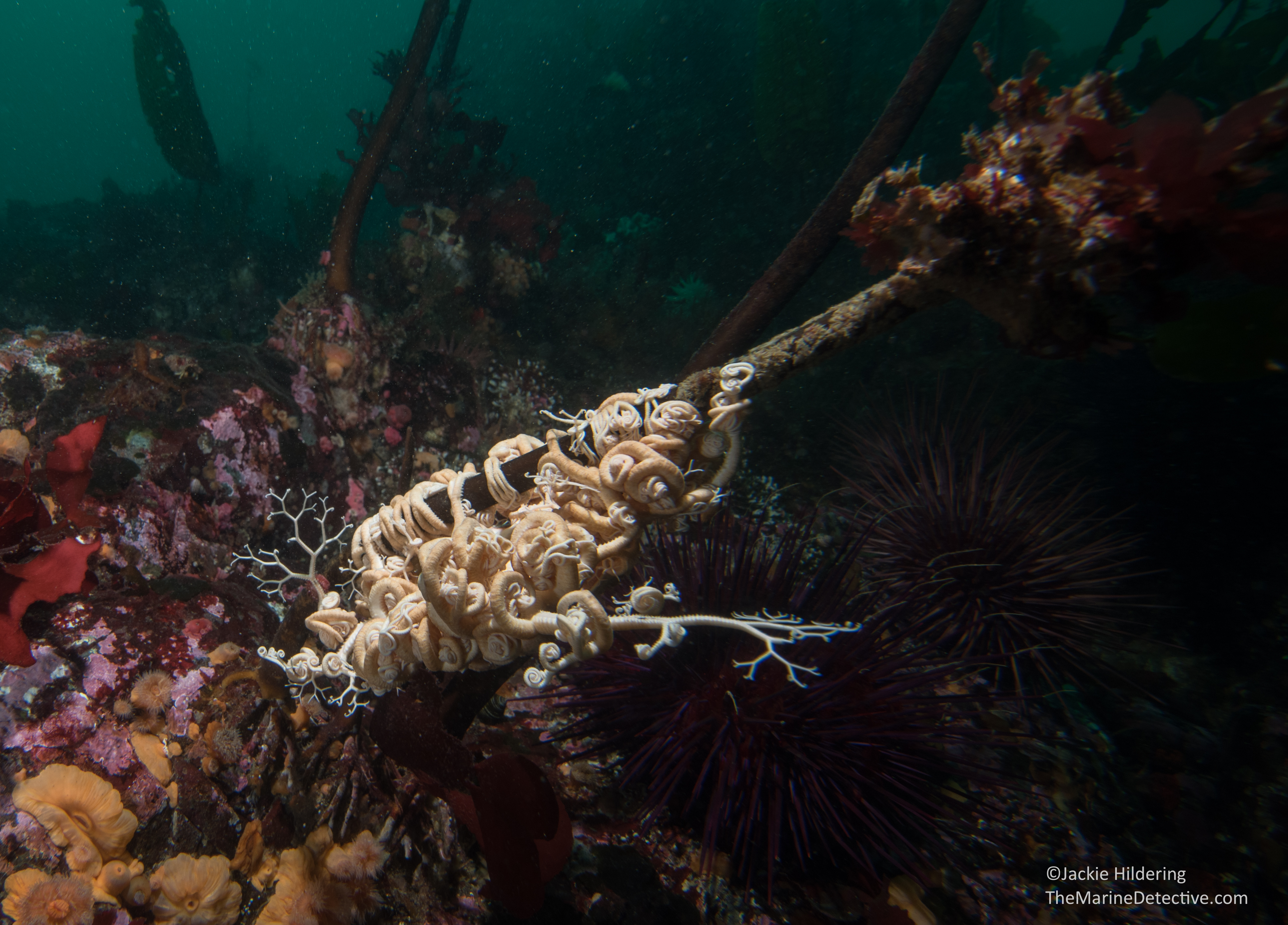
This species is reported to be long-lived. Multiple online descriptions state that Basket Stars can live up to 35 years but I could not find the scientific source for this. Regardless, in having the joy of diving the same sites over and over again, I am marvelling at the same ones again and again, trying to capture their surreal beauty.
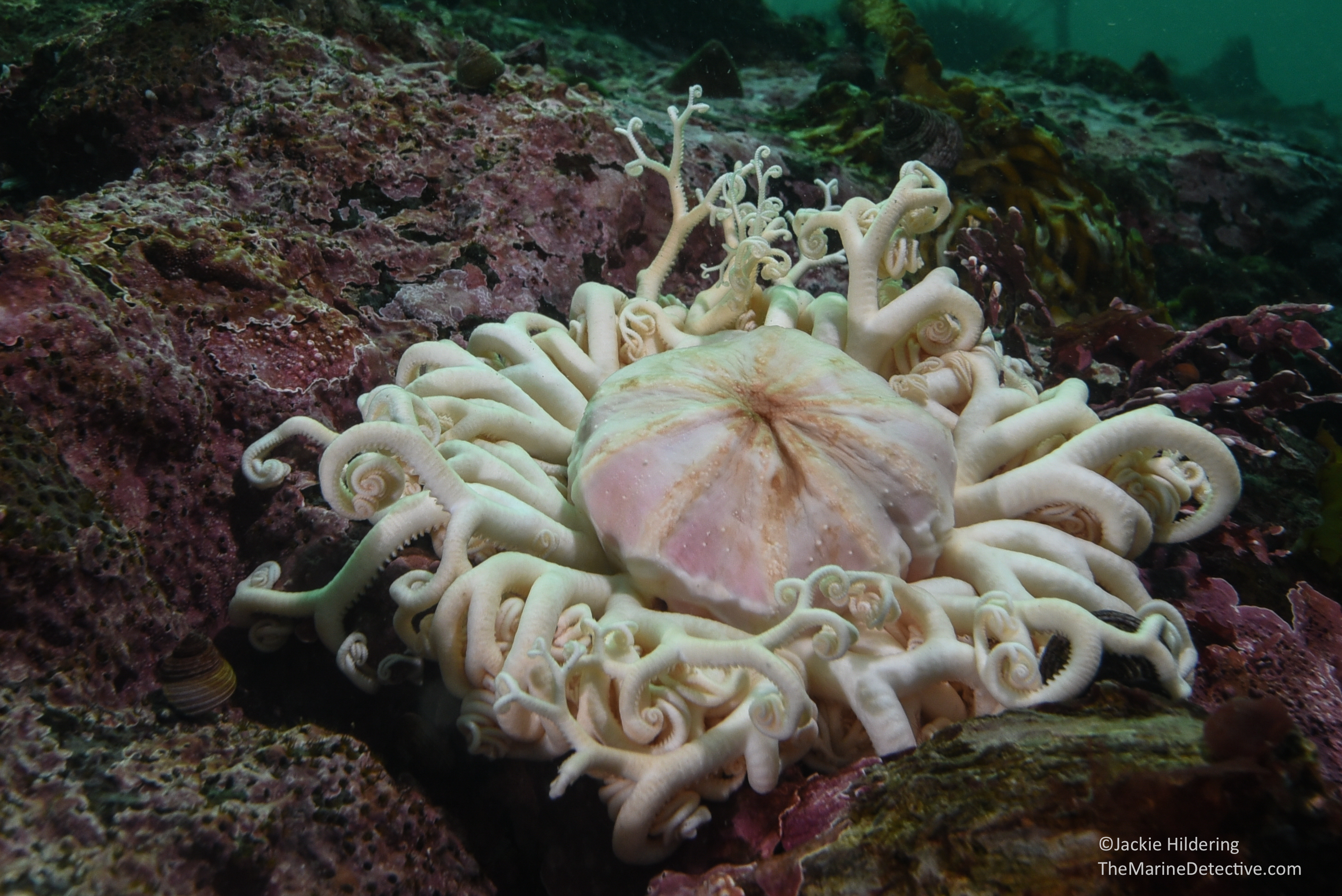
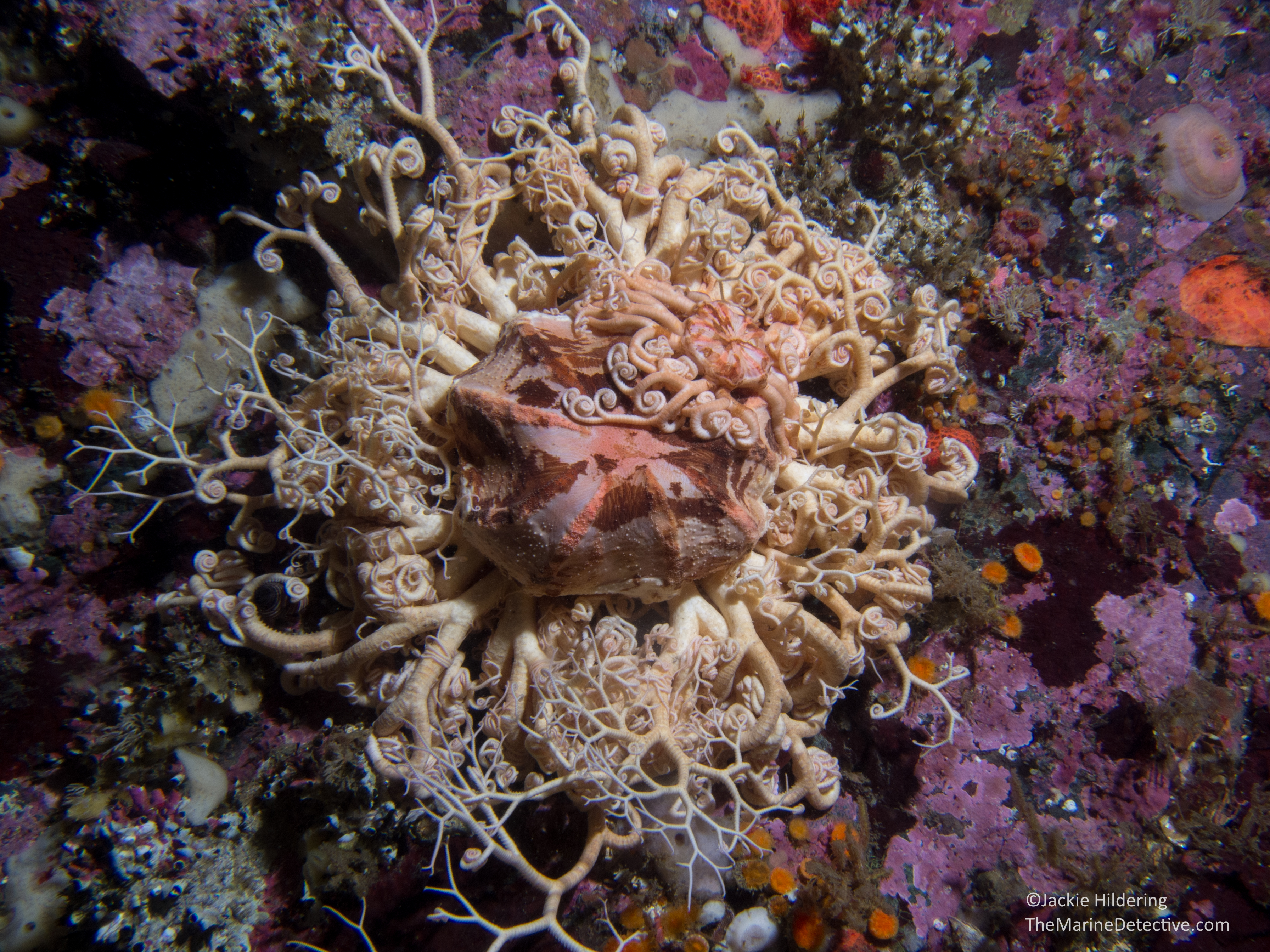
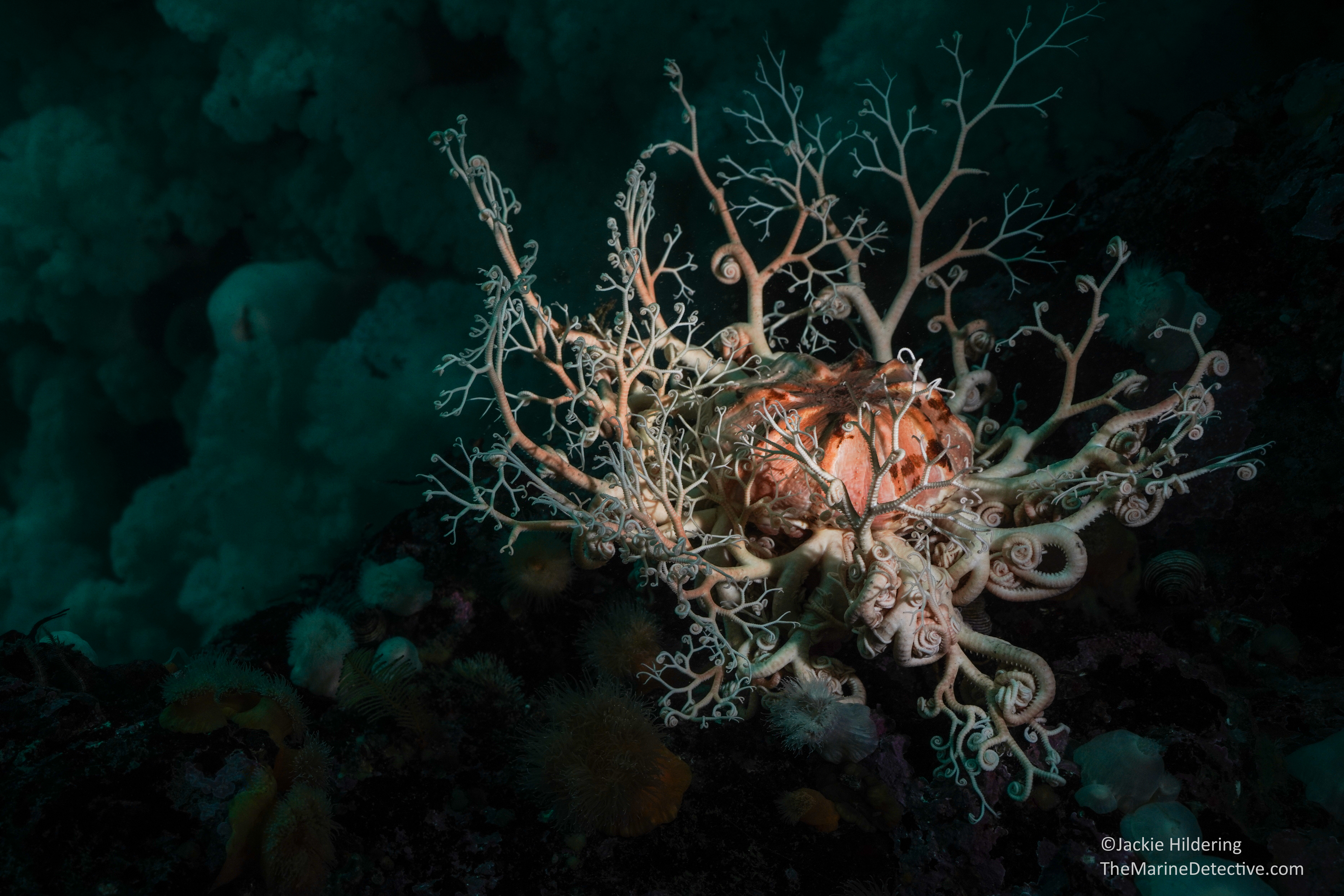
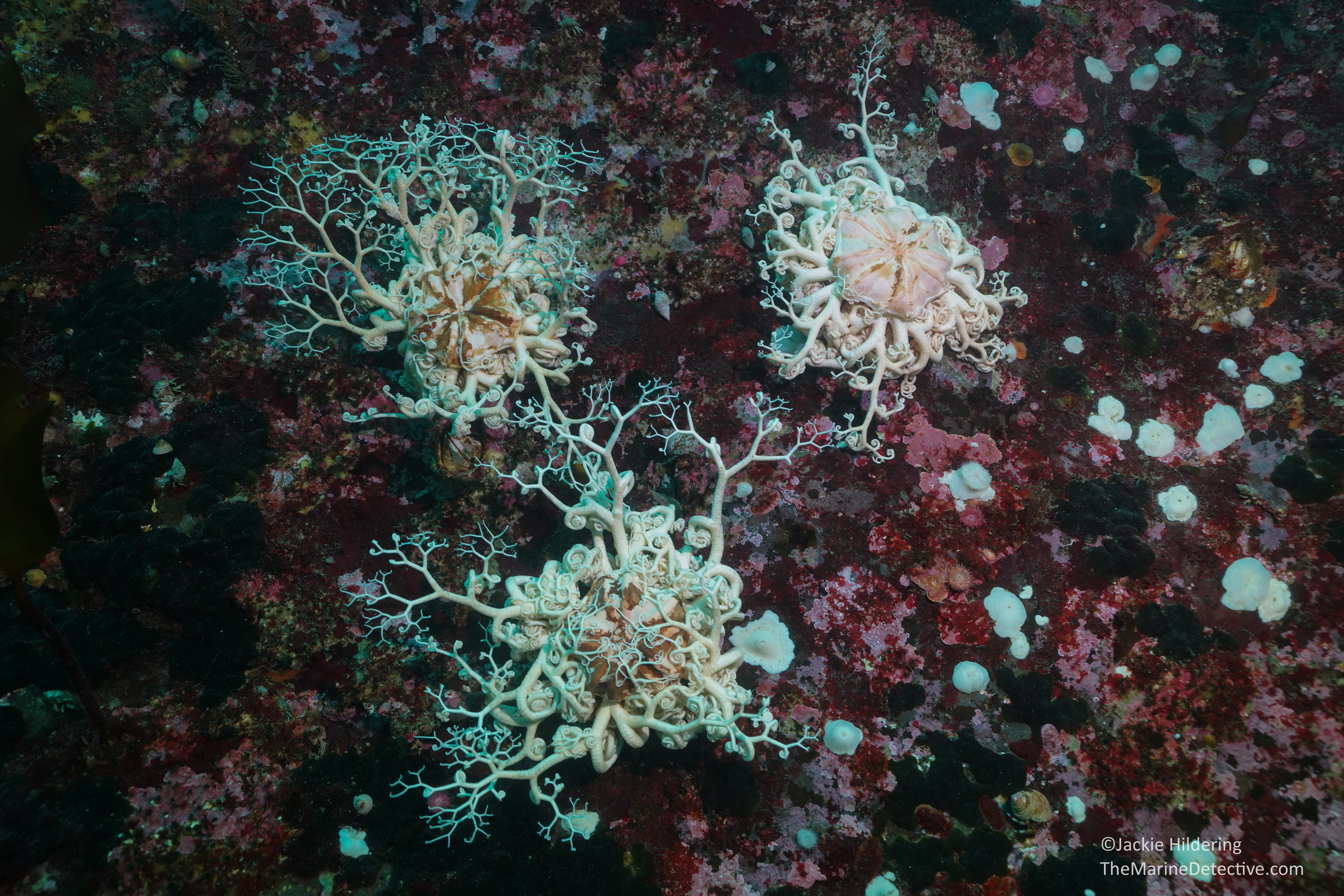

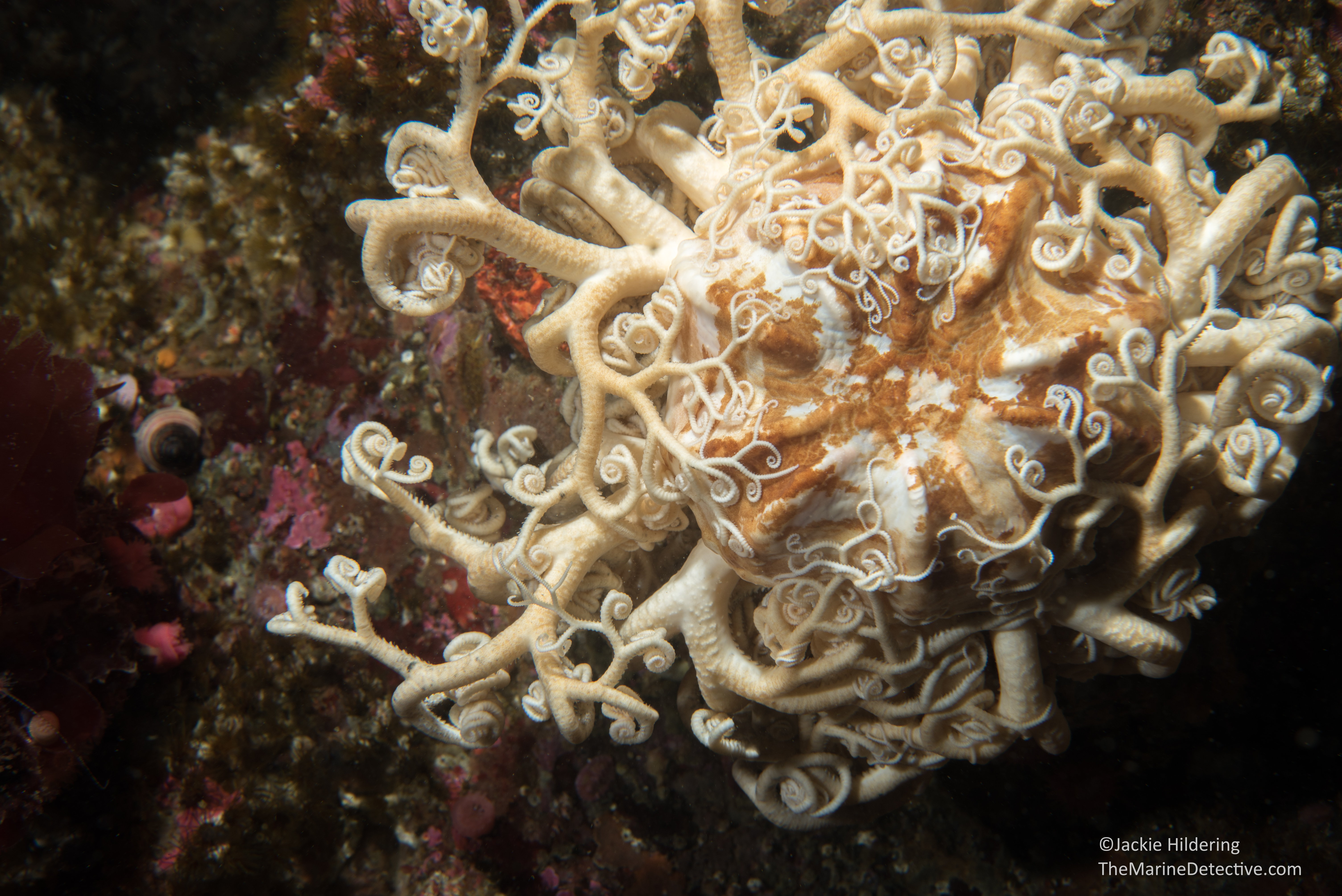
You’ll note from the photos how colour varies from beige to white and how the oral disc (the centre part) can have distinctive brown markings. Yes, I have thought about trying to identify and catalogue individuals. Please don’t encourage me!
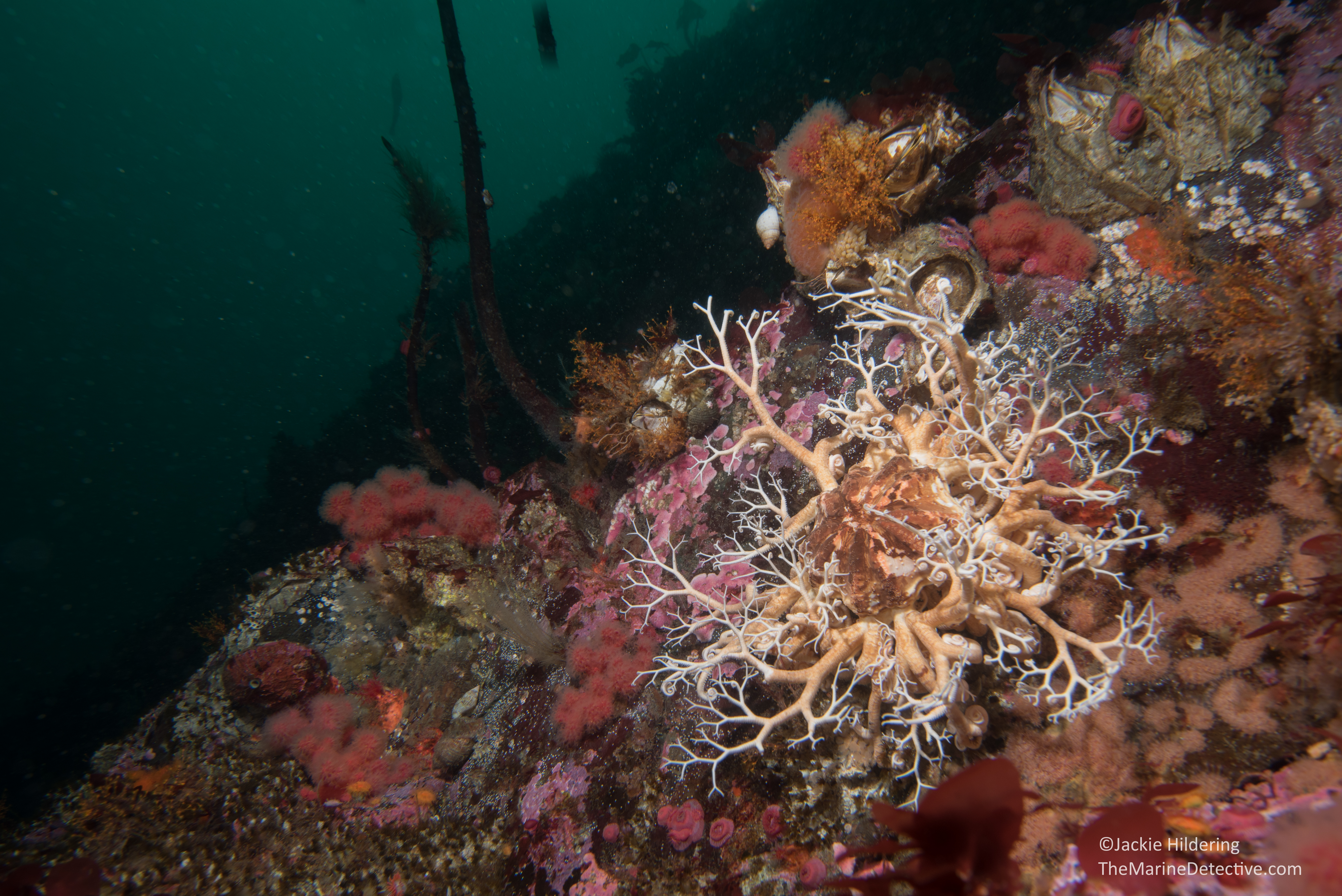
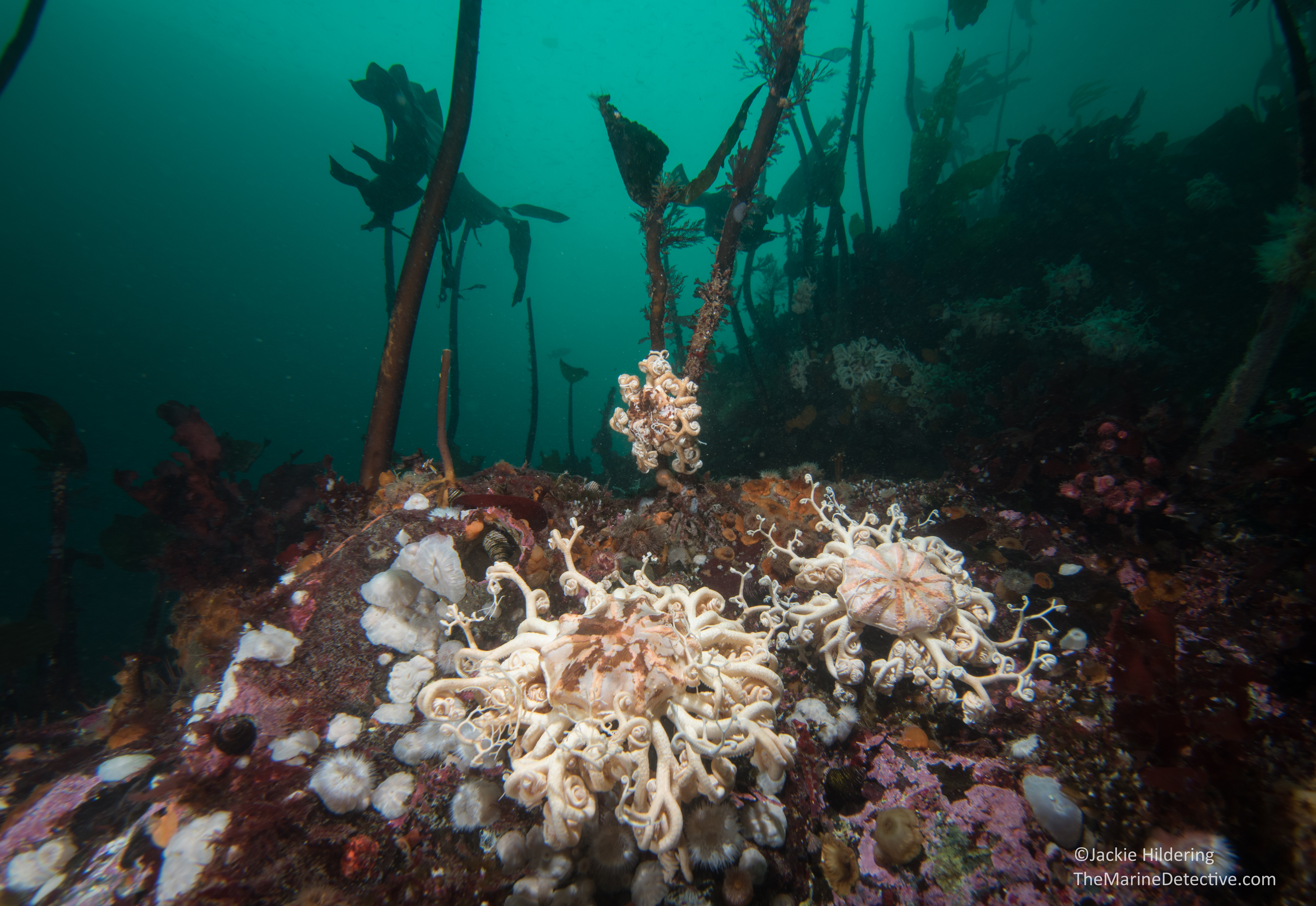
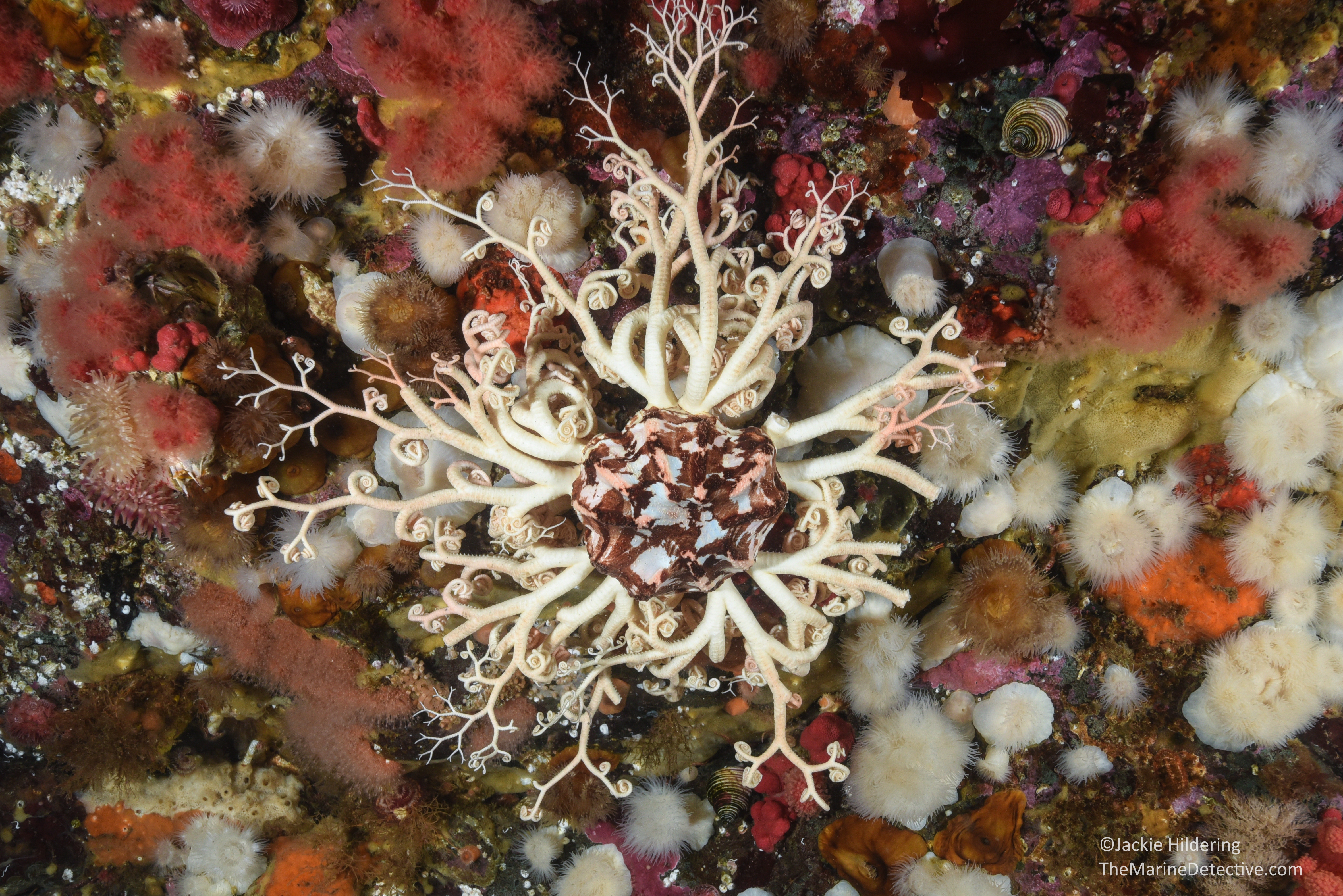
You can see how their oral disc also varies from being very flat to very puffy. Some have hypothesized that this might be related to their reproductive stage but it could be due to food and/or oxygen availability. See the reference to Makenna Hainey’s research below.
Wickedly wild embryos:
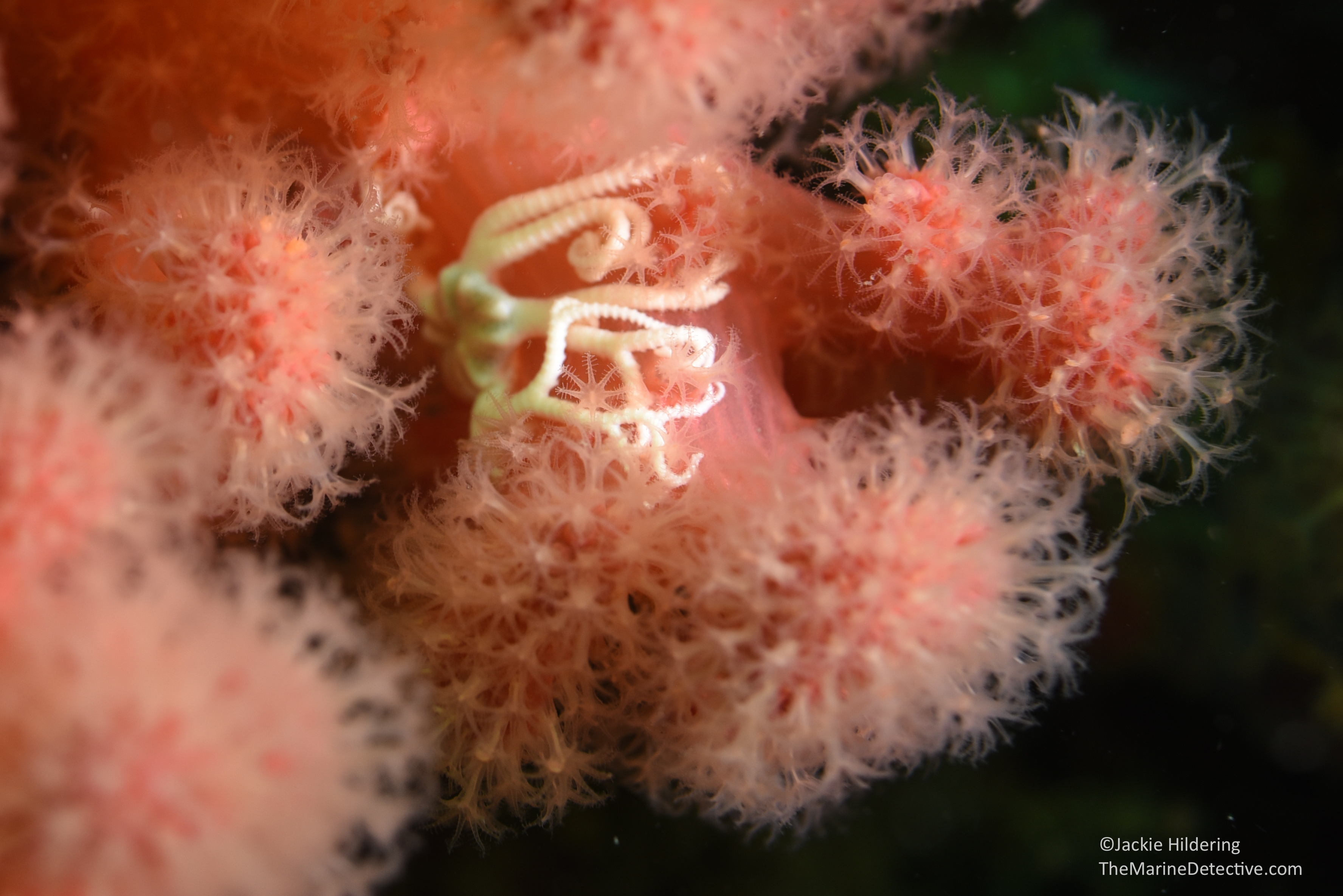
Basket Stars reproduce by broadcast spawning. Adult males and females release their gametes into the water. When they settle to the ocean bottom, the embryos are reported to develop INSIDE the polyps of Red Soft Coral. It’s thought the embryos feed on the soft coral’s eggs which brood inside the parent coral. Whoa!
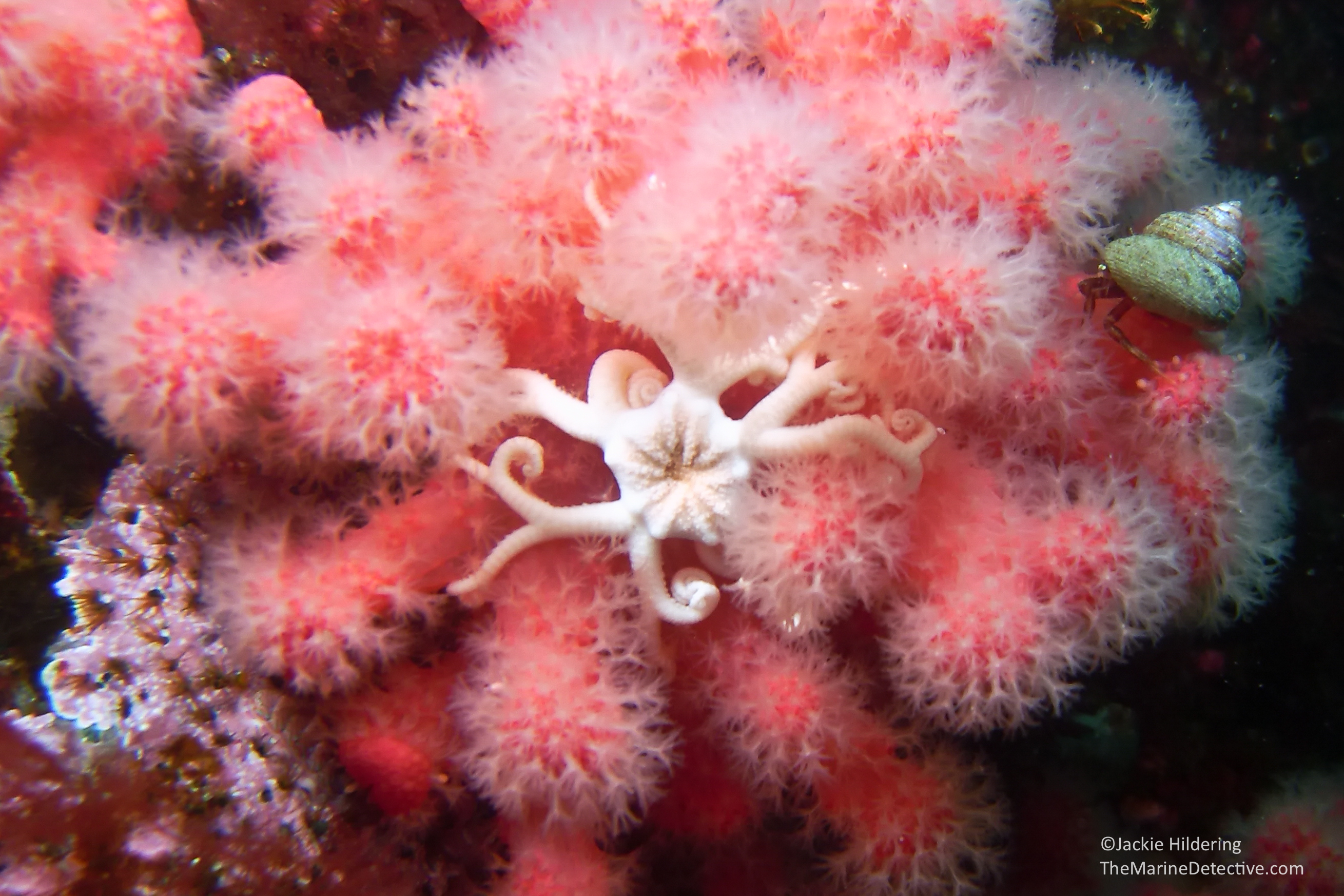
Then, when juvenile Basket Stars emerge from the coral’s polyps, they apparently hang onto the outside of the coral till about 3 millimetres in disk diameter. They shuffle off when approximately 5 centimetres in disk diameter and crawl onto an adult Basket Star.
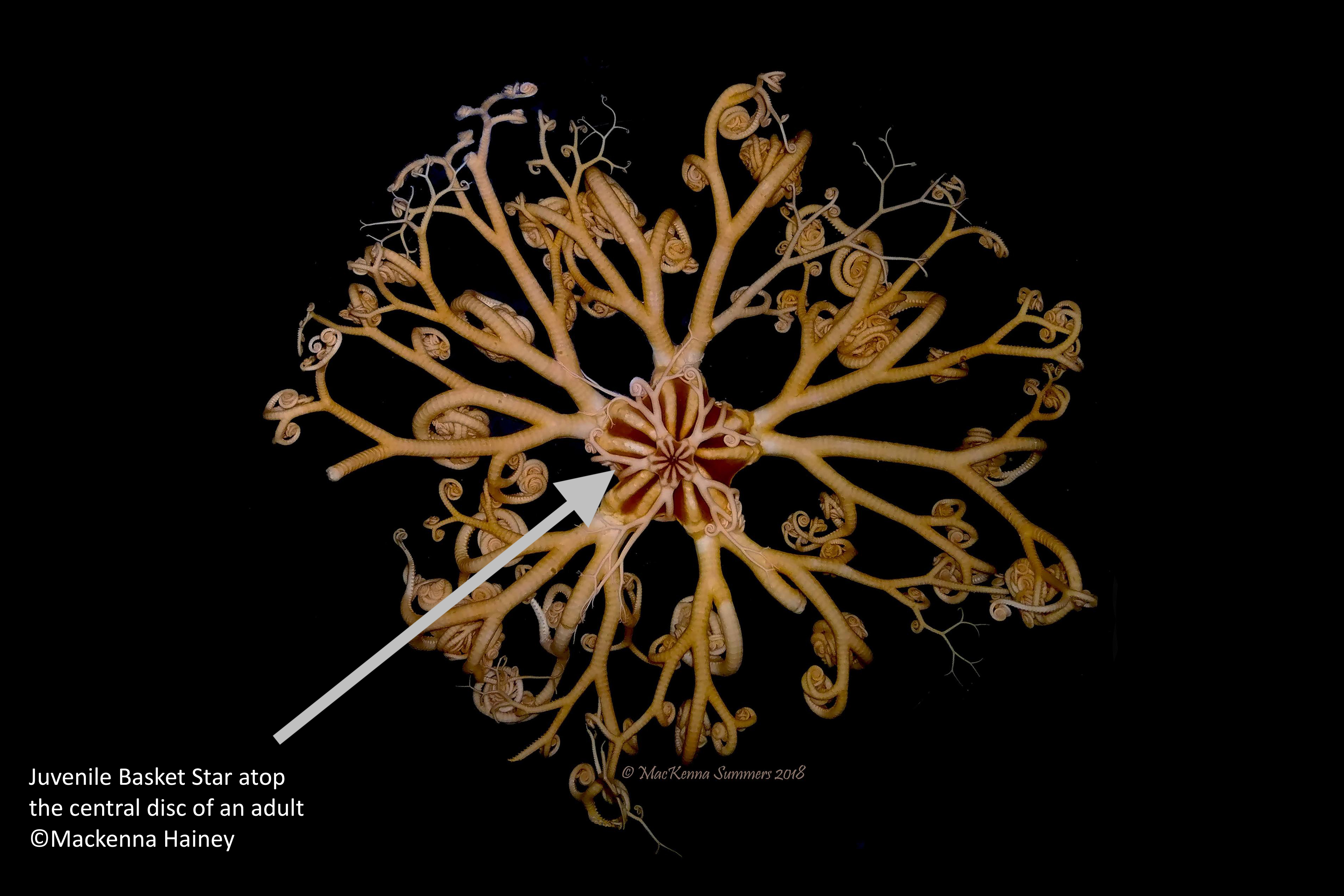
From Makenna Hainey (personal communication, October 1, 2023): “No one really knows how the juveniles get onto the adults. But the leading theory is that they use Soft Corals as bridges. From there, they will steal food bundles out of the mouths of the parents.”
More on diet and feeding:
From Invertebrates of the Salish Sea: ” . . . feeds on suspended particles by spreading rays out like a fan, oriented mostly perpendicular to the current. Macroscopic zooplankton such as copepods, chaetognaths, and jellyfish are caught by microscopic hooks on the rays. The fine branchlet tips then curl around the object and slowly move it toward the mouth (exact method is unclear). The prey of basket star species is said to range up to 3 cm (just over an inch) in size, and most basket stars capture prey mainly at night but may retain their prey until daytime to actually feed on them. Mucus may also help to immobilize prey. This species has also been reported to feed on the small benthic sea pen Stylatula elongata [Spiny White Sea Pen]”.
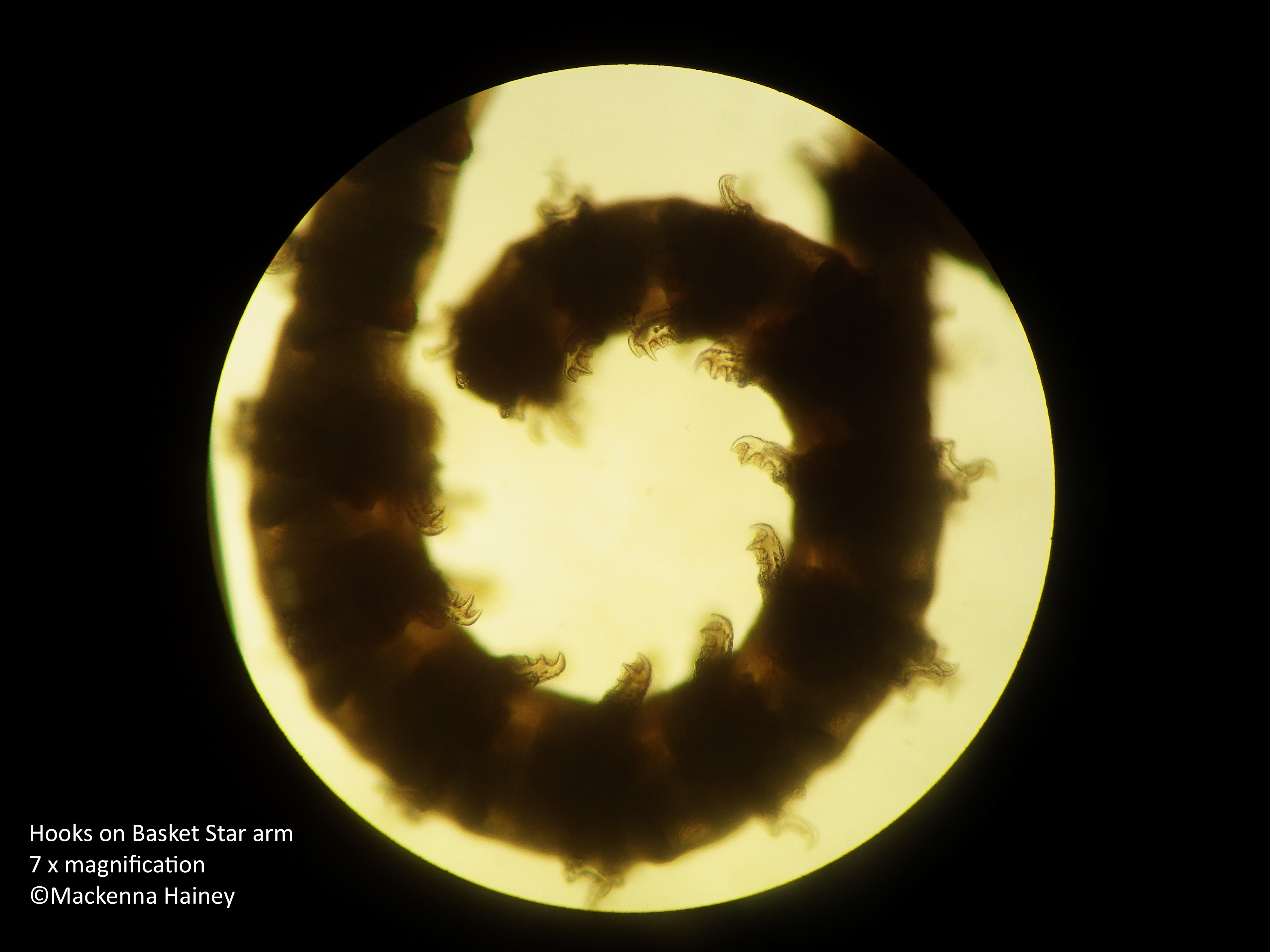
From Makenna Hainey (personal communication, October 1, 2023): “Basket Stars have tube feet. But, unlike asteroids [sea stars], echinoids , and holothurians [sea cucumbers], they don’t have suction cups on the tube feet. Thy have microscopic hooks that look and operate mechanically like cats’ claws to pin down prey while the tube feet secrete paralyzing mucus. They almost immediately bring food down to the mouth, insert the arm into the mouth, and wipe the food bundles off on the oral spines.”

Breathing:
Really interesting research has been done by Mackenna Hainey to measure the breathing rate (bursal ventilation) of this species of Basket Star.
Part of her research was to see, in a laboratory setting, how Basket Stars changed their breathing when fed a slurpee of krill. She found their breathing changed from approximately 10 to 30 an hour to 30 to 45 an hour.
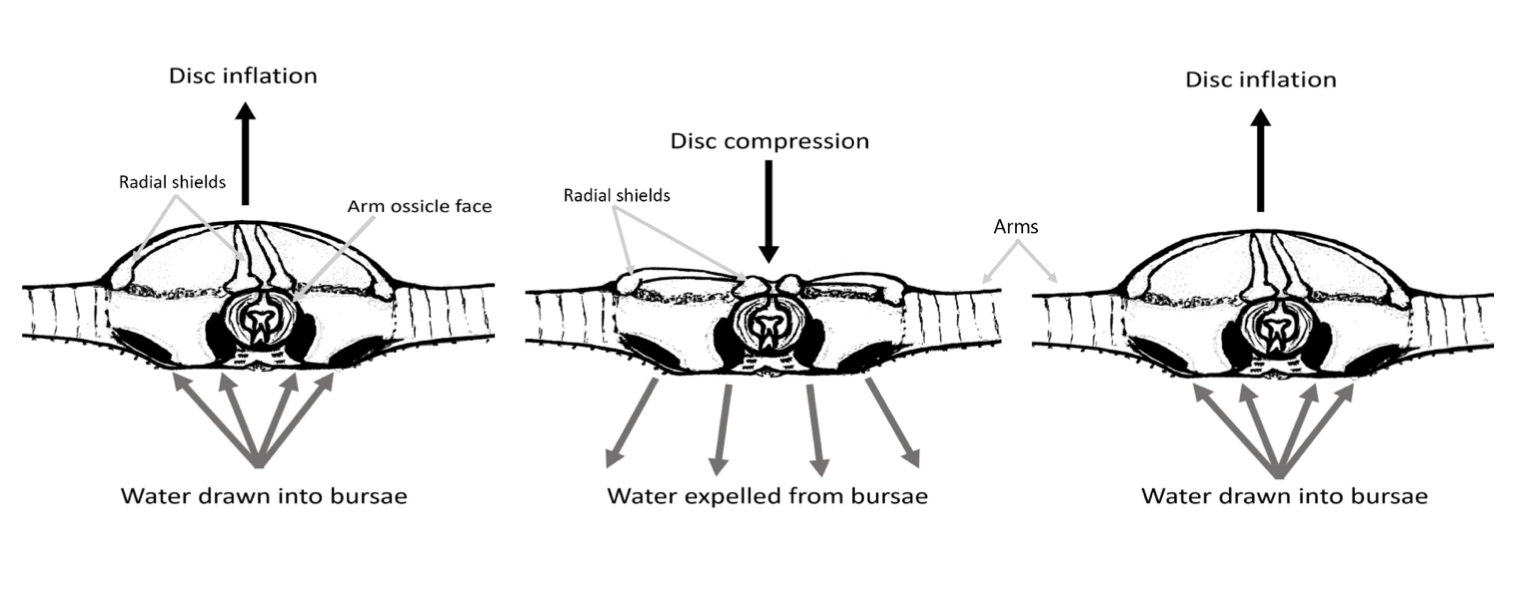
Mackenna reported: “Basket stars exhibited feeding behavior beginning a few seconds after food was introduced to the aquarium and lasted an average duration of 50 minutes . . . Once the food was detected by a basket star in the test aquarium, it quickly assumed a feeding position (some arms raised in a parabola, creating a basket shape with tendrils unfurled) and began to move 2-3 arms slowly through the water, looping arm tendrils as the arm hooks accumulated particles of krill. The rate of bursal ventilation increased rapidly once this feeding activity began.”
Breathing / ventilation rate also increased when the Basket Stars were exposed to reduced oxygen levels.
Range:
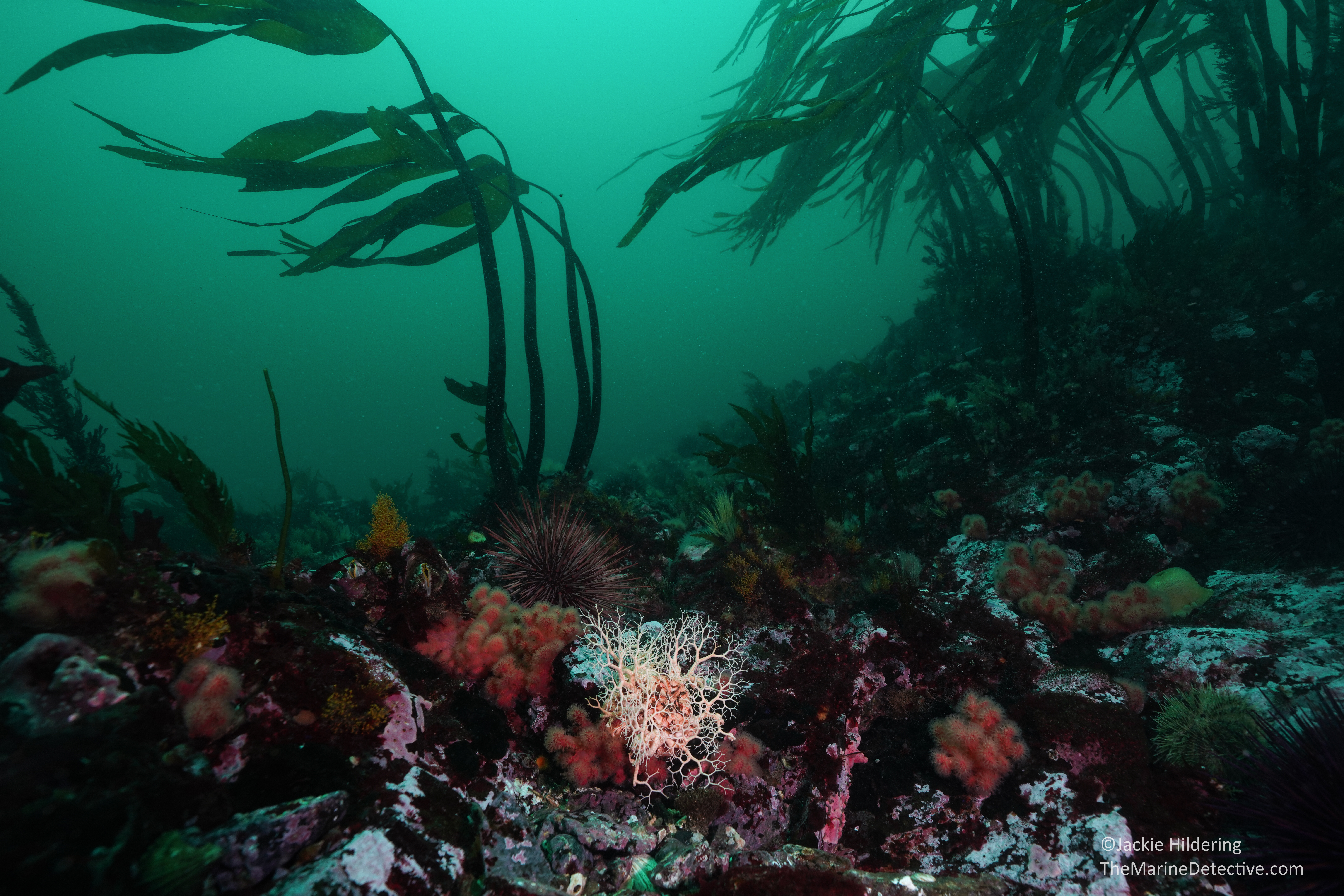
Basket Stars have been documented at depths from 8 to 1,850 metres. They are believed to be more common at depths between 15 to 150 metres.
Their range range was thought to be from the Bering Sea to San Diego until research published in 2014 reported that a Basket Star was documented from a submersible at Guadalupe Island, Mexico. That sighting extended their known range by over 400 kilometres.
Relatives:
Basket Stars are echinoderms, the phylum to which sea stars, urchins, feather stars, sand dollars, and sea cucumbers also belong. Basket Stars do not belong to the same class as sea stars such as Sunflower Stars, the Asteroidea. Basket Stars are in the Ophiuroidea class comprised of brittle stars and other basket star species. This class dates back 500 million years (give or take a million).
Photo gallery:
Because there can never be too many photos of Basket Stars.
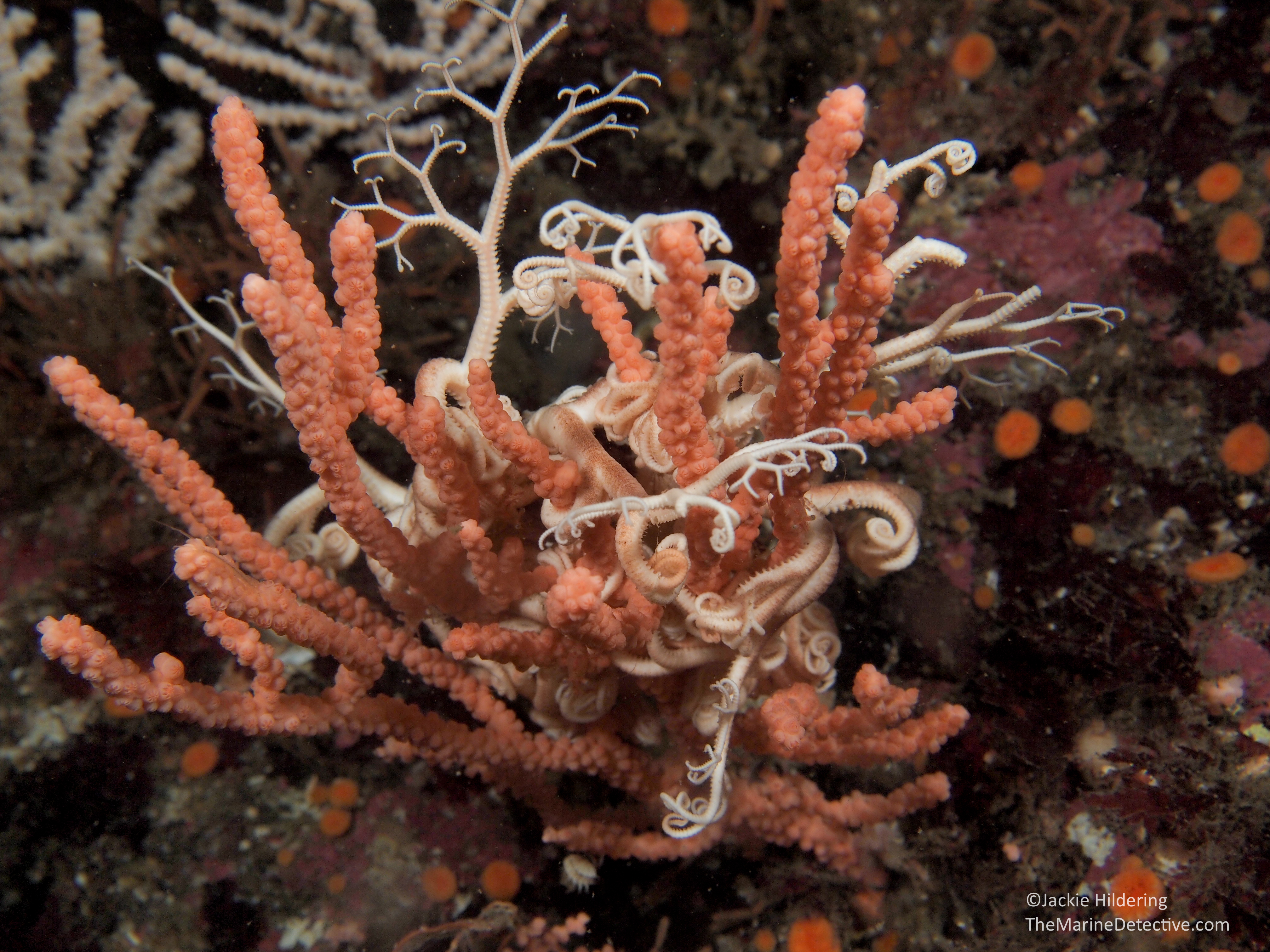
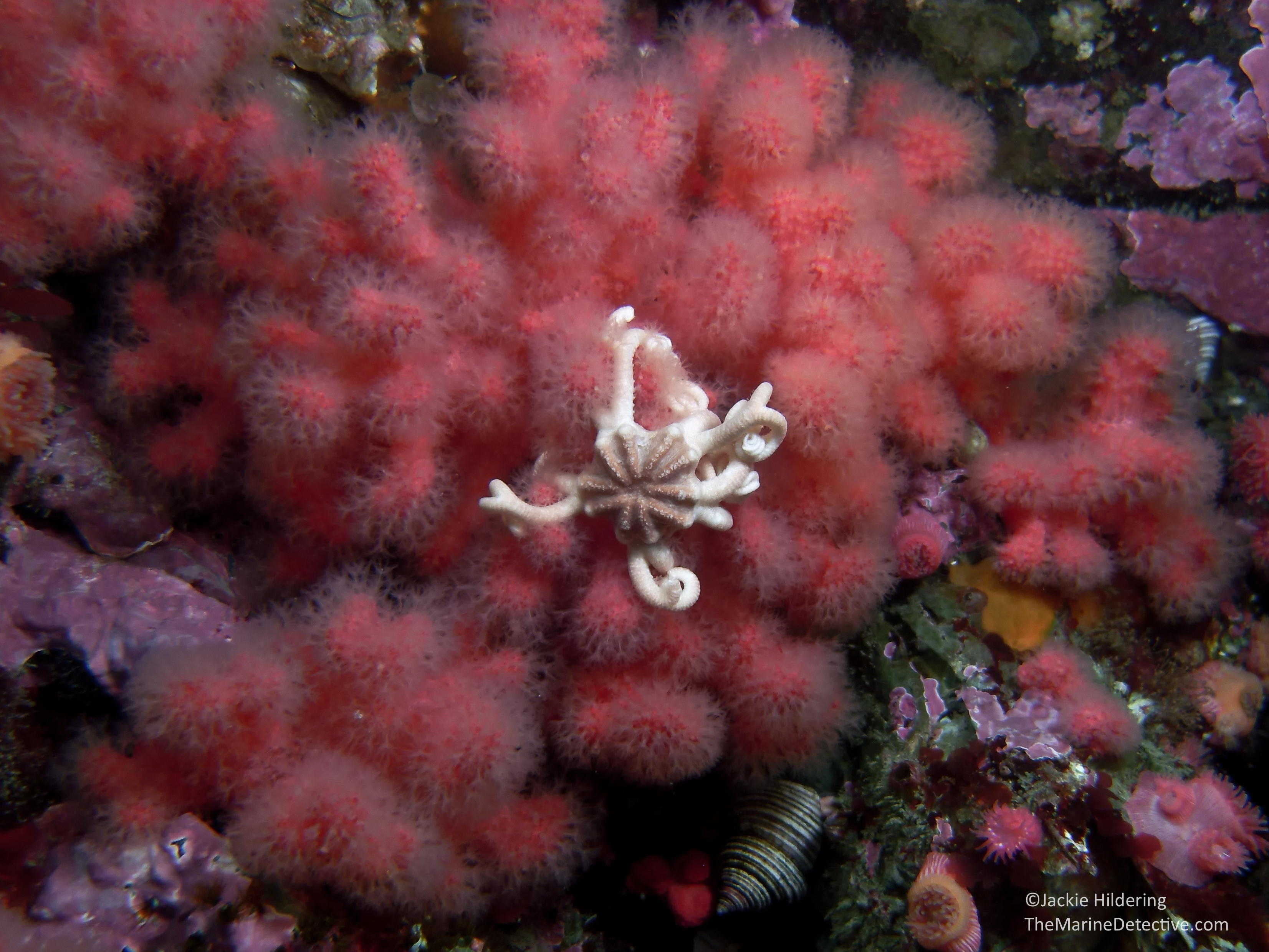

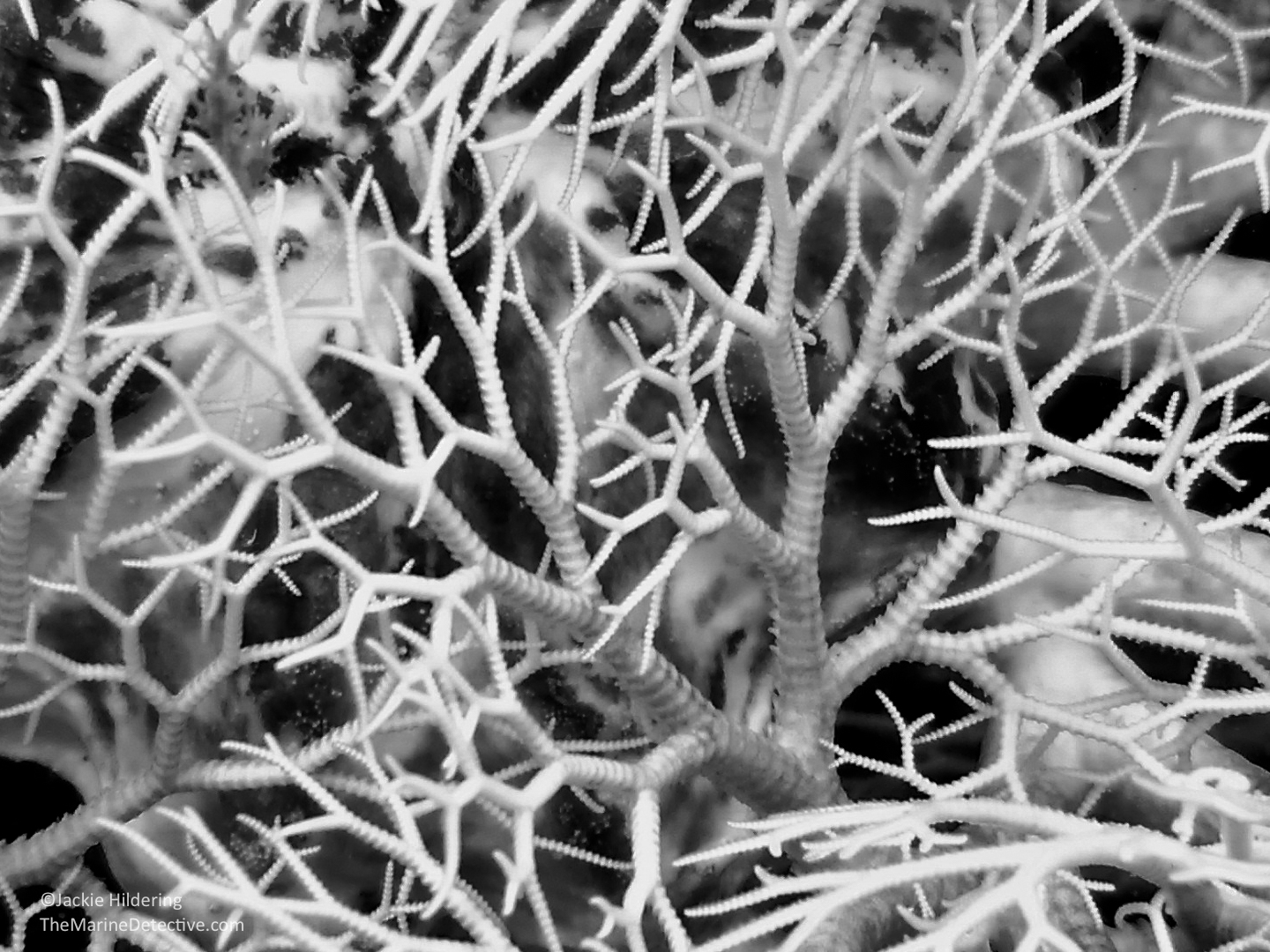
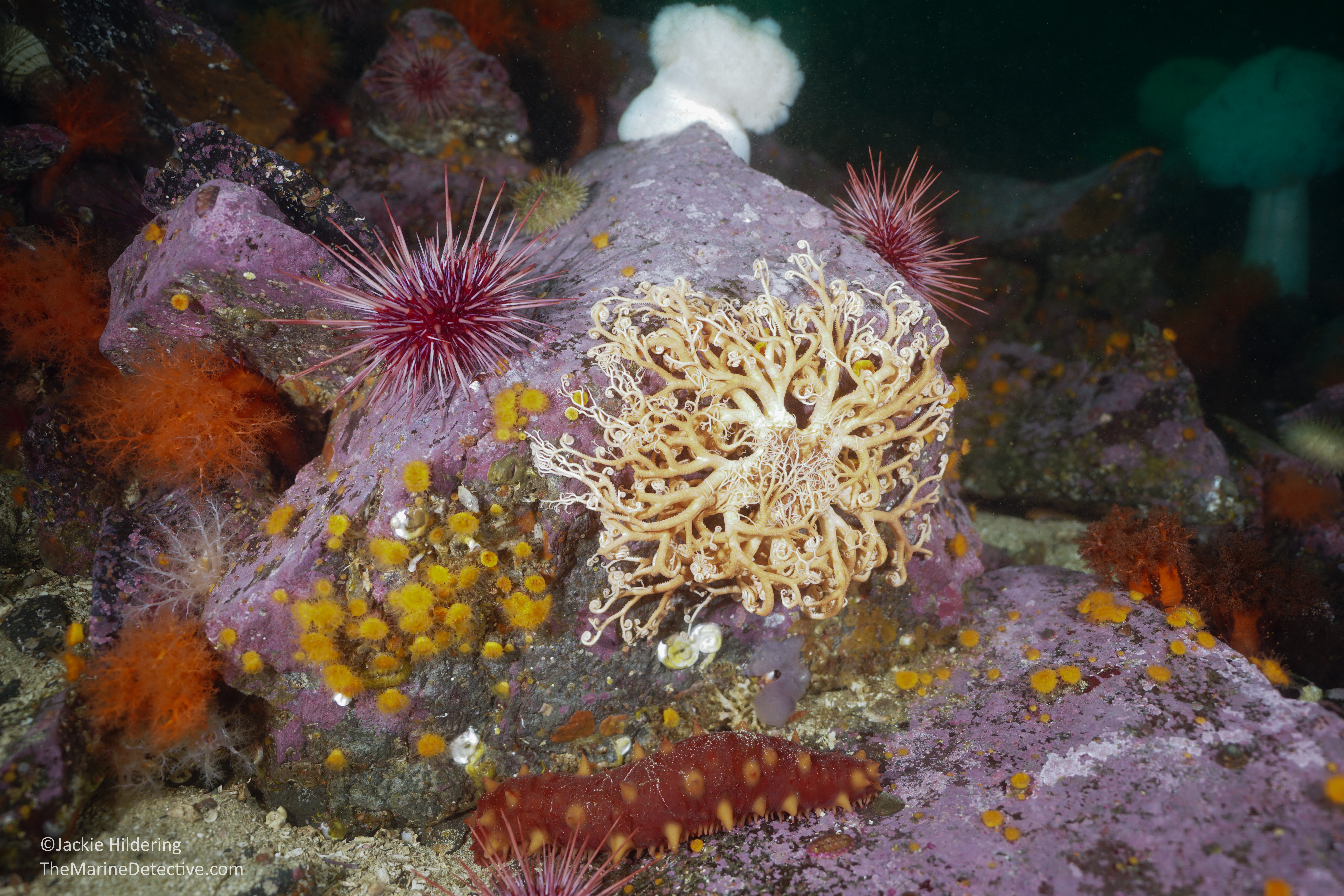
Etymology of the scientific name Gorgonocephalus eucnemis:
Gorgonocephalus = gorgós is Greek for dreadful and cephalus is Greek for head. “Dreadful head” is in reference to Basket Stars looking like the head of the Gorgon in Greek mythology.
Eucnemis = Greek for good or boot. A good dreadful head?! ☺️
Sources:
Emson, R.H., Mladenov, P.V., & Barrow, K. (1991). The feeding mechanism of the basket star Gorgonocephalus arcticus. Canadian Journal of Zoology, 69
Hainey MAH, Emlet RB. Gorgonocephalus eucnemis (Echinodermata: Ophiuroidea) and Bursal Ventilation. Biol Bull. 2020 Jun;238(3):193-205. doi: 10.1086/709575. Epub 2020 Jun 11. PMID: 32597717.
Hainey, Mackenna (2018). Masters thesis – Behavior and Fundtional Morphology of Respiration in the Basket Star Gorgonocephalus ecunemis and Two Brittle Stars in the Genus Ophiothrix.
Herrero-Pérezrul, M., Granja-Fernández, R., Hoyos-Padilla, M., & Reyes-Bonilla, H. (2014). New record of the basket star Gorgonocephalus eucnemis (Ophiuroidea: Gorgonocephalidae) at the Pacific coast of Mexico. Marine Biodiversity Records, 7, E33. doi:10.1017/S1755267214000323
Inaturalist Canada – Common Basket Star
Invertebrates of the Salish Sea – Basket Star
Lambert, P. and Austin, W.C. (2007) Brittle stars, sea urchins and feather stars of British Columbia, southeastern Alaska and Puget Sound. Victoria, Canada: Royal British Columbia Museum
Patent, D.H. (1970). Life history of the basket star, Gorgonocephalus eucnemis (Müller & Troschel) (echinodermata; ophiuroidea). Ophelia, 8, 145-159.
University of Oregon (2020). Student’s curiosity catches basket stars breathing
 The Marine Detective