Join me in the cold, dark, life-sustaining NE Pacific Ocean to discover the great beauty, mystery and fragility hidden there.

Posts from the ‘MARINE MEGAFAUNA’ category

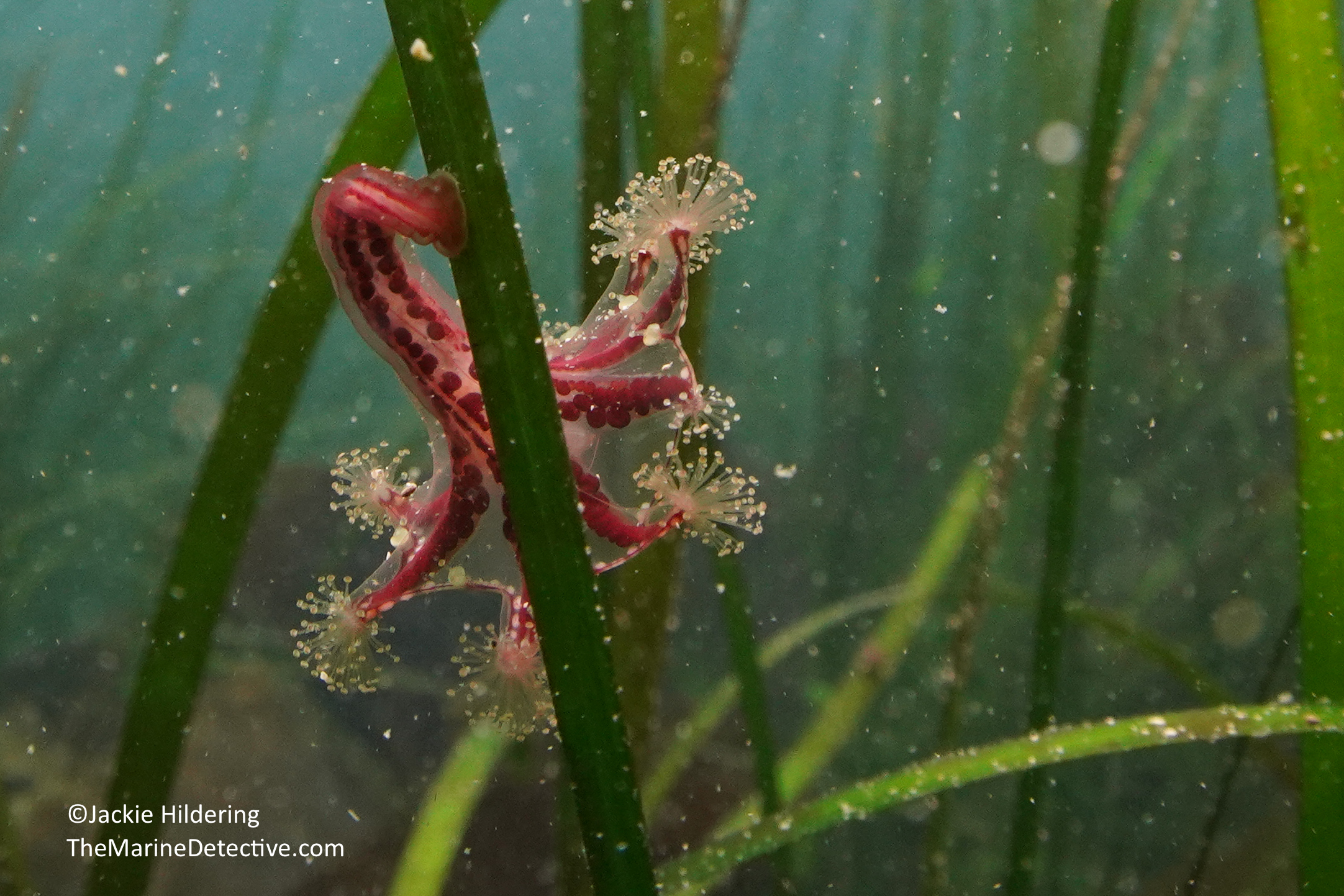
The rarest of the rare? Haliclystus californiensis in British Columbia? 

[Last updated on November 3, 2025.

Can a 2 cm stalked jelly make you feel small? Yes.
Can it fill you with awe, wonder, affirmation, purpose, and drive? Yes.
Does it make it feel like all the immersion, the cold, and the learning from this little bit of the planet, somehow makes a positive difference? In a quiet voice, I say . . . yes.

It has been confirmed by Claudia Mills that I have the identification of this stalked jelly correct as Haliclystus californiensis. Note that:

  • It has only been recognized as a distinct species in 2010 (Kahn et al., 2010). At the time of that publication, only 10 individuals had been found and only “from southern to northern California in coastal waters” (hence the species name “californiensis“).
  • There are only two other known sightings in British Columbia. One in 2017 as a result of a collaboration including the Smithsonian Institution’s Marine Global Earth Observatory and the Hakai Institute. Additionally, I learned from Claudia Mills that one was sighted near Bamfield by Ron Larson in October 1983.
  • This would be only the 25th global documentation to be included on the Global Biodiversity Information Facility, which, since the research of Kahn et al. in 2010, includes findings of the species in Sweden and Denmark. Note that there is doubt about whether the individuals documented in the Atlantic are indeed the same species.


Are they deep-dwelling? No. In the research I reference above, it is stated that they are known from depths of 10 to 30 metres. I found this one at about 6 metres depth.

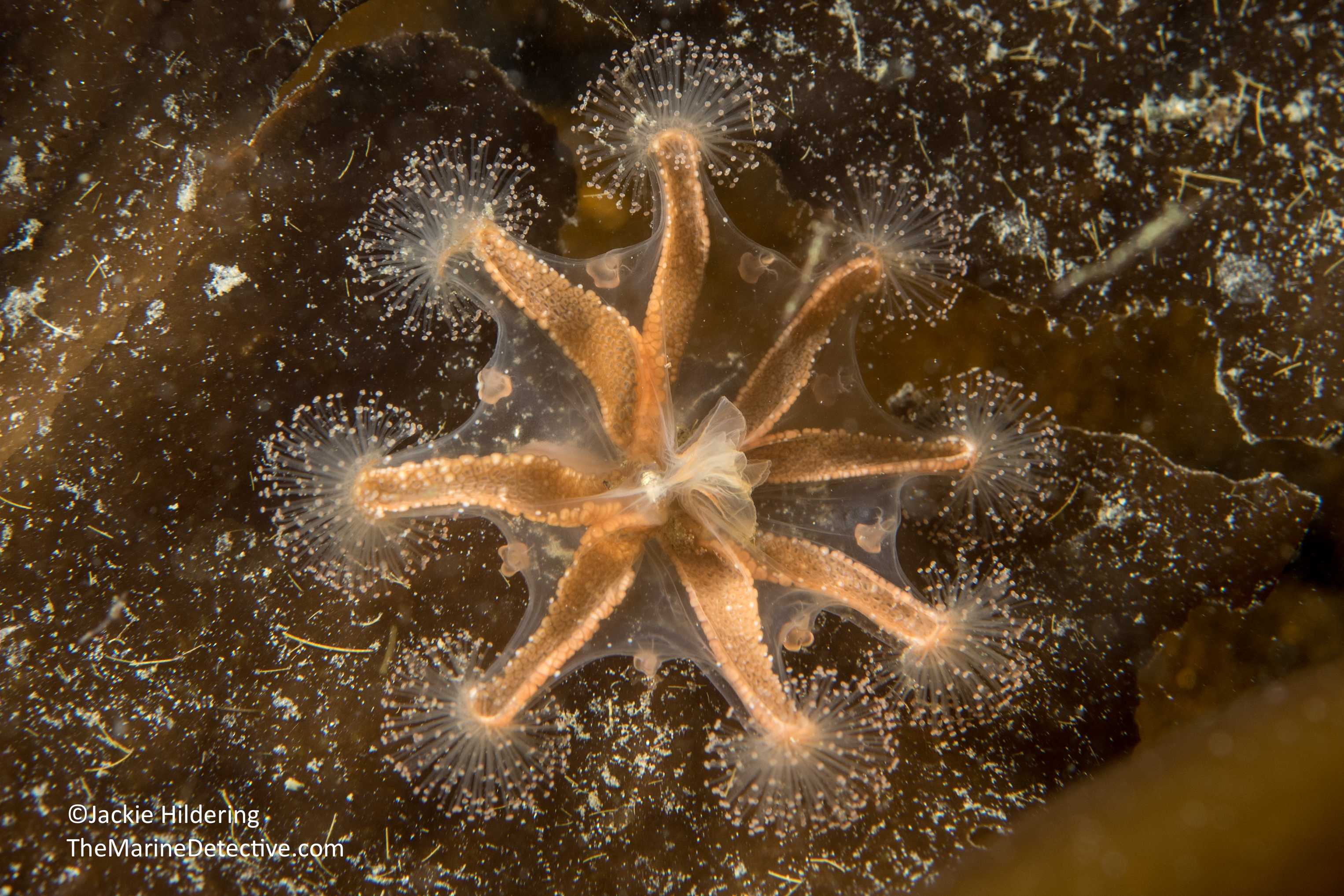
What are stalked jellies? They never become free-swimming, bell-shaped medusae like other jellies. They attach by their sticky stalk and have 8 arms with pom-pom-like clusters of tentacles at the ends. These tentacles have stinging cells to catch small crustaceans, which are then moved to the mouth at the centre of the 8 arms. If detached, stalked jellies can grip a surface with their tentacles and quickly reattach their stalk.


Above image from Kahn et al., 2010. Their description includes: martini glass shaped; 2.1 cm tall; 15.5 mm wide; 8 arms with 60 to 80 capitate secondary tentacles, and the red structures are gonadal sacs.


How did I find this one? There was fortuitousness involved. But also, I was looking when many would not. I was looking because of what I have been able to learn previously.

The sighting was on October 30, 2025, when diving with a group I organized to go to God’s Pocket Resort. It was our last dive of the trip and the last dive for the God’s Pocket Team for 2025. It had already been an astounding morning, which included documenting Humpbacks and Bigg’s Killer Whales while on the boat. Captain Bryan had been considering another dive site in Browning Pass, but the current and the potential for him to get more opportunistic whale IDs (with telephoto lens) while we were diving, led him to choose this location.

We had dived this site earlier in the week, and then too I had rushed to the “end” where I know there is a little patch of Eelgrass. I was looking for another species of Haliclystus I have found there before, for which a species name has NOT been assigned. This does not mean in any way that I discovered it, but rather that researchers have not yet published the research describing how it is morphologically and genetically distinct. See photo below.

This is the unnamed / undescribed species of Oval-anchored Stalked Jelly I have found at this site previously (and in a multitude of other locations around northeastern Vancouver Island).


I reached the Eelgrass bed and watched a school of Tubesnout (fish) swim around. Then, I focused on the Eelgrass to see if, maybe this time, I could find the undescribed species. Later, my photos would reveal just how intent I had been. See below for a photo of the school of fish with the flipper of a mature Steller Sea Lion in the frame. I had noticed he had passed so close to me. Yes, I can find 2 cm stalked jellies, and miss a ~3 m, 1,000 kg Steller Sea Lion.


And then, there it was. My brain started screaming immediately, knowing this was a unique species. Does it matter? It does to me. And maybe, it does to you.

May this add to wonder, appreciation, and the appropriate humility that we humans know so little about even the marine species that live in the shallows. May that foster care, and actions that benefit all of us connected by water and air on this ocean planet.

Photo gives you a better sense of how small this species is.

Sources:

Photos above and below: Divers and crew on my October 2025 trip with God’s Pocket Resort.

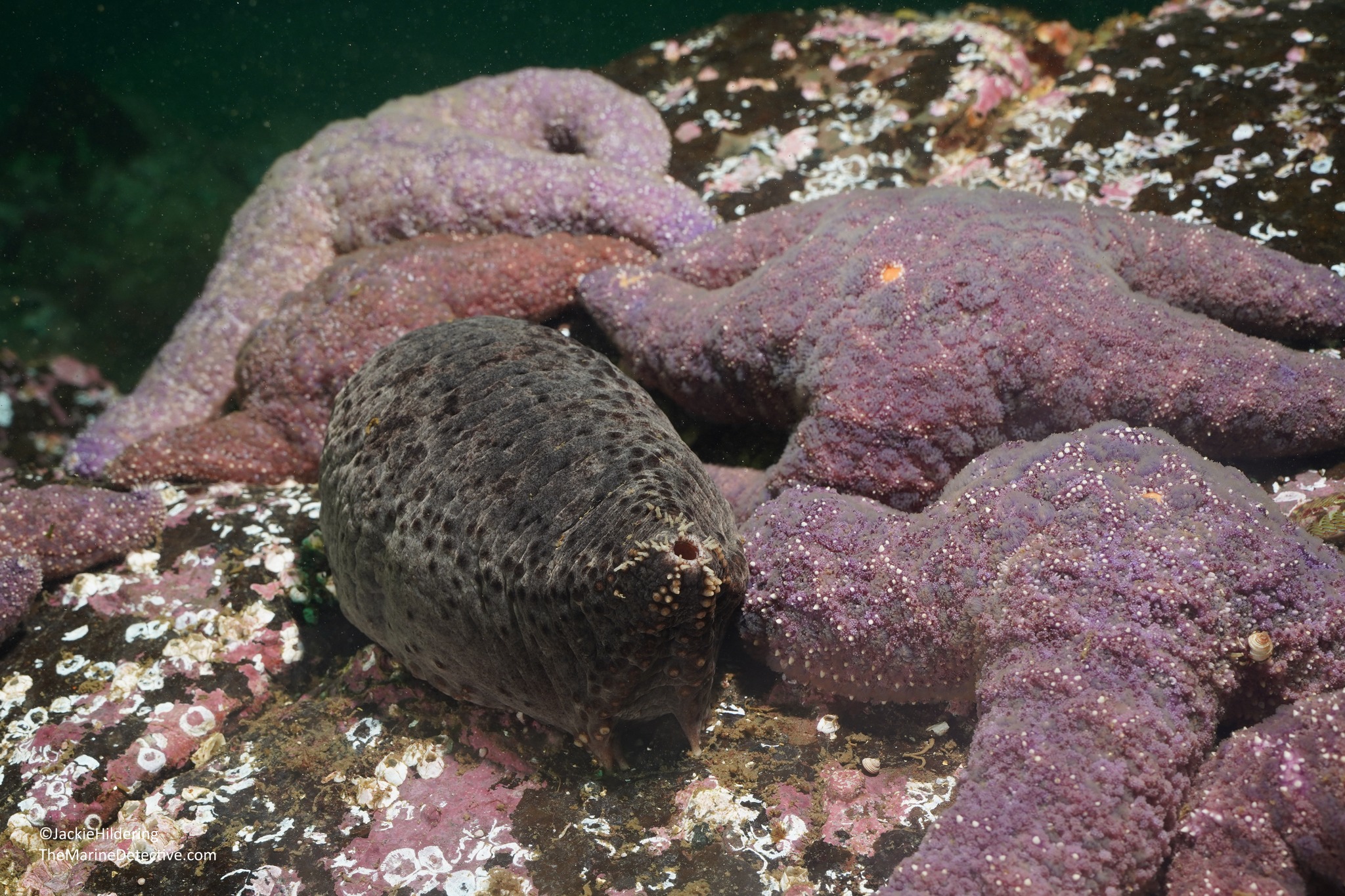
Giant Black Cucumaria – feeding!

What’s a “Giant Black Cucumaria”? It’s an extraordinary species of sea cucumber that has a football-shaped body and can be up to 30 cm long. Below I have a video of one feeding.

The Giant Black Cucumaria I documented for 4 months. Photographer here with my dive buddy, Natasha Dickinson.


I had never seen one before January of this year. I was able to document that one it in the same place over a period of 4 months. I never saw that individual with its feeding tentacles out.


But then, in April, I chanced upon another individual in a different location near northeast Vancouver Island. This one was feeding! In my video below, see how the Giant Black Cucumaria collects plankton on 10 bushy tentacles, sticks one in its mouth, and scrapes off food. Then, repeat with another tentacle. Yum!

This is also how some other species of sea cucumber feed e.g. Orange Sea Cucumbers (Cucumaria miniata).


More about Giant Black Cucumaria:

The two individuals I documented were near northeast Vancouver Island.

From “Sea Cucumbers of British Columbia, Southeast Alaska and Puget Sound” by Phil Lambert, I learned that the species is known to be more abundant further to the north along British Columbia’s Central Coast into Alaska and the Arctic Ocean.

The Giant Black Cucumaria has been assigned the scientific name “Cucumaria frondosa japonica” but its species status is not resolved. It’s believe to be closely related to Cucumaria japonica found near Japan.

The individual I documented for 4 months. May have been there longer. But when I returned after 5 months, it was no longer there.

Photos and video here were taken in the Traditional Territories of the Kwakwa̱ka̱’wakw ©Jackie Hildering, The Marine Detective.


You can find more information about this species in the Electronic Atlas of the Wildlife of British Columbia

Seven-armed Octopus – but has eight arms!

Oh how I’ve been eager to share this with you.

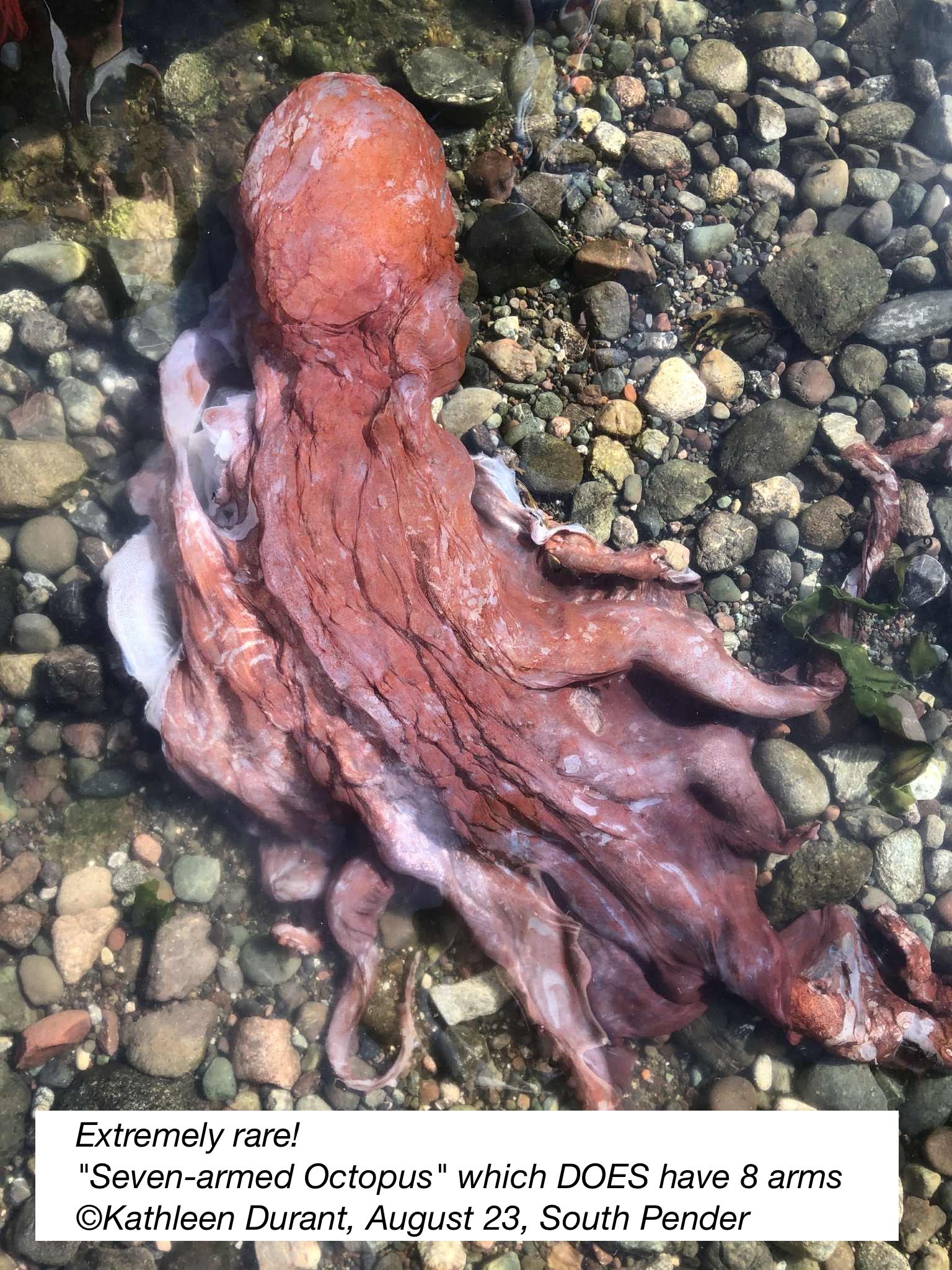
Extremely rare find – Seven-armed Octopus (Haliphron atlanticus)! This is a deep sea species which DOES have 8 arms, but the males do something that has led to this name. Read on!


Females are HUGE at up to 4 metres long and 75 kg. Males are SO MUCH smaller at only up to 30 cm long. This one was about 120 cm long and was juvenile female.

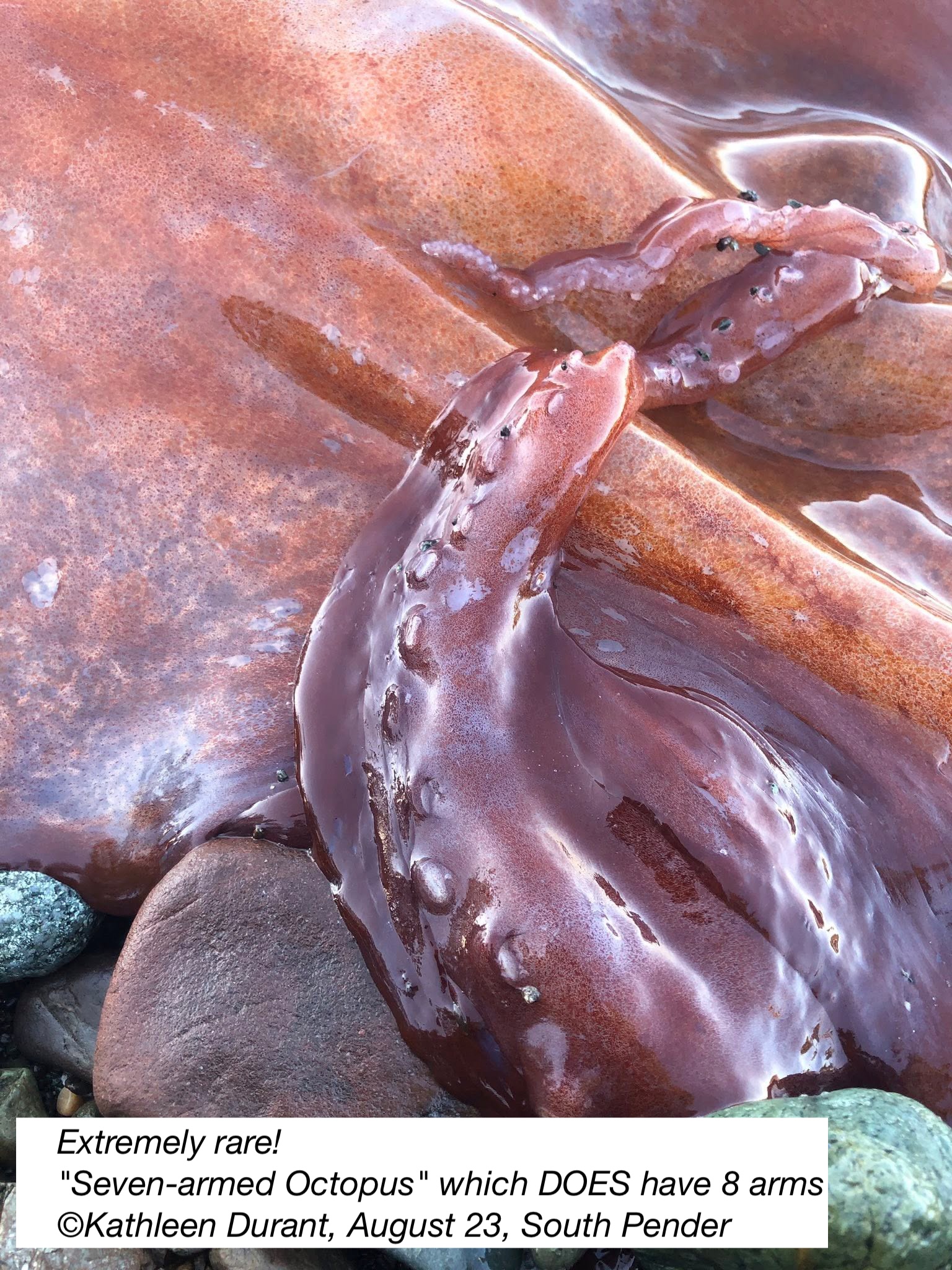
She was found dead by Kathleen Durant on South Pender Island, British Columbia on August 23, 2025. Thankfully, Kathleen knew this was unique and potentially important, took photos, and gathered the individual before it was lost to the tide.

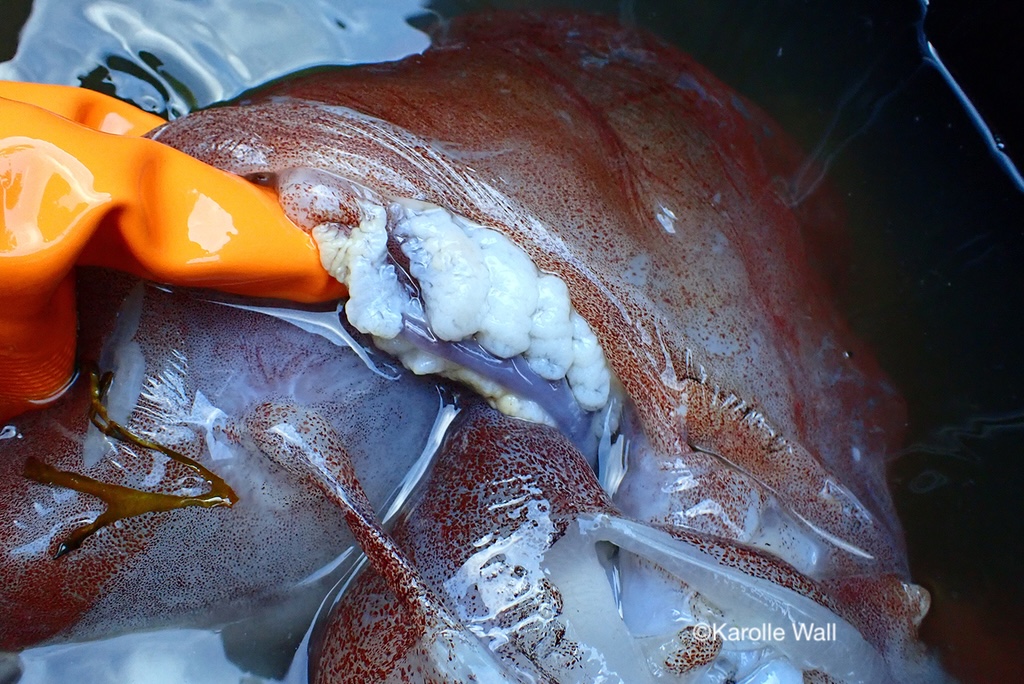
Dissection and photos by Karolle Wall documented the presence of “tiny teardrop eggs”, confirming this was a juvenile female.

She was initially identified as a Seven-armed Octopus by Casey Cook on the Field Naturalists of Vancouver Island (FNVI) Facebook page and confirmed by experts at the Royal BC Museum (in which I has a small role in connecting people). The Museum is where this extremely rare individual is now stored to contribute to knowledge/science.

Why the “Seven-armed Octopus” (also “Septopus” and “Blob Octopus”) when the species has 8 arms? Male octopuses have one specialized arm for reproduction which has no suckers at the tip called the “hectocotylus arm”. The section at the top which has the spermatophore. This section does not have the cells that allows colour and texture to change (the chromatophores). So, because it is not camouflaged, male octopuses hide it. In Giant Pacific Octopuses, the males usually curl up this arm. But, in THIS species, the males tuck away the arm . . . in a sac beneath their right eye! The arm is so well hidden that it looks like they have seven arms.

How rare are they? As an indicator, in an article from 2017 the Monterey Bay Aquarium Research Institute (MBARI) researchers with use of deep sea ROVs (remotely operated vehicles) had only seen three live H. atlanticus in 27 years.

Two truly extraordinary sightings of live individuals in the shallows were by divers Eric Askilsrud and Cam Polglase, both in September 2023. Eric took photos of one near Salt Creek, Washington and Cam videoed one near Ogden Point, British Columbia. Yes, I wish I was those divers.

I also learned from Gregory Jensen of the University of Washington that two other Seven-armed Octopuses are known to have washed up – one in south Puget Sound and the other by Whidbey Island, Washington.

Read the article from MBARI and watch the video above for how it was determined that this species feeds on gelatinous zooplankton – jellyfish, siphonphores and salps – and that the large females MAY use the jellies as defence!


You just never know how you could contribute to science, and wonder. As expressed by Casey Cook: “The ocean’s mysteries don’t always swim at six thousand feet! Sometimes they’re right at our feet.

Thank you so much Kathleen for making this count.


From the article referenced above by MBARI:

“Since female Haliphron atlanticus are so large, they are able to completely grasp and contain a large jelly within their webbed arms and still swim. They use their beak to bite through the bell of the jelly to access the digestive cavity to consume the food contained within and to have access to the more nutritious parts of the jelly. At this point the jelly is dead, but the bell and fringe are still intact. Hoving and Haddock [MBARI researchers] postulate that, given the way Haliphron is holding the bell with the fringe of tentacles dragging behind, the octopus could be using the sticky and stinging tentacles (which still sting after the jelly is dead) either for defense or to capture other more nutritious prey . .

ROVs enabled the first observations of this novel octopod species and its even more novel behavior that revealed an unexpected role in oceanic food webs. Researchers now know that Haliphron, a food resource for top predators such as sperm whales, blue sharks, and swordfish, distributes energy to its predators along a path that incorporates gelatinous species.”

Photo ©Karolle Wall from iNaturalist.
Information from the observation and dissection by the Royal BC Museum included: Total length 120 cm. Longest arm approximately 80 cm. Gonads and presence of tiny tear-drop shaped eggs determined sex as female. She was a juvenile (determined by her size being no where near the maximum of 4 metres for females).

Related TMD post:
Giant Pacific Octopuses – How do they mate?

Twelve Minutes With a Giant

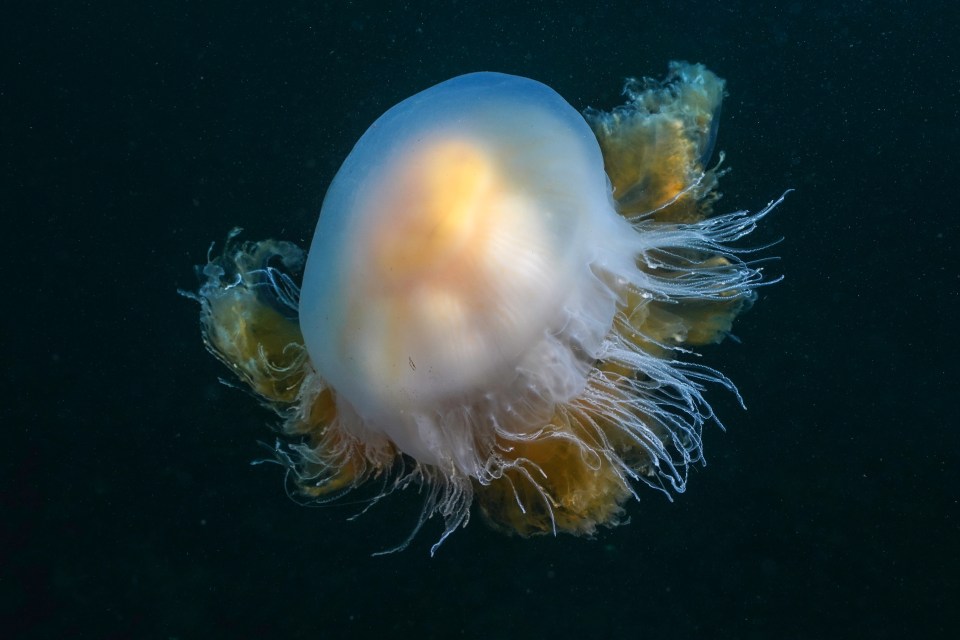
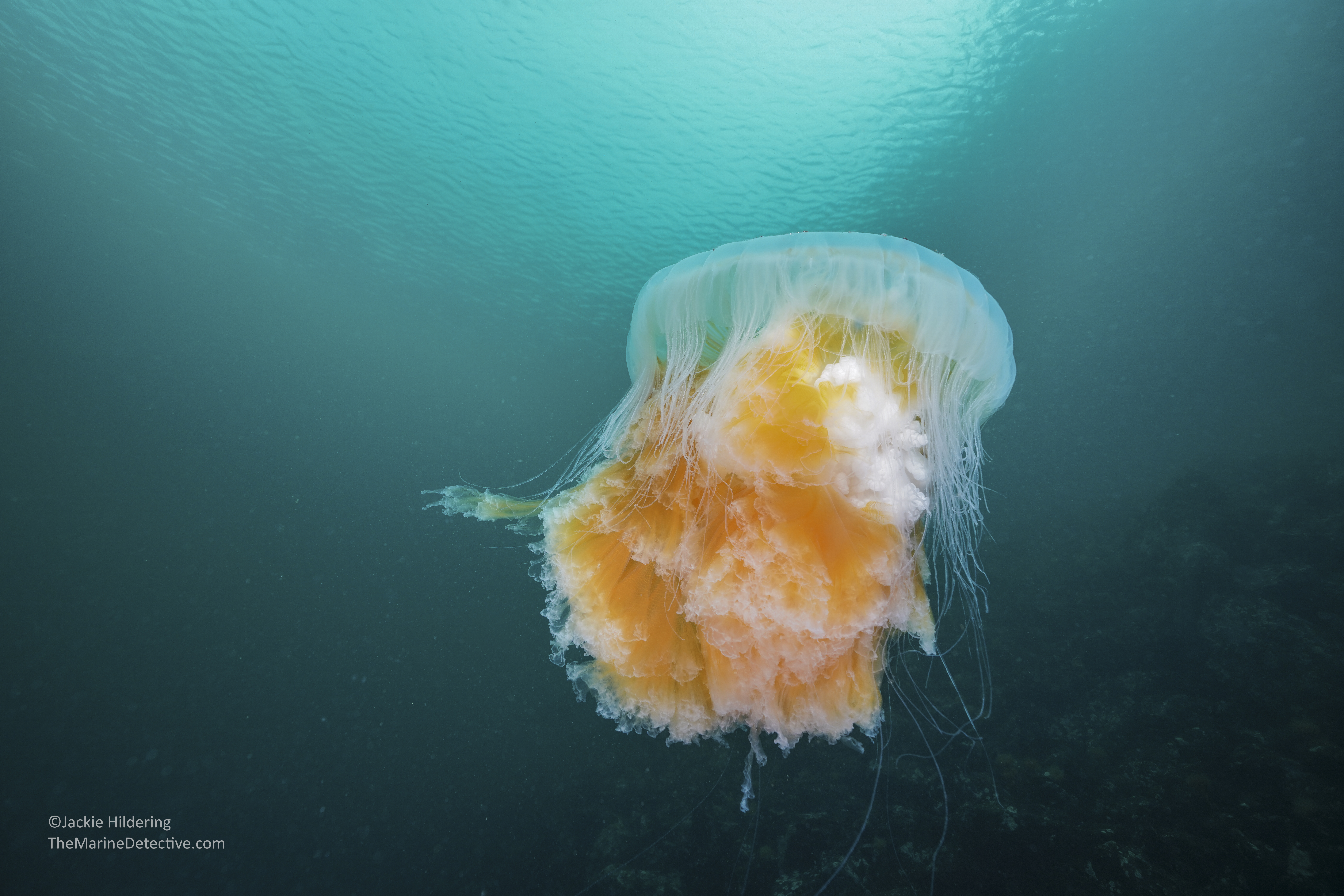
In April, there were quite a few Egg Yolk Jellies around northeast Vancouver Island. I dedicated one dive to trying to find at least one and watch it for a while. You never know what you’ll learn from a species that has survived on Earth for ~500 million years.


Egg Yolk Jellies are also known as Fried Egg Jellies. Gee, I wonder how this species got their common names? 😉 Their scientific name is Phacellophora camtschatica.

They are big at up to 60 cm across the bell. But that’s no where near as big as the other common giant jelly species off our coast, the Lion’s Mane Jelly. They can be 2.5 m across the bell (the bigger Lion’s Mane Jellies are usually not near the coast).

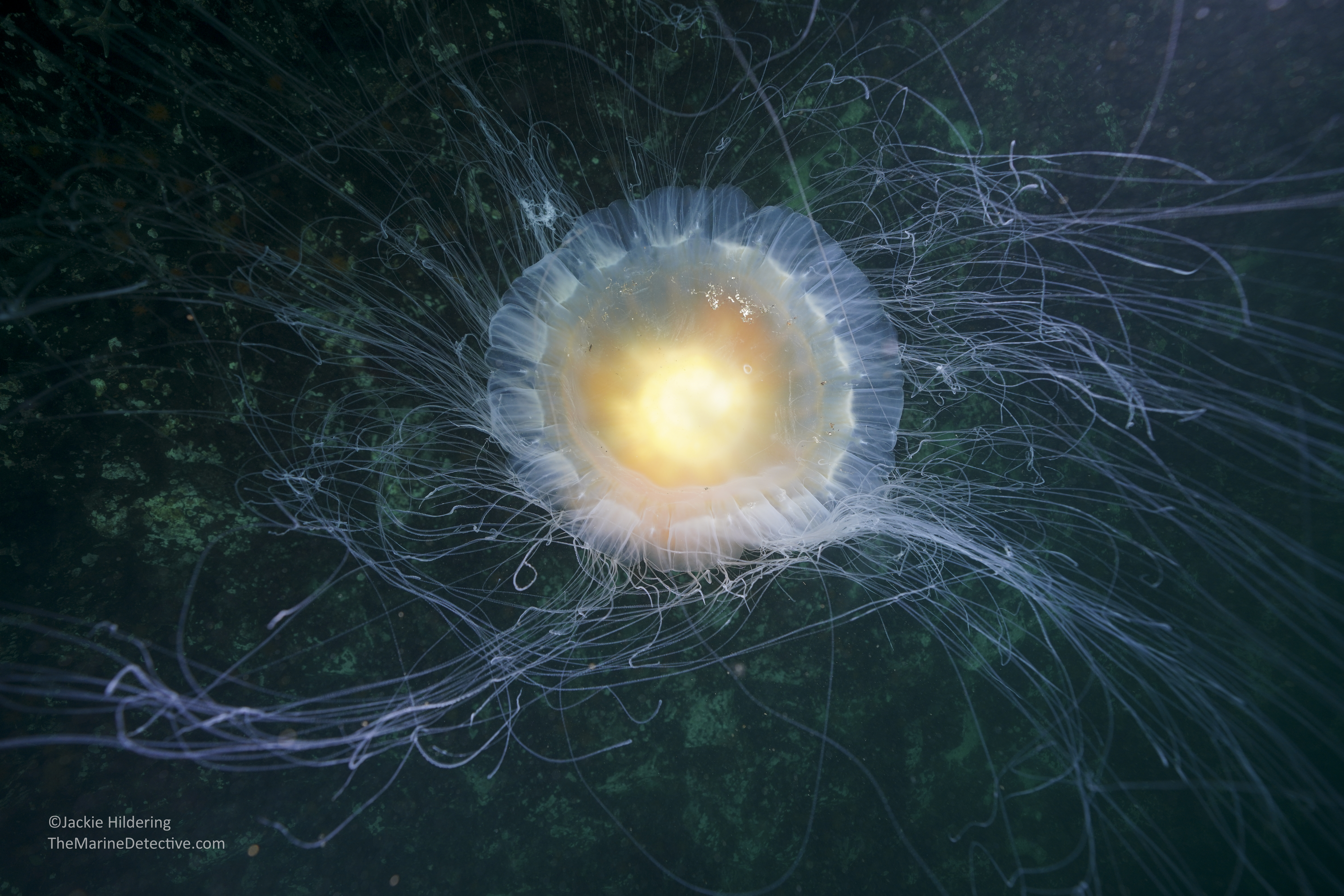
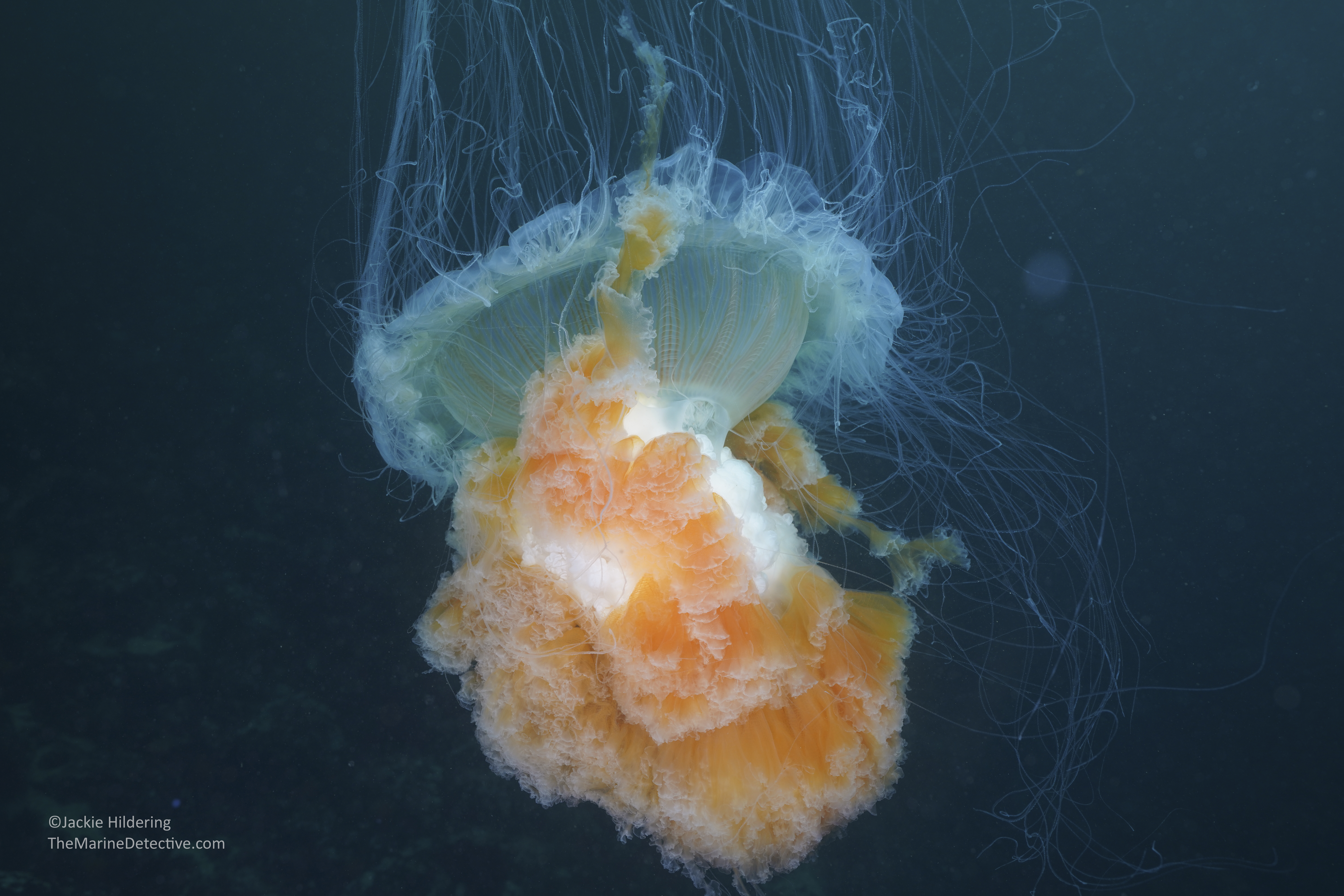
The yellow centres in Egg Yolk Jellies are the gonads. They can be much lighter coloured than the individuals you see here. Egg Yolk Jellies have 16 large lobes that alternate with much smaller lobe-like structures giving the bell a scalloped edge. Each lobe has clusters of up to 25 tentacles making for up to 400 tentacles (25 x 16) and they can be 6 metres long.

Egg Yolk Jelly and dive buddy Linnea Flostrand on a previous dive. ©Jackie Hildering.

I was more than 30 minutes into the dive when I saw the white, slow pulsing through the soup of plankton. The jelly was swimming in my direction. I swam toward the jelly.

For twelve minutes, I watched, photographed, and learned.

I saw how the tentacles became longer and that the jelly stopped pulsing. Motionless in the water column, the tentacles spread out like a net. See that in the series of photos below?

I don’t think there was a “catch” (they feed on zooplankton, including ctenophores and other jellies). Had there been, the tentacles with the prey would have moved toward the jelly’s mouth.

I now have a much better appreciation for how they are not “passively planktonic”. They are active swimmers responding to cues in the environment. Moriarty et al., 2012 used acoustic transmitters to tag them and noted differences in swimming speed and vertical migration dependent on time of day and tidal cycle.

Jellies have sensory structures called rhopalia.

From Rebecca Helm, 2018:
Each ropalium . . . is packed with microscopic crystals at its tip. These crystals help the jelly sense up and down, by bending in the direction of gravity, similar to our inner ear. They also have a small pigment spot, which likely helps the jelly sense basic light and dark. So far, we’ve got an animal that can tell which way it’s pointing in space, and see rough light and shadow. Next we’ve got a few mystery structures, like the little bonnet-like structure surrounding the rhopalium above, which may act like a jelly nose, helping it sense chemicals in the water . . . Each rhopalium also acts like a pacemaker, helping coordinate jelly movement, similar to the way our cerebellum coordinates ours.”

And you thought they were just “going with the flow”. 💙


All photos in the above series are of the same individual.
April 19, 2025 north of Port Hardy in the Traditional Territories of the Kwakwa̱ka̱’wakw (the Kwak̕wala-speaking Peoples). ©Jackie Hildering.


For more information about the diversity of jellies on our coast, see my previous blog post “Gob Smacked” at this link. From that blog:

Lion’s Mane Jellies and Egg Yolk Jellies. are the only two common jelly species in our waters that can create a sting that irritates human skin, even when the jellies are dead. The stinging cells (nematocysts) work even when the jelly is dead or you get a severed tentacle drifting by your face. The sting from a Lion’s Mane Jelly is reported to be worst than that of an Egg Yolk Jelly.

I’ve been stung by both and clearly it’s not been enough to deter me from striving to get photos of them. But if you have far more skin exposed or are a fisher grabbing nets with many of the tentacles wrapped in them, it is reported to be very uncomfortable.

The solution to the irritation is vinegar (acid), meat tenderizer (enzyme) and I know that many fishers swear by Pacific canned milk as well. Research puts forward that vinegar is the only real solution and that urine does not work at all.


Sources:


Generalized lifecycle of a jelly from Lucas, 2001 via “A Snail’s Odyssey”.
There is alternation between a polyp with asexual reproduction and a medusa with sexual reproduction.
I have not been able to find specifics about the lifespan of Egg Yolk Jellies other than “species can have a lifespan of several years.” I have questions about why we saw quite a few dead on the ocean bottom around the same time in different locations, and what that may suggest about the lifecycle.
Dead Egg Yolk Jelly in April 2025 with dive buddy, Brenda Irving. ©Jackie Hildering.

Browning Pass Hideaway – fire

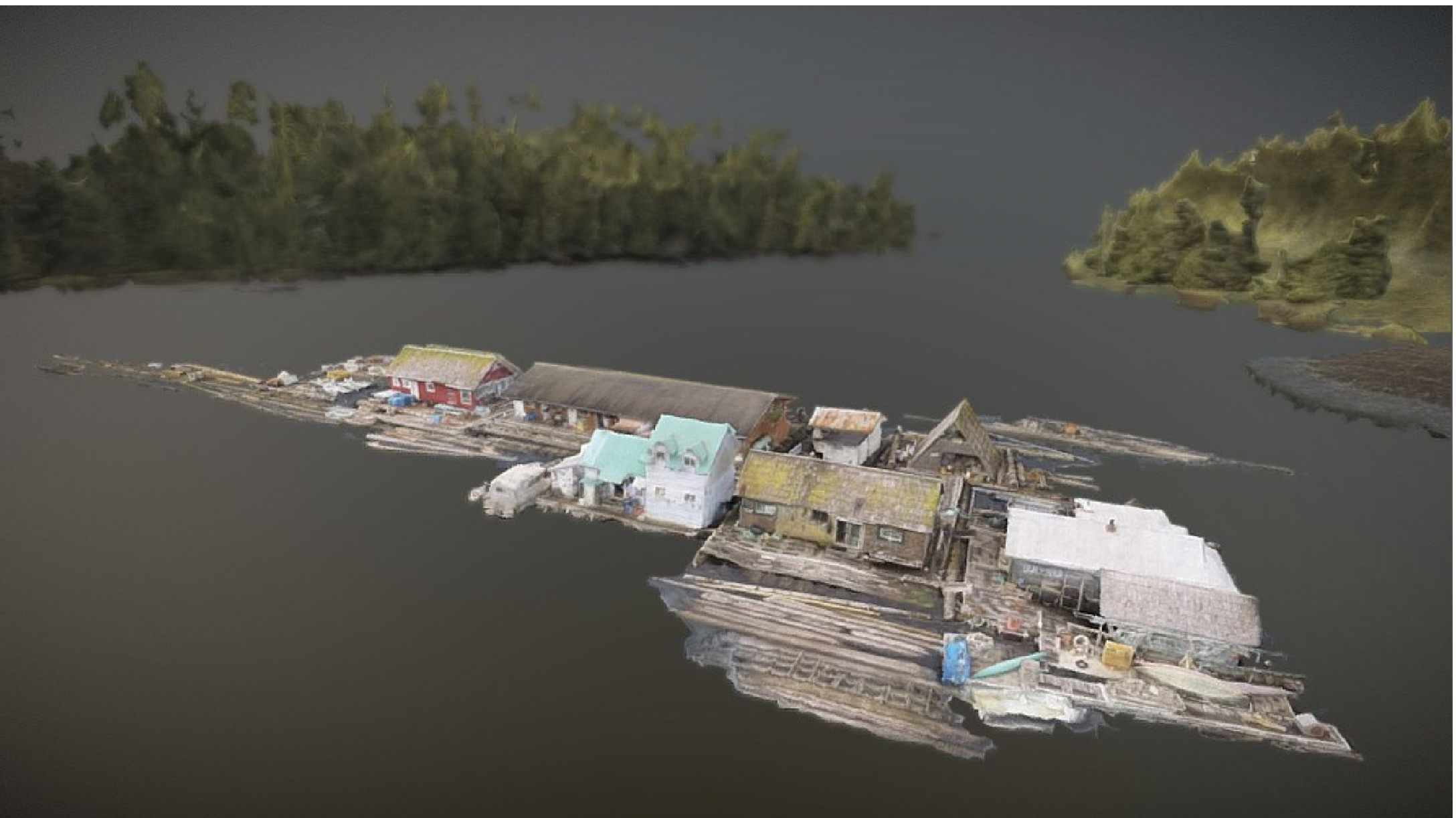
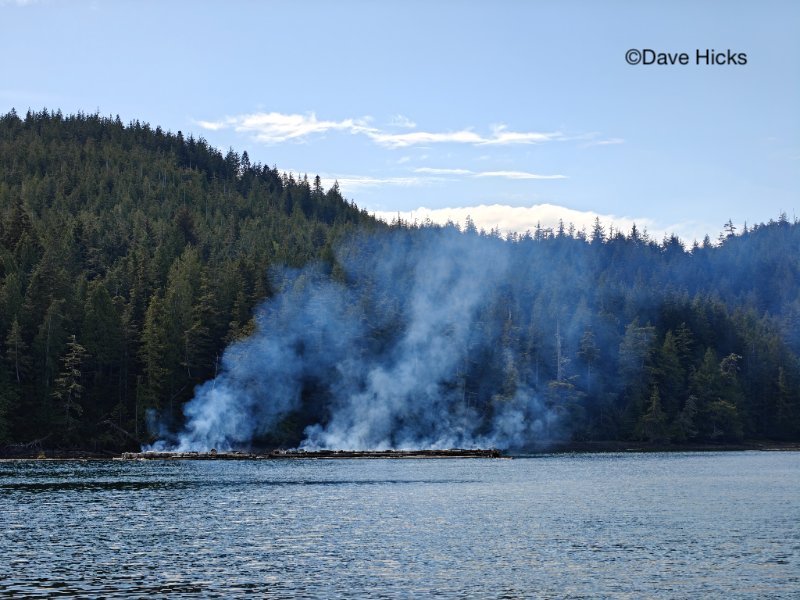
The Browning Pass Hideaway in Clam Cove burned today.

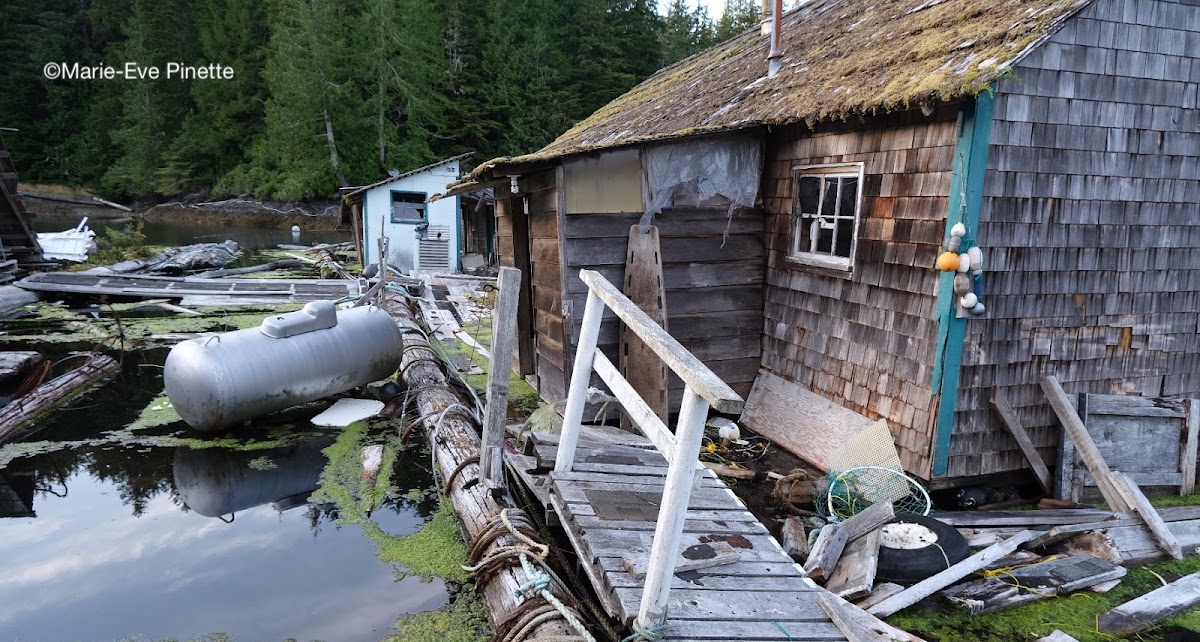
There has been a file from the BC Ministry of Forests regarding the tenure of this dive lodge dating back to 2016 (see notice below). There were very significant concerns about long-term neglect (see photos below) and resulting environmental impacts.

The fire was discovered and reported by a dive group from God’s Pocket Resort. No one was injured. Documentation is by Bryan Hillyer.

“At approximately 11:15am, our group of divers noticed smoke billowing out of Clam Cove, located on the north end of Browning Passage. We took the boat into the cove to check for danger and found The Hideaway, a scuba dive lodge, burning. We notified Coast Guard and stayed to monitor the flames to ensure the surrounding forest did not catch on fire. Once the flames receded and the majority of the floating structure had burned, we notified Coast Guard of the status of the fire and took our leave.”

There is no information currently about the cause of the fire, and speculation is not welcome.

Why am I sharing this information?

Because many of us in the BC dive community have a connection to this site be it because of concerns about the neglect and/or because of knowing the owner. Also, it provides insight into how there can be these realities of long-term neglect from those who lease sites, all the way up and down our coast. Who pays? The environment in astoundingly beautiful and important places that, of course, are connected to millennia of First Nations culture.


3D model resulting from photos of the site from Gaël via SketchFab.

Who Goes There? Sea Otter feeding pits

Who goes there?!
Or should that be – who DIGS there?!

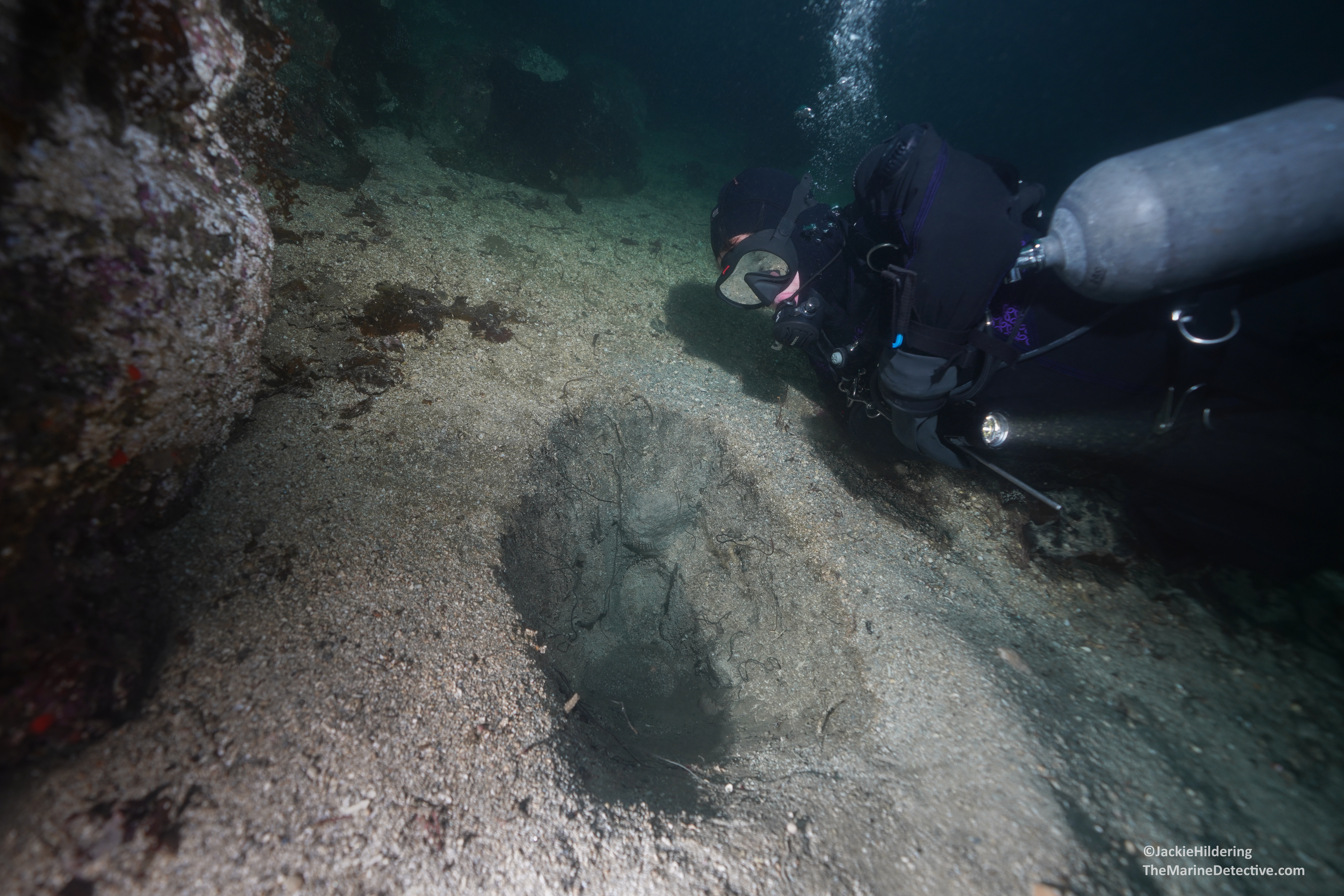
This is the pit resulting from a Sea Otter digging after a Pacific Geoduck – a very large, very long-lived clam species.

Dive buddy Natasha Dickinson posing beside the pit to give you a better indication of its size.
Photo: January 1st, 2025, ©Jackie Hildering.

If you see a Sea Otter going up and down in the same location without coming up with prey the first time (and breaking it open on their belly), this is likely what is happening.

Sea Otter with a Pacific Geoduck.
Photo: March 27, 2021, ©Jackie Hildering.

Geoducks have very long siphons (neck or shaft) and can be buried 1 metre below the surface. So it’s quite the endeavour when Sea Otters excavate Geoducks. My photo of the deep pit should aid in understanding why this is the case!

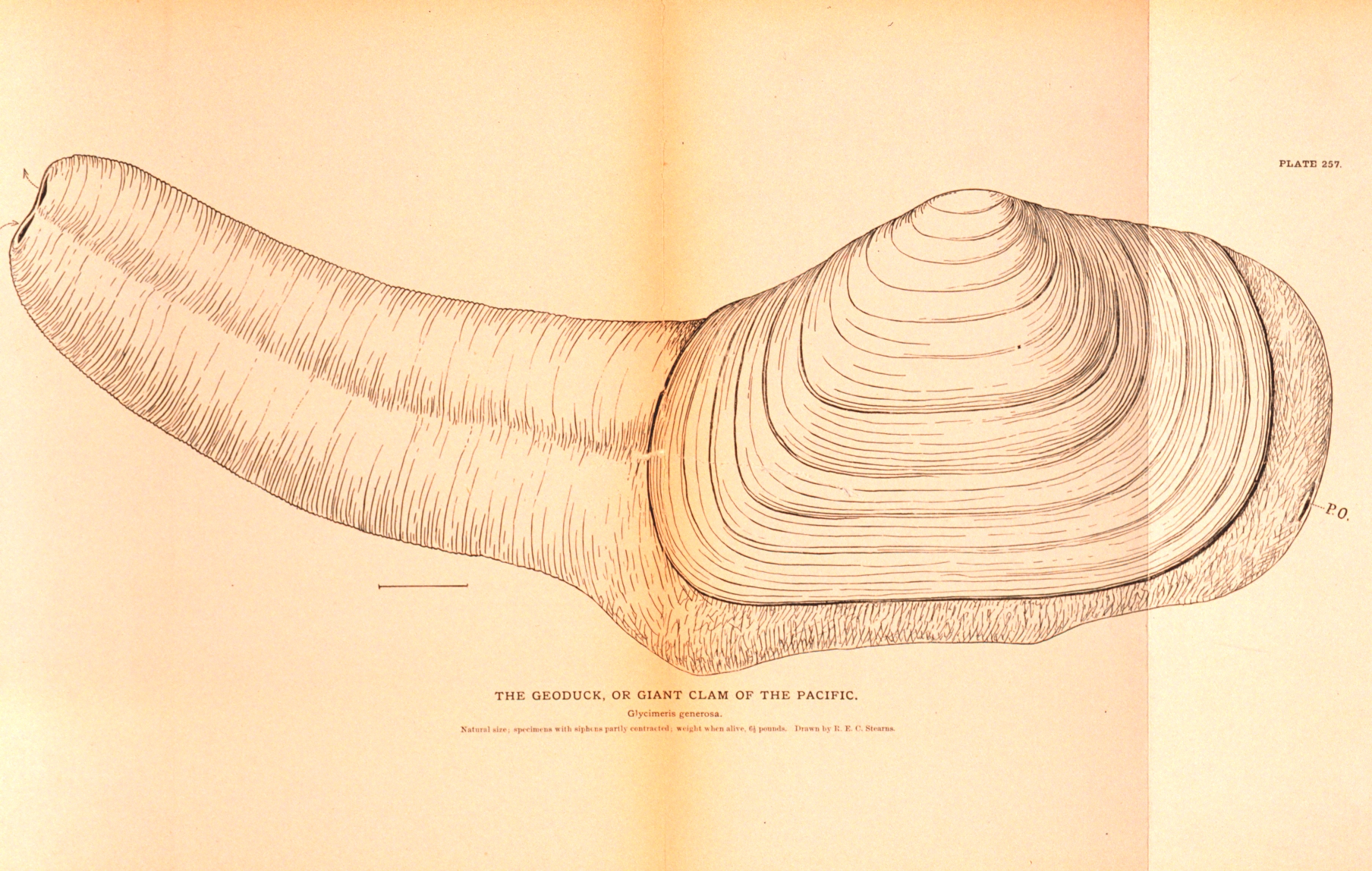
Pacific Geoduck (Panopea generosa) – World’s largest burrowing clam. Can live to ~160 years.
Source: Goode G. B. (1880). The Fisheries and Fisheries Industries of the United States via Wikimedia Commons.
Pacific Geoduck ©Fisheries and Oceans Canada

Sea Otters are reported to be able to dive up to 5 minutes (more often ~1 minute) but that’s unlikely when exerting themselves when digging like this.

Did the Sea Otter get this Geoduck? We don’t know for sure but there was an empty shell of a Geoduck near the pit.

Note that we did not dive in the presence of Sea Otters. Diving or swimming with marine mammals is illegal in Canada.

Geoduck shell near Sea Otter feeding pit.
Photo: April 20, 2019, ©Jackie Hildering.
Another Sea Otter feeding pit and dive buddy Natasha Dickinson.
Photo: January 9, 2021 ©Jackie Hildering

Background on Sea Otters in British Columbia

Sea Otters were completely wiped out (extirpated) with the last verified Sea Otter in Canada having been shot in 1929 near Kyuquot (NW Vancouver Island).

There are now over 8,100 Sea Otters off the coast of BC (Nichol et al. 2020). How did that happen? Around 89 Sea Otters were translocated to the outer coast of Vancouver Island from 1969 to 1972 (as a mitigation measure for nuclear testing in Alaska).

The population grew (and spread out) from there. And yes, they eat a lot. Even with their incredibly dense fur (which made them so “desirable” in the fur trade), they need to fuel their furnace by eating up to 1/4 of their body mass daily to survive in the cold ocean.

More Sea Otters = more kelp forests (since they eat the urchins that eat the kelp) = more habitat, more oxygen, more food, and more carbon sequestration.

Sea Otters are recognized as a species of Special Concern in Canada.


More Information

Sea Otters
– CBC, To oblivion and back – How sea otters are radically changing the West Coast ecosystem 50 years after their return to B.C.
– Nichol, L.M., Doniol-Valcroze, T., Watson J.C., and Foster, E.U. 2020. Trends in growth of the
sea otter (Enhydra lutris) population in British Columbia 1977 to 2017
. DFO Can. Sci. Advis.
Sec. Res. Doc. 2020/039. vii + 29 p.

Pacific Geoduck
– DFO, Geoduck clam
– IFLScience, What Is a Geoduck? The Ocean’s Giant Burrowing Clam
– iNaturalist.ca, Pacific Geoduck

To the Children

This is another big “daring to share” post.

It’s not about marine life. It’s about my life.

I share these more personal posts wanting the words to land where they may be of use to others. The following words emerged yesterday, on Mother’s Day. I shared them on social media and there was a strong response, so I am posting them here too. Here goes . . .


To the children, I did not have
You are here, with me

I carry you
In spirit and passion
Fire and purpose

Every child, the potential of you
Every child, motivated by you
Every child, the future of you

Grief duller now
The path not taken
Further behind

I could not be here
Were it not for you
I am here . . . because of you


There’s no comfort or reassurance needed dear Community. I am living the life I want to live. I also acknowledge that what I put into the world fits under the verb, “to mother”.

I am sharing these words so they may contribute to understanding and comfort for others. 💙


The above photo was taken by Nicole Doe on our most recent survey for our Marine Education and Research Society.

What I Didn’t See . . .

This blog contains a wee bit of self-mockery as well as a LOT of joy at what others saw during the most recent dive trip I organized to God’s Pocket Resort.

The October 2023 gang at God’s Pocket. Yes, that’s me gracefully gliding into the image after setting the timer on my camera.

There is so much I DID see and learn from when on this dive trip about 40 km north of my home on northern Vancouver Island. But there are three sightings by others that led to an unfamiliar upwelling of emotions for me and strange contortions near my jaw line. I think I may have been pouting. Not a good look!

Why? Let’s look at this case by case.

Sighting Number 1 – Mola / Sunfish documented by Timothy Manulides
I had a brilliant dive and was back on the dive boat. Timothy walked over and said, “I think I saw Sunfish.” I am sure my initial reaction. was to blank-stare him. I thought he was joking and poking a little bit of fun, knowing how much I would be happy for him, but sad for me.

Super biologist Isabelle Cote was also on this trip and said, “I saw them too!”.

It’s not that it’s impossible to see Mola (aka Sunfish) in this area. This year in particular has been remarkable for how many sightings there have been by scuba divers in the Browning Pass area (with possible repeat sightings of the same Mola).

Timothy may also have said: “I’ve never seen one before” to which there may have been the response: “Neither have I and I live here and we study them!”

We at the Marine Education and Research Society are involved with a study into the two species of Mola off the coast. While I have seen them while doing surveys from a boat, I have never seen one while diving.

I was on the same dive and very near to where Timothy and Isabelle sighted them! Thank goodness Timothy managed to get this video.

Here’s what I posted about this sighting on our Marine Education and Research Society social media:

“So thrilled that Timothy did see and document them so that we know (thanks to Dr. Marianne Nyegaard) that these are most likely juvenile Mola mola (Ocean Sunfish), not the other Mola species found in these waters Mola tecta (Hoodwinker Sunfish).

From Dr. Nyegaard about this sighting: ” . . . they look to me like very young Mola mola – the belly curve still has that angular look to them, which is the last remnant of the babyness.”

You may note that the Mola on the right has an injury on their tail. These juveniles were about 60 cm across.

The video also gives you a sense of how fast Mola are. They are often erroneously thought to be slow because, when at the surface, they are “sunning” to warm up from being in colder, deeper water. They can also be fairly stationary at the surface to present themselves for parasite removal by birds like albatross.

The other fish species in this video are Widow Rockfish and Yellowtail Rockfish.

This year it is extraordinary that we know of about 7 sightings of Mola in the Browning Pass area by scuba divers. We will be reporting on the other sightings once we have some more information. We will try to determine if they are repeat sightings of the same fish.

To report a sighting (with photo and/or video) and read about the differences between the two species, see www.mersociety.org/mola.

As the name “Hoodwinker” suggests, Mola tecta was hiding in plain sight. (“tecta” also means “hidden” in Latin).

It was only in 2017 that research was published on the very existence of the species and it was thought to only range in the temperate waters of the southern hemisphere. Only since 2019 has it been questioned whether they are found in colder waters and – they sure are! They’ve been mistaken as being Mola mola, the Ocean Sunfish.

We are collaborating and collecting the data for Ocean Sunfish Research.


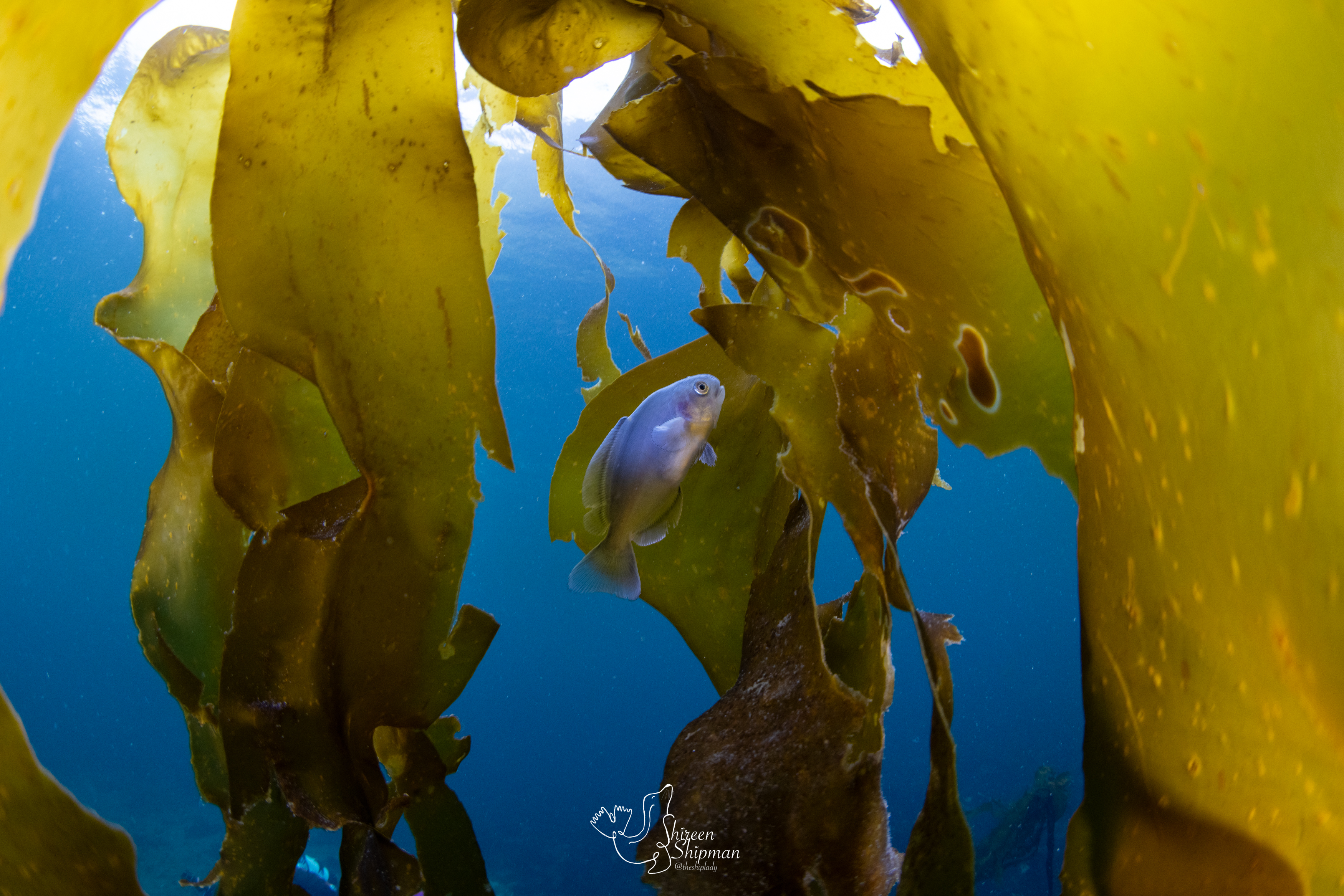
Sighting Number 2 – Medusafish seen by Shireen Shipman.
On one day of our dive trip, the wind was howling so fiercely that we could not get out in the boat. Thankfully, we could dive in the bay right in front of God’s Pocket. After one of these dives, Shireen showed me her stunning pictures and asked me if I knew the species.

My jaw may have dropped. Yes, my face got a good workout on this trip.

I thought this may be a Medusafish (Icichthys lockingtoni to 46 cm). But I had to check with expert Andy Lamb. I have never, knowingly, seen one. Their range does include where I often dive but sightings and photos of them by divers are rare. As the reference to “Medusa” suggests, these fish often are in amongst the tentacles of large jelly species. Even in Andy Lamb and Phil Edgell’s fish ID book, the only photo of a Medusafish is of a dead individual at the surface.

Andy confirmed this was a juvenile Medusafish and I am sure he is keen to use Shireen’s photo in future to help others ID the species.

Diver in the background is Shireen’s buddy, Melissa Foo.

The known range of Medusafish is the North Pacific Ocean: Japan and Gulf of Alaska to central Baja California, Mexico.

How wonderful that Shireen noticed that this was a unique fish and took beautiful photos. You can see how shallow they were. Oh and did I mention? I was on this dive.


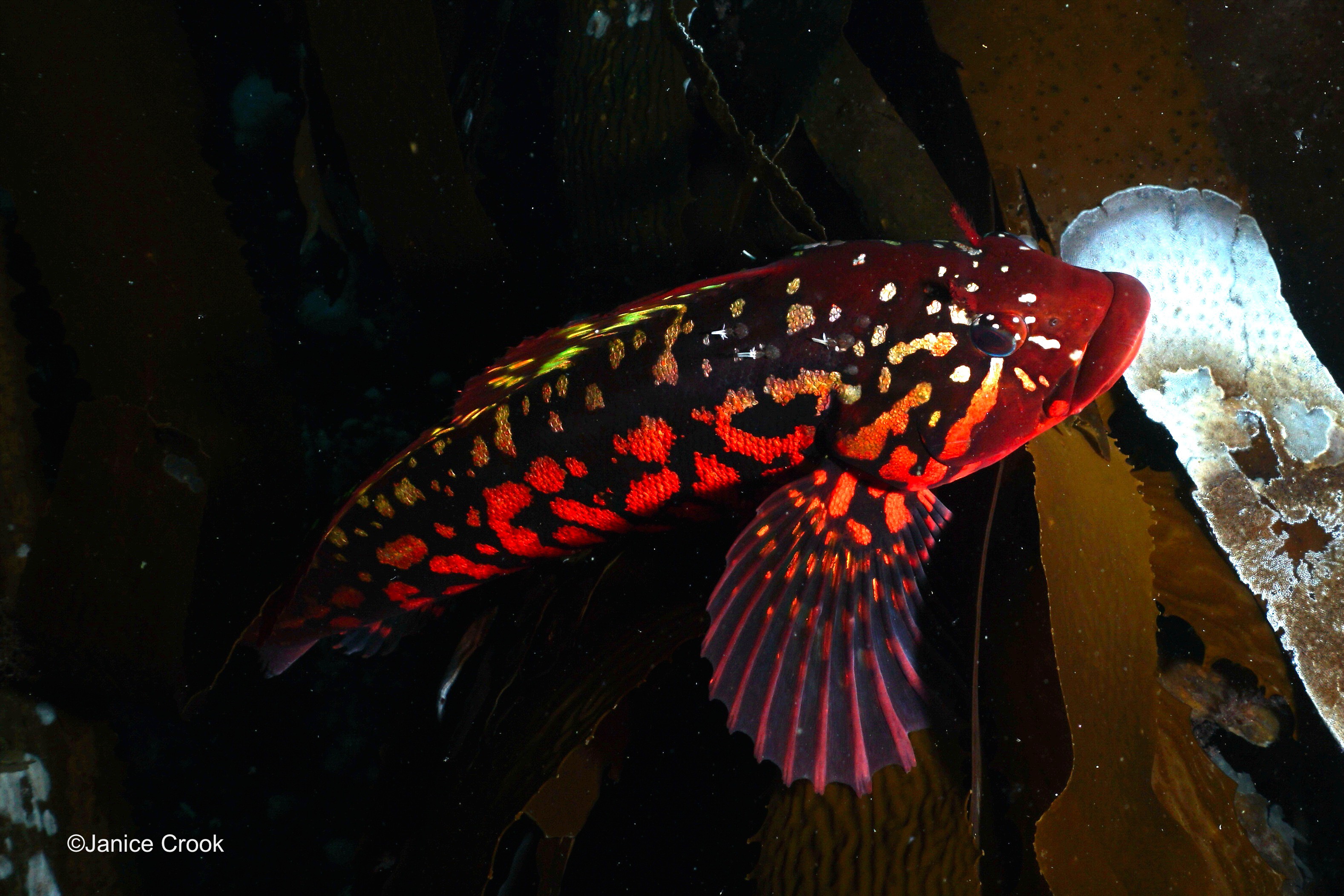
Sighting Number 3 – Male Rock Greenling seen by John Congden and Janice Crook
I was to dive with Janice and John but I could not clear my one ear. So I dived very near the surface telling myself that a byproduct could be . . . seeing a male Rock Greenling (Hexagrammos lagocephalus to 61 cm)! One had repeatedly been seen at this site. They are highly territorial AND in the shallows in sites with high surge like this.

There appears to be little known about Rock Greenlings and there is even scientific debate if the Rock Greenlings seen in Russia are the same species as those along the North American side of the North Pacific Ocean. Dr. Milton Love discusses how observations of this species from eastern Kamchatka and the Sea of Okhotsk are that they are in schools. While over on this side, they are observed to be solitary and very territorial.

Back to me diving . . . in the surge. I spend an hour at no more than 6 metres depth and looked, and looked for the male Rock Greenling. I was back on the dive boat when my beloved dive buddies, Janice and John, surfaced from their dive ecstatic because . . . the fish was where they had done their safety stop. Janice and John’s photos of the male Rock Greenling follow.


You can see how astoundingly, flamboyantly coloured mature male Rock Greenlings are and yet, also despite their territoriality, they can clearly be so difficult to spot.

I was so lucky to later see a mature female Rock Greenling on another dive, darting in and out of the Surfgrass. My photos of the female Rock Greenling are below.

There is much discussion about how territorial mature male Rock Greenlings are. But the mature females sure seem territorial too (based on my sample size of exactly ONE observation of a mature female Rock Greenling). 🙂


So why the pouty face?

Why indeed did my face do something similar to pouting upon not being part of these 3 sightings? The important things are:

  • Timothy’s video of the Mola was contributed to research.
  • Shireen’s photos of the Medusafish will help others ID the species.
  • Janice and John’s sighting of the male Rock Greenling was something they too had tried so hard for, dedicating many dives to being in the shallows, rocking back and forth in the surge. Between them, they have 59 years of diving, much of it in British Columbia’s marine waters and they have never before seen a Rock Greenling. Until this sighting, they had been referencing the species as the “mythic unicorn fish” of the northwest Pacific Ocean.
  • By being able to use their photos, I can still educate and hopefully increase care, understanding and action for the fragility the life in dark water. Thank you, dive buddies!

I actually looked up the definition of “to pout” for greater insight into what neural wiring leads to such a facial expression. I was gifted with: “to push one’s lips or one’s bottom lip forward as an expression of petulant annoyance or in order to make oneself look sexually attractive.” I assure you it was not the latter! Nor was it the former actually.

My inner 8-year-old is alive and well in this 60-year-old body. She’s the one who pouted, wanting to be filled with wonder too.

The more adult me loves the wonder of NOT seeing these fish. You can be on the same dive, at the same time, and not have the same experience. Isn’t that the truth! I love the metaphor it gives for life. I love how much more there is to marvel at, and to share.

It tests me too. Can we care and take action for species we have never seen, or may ever see? Can we do so with the understanding of how little is known about them and how that too threatens their survival? You, dear reader, know that answer to that in how YOU feel right now.

YES we can and yes, we must. 💙

2025 WILD Calendar

With a song in my heart, I can announce, the 2025 WILD Calendar is now available. Such great thanks to all who helped by voting on the selection of photos. They can be ordered at this link.

My WILD Calendar is aimed at creating awareness about the diversity and fragility of life hidden in the cold, dark, life-sustaining northeast Pacific Ocean. It is the waters dark with plankton that have more life, produce more oxygen, and buffer more carbon dioxide.

It’s the 16th year I have made a WILD Calendar. I am so grateful to all who put these calendars into the world. You are helping increase connection and understanding of our reliance on the Ocean. That’s needed to make the decisions, day-by-day, that consider future generations. 💙

Each month’s photo has a detailed descriptor included about the featured marinelife. The calendars are $27.50 + tax.

They are large and printed on sturdy paper on Vancouver Island, coil bound with a hole to hang them. 33 x 26.5 cm closed and 33 x 53 cm open (13 x 10.5″ closed /13 x 21″ open).

There are BIG spaces to write your daily adventures.

All photos are from the Territory of the Kwakwa̱ka̱’wakw (the Kwak̕wala-speaking Peoples), Northern Vancouver Island ©Jackie Hildering, The Marine Detective.


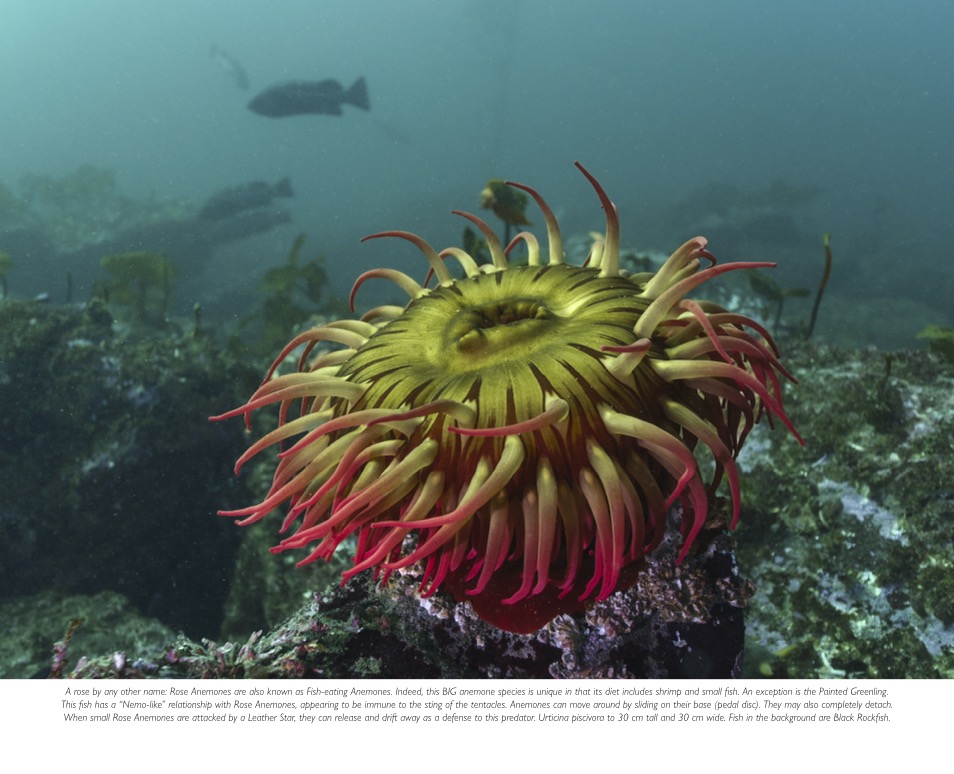
January 2025 image and text

A rose by any other name: Rose Anemones are also known as Fish-eating Anemones. Indeed, this BIG anemone species is unique in that its diet includes shrimp and small sh. An exception is the Painted Greenling. This sh has a “Nemo-like” relationship with Rose Anemones, appearing to be immune to the sting of the tentacles. Anemones can move around by sliding on their base (pedal disc). They may also completely detach. When small Rose Anemones are attacked by a Leather Star, they can release and drift away as a defense to this predator. Urticina piscivora to 30 cm tall and 30 cm wide. Fish in the background are Black Rocksh.

February 2025 image and text

The embrace: Bull Kelp intertwined in water thick with plankton. Love the ocean and the algae. They sustain life above and below the surface. From the microscopic to giant kelps, algae photosynthesize – absorbing climate-changing carbon dioxide and producing food and oxygen. At least 50% of the oxygen on Earth comes from marine algae and there is more productivity where the water is cold and there is high current. Kelp forests are also essential habitat to so many species. Kelp is impacted by changes in climate and the plight of Sunower Stars (which feed on Green Urchins which graze on kelp). Bull Kelp is Nereocystis luetkeana to 36 m long.

March 2025 image and text

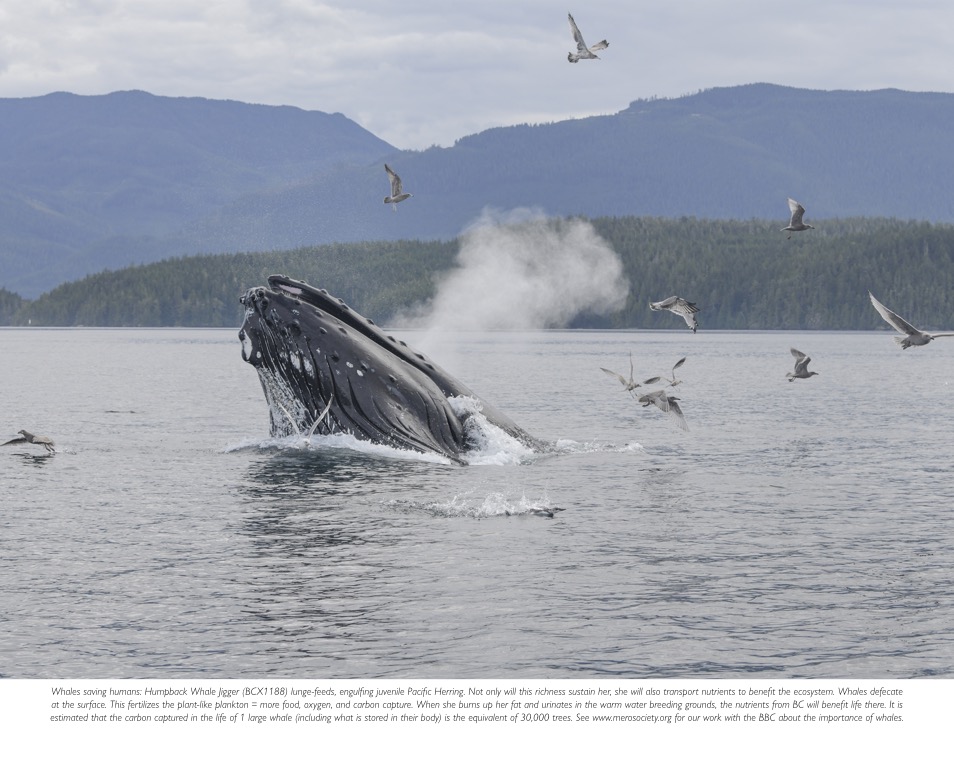
Whales saving humans: Humpback Whale Jigger (BCX1188) lunge-feeds, engulfing juvenile Pacific Herring. Not only will this richness sustain her, she will also transport nutrients to benefit the ecosystem. Whales defecate at the surface. This fertilizes the plant-like plankton = more food, oxygen, and carbon capture. When she burns up her fat and urinates in the warm water breeding grounds, the nutrients from BC will benefit life there. It is estimated that the carbon captured in the life of 1 large whale (including what is stored in their body) is the equivalent of 30,000 trees. See http://www.mersociety.org for our work with the BBC about the importance of whales.

April 2025 image and text


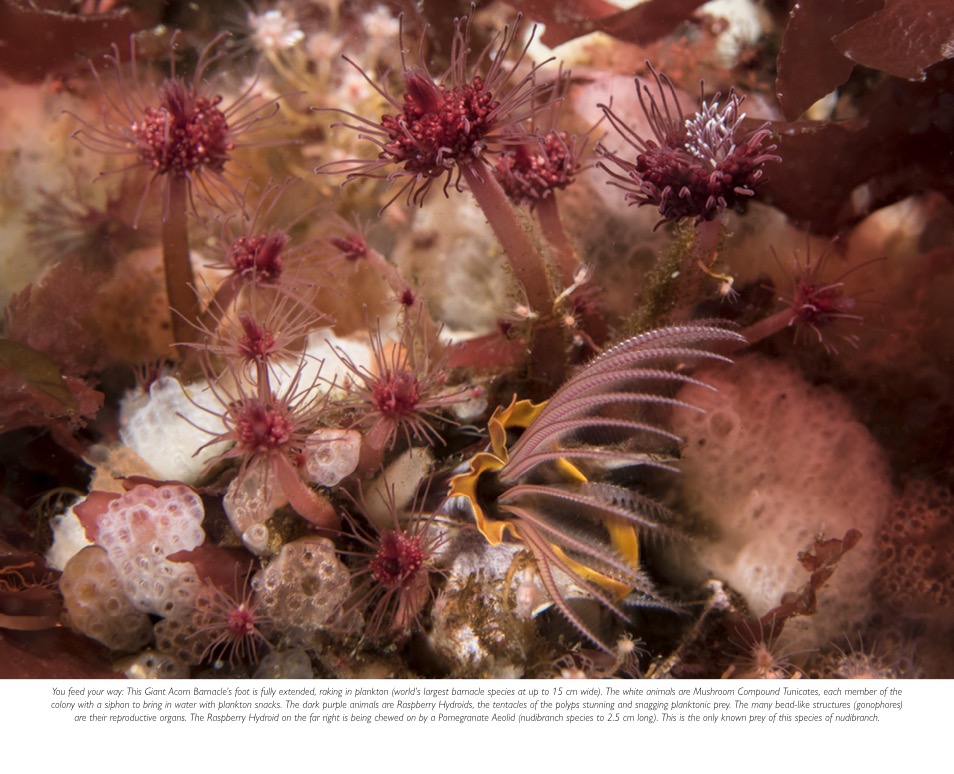
You feed your way: This Giant Acorn Barnacle’s foot is fully extended, raking in plankton (world’s largest barnacle species at up to 15 cm wide). The white animals are Mushroom Compound Tunicates, each member of the colony with a siphon to bring in water with plankton snacks. The dark purple animals are Raspberry Hydroids, the tentacles of the polyps stunning and snagging planktonic prey. The many bead-like structures (gonophores) are their reproductive organs. The Raspberry Hydroid on the far right is being chewed on by a Pomegranate Aeolid (nudibranch species to 2.5 cm long). This is the only known prey of this species of nudibranch.

May 2025 image and text


Pulsing with life: Lion’s Mane Jelly reflected against the surface. Cyanea capillata can be over 2 m across with 8 clusters of 70 to 150 tentacles which can be more than 9 m long. One is reported to have been

2.3 m across with 36.6 m long tentacles (was in the North Atlantic and may be classfied as a different species, McClain et al., 2015). The jelly in this photo was ~50 cm wide and tentacles were retracted. Jellies know which way is up. Small organs (“rhopalia”) sense gravity and light. Lion’s Mane Jellies have 1 between each of the 8 lobes of their bell. This species is among the very few in BC waters that have a sting that can cause human discomfort.

June 2025 image and text

Infinite wonder: 1. Sea star is a Leather Star (Dermasterias imbricata to 30 cm across). You can see some tube feet, their gills, and the “madreporite” – circular structure that is the opening to the water vascular system. Water enters to allow locomotion, respiration, and feeding. 2. Nudibranch is a Cockerell’s Dorid (Limacia cockerelli to 3 cm long). See the high surface area of the two “rhinophores” to detect chemicals/smell. 3. Species of encrusting coralline algae. Has a hard layer of calcium carbonate. They photosynthesize, making food and oxygen, and taking in carbon dioxide. 4. Snail is a Variegated Amphissa (Amphissa versicolor to 1.9 cm long).

July 2025 image and text

Bountiful biodiversity: This is just below the surface in so many areas off our coast. This is what we are connected to in many of our daily decisions . . . a dark ocean sustaining life in an intricate web, from anemones to nudibranchs, from plankton to people. The species here include: White-spotted Rose Anemone (to 25 cm tall / 15 cm wide); Monterey Dorid (nudibranch species to 15 cm long); Whitecap Limpet (to 5 cm across) with a Crenate Barnacle on its shell (to 2 cm); juvenile Bering Hermit Crab (to 2.5 cm) in a shell once made and inhabited by a Threaded Snail (to 2 cm); and species of crustose coralline algae (pink).

August 2025 image and text

Another living gem: Longfin Sculpins are powerful ambassadors for the colour in these cold waters. Just look at the patterns, the texture, and the gossamer fins. They crawl with their pectoral fins and can hold on vertically, head oriented downward, like Spider-Man. They rarely swim more than 0.5 m off the bottom and are most often solitary (except when mating and egg guarding). They are reported to be very territorial of areas that are 0.3 to 0.5 metres squared (source: Love, 2011). They darken at night to match their surroundings = “nocturnal protective colouration”. The males are also darker when courting females. Jordania zonope to 15 cm long.

September 2025 image and text

Symbionts: Ochre Stars and Giant Green Anemones in the shallows. This anemone species is vibrant green when the symbiotic algae living in their guts receive a lot of sunshine. More sun = more food through photosynthesis. The anemones benefit from the nutrients made by the algae. The algae benefit by being where their predators can’t get them (grazers like limpets, chitons, and snails). This anemone species is Anthopleura xanthogrammica to 30 cm high / 30 cm wide. The symbiotic algae are zoochlorellae (green algae) and zooxanthellae (dinoflagellates). There is also a green pigment in the skin of the anemones.

October 2025 image and text

Eight-armed teacher: For a little levity, here are some lessons I’ve learned from Giant Pacific Octopuses. (1) Do not fear what looks different. (2) Respect alternative intelligences. (3) Blend in to escape detection when necessary. (4) Trust your ability to squeeze through tight spaces and come out the other side. (5) Ink out the negative and jet away, leaving it behind you. (6) Know where your home is and keep the garbage outside. (7) Be big-hearted (octopuses have 3 hearts) and guard the next generation. (8) Use your beak when needed. Enteroctopus dofleini to 7.3+ metres from arm tip to arm tip. Of course there’s an octopus photo for October!

November 2025 image and text

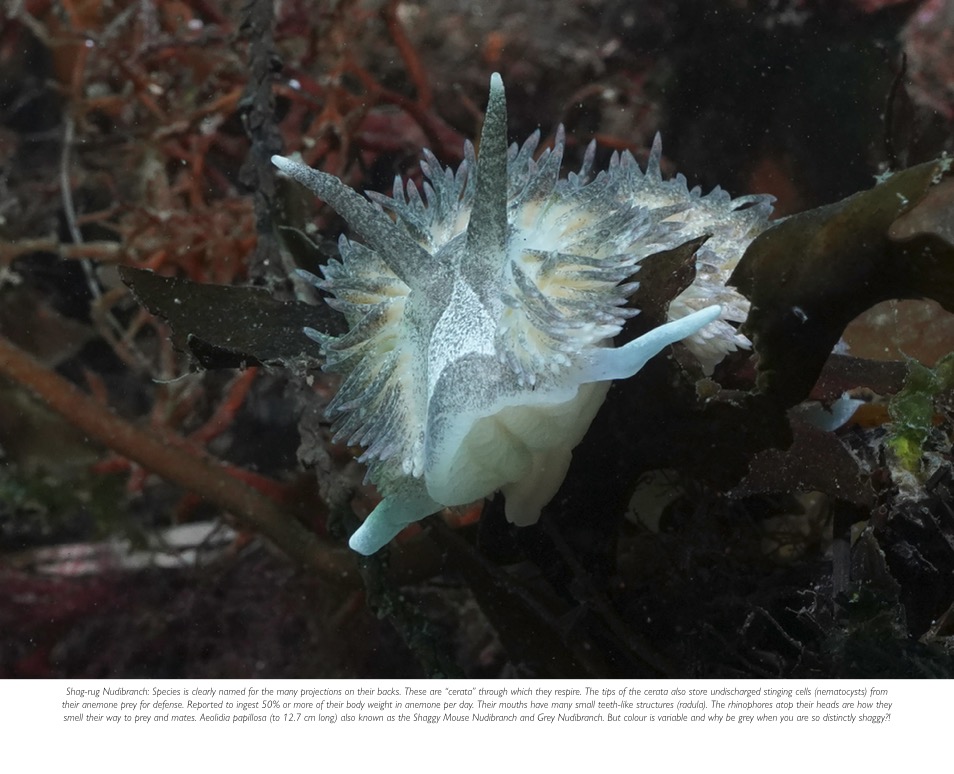
Pretty little predators: These Red-gilled Nudibranchs are feeding on Bushy Pink-mouth Hydroids – colonies of animals with stinging cells (nematocysts). The white coils are the nudibranchs’ egg ribbons. The bushy structures on the backs of the nudibranchs are the cerata. These function as gills and also have a role in defence. The stinging calls from their prey end up at the tips of the nudibranchs’ cerata. Yes, they “steal” the weapons of their prey and lay their eggs on top of them. Bushy Pink-mouth Hydroids are Pinauay crocea to 15 cm tall. The flabellina nudibranchs have undergone much reclassification. I believe these are Coryphella verrucosa to 10 cm long.

December 2025 image and text

No two alike: Rose Stars are also known as Snowflake Stars because there is so much diversity in pattern and colour. Even the number of arms varies, ranging from 8 to 16 (most often 11). They are fast at 50 cm/minute (source: McDaniel, 2018). You can see 3 structures on the surface of the sea star: (1) spines; (2) pedicellaria = structures that can nip off the tube feet of other species of sea star e.g. the predatory Morning Sun Star; and (3) papulae = the tufts that are the gills / respiratory organs. Crossaster papposus to 34 cm but in BC maximum size is believed to be ~17 cm. One species. So many colours. That’s beauty. That’s biology.

Backcover

Photo of yours truly by Kendra Parnham-Hall.

Giving It to You Straight – Toothshell Hermit Crabs and Wampum Tuskshells

Giving it to you straight!
This was my most exciting “find” for April.

This is a Toothshell Hermit Crab in the shell of a Wampum Tuskshell. The shells were used as currency by First Nations. Read on!

THIS species of hermit crab does not have curled body to hook and hold a snail shell home (like most hermit crabs).

THIS hermit crab species’ body is straight which means that it can’t live in a shell made by a marine snail. Its niche is to fit into the straight shells of Tuskshells or, if need be, the tube of calcareous tubeworm species* which is also straight.

Toothshell Hermit Crabs are only up to 0.8 cm long (Orthopagurus minimus).

Wampum Tuskshells are to only 5 cm long (Antalis pretiosa). They are molluscs belonging to the Tuskshell class (Scaphopoda).

My excitement is about this hermit crab species’ adaptations and that it is so rare to see a Tuskshell because they are usually burrowed deep in the sandy or shell bottom. The best chance of seeing one is as the home of a Toothshell Hermit. But then, there’s ALSO the great cultural significance of Tuskshells!

Wampum Tuskshells burrow themselves into the ocean bottom with their foot and use their sticky tentacles to trap microscopic food particles and move them to their mouths. Specifically, they are reported to feed on single-celled amoeboid protists called forminifera.
Crappy sketch is by yours truly.

Tuskshell species (also known as Dentalia and Toothshells) are of great importance to First Nations. They were used as currency and are still used in regalia in some areas.

The shells of these snails were used for over 2,500 years from what is now known as the Arctic to Baja California and across to the Great Lakes. The most important species of tuskshell is reported to have been the one I chanced upon recently, the Wampum Tuskshell.

One of the most important areas for harvesting these animals for their shells (know as hiqua / haiqua) was Quatsino Sound off northwest Vancouver Island.

The snail’s previous scientific name even translates into “valuable tooth” = Dentalium pretiosum. In part what made tuskshells so valuable was that they were difficult to get. But, not only were they scarce, they were also great as currency because of their beauty, being easy to transport, and because they could not be counterfeited.

The snail is often found in deeper water (between 9 to 75 m), burrowed in the sand. The Quatsino People engineered a way of catching them with an apparatus that looks like the head of a broom. To get this down to the shells, stick extensions were added a length at a time to get as deep as 21 m. All this while working from a canoe!

I hope this little hermit crab, in this little shell, adds to a BIG world of connection for you.

Photo from the Plains Indian Museum at the Buffalo Bill Center of the West.
Accompanying text: “Tooth or tusk shells commonly referred to as #dentalium is a scaphopod mollusk. Dentalium was harvested off the coast of Vancouver Island, Canada by tribes. Today, most commercial dentalium is harvested and sold from Asia. In the Plains, dentalium was a highly sought after trade product from the Plateau Tribes. Beautiful hues of smooth pink and white were prized and revered by Lakota, Dakota, and Nakoda women. Artists created dress capes, earrings, hair ornaments, and chokers to wear during times of ceremony and celebration.

Dress detail, #Lakota Northern Plains, ca. 1885. Selvage wool, dentalium shells, glass beads, silk ribbon, cotton thread. NA.202.40.”
From Money from the Sea: A Cross-cultural Indigenous Science Problem-solving Activity by Gloria Snively. Left: “The Dentalium “broom” was lowered to the shell beds by adding extensions to the handle. Illustration by Laura Corsiglia (2007).” Right: [In 1991, Phil Nuytten reconstructed the broom and submerged in his “Newt Suit” to observe how the broom worked.] “Phil Nuytten’s dentalia-harvesting broom outfitted with a weighted board. Loosening the ropes lowers the weighted board, an action that partially closes the broom head for grasping the shells. Illustration by Laura Corsiglia (2007).
From Money from the Sea: A Cross-cultural Indigenous Science Problem-solving Activity by Gloria Snively. “Extent of dentalium trade. Illustration by Karen Gillmore.”
Another perspective on the same Toothshell Hermit Crab I chanced upon on April 8, 2023 while diving north of Port Hardy in the Territory of the Kwakwa̱ka̱’wakw (the Kwak̕wala-speaking Peoples) with God’s Pocket Resort. Depth was around 13 meters. Dive buddy Natasha Dickinson.


See below for additional information from the wonderful lesson plan from the book edited by Gloria Snively and Wanosts’a7 Lorna Williams – Knowing Home: Braiding Indigenous Science with Western Science.

Dentalium Shell Money Story

“For 2,500 years, until the early 20th century, North American Indigenous peoples used the dazzling white cone-shaped shell of a marine mollusk as currency. Dentalium pretiosum [note that the species was reclassified to Antalis pretiosa] is a . . . mollusk of the class Scaphopoda, a group also known as tusk shells because of their slightly curved, conical shape . . . Dentalia inhabit coarse, clean sand on the surface of the seabed in areas of deep water, and are often found in association with sand dollars and the purple olive snail (Olivella biplicata).

As predators, they use their streamlined shape and muscular foot to move surprisingly quickly in pursuit of tiny single-celled prey called forminifera. Aboriginal peoples used many substances as trade goods, but dentalia were the only shells to become currency. Harvested from deep waters off the coast of Vancouver Island, they were beautiful, scarce, portable, and not easily counterfeited.

In 1778, Captain James Cook of the British Royal Navy visited the village of Yuquot (Friendly Cove) on Nootka Island off the west coast of Vancouver Island, BC. The island’s fur trading potential led the British East India Company to set up a trading post at Yuquot, which became a focal point for English, Spanish, and American traders and explorers.

Trade between Euro-Americans and Aboriginal peoples was initially conducted under the watchful eye of a powerful chief named Maquinna who acted as middleman, purchasing sea otter pelts using dentalia as currency and then reselling the pelts to white traders in exchange for other goods.

Once the white traders realized that shells were used as money, they began trading directly with dentalia harvesters among the Nuu-cha-nulth and Kwakwaka‘wakw people. The center of the fur trade subsequently moved to Nahwitti, a Kwakwaka‘wakw village on the northern tip of Vancouver Island (Nuytten, 2008b, p. 23), and dentalium shell money became a currency of cross-cultural trade, called Hy‘kwa in Chinook Jargon—a trade language spoken as a lingua franca in the Pacific Northwest during the 19th and early 20th centuries. The currency was used throughout Alaska, down the Pacific coast as far as Baja California, and across the prairies of the United States and southern Canada to the Great Lakes.

In addition to their use as currency, the pearly white dentalium shells also served as decorative wealth. They were fashioned into necklaces, bracelets, hair adornments, and dolls. The shells also decorated the clothing of both men and women.

It is generally agreed that the best dentalium shells were those harvested by the Ehattesaht and Quatsino people from shell beds off the west coast of Vancouver Island. These beds lay deep underwater—too deep for divers to hold their breath, too dark for them to see, and too cold to sustain a diving operation—so the Quatsino people designed specialized gear to harvest the money shells. Historical records indicate that a device with a very long handle and a bottom end resembling a “great, stiff broom” was used to pluck live dentalia from the seabed . . . Three of these implements still exist in museums in Victoria, British Columbia and Seattle, Washington.”


4-minute video from December 2022: “Hunter Old Elk, Assistant Curator of the Center of the West’s Plains Indian Museum, shows us a Dakota dress cape adorned with 1,500 – 2,000 dentalium shells

Please note that dentalia / tuskshells do not move from one shell to the other. Their shell grows.


From the Oregon Historical Society:

Tuskshells / Dentalia ” . . . were of great value prized mark of wealth and status, typically displayed as ornaments in clothing and headdresses, used as jewelry, and even used in some places as a type of currency.

Most dentalium entering the indigenous trade network of the Pacific Northwest originated off the coast of Vancouver Island. Chicklisaht, Kyuquot, and Ehattesaht communities of the Northern Nuu-chah-nulth, inhabitants of the west coast of the island, were the primary source of the shells. However, the Kwakwaka’wakw of Quatsino Sound and Cape Scott, on the eastern coast, were also large producers. Harvesters would work from their ocean-going canoes, extending specially-constructed long poles to the dentalium beds on the ocean floor. At the end of the long poles were large brushes that were pushed into the mollusk beds, ensnaring dentalium in the process.”


Sources:

Gloria Snively and Wanosts’a7 Lorna Williams (2016) – Knowing Home: Braiding Indigenous Science with Western Science, Chapter 11 – Money from the Sea: A Cross-cultural Indigenous Science Problem-solving Activity

Quartux Journal – Dentalia Shell Money: Hi-qua, Alika-chik

Oregon Historical Society (2003) – Dentalia Shell & Bead Necklace

Coast View (2022) – Quatsino, Quatsino Sound

Plains Indian Museum at the Buffalo Bill Center of the West (2022) – The currency of dentalium shells 

National Geographic Magazine (1993) via Dentalia Harvesting

The Midden (1990) – A Curious Currency Part 1: Haiqua shells on the Northwest Coast in the 19th century


*Note that there is another straight-bodied species of hermit crab in the northeast Pacific Ocean whose home is almost always the tubes of calcareous Tubeworms; the Tubeworm Hermit (Discorsopagurus schmitti).

From National Geographic Magazine (1993) via Dentalia Harvesting