Join me in the cold, dark, life-sustaining NE Pacific Ocean to discover the great beauty, mystery and fragility hidden there.

Posts from the ‘Humpback Whale’ category

Humpback Comeback Project – Please Vote!

Update: See this link for the results of the Humpback Comeback Project in the AVIVA competition.

____________________________

I have a whale-sized favour to ask . . . I need your votes.

To be exact, I need one vote a day for the next 10 days and your support in spreading the word to generate more votes for our “Humpback Comeback” research project.

It is of huge importance to me and the others in our small group of dedicated whale researchers on the Northern Vancouver Island (British Columbia) who, for the past 7 years, have been using our own boats, fuel, and equipment to try to learn more about humpbacks.

We have a chance of getting support through the Aviva Community Fund for an essential study to determine the rate of entanglement of humpbacks in B.C.  (whales getting caught in fishing gear). In a well-studied area of the North Atlantic ocean, about 75% of humpback whales have been tangled up in fishing gear at some point in their lives but there has been very little research into this threat to humpbacks in British Columbia.

Our motivation for this project is a direct result of what we have observed locally. See below for a very recent example of the severity of entanglement injury to a local humpback. The shocking images are of the before-and-after-entanglement of a whale we have nicknamed “Sharktooth” (no DFO catalogue number yet).

Please start voting today and up to November 26th, so that we might move on to the semi-finals.

Everyone has 10 votes (one vote a day), and you can vote for the same idea all 10 times.

So use your votes, tell your friends, and use Facebook or other social networks to spread the word! Please.

You need to register to vote at this link.

Then, please click the link in the email that is sent to you. You can then vote for the “Humpback Comeback Project” every day by clicking here.

Great thanks.
"Sharktooth" on June 20, 2010 - no injuries. Photo: Jackie Hildering. Click to enlarge.

"Sharktooth" on October 2nd, 2010 - with entanglement scarring. Photo: Bruce Paterson. Click to enlarge.

"Sharktooth" on October 2nd, 2010 - with entanglement scarring. Photo: Bruce Paterson.

"Sharktooth" on October 2nd, 2010 - with entanglement scarring. Photo: Bruce Paterson.

Of Humpbacks and Waterfalls

This comes to you from the Coast Guard ship the J.P. Tully where I have the great good fortune to serve as a marine mammal spotter for the next days.

BCY0057 nicknamed “Niagara”.

We have been recording many humpbacks sightings but today, while the larger ship was being fuelled in Port Hardy, we were able to do some work from a zodiac, allowing for a better opportunity to ID the humpbacks as individuals.

I share with you the experience of seeing one of these individuals, the humpback carrying the DFO (Department of Fisheries and Oceans) ID number BCY0057.

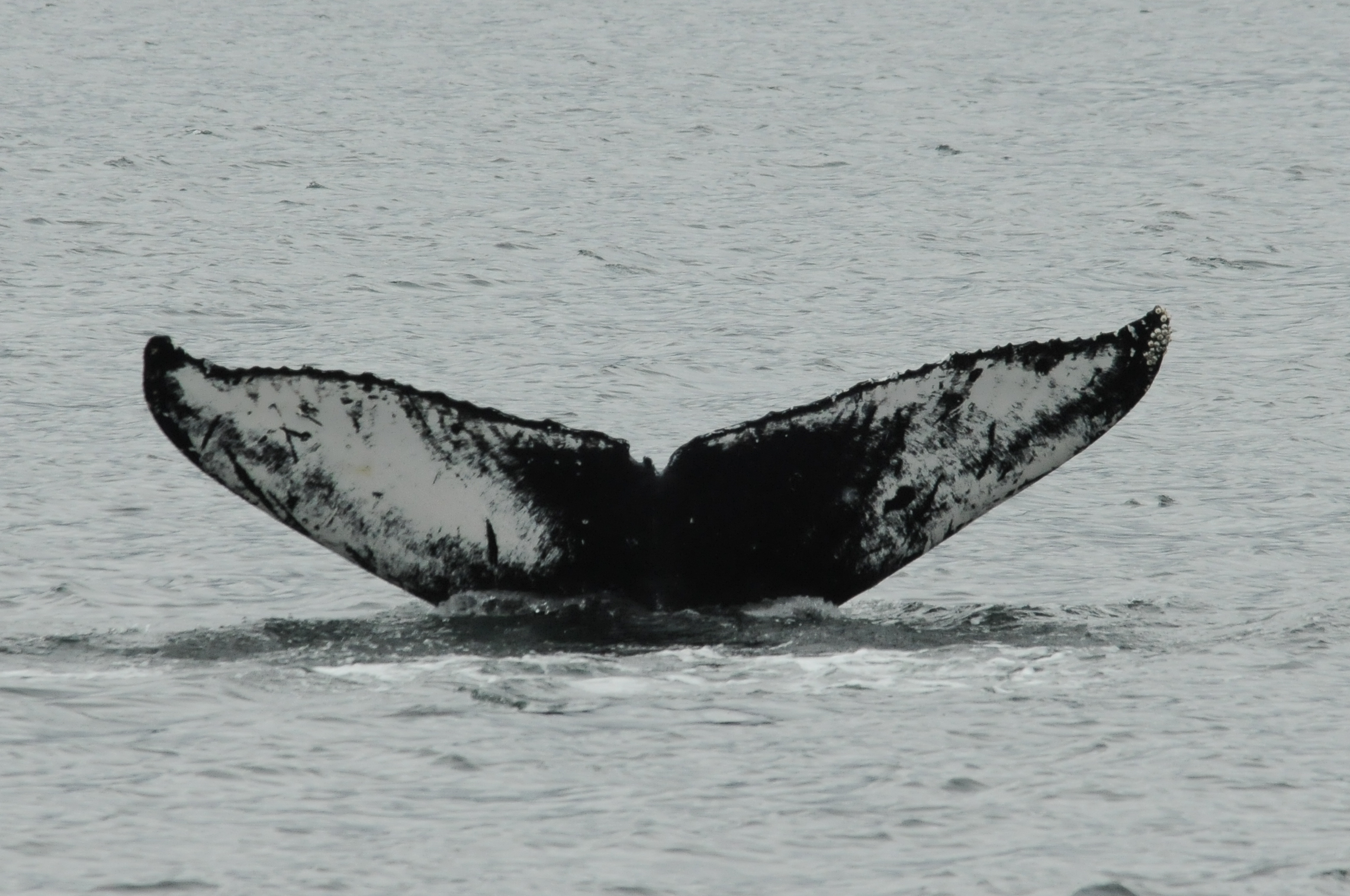
It is the easiest to ID humpbacks as individuals by using the unique markings of their tails. This particular humpback was one that we very quickly were able to recognize due to a very distinctly shaped white spot near the centre of its tail. The marking is in the shape of a waterfall so, since “BCY0057” is not an easy name to remember, locally this whale is known by the nickname . . . Niagara.

We know that Niagara is about 10 years old due to Dr. Alexandra Morton having taken a picture of the whale in 2000 when it was travelling with his mother.  As a further result of these photo records, we also know that Niagara’s mother is BCX0022 (aka “Houdini”), one of the most prolific humpbacks known to research. She had 5 calves in 7 years, quite the feat considering that humpbacks are pregnant for about a year.

Today’s experience of seeing Niagara again was moving.  It was also ideal from a research perspective since we were able to get good ID shots of the tail and both sides of the animal and, since Niagara was feeding at the surface, it was possible to collect scale samples of the fish being fed upon. DNA testing of these scales will confirm what species of fish Niagara was eating.

At the link below, I share with you an image of Niagara “lunge feeding” so that you can get a sense of how far the throat pleats of humpbacks distend to allow huge volumes of food and water to be engulfed. Reportedly up to 20,000 litres is taken in per mouthful. The water is then pushed out through the baleen.

The image also shows you the “beard” of barnacles on Niagara’s throat pleats. These species specific barnacles will surely be a topic of a future blog.

And, if you look very carefully, you’ll see Niagara’s right eye with lids closed.

Duty calls  . . . .

Click here for the image of Niagara (BCY0057) lunge feeding and for a larger ID photo.