Seeing Whales – Seeing Red

I saw A12 swim by today. A12, also known as Scimitar, is an old female killer whale of the “Northern Resident” population of fish-eating, inshore killer whales. She is about 69-years-old (known as the result of the photo-identification work of Dr. John Ford, Graeme Ellis and the late Dr. Michael Bigg).
A12 is the grand dame of the first family of killer whales I ever saw; an experience that had an impact on me that I will never fully be able to explain. It led me to make a radical career change, moving back to Canada to work as a marine educator on the very waters where I first saw A12.
Seeing her today was as powerful an experience for me as it was the first time I saw her but . . . there was sadness too and, there was anger.
Last year her son A33 “Nimpkish” went missing. He was around 38-years-old. Mother fish-eating killer whales never leave their sons so we knew there was very little chance of ever seeing him again. Indeed, no one ever has.
With A33 gone, A12 would still sometimes travel with her daughter A34 and A34’s calves and grand-calves but she was also often on her own. Then, as of July 22nd, she was frequently seen with “the three brothers” (the A36s); three mature male killer whales whose mother went missing in 1997. As the only surviving offspring, these males were always together. A12 is closely related to them and it was remarkable to see how the mother with no son, interacted with the sons with no mother.
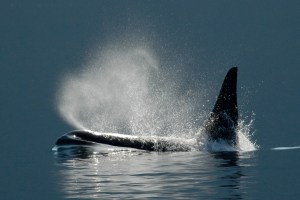
Today, there were only two of the three brothers near A12. The eldest, A32 (aka “Craycroft”) who was around age 46, is now missing.
Another male killer whale gone.
And this is what laced my experience today with anger. But why? Whales, like everything else, die.
I assure you I am not being overly sentimental. It will never be conclusive what made these whales die but, but, BUT we humans definitely had an influence. Their health, in fact, is an accurate mirror of how our actions impact the environment.
The whales, with their position high in the marine food chain, are full of chemicals like fire retardants and pesticides (the work of Dr. Peter Ross). Despite the many lessons learned with the likes of chemicals like PCBs and DDT, which were banned in 1977, we still do not appropriately test new chemicals and we use chemicals with reckless abandon. The toxic reality is that the ocean is a soup of chemicals – including the old and new (e.g. PBDEs) “persistent organic pollutants” that do not break down; “travel” to the colder areas of the world; build up in the food chain (bioaccumulate and biomagnify), and reduce animals’ ability to fight disease and reproduce.
A32 was above average age for a male killer whale but “average age” has been determined from the data available only after our use of these chemicals. It is not believed to be natural that male killer whales (and the males of many other marine mammal species) die at a much younger age than the females. Their earlier demise has to, at least in part, be due to their toxin loads being much higher than the loads in the females. The females’ toxin levels are lower because females download these fat-soluble toxins in the fatty mother’s milk, to their calves (of course with negative impacts to the calves).

These chemicals had to have an impact on the missing mature males and, the situation literally becomes all the more toxic, when coupled with lack of food. When the whales do not have enough food and use up their fat reserves, the toxins become more concentrated. And 2008 was an appalling year for Chinook salmon, the salmon species essential to the survival of killer whales of the “resident” populations. The work of Dr. John Ford has shown that there is a direct correlation between the survival of these killer whales and the availability of Chinook salmon and, of course, we humans impact the survival of salmon . . . by habitat loss, over-harvesting, climate change, current open net-cage salmon farming practices, etc.
So today, as I witnessed A32 no longer being with his brothers, I felt the wave of rage come up inside me. Missing whales causes reflection on the state of the environment due to human over-consumption, lack of precaution and disconnect from Nature.
But the wave passed shortly after the whales did. For there is still every reason for hope. As long as people care enough to change, there is hope. The potential for change is endless and there is ample evidence of humanity, increasingly, moving in a direction that considers the link between our daily actions and whales like A12, A33 and A32.
Indeed, there is ample reason for hope as long as there are people like you who read to the end of a lengthy blog entry like this.
Thank you.


 The Marine Detective