Join me in the cold, dark, life-sustaining NE Pacific Ocean to discover the great beauty, mystery and fragility hidden there.

Posts from the ‘MARINE MEGAFAUNA’ category

Looks Like We Made It – Humpback Comeback Project

Update: See this link for the results of the Humpback Comeback Project in the AVIVA competition.

_______________

Thank you so much!

Our  small, Northern Vancouver Island project has withstood whale-sized odds and, with your continued support, may now win $25,000 for humpback conservation research.

The Humpback Comeback Project competed against community projects from across Canada in the AVIVA Community Fund’s contest that operates very much like an “Idol” for charities.

So many people voted for Humpback Comeback that it has advanced to the final round of the voting, finishing in the top 30 of 528 projects in the funding category.  But now the going gets really tough since our Project is up against many (wonderful) community projects that are championed by large population bases in urban Ontario.

Our Project may not originate from a densely populated area, but the community of people who recognize the importance of this research is very large indeed.

So, please, in true Idol style, from December 2nd to 15th,  click here to find out how to vote for the Humpback Comeback Project, #5773!

You have one vote a day for ten days in this time period.

Please too could you promote the Project by sharing this blog item with your social networks? Demanding, I know – but a great deal is at stake.

BCY0710

BCY0710 "Twister" who was entangled in prawn trap lines and anchored to the bottom, twice in a 3 week period in 2009 (May 18th and June 10th). Photo: Jared Towers.


If you would like a daily reminder, I would be very happy to provide you with one. Please click here.

If you would like to follow along on Facebook, join at this link.

If you’ve not registered in the prior round of voting, you will have to do so and then click the link that gets sent to you in an email.

Click here for the direct link to the Project.

After the final voting round, a jury will decide which of the top scoring Projects will be funded.

What a SPLASH it would create if this included the Humpback Comeback Project!

From team MERS – again, thank you so much.


When Pilchard Return

Ms. Henderson’s students in Port Alice, B.C. put me onto a case yesterday.

They had me check what was happening in the beautiful inlet in front of their community on north-western Vancouver Island and – what a fabulously noisy case it was!

Pilchard (aka “Pacific sardines”; Sardinops sagax; up to about 40 cm) have brought in a whole food chain of activity:  fishing boats, hundreds of gulls, many Steller and California sea lions and, that’s just what we could see on the surface!  Pilchard were absent from the Pacific Northwest for about 50 years, having been very intensely fished into the early 1940s. With their return, our Coast has become much more vibrant with these fish fuelling a food web that includes humpback whales and both the Steller and California sea lions.

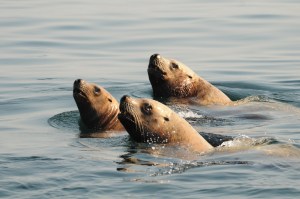
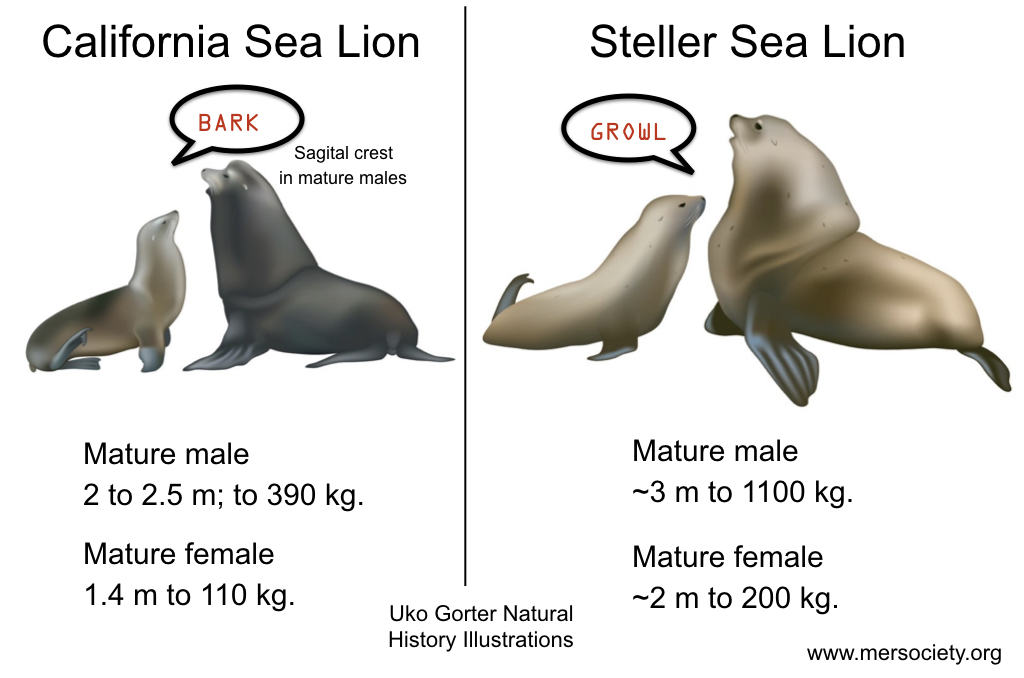
Steller sea lions - male on right. Image: Uko Gorter Natural History Illustration.


Having male Steller sea lions (Eumetopias jubatus) in our area is common. These giants (mature males up to 1,100 kg and 3.3 m) are the lighter coloured of the area’s two sea lion species.


In the last 7 years or so, we have also had some male California sea lion males (Zalophus californianus) around Northern Vancouver Island from the Fall into the Spring but they are far more common to the South.
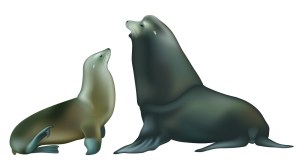
California sea lions - male on right. Image: Uko Gorter Natural History Illustration.


The California sea lions are the darker and much smaller sea lion species (mature males to 390 kg and 2.4 m). The mature males have distinct light colouration on parts of their head and a very unique shape to their foreheads. However, beyond these very apparent physical differences, you could be blind and still tell California sea lions and Steller sea lions apart! California sea lions bark. Steller sea lions growl.

The sea lion activity I witnessed yesterday is really unique and all thanks to the return of the pilchard. I have never seen this many California sea lions anywhere around northern Vancouver Island and it is not often that I have seen mixed groups of both species hunting together. I checked with the locals in Port Alice and no one can recall ever seeing this many California sea lions in Neroutsos Inlet.

This phenomena has fortunately been captured on video for you to enjoy (video from the Village of Port Alice).  See below and look very carefully for the lighter coloured Steller sea lions among the barking Californians!  All these sea lions are likely to all be male. The smaller ones are the immature males.

Great thanks to the students of Seaview Elementary for caring and knowing as much as they do.  Psst, I would be watching the water very carefully because this pilchard driven food chain has transient killer whales at its top!


For locals: Added January 3rd, 2011

Update on the sea lion that crossed the road and entered the Port Alice trailer park on Dec 16th. Because he appeared to be underweight and lethargic, he was taken to the Vancouver Aquarium’s Marine Mammal Rescue Centre on Dec 18th (I think). It is a male Steller sea lion and was confirmed to be malnourished and dehydrated with no indication of what may have caused his condition. He has been named “Kaouk” after a mountain near Fair Harbour.

My great respect to the people of Port Alice for knowing to call DFO’s marine mammal response line (1-800-465-4336) and have the RCMP conduct crowd control. Ms. Henderson’s class even had made up info brochures on how to best behave around the sea lions.

Humpback Comeback Project – Please Vote!

Update: See this link for the results of the Humpback Comeback Project in the AVIVA competition.

____________________________

I have a whale-sized favour to ask . . . I need your votes.

To be exact, I need one vote a day for the next 10 days and your support in spreading the word to generate more votes for our “Humpback Comeback” research project.

It is of huge importance to me and the others in our small group of dedicated whale researchers on the Northern Vancouver Island (British Columbia) who, for the past 7 years, have been using our own boats, fuel, and equipment to try to learn more about humpbacks.

We have a chance of getting support through the Aviva Community Fund for an essential study to determine the rate of entanglement of humpbacks in B.C.  (whales getting caught in fishing gear). In a well-studied area of the North Atlantic ocean, about 75% of humpback whales have been tangled up in fishing gear at some point in their lives but there has been very little research into this threat to humpbacks in British Columbia.

Our motivation for this project is a direct result of what we have observed locally. See below for a very recent example of the severity of entanglement injury to a local humpback. The shocking images are of the before-and-after-entanglement of a whale we have nicknamed “Sharktooth” (no DFO catalogue number yet).

Please start voting today and up to November 26th, so that we might move on to the semi-finals.

Everyone has 10 votes (one vote a day), and you can vote for the same idea all 10 times.

So use your votes, tell your friends, and use Facebook or other social networks to spread the word! Please.

You need to register to vote at this link.

Then, please click the link in the email that is sent to you. You can then vote for the “Humpback Comeback Project” every day by clicking here.

Great thanks.

"Sharktooth" on June 20, 2010 - no injuries. Photo: Jackie Hildering. Click to enlarge.

"Sharktooth" on October 2nd, 2010 - with entanglement scarring. Photo: Bruce Paterson. Click to enlarge.

"Sharktooth" on October 2nd, 2010 - with entanglement scarring. Photo: Bruce Paterson.

"Sharktooth" on October 2nd, 2010 - with entanglement scarring. Photo: Bruce Paterson.

Too Smart To Be “Nice” – Pacific White-Sided Dolphins Interact With Dall’s Porpoise Calf

Before you read further, a reminder:  There is no “good” or “bad” in Nature. There is only perfection. Animals do what they do for a reason. We humans may not understand their behaviour but to impose judgement is ridiculous. There is always a net gain for some of the animals involved.

Yes, this is me making very clear that to either typify dolphins as “good” (the Flipper phenomena) or “bad” is sheer anthropomorphism and does nothing to enhance the understanding of animal behaviour.

Dolphins are dolphins and they do what dolphins need to do.

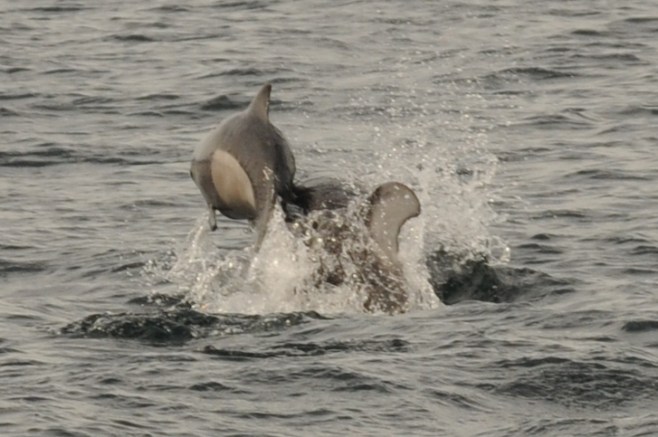
Dall's porpoise calf hit from below by Pacific white-sided dolphin.

Dall’s Porpoise calf hit from below by Pacific White-Sided Dolphin. ©Jackie Hildering.

Okay, now that I have made that very clear, I dare share the exceptional encounter I stumbled upon today. I found two adult male Pacific White-Sided dolphins negatively interacting with a Dall’s Porpoise calf.

I know there were only two dolphins as they had distinct dorsal fins allowing me to track them as individuals. I know they were adult males since the fins of adult males tend to be chunkier and are often more scarred. I perceive that it was a negative interaction since the two dolphins were corralling the Dall’s Porpoise calf; hitting it with their tails at the surface; pushing down on the calf’s head and hitting it from below.  It was an encounter that I witnessed for 10 minutes and was very persistent and intense.

I also saw what I think were only two adult Dall’s Porpoises repeatedly surfacing some 30 to 40 metres away from the interaction between the calf and the two Pacific White-Sided Dolphins.

In years past, I have seen this species of dolphin kill a Harbour Porpoise and a Pacific Harbour Seal pup. It is quite a regular occurrence for these dolphins to interact with fish-eating (“Resident”) Killer Whales in such a way that the Killer Whales dive longer, go silent and group up. Their interactions with Humpback Whales most often lead to the humpbacks “trumpeting”, rolling on the surface and slapping with their long pectoral fins. Such interactions are categorized in science as “harassment”. 

Dolphins are smart. Very smart.

I put forward that interactions like this allow them to learn, to feed their hungry brains.  If this does not sound plausible to you then you don’t have a younger sibling! Those of us who do have younger siblings know how “provoking” also allows young humans to learn. It allows them to find out “What happens when I do this?” “How about this?” “And when I do this?”

Dolphins are extremely social animals too. I believe such interactions allow the dolphins to exercise social bonds and strategize. The males of some well-studied dolphin species (e.g. Spotted dolphins and Bottlenose Dolphins) have been found to have “coalitions” / “alliances”; social units that allow them to group defend, group feed and group mate.  The Pacific White-Sided Dolphins off the coast of British Columbia are only beginning to be studied as individuals so science has yet to confirm what sort of social structures they might have.  My hypothesis is that the two Pacific White-Sided Dolphins from today’s interaction have an alliance.

I cannot give you a conclusion to the interaction I witnessed today. When I last saw the porpoise calf, it was alive. However, as fate would have it, I had boat engine difficulty and therefore “lost” the animals as I dealt with my boat woes.

I have annotated the photos at the following link, leaving them in chronological order so that you can see how the interaction developed. I have also provided notes that will help you discern the two dolphins as individuals. Photography was challenging due to wind and the speed of the action.

Remember, no judging the wild. 

Click here for the photos.

Click here for a study documenting “porpicide” of Harbour Porpoise by Bottlenose Dolphins.
Click here for article about Southern Resident Killer Whales (inshore fish-eaters) harassing Harbour Porpoise.
Click here for the population studies by Erin Ashe (Oceans Initiative) published since my writing the blog = Ecology of Pacific white-sided dolphins (Lagenorhynchus obliquidens) in the coastal waters of British Columbia, Canada (2015)

Come Away With Me

Come on. You know you want to, just for 3 minutes.

Come on the dives I did today.

The little slide show I have put together, is a testimony to the grand, jaw-dropping biodiversity of this area (Northern Vancouver Island, B,C., CANADA).

The Minke whale we saw, the fish using a sponge as a hammock, the bald eagle chick that took one of its first flights – all these are animals that I have learned from by knowing a small part of the world’s ocean well enough to be able to recognize individual animals.

Such a privilege and such a joy to share with you.

Come away with me . . . . click here.

Sperm Whales – Magnificent and Misunderstood

It was on July 16th, 2010 when I saw Sperm Whales for the first time off the coast of British Columbia and my world rocked.

This whale species is unlike any other and is extreme in so many ways.

Sperm Whales:

  • Make very long and very deep dives
  • Have the biggest brains
  • Are the largest toothed animals
  • Make the loudest sounds
  • Have a very strange common name reflecting great misunderstanding
  • Were hunted intensely
  • And are so very, very unique looking.

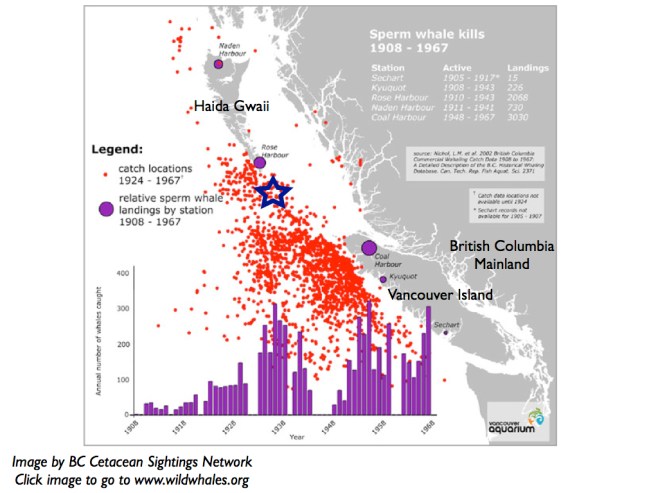
I saw the Sperm Whales while having the joy of being a Marine Mammal Observer on DFO’s Cetacean Research Program’s offshore survey. I first saw them in the area where I have put the blue star on the map below. You’ll note from this image that this area off the continental shelf is where many sperm whales were “taken” by whalers. It is in deep waters like this that sperm whales find their prey of deep ocean fishes and squid (from medium-sized squid species to the giant squid).

Sperm Whales inshore of Vancouver Island are exceedingly rare. There was one documented in February 2018 near Telegraph Cove by Lisa Larsson of OrcaLab and Jared Towers of DFO. In late fall of 1984 Dr. John Ford of DFO recorded the clicks from one in Johnstone Strait near Telegraph Cove (source: Ford, Marine Mammals of British Columbia).

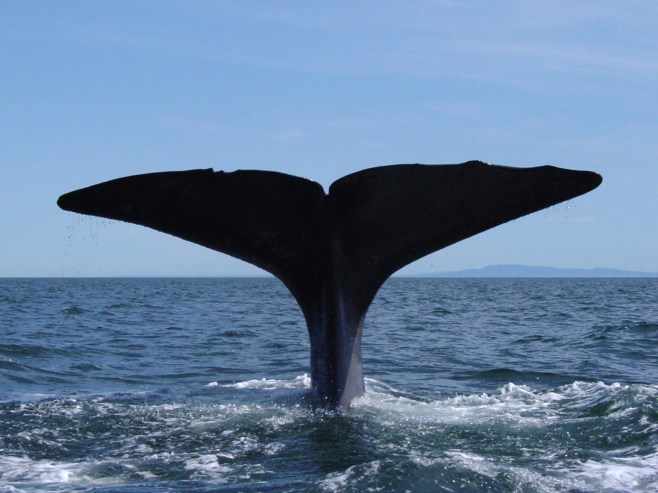
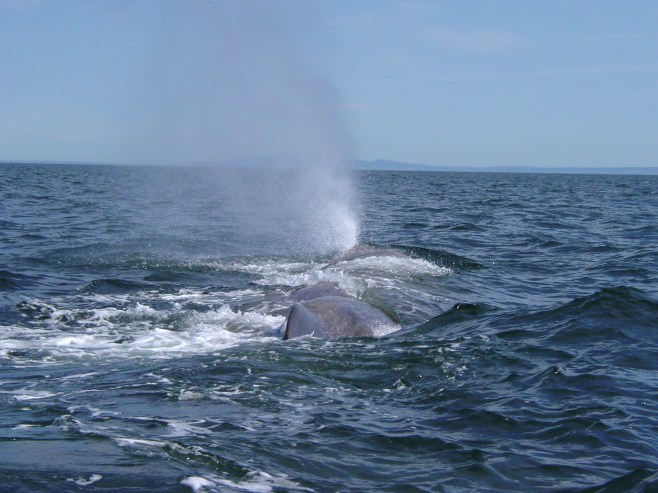
Our first clue that we might be sighting Sperm Whales was the very unique blows that veer sharply off to the left. Through binoculars we could confirm the species ID by seeing the animals’ colossal heads and wrinkly skin and, when they descended for a long and deep dive, it was indisputable that we were seeing Sperm Whales. The distinctly shaped tails came high out of the water, straight up and down and the animals descended as if slowly going down in an elevator. I found myself gasping in amazement when I first saw this. (Note that the images below showing the Sperm Whale’s dive and blow are not from the research trip in B.C.)

Down he went. Down, down, down. The dive could take up to 90+ minutes and could be to a depth of 1185 m (most dives to ~400 metres for 35 to 60 minutes). That’s more than 100 atmospheres of pressure!  (One weblink I provide below provides video of a Sperm Whale at this depth.)

Apparently an average Sperm Whale’s dive profile is to slowly descend for 10 minutes, hunt at depth (more often at 300 to 800 m) for approximately 25 minutes, then slowly ascend for 10 minutes. The whales then stay at the surface for some 8 minutes, taking up to 90 breaths (range of 20 to 70) to offload carbon dioxide and reload oxygen into their blood and muscles.

This long period at the surface is when they were an easy target for the whalers. Yes, Moby Dick was a Sperm Whale but the ferociousness portrayed by Herman Melville in this classic novel is pure fiction. Were Sperm Whales to attack and swallow people whole, they may not have been so terribly exploited. We humans wanted their blubber, their spermaceti and their ambergris. Ambergris is found in the intestines (see previous blog item) and “spermaceti” is a semi-liquid wax found in the Sperm Whales’ huge heads. Early whalers thought it was a reproductive material which is why the species has its strange common name. Science now believes that this material has a role in buoyancy by being cooled and contracting to become more dense when the whale is diving and then becoming heated and expanding to allow the whale to ascend from such great depths. It may also have a role in sound production.

In the dark world to which the Sperm Whales descended, they find their prey through echolocation. These clicks act like an “acoustic flashlight”. They go out from the whale’s huge head and, when they bounce off an object and “echo” back, this allows the sperm whale to form an image of its surroundings and prey. (I also provide a weblink below that provides amazing, but very worrying, video of a Sperm Whale using echolocation to take fish off a longline = “depredation”).

As well as these slow and regular echolocation clicks, Sperm Whales also make really loud clicks called “codas”. Codas are believed to allow the Sperm Whales to communicate with one another, maybe in a way like we humans use Morse code. Listen to the Sperm Whale that was in Johnstone Strait in February 2018 at this link. 

I don’t know that anyone can be quite the same after an enormously privileged experience like seeing a Sperm whale. I was left stunned with a cocktail of emotion surging through me that included wonder, joy, passion and resolve. More passion for conservation and more resolve to share these experiences to make them count.

Male adult Sperm Whale going of a deep dive. Image by Peter Jucker; taken in the St. Lawrence.www.juckiwildlifephotography.com

Typical Sperm Whale blow = low, bushy, explosive and at a sharp left angle.Image by Peter Jucker; taken in the St. Lawrence.www.juckiwildlifephotography.com

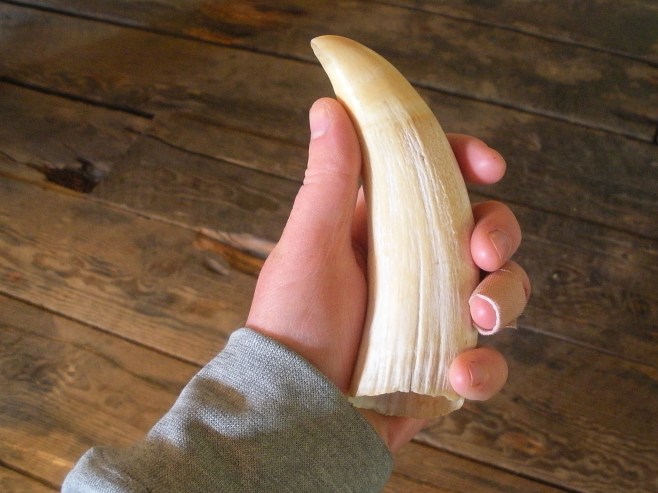
Sperm Whale tooth. Image by Louisa Bates of Telegraph Coves Whale Interpretive Centre.www.killerwhalecentre.org

Many thanks to Peter Jucker and Uko Gorter for their great generosity in sharing images for the purpose of education and conservation.


Links to Sperm Whale sound and video:


Sources:

Great resource for further information on Sperm Whales off British Columbia’s coast: John Ford’s 2014; Marine Mammals of British Columbia: Royal BC Museum Handbook; available via the Royal BC Museum and Amazon.ca .

AOKI, KAGARI; MASAO AMANO; KYOICHI MORI; AYA KOUROGI; TSUNEMI KUBODERA and NOBUYUKI MIYAZAKI (2012) Active hunting deep-diving sperm whales: 3D profiles and maneuvers during bursts of speed. Marine Ecology Progress Series 444:289-301.

Hakai Magazine, August 2021, Why We Can’t Shake Ambergris

Watwood SL, Miller P, Johnson M, Madsen PT, Tyack PL (2006) Deep-diving foraging behaviour of sperm whales (Physeter macrocephalus). Journal of Animal Ecology 75: 814-825.

Whitehead, H. (2003). “Vertical Movements: The Sperm Whale’s Dive”. Sperm Whales Social Evolution in the Ocean. University of Chicago Press. p. 79.

Of Humpbacks and Waterfalls

This comes to you from the Coast Guard ship the J.P. Tully where I have the great good fortune to serve as a marine mammal spotter for the next days.

BCY0057 nicknamed “Niagara”.

We have been recording many humpbacks sightings but today, while the larger ship was being fuelled in Port Hardy, we were able to do some work from a zodiac, allowing for a better opportunity to ID the humpbacks as individuals.

I share with you the experience of seeing one of these individuals, the humpback carrying the DFO (Department of Fisheries and Oceans) ID number BCY0057.

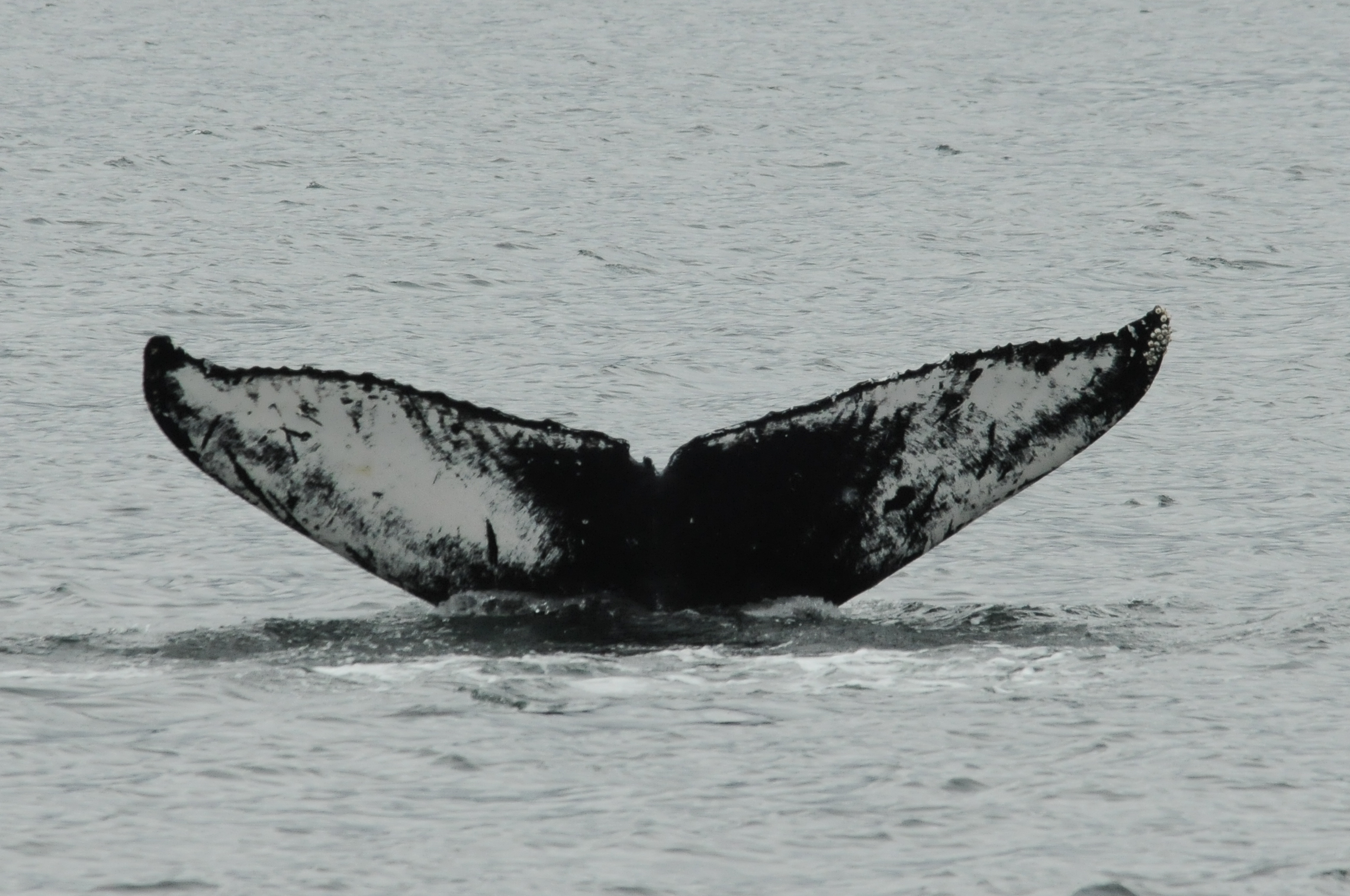
It is the easiest to ID humpbacks as individuals by using the unique markings of their tails. This particular humpback was one that we very quickly were able to recognize due to a very distinctly shaped white spot near the centre of its tail. The marking is in the shape of a waterfall so, since “BCY0057” is not an easy name to remember, locally this whale is known by the nickname . . . Niagara.

We know that Niagara is about 10 years old due to Dr. Alexandra Morton having taken a picture of the whale in 2000 when it was travelling with his mother.  As a further result of these photo records, we also know that Niagara’s mother is BCX0022 (aka “Houdini”), one of the most prolific humpbacks known to research. She had 5 calves in 7 years, quite the feat considering that humpbacks are pregnant for about a year.

Today’s experience of seeing Niagara again was moving.  It was also ideal from a research perspective since we were able to get good ID shots of the tail and both sides of the animal and, since Niagara was feeding at the surface, it was possible to collect scale samples of the fish being fed upon. DNA testing of these scales will confirm what species of fish Niagara was eating.

At the link below, I share with you an image of Niagara “lunge feeding” so that you can get a sense of how far the throat pleats of humpbacks distend to allow huge volumes of food and water to be engulfed. Reportedly up to 20,000 litres is taken in per mouthful. The water is then pushed out through the baleen.

The image also shows you the “beard” of barnacles on Niagara’s throat pleats. These species specific barnacles will surely be a topic of a future blog.

And, if you look very carefully, you’ll see Niagara’s right eye with lids closed.

Duty calls  . . . .

Click here for the image of Niagara (BCY0057) lunge feeding and for a larger ID photo.

Seeing Whales – Seeing Red

I saw A12 swim by today. A12, also known as Scimitar, is an old female killer whale of the “Northern Resident” population of fish-eating, inshore killer whales. She is about 69-years-old (known as the result of the photo-identification work of Dr. John Ford, Graeme Ellis and the late Dr. Michael Bigg).

A12 is the grand dame of the first family of killer whales I ever saw; an experience that had an impact on me that I will never fully be able to explain. It led me to make a radical career change, moving back to Canada to work as a marine educator on the very waters where I first saw A12.

Seeing her today was as powerful an experience for me as it was the first time I saw her but  . . . there was sadness too and, there was anger.

Last year her son A33 “Nimpkish” went missing. He was around 38-years-old. Mother fish-eating killer whales never leave their sons so we knew there was very little chance of ever seeing him again. Indeed, no one ever has.

With A33 gone, A12 would still sometimes travel with her daughter A34 and A34’s calves and grand-calves but she was also often on her own. Then, as of July 22nd, she was frequently seen with “the three brothers” (the A36s); three mature male killer whales whose mother went missing in 1997. As the only surviving offspring, these males were always together. A12 is closely related to them and it was remarkable to see how the mother with no son, interacted with the sons with no mother.

Today, there were only two of the three brothers near A12. The eldest, A32 (aka “Craycroft”) who was around age 46, is now missing.

Another male killer whale gone.

And this is what laced my experience today with anger. But why?  Whales, like everything else, die.

I assure you I am not being overly sentimental. It will never be conclusive what made these whales die but, but, BUT we humans definitely had an influence. Their health, in fact, is an accurate mirror of how our actions impact the environment.

The whales, with their position high in the marine food chain, are full of chemicals like fire retardants and pesticides (the work of Dr. Peter Ross). Despite the many lessons learned with the likes of chemicals like PCBs and DDT, which were banned in 1977, we still do not appropriately test new chemicals and we use chemicals with reckless abandon. The toxic reality is that the ocean is a soup of chemicals – including the old and new (e.g. PBDEs) “persistent organic pollutants” that do not break down; “travel” to the colder areas of the world; build up in the food chain (bioaccumulate and biomagnify), and reduce animals’ ability to fight disease and reproduce.

A32 was above average age for a male killer whale but “average age” has been determined from the data available only after our use of these chemicals. It is not believed to be natural that male killer whales (and the males of many other marine mammal species) die at a much younger age than the females. Their earlier demise has to, at least in part, be due to their toxin loads being much higher than the loads in the females. The females’ toxin levels are lower because females download these fat-soluble toxins in the fatty mother’s milk, to their calves (of course with negative impacts to the calves).

These chemicals had to have an impact on the missing mature males and, the situation literally becomes all the more toxic, when coupled with lack of food. When the whales do not have enough food and use up their fat reserves, the toxins become more concentrated. And 2008 was an appalling year for Chinook salmon, the salmon species essential to the survival of killer whales of the “resident” populations. The work of Dr. John Ford has shown that there is a direct correlation between the survival of these killer whales and the availability of Chinook salmon and, of course, we humans impact the survival of salmon  . . . by habitat loss, over-harvesting, climate change, current open net-cage salmon farming practices, etc.

So today, as I witnessed A32 no longer being with his brothers, I felt the wave of rage come up inside me. Missing whales causes reflection on the state of the environment due to human over-consumption, lack of precaution and disconnect from Nature.

But the wave passed shortly after the whales did. For there is still every reason for hope. As long as people care enough to change, there is hope. The potential for change is endless and there is ample evidence of humanity, increasingly, moving in a direction that considers the link between our daily actions and whales like A12, A33 and A32.

Indeed, there is ample reason for hope as long as there are people like you who read to the end of a lengthy blog entry like this.

Take one further step and click on this link to find out how easy it is to help the whales, and ourselves.

Thank you.

Killer Females – Menopause and Nature’s Plan for Older Females

The most valuable lessons I have learned about being female, I have learned from Killer Whales. For example, it is through my knowledge of these highly cultured whales that I know Nature’s plan for older females.

Let’s face it, human society does not generally help in this regard. As time etches lines into our interiors and exteriors – society does not tell us we are a-okay!  No, the general messaging is about loss, faded youth and endings. Firm up! Dye that hair! Want some Botox baby? We’re sweeping you aside, ‘cause you’re old!

Thank goodness I believe in Mother Nature.

One of my teachers – A12 aka “Scimitar”; born around 1941 and now passed away. She was a Northern resident (fish-eating) Killer Whale who was the grand dame of the A12 matriline.

As I weather the physiological and psychological changes of this time of my life, I know there is purpose in all this. Humans and Killer Whales are among the very few animal species where the females go through menopause; where they can live beyond their child-bearing years as “post-reproductive females”.

In the case of Killer Whale females, they can give birth between the ages of around 12 to 40 but are believed to be able to live to at least age 80. Thereby, female Killer Whales may live almost twice as long as they have babies. On the face of it, this appears to violate one of Mama Nature’s great laws. That is, if you’re going to use our food, you better pass on our genes.

But Nature makes sense. Therefore, the role of post-reproductive females must be so valuable that it “justifies” their using the population’s resources.

Science in fact believes that the old female Killer Whales are the teachers and decision-makers. These grandmas, wizened by their years, are believed to teach mothering skills, how and where to hunt; and they are known to share food, especially with their eldest son. These activities would benefit the population by ensuring that the offspring are better able to survive and mate . . . passing on shared genes. Since first posting this blog a decade ago, there has been further science published on this. Please see sources below. 

The likely role of the old females has been acknowledged in science with the convention being that each family group of Killer Whales is named for the eldest female (e.g. the A12s). Also, the collective name for a group of Killer Whales is “matriline” which loosely translates into “follow your mother”.

Female Killer Whales have taught me that I am not less as I age but rather that there is teaching to be done and leadership to be embraced.

These years are to be lived . . . as a killer female.

Another one of my teachers – A30 aka “Tsitika” with one of her sons, A39 “Pointer”. ©Jackie Hildering.

Studies related to my reflections above:

Whale Vomit?!

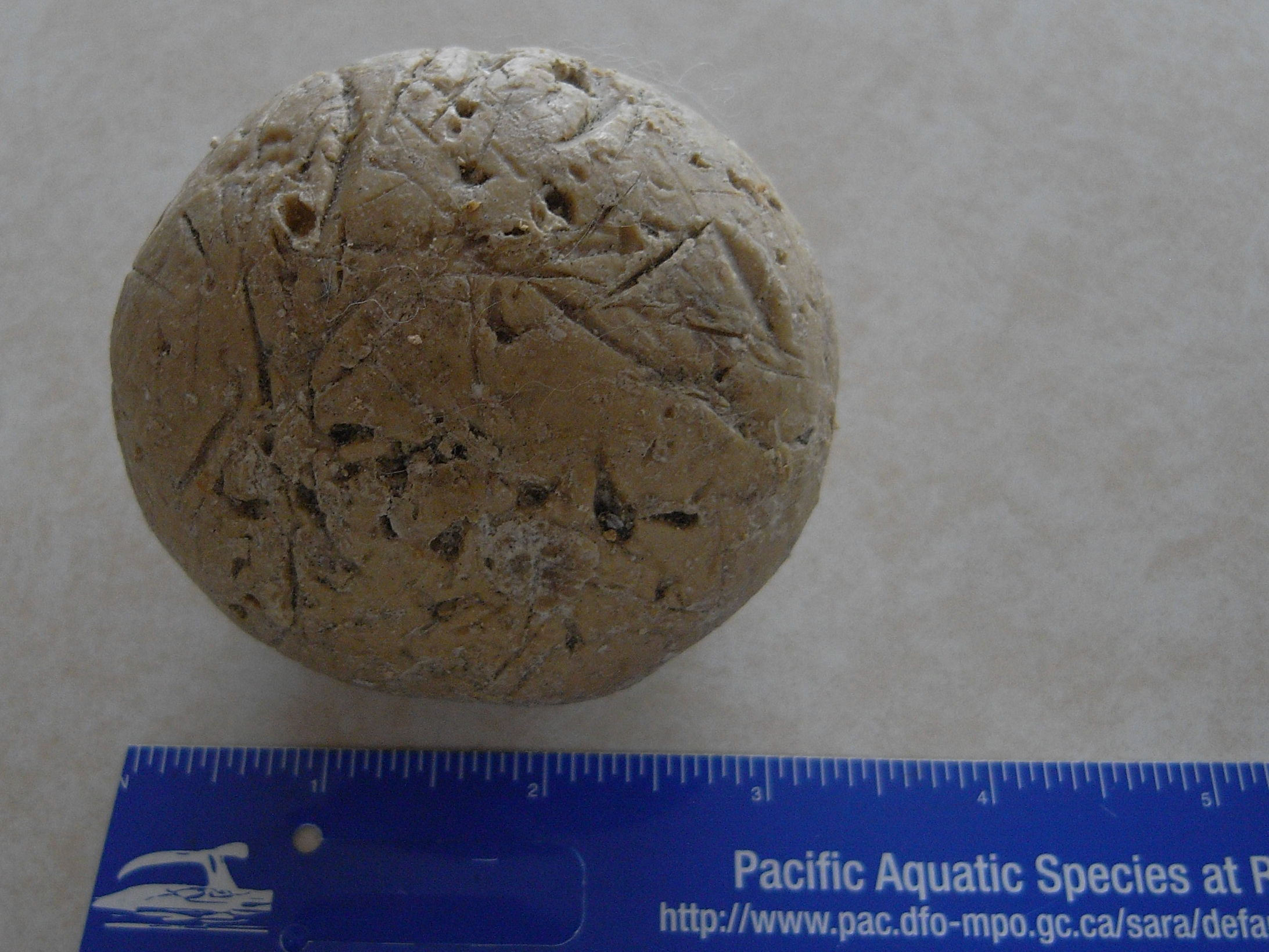
Mystery mass – ambergris? 3 inches wide (7.6 cm)

Recently, I was contacted by a local family about their very unique find on a beach on Southwest Vancouver Island. Their email had the entertaining subject line of “Whale Puke – Hopefully?” and contained pictures of what they had found.

I was amazed at how they had narrowed down what the strange looking masses might be  . . . ambergris (pronounced “amber-grease”; from the French for gray amber), a substance produced in the intestines of sperm whales.  And . . . ambergris is extremely valuable; apparently worth up to $20,000 USD per kg. It has a musky, very distinct odour and has been used in perfume as a fixative (to stop it all from evaporating quickly). It has also been used as food flavouring and medicine.  Apparently it was even believed to cure the plague.  Yes, sperm whales used to be intensely hunted and the hope of collecting ambergris was one of the reasons why.

The sperm whale is the largest toothed whale species. It has a head up to 1/3 of its body (Physeter macrocephalus = big head) and can dive to depths of 3,000 m. We humans have so much to learn about whales that are far less deep diving.  You can imagine what knowledge gaps there are for an animal that dives to such great depths and for so long; up to about an hour. (Click here for a detailed “The Marine Detective” posting on the sperm whale). 

So how and why do sperm whales create ambergris?  

It is believed to be caused by the beaks of the giant squid irritating the sperm whale’s intestines. However, ambergris may not be “whale vomit” at all, but rather, it may come with “whale poop”.  Apparently, when “fresh”, ambergris smells more like it comes from the anus. Some scientists believe it does get regurgitated (vomited up) if the piece is particularly large.

Was the family’s mysterious material the highly valuable ambergris? It seemed possible. We have sperm whales off the B.C. coast and the material was resinous, less dense than water and looked like some of the images of ambergris I could find online.

They found two masses, each about the size of a goose egg.  They dropped one and it fragmented and crumbled, some pieces darker and clearer than others. But, there were no bits of squid beaks nor was there a really distinct musky odour.

I wanted to be sure, so I contacted the wonderful Dr. John Ford, DFO’s head of Cetacean Research at the Pacific Biological Station in Nanaimo. He very kindly relayed a test that would prove whether it was the highly prized ambergris – or not.  If you heat a wire or needle to red hot and stick it into ambergris to about a centimetre’s depth, it melts into an opaque liquid the colour of dark chocolate and leaves a tacky residue on the wire/needle.

When I carried this out, the material did melt and leave a residue but it was a lighter brown material. It did not melt like chocolate. There was a distinct sizzling sound and a small puff of smoke. There was still no distinct musky odour.

So what could it be?  I decided to take about a teaspoon of the crumbs and melt them down and, when I saw the result, I had an idea.  The material was oily, it melted easily, it had small dark flecks in it. Why – it looked like used cooking oil!

Not ambergris but – cooking grease?!

It’s my best guess to date.  That a boat somewhere out a sea, dumped cooking oil. It solidified and got rolled around on the beach, rounding it and pitting it. Why were there two masses of about the same size? I have absolutely no idea. Feel free to offer any hypotheses.


 For further details to identify ambergris and where to sell it, go to http://www.ambergris.co.nz/identification 

Click here for my bundling of links  on B.C.’s sperm whales – includes video, sounds, information about the historical whaling of sperm whales and articles about ambergris.

Article related to finding a high-quality synthetic alternative for use in perfumes.  UBC Press Release: April 5, 2012; “How to make high-end perfumes without whale barf”

Hakai Magazine, August 2021, Why We Can’t Shake Ambergris

July 2023, Pathologist finds €500,000 ‘floating gold’ in dead whale in Canary Islands – Team hope sale of block of rare ambergris, used by perfumers, will help victims of 2021 La Palma volcano