Sharks Among Us #2 – The Bluntnose Sixgill Shark
Update May 1, 2023: Original blog is from 2011. I have added photos of additional, known dead Sixgill Sharks at the end of this blog.
And yes, there is a personal connection to this species. While these huge sharks are often in very deep water, I have seen them while diving in at depths of even less than 10 metres. It’s difficult to express the wonder and connection that results from these privileged experiences. It’s somewhat like seeing a living dinosaur. Bluntnose Sixgill Sharks have been perfected by 200 million years of adaptation.
They are not a threat to us. We are a threat to them.
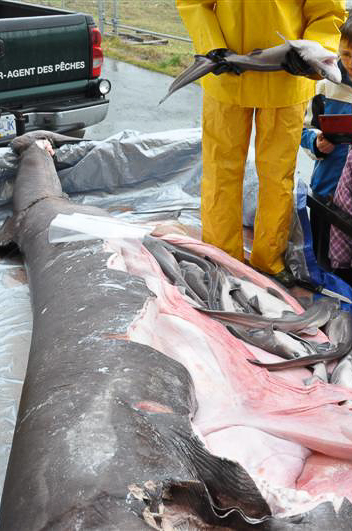
The awe-inspiring images below are of a pregnant female Bluntnose Sixgill Shark (Hexanchu griseus) who was found dead on a beach in Alberni Inlet on low tide in February of 2011. She was necropsied by Department of Fisheries and Oceans staff and there were no obvious indications of how or why she died.
The information below has been generously provided by shark biologist and friend, Romney McPhie. I am sharing in the hopes of increasing respect and understanding for these astounding, huge, deep-dwelling sharks who live off our coast.

This female Sixgill was 4.2 metres and was estimated to weigh 569 kg (1,254 lbs). As a viviparous shark species, she carried her embryos through the entire gestation period which is thought to be over 2 years long (species does not lay eggs / egg cases).
She may have given birth to some prior to her death and still had 28 pups inside her. The young hatch inside the female’s body before entering the ocean (these sharks are “yolk-sac viviparous”).
Sixgill Sharks have been reported to be up to 4.8 metres in length with females being larger than males (males to 3.5 metres). Age of sexual maturity is estimated to be between age 11 to 14 for males and between 18 to 35 years for females. It is believed that life expectancy may be up to 80 years of age.
The Committee on the Status of Endangered Wildlife in Canada (COSEWIC) 2007 assessment report on the Bluntnose Sixgill puts into perspective how rare an opportunity it is to learn about a pregnant Sixgill. It relates that the number of pups carried by females is known from only three previous credible accounts (ranging from 47 to 108 pups which were 61 to 73 cm in size).
The Bluntnose Sixgill Shark is an extremely cryptic species that can dwell at depts up to 2,500 m. So little is known about them and (sigh) they are “near threatened” globally and are a species of “special concern” in Canada.
I have had the incredible privilege of seeing Bluntnose Sixgill Sharks while diving and felt like I was in the presence of greatness. They are living fossils, perfected by 200 million years of adaptation. They are amazingly graceful with large, luminous and intensely green eyes.
They are of absolutely no threat to humans and, like all sharks, have an essential role in marine ecosystems. As top-level predators, sharks strongly shape food webs and the loss of such predators has proven to have profound effects on the number and diversity of other species.

We, however, are a threat to them.
There were historical fisheries and bycatch remains a concern. From 2006 to 2009 there an estimated 1979 Bluntnose Sixgill Sharks were Commercial Hook and Line catch
There is no information on the survival rates from bycatch nor of the accuracy of bycatch reporting. Population size and reproductive rate are not known for this species.
“The primary threats identified for these species are entanglement and bycatch. Other threats identified include pollution, habitat loss or degradation, climate and oceanographic change, and harassment. Historic threats included directed fisheries and entanglement/bycatch. While these populations are migratory throughout the northeast Pacific, it is unknown whether threats occurring outside of Canadian Pacific waters have an impact on these populations.”
Further from the 2022 Fisheries and Oceans Canada Report on the Progress of the Management Plan for Bluntnose Sixgill Sharks:
“The present population size and abundance trends are not known. The only available abundance index (encounter rates with immature Bluntnose Sixgill Sharks at a shallow site in the Strait of Georgia) has decreased significantly (>90%) in the last five years. This index is not likely representative of the overall abundance trend because only immature Bluntnose Sixgill Sharks are encountered and the site is shallow relative to the preferred depth range. The principal known threat to the species is fishing.
The Bluntnose Sixgill Shark has been the focus of at least three directed fisheries in Canadian waters, most recently in the late 1980s and early 1990s. It continues to be caught as bycatch, but survival of released sharks is unknown. Bluntnose Sixgill Sharks observed by divers sometimes show scars from entanglement in fishing gear.
Because of its late age of maturity (18 to 35 years for females), it is likely susceptible to overfishing even at low levels of mortality. Little is known about the abundance and movement patterns of this species elsewhere in the world, so the potential for a rescue effect is unknown.“

Sources for the biology, threats and conservation of Bluntnose Sixgill Sharks:
Fisheries and Oceans Canada. 2022. Report on the Progress of Management Plan Implementation for the Bluntnose Sixgill Shark (Hexanchus griseus) and Tope Shark (Galeorhinus galeus) in Canada for the Period 2012 to 2017. Species at Risk Act Management Plan Report Series. Fisheries and Oceans Canada, Ottawa. iv + 20pp
Fisheries and Oceans Canada, 2012. Management Plan for the Bluntnose Sixgill Shark (Hexanchus griseus) and Tope Shark (Galeorhinus galeus) in Canada [Final]. Species at Risk Act Management Plan Series. Fisheries and Oceans Canada, Ottawa. iv + 37 pp.
COSEWIC (Committee on the Status of Endangered Wildlife in Canada). 2007a. COSEWIC assessment and status report on the Bluntnose Sixgill Shark (Hexanchus griseus) in Canada. COSEWIC, Ottawa, Canada.
NOAA, 2017. Getting to know Sixgill Sharks.


©Ron DeVries.

©Ron DeVries.
 The Marine Detective