
Beautiful Berthella – a sea slug that is not a nudibranch
[Update! As a result of writing this blog, I learned that the species has been reclassified AGAIN. As of ~February 12, 2024, this is no longer Berthella chacei. It is now Boreoberthella chacei. I’ve updated the text below and will just reference the species as the “White Berthella”.]
There’s a whole lot of mating going on right now with the sea slug species, Boreoberthella chacei also known as “Chace’s Sidegill” and the “White Berthella”.

Not a nudibranch
The Berthella are examples of sea slugs that are NOT nudibranchs. I’ve emphasized previously that “nudibranch” is not synonymous with “sea slug”.

The nudibranchs are just one of the seven subgroups of sea slugs (the Heterobranchia). Thereby, all nudibranchs are sea slugs. But not all sea slugs are nudibranchs. I realize those two sentences may make your brain feel sluggish. Sorry / not sorry. 😉
Characteristics shared among nudibranchs are that they are sea slugs that all DO have naked gills on their backs (hence “nudi” and “branch”) and adults DON’T have an internal shell.
Berthellas belong in a different group of sea slugs than nudibranchs. They are sidegill sea slugs (the Pleurobranchida order). They DON’T have naked gills and DO have an internal shell. The shell of White Berthellas is thin and white and is at least half the length of their bodies. Their gills, as the name “sidegill” suggests, extend from their side.

Specifically, the gills are on the right side, between the mantle and the foot. See them in the photo above?


Mating time

It’s typically in February and March that I see mating and egg masses for White Berthellas near northeast Vancouver Island.

I find it a marvel that they find one another. Throughout the rest of the year I see them quite spread out from one another. There can be some within a few metres of one another but with other sea slugs species, they are often within centimetres of one another.
With other sea slug species, Nature has ensured they are often very close by the species having VERY specific prey e.g. Pomegranate Aeolids ONLY feed on Raspberry Hydroids. Thereby, there are often others of your kind, nearby on this prey.
White Berthellas are reported to feed on sponges (specifically plakinid sponges like Slime Sponge, Oscarella carmela). They don’t seem to aggregate near these sponges, maybe because they are more diffuse? They must find one another by smell detected by their rhinophores and then crawl to be within proximity (this species does not swim).
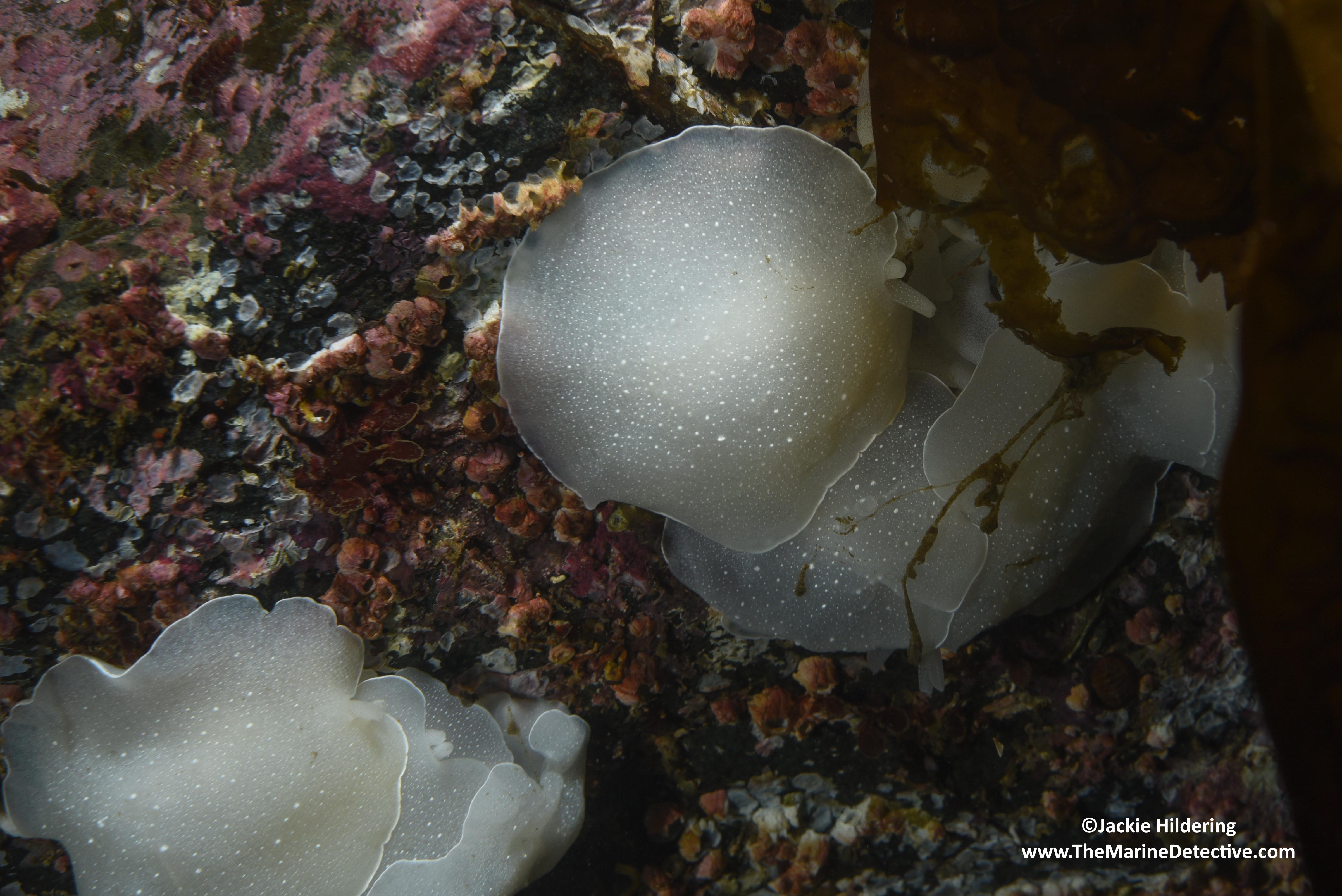
When they find one another, they appear to jostle for position in aggregations. Pairing up right-side-to-right side means that they can attach by their “gonopores” and mating can occur. Both partners become inseminated and both will lay eggs. Like other sea slugs, they are simultaneous hermaphrodites. It makes a lot of sense when you are a sea slug to maximize how many eggs are laid, especially if your young hatch out to be part of the planktonic soup of the ocean. I believe that more than one egg mass is laid per parent.
Each dot you see in the photo is an egg capsule that is only ~1.6 mm long and it contains 1 or 2 fertilized eggs. Imagine how many fertilized eggs are in the egg masses in the photos below!


The veliger larvae hatch out at the age of around 18 days in 11 to 14 degrees Celcius (it would take longer around northeastern Vancouver Island where temperatures are colder). These larvae have eyespots and shells and are around 153 micrometer long; that’s 0.153 mm! (Goddard, 1984).
Reclassification
The White Berthellahas only been recognized as being a distinct species since 2020 (Ghanimi et al, 2020). It was thought that it was one of two “morphotypes” of the California Sidegill. As mentioned in the update at the top of this blog, very recently the species has been reclassified AGAIN. it is now Boreoberthella chacei.
The White Berthella (Boreoberthella chacei) is up to 7 cm long. The body is white and has little white bumps (tubercles) randomly distributed all over its body and rhinophores. Known range is Alaska south to San Diego, California and the Sea of Japan (Behrens et al., 2022)
The California Sidegill (now also reclassified as Boreoberthella californica) is bigger on average at up to 12.7 cm. Body is white to tan and is smooth. The little white dots are uniformly spread and are not on the rhinophores. Known range is Ventura County, California to the Pacific Coast of Panama and the Galapagos Islands (Behrens et al., 2022)
The egg masses of each sea slug species are distinct. As you can see below in the compilation from the research paper, this is the case for these two species of Berthella.

Side note: How it made me smile to see that my photo of White Berthella egg masses was referenced in the research paper discerning the two species!

Sources:
- Behrens, D. W., Fletcher, K., Hermosillo, A. & Jensen, G. C. 2022. Nudibranchs & Sea Slugs of the Eastern Pacific
- Hessam Ghanimi, Jeffrey H R Goddard, Anton Chichvarkhin, Terrence M Gosliner, Dae-Wui Jung, Ángel Valdés. 2020. An integrative approach to the systematics of the Berthella californica species complex (Heterobranchia: Pleurobranchidae), Journal of Molluscan Studies.
- Invertebrates of the Salish Sea – Berthella chacei
- Sea Slug Forum (2007) – Sponge prey of Berthella from the NE Pacific
- World Register of Marine Species – Berthella chacei
- World Register of Marine Species – Berthella californica
More photos of White Berthellas mating, and their egg masses:




 The Marine Detective