Join me in the cold, dark, life-sustaining NE Pacific Ocean to discover the great beauty, mystery and fragility hidden there.

Posts tagged ‘Jellies’

Twelve Minutes With a Giant

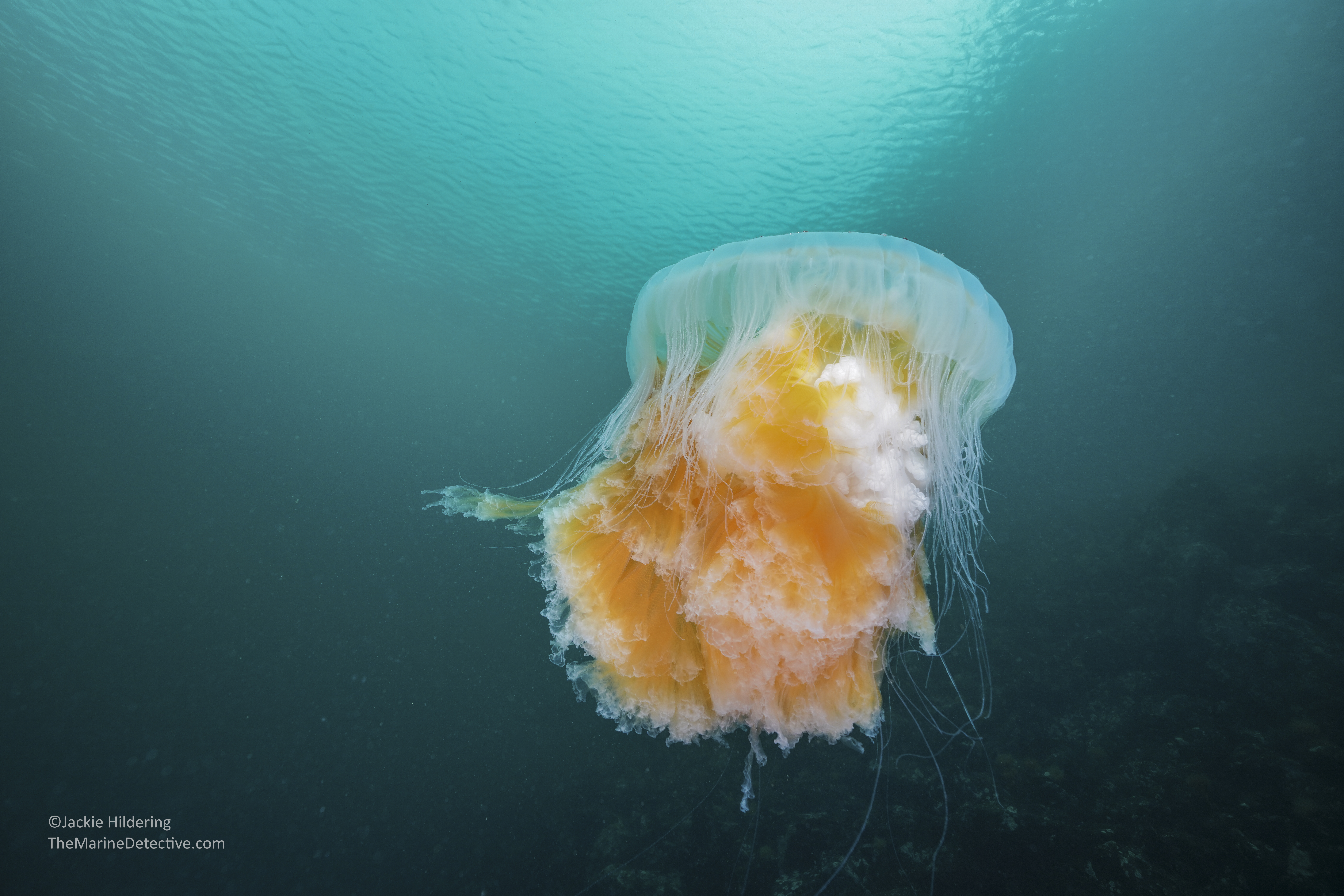
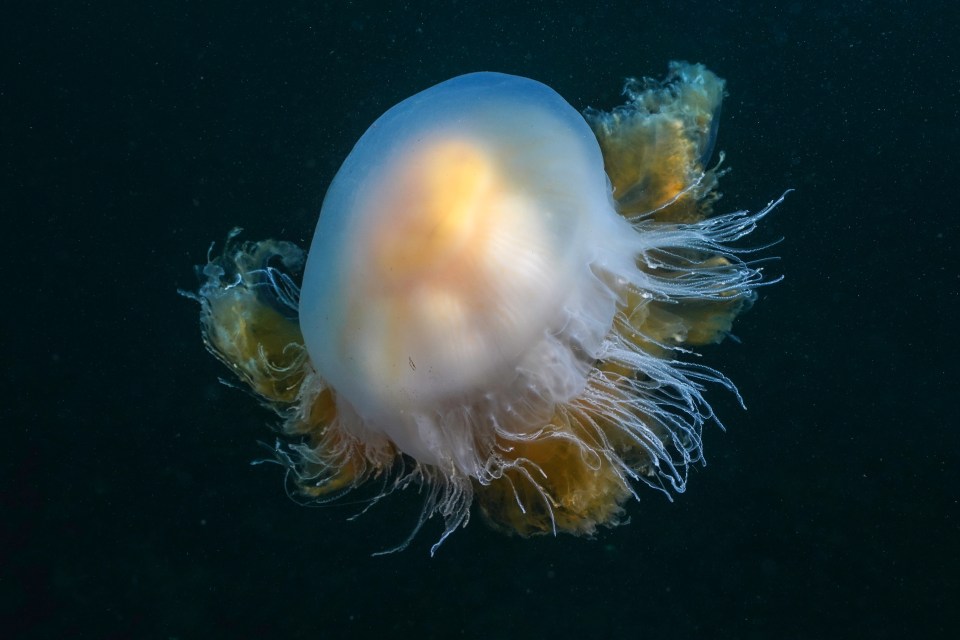
In April, there were quite a few Egg Yolk Jellies around northeast Vancouver Island. I dedicated one dive to trying to find at least one and watch it for a while. You never know what you’ll learn from a species that has survived on Earth for ~500 million years.


Egg Yolk Jellies are also known as Fried Egg Jellies. Gee, I wonder how this species got their common names? 😉 Their scientific name is Phacellophora camtschatica.

They are big at up to 60 cm across the bell. But that’s no where near as big as the other common giant jelly species off our coast, the Lion’s Mane Jelly. They can be 2.5 m across the bell (the bigger Lion’s Mane Jellies are usually not near the coast).

The yellow centres in Egg Yolk Jellies are the gonads. They can be much lighter coloured than the individuals you see here. Egg Yolk Jellies have 16 large lobes that alternate with much smaller lobe-like structures giving the bell a scalloped edge. Each lobe has clusters of up to 25 tentacles making for up to 400 tentacles (25 x 16) and they can be 6 metres long.

Egg Yolk Jelly and dive buddy Linnea Flostrand on a previous dive. ©Jackie Hildering.

I was more than 30 minutes into the dive when I saw the white, slow pulsing through the soup of plankton. The jelly was swimming in my direction. I swam toward the jelly.

For twelve minutes, I watched, photographed, and learned.

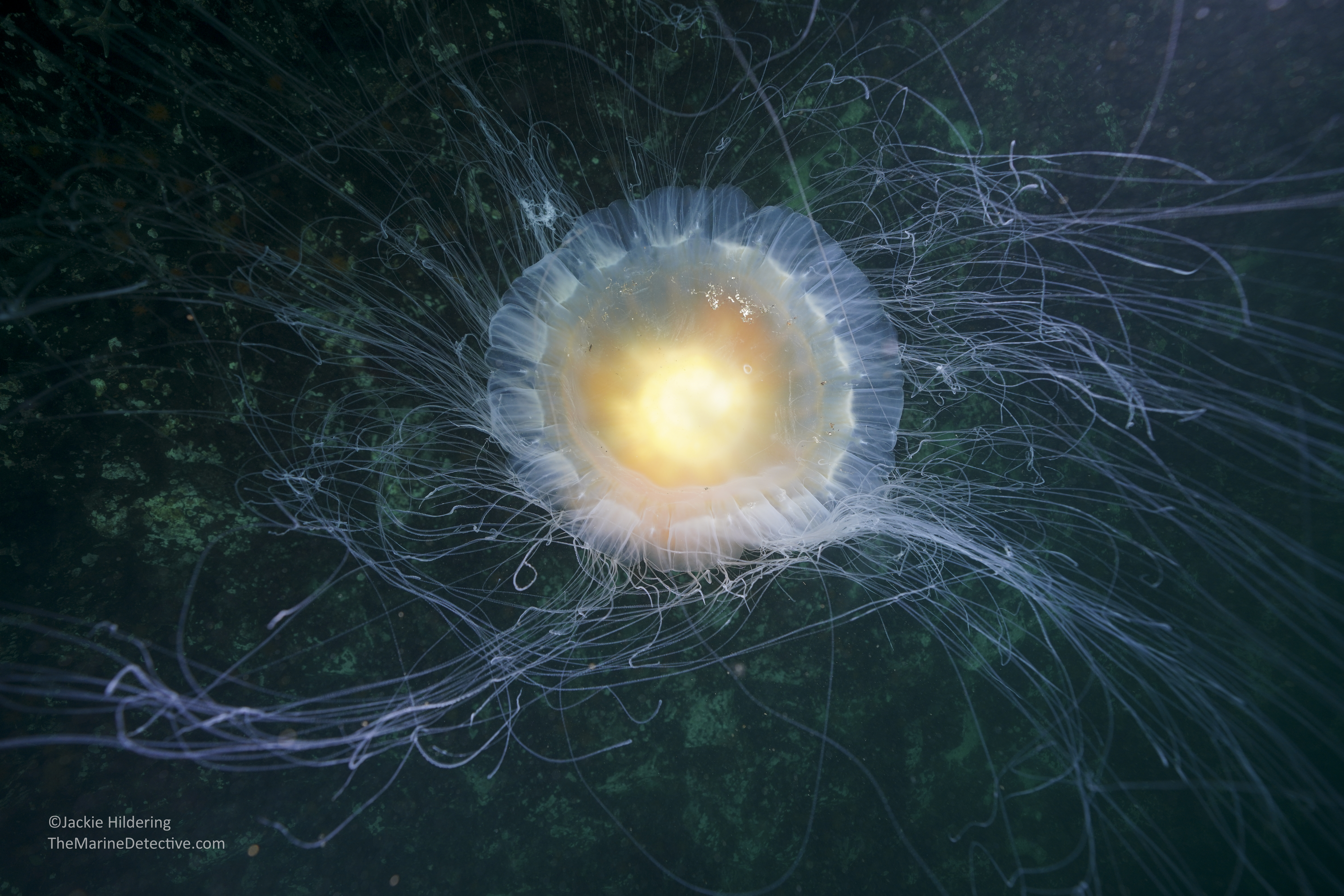
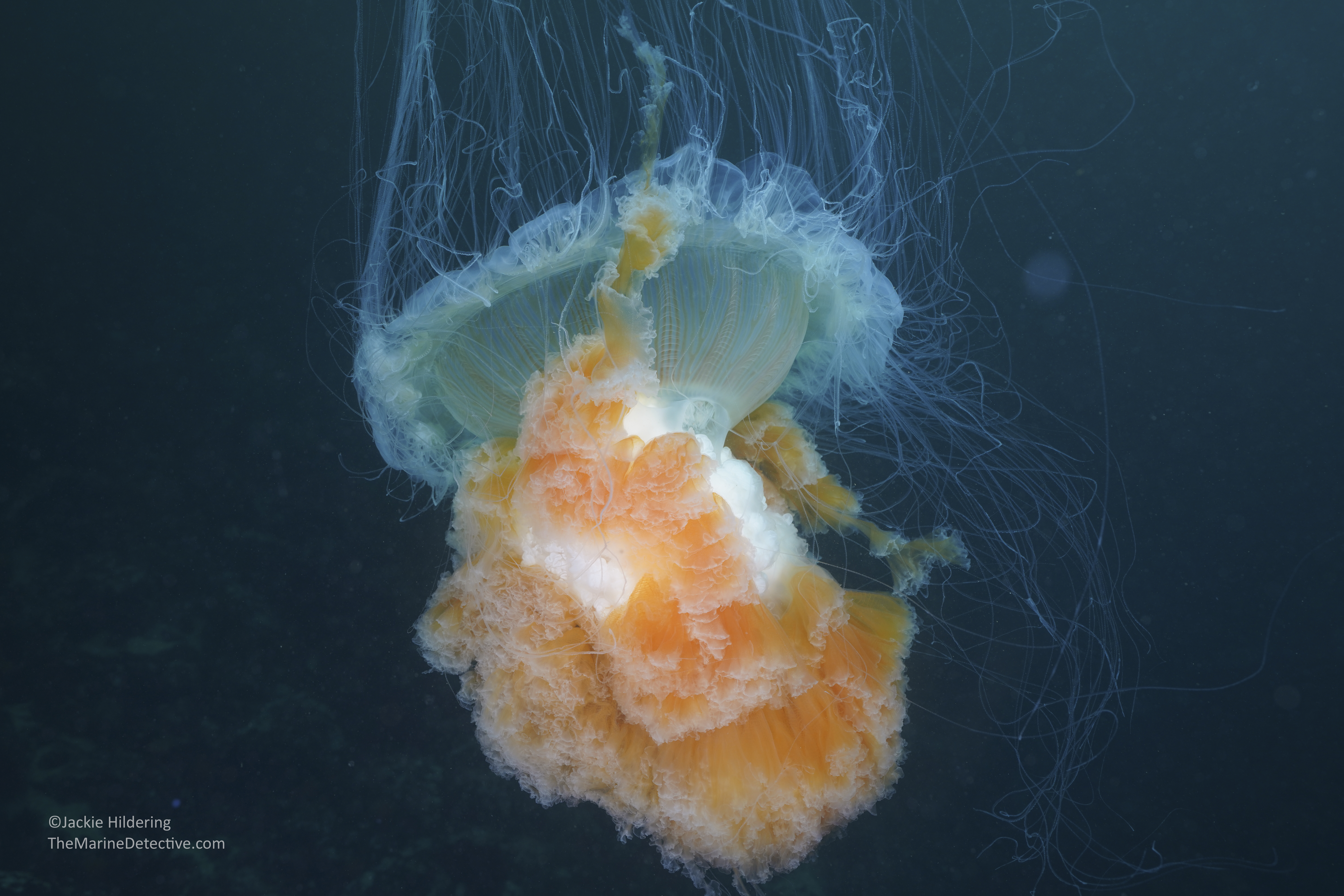
I saw how the tentacles became longer and that the jelly stopped pulsing. Motionless in the water column, the tentacles spread out like a net. See that in the series of photos below?

I don’t think there was a “catch” (they feed on zooplankton, including ctenophores and other jellies). Had there been, the tentacles with the prey would have moved toward the jelly’s mouth.

I now have a much better appreciation for how they are not “passively planktonic”. They are active swimmers responding to cues in the environment. Moriarty et al., 2012 used acoustic transmitters to tag them and noted differences in swimming speed and vertical migration dependent on time of day and tidal cycle.

Jellies have sensory structures called rhopalia.

From Rebecca Helm, 2018:
Each ropalium . . . is packed with microscopic crystals at its tip. These crystals help the jelly sense up and down, by bending in the direction of gravity, similar to our inner ear. They also have a small pigment spot, which likely helps the jelly sense basic light and dark. So far, we’ve got an animal that can tell which way it’s pointing in space, and see rough light and shadow. Next we’ve got a few mystery structures, like the little bonnet-like structure surrounding the rhopalium above, which may act like a jelly nose, helping it sense chemicals in the water . . . Each rhopalium also acts like a pacemaker, helping coordinate jelly movement, similar to the way our cerebellum coordinates ours.”

And you thought they were just “going with the flow”. 💙


All photos in the above series are of the same individual.
April 19, 2025 north of Port Hardy in the Traditional Territories of the Kwakwa̱ka̱’wakw (the Kwak̕wala-speaking Peoples). ©Jackie Hildering.


For more information about the diversity of jellies on our coast, see my previous blog post “Gob Smacked” at this link. From that blog:

Lion’s Mane Jellies and Egg Yolk Jellies. are the only two common jelly species in our waters that can create a sting that irritates human skin, even when the jellies are dead. The stinging cells (nematocysts) work even when the jelly is dead or you get a severed tentacle drifting by your face. The sting from a Lion’s Mane Jelly is reported to be worst than that of an Egg Yolk Jelly.

I’ve been stung by both and clearly it’s not been enough to deter me from striving to get photos of them. But if you have far more skin exposed or are a fisher grabbing nets with many of the tentacles wrapped in them, it is reported to be very uncomfortable.

The solution to the irritation is vinegar (acid), meat tenderizer (enzyme) and I know that many fishers swear by Pacific canned milk as well. Research puts forward that vinegar is the only real solution and that urine does not work at all.


Sources:


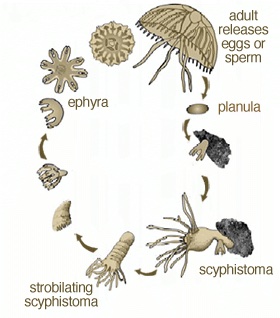
Generalized lifecycle of a jelly from Lucas, 2001 via “A Snail’s Odyssey”.
There is alternation between a polyp with asexual reproduction and a medusa with sexual reproduction.
I have not been able to find specifics about the lifespan of Egg Yolk Jellies other than “species can have a lifespan of several years.” I have questions about why we saw quite a few dead on the ocean bottom around the same time in different locations, and what that may suggest about the lifecycle.
Dead Egg Yolk Jelly in April 2025 with dive buddy, Brenda Irving. ©Jackie Hildering.

Gob-Smacked!

Otherworldly. One-worldly!
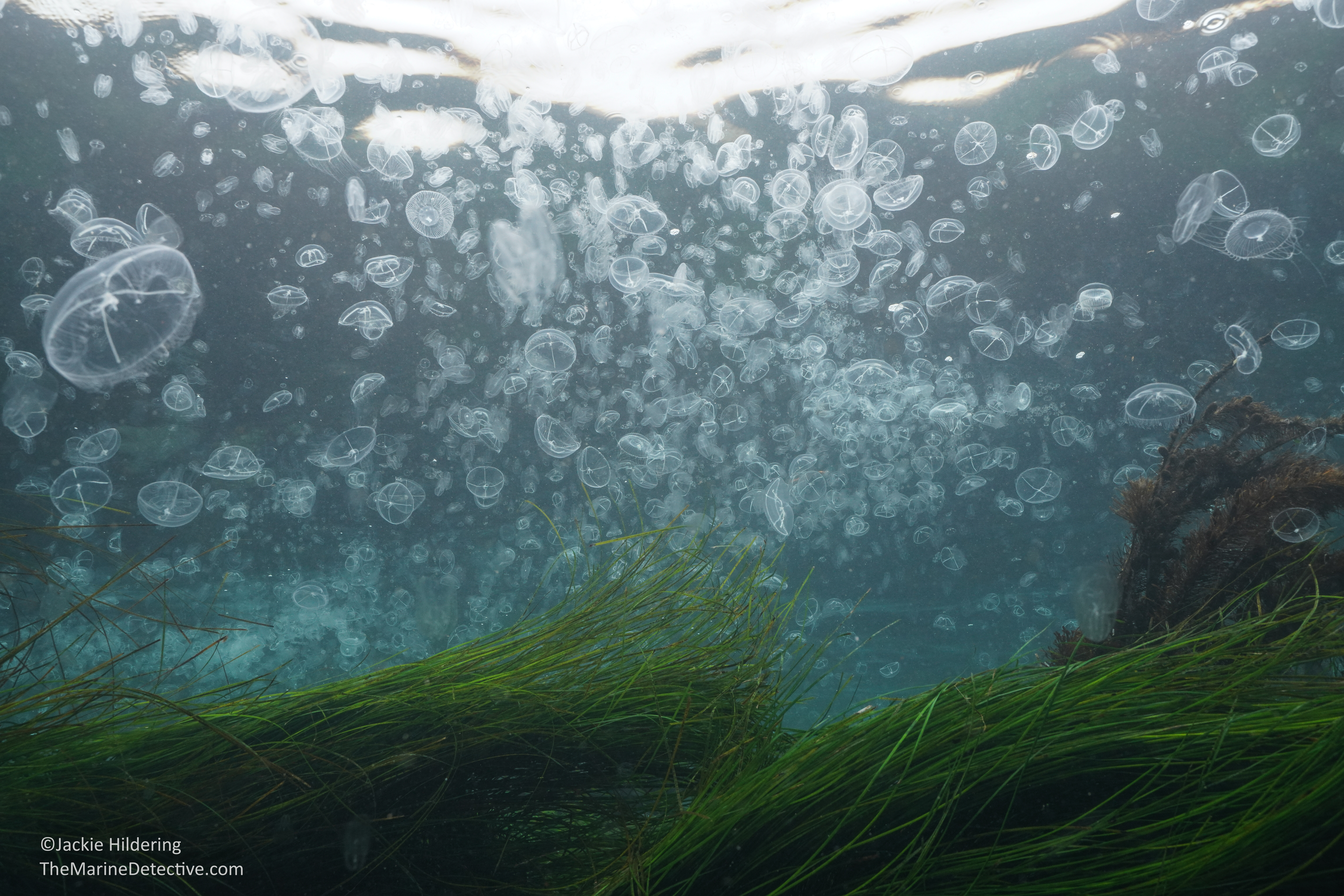
While on a recent trip to God’s Pocket Resort north of Port Hardy, it happened to be that there was a huge aggregation of jellies. It was truly awe-inspiring to be diving amid this galaxy of jellies.

Black Rockfish, Bull Kelp and a smack of jellies.
Aggregating Anemones and jellies.


The collective noun for jellies actually is a “smack”, not a galaxy.

A smack of this magnitude is the result of the jellies’ lifecycle and big tidal exchanges concentrating them. We were certainly gob-smacked by the number and diversity as we watched them cascade past in the current as the plankton they are, pulsing to feed on smaller plankton.

The astounding photo above was taken by dive buddy Melissa Foo. It’s me in the smack, appearing to be in a globe of jellies.

And this photo of me was taken by dive buddy Janice Crook. I am including it anticipating that there will be questions about if we were stung by the jellies. We were not. Only the stinging cells of the large jelly species off our coast lead to human discomfort. Later in this blog, I show photos of those big jelly species.


The majority of the jellies in the smack were Water Jellies and Cross Jellies.

Cross Jellies, as the name suggests, have a cross on their bell. They are Mitrocoma cellularia to 10.5 cm across.

Cross Jellies reflected against the surface, trees above the surface.


Water Jellies are a group of jellies that have little lines all around the outside of the bell that look like the spokes of a wheel. The little white part hanging down from the bell is the mouth (manubrium). Aequorea species are up to 17.5 cm across.

Cross Jelly with manubrium.


There were also Moon Jellies. Moon Jellies are easy to discern because they have a clover shape on their bell which is their 4 gonads / sex organs. Aurelia labiata are up to 40 cm across. 

The following photo shows a Moon Jelly female with fertilized eggs. The eggs are the less translucent white structures. 


The biggest jelly species I saw were Lion’s Mane Jellies and Egg Yolk Jellies.

The Lion’s Main Jelly is the biggest jelly species in the world. Cyanea ferruginea can be 2.5 m across with 8 clusters of 70 to 150 tentacles which can be up to 36 m long! Know that the larger individuals of this species tend to be further offshore and that they can retract their tentacles.

Lion’s Mane Jelly reflected against the surface.
Lion’s Mane Jelly with dive buddies’ bubbles in the background.


The Egg Yolk or Fried Egg Jelly is Phacellophora camtschatica and can be 60 cm across. They have 16 large lobes that alternate with small lobes giving the bell of the jelly as scalloped edge. Each of the 16 lobes has clusters of up to 25 tentacles which can be 6 metres long.

The individuals I saw on these dives happened to be white with light yellow. They part that looks like the yolk of an egg is often darker yellow.

Egg Yolk Jelly – see it’s prey in these two photos? It has caught other jelly species in its tentacles.


Lion’s Mane Jellies and Egg Yolk Jellies. are the only two common jelly species in our waters that can create a sting that irritates human skin, even when the jellies are dead. The stinging cells (nematocysts) work even when the jelly is dead or you get a severed tentacle drifting by your face. The sting from a Lion’s Mane Jelly is reported to be worst than that of an Egg Yolk Jelly.

I’ve been stung by both and clearly it’s not been enough to deter me from striving to get photos of them. But if you have far more skin exposed or are a fisher grabbing nets with many of the tentacles wrapped in them, it is reported to be very uncomfortable.

The solution to the irritation is vinegar (acid), meat tenderizer (enzyme) and I know that many fishers swear by Pacific canned milk as well. Research puts forward that vinegar is the only real solution and that urine does not work at all.

Egg Yolk Jelly and trees.


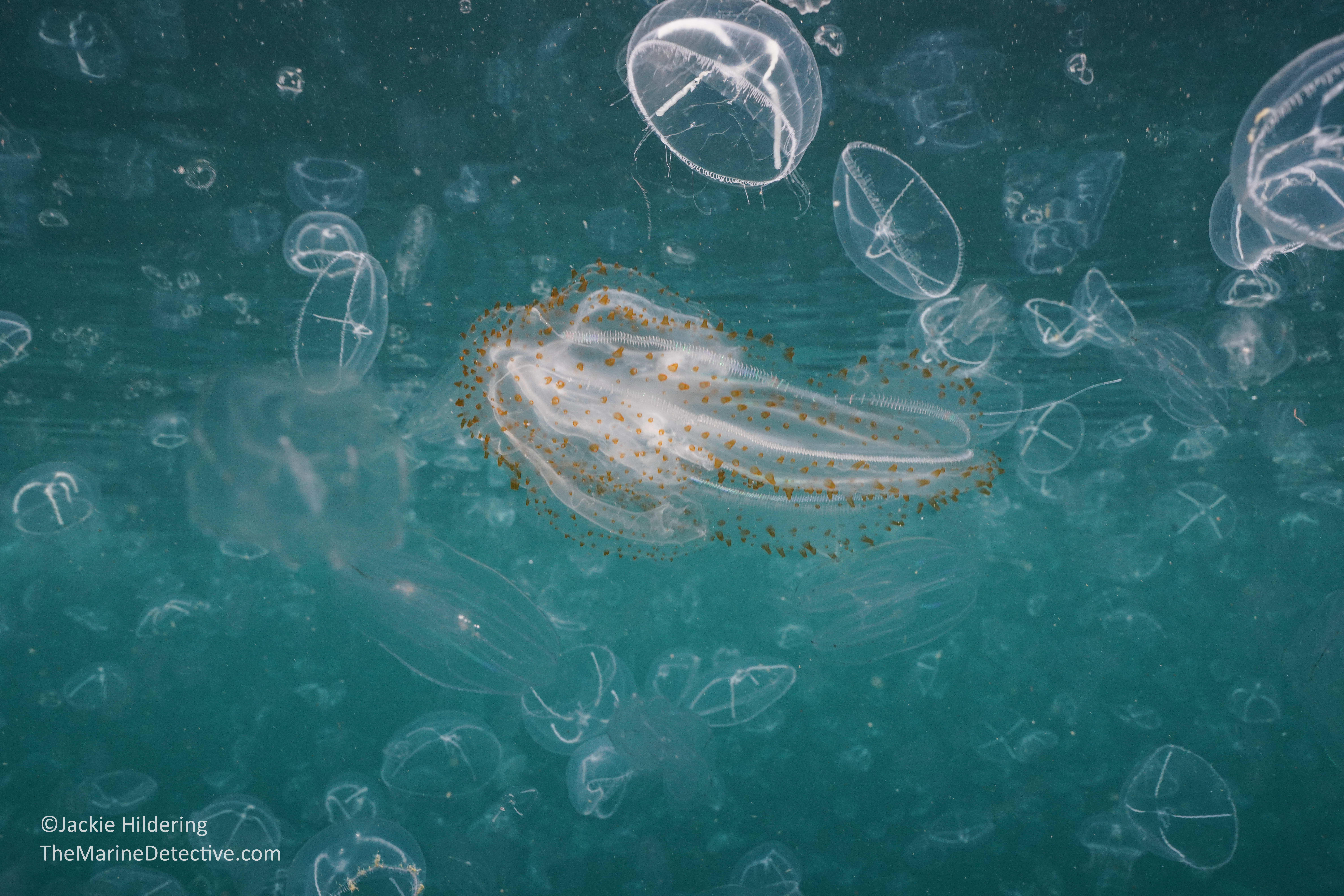
There were also various species of sea gooseberry / comb jellies in the smack. These elongate jellies open up at one end and engulf their prey. Comb jellies move by cilia which are arranged like teeth on a comb. These cilia cause light to scatter whereby you can see rainbow-like flashes over the animals. This is not bioluminescence as the light is not created by the jellies.

Comb Jellies belong to the Ctenophora phylum while the other species referenced on this blog are in the Cnidarian phylum.

Comb Jelly on the bottom right (Beroe  species to 10 cm long).
Orange-tipped Sea Gooseberry (Leucothea pulchra) – Comb jelly species to 25 cm long.

Below there are more photos of the smack. All photos were taken between October 15 to October 19, 2023 in Browning Pass north of Port Hardy, Territory of the Kwakwa̱ka̱’wakw (the Kwak̕wala-speaking Peoples) ©Jackie Hildering.

Dive buddy Janice Crook.
Dive buddy Melissa Foo.
Tail segment of a Giant Siphonophore.