Blog updated on February 15, 2026, with a sighting of Darwin the Tiger Rockfish, now documented in the same location for 7 years!
Yes, in addition to cataloguing Humpback Whales, I attempt to identify and catalogue individual Tiger Rockfish. I can’t stop myself.
There’s so much that may be learned when you can recognize animals as individuals. There is more conservation value too when people realize that even individual fish have homes.
The markings of Tiger Rockfish are so distinct that it is easy to recognize them as individuals IF they are not tucked away deep in a crack, which is often their way. See below for some of the individuals, how long I have been able to document them, and what their homes look like.
To date (2026), the longest I have been able to document any Tiger Rockfish is 8 years. This shows how strong the site fidelity is and why Rockfish Conservation Areas can have such success.
I will clearly have to hand off this cataloguing to a younger biologist since these fish are likely to outlive me. They are known to be able to live to age 116.
Tiger Rockfish =Sebastes nigrocinctus to 61 cm long (35 cm by 17 years of age).
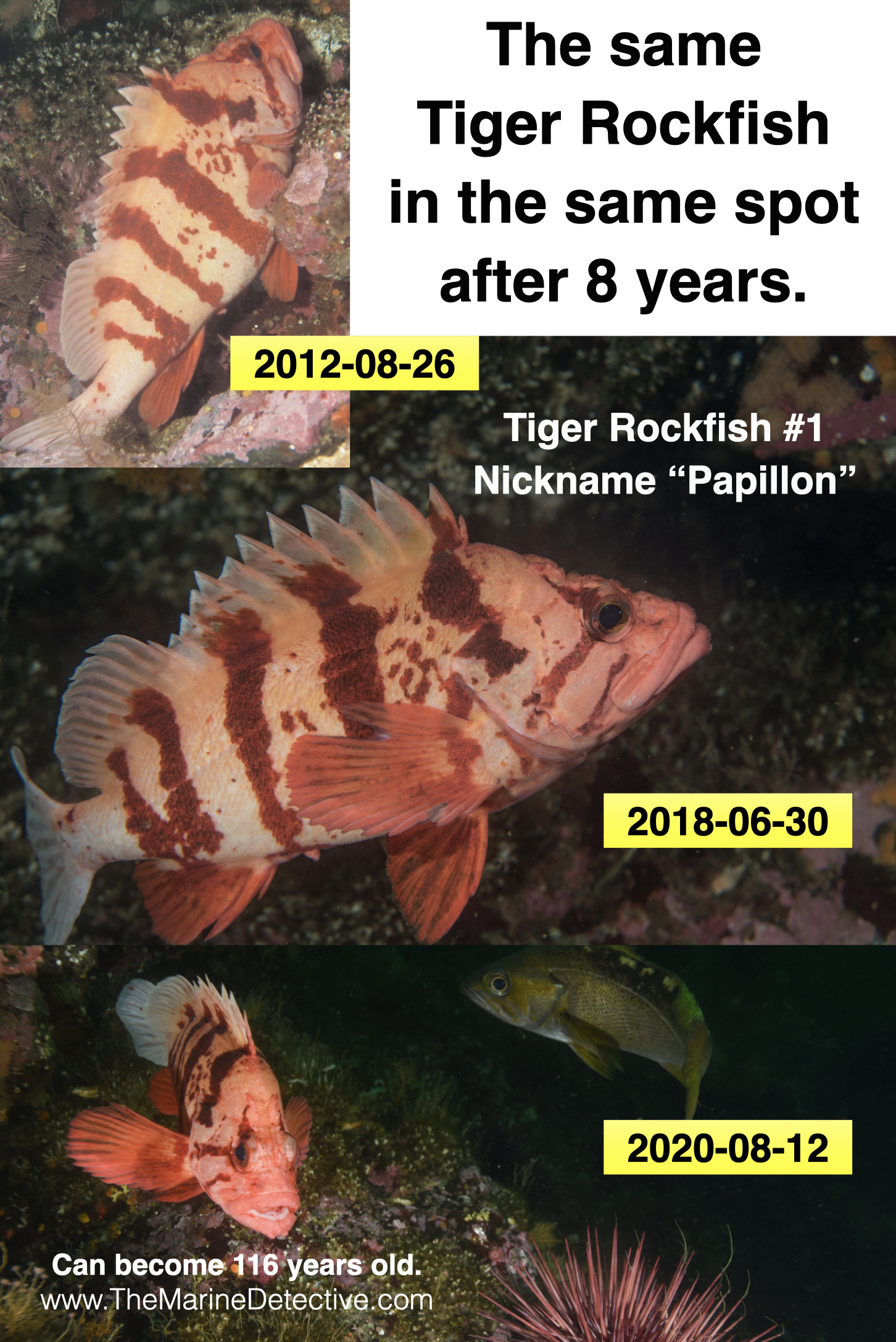
Tiger Rockfish #1
Nickname Papillon for the butterfly or bowtie-like marking on the right side of her head.
Appeared pregnant/gravid in 2012.
Documented in the same location for 8 years.
Not seen since August 2020.
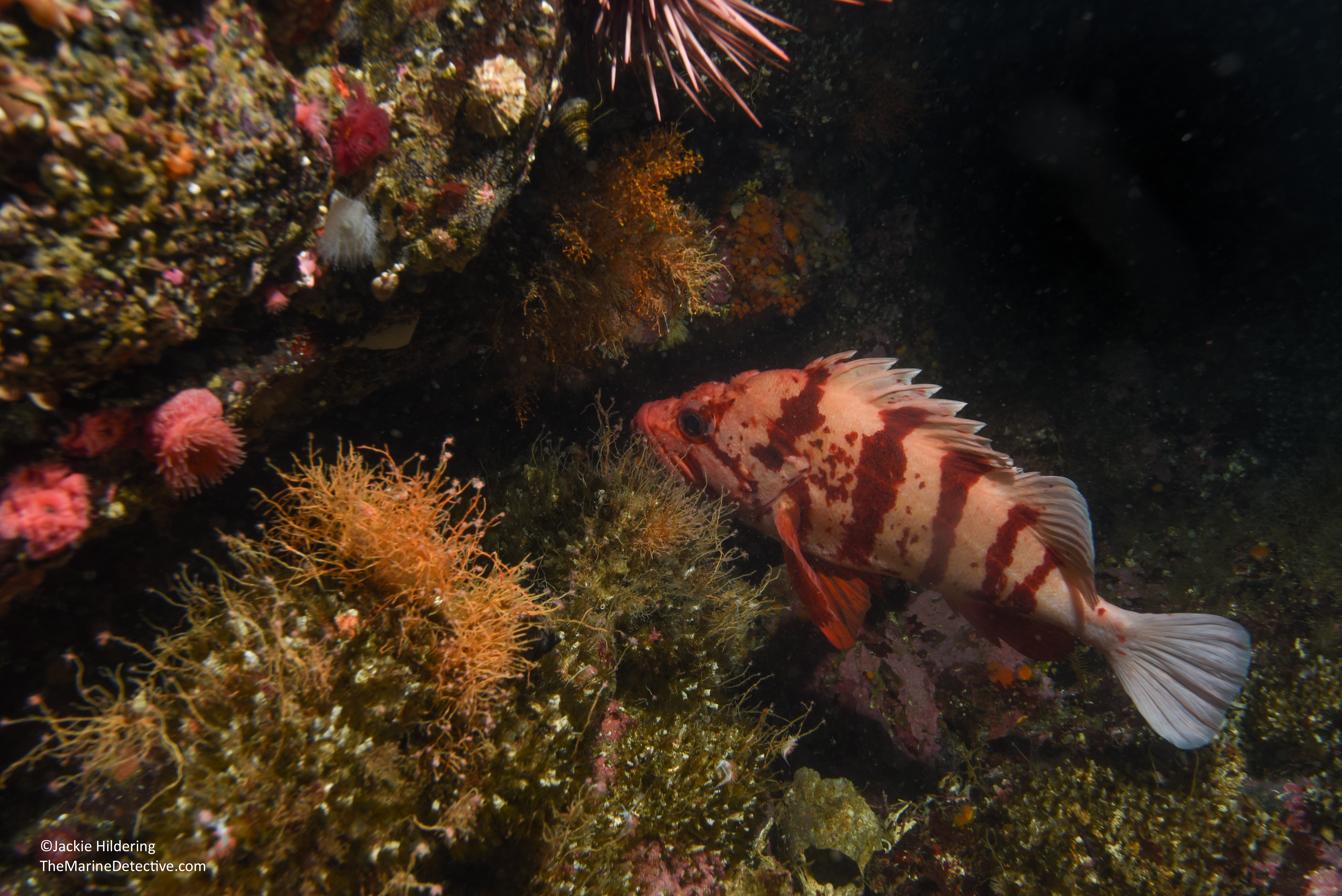
Papillon near her home in 2020.
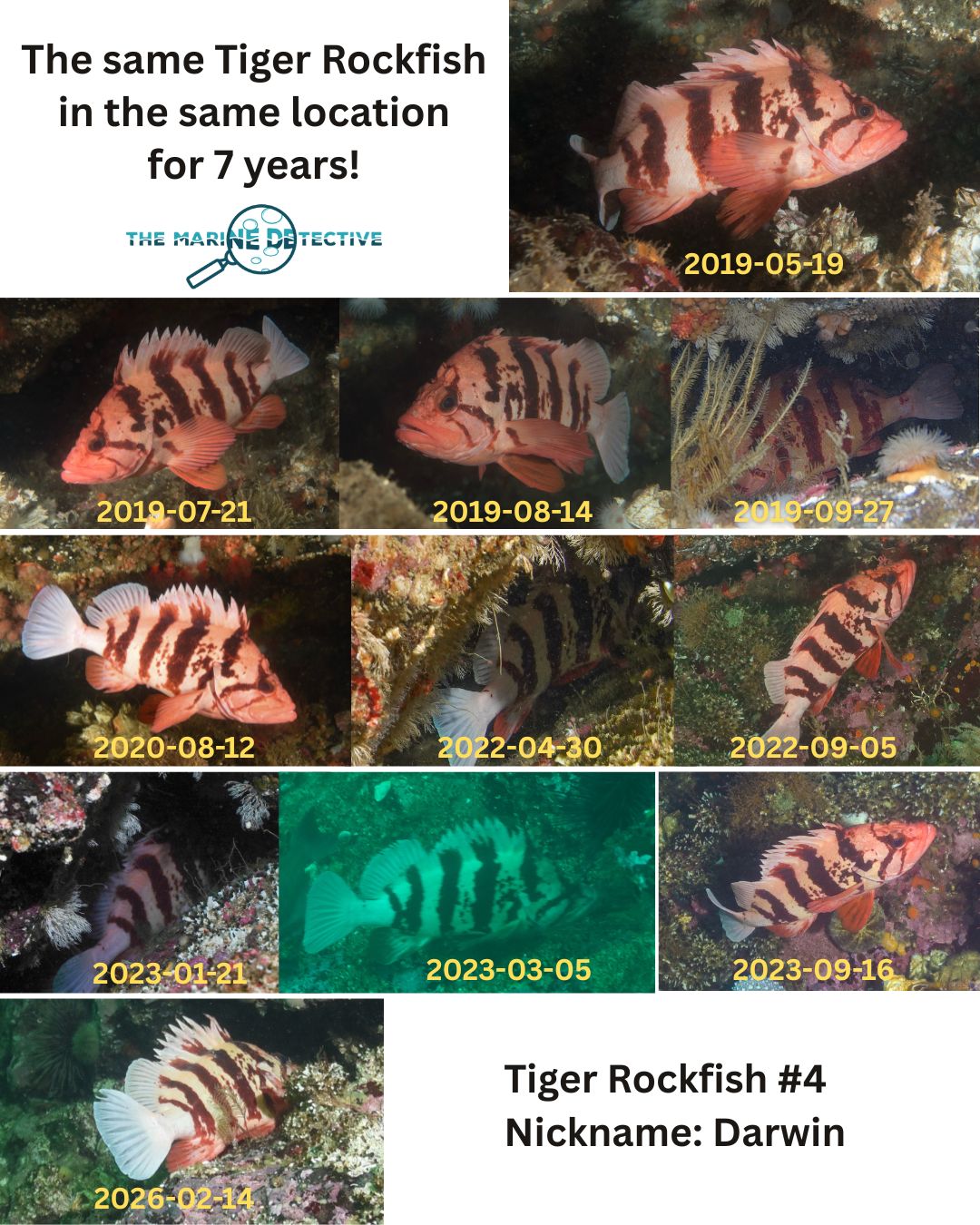
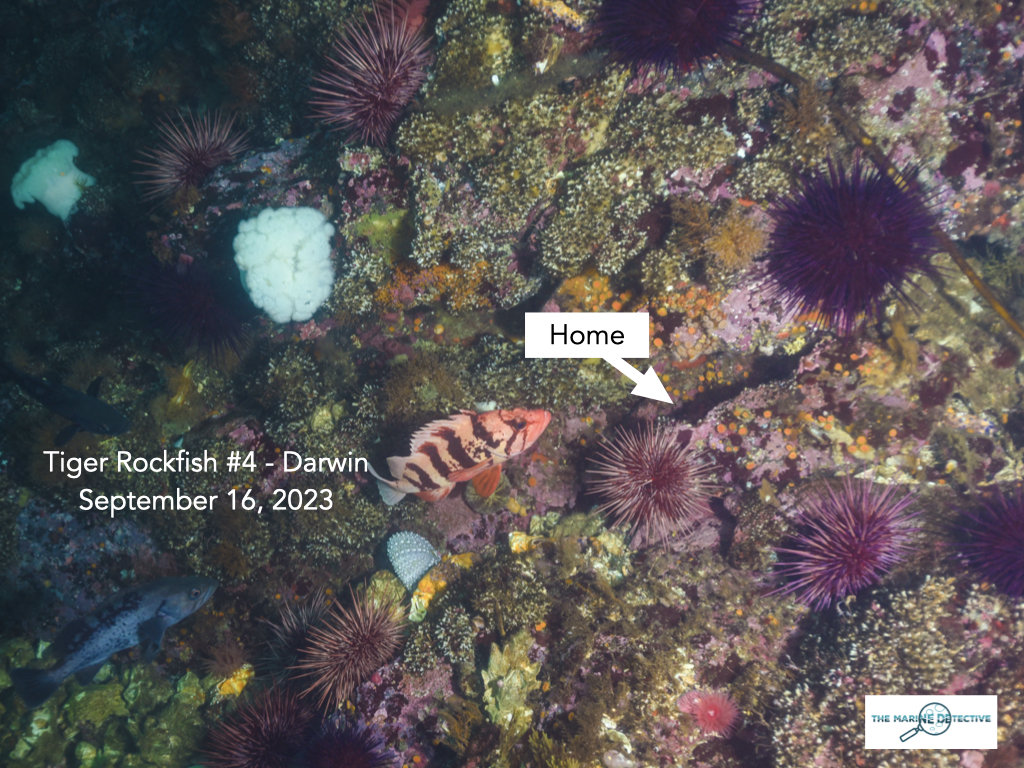
Tiger Rockfish #4
Nickname Darwin for the stripes being reminiscent of one of those cartoons showing the progression of evolution to a human-like shape (from tail to head on this fish).
Lives very near to where Papillon lives/lived. Documented them both from 2019 to 2020.
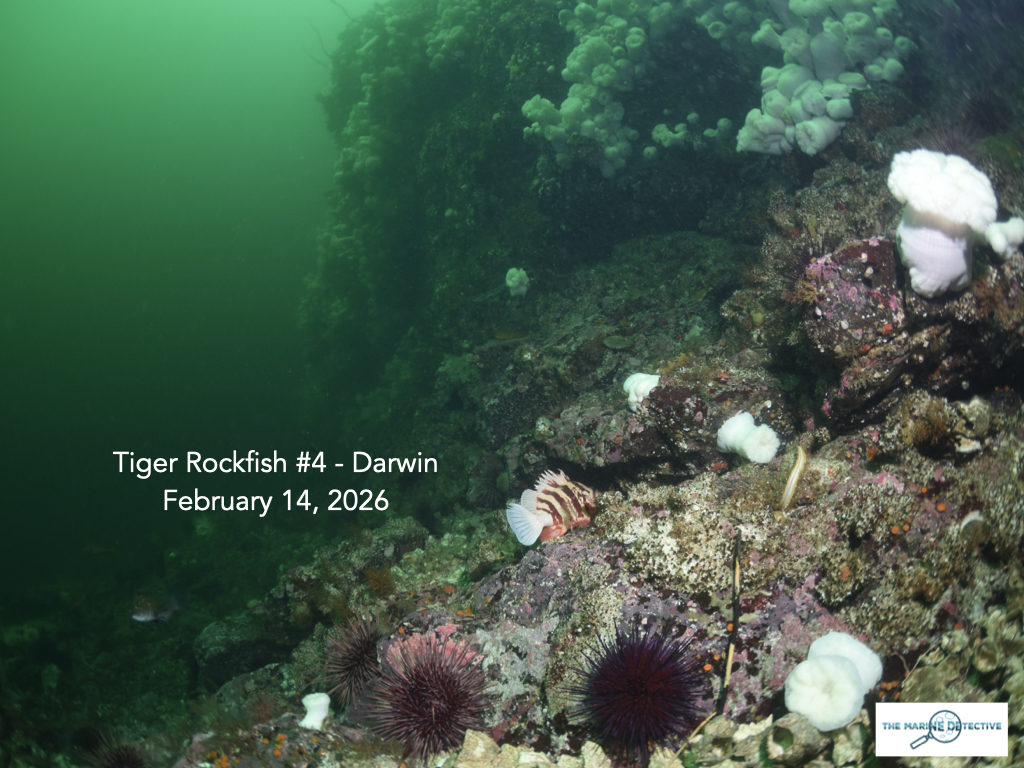
Documented in the same location for 7 years.
Last sighting 2026-02-14. You can maybe imagine the euphoria at having seen him after almost 1.5 years. I feared he might be dead. Why didn’t I see him over that time span? Because he was “out and about”? Because he was safe deep in his home? Because he knew I was there before I did and retreated into his home? Because other divers passed by first, whereby he may have retreated? I don’t know. Note that I know to be very slow and quiet when I near his home and to try to document him from afar.
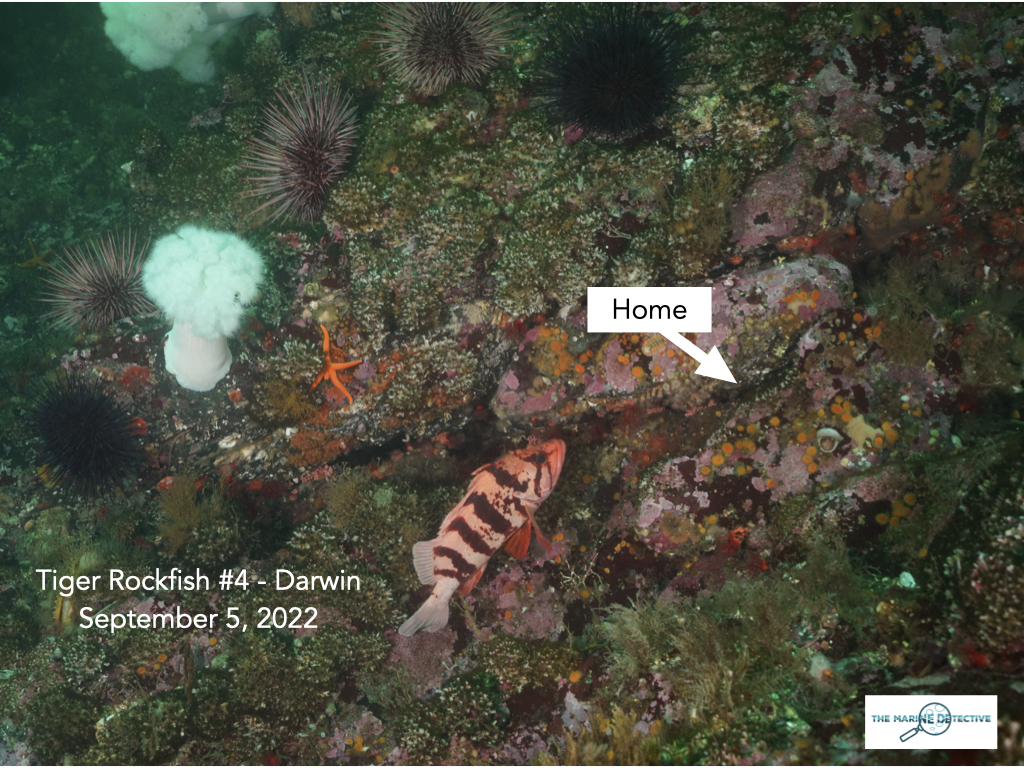
In the 3 photos below, you can see where Darwin lives and get a sense of the ideal habitat for Tiger Rockfish.
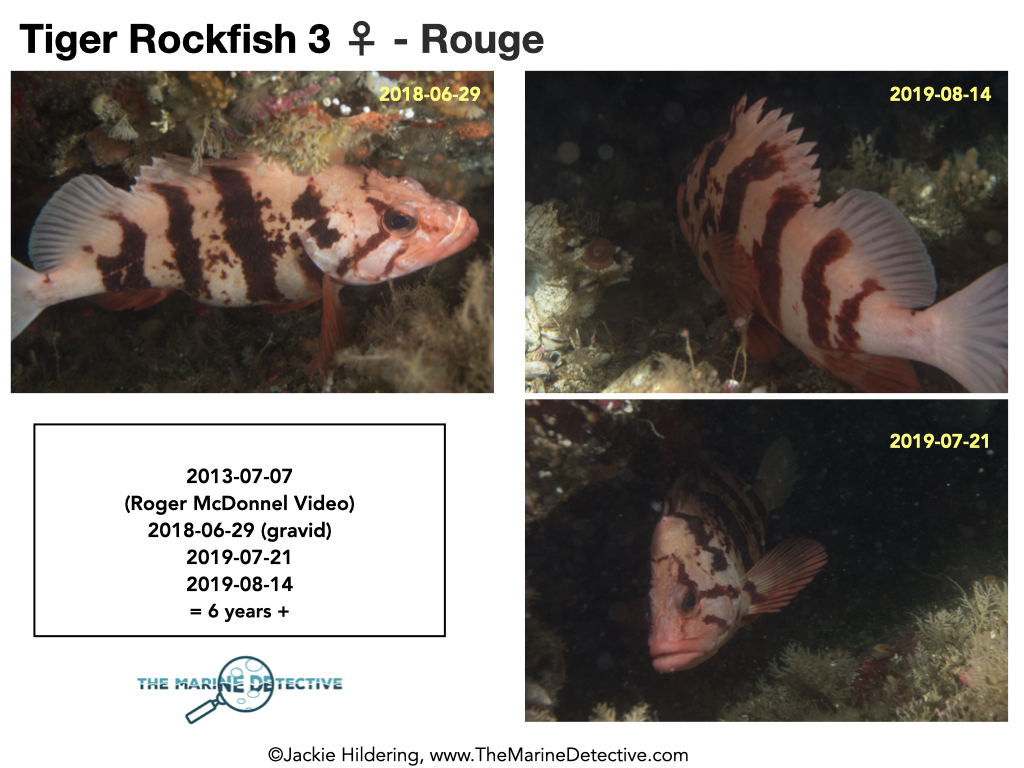
Tiger Rockfish #3
Nickname Rouge for the bat-like markings near the right side of her head.
Pregnant/gravid in 2018.
Documented in the same location for 6 years.
Last sighting 2019-08-14
Please read more on Rockfish Conservation Areas, barotrauma, and rockfish reproduction in my previous blog at this link.
Resources:
Get the app that alerts you when you enter a Rockfish Conservation Area
Get the app that alerts you when you enter a Rockfish Conservation Area.
Update: Fisheries Notice March 25, 2019 The use of a descending device is now required by condition of licence to assist in the conservation and survivability of rockfish being returned to the water. Because of their closed swim bladders, rockfish brought to the surface suffer barotrauma, causing the swim bladder to inflate and reducing the probability of their survival upon release. Handle catch as little as possible, using wet hands to preserve the protective slime coat, and return to the water at depth of capture as quickly as possible (under two minutes). To avoid catching rockfish, move to another fishing location.”
_______________________________________________
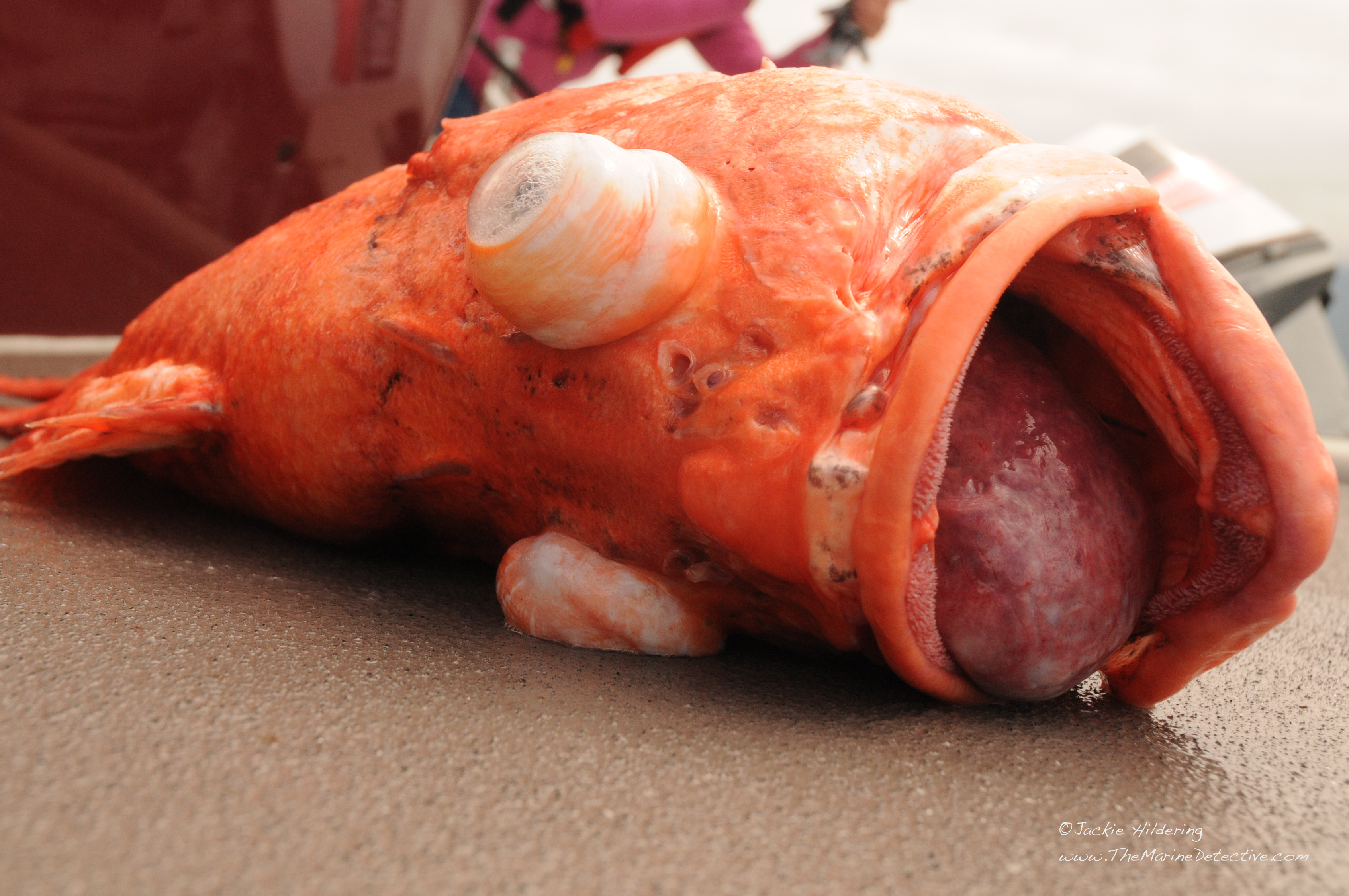
This photo is of a Yelloweye Rockfish that has died from barotrauma, also known as “pressure shock”.
Yelloweye Rockfish that has died of barotrauma. Reduced water pressure causes the air in the swim bladder to expand and push out the esophagus and eyes. BUT this is a reversible condition whereby the fish can survive through use of a “fish descender”. Photo: Hildering.
Many rockfish species are particularly sensitive to reductions in pressure since the air in their swim bladders expands substantially. The swim bladder is a buoyancy control organ and even when slowly reeled in from a depth of only 20 m (60’), a rockfish’s swim bladder can expand to three times its size, putting pressure on the fish’s organs.
As is the case with the Yelloweye Rockfish in the photo, the swim bladder can expand to the point of causing the fish’s eyes to bulge out of their sockets and its esophagus to be pushed out of its mouth (the esophagus is the first section of the digestive tract). I know this is likely a sight that may not enhance your appetite for your rockfish catch but please read on since, contrary to the thinking of many, this IS reversible whereby the rockfish stands a good chance of survival.
Colossal “management” errors were made with overfishing slow-growing rockfish. Many species are extremely long-lived, slow to sexually mature, and the big, old females are the most fertile – producing the most eggs and hatching the largest number of healthy young.
For example, Yelloweye Rockfish are believed to have a lifespan of up to 118 years. They don’t reproduce until they are at least 12 years old, and the old females can incubate up to 2.7 million eggs! Know that there are 38 species of rockfish off the coast of British Columbia.
This means that species are very slow to reproduce whereby, if you catch lots, especially the big females, you can devastate populations very quickly.
Another nail in the coffin of rockfish is that many adults also have high site fidelity so that by fishing one area, you can wipe out a community of fish. Click here for my blog on having found back the SAME individual rockfish in the SAME spot after EIGHT YEARS. This is why Rockfish Conservation Areas (RCAs) are essential, where it is most often illegal to do any hook and line fishing (see restrictions here).
But, what is you accidentally catch a rockfish outside these areas?
There are studies that support that if you were to quickly recompress the fish, it would stand a very good chance of survival, even where it appears dead at the surface. The fish could be brought back to depth with barbless weighted hooks, or commercial “fish descenders”.
This video make the life-saving potential of fish descenders very clear.
From Island Fisherman Magazine: “Common types of descending devices include a simple, inverted barbless hook, a spring-loaded clamp, and a pressure-release clamp. Of the different devices available, the most effective and simplest to use is a depth pressure activated release device, the Seaqualizer . . . Automatically opening at preset depth, the motion of the boat or the actions of the rockfish as it descends will not prematurely release the fish.“
How wonderful it would be if more people would undertake the effort to recompress the fish, knowing how dire the situation is for many rockfish species. Imagine the further positive impact if people would choose to return the depleted species to depth even when they haven’t reached their catch limit, especially the big, highly productive females.
But, even if there was to be such enlightenment, many rockfish populations are so depleted that they need far more protection.
Again, Rockfish Conservation Areas (RCAs) are essential. These should be areas known to be the territory of depleted rockfish populations. Since these are no-fishing zones, there is no chance of barotrauma and the rockfish populations that live in the area are given the time to rebuild to have more sexually mature fish and more big old super mamas.

 The Marine Detective