Join me in the cold, dark, life-sustaining NE Pacific Ocean to discover the great beauty, mystery and fragility hidden there.

Posts from the ‘Rockfish’ category

Rockfish vocalizations: “Knock knock, who’s there?”

I feel compelled to share this new research by Lancaster et al., 2025 with you because:
1. It is about a non-destructive / non-invasive way to study fish. Using Passive Acoustic Monitoring (PAM) to determine wild fish presence in the same way one would identify birds by their calls.

2. It is yet another example of how little we know about even common marine species. Among the eight species of fish near Vancouver Island for which vocalizations were documented by the researchers, this is the first time ever that the sounds of Canary and Vermillion Rockfish have been identified.

3. The title of the research paper is so clever: Knock knock, who’s there? Identifying wild species-specific fish sounds with passive acoustic localization and random forest models”.

4. I know you want to see the video below and listen to the sounds!


Excerpts from the University of Victoria’s media release about the research:

“University of Victoria (UVic) biologists have discovered that even closely related fish species make unique and distinctive sounds and determined that it’s possible to differentiate between the sounds of different species. The discovery opens the door to identifying fish based on sound alone.  

Using passive acoustics, the researchers identified unique sounds for eight different Vancouver Island fish species in their natural habitats. They then developed a machine learning model that can predict which sounds belonged to which species with up to 88 per cent accuracy. This could have positive implications for marine conservation efforts and allow scientists to monitor specific fish species using acoustics, says Darienne Lancaster, a PhD candidate in biology who led the project. 

The research, published in the Journal of Fish Biology, is part of the larger fish sounds project run out of the Juanes Lab at UVic


While researchers have been identifying fish sounds for years, these sounds were typically recorded in a laboratory setting, rather than in the wild and whether different species made unique sounds had never been tested.  

Lancaster identified unique sounds for eight different species of fish commonly found on the coast of British Columbia: the black rockfish, quillback rockfish, copper rockfish, lingcod, canary rockfish, vermillion rockfish, kelp greenling and pile perch. This was the first time, in the lab or the wild, that sounds had been identified for the canary and vermillion rockfish

“It has been exciting to see how many different species of fish make sounds and the behaviours that go along with these calls,” says Lancaster. “Some fish, like the quillback rockfish, make rapid grunting sounds when they’re being chased by other fish, so it’s likely a defensive mechanism.  Other times, fish, like copper rockfish, will repeatedly make knocking sounds as they chase prey along the ocean floor.” 

The black rockfish make a long, growling sound similar to a frog croak and the quillback rockfish make a series of short knocks and grunts

Lancaster used a technique called passive acoustic monitoring to identify the fish sounds. She collected underwater audio and video using a sound localization array designed by former UVic PhD student and project collaborator, Xavier Mouy, and then used sound characteristics to identify differences in species calls.  

Her machine learning model used a set of 47 different sound features, such as duration and frequency, to detect small differences in each species’ sounds that can be used to tell them apart. The model used these small differences in sound features to group species calls together. 

“The ability of passive acoustics to identify specific fish by sound could be an important new tool for conservationists and fisheries managers,” says Francis Juanes, UVic biology professor and principal investigator on the project. “Passive acoustics could allow us to estimate population size, monitor activity, and assess the overall health of a fish population in a way that is minimally invasive to vulnerable marine animals.”
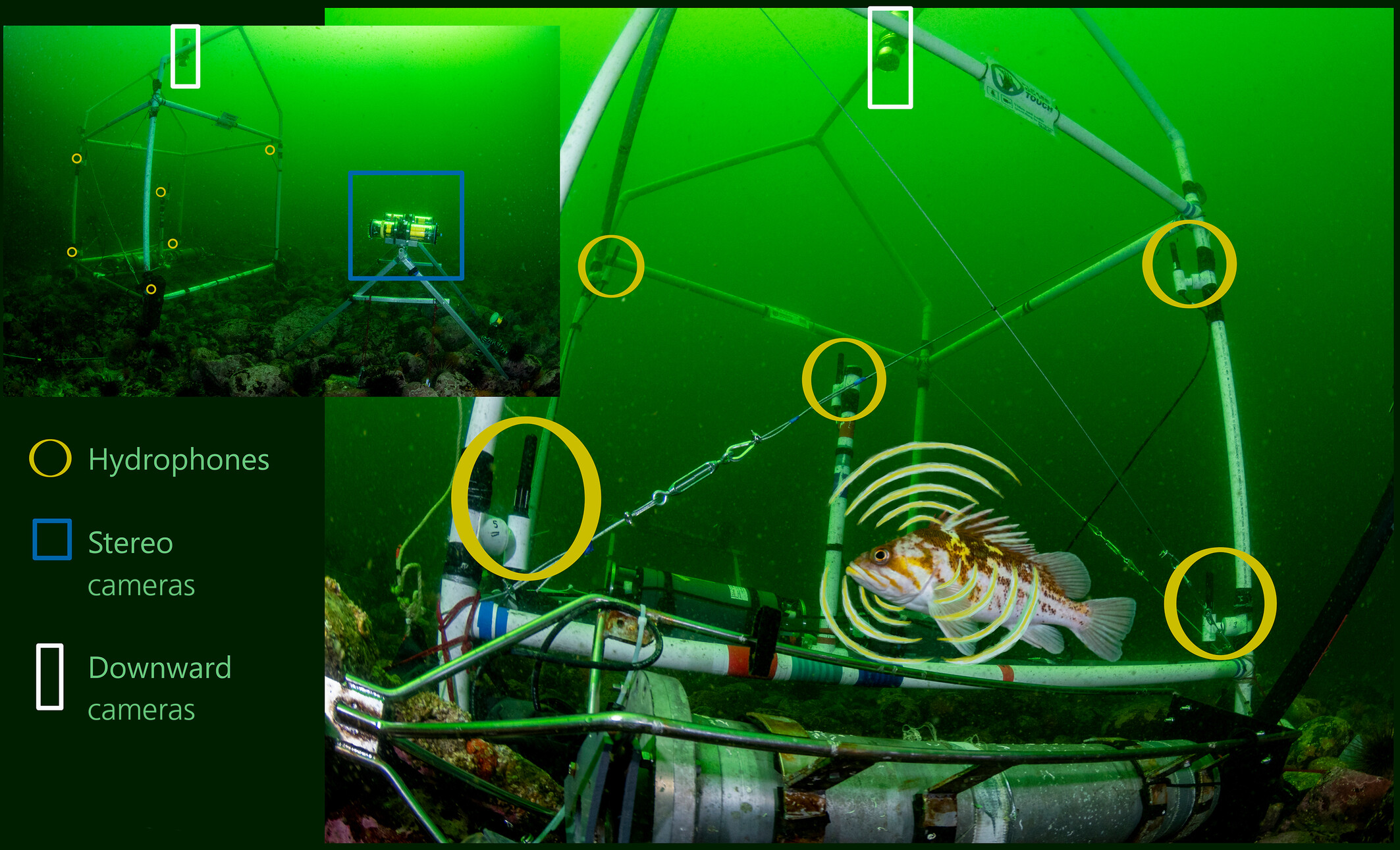
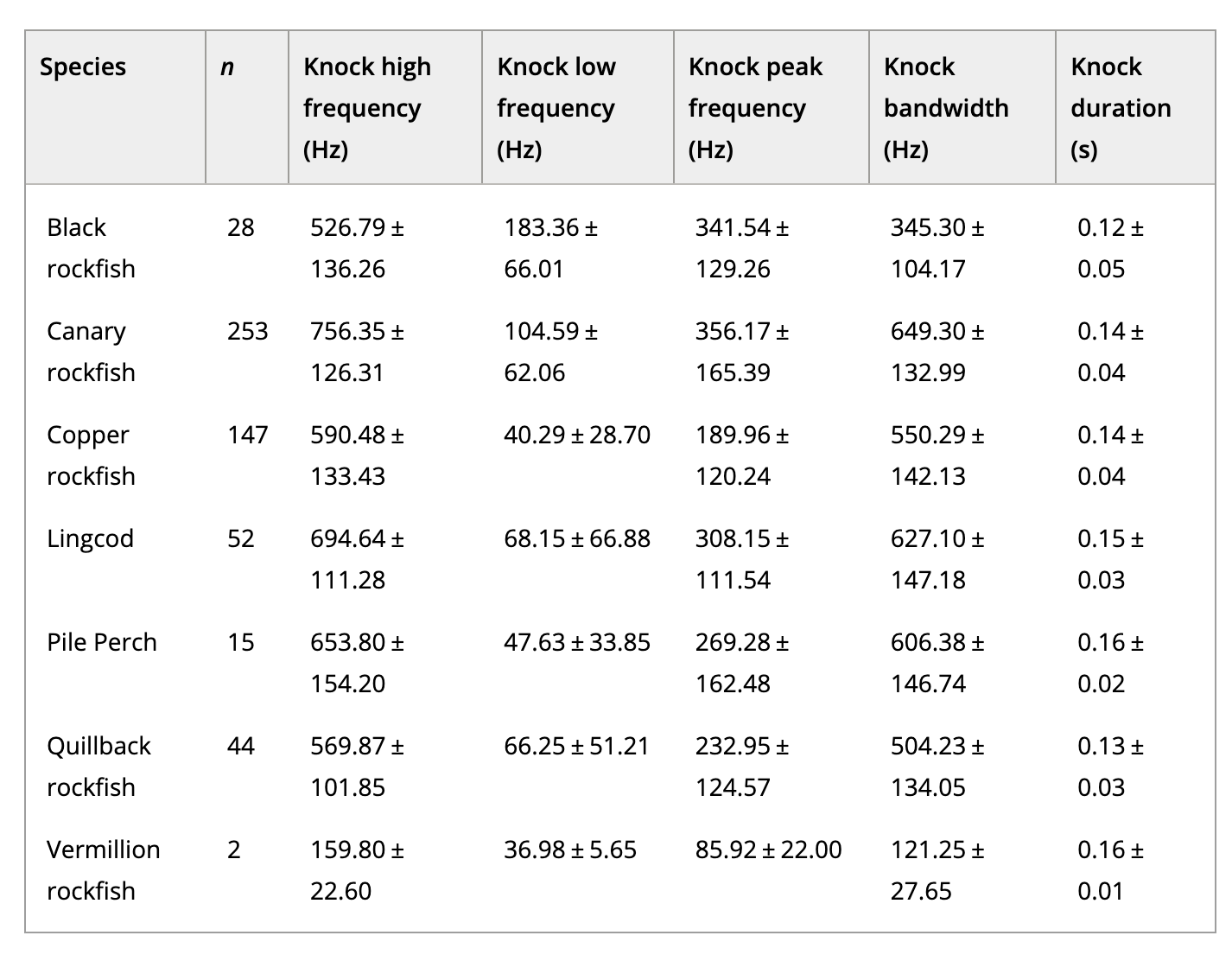
Figure 2 in the research paper: “Localization array with visualization of copper rockfish (Sebastes caurinus) calling near hydrophones. (images, Shane Gross; graphics, Darienne Lancaster).”

Table 2 from the research paper: “Summary of knock features (mean and standard deviation) for each species. Note: Only sounds with an ID confidence of 1 (high) were included for most species. Sounds with ID confidence 2 (moderate) were included for lingcod as no high confidence knocks were recorded. Kelp greenling (Hexagrammos decagrammus) knocks were not included as ID confidence for all knocks was low. Full species scientific names: black rockfish (Sebastes melanops), canary rockfish (Sebastes pinniger), copper rockfish (Sebastes caurinus), lingcod (Ophiodon elongatus), pile perch (Rhacochilus vacca), quillback rockfish (Sebastes maliger), vermillion rockfish (Sebastes miniatus).”

Excerpts from the research paper’s discussion:
We documented knocks and/or grunts for eight species of rocky reef fish. Two species—canary and vermillion rockfish—have never been documented as soniferous, and pile perch sounds have not been documented since 1966 (Meldrim & Walker, 1966). Black rockfish sounds have never been described or presented in spectrogram form (Fletcher, 1969). We provide summaries of species sound features in Tables S3–S5 and audio of species sounds are available on our data repository. We also demonstrate the importance of analysing field rather than aquarium recordings to determine if fish are soniferous and to characterize species calls. Aquarium-based studies can struggle to determine sonifery and the range of sounds in fishes’ repertoires. For example, an aquarium study by Nichols (2005) failed to elicit sounds from canary, black, and vermillion rockfish through prodding, but our study in fish habitat found that all three species are soniferous…

It was not possible to determine if kelp greenling are soniferous during this study. Kelp greenling were frequently present in videos, and we identified 25 possible kelp greenling calls with low ID confidence. Kelp greenling were typically interacting with other soniferous fish during calling activities so it was impossible to confidently determine which fish was calling. Further studies on kelp greenling calling would be useful to determine if they are soniferous.

Copper and quillback rockfish showed similar sound feature characteristics and were sometimes misclassified in the random forest knock model. This similarity is unsurprising as these two species can hybridize (Schwenke et al., 2018). However, quillback rockfish knocks and grunts had higher peak frequencies than copper rockfish sounds. We are unsure if this is a species-specific trait or an artefact of size differences across species. Higher frequency sounds often occur in smaller conspecifics (Kasumyan, 2008; Mann & Lobel, 1995; Myreberg et al., 1993; Rountree & Juanes, 2020), and larger copper rockfish are typically found at the same depth range as smaller quillback rockfish (Love et al., 2002). Future work will use our stereo-camera length information to examine size impacts on call characteristics.

This study expands the utility of PAM for assessing species richness and presence/absence, which are cornerstones of conservation and fisheries monitoring. We outline a novel method for collecting wild fish sounds and identifying species-specific sound features for use in fish sound detectors. Our study results can be used to detect the presence of specific fish species based on our documented sound parameters, which provide much greater precision than acoustic indices like ADI (Dimoff et al., 2021; Minello et al., 2021). Our work also contributes to the growing library of marine fish sounds required for PAM abundance estimation, but more localization studies are required to document the diversity of soniferous fish sounds. Future research should focus on localizing sounds for more species as well as collecting additional sound samples for underrepresented species. Further research into regional differences in species-specific calls is also recommended to determine the transferability of sound characteristics.”


You could be lucky enough to get BC researchers to provide education on fish bioacoustics: “FishSounds Educate is a free educational program that aims to use the topic of bioacoustics (biological sounds) to encourage future conservation leaders and enhance ocean literacy across Canada.” See this link.


Sources:


Note: I will try to get/find the sound samples of the Canary and Vermillion Rockfish. They have not yet been uploaded to Fishsounds.net. From that resource I did find the samples of the vocals of these species referenced in the research:


And for more vocals from fish (and other species) go to the “Discovery of Sounds in the Sea (DOSITS)” website. You do NOT want to miss the sounds of the Plainfin Midshipman, another common species off our coast. Then also go to this Nature of Things clip featuring this species with expert input from Sarika Cullis-Suzuki who did her PhD research on Plainfin Midshipman.
Fish Have Homes!

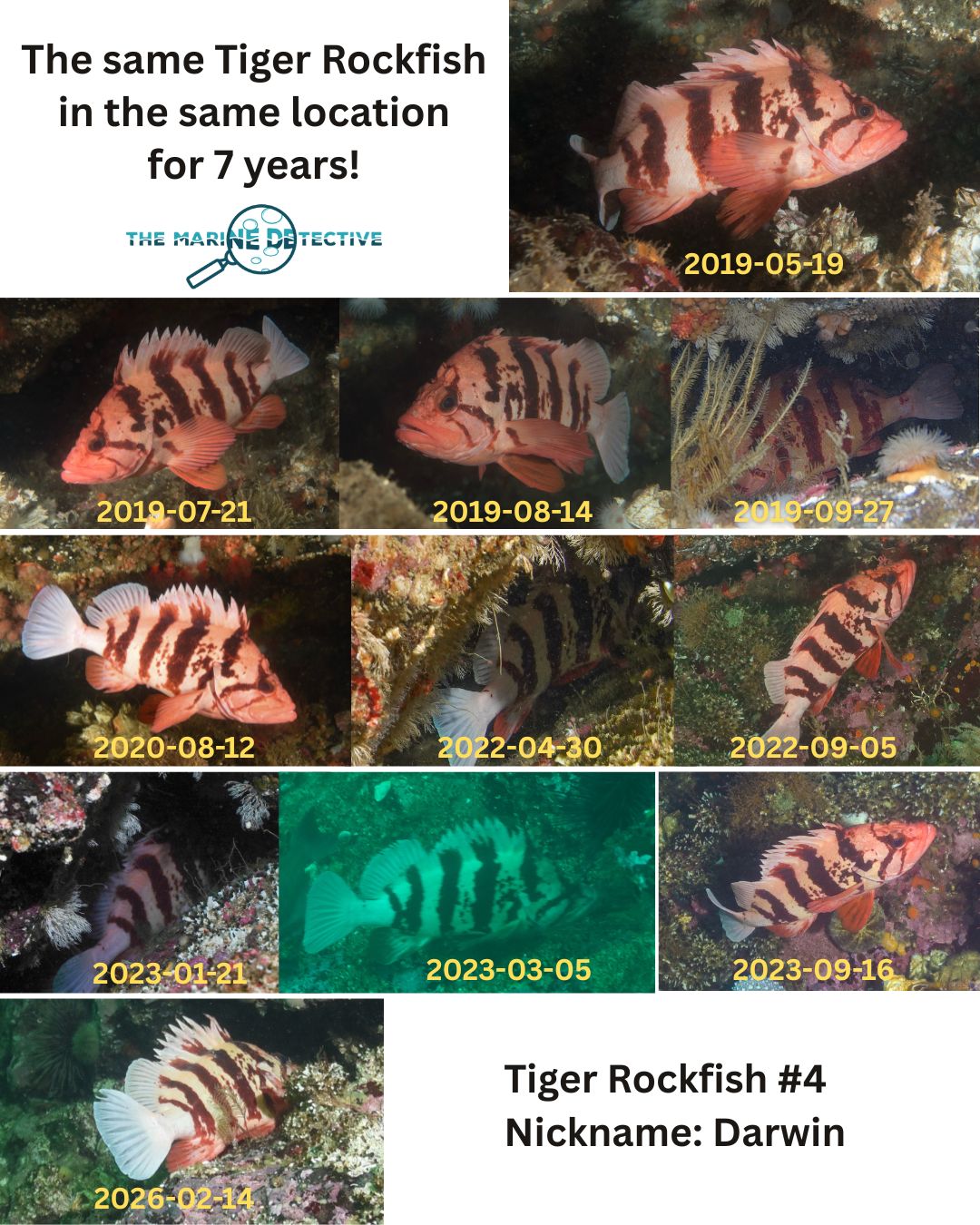
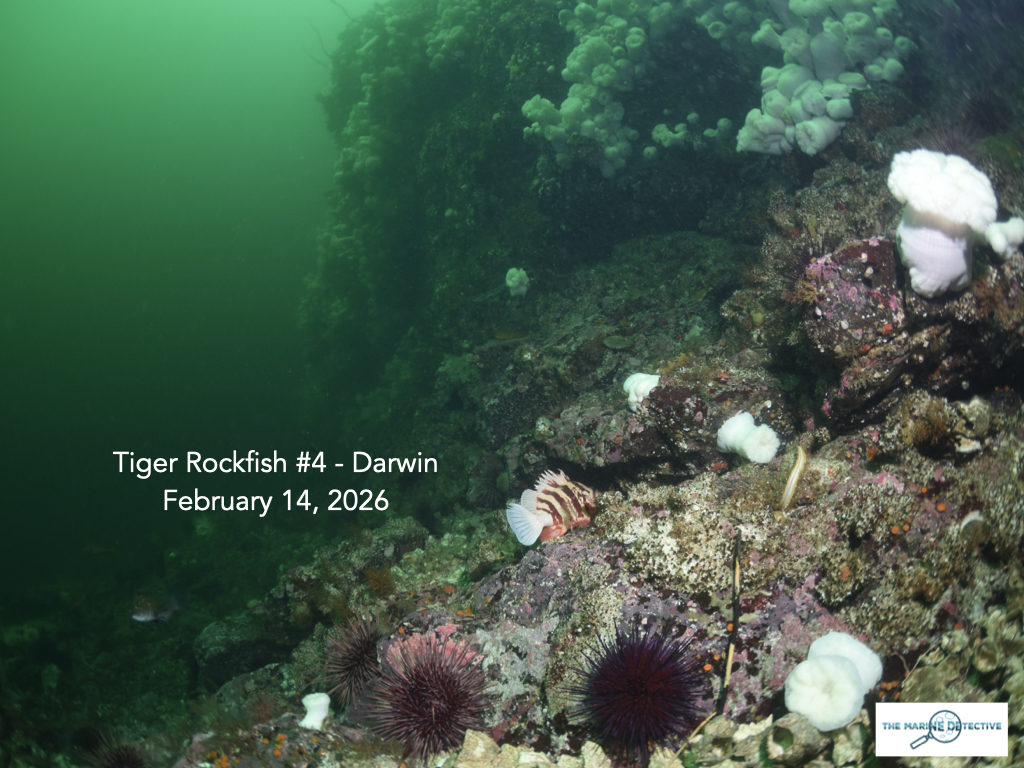
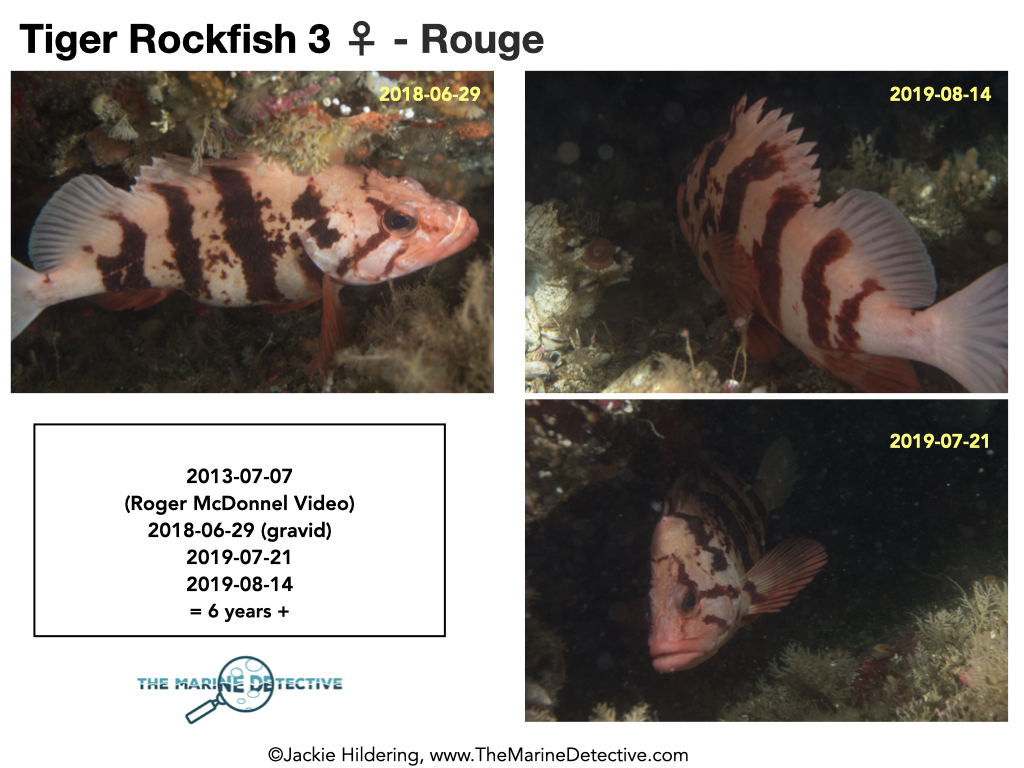
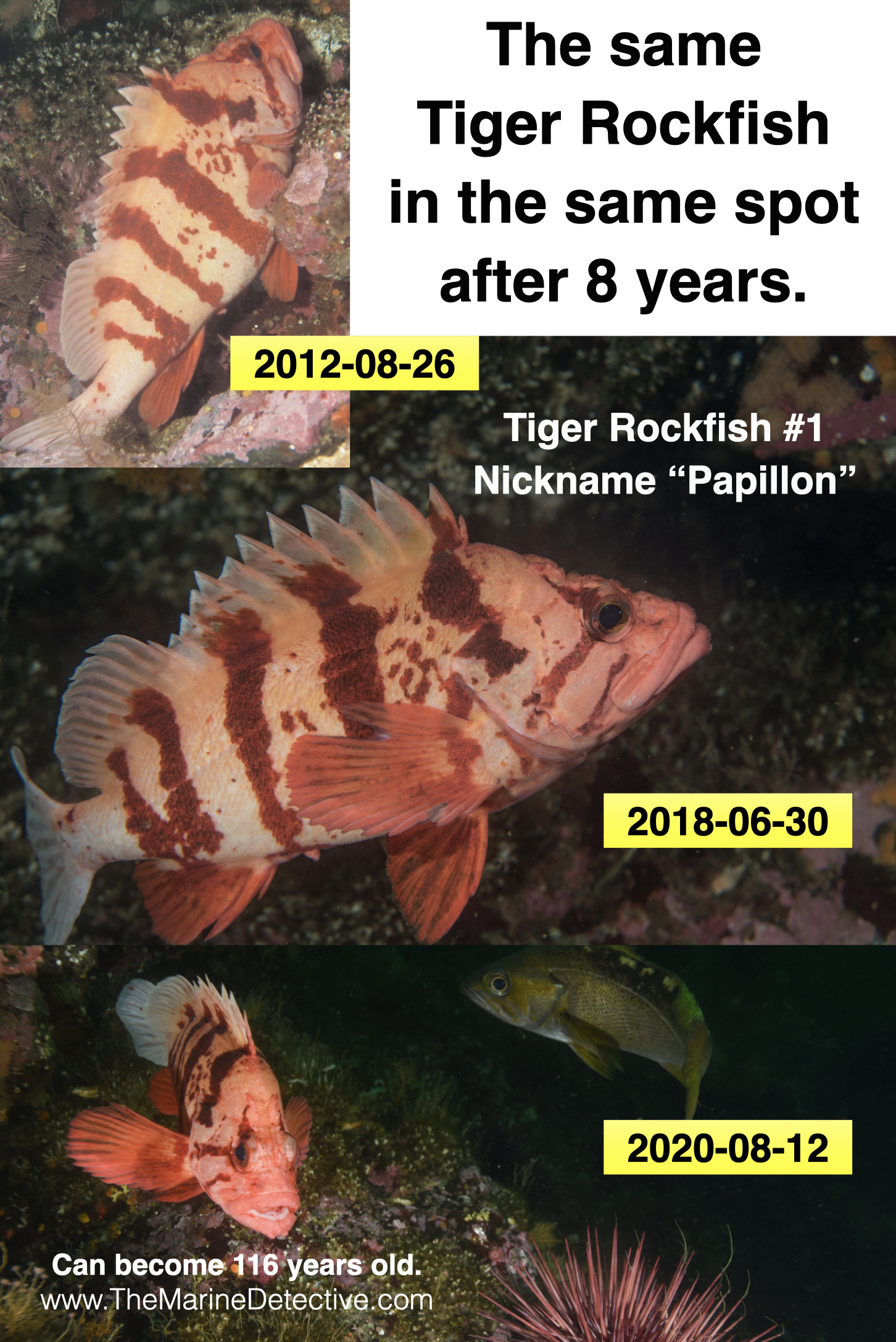
I found back the same Tiger Rockfish in the same spot after eight years.

Yes, on top of cataloguing Humpback Whales, I catalogue Tiger Rockfish. I can’t stop myself.

There’s so much that may be learned when you can recognize animals as individuals. There is more conservation value too when people realize that even individual fish have homes.

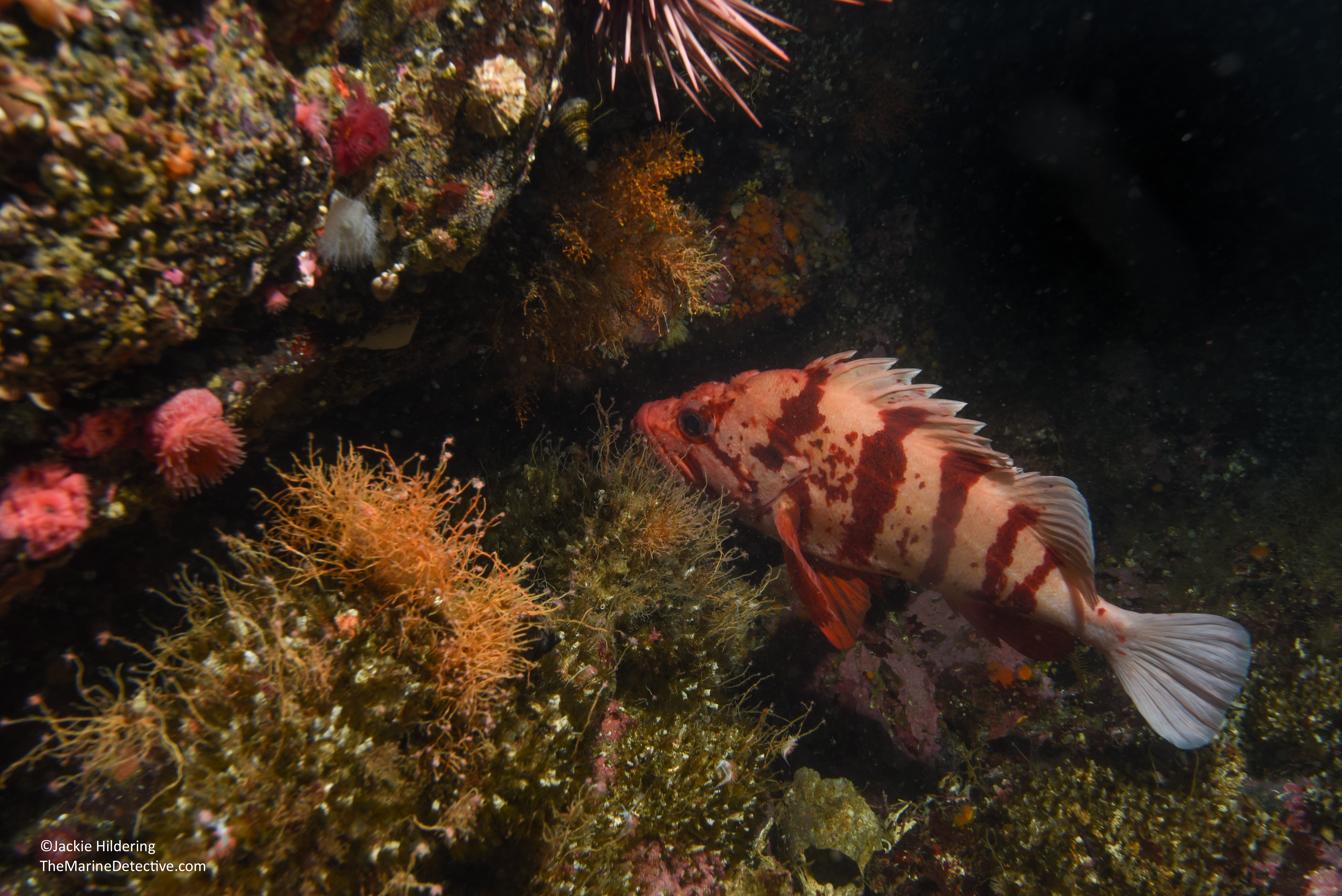
The markings in this species of rockfish are so distinct that it is easy to recognize them as individuals IF they are not tucked away deep in a crack which is often their way. See below to compare the markings of this mature female to two other individuals for whom I also have repeat sightings at this location.  I will clearly have to hand off this cataloguing to a younger biologist since these fish are likely to outlive me. They are known to be able to live to age 116.

I was already very excited when I found back this individual after 6 years. Now I can show that this fish was documented in the exact same location after least 8 years. This shows how strong the site fidelity is and why Rockfish Conservation Areas can have such success. Please read more on Rockfish Conservation Areas, barotrauma and rockfish reproduction in my previous blog at this link.

Tiger Rockfish = Sebastes nigrocinctus to 61 cm (35 cm by 17 years of age).


Below, pages from my Tiger Rockfish ID catalogue for this site.

The fish above is “Tiger Rockfish 1”. Note how distinct the markings are and how easy it is to recognize these individuals. I nickname these fish for distinctive features as we do with the Humpback Whales. Tiger Rockfish #1 is now “Papillon” for the bowtie like marking on the right side of her head.

Below is another Tiger Rockfish in my catalogue so you can see how distinctive their markings are, allowing them to be recognized as individuals. 


Update 2022-09-14
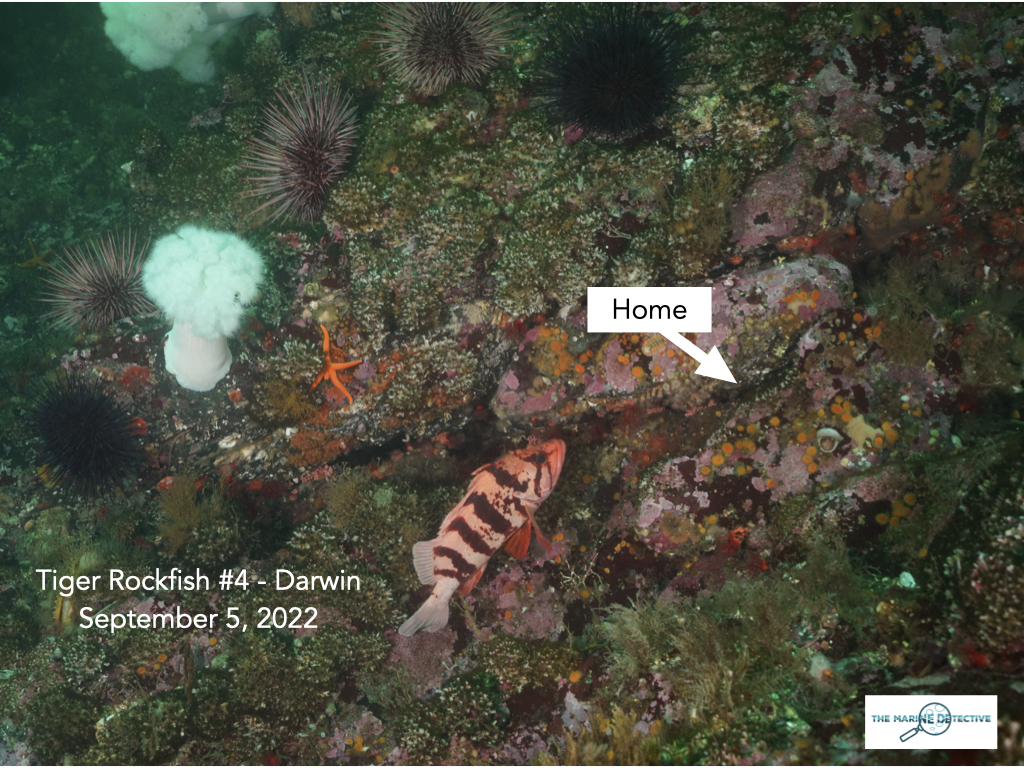
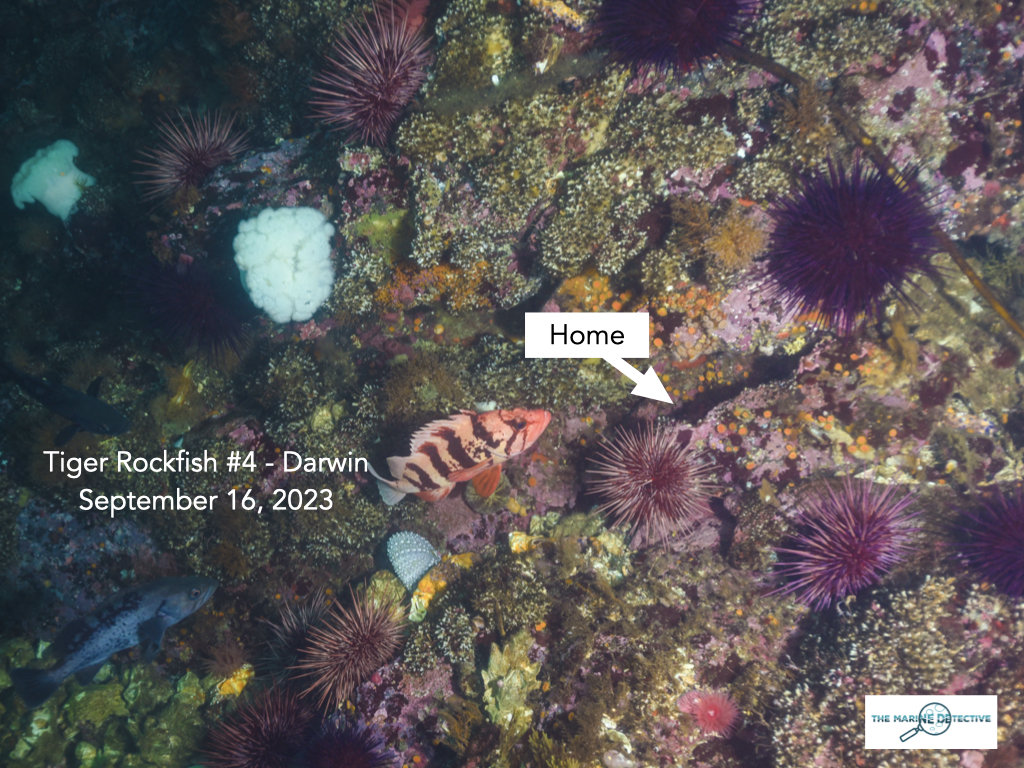
Have now documented Rockfish #4 (Darwin) for 3 years in the same location. See my posts from April and September 2022 below. 

RockfishCatalouge.001

Resources:


Five Fish

Five fish. One Dive.

Here are just five fabulous fish faces from my dive on July 12. These are just the fish who tolerated my taking photos. I am sharing with you to add to the sense of biodiversity hidden in these waters.

Also, I really value what I feel is mirrored back from these fish . . . the “What the hell are YOU and what are you doing here?” It’s good to feel like a visitor in others’ habitat rather than than a human at the epicentre of the universe. It’s below the waves, with the fish, that I best know my place and where I best feel humility. I also feel apology, not just for the disturbance of taking photos but as an ambassador for my species.

Sometimes I think as I look at the life below the surface “I’m trying. Please know, I’m trying”.

Thank you for caring and for trying too.

[Please note that I did not realize when compiling these photos that I have a blog on every species represented here. I suggest that the most insight would be gained from reading this blog first and then accessing the further links I provide here showing video, etc.]


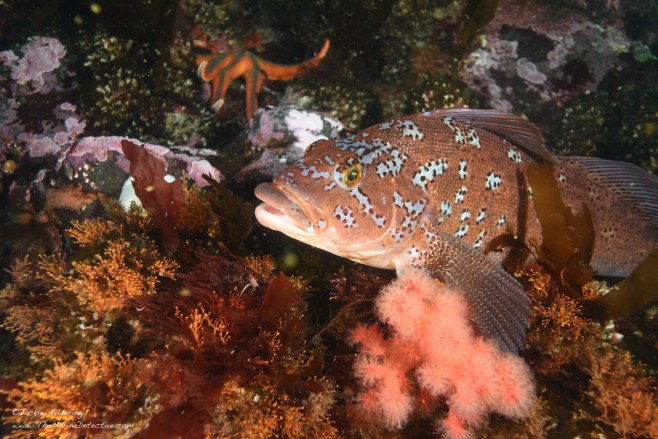
Fish #1
Male Kelp Greenling with a Striped Sunflower Star to his right.


This species seems to so often be chasing one another and they have extraordinary courtship where the males change colour. Males will guard the fertilized eggs.

Video of the courtship is in my blog “Kelp Greenling Colour and Courtship” at this link.

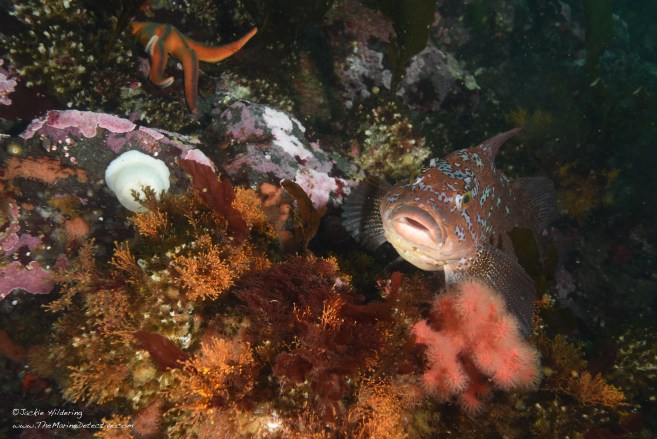
Photo above is another perspective on the same fish. Note that the bright orange life you see here are animals, not plants. They are Orange Hydroids. The soft coral beside the Kelp Greenling’s head is Red Soft Coral.


Fish #2
Quillback Rockfish

Quillbacks, like so many of BC’s 34 rockfish species, have been over-exploited.

Rockfish are slow to mature, and are very localized in where they live. Therefore, they are particularly vulnerable to overfishing.

As divers, we’ve seen how Rockfish Conservation Areas can make a real difference for the number, diversity and size of rockfish.

There is no egg-guarding in this species because the young develop inside the females and are born into the water i.e. they are viviparous.

Please see my previous blog “Rockfish Barotrauma” at this link on the importance of Rockfish Conservation Areas and also on how to reverse what happens to rockfish when they are brought up from depth i.e. how to easily reverse barotrauma.

Quillback Rockfish = Sebastes maliger to 61 cm.


Fish Face #3
Lingcod

Lingcod males also guard the fertilized eggs. They are extraordinary large masses that look like Styrofoam. We survey for the egg masses each year to get a sense of potential recovery since this species was overexploited. It’s believed the same males guard eggs in the same spot year upon year. This again helps understanding of how many fish have homes whereby fishing intensely in one area can lead easily to overexploitation. My blog “Fastidious, Fanged Fathers” at this link shows the egg masses with information on Ocean Wise’s Lingcod Egg Mass Survey. 

Lingcod = Ophiodon elongatus, females larger, to 1.5 m.


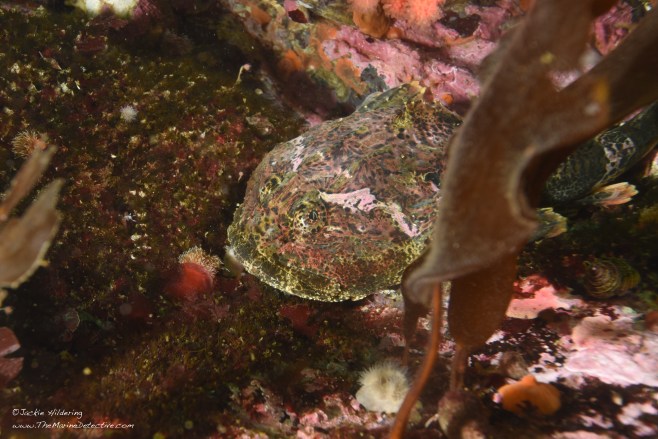
Fish Face #4
Buffalo Sculpin

Yes, this is a fish, not a rock with eyes.

There is so little understanding about how species like this can change their colour as they do.

It won’t surprise you that the most research is done on “commercially important” species with regards to stock management. Males also guard the fertilized eggs in this species.  See my blog “Buffalos Mating Underwater” at this link for photos showing the diversity of colour / camouflage and for photos of the eggs.

Buffalo Sculpin = Enophrys bison to 37 cm long.


Fish #5
Red Irish Lord


I must have disturbed this Red Irish Lord with my bubbles for him/ her to be easily visible like this. They are usually fully camouflaged.

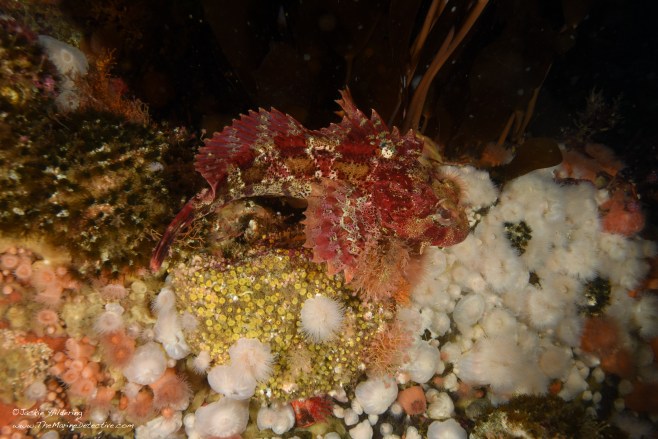
Note the shell the Red Irish Lord is on. This is a Giant Rock Scallop whose shell has been drilled into by Boring Sponge. Astounding isn’t it to think that Giant Rock Scallops (Crassadoma gigantea to 25 cm across) start off as plankton; are free-swimming to ~2.5 cm; and then attach to the bottom with their right side and can grow to 25 cm. They may live as long as 50 years but there have been problems with human over-harvesting.

Red Irish Lord parents take turns caring for their fertilized eggs (Hemilepidotus hemilepidotus; up to 51 cm).

Please see my blog “In the Eye of the Lord – the Red Irish Lord That Is” at this link. 

Lingcod = Hemilepidotus hemilepidotus, to 51 cm long. 

And the final photo and thoughts for you dear reader:

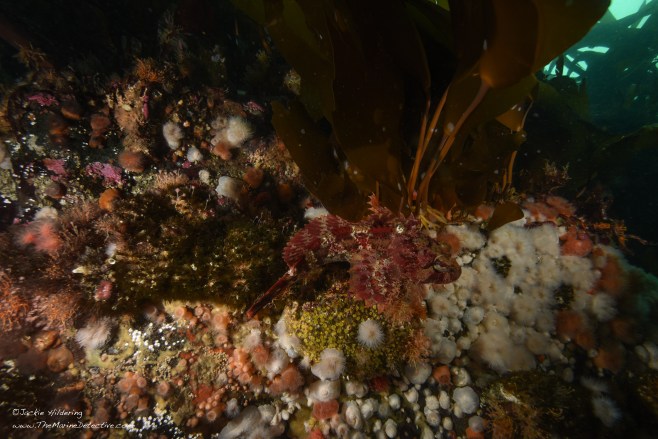
Same Red Irish Lord as in the photo above.


Under the canopy, beams of light shimmering through as they would in a forest of trees, bringing energy to the algae which feed the depths. This is all at only 5m depth. This is life you could imagine when you close your eyes and think of the dark sea off our coast. This is the world where Humpbacks feed, where families of Orca follow the same lineages of Chinook Salmon generation after generation, where species exist without our knowledge let alone our respect. This is their world. This is the world to which all life on earth is connected.

Five fish. One dive. A world connected.

Rockfish Barotrauma

Update: September 2022
New paper – Hailey L. Davies, Shane Gross, Dana R. Haggarty, Francis Juanes (August, 2022)- PHOTO DIARY – Conserving Rockfishes: Barotrauma and Descending Devices in the Northeast Pacific, Fisheries Magazine.

Get the app that alerts you when you enter a Rockfish Conservation Area.

Update: Fisheries Notice March  25, 2019
The use of a descending device is now required by condition of licence to assist in the conservation and survivability of rockfish being returned to the water. Because of their closed swim bladders, rockfish brought to the surface suffer barotrauma, causing the swim bladder to inflate and reducing the probability of their survival upon release. Handle catch as little as possible, using wet hands to preserve the protective slime coat, and return to the water at depth of capture as quickly as possible (under two minutes). To avoid catching rockfish, move to another fishing location.”

_______________________________________________

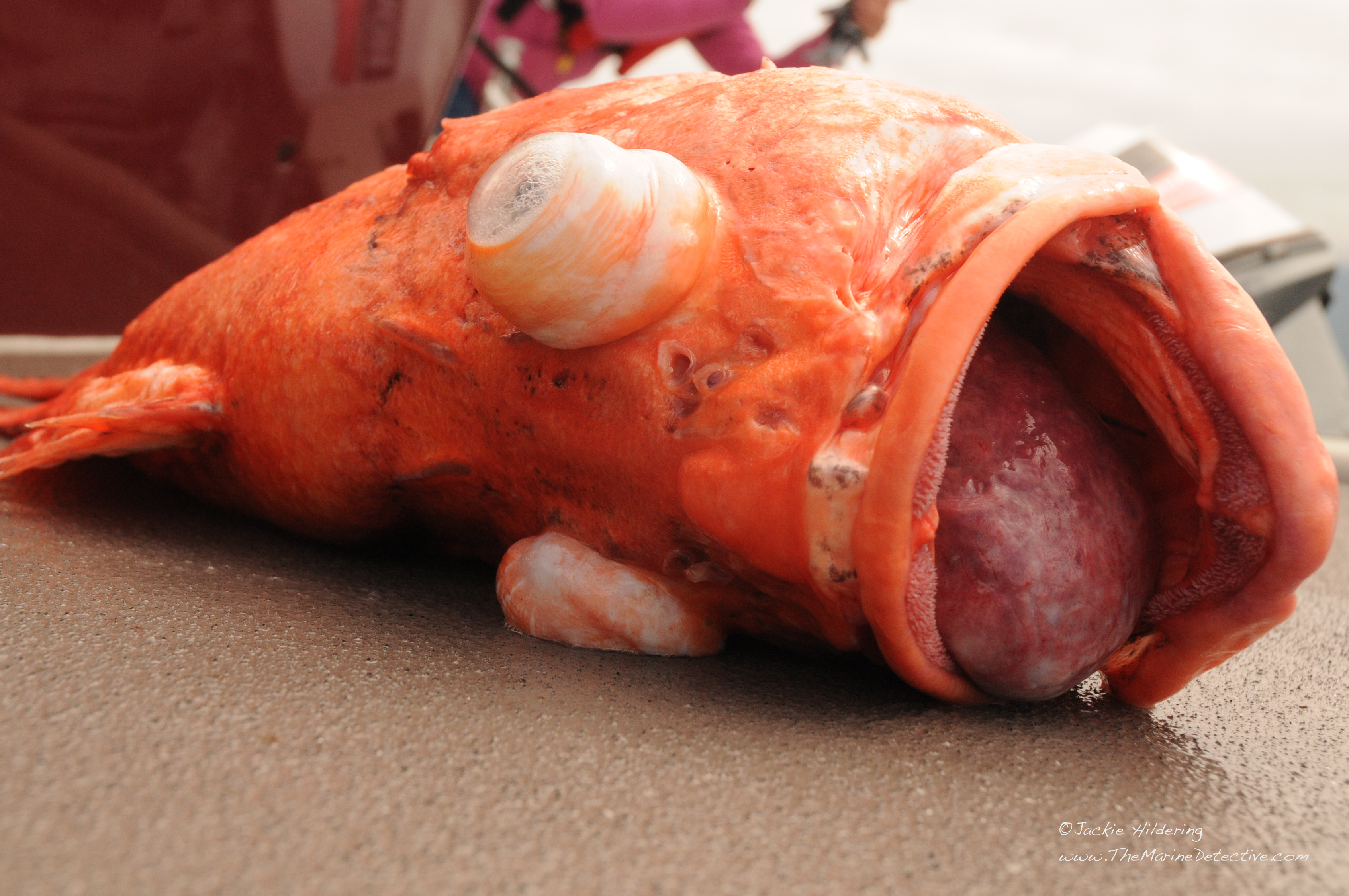
This photo is of a Yelloweye Rockfish that has died from barotrauma, also known as “pressure shock”. 

Yelloweye Rockfish that has died of barotrauma. Reduced water pressure causes the air in the swim bladder to expand and push out the esophagus and eyes. BUT this is a reversible condition whereby the fish can survive through use of a “fish descender”. Photo: Hildering. 

Many rockfish species are particularly sensitive to reductions in pressure since the air in their swim bladders expands substantially. The swim bladder is a buoyancy control organ and even when slowly reeled in from a depth of only 20 m (60’), a rockfish’s swim bladder can expand to three times its size, putting pressure on the fish’s organs.

As is the case with the Yelloweye Rockfish in the photo, the swim bladder can expand to the point of causing the fish’s eyes to bulge out of their sockets and its esophagus to be pushed out of its mouth (the esophagus is the first section of the digestive tract). I know this is likely a sight that may not enhance your appetite for your rockfish catch but please read on since, contrary to the thinking of many, this IS reversible whereby the rockfish stands a good chance of survival.

Colossal “management” errors were made with overfishing slow-growing rockfish. Many species are extremely long-lived, slow to sexually mature, and the big, old females are the most fertile – producing the most eggs and hatching the largest number of healthy young.

For example, Yelloweye Rockfish are believed to have a lifespan of up to 118 years. They don’t reproduce until they are at least 12 years old, and the old females can incubate up to 2.7 million eggs! Know that there are 38 species of rockfish off the coast of British Columbia. 

This means that species are very slow to reproduce whereby, if you catch lots, especially the big females, you can devastate populations very quickly.

Another nail in the coffin of rockfish is that many adults also have high site fidelity so that by fishing one area, you can wipe out a community of fish. Click here for my blog on having found back the SAME individual rockfish in the SAME spot after EIGHT YEARS. This is why Rockfish Conservation Areas (RCAs) are essential, where it is most often illegal to do any hook and line fishing (see restrictions here). 

But, what is you accidentally catch a rockfish outside these areas?

There are studies that support that if you were to quickly recompress the fish, it would stand a very good chance of survival, even where it appears dead at the surface. The fish could be brought back to depth with barbless weighted hooks, or commercial “fish descenders”.

This video make the life-saving potential of fish descenders very clear.

From Island Fisherman Magazine: “Common types of descending devices include a simple, inverted barbless hook, a spring-loaded clamp, and a pressure-release clamp. Of the different devices available, the most effective and simplest to use is a depth pressure activated release device, the Seaqualizer . . . Automatically opening at preset depth, the motion of the boat or the actions of the rockfish as it descends will not prematurely release the fish.

Examples of fish descenders:
Seaqualizer Fish Release Tool (~ $60 CAN)
(Recommended by various fishing organizations and publications)
Shelton Fish Descender (~$8 CAN) 
SeaQualizer SeaYaLater Fish-Release Hook (~$20 CAN)”

If you can act quickly enough (which is essential) you can even use and inverted, weighted milk crate. See clip below AND this link for making your own descending device.

How wonderful it would be if more people would undertake the effort to recompress the fish, knowing how dire the situation is for many rockfish species. Imagine the further positive impact if people would choose to return the depleted species to depth even when they haven’t reached their catch limit, especially the big, highly productive females.

But, even if there was to be such enlightenment, many rockfish populations are so depleted that they need far more protection.

Again, Rockfish Conservation Areas (RCAs) are essential. These should be areas known to be the territory of depleted rockfish populations. Since these are no-fishing zones, there is no chance of barotrauma and the rockfish populations that live in the area are given the time to rebuild to have more sexually mature fish and more big old super mamas.

In summary, it’s so easy to contribute to rockfish conservation:
(1) Respect Rockfish Conservation Areas knowing that you usually cannot do ANY hook and line fishing there; and
(2) Invest in a fish descender for rockfish caught outside RCAs.

Long live rockfish!

Fantastic video showing how rockfish that appear dead at the surface due to barotrauma fully can revive at depth! From the Coastside Fishing Club:

Video from Alaska Department of Fish and Wildlife showing a summary of homemade and commercial fish descenders. 

Entertaining and super informative video “How to save a life – a rockfish life” by fish guru Milton Love with a rap song by Ray Troll:

Source: Protecting Rockfish – Fisheries and Oceans Canada

Links
Get the app that alerts you when you enter a Rockfish Conservation Area

Government of Canada

Examples of fish descenders

Research on the effectiveness of fish descenders