
Abseiling Sea Snail
Go ahead, say that 5 times “abseiling sea snail, abseiling sea snail, abseiling sea snail . . .”
Now that you’ve warmed up and possibly developed a lisp, meet the Wrinkled Amphissa (Amphissa columbiana). They are also known as “Wrinkled Dove Snails”.
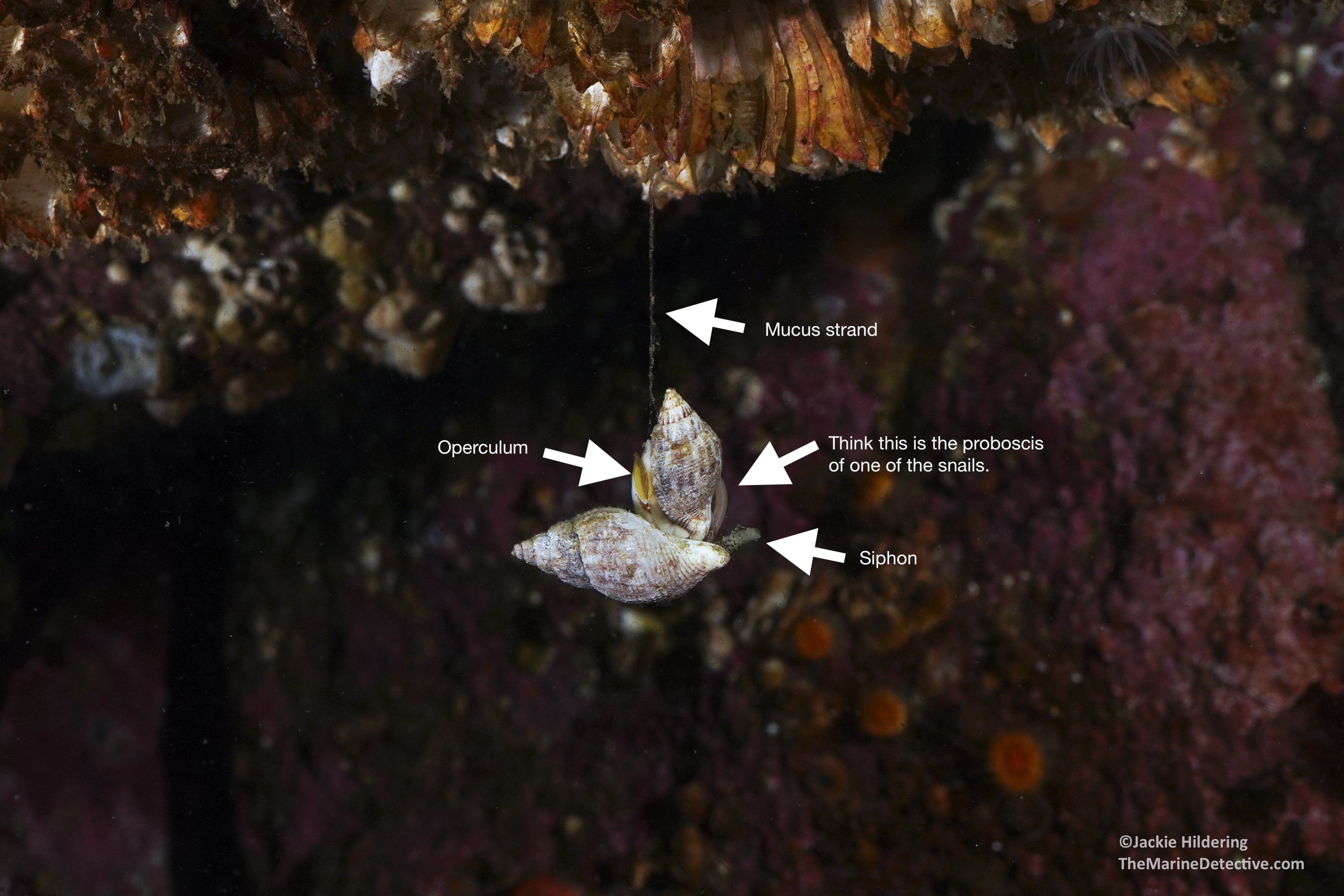
This species of marine snails is so fabulously wicked. A gland near their foot can secrete thick mucus allowing them to climb up and down to where they smell food and suspend themselves. See that strand above the two Wrinkled Amphissas in the photo?
At only up to 3 cm long, they can also deter MUCH bigger sea stars. Read on!
Scavenging
In this species, a gland near the foot secretes thick mucus that allows them to climb up and down and suspend themselves in the sea.
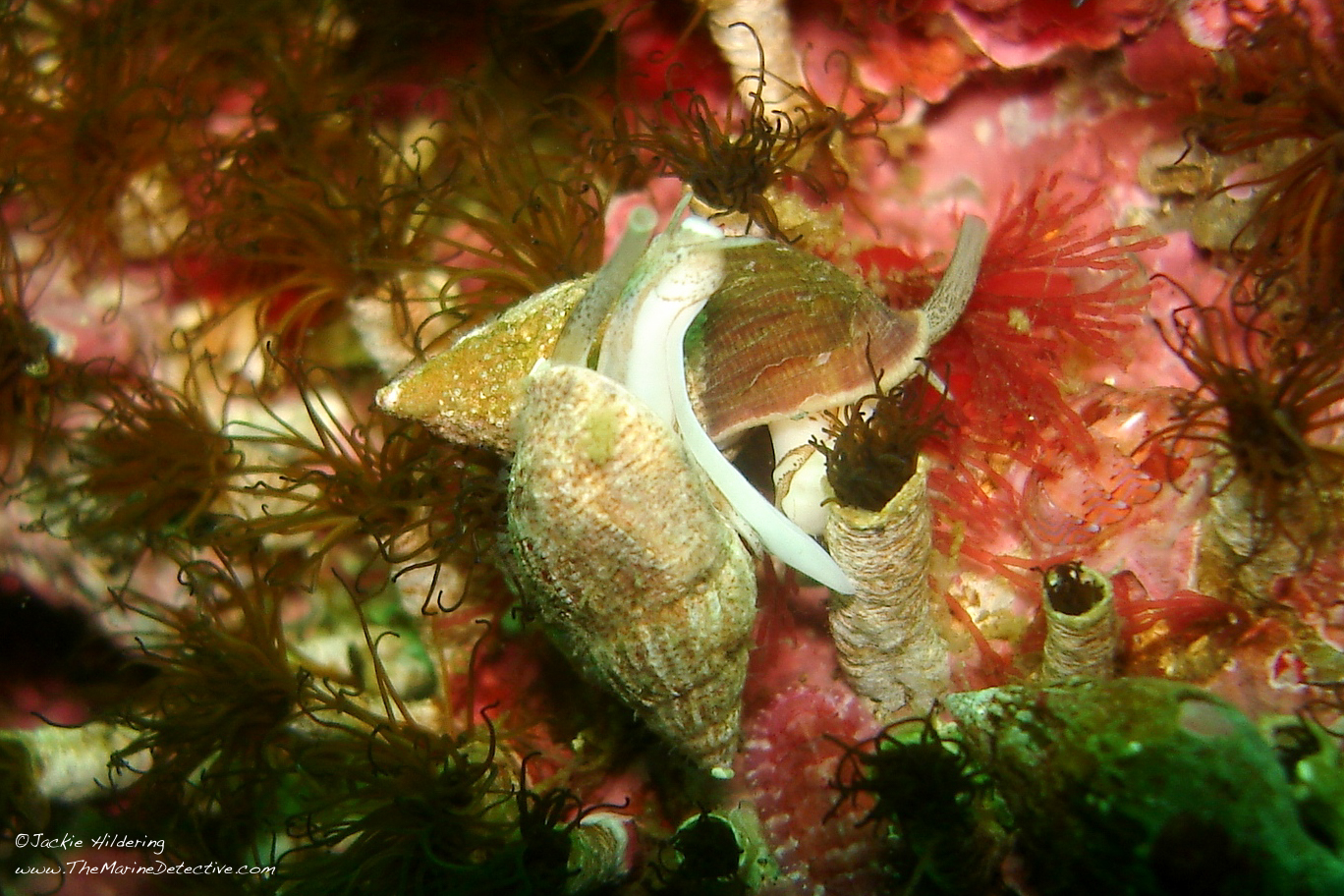
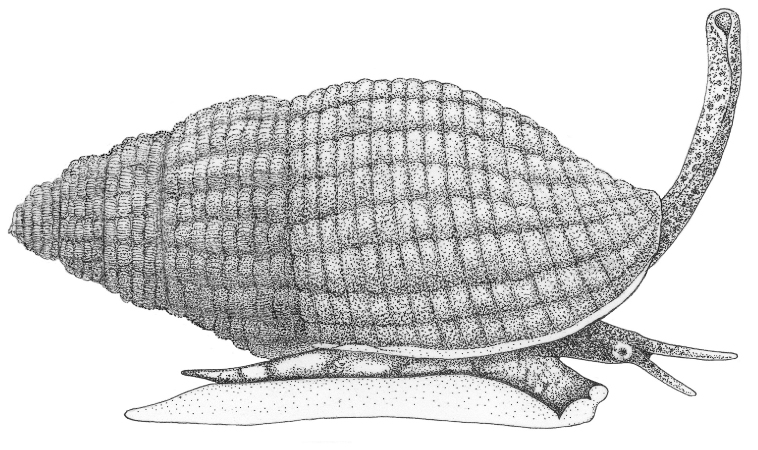
Where are they abseiling to? These marine snails are big-time scavengers and are very active, using their long siphon to smell out dead animals and algae.
It appears they can detect the chemicals of decay incredibly well and they also follow the mucus trails of others of their kind. Often a pile of them are scavenging together as you seen in the photos below.
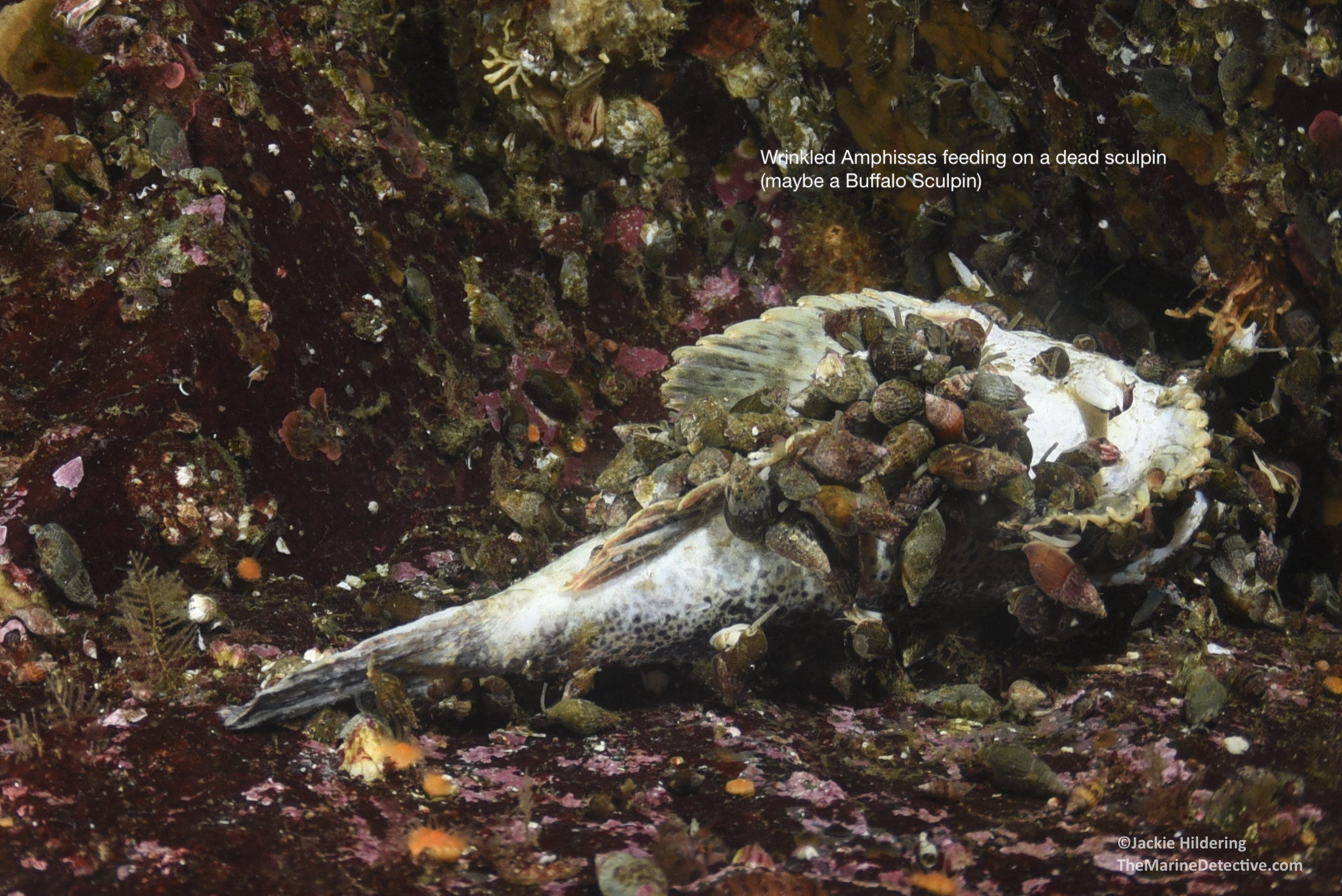
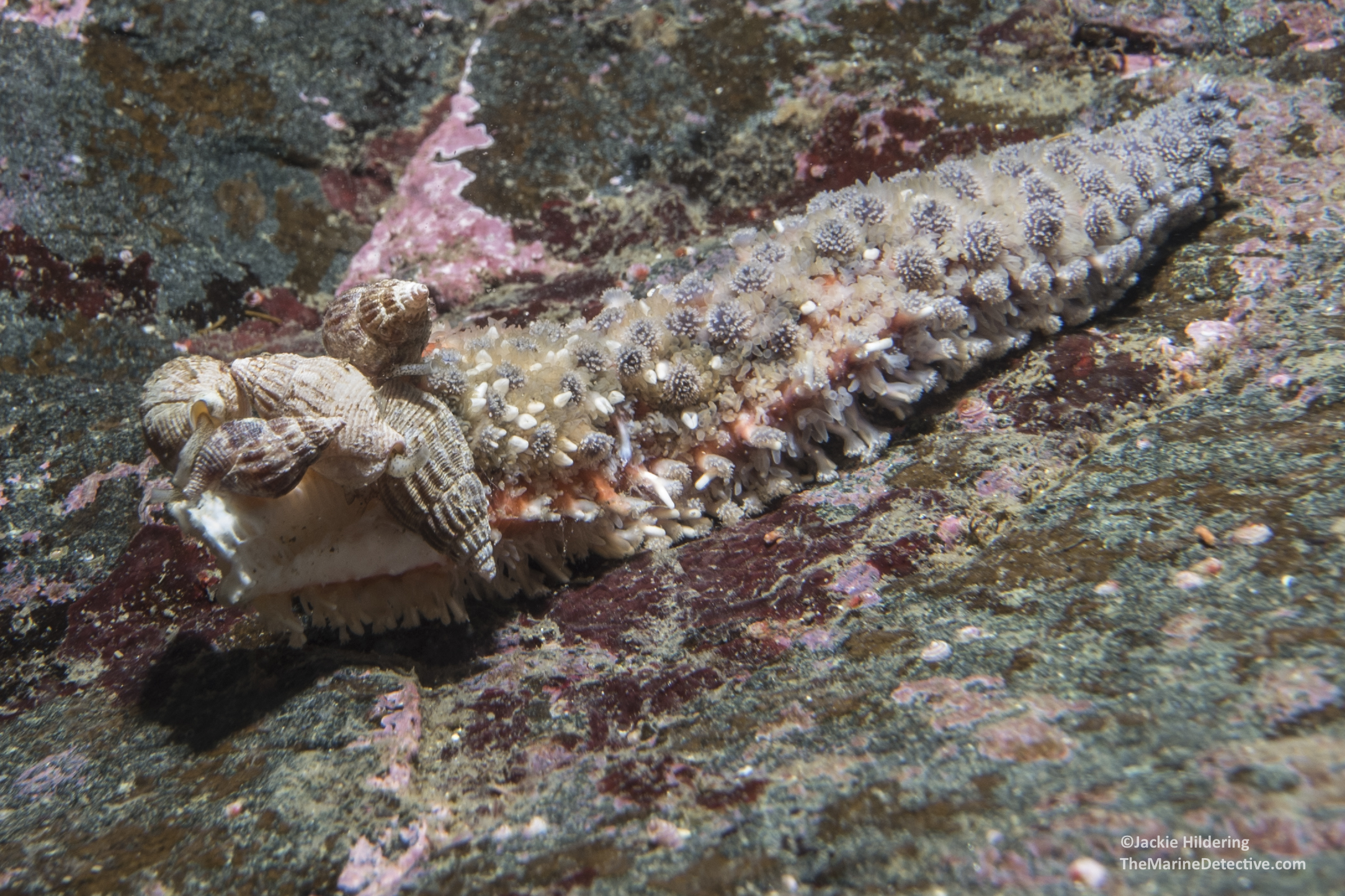
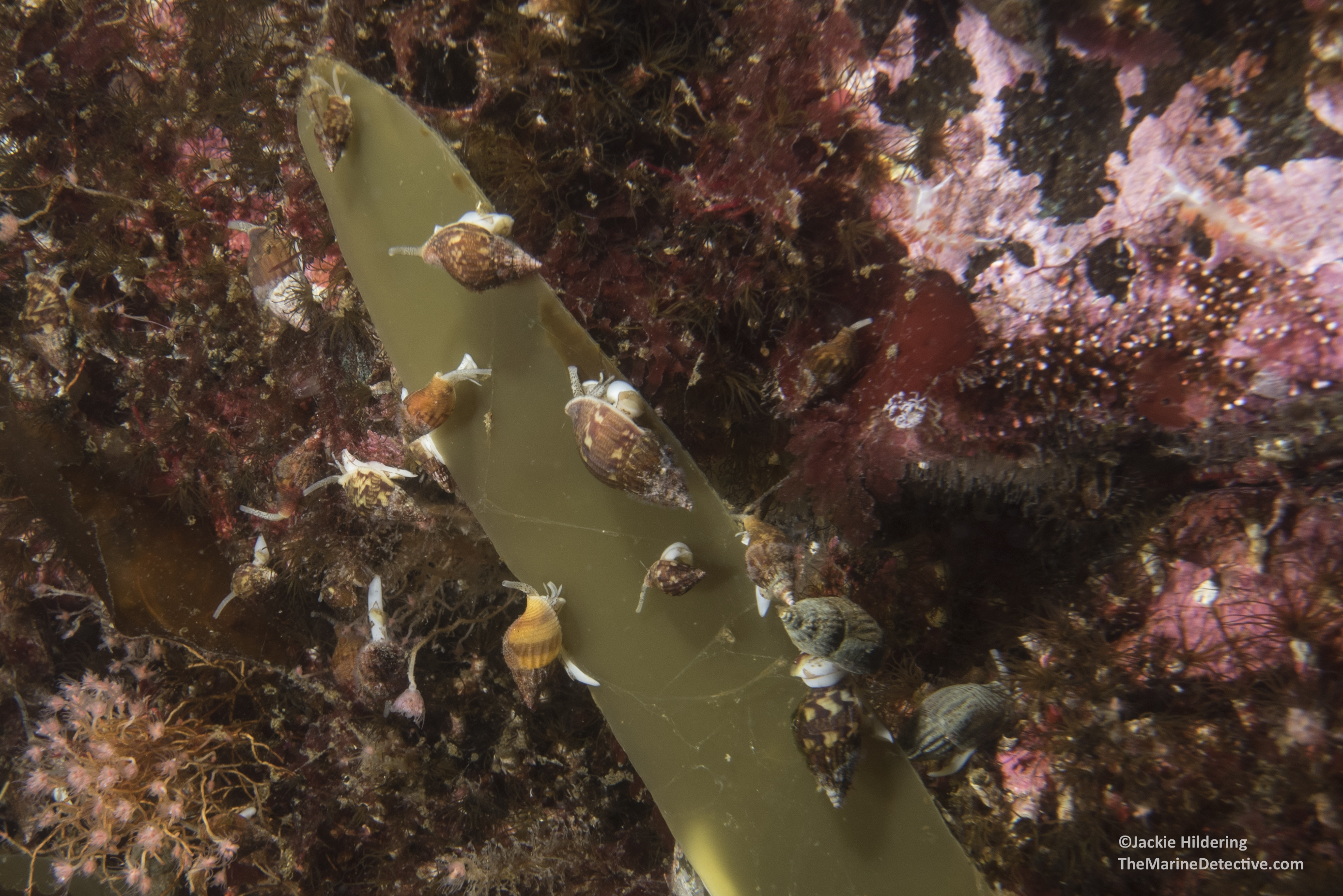
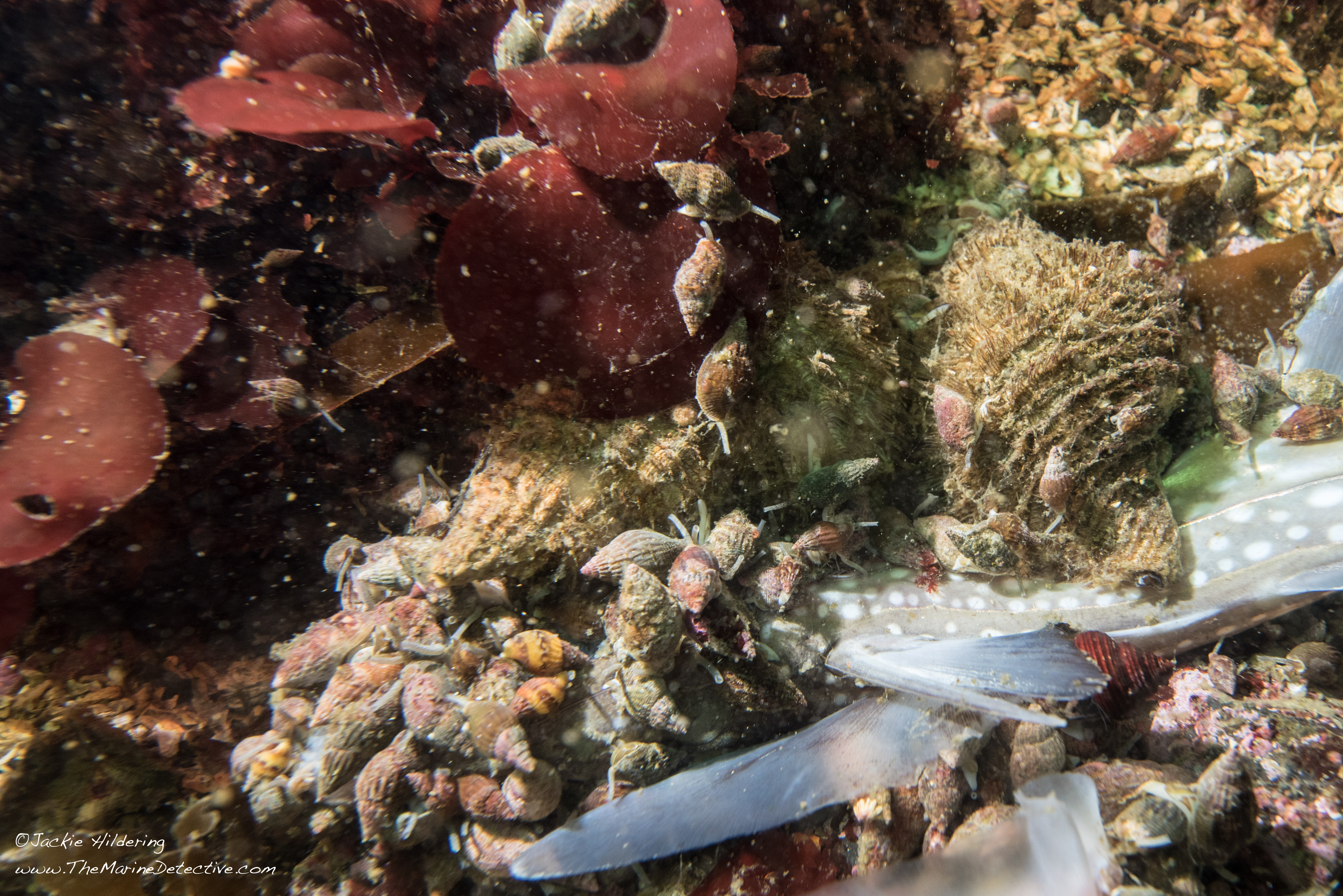
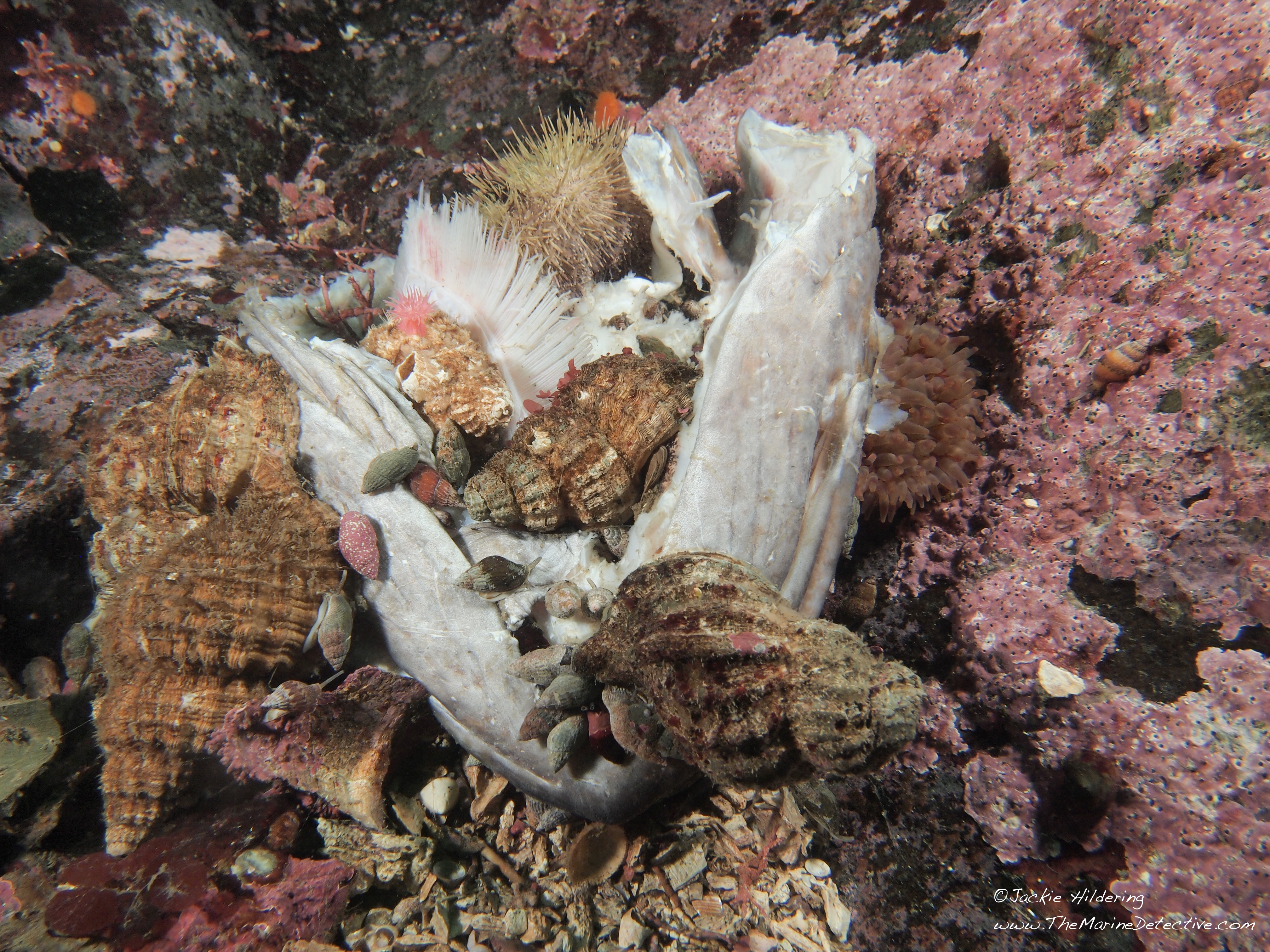
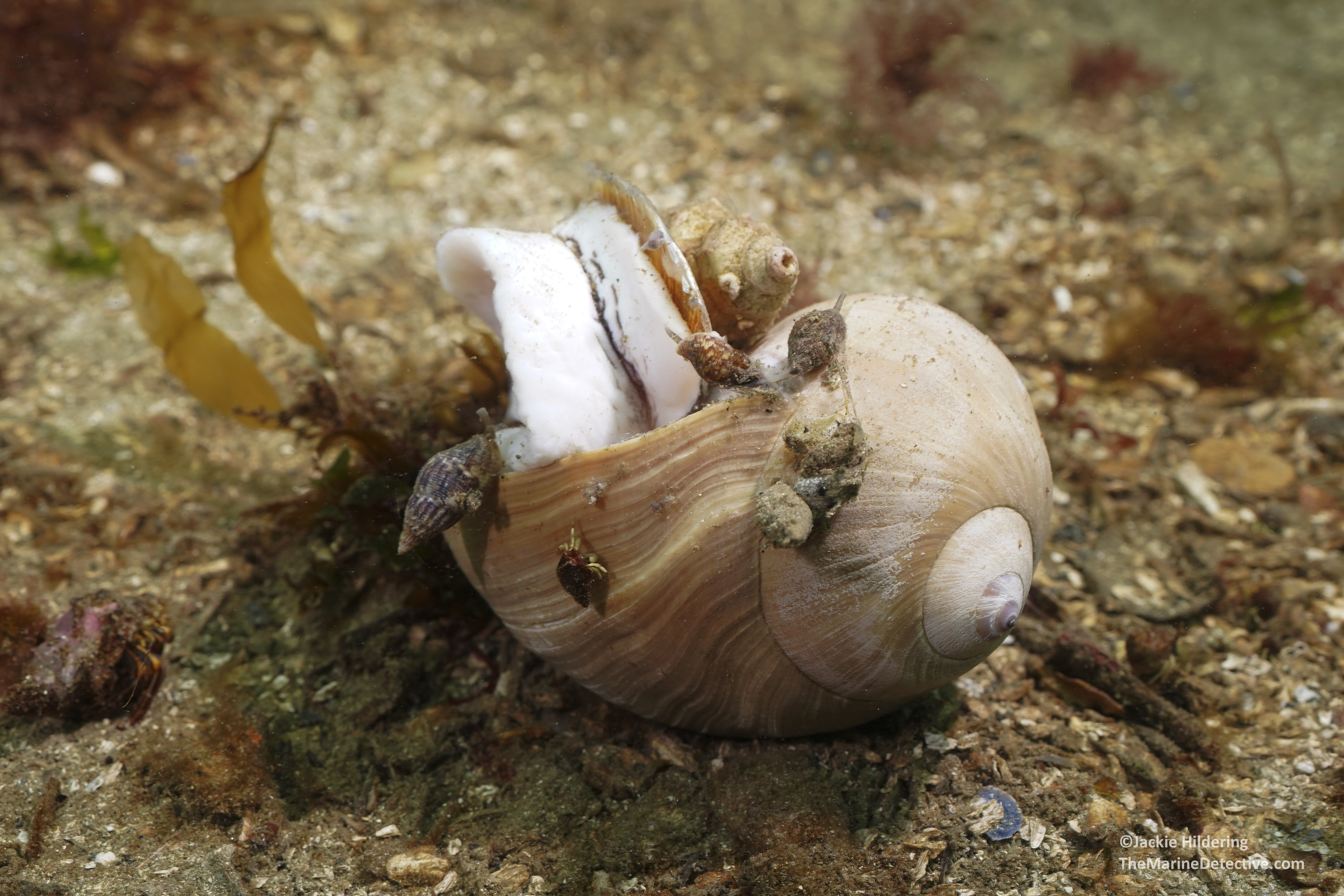
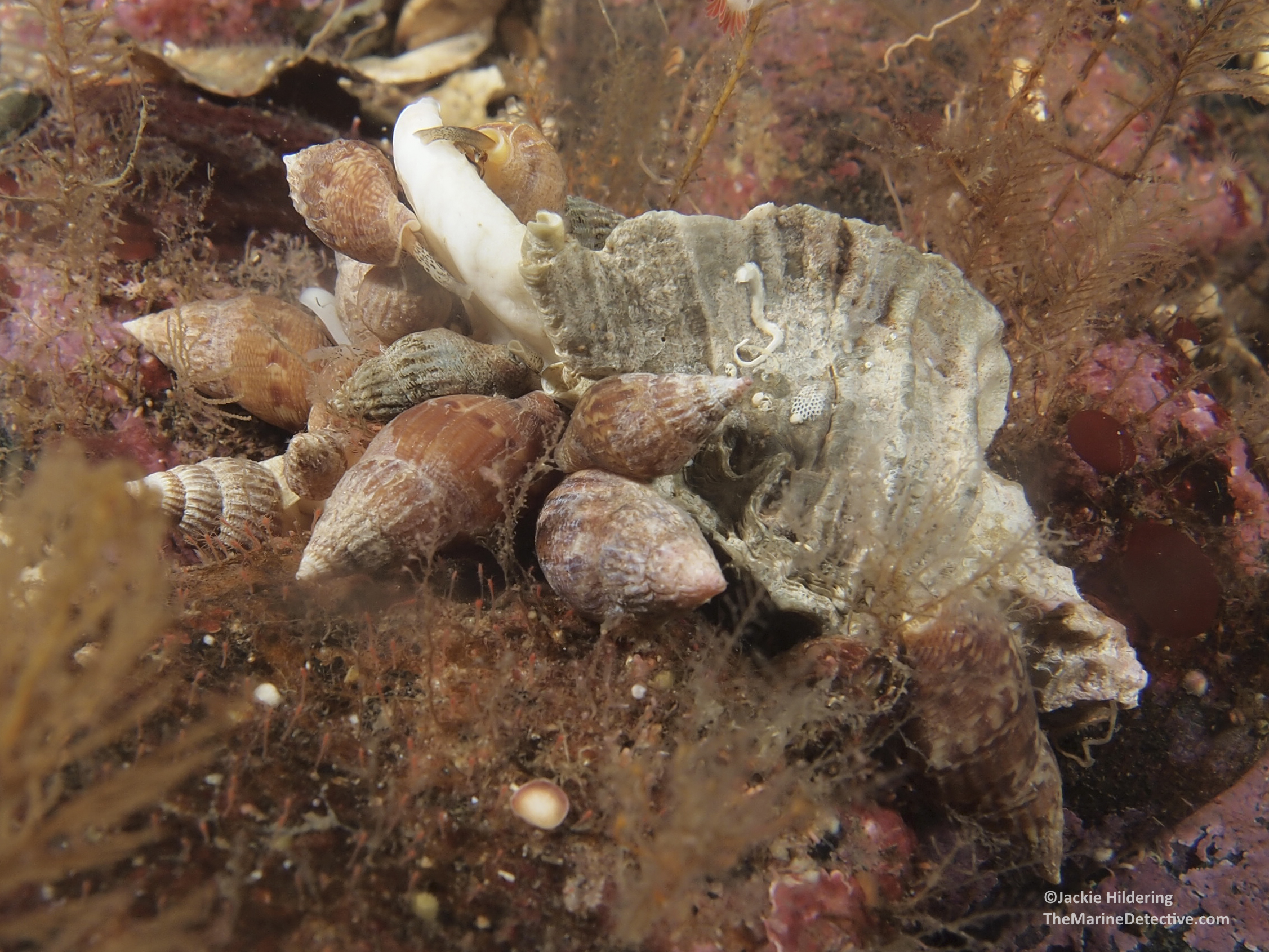
From Braidwaithe et al., 2017 regarding feeding. “They appear to locate food resources primarily through chemosensory cues, often following conspecific mucus trails and sometimes congregating around actively feeding sea stars. The chemical cues that draw A. columbiana to food act as feeding stimulants; the addition of scent from a damaged animal induced the snails to feed on healthy prey. The ability to sense chemical cues from damaged animals, including those being consumed by feeding sea stars, creates scavenging opportunities other gastropods may be unable to exploit.”
Biting
They also have a wicked defence against sea stars where they insert their very long mouth part (the proboscis can be more than 2.5 times the lenght of the shell) into one of the grooves on the underside of the arms of predatory sea stars, biting a nerve.
From Braidwaithe et al., 2010 “The injury, which generally repelled the attacking sea star, immobilized the affected arm, rendering it useless for several days. The biting defense appears to be effective against several sea star species and may reduce predation on A. columbiana.” Some crab species do feed on Wrinkled Amphissas.
Such remarkable adaptations in a sea of remarkable organisms which means I will be writing blogs and allotting abundant alliteration for a long, long time to come.
Adapting over thousands of years
I am sharing the photo below to give a sense of the diversity in the mollusc phylum to which snails belong.
“Mollis” means soft in Latin and the molluscs are our soft-bodied terrestrial and marine invertebrate neighbours. Their phylum is the second largest (the insects take first place). Note that all the organisms in this photo start off as larvae in the planktonic soup of the Ocean.
You can imagine how excited I was to chance upon 5 highly diverse marine mollusc species in one small area.
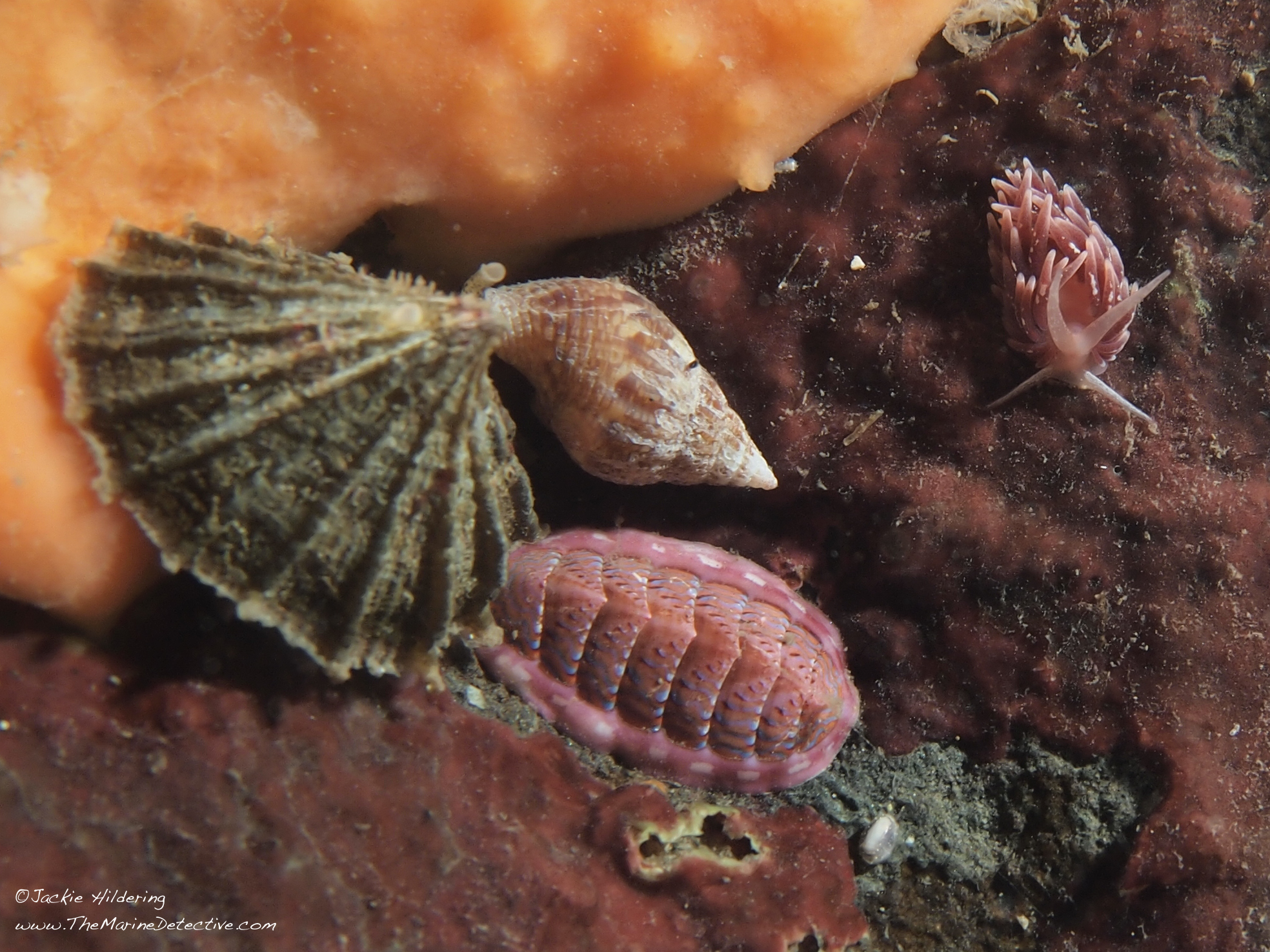
Details about the species in the above photo:
– To the left of the Wrinkled Amphissa is a Keyhole Limpet who makes its own hat-like shell and grazes on rocks (preferred diet is bryozoans). Limpet species need to suction down hard on a flat surface because they do not have a shell to cover its underside. The individual here is in a risky position as a predator could easily flip and consume limpet. Too cool not to share with you is that engineers have found that the “teeth” of limpets (the radula) are made of the strongest biological material ever tested (and the teeth are less than a millimetre long)! Note that marine snails like the Wrinkled Amphissa are protected not only by a shell, but they have an operculum which serves like a door to close the entrance to the shell when the snails withdrawn into its shell.
– Below the Wrinkled Amphissa, a Blue-Lined Chiton. Chitons make 8 plates to protect themselves. They are grazers like limpets. They too need to be able to suction down to protect themselves but do not need to be on a flat surface since the plates allow them to “contour” onto the surface.
– To the right of the Wrinkled Amphissa is a species of sea slug known as the Pomegranate Aeolid. It has “naked gills” and is therefore in the group of sea slugs known as “nudibranchs”. Sea slugs are marine mollusc without ANY shell or plates for protection. They are protected by feeding on animals with stinging cells (nematocysts) which become incorporated into those structures on its back (they are called cerata and also function as the naked gills for respiration). Specifically, Pomegranate Aeolids feed on Raspberry Hydroids which were only acknowledged as a new species in 2013. Scientific name is “Zyzzyzus rubusidaeus” and again, I do NOT make up these names. 🙂 See photo below.
– Below the chiton, if you look very carefully, is a very tiny sea slug species. I believe this is a Sea Cherub – a type of sea slug that swims and does not have naked gills (and therefore is not a nudibranch).
Not in the photo but to be considered too in the incredible diversity among marine molluscs are – octopuses!
Sources:
Anita Brinckmann-Voss & Dale R. Calder (2013). “Zyzzyzus rubusidaeus (Cnidaria, Hydrozoa, Tubulariidae), a new species of anthoathecate hydroid from the coast of British Columbia, Canada” (PDF). Zootaxa. 3666 (3): 389–397.
Lee F. Braithwaite, Anthony Rodríguez-Vargas, Miles Borgen, Brian L. Bingham (2017).”Feeding Behavior of the Wrinkled Dove Snail Amphissa columbiana,” Northwest Science, 91(4), 356-366.
Lee F. Braithwaite, Bruce Stone, Brian L. Bingham (2010). “Defensive Behaviors of the Gastropod Amphissa columbiana,” Journal of Shellfish Research, 29(1), 217-222.
Invertebrates of the Salish Sea – Amphissa columbiana
 The Marine Detective
Leave a comment