Dear Community, It’s the annual announcement that always gives me great joy while also feeling like a big relief. Next year’s WILD Calendar is now available. Thank you so much to all who helped by voting on the selection of my photos. The 2026 WILD Calendarscan be ordered at this link.
My WILD Calendar is aimed at creating awareness about the diversity and fragility of life hidden in the cold, dark, life-sustaining northeast Pacific Ocean. It is the waters dark with plankton that have more life, produce more oxygen, and buffer more carbon dioxide.
It’s the 17th year I have made a WILD Calendar. It’s truly moving to feel the support from you who put these calendars into the world. You are helping increase connection and understanding of our reliance on the Ocean. That’s needed to make the decisions, day-by-day, that consider future generations – from whales, to octopuses, nudibranchs, sea stars, and our own very strange, two-legged species. 💙
Each month’s photo has a detailed descriptor included about the featured marine life. The calendars are $28.50 + tax.
They are large and printed on sturdy paper on Vancouver Island, coil bound with a hole to hang them. 33 x 26.5 cm closed and 33 x 53 cm open (13 x 10.5″ closed /13 x 21″ open).
There are BIG spaces to write your daily adventures. Text is included to indicate when there is a full moon (PDT).
Beauty amid the debris: Mosshead Warbonnet living in a beer bottle. Natural habitat would be a crevice or a tube-worm tube. Glass is by far not the worst debris or pollutant in the ocean. But the ocean is not where any of our waste belongs. Up and down our coast, there is evidence of garbage purposely “deposited” as if it were a black hole into which waste disappears. This is testament to the extreme disconnect between human health and marine health, and ignorance about the marine life “hidden” in these dark waters thick with plankton. May a fish face make a difference. Chirolophis nugator to ~15 cm long.
February 2026 image and text
Candy Stripe Shrimp on a Crimson Anemone: They must be immune to the anemone’s stinging cells (nematocysts). The shrimp benefit from snacks (anemone poop and sloughed tissues) and the anemone may get protection. Greg Jensen of “Crabs and Shrimps of the Pacific Coast” observed in his aquarium that Candy Stripe Shrimp would share space on an anemone with Kincaid’s Shrimp but immediately attacked Snyder’s Blade Shrimp – a species believed to harm the anemone. Candy Stripe Shrimp (Lebbeus grandimanus) to 4.5 cm long. Crimson Anemone (Cribrinopsis rubens) to 30 cm tall and only described as a distinct species in 2018.
March 2026 image and text
Flowing underwater forest: Young Bull Kelp growing toward the sun — providing habitat, refuge, oxygen, carbon buffering, food for many species, and even serving as a navigation aid. Bull Kelp is an annual species. Most of what you see here (the sporophyte) dies off in winter. The sporophyte results from the reproduction of a completely different version of Bull Kelp — the very small gametophyte. The stipe (stem-like structure) can grow up to 36 m in length. The stipe has to grow an average of 17 cm per day over the ~210-day growing period (source: Druel) to drink in the sunlight, photosynthesize, and help sustain life on Earth — above and below the surface.
April 2026 image and text
Magnificent acrobats: Northern Opalescent Nudibranch feeling their way over Eelgrass. The structures extending upward from the head are the rhinophores by which they “smell” their way around. At the base of each rhinophore is an eye with 5 photoreceptor cells to sense light and dark. Species is up to 8 cm long and was reclassified as Hermissenda crassicornis in 2016. Where the ranges of 2 Hermissenda species overlap, this one is now often referenced as the Thick-horned Nudibranch. But, as I have stated previously, who wants to be called “thick” when you can be called “opalescent”?! Let’s go with Northern Opalescent Nudibranch.
May 2026 image and text
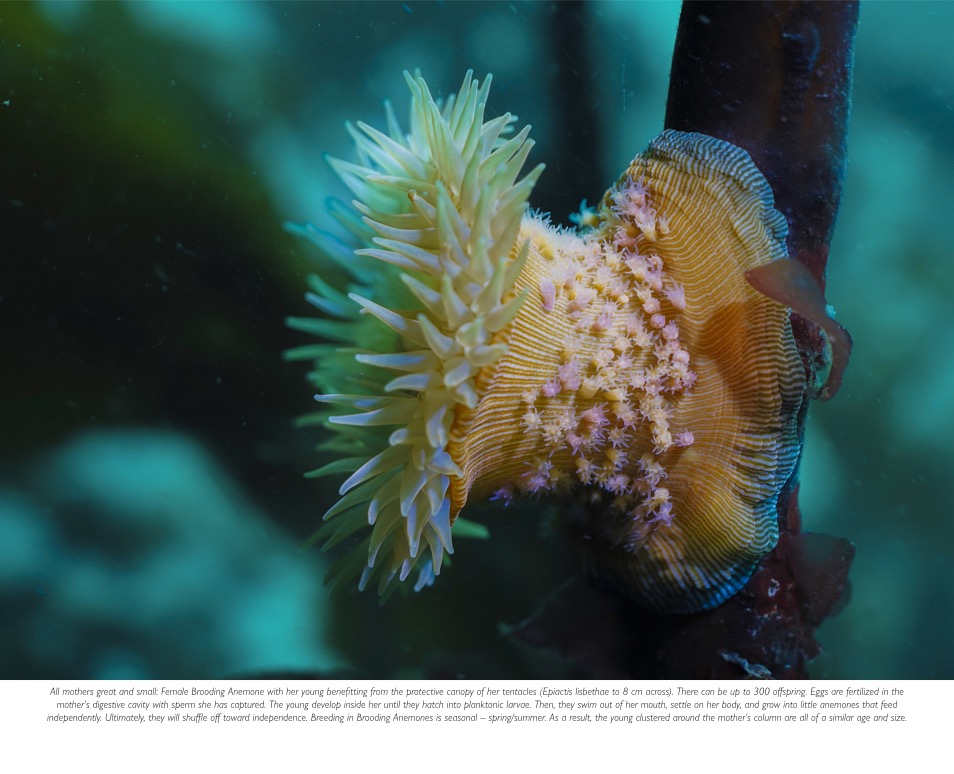
All mothers great and small: Female Brooding Anemone with her young benefitting from the protective canopy of her tentacles (Epiactis lisbethae to 8 cm across). There can be up to 300 offspring. Eggs are fertilized in the mother’s digestive cavity with sperm she has captured. The young develop inside her until they hatch into planktonic larvae. Then, they swim out of her mouth, settle on her body, and grow into little anemones that feed independently. Ultimately, they will shuffle off toward independence. Breeding in Brooding Anemones is seasonal – spring/summer. As a result, the young clustered around the mother’s column are all of a similar age and size.
June 2026 image and text
Sea Otter and Geoduck: Sea Otters were wiped out (extirpated) in BC. From 1969 to 1972, ~89 were translocated to NW Vancouver Island as a mitigation measure for nuclear testing in Alaska. Now, there are 8,100+ (Nichol et al. 2020). Even with incredibly dense fur – which made them so desirable in the fur trade – they need to eat up to 25% of their body mass per day to be warm in this cold ocean. Diet includes urchins which eat kelp. So, with more Sea Otters there is more kelp (with the many benefits). This may be a female. Males often bite females’ noses during mating. Geoducks are the world’s largest burrowing clam and can live for 140+ years.
July 2026 image and text
Red Irish Lord: This fish’s face says a lot about how I have felt about “developments” in the world. You too? Red Irish Lords are powerful ambassadors for the vivid colour in these cold waters (Hemilepidotus hemilepidotus to 51 cm). They are variations/combinations of red, orange, yellow, pink, purple, and white. How could such a colourful fish be camouflaged? Because the life around them has this intensity and diversity of colour. Even their eyes are camouflaged. This Red Irish Lord is on top of Red Soft Coral and Bushy Pink-mouth Hydroids – motionless, waiting for prey to come near. See my blog “Crabs Making Bad Choices” for what happens.
August 2026 image and text
Life in sand: Tube-dwelling Anemone (Pachycerianthus fimbriatus crown to 30 cm wide) and Northern Moonsnail (Neverita lewisii shell to 14 cm across). These anemones retract into their long tube in the sand (up to 1 m long) when pounced on by their predator, the Giant Nudibranch. Moonsnails need a big foot to dig for clams, which they drill into with their radula. The foot of a Northern Moonsnail can inflate with seawater to be 4 times the size of what it is when in the shell. They also rely on sand for their egg masses. Females embed 1000s of eggs between 2 layers of sand bound with mucus. Then, they push the collar-shaped egg mass above the sand.
September 2026 image and text
Humpback Inukshuk (BCZ0339): Nickname is for the marking on the centre of his fluke that looks like a pile of rocks. He is known to migrate to the breeding grounds of Mexico and return (skinny) to the feeding grounds of NE Vancouver Island every year since 2008. Sometimes still here in November. Some Humpbacks leave even later. They have staggered migrations – leaving and returning at different times whereby there can be Humpbacks in BC at any time of year. Inukshuk often rests at the surface during the day and can be so difficult to detect. There is great concern about vessel strike. For whale and boater safety, please see http://www.WhaleSafeBoating.org.
October 2026 image and text
Veiled octopus: I now carry this experience with me. I want you to carry it too – knowing about this Giant Pacific Octopus and feeling at least some of what I felt. I had my head down, slowly moving along in awe of a little species of sea cucumber that was spawning. I looked up from my focus on the small, and there, looking in my direction, was this Giant Pacific Octopus. I backed off. The octopus backed up, into the filamentous brown algae. And then, for some 5 minutes, we looked at one another. The octopus veiled in the algae. Me, wrapped in wonder. One of us a brief, and light-flashing visitor. The other, royalty among the invertebrates.
November 2026 image and text
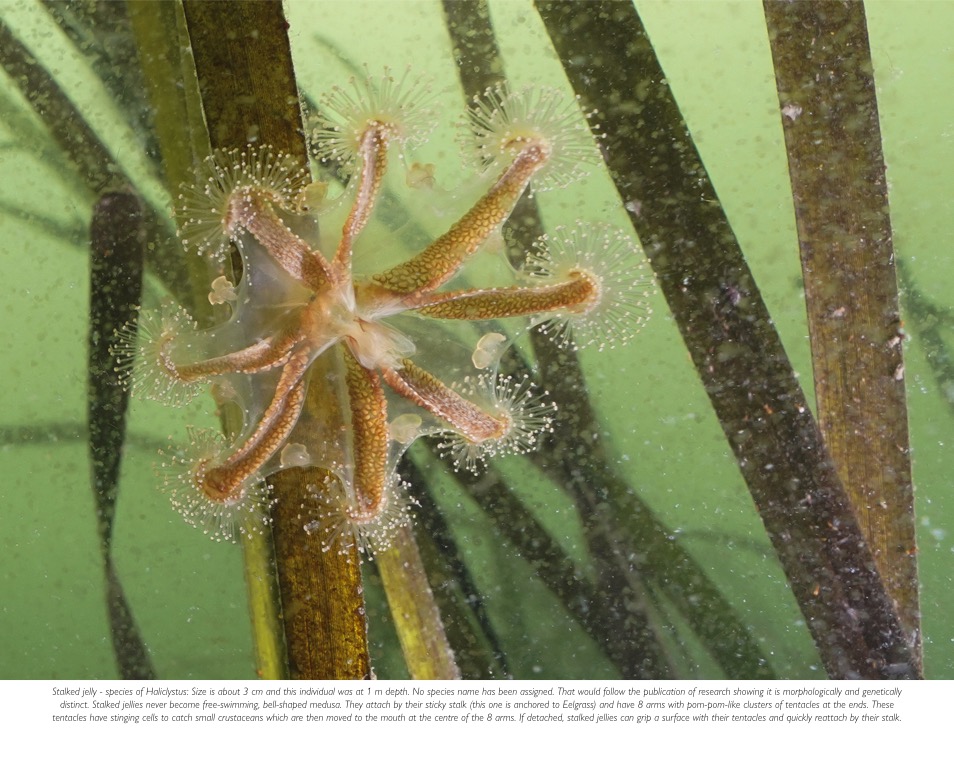
Stalked jelly – species of Haliclystus: Size is about 3 cm and this individual was at 1 m depth. No species name has been assigned. That would follow the publication of research showing it is morphologically and genetically distinct. Stalked jellies never become free-swimming, bell-shaped medusa. They attach by their sticky stalk (this one is anchored to Eelgrass) and have 8 arms with pom-pom-like clusters of tentacles at the ends. These tentacles have stinging cells to catch small crustaceans which are then moved to the mouth at the centre of the 8 arms. If detached, stalked jellies can grip a surface with their tentacles and quickly reattach by their stalk.
December 2026 image and text
Shut the door: The species in the centre is a Red-trumpet Calcareous Tubeworm with its crown (radioles) of high surface area to snare plankton. The colourful, trumpet-like structure on the animal’s lower right is their operculum. It functions like a door, pulling closed after the tubeworm retracts, giving further protection to the worm in its hard, shell-like tube of a home. Serpula columbiana to 6.5 cm long. The other species near the worm are tunicates – our closest invertebrate relatives. In their larval stage, tunicates have a backbone-like structure (notochord). Here, the Broadbase Tunicate is red, and the Mushroom Compound Tunicates are white.
Absolutely gorgeous, and informative to boot! I just ordered a couple and it feels strange, but so good, to have some of my Christmas shopping done in July. One will be going to my grandson, living in Phoenix, who has never seen the ocean, let alone the fabulous sea life we are blessed with here in BC.







 The Marine Detective
6 Responses to “2026 WILD Calendar”
Jackie! These are beautiful!! Thank-you for taking us into your world!
Thank you so much for the uplifting feedback,Terry.
Absolutely gorgeous, and informative to boot! I just ordered a couple and it feels strange, but so good, to have some of my Christmas shopping done in July. One will be going to my grandson, living in Phoenix, who has never seen the ocean, let alone the fabulous sea life we are blessed with here in BC.
A big smile to you Allan and thank you! How this makes me smile.
I keep trying to order 3 calendars but can not complete the transaction????
Mike
I am so sorry you are having problems Mike. It appears others were able to make an order. I will email you and you could pay by e-transfer.
Thank you!