Seven-armed Octopus – but has eight arms!
Oh how I’ve been eager to share this with you.
Extremely rare find – Seven-armed Octopus (Haliphron atlanticus)! This is a deep sea species which DOES have 8 arms, but the males do something that has led to this name. Read on!
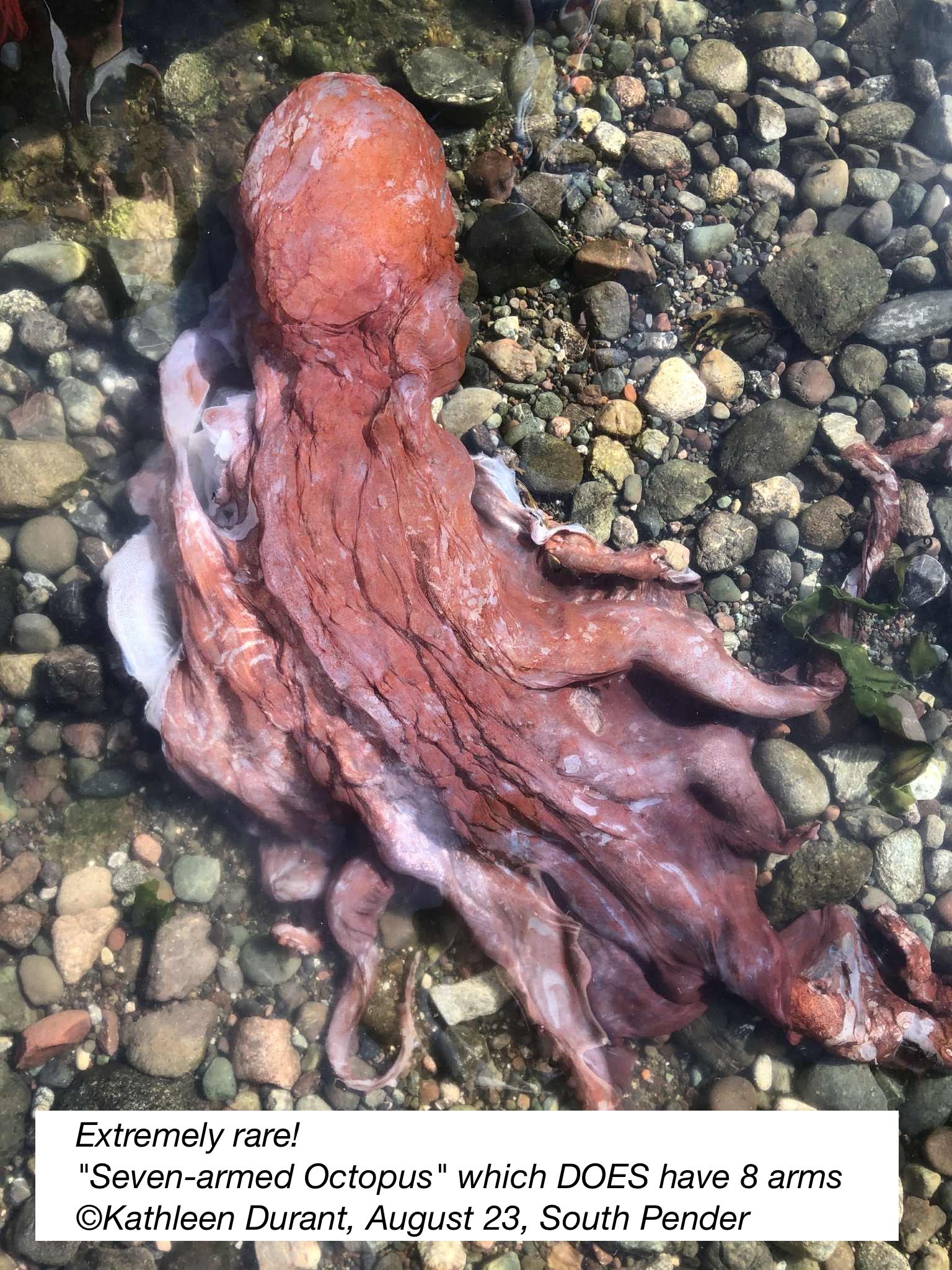
Females are HUGE at up to 4 metres long and 75 kg. Males are SO MUCH smaller at only up to 30 cm long. This one was about 120 cm long and was juvenile female.
She was found dead by Kathleen Durant on South Pender Island, British Columbia on August 23, 2025. Thankfully, Kathleen knew this was unique and potentially important, took photos, and gathered the individual before it was lost to the tide.
Dissection and photos by Karolle Wall documented the presence of “tiny teardrop eggs”, confirming this was a juvenile female.

She was initially identified as a Seven-armed Octopus by Casey Cook on the Field Naturalists of Vancouver Island (FNVI) Facebook page and confirmed by experts at the Royal BC Museum (in which I has a small role in connecting people). The Museum is where this extremely rare individual is now stored to contribute to knowledge/science.
Why the “Seven-armed Octopus” (also “Septopus” and “Blob Octopus”) when the species has 8 arms? Male octopuses have one specialized arm for reproduction which has no suckers at the tip called the “hectocotylus arm”. The section at the top which has the spermatophore. This section does not have the cells that allows colour and texture to change (the chromatophores). So, because it is not camouflaged, male octopuses hide it. In Giant Pacific Octopuses, the males usually curl up this arm. But, in THIS species, the males tuck away the arm . . . in a sac beneath their right eye! The arm is so well hidden that it looks like they have seven arms.

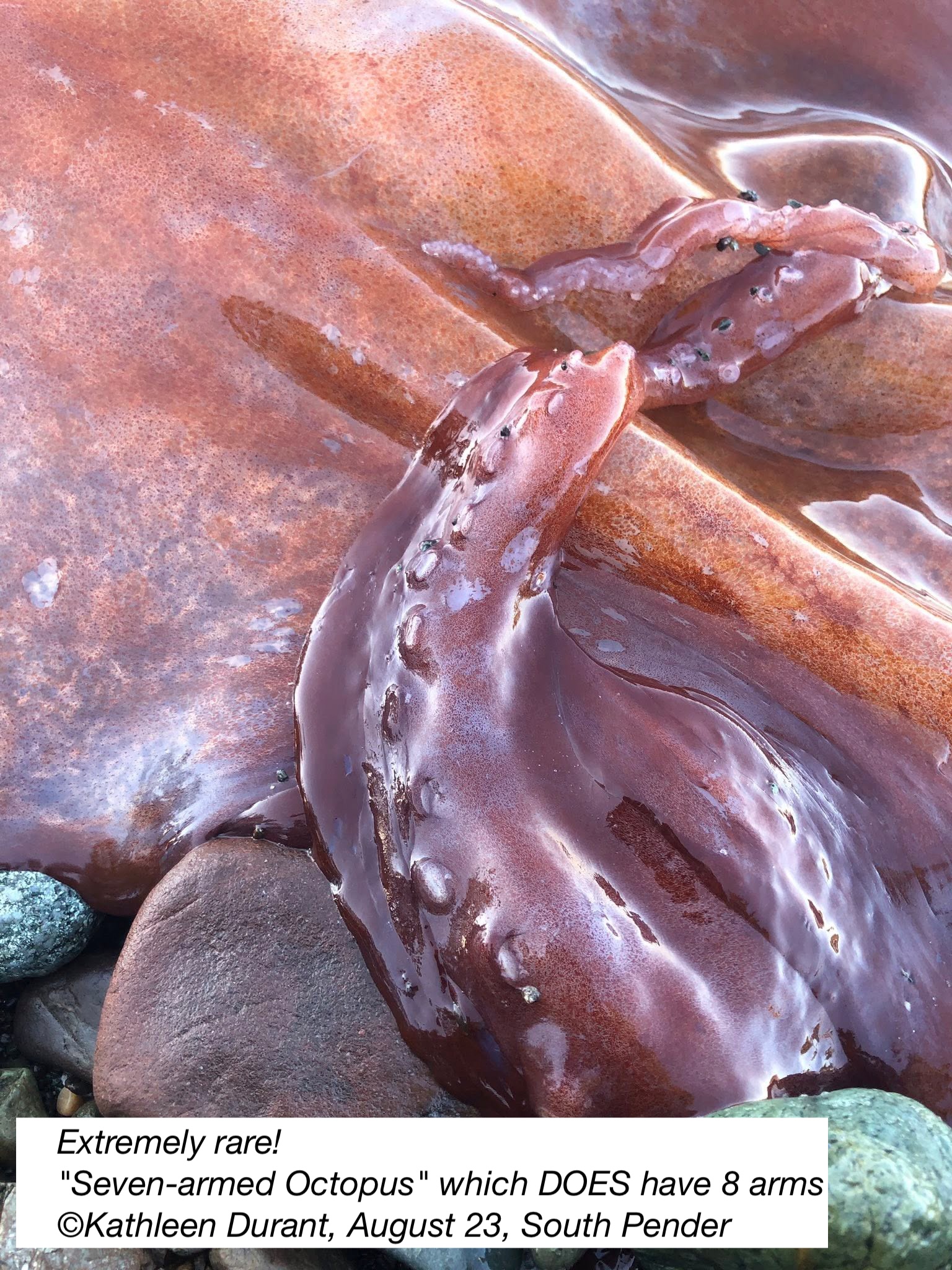
How rare are they? As an indicator, in an article from 2017 the Monterey Bay Aquarium Research Institute (MBARI) researchers with use of deep sea ROVs (remotely operated vehicles) had only seen three live H. atlanticus in 27 years.
Two truly extraordinary sightings of live individuals in the shallows were by divers Eric Askilsrud and Cam Polglase, both in September 2023. Eric took photos of one near Salt Creek, Washington and Cam videoed one near Ogden Point, British Columbia. Yes, I wish I was those divers.
I also learned from Gregory Jensen of the University of Washington that two other Seven-armed Octopuses are known to have washed up – one in south Puget Sound and the other by Whidbey Island, Washington.
Read the article from MBARI and watch the video above for how it was determined that this species feeds on gelatinous zooplankton – jellyfish, siphonphores and salps – and that the large females MAY use the jellies as defence!
You just never know how you could contribute to science, and wonder. As expressed by Casey Cook: “The ocean’s mysteries don’t always swim at six thousand feet! Sometimes they’re right at our feet.“
Thank you so much Kathleen for making this count.
From the article referenced above by MBARI:
“Since female Haliphron atlanticus are so large, they are able to completely grasp and contain a large jelly within their webbed arms and still swim. They use their beak to bite through the bell of the jelly to access the digestive cavity to consume the food contained within and to have access to the more nutritious parts of the jelly. At this point the jelly is dead, but the bell and fringe are still intact. Hoving and Haddock [MBARI researchers] postulate that, given the way Haliphron is holding the bell with the fringe of tentacles dragging behind, the octopus could be using the sticky and stinging tentacles (which still sting after the jelly is dead) either for defense or to capture other more nutritious prey . .
ROVs enabled the first observations of this novel octopod species and its even more novel behavior that revealed an unexpected role in oceanic food webs. Researchers now know that Haliphron, a food resource for top predators such as sperm whales, blue sharks, and swordfish, distributes energy to its predators along a path that incorporates gelatinous species.”
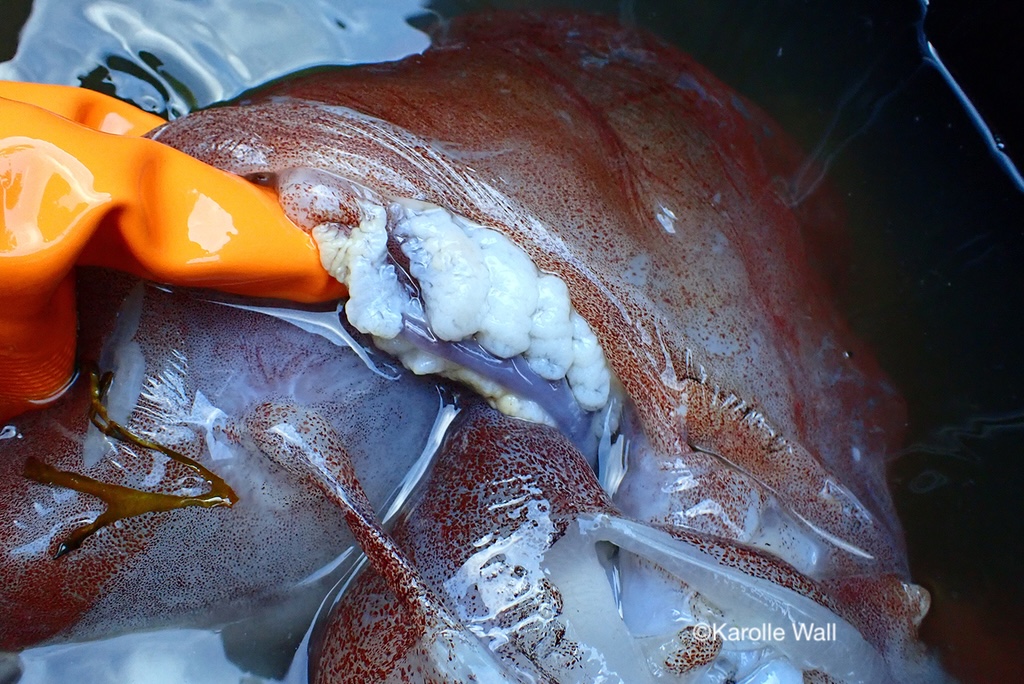
Information from the observation and dissection by the Royal BC Museum included: Total length 120 cm. Longest arm approximately 80 cm. Gonads and presence of tiny tear-drop shaped eggs determined sex as female. She was a juvenile (determined by her size being no where near the maximum of 4 metres for females).
Related TMD post:
Giant Pacific Octopuses – How do they mate?
 The Marine Detective
6 Responses to “Seven-armed Octopus – but has eight arms!”
Wow! Thanks so much for this facinating email.
Because I am “that guy” I feel compelled to point out that Eric was the diver who took pictures and Cam was the diver who shot video.
If nothing else me pointing this out to you shows that at least one person (me) is actually reading your missives. grin
A huge fan,
Allan
Thank you for being “that guy”. I am big on accuracy and humility. Correcting now!
Nature is slways fasvinating in what evolution can create. A seven-armed octopus, complete with eight arms, is almost unimaginable, but yet there she is. Just incredible! Thank you.
Huge smile to you! Yes!
You truly bring wonder and wow to us all with each ocean “story” you share! Non -fiction at its finest! Thank you!
How this makes me smile dear Christy!