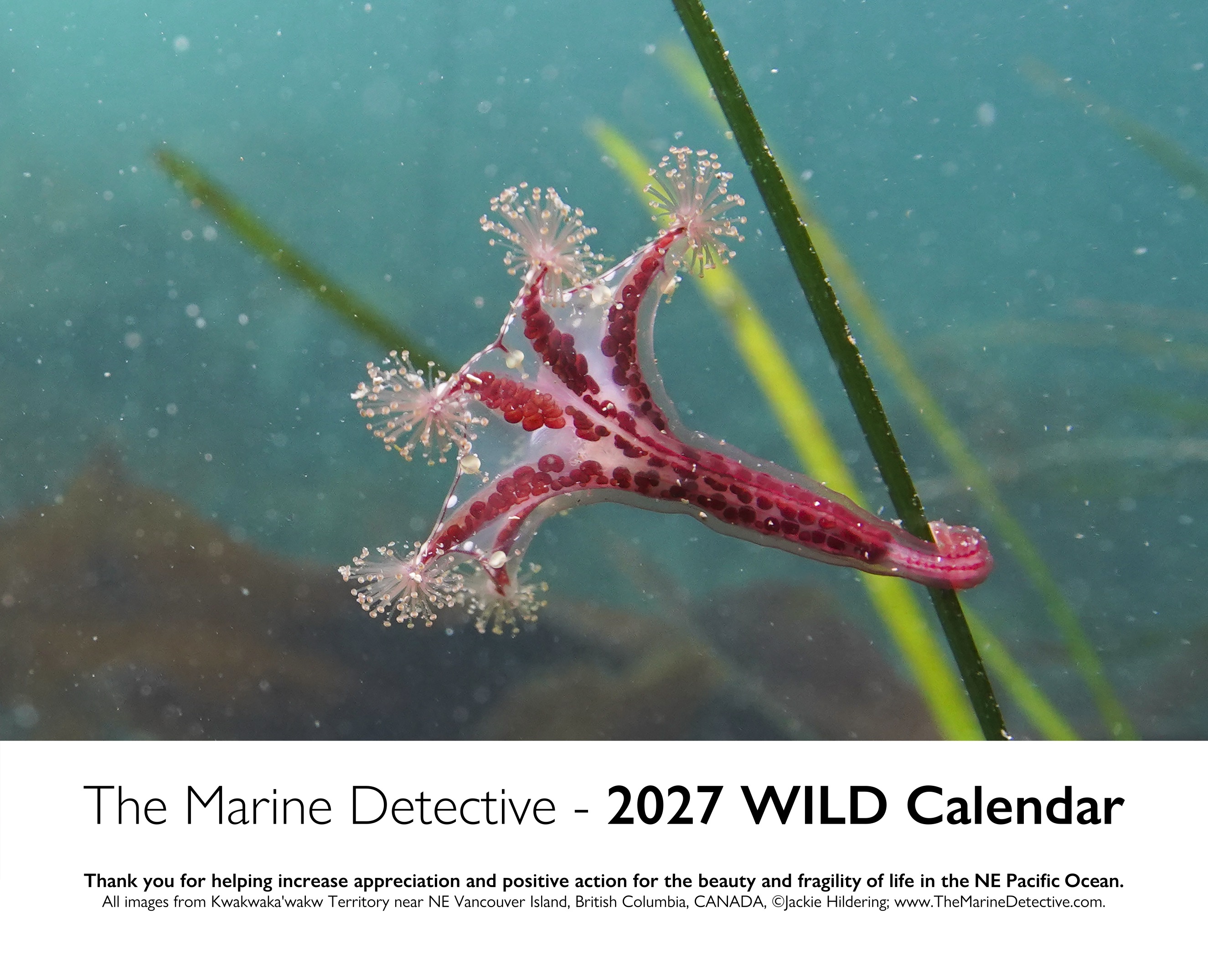
Hurrah! My annual WILD Calendar is now being printed. It’s quite the journey to finalize which photos will be in the calendar, complete the design, and ensure the colours print correctly.
Thank you so much to all who helped by voting on the selection of my photos.
My WILD Calendar is aimed at creating awareness about the diversity and fragility of life hidden in the cold, dark, life-sustaining northeast Pacific Ocean. These waters are dark because they are rich in plankton. With more plankton, they sustain more life, produce more oxygen, and absorb more carbon dioxide.
It’s the 18th year I have made a WILD Calendar. It’s truly moving to feel the support of those of you who put these calendars into the world. You are helping increase connection and understanding of our reliance on the Ocean. That’s needed to make day-by-day decisions that consider the wellbeing of future generations – from whales to octopuses, nudibranchs, sea stars, and our own very strange, two-legged species. 💙
Each month’s photo has a detailed descriptor. They are large and have BIG spaces to write your daily adventures.
They are printed on sturdy paper on Vancouver Island, coil-bound, and have a hole for hanging. They measure 33 × 26.5 cm closed and 33 × 53 cm open (13 × 10.5″ closed; 13 × 21″ open). Text is included to indicate when there is a full moon (PDT).
All photos were taken by yours truly in the Territory of the Kwakwa̱ka̱’wakw (the Kwak̕wala-speaking Peoples) on northern Vancouver Island. Formatting help by the wonderful Dawn Dudek.
Thank you.
January image and text
So much life: Cold water has more dissolved oxygen. In high-current areas, such as what you see here, there is much mixing and distribution of oxygen and nutrients. As a result, there is more life. It’s the plankton that start it all; the soup of life that fuels the food web. Here you see Giant Plumose Anemones (up to 1 m tall), Crimson Anemones (only described as a distinct species in 2019 by Sanamyan et al.), Red Soft Corals, Giant Acorn Barnacles (the world’s largest barnacle species), Mushroom Compound Tunicates, Peach Ball Sponges, Yellow Boring Sponges, Sulphur Sponges, a variety of hydroids, etc.! Dive buddy in this photo is Don Gordon.
February image and text
Animal, not plant: This is a Giant Pink-Mouth Hydroid. They are up to 10 cm tall. The bead-like structures amid the tentacles are reproductive structures that produce sex cells and incubate fertilized eggs. Hydroids are related to jellies, anemones, and corals (phylum Cnidaria). Almost all are colonial. They catch drifting prey with polyps aided by their nematocysts (stinging cells). No hydroid species off our coast deliver a sting that humans can feel or be harmed by. Greg Jensen notes in Beneath Pacific Tides that Giant Pink-Mouth Hydroids need re-examination to determine if they are the same species as those in the Atlantic (Tubularia indivisa).
March image and text
Thank goodness for Herring: Thank you Pacific Herring for all you sustain, all you connect, and all you heal. Ecosystems would crumble without Herring—they connect ocean, land…and sky. They were very heavily exploited through disconnected, non-integrated, short-term approaches to fisheries. Herring are not a spawn-and-die species. They can live for 8+ years, spawning annually from ~3 years of age. The remaining fishery in BC is for their roe (eggs)—a choice to not allow them to spawn again and fuel the ecosystem. Diving birds preying on Herring cause the fish to ball up near the surface—opportunity for a Bald Eagle to grab talons full of Herring.
April image and text
Striped Stars: This is one of the most variably coloured sea star species off our coast—the gobsmackingly beautiful Striped Sun Star (Solaster stimpsoni, up to 58 cm across). They are ambassadors for the beauty and colour below the waves. They most often have 10 arms and have a blue/purple stripe down the centre of each arm which can be on a background of shades of red, pink, or orange. Some individuals are entirely blue. The diet of Striped Sun Stars includes various species of sea cucumber. There are six species of sea star off our coast that have more than ten arms. The other five many-armed sea star species do not have blue stripes down their arms.
May image and text
Sand-Rose Anemone: One of the world’s largest anemones—up to 1 m across and 25 cm tall. Their column is often partially buried in sand. They feed on plankton and detritus in the water and sometimes host symbiotic shrimp, including Candy Stripe Shrimp. Painted Greenlings also seek refuge under the tentacles. These fish appear to be immune to the anemone’s stinging cells. Sand-Rose Anemones are classified as Urticina columbiana, but the experts at actiniaria.com note: “Surprisingly, despite large size and characteristic exterior, allowing easy identification, its internal structure is insufficiently known and its assignment to Urticina requires confirmation.”
June image and text
Novel feeding strategy: Humpback Whales Twister (BCY0710, left) and Ripple (BCX1063, right) are using a feeding strategy researched by the Marine Education and Research Society (MERS) dubbed trap-feeding. I am a cofounder and team member of MERS. In 2011, we documented this behaviour being used by two Humpbacks. Forty have now been documented feeding this way. When juvenile Pacific Herring are in less dense concentrations and are being pursued by diving birds, the whales hang at the surface with their mouths wide open (for at least 4 seconds). The fish may go into the whale’s mouth to escape the birds. See mersociety.org.
July image and text
Rarest of the rare: This may be the rarest sighting I have ever had off the coast of British Columbia, other than an endangered Leatherback Sea Turtle. Oh, the euphoria when I noticed this beautiful ~2 cm species of stalked jelly on Eelgrass. I believe it is Haliclystus californiensis, described as a “new” species of stauromedusa in 2010 by Kahn et al. At that time, only 10 individuals had been documented, and all were “from southern to northern California in coastal waters”. In iNaturalist, there is only one other sighting in British Columbia. You can imagine how much is still unknown. But with pom-pom-like ends to their appendages, they must feed on plankton.
August image and text
Colourful giant: This nudibranch species, Dendronotus iris, can be up to 30 cm long. They have remarkable colour variations. Adults always have a white line around their foot. They patrol the ocean bottom for Tube-Dwelling Anemones. Nudibranchs can only sense shadows so they must detect this anemone species by smell and/or touch. The Giant Nudibranch pounces on the Tube-Dwelling Anemone which rapidly withdraws into its tube, pulling part of the nudibranch with it. Eventually, the nudibranch emerges, if successful, with some bits of tentacles. As is the way with nudibranchs, they lay their eggs on their prey. Oh, the insult! This nudibranch can also swim.
September image and text
Distracted by dolphins: Pacific White-Sided Dolphins were once thought to be an open-ocean (pelagic) species because coastal sightings were so rare up to the mid 1980s. But some First Nations middens contain dolphin teeth, suggesting they were also an inshore species ~2,000 years ago. They are now common inshore, sometimes in groups of hundreds. Research being done to study them as individuals found that some pairs were resighted together again after 19 years, but social structure is still poorly understood. The dolphins in this photo were herding Pacific Herring near Yalis/Alert Bay. Males to 2.5 m long (Aethalodelphis obliquidens).
October image and text
Astonishing adaptations: Each Orange Sea Pen (Ptilosarcus gurneyi) is a colony of polyps (small anemone-like individuals) working together for the survival of the whole. They can be up to 48 cm tall if not deflated to shrink into the sand and avoid having chunks bitten out of them by their sea star and nudibranch predators. That’s right, they can deflate! Research suggests that how far they retract is specific to the predator species. But wait there’s more! They can also: (1) bioluminesce, producing a greenish-blue light believed to deter predators; (2) drift away by inflating and lifting out of the sand; and (3) produce a toxin (but this is poorly understood).
November image and text
Rock Greenling: Lives in the rocky shallows, at home in the kelp and seagrasses swaying in the surge. This is likely a juvenile. Mature males are so flamboyantly coloured—red and orange mottling with patches of bright red, blue, and/or yellow. But they are still so well camouflaged. Their movements are like the flow of kelp. Little appears to be known about Rock Greenlings with scientific debate about whether those in the northwest Pacific Ocean are the same species as those in the northeast Pacific. Dr. Milton Love discusses how those in Russia are seen in schools. On this side, they are solitary and very territorial. Hexagrammos lagocephalus to 61 cm.
December image and text
Surviving star: Sunflower Stars are the world’s largest sea stars, at up to 1 m across. Before 2013, were you to look down from a dock on our coast, you would likely see these giants. But they are devastated most by Sea Star Wasting Disease (SSWD) caused by a bacterium (Vibrio species) that appears to do better in warmer water. They have an important role in the health of kelp forests by eating Green Urchins that eat kelp. Know that the plight of these stars is not an additional problem. SSWD is a symptom of the same changes that impact our own species. This means there are common solutions. Vote for the future. Care more. Consume less.
I am trying to purchase one of your beautiful and informative calendars, but I csnnot seem to get into the shopping app. I would like to pay by etransfer, buy I have no idea how much shipp8ng costs would be to my new address at
10 Fairmont Bay S
Lethbridge, AB
T1K 7G2
If you have any left in stock.
The calendar should be addressed to Jerry Miller, otherwise known as rawgod.
Please advise by email to gewcolo@gmail,com and I will direct the payment to you.
Order received. Thank you so much. Will be with you by around mid July.
E. Lisbeth Donaldson
Was going to order but the link says SOLD OUT.
Let me know if it is possible to purchase one calendar. I will be in Sydney July 28 so could pick it up there.
Betty Donaldson
Courtenay
2503310475 landphone
So sorry Betty! I fixed the settings now.
I thought I had updated the inventory but am at sea and it did not save.
You can order via the link now. Thank you!
Please be sure to phone the Shaw Centre first Betty to make sure they have the calendars. They have not confirmed that they will be taking them this year. It’s very likely but to be sure.
Thank you!
Hi!I just got notification that the 2027 calendars are ready to order. I want to order two but the website says they’re sold out. Are they or is it a glitch?Thanks ever so for all that you do!Sherry Lynn McGregorNelson, BCSent from my iPhoneOn Jun 27, 2026,





10 Responses to “2027 WILD Calendar”
Hi Jackie,
I am trying to purchase one of your beautiful and informative calendars, but I csnnot seem to get into the shopping app. I would like to pay by etransfer, buy I have no idea how much shipp8ng costs would be to my new address at
10 Fairmont Bay S
Lethbridge, AB
T1K 7G2
If you have any left in stock.
The calendar should be addressed to Jerry Miller, otherwise known as rawgod.
Please advise by email to gewcolo@gmail,com and I will direct the payment to you.
Thank you.
Hope you are enjoying your trip.
Thank you so much, Jerry.
Apologies that I had not updated the inventory. You can order directly online now.
Thank you!
Order and eTransfer sent. Will expect delivery late July, early August. Thank you.
Order received. Thank you so much. Will be with you by around mid July.
Was going to order but the link says SOLD OUT.
Let me know if it is possible to purchase one calendar. I will be in Sydney July 28 so could pick it up there.
Betty Donaldson
Courtenay
2503310475 landphone
Get Outlook for iOShttps://aka.ms/o0ukef
So sorry Betty! I fixed the settings now.
I thought I had updated the inventory but am at sea and it did not save.
You can order via the link now. Thank you!
Great – enjoy te days at sea. Lovely time to be on the water.
Get Outlook for iOShttps://aka.ms/o0ukef
Apparently, I can only pick up in Port Hardy – that isn’t going to be pen. I am in Sydney July 28 and will try to purchase on at the store there.
B
Get Outlook for iOShttps://aka.ms/o0ukef
Please be sure to phone the Shaw Centre first Betty to make sure they have the calendars. They have not confirmed that they will be taking them this year. It’s very likely but to be sure.
Thank you!
Hi!I just got notification that the 2027 calendars are ready to order. I want to order two but the website says they’re sold out. Are they or is it a glitch?Thanks ever so for all that you do!Sherry Lynn McGregorNelson, BCSent from my iPhoneOn Jun 27, 2026,