[If you are coming here from Instagram, please see this linkfor background on Sea Star Wasting and where to report sightings.]
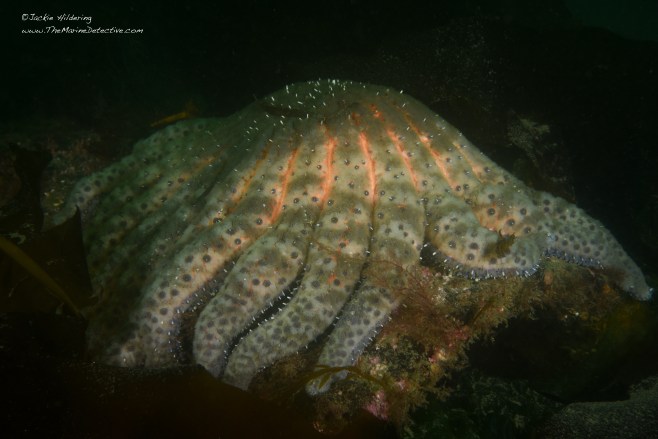
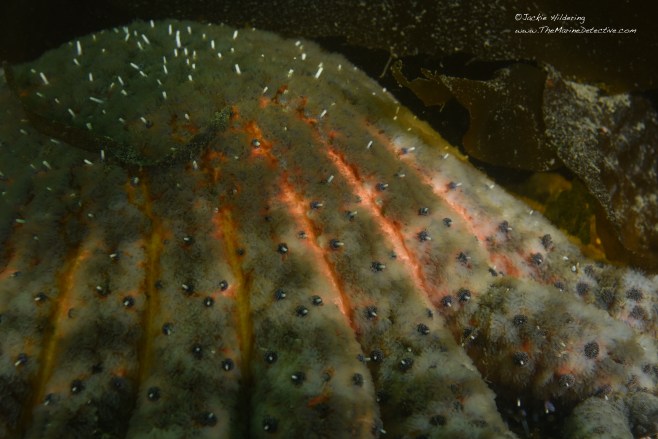
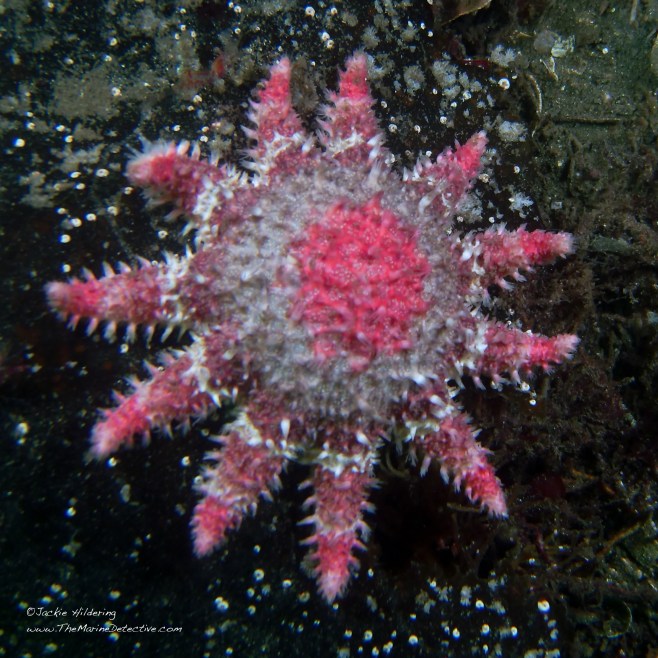
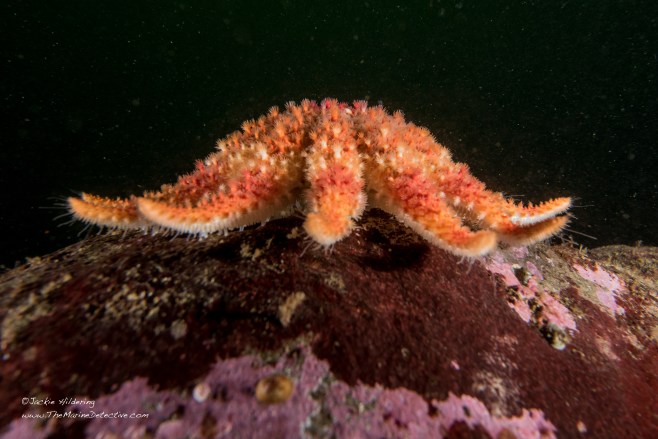
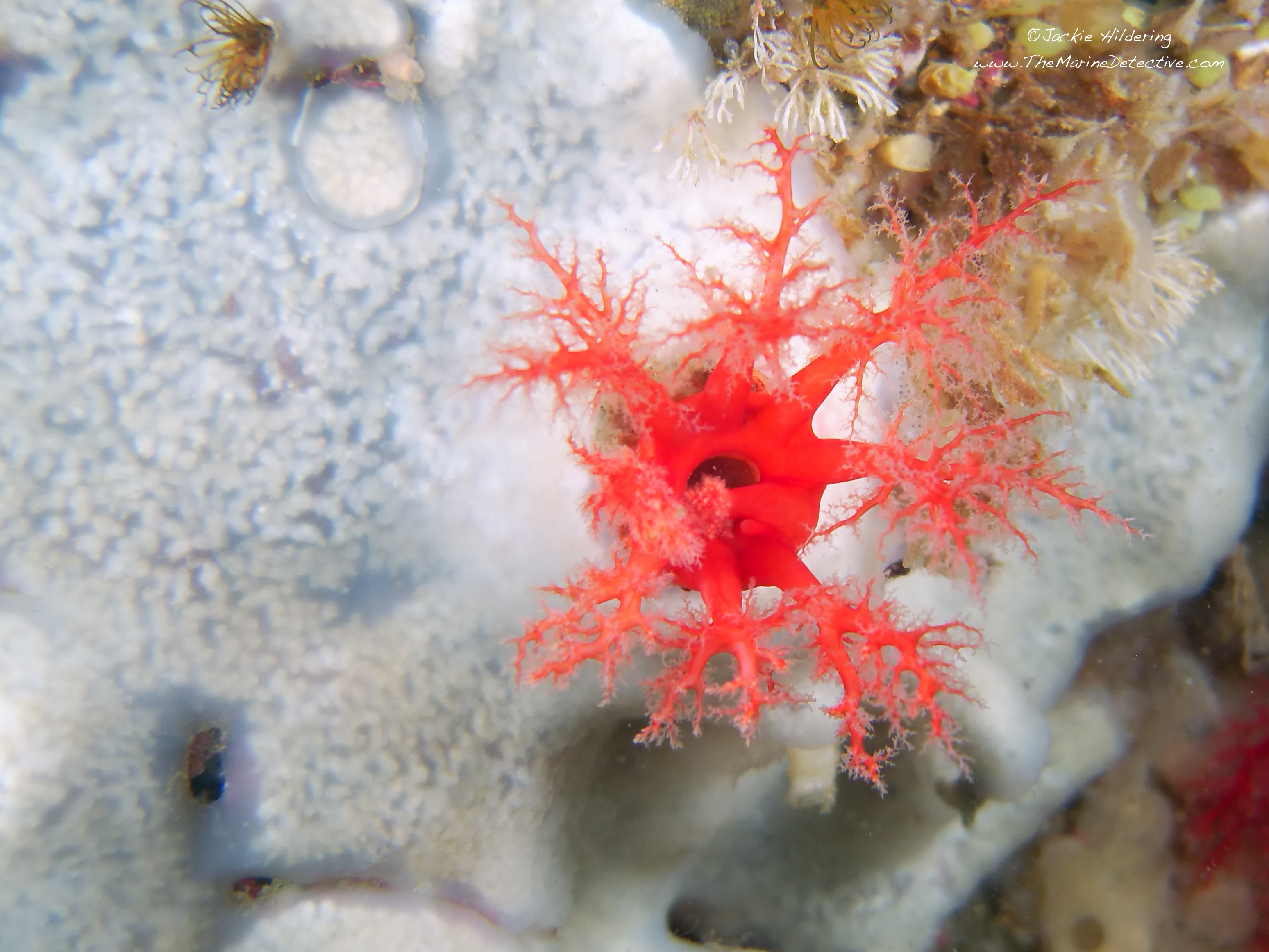
Endangered? I gasped when I saw this adult Sunflower Star on my last dive and hung nearby for a little while. I found myself thinking in a way that could be interpreted as prayer.
Did you realize Sunflower Stars are now so rare – these giants that should be abundant on the coast from Alaska to Mexico?
Endangered? Many of us who have been monitoring Sea Star Wasting Disease since 2013 certainly think so andthere is a campaign in Washington State to have them recognized as such.
There has been such misunderstanding and “ocean blindness” about what has been going on. Even reputable news outlets have put into the world information about the Disease that speaks of sea stars as if they were one species and hence, if some sea stars are sighted, well then everything is fine.
It’s not fine. At least 20 species of sea star have been impacted by Sea Star Wasting Disease. Some are recovering well but . . . this the world’s largest sea star species, the Sunflower Star, Pycnopodia helianthoides, is NOT.
We sometimes see waves of juveniles, maybe resulting from more adults being at depth who are close together enough that when they broadcast spawn, fertilization results (broadcast spawning is when males and females release their sex cells into the water on cue). But, ultimately these juveniles disappear.
Sea Star Wasting Disease (SSWD) is the largest wildlife die off in recorded history. That be truth. But because it is happening below the surface there is less engagement, funding, and knowledge.
Does it matter? Yes, it matters a lot, ecologically and with regard to what the Disease may teach us.
Sunflower Stars have a similar ecological niche to Sea Otters re. grazing on urchins and maintaining kelp forests (see video below). You know that if Sea Otters were dying en masse we would certainly be engaged, invest in research, and want knowledge.
Why would a virus that is not new be able to have a greater impact? Due to stressors and yes, these are believed to be related to climate change.
To those wonderfully engaged humans who have read all of this, please know this is not an additional problem that requires novel solutions. You are the last people who I wish to burden, you who care as you do. The plight of Sunflower Stars is a symptom of what is the same set of problems re. short term economies, absence of precaution, fossil fuel use, and consumerism.
Reporting sightings? I have reported the sighting of this lone, adult Sunflower Star to add to the knowledge of the impacts of SSWD. Citizen science is so important to understanding. Further information on the Disease and where to report sightings of sea stars can be in my blog at this link.
And to you dear Sunflower Star,
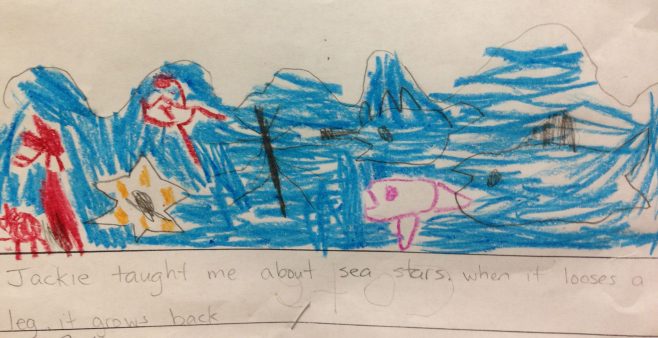
May you find another of your kind for the sake of biodiversity, ecology, human learning and understanding, and so that your species will not disappear from children’s drawings of life on our coast.
May it not be that we continue on a path where Sunflower Stars slip away from our memories, or that we end up talking to children about “There used to be these giant, colourful sea stars . . .”
💙
Sighting was made on June 15th, near Port McNeill.
Video below re. Sea Star Wasting Disease and ecological impacts.
Here’s a whole lot of information, and entertainment, about ocean education.
It includes:
Ocean Inspiration (why it is so important to teach about the ocean)
Action for the Ocean (detail on the many ways we can reduce impacts); and
Guidelines for Beach Walks.
My Ocean’s Day presentation on Ocean Wonders.
Ocean Inspiration
Why is it so important to educate and help others love the ocean?
Chances are that if you have the interest and motivation to read this, you already have that knowledge. May the following then provide you with affirmed purpose and inspiration.
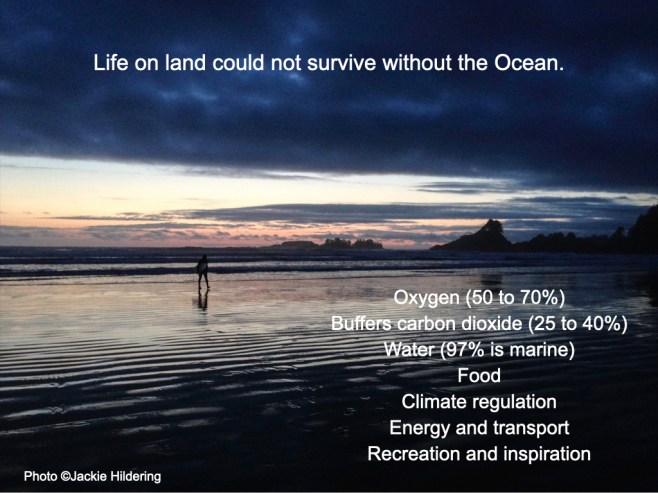
The ocean is the life-sustaining force on the planet. It is where life began. The ocean’s algae produce at least 50% of the world’s oxygen, buffering carbon dioxide in the process. As water cycles around, over 90% at any time is ocean. The ocean is the largest surface on earth, whereby it has a significant impact on climate regulation. The ocean is also a source of food, energy, inspiration, transportation, and healing.
Human psychology so often puts a divide between land and sea. There is not enough understanding that life on land cannot survive without the ocean, no matter how far you are from her shores. As a result of this perceived divide, assaults upon the ocean include persistent organic pollutants, agricultural runoff, warming and ocean acidification, disease organisms, and plastics and further marine debris. Consequently, the ocean so often testifies to socio-environmental problems first.
This “ocean blindness” is especially true of the perception of dark oceans where the rich plankton soup means we cannot see the marine life easily. Thereby, many of us form biases to thinking there is more life in warmer waters with less plankton. This is exactly backwards. Less plankton means there is less food at the bottom of the food web. Thereby, if you can easily see through water, there is less life in it.
This bias and blindness is exacerbated because, so often, the imagery we are fed in everything from documentaries, to children’s books and movies, is of life in warmer seas. If we do not know how extraordinary our marine neighbours are, and how important the ocean is, how can we be the teachers, parents and voters we need to be?
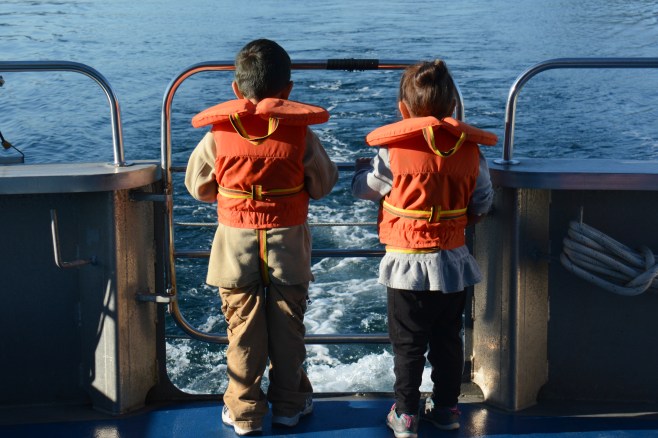
By helping others love the ocean, you are not only helping marine life, you are helping the future of our own species as well.
Power to you.
Ocean Action
First there’s a summary. Then, there’s depth.
SUMMARY 1. Learn about the ocean. Enjoy the ocean.
It is especially important to learn about species that live closest. No matter how far away the ocean is, we are connected to the life there through the cycling of water.
2. Care, knowing how important the ocean is to life on land and how amazing our marine neighbours are. We need to be especially careful because we still know so little about life in the ocean which means we could make big mistakes.
3. Use less because it is about gain, not loss. By making sure there is less garbage (includes less disposables and less consumerism) and less bad chemicals, there is less pollution in the ocean AND on land. By saving energy and helping use less oil and gas (fossil fuels), there is less change in temperature and climate. By using less water, less chemicals are added to the water at the sewage treatment plant. What cannot be biodegraded (rot away) or physically filtered out of the water at the treatment plant, will end in the ocean.
4. Teach and share with others about the importance of the Ocean and how easy it is to do good things that help the ocean AND ourselves.
1. No Problems Without Solutions Yes, it is important for students to know of environmental problems. But, there is the potential of creating overwhelm, fear / paralysis, disconnect and the perception that nature and/or the ocean is sick. It is vital to ensure that solutions are provided; that those doing the teaching are modelling those solutions; and that the common denominators between socio-environmental problems are made clear i.e. most problems have the same causes whereby there are the same solutions. Examples are the connection between Sea Star Wasting Disease in Sunflower Stars and warming seas; over-harvesting being related to inequality in the world and the lack of precaution in favour of short-term economic gain; and plastic pollution being the result of consumerism, overuse of disposables, and disconnect with the environment.
2. Connect / Learn / Respect No matter how far you are from the ocean, you can connect to the ocean. I emphasize again the value of prioritizing learning about the most local ocean (and species) so that the biases and blindness I referenced above are not exacerbated. For example, turtles are amazing and engaging but what is most valuable for Canadians is connecting to the Leatherback Turtles that belong off both Canada’s east and west coasts.
Understanding of the water cycle is such an effective way to connect to the ocean from any distance i.e. the ocean is on top of mountains as snow, it flows through rivers and groundwater, and it comes out of the tap. Therefore it is impacted by what we do to water even when far away from the ocean. Including sewage treatment in the water cycle is of great value.
I find it helps to reference local marine life as “neighbours” as this suggests that we live together and are connected. Beach walks, if possible, certainly aid this if conducted as a study and with respect. Please see my guidelines for good beach walk practices below.
It is so valuable too to teach from a perspective of adaptations, allowing students to deduce why species look the way they do, live where they do, and/or behave as they do. This allows for the understanding that nature is not “random” but that organisms are connected, evolved, and have fulfilled niches to fit into the puzzle of life.
Please, do not limit learning to the species at the surface i.e. the charismatic marine megafauna like whales. To understand why there are these big animals, requires an understanding and valuing of the biodiversity and interconnectedness below the surface.
Please too do not encumber yourself with feeling you need to know a lot about marine species in order to aid love and action for the ocean. By not knowing, you give even more space for students to form connections and hypotheses about adaptations, and to own their knowledge. One of the most vital things in loving and learning about the ocean, is to emphasize how little is known about life in the ocean and, therefore, that it is essential to have the appropriate humility and precaution in how we “manage” the ocean.
3. Reduce This is the single most important solution to reducing socio-environmental problems, including impacts to the ocean.
So many students believe that recycling is the best thing they can do (and our consumer paradigm of course favours this). It shows, in part, that understanding has been lost that the three “Rs” are a hierarchy. By far the most important is to REDUCE. Next is to re-use. And if reducing and reusing are not possible, then . . . recycle.
Reduce what?
It is very important to approach this from the perspective that reducing is not about loss, but about gain and that the following are also the solutions for so many other problems.
– Reduce the use of harmful chemicals that can flow or condense into the ocean. Which chemicals are bad? The easiest with younger students it to show the skull and crossbones on the label of products like bleach. Older students have curriculum content about pesticides and other persistent organic pollutants. It is valuable of course to discuss how the human-made bad chemicals are not essential and/or that there are alternatives that are not harmful.
– Reduce fossil fuel use because of the impacts on climate change. The ideal is to enable students to think in terms of carbon footprint and, thereby, to know how many ways we are empowered to reduce fossil fuel use in our every day actions and how smart and innovative we become when we care more.
Never too young to learn about animals as individuals.
– Reduce waste. This goes far beyond beach clean-ups. Understanding is needed of why there is so much garbage and how easily this can be solved when we learn and care. This includes using durable and reusable things, not buying so much, being aware of how much packaging things have and, here’s the BIGGY, to understand the difference between biodegradable and non-biodegradable. If something cannot rot away there is no “away”. It cannot be flushed “away” or thrown “away”. Non-biodegradable chemicals enter the water and food webs. Plastics that cannot rot will entangle, or get mistakenly eaten by animals, and/or break down into smaller pieces that enter the food web.
4. Empower
Sharing good news stories, especially of innovative and ethical thinking and technologies that create positive change, allows students to know about human social evolution, that we learn from our mistakes, and make huge steps forward when empowered with knowledge and caring. It will help make them feel there is space in the world for their ideas and that every generation learns from the ones before. It is tricky though to ensure that hope and human ingenuity are not perceived as exit strategies.
Empowerment too means providing students with the opportunity to participate in decision-making and respectful dialogue about practices and decisions made at home and at school. It will involve discussions about ethics and how we cannot be perfect. We have to use resources and make some garbage but can make decisions that reduce impacts. It invites critical thinking. It can lead to learning about who and what we support with our money and effort is like voting, and the importance of that.
Again, power to you. 💙
Below is my presentation on Ocean Wonders.
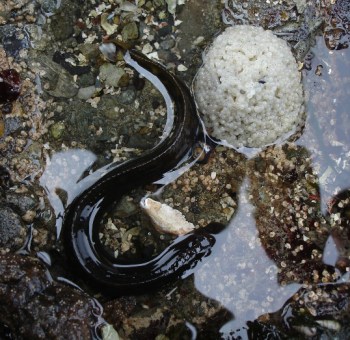
Black Prickleback father guarding eggs. Were he to be moved by those who think he does not have enough water, the eggs would be eaten by predators.
Good Beach Walk Practices Include:
No Taking and No Touching (with exceptions)
There are exceptions when you know for sure a species is hearty or truly in trouble. Hearty species like sea stars can gently be touched with one’s pinky. By using your little finger, you can’t apply much pressure and this very act instills greater understanding and respect in children for the life they are visiting and learning from. It is also the case, that what is one our hands, may not benefit other animals. I am sure there is heightened awareness of transmission of pathogens in our current COVID world
Collecting animals does not model respect (e.g. Shore Crabs). Even taking shells does not allow for the understanding that there are animals that will use these (e.g. hermit crab species) and that, as the shell breaks down, nutrients are returning to the Ocean. There are exceptions here too where a few “treasures” (non living) can be taken for further study.
Moving animals, even with the best of intentions, can lead to unintended consequences like displacing fish fathers from the eggs they were guarding. There are fish species that are very well-adapted to surviving with little water at low tide.
Another exception is, of course, that you DO want to remove garbage that you are sure IS garbage and that has not become habitat (has life living on it).
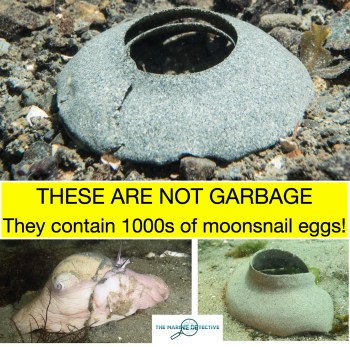
Another fabulous example of where the well-intentioned are not helping. These are not garbage. They are moonsnail egg collars. They are wondrous constructions to house and protect moonsnail embryos. There’s much more information about them in my blog at this link.
Rock Rules
Only lift rocks that you do not need to pivot and that you can put back very carefully. If you pivot big rocks, animals will rush to hide at the leverage point and will be crushed when you lower the rock. A good rule is to only lift rocks smaller than your head, and that clearly have space under them (this means there are likely to be animals there and that you can better return the rock to its position). I have found it really helps to explain to children why life under a rock lives there and not on top of a rock (i.e. teaching about habitat). Children seem to understand well that lifting a rock is like lifting the roof off a human’s house.
Walk Carefully This is not only for human safety but seaweed and Eelgrass are habitat to so many animals.
Barnacles too are living animals.
No Squealing and No YUCK! This is negative and can perpetuate a physical reaction of disconnect and disrespect for the natural world. It is “rejection” and judgement of another organism being “wrong” rather than understanding the perfection of adaptations and evolution. Beach walks are about visiting organisms in their habitat and the gift of being able to learn that everything is the way it is for a reason. I find it helps to let children know, when about to lift a rock, that we are disrupting animals in their home so that we can learn and that, of course, the animals are going to be startled i.e. so they anticipate the potential of things like fish flopping about.
YES to pictures, learning and contributing to knowledge. 💙
Below, an exception to the rule. This Gumboot Chiton was upside down and could not have righted itself. They are tough organisms and provided a wonderful opportunity for students to feel how this is a living animal that responded to their gentle touch.
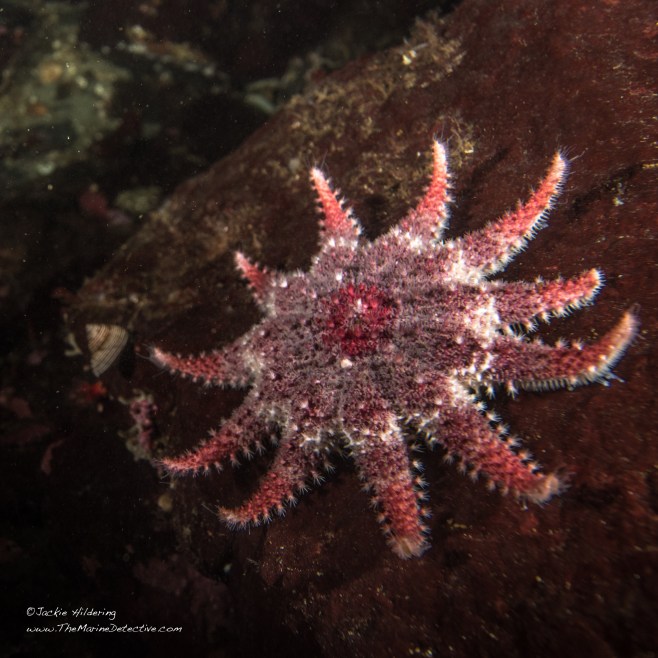
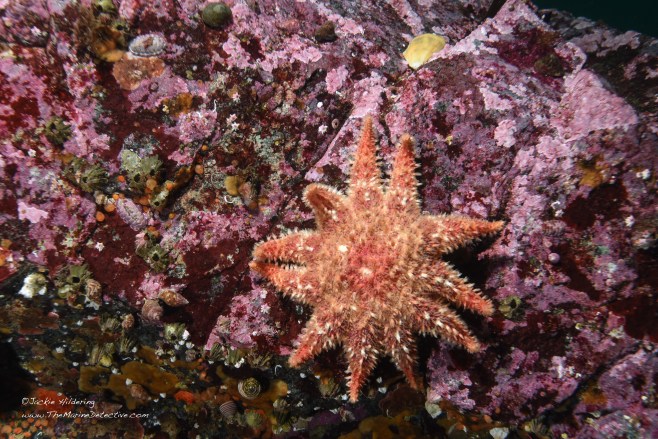
Rose Stars have such diversity in colour and pattern, that the species is also known as the “Snowflake Star”; a name suggesting that no two are alike.
Am I trying to make some sort of point as it applies much more broadly? Why, whatever would make you think that? 😉
Surely we humans rejoice in the beauty of diversity?
Notice that above this Rose Star, there is another local, marine ambassador for diversity of colour within a species.See the Blue-Line Chiton (Tonicella undocaerulea)?
Please see additional photos (and slideshow) below to get a further sense of the diversity, the beauty, and the perfection.
Species information:
Crossaster papposus to 34 cm but in British Columbia the maximum size is believed to be 17 cm.
They can live to at least age 20. Species is slow growing. Maximum size is reached around age 10.
Even the number of arms varies. Most Rose Stars have 11 arms but number ranges from 8 to 16. From personal communication with zoologist Neil McDaniel: ” I did counts of 63 images I had on file [all from British Columbia’ and nearly 90% (87%) had 11 arms, about 10% had 10 and 3% had 12.”
They are SPEEDY! Zoologist Neil McDaniel clocked them at 50 cm/min. Larger individuals were documented to travel over 5 meters in 12 hours. They are serious predators but may also be speedy because they are known to be prey for Sunflower Stars and Morning Sun Stars.
Diet is known to include sea pens, nudibranchs, bryozoans, bivalves (e.g. clams), juvenile urchins and tunicates. Their diet is likely broader than this as they are not picky eaters. I often see them in rocky habitats covered by coralline algae species (see photo below) and believe that is, at least in part, because the prey there include Orange Social Tunicates. They are one of the few species of sea star known to feed on nudibranchs. They also are known to have attacked other sea star species – Mottled Stars and Six-rayed Stars
How they feed: When they feel their prey, and are hungry, they retract their sensory tube feet (tube feet at the tips of their arms), and then stretch up on their tippy toes (extending their terminal tube feet) to be higher and able to “pounce” on their prey when on the ocean bottom. Smaller prey are swallowed whole. Larger prey are held with the tube feet and, as is the case with other sea star species too, they evert their stomach OUT OF THEIR BODIES and into or over their prey.
Research supports that Rose Stars can sense potential prey and other sea stars by smell (distance chemoreception).
In the photos below you will also see the intricacy of the surface of sea stars. You will see:
Spines
Pedicellaria = amazing little structures that can nip off the tube feet of other species of sea star e.g. the predatory Morning Sun Star (Solaster dawsoni).
The tufts are “papulae”. They are the gills / respiratory organs of the sea star. They can retract into the surface of the sea star’s body.
Range: Bering Sea to Puget Sound; Arctic Ocean, North Atlantic Ocean, North Sea, western Baltic Sea.
Depth: Found from the shallows of the intertidal to ~1,200 m. Believed to more often be in low current areas.
I saw little impact on this species from Sea Star Wasting Disease around NE Vancouver Island BUT Rose Stars were hit very badly in 2014 in other areas e.g. Sechelt Inlet, British Columbia (McDaniel, pers. comm.). See photo at the end of the blog. The species seems to be rebounding, unlikely Sunflower Stars which remain devastated across their range.
Rose Star and retracted Orange Zoanthids. Some are likely being snacked upon.
Very typical habitat for where I find Rose Stars. I believe their prey on these coralline algae covered rocks include the small orange animals you see = Orange Social Tunicates. Notice too that there is another Blue-Line Chiton.
Here you have five Find the Fish challenges for Oceans Day.
Background:
Photo to give a sense of the equipment needed to dive in cold water. Yes, that includes a tutu.
You may be aware that I post one such search on social media every Friday (i.e a “Find the Fish Friday” challenge) and that there are three Find the Fish children’s books as well.
The aim of these “Where’s Waldos” of the fish world, is to help create awareness of what it looks like below the surface of the dark, cold NE Pacific Ocean. So often we are presented with marine imagery from warm waters, not realizing that it is the cold, current-rich waters of the world that have more oxygen dissolved in them. More oxygen means more life and the resulting plankton soup makes this ocean appear dark. Thereby, the colour, beauty and fragility are hidden.
Often even adults do not realize they have a bias to thinking the marine life is “better” and more abundant in warmer water. But if it is easy to see deep into the water as it is in the tropics, this is because there is less plankton. If there is less plankton, there is less food to fuel the food web and there is also less oxygen production and absorption of carbon dioxide.
So here we go.
I will first show what the fish species looks like. I will then provide the challenge and then, a link to the answer.
Challenge #1:
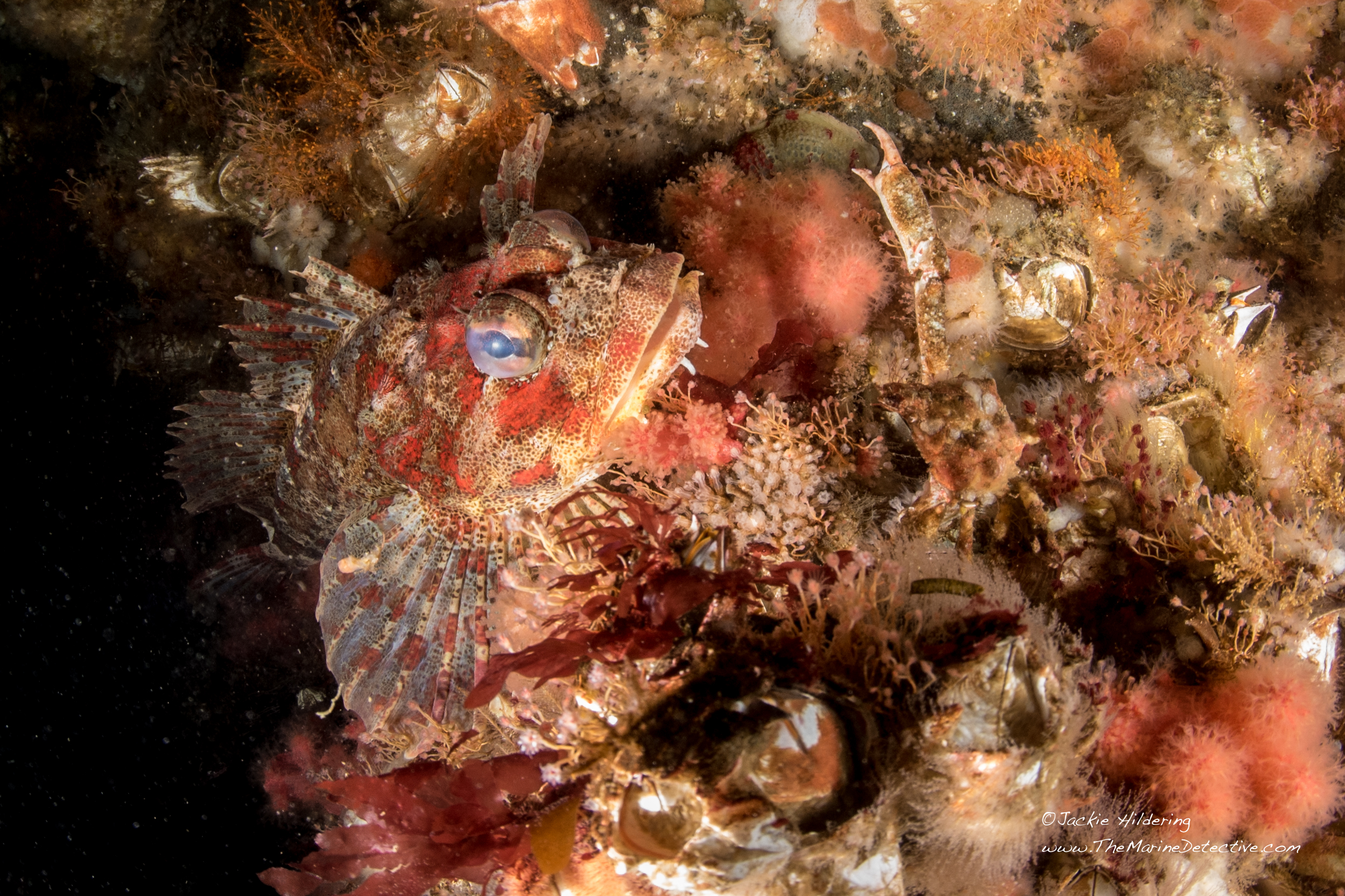
This is a Red Irish Lord.
They can be 51 centimetres long and are incredibly good at camouflaging.
How is that possible when they are red, yellow, pink, orange and/or white? Because that’s how colourful the life around them is, so they blend in. They can be so many different colours and even their eyes have spots on them to help the camouflage.
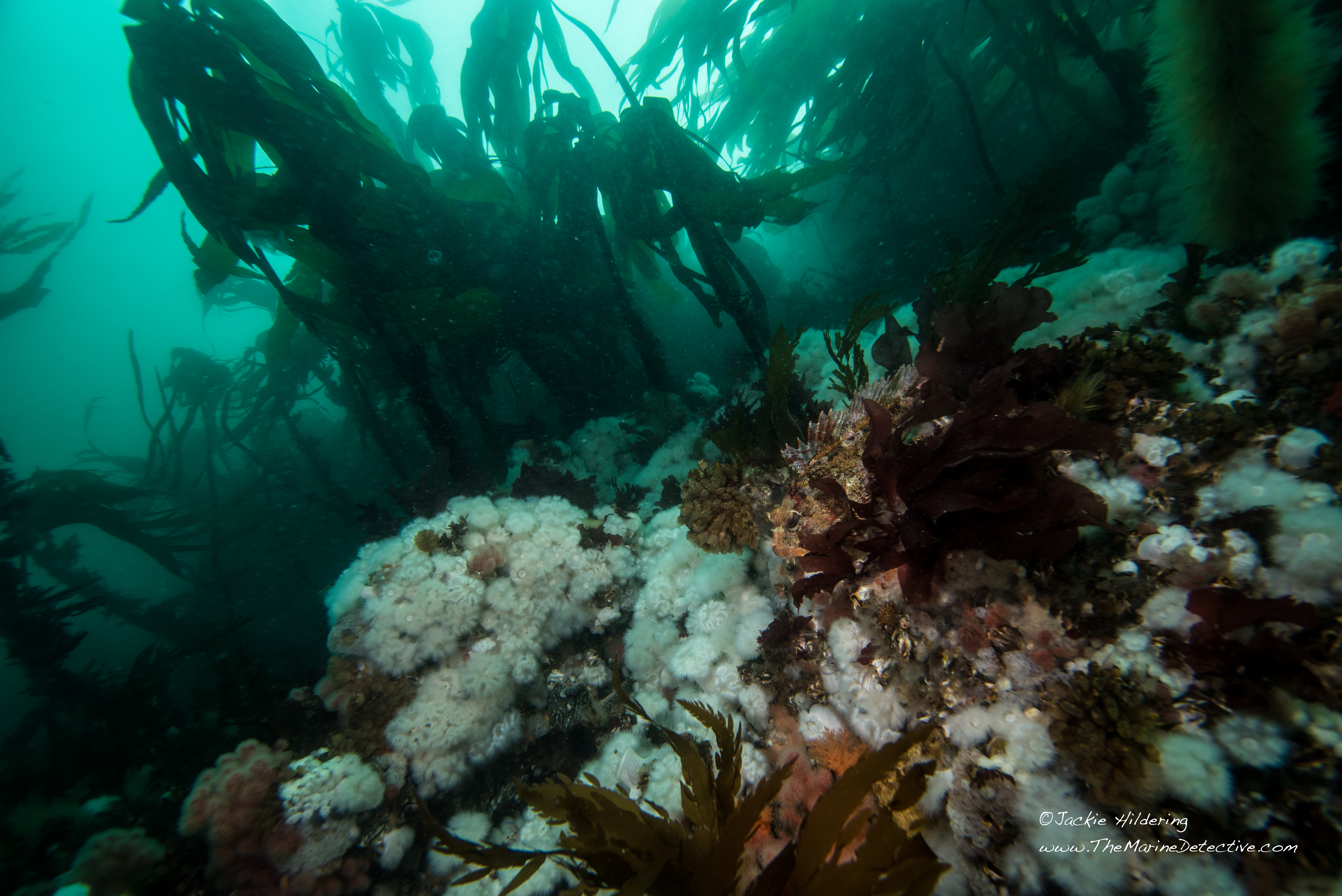
Can you find the Red Irish Lord in the kelp forest in the picture below? If you click the photo you can make it bigger.
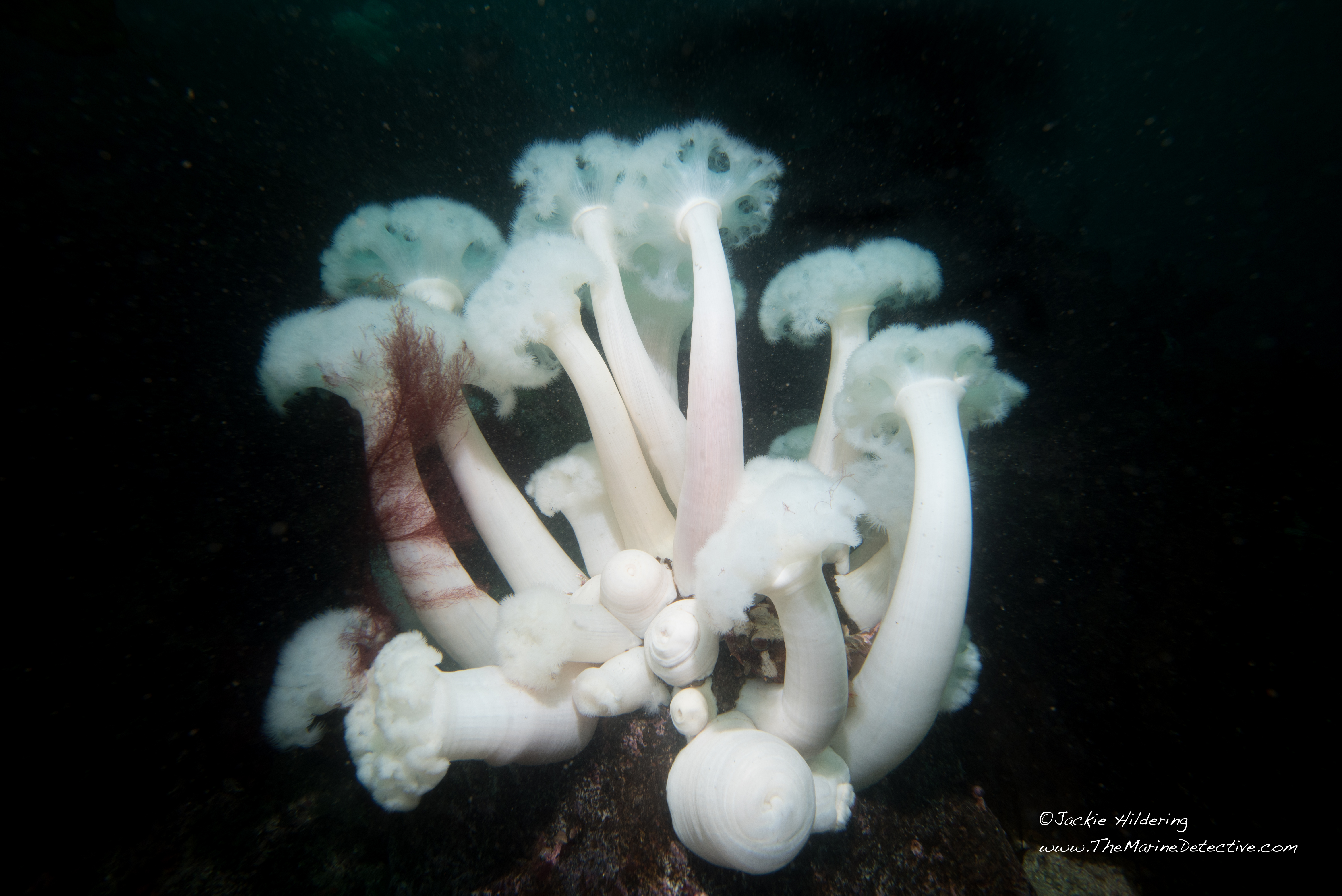
You are searching for another Red Irish Lord in the picture below. Those anemones you see are the biggest in the world. They are called Giant Plumose Anemones and are up to 1 meter tall. Because there is so much oxygen and food in this ocean, there are many of the world”s largest marine species.
Think about why the Red Irish Lords are camouflaged and are most often motionless, not swimming around the ocean in schools like other kinds of fish. What advantages does it give them to behave like this.
You probably realized that it helps them hunt. They are ambush hunters which means they wait for a fish or crab to come by and then they grab it. I have even seen crabs walk right on the face of a Red Irish Lord.
In the picture below, see what the crab is doing? By making itself really big by spreading its claws, the Red Irish Lord will not be able fit the crab into its mouth!
When an animal is camouflaged, it has a better chance of being hidden from:
1.The animals trying to eat it (predators);
2.The animals it hopes to eat (prey); and
3.Others of its kind that might compete for food or mating.
Challenge #3:
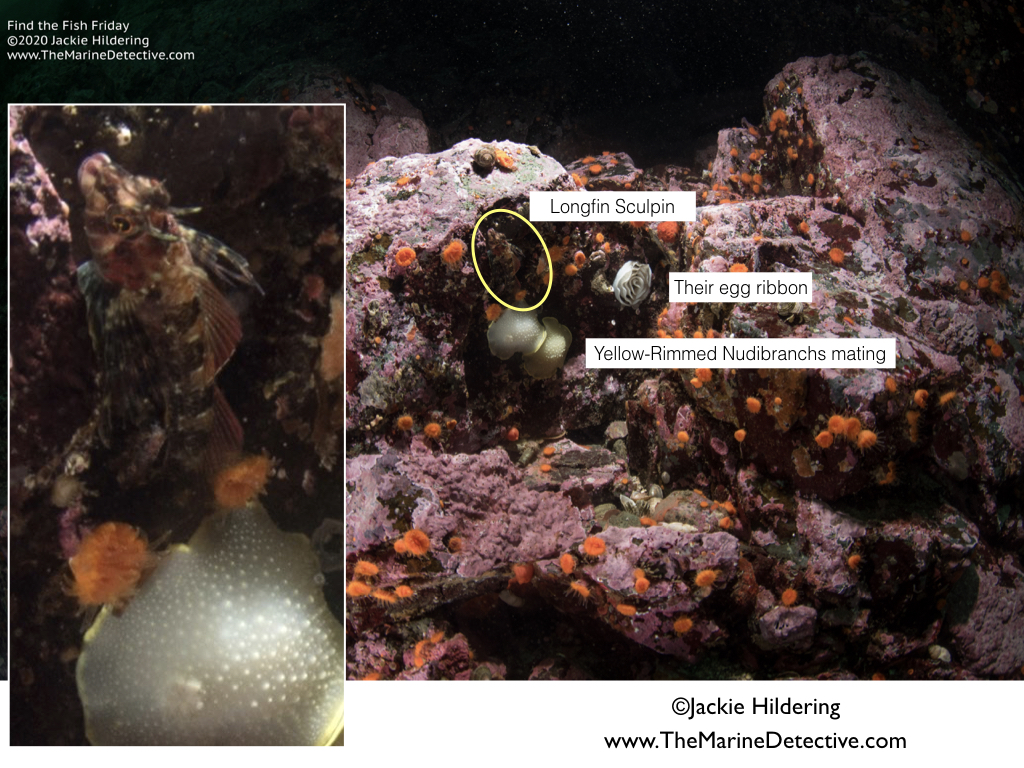
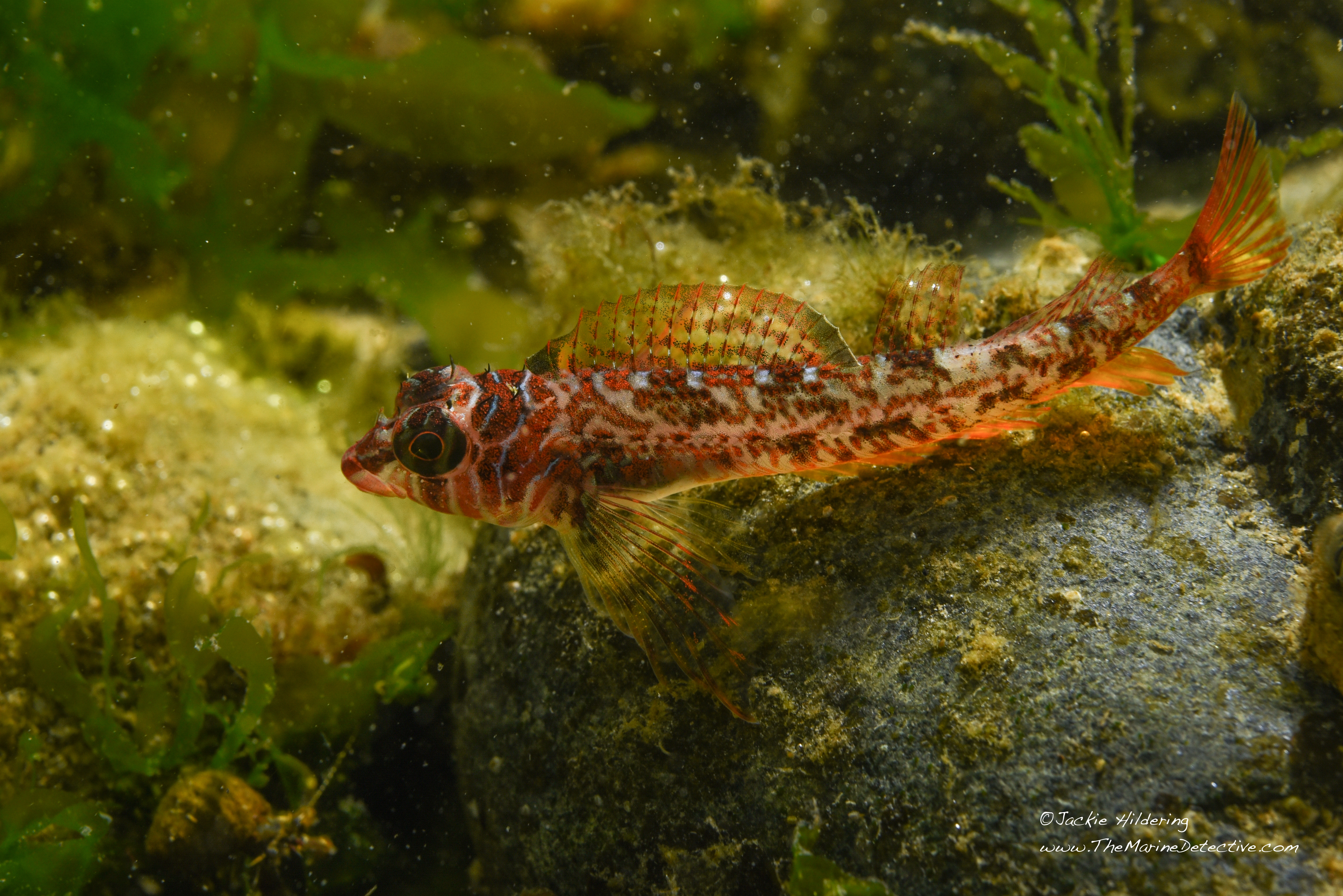
This is a Longfin Sculpin. See the amazing colours and textures. It’s a smaller fish. Maximum size is to 15 centimetres.
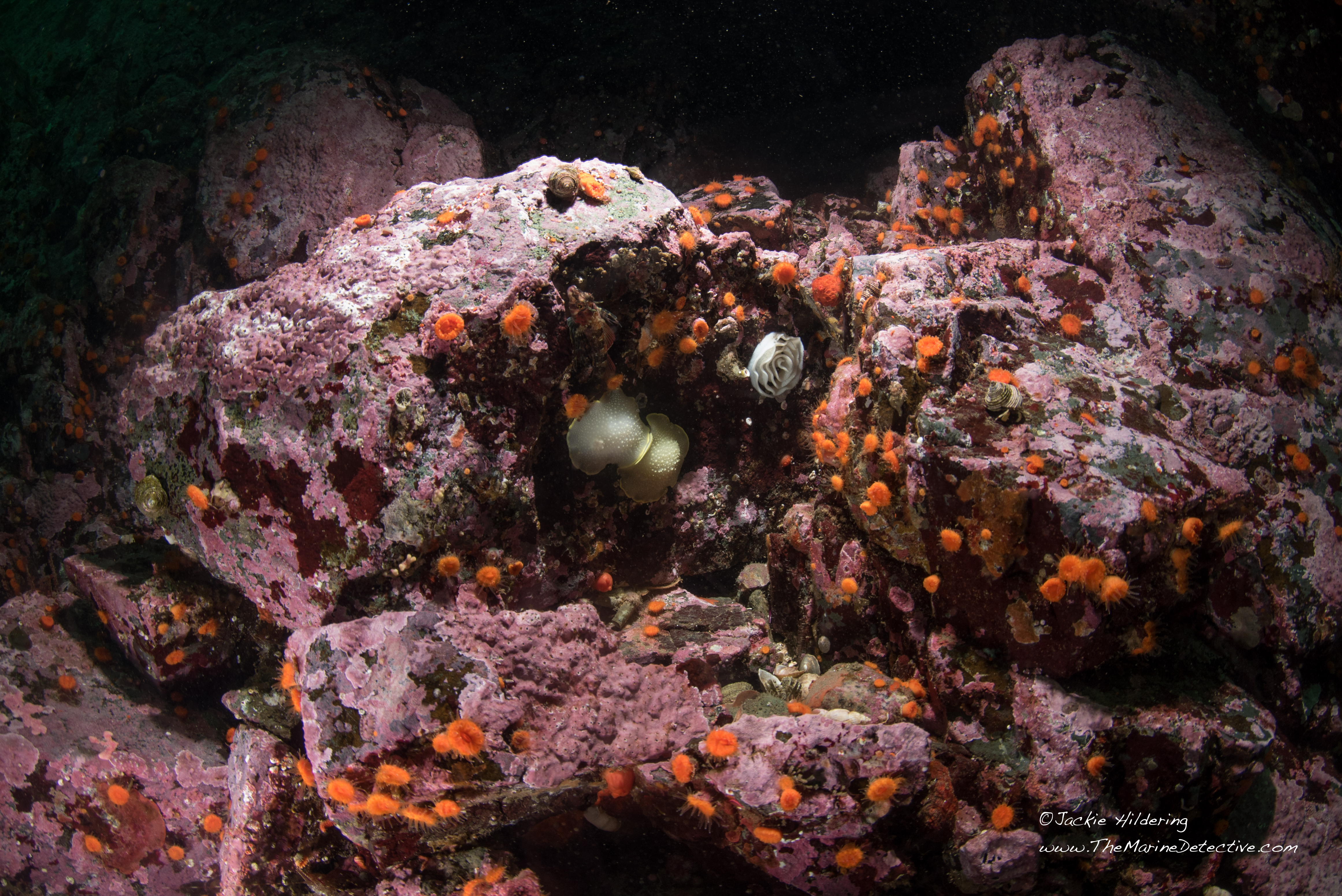
Can you find a Longfin Sculpin in the photo below? All those orange circles are animals. They are Orange Cup Corals. The rocks are covered with species of coralline algae. Yes, this is a pink type of seaweed that forms crusts all over the rocks. The two white animals close together are a species of sea slug. They are called Yellow-Rimmed Nudibranchs. They are mating and the spiral you see is a ribbon of their eggs. There are hundreds of tiny little eggs in that spiral and the babies will hatch into the ocean.
Click to enlarge.
For the answer showing where the Longfin Sculpin is, click this link.
Longfin Sculpins look very different at night. They are among the local fish species that darken to match their night surroundings. This is called “nocturnal colouration”. You can see how very different Longfin Sculpin’s night colour is by going to my blog here.
Challenge #4:
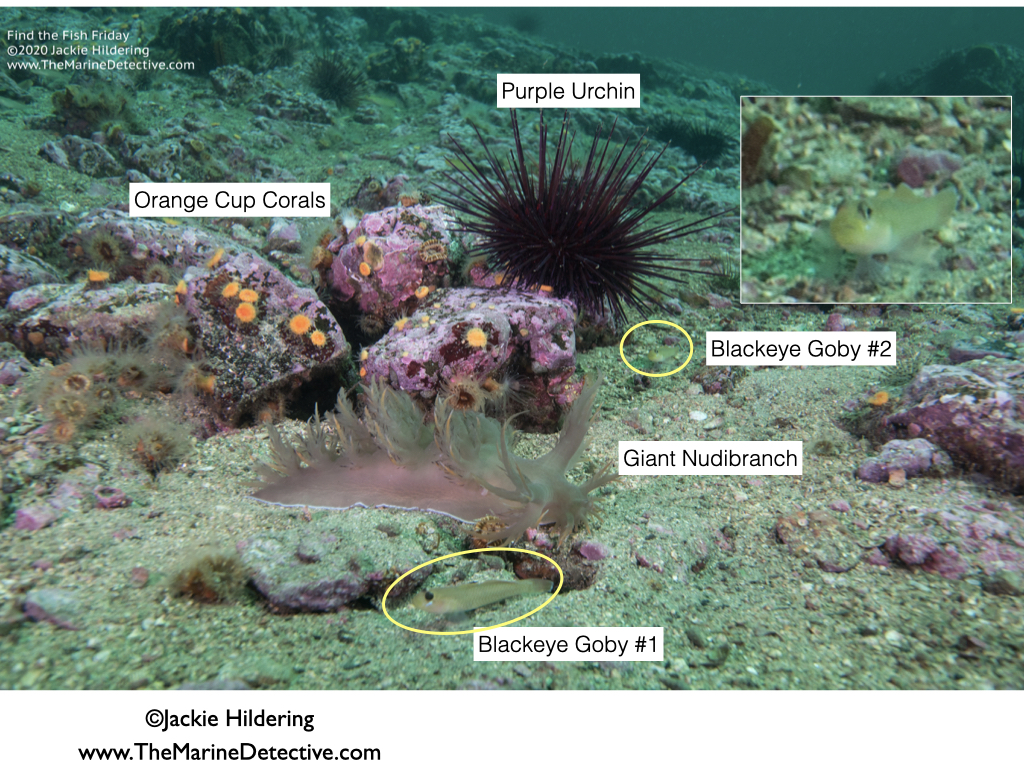
This is a Blackeye Goby.
They are up to 15 centimetres long.
In the picture below. There are two Blackeye Gobies. One is easy to find but you will likely have to search quite hard to find the second one. As you search, notice the Giant Nudibranch. Yes, another GIANT. This kind of sea slug can be 30 centimetres long. They can swim and they are also amazing predators. I have lost of information about them in my blog at this link.
There are also more Orange Cup Corals, some Tube-Dwelling Anemones and Purple Urchins.
Extra information about Blackeye Gobies: They ALL start off as females and under the right conditions, will become male. The males are tidy housekeepers, cleaning out the sand form their den. They are highly territorial and come out of their tidy homes to attract multiple females. After mating, the father fish will guard the eggs of the multiple females: ~1,600 to 27,000 eggs at a time for10 to 30 days!.
Blackeye Gobies also change colour at night to blend in better with their background.
Challenge #5 – The SUPER CHALLENGE:
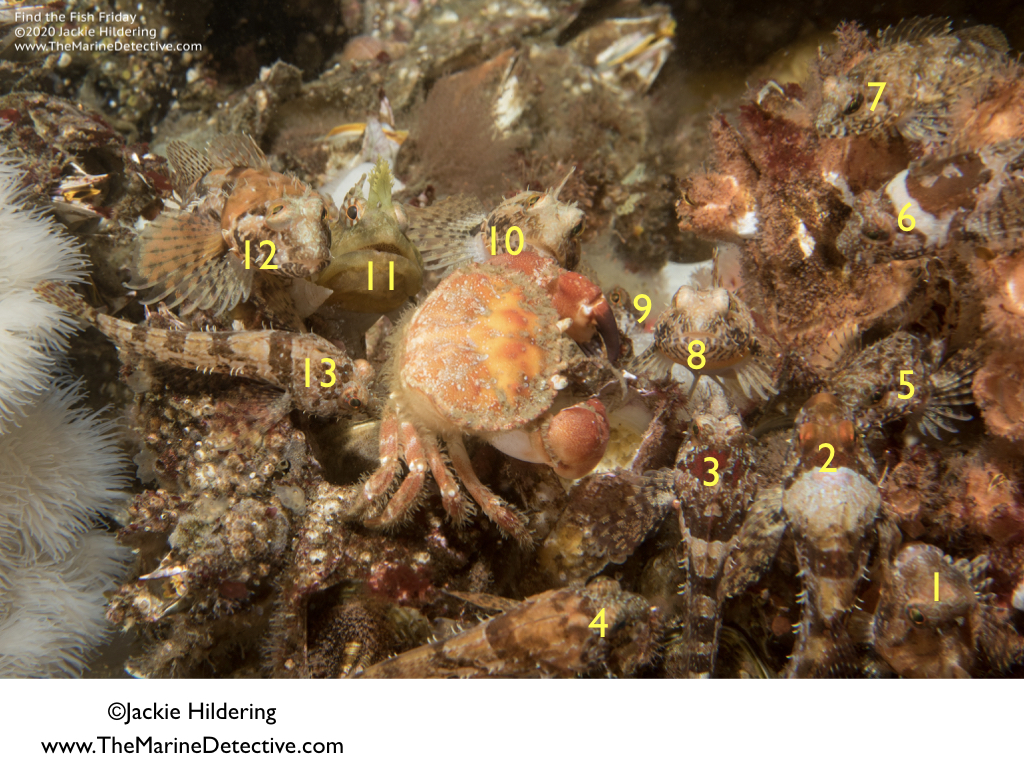
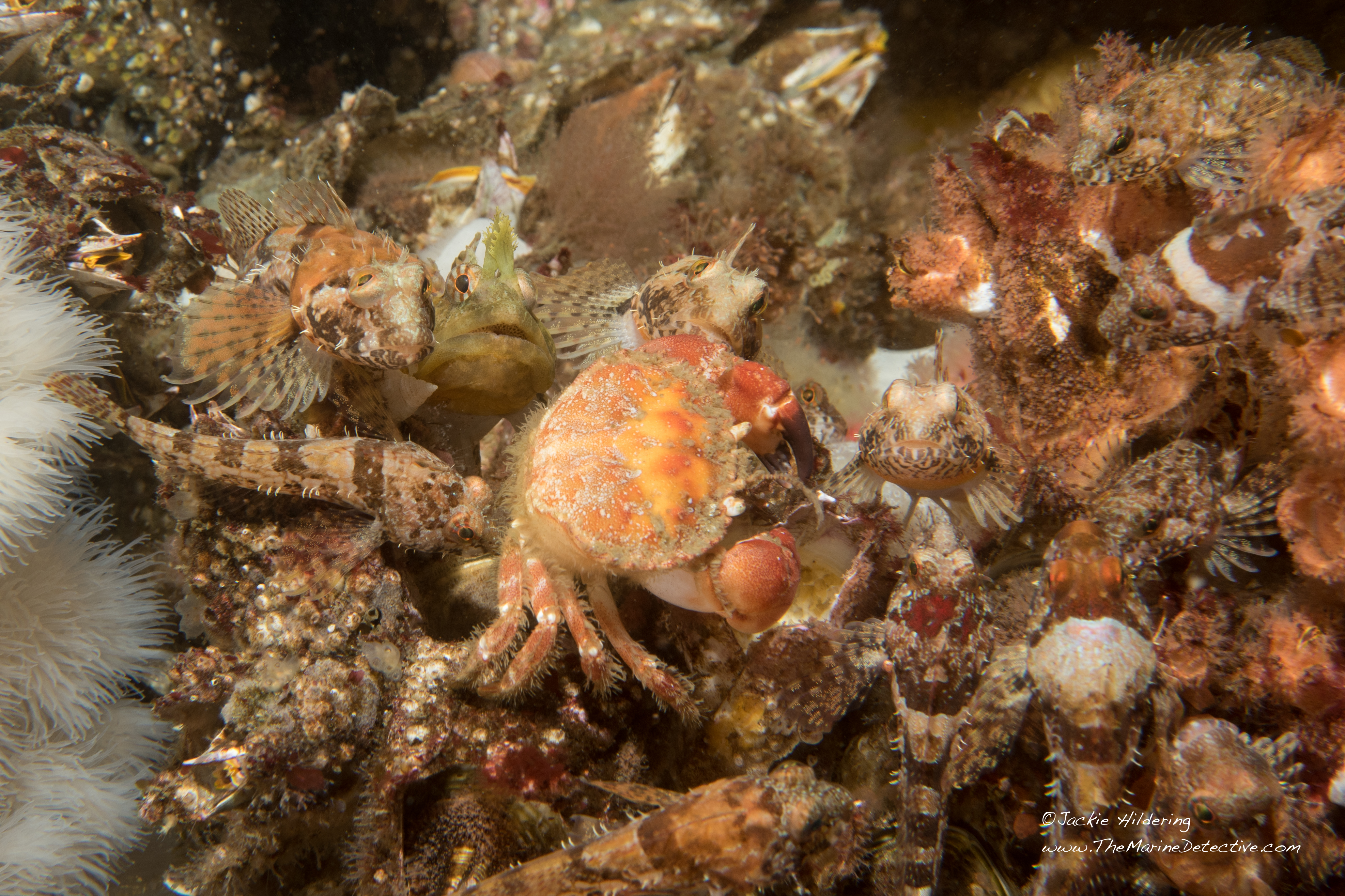
This is a Scalyhead Sculpin.
They are a small fish with maximum size being only 10 centimetres. They can be a lot of different colours and the mature males have what look like big bushy eyebrows (cirri).
They are INCREDIBLE at camouflaging. There can be so many is just one small area. Think about how big the top of a school desk is. The photo below is of an area much smaller than that and there are TWELVE Scalyhead Sculpins here! The crab you see is a Pygmy Rock Crab. They usually hide out in the old shells of Giant Barnacles and do not get bigger than about 5 centimetres. If you can find even six of them you have done very well.
Click to enlarge .
The answer for the locations of all twelve of the fish is at this link.
I am hoping now that when you think of the bottom of the Northeast Pacific Ocean, you have a better idea of just how colourful it is. To be sure, please see the pictures below.
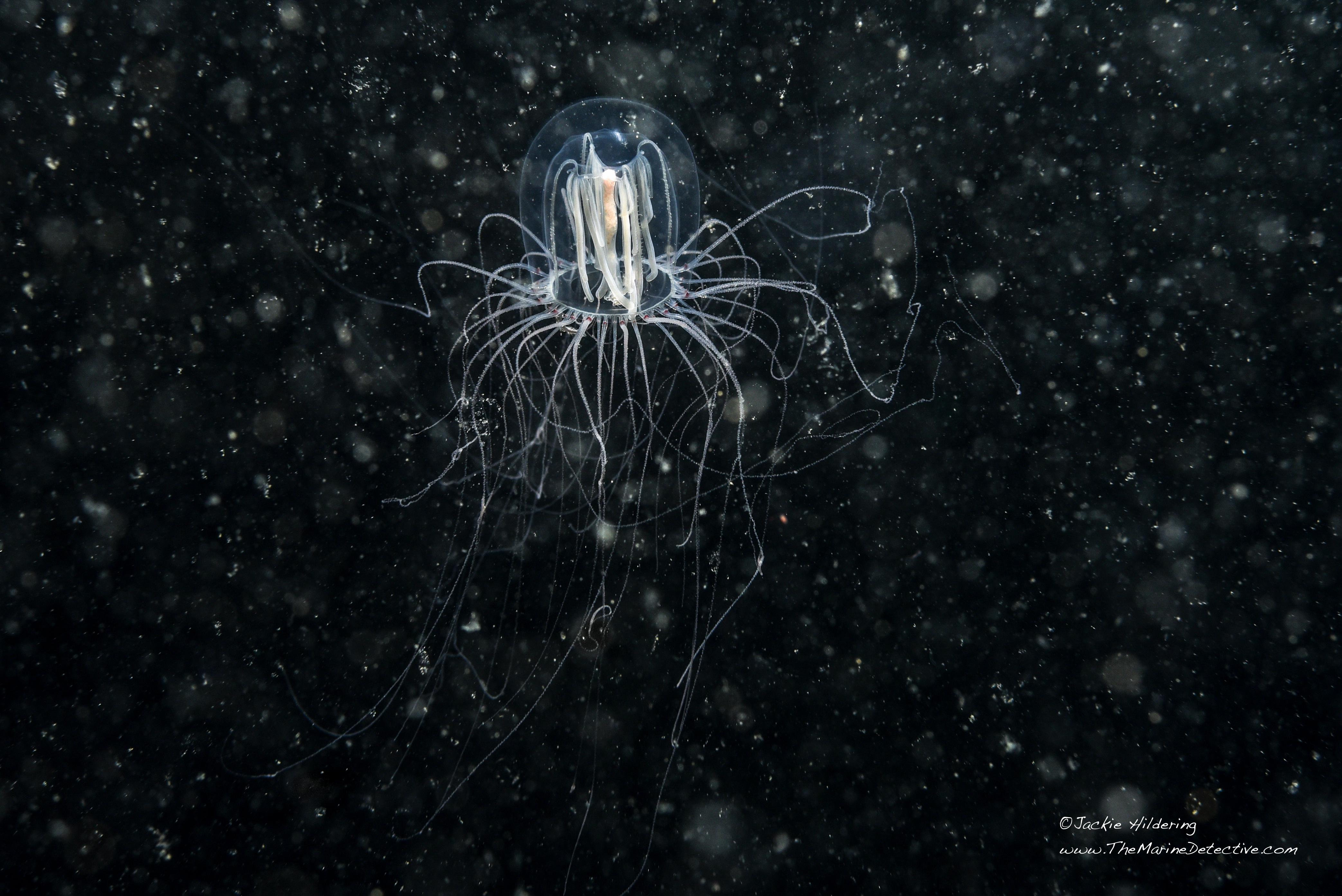
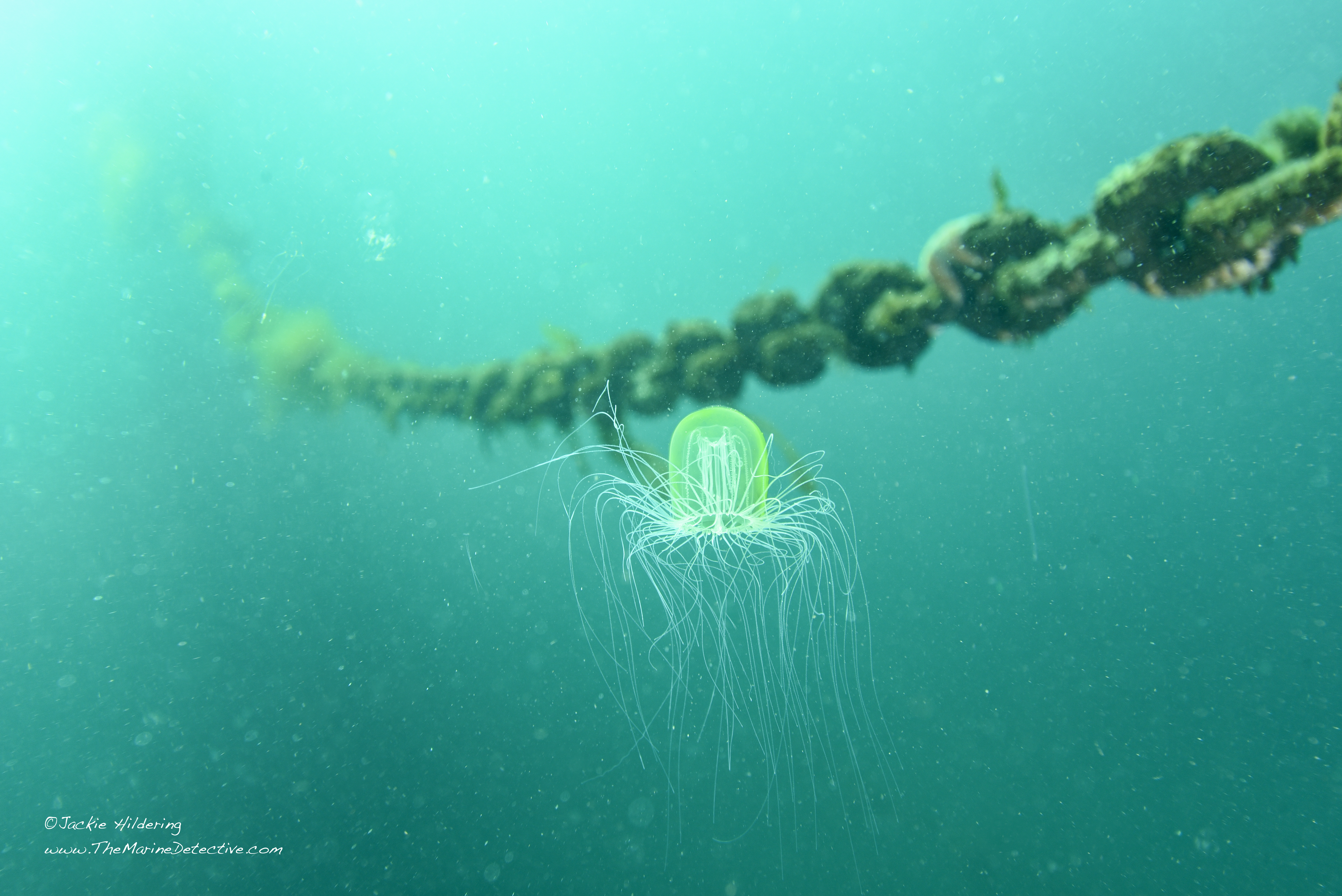
Oh wait no, this was yesterday, diving in a soup of Red Eye-Medusa.
Imagine the water thick with plankton to the extent that it actually feels soupy, and throughout, these jellies are suspended . . . like little, living fairy lights in the dark.
When the visibility is poor like this, it of course limits what else can be seen. But, when you’re in the dark, that’s where you are and that’s where there is still much learning to be done and beauty to be seen.
Yep = life metaphor.
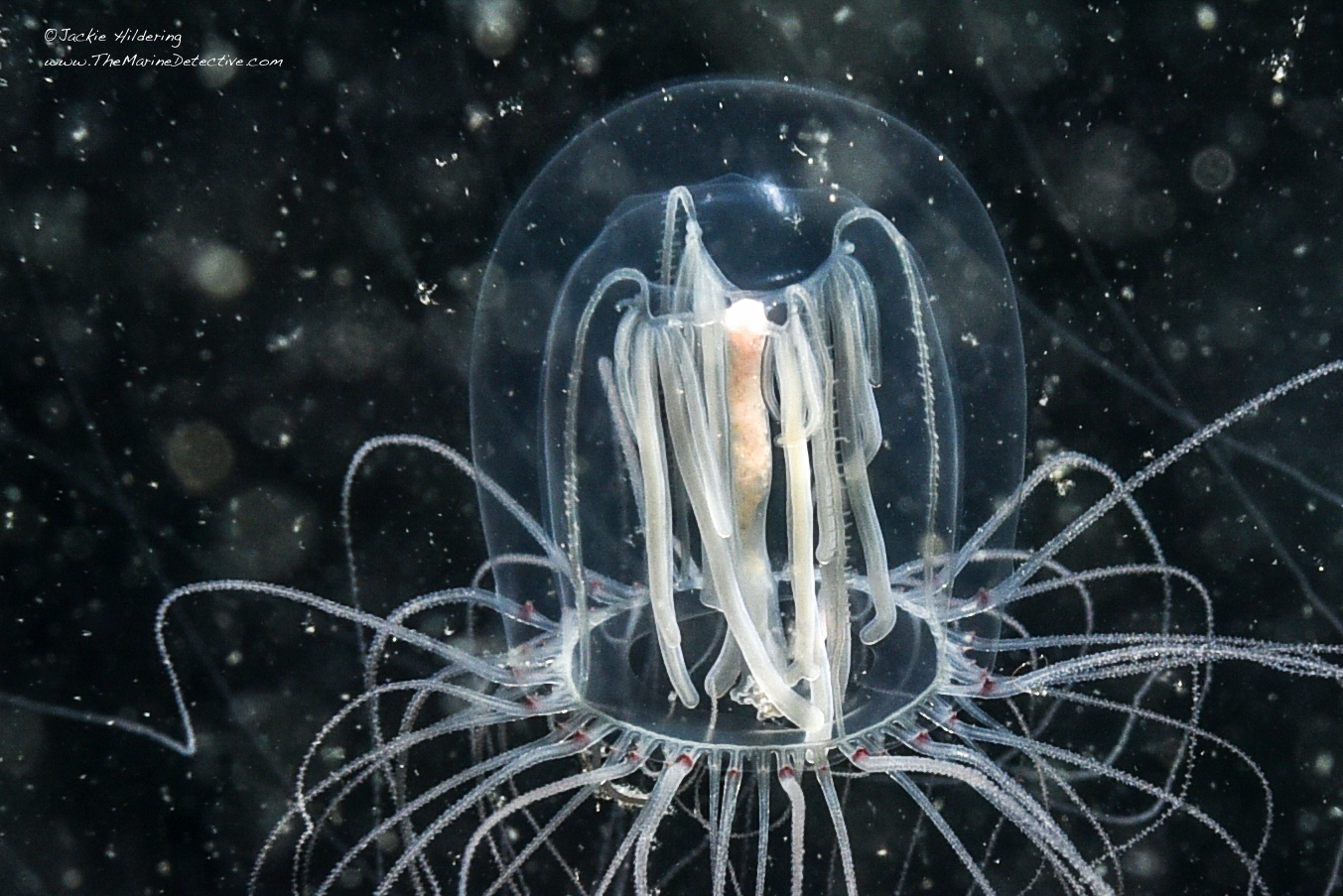
Polyorchis penicillatus are up to 10 cm in size and they are “sink fishing” when hanging like this (detail below).
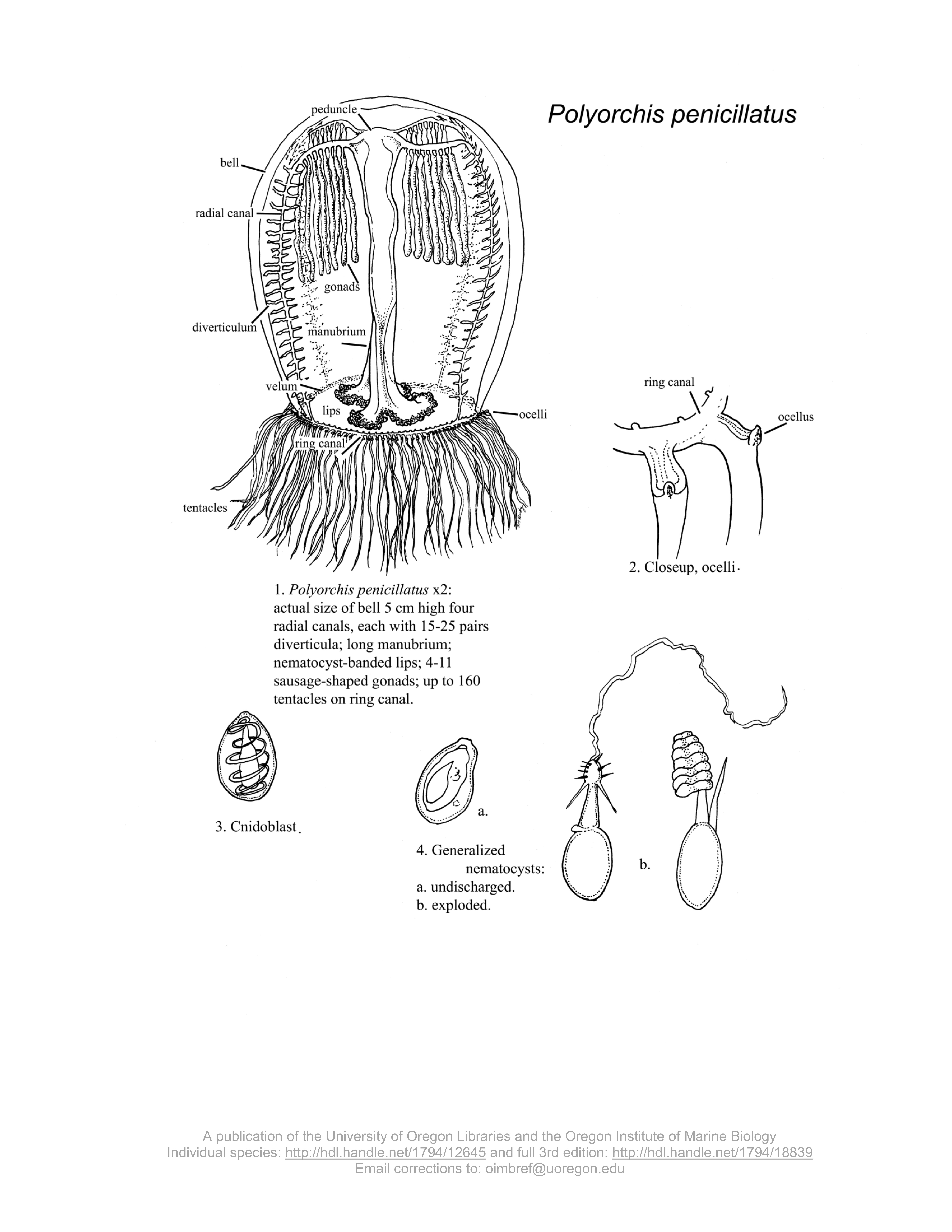
Look at the bottom of the bell for the red “eyes” (eyespots / ocelli). These can sense light intensity, helping the jelly know which way is up.
The stomach is in the middle and the gonads are the elongate organs surrounding that. Species has up to ~160 tentacles (more often around 100). This jelly species makes “hopping” motions. In part, this is believed to help when feeding near the seafloor by stirring up prey (true story).
More detail on feeding from the University of Oregon:
“They feed in both the water column and on the bottom, using different methods for each (Mills et al. 2007). On the bottom, they perch on their tentacles and eat benthic organisms by touching the sediment with their manubrium [stomach with mouth at tip]. Sometimes, they will hop on the sediment, likely to stir up possible prey or move to a new location (Mills 1981, 2001). In the water column, they use “sink fishing” to find their prey. During sink fishing, the medusae extend their tentacles out from their bell and let the distal ends sink downward. They either maintain their position in the water column or sink slowly and catch prey with their tentacles. When a prey item touches a tentacle, the medusa will use that tentacle to bring the prey to the manubrium, though large prey sometimes require more tentacles; this process causes cessation in swimming and crumpling (Arkett 1984).”
#YouAreWhereYouAre
Another Red-Eye Medusa at the same site in Port Hardy. Species of sea star on the anchor chain is a Leather Star.
Source of annotated diagram below and ALL you wish to know about the species:
Polyorchis penicillatus, A publication of the University of Oregon Libraries and the Oregon Institute of Marine Biology Individual species.
To follow up on yesterday’s blog about Candy-Stripe Shrimp and their association with Crimson Anemones, here’s another ambassador from my last dive who shatters the notion that these waters do not explode with colour and biodiversity.
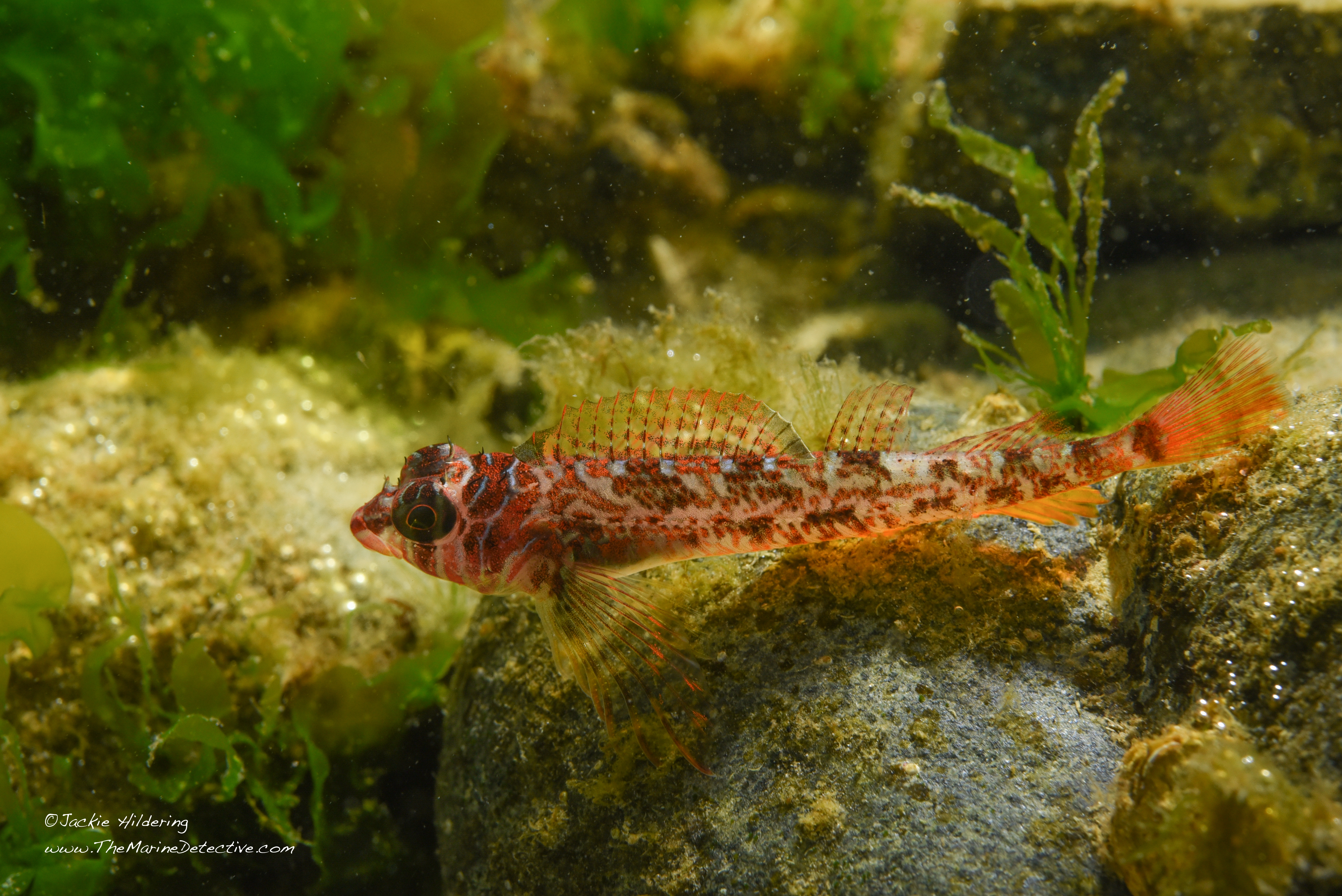
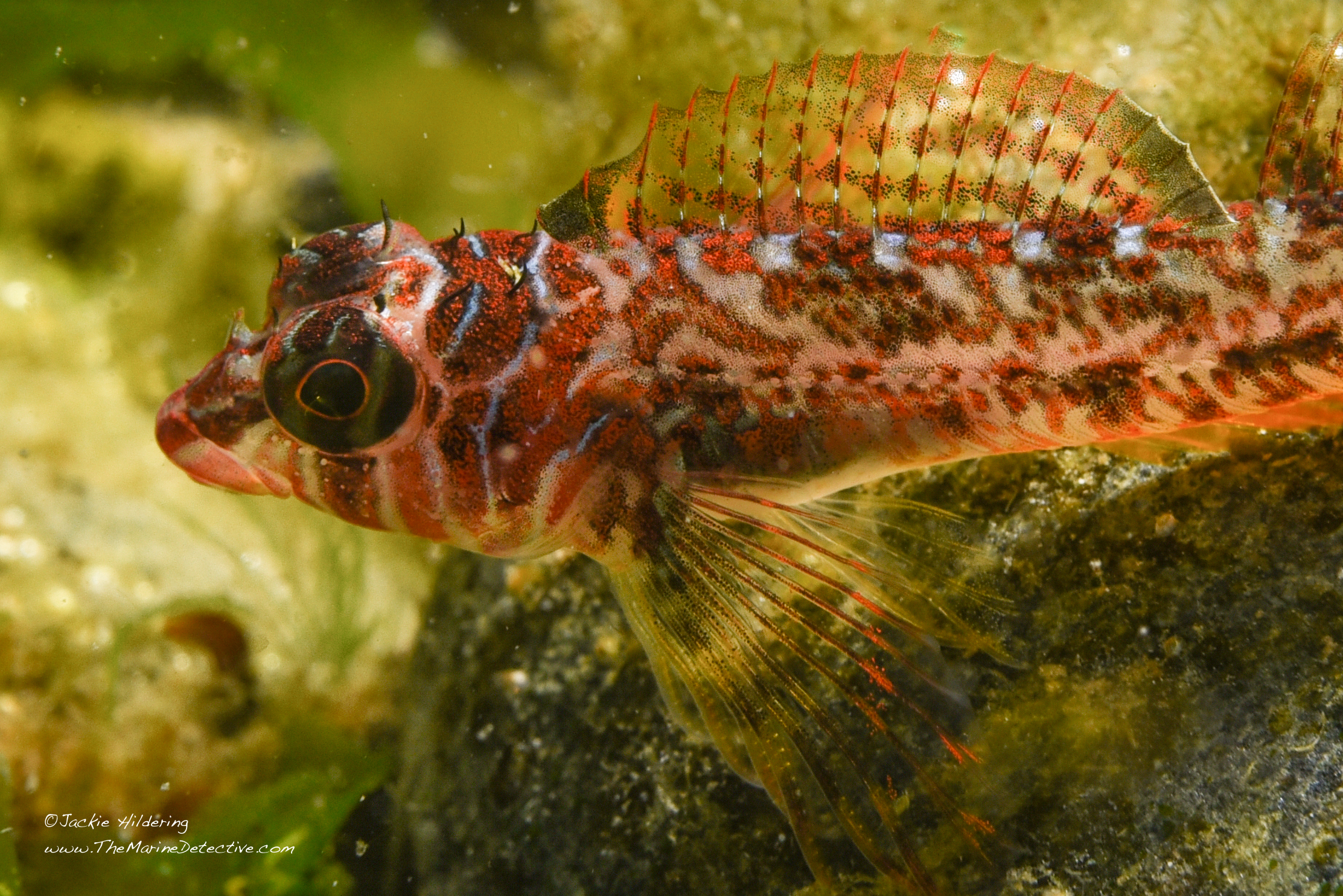
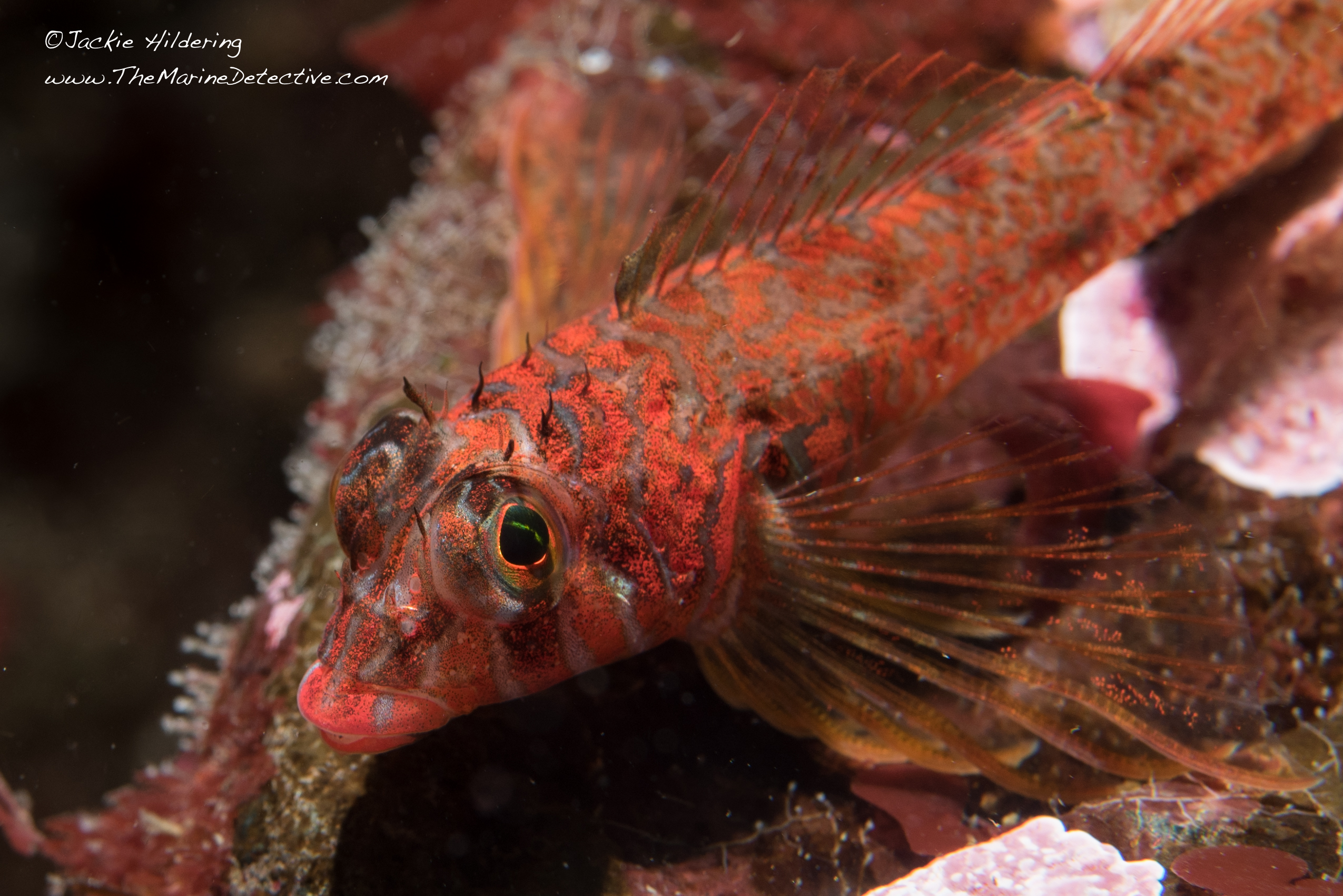
This little Longfin Sculpin was at only 1 m depth. I saw him/her immediate when I descended and had such good fortune that the fish did not dart away. It’s usually what they do.
Longfin Sculpin = Jordania zonope to 15 cm long. May 20th, 2020 near Telegraph Cove.
May 20th, 2020 near Telegraph Cove.
JUST LOOK at the colour, the patterns, the texture . . . and the gossamer fins.
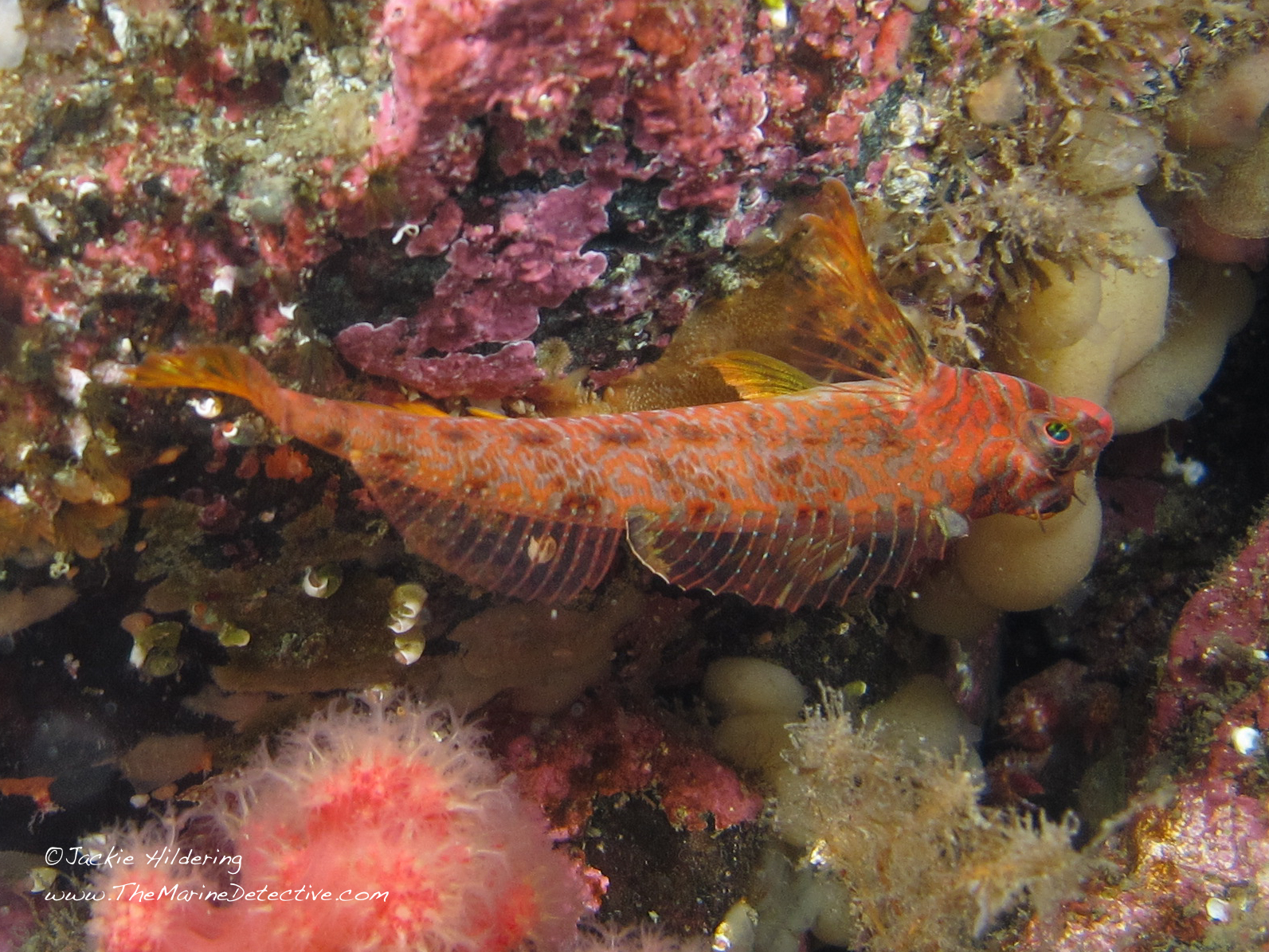
Here’s another individual from a different dive to give you a sense of the variation in colour and patterns. This colouration and banded pattern often helps them camouflage because so much of the life in these waters is brightly coloured.
June 9, 2019 Hanson Island
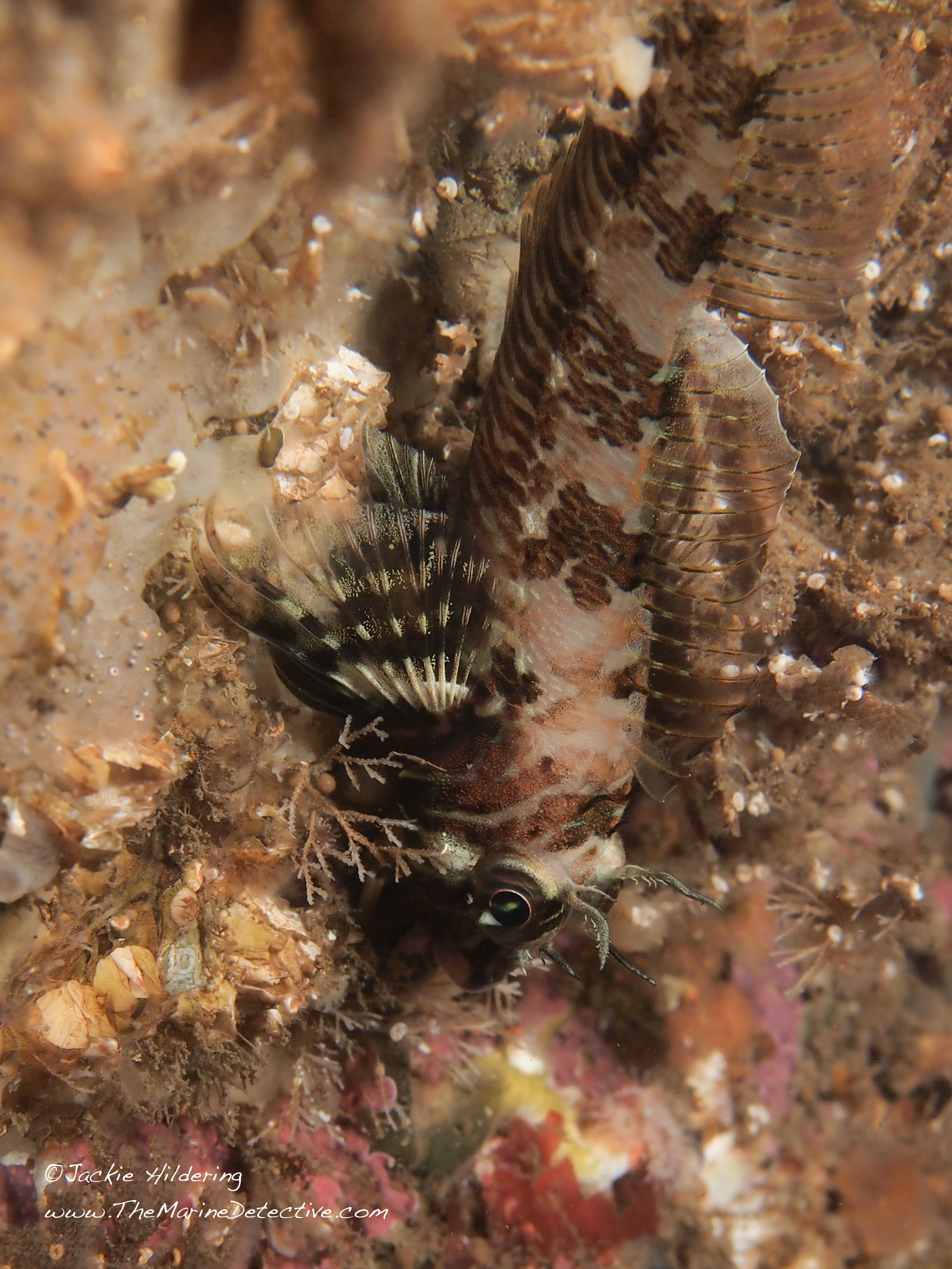
BUT Longfin Sculpins are among the local fish species that change colour at night. They darken to match their nocturnal surroundings so they have a better chance of . . . seeing another day.
The photo below shows how extreme this colour change is.
March 5th, 2013 Port Hardy.
This is known as “nocturnal protective colouration” and this adaptation is not unique to species of fishes but is also found in birds, mammals, insects, etc
The males are apparently also darker when courting females and protecting eggs. They are very territorial when egg-guarding.
A Longfin Sculpin in “Spider Man” mode. September 9, 2011 Pearse Island.
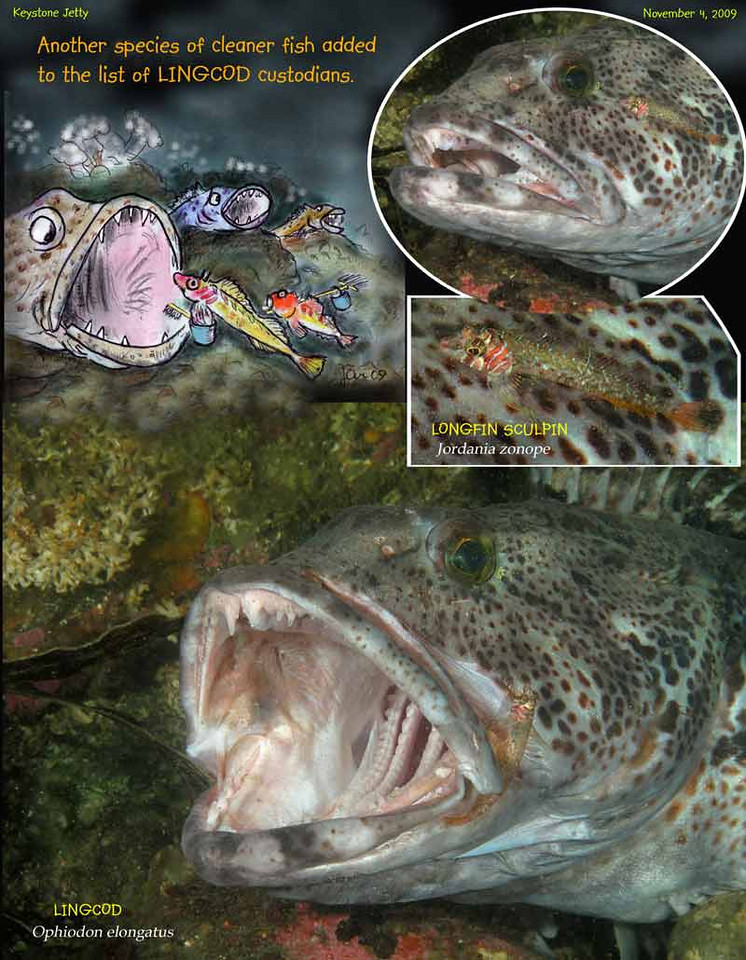
Further information from Dr. Milton Love’s Certainly More Than You Want to Know About the Fishes of the Pacific: “Young settle out of the plankton when around 2.3 to 3 cm long and then live a life where they are mostly solitary (other than to mate and egg guard) and rarely swim more than 0.5 m off the bottom. They use their pectoral fins to crawl around and hang on, even able to kind of “Spider Man” it by hanging on to vertical walls, head oriented downward. They are reportedly highly territorial with domains being from 0.3 to 0.5 metres squared / individual) . . . There have been some observations of the species cleaning the mouths of Lingcod, amid their many and very sharp teeth.”
Below, is one of Jan Kocian’s amazing captures (and cartoons) of a Longfin Sculpins serving as a cleaner fish to a Lingcod.
Scalyhead Sculpins have also been documented by as cleaner fish to Lingcod.
More often than eating snacks found on Lingcod 🙂 , Longfin Sculpins’ diet is “benthic arthropods” which include crabs, hermit crabs, isopods and shrimp. This is the diet of many sculpin species but one study found that Longfin Sculpins take bites out of their prey where other species like Scalyhead Sculpins swallow them whole.
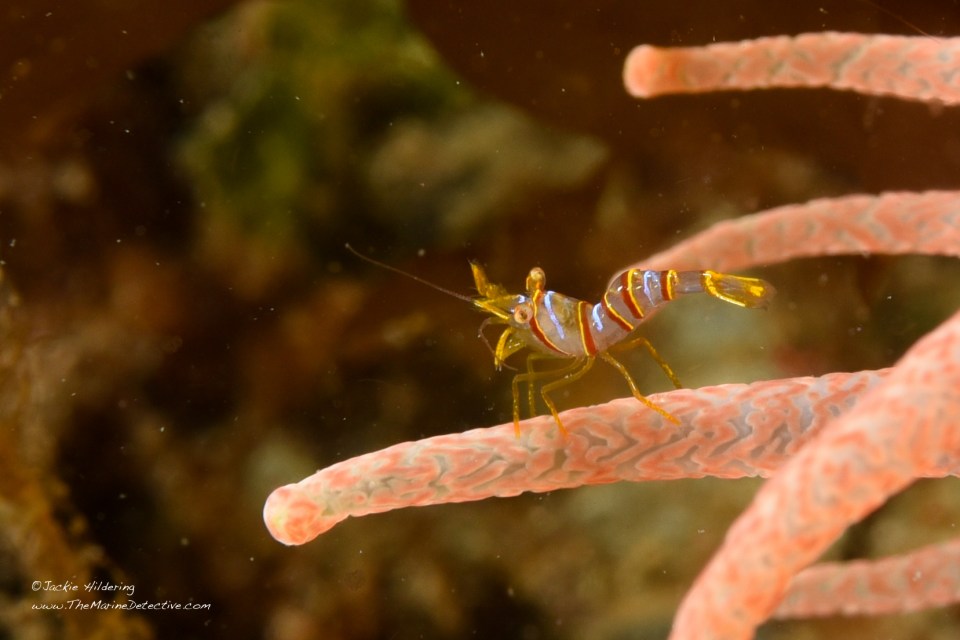
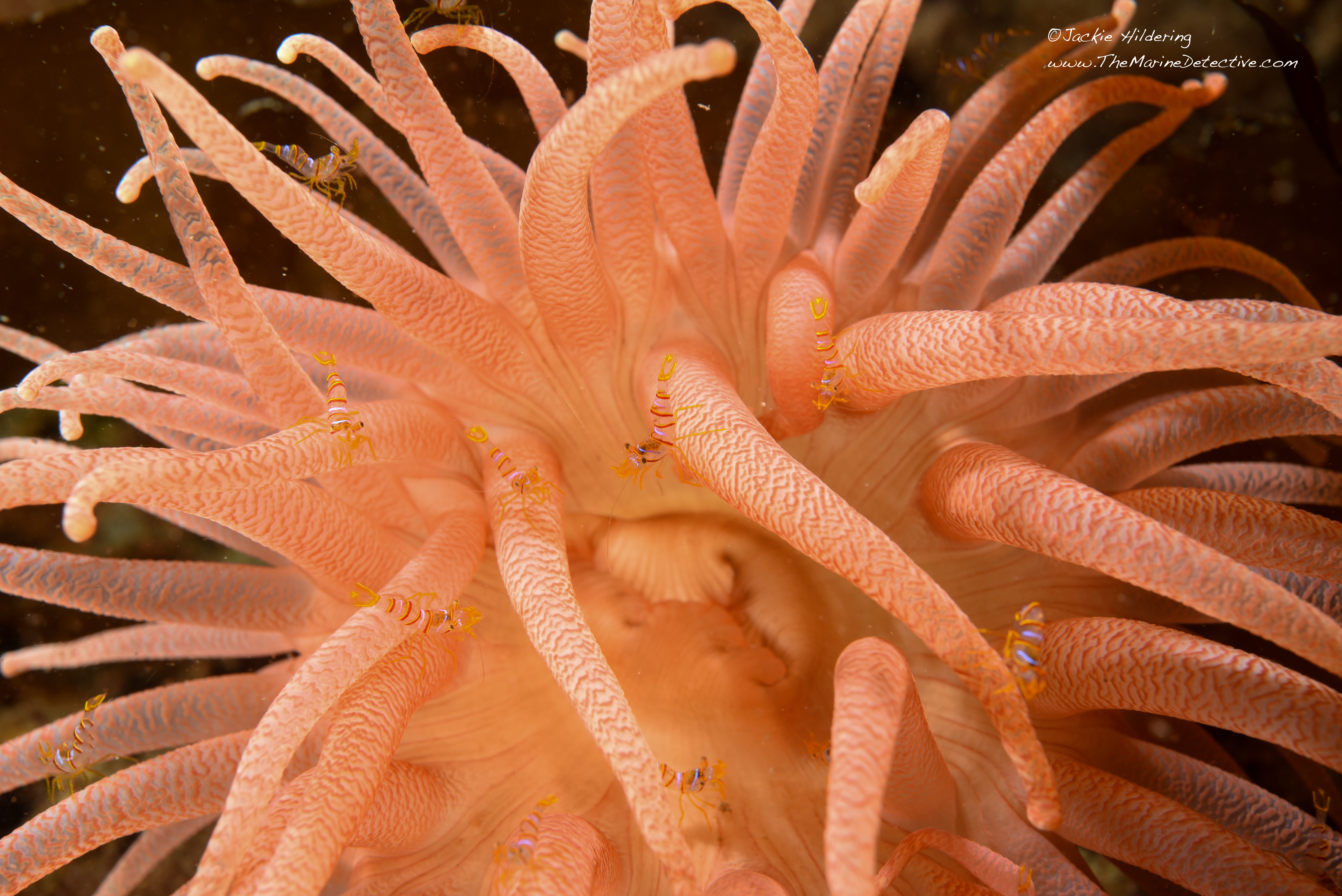
I went diving yesterday in an area where I knew there were Crimson Anemones. My hope was that if I took my magnifying glass and my macro lens MAYBE I would find a few Candy-Stripe Shrimp.
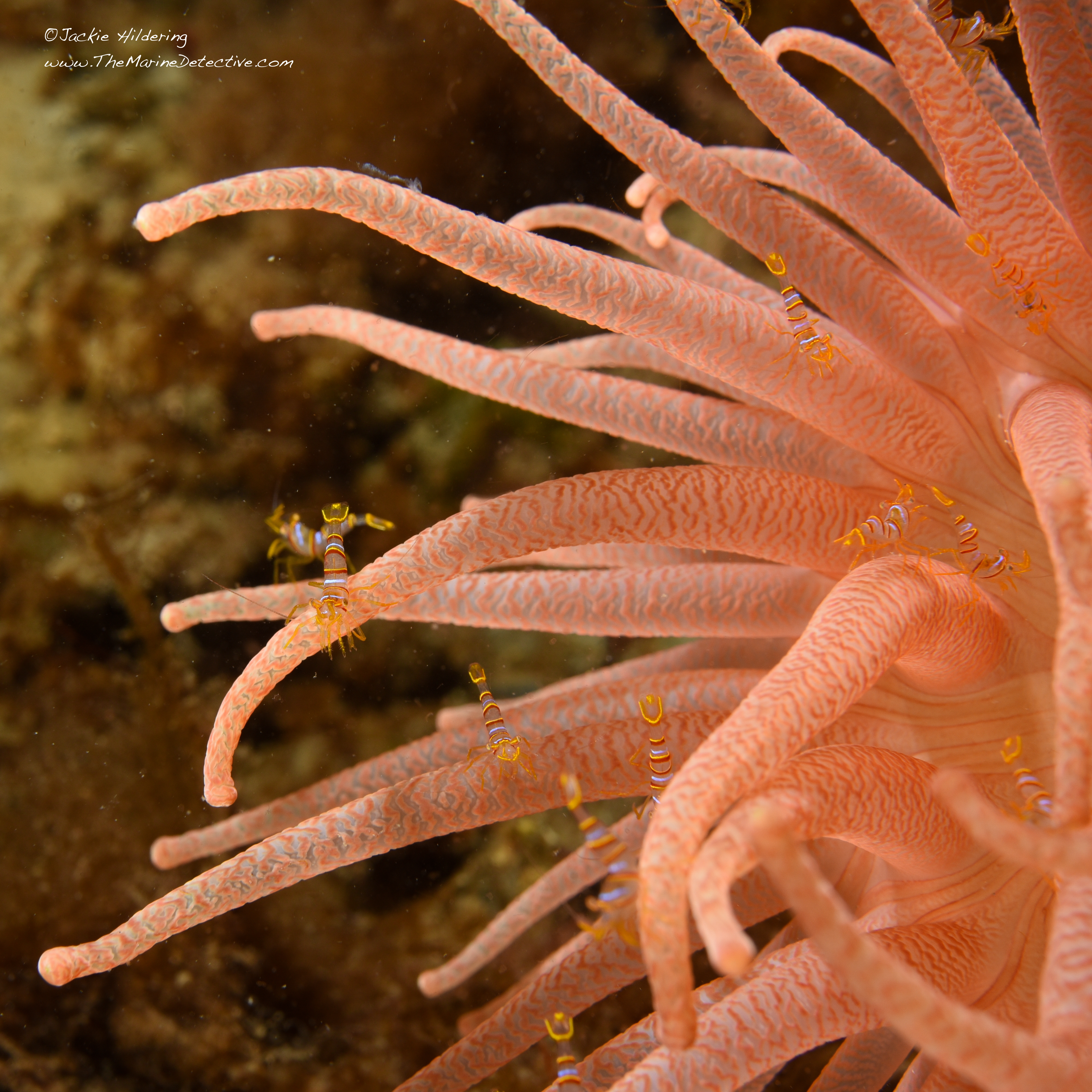
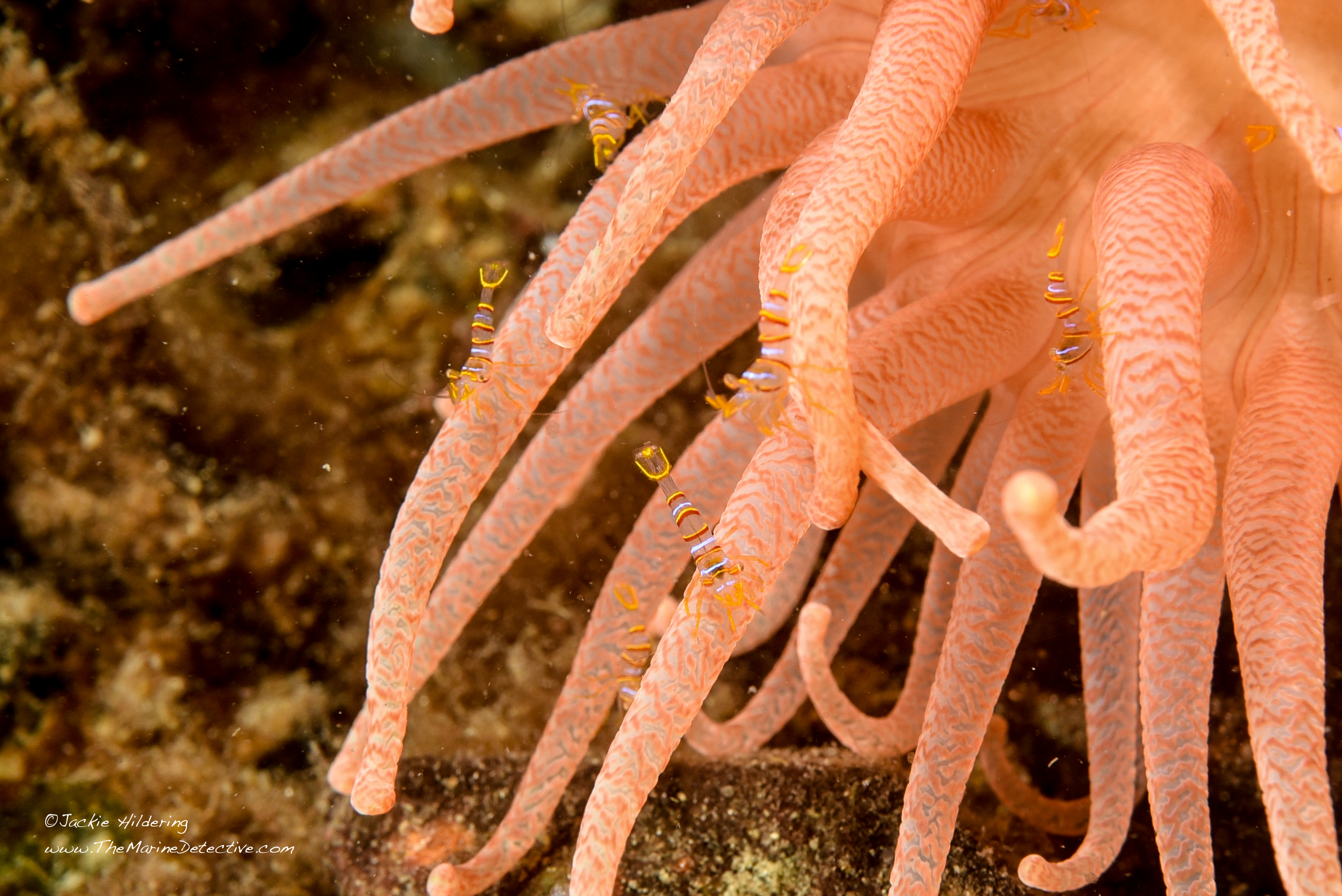
LOOK! One little Crimson Anemone had ~40 Candy-Stripe Shrimp!
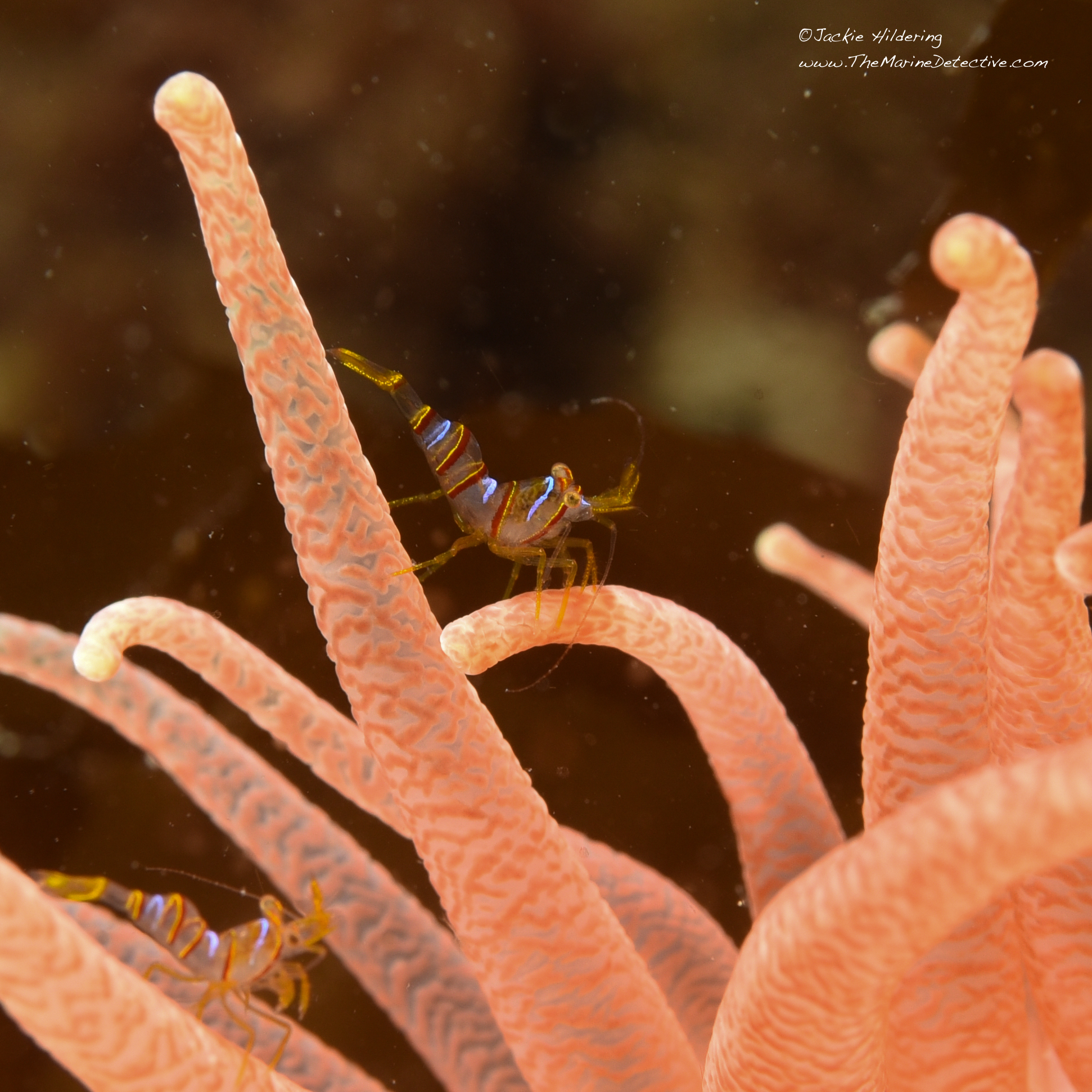
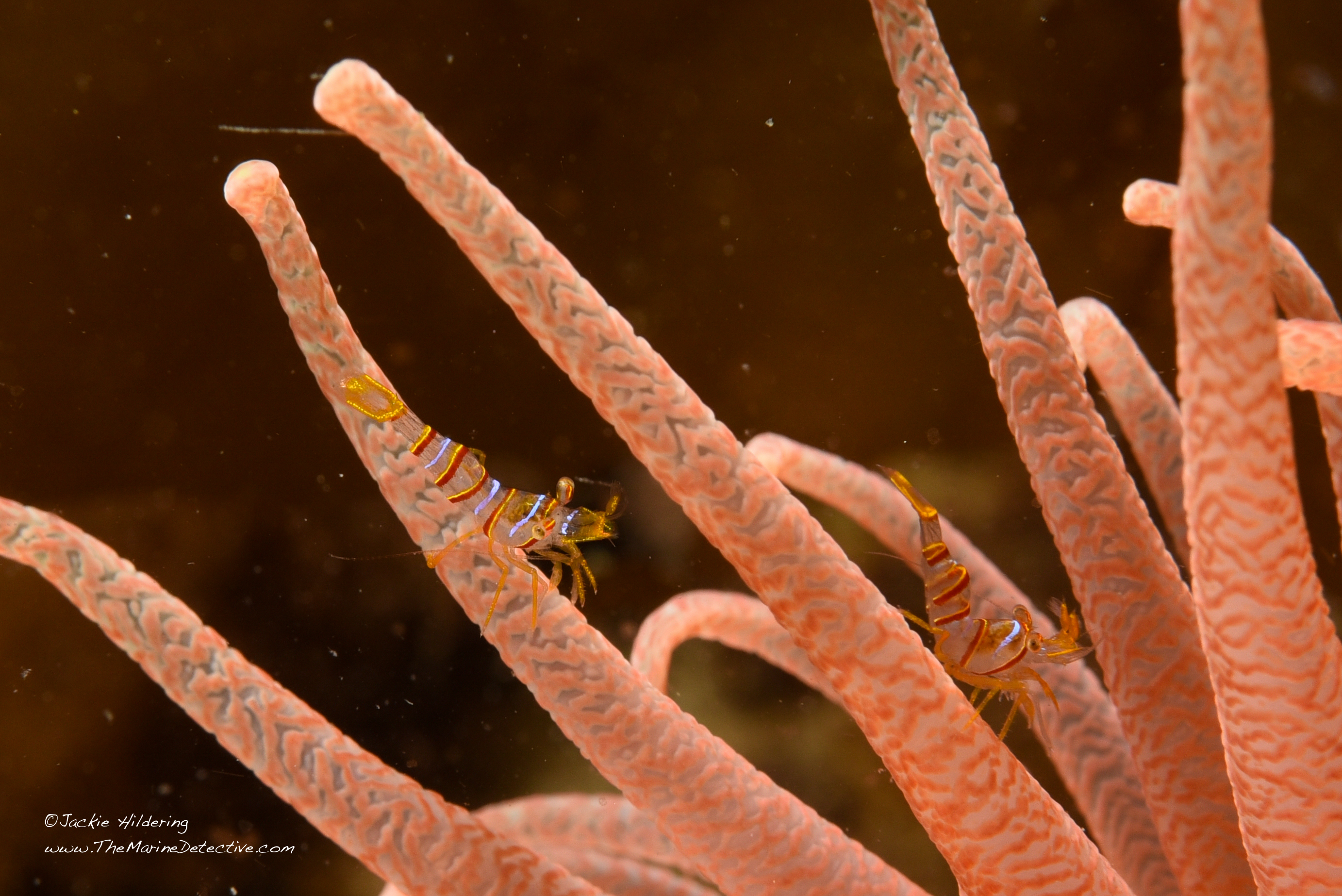
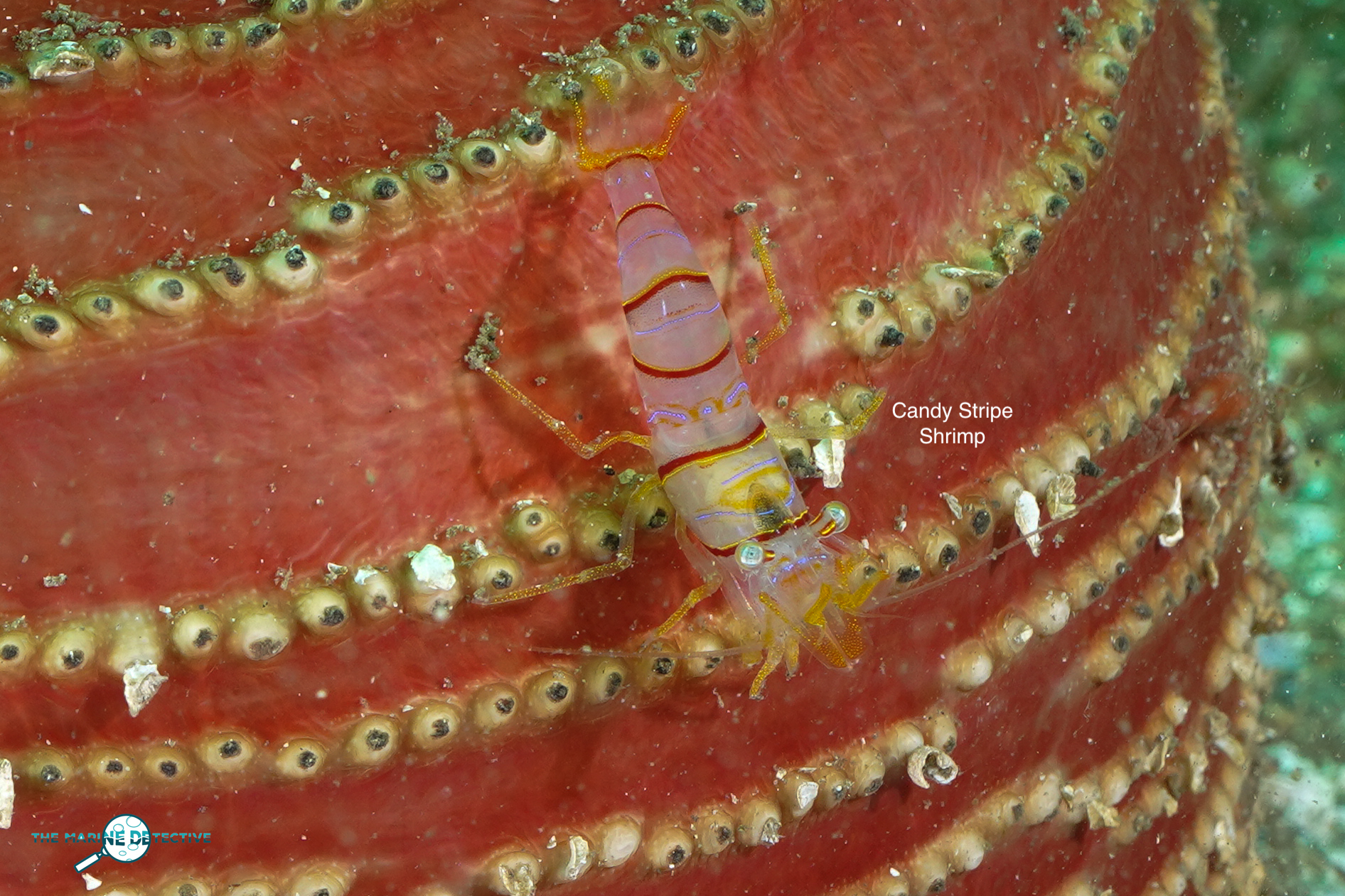
This species of shrimp is almost always found in association with this species of anemone and must be immune to its stinging cells (nematocysts). The shrimp get the benefit of snacks and the anemone MAY get protection. From Greg Jensen’s “Crabs and Shrimps of the Pacific Coast”: “The shrimp are believed to feed primarily on egested material [think poop] and the sloughing tissues of their host anemone”.
Greg observed in his aquarium (anecdotally) that Candy-Stripe Shrimp would share space on an anemone with other shrimp species (Kincaid’s Shrimp) but immediately attacked another shrimp species believed to harm the anemone – Snyder’s Blade Shrimp. Maybe this is what the anemones get out of the deal.
Candy-Stripe Shrimp can be up to 4.5 cm but these were all around 1 cm or less. What else was extraordinary in this “encounter” is that these shrimp usually dart away as soon as an annoying photographer shows up. That did not happen. So for you, LOTS of photos of these colourful marvels and their possible symbiosis / coevolution.
Shrimp = Lebbeus grandimanus Crimson Anemone = Cribrinopsis fernaldi to 30 cm tall. Candy-Stripe Shrimp have also found in association with a few other anemone species but most often with Crimson Anemones.
Tomorrow I will post about another “living gem” I documented on this dive. That is, another species that shatters the notion that these cold, dark waters do not explode with colour and biodiversity. 🙂
The photos below were added to the original post above on April 2, 2023. The text that accompanied the photos on social media was:
“Huge Sand-rose Anemone with a Candy-stripe Shrimp!
This anemone species is often buried as the name suggests. But, not only was this one not buried, but its tentacles were retracted whereby you can see its red column with the characteristic white bumps (tubercles) AND the Candy-stripe Shrimp. If the tentacles were not retracted, the shrimp would likely be hidden under the protection of the tentacles.
I took the final photo (below) when I came back after 30 minutes. I hoped the anemone would have its tentacles back out so you could see the before and after. Success!
Sand-rose Anemones are one of the world’s largest anemones at up to 1 metre across and 25 cm high. Feeds on plankton and detritus suspended in the water.
They are host to several species of symbiotic shrimp. The shrimp get protection under the long tentacles with stinging cells and the anemone potentially benefits from the shrimp eating other animals and organic bits near the anemone, and from possibly getting bits of food.”
Here’s one of your highly evolved and wonderfully unique marine neighbours.
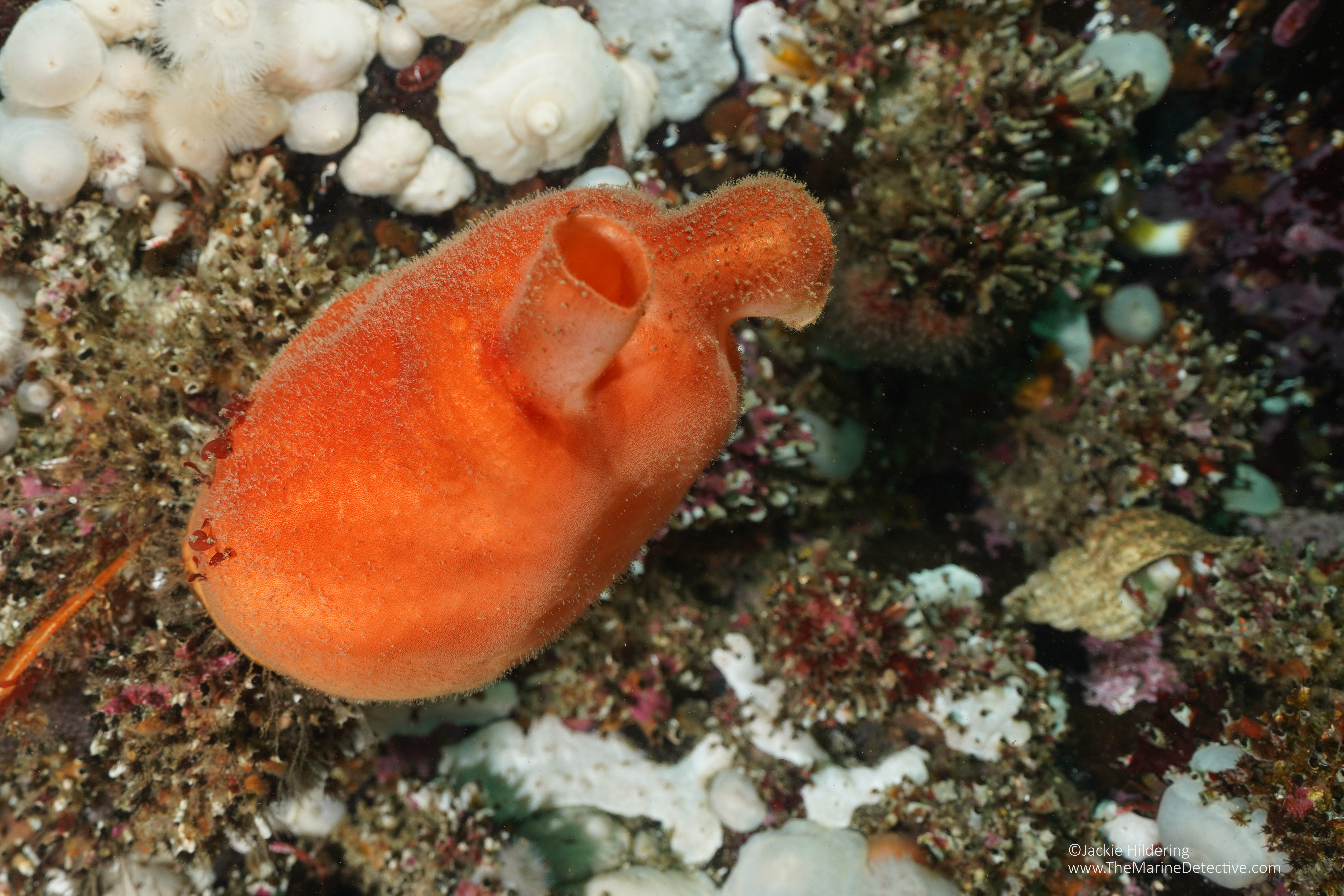
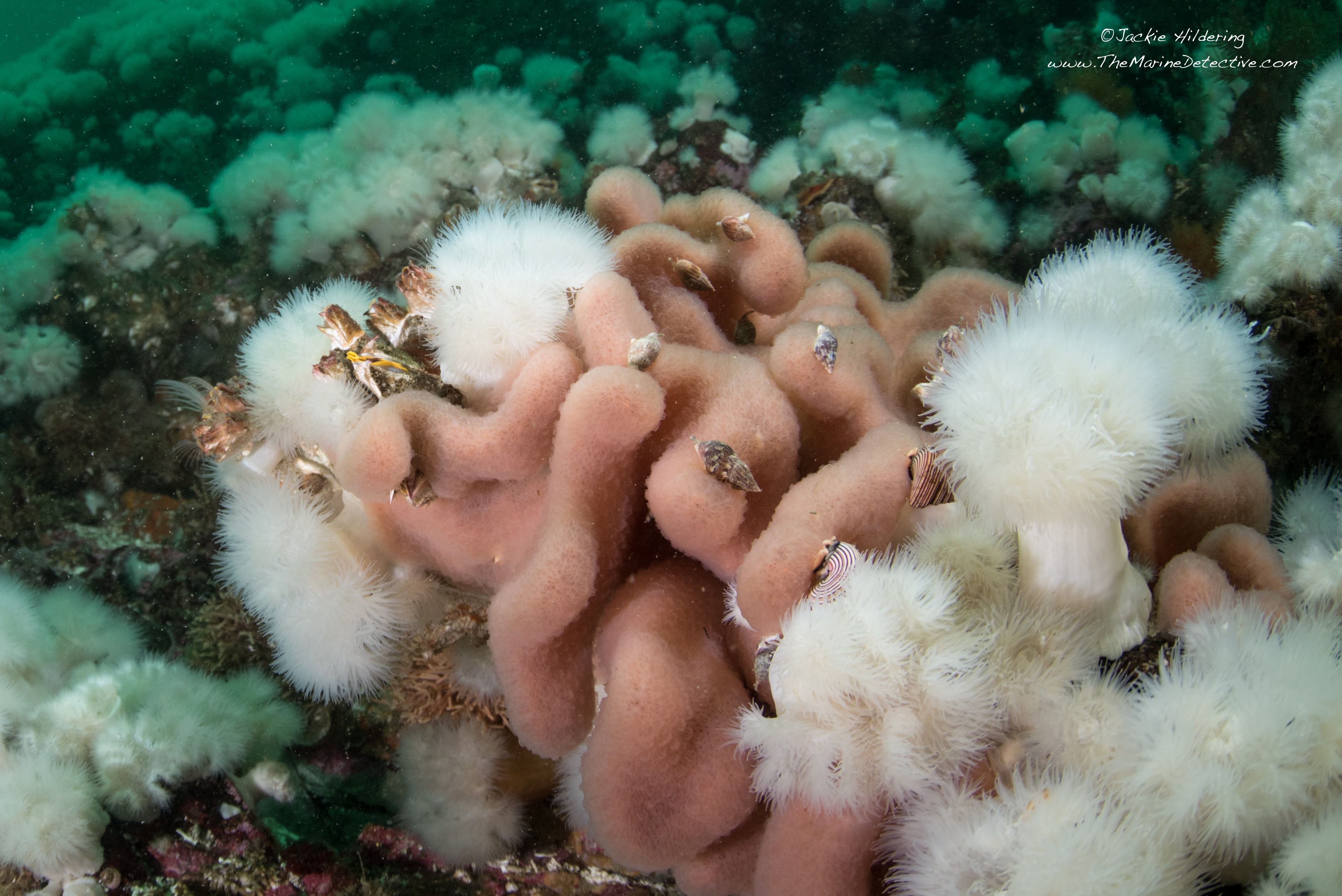
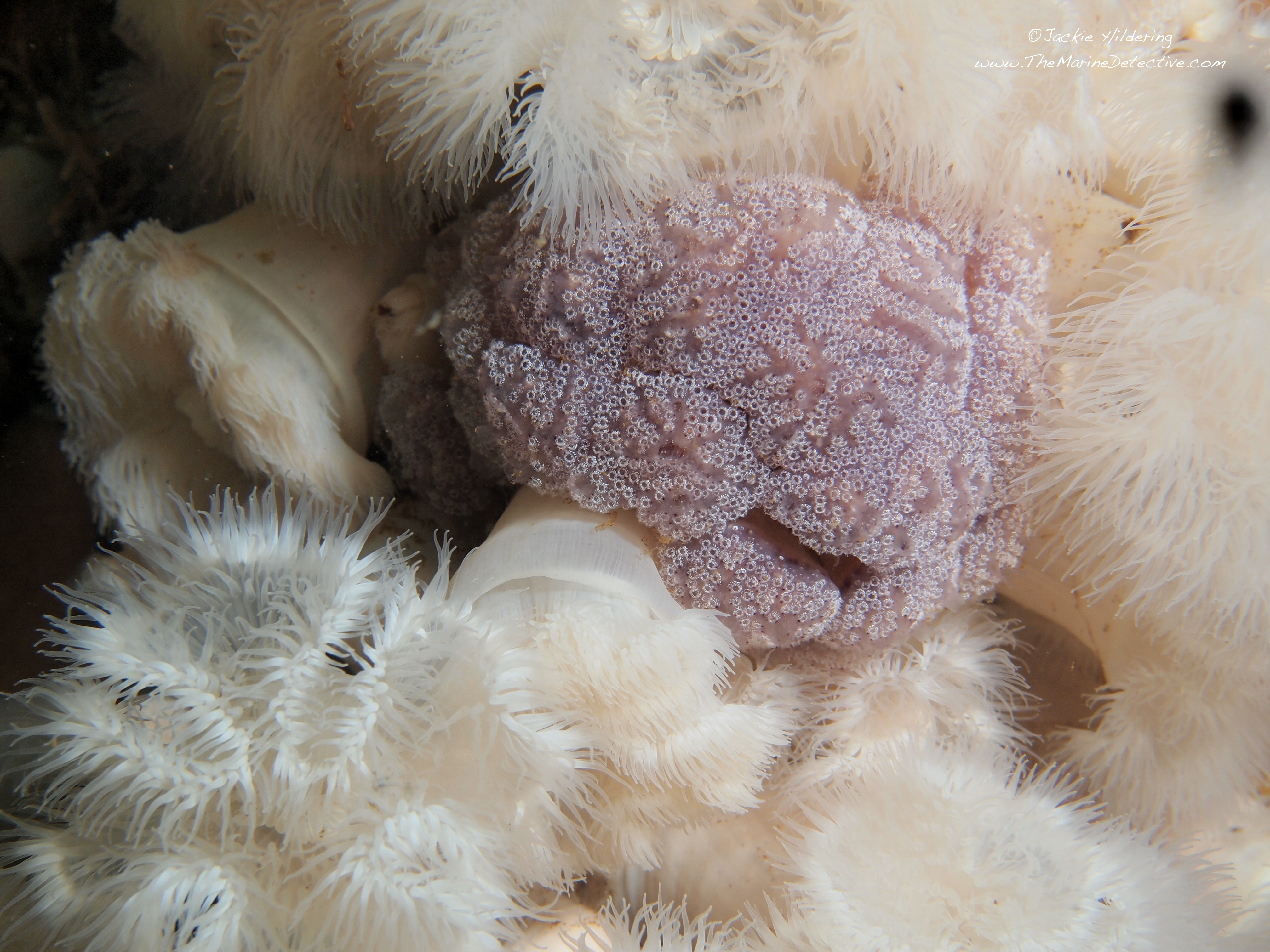
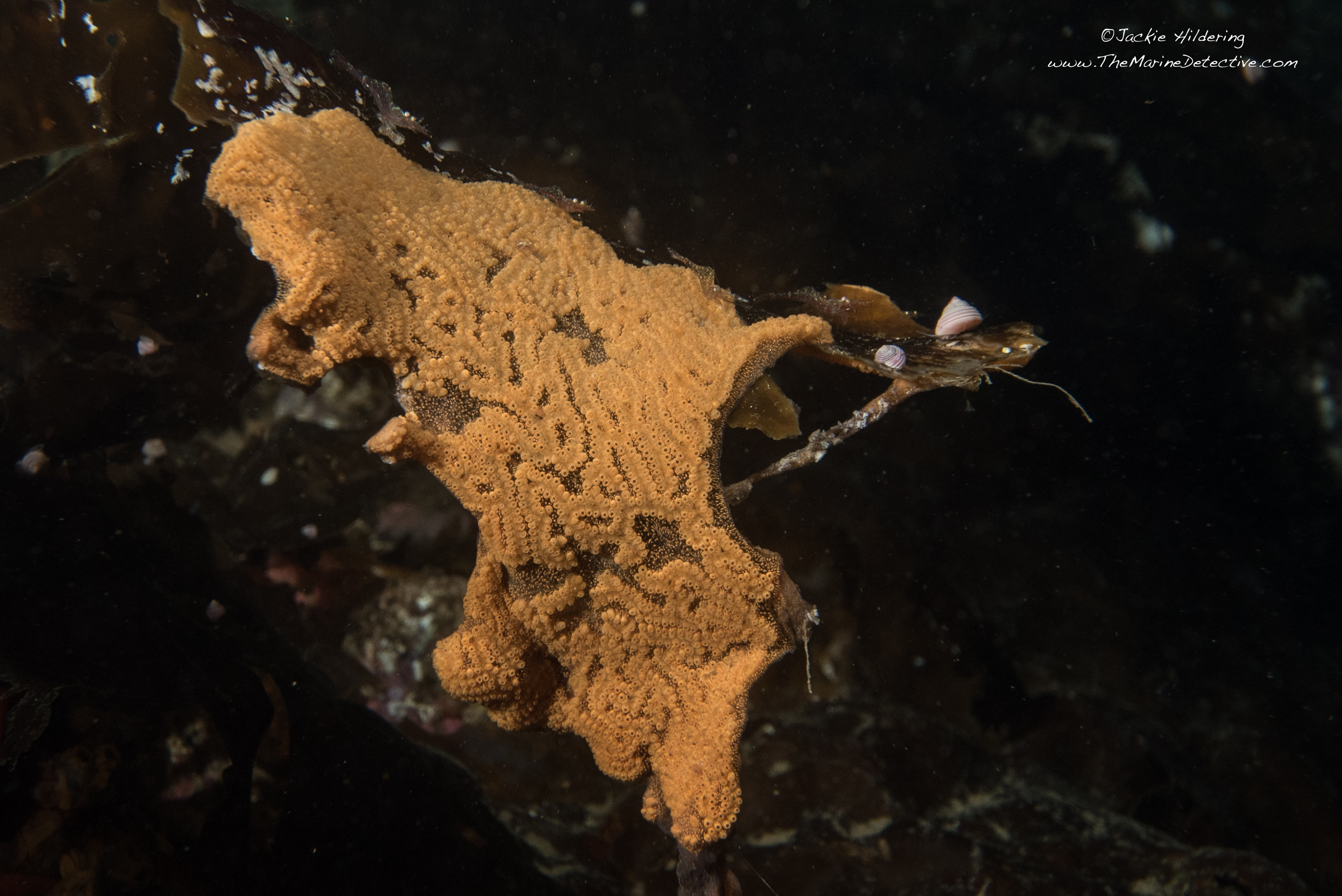
Five colonies of Mushroom Tunicate. I believe this is Distaplia occidentalis.
Mushroom Tunicates are one of the many species of tunicate in the NE Pacific Ocean. The tunicates, as simple-looking as they may seem to you, are our closest invertebrate relative. That’s how complex their anatomy is.
From Dr. Laura Cole quoted from the Smithsonian blog Tunicates — Not So Spineless Invertebrates “About 3,000 tunicate species are found in salt water habitats throughout the world. Although tunicates are invertebrates (animals without backbones) found in the subphylum Tunicata (sometimes called Urochordata), they are part of the Phylum Chordata, which also includes animals with backbones, like us. That makes us distant cousins . . . What unites these diverse groups and makes them our relatives? All animals in the Phylum Chordata have a notochord, a flexible backbone like structure, at some point in their lives.”
So here are some fascinating facts that may influence how we perceive organisms that look very different than we do.
Tunicates have a unique exoskeleton called a tunic.
Photo showing the diversity of colour in Mushroom Tunicates.
Some tunicate species are solitary, living as distinct individuals. Others, like Mushroom Tunicates are COMPOUND tunicates where individuals live together in the colony, within one tunic. The individuals in the colony are called zooids. The zooids have specialized functions that can serve the collective colony. In this species each individual has its own incurrent siphon and pharynx (throat-like structure) to bring in water to filter feed. The individuals in the colony share digestive, reproductive and circulatory organs and excurrent siphons (to carry water out).
Oh, and by the way, tunicates are the only animals known to have a heart that can pump in two directions; they can reverse the direction of circulation.
Photo shows how compound tunicate colonies share a stalk.
Tunicates are hermaphrodites where reproduction occurs both by cross-fertilization and self-fertilization. The fertilized eggs are brooded inside the colony in a brood pouch and the timing of when parents hatch out the relatively large tadpole-like larvae has been found to be influenced by light (morning appears to be preferred).
Some species of tunicate have been found to have bacteria associated with them that provide chemicals that ward off predators and disease-causing microorganisms. You can imagine the human interest in how these chemicals might help our species fight off pathogens.
And in case this all isn’t wild enough, colonial species of tunicate are known to regenerate their entire body from a group of cells named blood cells. This too makes them of great interest to we humans, who are tunicates’ distant relatives, but evolved to NOT be able to regenerate body parts.
The most common tunicates are sometimes called sea squirts because when touched or alarmed by a sudden movement, their muscles contract and the water in the animal shoots out. They are sessile after their larval stage, meaning that they remain attached to a hard substrate, such as dead coral, boat docks, rocks or mollusk shells, all of their adult lives. The name “tunicate” comes from their outer covering, called the tunic, that protects the animal from predators, like sea stars, snails and fish. Unlike the sessile sea squirts, other kinds of tunicates float in the water their entire lives. The salps and pyrosomes are mostly transparent tunicates that look a bit like jellyfish floating freely—some pyrosomes have be known to reach 60 feet (18 m) in length. Much smaller but still visible to the naked eye are the larvaceans—tiny tadpole like creatures that live inside a small house that they build and regularly replace.
[Note there are two related The Marine Detective blogs: (1) “Pyrosomes! Say What?” at this link and (2) “Otherworldly Drifter. Mind Blown” at this link.]
What unites these diverse groups and makes them our relatives? All animals in the Phylum Chordata have a notochord, a flexible backbone like structure, at some point in their lives.
Sea squirts have a notochord only in the larval stage which they use to swim and find an ideal place to attach—one that is bathed in particle-rich waters, since like all tunicates they are filter feeders and rely on water currents for food and nutrients. Once a good location is found, the larva attaches with a suction-like structure and metamorphosis begins. The notochord shrinks and gets absorbed into the body as the animal changes into an adult, and the tunic forms as the transformation occurs. The animal will then spend its days feeding on tiny particles from the water, primarily bacteria.
There are two types of sea squirts: solitary and colonial. The solitary animals live separately all of their lives inside of their tunics. Each has two siphons—the oral siphon that receives the nutrient rich current and the atrial siphon that excretes the waste. Colonial species share a common tunic and sometimes also share the atrial siphon. Colonies of sea squirts are formed as a result of budding—when the larva settles and changes into the adult form, it then splits (or buds) to produce new individuals, called zooids. Colonies can be a few centimeters to several yards wide depending on food availability and predation.
Sea squirts don’t look much like us as adults on the outside, but they have a digestive system similar to ours—with an esophagus, stomach, intestines and a rectum. But there are plenty of other differences. Unique to the benthic tunicates is a heart that reverses its beat periodically. It’s still a mystery to researchers why the tunicate heart will circulate blood through the heart in one direction and then switch to the opposite direction, or if the ability gives them some sort of advantage.
On land, we don’t encounter sea squirts that often, although they are increasingly eaten by some Mediterranean, Asian and South American countries. Not only is the soft body inside of the tunic eaten, but the tunic itself can be pickled and enjoyed later. Compounds from several tunicate species could be useful in medical treatments for diseases ranging from cancer to asthma. Tunicates act as ocean purifiers, since they consume bacteria, and they can send a message that heavy metals are present in ecosystems where they are found, since they absorb metals like zinc and vanadium. Because they like to attach to hard surfaces, sea squirts are often found on the underside of boats, or inside motors, where they can wreak havoc on equipment, and some have become invasive species after being transported from their native ranges. Their relatives the pyrosomes, also called sea pickles, sometimes wash up in large numbers on the shore and are known for their bioluminescence.
Like with many a large family, most of us don’t know about these distant relatives found in the ocean, but that doesn’t mean they aren’t worth keeping an eye on.”
Photos of other species of tunicate living in the NE Pacific Ocean. Note that there are many more species than what I show here.
Solitary tunicate species: Pacific Sea Peach, Halocynthia aurantium, to 15 cm tall. Species like this have led to tunicates sometimes being referenced as “Sea Squirts” due to to larger, solitary species of tunicate having the “tendency to squirt seawater periodically from the main branchial siphon to back-flush sediments, other indigestible matter, and small animals from the filtering basket (about 10 times per hour in some species). Source: Snail’s Odyssey. Another Pacific Sea Peach. Solitary tunicate species: Glassy Tunicate, Ascidia paratropa to 15 cm tall. Solitary tunicate species: Sea Vase. In this photo, multiple individuals are “reaching” out of a crack in a wooden piling. Ciona savignyi to 15 cm tall.
Solitary tunicate species: These Transparent Tunicate have a problem. This species gets invaded by a wicked parasite (as opposed to all those gentle and meek parasites out there) . . . the Spotted Flatworm! This species of flatworm curls up, sneaks in through the tunicate’s branchial siphon, unrolls, eats the tunicate’s internal organs over 3 to 7 days and then moves on, leaving behind the empty tunic. They are species specific parasites, apparently specializing in invading Transparent Tunicates. The dark coil you see here is the waste inside their rectums. Transparent Tunicate = Corella willmeriana to 7.5 cm tall. Spotted Flatworm = Eurylepta leoparda to 2.5 m.
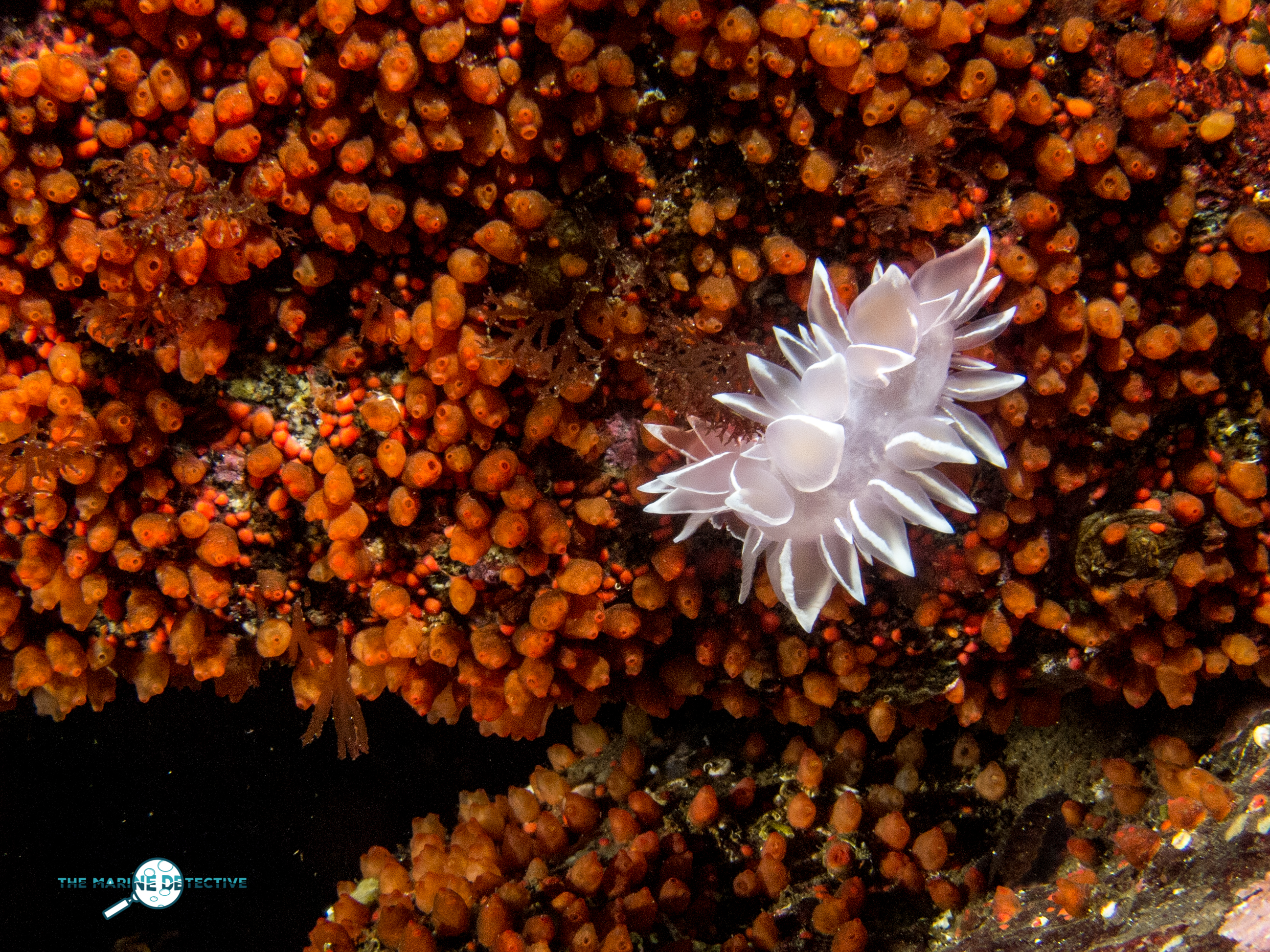
Alabaster Nudibranch atop Orange Social Tunicates (Metandrocarpa taylori. Light-Bulb Tunicate. Clavelina huntsmani to 5 cm tall.Stalked compound tunicate – possibly Distaplia smithiCompound tunicate species: Red Ascidian. Aplidium solidum to 20 cm across.Compound tunicate species: Lobed Compound Tunicate. Cystodytes lobatus, irregular size and shape, can be more than 50 cm wide.Compound tunicate species: Lobed Compound Tunicate. Cystodytes lobatus with a feeding Orange Sea Cucumber.Compound tunicate species: Lobed Tunicates and Mushroom Tunicates (and a whole lot more) 🙂
Compound tunicate species: May be Pale Mushroom Compound Tunicate. Aplidiopsis pannosum to 5 cm wide. Perspective into the siphons of a Broadbase Tunicate (Cnemidocarpa finmarkiensis to 5 cm across). Hairy Tunicate (Boltenia villosa to 10 cm tall) near Broadbase Tunicate.
This is an example of an invasive tunicate species now found off the coast of British Columbia (and many other places). . It’s the Lined Compound Ascidian, Botrylloides violaceus. All the other species shown here are not invasive
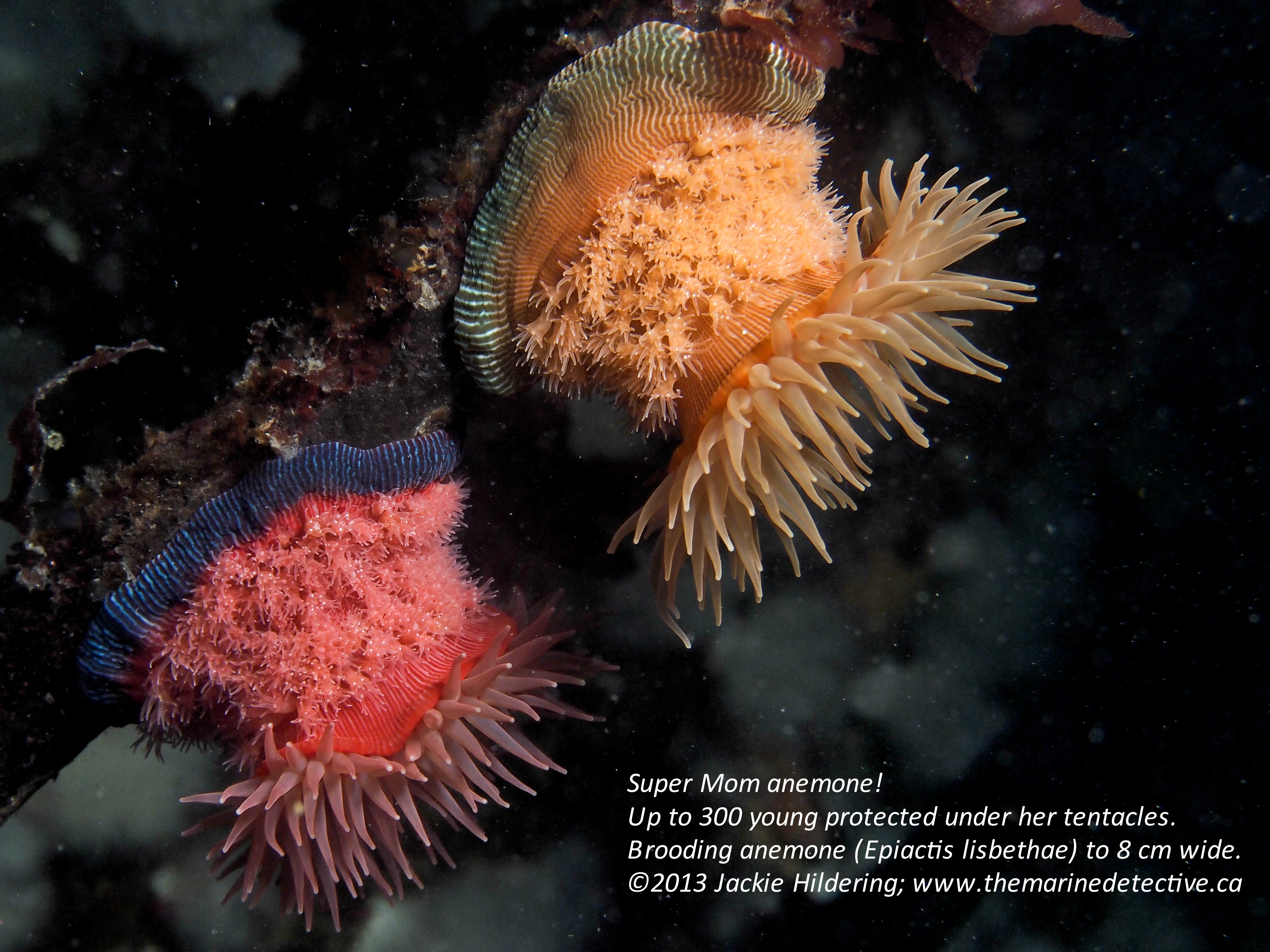
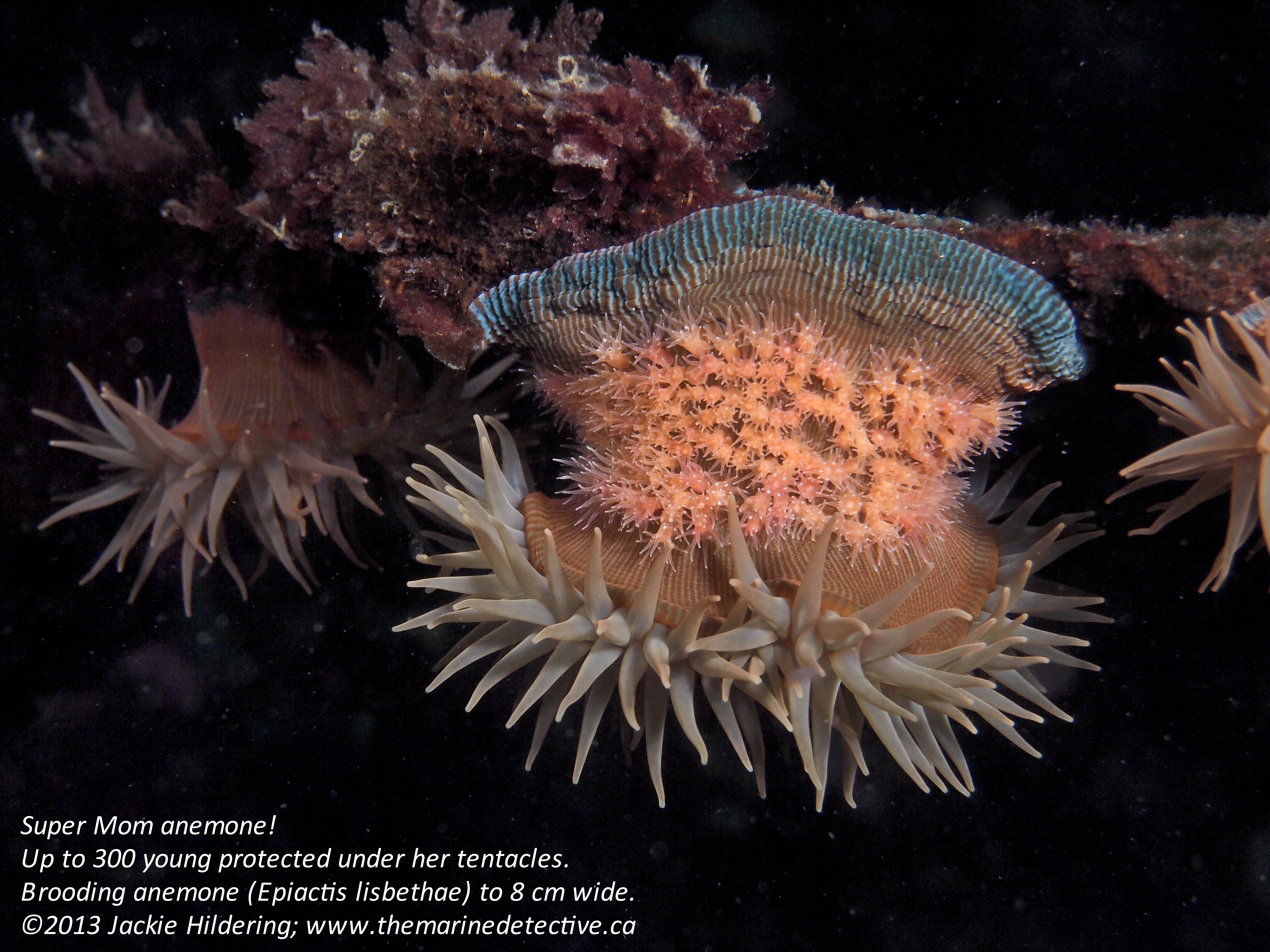
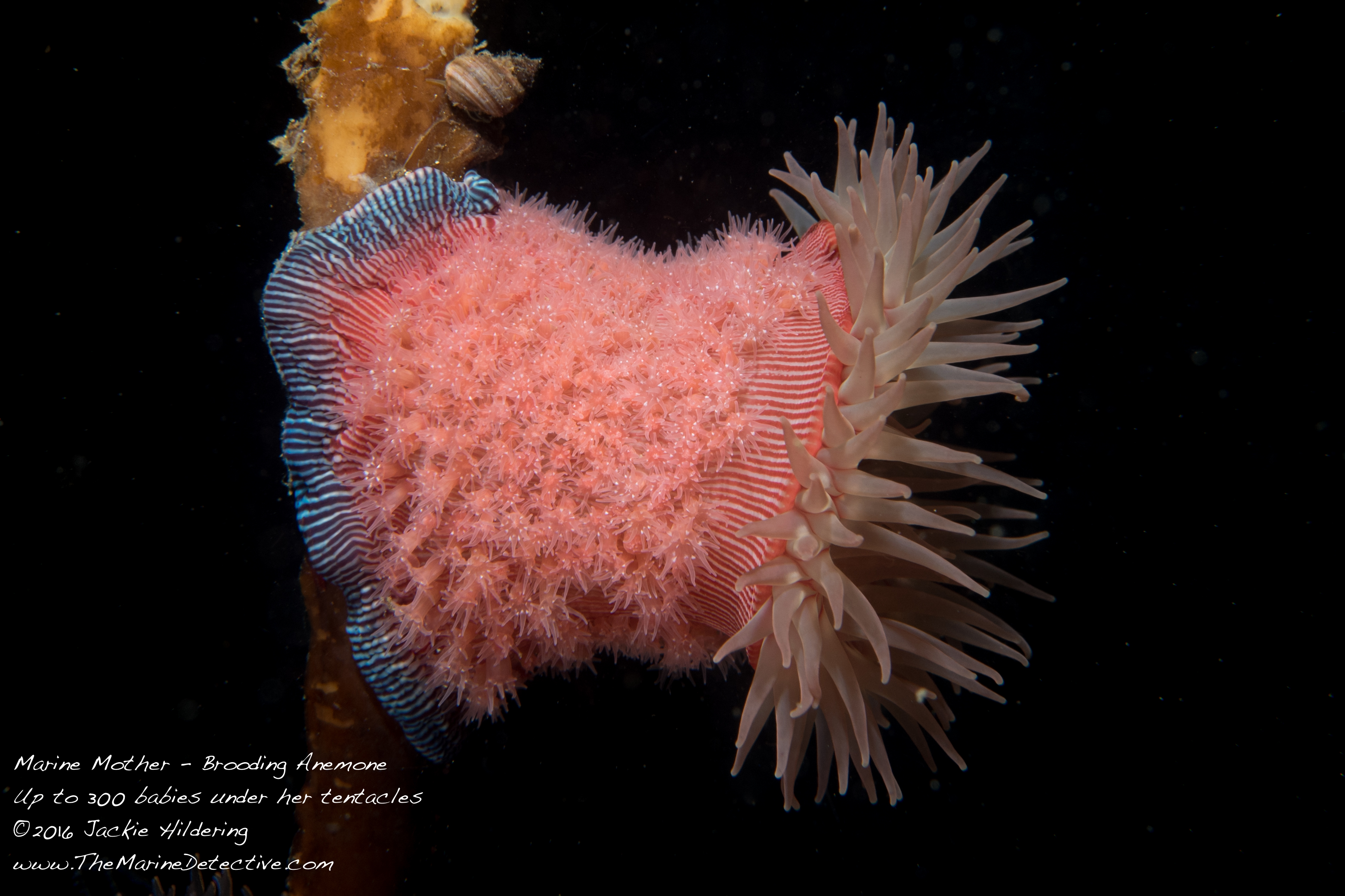
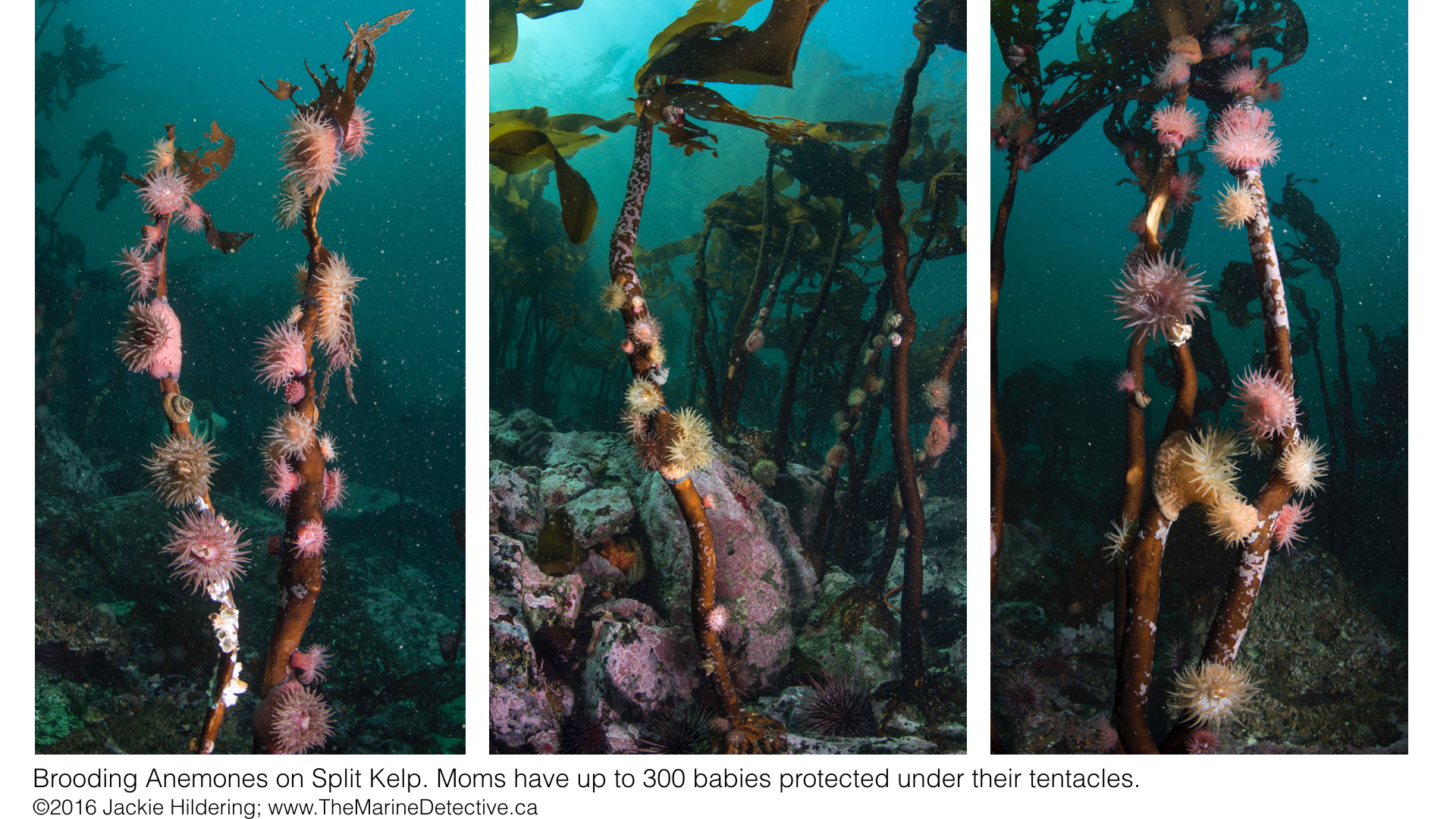
This is a Brooding Anemone (Epiactis lisbethae to 8 cm across).
She may not have a backbone but she’s a Super Mom!
As many as 300 young can be clustered around her in up to 5 rows, benefitting from the protective canopy of her tentacles which contain stinging cells (nematocysts). The offspring remain here until big enough to stand a good chance of surviving on their own. They then crawl toward independence, claiming their own piece of the ocean bottom.
Note: This blog was initially published in 2013. Reposting for Mothers Day 2020.
I am awestruck by this species’ beauty and reproductive strategy. It is also a reminder of how little we know about marine species that the Brooding Anemone was not recognized as a distinct species until fairly recently (1986), and it still so often gets confused with the Proliferating Anemone (Epiactis prolifera).
I share my marine “detectiving” about this species with you to provide a further example of how extraordinary our marine neighbours are and maybe, thereby, help inspire greater conservation efforts.
But yes, the timing of the blog is no accident. It may be that reflection upon an anemone Super Mom stimulates thought about our human mothers – just in time for Mother’s Day.
So here goes . . . bear with me as I build to clarifying the reproduction of our featured species.
Anemones have many reproductive strategies.
For many species, reproduction can be asexual as well as sexual with strategies like budding off offspring; splitting into two; or pedal laceration where a torn piece of the bottom of the anemone can grow into another anemone!
Some species are hermaphrodites with highly diverse ways by which offspring develop into adults.
In species that have separate sexes, many are broadcast spawners where Mom and Dad release their eggs and sperm into the ocean around them. Fertilization and development thereby happens in the water column.
Then, for only some 20 species of the world’s more than 800 kinds of anemone, there are those in which the female captures the males’ sex cells as they drift by and draws them into her digestive cavity to fertilize her eggs. She “broods’ her young.
Some such anemone species are internal brooders. The young develop inside Mom until they hatch and are expelled into the water column as planktonic larvae.
But then there’s Super Mom – the Brooding Anemone (Epiactis lisbethae). She’s an external brooder.
After she has fertilized the eggs inside her digestive cavity with the sperm she has captured, the young develop inside her until they hatch into planktonic larvae. THEN, they swim out of her mouth, settle on her body under the tentacles and grow into little anemones that feed themselves.
When the offspring are big enough to stand a good chance of survival without the protection of Mom’s tentacles, they shuffle away to independence, leaving space for next season’s young.
The brooding anemone’s young are all of the same generation and are therefore all about the same size.
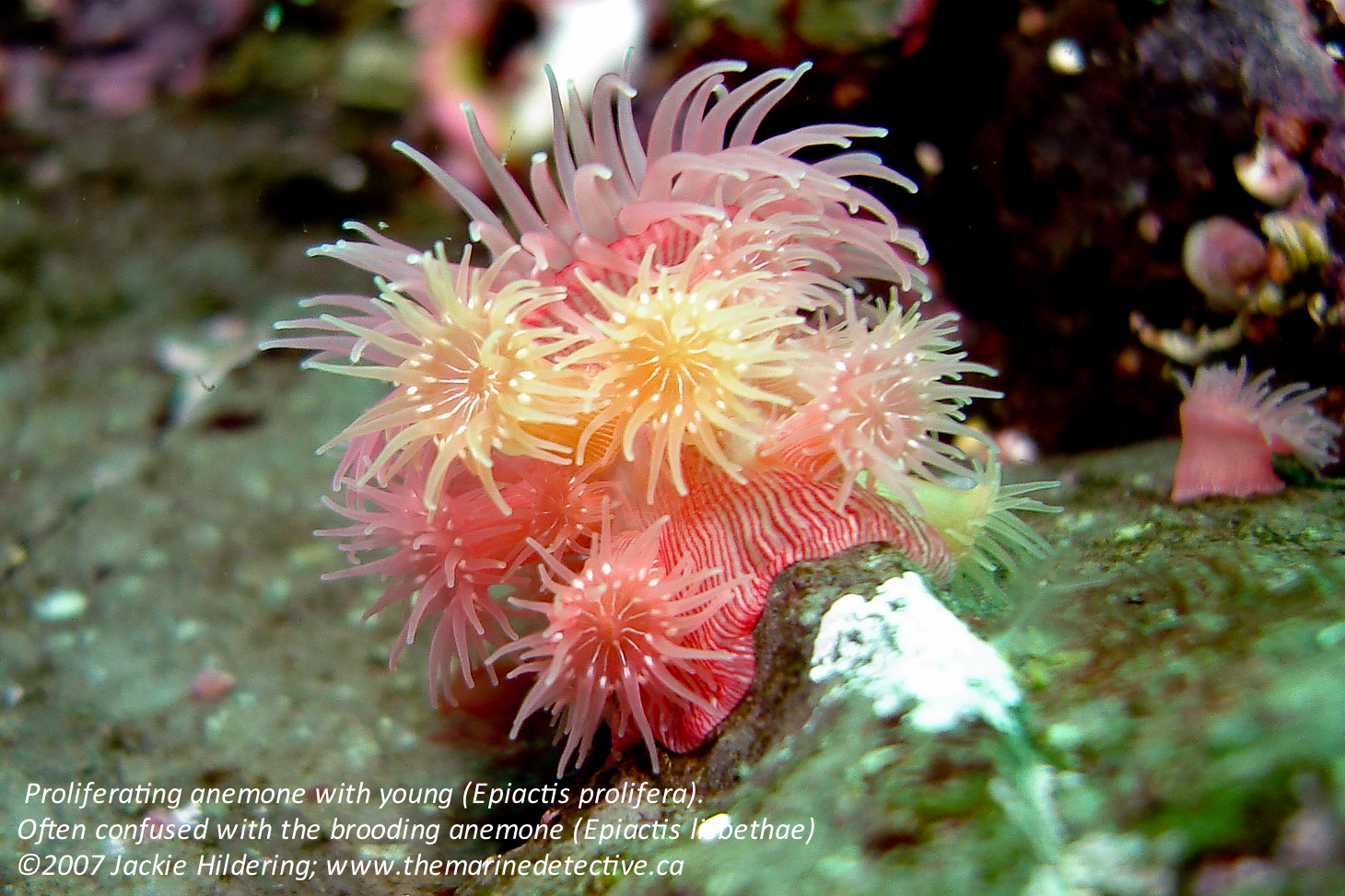
However, there is a second externally brooding anemone species in the eastern North Pacific where you most often see young of different sizes huddled under Mom’s tentacles. This species – the Proliferating Anemone (Epiactis prolifera) is the one that very, very frequently gets confused with the Brooding Anemone.
Proliferating Anemone with young (Epiactis prolifera). Often confused with the Brooding Anemone (Epiactis lisbethae).
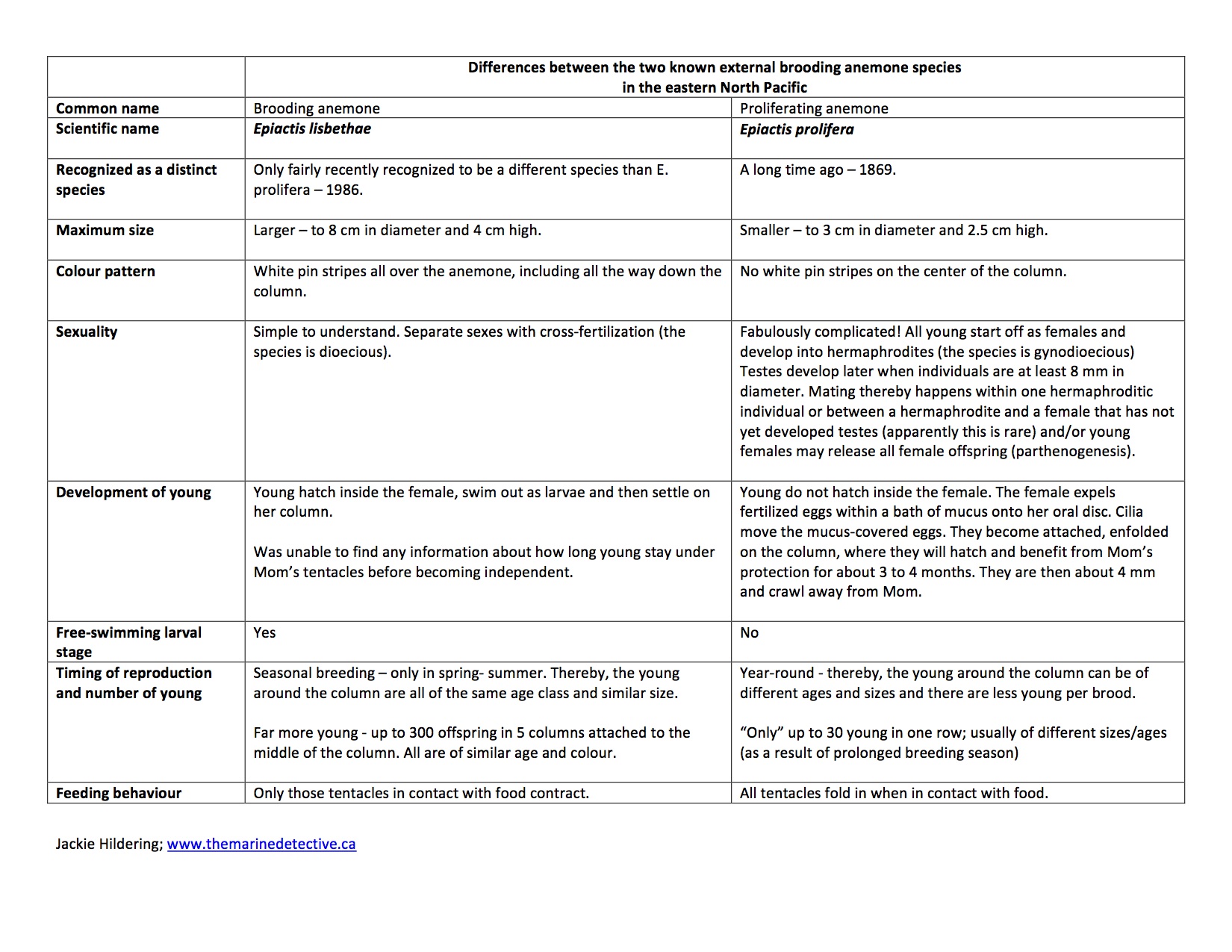
I have strived to clarify the many differences between these two externally brooding anemone species in the table below but to summarize: the Proliferating Anemone is smaller and does not have striping all the way down the column; adults are hermaphrodites; breeding happens year round; there are far fewer young clustered under mom’s tentacles; and they start off there as fertilized eggs, not as free-swimming larva.
The main similarity between these two species is and yes, I am going to use a tongue twister here since I believe it is inevitable when discussing anemones: with anemone mothers like these, baby anemones are protected from their anemone enemies!
Now off you go, share some ocean love with a Super Mom!
There are so many human females out there worthy of awe.
Where, were we to consider how many young they have shielded and helped to independence, the number might well be 300 or more.
Click to enlarge. Table summarizing the differences between Brooding and Proliferating Anemones.
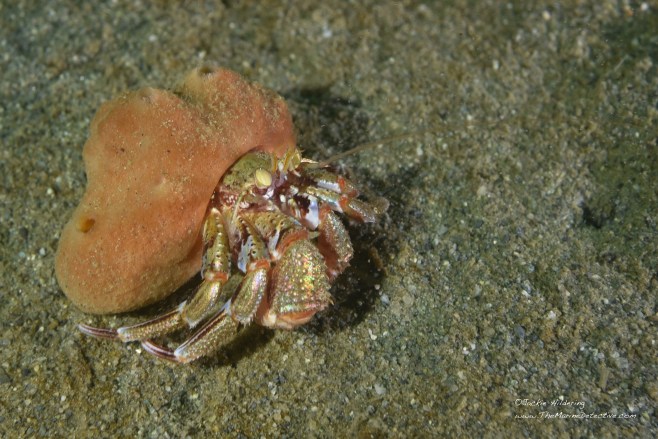
Alaskan Hermit Crab = Pagurus ochotensis to 5.3 cm long. The yellow eyes and “sheen” on the legs help in IDing this species. See how uniquely reflective the legs are? This species often lives in a shell made by a Northern Moon Snail (until a suberites sponge dissolves it away 😉 ).
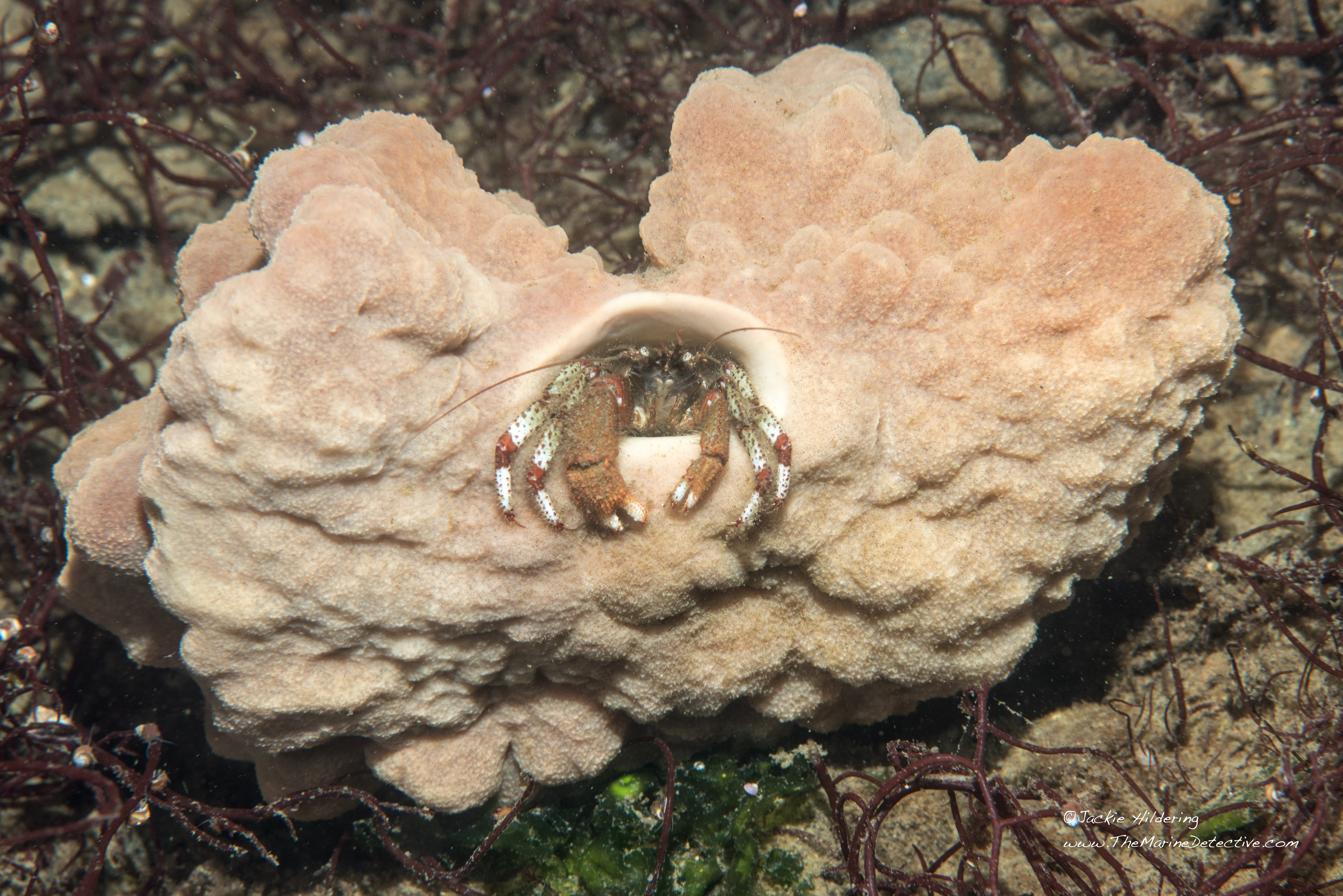
This is an Alaskan Hermit Crab (who resides in front of Port McNeill, not Alaska).
Living on his/her back is a “Hermit Crab Sponge”.
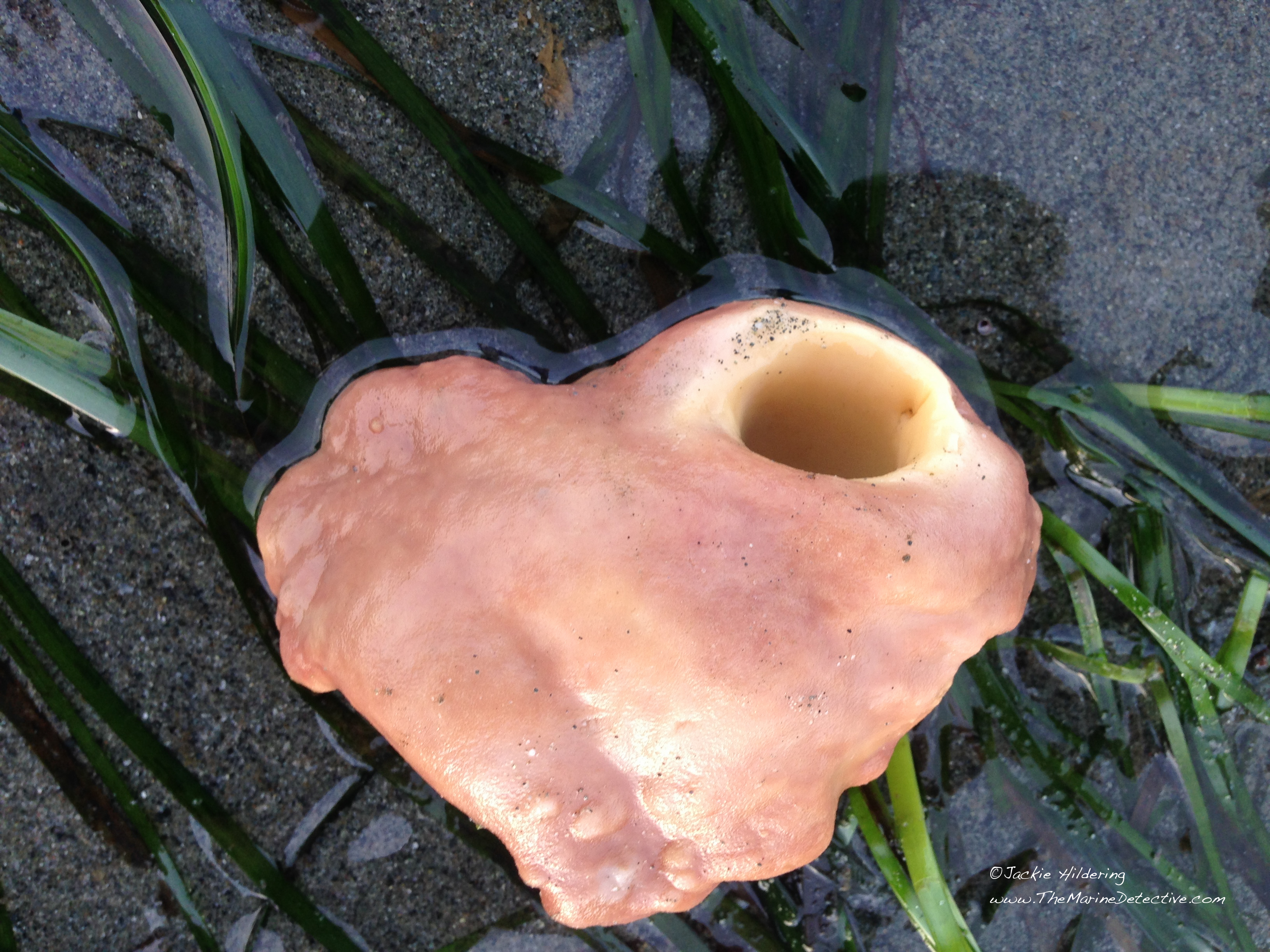
This sponge species (Suberites latus) settles on the shell home of some hermit crab species and can completely dissolve the shell away.
Having a sponge home has its advantages. It is light. Also, the sponge will grow whereby the hermit crab need not find a new home as would be the case if it outgrew a shell home.
But, it can be awkward to tote around when it gets really big. See an example below.
Bering Hermit with a huge suberite home relative to its size. (Pagurus beringanus to 2.6 cm).
Yes, the hermit crab could leave the sponge and get another home if one were available. But, there is risk when outside your home, be it ever so brief.
Another disadvantage is when you have unwelcome house guests.
See below to get a sense of the inconvenience when a sponge predator crawls on your back.
Close-up on the inconvenienced Mud Hermit Crab.
From top to bottom: the big yellow animal is a Monterey Dorid (nudibranch species – gills are on left). This nudibranch is feeding on the Hermit Crab Sponge (tan colour) and then, see the tiny face? That’s a Mud Hermit Crab who isn’t going anywhere for a little while (Pagurus capillatus to 4 cm).!
Here’s another Mud Hermit Crab. See the bite out of the sponge? I initially found this individual upside down. The resulting photo of the underside of the sponge gives you a sense of how the sponge is shaped to the hermit crab’s body.
Note too how all the hermit crabs included in this blog have one claw bigger than the other? This is the case for many hermit crab species and it allows them, when they retreat into their home, to seal off the opening to the shell or sponge with the bigger claw. They close the door to their home.
In the photo below, see how the larger claw seals off the hole for the hermit crab on the right? I suspect this interaction captured in this photo more about mate selection that it is about home envy.
I hope this “who is sponging off who” interaction provides some wonder for you at a time when safety in homes is such a reality for our species too (re COVID-19).
Be safe whatever, and wherever, your chosen home. 💙
The Hermit Crab Sponge is Suberites latus to 20 cm long, 6 cm wide and 4 cm high.
Source for these dimensions is “Beneath Pacific Tides” by Greg Jensen.
Bluespine Hermit with sponge home (Pagurus kennerlyi to 3.5 cm long)
Juvenile Alaska Hermit who will benefit from the sponge growing bigger.
Bering Hermit Crab interaction. This too is more likely about dragging around a potential mate.


































 The Marine Detective