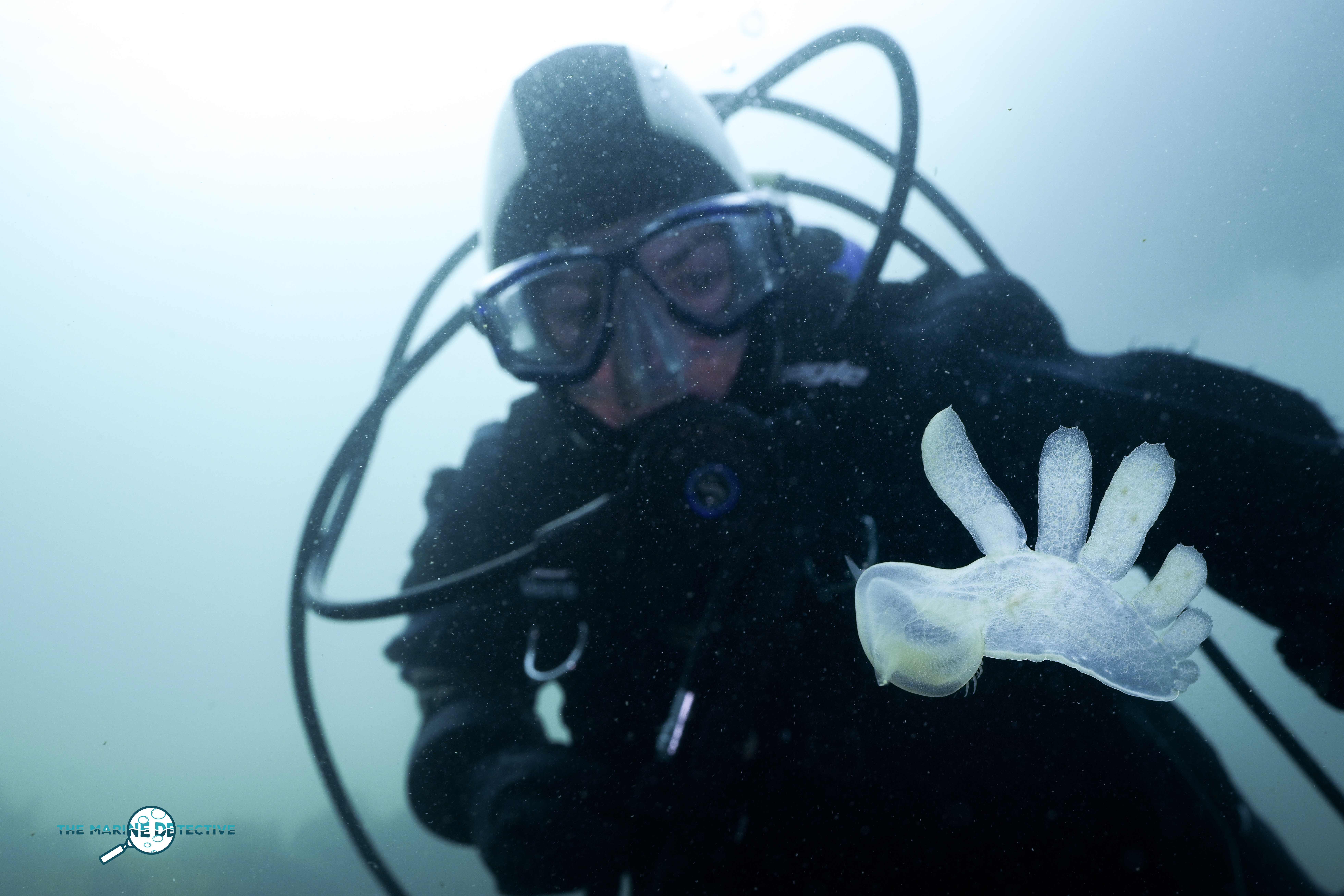
Join me in the cold, dark, life-sustaining NE Pacific Ocean to discover the great beauty, mystery and fragility hidden there.

Seeing Whales – Seeing Red

I saw A12 swim by today. A12, also known as Scimitar, is an old female killer whale of the “Northern Resident” population of fish-eating, inshore killer whales. She is about 69-years-old (known as the result of the photo-identification work of Dr. John Ford, Graeme Ellis and the late Dr. Michael Bigg).

A12 is the grand dame of the first family of killer whales I ever saw; an experience that had an impact on me that I will never fully be able to explain. It led me to make a radical career change, moving back to Canada to work as a marine educator on the very waters where I first saw A12.

Seeing her today was as powerful an experience for me as it was the first time I saw her but  . . . there was sadness too and, there was anger.

Last year her son A33 “Nimpkish” went missing. He was around 38-years-old. Mother fish-eating killer whales never leave their sons so we knew there was very little chance of ever seeing him again. Indeed, no one ever has.

With A33 gone, A12 would still sometimes travel with her daughter A34 and A34’s calves and grand-calves but she was also often on her own. Then, as of July 22nd, she was frequently seen with “the three brothers” (the A36s); three mature male killer whales whose mother went missing in 1997. As the only surviving offspring, these males were always together. A12 is closely related to them and it was remarkable to see how the mother with no son, interacted with the sons with no mother.
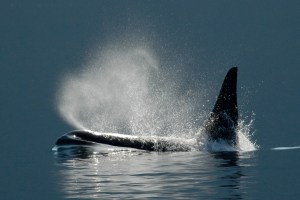
Today, there were only two of the three brothers near A12. The eldest, A32 (aka “Craycroft”) who was around age 46, is now missing.

Another male killer whale gone.

And this is what laced my experience today with anger. But why?  Whales, like everything else, die.

I assure you I am not being overly sentimental. It will never be conclusive what made these whales die but, but, BUT we humans definitely had an influence. Their health, in fact, is an accurate mirror of how our actions impact the environment.

The whales, with their position high in the marine food chain, are full of chemicals like fire retardants and pesticides (the work of Dr. Peter Ross). Despite the many lessons learned with the likes of chemicals like PCBs and DDT, which were banned in 1977, we still do not appropriately test new chemicals and we use chemicals with reckless abandon. The toxic reality is that the ocean is a soup of chemicals – including the old and new (e.g. PBDEs) “persistent organic pollutants” that do not break down; “travel” to the colder areas of the world; build up in the food chain (bioaccumulate and biomagnify), and reduce animals’ ability to fight disease and reproduce.

A32 was above average age for a male killer whale but “average age” has been determined from the data available only after our use of these chemicals. It is not believed to be natural that male killer whales (and the males of many other marine mammal species) die at a much younger age than the females. Their earlier demise has to, at least in part, be due to their toxin loads being much higher than the loads in the females. The females’ toxin levels are lower because females download these fat-soluble toxins in the fatty mother’s milk, to their calves (of course with negative impacts to the calves).

These chemicals had to have an impact on the missing mature males and, the situation literally becomes all the more toxic, when coupled with lack of food. When the whales do not have enough food and use up their fat reserves, the toxins become more concentrated. And 2008 was an appalling year for Chinook salmon, the salmon species essential to the survival of killer whales of the “resident” populations. The work of Dr. John Ford has shown that there is a direct correlation between the survival of these killer whales and the availability of Chinook salmon and, of course, we humans impact the survival of salmon  . . . by habitat loss, over-harvesting, climate change, current open net-cage salmon farming practices, etc.

So today, as I witnessed A32 no longer being with his brothers, I felt the wave of rage come up inside me. Missing whales causes reflection on the state of the environment due to human over-consumption, lack of precaution and disconnect from Nature.

But the wave passed shortly after the whales did. For there is still every reason for hope. As long as people care enough to change, there is hope. The potential for change is endless and there is ample evidence of humanity, increasingly, moving in a direction that considers the link between our daily actions and whales like A12, A33 and A32.

Indeed, there is ample reason for hope as long as there are people like you who read to the end of a lengthy blog entry like this.

Take one further step and click on this link to find out how easy it is to help the whales, and ourselves.

Thank you.

Sea Spiders?!

Yes – there are spider-like animals in the ocean!

Globally, more than 1,300 species have been identified.

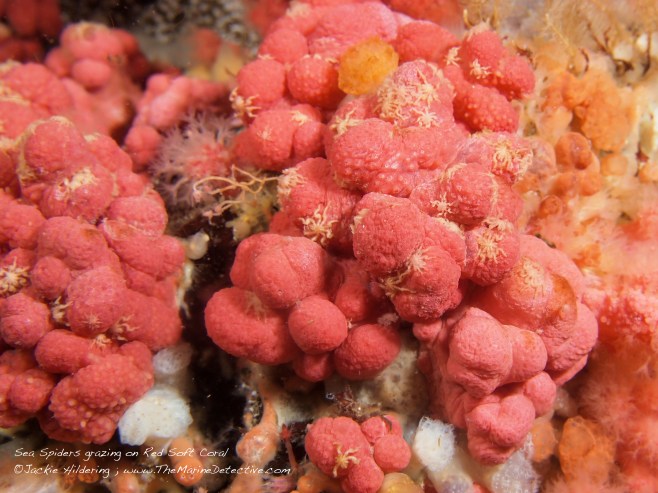
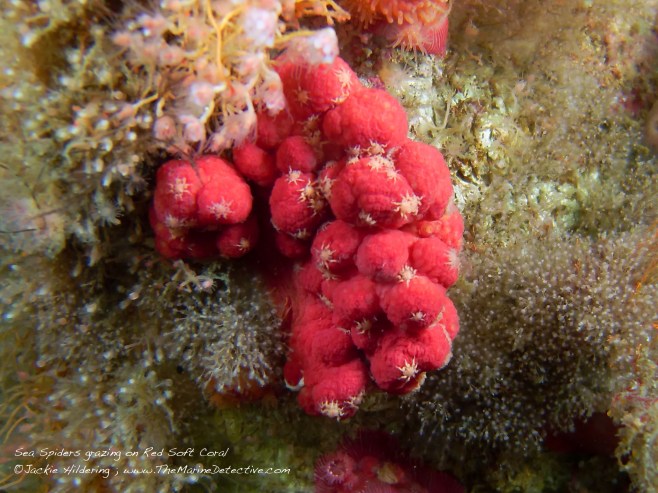
Yellow Hairy Sea Spider likely grazing on the polyps of Red Soft Coral. 

But, even though they are invertebrates with jointed legs (arthropods) and most have 8 legs, they are not spiders (arachnids). They are also not crustaceans. They are classified into the a distinct group of arthropods – the chelicerate subphylum. The particular species you see in these images, belongs in the subgrouping (order) called the “pantapoda”. That’s Latin for “all legs”. It’s a good name since this species has almost no abdomen. 

“All legs” indeed. Yellow Hairy Sea Spiders on retracted / deflated Red Soft Coral. 


T
hey have a mouth part called a proboscis, a flexible tube that they use to mix digestive chemicals with their food and then suck it up.

Yellow Hairy Sea Spider appears to have “decorated” himself with algae. 

Some species have additional leg-like appendages near their mouths. Often only the male has these structures so that they can take care of the eggs by carrying them.

The species pictured here are those I see most often around northeast Vancouver Island and they are only about 1 cm across. They have been given the common name “Yellow Hairy Sea Spider” (Tanystylum grossifemorum)

The hairy parts are believed to help the animals feel and sense chemicals.

I have only ever seen this sea spider species on Red Soft Coral colonies (Gersimia rubiformis). They appear to feed on the bushy polyps of the soft coral. As defence, the polyps can retract and have stinging cells but this seems to do little to deter the sea spiders. 

One of the things I find fascinating about sea spiders is that they have a very thin external skeleton (exoskeleton) and as a result don’t need a respiratory system; they can “breath” through their skins.

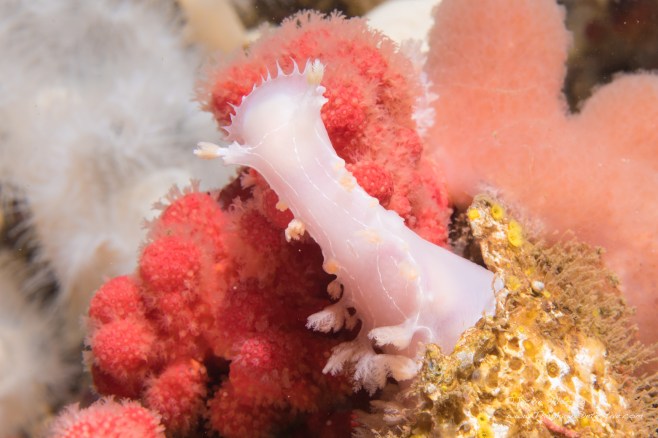
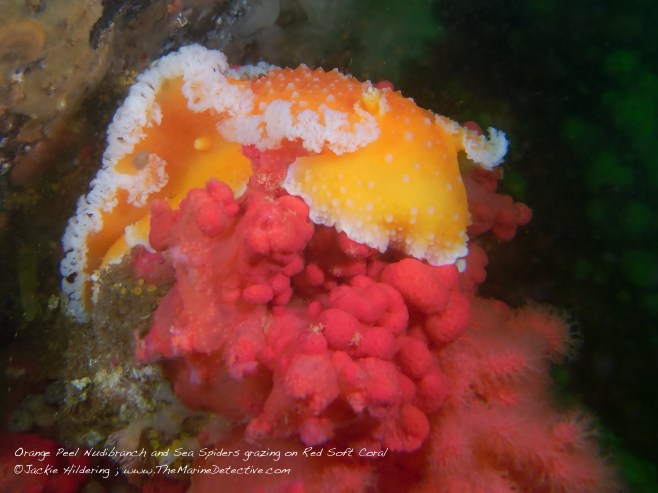
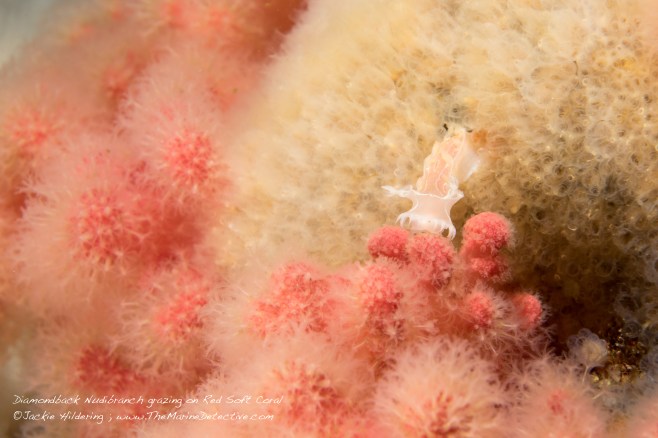
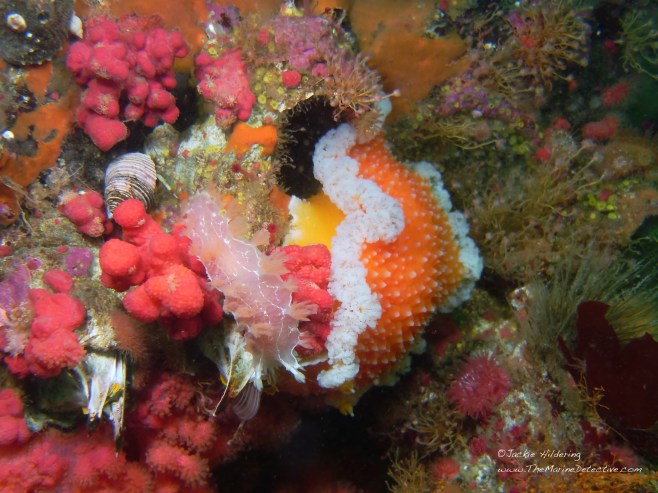
Nudibranch species that also feed on Red Soft Coral include the Diamondback Nudibranch (Tritonia festiva to 10 cm) and the Orange Peel Nudibranch (Tochuina gigantea to 30 cm).  

_JH15378

SEA&SEA 1200HD

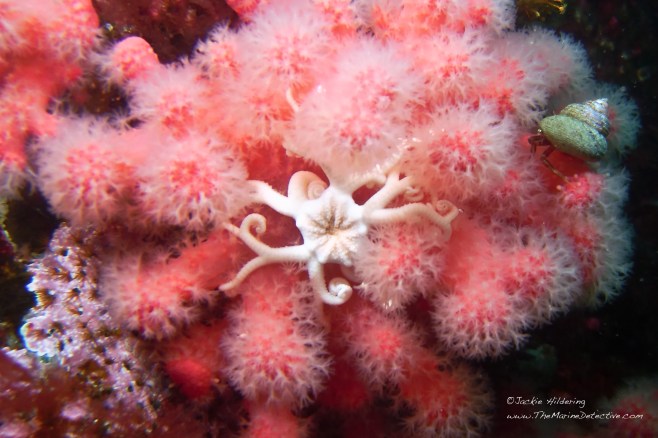
As an aside, there is also a fascinating association between Red Soft Coral and Basket Stars (Gorgonocephalus eucnemis).  See below. Basket Star embryos develop INSIDE the polyps of the soft coral! It’s also thought the embryos feed on the soft coral’s eggs which brood inside the parent. When juvenile Basket Stars emerge from the coral’s polyps, they hang onto the outside till about 3 mm in disk diameter. Then, they crawl onto an adult Basket Star, shuffling off when approx. 5 cm. When adult Basket Stars’ 5 seeming infinitely branched arms are fully outstretched, width is up to 75 cm. Age is up to 35 years.

SEA&SEA 1200HD

Sources:

Below the Kelp

It’s the day before summer begins and  . . . what a day it was.

We had radiant sunshine and a flat-calm ocean during our dive today.

I can think of no better way to share the beauty and wonder of today’s adventure than to take you below the kelp with me.

Please see today’s images at link below. I have included captions that provide a bit of information about the species we were so fortunate to see.

Come below the kelp – by clicking here.

It’s Raining Fish?!

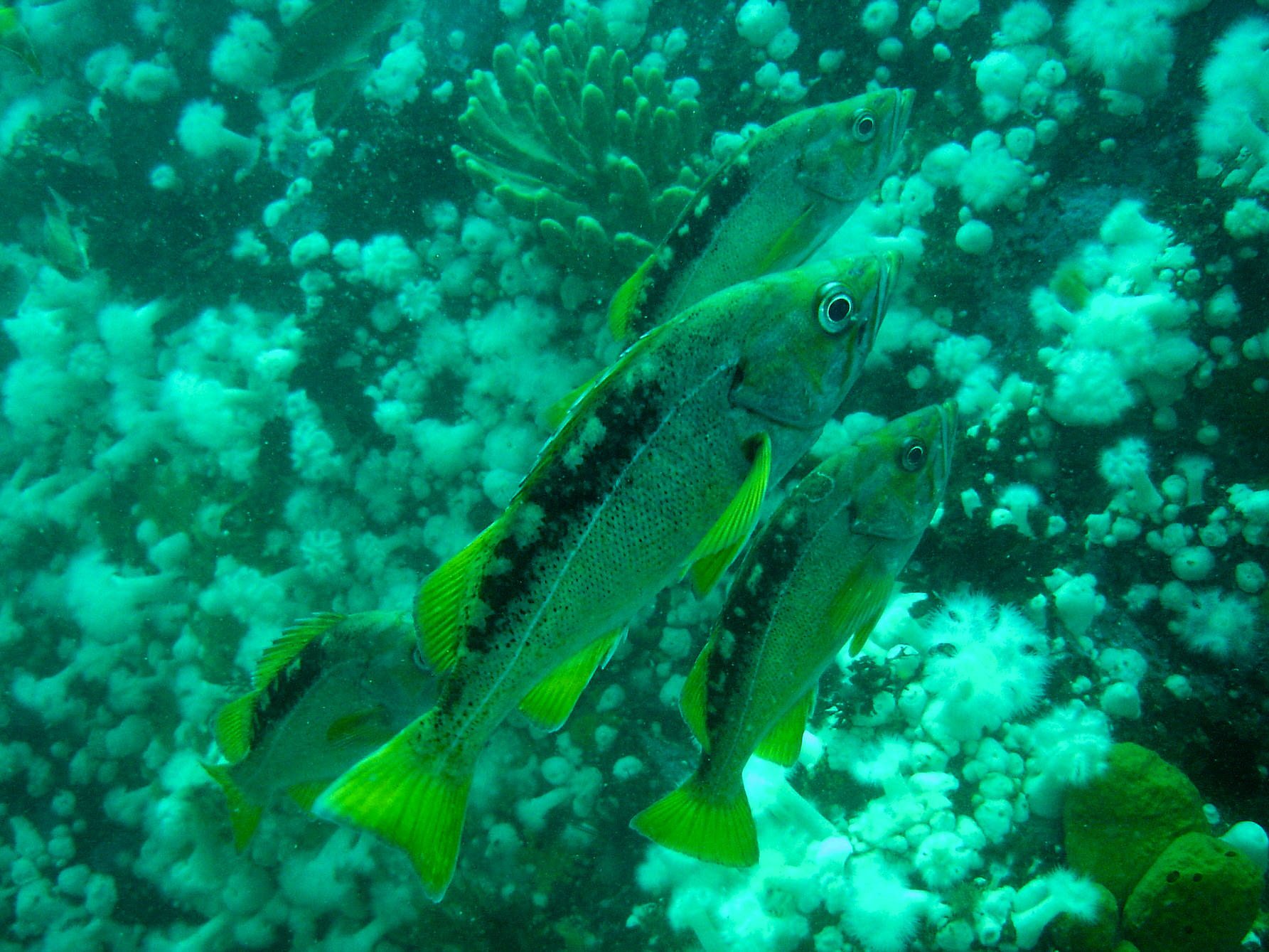
Juvenile yellow-tail rockfish.

Recently, I noticed a lot of splashing in a tideline off Telegraph Cove, BC. I share my observations with you via the little video clip at the link below.

You’ll note that it looks like big rain drops are hitting the water.

I discovered that what was creating the splashing were juvenile yellow-tail rockfish feeding on zooplankton. The zooplankton, including a small species of krill, had been concentrated at the surface by the big tidal exchange. There had been almost a 4 metre exchange between high and low tide (more than 12 feet).

I also discovered a very unique larval fish in the tideline that day but will share that discovery in a future “The Marine Detective”.

Click here for the video of the yellow-tail rockfish feeding in the tideline.

Enjoy!

One Dive – Photographic Essay

Swimming anemone at Stubbs Island, N. Vancouver Island, BC

Today there was quite a small tidal exchange which allowed us to dive a more challenging site, Stubbs Island.

On larger tides, this island receives so much current that eddies and big upwellings form. All this churning water means there is abundant oxygen and plankton delivery so the density of marine-life on Stubbs Island is truly mind-blowing.  There isn’t a centimetre of rock that does not have something growing on it.

I would like to share my images from this dive today. I hope they give a sense of the awe-inspiring beauty and biodiversity of our Northern Vancouver Island marine “backyard”.

I’ll let the photos do talking.

Click here for the photos of  –  just one dive at Stubbs Island.

Who’s Your Daddy?

Scalyhead Sculpins are a tiny fish but the males have a giant parenting role (species Artedius harringtoni).

I found what I believe were this species’ eggs while guiding a recent beach study (Port Hardy, BC).

To share this information, and my photos, I’ve tried something new. Below, you’ll find a slideshow that I have narrated to explain how Scalyhead Sculpins are super dads.

Yes, that’s right, you get to hear my voice this week (oh-so-human stumbled speech and all!). Please realize I am speaking as I would to a +/- 10 year old.

Killer Females – Menopause and Nature’s Plan for Older Females

The most valuable lessons I have learned about being female, I have learned from Killer Whales. For example, it is through my knowledge of these highly cultured whales that I know Nature’s plan for older females.

Let’s face it, human society does not generally help in this regard. As time etches lines into our interiors and exteriors – society does not tell us we are a-okay!  No, the general messaging is about loss, faded youth and endings. Firm up! Dye that hair! Want some Botox baby? We’re sweeping you aside, ‘cause you’re old!

Thank goodness I believe in Mother Nature.

One of my teachers – A12 aka “Scimitar”; born around 1941 and now passed away. She was a Northern resident (fish-eating) Killer Whale who was the grand dame of the A12 matriline.

As I weather the physiological and psychological changes of this time of my life, I know there is purpose in all this. Humans and Killer Whales are among the very few animal species where the females go through menopause; where they can live beyond their child-bearing years as “post-reproductive females”.

In the case of Killer Whale females, they can give birth between the ages of around 12 to 40 but are believed to be able to live to at least age 80. Thereby, female Killer Whales may live almost twice as long as they have babies. On the face of it, this appears to violate one of Mama Nature’s great laws. That is, if you’re going to use our food, you better pass on our genes.

But Nature makes sense. Therefore, the role of post-reproductive females must be so valuable that it “justifies” their using the population’s resources.

Science in fact believes that the old female Killer Whales are the teachers and decision-makers. These grandmas, wizened by their years, are believed to teach mothering skills, how and where to hunt; and they are known to share food, especially with their eldest son. These activities would benefit the population by ensuring that the offspring are better able to survive and mate . . . passing on shared genes. Since first posting this blog a decade ago, there has been further science published on this. Please see sources below. 

The likely role of the old females has been acknowledged in science with the convention being that each family group of Killer Whales is named for the eldest female (e.g. the A12s). Also, the collective name for a group of Killer Whales is “matriline” which loosely translates into “follow your mother”.

Female Killer Whales have taught me that I am not less as I age but rather that there is teaching to be done and leadership to be embraced.

These years are to be lived . . . as a killer female.

Another one of my teachers – A30 aka “Tsitika” with one of her sons, A39 “Pointer”. ©Jackie Hildering.

Studies related to my reflections above:

Challenge – Find the Crab!


Typical shape of members of the kelp crab family. Species in this family are usually from 5 to 9 cm across the carapace.

This week I bring you the “Where’s Waldo?” of the marine invertebrates. There is a decorator crab in each of the images at the link below. But first, here are some clues for you.

Most of the species of crabs that decorate themselves to be masters of camouflage are in the spider crab family (Majidae family – also known as “kelp crabs”).  The image to the right shows you an undecorated kelp crab with the typical long legs and distinctly shaped shell (“carapace”) of this family.

Some crabs only partially camouflage themselves, especially when they are juveniles. Others “plant” so many marine neighbours onto themselves that you can’t tell them apart from their environment until they move.

Although they look like walking gardens, the organisms they attach to the stiff, curved hairs on their legs and backs are algae and animals, not plants. The animals can be soft corals, sponges or unique creatures like “bryozoans” and “hydroids”.

Not only does this covering of life allow the crabs to hide from predators, it also changes the way the crabs feel and taste. For example, sponges taste bad or are even toxic to many predators so, if you cover yourself with sponges, predators be gone! The bonus of carrying other organisms on your back is that you also have a food supply within a pincher’s reach.

It is truly astounding how well the decorator crabs match their immediate surroundings which added another mystery to my list: Is the range of decorator crabs really small so that they always match their background OR do they know to “adjust” their camouflage when they move to an area where they no longer blend in?

I have learned that the latter appears to be the case. Experiments with captive decorator crabs have shown that, if moved to a background that no longer offers camouflage, the crabs will “adjust” their decorations!

Click here to find the decorator crabs in my images or view gallery below. 

Hooded mystery #2 – Hooded nudibranch swimming

See last week’s post for Part 1 about Hooded Nudibranchs (Melibe leonina).

This week, I share video showing this remarkable sea slug when it is swimming. 

When viewing the clip, try to identify the animal’s “rhinophores”, the structures coming off the animal’s head that allow it to smell its way around. These structures have the shape of mouse ears but they pick up on chemical signals, not sound.  In last week’s posting I shared how the Hooded Nudibranchs come together to mate through being attracted by smell (pheromones).

Video from today of a swimming Hooded Nudibranch. 

The lobed structures on the animal’s back are the naked (nudi) gills (branchs). They can detach if the hooded nudibranch is threatened and are sticky. Maybe this is so that the predator is distracted by the gills sticking to it allowing the hooded nudibranch to have a greater chance of getting away.

Hooded Nudibranchs (up to 17.5 cm) on Giant Kelp.

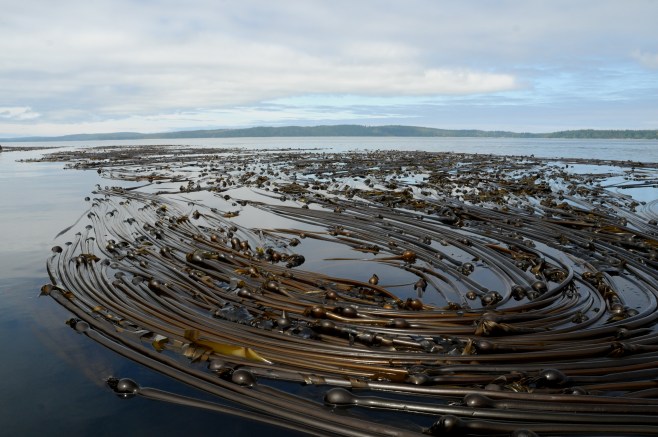
I have included a second clip this week too, taken on today’s dive. No Hooded Nudibranchs in it, but Bull Kelp forest visions while on my “safety stop”; a 3-minute rest at 15 feet to offload nitrogen before surfacing. Thought you might like to take a dip with me!

Click here for kelp forest video from today’s dive.


Hooded Nudibranchs and their eggs

©Jackie Hildering
Hooded Nudibranchs – oral hood open ©Jackie Hildering

[Last updated on January 2, 2022]

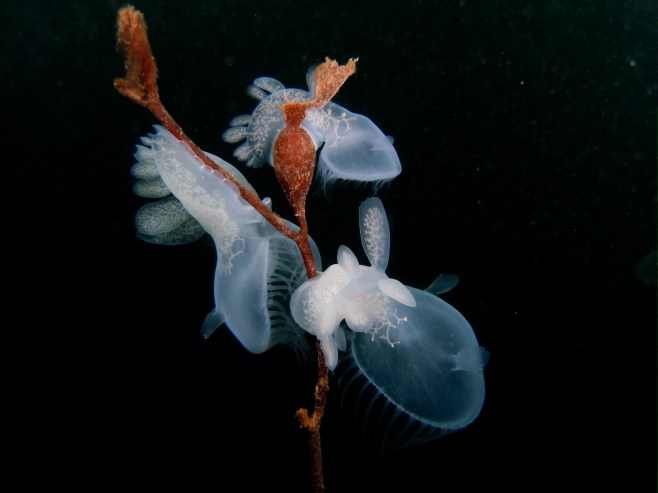
The remarkable-looking animals to the right are Hooded Nudibranchs (Melibe leonina up to 17.5 cm). A nudibranch is subgrouping of sea slugs whose characteristics include having naked (“nudi”) gills (“branchs”).

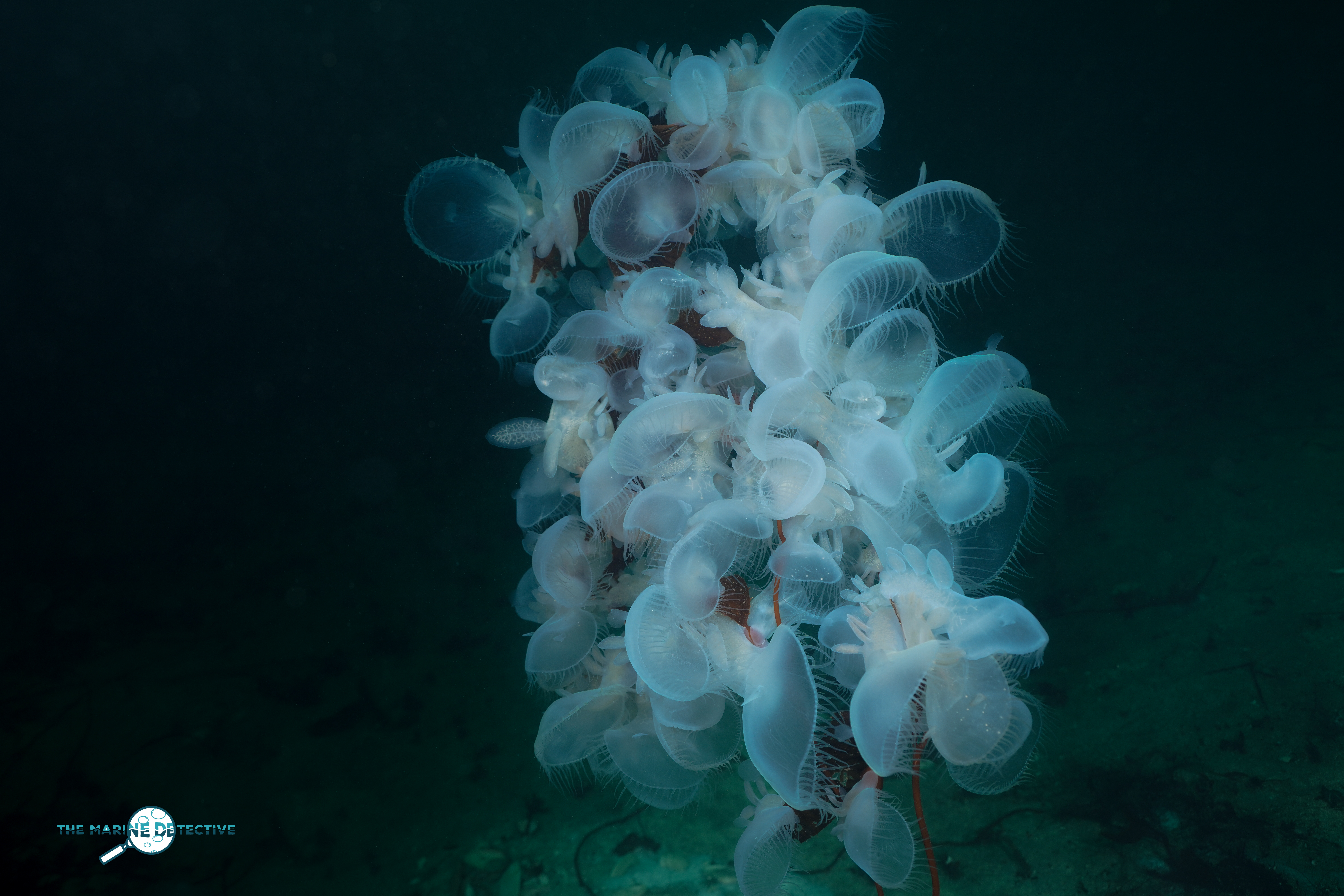
Typically, starting in the fall, around northeast Vancouver Island, Hooded Nudibranchs come together in the hundreds. It is awe-inspiring to see them clustered together just below the surface, delicate and ghost-like, clinging to kelp. Most are translucent white but some individuals are more green or orange.

Often, you can see them swimming on the surface and many people mistake them for jellyfish. But no, they are sea slugs.


The large oral hood (disc-like head) is used to feed on plankton and small crustaceans. The lobed structures on the animals’ backs are the naked gills (cerata). The cerata can pop off if the Hooded Nudibranch is threatened e.g. pinched by a crab. This “ceretal autonomy” and the ability to swim, are believed to be distractors for predator (Bickell-Page, 1989).

The two structures on the Hooded Nudibranch’s oral hood are their rhinophores by which they smell their way around. Hooded Nudibranchs are believed to signal one another by emitting a fruity scent. My personal experience after having picked up a dead Hooded Nudibranch on the beach, is that the smell is something like a mix of watermelon and grapefruit. The scent stayed on my hand for more than an hour.

Hooded nudibranch swimming. ©Jackie Hildering
Hooded nudibranch swimming ©Jackie Hildering.

The secretion is reported to serve as a repellent for predators but does not deter Northern Kelp Crabs.

After mating, as is the way with sea slugs, both individuals lay eggs and then, they die. You can find additional information about sea slugs being reciprocal hermaphrodites in this past blog posting. 

Hooded Nudibranch eggs. ©Jackie Hildering
Hooded Nudibranch egg ribbons. ©Jackie Hildering

In the area around northeast Vancouver Island, I have observed that they lay their egg masses between January and April. Each ribbon of eggs is only about one centimetre wide. Every dot is an egg capsule containing 15 to 25 eggs. After about 10 days, depending on temperature, the eggs will hatch into larvae that will be part of the zooplankton soup of the Ocean.

After 1 to 2 months, they settle to the ocean bottom and change body shape and even digestive tract to become small adult Hooded Nudibranchs

Hooded Nudibranchs do not have the rasping mouth structure of many other sea slugs (the radula). They feed by opening their oral hood to capture prey while standing on kelp or Eelgrass.

Hooded Nudibranch on Eelgrass and yes, those little snails are part of their diet.


From Invertebrates of the Salish Sea: ” . . . diet includes copepods, amphipods, and ostracods, as well as small post-larval mollusks.  The animal stands attached to the substrate and expands the oral hood.  It then sweeps the hood left and right or downward. When the ventral surface of the hood contacts a small animal the hood rapidly closes and the fringing tentacles overlap, holding the prey in.  The whole animal is then forced into the nudibranch’s mouth.”

Hooded Nudibranchs on Giant Kelp. ©Jackie Hildering, 2022

For more information:

Biodiversity of the Central Coast: Hooded Nudibranch

Deep Sea News: “This sea slug is like a cross between a dinosaur, a jellyfish, and a watermelon”

Lawrence, K. A. and Winsor H Watson. “Earth , Oceans , and Space ( EOS ) 10-1-2002 Swimming Behavior of the Nudibranch Melibe leonina.” (2017).

Newcomb, James M., et al. “Homology and Homoplasy of Swimming Behaviors and Neural Circuits in the Nudipleura (Mollusca, Gastropoda, Opisthobranchia).” Proceedings of the National Academy of Sciences of the United States of America, vol. 109, National Academy of Sciences, 2012, pp. 10669–76, http://www.jstor.org/stable/41601654.

100s of Hooded Nudibranchs just below the surface in Telegraph Cove ©Jackie Hildering.

Dive buddy Jacqui Engel with Hooded Nudibranch ©Jackie Hildering.