[Positive update November 12: NatGeo has taken the video down from Instagram and Facebook. But, still has it on their YouTube Channel.]
Whoa! Astoundingly and disconcertingly inaccurate!
This video is from National Geographic. The added text is mine. The first time they used the video was 5 years ago for “Alaska’s Deadliest on National Geographic TV”. NatGeo Wild posted the sensationalized and inaccurate video again on November 3, 2023 to their audiences of millions of people.
They are evidently not “encumbered” by the lack of logic and truth, despite the feedback of many. They knew how incorrect it was 5 years ago, chose to use it again, and are not heeding any of the concerns. I have provided feedback on their social media posts and am providing it here too in the hopes of countering the misinformation and holding NatGeo accountable for accuracy. They have the responsibility not to create, and perpetuate, sensationalized nonsense.
Is this worth the effort especially with so much else going on in the world? For me, it’s clearly yes. Putting this kind of illogical, inaccurate information into the world especially when perceived as an educational giant is NOT okay. It feeds the atrophying of truth, science and facts.
Deep, deep sigh.
The feedback I provided NatGeo Wild about the video:
“This content is astoundingly inaccurate. Reflect on the reality that salmon eggs are laid in freshwater, on the bottom. These jelly species do not feed on the bottom and are almost always in the ocean, not freshwater.
The eggs you say are salmon eggs being eaten by the Moon Jelly are her own fertilized eggs! In Moon Jellies, when the male releases sperm, the pulsing action of the female Moon Jelly brings the sperm in contact with the eggs under her oral arms and are brooded there.
My photo below shows a female Moon Jelly with fertilized eggs under their oral arms. The eggs she are brooding are brighter white. See them?
Female Moon Jelly brooding fertilized eggs.
Moon jellies are Aurelia labiata, maximum size is 40 cm across.
The tide was high, the boat ramp was flat, and we all need the fun.
I shared this video on my social media feeds and it appears there was significant appreciation of the intended humour and levity. I wouldn’t want to deprive you of that. So, here you go.
Backstory: This was taken on the October dive trip I organized to God’s Pocket Resort, north of Port Hardy.
We were soon to depart on our next dive when I noticed how high the tide was and that the boat ramp. well, in my mind it had become a catwalk and a ripe opportunity for humour.
My scuba sisters only needed to hear “catwalk now” and this was the result with Shireen Shipman, Melissa Foo, Kim Cardenas, Isabelle Cote, and upfront – you know who.
If you think you’ve got the stuff, I have three open spots on my April 2024 trip to God’s Pocket and am taking names of those interested in joining my October 2024 trip. See this link for specifics about the trips, including skills needed. Sense of humour and ability to strut are considered assets. ______________________________________
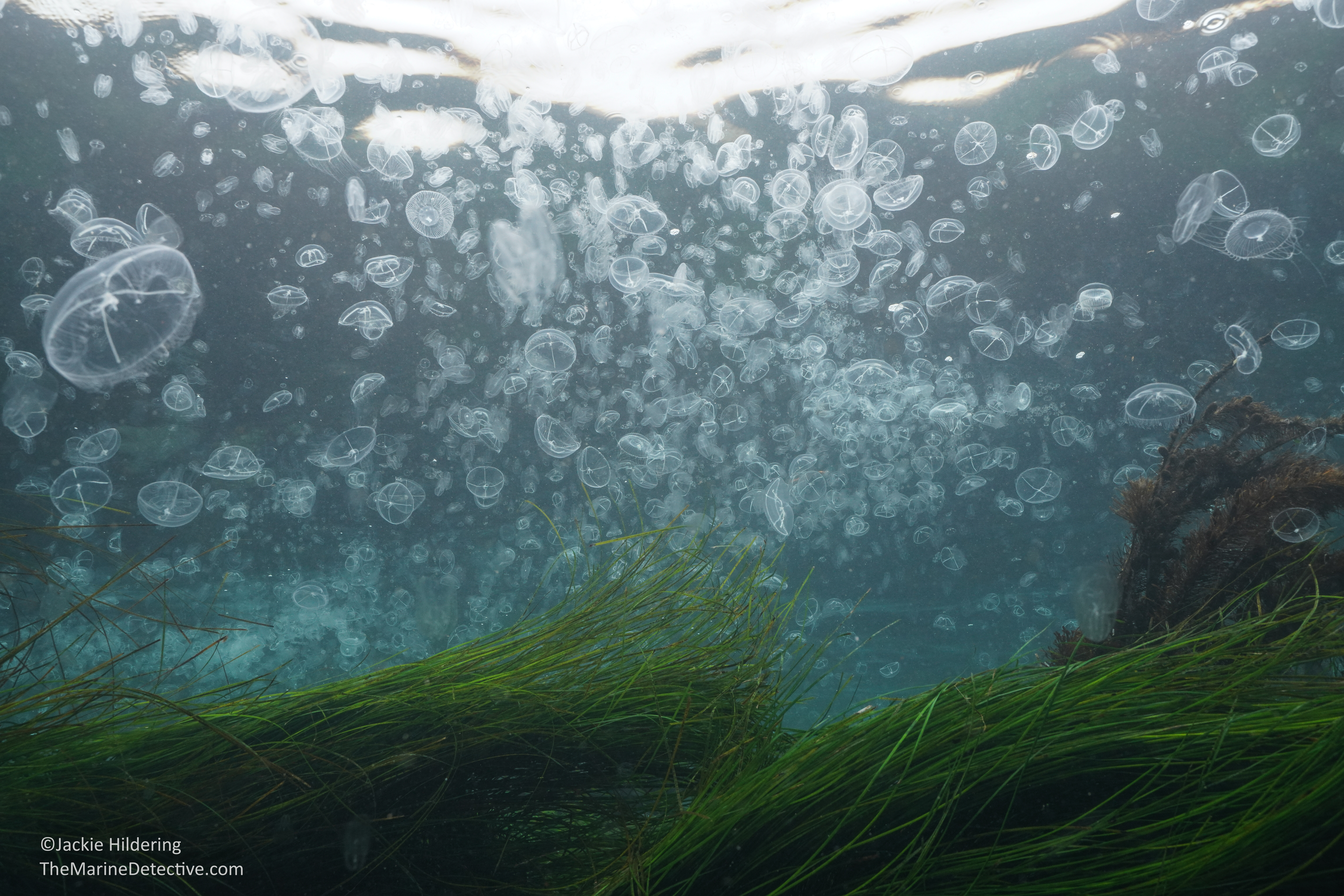
Otherworldly. One-worldly! While on a recent trip to God’s Pocket Resort north of Port Hardy, it happened to be that there was a huge aggregation of jellies. It was truly awe-inspiring to be diving amid this galaxy of jellies.
Black Rockfish, Bull Kelp and a smack of jellies. Aggregating Anemones and jellies.
The collective noun for jellies actually is a “smack”, not a galaxy.
A smack of this magnitude is the result of the jellies’ lifecycle and big tidal exchanges concentrating them. We were certainly gob-smacked by the number and diversity as we watched them cascade past in the current as the plankton they are, pulsing to feed on smaller plankton.
The astounding photo above was taken by dive buddy Melissa Foo. It’s me in the smack, appearing to be in a globe of jellies.
And this photo of me was taken by dive buddy Janice Crook. I am including it anticipating that there will be questions about if we were stung by the jellies. We were not. Only the stinging cells of the large jelly species off our coast lead to human discomfort. Later in this blog, I show photos of those big jelly species.
The majority of the jellies in the smack were Water Jellies and Cross Jellies.
Cross Jellies, as the name suggests, have a cross on their bell. They are Mitrocoma cellularia to 10.5 cm across.
Cross Jellies reflected against the surface, trees above the surface.
Water Jellies are a group of jellies that have little lines all around the outside of the bell that look like the spokes of a wheel. The little white part hanging down from the bell is the mouth (manubrium). Aequorea species are up to 17.5 cm across.
Cross Jelly with manubrium.
There were also Moon Jellies. Moon Jellies are easy to discern because they have a clover shape on their bell which is their 4 gonads / sex organs. Aurelia labiata are up to 40 cm across.
The following photo shows a Moon Jelly female with fertilized eggs. The eggs are the less translucent white structures.
The biggest jelly species I saw were Lion’s Mane Jellies and Egg Yolk Jellies.
The Lion’s Main Jelly is the biggest jelly species in the world. Cyanea ferruginea can be 2.5 m across with 8 clusters of 70 to 150 tentacles which can be up to 36 m long! Know that the larger individuals of this species tend to be further offshore and that they can retract their tentacles.
Lion’s Mane Jelly reflected against the surface. Lion’s Mane Jelly with dive buddies’ bubbles in the background.
The Egg Yolk or Fried Egg Jelly is Phacellophora camtschatica and can be 60 cm across. They have 16 large lobes that alternate with small lobes giving the bell of the jelly as scalloped edge. Each of the 16 lobes has clusters of up to 25 tentacles which can be 6 metres long.
The individuals I saw on these dives happened to be white with light yellow. They part that looks like the yolk of an egg is often darker yellow.
Egg Yolk Jelly – see it’s prey in these two photos? It has caught other jelly species in its tentacles.
Lion’s Mane Jellies and Egg Yolk Jellies. are the only two common jelly species in our waters that can create a sting that irritates human skin, even when the jellies are dead. The stinging cells (nematocysts) work even when the jelly is dead or you get a severed tentacle drifting by your face. The sting from a Lion’s Mane Jelly is reported to be worst than that of an Egg Yolk Jelly.
I’ve been stung by both and clearly it’s not been enough to deter me from striving to get photos of them. But if you have far more skin exposed or are a fisher grabbing nets with many of the tentacles wrapped in them, it is reported to be very uncomfortable.
The solution to the irritation is vinegar (acid), meat tenderizer (enzyme) and I know that many fishers swear by Pacific canned milk as well. Research puts forward that vinegar is the only real solution and that urine does not work at all.
Egg Yolk Jelly and trees.
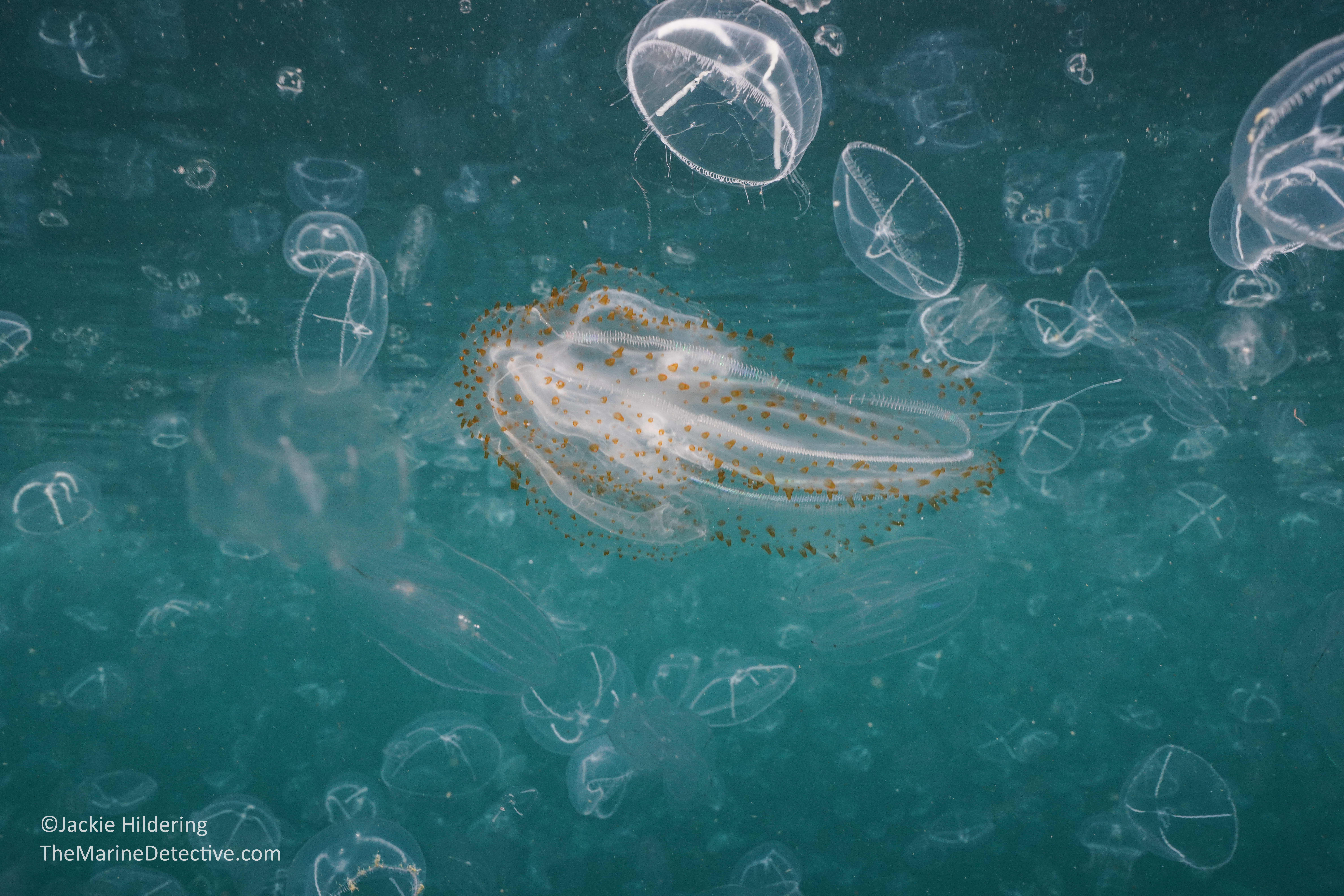
There were also various species of sea gooseberry / comb jellies in the smack. These elongate jellies open up at one end and engulf their prey. Comb jellies move by cilia which are arranged like teeth on a comb. These cilia cause light to scatter whereby you can see rainbow-like flashes over the animals. This is not bioluminescence as the light is not created by the jellies.
Comb Jellies belong to the Ctenophora phylum while the other species referenced on this blog are in the Cnidarian phylum.
Comb Jelly on the bottom right (Beroe species to 10 cm long). Orange-tipped Sea Gooseberry (Leucothea pulchra) – Comb jelly species to 25 cm long.
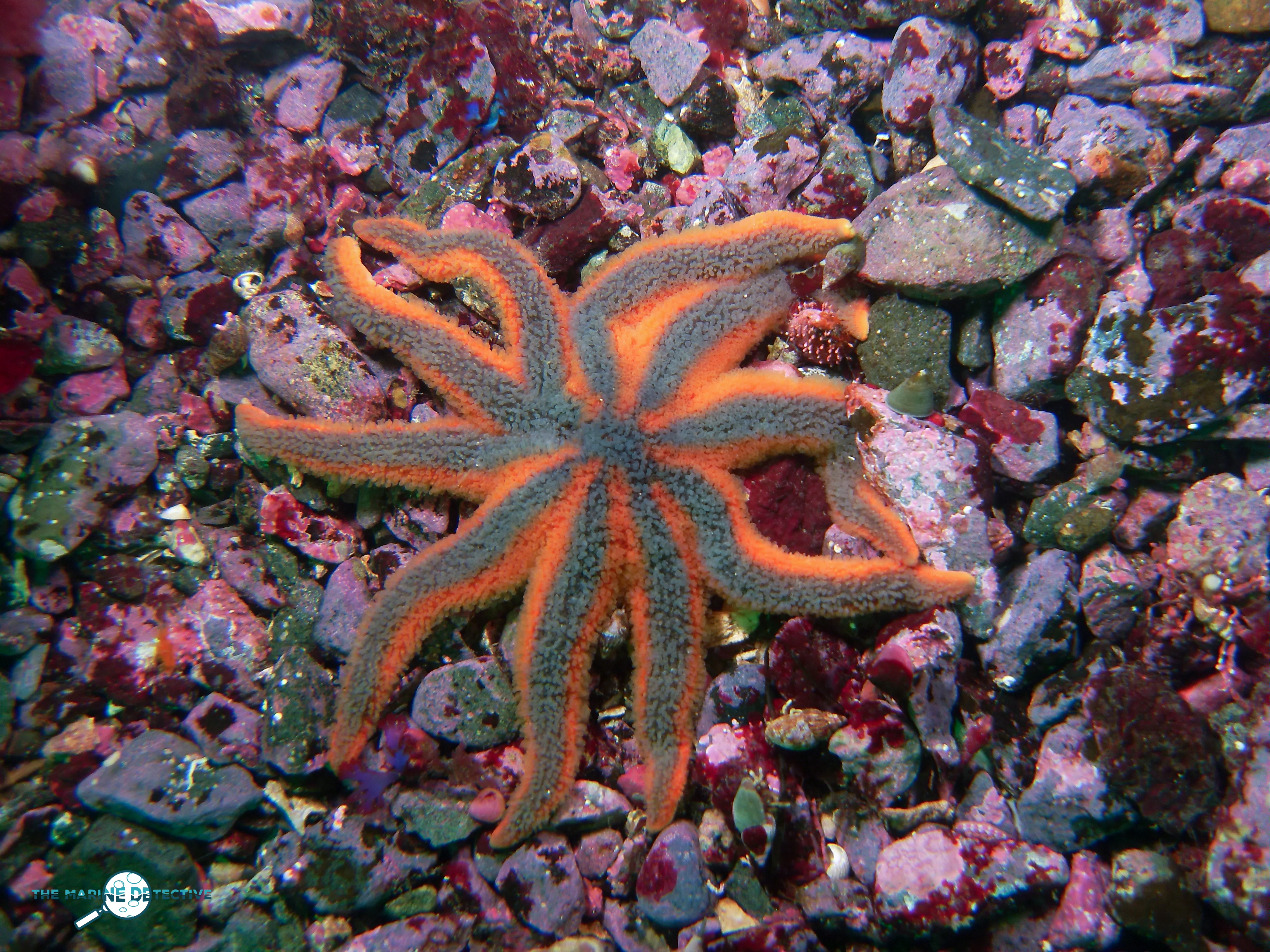
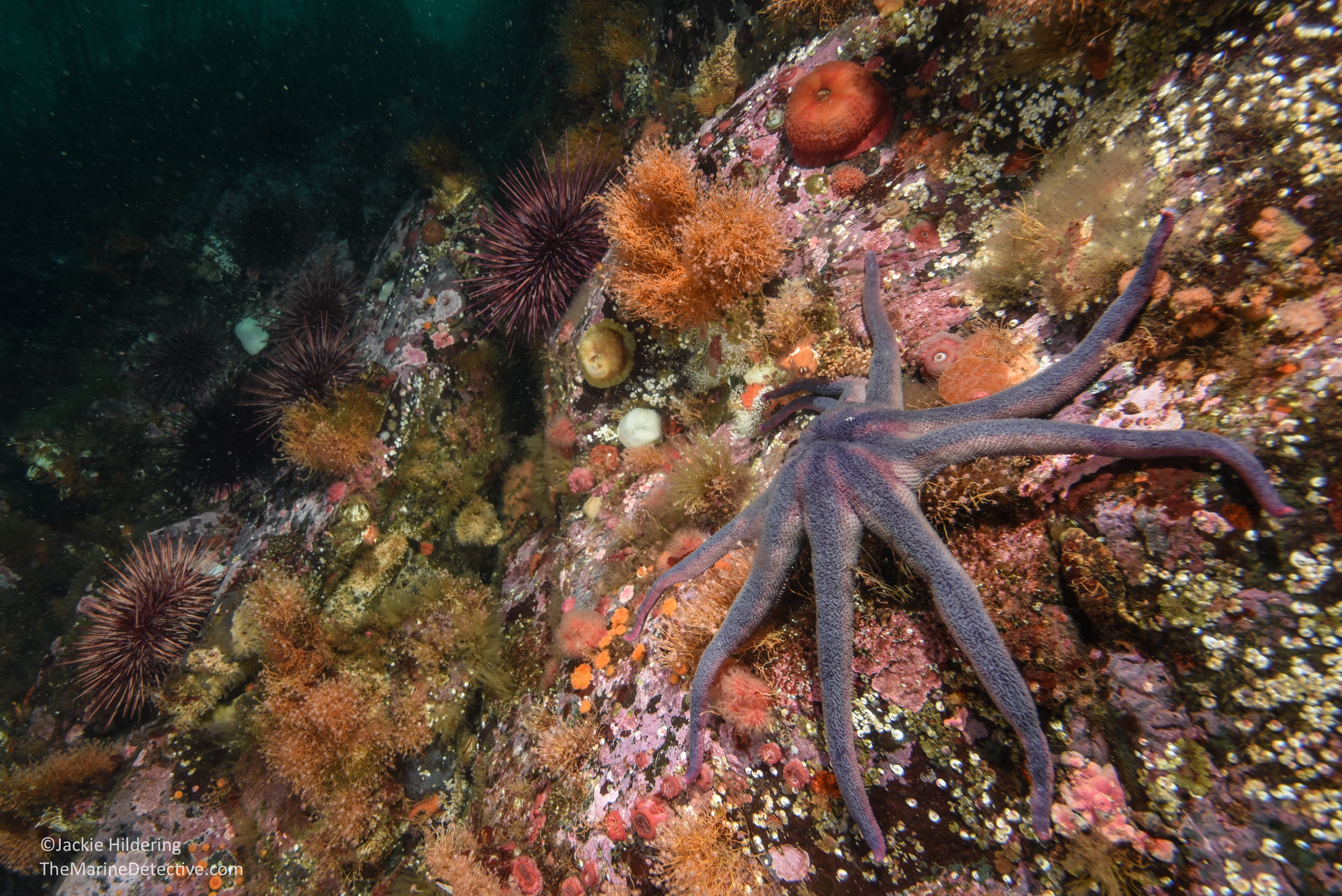
I found distraction from the darkness by making compiling these photos of one of the most diversely colourful sea star species off our coast – the gobsmackingly beautiful Striped Sea Star.
Note how Nature supports diversity. 💙
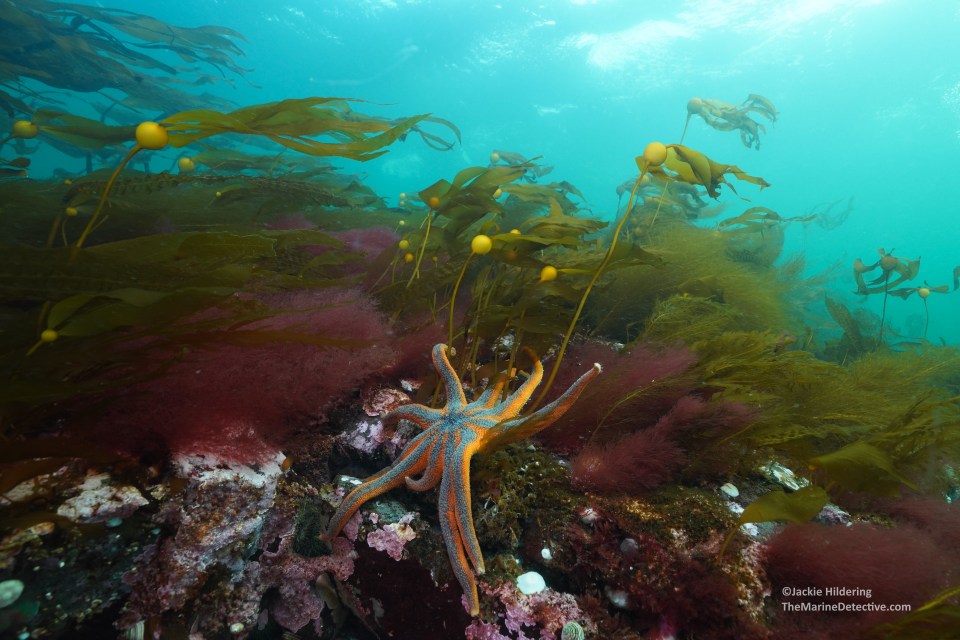
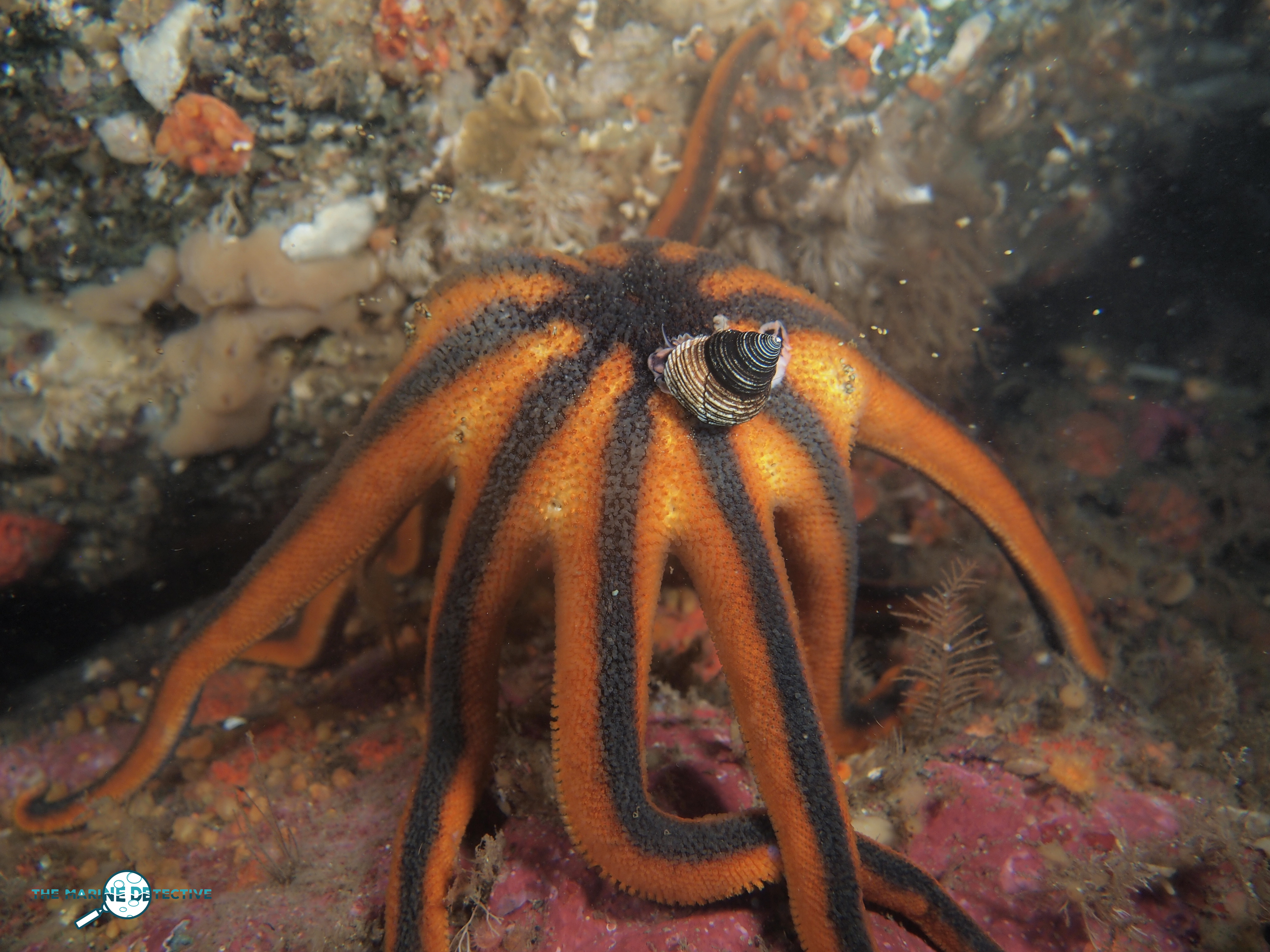
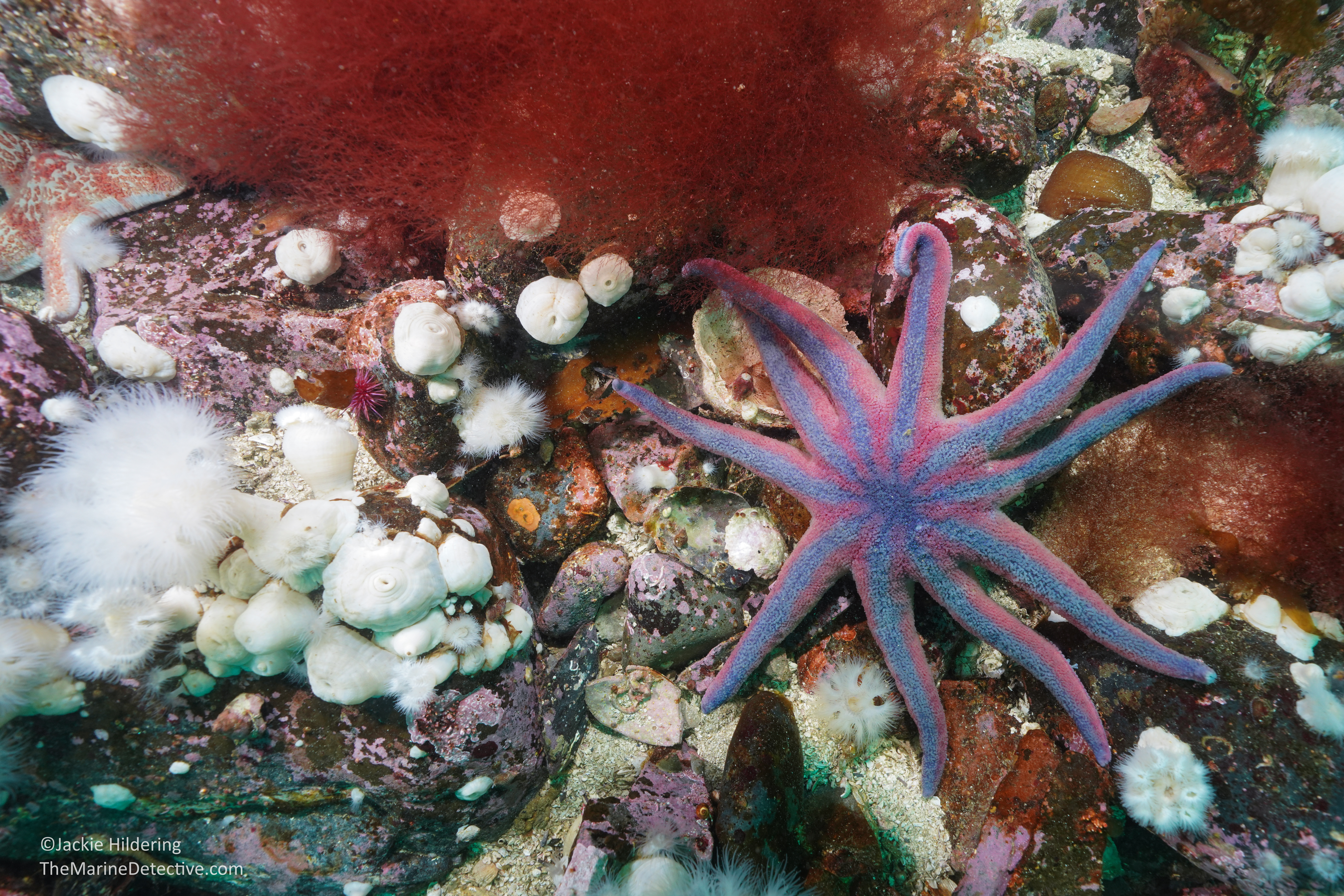
Striped Sun Stars (Solaster stimpsoni) can be up to 58 cm across. They most often have 10 arms with a blue line down the centre of each arm. Some individuals are entirely blue.
Underside of a Striped Sun Star.
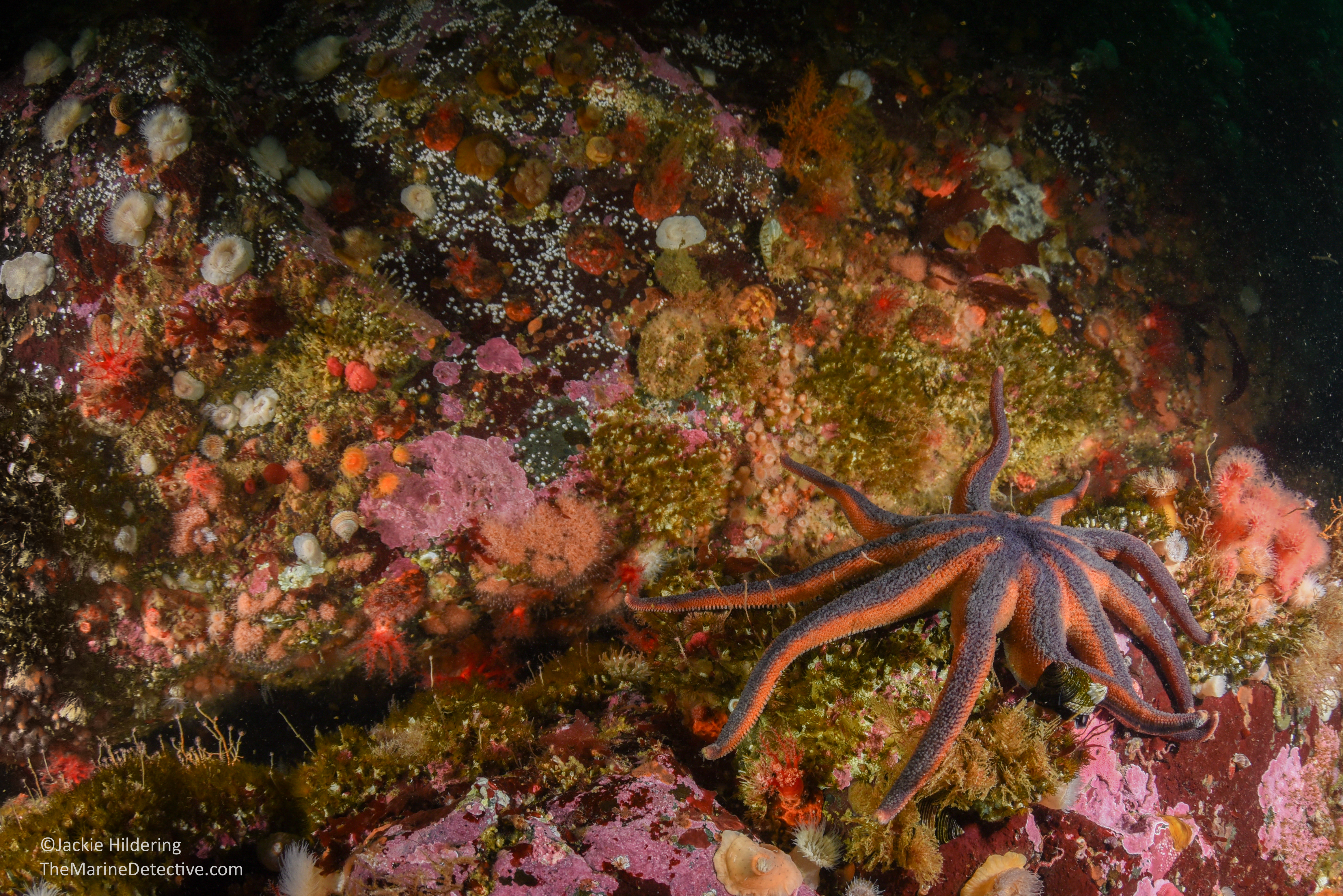
Whenever I post photos of this species, they create a bit of a sensation. That’s likely because they are astoundingly colourful and usually live in really colourful neighbourhoods too.
But also, I think there is reduced awareness about the species because Striped Sun Stars are not often in the intertidal zone.
Oh, and then there’s that misunderstanding / underestimation of the colour and diversity of life in this cold ocean.
But LOOK! Look at the diversity in colour of this sea star species and look at the density and colour of the life around them. This is the life off our coast in high current areas.
A completely blue individual. You can still see the blue stripe down each arm. Blue Turban Snail atop a Striped Sun Star.
The diet of Striped Sun Stars includes various species of sea cucumber.
There are 6 species of sea star off our coast that have more than 10 arms. The other 5 many-armed sea star species do not have the blue stripes down the arms. They are Sunflower Stars, Rose Stars, Morning Sun Stars, Northern Sun Stars, Orange Sun Stars. There’s really good information about the diversity of sea stars off our coast on Neil McDaniel’s page at this link.
An individual succumbing to Sea Star Wasting Disease. This species is believed to be heavily impacted.This individual is regrowing one arm which most likely got nipped off by a crab. Echinoderms are astounding in how they can regenerate body parts. In sea stars, as long as part of the central disc is intact, and the individual can avoid predation while handicapped, all arms will grow back even if they have just one left. Reportedly though, regrowth is slow and can take up to a year leaving the handicapped sea star more vulnerable.Juvenile amidst Green Sea Urchins.
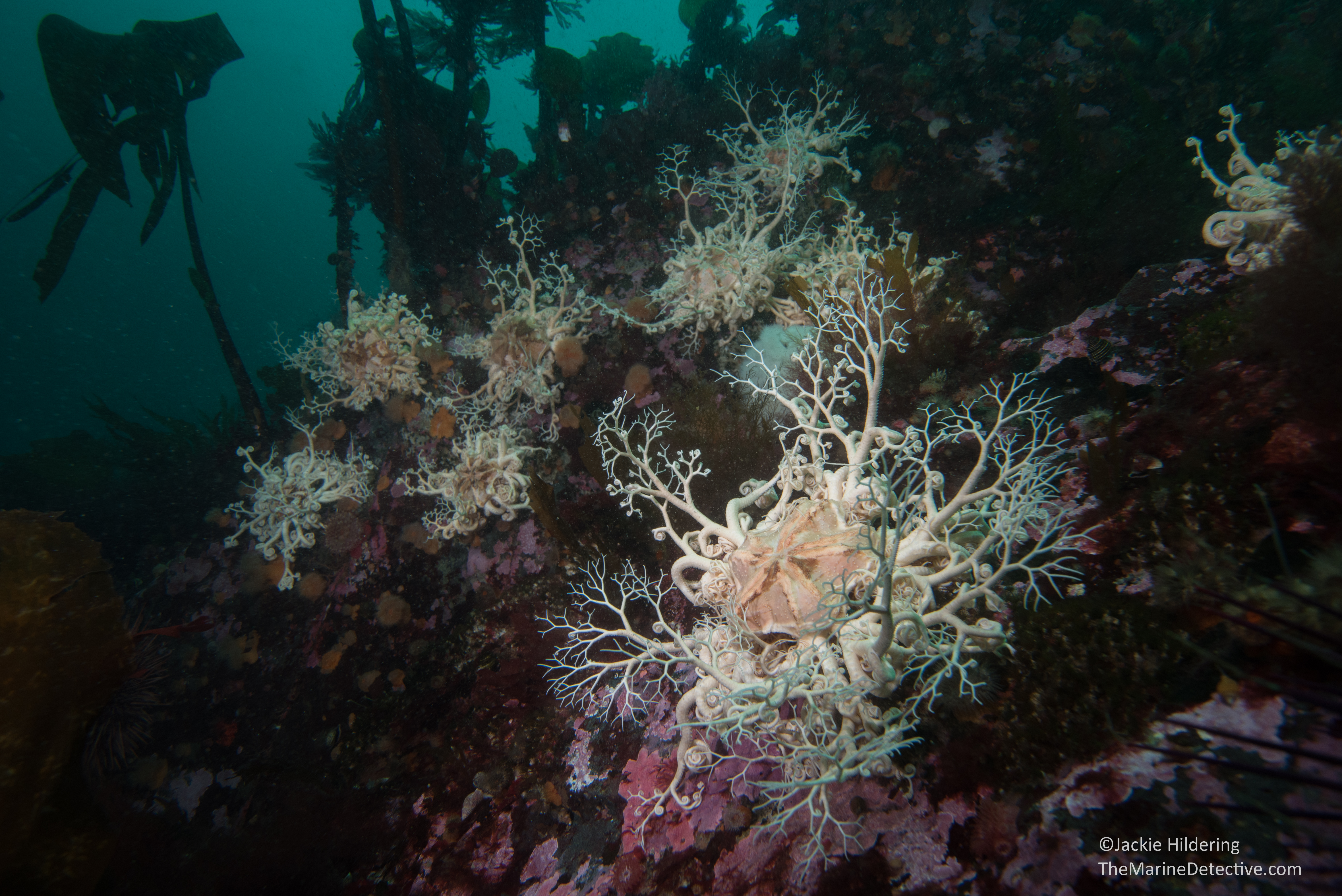
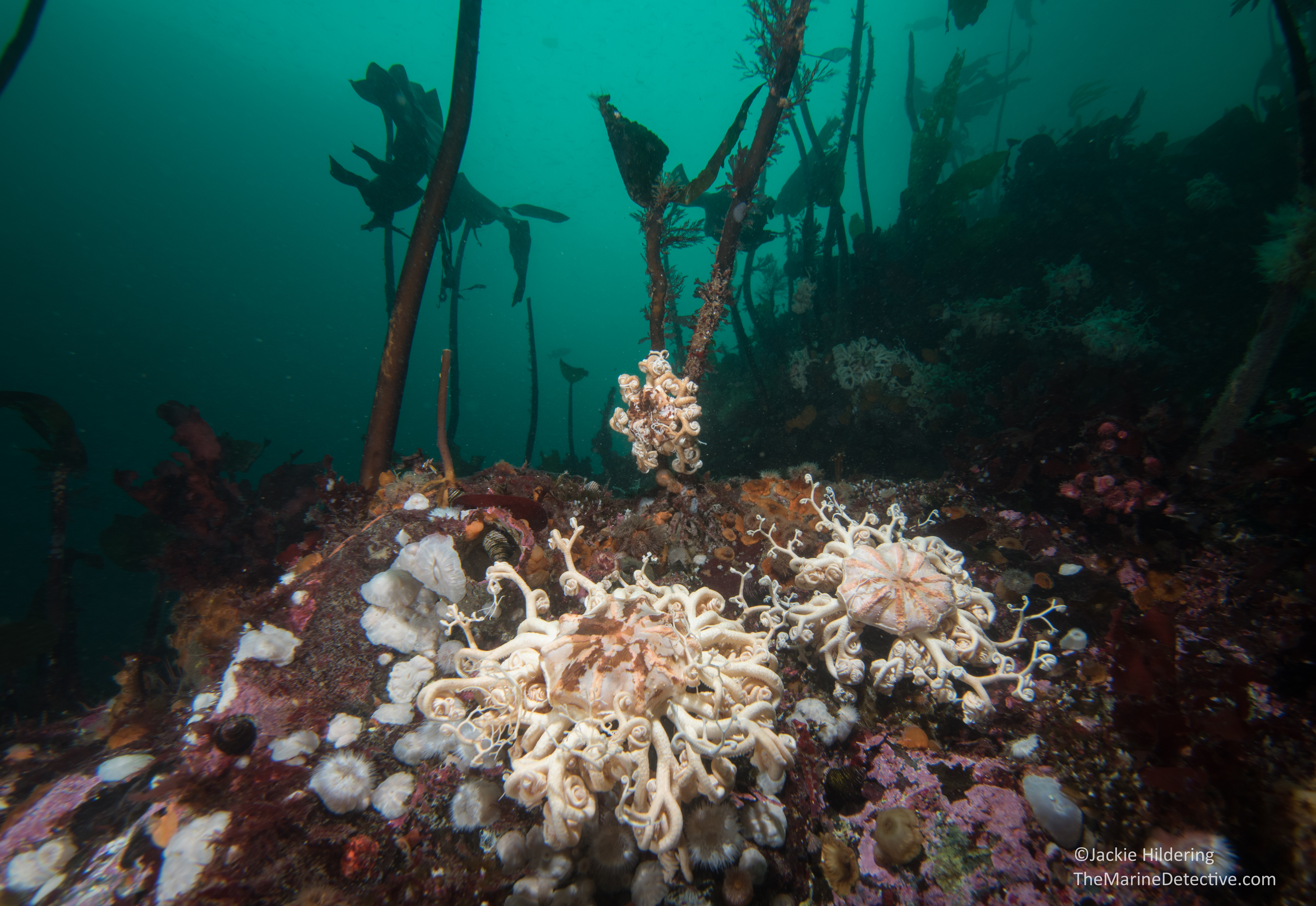
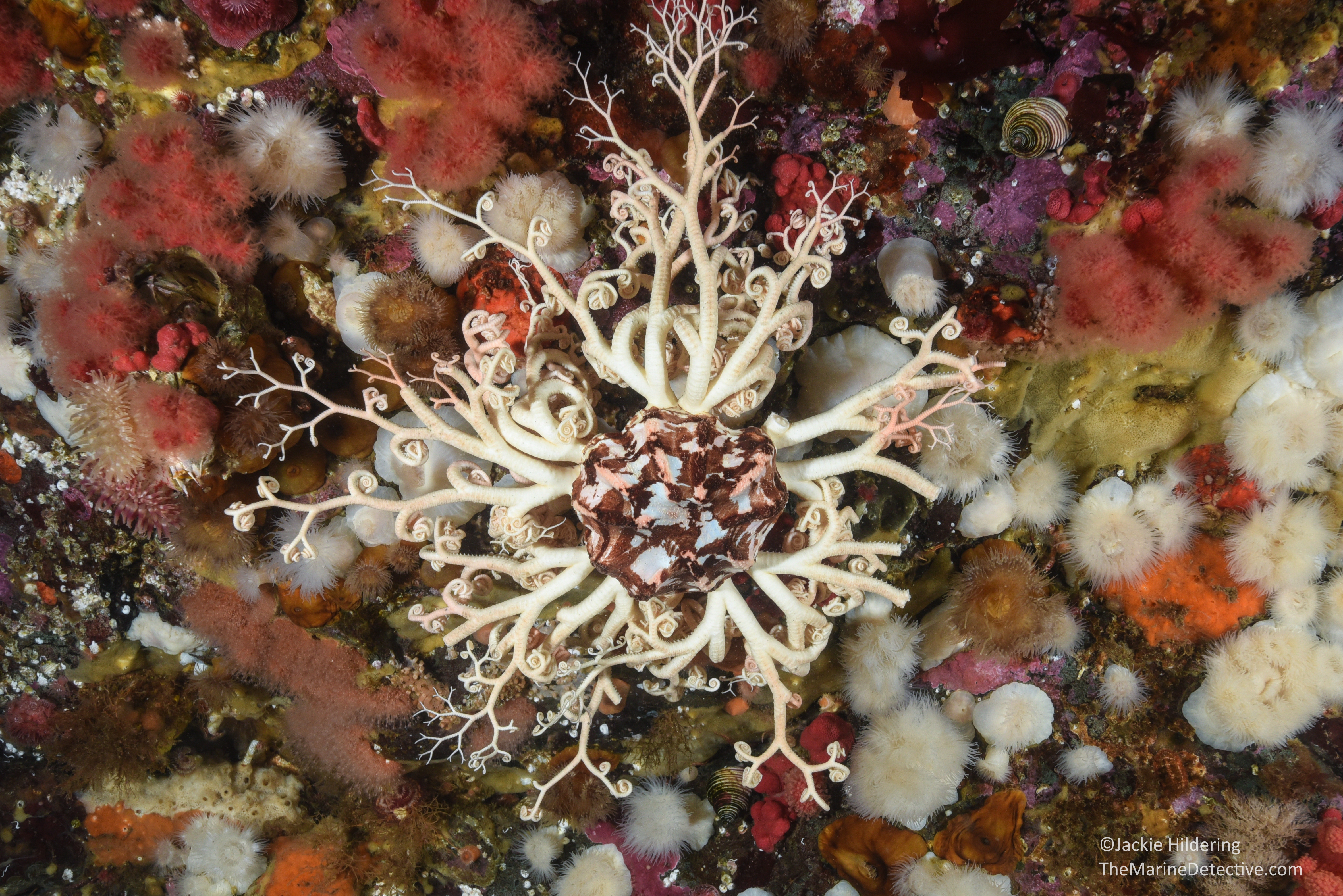
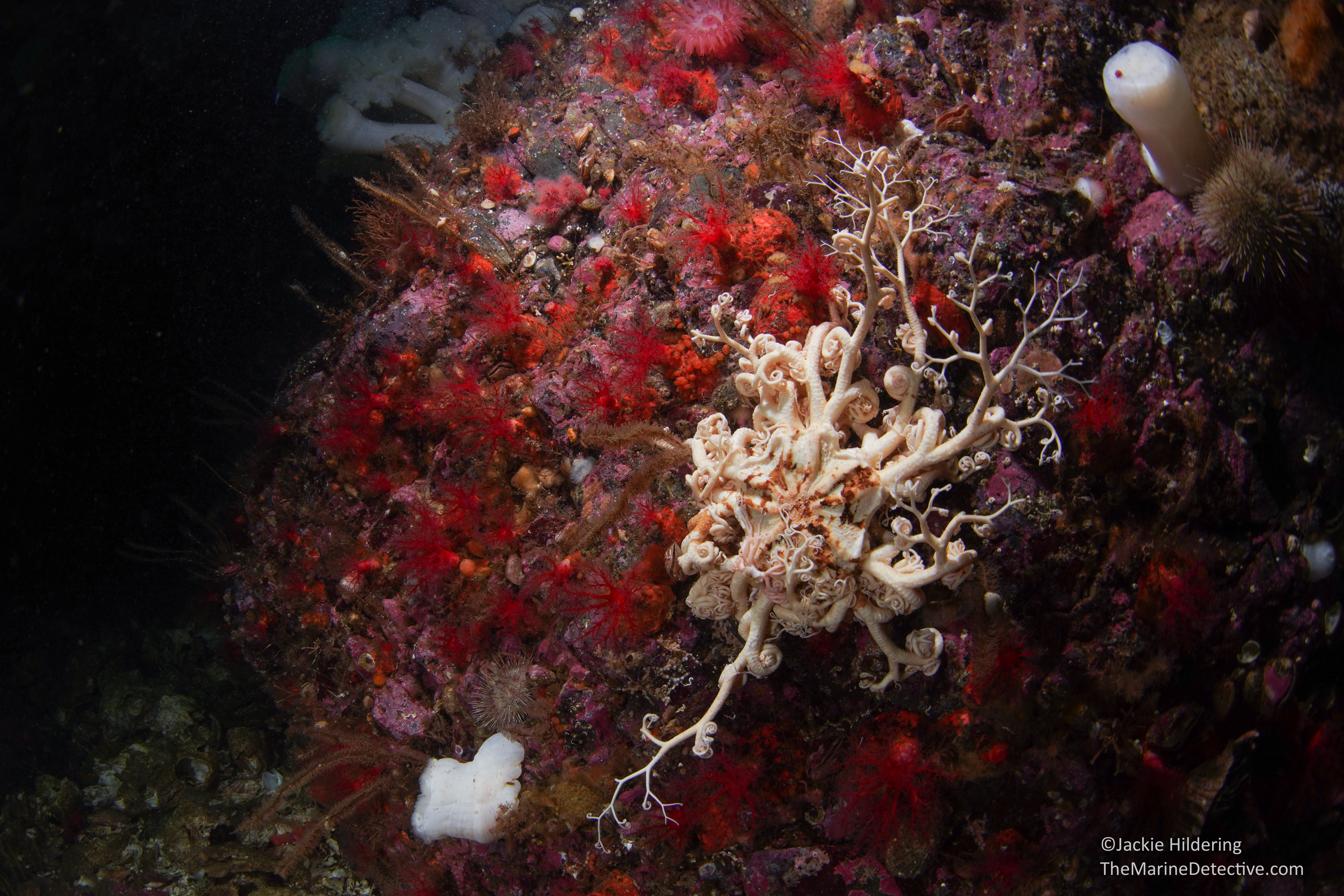
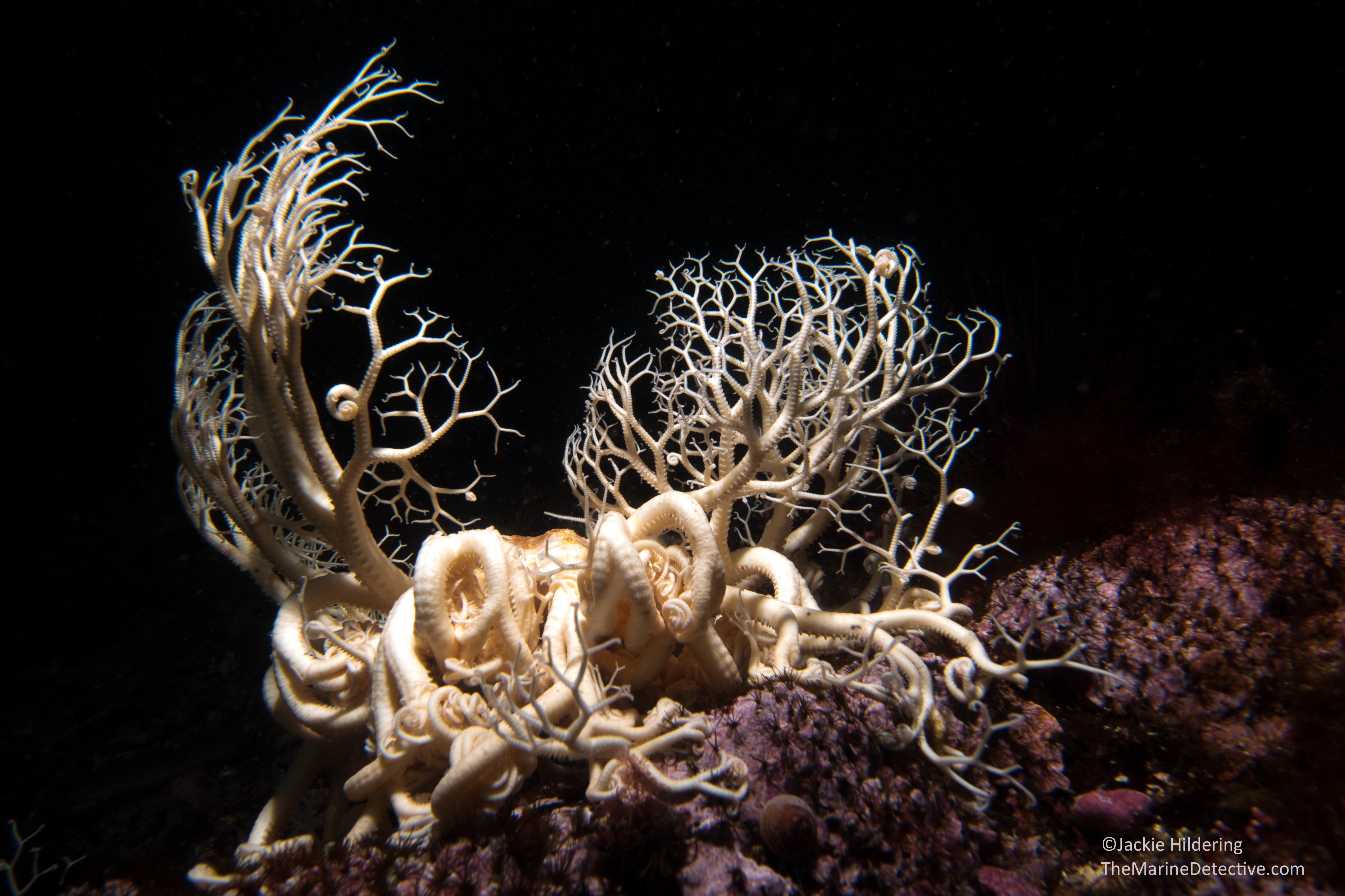
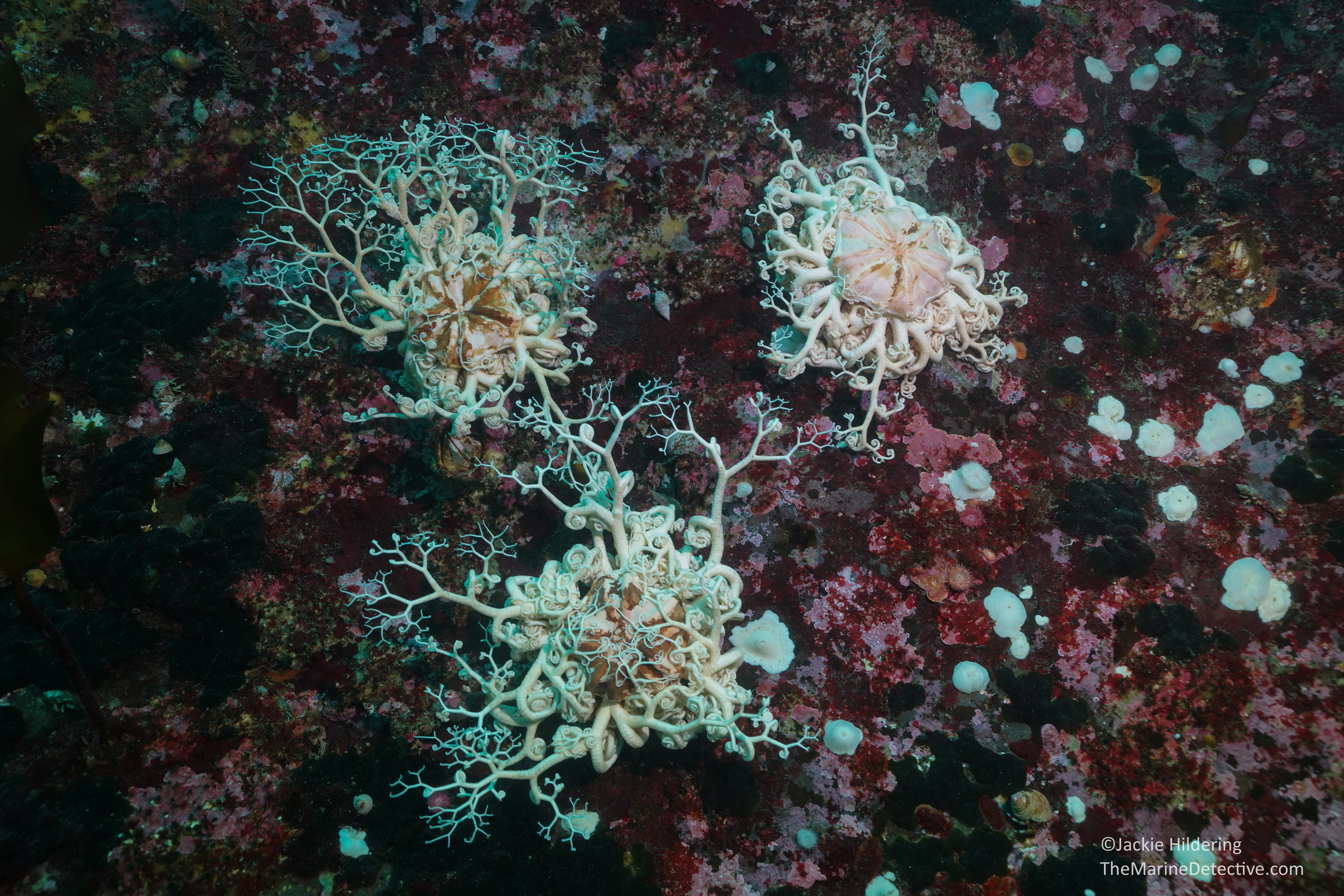

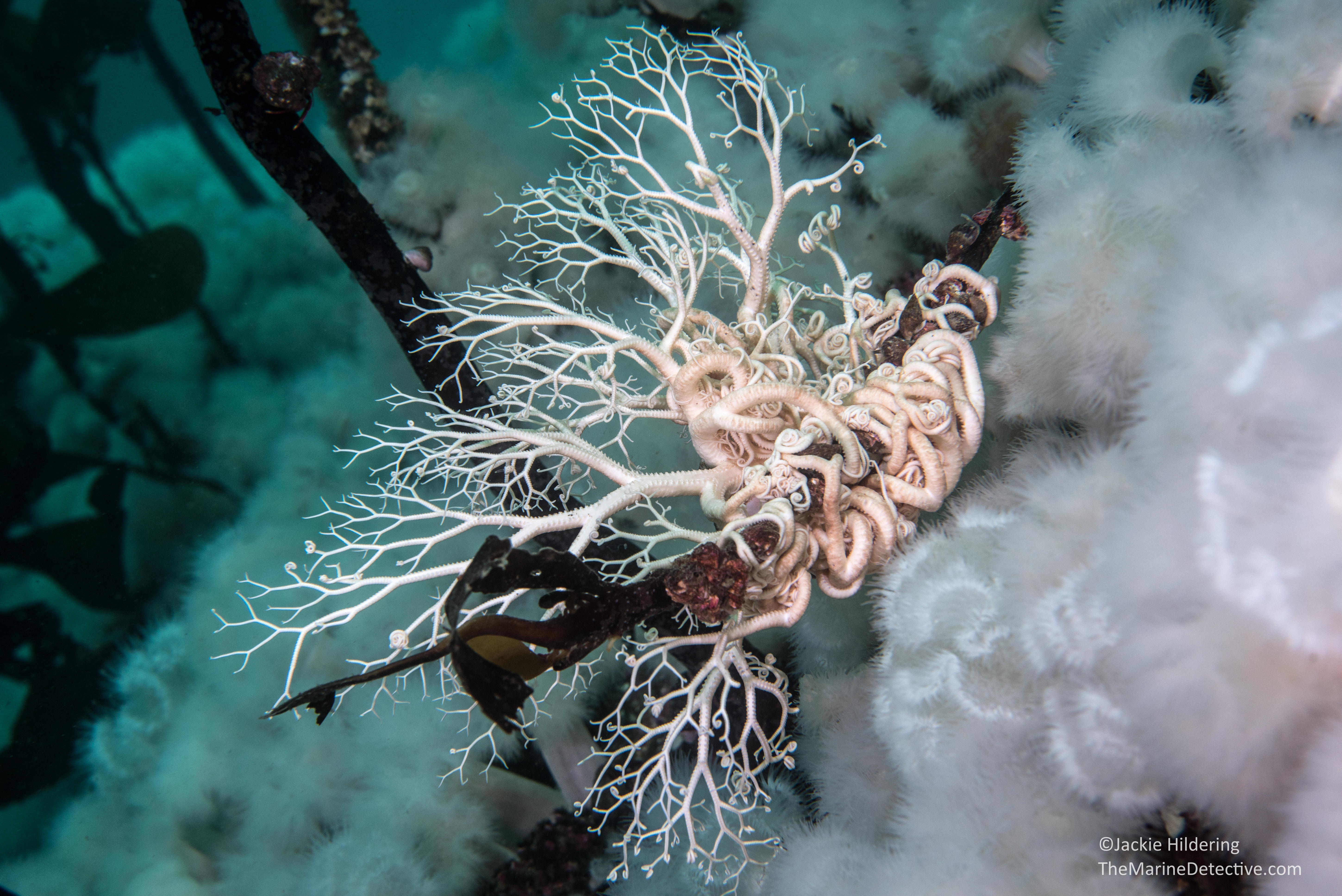
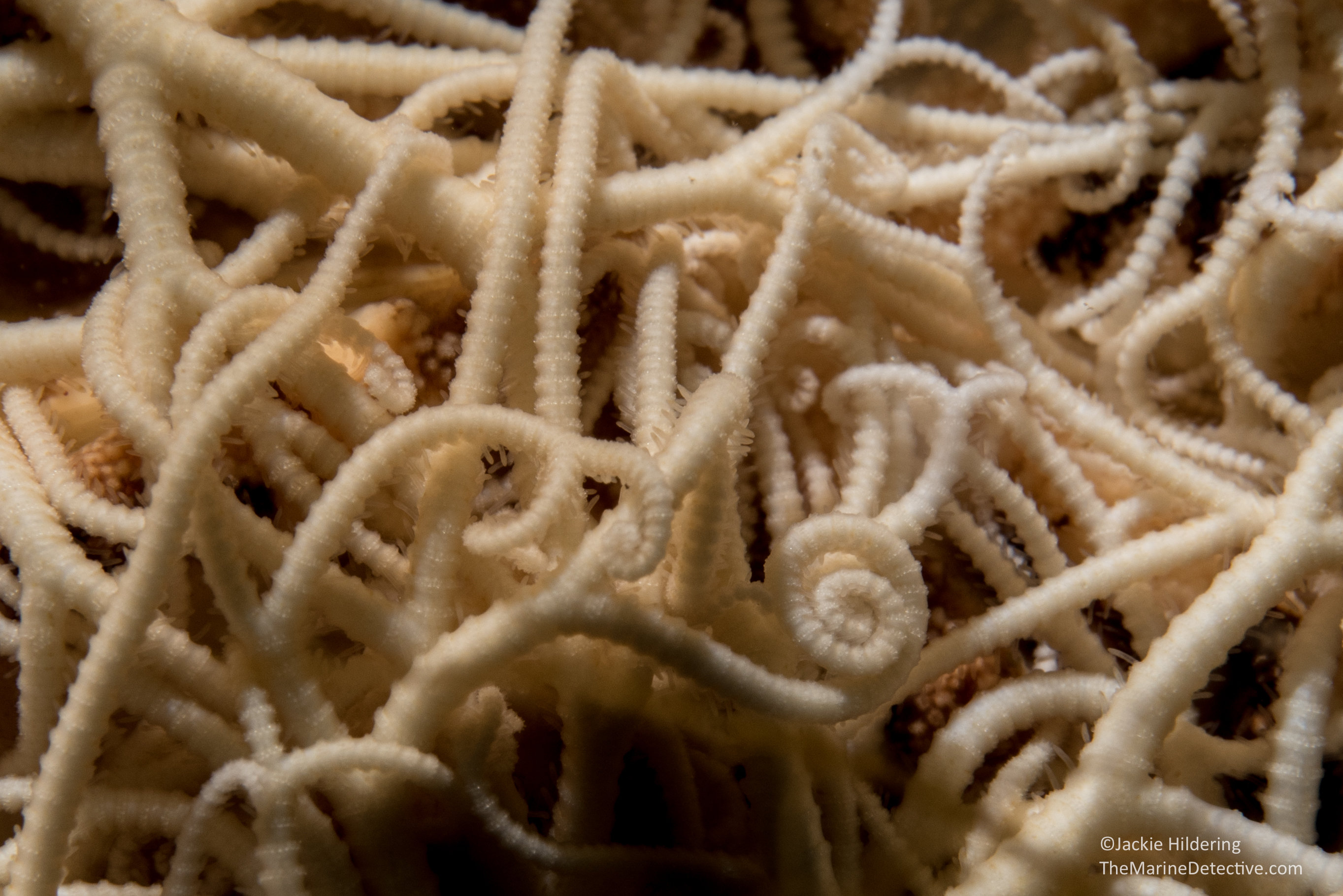
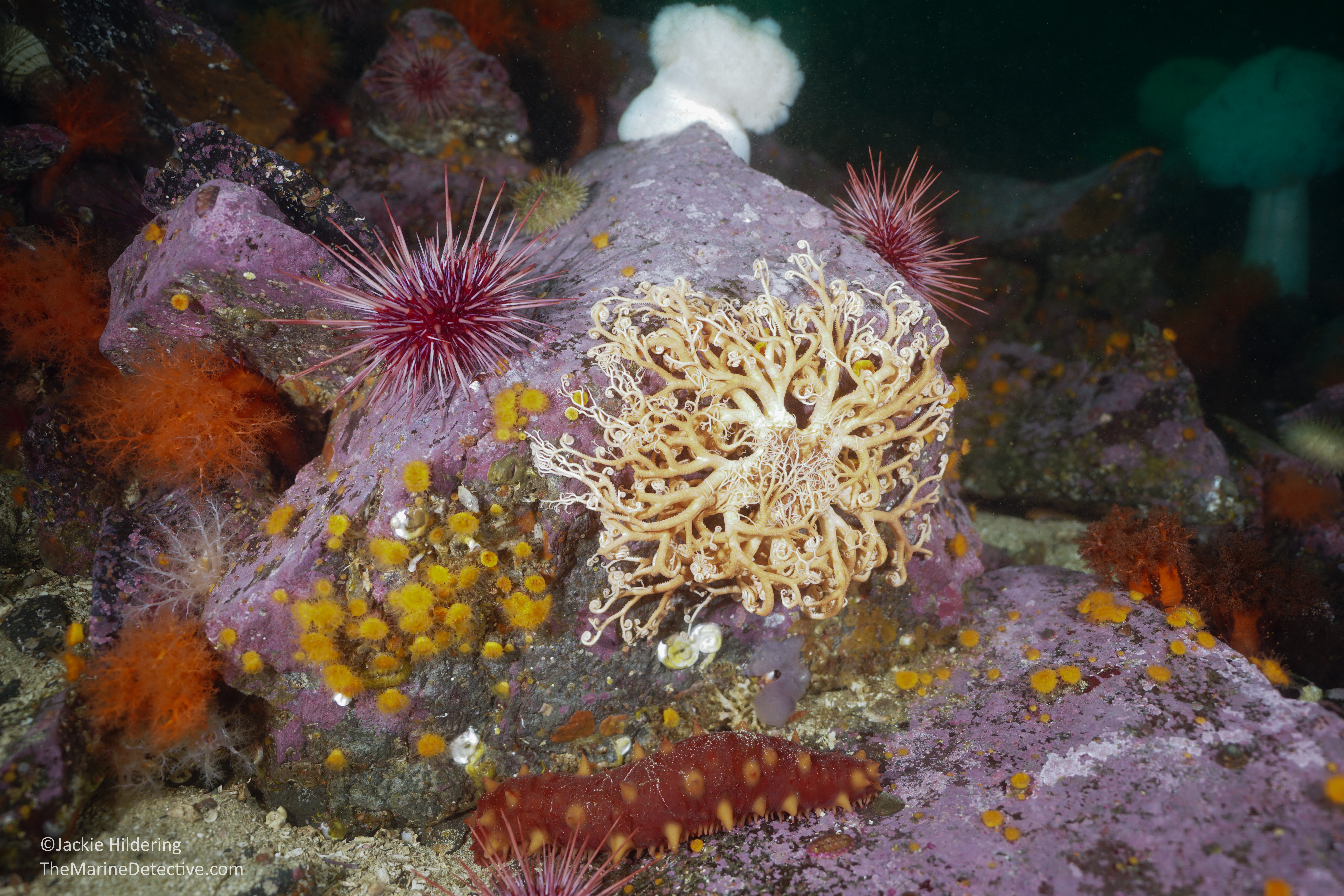
How can it be that I do not yet have a blog about Basket Stars? I am hereby correcting that and including a gallery of photos of this astoundingly beautiful species.
Prepare yourself for abundant superlatives!
They truly are stars of wonder.
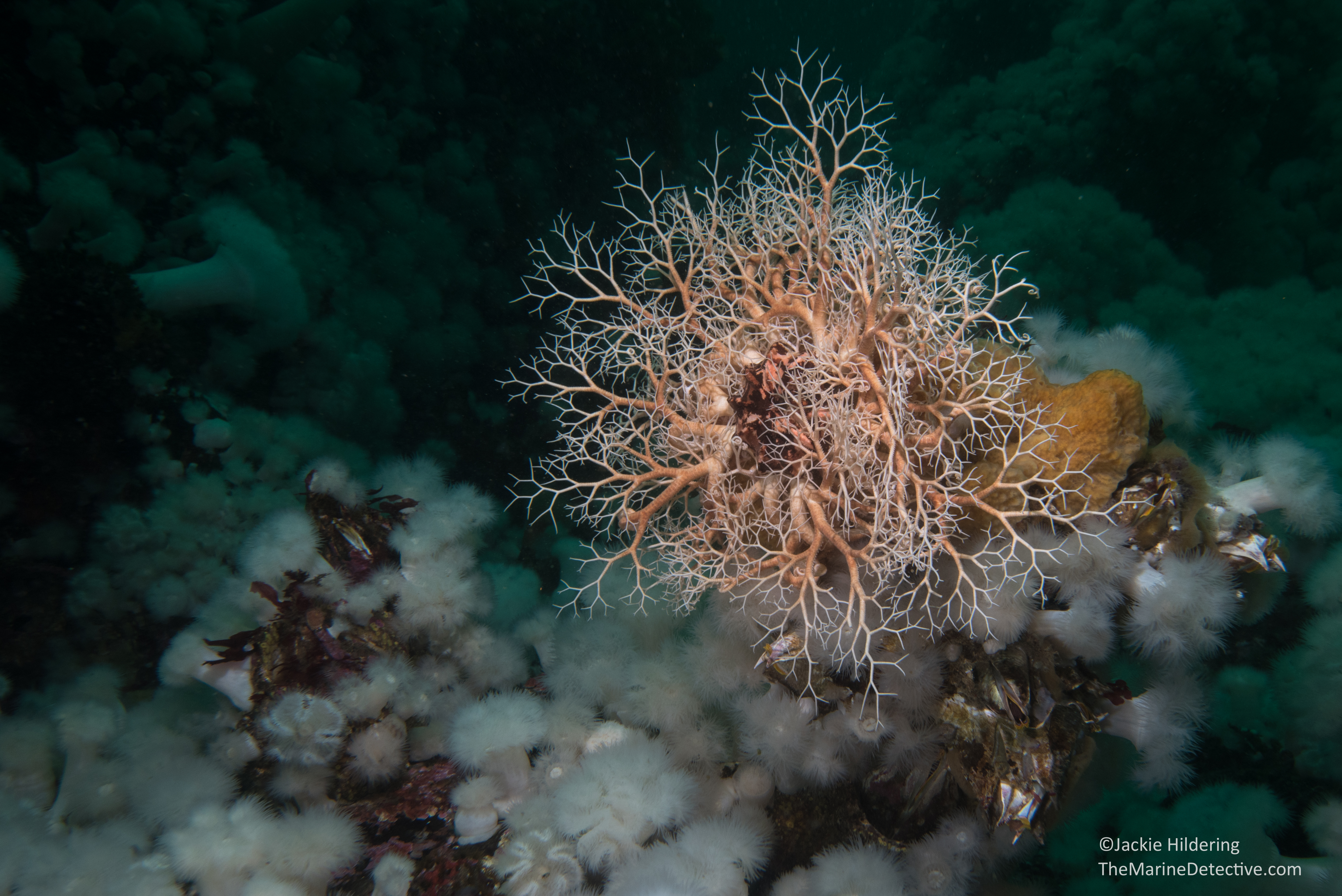
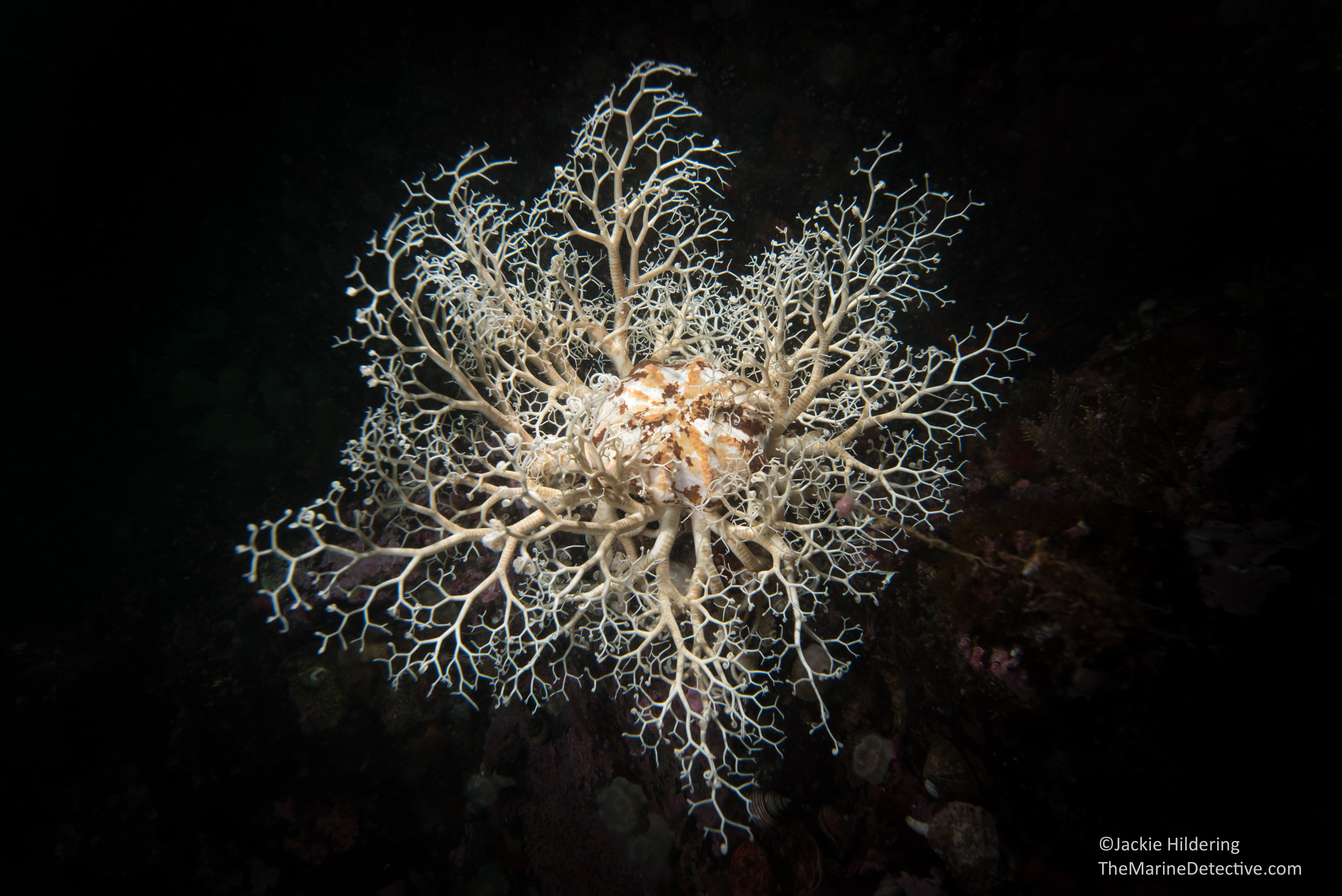
Of all the photos I have taken, it is this one of a Basket Star that is centre stage in my home.
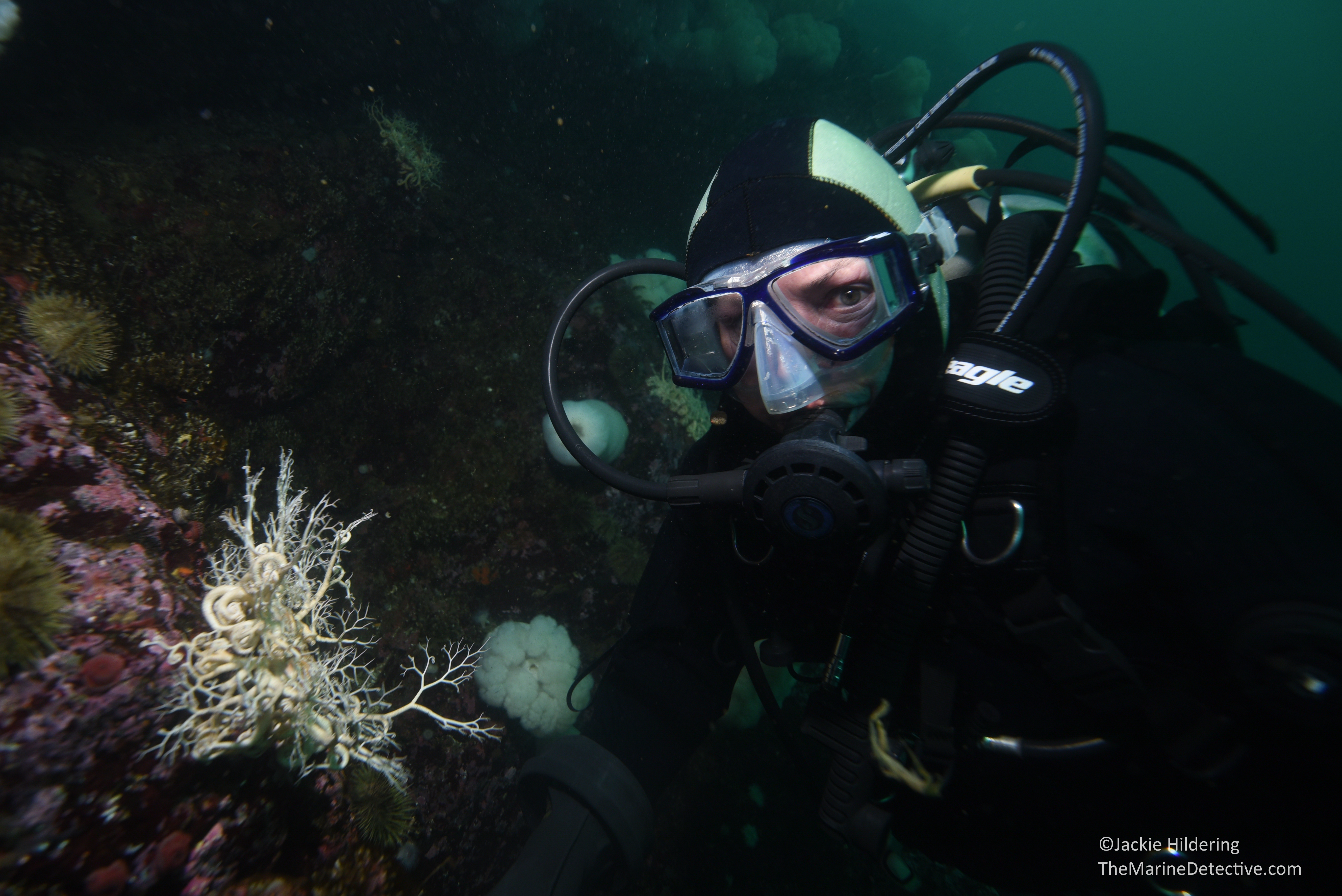
Basket Stars are brilliant ambassadors for the beauty and extraordinary life off this coast. It is my experience that when people learn about them, there’s often a hushed “They live here?”.
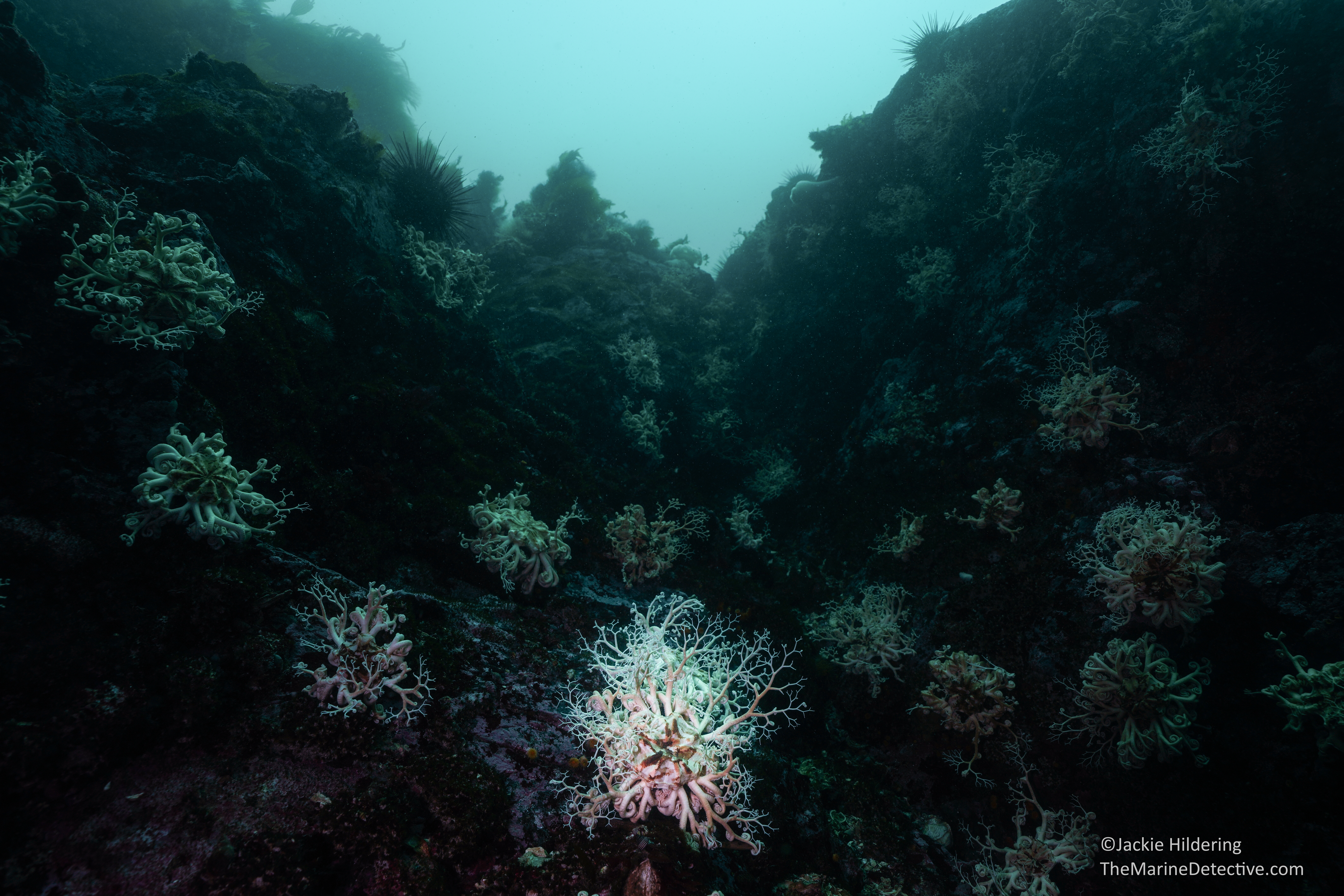
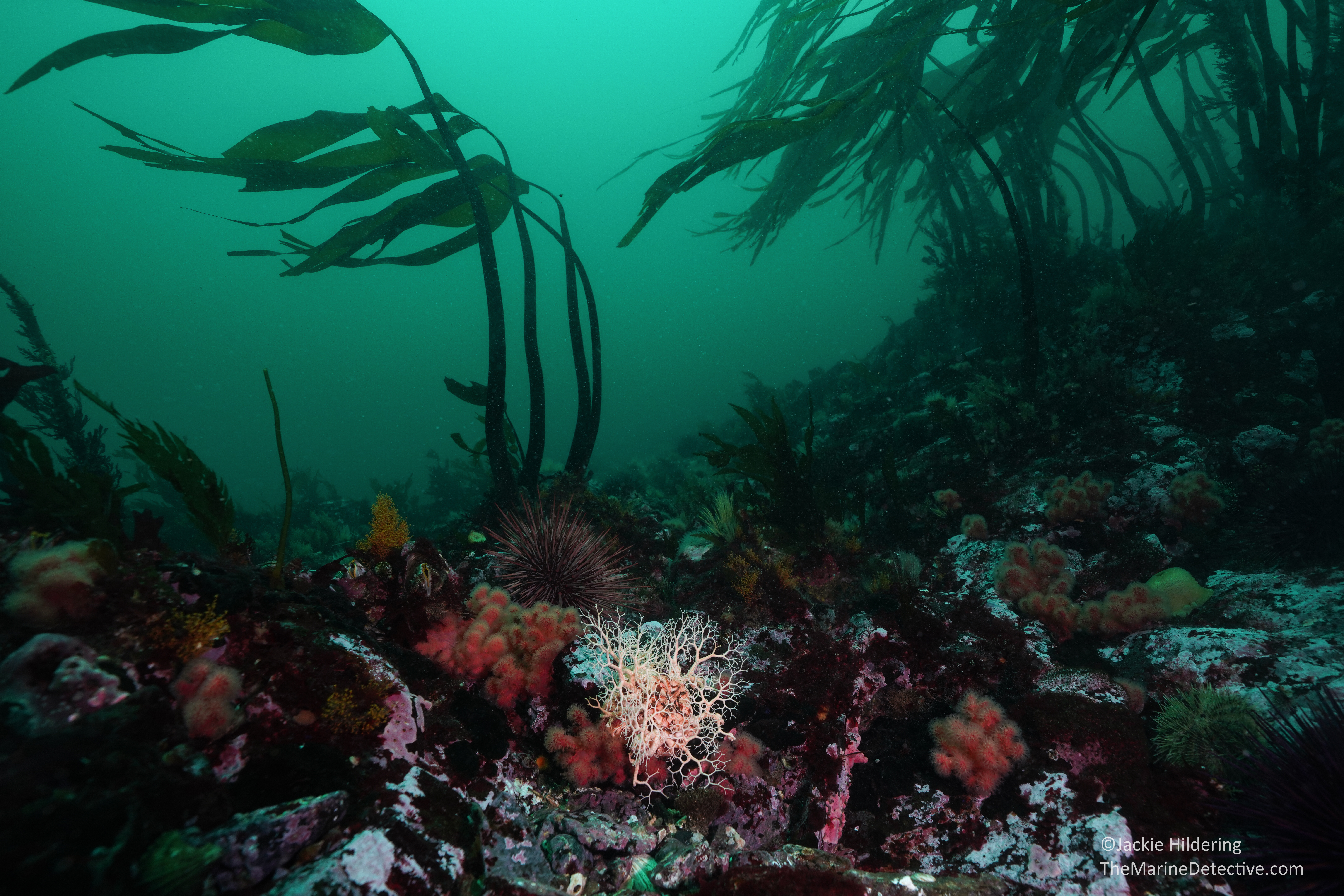
Valley of the Basket Stars. See how many there are?!
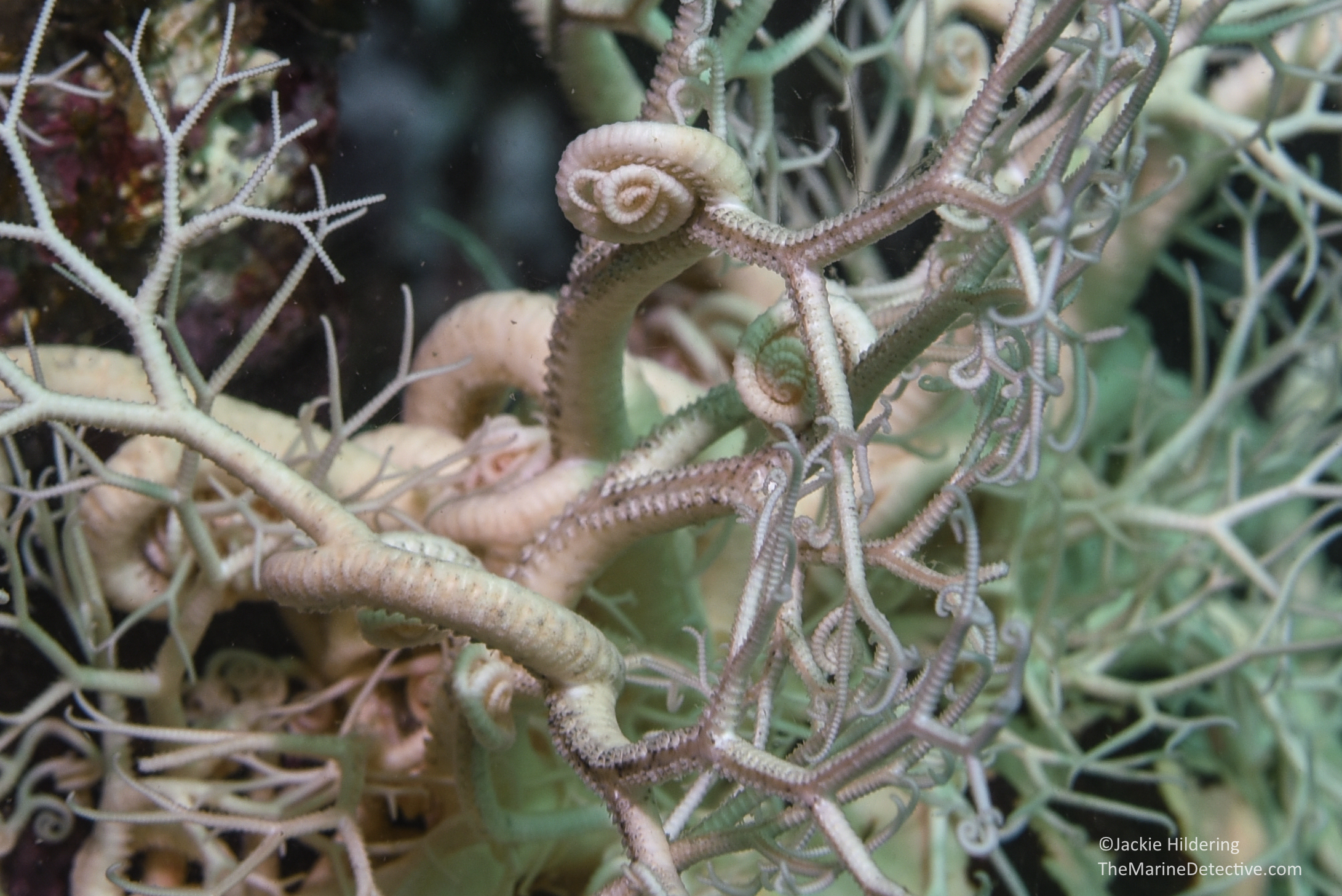
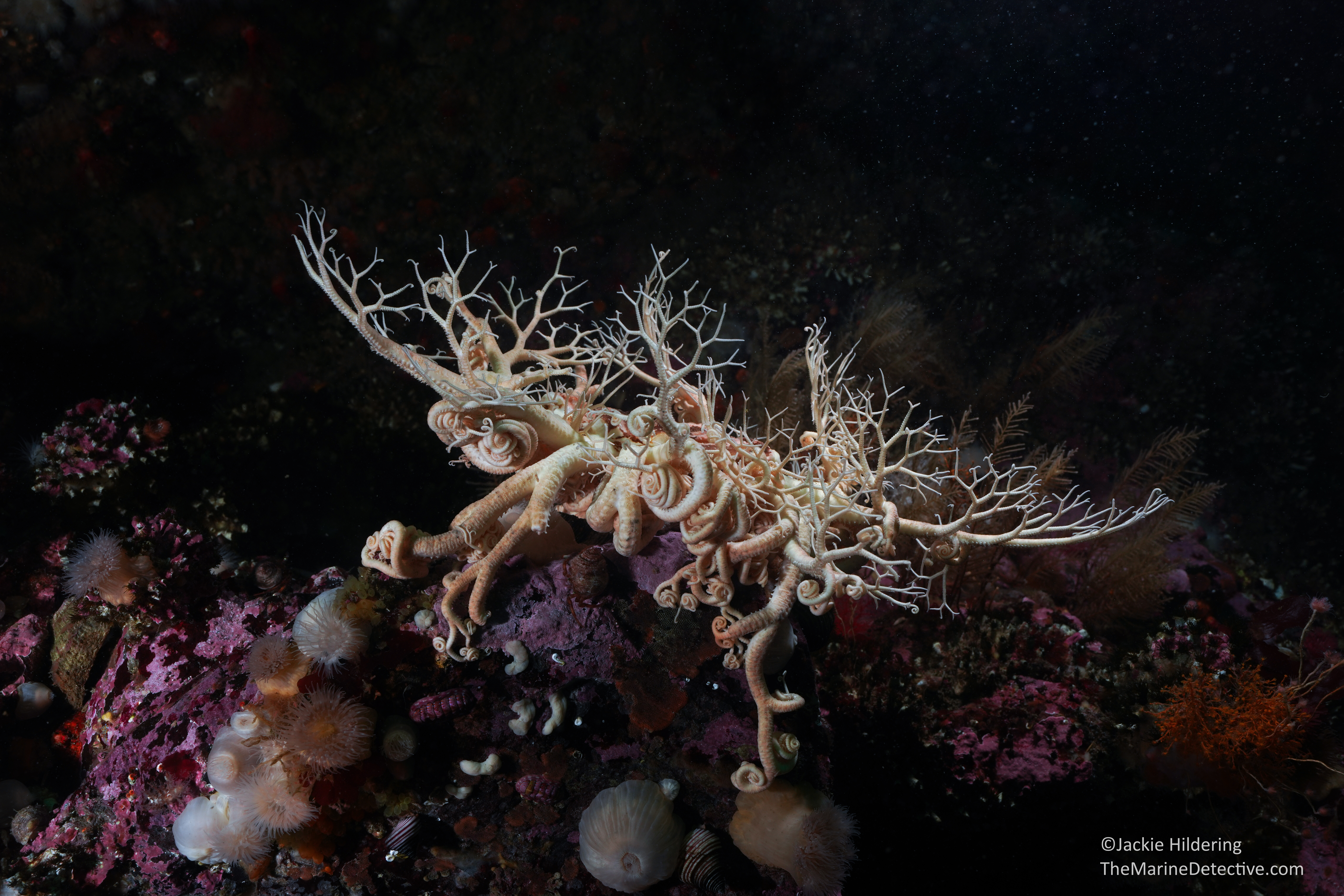
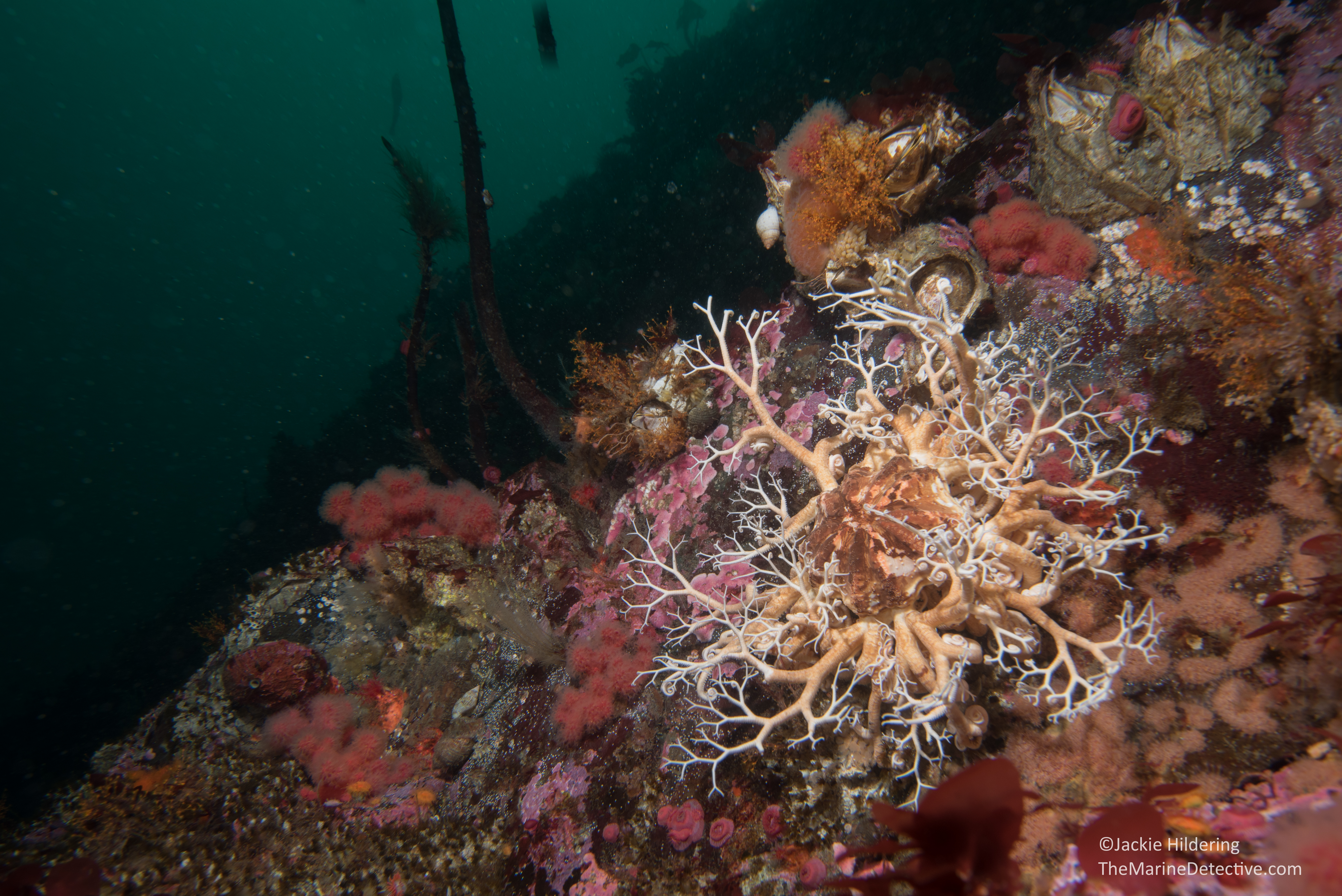
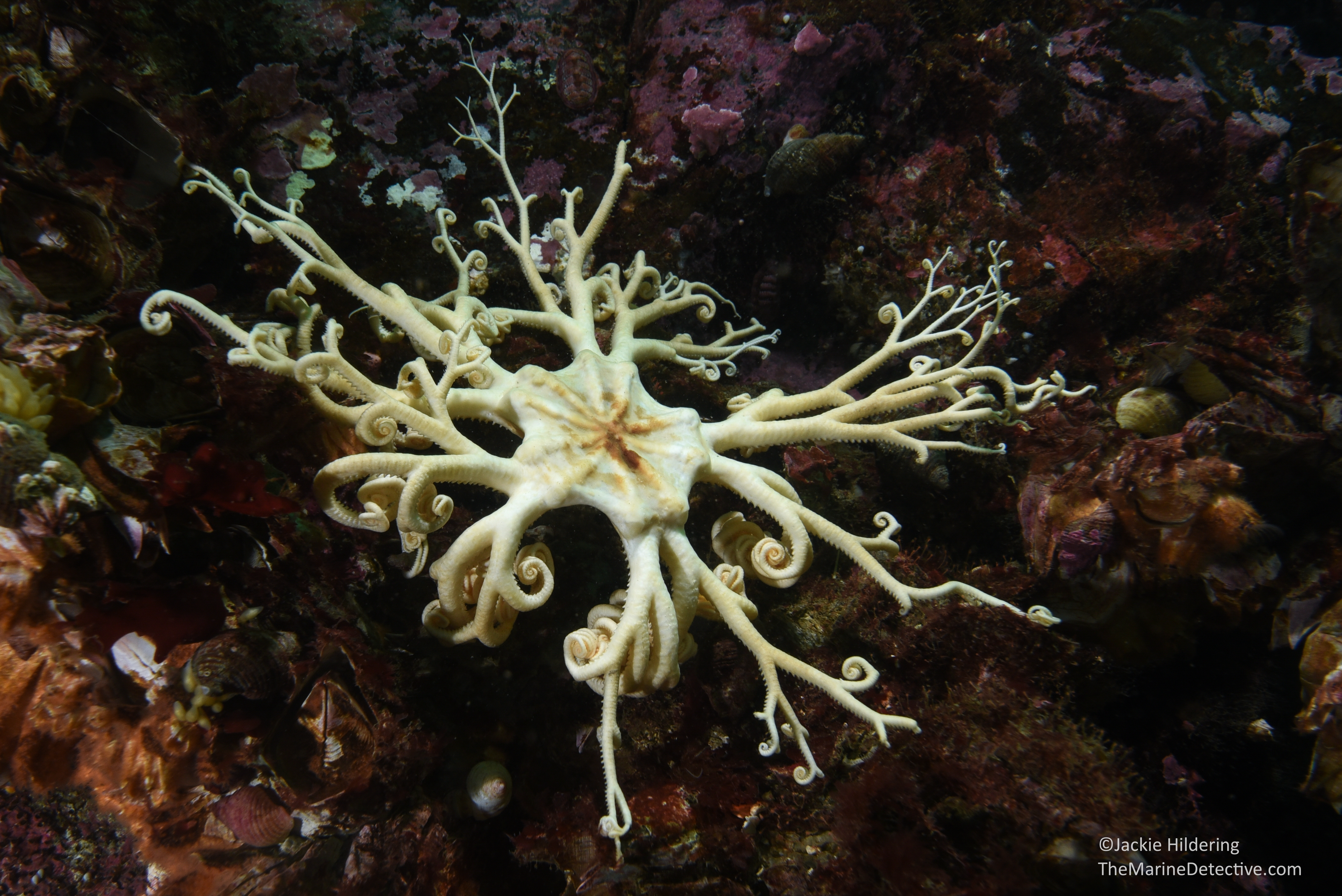
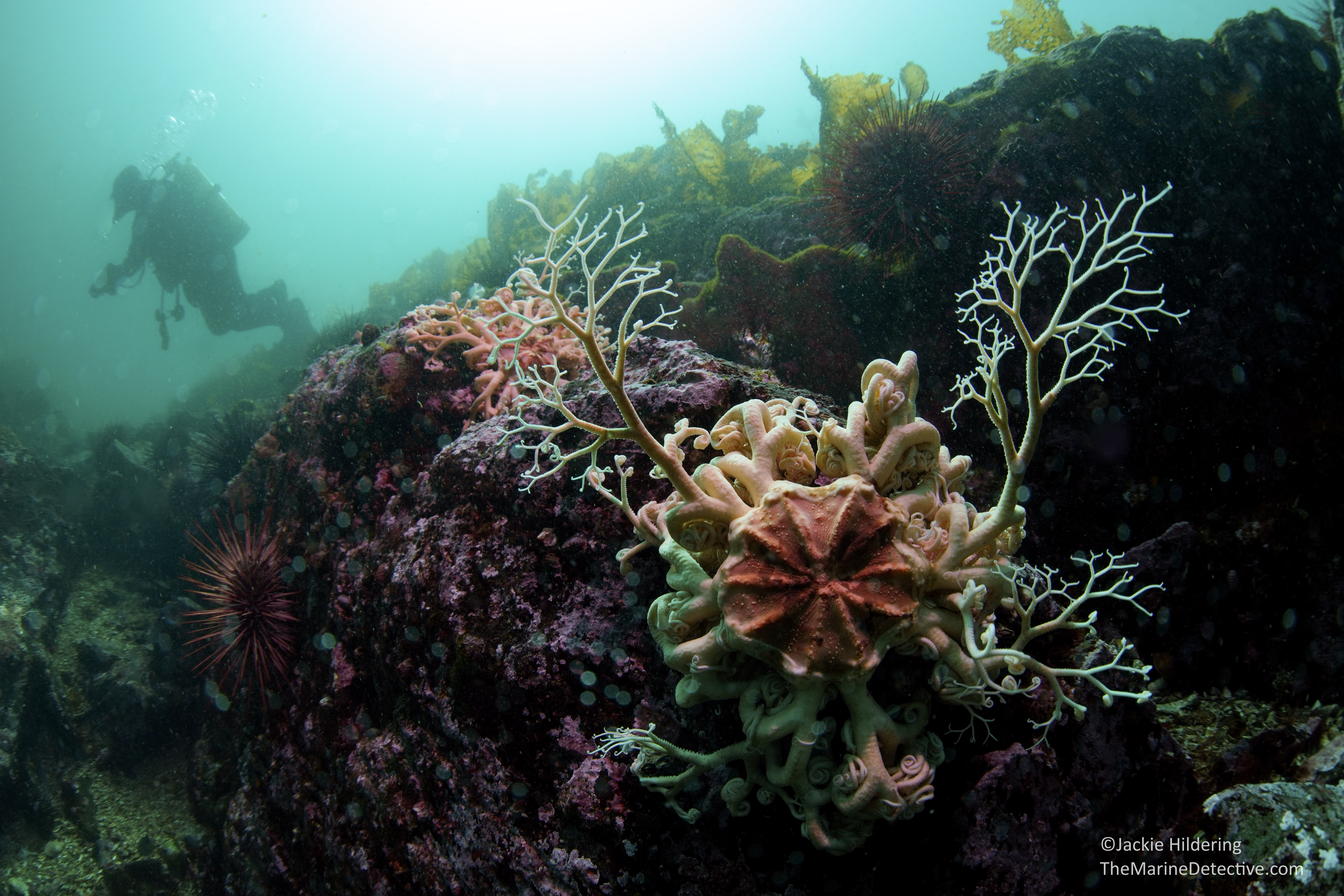
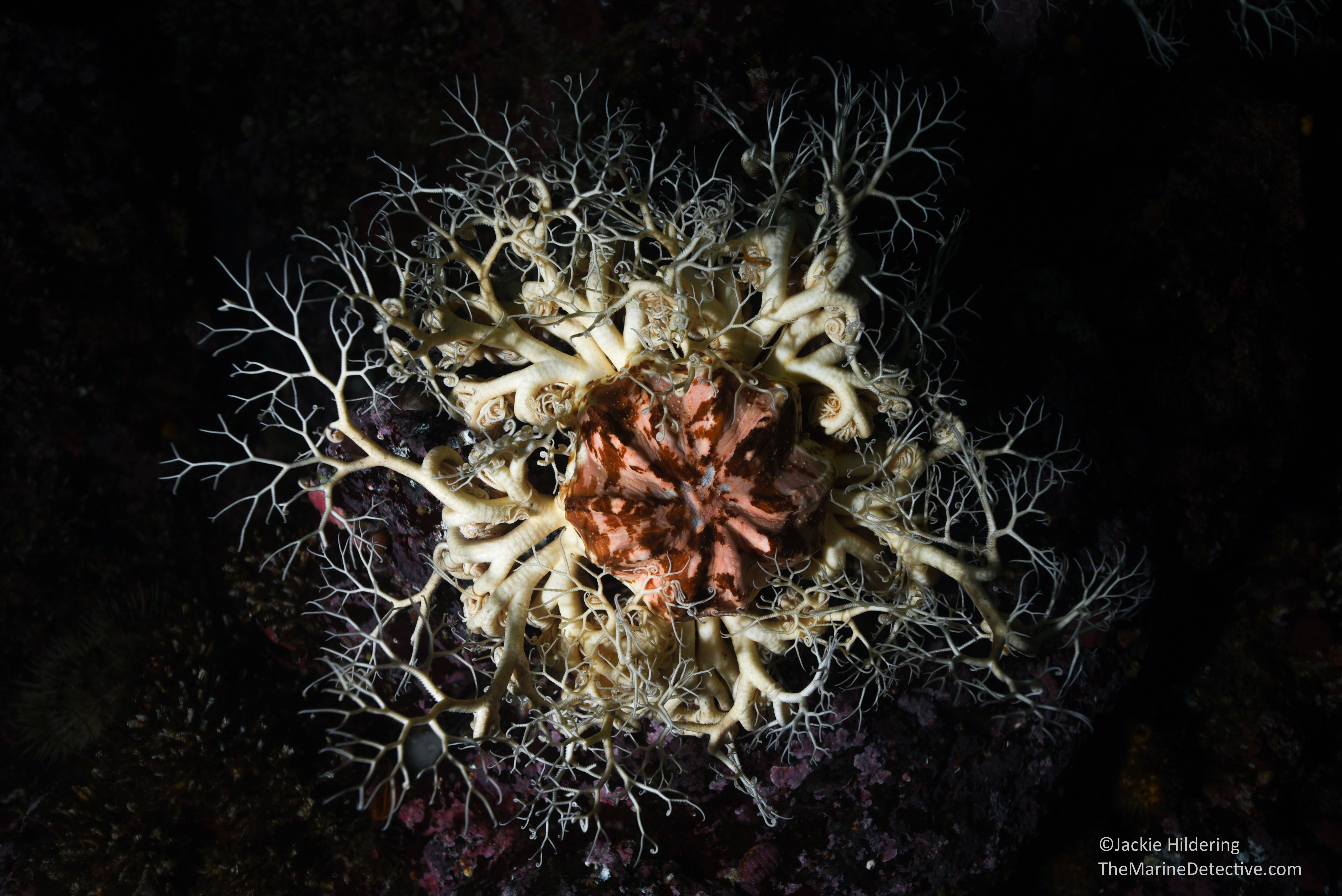
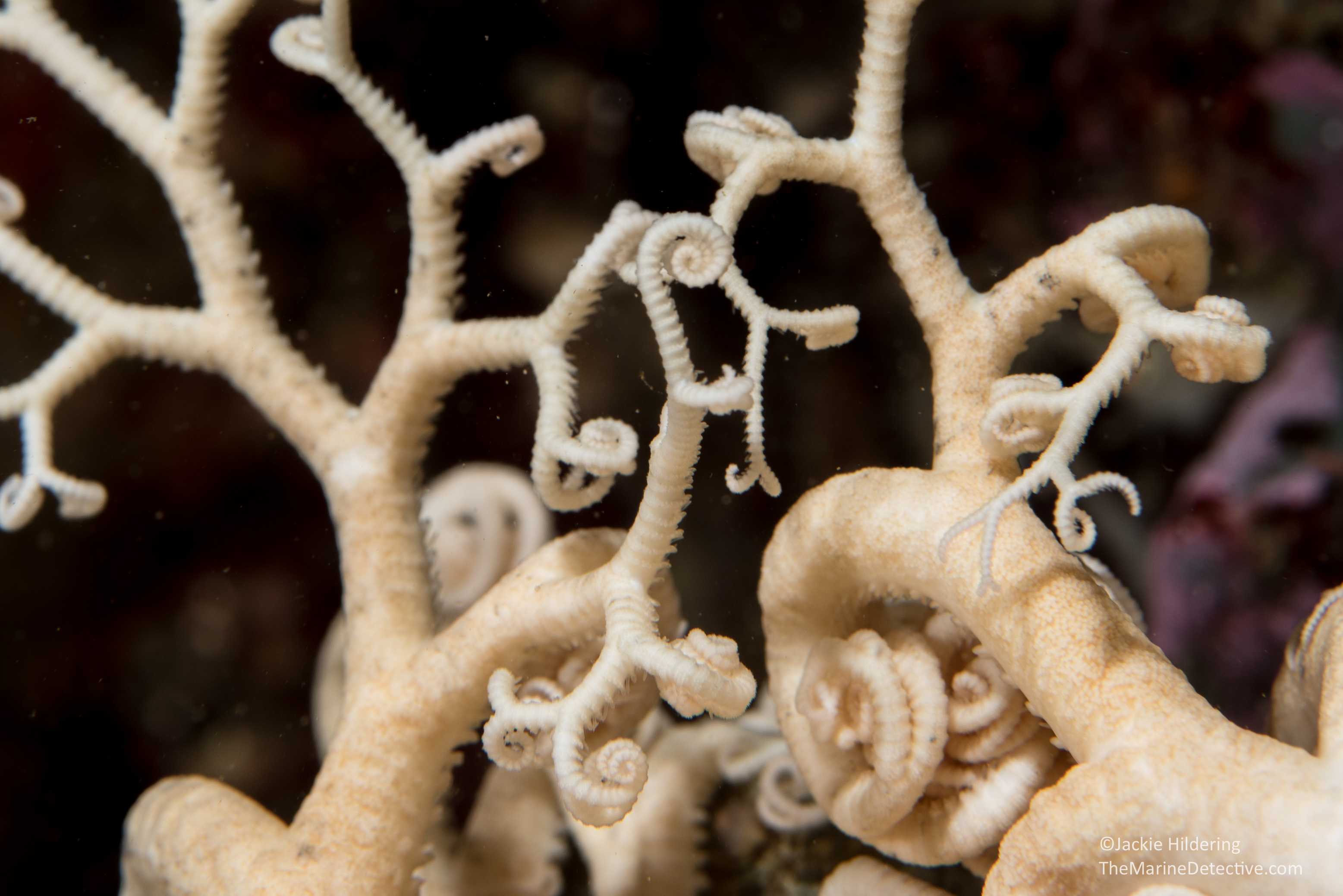
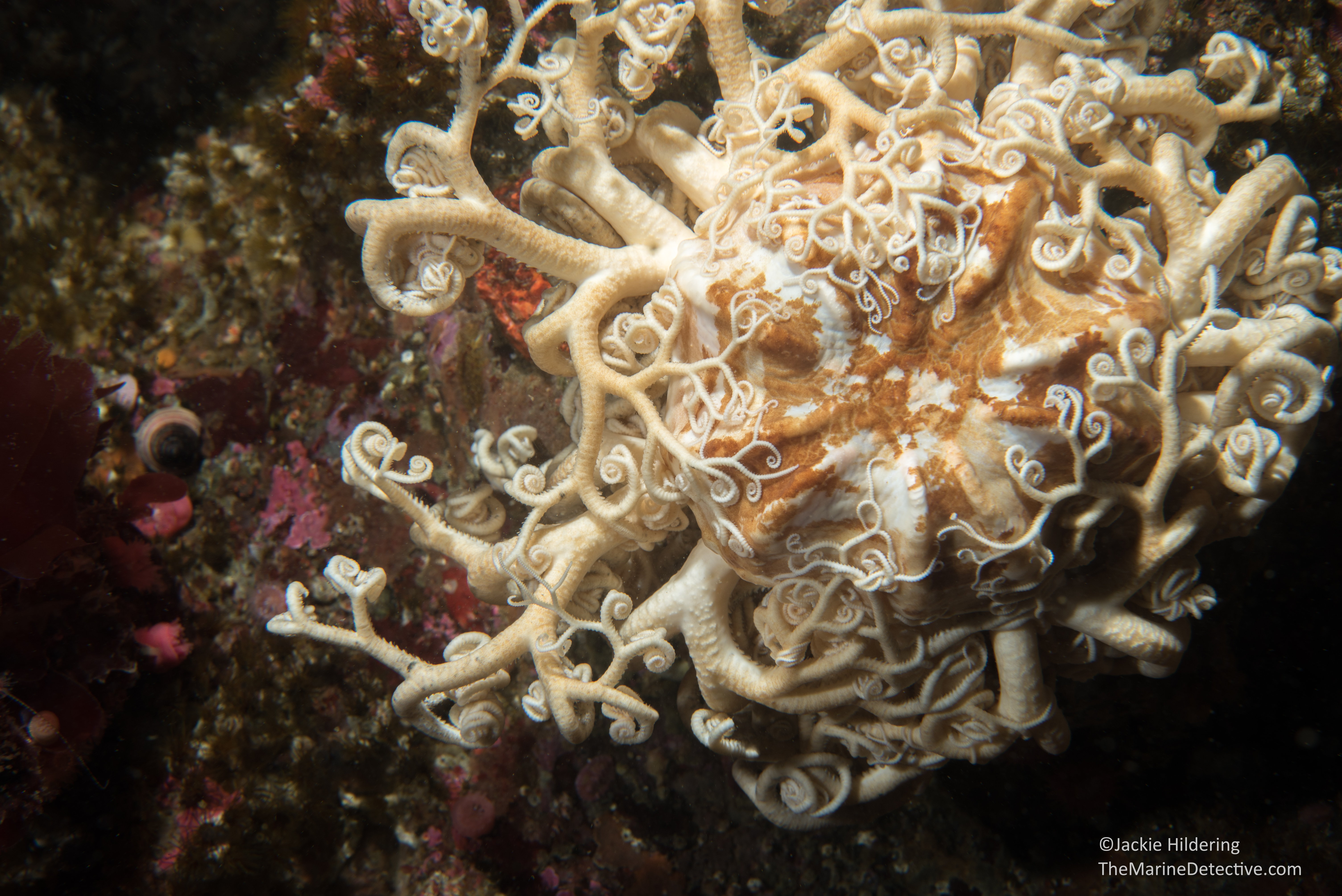
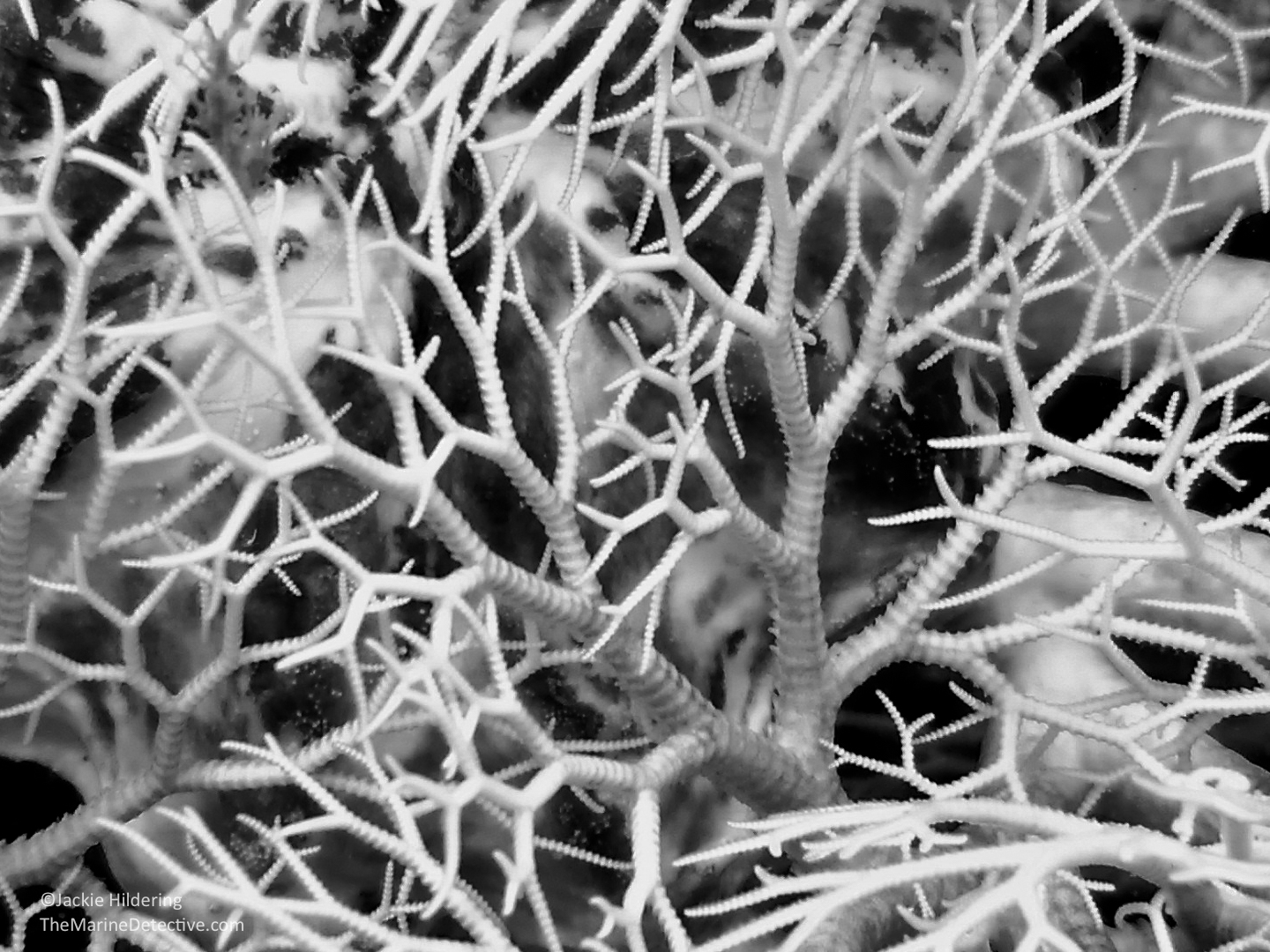
Yes, they are a common species here. They have 5 pairs of arms that seem to branch infinitely and they are big! When the branched arms of Gorgonocephalus eucnemis are fully outstretched, adults can be up to 80 centimetres wide (Source: Hainey).
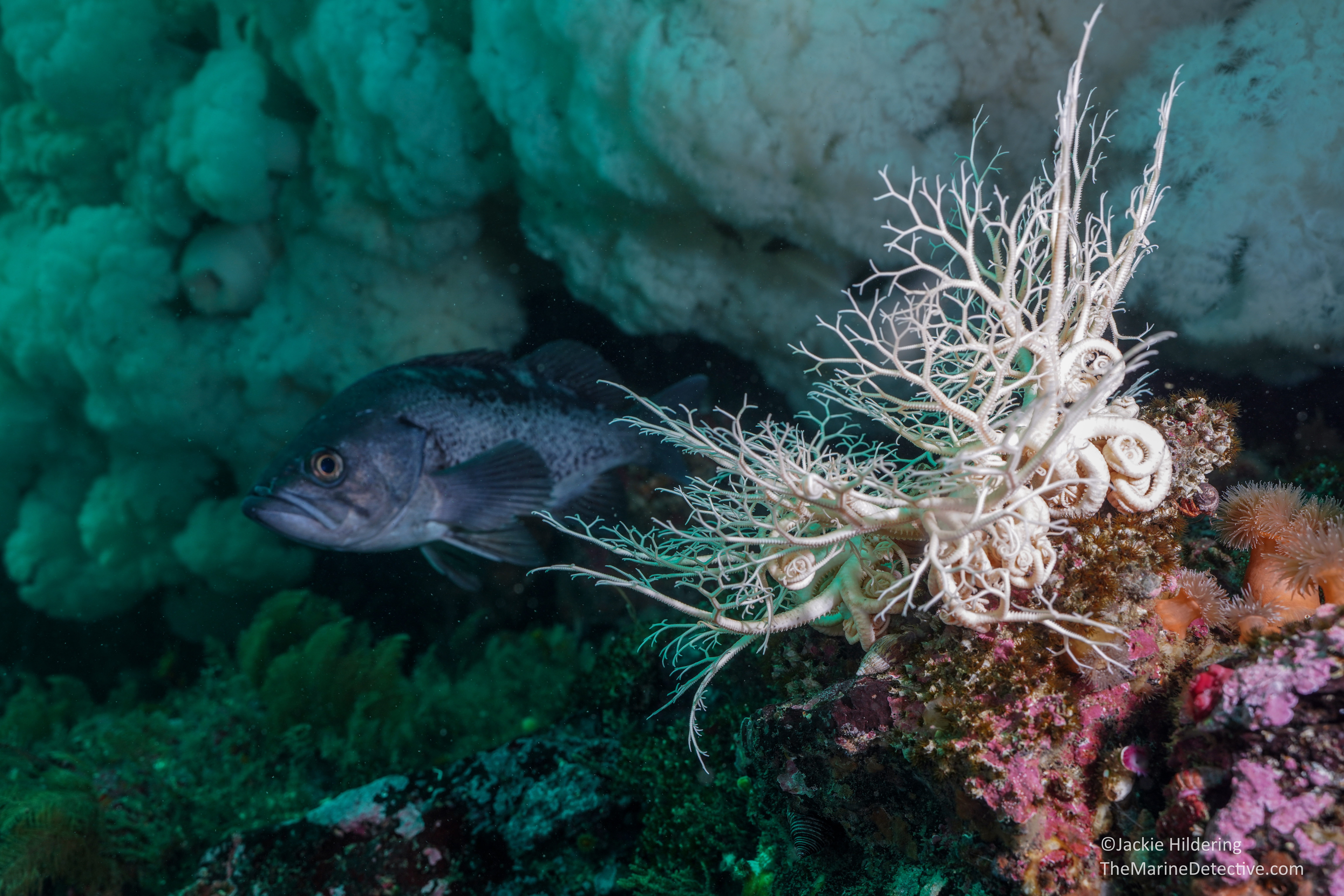
Basket Star and Black Rockfish.
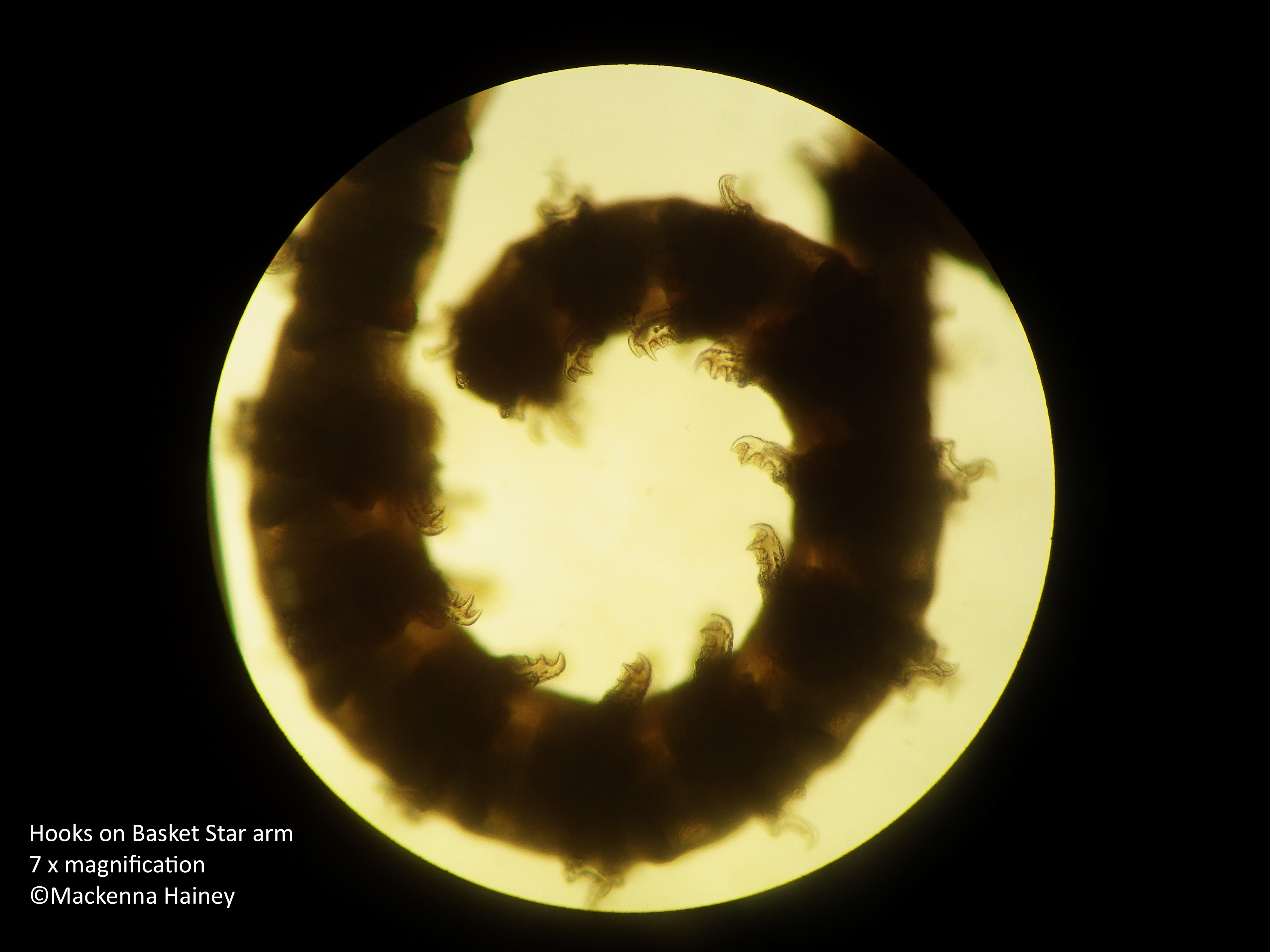
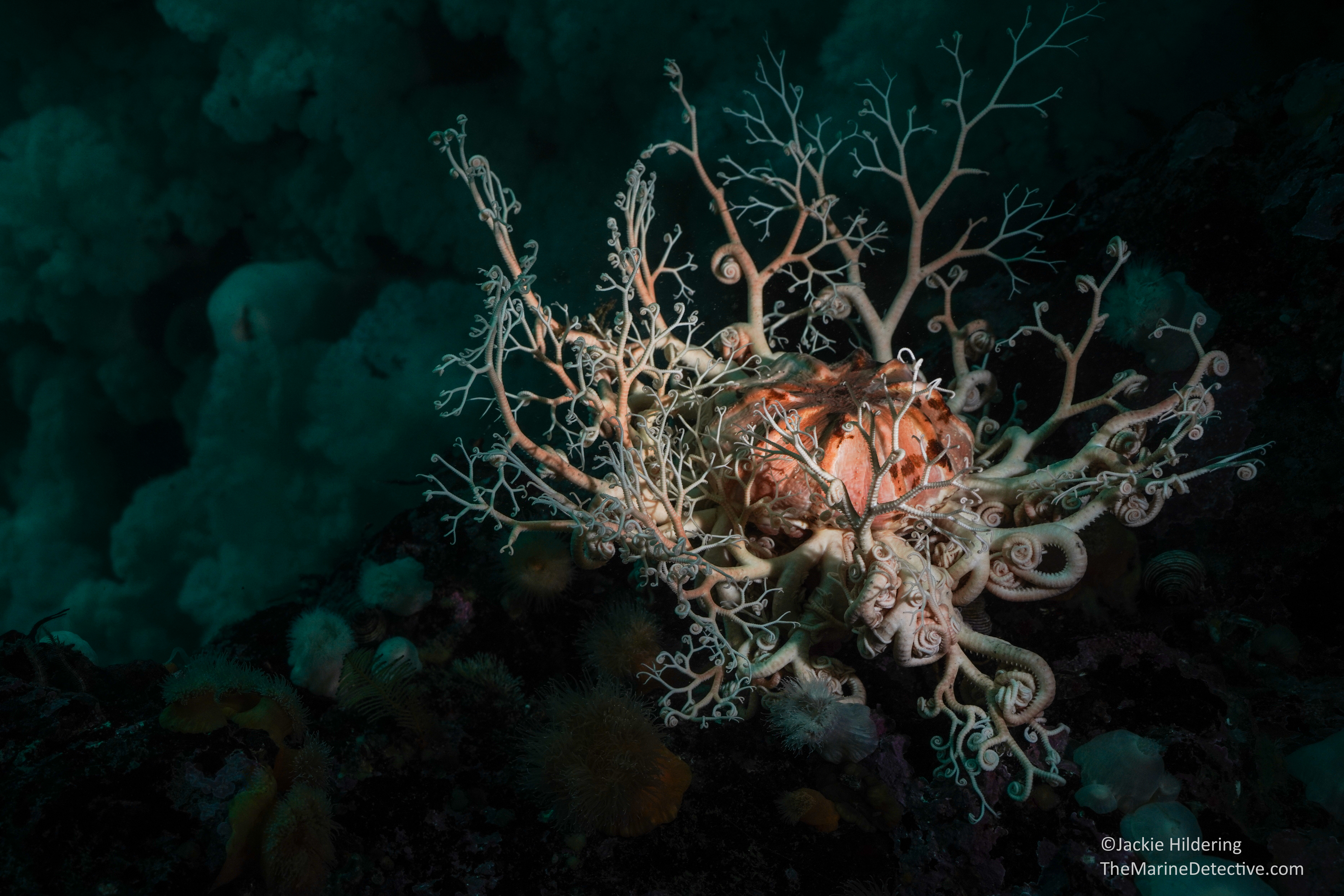
Imagine submerging and watching how, when the current increases, their arms unfurl into a basket to ensnare plankton. Through microscopic hooks and mucus, the snacks are moved to the Basket Star’s mouth which is on the underside of the central disc.
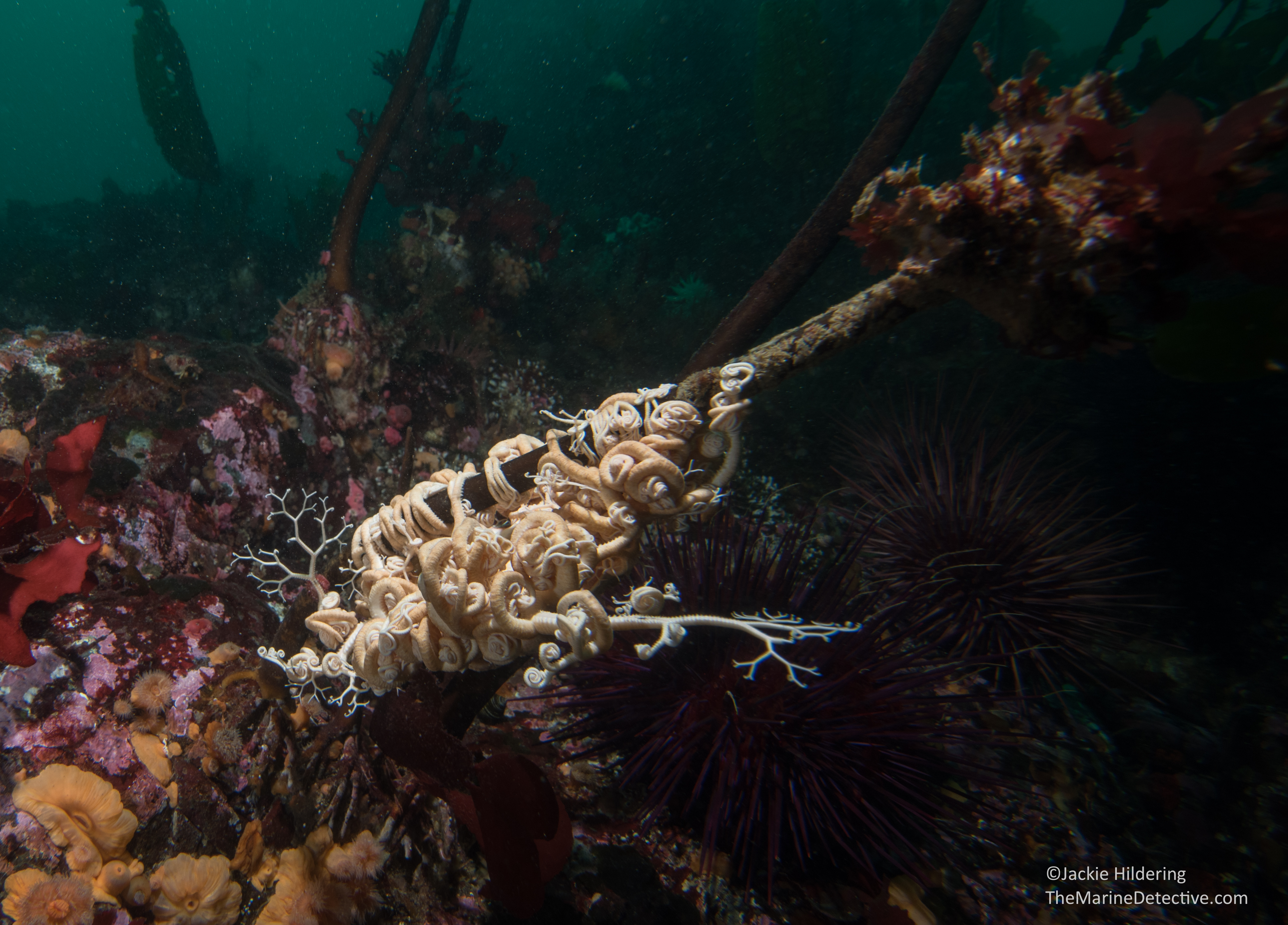
Basket Stars hold on and move about with their arms. They even climb kelp to position for more favourable feeding. They have tube feet, as do all echinoderms, but Basket Star tube feet do not appear to have a role in locomotion.
Basket Star climbing kelp.
This species is reported to be long-lived. Multiple online descriptions state that Basket Stars can live up to 35 years but I could not find the scientific source for this. Regardless, in having the joy of diving the same sites over and over again, I am marvelling at the same ones again and again, trying to capture their surreal beauty.
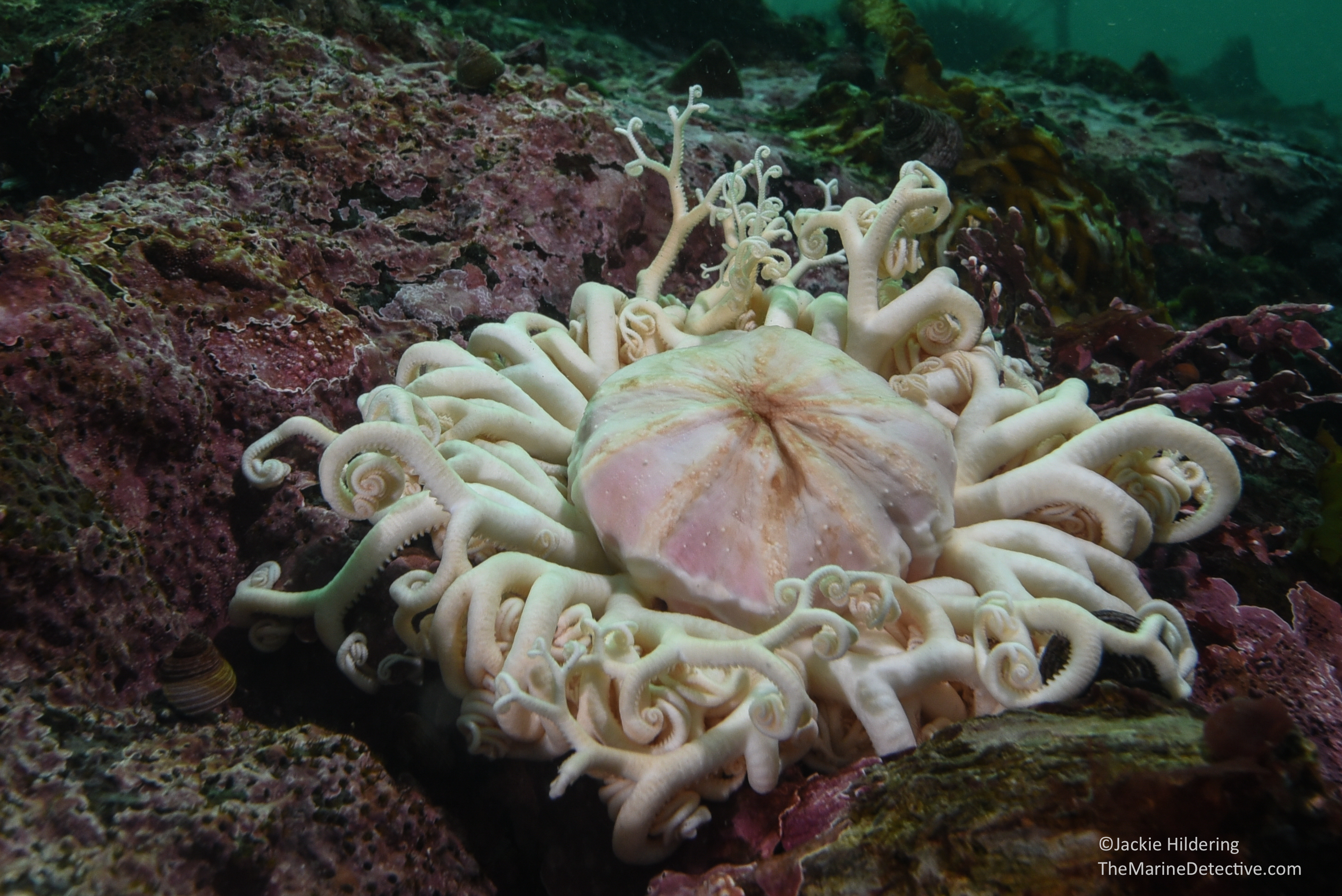
You’ll note from the photos how colour varies from beige to white and how the oral disc (the centre part) can have distinctive brown markings. Yes, I have thought about trying to identify and catalogue individuals. Please don’t encourage me!
You can see how their oral disc also varies from being very flat to very puffy. Some have hypothesized that this might be related to their reproductive stage but it could be due to food and/or oxygen availability. See the reference to Makenna Hainey’s research below.
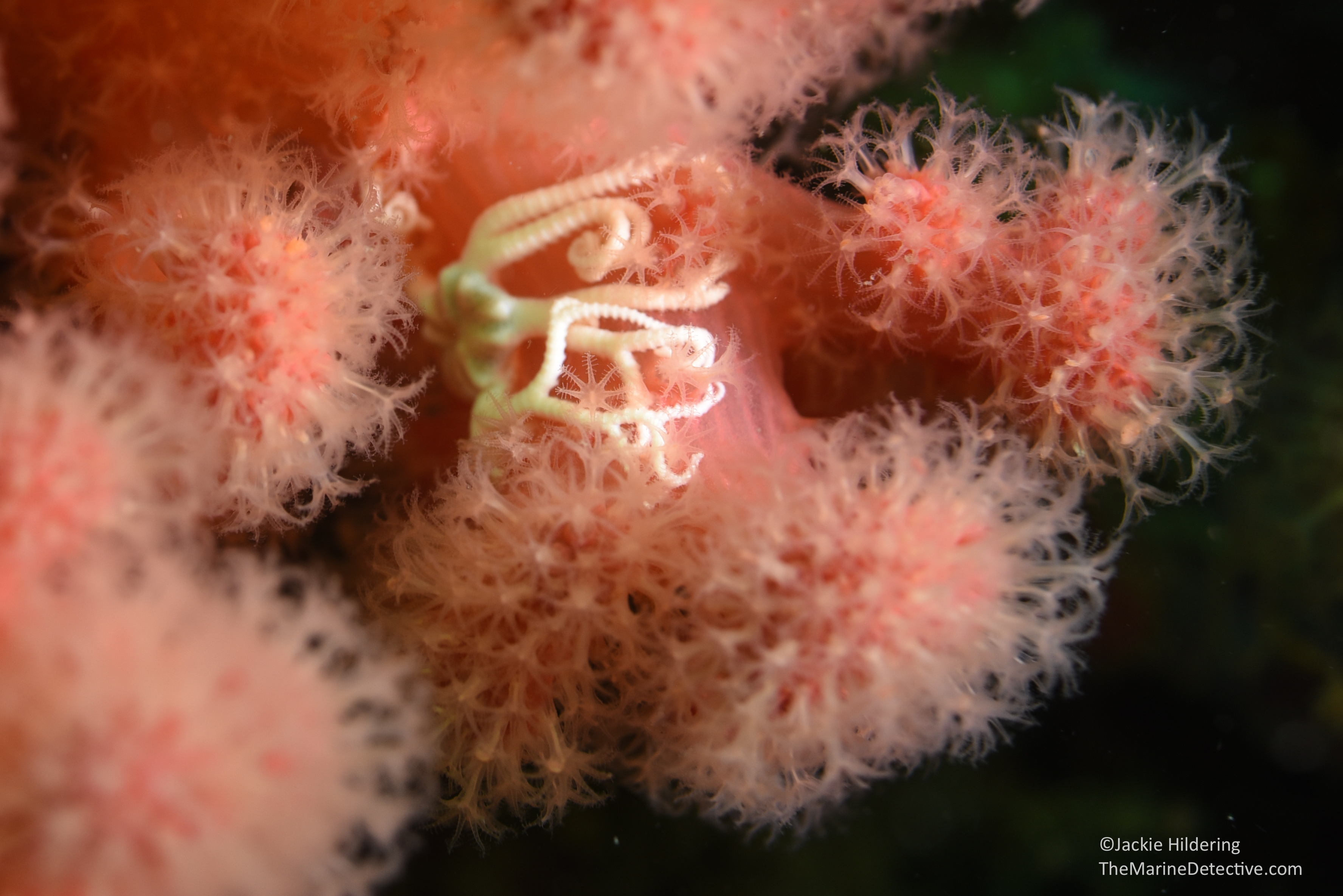
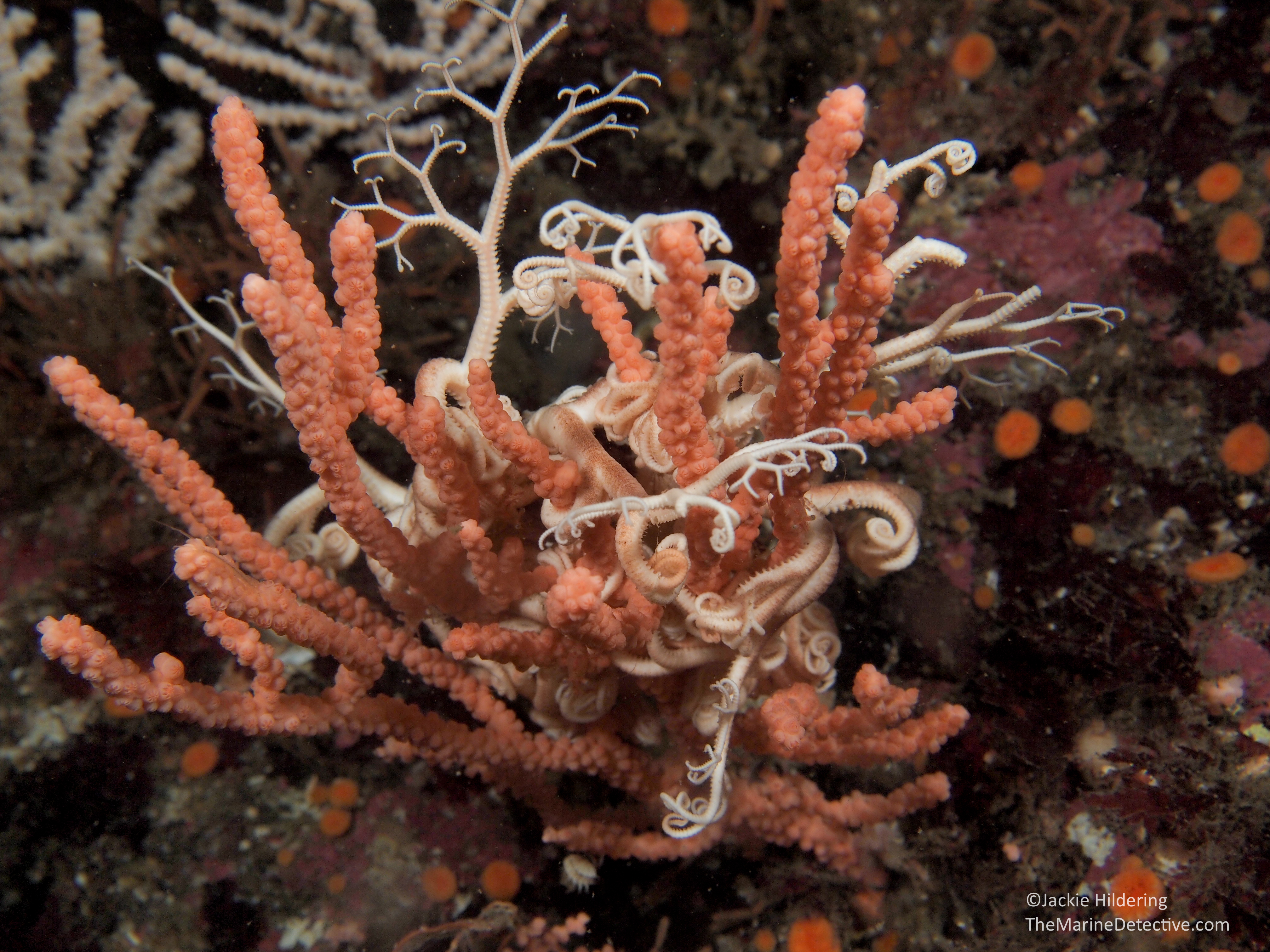
Wickedly wild embryos: Basket Stars reproduce by broadcast spawning. Adult males and females release their gametes into the water. When they settle to the ocean bottom, the embryos are reported to develop INSIDE the polyps of Red Soft Coral. It’s thought the embryos feed on the soft coral’s eggs which brood inside the parent coral. Whoa!
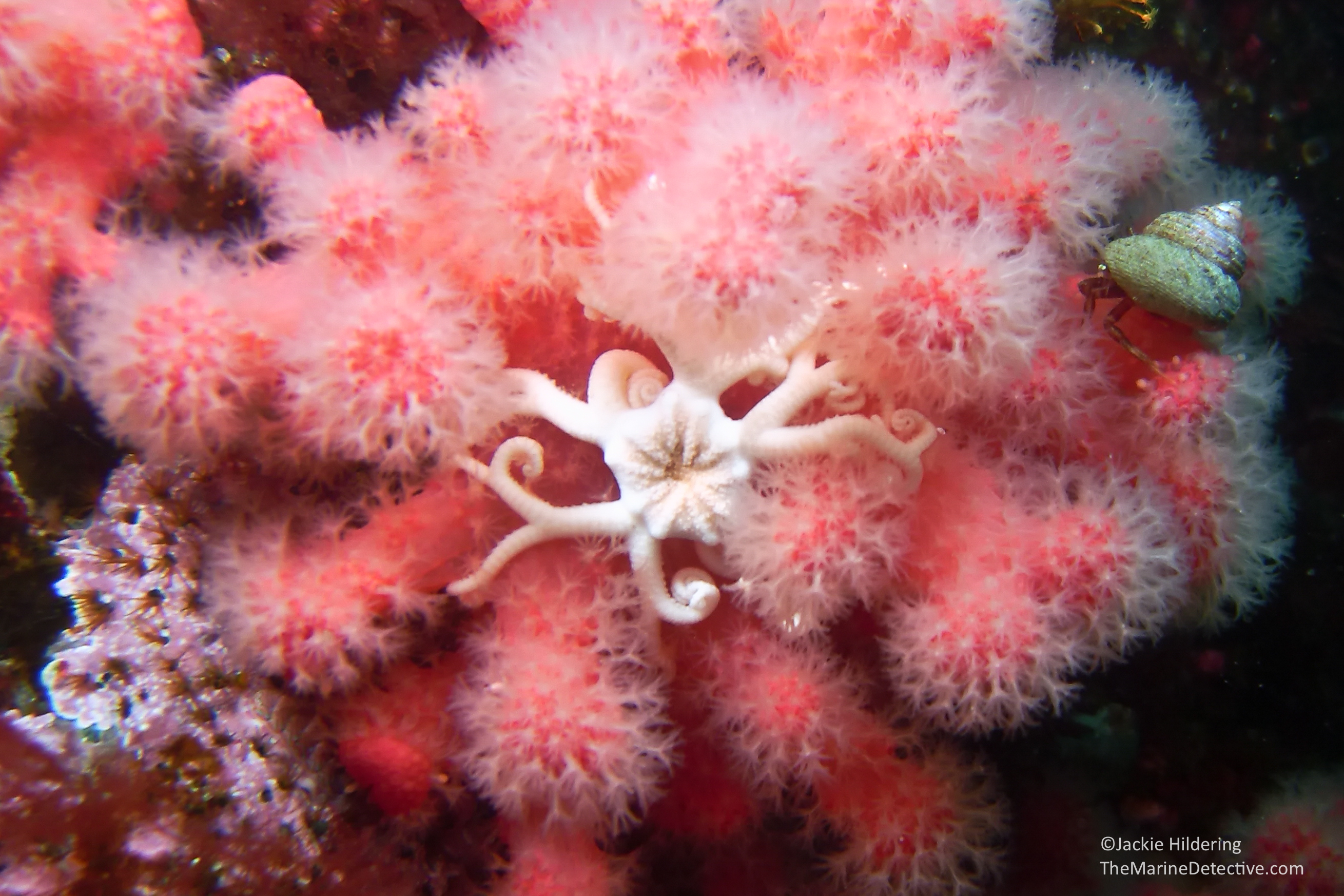
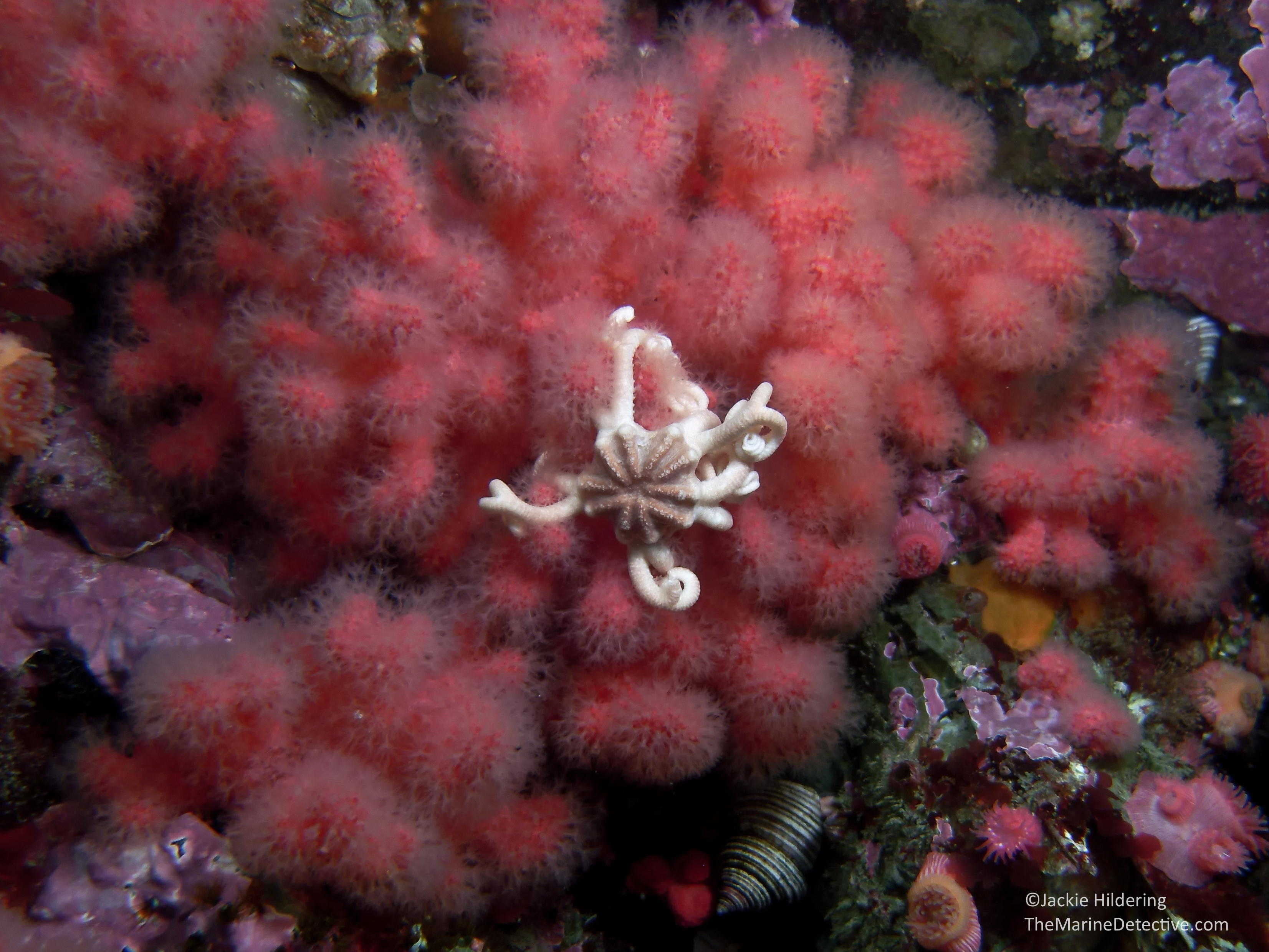
Baby Basket Star holding onto Red Soft Coral (Alcyonium sp.).
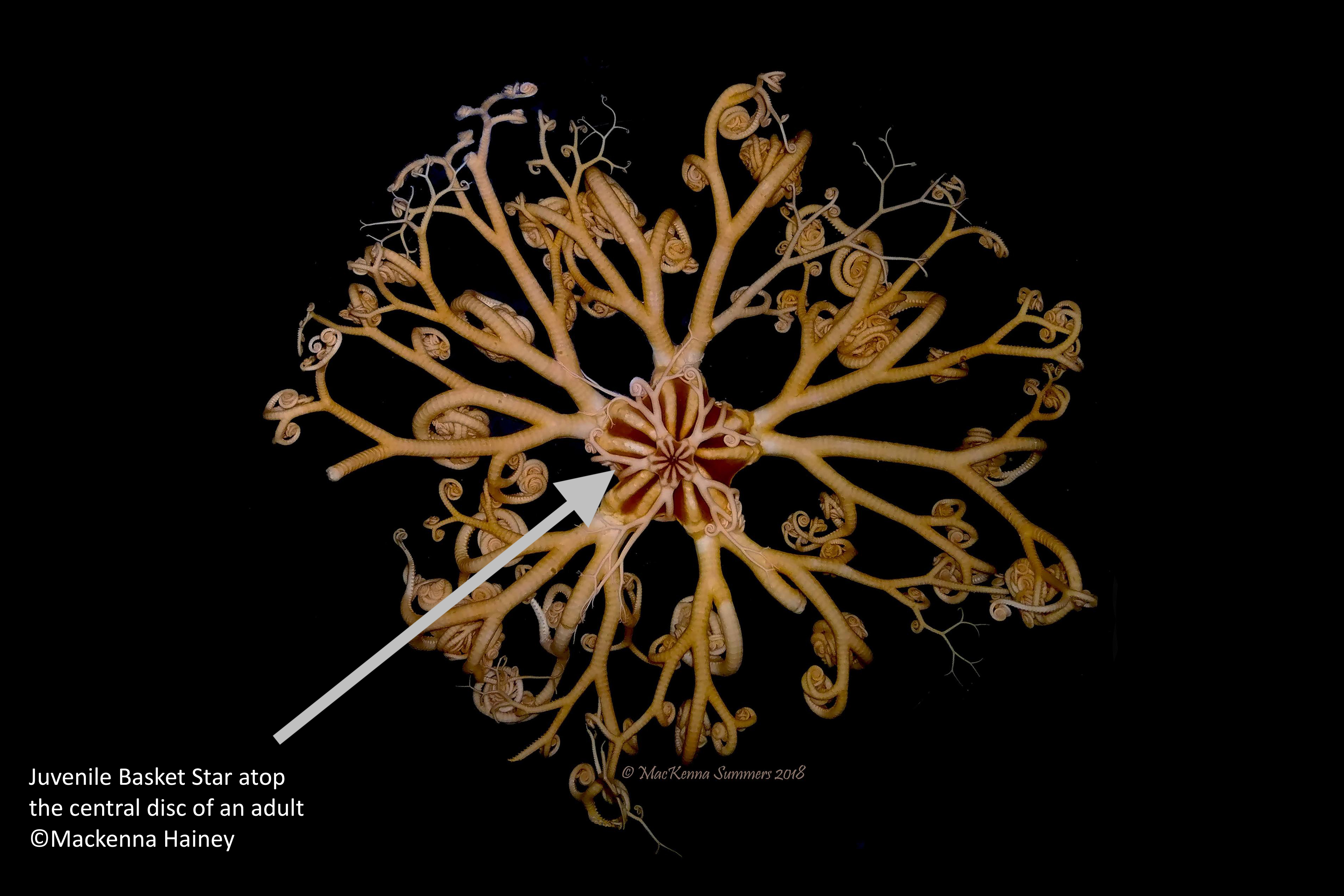
Then, when juvenile Basket Stars emerge from the coral’s polyps, they apparently hang onto the outside of the coral till about 3 millimetres in disk diameter. They shuffle off when approximately 5 centimetres in disk diameter and crawl onto an adult Basket Star.
From Makenna Hainey (personal communication, October 1, 2023): “No one really knows how the juveniles get onto the adults. But the leading theory is that they use Soft Corals as bridges. From there, they will steal food bundles out of the mouths of the parents.”
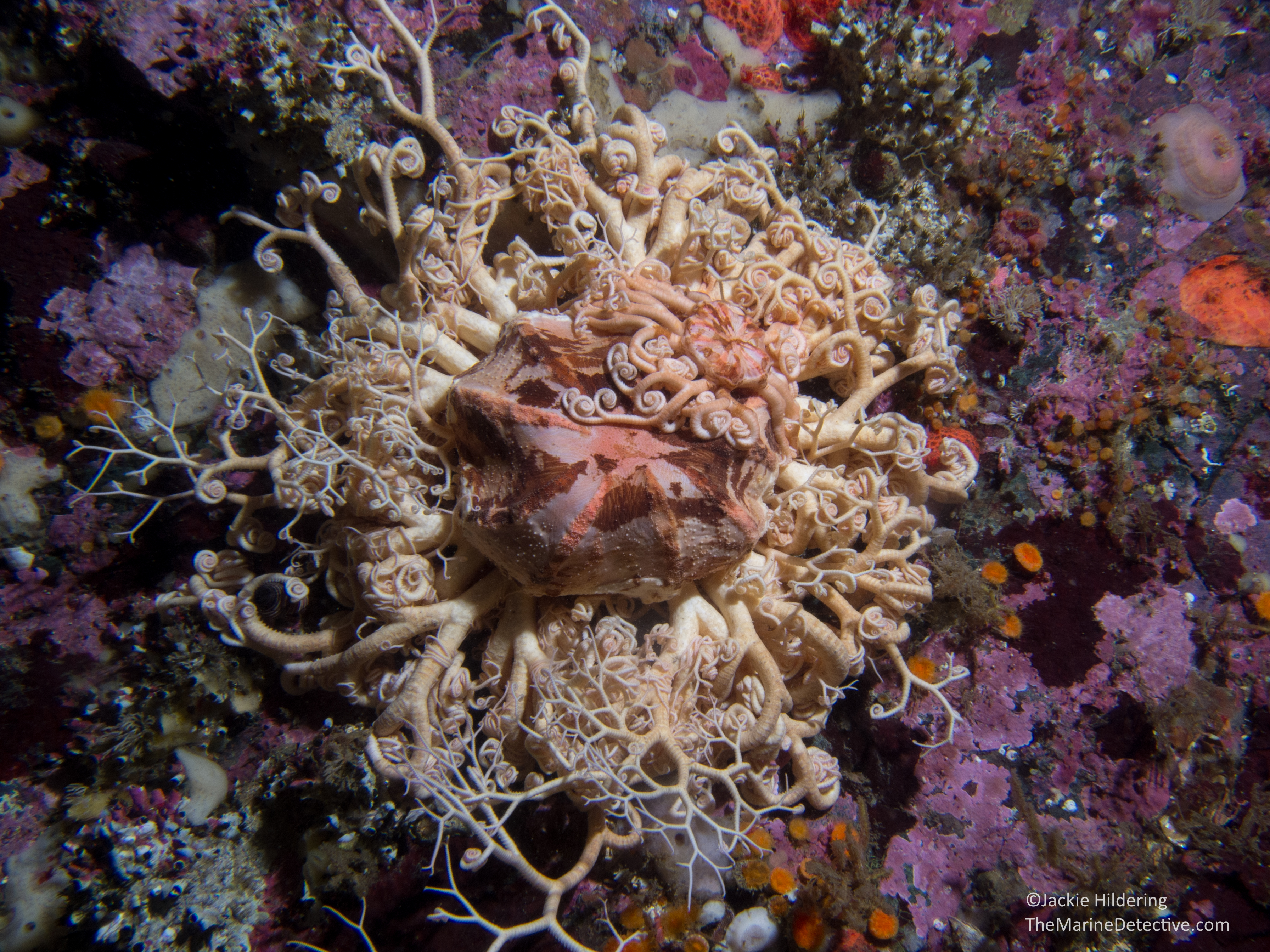
See the smaller Basket Star atop the adult (top right)?
More on diet and feeding: From Invertebrates of the Salish Sea: ” . . . feeds on suspended particles by spreading rays out like a fan, oriented mostly perpendicular to the current. Macroscopic zooplankton such as copepods, chaetognaths, and jellyfish are caught by microscopic hooks on the rays. The fine branchlet tips then curl around the object and slowly move it toward the mouth (exact method is unclear). The prey of basket star species is said to range up to 3 cm (just over an inch) in size, and most basket stars capture prey mainly at night but may retain their prey until daytime to actually feed on them. Mucus may also help to immobilize prey. This species has also been reported to feed on the small benthic sea pen Stylatula elongata [Spiny White Sea Pen]”.
From Makenna Hainey (personal communication, October 1, 2023): “Basket Stars have tube feet. But, unlike asteroids [sea stars], echinoids , and holothurians [sea cucumbers], they don’t have suction cups on the tube feet. Thy have microscopic hooks that look and operate mechanically like cats’ claws to pin down prey while the tube feet secrete paralyzing mucus. They almost immediately bring food down to the mouth, insert the arm into the mouth, and wipe the food bundles off on the oral spines.”
Basket Star unfurling its arms when on Gorgonian Coral. Basket Star and Creeping Pedal Sea Cucumbers (red) and Orange Social Tunicates.
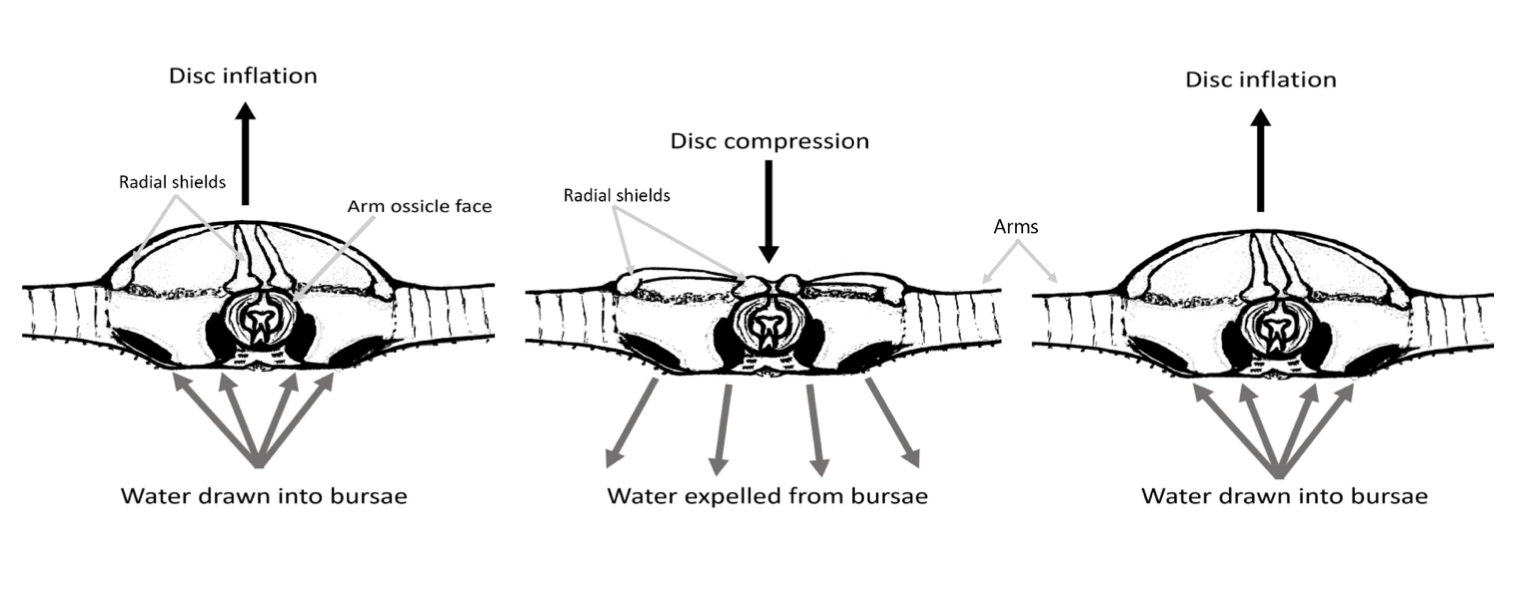
Breathing: Really interesting research has been done by Mackenna Hainey to measure the breathing rate (bursal ventilation) of this species of Basket Star.
Part of her research was to see, in a laboratory setting, how Basket Stars changed their breathing when fed a slurpee of krill. She found their breathing changed from approximately 10 to 30 an hour to 30 to 45 an hour.
Bursal ventilation of a Basket Star before and after food (krill slurpee) was added to the tank.
Mackenna reported: “Basket stars exhibited feeding behavior beginning a few seconds after food was introduced to the aquarium and lasted an average duration of 50 minutes . . . Once the food was detected by a basket star in the test aquarium, it quickly assumed a feeding position (some arms raised in a parabola, creating a basket shape with tendrils unfurled) and began to move 2-3 arms slowly through the water, looping arm tendrils as the arm hooks accumulated particles of krill. The rate of bursal ventilation increased rapidly once this feeding activity began.”
Breathing / ventilation rate also increased when the Basket Stars were exposed to reduced oxygen levels.
Range: Basket Stars have been documented at depths from 8 to 1,850 metres. They are believed to be more common at depths between 15 to 150 metres.
Their range range was thought to be from the Bering Sea to San Diego until research published in 2014 reported that a Basket Star was documented from a submersible at Guadalupe Island, Mexico. That sighting extended their known range by over 400 kilometres.
Relatives: Basket Stars are echinoderms, the phylum to which sea stars, urchins, feather stars, sand dollars, and sea cucumbers also belong. Basket Stars do not belong to the same class as sea stars such as Sunflower Stars, the Asteroidea. Basket Stars are in the Ophiuroidea class comprised of brittle stars and other basket star species. This class dates back 500 million years (give or take a million).
Photo gallery: Because there can never be too many photos of Basket Stars.
Basket Star and Jacqui EngelBasket Star, Red Soft Coral and Red Irish Lord.
Etymology of the scientific name Gorgonocephalus eucnemis: Gorgonocephalus = gorgós is Greek for dreadful and cephalus is Greek for head. “Dreadful head” is in reference to Basket Stars looking like the head of the Gorgon in Greek mythology. Eucnemis = Greek for good or boot. A good dreadful head?! ☺️
Lambert, P. and Austin, W.C. (2007) Brittle stars, sea urchins and feather stars of British Columbia, southeastern Alaska and Puget Sound. Victoria, Canada: Royal British Columbia Museum
With a song in my heart, I can announce, the 2025 WILD Calendar is now available. Such great thanks to all who helped by voting on the selection of photos. They can be ordered at this link.
My WILD Calendar is aimed at creating awareness about the diversity and fragility of life hidden in the cold, dark, life-sustaining northeast Pacific Ocean. It is the waters dark with plankton that have more life, produce more oxygen, and buffer more carbon dioxide.
It’s the 16th year I have made a WILD Calendar. I am so grateful to all who put these calendars into the world. You are helping increase connection and understanding of our reliance on the Ocean. That’s needed to make the decisions, day-by-day, that consider future generations. 💙
Each month’s photo has a detailed descriptor included about the featured marinelife. The calendars are $27.50 + tax.
They are large and printed on sturdy paper on Vancouver Island, coil bound with a hole to hang them. 33 x 26.5 cm closed and 33 x 53 cm open (13 x 10.5″ closed /13 x 21″ open).
There are BIG spaces to write your daily adventures.
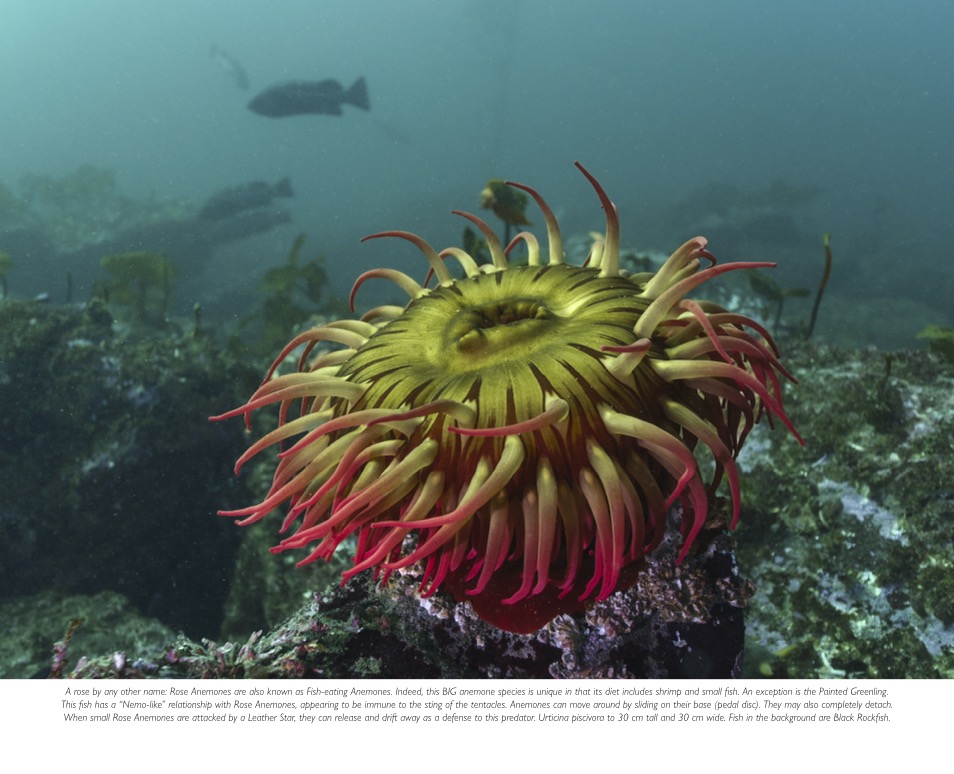
A rose by any other name: Rose Anemones are also known as Fish-eating Anemones. Indeed, this BIG anemone species is unique in that its diet includes shrimp and small sh. An exception is the Painted Greenling. This sh has a “Nemo-like” relationship with Rose Anemones, appearing to be immune to the sting of the tentacles. Anemones can move around by sliding on their base (pedal disc). They may also completely detach. When small Rose Anemones are attacked by a Leather Star, they can release and drift away as a defense to this predator. Urticina piscivora to 30 cm tall and 30 cm wide. Fish in the background are Black Rocksh.
February 2025 image and text
The embrace: Bull Kelp intertwined in water thick with plankton. Love the ocean and the algae. They sustain life above and below the surface. From the microscopic to giant kelps, algae photosynthesize – absorbing climate-changing carbon dioxide and producing food and oxygen. At least 50% of the oxygen on Earth comes from marine algae and there is more productivity where the water is cold and there is high current. Kelp forests are also essential habitat to so many species. Kelp is impacted by changes in climate and the plight of Sunower Stars (which feed on Green Urchins which graze on kelp). Bull Kelp is Nereocystis luetkeana to 36 m long.
March 2025 image and text
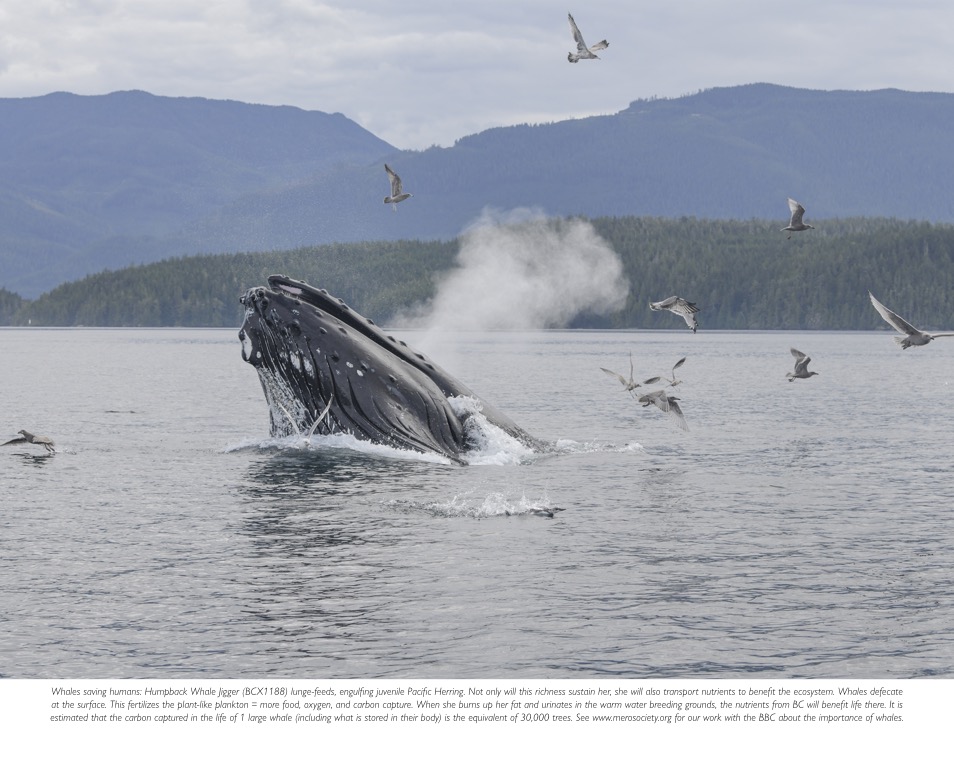
Whales saving humans: Humpback Whale Jigger (BCX1188) lunge-feeds, engulfing juvenile Pacific Herring. Not only will this richness sustain her, she will also transport nutrients to benefit the ecosystem. Whales defecate at the surface. This fertilizes the plant-like plankton = more food, oxygen, and carbon capture. When she burns up her fat and urinates in the warm water breeding grounds, the nutrients from BC will benefit life there. It is estimated that the carbon captured in the life of 1 large whale (including what is stored in their body) is the equivalent of 30,000 trees. See http://www.mersociety.org for our work with the BBC about the importance of whales.
April 2025 image and text
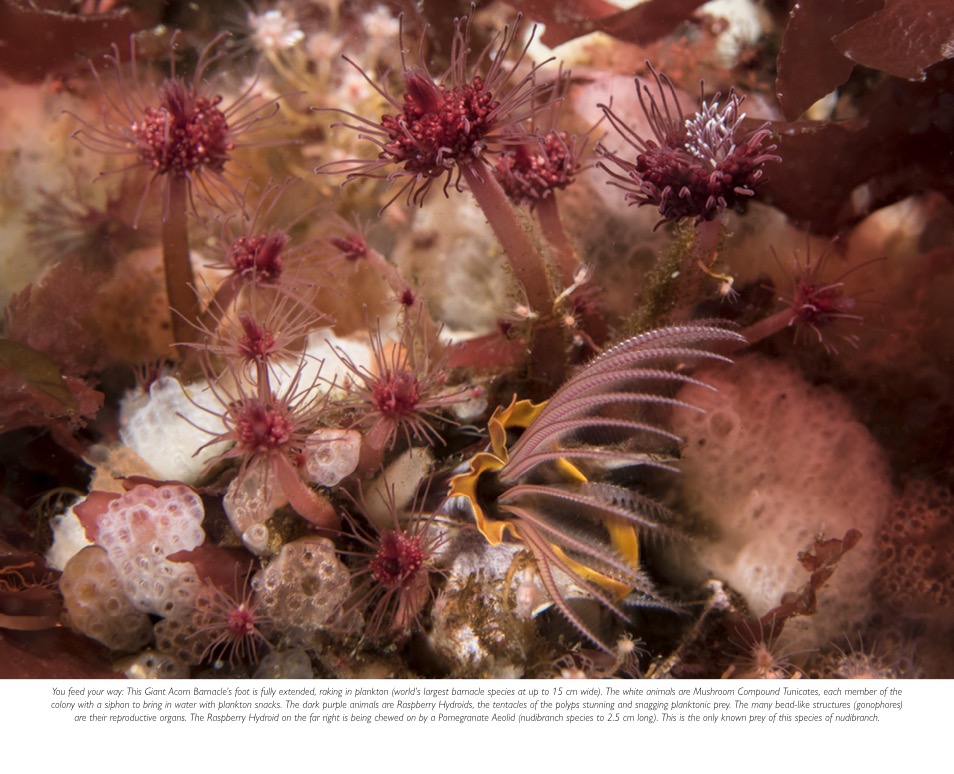
You feed your way: This Giant Acorn Barnacle’s foot is fully extended, raking in plankton (world’s largest barnacle species at up to 15 cm wide). The white animals are Mushroom Compound Tunicates, each member of the colony with a siphon to bring in water with plankton snacks. The dark purple animals are Raspberry Hydroids, the tentacles of the polyps stunning and snagging planktonic prey. The many bead-like structures (gonophores) are their reproductive organs. The Raspberry Hydroid on the far right is being chewed on by a Pomegranate Aeolid (nudibranch species to 2.5 cm long). This is the only known prey of this species of nudibranch.
May 2025 image and text
Pulsing with life: Lion’s Mane Jelly reflected against the surface. Cyanea capillata can be over 2 m across with 8 clusters of 70 to 150 tentacles which can be more than 9 m long. One is reported to have been 2.3 m across with 36.6 m long tentacles (was in the North Atlantic and may be classfied as a different species, McClain et al., 2015). The jelly in this photo was ~50 cm wide and tentacles were retracted. Jellies know which way is up. Small organs (“rhopalia”) sense gravity and light. Lion’s Mane Jellies have 1 between each of the 8 lobes of their bell. This species is among the very few in BC waters that have a sting that can cause human discomfort.
June 2025 image and text
Infinite wonder: 1. Sea star is a Leather Star (Dermasterias imbricata to 30 cm across). You can see some tube feet, their gills, and the “madreporite” – circular structure that is the opening to the water vascular system. Water enters to allow locomotion, respiration, and feeding. 2. Nudibranch is a Cockerell’s Dorid (Limacia cockerelli to 3 cm long). See the high surface area of the two “rhinophores” to detect chemicals/smell. 3. Species of encrusting coralline algae. Has a hard layer of calcium carbonate. They photosynthesize, making food and oxygen, and taking in carbon dioxide. 4. Snail is a Variegated Amphissa (Amphissa versicolor to 1.9 cm long).
July 2025 image and text
Bountiful biodiversity: This is just below the surface in so many areas off our coast. This is what we are connected to in many of our daily decisions . . . a dark ocean sustaining life in an intricate web, from anemones to nudibranchs, from plankton to people. The species here include: White-spotted Rose Anemone (to 25 cm tall / 15 cm wide); Monterey Dorid (nudibranch species to 15 cm long); Whitecap Limpet (to 5 cm across) with a Crenate Barnacle on its shell (to 2 cm); juvenile Bering Hermit Crab (to 2.5 cm) in a shell once made and inhabited by a Threaded Snail (to 2 cm); and species of crustose coralline algae (pink).
August 2025 image and text
Another living gem: Longfin Sculpins are powerful ambassadors for the colour in these cold waters. Just look at the patterns, the texture, and the gossamer fins. They crawl with their pectoral fins and can hold on vertically, head oriented downward, like Spider-Man. They rarely swim more than 0.5 m off the bottom and are most often solitary (except when mating and egg guarding). They are reported to be very territorial of areas that are 0.3 to 0.5 metres squared (source: Love, 2011). They darken at night to match their surroundings = “nocturnal protective colouration”. The males are also darker when courting females. Jordania zonope to 15 cm long.
September 2025 image and text
Symbionts: Ochre Stars and Giant Green Anemones in the shallows. This anemone species is vibrant green when the symbiotic algae living in their guts receive a lot of sunshine. More sun = more food through photosynthesis. The anemones benefit from the nutrients made by the algae. The algae benefit by being where their predators can’t get them (grazers like limpets, chitons, and snails). This anemone species is Anthopleura xanthogrammica to 30 cm high / 30 cm wide. The symbiotic algae are zoochlorellae (green algae) and zooxanthellae (dinoflagellates). There is also a green pigment in the skin of the anemones.
October 2025 image and text
Eight-armed teacher: For a little levity, here are some lessons I’ve learned from Giant Pacific Octopuses. (1) Do not fear what looks different. (2) Respect alternative intelligences. (3) Blend in to escape detection when necessary. (4) Trust your ability to squeeze through tight spaces and come out the other side. (5) Ink out the negative and jet away, leaving it behind you. (6) Know where your home is and keep the garbage outside. (7) Be big-hearted (octopuses have 3 hearts) and guard the next generation. (8) Use your beak when needed. Enteroctopus dofleini to 7.3+ metres from arm tip to arm tip. Of course there’s an octopus photo for October!
November 2025 image and text
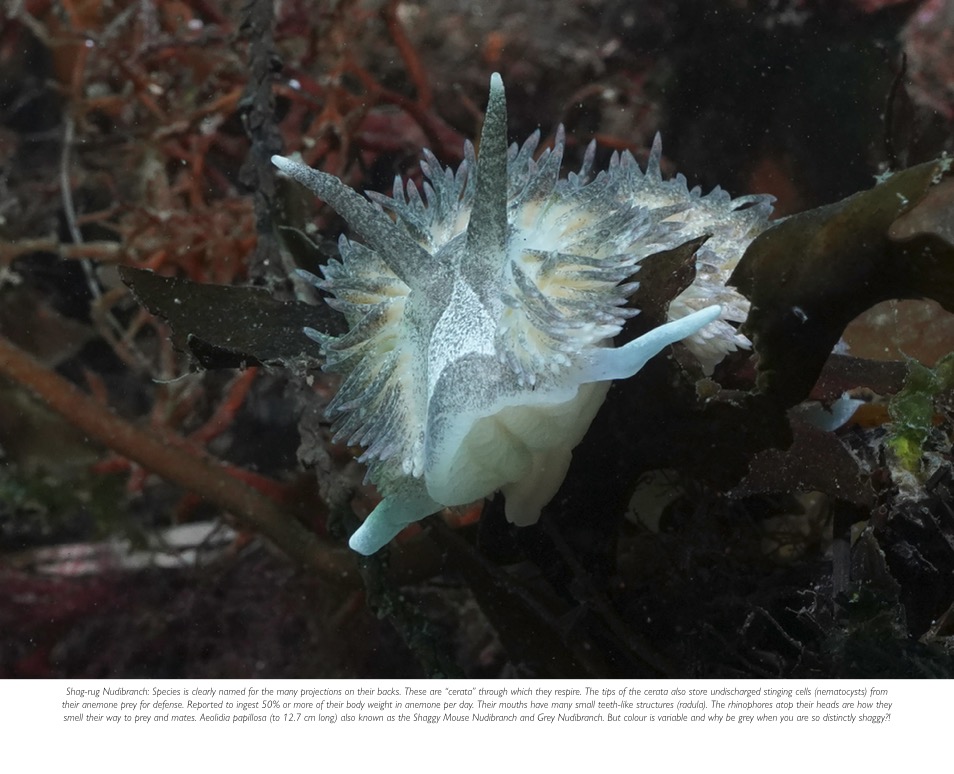
Pretty little predators: These Red-gilled Nudibranchs are feeding on Bushy Pink-mouth Hydroids – colonies of animals with stinging cells (nematocysts). The white coils are the nudibranchs’ egg ribbons. The bushy structures on the backs of the nudibranchs are the cerata. These function as gills and also have a role in defence. The stinging calls from their prey end up at the tips of the nudibranchs’ cerata. Yes, they “steal” the weapons of their prey and lay their eggs on top of them. Bushy Pink-mouth Hydroids are Pinauay crocea to 15 cm tall. The flabellina nudibranchs have undergone much reclassification. I believe these are Coryphella verrucosa to 10 cm long.
December 2025 image and text
No two alike: Rose Stars are also known as Snowflake Stars because there is so much diversity in pattern and colour. Even the number of arms varies, ranging from 8 to 16 (most often 11). They are fast at 50 cm/minute (source: McDaniel, 2018). You can see 3 structures on the surface of the sea star: (1) spines; (2) pedicellaria = structures that can nip off the tube feet of other species of sea star e.g. the predatory Morning Sun Star; and (3) papulae = the tufts that are the gills / respiratory organs. Crossaster papposus to 34 cm but in BC maximum size is believed to be ~17 cm. One species. So many colours. That’s beauty. That’s biology.
Here’s a tale of two octopuses, recounted from a recent dive.
But first a little background:
Giant Pacific Octopuses must see we human divers, far, far, FAR more often than we see them. They are so good at camouflage!
There are sometimes good clues they are near.
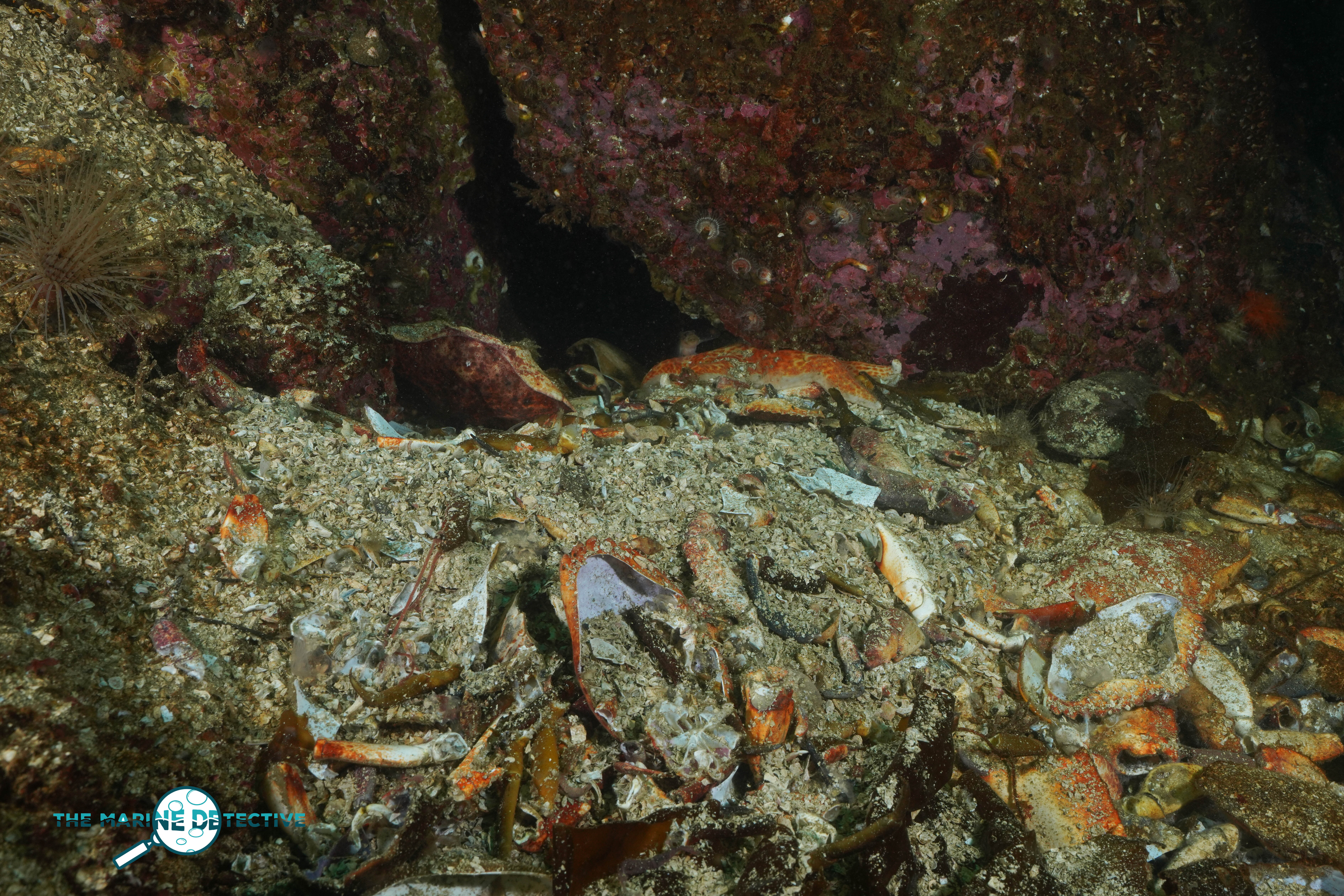
A really helpful clue is that their homes (dens) have the remains of their dinners thrown out in front i.e. middens of shells from crabs and bivalves like scallops.
The area in front of a Giant Pacific Octopus’ den who has clearly been eating a lot of scallops! And the Giant Pacific Octopus who lives in this den has clearly been eating a lot of Red Rock Crab.
If the octopus is shedding their suckers, you will also have the clue of seeing little “flakes” coming from the den. See my blog about that at this link.
They are of course easier to see if on the move. When a Giant Pacific Octopus is hunting, there sometimes is an entourage of rockfish too, hoping to benefit when the octopus flushes out the other fish and shrimp from between rocks.
See the Copper Rockfish on the right? This fish was following this female Giant Pacific Octopus around as she hunted.
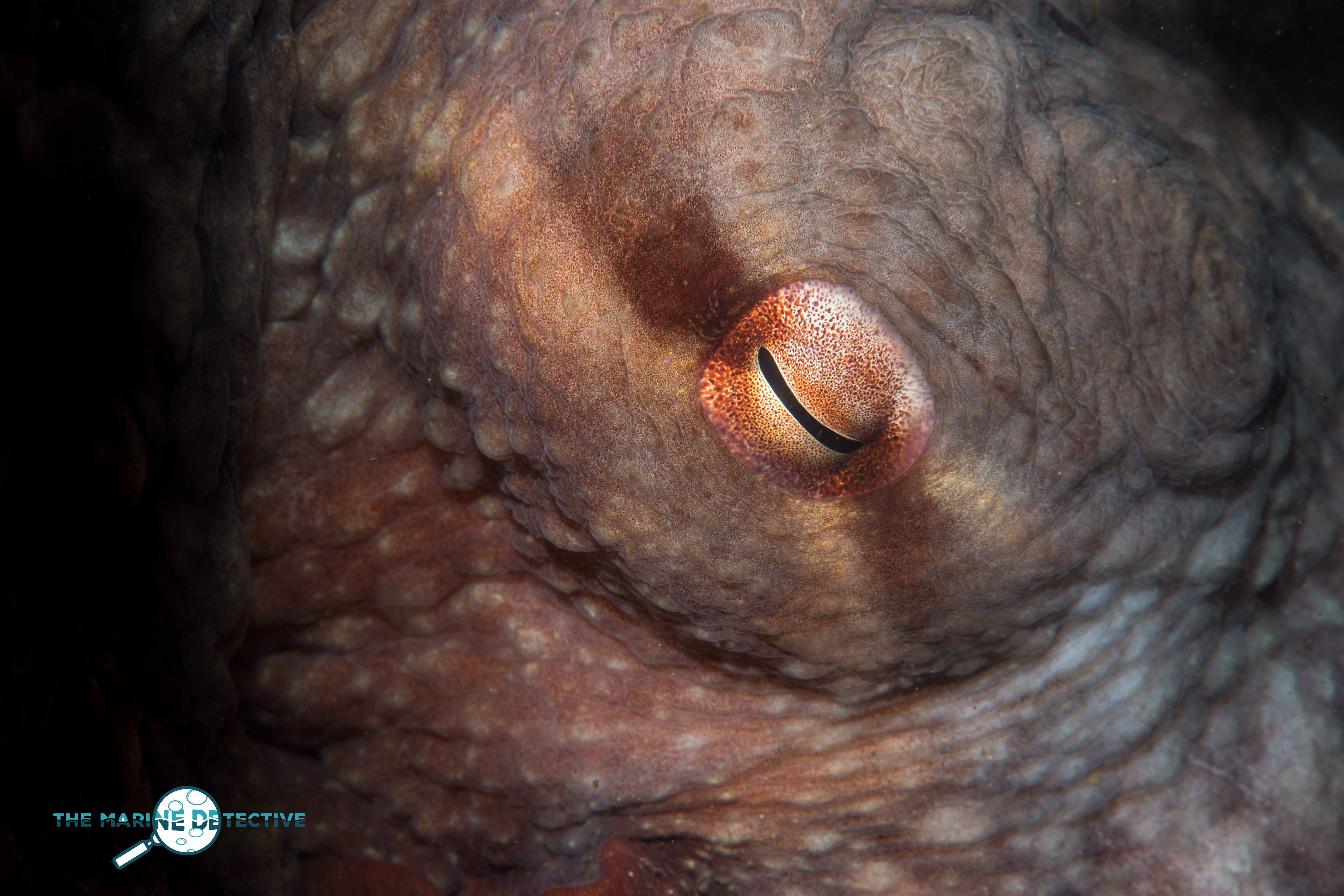
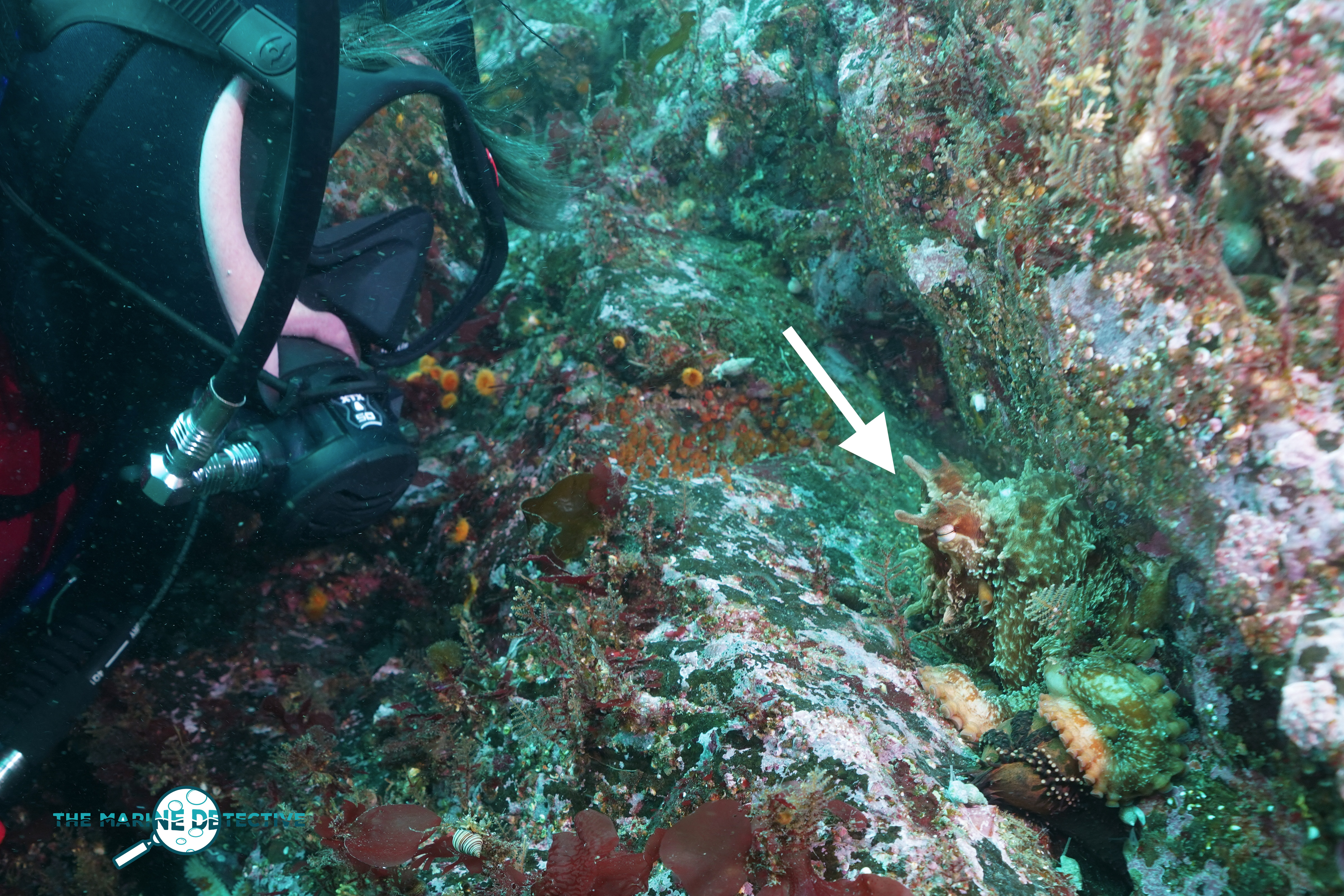
But otherwise, you just have to have the luck to realize the rock you are looking at has eyes with remarkable pupils.
Giant Pacific Octopus eye with the pupil constricted due to my light. I took the photo with a zoom lens when this octopus was in her den.
Now the tale of two octopuses on one dive:
Now that I’ve emphasized how difficult it can be to detect an octopus, let me share the joy of seeing two Giant Pacific Octopus within 5 minutes.
Octopus #1 was out on a ledge. You can see how small this one is from the relative size to my dive buddy, Natasha.
See the small Giant Pacific Octopus? The same little Giant Pacific Octopus.
I saw Octopus #2 about 4 minutes after seeing the first octopus. We were still blissed out from that encounter. Then, I saw a big arm reach for a Kelp Greenling (fish).
I think I may have shouted in surprise. The fish darted away because of my reaction I think. I am truly sorry dear octopus for spoiling your dinner. I didn’t mean to!
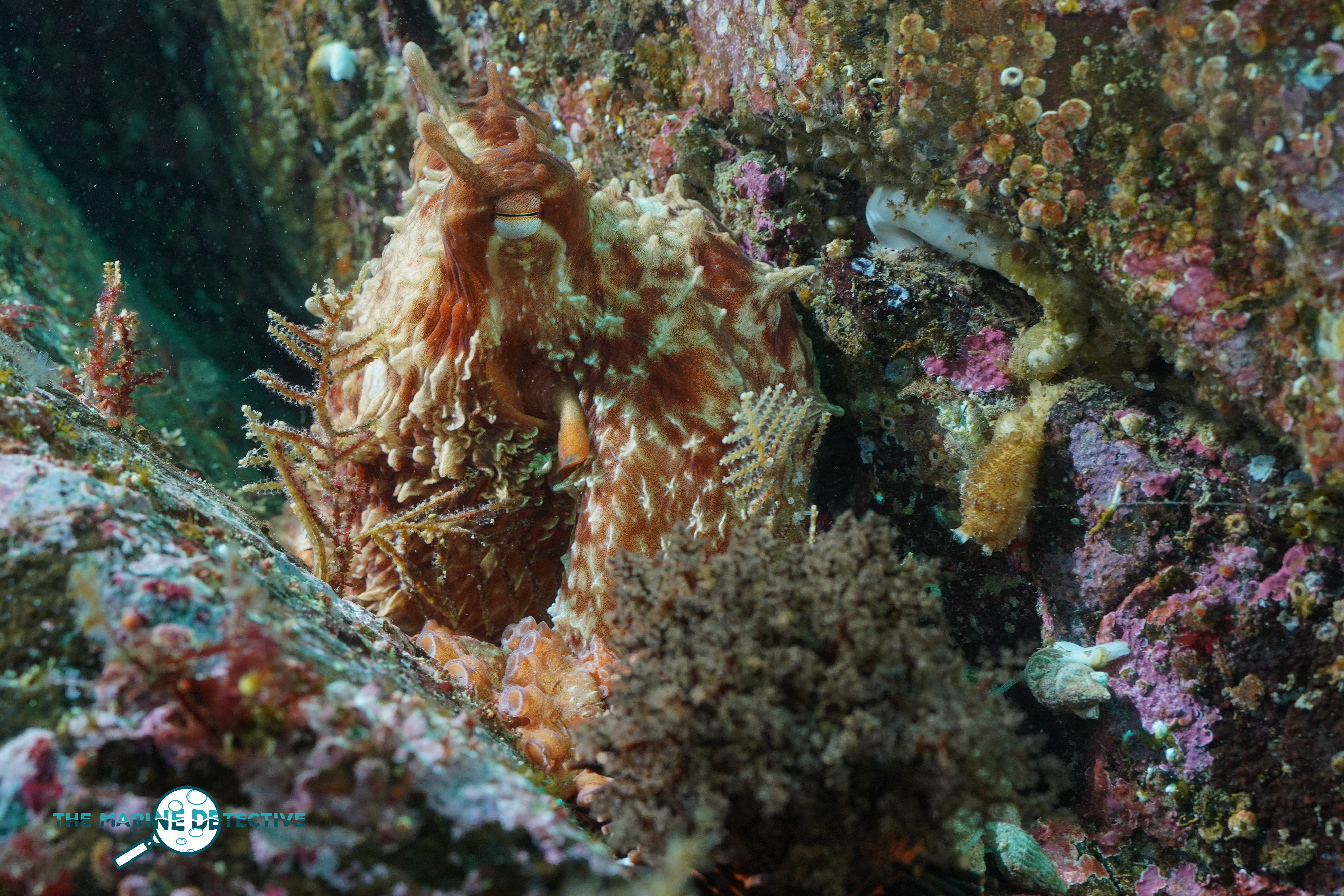
This Giant Pacific Octopus remained motionless other than their siphons (vents) opening and closing to breathe, billowing water in and out.
Giant Pacific Octopus #2
I got lost for a little while in trying to capture the beauty of this giant and their environment – Black Rockfish swimming above, the pink crusts of coralline algae, Orange Cup Corals, a hermit crab, Wrinkled Amphissa snails.
Time and air passed a lot faster than I realized, or wanted. To the surface, we needed to go. I left wondering when I would next see a Giant Pacific Octopus out in the open again. The Giant Pacific Octopus was probably left hoping some weirdo-looking creature doesn’t spoil their dinner again.
Octopus #2 tolerating my presence.
About estimated Giant Pacific Octopus growth rate: When they hatch from eggs as plankton, they are about the size of a grain of rice. They have to grow incredibly quickly to become giants, only having a lifespan of about 3 years. From Jim Cosgrove and Neil McDaniel’s great book “Super Suckers”: They start at ~0.03 grams (0.0011 oz) and grow to 20–40 kg (44–88 lb) at adulthood = an increase of around 0.9% per day.
Photos of the two Giant Pacific Octopuses are from a dive on April 11, 2023, Browning Pass when with God’s Pocket Resort. On this dive, I had even more gratitude than usual for my dive buddy Natasha Dickinson. I’ve been having big problems with the strobes of my camera and she helped by providing lighting for these photos.
I’ve wanted to write a blog about chitons for so long because, they are wondrous and . . . we need wonder.
If you are fortunate enough to live near the Ocean, chitons are there, on rocks right in the intertidal zone, descendent from ancestors that date back ~500 million years. Chitons are in fact referenced as living fossils since their body design has not changed significantly for more than 300 million years.
Other members of this class are found at great depth. There are about 1,000 species worldwide with 50 known to live in the range from Baja California, Mexico to the Aleutian Islands, Alaska.
What makes them unique among molluscs (the soft-bodied invertebrates) is that while some molluscs have no shell (octopuses, squid and sea slugs); and some molluscs have one shell (snails, abalone and limpets); and some molluscs have two shells (clams and oysters) . . . chitons went their own way to all have EIGHT shells, known as plates.
This is reflected in the name of the class to which they belong – the “Polyplacophora” which translates into “many plates” in Greek. Oh and “chiton” also reflects that they have multiple shells. Chiton is Greek for “coat of mail”. Chiton is pronounced “ky-ton” by the way.
Chiton anatomy – diagram retrieved from this source.
But all the preceding information about chitons is what you could read in a field book. Let me share the wonder of chitons with you as it has awakened in me, taking my appreciation far beyond the limits of drawings and words in biology textbooks.
Chitons are THIS.
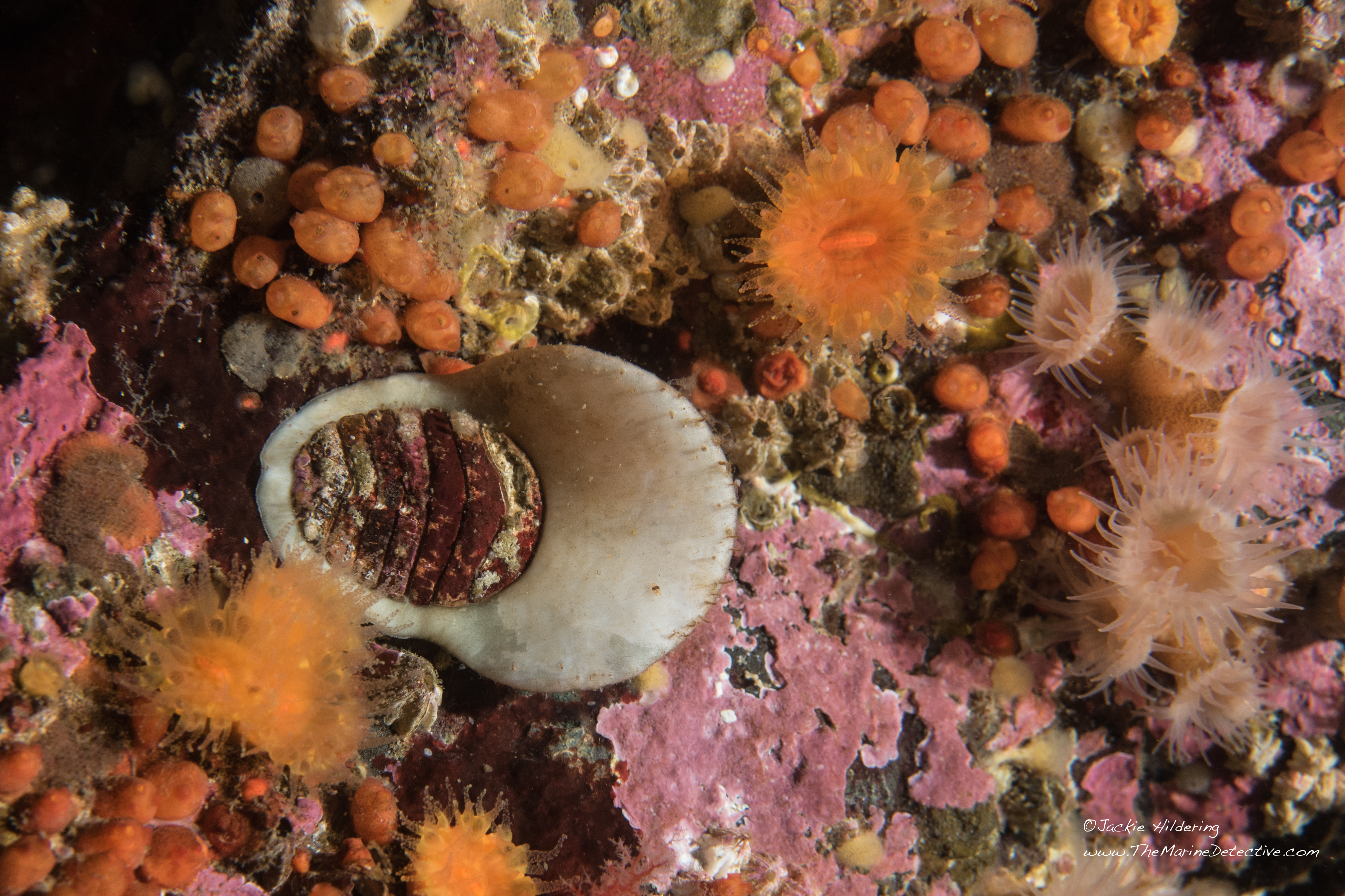
Lined Chiton – Tonicella lineata to 5 cm long. This is also the species in the photo at the top of this blog item. There’s such diversity in the colour of this species!
And THIS
Believe this one is a Blue-line Chiton – Tonicella undocaerulea to 5 cm long.
And THIS
Woody Chiton – Mopalia lignosa to 8 cm long.
And THIS
Black Katy Chiton aka Black Leather Chiton – Katharina tunicata to 15 cm long.
And THIS
Red Veiled-Chiton (Placiphorella rufa to 5 cm long) – unique amongst chitons in how it feeds. Most chitons graze, scraping algae off rocks with their radula (see video at the end of this blog). However, Veiled Chitons are carnivores! When an animal wanders under their veil, this triggers the veil to drop and then . . . lunch. You can see how quickly that happens in the video at the end of this blog.
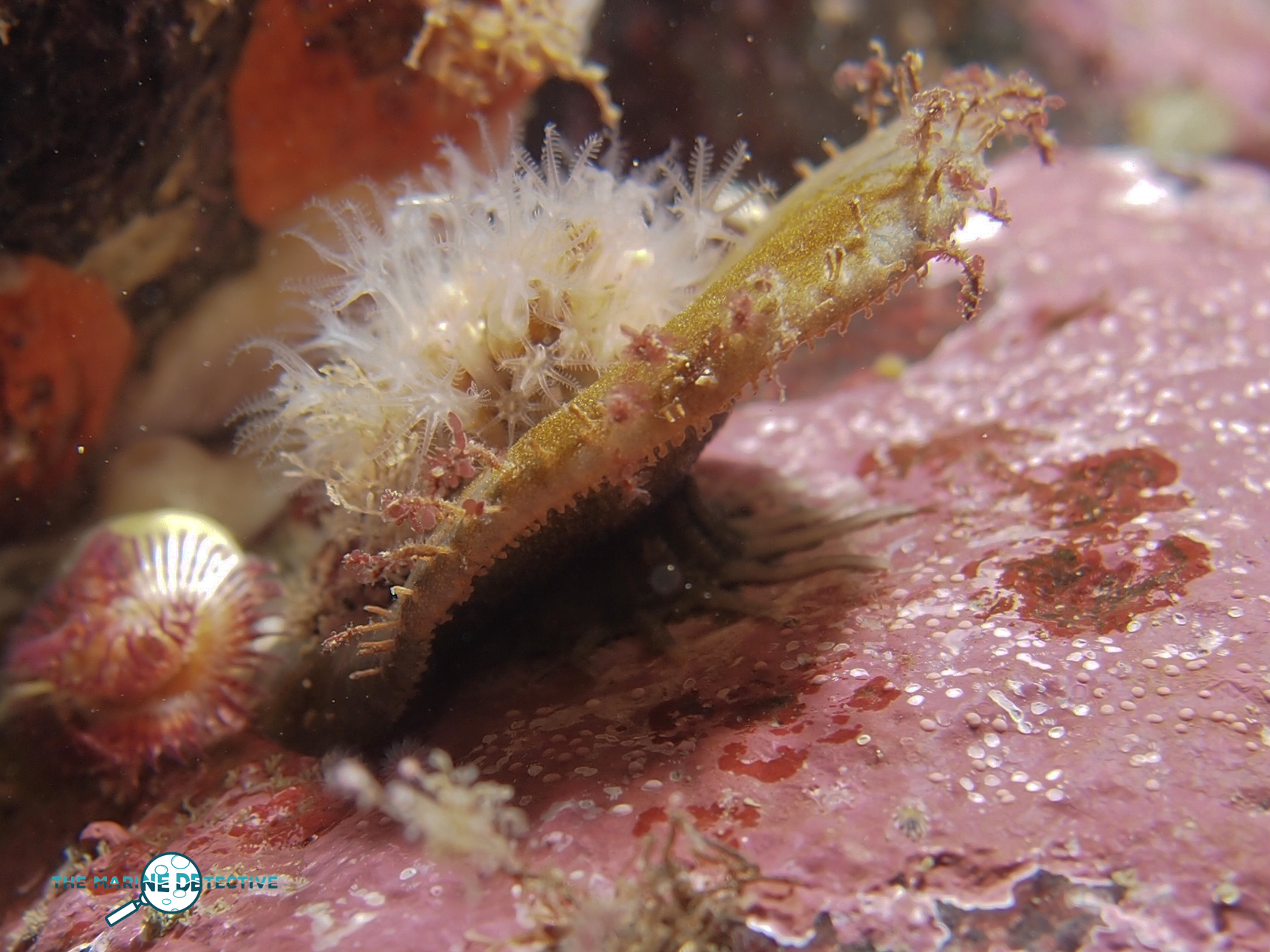
Veiled Chiton – Placiphorella velata to 6 cm. Soft coral is growing on top of the Chiton.
By having eight plates and a band of muscle (the girdle) chitons are flexible and can secure themselves really well to uneven or curved surfaces. This is very different from molluscs like limpets. With their single shell, they have to be on a very flat surface to be secure, and therefore safe from predators.
In most species of chiton, you can see the eight plates. The exception is the giant in the group – the Gumboot Chiton aka the Giant Pacific Chiton. In this species, the girdle fully covers the plates.
See the photo below and my blog dedicated to Gumboot Chitons at this link. That blog includes photos of their “butterfly shells” and video of Gumboot Chitons spawning. Yes, you can then discern males from females!
Gumboot Chitons are another species in these rich waters that are the “biggest of their kind in the world”. The maximum size of Cryptochiton stelleri is reported to be 35 cm!
The plates on the right are from a Gumboot Chiton.
Nature once presented me with the following opportunity to take a picture that shows the diversity of molluscs. I did not move the species into the positions you see in my photo below.
Mollusc biodiversity 1. Keyhole Limpet, protected by its single-shelled cap and by sucking down on flat surfaces. This individual is in a precarious position for predation because it is not secured to a flat surface. 2. Wrinkled Amphissa Snail, protected by its single shell and a keratinous “trapdoor” (operculum) that seals the shell. 3. Pomegranate Aeolid (nudibranch species), with no shell but protected by the stinging cells obtained from its prey – the Raspberry Hydroid. 4. Blue-Line Chiton protected by its eight shell plates and a strong band of muscle that lets it solidly adhere to non-flat surfaces.
These extraordinary animals are not jellyfish. In fact, they are more closely related to you than they are to jellyfish.
These are salps. They are planktonic tunicates with an astounding lifecycle and whose importance includes cycling of nutrients and reducing carbon.
Natasha Dickinson and aggregate form of Salpa aspera. Natasha was my dive buddy on the dives I reference here. We were diving with God’s Pocket in Browning Pass. Photo: Jackie Hildering.
When diving this past April, we happened to be in a bloom of the salp species “Salpa aspera“.
It was truly mind-rupturingly, staggeringly astounding to be carried in the current with so many chains of clones snaking by (they are jet propeled). Yes, I had to make up a new adverb just for this experience!
The stomach is the dark, circular organ you see in each individual in the chain (aggregate).
We also saw an individual break from the chain and move independently! More on that below.
Male Kelp Greenling nipping at Salp aspera. We also saw multiple rockfish species feed on them. Seastar species here is a Striped Sun Star. Photo: Jackie Hildering
Which species of salp?
I did not know which species of salp was all around me. Thankfully, I was able to tap into expertise far greater than my own. Moira Galbraith, Zooplankton Taxonomist with the Institute of Ocean Sciences, very generously shared her knowledge when I sent her my photos, euphoric observations, and request for an ID.
Moira’s answer to my ID request: “By the size of the stomach and placement (red/green ball), the shape of the ganglion (the c-shape you can see at opposite end from the stomach) and the short projections along where the individuals are attached to each other; I would say that this is Salpa aspera. These have been washing up on beaches off the west coast of Vancouver Island. . ..
Each individual takes in water through the front and channels it out the back. There are muscles bands along the body which create a pulse or pump. Food is taken from the incoming stream and diverted to the stomach. The water going out the back allows the animal to propel itself through the water. Chains work together making it look like a snake or an eel moving through the water.”
Importance?
Salps can grow and reproduce VERY quickly when conditions are right. They are one of the fastest growing multicellular animal on Earth.
Salps are also big zooplankton.
As a result of their size and number, a whole lot of water gets filtered and the poop that comes out is bigger than the plankton that got consumed. These big “fecal pellets” sink and transport nutrients.
If the fecal pellets make it to the bottom of the ocean, they could carry carbon away from where it will enter the atmosphere. Further, when salps die, their bodies also sink quickly and could thereby remove more carbon from entering the atmosphere.
Source: Nereus Program
Lifecycle:
The chains are the “aggregate” form of the salp lifecycle. They are all female clones.
A male individual fertilizes the aggregate.
The females break-off from the aggregate and release a single embryo. The solitary females then go on to develop testes, become males and fertilize the aggregates.
Whoa! Imagine how astoundingly it was for us to watch an individual break from the aggregate and then move independently. If I understand the lifecycle properly, this would have been a female with an embryo.
Salp lifecycle. – alternation of generations where the asexually reproducing form makes the sexually reproducing form. Source: Henschke et al. Salpa aspera aggregate and the individual in the video (on the bottom left). All the pink animals on the ocean bottom are Great Winged Sea Slugs and their egg masses!
Range: Salpa aspera is “circum-(sub)tropica”l between 45° north and 45° south.
More information:
Madin et al., 2006: “Development of such large populations is presumably made possible by the high rate and efficiency of filter feeding by salps, their rapid growth and their alternation of sexual and asexual reproduction. These characteristics permit a rapid population response by salps to favorable food availability, such as may result from seasonally high phytoplankton productivity in oceanic regions of water mass intrusions and mixing along fronts. In some locations, high population densities of salps can be produced in as little as a few weeks.”
Woods Hole Oceaonographic Institute: “From their clear, blob-like appearance, you’d be forgiven for mistaking the salp for a jellyfish. But it turns out that these gelatinous zooplankton actually are more closely related to humans than to brainless jellyfish. Unlike the jellyfish, salps (and humans) boast complex nervous, circulatory and digestive systems, complete with a brain, heart, and intestines.
Salps use jet propulsion to efficiently glide through the ocean. They’re great at multitasking: while expanding and contracting their muscles to move, they’re also pumping phytoplankton-rich water through their feeding filters, taking in the nutrients they need to survive . . . .
When food is plentiful, they can quickly create more chains, and each salp can increase rapidly in size. This superpower makes them one of the fastest-growing multicellular animals on Earth. Like all good things, the salp bloom comes to an end when all their available food is consumed.
Found throughout the world ocean, salps play an essential role in the ocean’s biological pump. Because they feed on phytoplankton—which grow in the presence of sunlight and carbon dioxide—salp poop is extremely rich in carbon. When these fecal pellets (and dead salps) fall to the seafloor or are snapped up by other twilight zone creatures, it’s like putting carbon into a bank vault.
The carbon remains at the bottom of the ocean for years, if not centuries, helping regulate our climate. Scientists don’t yet have an accurate assessment of how changes in salp numbers and distribution could affect the ocean’s carbon cycle—and impact climate change—but it’s clear that these critters play an important role.”
New York Times article about the research of Sutherland and Welhs (2017).
[Note that this research was on two different species of salp.]
“Meet the salp. It typically lives in deep waters, where its barrel-shaped body glides around the ocean by jet propulsion, sucking in water from a siphon on one end and spitting it back though another. It swims alone for part of its life. But it spends the rest of it with other salps, linked together in chains arranged as wheels, lines or other architectural designs . . .
Over years of watching them swim in chains, she [Dr. Sutherland] made a surprising discovery. They synchronize their strokes when threatened by predators or strong waves and currents. But while linked together in day-to-day life, each salp in the chain swims at its own asynchronous and uncoordinated pace. Counterintuitively, this helps salps that form linear chains make long nightly journeys more efficiently.
The life story of the sea salp is peculiar. Each one starts life as a female, then switches to male . . .
Making chains is part of their life cycle, and if these chains break, they don’t link back together. Each salp lives only a few days or a month in two stages: solitary, and in a colonial chain. A solitary salp gives rise to a colony of genetically identical salps asexually. The salps are connected in a chain that starts as a coil around the solitary salp’s gut. It grows over time and eventually breaks free, the beginning of the colony phase. Each individual within the chain will reproduce sexually. Through spawning, a male’s sperm reaches a female’s egg, forming a baby solitary salp that eventually swims out of its parent. “That solitary will make a chain and so on,” said Dr. Sutherland. It’s a chicken-or-the-egg kind of situation.
Perhaps to enhance a salp’s reproductive success, many salps migrate vertically, from the deep sea toward its top at night and back down during the day. At the surface, they can congregate with a greater chance that the sperm of one hits an egg of the same species.
And salps in linear chains are particularly skilled at this migration, traveling thousands of feet each night, at speeds around 10 body-lengths a second. “That’s like running a marathon every day,” said Dr. Sutherland.
You might think that fast synchronized, coordinated swimming strokes would be the way to make that happen. But each salp in the chain pumps to the rhythm of its own built-in pacemaker.
The resulting swim isn’t as fast, but it’s smooth and sustainable, with less interference from the wakes made by individuals. It’s like the difference between a Porsche and a Prius, said Dr. Sutherland. A Porsche can accelerate quickly to top speeds, but a Prius is more fuel-efficient.”
Sources: Henschke N, Everett JD, Richardson AJ, Suthers IM. Rethinking the Role of Salps in the Ocean. Trends Ecol Evol. 2016 Sep;31(9):720-733. doi: 10.1016/j.tree.2016.06.007. Epub 2016 Jul 18. PMID: 27444105.
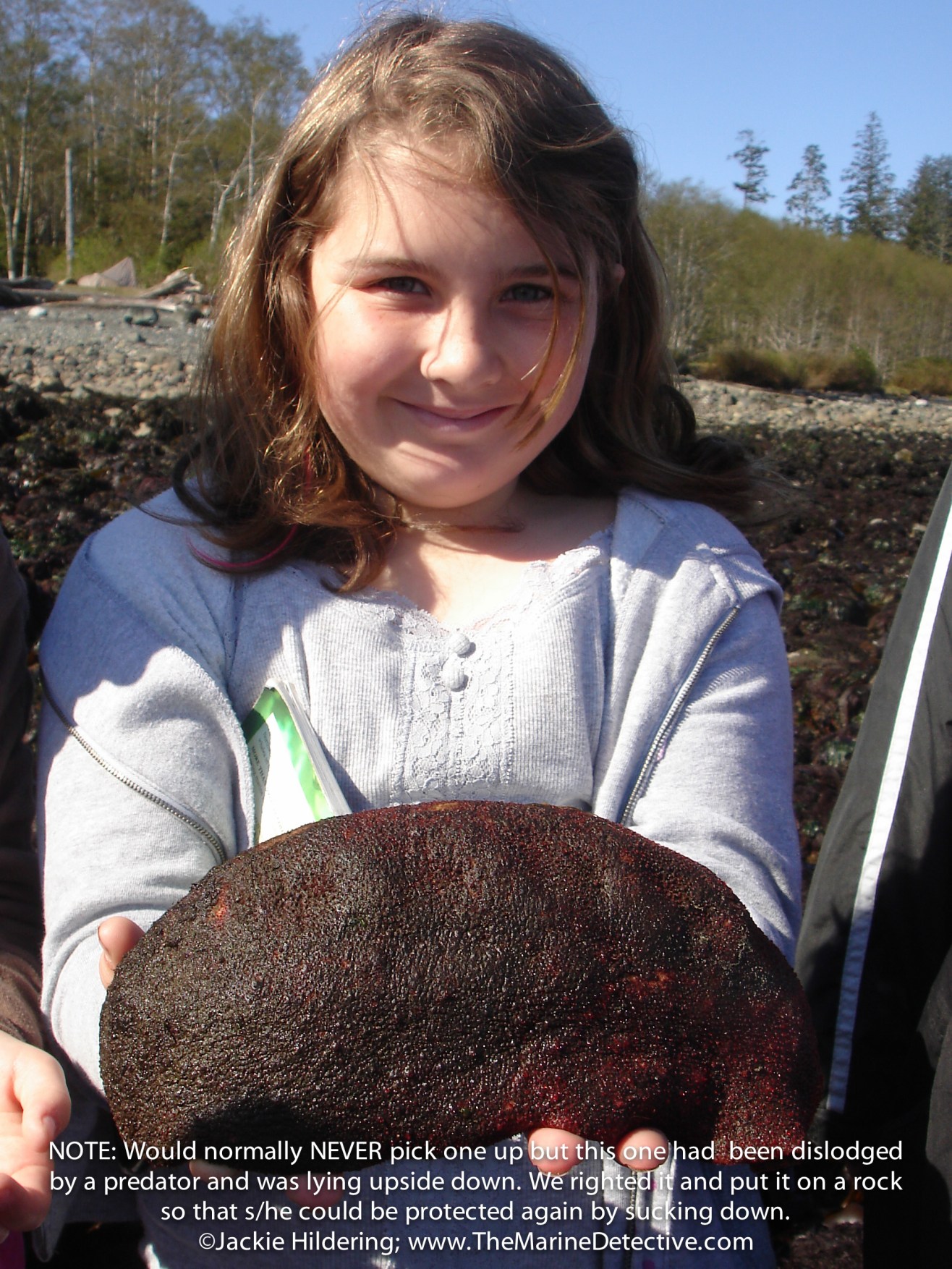
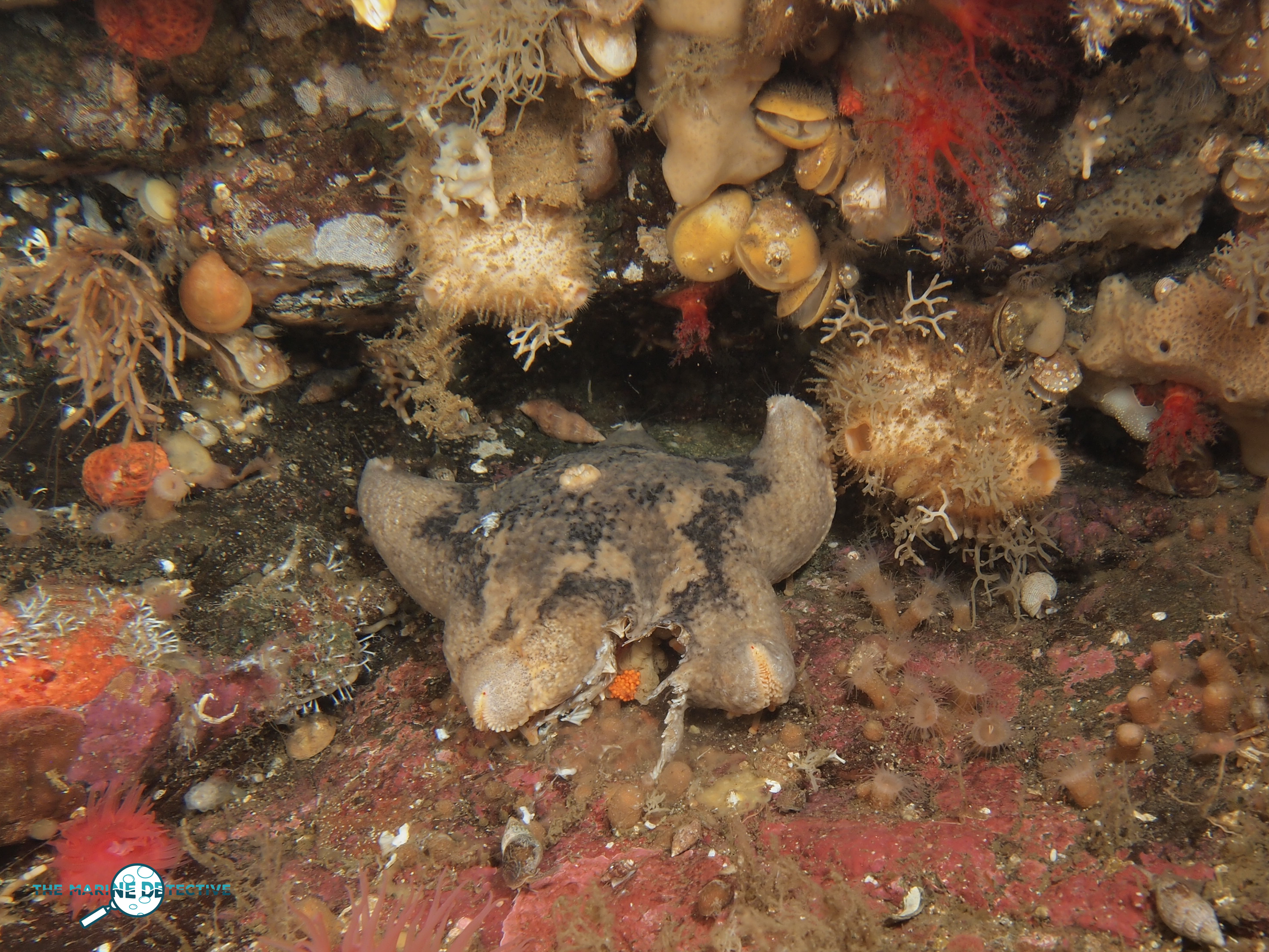
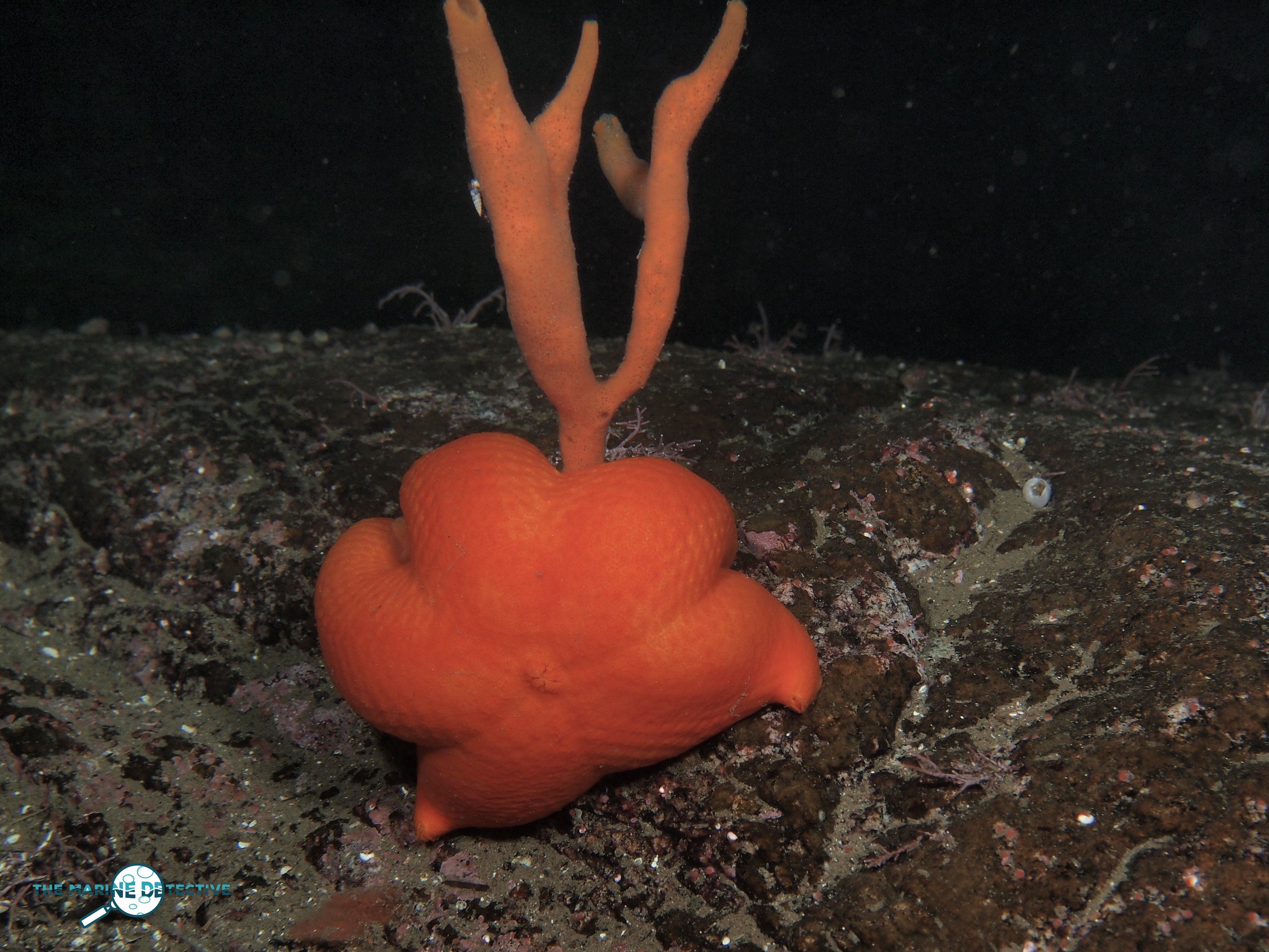
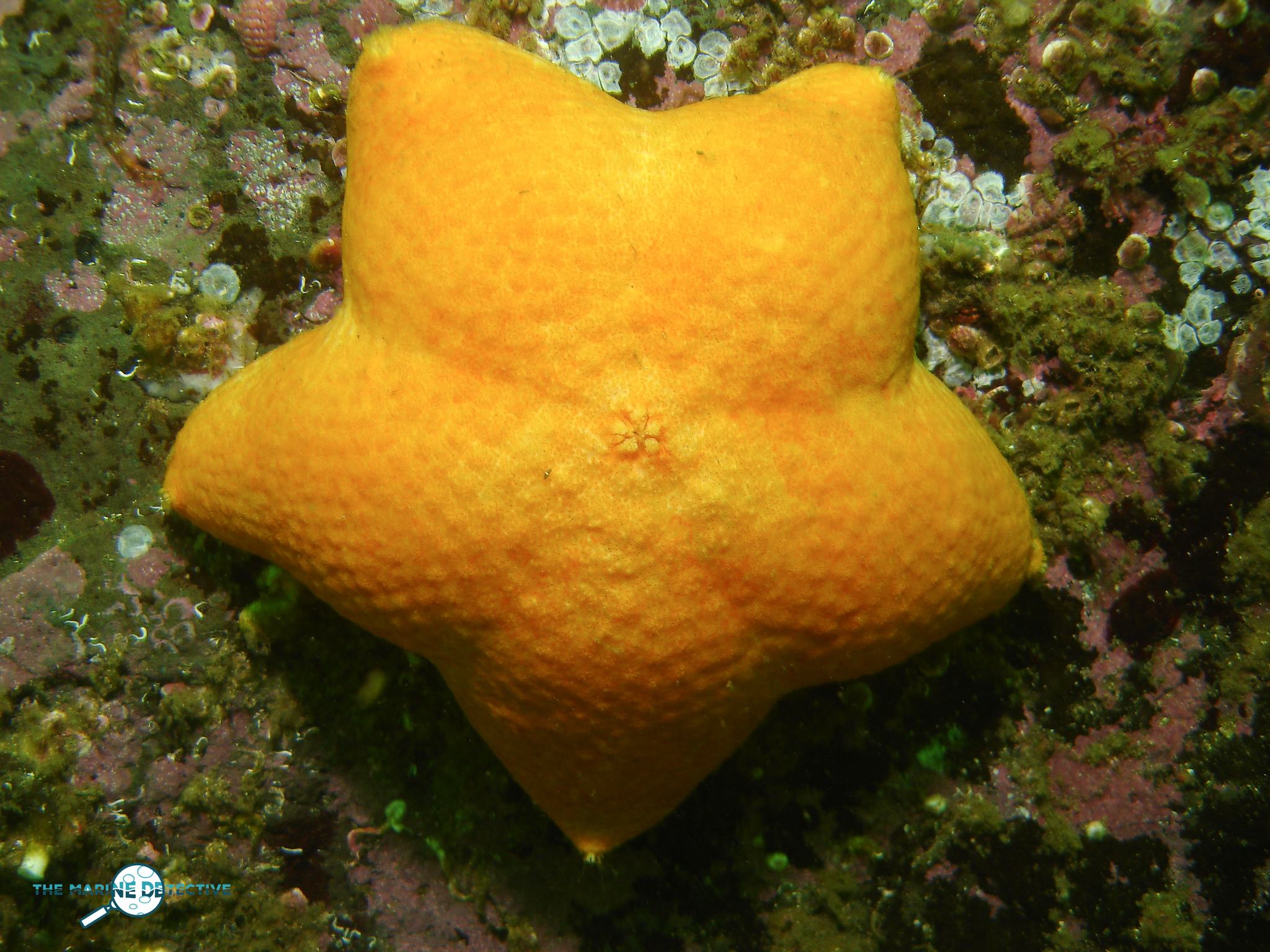
Did you know about the species of sea star in our waters that releases slime to deter predators?
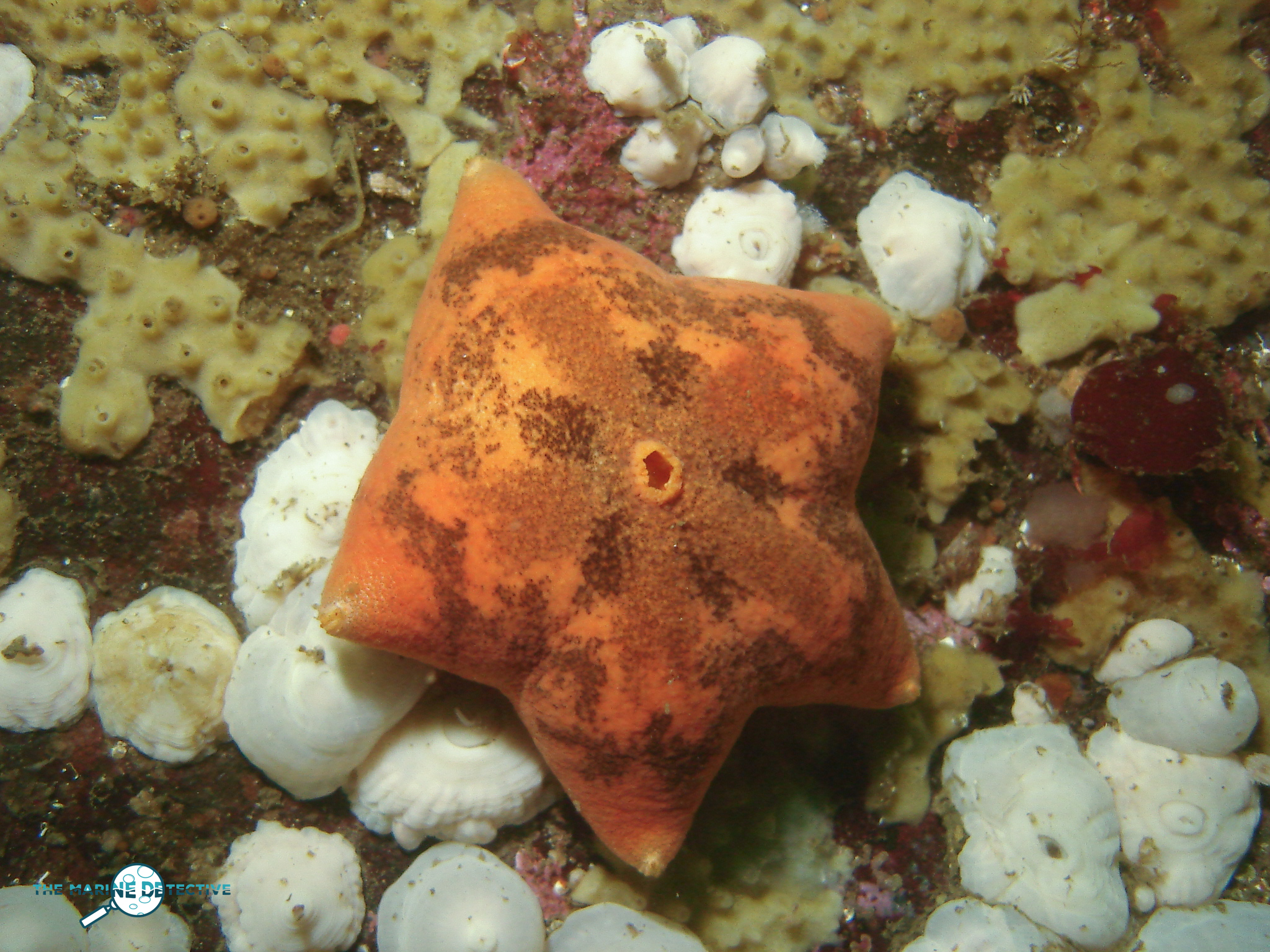
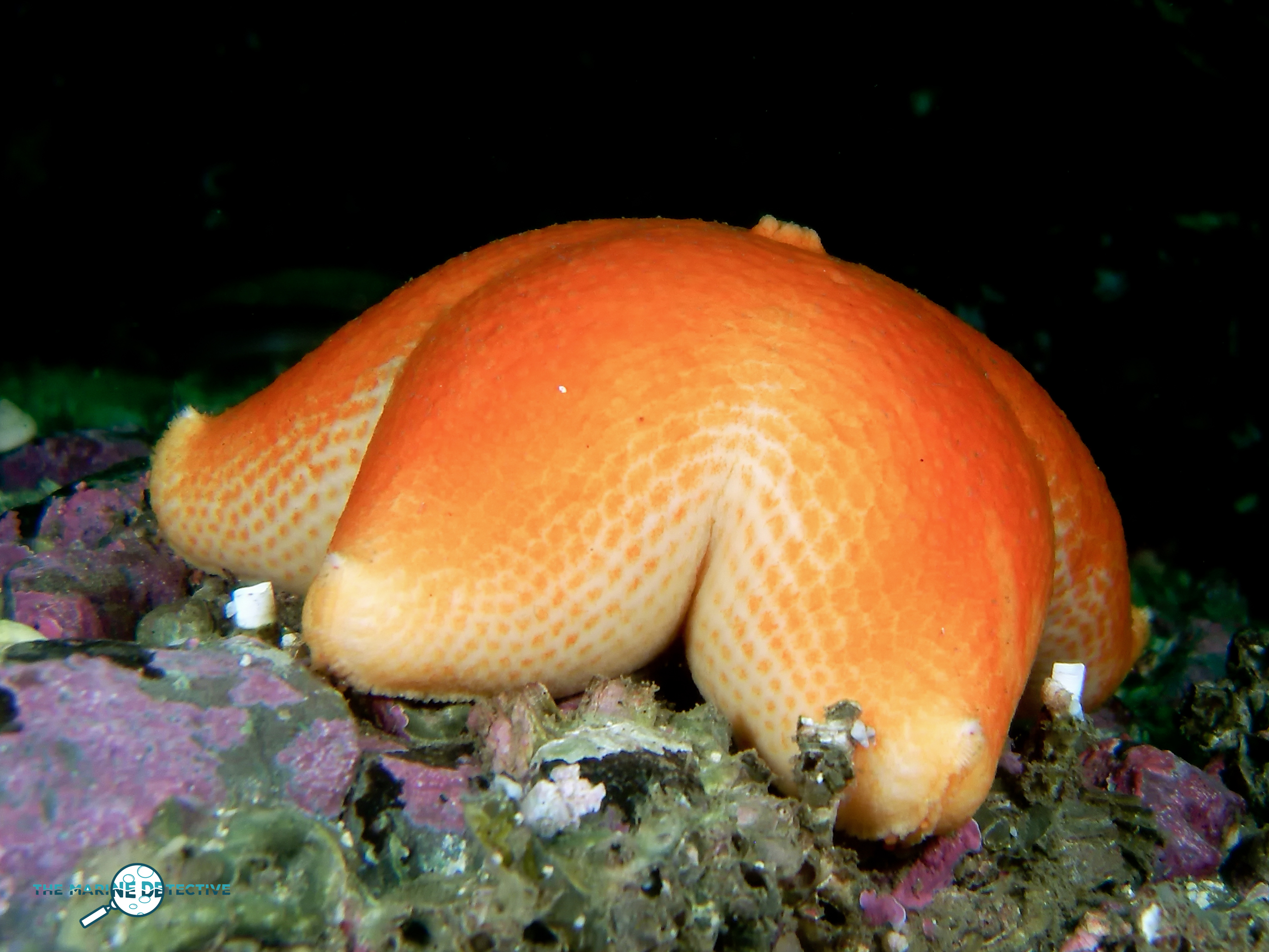
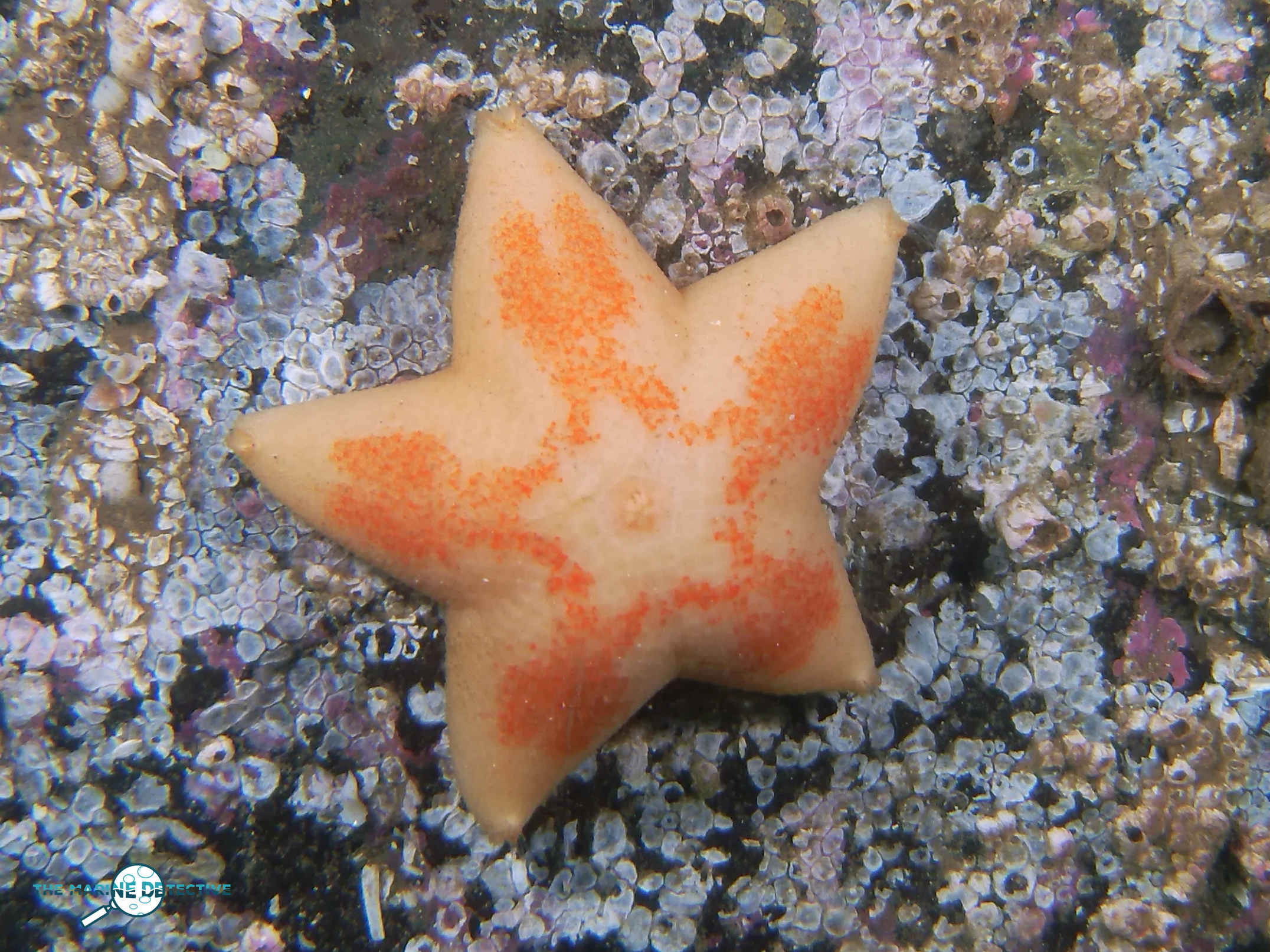
Slime stars are so wickedly adapted! Their distinctive puffy bodies have led to them also being known as Cushion Stars.
They release a LOT of thick, transparent goo from their upper surface when disturbed.
Disturbance constitutes rough handling, temperature shock or when other sea star species try to eat them. Sunflower Stars and Morning Sun Stars are known to trigger the slime production and get a mouthful of goo. The mucus is reported to be toxic to other invertebrates if they are immersed in it for 24 hours.
How much mucus do Slime Stars produce? See the Hakai Institute’s video below.
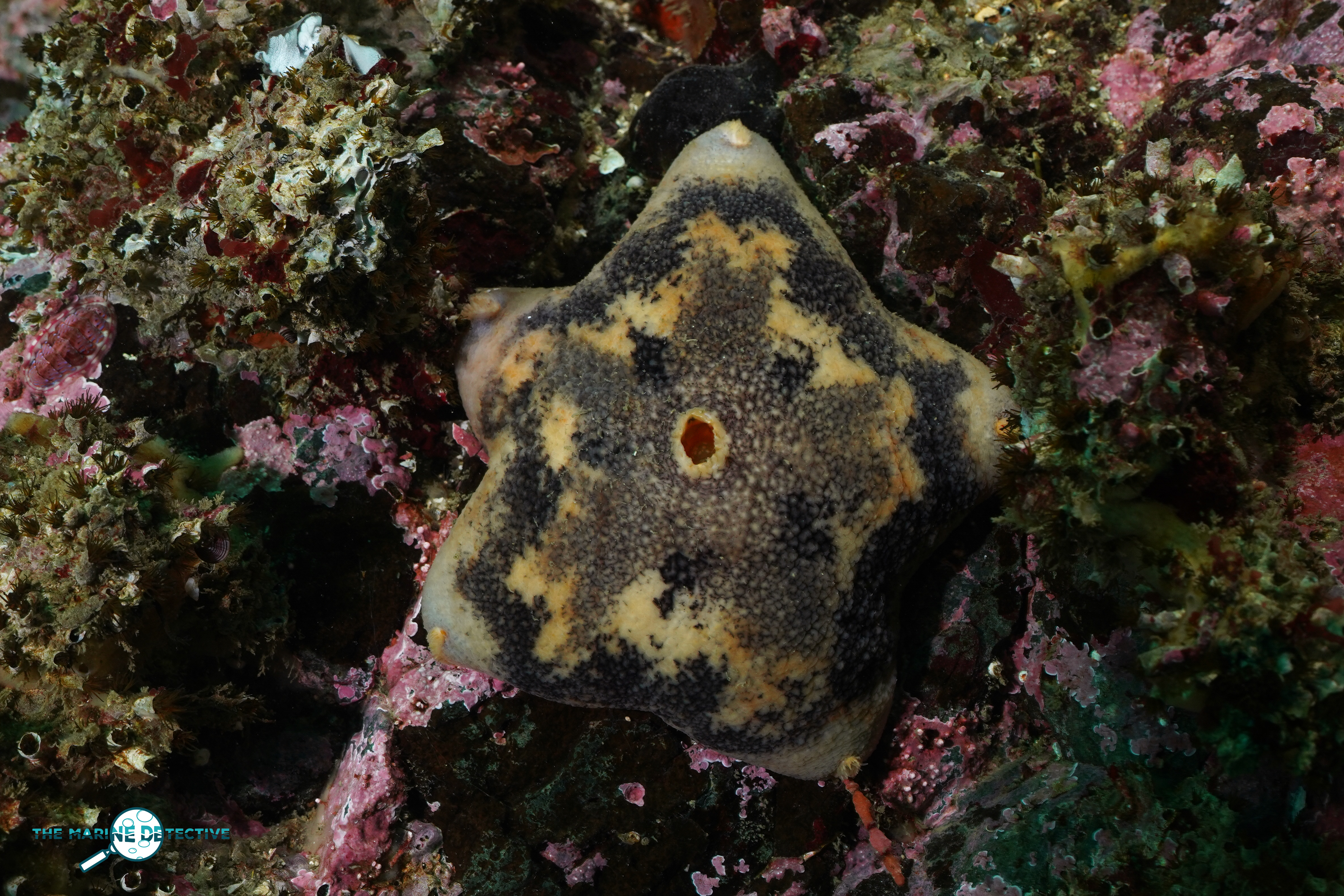
What is also so unique about Slime Stars is that they “exhale” water through that big pore in their upper surface every few minutes (the osculum). The full “exhalation” of the water takes about 5 seconds. You can see in the photos and video below how wide the hole opens. Water enters the sea star on the underside (through ambulacral grooves).
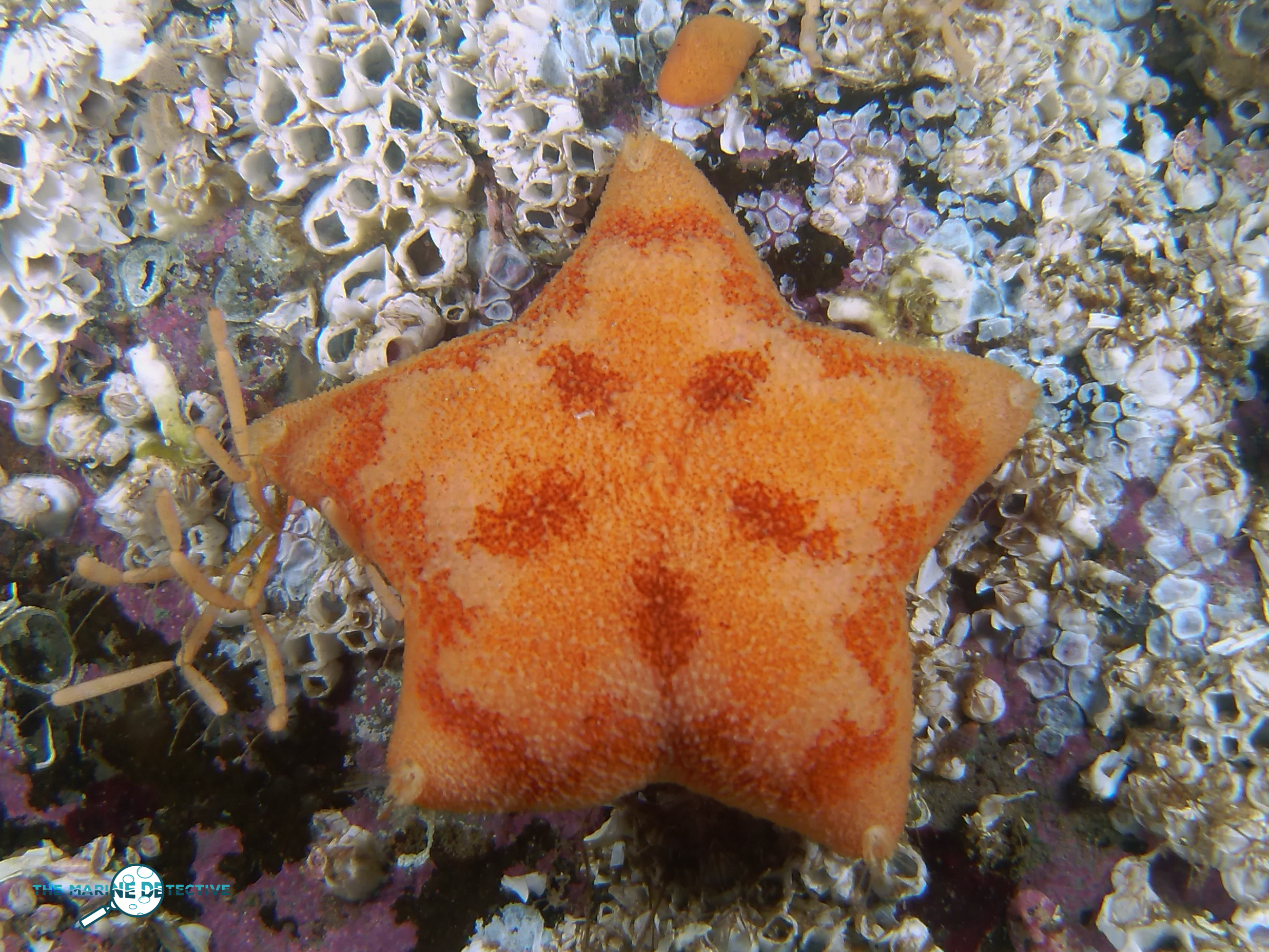
The tips of the arms / rays of Slime Stars are also distinctive. See how they curl upward? That is believed to be an adaptation to hold the mucus on the upper surface of the sea star.
See how the tips of the rays are curled upward?
As a result of genetic research, it has been put forward that the individuals with dark markings may be a distinct species from the solid-coloured ones. Currently, they are all classified as Pteraster tesselatus.
– Maximum size: 24 cm across. – Known range: Bering Sea to Washington State; from 6 to 436 meters. – Diet: Sponges, tunicates, and bivalves such as the False Jingle.







 Look at the diversity in colour of this sea star species and look at the density and colour of the life around them. This is the life off our coast in high current areas.


























 The Marine Detective