Knowing Right From Wrong – North Pacific Right Whale
Last updated on February 9, 2026
Presentation recordings from the symposium by Save the North Pacific Right Whale.
The current known number of sightings of North Pacific Right Whales in the waters of British Columbia from 1951 to 2026 is six (see list below, of the six sightings, one involved two whales). Individual IDs were determined for only three of these whales, whereby it is not known if the other sightings involve repeat sightings of the same individuals. At a minimum, three different North Pacific Right Whales have been documented since 1951. If there are no duplicate sightings, it could be as many as seven individuals.
Tracking of sightings of North Pacific Right Whales in BC waters
See news stories related to these sightings near the end of the blog.
1. June 9th, 2013 – First known sighting of a North Pacific Right Whale in BC waters since 1951. Callosity and scar patterns did not match any of the 22 distinct individuals in the MML’s North Pacific right whale catalogue, and the whale has been assigned the new identifier MML90.” (Source: Ford et al., 2016).
2. October 25th, 2013 – Second North Pacific Right Whale sighting in BC waters (different whale than the one seen in June). “… photo-identification images did not match any individual in the MML’s North Pacific right whale catalogue, and it has been assigned the new identifier MML92.” (Source: Ford et al., 2016).
3. June 4th, 2018 – North Pacific Right Whale sighting off the west coast of Haida Gwaii by the Canadian Coast Guard. Referenced in NOAA’s Five-Year Review of North Pacific Right Whales (2024) with the text: “Unable to make an individual ID from photos.”
[Unverified Spring 2020 – one seen from the air?]
4. June 2020 – Sighting from a cargo ship. See video below. Referenced in NOAA’s Five-Year Review of North Pacific Right Whales (2024) with the text: “Unable to make an individual ID from video; Animal had a large scar on the left side of its back.”
5. June 2021 – North Pacific Right Whale sighting off the west coast of Haida Gwaii by DFO Team Jared Towers and James Pilkington. ID photos were taken, but I do not know the catalogue number of this individual. Referenced in NOAA’s Five-Year Review of North Pacific Right Whales (2024) with the text: “Confirmed new individual; Biopsy, prey, and scat samples collected (analyses ongoing).”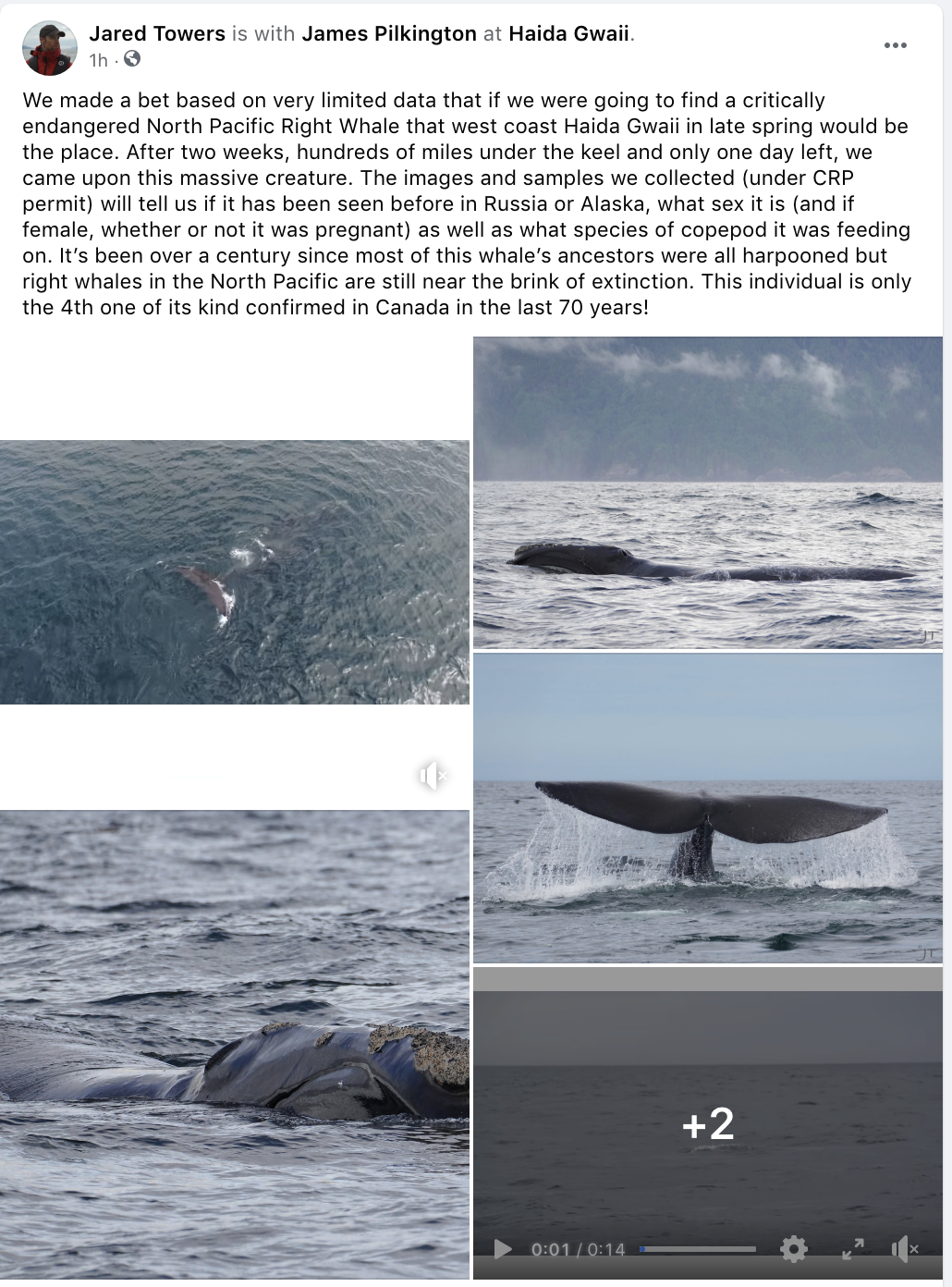
6. July 2021: TWO North Pacific Right Whales sighted by an Observer on a seismic survey vessel. Referenced in NOAA’s Five-Year Review of North Pacific Right Whales (2024) with the text: “Unable to make an individual ID
from photos. Seismic operations shutdown when whales were present.”
Original blog from June 2013
On June 9th 2013, while surveying off the west coast of Haida Gwaii for DFO’s Cetacean Research Program, biologist James Pilkington sighted one of the world’s most critically endangered mammals – a North Pacific Right Whale (Eubalaena japonica).
The species was once common but endured a catastrophic assault by whaling whereby there are now only about 30 left in the whole eastern North Pacific.
Reflecting on this whaling history makes clear how much positive change there has been in our attitudes to whales and this may have particular potency for those of us on Northern Vancouver Island due to BC’s last whaling station having operated in Coal Harbour from 1948 to 1967.
But, the devastation started far before that.
In 1835, intensive whaling began in the North Pacific and the most desirable target was the RIGHT whale. It was the right whale to kill since they were easy pickings with high reward.
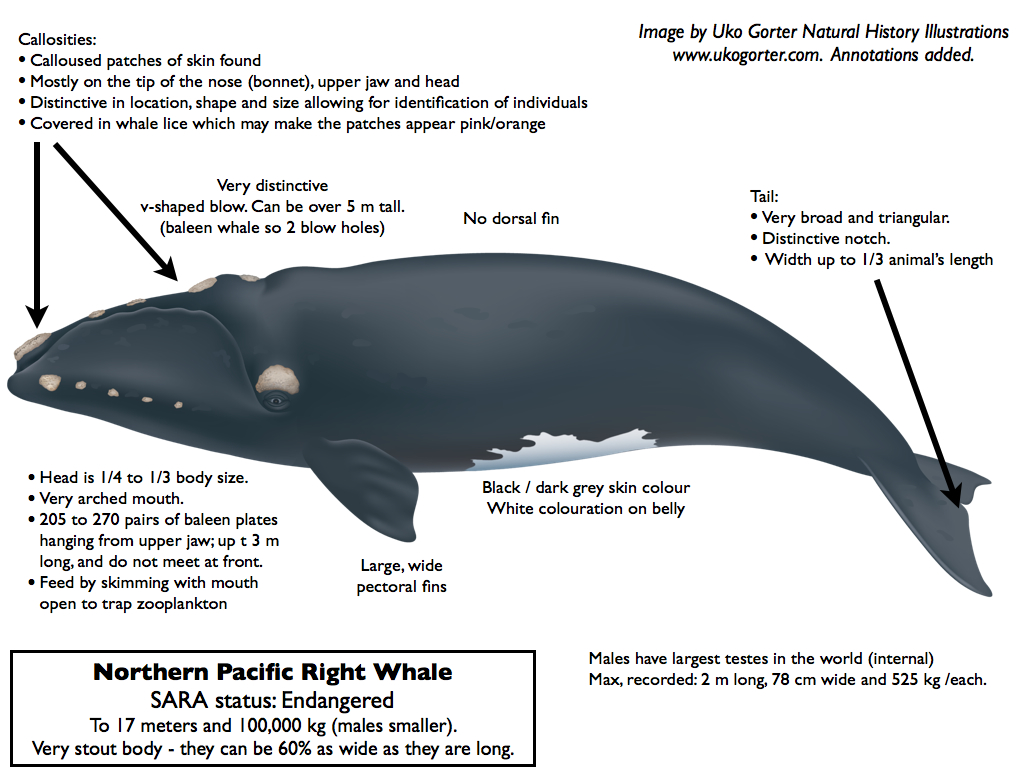
Right Whales feed by using their huge baleen plates (up to 3 m long) to skim zooplankton into their mouths, slowly powering themselves forward with massive tails. When feeding on the surface in this manner, they made life very easy for whalers – being slow moving, often near the coast and easy to approach. The long, fine baleen had very high commercial value as “whale bone”, largely used to stiffen women’s clothing.
Also making them a preferred species for whalers is that Right Whales are particularly stout, weighing as much 90,000 kg at about 17 m. They have very thick blubber which provided whalers with vast amounts of oil, desirable for lighting in that era. The large blubber layer also meant that right whales floated when killed, making them easier to harvest than other whale species.
Being easy to kill and having high commercial value, meant the Right Whales of the world were done a great deal of wrong. For the North Pacific Right Whale alone, the estimate is that 11,000 were killed between 1835 and 1849 and that the species was determined to be “commercially extinct” by 1900.
Protection was very late for animals so very endangered. The first International Whaling Convention only came into effect in 1935 and was not ratified by Japan and Russia. An additional Convention came into effect in 1949 strengthening protection, but there was still illegal Soviet whaling in the North Pacific from 1961 to 1979.
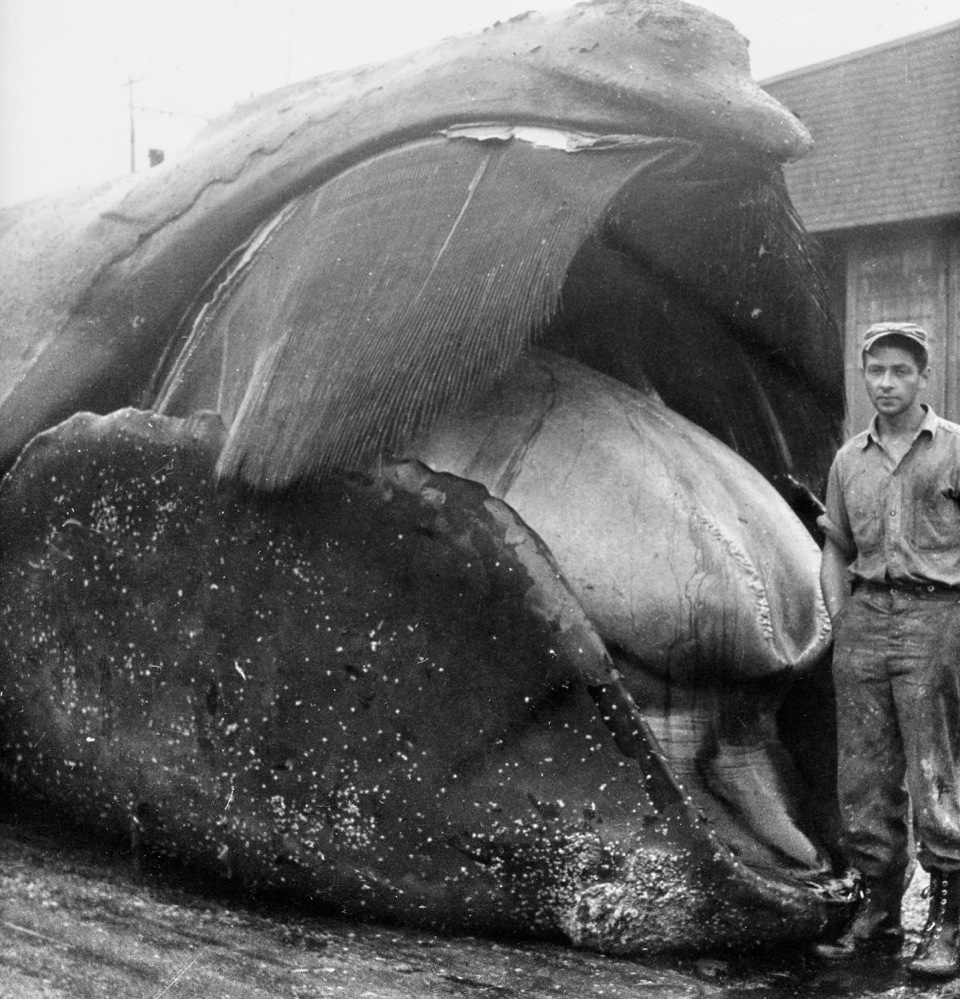
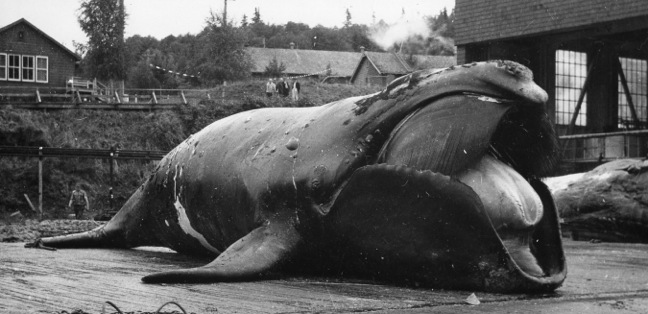
In British Columbian waters, despite the knowledge that they were the rarest of the rare, BC whalers killed the only 6 confirmed North Pacific Right Whales sighted in the last century. Five of these were killed before 1933 and 1 was killed in 1951.
What might make this hit literally close to home is that the 1951 whale, a 12.5 m mature male was killed by Coal Harbour whalers (see photograph, 1951 North Pacific right whale with Gordon Pike, the DFO biologist responsible for monitoring whaling at Coal Harbour).
It was said to be an accident; that they did not know it was a North Pacific Right Whale but got the directive to kill him anyway.
What a difference 62 years makes.
The last thing on the minds of those observing the North Pacific Right Whale in June 2013 was killing it. From the moment James Pilkington noted the distinct v-shaped blow, hope soared that the “holy grail of whales” had been found and that the opportunity to study it might aid conservation.
DFO’s cetacean researchers, Dr. John Ford and Graeme Ellis joined James and shot the whale with cameras not harpoons, allowing the whale (a sub-adult) to be identified as an individual from the raised patches of skin called callosities that are unique to every right whale. They managed to get DNA and scat samples. DNA confirmed the whale was a young female and had not been previously documented. She has been assigned the ID MML90 (See Ford et al).
And when the sighting was relayed to the media, the societal change became so very clear. What was once the right whale to kill, is now the right whale to provide us with hope about the resilience of nature.
However, I believe that to truly know the significance of this sighting, it may take another 62 years.
Will society then be able to look back with the same sense of positive change, having learned that there are still many ways to kill a whale and impact the ecosystems for which they are ambassadors?
Will we have significantly reduced our fossil fuel addiction that drives climate change, impacting the whales’ food supply? Will we have realized that our individual demand for energy literally fuels the threat of tanker traffic, and therefore oil spills, on our Coast? Will we have curbed our consumer lifestyles of disposable goods that lead to a literal sea of plastic?
With such changes, the potential increases for the recovery of North Pacific Right Whales and the health of the marine ecosystem on which we too depend. This will be our ultimate reward for better knowing right, from wrong.
See video below of the June 2013 sighting of the first North Pacific Right Whale in 62 years below. Narration is by Dr. John Ford.
Coverage of sightings in BC waters:
July 2021 sighting of 2 individuals near Haida Gwaii:
- NOAA; February 2024; North Pacific Right Whale (Eubalaena japonica) Five-Year Review
June 2021 sighting:
- CTV News, June 17, 2021 “Endangered North Pacific Right Whale spotted in B.C., only 4th time in 70 years.”
- Jared Towers’ June 15, 2021 Facebook Post
June 2018 sighting:
- National Observer; June 25, 2018; “Rare whale sighting spurs hope and research on Canadian Pacific Ocean“
- CBC News; June 20, 2018; “Coast guard crew makes rare sighting of right whale off Haida Gwaii- This is the 3rd sighting in the last decade; fewer than 50 animals remain in eastern Pacific“
2013 sightings of two individuals – June and October:
- Scientific paper on the two 2013 sightings. Includes that the 2nd sighting in 2013 was of a previously undocumented whale (now assigned ID MML92) and that the whale had severe scarring, likely from entanglement. DNA was not collected so the sex of this whale is not known.
- Ford, J.K.B., Pilkington, J.F., Gisborne, B. et al. Recent observations of critically endangered North Pacific right whales (Eubalaena japonica) off the west coast of Canada. Mar Biodivers Rec (2016) 9: 50.
- Retrospective on the 2013 sighting off Haida Gwaii; Haida Gwaii Observer; July 22, 2016; “Scientists recall the whale tale of a lifetime“
- Vancouver Sun; October 31, 2013; “Second sighting of endangered North Pacific right whale in B.C. waters in 62 years – Researchers ‘astonished’ after whale spotted off the entrance to Juan de Fuca Strait near Victoria”
- Globe and Mail; June 20, 2013; ‘Miracle’ whale leaves scientists elated – and relieved
Sources:
- Feldhamer, George A.; Thompson, Bruce C.; Chapman, Joseph A. (2003). Wild mammals of North America : biology, management, and conservation (2nd ed. ed.). Baltimore, Md.: Johns Hopkins University Press. p. 432. ISBN 9780801874161.
- Fisheries and Oceans Canada. 2017. Action Plan for Blue, Fin, Sei and North Pacific Right Whales (Balaenoptera musculus, B. physalus, B. borealis, and Eubalaena japonica) in Canadian Pacific Waters. Species at Risk Act Action Plan Series. Fisheries and Oceans Canada, Ottawa. iv + 28 pp.
- Fisheries and Oceans Canada. 2011. Recovery Strategy for the North Pacific Right Whale (Eubalaena japonica) in Pacific Canadian Waters [Proposed]. Species at Risk Act Recovery Strategy Series. Fisheries and Oceans Canada, Ottawa. vii + 51 pp.
- Nichol, L.M., E.J. Gregr, R. Flinn, J.K.B. Ford, R. Gurney, L. Michaluk, and A. Peacock. 2002. British Columbia Commercial Whaling Catch Data 1908 to 1967: A detailed Description of the B.C. Historical Whaling Database. Can. Tech. Rep. Fish Aquat. Sci. 2371: vi + 77 p.
- NOAA; February 2024; North Pacific Right Whale (Eubalaena japonica) Five-Year Review
- Pilkington, James; July 2, 2013; AquaBlog – “The Right Place, Right Time, Right Whale: Update #1” [no longer available online]
- Save the North Pacific Right Whale – symposium recordings 2025 and 2026
- Scarff, J.E. 1986. Historic and present distribution and abundance of the right whale (Eubalaena glacialis) in the eastern North Pacific south of 50N and east of 180W. Rep. int. Whal. Commn (Special issue 10):43-63.
- Welcome to Coal Harbour, Canada – webpage
 The Marine Detective