Join me in the cold, dark, life-sustaining NE Pacific Ocean to discover the great beauty, mystery and fragility hidden there.

Posts from the ‘MARINE MEGAFAUNA’ category

Not a Show. Not a Breach. Not a Surprise.

There’s another viral video showing a Humpback Whale very close to a boat.

Here it is, posted on YouTube in June of 2017. Since, it has been used as “click bait” by many news outlets with little to no consideration of the impacts of rewarding bad boater behaviour.

Media coverage includes statements like the following:

“Humpback breaches next to boat”. This whale is not breaching. This whale is feeding; using a strategy called “lunge-feeding”.

– “Boaters in the right place at the right time“. No they are not.

“Whale puts on a show for boaters”. Deepest of sighs – whales do not put on shows for humans in the wild. They are carrying out their lives. In this case, a whale is trying to engulf as many small schooling fish as possible. At the time of this video, the spring, whales are particularly hungry. Likely this Humpback is recently back from the breeding grounds where there is little to no food for them.

“Whale surprises boaters”. This cannot have been a complete surprise. As you can see, their cameras were at the ready. This suggests they knew there was at least one whale in the area and likely the whale had already been feeding at the surface. There would also have been a lot of active sea birds as a clue that there was a density of fish in the area, and thereby a much increased chance of whale presence.

[Update: Via various media sources, it is confirmed that the boaters knew the whale was in the area and that they chose to move closer e.g. “Paul Ziolkowski told WABC his family and friends had been fishing for a couple of hours . . . . and saw the whale a couple of times. The whale was about 60 yards away when they decided to move a little closer to get a better view . . . ” Longer versions of the video also show they had a fishing line in the water when doing so which exposes the whale to further risk.]

It can only be hoped that the result of this video going viral leads to increased awareness of how unpredictably Humpbacks can surface; that they can be astoundingly oblivious of boats; and that they really need their space. Toothed whales like Orca have biosonar. So many boaters are not aware that baleen whales like Humpbacks do not have this biosonar. So many are not even aware that Humpback Whales are now very commonly encountered close to our coasts, having made a remarkable and very recent return from the brink of extinction.

For the sake of whale AND boater safety,  please click here for the Marine Education and Research Society’s “See a Blow? Go Slow!” campaign to reduce the risk of collision with whales.

See www.SeeABlowGoSlow.org to reduce risk of collision with whales.


Key points include:


Another deep sigh –  “The Dodo” put the following video into the world  with the text “Whales Surprise Guy on Kayak. This guy had the cutest reaction when whales surprised him up close.”

No. Just no. This too could NOT have been a surprise. The birds are an indicator of the presence of feed and the whales would have surfaced previously, feeding in the area. This is a boater getting in the way of feeding whales and putting himself at risk. This is another case of the media rewarding boater bad behaviour for the sake of views / “click bait”. 

Enough is enough! Your help needed to stop disturbance of marine mammals in Canada

Update July 11, 2018: Amended Marine Mammal Regulations posted at http://gazette.gc.ca/rp-pr/p2/2018/2018-07-11/html/sor-dors126-eng.html. FINALLY, FINALLY they include the following:

    • Disturbance is defined.
      “ Disturb includes to approach the marine mammal to, or to attempt to:
      (a) feed it;
      (b) swim with it or interact with it;
      (c) move it or entice or cause it to move from the immediate vicinity in which it is found . . .
      (e) trap it or its group between a vessel and the shore or between a vessel and one or more other vessels . . .”
    •  In addition to a minimum approach distance of 200m for all Killer Whales in BC and the Pacific Ocean, there is a 100m general distance for all marine mammals. However, the distance must be 200m if a whale, dolphin or porpoise is resting or with its calf.
    • Mandatory reporting of collisions and accidental contact between marine mammals and vessels or fishing gear.

Original post form May 2017:
You’ve seen it haven’t you, the video of the little girl getting pulled into the water by a sea lion habituated to people feeding him?
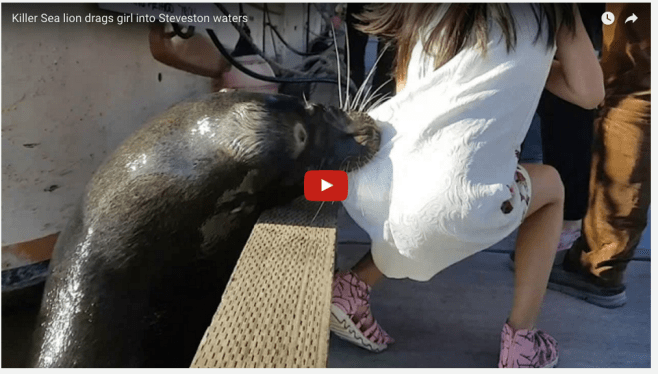
18588743_10155592674299218_1830232447761924957_o

And  . . . you’re likely baffled and outraged that there has been no penalization for those humans misguided enough to cause this habituation?

Please then, while there is so much public attention on this “incident” and the limits of the current Canadian Marine Mammal Regulations, let’s make it count.

Let’s ensure that the amendments that would much improve these regulations are FINALLY passed into law. It will take less than 5 minutes of your time to help, I promise. But I need to provide a bit of background to maximize our chances of succeeding. If you are already aware of the limitations, click here to go directly to “This Is How We Create Change”.

The Problem:
Currently, the Marine Mammal Regulations under the Fisheries Act (Section 7) state “No person shall disturb a marine mammal  . . .” but there is no definition of disturbance. Thereby, there are significant limitations to prosecuting people whose behaviour puts marine mammals at risk e.g. an expert witness is needed to testify that a marine mammal was indeed “disturbed”.  
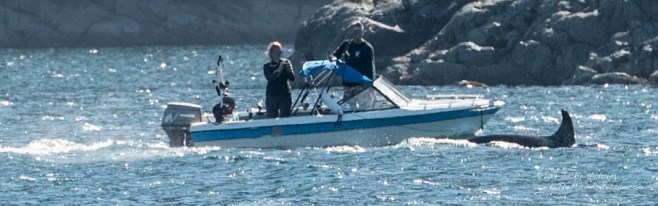
KW_2016-09-08_JH_Wastell Islands-12598

Vessel under power and almost on top of a member of the A30 matriline of Northern Residents (Threatened population). Photo: ©Jackie Hildering.

The Solution:
The solution has been available since 2004 but has yet to be entered into law by the Federal Government.  That’s right, 13 years ago, the “Regulations Amending the Marine Mammal Regulations” were drafted. I was part of the process. They have twice gone through a public review process and still  . . . no action.

They are incredibly solid and will allow for b
etter prevention, enforcement and understanding of threats to Canada’s marine mammals because they: 

  • Define “disturbance” as “approaching the marine mammal to (a) feed it; (b) swim with it or otherwise interact with it; (c) move it or entice or cause it to move from the immediate vicinity in which it is found; or (d) tag or mark it.”
  • Specify minimum approach distances to marine mammals for boats and aircraft e.g. that boats must stay at minimum of 100m away.
  • Require reporting to DFO of any accidental contact with a marine mammal (e.g. entanglement or collision).

These regulations would of course also reduce risk to humans e.g. the girl being pulled into the water by a habituated sea lion and injury to boaters as a result of colliding with a whale.
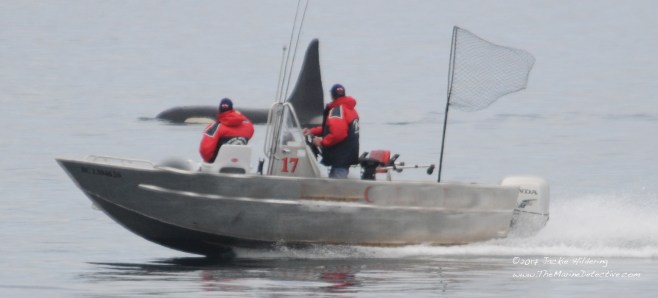
Vessel at high speed near Northern Resident Orca (Threatened population). Did not slow down while clearly aware of the whale’s presence, and presumably, the potential of other whales being in the area. Photo: ©Jackie Hildering.

Here’s How We Make Change

Please, contact your Member of Parliament and insist upon these regulations being passed into law. 

You can find their contact information by clicking this link.

In case it is of help, here is sample text that could be used:

“I am aware of the limitations of the current Marine Mammal Regulations and that, for more than a decade, amendments have existed that would much improve the protection of Canada’s marine mammals (many of which are at risk). It is unacceptable that the Federal Government has yet to pass these into law. Thereby, I ask you, as my Member of Parliament, to urgently undertake action to enable the “Regulations Amending the Marine Mammal Regulations” to come into force. If further background is needed to understand why there is such urgency, see this link https://themarinedetective.com/2017/05/24/enough-is-enough.”

Please also share this information so that more will contact their MPs.
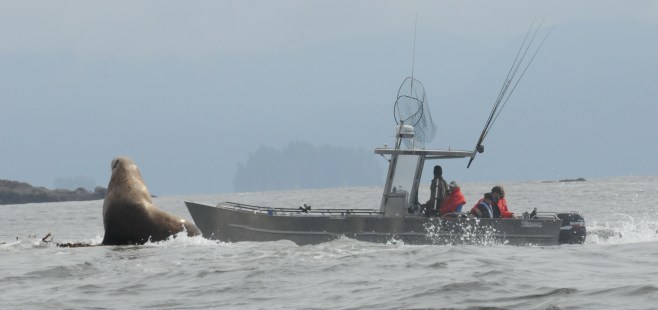
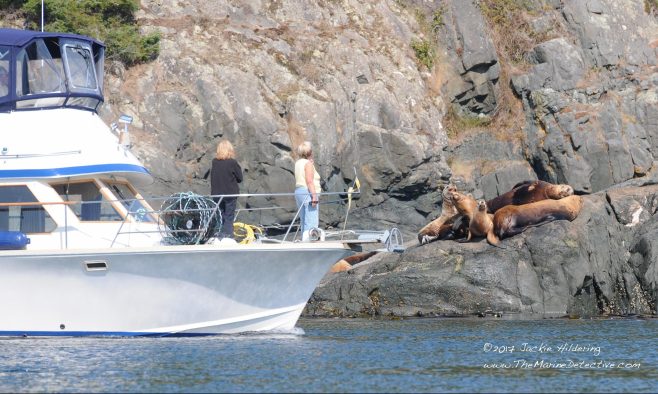
How’s this for astoundingly misguided behaviour? Boats are to remain at least 100m away from seal and sea lion haulouts and rookeries. Steller Sea Lions are protected under Canada’s Species at Risk Act.

Male California Sea Lion being hand fed. Photo: ©Jackie Hildering.
HW_2016-09-29_JH_White Cliffs-13974

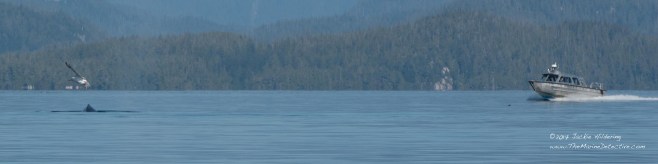
Boat at high speed in proximity of Humpback Whales “Slash” (BCY0177) and her 2016 calf (on left). Collision is a serious risk for whales AND boaters. Photo: ©Jackie Hildering.

Background:
A video went into the world on May 20th, 2017 entitled “Killer Sea lion drags girl into Steveston waters” (Steveston, British Columbia). When it was brought to my attention, I posted the following on social media:

“NOT a “Killer Sea Lion”. Rather – misguided humans. Please help educate around why a mature male California Sea Lion grabbed a child that was allowed within a metre of him. This is absolutely not natural behaviour. THIS is indisputably a sea lion that has been fed and habituated to humans. This is predictable. By humans not respecting the wild, the wild loses wariness, associates humans with food (or some other “reward”), and most often . . . loses entirely. THIS is yet another reason why the amendments to the marine mammal regulations should finally be passed by our government. They define “disturbance” and enter into law . . . no feeding, no swimming with, no touching, stay 100m away, etc (they have been drafted since 2004!).  Please, if you witness marine mammal distress or disturbance (includes feeding) call the Incident Reporting Line 1-800-465-4336.” 

The resounding response of outrage to the incident is what has led to my believing that we can make this count; that we can ride this wave of awareness to have the amended regulations passed.

Thank you so much for caring as you do and helping to ensure the protection of Canada’s marine mammals.

For best practices to avoid disturbance of marine mammals see www.SeeABlowGoSlow.org

Close passes like this contribute to habitation; animals losing their wariness; and the disruption of life processes like feeding, nursing and resting. Photo: ©Jackie Hildering.
Porpoise-full Blog!

This, like my “You Otter Know” blog, is aimed at clearing up species confusion and offering some support to my fellow marine educators.

Yes, I am writing this for much needed educational porpoises. Sorry! I will attempt to restrain myself from further bad puns (but I am counting on you, the readers, to come up with some doozies).

Oh the number of times I have had the joy of an exchange like this:
Me: “Look, a porpoise!”
Response: “Ja, ja, een delfin!” or “Oui, oui, un dauphin” or “Ja, ja,  een dolfijn” or “Yes, yes, a dolphin!”.
Me (armed with images like those below): “Nein – een schweinswal” / “Non – un marsouin” / “Nee – een bruinvis” / “Nope – it really is a porpoise!”

It is so understandable that there is significant confusion. The words dolphin and porpoise were, colloquially, used as if they were synonyms into at least the 1970s.

But, dolphins and porpoises are more distinct than lions and tigers.  Lions and tigers are not only in the same family but in the same genus. Dolphins and porpoises are in different families, having diverged around 15 million years ago.

_JH11109

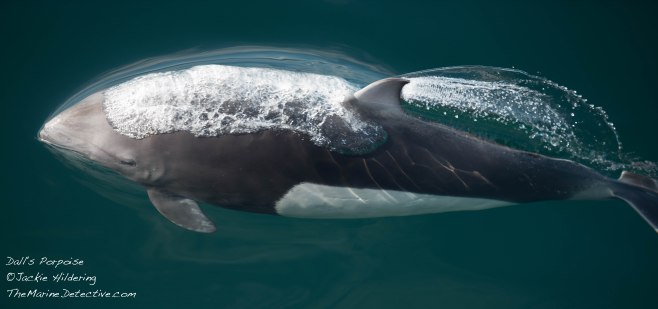
That’s no dolphin! It’s a Dall’s Porpoise. ©2015 Jackie Hildering.

The differences between porpoises and dolphins span from fin and head shape, to behaviour, vocals and average group size.

Read more

Bubbling Giants: Humpback Whales Bubble-Net Feeding

This is going to be worth the 4 minutes of viewing believe me!

Humpback Whales have many complex feeding strategies. In areas where current and birds do not force the feed together, there are Humpbacks that work as a team to corral the fish. This strategy includes an intense feeding call and making a net of bubbles.

This video was taken while I was with Pacific Wild in Caamano Sound off British Columbia’s Central Coast.

This is exactly the area where there is the potential of increased tanker traffic.

Knowing how important this area is – not only for at-risk Humpback, Fin and Killer Whales; but for human health and so much more – is a huge motivator to do all I can do reduce the demand for fossil fuels.

For more on the feeding strategies of Humpback Whales, please see our Marine Education and Research Society research at this link. It includes that we have published on a never-before-documented strategy we have dubbed “trap-feeding”.

And They Spread Their Giant Wing-Like Fins . . .

TMD Memes.001

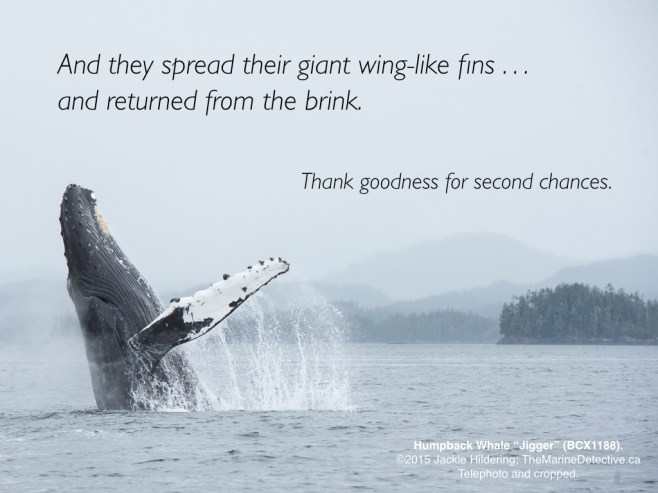
And they spread their giant wing-like fins . . . and returned from the brink.

The whales remind us of our great capacity for positive change . . . when our value systems change and knowledge, connection and humility replace fear and misunderstanding.

The simple solution? Care More. Consume Less.

There are still so many ways to indirectly kill a whale and damage the life-sustaining seas upon which we all depend.

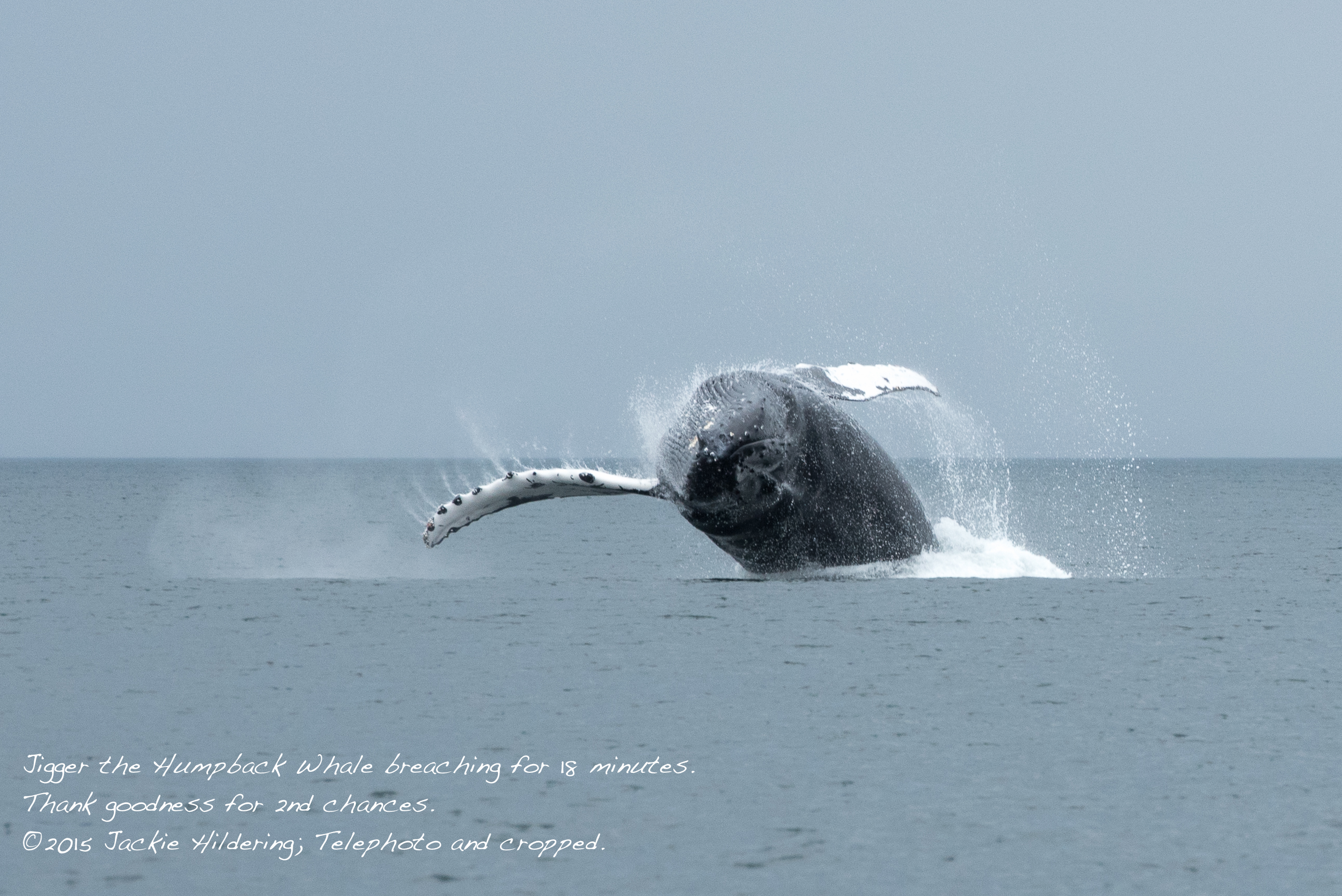
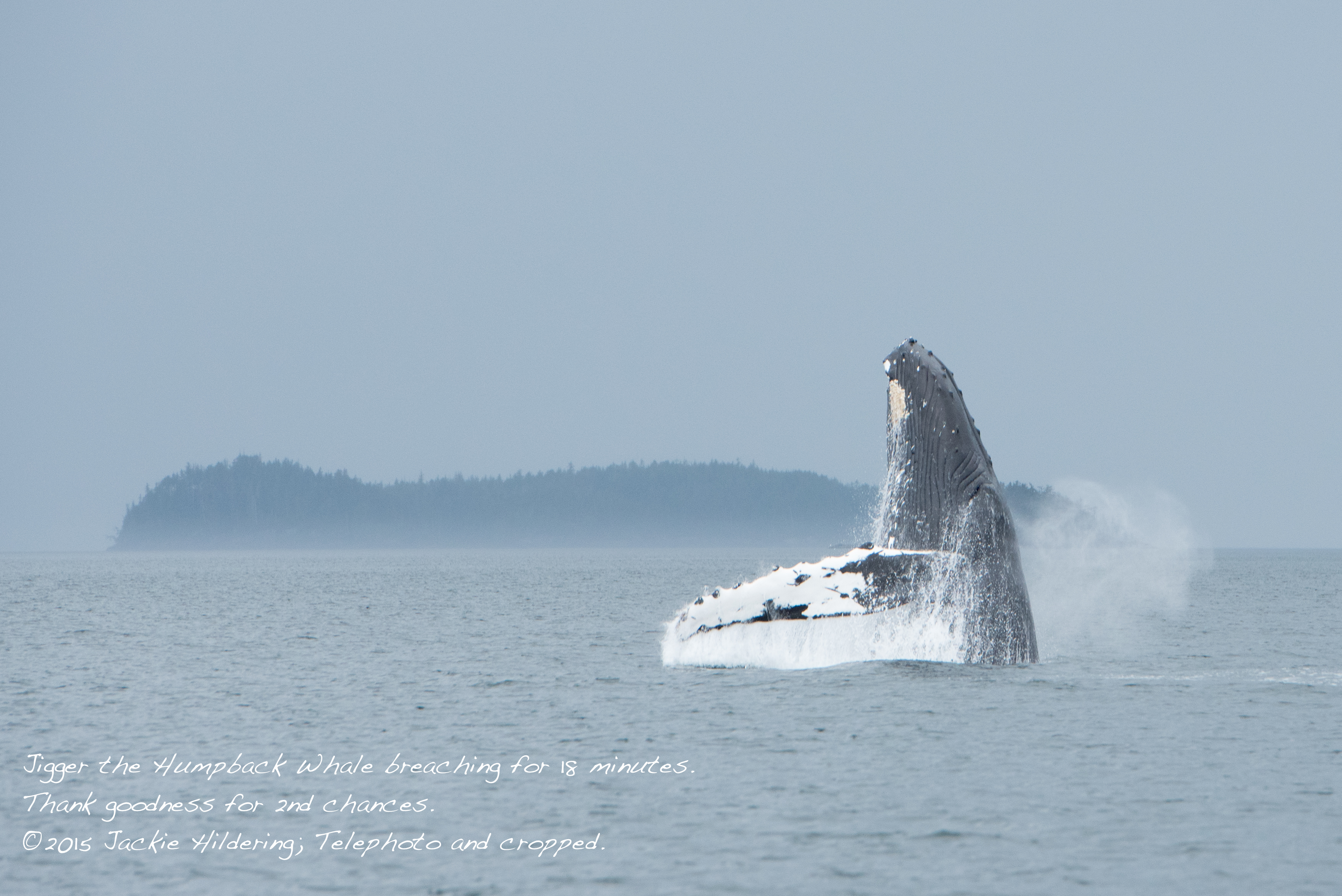
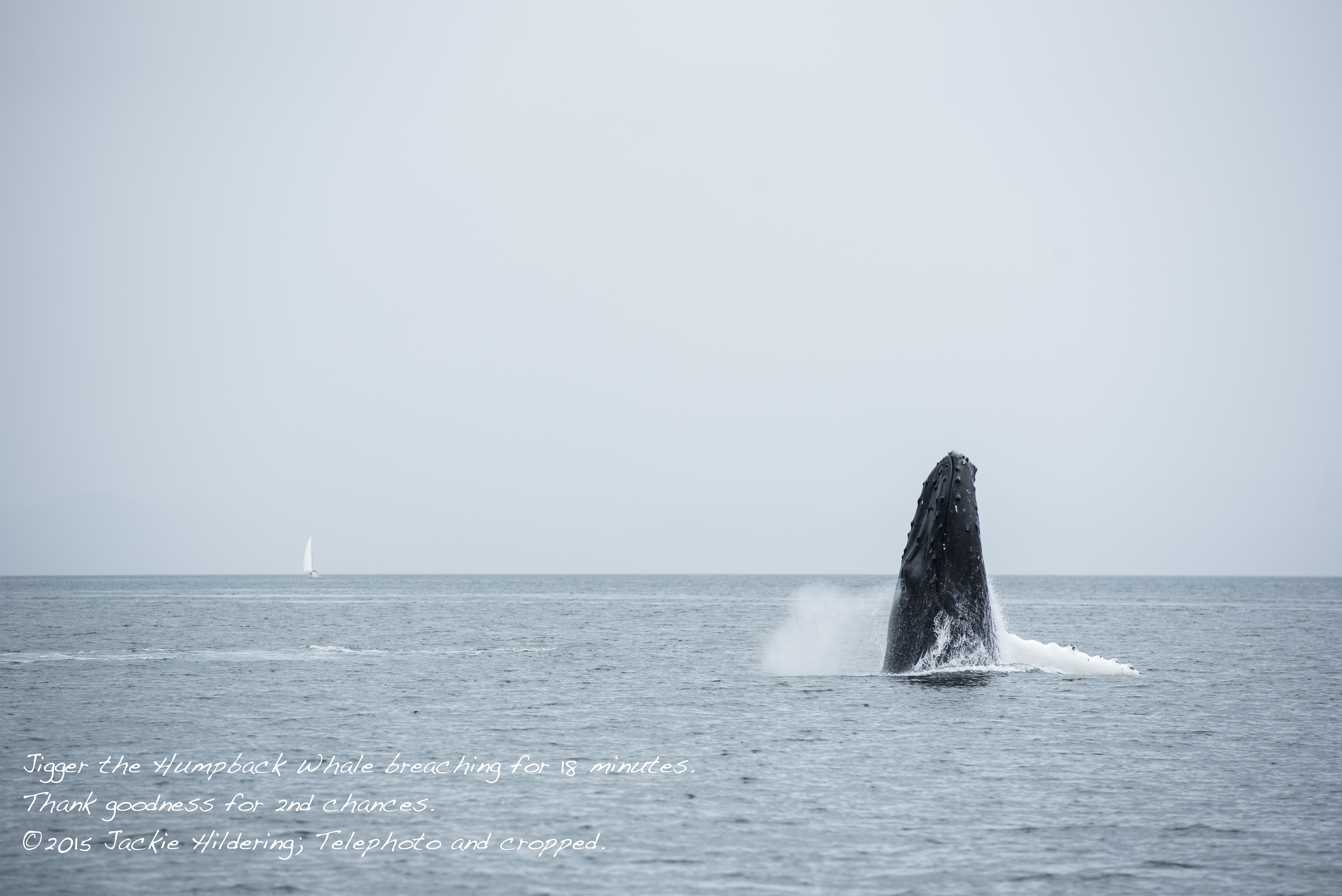
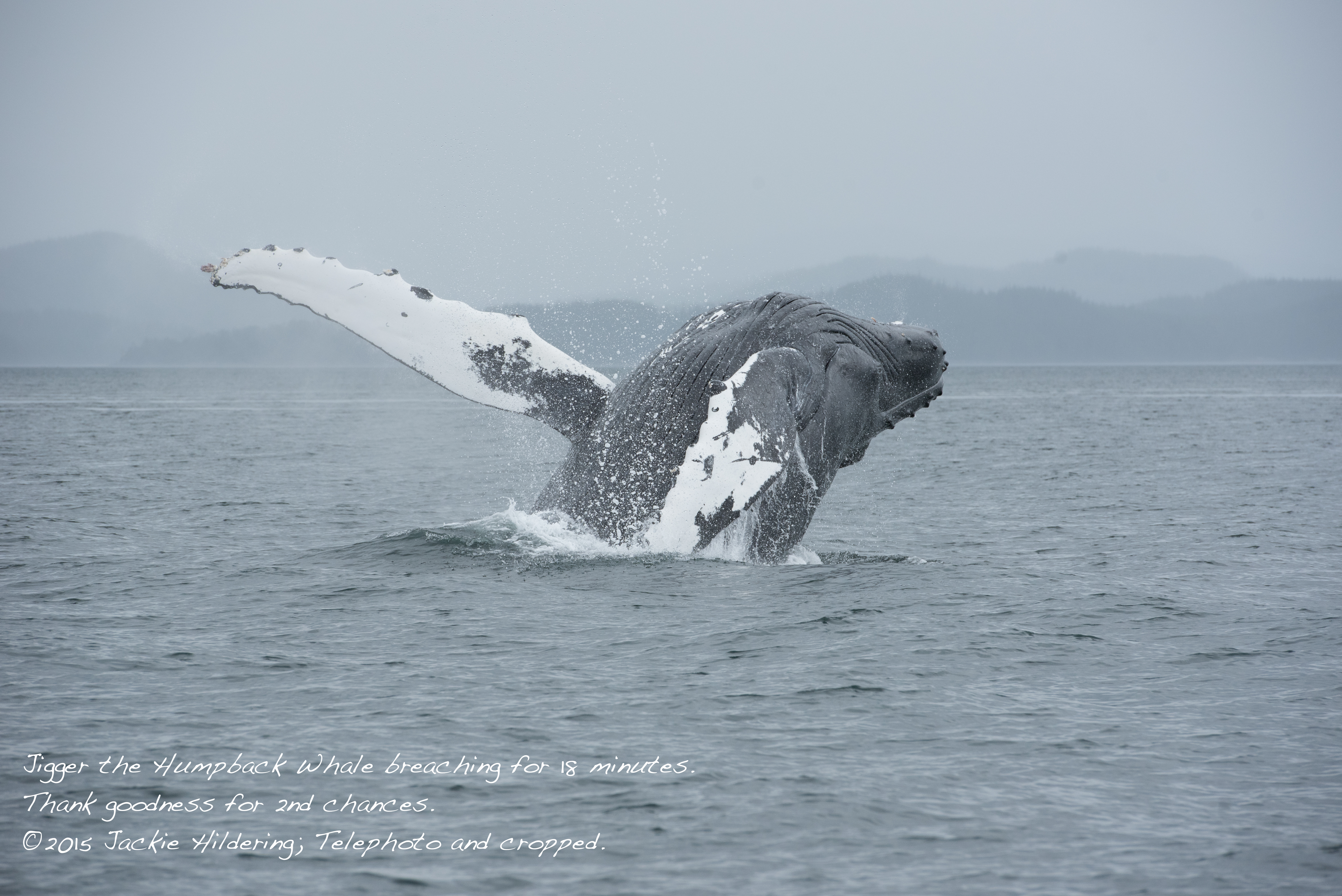
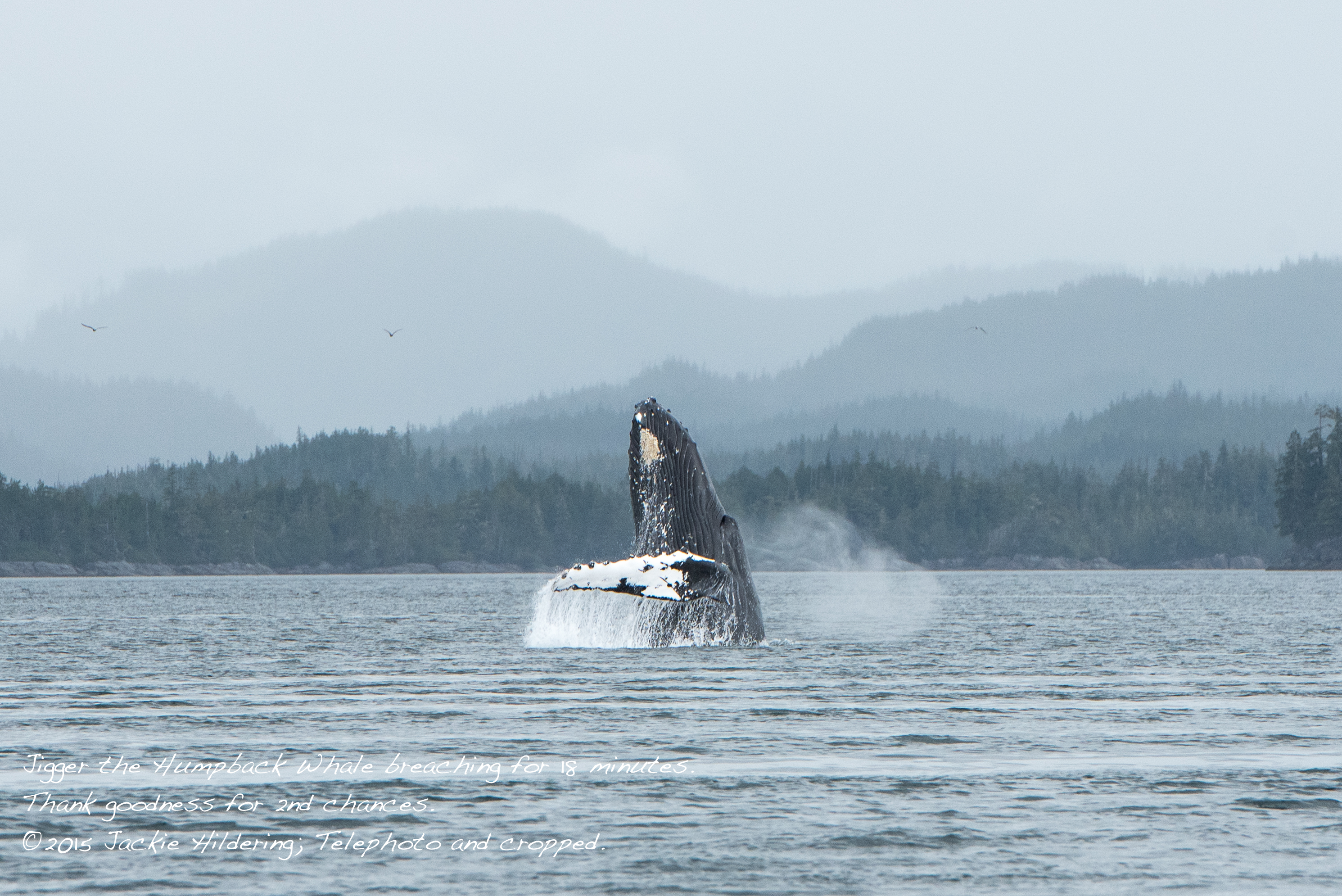
Image is of “Jigger” the mature female Humpback Whale who breached for 18 minutes. More images below.

You simply can’t be the same after seeing something like this, nor would I want to be.

What triggered this behaviour may have been an encounter with another Humpback (“Slash” BCX0177″) but we cannot know for sure.

For the work of our Marine Education and Research Society, please see here and yes, you can support our work by sponsoring a Humpback Whale!

HW_2015-07-25_JH_White Cliffs-15374 HW_2015-07-25_JH_White Cliffs-15389 HW_2015-07-25_JH_White Cliffs-15390 HW_2015-07-25_JH_White Cliffs-15392 HW_2015-07-25_JH_White Cliffs-15396 HW_2015-07-25_JH_White Cliffs-15415 HW_2015-07-25_JH_White Cliffs-15421 HW_2015-07-25_JH_White Cliffs-15424 HW_2015-07-25_JH_White Cliffs-15425 HW_2015-07-25_JH_White Cliffs-15426 HW_2015-07-25_JH_White Cliffs-15454 HW_2015-07-25_JH_White Cliffs-15494

Rub Me Right – “Beach-Rubbing” Behaviour of Northern Resident Orca

[Update September 2020: Click here for OrcaLab’s live cameras and video highlights of Northern Resident Orca rubbing at the Strider Beach in the Robson Bight Ecological Reserve, NE Vancouver Island.]


Likely you’ve seen it – Chris Wilton’s video of Killer Whales* / Orca rubbing on a beach in the Discovery Islands on January 29th, 2015, the whales only within ~1.5 metres of the incredibly fortunate humans’ feet?

[Video used with permission. For licensing / permission to use: Contact – licensing(at)jukinmediadotcom]

I became a resource to the news for interpreting the whales’ behaviour in this video as a result of my posting their IDs and commenting on the behaviour on social media. However, it proved difficult to extinguish some misinterpretation and misinformation, for example, the notion that the behaviour captured in the video was rare e.g. “B.C. orcas’ rare beach-rubbing behaviour caught on video” (CBC News. January 31, 2015).

It’s not rare behaviour at all. It is rare that people get to see it.

Big difference!

That’s what has motivated me to write this blog but before I proceed let me qualify that while I have spent a lot of time staring at Killer Whales through binoculars, I am a Humpback Whale researcher and marine educator. Everything that is known about Killer Whales is due to the long-term population study by DFO’s Cetacean Research Program. It began in 1973 with the late, great Dr. Michael Bigg and as a result, the Killer Whales of British Columbia have been studied as individuals longer than any other marine mammals in the world.

Thanks to the Cetacean Research Program’s work, identifying the whales in Chris’ video was easy. I recognized that they were beach-rubbing and, therefore, they had to be members of the threatened Northern Resident population. “Resident” Killer Whales are inshore, fish-eaters who can best be described as “Chinook-aholics”. The Northern Residents are the only Killer Whales of BC’s four distinct populations that rub on smooth pebble beaches.

When the video was brought to my attention, I was with two fellow Humpback Whale researcher friends, and we laughed aloud at about 1:56 in the video because there was mature male A66 (“Surf”), almost stationary on the beach. His left side was facing Chris’ camera, making it so easy to see his distinct saddle patch and the nick in his dorsal fin. It simply could not have been easier to identify him.

Screen grab from Chris Wilton's video showing why it was so easy to identify A66 / Surf. Used with permission. For licensing / permission to use: Contact -licensing(at)jukinmediadotcom

Screen grab from Chris Wilton’s video showing why it was so easy to identify A66 / Surf. Used with permission.

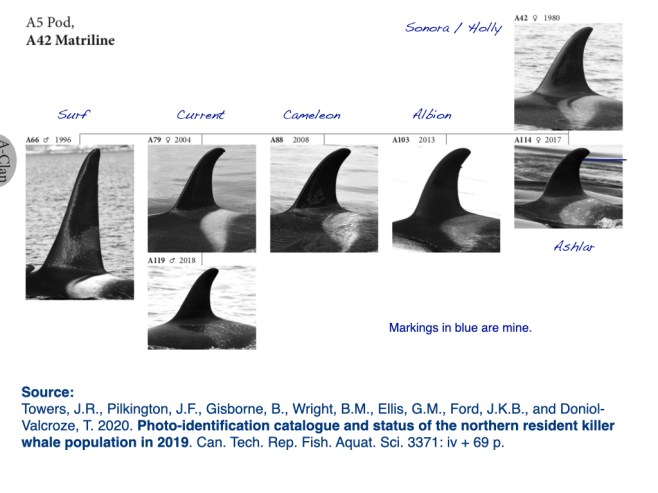
Ah ha! If Surf was there, his mother and three siblings had to be there too for such is the way of “Resident” Killer Whales; they stay with their mothers for their entire lives, seldom separated by more than a short distance. If the mother dies, the remaining family members stay together. Northern Resident families are in fact named for the eldest female who is believed to be the leader, A42 in this case, and the families are known as “matrilines”. This term loosely translates into “follow your mother”.

Upon viewing the rest of the video, we could confirm that all five member of the A42 matriline were indeed there. Surf was with his mother, Sonora, and her three other offspring.

Updated: Shows the A42 matriline in 2019. Source: Towers, J.R., Pilkington, J.F., Gisborne, B., Wright, B.M., Ellis, G.M., Ford, J.K.B., and Doniol-Valcroze, T. 2020. Photo-identification catalogue and status of the northern resident killer whale population in 2019. Can. Tech. Rep. Fish. Aquat. Sci. 3371: iv + 69 p.


So what’s with the beach-rubbing?

Absolutely essential to understanding this behaviour is to know that the Killer Whales of the world have culture. Like humans, they have specialized to make use of certain prey and the geography of their area e.g. specializing in eating salmon vs. marine mammals.

In BC, the four Killer Whale populations (Northern Resident; Southern Resident; Offshore; and Bigg’s / Transients), overlap in their ranges but the populations have different languages and do NOT mate with one another. Thereby, they preserve the culture and traditions of their populations. To emphasize just how long-lived these cultural differences and specializations are, know that the mammal-hunting Bigg’s / Transients diverged from the other kinds of Killer Whales 700,000 years ago!

As mentioned, throughout the Northern Resident Killer Whales there is the culture of skidding their bodies over sloping beaches of smooth pebbles. None of the Killer Whale populations with which they have overlapping range in British Columbia have this behaviour. (Note: The AK Pod of Alaskan Residents is also known to beach rub. Please see detail at the end of the blog). As you can see in Chris’ video, in order to get down low and in contact with the rocks, they often super-deflate their lungs to reduce buoyancy, releasing a gush of bubbles. They rub all parts of their bodies. Sometimes they do this for a few minutes, and sometimes for more than an hour.

In OrcaLab’s video below, you can see underwater footage of the behaviour. Video was taken with remote underwater cameras under permit from Fisheries and Ocean’s Canada.

The behaviour can’t be about rubbing off parasites! The skin of Killer Whales sloughs off like ours does and therefore there’s no “fouling” of barnacles like there is on Humpbacks and Grey Whales. And hey, if it was due to ectoparasites, the other Killer Whales in BC would have them and be beach-rubbing too!

Beach-rubbing by the Northern Residents must be a social and recreational behaviour. A whale massage? Certainly it must feel good. Maybe, as an additional benefit, doing something you enjoy together also further solidifies family bonds (social cohesion being needed for community maintenance)? Reportedly, the vocals sometimes made by the Northern Residents while beach-rubbing support that this is a social behaviour since they are the same “looney tunes” made when Northern Resident families reunite.

Again, it is not rare for the Northern Residents to beach-rub at all. It is a regular social behaviour. What’s quite rare is that there were humans present on a beach when the behaviour was happening since where the whales most often are known to rub is a no-go zone.

These best known rubbing beaches are on NE Vancouver Island, in the Michael Bigg Ecological Reserve at Robson Bight in Johnstone Strait. The Northern Resident matrilines that most often feed in this area use these beaches to rub with incredible regularity, including the A42s – the whales that Chris videoed beach-rubbing much further to the south, around central Vancouver Island. These Robson Bight beaches are within recognized critical habitat for this population and are fully protected. The waters around these beaches are a restricted area as well.

But Northern Resident rubbing beaches are found all along our Coast and I believe that individual families have preferences, places they have been rubbing generation after generation after generation. There are Northern Resident families that rarely come into Johnstone Strait and they must have their equivalent of a Robson Bight somewhere else on our coast.

As confirmed by Dr. John Ford, head of DFO’s Cetacean Research Program, the Strait of Georgia where Chris got the video has been known to be part of the range of the closely related families to which the A42s belong (the A5s) since the 1960s and likely for many, many years further back. However, at that time, we would not have been collecting the data.

In 1961, near to where the video was taken, a 50-calibre machine gun was positioned for the purposes of executing Killer Whales and, as of 1964, it became common to attempt to capture them for captivity.

Just 55 years later, in January 2015, Chris and others stood on a beach in the Discovery Islands marvelling at what they were witnessing, recognizing their good luck to see this wild behaviour, and being able to record it in the video that has now gone viral.

Thank goodness that we have this capacity for positive change and that it’s now NOT rare that people feel a strong concern for and connection to Killer Whales.  I believe that the wide reach of Chris’ video has led to raised awareness about how cultured and social Killer Whales are and how lucky we are to have them as our marine neighbours. Maybe that awareness will be reflected in further changes that benefit the whales and the marine ecosystem for which they are ambassadors?

Then we’d be rubbing the right way and have more reasons to bubble with happiness.

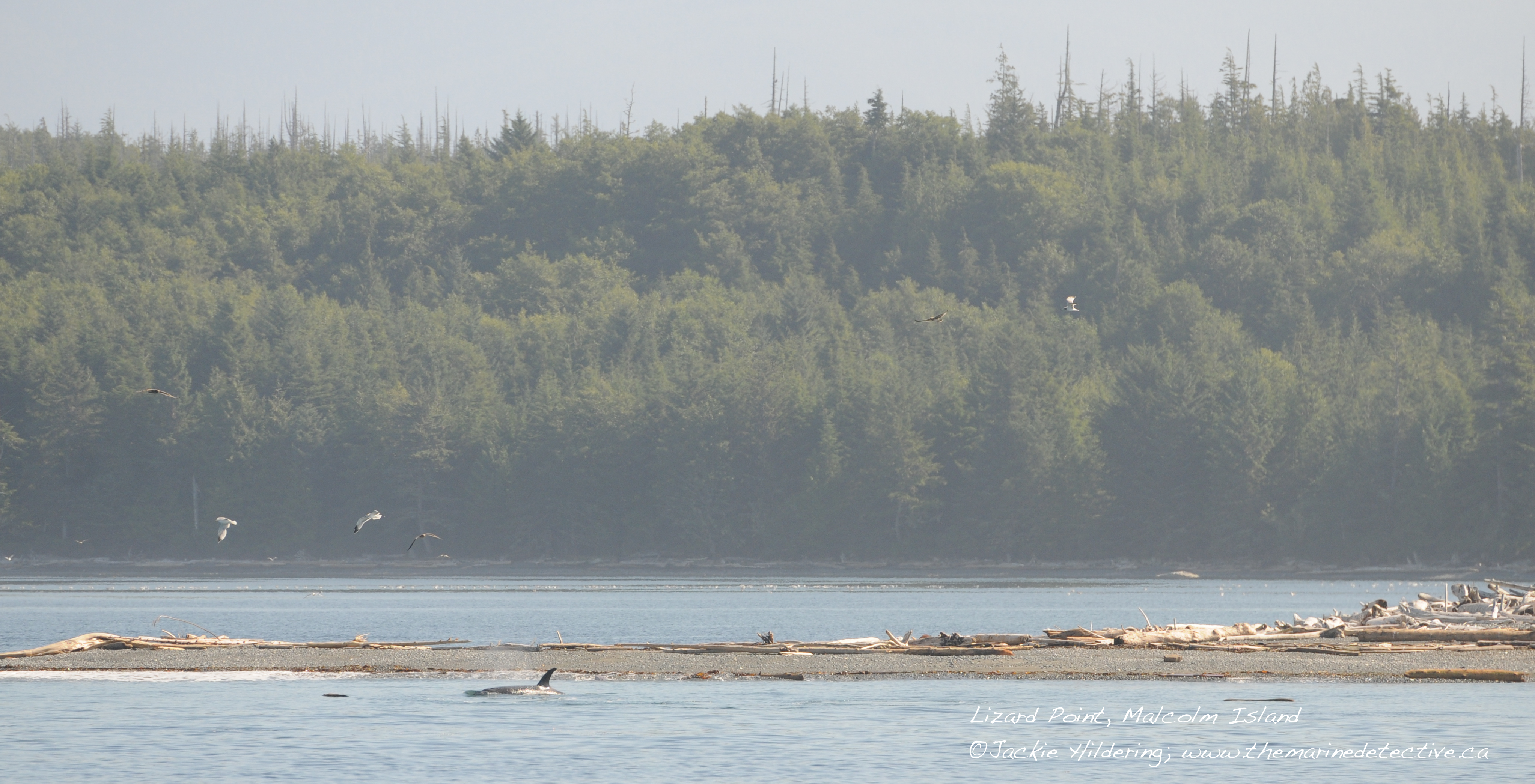
Northern Residents using a rubbing beach on Malcolm Island off NE Vancouver Island. For more information on these beaches see Friends of the Wild Side.

Northern Residents using a rubbing beach on Malcolm Island off NE Vancouver Island. For more information on these beaches see Friends of the Wild Side.

_________________________________

Additional Videos of Beach-Rubbing of Northern Residents:

Video 2021 of the A42s rubbing near Sechelt

Video 2015  by – beach rubbing by A42s near Powell River.

Video January 27, 2018 by Sasha Koftinoff – beach rubbing by A42s near Sechelt.

Video January 27, 2018 by Martin Michael – beach rubbing by A42s + other Northern Residents near Sechelt.

Video January 27, 2018 by Bruce Robinson – beach rubbing by A42s + other Northern Residents near Sechelt.

Video – Feodor Pitcairn’s 2001  “Realm of the Killer Whales” with underwater footage of the beach-rubbing as of timestamp 48:15. This footage was obtained as a result of a special DFO permit.

Notes and Sources:
*Scientific convention is to reference Orcinus orca as Killer Whales. Many prefer “Orca” but please know that Orcinus orca loosely translates into “demon of the underworld”. The whales did not name themselves, we did and locked within the names is our misunderstanding and complex history with these remarkable, social, intelligent, big dolphin.

For more information on the BC’s Killer Whale populations see this previous blog  or Dr. John Ford’s book Marine Mammals of British Columbia, 2015.

For more footage from the OrcaLab cameras and hydrophones from NE Vancouver Island click hereYou can sign-up for text alerts by scrolling down at that link and filling in the field on the bottom left.

For potential impact of boat presence on rubbing behaviour, see Estimating relative energetic costs of human disturbance to killer whales (Orcinus orca). Rob Williams, David Lusseauc, Philip S. Hammonda (2006).

This blog led to my being interviewed for BBC’s “Ingenious Animals”. The episode includes a compilation of video of Northern Resident matrilines beach-rubbing. Available at this link as of 41 min.

Information on Beach-Rubbing in Alaskan Residents:

  • Members of AK pod are known to beach rub using “several different rubbing locations in Prince William Sound as well as in Kenai Fjords and Resurrection Bay.” Source: North Gulf Oceanic Society.
  • Alaskan Residents’ range overlaps with that of the Northern Residents, especially in Frederick Sound. It is unknown how often the Northern Residents and the AK pod of Alaskan Residents do or do not overlap in their ranges.
  • Video below shows beach-rubbing in what is very likely Alaskan Residents (members of AK pod) by Eric Eberspeaker – August 2015; Kenai Fjords Wilderness Lodge on the shore of Fox Island. You’ll note there are some very unique human vocals resulting from witnessing the beach rubbing.


Thank Goodness for Second Chances . . . .

It’s Canadian Thanksgiving and I am overwhelmed with depth of gratitude and purpose.

It is an extraordinary privilege to be able to live the life I do and I want so much for it to count.

Thank you dear readers for helping to amplify the beauty, mystery and fragility into the world so that there may be more understanding that there is no divide between land and sea and how our daily actions regarding chemical and energy use connect us – no matter how far away from this place you are.

The photo below is from two days ago – “Frosty” the Humpback Whale in Johnstone Strait, NE Vancouver Island.

To think we could have lost these glorious, majestic, mysterious, winged, singing, acrobatic ambassadors of our life-sustaining seas . . . .

Thank goodness for second chances.

Frosty the Humpback Whale (BCX1187) in Johnstone Strait, October 11, 2014. Just outside Telegraph Cove. Blinkhorn Light in the background. ©Jackie Hildering.

Frosty the Humpback Whale (BCX1187) in Johnstone Strait, October 11, 2014. Just outside Telegraph Cove. Blinkhorn Light in the background. ©Jackie Hildering.

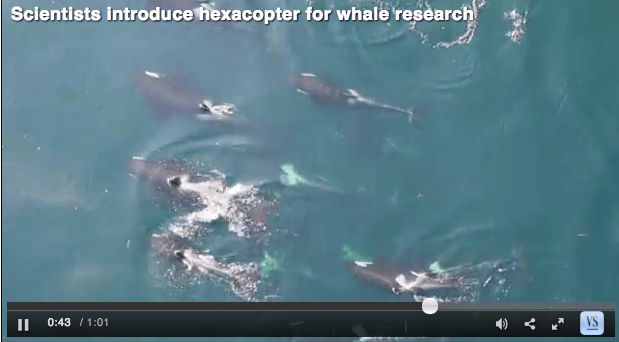
Look Up! Way Up! – “Hexacopter” soars high above killer whales to study their fitness

[Update summer 2016 – research team is now applying this technology to Humpback Whales – both photogrammetry and collecting blow samples. See here for video of the research.]

Whale researchers generally have some pretty lofty goals but the methodology being used to study the health of at-risk Killer Whales might have the highest standard of all – literally.

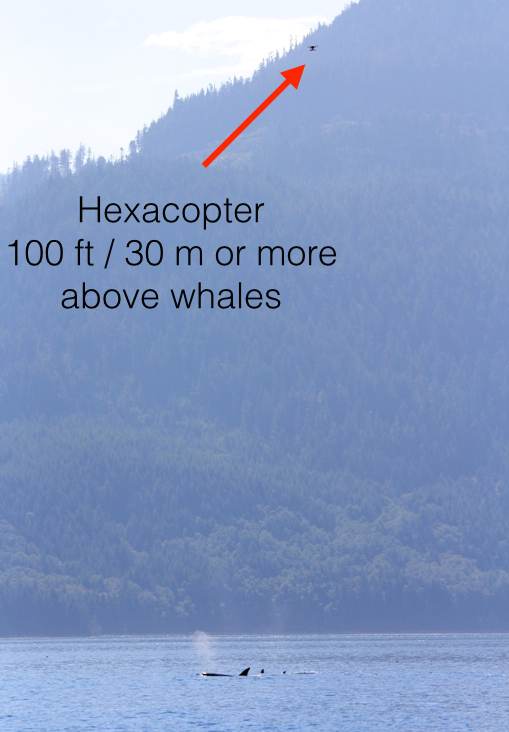
With Johnstone Strait being one of the most predictable and sheltered places to see Killer Whales, many of us seafarers on Northern Vancouver Island had a front row seat in seeing what was “up” with this research. A marine “hexacopter” was used, a drone with a camera mounted to it that soars 30m or more above the whales to obtain high quality video and photos that provide very valuable information about the whales’ fitness.

Ready for take-off: Olympus EPL2 camera mounted to the APH-22 marine hexacopter. Photo Hildering.

Ready for take-off: Olympus E-PL2 camera mounted to the APH-22 marine hexacopter. Photo Hildering.

Researchers Dr. Lance Barrett-Leonard, Head of the Cetacean Research Program at the Vancouver Aquarium, and Dr. John Durban and Dr. Holly Fearnbach of United States’ National Oceanic and Atmospheric Administration (NOAA) were very generous in sharing information about their high-flying research with our community. (Are you getting tired of my clever puns referencing height yet?!)

Dr. Holly Fearnback releasing the helicopter. Dr. John Durban centre and Dr.Lance Barrett Leonard on the right. Photo: Hildering.

Dr. Holly Fearnbach releasing the helicopter. Dr. John Durban centre and Dr.Lance Barrett Leonard on the right. Photo: Hildering.

Photo by Suzanne Burns showing how benign this method of study is - the research boat is more than 100m away and the hexacopter with camera is 30 m or move above the whales.

Photo by Suzanne Burns showing how benign this method of study is – the research boat is +/- 100m away and the hexacopter with camera is 30m or move above the whales.

All Killer Whales in BC are all at risk (Threatened or Endangered) and by getting the images from on-high, it is possible to better determine if the whales are thin and even if they are pregnant. This provides vital data such as being able to know if pregnancies did not go to term and how much the fitness of “Resident” Killer Whales depreciates in years of low Chinook salmon abundance. “Resident” Killer Whales are inshore fish-eating populations culturally programmed to be “Chinook-aholics” and their survival has been proven to be directly correlated to the abundance of Chinook salmon.

Here are some examples of the data obtained via hexacopter, revealing good news and bad news.

The bad news first  . . .

When Killer Whales are in dire condition and lose too much fat, this manifests as “peanut head”, sunken areas near the eye patches. I see this as the equivalent as sunken cheeks in the gaunt faces of underweight humans.

A Killer Whale with "peanut head" where the extreme loss of fat around the head causes sunken areas in the whale's head = the equivalent of gaunt cheeks in underweight humans. Photo taken during presentation by Dr. Lance Barrett Leonard, Dr. John Durban and Dr. Holly Fearnbach at Telegraph Cove's Whale Interpretive Centre on August 25th, 2014. Photo: Jackie HIldering

A Killer Whale with “peanut head” where the extreme loss of fat around the head causes sunken areas in the whale’s head.  This is a photo of a slide from the presentation given by Dr. Lance Barrett Leonard, Dr. John Durban and Dr. Holly Fearnbach at Telegraph Cove’s Whale Interpretive Centre on August 25th, 2014.

The images obtained with the hexacopter revealed that “Northern Resident” Killer Whales A37 and I63 were in extremely poor condition and, in fact, the whales disappeared from their matrilines (families) shortly after the images were taken. “Resident” Killer Whales stay with their families their entire lives so absence from the matriline most often means death.

The cause of death cannot be determined but know that when fat stores are get used up, manmade fat-soluble persistent organic pollutants (such as brominated fire retardants, PCBs, dioxins, etc) are released and affect the whale’s immune system. The mammal-eating Killer Whale of BC are known to be the most contaminated animals on earth.

In the presentation the research team provided in Telegraph Cove, I was gutted by the images of “Plumper” (A37 of the A36s) and I63 which showed concave eye patches and a tadpole-like body shape. The image of Plumper was contrasted to a healthy mature male Killer Whale (see below). As explained by Dr. Durban, Killer Whales when faced with fat loss, put water into the blubber layer so that they remain stream-lined. Plumper had lost so much fat, that it appeared he had to keep his pectoral fins extended to remain buoyant.  Ugh.

Image taken from the hexacopter revealing A37's very poor condition. He disappeared about 10 days after this photo was taken. A37 aka "Plumper" was one of the last 2 remaining whales in the A36 matriline of Northern "Resident" killer whales. He was 37 years old. The hexacopter study reveals that his brother A46 aka "Kaikash" is in good condition and he has been seen travelling with members of closely related matrilines. (Photo taken during the presentation by Dr. Lance Barrett Leonard, Dr. John Durban and Dr. Holly Fearnbach at Telegraph Cove's Whale Interpretive Centre on August 25th, 2014. Photo: Jackie Hildering)

Image taken from the hexacopter revealing A37’s very poor condition. He disappeared about 10 days after this photo was taken. A37 aka “Plumper” was one of the last 2 remaining whales in the A36 matriline of “Northern Resident” killer whales. He was 37 years old. The hexacopter study reveals that his brother A46 aka “Kaikash” is in good condition and he has been seen travelling with members of closely related matrilines. The above is a photo of a slide from the presentation by Dr. Lance Barrett Leonard, Dr. John Durban and Dr. Holly Fearnbach at Telegraph Cove’s Whale Interpretive Centre on August 25th, 2014.


Image taken from the hexacopter revealing I63's very poor condition. She disappeared from her matriline about a week after this photo was taken (I15 matriline of Northern "Resident" killer whales). She was 24 years old. Photo taken during the presentation by Dr. Lance Barrett Leonard, Dr. John Durban and Dr. Holly Fearnbach at Telegraph Cove's Whale Interpretive Centre on August 25th, 2014. Photo: Jackie HIldering

Image revealing I63’s very poor condition. She disappeared from her matriline about a week after this photo was taken (I15 matriline of “Northern Resident” killer whales). She was 24 years old. The above is a photo of a slide from the  presentation by Dr. Lance Barrett Leonard, Dr. John Durban and Dr. Holly Fearnbach at Telegraph Cove’s Whale Interpretive Centre on August 25th, 2014.

The good news . .  .

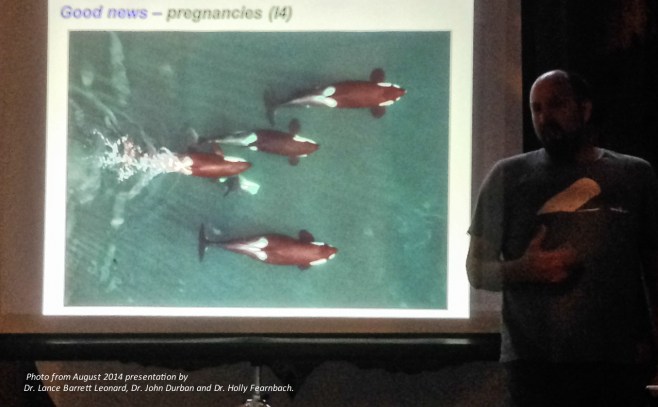
Data collected also revealed fat calves, robust nursing mothers, and pregnant females. Below, Dr. John Durban shares an image of 34-year-old “I4” of the I15 matriline of “Northern Residents” revealing that she is pregnant again.

Happy news! Photo taken from the hexacopter revealing reveals that I4 is pregnant. Photo taken during presentation by Dr. Lance Barrett Leonard, Dr. John Durban and Dr. Holly Fearnbach at Telegraph Cove's Whale Interpretive Centre on August 25th, 2014. Photo: Jackie HIldering

Happy news! Photo taken from the hexacopter revealing that I4 is pregnant again (she is the whale at the bottom of the image). With gestation being 17.5 months in killer whales and that, around the world killer whales give birth in the winter, I4 is likely about 1 year pregnant in this photo. Photo taken during presentation by Dr. Lance Barrett Leonard, Dr. John Durban and Dr. Holly Fearnbach at Telegraph Cove’s Whale Interpretive Centre on August 25th, 2014. Photo: Hildering.

I am in no way advocating for the unregulated use of drones for viewing whales. The researchers reported that the regulatory paperwork needed to get approval for this research weighed more than the hexacopter did and that they were glad that this was the case.

This research methodology, when applied correctly, is a wonderful example of how advances in technology can lead to advances in knowledge in a way that is benign to wildlife. The sky’s the limit in how we let this knowledge impact our day-to-day actions to improve the health of the marine environment for which Killer Whales serve as powerful sentinels.

How high will you go for the sake of Killer Whales and what they are revealing about the health of our life-sustaining oceans?


Video taken with the Olympus EPL2 camera mounted to the APH-22 marine hexacopter. Note that the whales would not hear what you are hearing in this video as the camera is 30m or more above the whales. If video does not load go to http://tinyurl.com/pjz3hpf

Video taken with the Olympus EPL2 camera mounted to the APH-22 marine hexacopter. Note that the whales would not hear what you are hearing in this video as the camera is 30m or more above the whales. If video does not load go to http://tinyurl.com/pjz3hpf

Research methodology allowed for an assessment of the fitness of 77 "Northern Resident" Killer Whales (inshore fish-eaters) and 7 "Bigg's" Killer Whales (mammal-eaters aka "Transients"). Here, mature male mammal-eating killer whale T060s is being photographed from on high.

The hexacopter research allowed for an assessment of the fitness of 77 “Northern Resident” Killer Whales (inshore fish-eaters) and 7 “Bigg’s” Killer Whales (mammal-eaters aka “Transients”) by the research team during 2 weeks in August. Here, mature male mammal-eating killer whale T060C is being photographed from on high. Photo: Hildering.

Photo by Laurie Sagle showing how high the hexacopter is above the whales.

Photo by Laurie Sagle showing how high the hexacopter is above the whales.

The research team: Dr. Holly Fearnback; Dr. Lance Barrett-Leonard; and Dr. John Durban. Photo: Hildering.

The research team: Dr. Holly Fearnbach; Dr. Lance Barrett-Leonard; and Dr. John Durban. Photo: Hildering.

For more information:

Whale Watching – Not “Up-Close-and-Personal!” How to make a good choice?

Click here to jump to the summary of points to consider in making the best choice for a whale-watching company.


This blog is catalyzed by advertisements for whale watching that I perceive to be extremely exploitive of whales, suggesting high adrenaline “up-close-and-personal” encounters.

The problem with such marketing, where boats are in very close proximity with whales, is threefold:

1. It feeds consumer demand for a whale watching experience that is not good for the whales. Close boats (including kayaks) have greater potential for stressing whales; disturbing whales’ natural behaviour; and increasing habituation to vessels whereby risks such as vessel strike are increased. These potential effects have been proven through scientific peer-reviewed research (see references below).

Pacific White-Sided Dolphins with new born calves. ©Jackie Hildering

Pacific White-Sided Dolphins with newborn calves. ©Jackie Hildering; telephoto and cropped image.

2. It creates false expectations and miseducates people. There are Marine Mammal Regulations and guidelines for respectful, legal and safe marine mammal viewing which include distance limits (200m for Orca and 100m for other cetaceans). However, if people see advertising promoting close interactions between boats and whales, they may believe this is what is to be expected on their tour. Thereby, companies who choose to use this marketing approach are creating increased pressure on whale watching boat operators to fulfill these expectations. And note, it is NOT okay to position your boat in order to “have the whales come to us.”

There will be those who succumb to such pressure, and who will conduct their vessel in a way that violates the regulations and thus creates greater disturbance for the animals. I solidly believe that the average consumer wishes to marvel at whales in the wild in a way that is as benign and natural as possible. Were they to know the potential impacts of close encounters or that the company they had chosen was “blurring” what is right, it would very much taint the experience for them.

Pacific Habour Seal mother nursing her newborn. The pup is so young you can see his/her umbilical cord. ©Jackie Hildering

Pacific Harbour Seal mother nursing her newborn. The pup is so young you can see his/her umbilical cord. ©Jackie Hildering; telephoto and cropped image.

3. It creates a “marketplace” where other companies with more solid ethics face the dilemma of how to counteract such advertising and aid consumers in making a better choice. Sometimes, unexpectedly whales do surface within the viewing distance limits but to promote this feeds the “get-up-close-and-personal” monster.
In order to solve this dilemma and counteract the above two points as well, there are whale watching associations where operators have agreed not to show their boats in close proximity to whales.

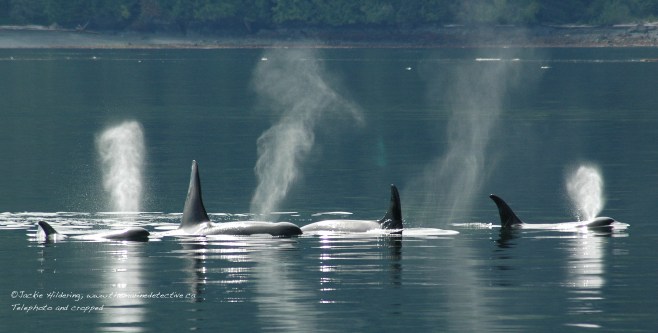
Resting line of the A12 matriline of "Northern Resident" orca (inshore fish-eating population). ©Jackie Hildering

Resting line of the A12 matriline of “Northern Resident” orca (inshore fish-eating population). ©Jackie Hildering; telephoto and cropped image.


Granted, we’ve come a long, long way.  Public attitude towards whales has changed drastically. We’re not shooting whales anymore and we’re not putting them in captivity. Whaling only ended in British Columbia in 1967 and the live capture of orca only ended in 1973/74 (thank you Dr. Michael Bigg).

Now, thankfully, our values and knowledge have largely evolved to where we respect whales as sentient, social, intelligent animals with culture.


So how to make a good choice?

How to choose a whale watching experience that has the least impact on the environment with the greatest potential for learning and conservation?   How to navigate the sea of choice when confronted with the vast array of variables such as location, vessel type, crew, and advertising strategies?

Humpback Whales resting at the surface. ©Jackie Hildering

Humpback Whales resting at the surface. ©Jackie Hildering


Know that the great truth is that the best possible experience is that your viewing of wildlife happens as if you were not there.

The ideal would be to watch cetaceans from land with interpretation from a knowledgeable guide but there are very few places where whales pass by with predictability.

Going out in a private motorized vessel is also an option but most often means a larger noise and fossil fuel footprint per person and not having the many benefits of knowledgeable crew who can educate and operate the vessel in a way that is more benign. Data collected by the Cetus Research and Conservation Society supports that it is by far more often the case that recreational boaters violate the guidelines / regulations than do commercial whale watch operators.

See the little fin at the far left? That is "Cutter" (A86) as a calf in 2006 nursing mother "Clio" (A50). Sibling "Bend" (A72) is the whale with the injured dorsal fin. Bend now has a calf of her own. A30 matriline of "Northern Resident" orca population (inshore fish- eaters) ©Jackie Hildering.

See the little fin at the far left? That is “Cutter” (A86) as a calf in 2006 nursing mother “Blinkhorn” (A54). Sibling “Bend” (A72) is the whale with the injured dorsal fin. A30 matriline of “Northern Residents (inshore fish- eaters) ©Jackie Hildering; telephoto and cropped image.


Of course, it would help consumers and marine wildlife greatly if there were a effective system in place that guarded high standards of operation and that sufficient resources were made available for effective monitoring, education and enforcement of boaters around marine wildlife. Sadly, these resources are not available whereby consumer awareness and operator ethics become all the more important, as does reporting violations to the DFO Incident Reporting Line at 1-800-465-4336.

Steller Sea Lions socializing at the haul-out. ©Jackie Hildering.

Steller Sea Lions socializing at the haul-out. ©Jackie Hildering.


So, here we go . . .

Summary of points for consideration in making a whale watching choice that is better for the whales and environmental sustainability in general.

1. Location:

How close is the vessel departure point from the area where whales are likely to be i.e. how long and how fast will you need to travel? This affects how large your fossil fuel and noise footprint will be.

2. Crew:

How much successful experience and training and what qualifications does the crew have in:

  • Operating vessels around whales?
  • Providing science-based information that would make whale-watching count for the sake of inspiring greater conservation efforts rather than just be about opportunities for photography?

3. Vessel Related:

  • Does the vessel type allow for effective delivery of educational information?
  • How large is the vessel?  This is highly relevant in determining the noise and fossil fuel footprint per person as is the fuel efficiency of the vessel and the engine type.
  • Usually more difficult to determine unless specified on the company’s website: Is the engine of a design where noise is reduced? Do operators shut off the engine whenever possible?

4. Ethics and Approach:

Does the company:

  • Have a holistic and comprehensive approach to environmental sustainability e.g. noise reduction measures, avoiding disposable goods, use of organic, energy-efficient, and biodegradable products, etc?
  • Contribute to marine conservation and research efforts e.g. sightings data being relayed to research initiatives, financial or in-kind support, etc.
  • Use language and images, in advertising and social media, that are respectful of the marine wildlife and the guidelines for viewing them? This includes NOT including imagery that feeds the “up-close-and-personal” monster. 
Mammal-eating orca T39 just having successfully killed a Pacific White-Sided Dolphin. Splash on the left is her calf just having entered the water before her. Splashes in the background, right in front of Telegraph Cove, are the dolphins that got away. ©Jackie Hildering

Mammal-eating orca T39 just having successfully killed a Pacific White-Sided Dolphin. The splash on the left is her calf just having entered the water, learning to hunt alongside her. The splashes in the background, right in front of Telegraph Cove, are the dolphins that got away. ©Jackie Hildering; telephoto and cropped image.


My life radically changed after going on just one whale-watching trip many years ago. I certainly know how profoundly transformative and powerful an experience it can be.

When done right, ensuring guidelines / regulations are adhered to and solid conservation messaging is shared, whale-watching guests are able to have the best possible experience. An experience that is benign and respectful can lead to greater caring; a sense of connection to the animals and the life-sustaining ocean for which they are ambassadors; and the inspiration to undertake action that is better for the environment (and therefore, ourselves).

Consumers have very significant power to shape how whale watching is conducted. By supporting companies striving to operate in a way that is best for the whales and the environment at large, you are not feeding the “get-up-close-and-personal” monster. The resulting reward is to know that your experience will be as wild as can be – best for you, best for the whales and best in not rewarding those who compromise their ethics and the privilege of being a conduit for people to experience the raw beauty of seeing whales in the wild, where they belong.

So please, consider the above points and take particular notice of whale watching companies’ advertisements.  Choosing a company whose marketing reflects respectful whale watching is the first step to ensuring your experience will be as good as you want it to be.

Pacific Harbour Seal about to give birth. ©Jackie Hildering

Pacific Harbour Seal about to give birth. ©Jackie Hildering; telephoto and cropped image.


If you witness an incident of concern regarding marine life, please call the DFO Incident Reporting Line at 1-800-465-4336.


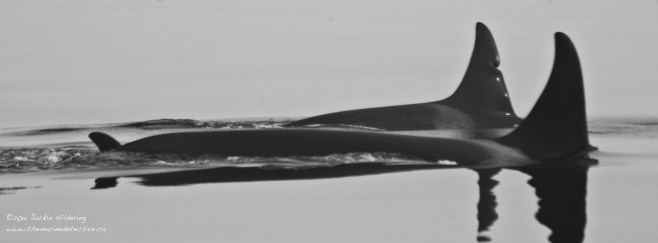
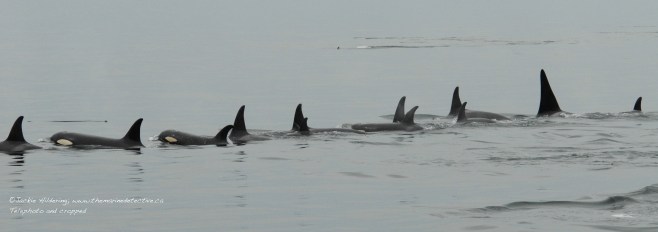
Resting line of "Northern Resident" orca (inshore fish-eaters). ©Jackie Hildering

Resting line of “Northern Resident” orca (inshore fish-eaters). ©Jackie Hildering; telephoto and cropped image.

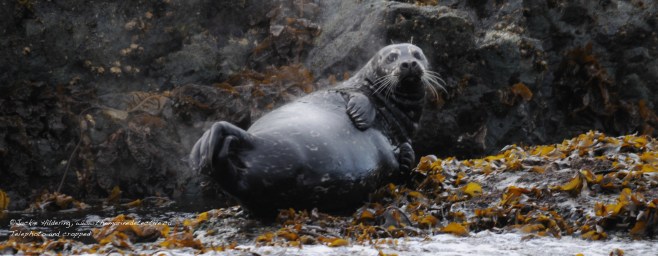
Pacific Habour Seal resting at the surface. ©Jackie Hildering

Pacific Harbour Seal resting at the surface. ©Jackie Hildering; telephoto and cropped image.

References:

“Posturing” Humpback Whales?

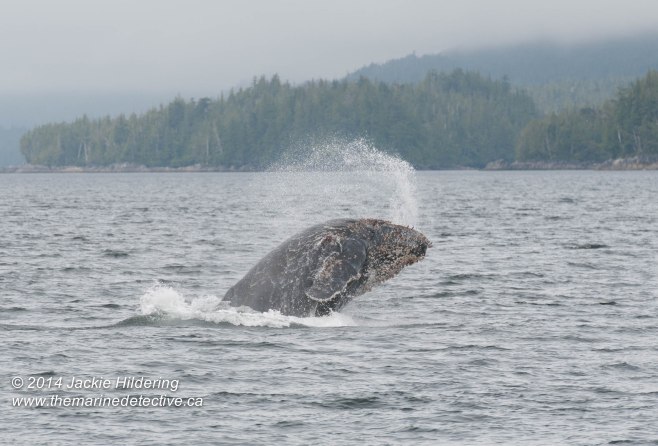
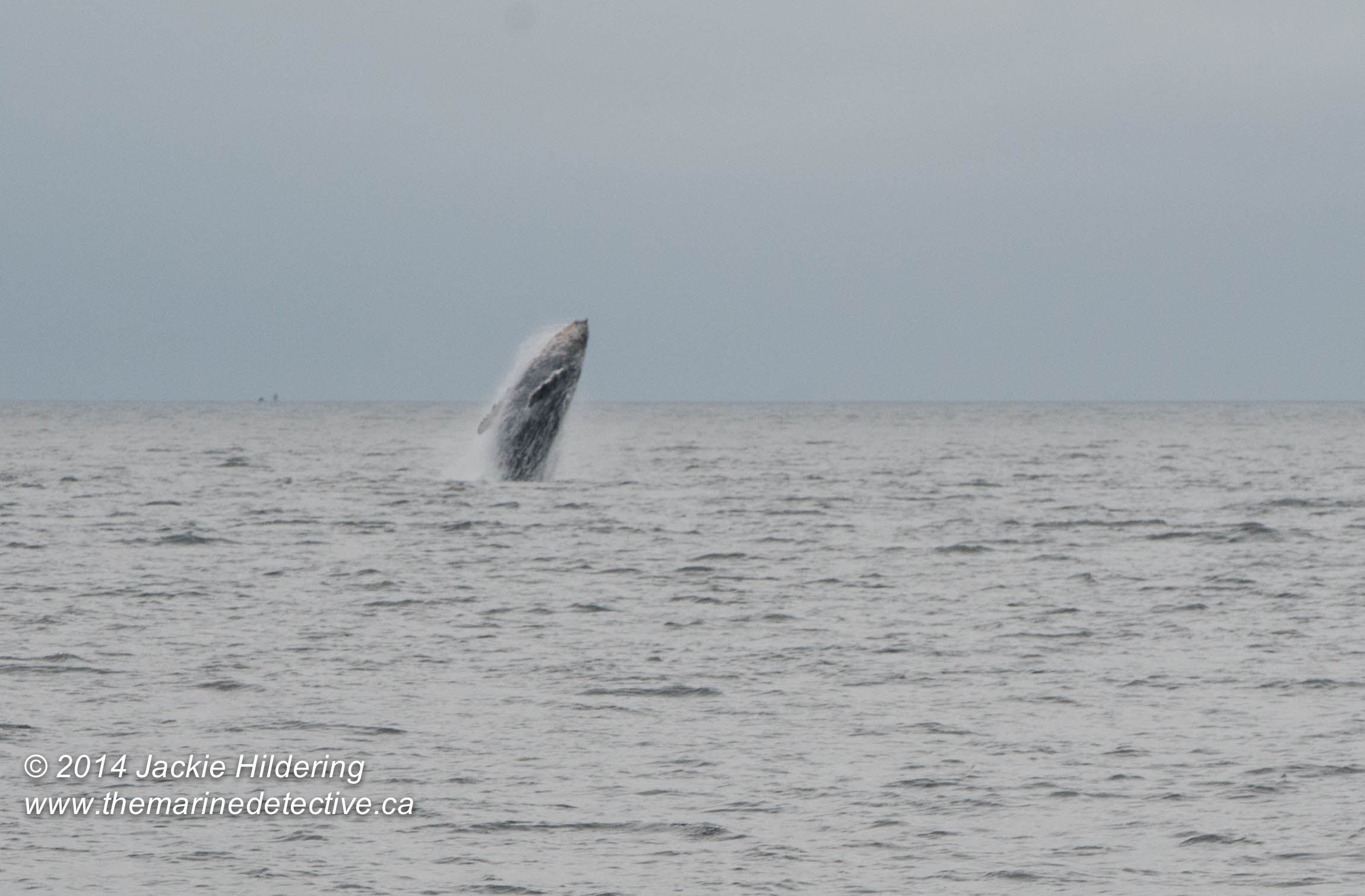
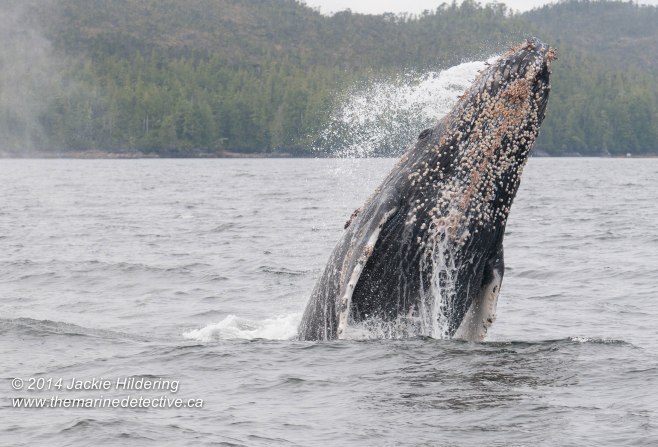
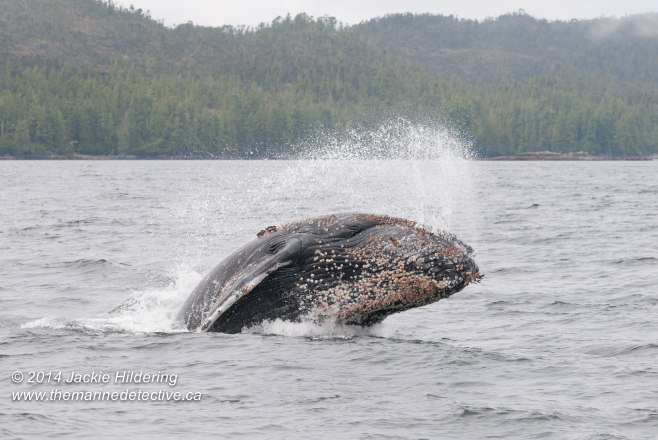
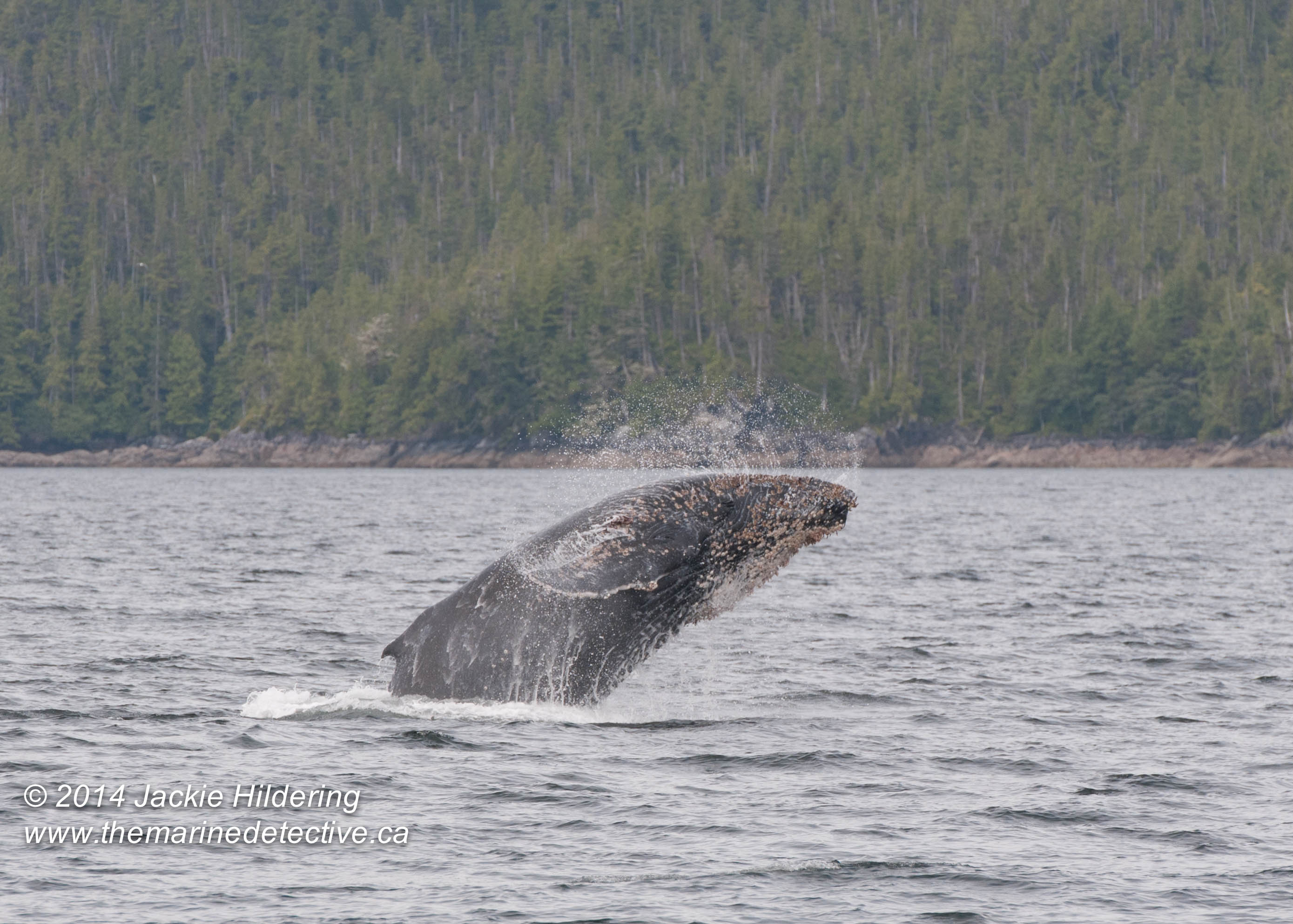
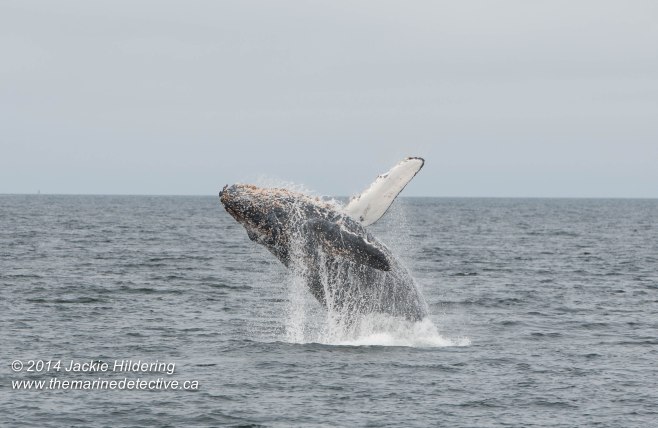
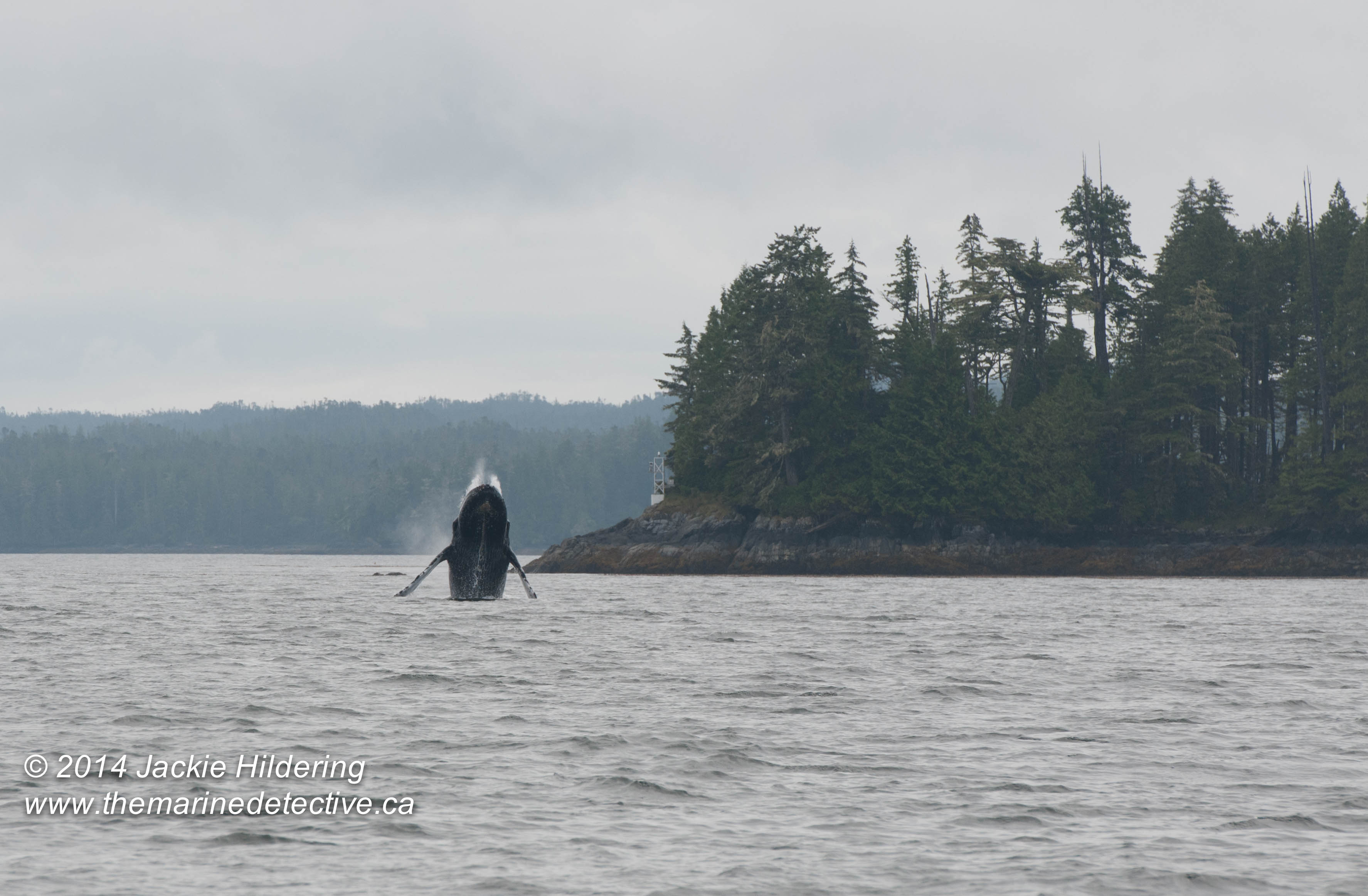
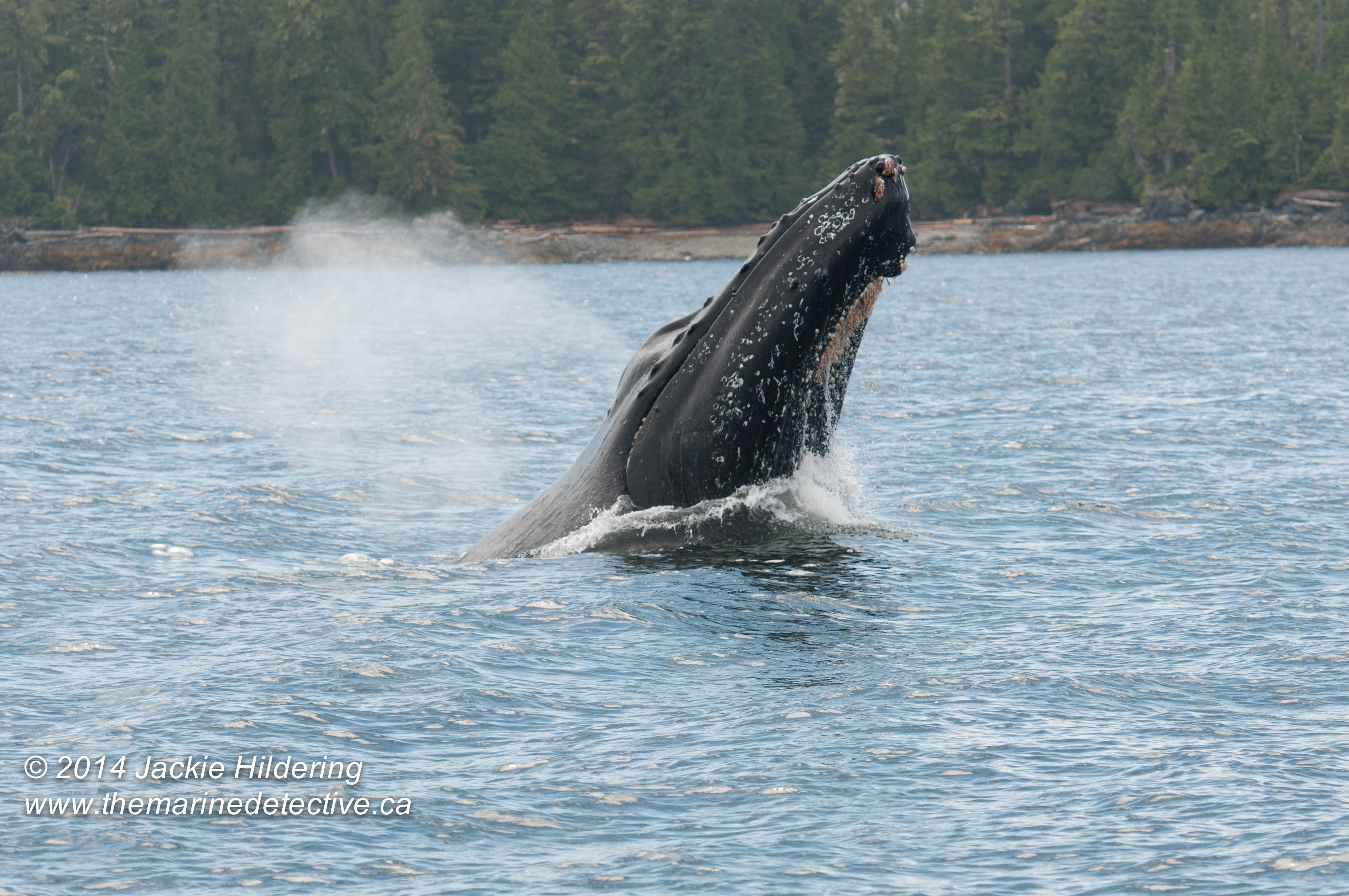
Some experiences are best shared in photos. So here you have 20 images documenting the marvel of how 2 humpback whales interacted with one another for more than an hour. Huge energy was expended by both whales in head lobbing, lobtailing, pectoral fin slapping, and breaching. Back and forth it went, the sounds resounding above and under the water in the Great Bear Sea around Caamano Sound (proposed tanker route).

I witnessed this while with Pacific Wild as an educator for the SEAS program (Supporting Emerging Aboriginal Stewards).

What was this humpback whale exchange about?  In this case, I really don’t know.

One of the two humpbacks that was incredibly surface active ©Jackie Hildering. All photos Telephoto and cropped.
One of the two humpbacks that was incredibly surface active ©Jackie Hildering. All photos telephoto and cropped.

I have had the privilege of learning from these giants for more than a decade now and have seen such exchanges in all sorts of contexts.

I reference the behaviour as “posturing” since the whales appear to making a display to one another. Outside of play behaviour and learning in young animals, my interpretation is that these incredibly powerful surface active displays between whales may serve the purpose of:

  • Delivering a clear “I’m big don’t mess with me” message to a perceived threat e.g. the presence of mammal-eating killer whales (“Bigg’s”/”transients) or the vocals of fish-eating killer whales (“residents”) to which the humpbacks are not habituated;
  • Communicating the presence of a perceived threat to other humpback whales since the slaps of humpback fins and bodies resound underwater;
  • Striving to display dominance / greater vigour to other humpbacks which may be particularly relevant for mating;
  • Possibly establishing spacing between humpbacks; and/or
  • Some sort of social function that leads to them ultimately joining up and swimming away together as was the case in exchange for which I provide the photos below.

Here we go. Photos provided in chronological order.

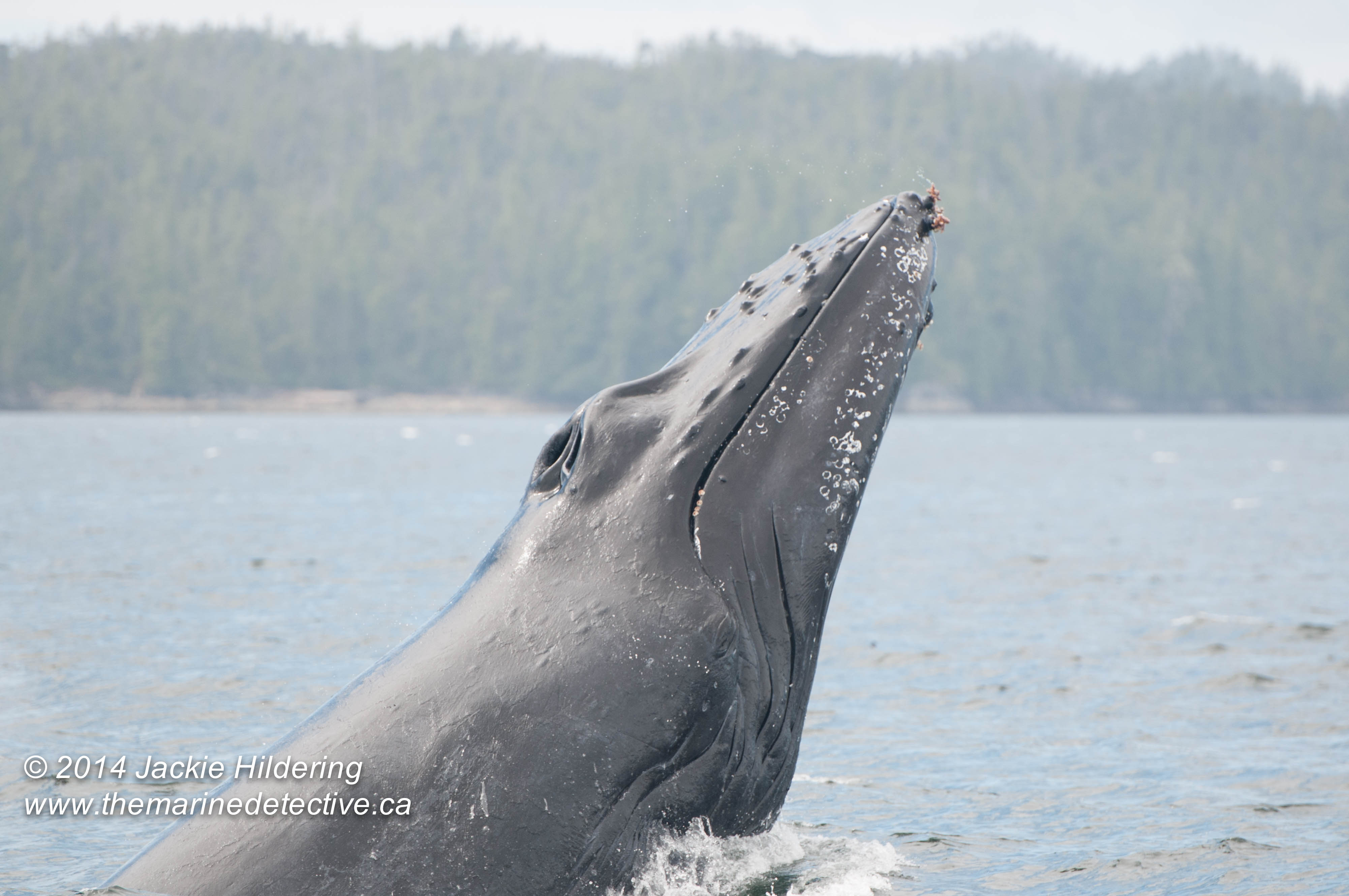
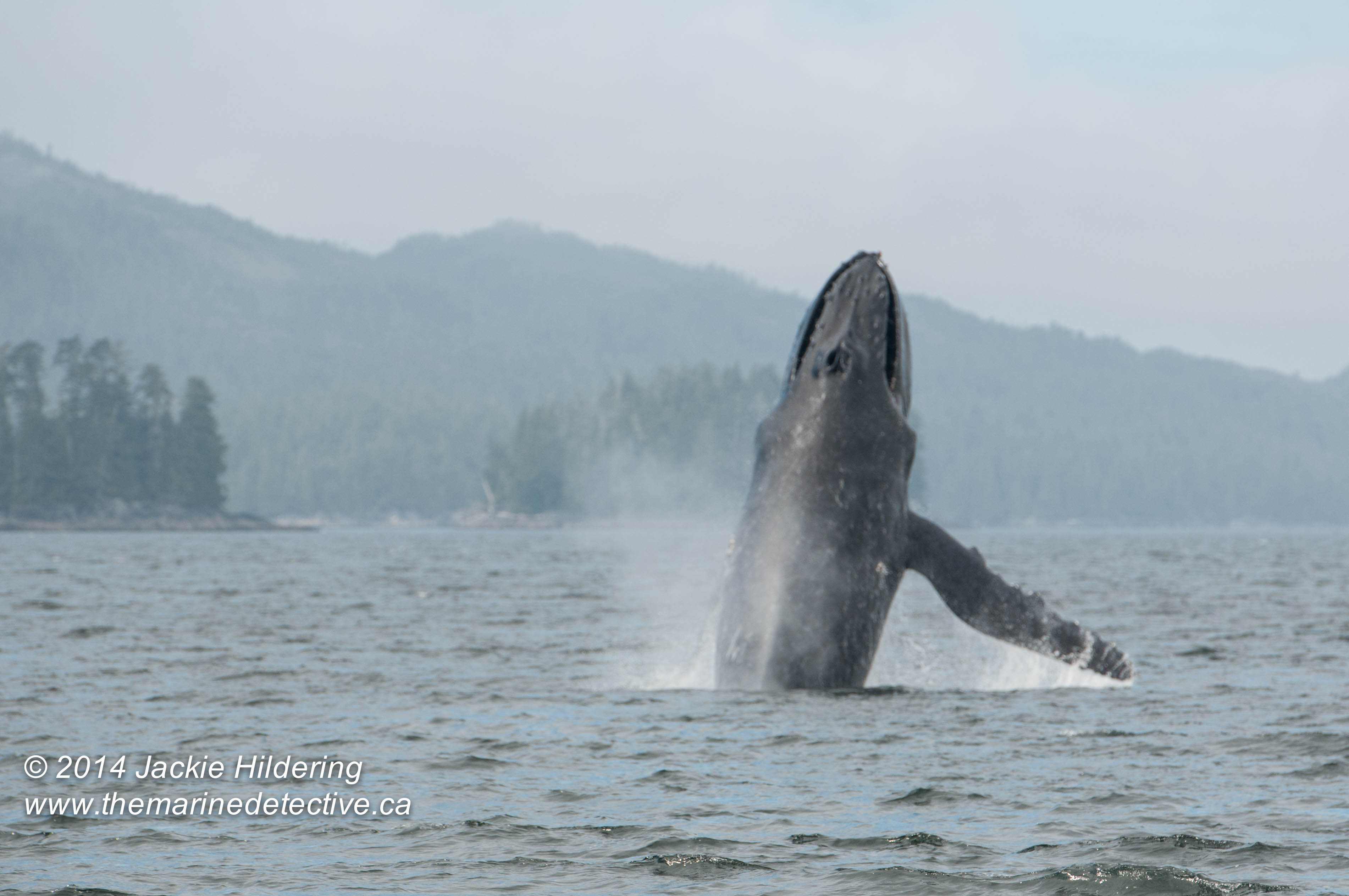
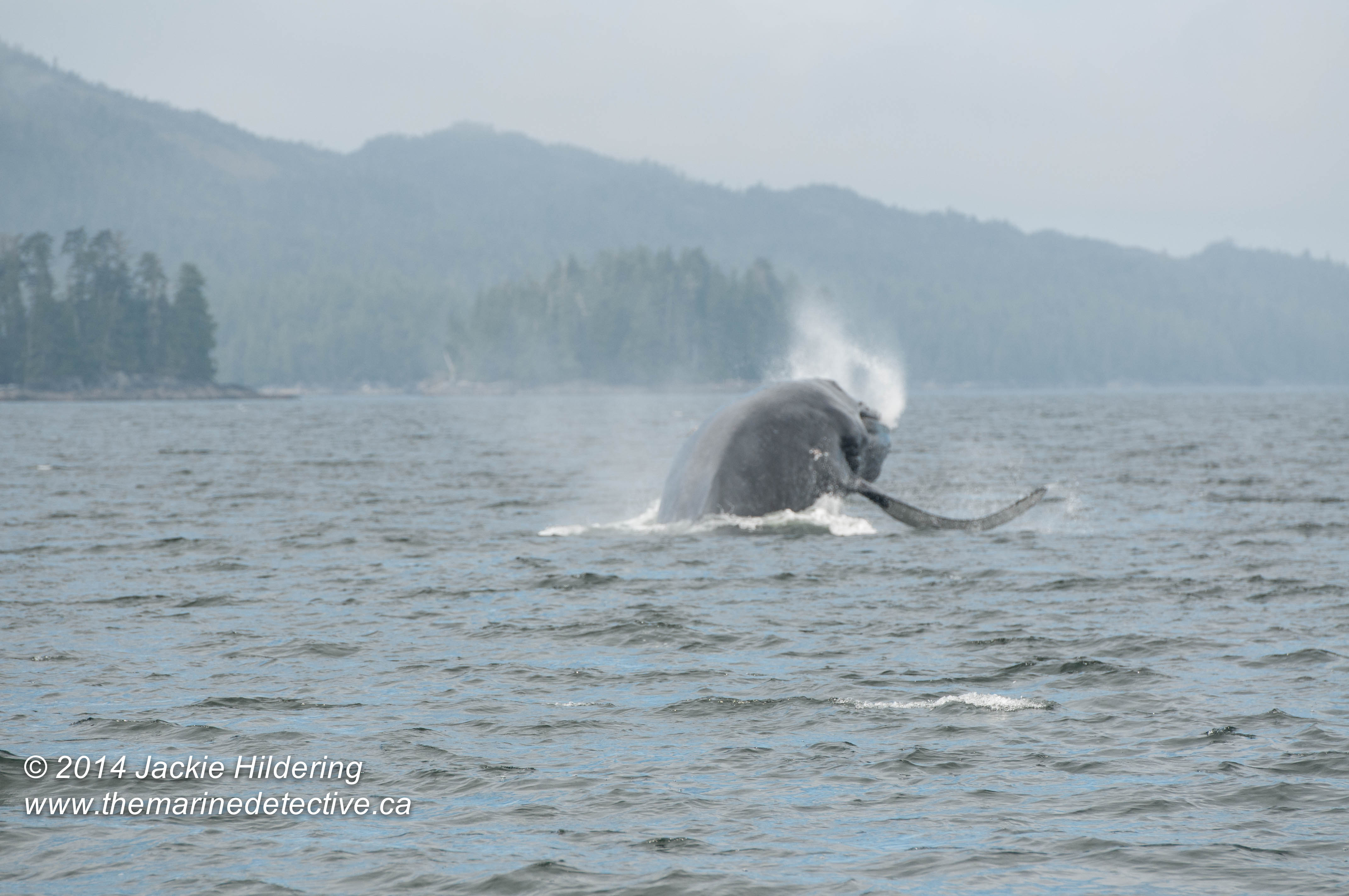
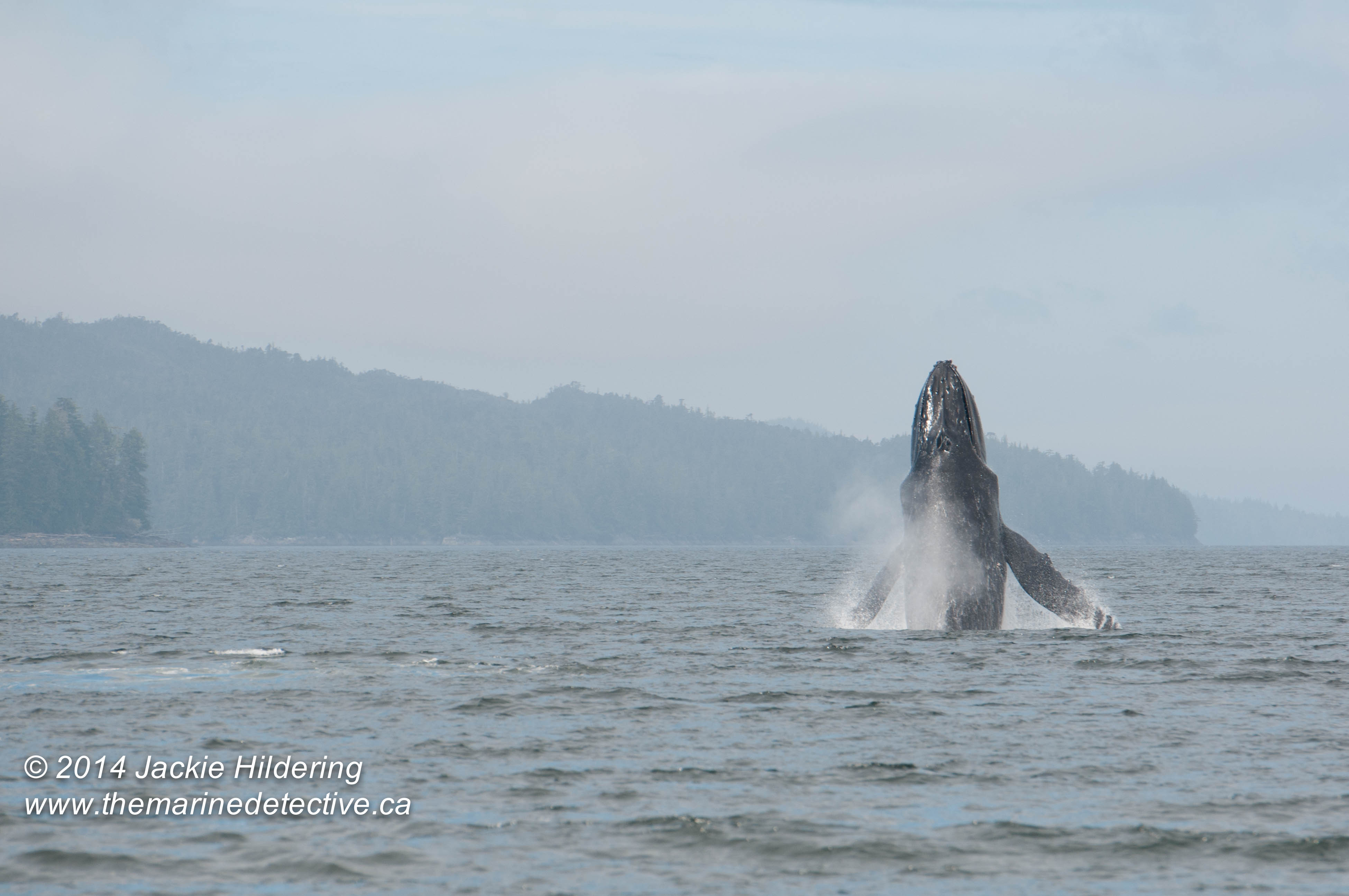
Almost simultaneously, when both whales were within 200 m of one another, Humpback 1 (lots of barnacles and smaller but too big to be the 2nd whale’s calf) started breaching and Humpback 2 (larger) started lobtailing. [Note, there were also two other humpbacks in the area but at a greater distance away and they were not surface active.]

©Jackie Hildering. Telephoto and cropped.
Humpback 1 starts breaching. ©Jackie Hildering. All photos telephoto and cropped.

©Jackie Hildering. Telephoto and cropped.

Humpback 2 starts tail-lobbing. ©Jackie Hildering. All photos telephoto and cropped.

Humpback #1 then began repeatedly head-lobbing, advancing away from Humpback 2.

 All photos telephoto and cropped ©2014 Jackie Hildering.
Humpback 1 head-lobbing. All photos telephoto and cropped ©2014 Jackie Hildering.

©Jackie Hildering. Telephoto and cropped.
Humpback 1 continues to be very surface active.  ©Jackie Hildering. Telephoto and cropped.

©Jackie Hildering. Telephoto and cropped.

Humpback 1 continues to be very surface active. ©Jackie Hildering. Telephoto and cropped.
©Jackie Hildering. Telephoto and cropped.
Humpback 1 still at it. ©Jackie Hildering. Telephoto and cropped.

©Jackie Hildering. Telephoto and cropped.

Humpback 1 breaching. ©Jackie Hildering. Telephoto and cropped.

©Jackie Hildering. Telephoto and cropped.

Some more head lobbing from Humpback 1. ©Jackie Hildering. Telephoto and cropped.

©Jackie Hildering. Telephoto and cropped.

Some more head lobbing from Humpback 1. ©Jackie Hildering. Telephoto and cropped.

HW_2014-08-05-_JH_Rambothem Island-1536

Leandrea, intern at Pacific Wild, listening to how the slaps of fins and body could be heard underwater.

©Jackie Hildering. Telephoto and cropped.

Whale 1 not done yet. Breaching here. ©Jackie Hildering. Telephoto and cropped.

Half an hour later, Whale 2 advanced from the position where the exchange with Whale 1 began. S/he head-lobbed and breached down the same track as Whale 1.

©Jackie Hildering. Telephoto and cropped.

Humpback 2 head-lobbing, advancing down from where the exchange with Whale 1 began. ©Jackie Hildering. Telephoto and cropped.

©Jackie Hildering. Telephoto and cropped.

Humpback 2 – more head lobbing. ©Jackie Hildering. Telephoto and cropped.

©Jackie Hildering. Telephoto and cropped.

Humpback  2 – head lobbing and moving toward Whale 1. ©Jackie Hildering. Telephoto and cropped.

©Jackie Hildering. Telephoto and cropped.

Humpback  2. See his/her eye? ©Jackie Hildering. Telephoto and cropped.

©Jackie Hildering. Telephoto and cropped.

Humpback  2. Imagine the energy expended to lob his/her body like this. ©Jackie Hildering. Telephoto and cropped.

©Jackie Hildering. Telephoto and cropped.

Humpback 2 continues in the direction of Whale 1. ©Jackie Hildering. Telephoto and cropped.

©Jackie Hildering. Telephoto and cropped.

Humpback  2. ©Jackie Hildering. Telephoto and cropped.

©Jackie Hildering. Telephoto and cropped.

Shortly after this, s/he joined with Humpback 1. ©Jackie Hildering. Telephoto and cropped.

Humpback 2 only stopped this highly surface active behaviour after half an hour when close to Humpback 1. And then . . . . then they joined up very close together and swam back in the direction that exchange had begun. What was it all about?!

With these whales being on the Central Coast, I am relaying fluke and dorsal photos to the wonderful Janie Wray and Herman Meuter of Cetacea Lab to find out if they might know the identities of the whales involved in this exchange. They are not known to us at the Marine Education and Research Society.

But will we ever know for sure what such a display was about? In having the extraordinary privilege of learning from the marine environment, one of my most valued lessons is to recognize how little we know and thereby to have the correct humility and precaution in decisions about marine resources.

Humpback whales are giants, they are easy to identify as individuals, they have been studied for some 40 years and still there is so very much we don’t know – including the benefit of expending so much energy in such an exchange.

_________________________________________

For related information see my previous blog “Might As Well Jump

For an ethogram of humpback whale behaviours from the Whale and Dolphin Conservation Society, see here.