A member of the A12 matriline of Northern Resident Killer Whales spyhops in Johnstone Strait. Likely A55 (aka “Echo”); male born in 1990. Photo by Jackie Hildering.
Where are the whales?!
If I had a dollar for every time I have been asked that question, I could now purchase an E-Tec engine for my little research boat and live with a clearer and cleaner carbon conscience!
It is indeed the question most often asked of marine naturalists and suggests that there are those who believe that there is incredible predictability to viewing wild whales; that there may even be a single location where they will always be found.
I have found that this is particularly true in reference to Killer Whales and that a significant number of people appear to believe that the Michael Bigg (Robson Bight) Ecological Reserve in Johnstone Strait will always have Killer Whales within its boundaries (see here for information on beach-rubbing).
Of course, it does not help comprehension that the inshore fishing-eating populations of British Columbia have been named “Residents”. This leads to Northern Vancouver Island often being promoted as “home” to a population of some 300 [2016 estimate] members of the Northern Resident Population.
In answering “Where are the whales”, I will make the point that you can never quite know where wild whales are and, when I think I can get away with being a little bit cheeky – which thankfully is quite often – I will make this point by with the answer “The whales are underwater”.
But, it is of course true that Northern Vancouver Island is possibly the most predictable place on earth to see Killer Whales and that it is our extraordinary privilege to live in the area that is a mecca for those hoping to see them – and so much more marine wildlife. However, the Killer Whales are not “resident” and they are not in this area in the 100s.
My answer to “Where are the whales” must therefore also explain that Killer Whales have culture; they have evolved into discrete “ecotypes” whose lifestyles have been shaped by what they eat.
BC’s waters have two populations of highly vocal and social in-shore fish-eating killer whales that love to snack on salmon (the northern and southern “Residents”); a population of stealthy marine-mammal-eating killer whales (“Transients” also known as “Bigg’s Killer Whales”); and a fish-eating population that is more often off the continental shelf and whose diet includes sharks (“Offshores”).
In order to preserve the culture that allows them to specialize on different prey, none of these populations mate with one another. The predictability of seeing them is dependent on where their prey is and how stealthy they have to be to successfully hunt.
Johnstone Strait is the only waterway that allows full passage on the inside of Vancouver Island and therefore it is like a funnel for the salmon traveling to natal rivers further south to spawn. This is why, most often, there are some families (“matrilines”) of the Northern Resident Population in our area from July into October/November. This is when the salmon are running and the Killer Whales are especially present when there is the opportunity to pursue fatty Chinook salmon.
Sometimes, presumably when whale bellies are full enough, there will be some 100 madly socializing members of the Northern Resident Killer Whale population around Johnstone Strait. However, this is a rarity since the families have different affinities for areas of BC’s coast. There are some families, like the A34s and the A30s, that have an extraordinary affinity for fishing in this area, while there are other families like the Hs and Rs that very rarely chase the salmon around Johnstone Strait. Sometimes we even have groups of Southern Residents transiting through the area – this is the endangered population that is more often found near Victoria.
In contrast to Residents, there is less seasonality in the movements of the marine-mammal-eating “Transient” killer whales since seals, sea lions, dolphins, porpoises, etc, can be here year round. But, but, but . . . this does not mean that if you see a Killer Whale in our area in the winter, it is a Transient!
Resident killer whales can be here in the winter as well, but unlike at other times of the year, it is usually not for more than a day at a time and they likely are here to feed on other fish species like halibut. The OrcaLab on Hanson Island monitors whale vocals year round and, since every northern resident family’s calls are distinct, they can even conclude which families are in the area
Despite all this knowledge, there is so much we do not know about BC’s Killer Whales and the threats that have necessitated all populations getting protection under Canada’s Species at Risk Act.
For Species at Risk Act “Status Reports” on the Pacific Northeast populations of Killer Whales – click the links below:
In the Northeast Pacific, “Bigg’s Killer Whales” (formerly known as “Transients”) are believed to have diverged from the “resident” (inshore fish-eating) and “offshore” (offshore fish-eating) ecotypes some 700,000 years ago (Morin et al, 2010), to refine a culture of stealth and unpredictability in order to hunt their marine mammal prey.
I would suggest that we humans are the last species that should be judging others for how much they eat. However, often Bigg’s Killer Whales are profiled and misunderstood for interpretations of their feeding behaviour. This includes that they don’t always eat what they kill.
From Kuker and Barrett-Lennard (2010) “Like many other predators, transient killer whales sometimes demonstrate ‘surplus killing’, killing greater numbers of prey than they consume (DelGiudice 1998, Wobeser 2000, Short et al. 2002). In surplus killing incidents, the whale plays with animals, such as sea birds (Stacey et al. 1990) and harbour seal pups (Gaydos et al. 2005). The whales may breach on the victim or toss and ram it until it dies, but it is not consumed. This behaviour could be part of the process of learning to hunt, in which adults are training young to capture and handle prey, or it could be simply play behaviour (Ford et al. 1998, Gaydos et al. 2005).”
Below is my account of one such surplus killing events witnessed on August 31st, 2011. It was not a good day for some Rhinoceros Auklets (Cerorhinca monocerata) in Johnstone Strait, British Columbia, Canada.
Young Bigg’s Killer Whale grabs Rhinoceros Auklet. Photo: Hildering. All photos taken with telephoto lens and cropped.
That day, I witnessed a very socially active group of Bigg’s Killer Whales repeatedly harassing these birds – mouthing them and slapping them. At least 3 juvenile Rhinoceros Auklets were involved. Since these are diving birds, they cannot “alight” and escape the teeth and fins below them. Yet, I believe they survived.
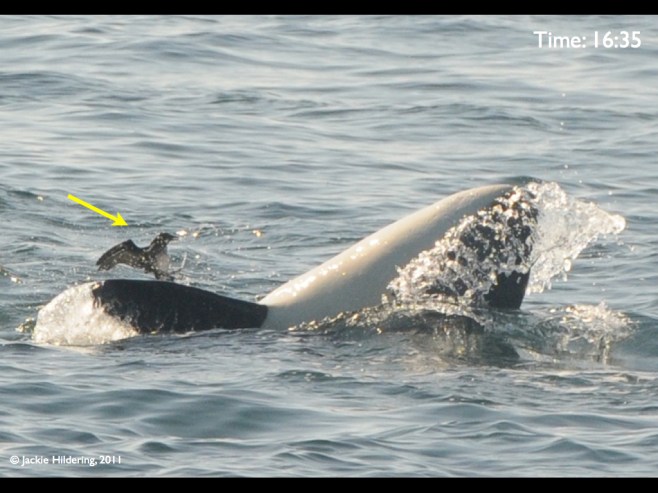
Bigg’s Killer Whale surfaces right beside a Rhinoceros Auklet. Photo: Hildering.
I personally had never seen such a prolonged display of this play behaviour before. In fact, I had never seen Bigg’s Killer Whales socialize quite so rambunctiously! [Update 2020, now that seals and sea lions are more readily available, members of this population appear to be far less stealthy].
Clearly, when their bellies are full and social needs dominate, this type of Orca is anything but stealthy. On August 31st, this incredibly socially active group of 20+ Bigg’s took about 1.5 hours to travel only +/- 4.5 km (2.5 nautical miles) – slapping birds, rolling over one another, tail slapping, vocalizing and breaching along the way. The whales would go on to bound past the community of Alert Bay, Cormorant Island. I have have previously written about this in the blog item “Might As Well Jump.”
Jared Towers of the Department of Fisheries and Ocean has confirmed the IDs of the Bigg’s Killer Whales in the August 31, 2011 encounter to be: T010s, T034s, T035s, T037s, T046Bs, and T146s.
Insight into this behaviour is provided by Dr. John Ford and Graeme Ellis. The following interpretation of the behaviour is from the chapter “Seabirds: Playthings and Practice, or Between-Seal Snacks?” in Transients: Mammal-Hunting Killer Whales of British Columbia, Washington, and Southeastern Alaska, 1999.
“It is not unusual to see transients chasing and harassing seabirds. During most of these incidents, the whales do not seem intent on eating the birds. Rather, they let the bird escape or they abandon it after it has been injured or killed. Seabird harassment appears to be a favourite activity of juvenile transients. The young whales will sometimes swim upside down and on their sides, looking for birds paddling at the surface above. Once a victim is sighted, they will try to slap it with their tail flukes, jump on it, or seize it in their mouth. This interaction may continue for several minutes, before the bird is eaten, incapacitated, or left dead in the whale’s wake. We and others have recorded at least 10 seabird species that have become casualties of transients. Frequent victims are common murres, which are flightless for several weeks during the late summer and are like “sitting ducks” for transients. Other species include black brant, common loon, white-winged scoter, surf scoter, cormorant (species uncertain), western grebe, marbled murrelet, rhinoceros auklet, and red-breasted merganser. Seabirds seem to be more important as objects of play or harassment than as a dietary item. Juveniles playing with seabirds no doubt learn useful skills in prey capture and handling that may enhance their success in hunting harbour seals and other wily prey.”
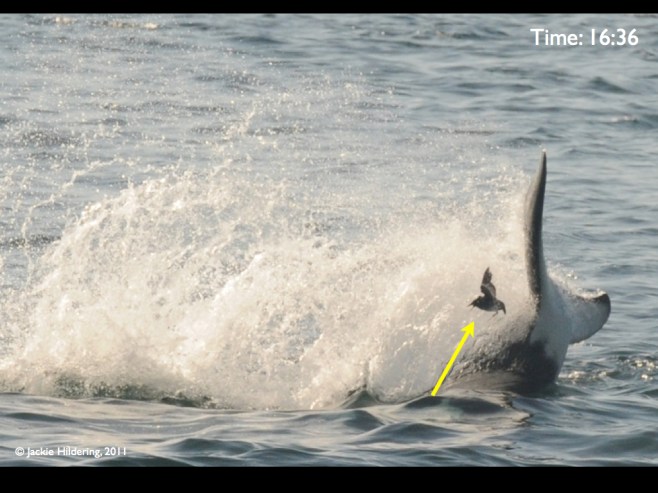
Bigg’s Killer Whale tail-slapping a Rhinoceros Auklet. Photo: Hildering.
T’is the season for reflection. It is the time of year where, the nebulous, undefinable but essential life forces of hope, love and spirituality may burn brightest.
So for you, I share the following story.
I emphasize that this is an atypical blog item for The Marine Detective and I have had to wrestle my left brain into submission to write it. I am very fearful too of feeding the monster of human need to get up close and personal to whales and claim a “piece” of them.
With that preamble and context – I give you this story for Christmas:
In short, we nickname the whales for a feature on their flukes since the scientific alphanumeric names (e.g. BCZ0297) are much more difficult to remember. [See my past blog item “What’s in a Name” for a more detailed explanation including photos of nicknamed Humpbacks.]
Where we can, we like to have local school children nickname the whales for reasons I am sure you understand.
BCY0729. Note the marking in the shape of an “A” on the left fluke. Photo: Hildering.
But that day, just after talking about the Humpbacks, I learned of the death of man who loved the sea – a man of depth and creativity who should still walk among us. I heard about Jason from his father Cliff, whose eyes of course told more about the pain, loss and love of his son than words could. I had only recently met Cliff and never had the privilege of knowing Jason.
Immediately, I thought of the Humpback Whale BCY0729 who has a marking on his left fluke that looks very much like the letter “A”.
As an exception to having children name the whales, I decided we could nickname this whale “Argonaut” in honour of Jason. [if unclear about the association between “Jason” and “Argonauts”, please click here].
It was a simple thing to do. We had a good nickname for the whale and Cliff and his family had some comfort in the sentiment and symbolization of a whale being nicknamed for Jason.
That was September 3rd, 2011. Below, email correspondence to Jason’s father on September 22nd.
“Cliff, I got goosebumps today and had tears in my eyes.
And – you’re going to get the same.
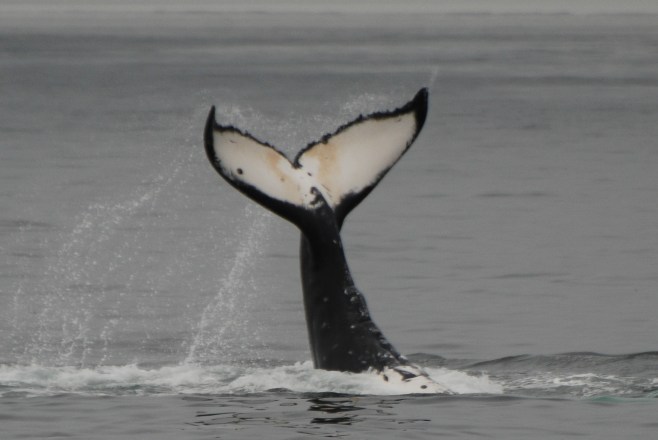
I saw Argonaut today, for the first time since September 30th, 2010. He was very near Telegraph Cove feeding in the area with another juvenile whale that we have named “Guardian” because there is an angel-like marking on this whale’s tail (rimmed in a yellowish shade).
You’ll see from the photos that it was a very wet and misty day . . . beautiful. I was on a school trip [for Stubbs Island Whale Watching] with a group of local First Nations school children . . . I shared the story of Argonaut with them and of course, it moved them.”
Argonaut on September 22nd, 2011. Photo: Hildering.
Guardian on September 22nd, 2011. Photo: Hildering.
Guardian on September 9th, 2011. The image shows the yellow angel-like shape around the centre of the fluke. Photo: Leah Thorpe, MERS. Leah also nicknamed Guardian.
I saw Argonaut and Guardian every other day I went out up to October 30th, 2011. They were not always right beside one another but they were within the same general area.
Does this have any significance beyond two Humpback Whales with distinctly marked tails feeding together? The beauty is, I’ll never know, no matter how much data I collect.
There is “something” about whales that I use almost daily to try to engage and motivate and frankly, plea with people to get their heads out of their bottoms and realize that their daily frivolous actions (and inactions) collectively cause such needless environmental damage.
Coincidence such as this story of “Angels and Argonauts” is the kind of thing that throws my structured-science-oriented left brain into discussion with my philosophical-reflective right brain about the undefinable and intangible. But something both sides of my brain agree upon . . . these giant sentient beings inspire marvel and wonder and hope and comfort and, so often . . . they inspire us gangly bipeds to understand connectedness and the truly important things in life.
May the greatness we sense from whales inspire us to bigger things that benefit society and the environment.
Merry Christmas readers.
I leave you with this sound clip of Jason singing “With or Without You” – a small indication of the depth of the man who loved the sea. Click here to listen.
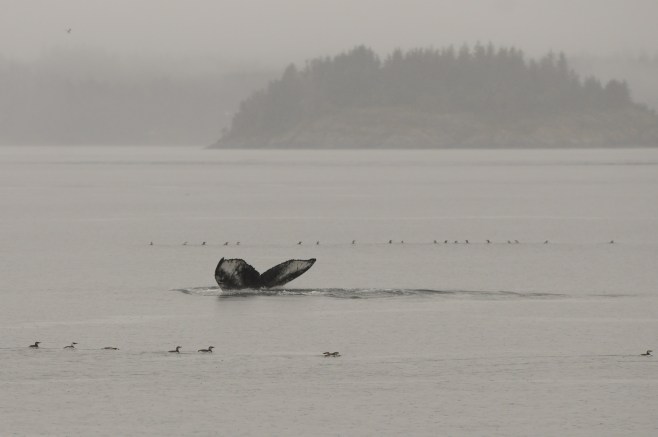
Update December 2014: Since writing this blog in 2011, Argonaut has become one of the most predictably sighted whales in our area. Guardian too is seen very predictably but is rarely with Argonaut. When Cliff came back in 2013 hoping to see the whale named in honour of his son, we spotted Argonaut within minutes of being on the water.
Update July 2016: Argonaut is now part of our Marine Education and Research Society’s Humpback Sponsorship Program as a means of funding research and education to reduce threats to whales like Argonaut. Please see here.
Argonaut lunge feeding on September 28, 2011. Photo: Hildering.
Argonaut at sunset on October 7th, 2011. Photo: Hildering.
Argonaut tail-slapping August 2012. Photo: Hildering.
When serving as a marine naturalist, one of the questions I am most often asked about whales is “Why do they jump?”
When whales jump it is called “breaching” and the answer to why they do it is not a simple one. Why whales do something depends on context; there is not just one trigger for breaching. This is no different than interpreting human behaviour. For example, if someone is tapping their foot, it could indicate irritation, having an itch, impatience or hearing a good tune!
The breaching of whales can be related to socializing, feeding, mating, communication and/or defence. Of course, when whale calves breach, it is often related to “play” behaviour which leads to good brain development and coordination. Ultimately, I believe that the high energy behaviour of breaching must somehow lead to a gain in food and/or increased success in passing on DNA.
Let me share two very specific and recent “cases” of breaching with you; one of which was witnessed by many residents of Alert Bay.
While out in our area with Orcella Expeditions last week, we saw an adult humpback whale breach some 30 times and also witnessed a mature male mammal-eating killer whale (“transient” or “Biggs killer whale”) breach within 30 meters of Alert Bay’s shoreline.
I have never seen anything quite like these two awe-inspiring events.
Humpback whale, ‘KC” on August 30th, 2011. One of the some 30 times he breached in less than 2 hours. Photo: Hildering
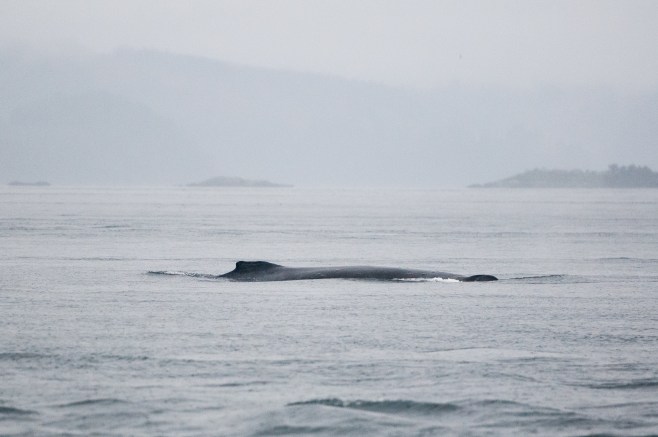
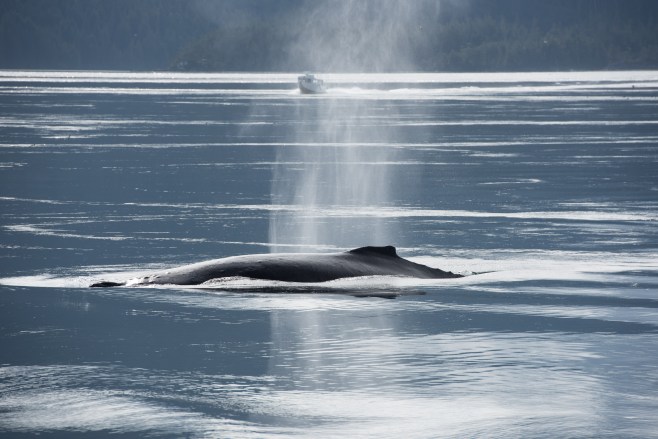
The humpback that breached so often was “KC” (BCY0291) who was born in 2002. Initially, I believe the breaching was triggered by the presence of highly vocal fish-eating killer whales (“residents”). Humpbacks do not have teeth with which to defend themselves but they do have whale barnacle studded fins and a whole helluva lot of heft to throw around so even the mammal-eating type of killer whales very rarely interact with adult humpbacks.
My interpretation is that KC was not habituated to the killer whale dialect he heard that day (I15 and I31 calls) and was making sure he made clear “do NOT mess with me!”. He was posturing to the killer whales. After his killer whale encounter, he turned around and came upon another humpback whale and again started breaching and making very forceful exhalations called “trumpeting”. Was this communication to the other whale about the presence of the killer whales? Was it related to a dominance display that may have to do with mating? I may never know for sure but it is very interesting that KC’s incredible bout of breaching seemed to lead to other humpbacks breaching as well.
Mature male mammal-eating killer whale “Siwash” breaching in front of Alert Bay on August 31, 2011. Photo: Hildering.
And then . . there was the mind-blowing, highly witnessed breaching of the 27 year-old killer whale “Siwash” (aka T10B ) in front of Alert Bay. Siwash was travelling with a group of 20+ other mammal-eating killer whales. As mammal-eaters, this type of killer whale has to be stealthy and unpredictable and therefore, they are most often far less vocal and surface active than the fish-eating killer whales. This certainly wasn’t the case as they bounded past Alert Bay last Wednesday evening! They were swimming on their backs; fin slapping and travelling right past the shore; calves were “cat and mousing” small diving birds – whacking them around; and there were even male sex organs to be seen at the surface!
What was going on? Let me state the obvious – they were socializing. Their bellies must have been full enough to allow them to throw stealth to the wind. These particular whales would most often not travel together so the socializing might even be related to mating.
But ultimately . . . in trying to understand the behaviour of these sentient beings, we have to have the humility to accept that we may only ever have hypotheses for why they do what they do. It is the stuff of awe and wonder that the mighty Max̱’inux̱ were so visible to the very people that have such a strong cultural connection to them, as they swam by Alert Bay . . . . “Home of the Killer Whale.”
We now have a Humpback that we’ll refer to as “Beethoven” thanks to the great creativity of Maureen and Dave Towers of Seasmoke Whale Watching.
Let me explain why we think this nickname is particularly clever.
The convention in assigning a British Columbian catalogue number to Humpback Whales is that it reflects the amount of black or white on the underside of the whale’s tail.
The Humpbacks are determined to be an:
“X” if there is lots of black on the underside of the tail (less than 20% white)
“Y” if there is an intermediate amount of white on the underside of the tail (20 to 80% white); or
“Z” if there is lots of white on the underside of the tail (more than 80% white)
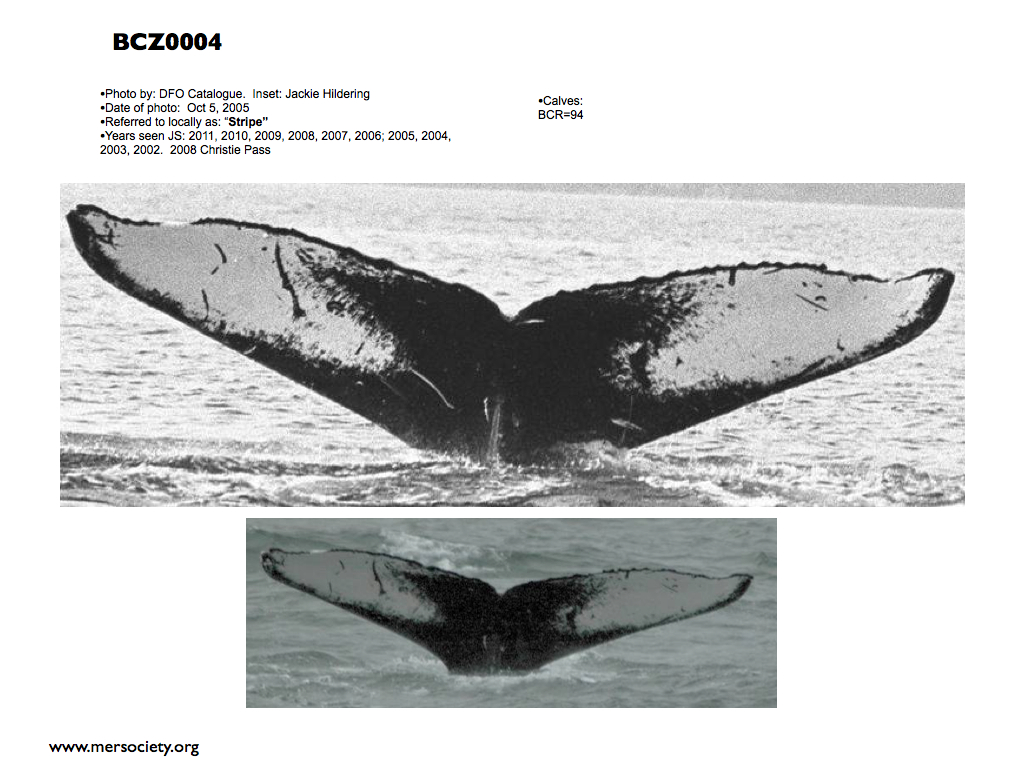
For example, BCZ0004 is the 4th Humpback with a lot of white on his/her tail to be photographed in BC and catalogued.
(Note: Up to 2010, these catalogue numbers would be assigned by Fisheries and Oceans Canada (DFO), to which we at the Marine Education and Research Society (MERS) would contribute our ID photos. Since 2010, DFO has not catalogued Humpbacks whereby there are now also numbers such as BCZuk2012#3. Please see the end of this blog for an explanation of the “uk”).
BCZ0004? It’s not such an easy name to remember is it? So, years ago, we started assigning nicknames to the whales with the guideline that the name should somehow give a clue to the identification of the whale. The hope was that this would help people discern the whales as individuals. For example, I am responsible for giving BCZ004 the nickname “Stripe”. See the ID page from our MERS Humpback catalogue below and determine if you think this name is fitting.
Click to enlarge. BCZ0004 aka “Stripe”. ID photos from DFO catalogue and Hildering.
Okay , so it’s not a creative name but – it worked! People associated the stripe-like marking with the whale and could identify “Stripe” as an individual.
Here you have the female “Chunky”, aka BCX0081.
Click to enlarge. BCX0081 aka “Chunky”. ID photos from DFO catalogue and Hildering.
Not to be confused with “Vader”, aka BCX0989, who also has a distinct v-shaped marking (may the force be with you for this one).
Click to enlarge. BCX0989 aka “Vader”. ID photo contributed to MERS by Jacqueline McGill.
And then there are the more creative names, like “Niagara” for BCY0057 whose tail has a white spot shaped like a waterfall.
Click to enlarge. BCY0057 aka “Niagara”. ID photos from DFO catalogue and Dr. Alexandra Morton.
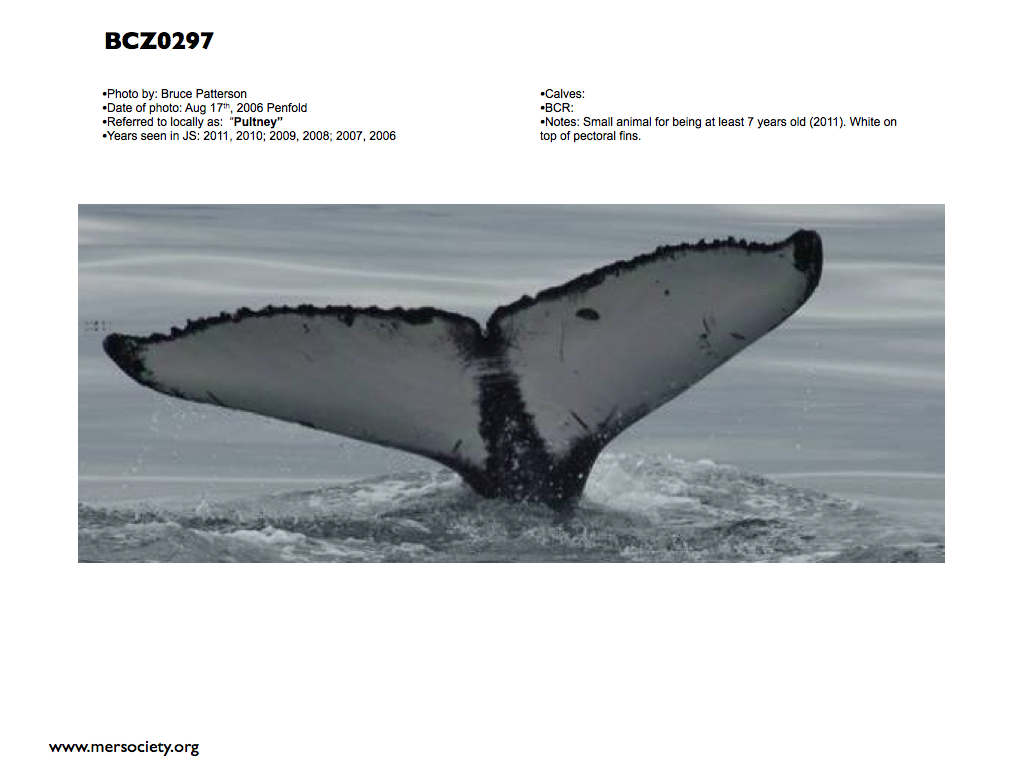
“Pulteney”, aka BCZ0297, has been named with the Pulteney lighthouse in mind. See the lighthouse on BCZ0297’s tail?
Click to enlarge. BCZ0297 aka “Pultney”. ID photo contributed to MERS by Bruce Paterson.
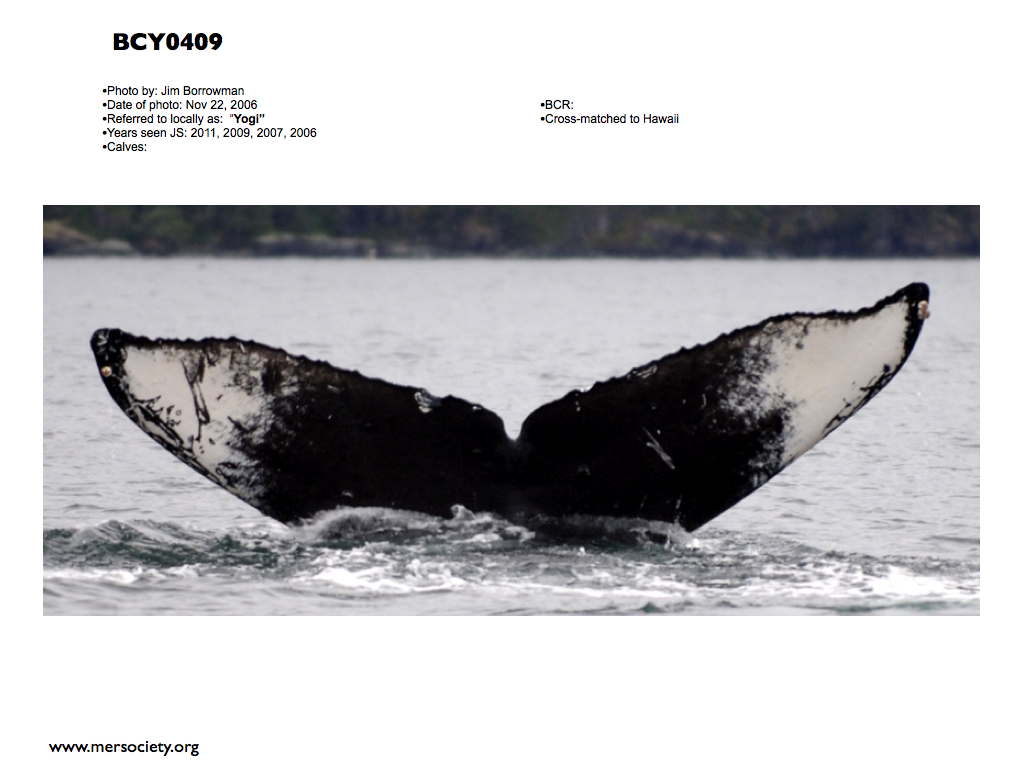
Sometimes, the name may seem even more like taking a Rorschach Test (ink blotch test). For example, see the shape of a bear’s head on the left part of “Yogi’s” tail (aka BCY0409)?
Click to enlarge. BCY0409 aka “Yogi”. ID photo by Jim Borrowman, Stubbs Island Whale Watching.
For the greater good, we often get local children involved in the naming and as a result have Humpbacks with highly creative nicknames like “Rocket”, “Sprinter”, “Hunter”, “Shark Tooth”, “Barracuda” and “Ashes”.
Otherwise, it is the person who first shares the sighting of the whale with MERS that has the joy of suggesting a fitting nickname.
Such was the case with Dave and Maureen. They were the first to photograph the whale below on July 19th and relay the sighting to MERS. It is a Humpback that we had not previously sighted in the area.
Click to enlarge. Photo by Dave Towers, Seasmoke Whale Watching.
See the dot-dot-dot-stripe on the tail?
While “Dot-Dot-Dot-Stripe” is a very literal name, in musical notation for conductors “dot-dot-dot-stripe” signifies . . . da-da-da-dum.
Da-da-da-dum! Like in Beethoven’s Fifth Symphony!
Hence, there is now a Humpback whale nicknamed “Beethoven”.
Thank you Dave and Maureen – a gold star to you!
Note, regarding “uk” codes: Until 2010, Fisheries and Oceans Canada (DFO) ultimately assigned a catalogue number to Humpbacks in British Columbia. We at MERS contributed our data for this centralizing cataloguing and would assign a temporary “uk” (unknown) designation for whales not already in the DFO catalogue e.g. BCZuk2012#2 has a mostly black fluke, is not in the 2010 DFO catalogue, and was first documented by MERS in 2012. We are currently (2018) collaborating with colleagues to achieve an updated province-wide catalogue for Humpback Whales sighted off British Columbia’s coast.
The MERS Humpback catalogue can be downloaded via this link.
If I had a dollar for every time I have had a conversation like the following:
Enthusiastic otter viewer: I saw a Sea Otter on the dock!
Me: How wonderful but . . . it wasn’t a Sea Otter.
Otter viewer: Yes it was, it came out of the ocean and was running on the dock.
Me: Isn’t that wonderful but . . . that was a River Otter NOT a Sea Otter. River Otters live in the sea too. It’s really unfortunate that their common name is “River Otter”. It confuses people. Sea Otters can’t run. They are adapted to be in the ocean so their hind limbs are like paddles and, since they so rarely are on land, their front paws are adapted to be really dexterous and use tools.
Otter viewer: But it was in the sea!!!!
Ah yes, how I would like to find whoever was responsible for the common name “River Otter”.
Click the image below to enlarge a table of some of the key differences between River Otters and Sea Otters. The otter illustrations are by Uko Gorter Natural History Illustrations.
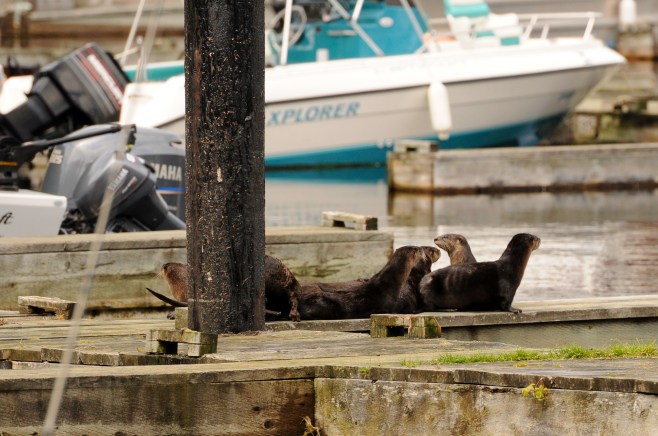
What has stimulated my sharing this with you is that, this year, we have the great privilege of having a mother River Otter and her six pups delighting us in Telegraph Cove, B.C. Today, I had the chance to get some photos of them. Below, see some of these images, including a little slide show.
Yes, they are otterly adorable even though they add colour and odour to my days by pooping on the lines of my boat and leaving bits of fish for me to slip on . . . as well as stimulating all those “I saw a Sea Otter” conversations!
Mama River Otter and most of her brood of six. Photo: Hildering.
Crazy cute I know. Also, note the deposit under the head of the River Otter. These gifts are abundant and usually on the lines of my boat 😉 . Photo:Hildering
One of the River Otter pups shaking off some SEA water. Photo: Hildering
Mama River Otter jumping back into the ocean. Note her reflection in the water. Photo: Hildering.
This remarkable photo of a humpback whale breaching in front of Campbell River, B.C. was on the July 1st front-page of the Courier Islander newspaper.
Humpback whale breaches in front of Campbell River on June 24th. Remarkable photo by Caylin Dubé - Oak Bay Marine Group.
As someone who has been working to ID the humpbacks around northern Vancouver Island, I almost jumped as high as that humpback when I saw the photo! I took up contact with the photographer, Caylin Dubé of the Oak Bay Marine Group, hoping she might have images from the June 24th encounter that would allow me to determine who the humpback was. Caylin was extremely generous with her photos, wanting to know who the whale was as much as we at the Marine Education and Research Society (MERS) did.
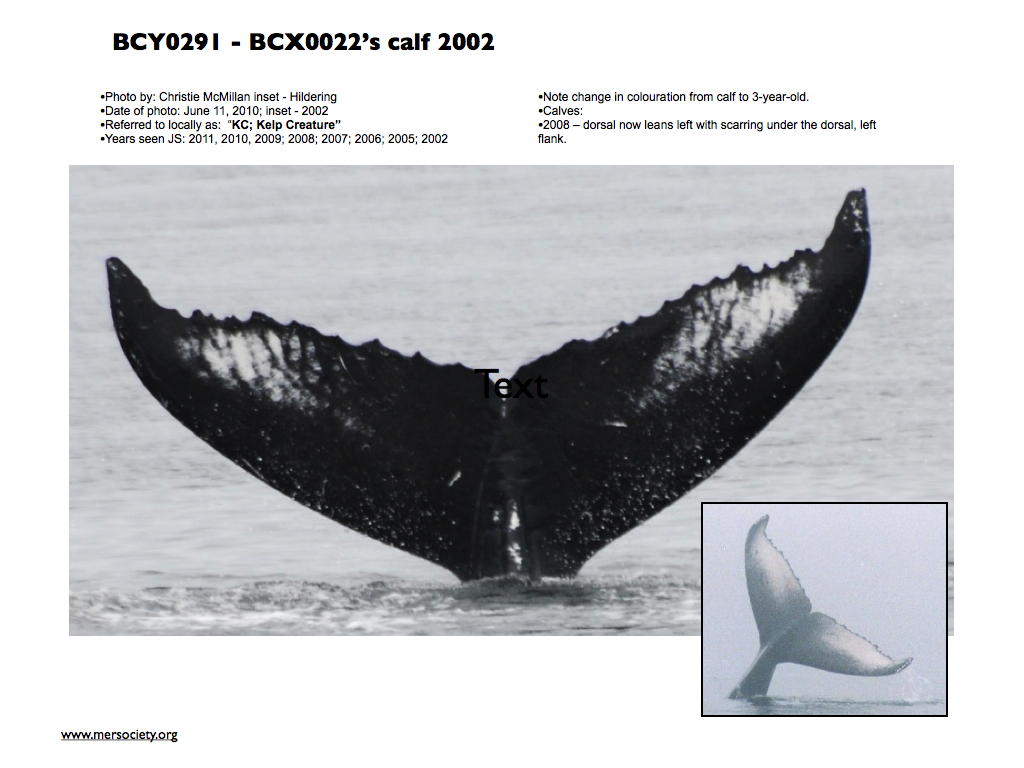
My hunch was quickly confirmed. The ID work of the last 8 years allowed us to conclude that the breaching whale is BCY0291 (DFO catalogue number) who we have nicknamed “KC”. KC is short for “Kelp Creature” but the origin of that name is too long a story to explain here!
We have known this whale since it was a first year calf off the waters of Telegraph Cove in 2002; an area for which this whale has extremely strong site fidelity. However, since last year, KC has also been sighted around Campbell River, only to quickly turn around and swim back to the waters around Telegraph Cove. We have theories about why s/he might do this but generally – it’s an additional mystery. Although the humpbacks are long-studied and easy to identify as individuals, there is still so much we do not know about these giants that breath the very air we do. For example, KC likely belongs to the population of humpbacks that go to Hawaii to breed in the winter, yet no one knows how the whales navigate to the Hawaiian Islands.
From the MERS humpback ID catalogue. Fluke ID for BCY0291 aka "KC". Click to enlarge.
From the MERS humpback ID catalogue. Flank IDs for BCY0291 aka "KC". Click to enlarge.
Caylin’s photos also revealed that there was a second humpback with KC. Even without a photo of the underside of the tail (the easy way to identify humpbacks as individuals since the markings and trailing edge of each whale is unique), MERS dedication to also cataloguing flank photographs of the humpbacks allowed us to determine the second humpback very likely was “Arial” (BCY0767) who we also have known since a first year calf in our area in 2007. Very interestingly, these two whales have the same mother but since humpback calves only stay with their moms for a year, to our human knowledge they would not know they were siblings. That these two humpbacks sometimes travel together could be coincidence or not – yet another whale of a mystery to try to solve.
That we at MERS were able to identify the whales from Caylin’s photographs (taken from well beyond the 100 m that boats must stay away from whales) is testament to the value of the great community effort to understand the return of humpback whales to our waters. We have ID photographs dating back to the 1980s thanks to the relentless vigilance of Dr. Alexandra Morton to understand our marine ecosystem. Many other ID photographs have been contributed by the whale watching community from Port Hardy to Campbell River (of course taken when following the Be Whale Wise guidelines). Of special note for the consistency and longevity of their contributions is Stubbs Island Whale Watching.
For the work of the Marine Education and Research Society, including our efforts to understand the threat of humpbacks becoming entangled in fishing gear, see www.mersociety.org.
Below, I include a few more pictures of KC, including the most entertaining ID photo we have ever received – a photo of KC heading in the direction of Campbell River passing the Spirit of the West Adventures kayaking camp. Note the happy humans-in-a-hot-tub in the foreground! Photo by Rick Snowdon of Spirit of the West.
KC feeding in the area around Telegraph Cove in 2007. Photo: Hildering
KC breaches near Telegraph Cove, July 2nd, 2011. Photo: Hildering
KC heading in the direction of Campbell River in 2010, passing the Spirit of the West Adventures kayaking camp. Photo by Rick Snowdon. Click to enlarge.
ID photo of “Dusty” the grey whale by Christie McMillan. See the Marine Education and Research Society blog for many more photos and detail on Dusty (link below).
Two more unique whale events have been documented in the ocean corridor between Port McNeill, Sointula and Alert Bay (Northern Vancouver Island, B.C.,Canada).
Following the remarkable “visit” of offshore* killer whales at the end of March, on May 16th what is likely the largest group of marine mammal-eating** killer whales ever documented swam past our communities.
It is possible that there were up to 37 different animals in this group. These killer whales, as hunters of marine mammal prey, need to have a culture of stealth and unpredictability and therefore usually travel in small groups. It should be noted that the work of the Orca Lab documented this extraordinary encounter (both visually and acoustically) and that DFO expertise determined the IDs of the whales. (Click here for OrcaLab’s blog on the encounter).
Then, this last week, we had frequent sightings of a little grey whale in front of our communities. Grey whales are already a rarity in our specific area but what makes this whale really unique is that s/he is potentially the first grey whale known to become a summer “resident” here.
Jared Towers and Christie McMillan (of the Marine Education and Research Society /MERS) confirmed that this is the same grey whale that they kept an eye on last year. From June to early October 2010, the whale was more often around Cormorant Island and the east end of Malcolm Island and became known as “Dusty” and “LGW” (Little Grey Whale). Dusty is relatively easy to identify as an individual because its tail bears the evidence of having survived an attack by mammal-eating killer whales and because there are distinct markings on its flanks including the larger white spot seen in the image above.
This May 31st, Christie and Jared confirmed that Dusty had returned to the area and was the whale that many of us in Port McNeill, Sointula and Alert Bay had the great privilege of seeing while it fed near our shores. (Click here for Jared and Christie’s MERS blog with far more detail on Dusty and includes pictures).
If we are indeed so lucky that Dusty is able to “make a living” by feeding here, we’ll be able to whale watch from land with some predictability. We will also need to be good marine neighbours, since Dusty has been sighted very near the harbours of our communities and can surface very unexpectedly.
* Offshore killer whales are most often near the continental shelf and their diet has been confirmed to include sharks. Click here for a previous “The Marine Detective” blog on the offshore killer whales sighted at the end of March, 2011.
** The mammal-eating killer whales are known as “transients” and “Bigg’s killer whales”. The latter name is a recent move to honour the late Dr. Michael Bigg, father of killer whale research. Recent research has found these to be the most genetically divergent type of killer whale and they may be recognized as a different species.
Record of possible sightings of Dusty as of June 7th.
June 7 – Port McNeill
June 8 – Alert Bay (Source – MERS, confirmed as Dusty)
June 9 – Campbell River. (Source – Susan MacKay, confirmed )
June 11 – Campbell River seen heading north (Source – via Susan MacKay)
June 12 – passing by the Orca Lab, Blackfish Sound (Source Orca Lab; ID photos to come)
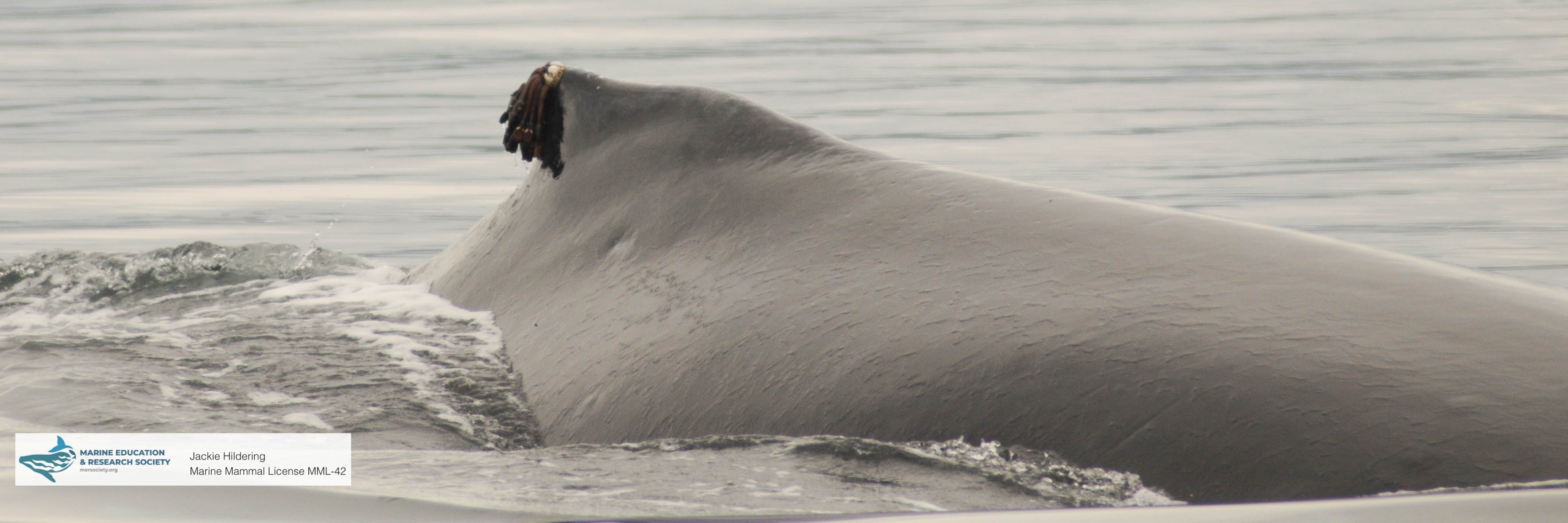
When we saw Jigger in 2009, we noted the barnacle growing on the right top of her dorsal fin. Such barnacles are a distinct species only found on Humpback Whales. The Humpback Whale Barnacle is Coronula diadema (to 5 cm tall and 6 cm wide.
Then, when we saw Jigger in August of 2010, we noted that her dorsal fin looked very different. My research partner from the Marine Education and Research Society, Christie McMillan, and I were worried that it might be an injury so we tried to get a better photo of the dorsal fin.
Here’s what the dorsal fin looked like from behind (photo taken with a telephoto lens and cropped) When I had this perspective, I thought that what we were looking at might be seaweed growing on the Humpback Whale Barnacle we had seen the year before (note that the barnacles often do fall off between years).
But, it didn’t quite look like seaweed. With patience and good camera lenses, we got a better look.
What on Earth?! They’re gooseneck barnacles growing on the Humpback Whale Barnacle!
Gooseneck barnacles are an order of barnacles that are attached to a hard surface by a long stalk that looks like a goose’s neck. They depend on the motion of the water to feed on plankton as they do not have the “foot” (cirri) that rakes in plankton in many other barnacle species.
That’s when I learned that there is a species of gooseneck barnacle that, in the North Pacific Ocean, most often grows on the Humpback Whale Barnacle!! The species is the Humpback Whale Gooseneck Barnacle, also known as the Rabbit-eared Whale Barnacle (Conchoderma auritum (to 11 cm long).
This is the kind of discovery that causes wonder and euphoria in my world.
To be able to identify a Humpback as an individual is already something of great scientific and educational value.
That this attention to an individual whale leads me to learn that there is a species of gooseneck barnacle that grows almost exclusively on a species of barnacle that only grows on Humpback Whales = sheer wonder.
I can’t wait to find out what else the Humpbacks are going to teach me!
Image from Fertl, Dagmar & Newman, William. (2018). Barnacles.
Update: January 2022. Oh and by the way, when Jigger returned to the feeding grounds around northeastern Vancouver Island the next year, she did not have the two barnacle species on her dorsal fin. But she did have . . . a calf. The calf is “Quartz” and has returned to northeast Vancouver Island every year from 2011 to 2021. From our Marine Education and Research post from January 2022: There are two species here on Dapple’s chin and these barnacle species are very often also on the tips of Humpback Whales’ tails.
1) The big, round barnacles are “Humpback Whale Barnacles” (Coronula diadema to 5 cm tall and 6 cm wide) and they ONLY grow on Humpbacks. When they fall off, they leave those round white marks. The barnacles that grow on Grey Whales are a different species that ONLY grow on Grey Whales (Cryptolepas rhachianecti).
2) Growing atop the Humpback Whale Barnacles are “Humpback Whale Gooseneck Barnacles” (Conchoderma auritum to 11 cm long) aka “The Rabbit-Eared Gooseneck Barnacle” which, in the North Pacific Ocean, MOST OFTEN ONLY GROW ON TOP of Humpback Whale Barnacles! There can be up to 50 Humpback Whale Gooseneck Barnacles on one Humpback Whale Barnacle and each gooseneck barnacle is usually oriented with the opening facing the direction the whale swims allowing for better feeding on plankton. (Source: EFauna BC). With that long, fleshy “neck” it certainly is clear why they are called GOOSENECK barnacles.
That’s two layers of specificity made all the more thought-provoking when you realize that barnacles start off as plankton drifting in the ocean, attach to the correct surface, and then grow a shell. The amount and position of these barnacle species can change quickly. For example, there were no Humpback Whale Gooseneck Barnacles to be seen on Dapple’s chin on August 18th but there they are by September 25th. Thereby, barnacles often cannot help identify individual Humpbacks between years but . . those scars from Humpback Whale Barnacles DO persist.
Please know that barnacles are NOT thought to be a hinderance to the whales. It is believed that there’s symbiosis. The barnacle species have good positioning to feed on plankton and the Humpback Whale and Grey Whale Barnacles are believed to offer defence to these slower moving big baleen whales. Grey Whales and Humpback Whales are built for fight rather than flight from mammal-hunting Orca (Bigg’s Killer Whales) and will posture, trumpet and lash out. The barnacles are likely also of use when the males fight for females in the breeding grounds. Hey, when you don’t have teeth, it helps to have something similar to brass knuckles.
More detail
From E-FAUNA BC: ELECTRONIC ATLAS OF THE WILDLIFE OF BRITISH COLUMBIA “Conchoderma auritum is most often found attached to the shells of Coronula on the humpback whale; sometimes more than fifty are attached to one shell. “Rarely a specimen is found attached to the base of the teeth of an old sperm whale” (Sheffer, 1939). Gordon C. Pike reports finding specimens of C. auritumon sperm and fin whales taken in British Columbia. In each case the barnacles were associated with a deformation or an apathological condition of the jaws, baleen, or teeth. Each barnacle is usually oriented with the opening facing in the direction the whale swims. The food-laden water passes through the opening and over the feeding appendages, then out through the two “ears” which have tubular openings.”
From the Marine Species Identification Portal: Species is “attached to the whale barnacle Coronula diadema and sometimes Coronula reginae. It seems to be a rule that no Coronula is without a Conchoderma. Whether this is a form of symbiosis has been discussed by Broch (1924b). Specimens from northern waters have been taken from humpback whales (Megaptera novaeangliae ) or from teeth of bottle-nosed whales (Hyperodon spp.). In the Antarctic C. auritum has also been found on baleen plates of whales and on their tails. In tropical and subtropical parts of the oceans it can also be found attached to ships’ hulls and other floating objects, to slow moving fishes or to the tail of a large eel, but never on soft objects.” From Mike Horan (pers. com January 2022) “I have also seen the stalked barnacle [Conchoderma auritum] on Bottlenosed Dolphins during the die off of 1987 in New Jersey.”
“Individual whales have been known to collect up to 450 kilograms of barnacles. That’s an enormous mass, but relative to a 30-tonne humpback, it would weigh only about as much as an extra layer of clothes. And as far as scientists can tell, the hangers-on don’t particularly bother a healthy whale. They may slightly increase drag as the whale swims, but they may also be helpful as a set of brass knuckles when adult males battle each other over the chance to mate [and when dealing with mammal-hunting Bigg’s Killer Whales]
Here’s what we don’t know about whale barnacles, at least with any certainty: just about everything else. Like, how do their larvae, no bigger than a grain of salt, find a migratory whale to grab onto in the first place? Once they locate one, how do they navigate around its gargantuan body—hundreds of thousands of times larger than theirs—to find their permanent homestead? “It just seems preposterous,” says John Zardus, a marine biologist at the Citadel in Charleston, South Carolina. He specializes in studying barnacles that live on other living things.
Studying those symbiotic barnacles that live on sea turtles, dolphins, crabs, and other marine animals has given Zardus some idea of how whale barnacles might hack it. Adults mate on the whale, but rather than take their chances during their host’s oceanic migrations, they likely wait to release their larvae until the whales gather in coastal areas to breed. The larvae then go through several developmental stages, which can take up to two weeks, before they’re ready to settle. “It’s not like the larva is being released from a whale and it’s going to [immediately] attach to the whale next door,” Zardus says.
When a larva is ready, a chemical signal is most likely what tips it off that it’s in the presence of whale skin. This could be a pheromone emitted by already settled adult barnacles—a strategy commonly used by other barnacle species—or it could be some molecule that wafts off the surface of the skin itself. If other barnacles are any indication, the larva probably reaches out with its sensitive antennules to familiarize itself with the epidermis. It squeezes a drop of sticky polymer out of one antennule to adhere itself temporarily, then sticks down a second antennule and releases the first one, swinging it over to another spot. By repeating this process, a larva “ends up walking around on the surface, leaving little gluey footprints,” says Zardus. “These larvae can possibly crawl all over the host until they find the right location where they want to be.”
Where they want to be is generally on the whale’s forehead, its tail, or the leading edges of its flippers. Those are the places on a whale’s body that water flows over most efficiently. That gives the barnacle a front-row seat when the whale swims through a cloud of plankton, which the barnacle also gets to eat. When the larva finds a good place to settle down, it exudes a stronger glue onto the skin and cements itself for the rest of its life, which may last about one to three years.
Much of this is informed speculation, Zardus stresses, because living whale barnacles and their larvae are extremely hard to come by. Collecting them from a living whale is out of the question, since it would require cutting into the whale’s flesh. A dead whale that washes up has to be discovered before its barnacles die of hunger, desiccation, or predation . . ..
Other than whale barnacles, nothing else reliably recorded the month-to-month movements of ancient whales, says Taylor. Bone tissue doesn’t care about the chemistry of the water it grew in; baleen does, but it’s hardly ever fossilized. But a well-preserved whale barnacle is the perfect time-traveling tracking device. “We won’t be able to tell you, ‘This whale hung a left at Malibu,’” says Taylor, “but [we can] get a general sense of where animals might have been moving.” . . .
Jigger bulking up before the migration, near Sayward in British Columbia, in November 2021.
Update to the April/May information below: June 16, 2011.
From Peter Olesiuk, DFO – “I have not heard anything from Kaouk for over 2 days now, and I suspect his tag may have been moulted. In our Steller studies the tags tended to fall off in July-August. However, I checked the literature and the moult is 1-1/2 months earlier in juveniles, typically starting on 21 June. In my experience, tags glued to the pelage [fur] tend to fall off when the hair follicles weaken early in or just before the actual moult.”
_______________________________
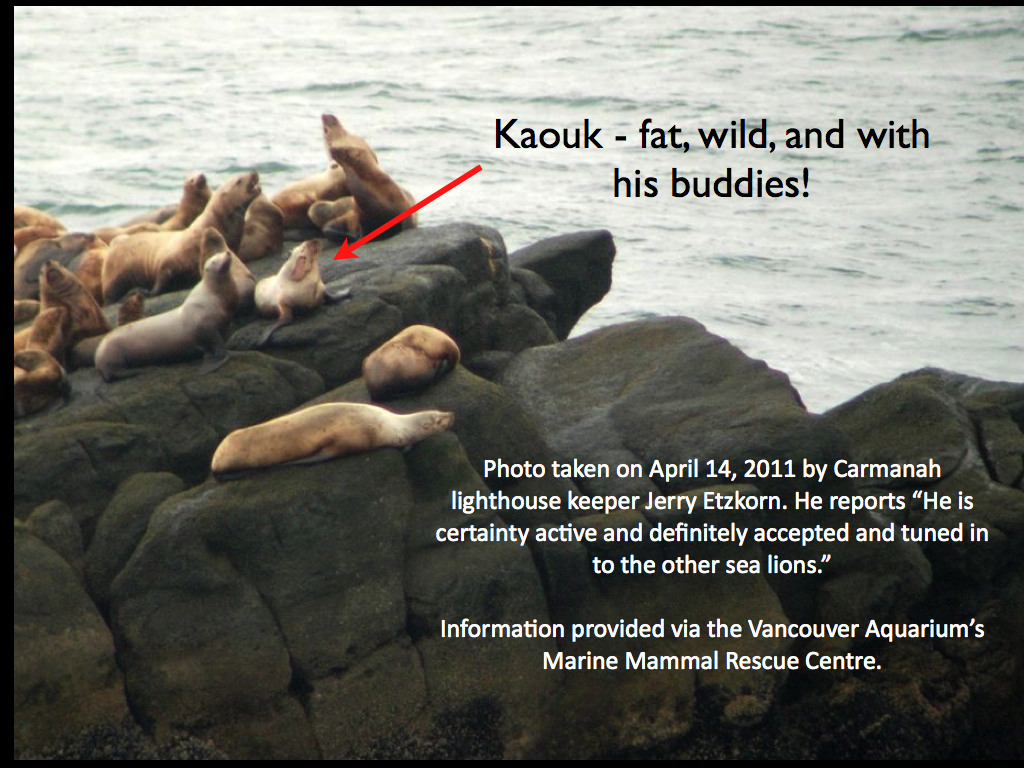
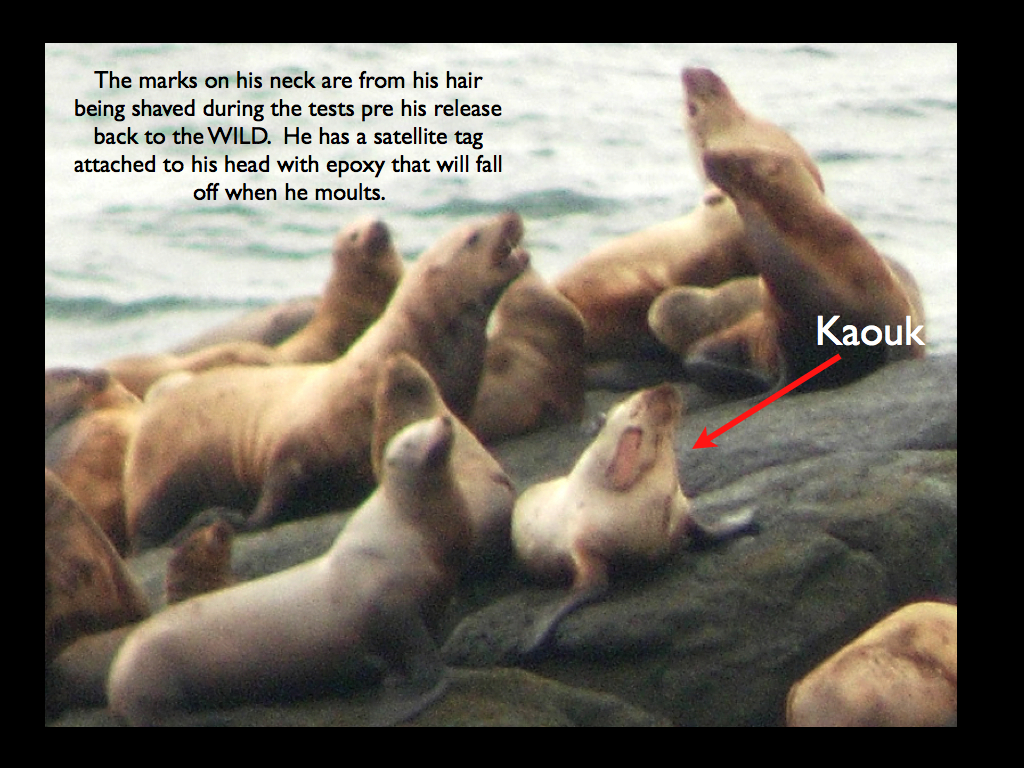
A picture is definitely worth a thousand words. See below for April 14th and May 8th images of Kaouk the Steller sea lion healthy, fat, WILD and with his peers!!
This photos and information has been provided by lighthouse keeper Jerry Etzkorn, via DFO and the Vancouver Aquarium’s Marine Mammal Rescue Centre (you can follow MMR on Facebook at this link).
Kaouk, is the male Steller sea lion that walked into the Port Alice trailer park on December 16th and was flown to the Vancouver Aquarium’s Marine Mammal Rescue Centre. He inspired the students of Port Alice to write a children’s book and was released back into the wild on March 17th from southwestern Vancouver Island.
For background information on Kaouk, including how you can follow him via satellite tag, click this linkfor a previous blog posting.
Click the images to see them at a larger size.
Another happy Kaouk update from May 8th, 2011. Thank you Peter Olesiuk.
Photo taken on April 14, 2011 by Carmanah lighthouse keeper Jerry Etzkorn. He reports “He is certainty active and definitely accepted and tuned in to the other sea lions.”