Join me in the cold, dark, life-sustaining NE Pacific Ocean to discover the great beauty, mystery and fragility hidden there.

Posts tagged ‘northern vancouver island’

You Win! You Lose?

You win some and you lose some . . . or do you?

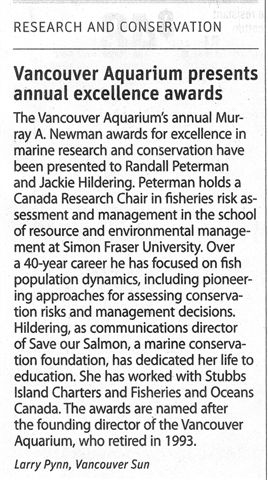
On January 19th, I had the extreme honour of receiving the Vancouver Aquarium’s Murray A. Newman Award for Excellence in Aquatic Conservation. In the thick, wonderful soup of positive emotions associated with this, I delight in the award being known as The MAN Award.  Yeah, I got a MAN award! (For my acceptance speech, see the link at the bottom of this post).
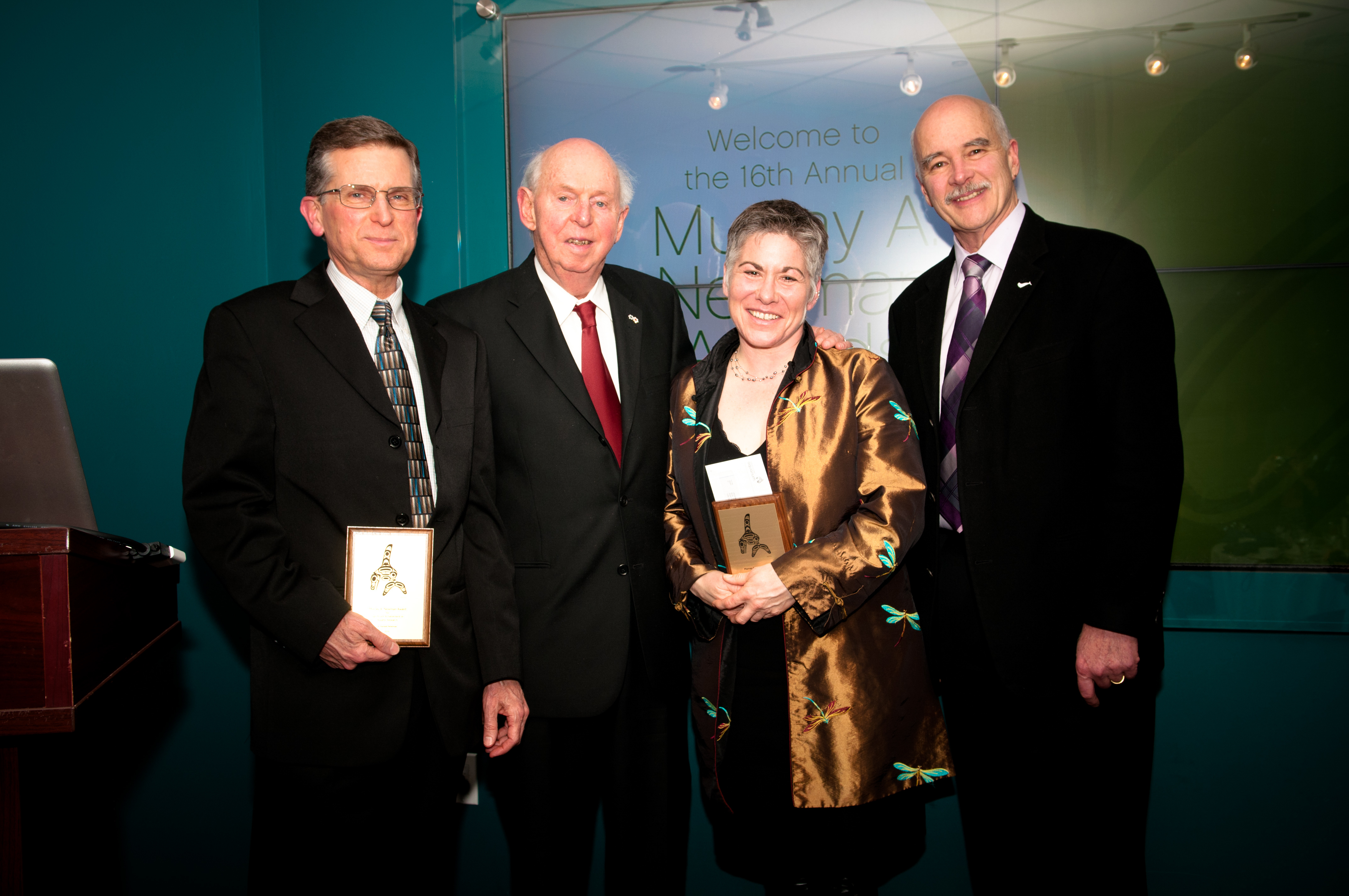
Photo by Vancouver Aquarium’s John Healey. The Marine Detective among Drs. Left to right: Dr. Randall Peterman – winner MAN award for Science; Dr. Murray A. Newman – the award I received is in his honour; founding director of the Vancouver Aquarium; Dr. John Nightengale – President Vancouver Aquarium.
Humpback Comeback Results
The final AVIVA voting results in our funding category (to $25K). Click image for close-up.

On January 25th, it was announced that the Marine Education and Research Society’s Humpback Comeback Project would not receive funding dollars from the AVIVA Community Fund. (I am a cofounder of or MERS and have had the joy of 7 years of volunteer effort in studying local humpbacks.) The competition result was a shock as this small local project succeeded in getting the third highest number of votes out of more than 520 in our category (7,113 votes total, more than 1,100 votes ahead of fourth place).

After the intensive on-line voting, the projects were judged and Humpback Comeback was determined not to best meet the AVIVA criteria/priorities. Observations are that “build ’em” and human-to-human projects such as playgrounds were more successful in meeting the criteria of this generous and PR-savvy insurance company.

It was a shock yes, but there are far more similarities between winning the MAN award and the AVIVA result than just my exclaiming “Oh man!” at the end of both.

I could not have achieved what was recognized by the award without the opportunities and support provided by the people of Northern Vancouver Island.  The astounding community support and encouragement we also received for the Humpback Comeback Project provided an equally potent affirmation of purpose.

Losing?  Every time someone voted for our Humpback Comeback Project or that we had a media opportunity, awareness was created for whales and for the threat of entanglement; positive attention was focused on our area and its remarkable biodiversity; and people responded to an opportunity to create positive change.  There are those that have now even decided to support the Project through donations or by helping to find alternative funding sources (donations made via http://www.mersociety.org).

Sometimes life deals a challenge that only intensifies focus, strengthens resolve, and enhances creativity to achieve what you believe in.  Oh man, I assure you that this is the case with the Humpback Comeback Project!
Great thanks to you all for the support.
______________________________

For my acceptance speech for the Murray A. Newman award, see this link (15 minutes). It is apparently laughter and tear inducing with the ultimate message being – be relentless in creating positive change. Includes lots of my images of the marine biodiversity of Northern Vancouver Island.


Kaouk – The Steller Sea Lion That Flew

Kaouk at the Marine Mammal Rescue Centre. Photo: Hildering

Below, please find a link to a slide show update on Kaouk, the juvenile male Steller sea lion that walked into the Port Alice (BC, Canada) trailer park on December 16th, 2010.


I had the privilege of visiting Kaouk at the Vancouver Aquarium’s Marine Mammal Rescue Centre on January 20th and was amazed at the improvement in his health.  A decision will soon be made about his return to the wild.


See this link for the 3 minute slide show (available in two sizes for ease of viewing).

See this link for a background story in the North Island Gazette.

Wonder Worm

January 9th, 2011

While diving in the Plumper Island Group near Telegraph Cove, British Columbia, I chanced upon a white-ringed ribbon worm (Tubulanus albocinctus) fully out in the open. This is the first time I have been able to see the whole animal and marvelled at it’s length and colour. This “specimen” that I filmed was more than 1 metre long.  Apparently, they can reach 6 metres in length!

White-ringed ribbon worm found at about 30' (10m). Photo: Hildering


Ribbon worms have unsegmented bodies but what sets them apart from all other worm species is that they have a “proboscis”. The proboscis is a part of their gut that can be launched out to wrap around prey and then retract pulling the prey into the ribbon worm’s mouth.  Venom may also be associated with the proboscis. The white-ringed ribbon worm may prey on segmented worms, small crustaceans and maybe even some small fish. The proboscis can also be used for digging.

In the video clip (link below) you will see how the animal moves with powerful waves of muscular contraction (peristalsis). Small hairs called cilia also help it glide along.

In trying to find some basic facts about this species’ natural history, I discovered that very little is known about it even though it quite common in the Pacific Northeast. Although not able to find research to support this, I believe that the animal’s bright colour is a warning to predators that it tastes bad or is toxic.

I assure you I will be on the lookout for this wonder worm to try to learn more (I would love to see the proboscis in action)!

See the short video clip (30 sec) of my white-ringed ribbon worm encounter at this link.

More on ribbon worms at this link (includes a diagram of the internal anatomy).

Update January 12: A neighbour, Graham MacDonald, shared his observations of white-lined ribbon worms preying on rockweed isopods on a local sandy beach. He has repeatedly observed a black structure extending from the worm to the isopod and moving around on the isopod (likely the probosis). He noted that it appeared that the isopod was suffering (due to toxin or digestive juices?) and that it was a prolonged process. I will definitely be going to sandy beaches to see if I can capture this on film. Thank you Graham.

When Pilchard Return

Ms. Henderson’s students in Port Alice, B.C. put me onto a case yesterday.

They had me check what was happening in the beautiful inlet in front of their community on north-western Vancouver Island and – what a fabulously noisy case it was!

Pilchard (aka “Pacific sardines”; Sardinops sagax; up to about 40 cm) have brought in a whole food chain of activity:  fishing boats, hundreds of gulls, many Steller and California sea lions and, that’s just what we could see on the surface!  Pilchard were absent from the Pacific Northwest for about 50 years, having been very intensely fished into the early 1940s. With their return, our Coast has become much more vibrant with these fish fuelling a food web that includes humpback whales and both the Steller and California sea lions.

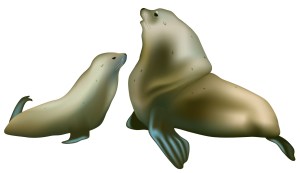
Steller sea lions - male on right. Image: Uko Gorter Natural History Illustration.


Having male Steller sea lions (Eumetopias jubatus) in our area is common. These giants (mature males up to 1,100 kg and 3.3 m) are the lighter coloured of the area’s two sea lion species.


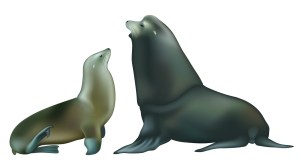
In the last 7 years or so, we have also had some male California sea lion males (Zalophus californianus) around Northern Vancouver Island from the Fall into the Spring but they are far more common to the South.

California sea lions - male on right. Image: Uko Gorter Natural History Illustration.


The California sea lions are the darker and much smaller sea lion species (mature males to 390 kg and 2.4 m). The mature males have distinct light colouration on parts of their head and a very unique shape to their foreheads. However, beyond these very apparent physical differences, you could be blind and still tell California sea lions and Steller sea lions apart! California sea lions bark. Steller sea lions growl.

The sea lion activity I witnessed yesterday is really unique and all thanks to the return of the pilchard. I have never seen this many California sea lions anywhere around northern Vancouver Island and it is not often that I have seen mixed groups of both species hunting together. I checked with the locals in Port Alice and no one can recall ever seeing this many California sea lions in Neroutsos Inlet.

This phenomena has fortunately been captured on video for you to enjoy (video from the Village of Port Alice).  See below and look very carefully for the lighter coloured Steller sea lions among the barking Californians!  All these sea lions are likely to all be male. The smaller ones are the immature males.

Great thanks to the students of Seaview Elementary for caring and knowing as much as they do.  Psst, I would be watching the water very carefully because this pilchard driven food chain has transient killer whales at its top!


For locals: Added January 3rd, 2011

Update on the sea lion that crossed the road and entered the Port Alice trailer park on Dec 16th. Because he appeared to be underweight and lethargic, he was taken to the Vancouver Aquarium’s Marine Mammal Rescue Centre on Dec 18th (I think). It is a male Steller sea lion and was confirmed to be malnourished and dehydrated with no indication of what may have caused his condition. He has been named “Kaouk” after a mountain near Fair Harbour.

My great respect to the people of Port Alice for knowing to call DFO’s marine mammal response line (1-800-465-4336) and have the RCMP conduct crowd control. Ms. Henderson’s class even had made up info brochures on how to best behave around the sea lions.


Kelp Greenling Colour and Courtship

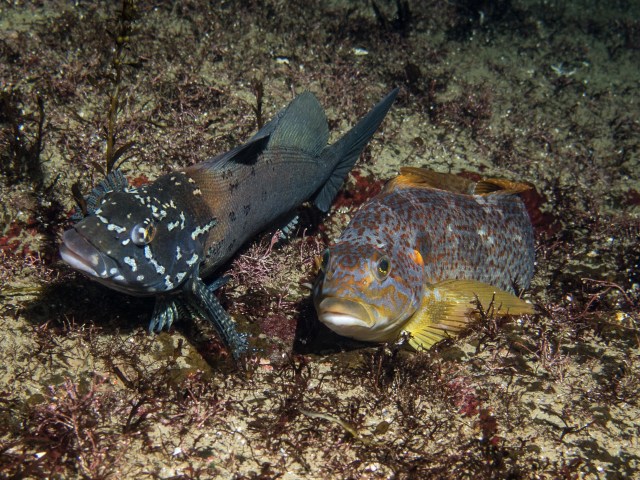
While diving this morning, I came across a kelp greenling couple while they were courting (Hexagrammos decagrammus to 60 cm).

In addition to being fascinated by the courtship behaviour, I was struck by the intense colouration, especially of the courting male.

Male kelp greenling. Normal colouration. ©2013 Jackie Hildering

Male kelp greenling. Normal colouration. ©Jackie Hildering

Mature male and female kelp greenlings look very different but I had never fully realized how the males’ gender specific colour intensifies during courtship.
Their bodies become much paler while the heads remain dark blue.

Courting male on left (note how much lighter the body is than the head); female on the right. © 2013 Jackie Hildering

Courting male on left (note how much lighter the body is than the head); female on the right. ©Jackie Hildering

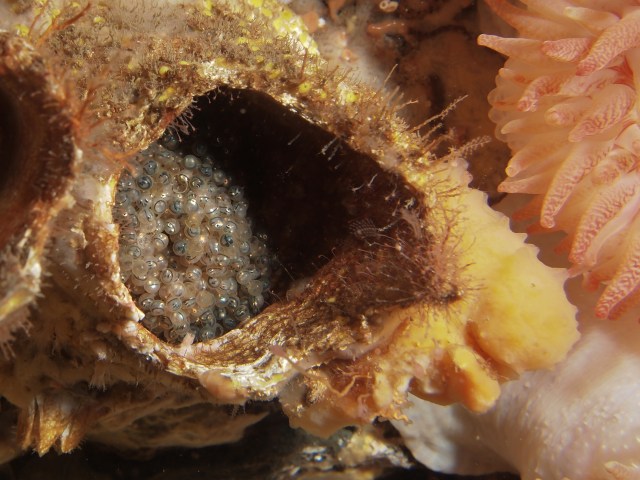
My 1.5 minute video below shows the courtship behaviour. After that there is a photo of eyed kelp greenling eggs.

Kelp greenling eggs in a giant barnacle shell. See the eyes?! © 2013 Jackie Hildering

Kelp greenling eggs in a giant barnacle shell. See the eyes?! ©Jackie Hildering

Fish Forever – The Wisdom of a Nine-Year-Old

Nature gave us sockeye salmon this year. A red-scaled, bounding life source, some 34 million fish strong.

This has led to human voices shouting out in all from gratitude to greed; from delight to denial.

Predictably, sadly, there have been far too many who have been at the “greedy denial” end of the spectrum. I will not tire you with that here though.

I want to fish out two voices of sanity from the ocean of opinions. One voice is that of reporter Stephen Hume from the Vancouver Sun. The other is nine-year-old Avery Walker who I am privileged to have as a member of my Northern Vancouver Island Young Naturalists’ Club.

Stephen Hume, award-winning author,  in The Vancouver Sun: “Columnists who apparently wouldn’t know the difference between a sockeye and a sculpin cluck and scold in a Toronto newspaper. One enthusiastically advances the argument that we should whack 30 million of the 34 million returning salmon . . . . . Instead of permitting a lust for instant gratification to derail a natural process for rebuilding small stocks, now is the time for restraint, for harvest restraint is a critical investment in future abundance. So enjoy your sockeye. Be grateful for this gift from nature. But don’t let the gong show of greed sway us from good stewardship.”

Avery Walker - Salmon Superstar. Photo by Larry Walker and Anna Marchand.

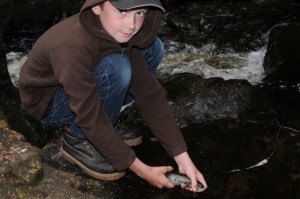
Avery Walker, 9-year-old Young Naturalist, with his prize-winning submission to the Wild Salmon Circle’s “Spawning Ideas” contest: “I fish only with barbless hooks, I’ve taken all the treble hooks from the all the buzzbombs I have and replaced them with single barbless hooks. I don’t jig the fish, I fish the ones who bite. Sometimes this is really hard to do, because not all of my friends fish like this, and so they sometimes take home more fish than I do. I abide by the regulations about which salmon I can keep and which ones I can’t. I never go over my limit. Or keep undersized fish. Most of the time, I catch and release. I love to fish, and I want to be able to do it forever.”

Thank you Avery. Thank you Stephen. Thank you all who make choices that may allow us to have  . . . fish forever.

For insights into the need for precaution in managing the harvesting and threats to the Fraser River sockeye, please click here for information from “Save Our Salmon”.

They’re Back . . . Hooded Nudibranchs

In late August, some of my Young Naturalists alerted me that they had already seen hooded nudibranchs (Melibe leonina) around Port Hardy (B.C., CANADA).

[It so wonderful that these local children know and greatly appreciate nudibranchs.]

Late August is earlier than we historically have seen the hooded sea slugs gather in large numbers. Usually this happens in late September / early October with them beginning to lay eggs in the spring.

Hooded nudibranchs back in very large numbers. Late August 2010.

This week, I had the opportunity to check how many are already in the area and, it’s official – the hooded nudibranchs are very much back.

To see the video from today, click here (2-minute video).

For explanations on the natural history of hooded nudibranchs, please see my previous blog postings from April 10th, 2010 and May 2nd, 2010.

Hooded nudibranch egg masses (March 2011). Each mass is about 1 cm high. Each little white dot is an egg.

Hooded nudibranch egg masses (March 2011).


Mystery Organism – A Jellyfish With a Stalk?!

Blog updated on June 25, 2024.

This is a Marine Detective case for those of you who appreciate mini-mysteries as much as whale wonders.

Gillian Butler and Erin Paul of found this remarkable invertebrate off their kayak base camp in Johnstone Strait, northeastern Vancouver Island in September of 2010. 

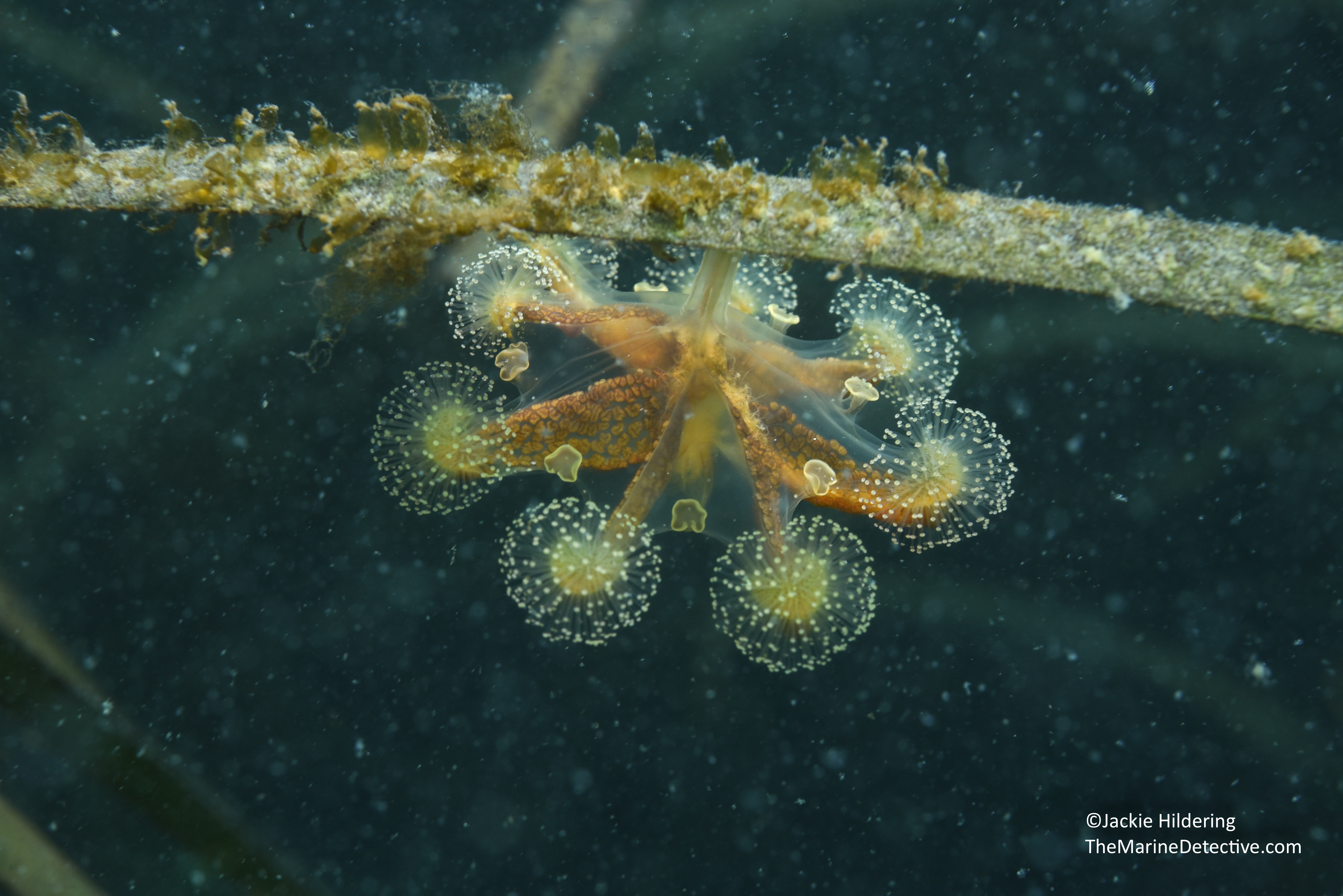
I was thrilled to get the “What’s this?” email from them as this is a type of jelly I know is off our coast but that I had never been able to find! It’s a jelly that is only 3 cm wide and is usually attached to kelp or Eelgrass . . . by its stalk!

Stalked Jelly – photo by Gillian Butler

Yes, it is species of stalked jellyfish (stauromedusae). The species well documented on our coast is the “Oval-anchored Stalked Jelly” (Haliclystus sanjuanensis). Read below for what is believed to be a new (undescribed) species!

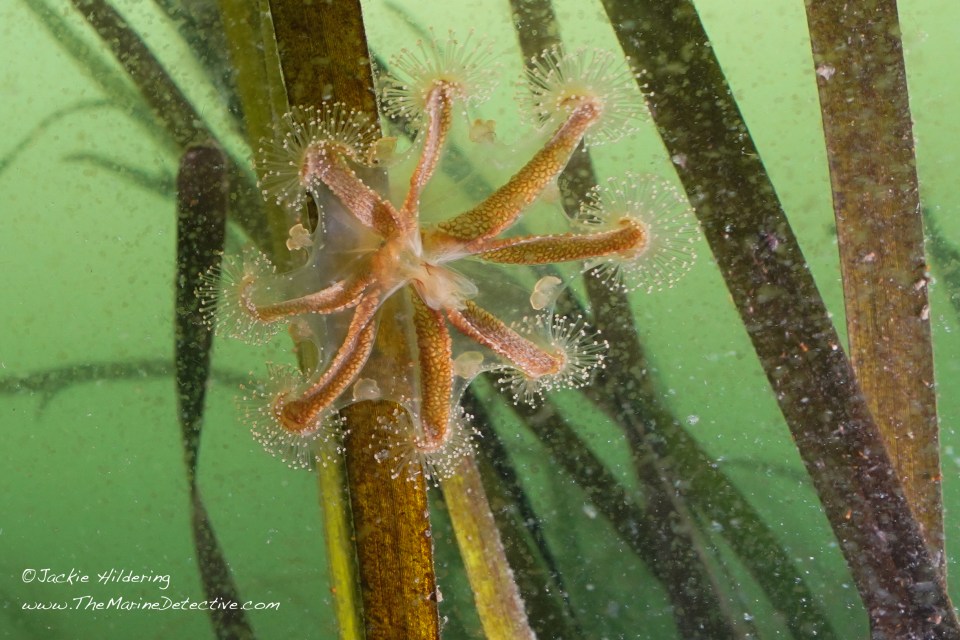
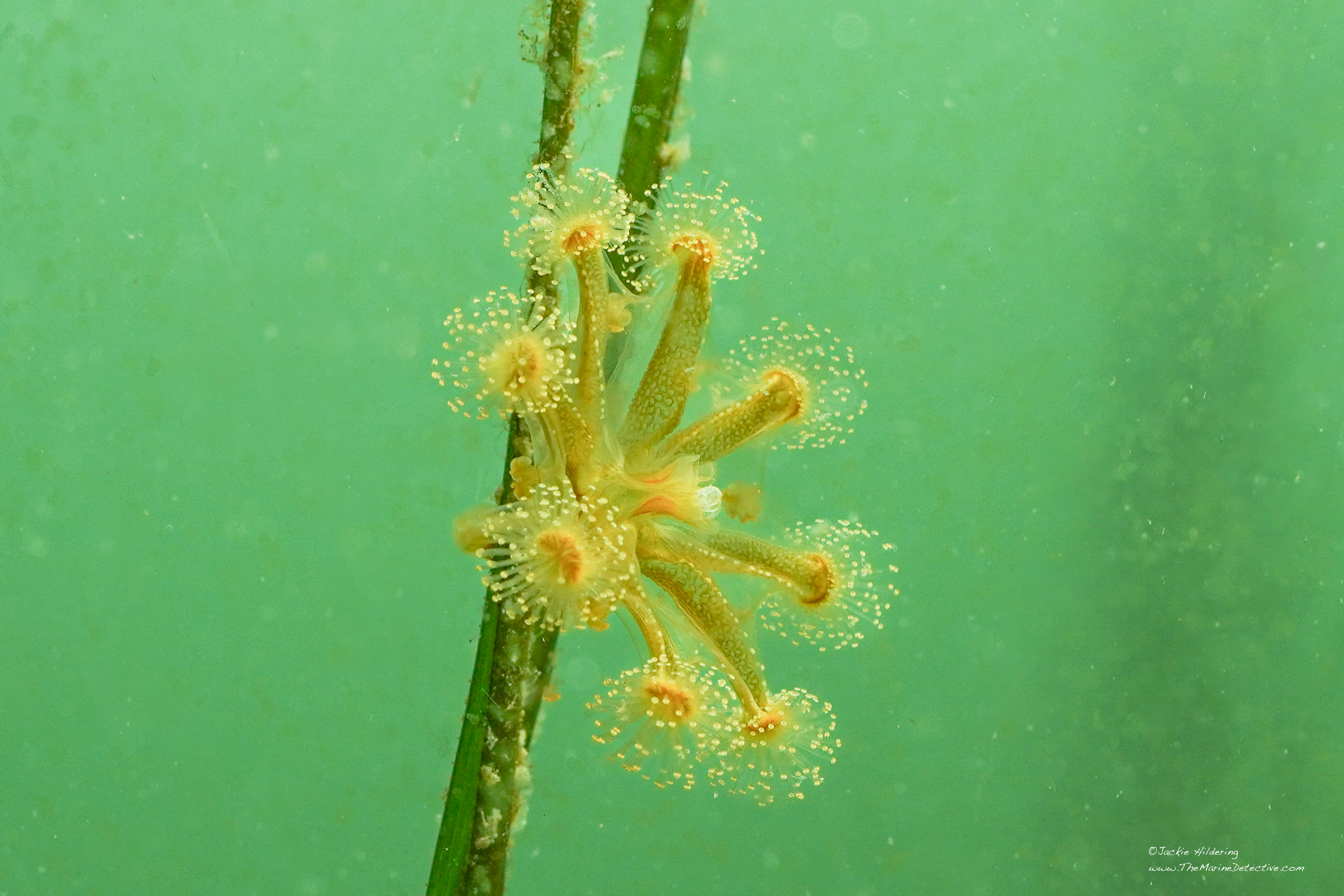
Stalked jellies never become free-swimming, bell-shaped “medusa” like most jellyfish species. Their stalk is sticky allowing them to attach to Eelgrass, seaweed, or rocks in the shallows.  They have 8 “arms” that look like they have pom-poms at their ends.  These clusters of 30-100 tentacles have stinging cells so that the stalked jelly can catch small crustaceans with the pom-poms and bring this food to their mouth (positioned at the centre of the 8 arms).

They are remarkably mobile which you will see in the Lester B. Pearson College video at the end of this blog. If the stalk becomes detached, the animal can hold on with its tentacles till it reattaches its stalk. The student video will also allow you to see the base of the stalk and how the arms can close up.

Only about 50 species of stalked jelly had been discovered worldwide. New extremely deep-dwelling species been discovered around hydrothermal vents AND . . . potentially also in the shallows in front of my community on northeastern Vancouver Island. 

Stalked Jelly found by yours truly on July 1, 2019.

After my photo (above) went into the world in July 2019, it led to contact with researcher Claudia Mills. She let me know this is an undescribed species (also genus Haliclystus). This is such testament to how little we know about the Ocean. Again, this was in the shallows at only approximately 1 metre depth very near to where I live.

Claudia also thought that the stalked jelly that Gillian and Erin found is likely also the undescribed species. Please note that these are NOT the only known sightings of this “new” species. Their range is believed to include the San Juan Islands (Washington) to southeast Alaska and possibly even northern Japan and sightings go back decades. See Neil McDaniel’s photo form the 1970s below.

From Claudia Mills on iNaturalist in 2020: “This undescribed species is easily mistaken for Haliclystus sanjuanensis. It may still be present in some locations in the San Juan Islands, Southern Vancouver Island, or the Canadian Gulf Islands, but we can no longer find it. My internet searches have found this species in quiet bays along northern Vancouver Island and in at least SE Alaska. It might be the same species as is found in the Russian Far East and Northern Japan, but we are trying to figure that out”

I had hoped to find the species again. Finally, I had success on June 27, 2022. See the photos below. These stalked jellies were again at only about 1-metre depth in the same location as the 2019 “find”.

Limitations in finding the species again were:

(1) That I think it is more likely to be found in the summer months when the visibility while diving is limited due to the richness of plankton in the water column; and

(2) Needing a dive buddy who is willing to gear up in thick neoprene in the summer and do a beach dive when it is usually hotter and much more difficult to see around you in the water. Diving from the beach usually involves more exertion than just rolling off a boat into the ocean. Also the visibility tends to be worse for beach dives because these locations often don’t get as much tidal flushing as do dive sites in narrow passes between islands.

YOU could find this species of Oval-Anchored Stalked Jelly too and carefully document it (not touching it and also being really careful in its habitat e.g. avoid stepping on Eelgrass). Your chances are likely best in summer, on a low tide.

You could upload the sighting to iNaturalist where Claudia Mills would ID. On a recent sighting there she shared: “This is the “other” uncommon, species of Haliclystus that we have found in BC and Alaskan waters. It is usually found in (environmentally) undisturbed quiet bays, on kelp or eelgrass in the shallow subtidal.”

For this Oval-anchored Stalked Jelly to be “described” and get a species name, experts like Claudia would write up and publish their research on how the species is physically and genetically different.

Note that this is an older video. I think we would be less inclined to touch the animal directly with current-day understanding and ethics.

Update: May 28, 2023

Found two individuals again in the same location as where I have seen them previously! See the photos below.

Update: June 24, 2024
Found another two individuals again in the same location.

Resources:
Mills CE, Westlake H, Hirano YM, Miranda LS. 2023. Description of a common stauromedusa on the Pacific Coast of the United States and Canada, Haliclystus sanjuanensis new species (Cnidaria: Staurozoa) PeerJ 11:e15944

Inaturalist
www.inaturalist.org/observations/48578263
www.inaturalist.org/observations/85506767


Too Smart To Be “Nice” – Pacific White-Sided Dolphins Interact With Dall’s Porpoise Calf

Before you read further, a reminder:  There is no “good” or “bad” in Nature. There is only perfection. Animals do what they do for a reason. We humans may not understand their behaviour but to impose judgement is ridiculous. There is always a net gain for some of the animals involved.

Yes, this is me making very clear that to either typify dolphins as “good” (the Flipper phenomena) or “bad” is sheer anthropomorphism and does nothing to enhance the understanding of animal behaviour.

Dolphins are dolphins and they do what dolphins need to do.

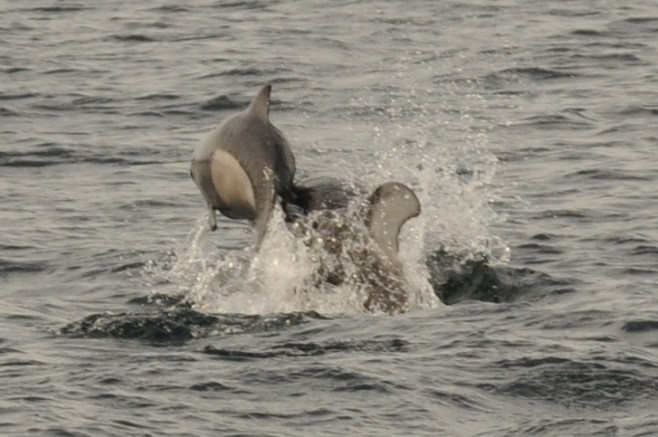
Dall's porpoise calf hit from below by Pacific white-sided dolphin.

Dall’s Porpoise calf hit from below by Pacific White-Sided Dolphin. ©Jackie Hildering.

Okay, now that I have made that very clear, I dare share the exceptional encounter I stumbled upon today. I found two adult male Pacific White-Sided dolphins negatively interacting with a Dall’s Porpoise calf.

I know there were only two dolphins as they had distinct dorsal fins allowing me to track them as individuals. I know they were adult males since the fins of adult males tend to be chunkier and are often more scarred. I perceive that it was a negative interaction since the two dolphins were corralling the Dall’s Porpoise calf; hitting it with their tails at the surface; pushing down on the calf’s head and hitting it from below.  It was an encounter that I witnessed for 10 minutes and was very persistent and intense.

I also saw what I think were only two adult Dall’s Porpoises repeatedly surfacing some 30 to 40 metres away from the interaction between the calf and the two Pacific White-Sided Dolphins.

In years past, I have seen this species of dolphin kill a Harbour Porpoise and a Pacific Harbour Seal pup. It is quite a regular occurrence for these dolphins to interact with fish-eating (“Resident”) Killer Whales in such a way that the Killer Whales dive longer, go silent and group up. Their interactions with Humpback Whales most often lead to the humpbacks “trumpeting”, rolling on the surface and slapping with their long pectoral fins. Such interactions are categorized in science as “harassment”. 

Dolphins are smart. Very smart.

I put forward that interactions like this allow them to learn, to feed their hungry brains.  If this does not sound plausible to you then you don’t have a younger sibling! Those of us who do have younger siblings know how “provoking” also allows young humans to learn. It allows them to find out “What happens when I do this?” “How about this?” “And when I do this?”

Dolphins are extremely social animals too. I believe such interactions allow the dolphins to exercise social bonds and strategize. The males of some well-studied dolphin species (e.g. Spotted dolphins and Bottlenose Dolphins) have been found to have “coalitions” / “alliances”; social units that allow them to group defend, group feed and group mate.  The Pacific White-Sided Dolphins off the coast of British Columbia are only beginning to be studied as individuals so science has yet to confirm what sort of social structures they might have.  My hypothesis is that the two Pacific White-Sided Dolphins from today’s interaction have an alliance.

I cannot give you a conclusion to the interaction I witnessed today. When I last saw the porpoise calf, it was alive. However, as fate would have it, I had boat engine difficulty and therefore “lost” the animals as I dealt with my boat woes.

I have annotated the photos at the following link, leaving them in chronological order so that you can see how the interaction developed. I have also provided notes that will help you discern the two dolphins as individuals. Photography was challenging due to wind and the speed of the action.

Remember, no judging the wild. 

Click here for the photos.

Click here for a study documenting “porpicide” of Harbour Porpoise by Bottlenose Dolphins.
Click here for article about Southern Resident Killer Whales (inshore fish-eaters) harassing Harbour Porpoise.
Click here for the population studies by Erin Ashe (Oceans Initiative) published since my writing the blog = Ecology of Pacific white-sided dolphins (Lagenorhynchus obliquidens) in the coastal waters of British Columbia, Canada (2015)

“Exquisite Handiwork” – Sea Slug Eggs

“Some of nature’s most exquisite handiwork is on a miniature scale, as anyone knows who has applied a magnifying glass to a snowflake.

I was reminded of this Rachel Carson quote today when diving but found myself changing the ending to ” . . . as anyone knows who has seen sea slug egg masses.”

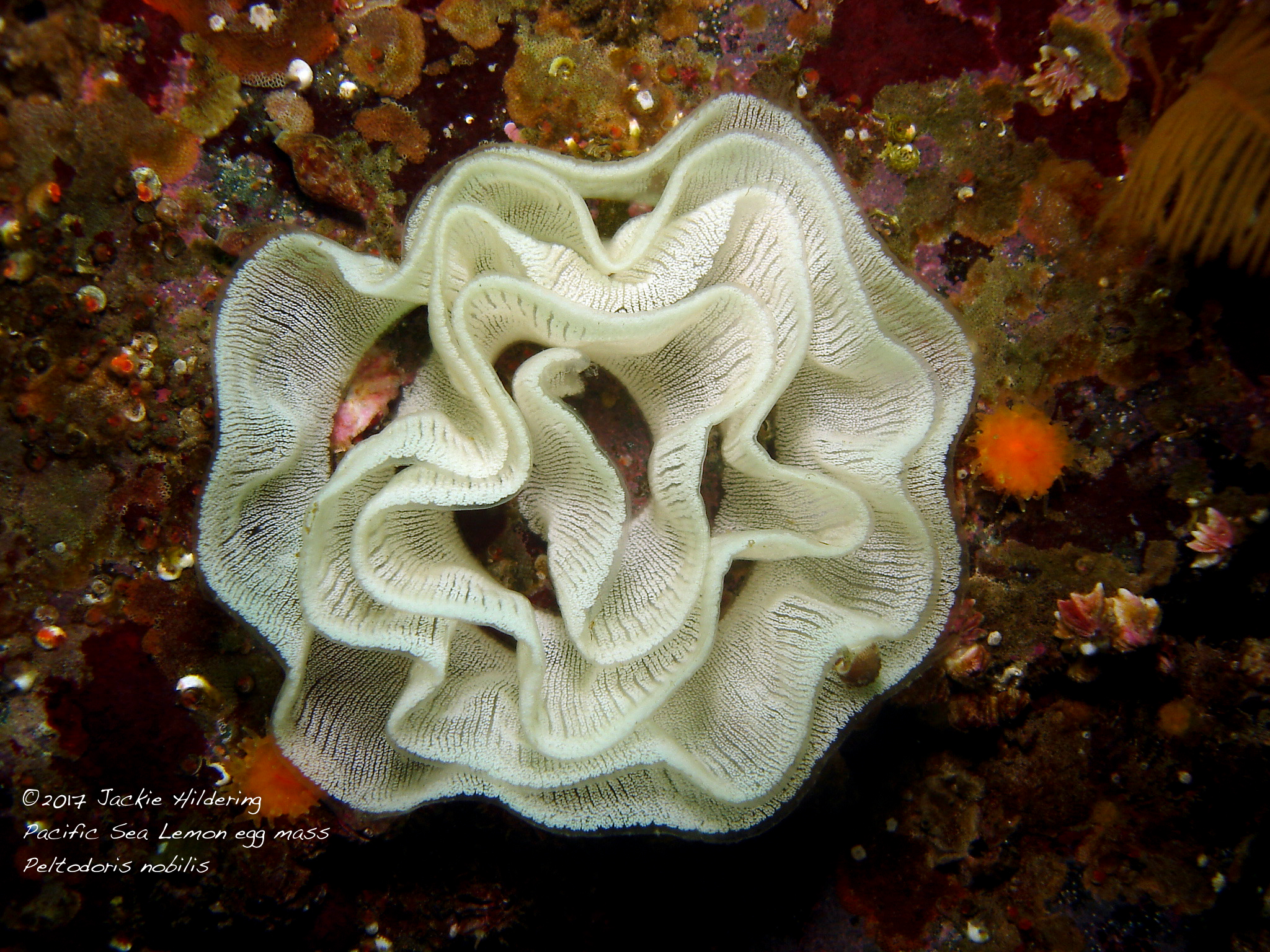
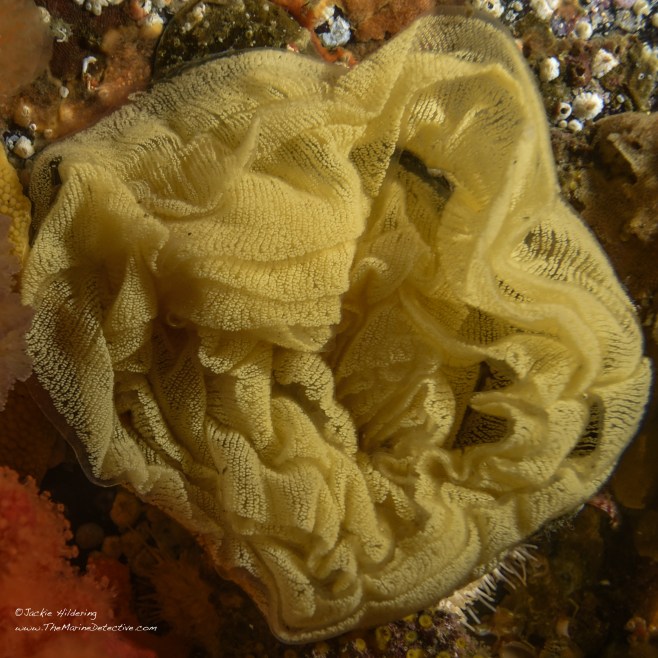
The image here is the egg mass of the Pacific Sea Lemon (Peltodoris nobilis), a sea slug up to 20+ cm. It’s egg mass is up to some 20 cm as well.  Every little dot you see contains up to 20 fertilized eggs. So many eggs are needed when your young are hatched into the planktonic soup of the sea. 

The egg mass is the result of the Sea Lemons lining up right-side-to-right-side and both becoming fertilized. Being a hermaphrodite is of course a good design when you are a slow-moving slug that relies on smell to find its way.  More detailed information about sea slug mating can be found at this previous TMD blog entry.

Looking like rich, textured crocheting, the egg mass is indeed Nature’s exquisite handiwork.  Its intricacy rivals that of any spider’s web and, in my perception, surpasses any human nanotechnology.

Seeing such beauty serves as testimony of Nature’s perfection and complexity. How we humans are newcomers to it all, unable to truly grasp the billions of years of design that proceeded our walking upright on earth. It should further motivate us all to walk with much smaller footprints so that we do not blunder and crush the systems that are Nature’s exquisite handiwork.


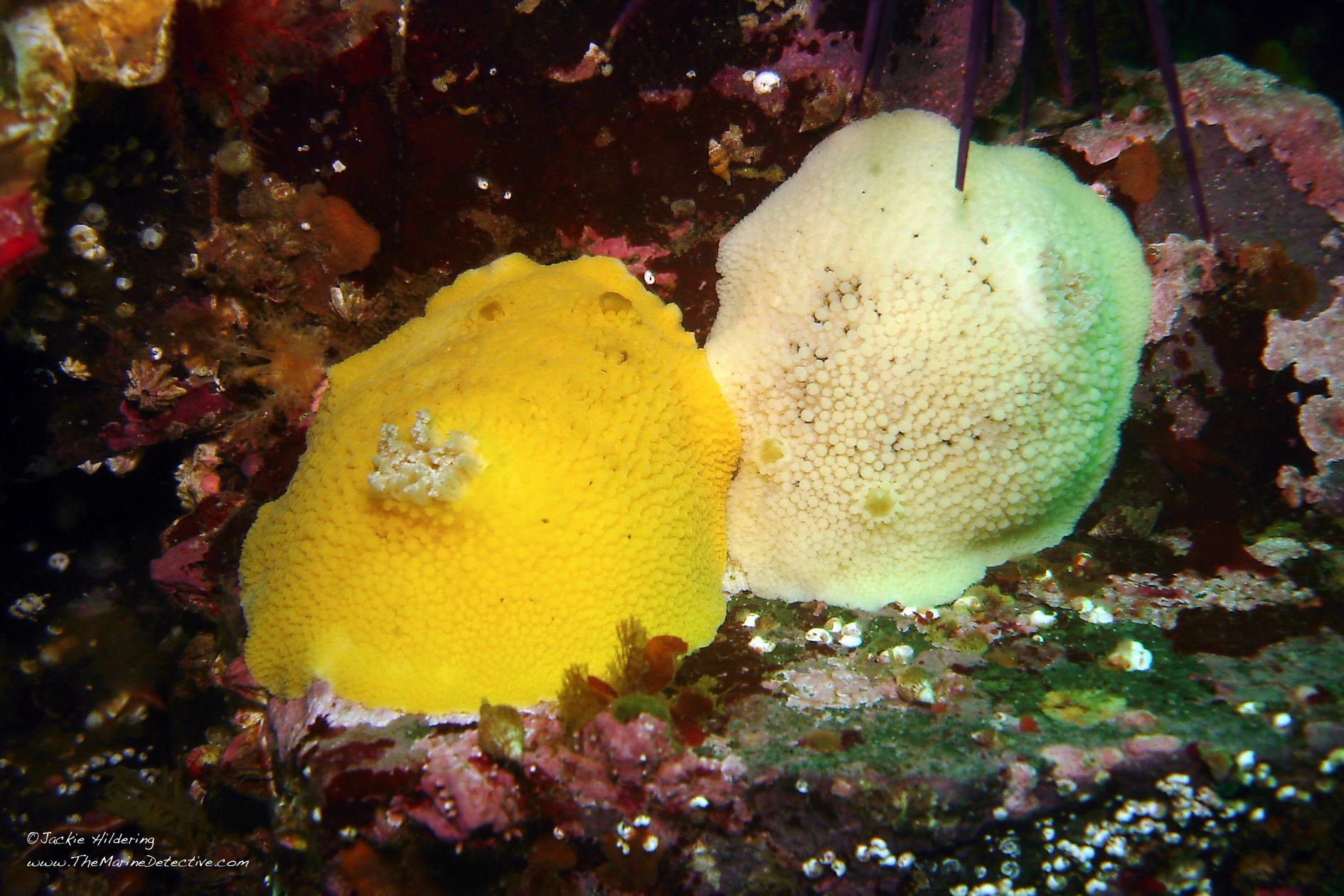
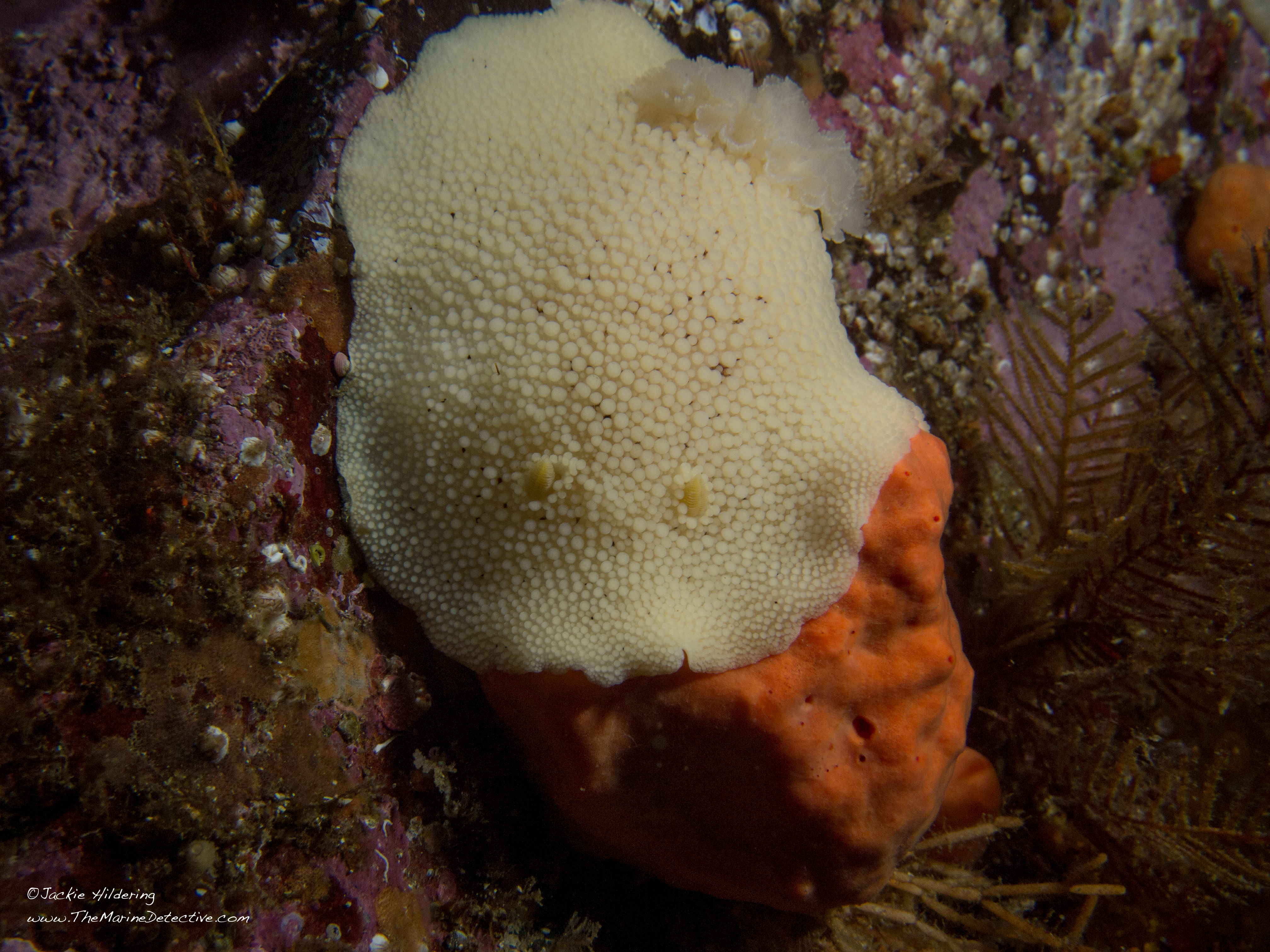
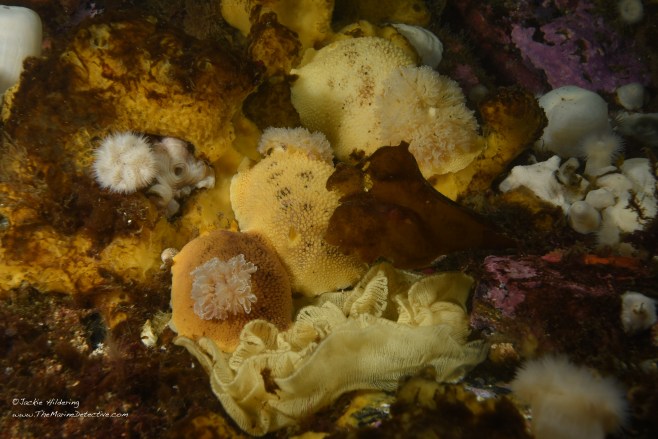
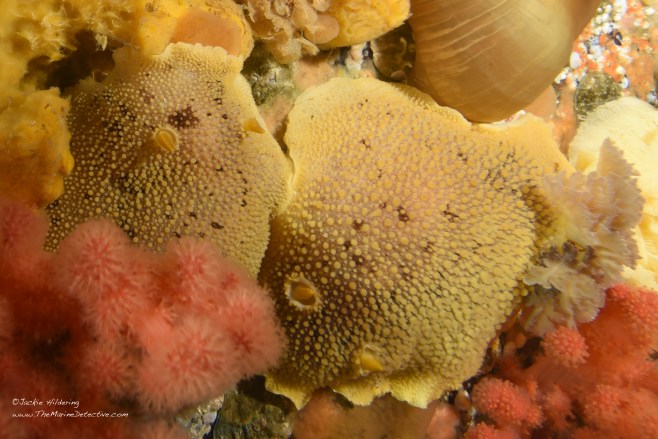
Note: The Sea Lemon is often mistaken for other dorid species such as the Monterey Dorid (Doris montereyensis).  The easiest way to ID them correctly is to know that Pacific Sea Lemons have white gills. See the photos below and note how, although the body colour can be different, the colour of the gills is always white. The gills of the Monterey Dorid are yellow. The other difference, albeit more subtle, is that the little brown bits of colour do not extend to the top of the tubercles in Pacific Sea Lemons and the brown does go to the tips in Monterey Dorids. The tubercles are those bumpy little structures all over the sea slugs. Also, every sea slug species’ egg masses looks different which  provides further ID clues. The egg masses of Monterey Dorids are not quite as intricate. 

[Update 2020: I promise I will provide a blog showing the differences in IDs and egg masses of Pacific Sea Lemons, Monterey Dorids AND two more species which add to the ID confusion – Freckled Sea Lemons and Heath’s Dorids. Just need a bit of time!]

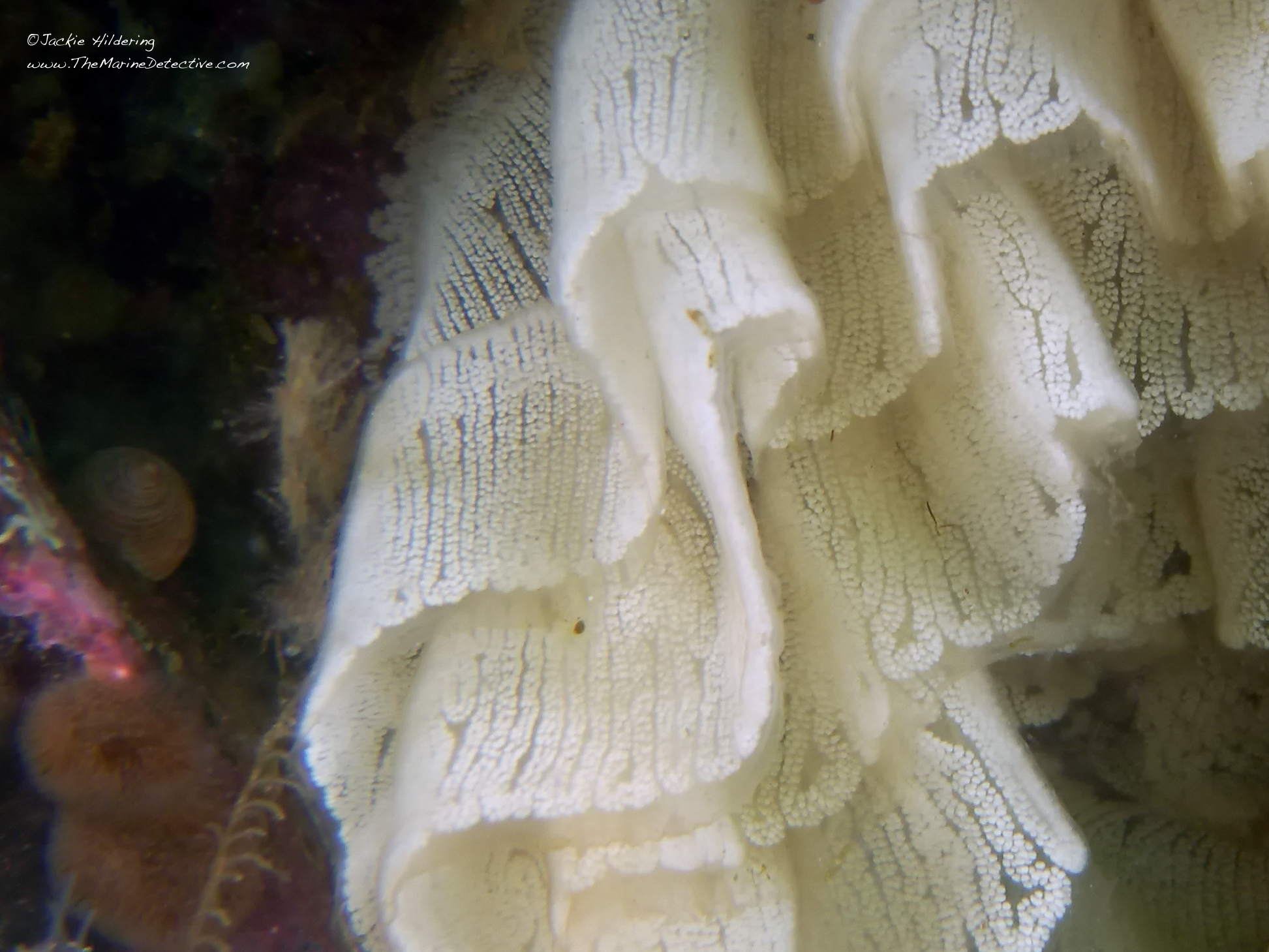
Close up on a Pacific Sea Lemon’s (Peltodoris nobilis) egg mass. Every dot contains up to 20 fertilized eggs.


Peltodoris nobilis egg laying (note the Brittle Star arms coming out of the crack).


Peltodoris nobilis mating – always right side to right side in slugs with gonopores linked so both become inseminated and lay eggs = simultaneous hermaphrodites.


The following photos give more of a sense of the variation in colour in this species.


More mating and eggs masses

3 Pacific Sea Lemons, two mating, one egg mass. Individuals appear to lay multiple egg masses to increase the chances of young surviving to adulthood. Not the white gills. 

Mating. These two were right beside the egg mass in the following photo.