Swimming, Shelled Sea Butterfly – Limacina helicina
It’s b-earthday, April 22nd. That’s a combination of Earth Day and my birthday.
Here’s my gift to you – information and imagery about the “Common Sea Butterfly” (Limacina helicina), also known as the “Helicid Pteropod”.
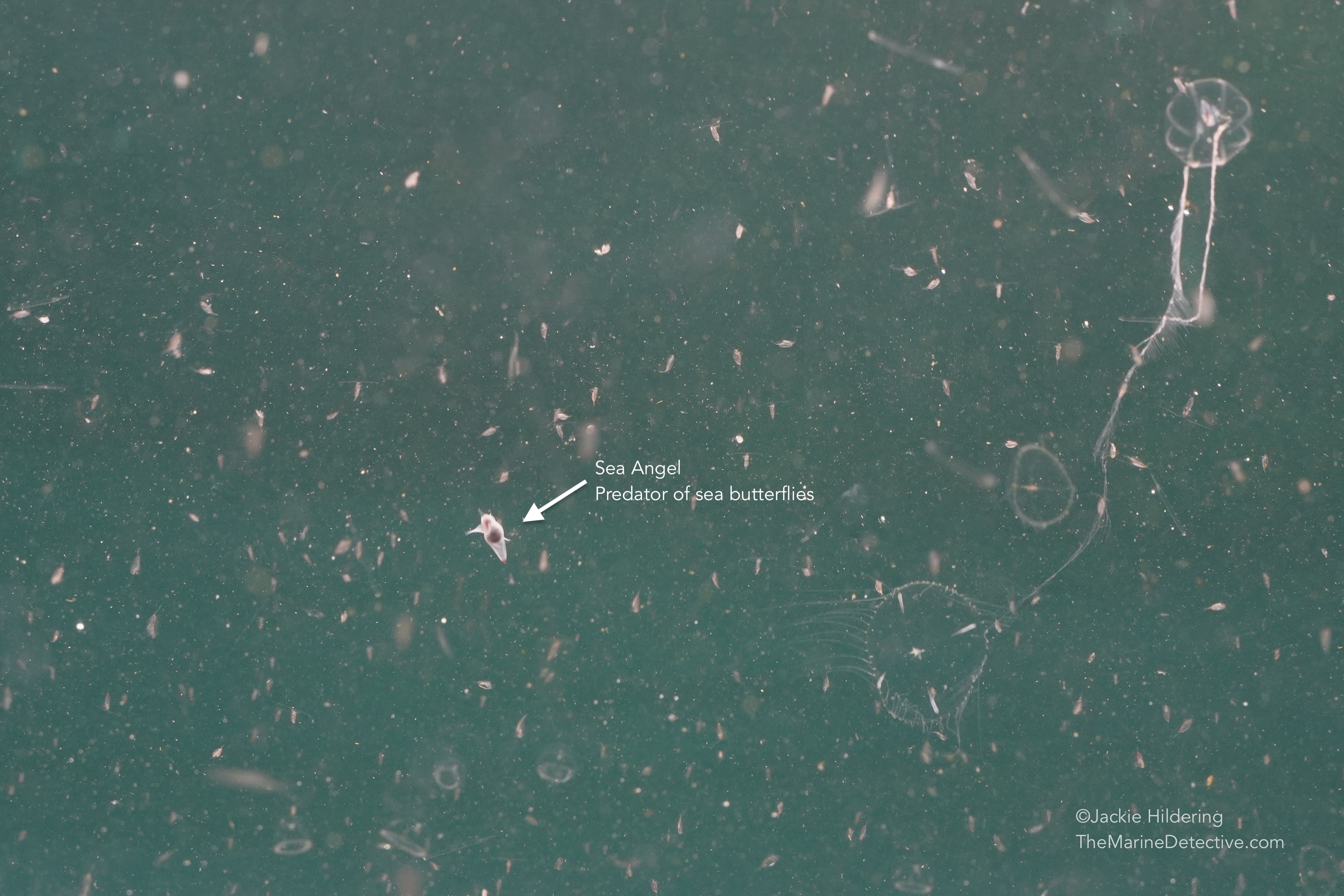
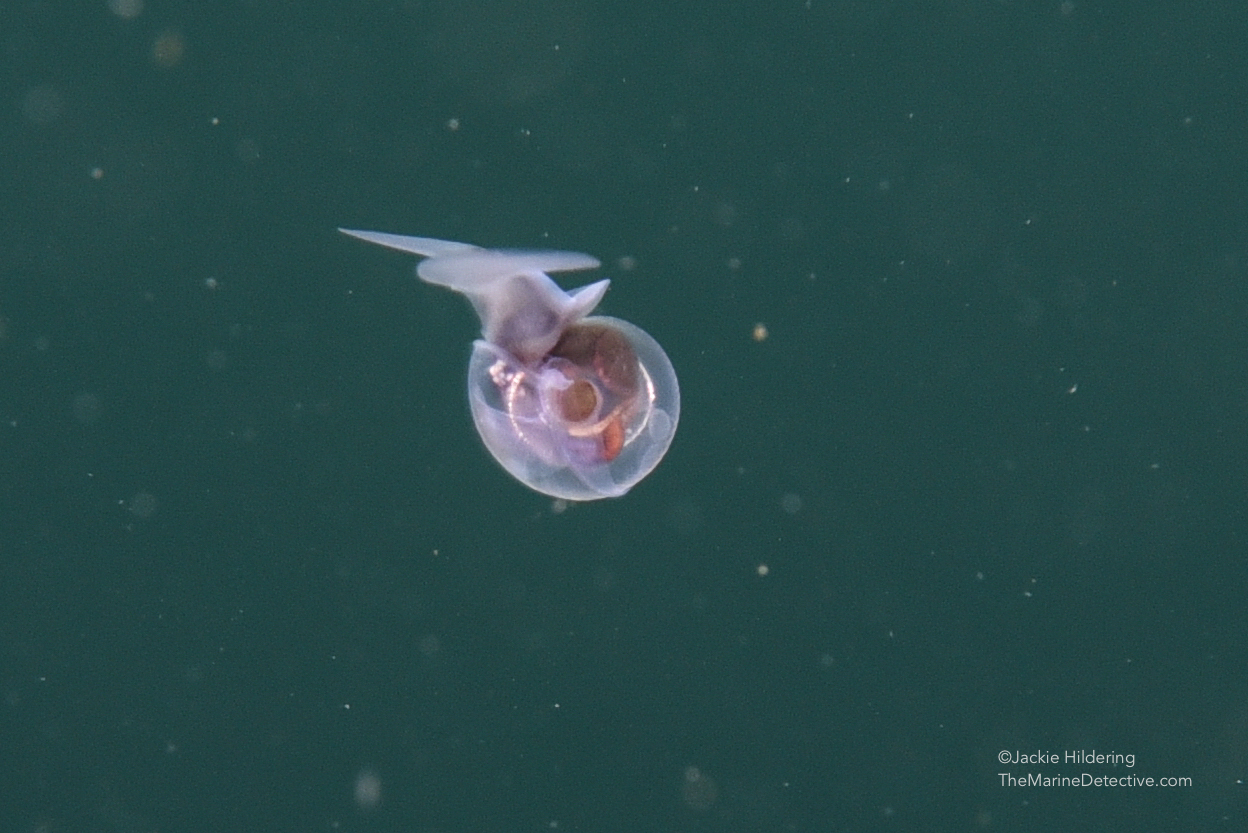
Imagine the awe of being surrounded by these tiny, winged, shelled animals. The largest are only 1.5 cm. Most are smaller. They appear as fragile as they do wondrous. Indeed, their very thin shells are heavily impacted by ocean acidification.
Their motion is transfixing, rhythmic – their “wings” clapping and flinging in a figure-of-eight pattern to create lift. Where other slugs and snails crawl, the foot of sea butterflies evolved into swimming structures, the parapodia. They use their feet as wings – living as plankton, never to crawl, only to fly.
I want to be able to use my feet as wings! I also want to be able to cast a mucus net like they do! Read on.
Background on the images:
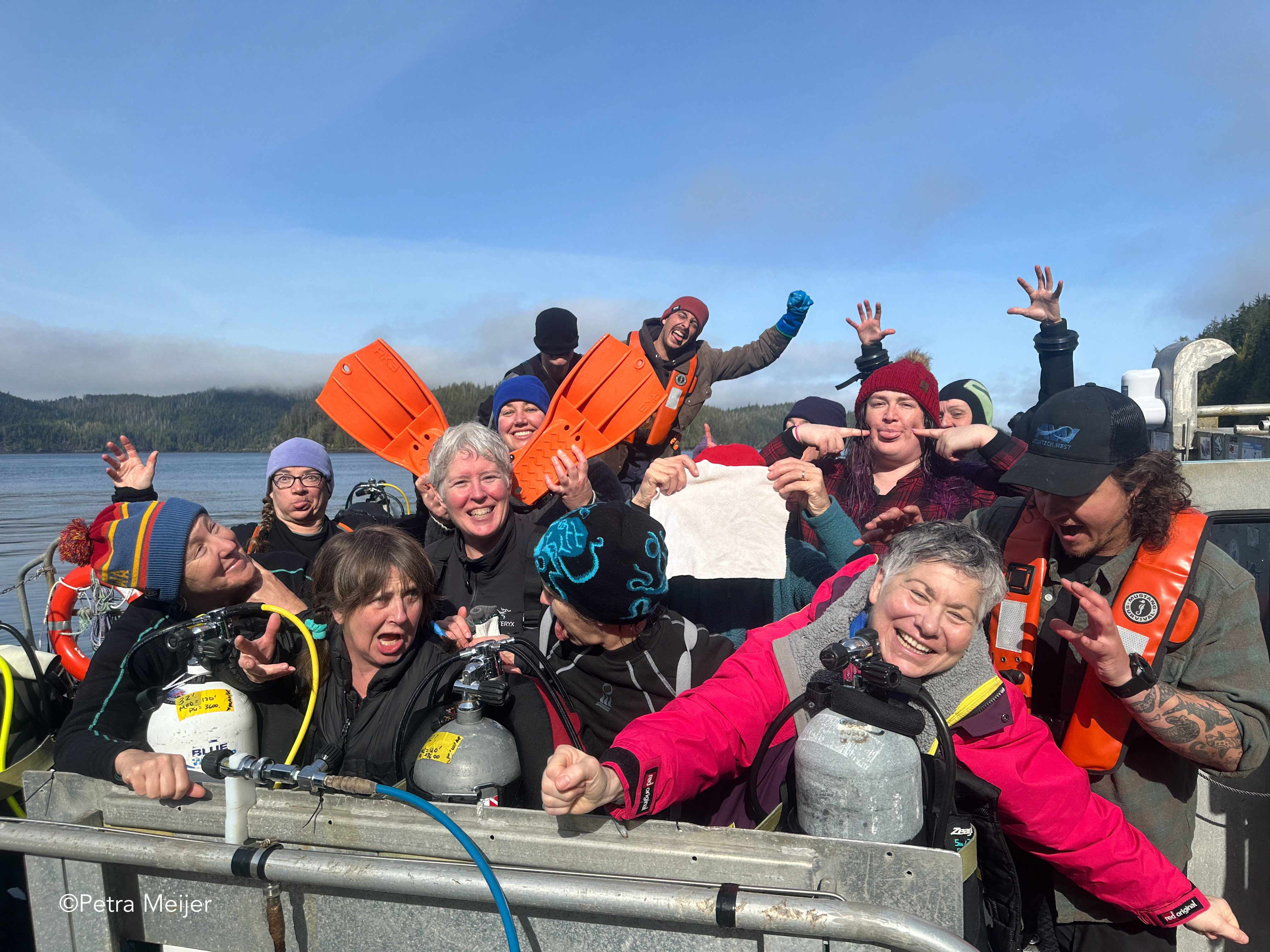
The images in this blog were taken on the recent trip I organized to God’s Pocket. I have never noticed this species of sea butterfly before, and certainly not in such numbers. That’s right, the so-called COMMON Sea Butterfly is not common in this area at all. Despite the abundance of these planktonic marvels during this trip, I initially did not notice them when most of the other divers on my trip did. I had to laugh at myself when I did the next dive and saw just how abundant they were in the shallows. With the camera setup I had, I was literally focusing on bigger life.
I am very grateful to Olivia’s Reef Diving for sharing her stunning footage. Believe me, it is NOT easy to get these small swimming slugs in focus while also contending with current. It’s no small feat to get such good video of a sea slug flying with its feet!

Classification:
Sea butterfly species are flying gastropods (snails/slugs) belonging to the Pteropoda (clade). Ptero = winged and poda = foot. As described in Nudibranchs and Sea Slugs of Eastern Pacific, the pteropods are “graceful, pelagic sea slugs that resemble transparent gelatinous butterflies”.
Not all Pteropoda are sea butterflies and include species that I have blogged about previously:
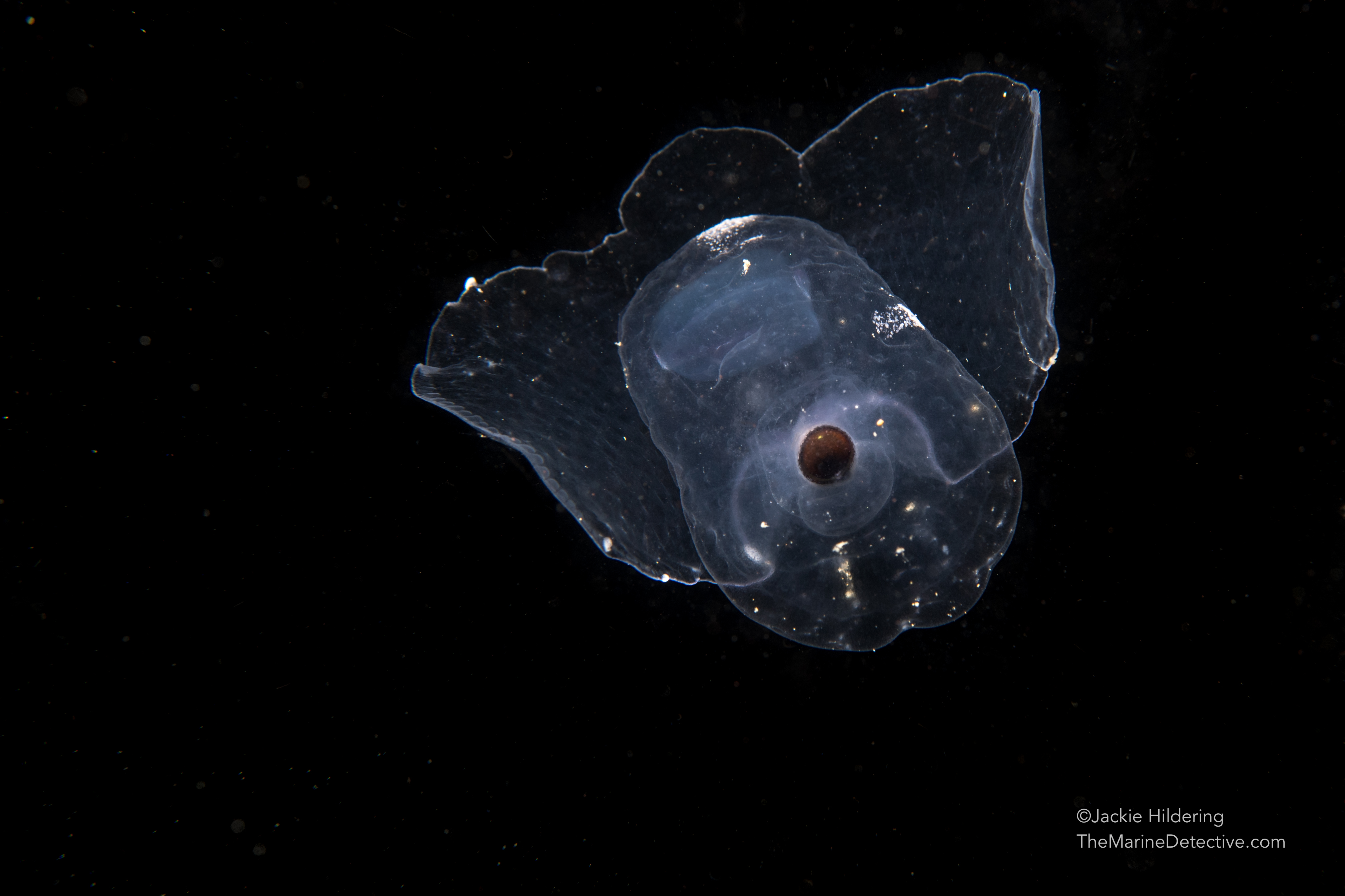
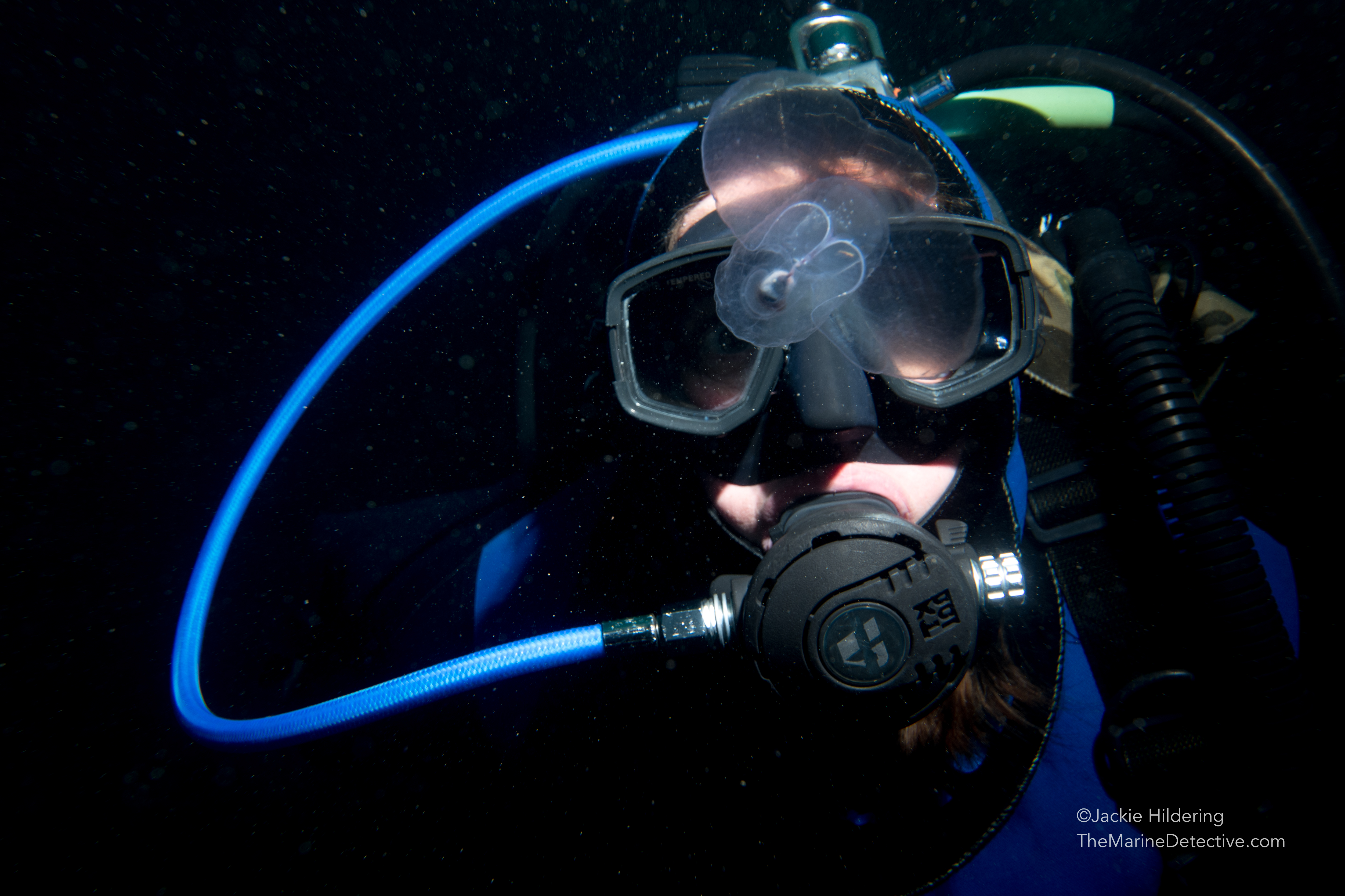
- The Spectacular Corolla (Corolla spectabilis) is another local sea butterfly species in the Thecosomata order. Almost all sea butterfly species have shells.
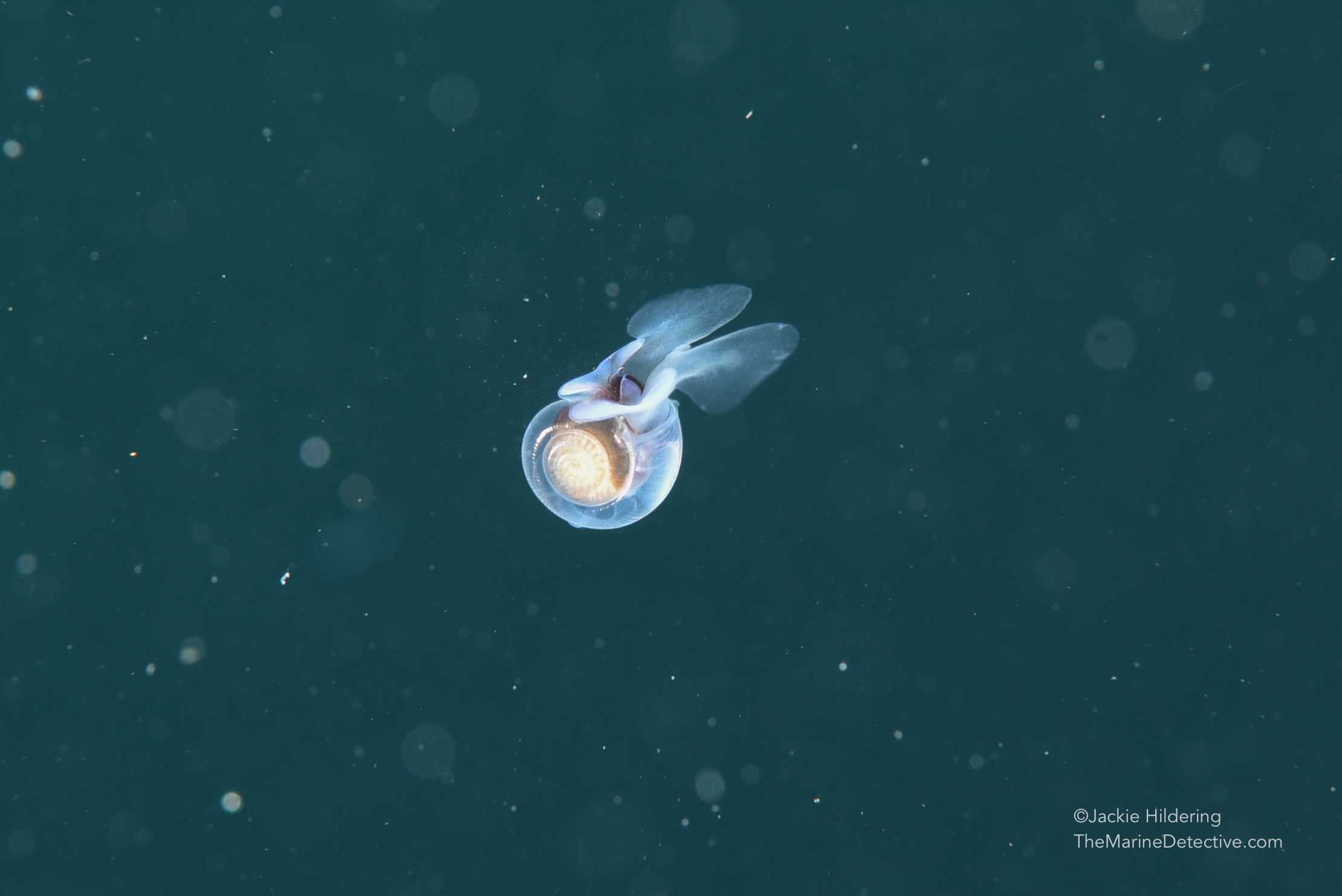
- Sea Angels (e.g., Clione limacina) are in the Gymnosomata order and eat sea butterflies! Adult sea angel species do not have shells.
- Note that Great-Winged Sea Slugs, while also a sea slug (Heterobranchia) that flaps “wings”, they are not pteropods.
There, don’t you feel better now that that’s sorted out? I am here to bring order to your life. See what I did there?
Morphology:
Most sea butterflies (Thecosomata) have shells.
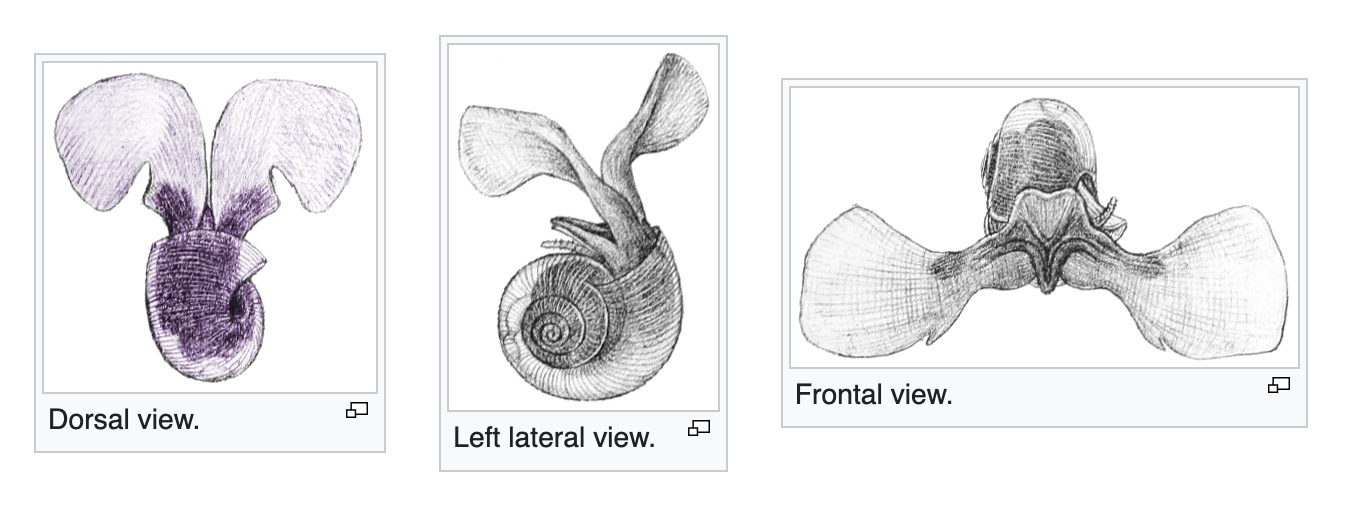
The very thin shells of sea butterfly species like Limacina helicina are made of aragonite, which is a form of calcium carbonate that dissolves very easily, especially in colder waters. This makes them very vulnerable to ocean acidification resulting from climate change.
The ocean absorbs about one-third of human-produced carbon dioxide, which lowers pH, reduces the availability of calcium carbonate needed to build shells, and weakens and dissolves shells.
Research confirms that the sea butterflies cannot build and maintain their shells under more acidic conditions. Because their shells are essential to protection, buoyancy, and vertical movement, reduced shell integrity has direct consequences for survival. Since sea butterflies are an essential part of marine food webs, they are a key indicator species for ocean acidification, providing an early warning of broader ecosystem change – particularly in the Arctic.
Locomotion:
From the abstract of “Underwater flight by the planktonic sea butterfly” (Murphy et al., 2016):
“In a remarkable example of convergent evolution, we show that the zooplanktonic sea butterfly Limacina helicina ‘flies’ underwater in the same way that very small insects fly in the air. Both sea butterflies and flying insects stroke their wings in a characteristic figure-of-eight pattern to produce lift, and both generate extra lift by peeling their wings apart at the beginning of the power stroke (the well-known Weis-Fogh ‘clap-and-fling’ mechanism). It is highly surprising to find a zooplankter ‘mimicking’ insect flight as almost all zooplankton swim . . . using their appendages as paddles rather than wings. The sea butterfly is also unique in that it accomplishes its insect-like figure-of-eight wing stroke by extreme rotation of its body (what we call ‘hyper-pitching’), a paradigm that has implications for micro aerial vehicle (MAV) design. No other animal, to our knowledge, pitches to this extent under normal locomotion.”
Feeding:
Reportedly, sea butterfly species produce a mucous web, many times bigger than they are (said to be up to 6 cm for the Common Sea Butterfly). When they have “cast” their net, they slowly sink, and plankton and organic particles get trapped in the net! They are thought to feed when they are not actively swimming.
What a huge b-earthday gift it would be if someone could find a picture or graphic of the net! Believe me, I searched!
Sea butterfly species and other pteropods are sometimes referenced as the “potato chips of the sea” because they are fed on by so many other species and therefore have great importance in the marine food web. Predators include Sea Angels, fish, birds, and there is also some cannibalism.
Summary from Wikipedia.
“They produce large mucus webs to filter-feed on phytoplankton but also small zooplankton. They eat the web with the captured prey . . . The web is large and spherical and it is difficult to see during the day because of diffuse reflection. Webs are easier to see at night. Limacina helicina is easily disturbed (like all other Thecosomata); when disturbed, it retracts into its shell and destroys its web.“
Range / Habitat:
Sea butterfly species spend their whole lives as plankton (are holoplanktonic). They are most commonly reported where water temperature is in the range of – 0.4 °C to + 4.0 °C. They are said to rarely be in areas with temperatures up to 7 °C, but that was the approximate temperature when we saw them.
From Earthling Nature:
The habitat of the common sea butterfly includes the cold waters of the Arctic region, including the Arctic Ocean and neighboring areas of the Atlantic and Pacific oceans. In the Pacific, it can occur southward to Japan and the northern parts of the United States. Larger specimens tend to inhabit deeper waters, up to 150 m deep, while smaller ones live closer to the surface, up to 50 m down. Until very recently, the Common Sea Butterfly was thought to inhabit Antarctic waters as well but molecular studies revealed that the populations around Antarctica belong to a different species, Limacina antarctica.
Smaller Limacina helicina (from 0.2 to 0.4 mm) are said to be more often in shallower waters (0 m to 50 m). Larger individuals can also be in the shallows but are more likely to be deeper, to 150 m.
Reproduction / Life Cycle:
Sea butterflies all start their lives as males and, when larger than ~5 mm, they change into females = they are protandric hermaphrodites. Egg ribbons are laid mainly in summer.
Said to live about ~1 year or up to 2 years in colder waters.
What a gift it is that we share the earth with such organisms. May we care more, and do more, knowing our connection to such winged wonder. Happy b-earthday.
Photos below: Another, much bigger local sea butterfly species – the Spectacular Corolla (Corolla spectabilis). Dive buddy is Natasha Dickinson.
Sources:
Bednaršek, N. (2016). Pteropods on the edge: Cumulative effects of ocean acidification, warming, and deoxygenation on pelagic calcifiers. Advances in Marine Biology, 76, 1–76.
Comeau, S., Gorsky, G., Jeffree, R., Teyssié, J.-L., & Gattuso, J.-P. (2009). Key Arctic pelagic mollusc (Limacina helicina) threatened by ocean acidification. Biogeosciences Discussions, 6, 2523–2537.
Döring, M. (2022). Limacina helicina (Phipps, 1774). In English Wikipedia – Species Pages. Wikimedia Foundation. Retrieved April 21, 2026, via GBIF: https://www.gbif.org/species/165475365
Earthling Nature – Friday Fellow: Common Sea Butterfly
GBIF Secretariat. (n.d.). Limacina helicina (Phipps, 1774). Global Biodiversity Information Facility. Retrieved April 22, 2026, from https://www.gbif.org/species/165475365
Hunt, B., Strugnell, J., Bednaršek, N., Linse, K., Nelson, R. J., Pakhomov, E., Seibel, B., Steinke, D., & Würzberg, L. (2010). Poles apart: The “bipolar” pteropod species Limacina helicina is genetically distinct between the Arctic and Antarctic oceans. PLoS ONE, 5(3), e9835. https://doi.org/10.1371/journal.pone.0009835
iNaturalist. (n.d.). Helicid pteropod (Limacina helicina). Retrieved April 22, 2026, from https://www.inaturalist.org/taxa/139059-Limacina-helicina
Lalli, C. M., & Gilmer, R. W. (1989). Pelagic snails: The biology of holoplanktonic gastropod mollusks. Stanford University Press.
Murphy, D. W., Adhikari, D., Webster, D. R., & Yen, J. (2016). Underwater flight by the planktonic sea butterfly. Journal of Experimental Biology, 219(4), 535–543.
Plankton Chronicles. (n.d.). Pteropods – Swimming mollusks. Retrieved April 21, 2026, from https://planktonchronicles.org/en/portfolio/pteropods-swimming-mollusks
Rudman, W. B. (2002, December 12). Corolla spectabilis Dall, 1871. In Sea Slug Forum. Australian Museum. Retrieved April 22, 2026, from http://www.seaslugforum.net/find/corospec
SGS Laboratory. (n.d.). Why are pteropods excellent recorders of climate change. Retrieved April 22, 2026, from https://www.sgs.com/en/news/2019/05/why-are-pteropods-excellent-recorders-of-climate-change
Wang, K., Hunt, B. P. V., Liang, C., Pauly, D., & Pakhomov, E. A. (2017). Reassessment of the life cycle of the pteropod Limacina helicina from a high-resolution interannual time series in the temperate North Pacific. ICES Journal of Marine Science, 74(7), 1906–1920. https://doi.org/10.1093/icesjms/fsx014
Wikipedia contributors. (n.d.). Limacina helicina. In Wikipedia. Retrieved April 21, 2026, from https://en.wikipedia.org/wiki/Limacina_helicina

