Join me in the cold, dark, life-sustaining NE Pacific Ocean to discover the great beauty, mystery and fragility hidden there.

Posts tagged ‘stalked jellyfish’

The rarest of the rare? Haliclystus californiensis in British Columbia? 

[Last updated on November 3, 2025.

Can a 2 cm stalked jelly make you feel small? Yes.
Can it fill you with awe, wonder, affirmation, purpose, and drive? Yes.
Does it make it feel like all the immersion, the cold, and the learning from this little bit of the planet, somehow makes a positive difference? In a quiet voice, I say . . . yes.

It has been confirmed by Claudia Mills that I have the identification of this stalked jelly correct as Haliclystus californiensis. Note that:

  • It has only been recognized as a distinct species in 2010 (Kahn et al., 2010). At the time of that publication, only 10 individuals had been found and only “from southern to northern California in coastal waters” (hence the species name “californiensis“).
  • There are only two other known sightings in British Columbia. One in 2017 as a result of a collaboration including the Smithsonian Institution’s Marine Global Earth Observatory and the Hakai Institute. Additionally, I learned from Claudia Mills that one was sighted near Bamfield by Ron Larson in October 1983.
  • This would be only the 25th global documentation to be included on the Global Biodiversity Information Facility, which, since the research of Kahn et al. in 2010, includes findings of the species in Sweden and Denmark. Note that there is doubt about whether the individuals documented in the Atlantic are indeed the same species.

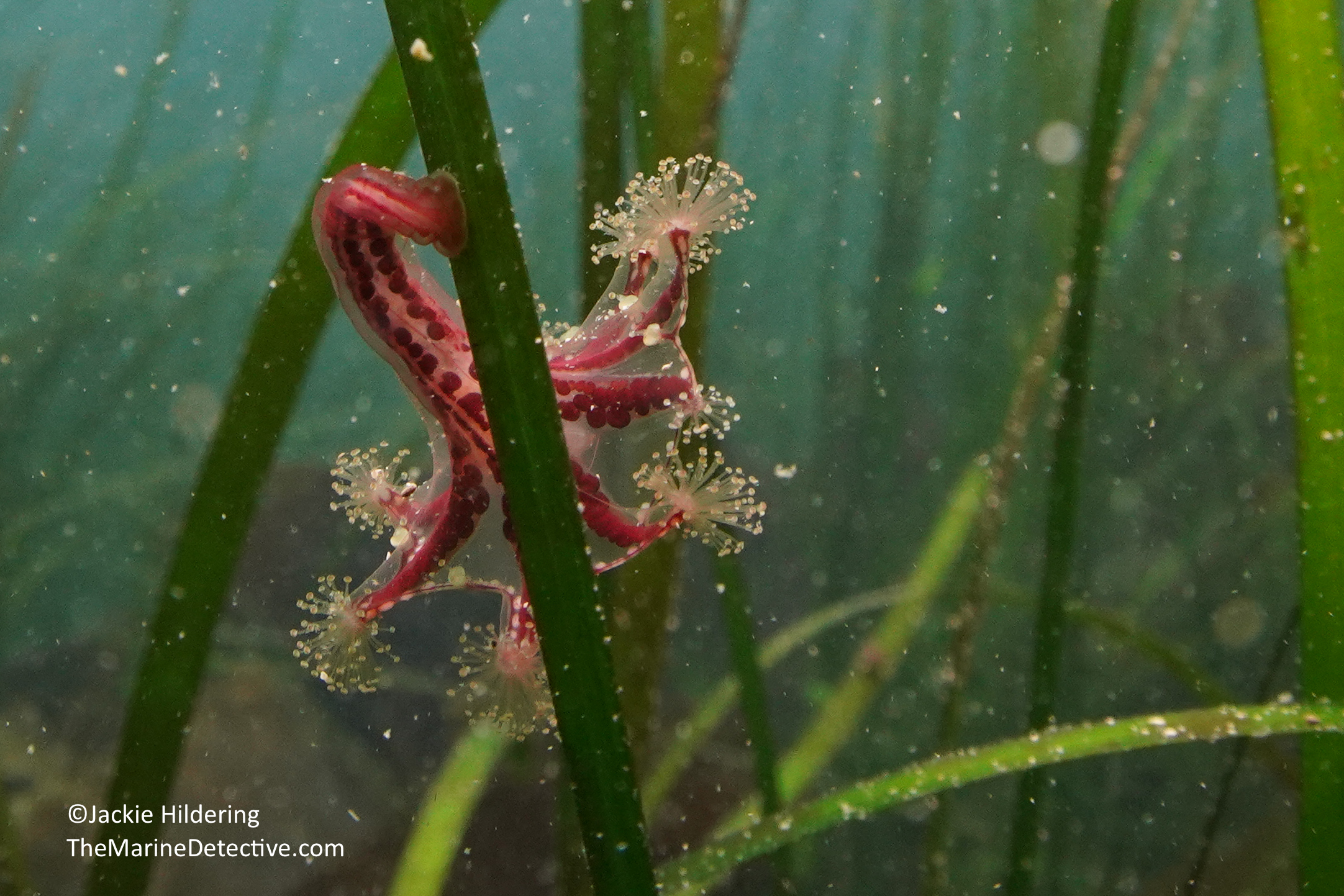

Are they deep-dwelling? No. In the research I reference above, it is stated that they are known from depths of 10 to 30 metres. I found this one at about 6 metres depth.

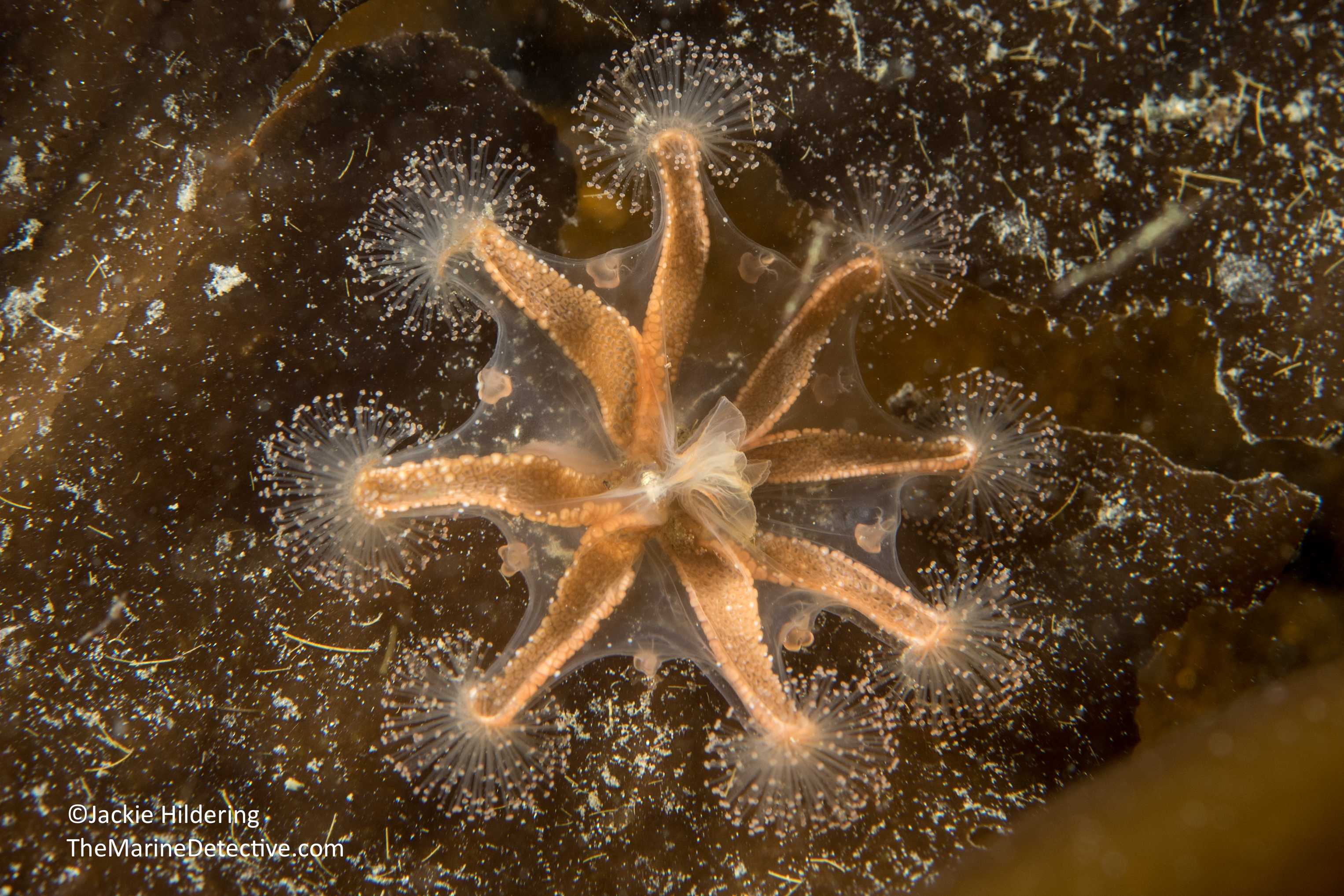
What are stalked jellies? They never become free-swimming, bell-shaped medusae like other jellies. They attach by their sticky stalk and have 8 arms with pom-pom-like clusters of tentacles at the ends. These tentacles have stinging cells to catch small crustaceans, which are then moved to the mouth at the centre of the 8 arms. If detached, stalked jellies can grip a surface with their tentacles and quickly reattach their stalk.


Above image from Kahn et al., 2010. Their description includes: martini glass shaped; 2.1 cm tall; 15.5 mm wide; 8 arms with 60 to 80 capitate secondary tentacles, and the red structures are gonadal sacs.


How did I find this one? There was fortuitousness involved. But also, I was looking when many would not. I was looking because of what I have been able to learn previously.

The sighting was on October 30, 2025, when diving with a group I organized to go to God’s Pocket Resort. It was our last dive of the trip and the last dive for the God’s Pocket Team for 2025. It had already been an astounding morning, which included documenting Humpbacks and Bigg’s Killer Whales while on the boat. Captain Bryan had been considering another dive site in Browning Pass, but the current and the potential for him to get more opportunistic whale IDs (with telephoto lens) while we were diving, led him to choose this location.

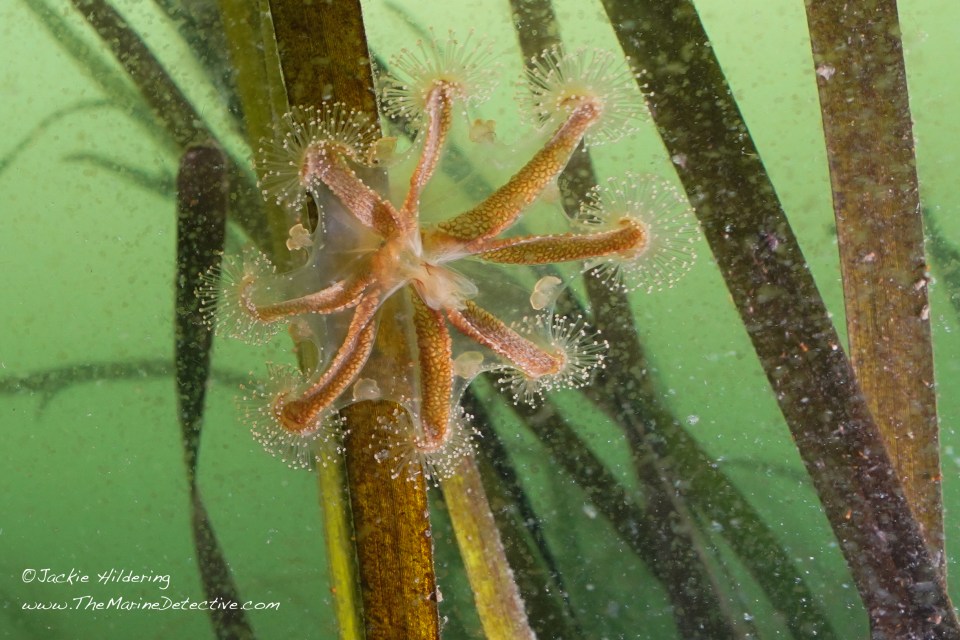
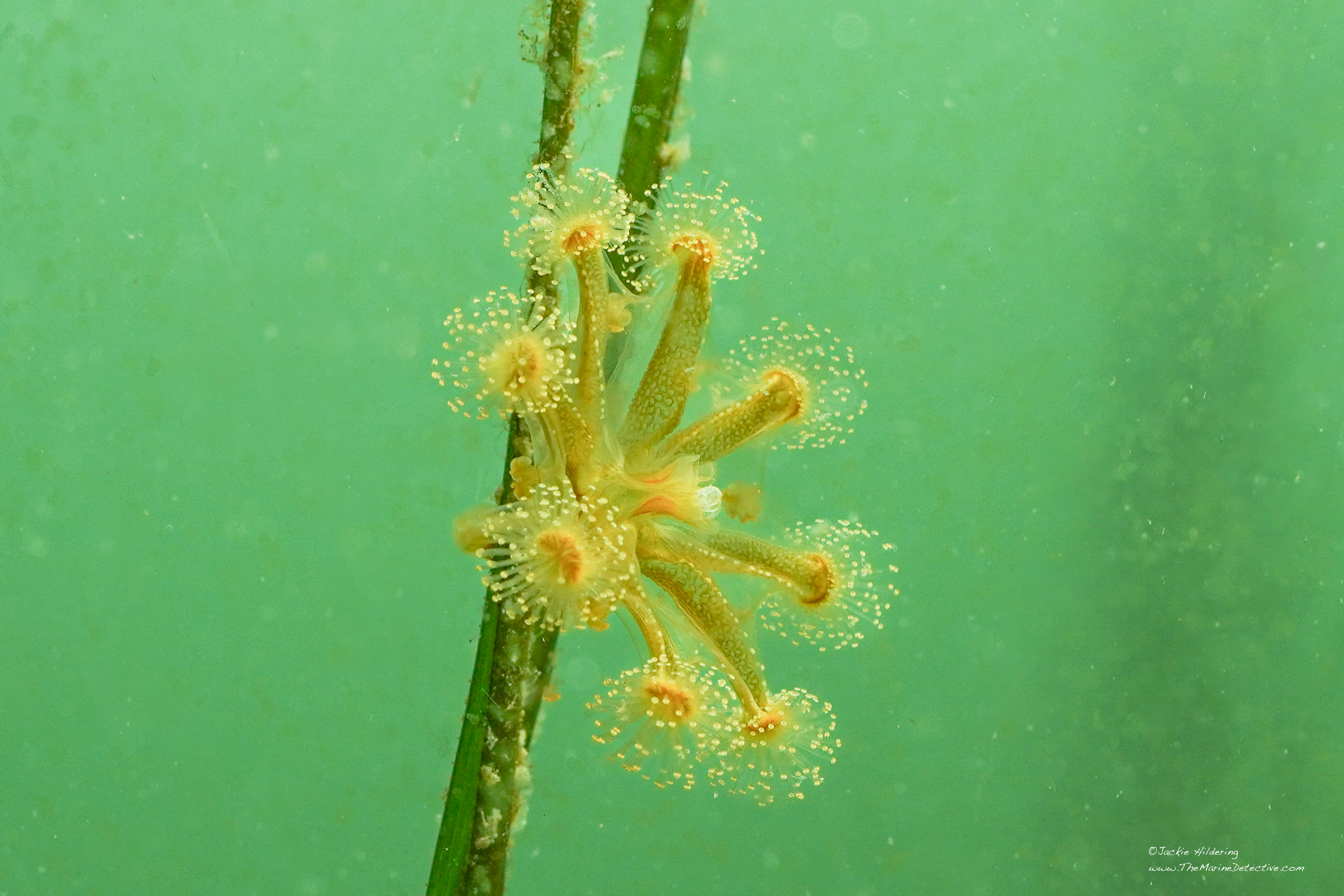
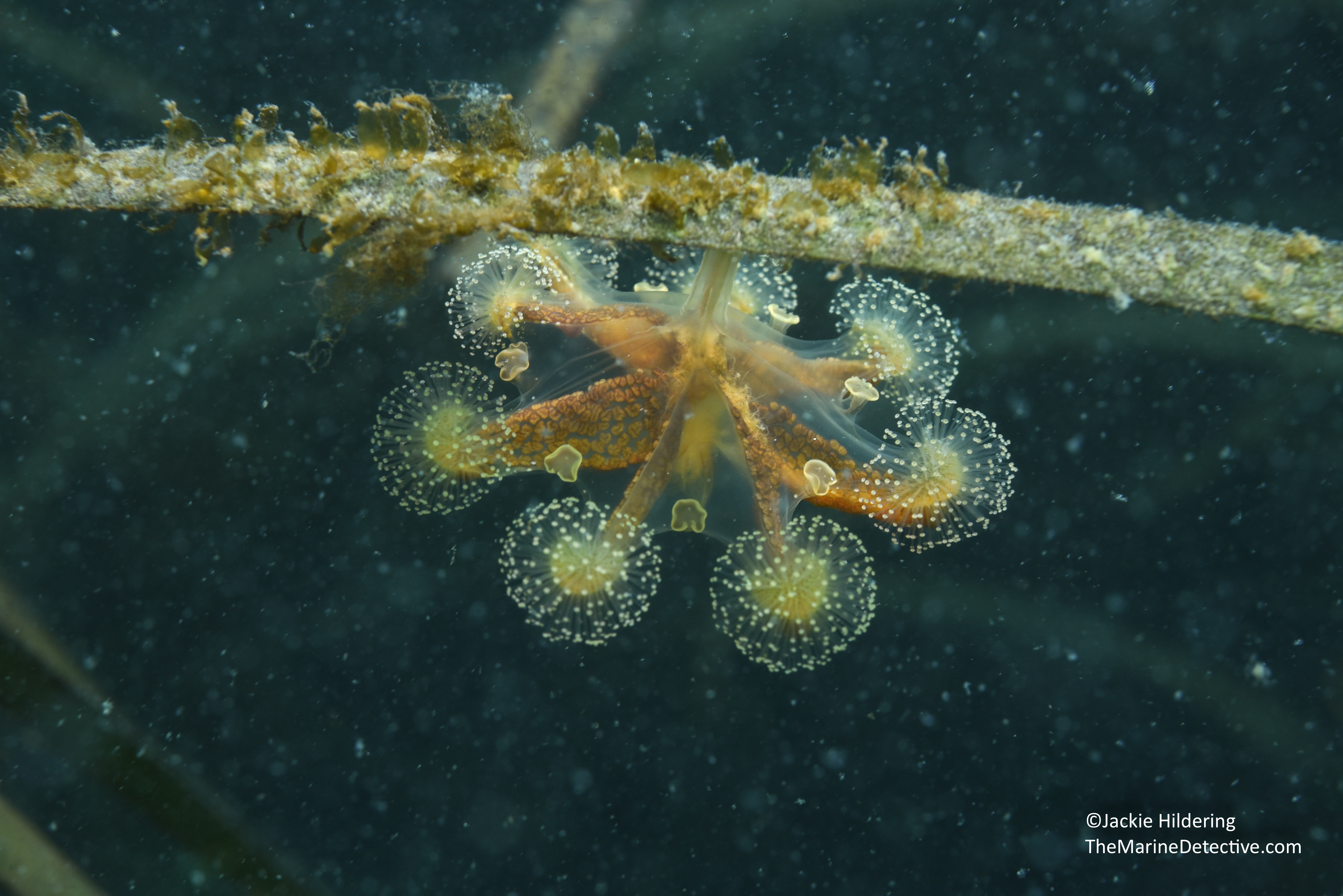
We had dived this site earlier in the week, and then too I had rushed to the “end” where I know there is a little patch of Eelgrass. I was looking for another species of Haliclystus I have found there before, for which a species name has NOT been assigned. This does not mean in any way that I discovered it, but rather that researchers have not yet published the research describing how it is morphologically and genetically distinct. See photo below.
This is the unnamed / undescribed species of Oval-anchored Stalked Jelly I have found at this site previously (and in a multitude of other locations around northeastern Vancouver Island).


I reached the Eelgrass bed and watched a school of Tubesnout (fish) swim around. Then, I focused on the Eelgrass to see if, maybe this time, I could find the undescribed species. Later, my photos would reveal just how intent I had been. See below for a photo of the school of fish with the flipper of a mature Steller Sea Lion in the frame. I had noticed he had passed so close to me. Yes, I can find 2 cm stalked jellies, and miss a ~3 m, 1,000 kg Steller Sea Lion.


And then, there it was. My brain started screaming immediately, knowing this was a unique species. Does it matter? It does to me. And maybe, it does to you.

May this add to wonder, appreciation, and the appropriate humility that we humans know so little about even the marine species that live in the shallows. May that foster care, and actions that benefit all of us connected by water and air on this ocean planet.

Photo gives you a better sense of how small this species is.

Sources:

Photos above and below: Divers and crew on my October 2025 trip with God’s Pocket Resort.

Mystery Organism – A Jellyfish With a Stalk?!

Blog updated on June 25, 2024.

This is a Marine Detective case for those of you who appreciate mini-mysteries as much as whale wonders.

Gillian Butler and Erin Paul of found this remarkable invertebrate off their kayak base camp in Johnstone Strait, northeastern Vancouver Island in September of 2010. 

I was thrilled to get the “What’s this?” email from them as this is a type of jelly I know is off our coast but that I had never been able to find! It’s a jelly that is only 3 cm wide and is usually attached to kelp or Eelgrass . . . by its stalk!

Stalked Jelly – photo by Gillian Butler

Yes, it is species of stalked jellyfish (stauromedusae). The species well documented on our coast is the “Oval-anchored Stalked Jelly” (Haliclystus sanjuanensis). Read below for what is believed to be a new (undescribed) species!

Stalked jellies never become free-swimming, bell-shaped “medusa” like most jellyfish species. Their stalk is sticky allowing them to attach to Eelgrass, seaweed, or rocks in the shallows.  They have 8 “arms” that look like they have pom-poms at their ends.  These clusters of 30-100 tentacles have stinging cells so that the stalked jelly can catch small crustaceans with the pom-poms and bring this food to their mouth (positioned at the centre of the 8 arms).

They are remarkably mobile which you will see in the Lester B. Pearson College video at the end of this blog. If the stalk becomes detached, the animal can hold on with its tentacles till it reattaches its stalk. The student video will also allow you to see the base of the stalk and how the arms can close up.

Only about 50 species of stalked jelly had been discovered worldwide. New extremely deep-dwelling species been discovered around hydrothermal vents AND . . . potentially also in the shallows in front of my community on northeastern Vancouver Island. 

Stalked Jelly found by yours truly on July 1, 2019.

After my photo (above) went into the world in July 2019, it led to contact with researcher Claudia Mills. She let me know this is an undescribed species (also genus Haliclystus). This is such testament to how little we know about the Ocean. Again, this was in the shallows at only approximately 1 metre depth very near to where I live.

Claudia also thought that the stalked jelly that Gillian and Erin found is likely also the undescribed species. Please note that these are NOT the only known sightings of this “new” species. Their range is believed to include the San Juan Islands (Washington) to southeast Alaska and possibly even northern Japan and sightings go back decades. See Neil McDaniel’s photo form the 1970s below.

From Claudia Mills on iNaturalist in 2020: “This undescribed species is easily mistaken for Haliclystus sanjuanensis. It may still be present in some locations in the San Juan Islands, Southern Vancouver Island, or the Canadian Gulf Islands, but we can no longer find it. My internet searches have found this species in quiet bays along northern Vancouver Island and in at least SE Alaska. It might be the same species as is found in the Russian Far East and Northern Japan, but we are trying to figure that out”

I had hoped to find the species again. Finally, I had success on June 27, 2022. See the photos below. These stalked jellies were again at only about 1-metre depth in the same location as the 2019 “find”.

Limitations in finding the species again were:

(1) That I think it is more likely to be found in the summer months when the visibility while diving is limited due to the richness of plankton in the water column; and

(2) Needing a dive buddy who is willing to gear up in thick neoprene in the summer and do a beach dive when it is usually hotter and much more difficult to see around you in the water. Diving from the beach usually involves more exertion than just rolling off a boat into the ocean. Also the visibility tends to be worse for beach dives because these locations often don’t get as much tidal flushing as do dive sites in narrow passes between islands.

YOU could find this species of Oval-Anchored Stalked Jelly too and carefully document it (not touching it and also being really careful in its habitat e.g. avoid stepping on Eelgrass). Your chances are likely best in summer, on a low tide.

You could upload the sighting to iNaturalist where Claudia Mills would ID. On a recent sighting there she shared: “This is the “other” uncommon, species of Haliclystus that we have found in BC and Alaskan waters. It is usually found in (environmentally) undisturbed quiet bays, on kelp or eelgrass in the shallow subtidal.”

For this Oval-anchored Stalked Jelly to be “described” and get a species name, experts like Claudia would write up and publish their research on how the species is physically and genetically different.

Note that this is an older video. I think we would be less inclined to touch the animal directly with current-day understanding and ethics.

Update: May 28, 2023

Found two individuals again in the same location as where I have seen them previously! See the photos below.

Update: June 24, 2024
Found another two individuals again in the same location.

Resources:
Mills CE, Westlake H, Hirano YM, Miranda LS. 2023. Description of a common stauromedusa on the Pacific Coast of the United States and Canada, Haliclystus sanjuanensis new species (Cnidaria: Staurozoa) PeerJ 11:e15944

Inaturalist
www.inaturalist.org/observations/48578263
www.inaturalist.org/observations/85506767