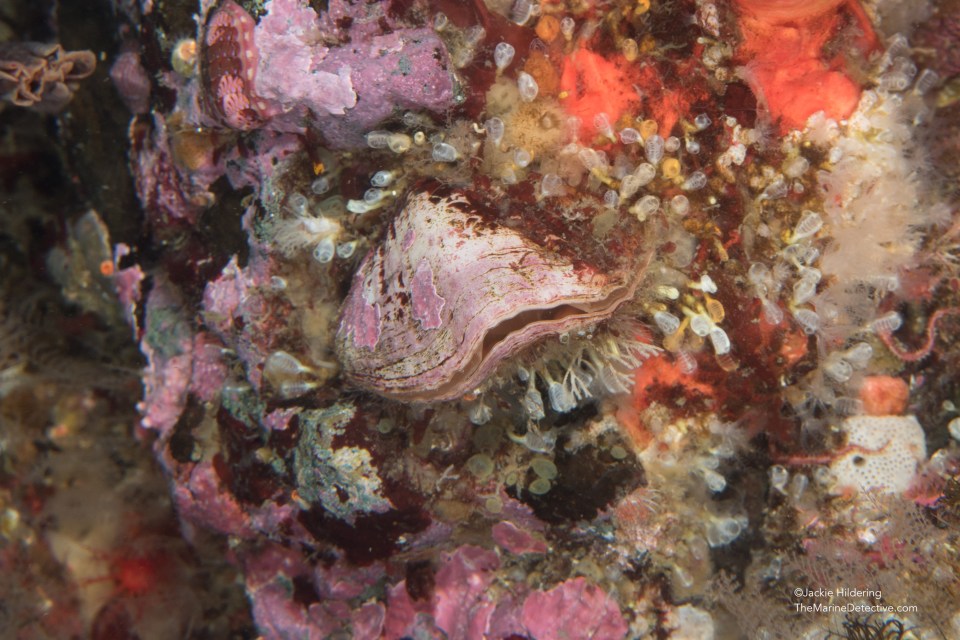
Lampshells – Not a clam!
Did you know about Lampshells, also known as Brachiopods?
Lampshell species also have two shells, but they are in a completely different phylum than clams (Brachiopoda vs. Mollusca). They have a stalk and orient themselves upside down. Also, see that structure inside the shells? They have a lophophore with which they respire and pump water into their mouths to filter-feed.
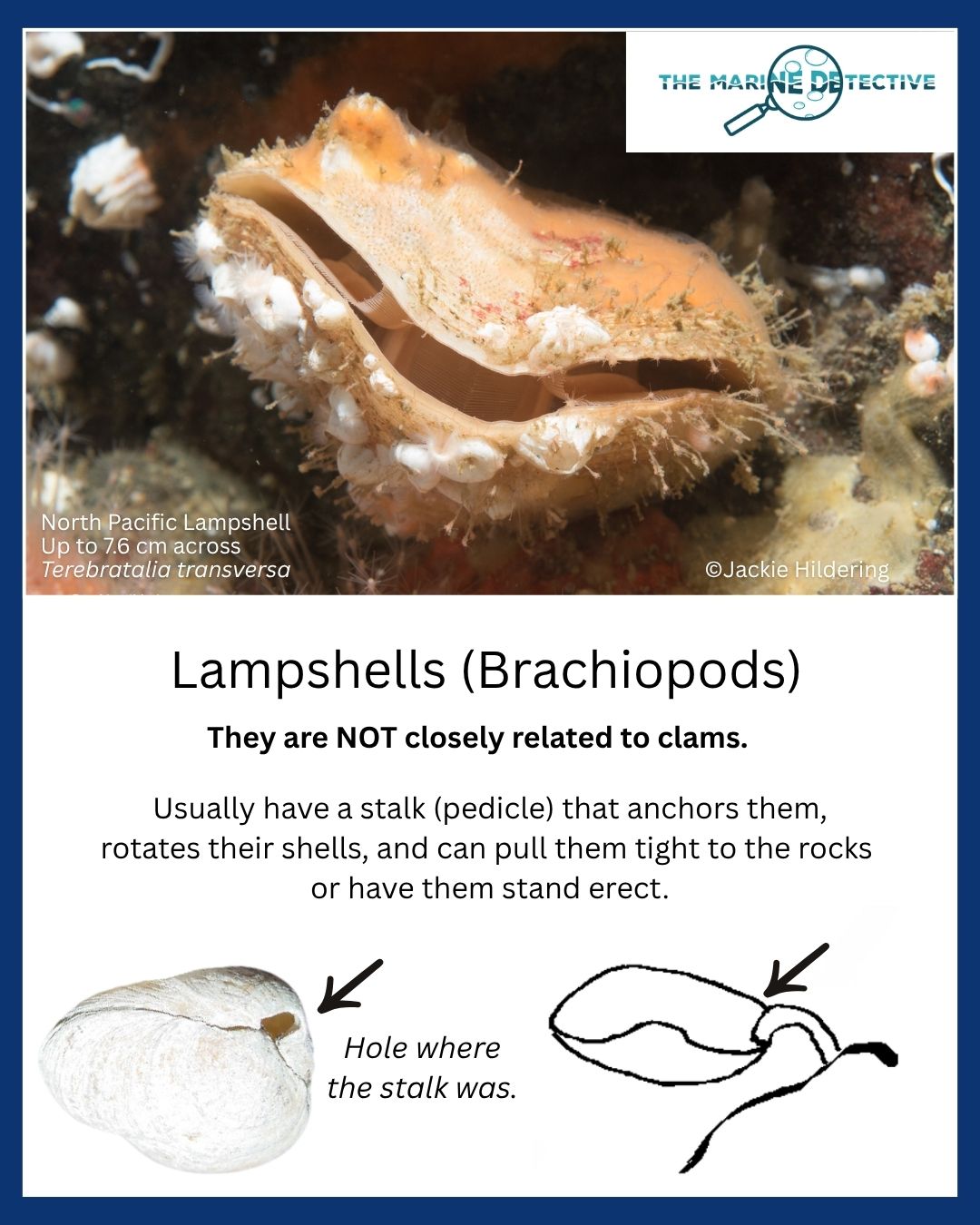
From Marine Life of the Pacific Northwest (Hanby and Lamb)
“…Oddly, a lampshell often rotates upon its stalk, orienting itself “upside down” so that the ventral shell [lower] is uppermost… a brachiopod’s internal anatomy is based on a large filter-feeding organ called a lophophore. This structure, powered by the movement of cilia (hairs), rests on a delicate calcareous “tray” supported by the ventral shell.”
Lampshells are Ancient
Lampshells/Bryozoans were on Earth 5 to 15 million years before the first clams. Lampshell fossils have been found that are 520 million years old.  They are one of the first organisms that evolved to have tissues harden with minerals. This is why there are so many fossils of them.
But they are not “living fossils” which would mean they have not evolved since their ancient ancestors. While they look the same, genetic research supports that they have evolved (Luo et al., 2015).
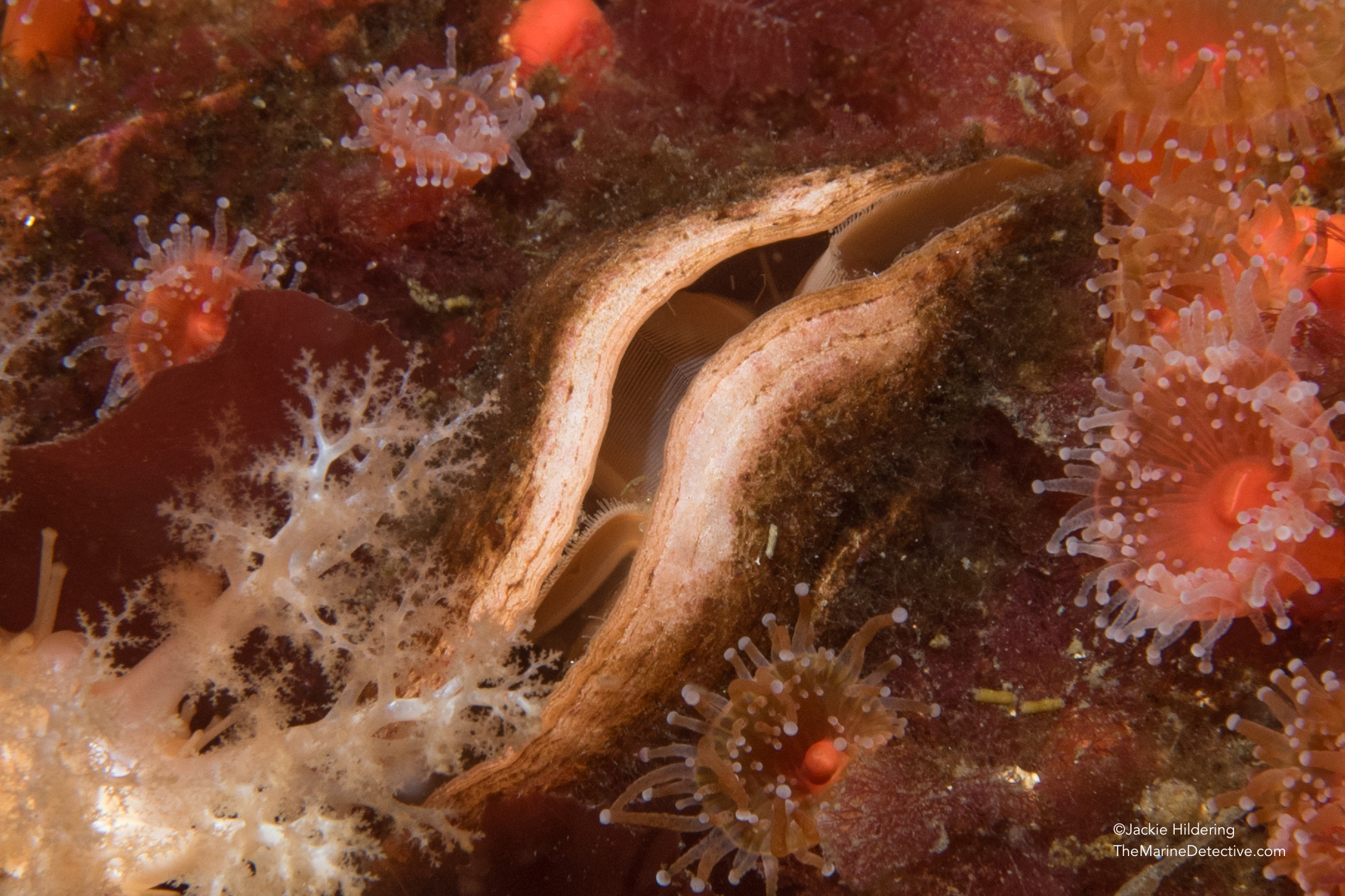
Photo ©Jackie Hildering. All photos taken near northeast Vancouver Island in the Territory of the Kwakwa̱ka̱’wakw.
Origin of the Name?
The inspiration for the common name “Lampshell” is easy to understand when you look at the shells at the end of the stalk. They look like a lamp.
But why the scientific name “Brachiopod,” which translates into arm foot?!
- Brachium – Latin for arm
- Pod – Greek for foot
Apparently “Brachiopod” was inspired by the two arm-like branches of the feeding structure (the lophophore) and its calcareous support structure.
Ecological Role
From the Digital Atlas of Marine Life:
Being so similar in appearance, it’s been assumed that brachiopods and bivalves play similar ecological roles in marine environments (their ecological niche), but this is not true. Bivalves are by far much more diverse in what they eat, where they live, and what they do. Brachiopods, although diverse in shape, share a similar ecology.
Brachiopods have thrived in warm, shallow seas through Earth’s history, although today competition has pushed them into cold, low-light regions of the modern ocean. Brachiopods are prolific survivors in places where their low metabolism, thick shells, and low body mass allow them to persist. Today they live in every ocean and major benthic (ocean-bottom) habitat…
Another important difference separating these two groups is the ability to move around. Most species are almost entirely sessile (stationary) and have adapted to life above the sediment or hard substrate. Lingulid brachiopods are exceptions. They create burrows in the sediment and use their pedicles anchor them down, while the shell (with the lophophore) sits close to the sediment surface to filter feed.
Bivalves, however, are burrowing specialists and have diversified their ability to move and dig burrows of varying depths. To achieve this, they use a straw-like structure called a siphon to bring food and oxygenated water into their shells while buried. Other bivalves, in particular scallops, have evolved the ability to swim by rapidly opening and closing their valves.
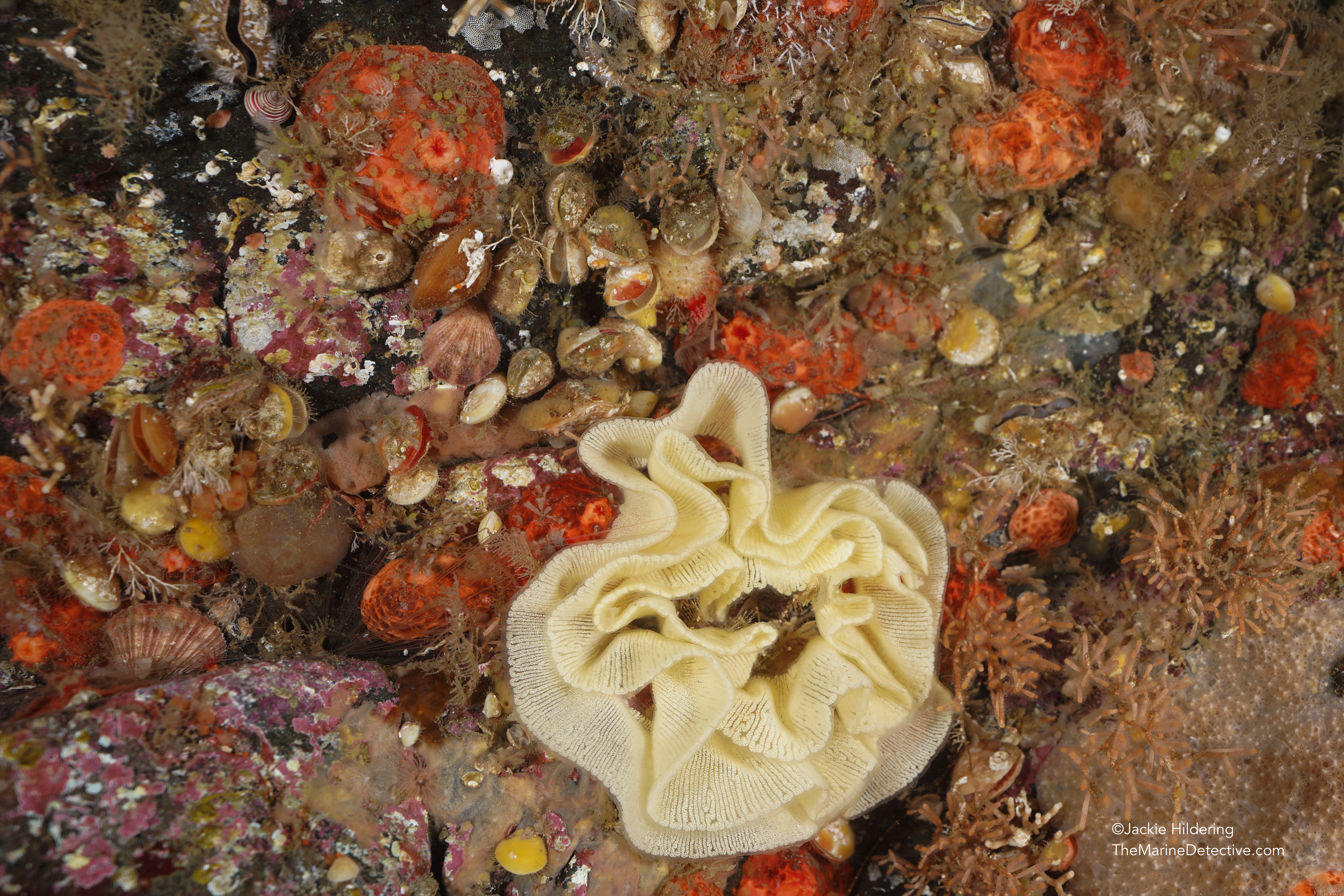
Shell Symmetry
Another difference between species like clams and mussels (bivalves) and brachipods is how the shells are oriented around the animal’s body.
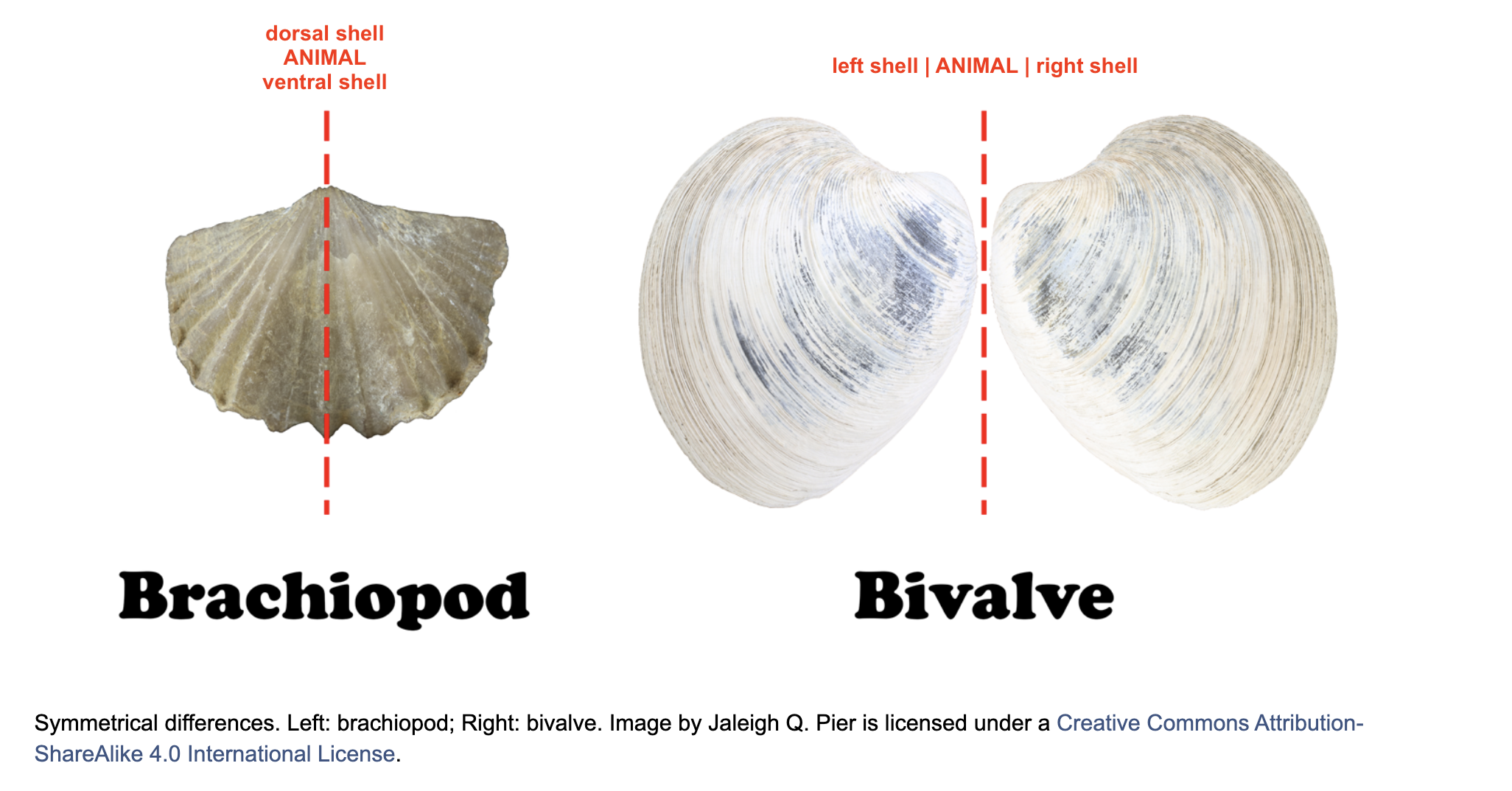
In clams and mussels (bivalves), the two shells are on the left and right sides of its body. The two shells are bilaterally symmetrical. They are the same shape / mirror images.
In brachiopods, the shells are above and below the animal. The two shells are NOT bilaterally symmetrical with one another. Rather, the two halves of a single shell are bilaterally symmetrical. Imagine drawing a line down the middle of one shell. You would get two matching halves.
From the Digital Atlas of Ancient Life
“The key to distinguishing brachiopods from bivalves is determining their lines of symmetry. Bivalves have a plane of symmetry that cuts between their two valves. They have symmetry similar to our hands. If you were to separate their two halves (or your two hands), each side perfectly mirrors the other, even though the shell shape itself might not be symmetrical. Bivalves are often described as having left and right valves.
Brachiopods have a plane of symmetry that cuts across the two valves. This you can think of if someone to cut your body in half down the middle, each side would have an eye, arm, and leg that matches the other side. If you were to cut a closed brachiopod shell in half down the center, both halves would mirror each other but the valves themselves may be different shapes or sizes.“
Big Takeaway
If your head hurts, I understand – you more-or-less bilaterally symmetrical human, you.
Most important in all of this is to know that these astounding, ancient organisms are your neighbours. To care. To feel and wonder. To have the appropriate humility and connection reflected in our daily actions.
There’s good hope for that for you if you read this far about a little two-shelled organism that has a stalk.
Thank you.

Sources:
Barclay, Kristina. “What Is a Brachiopod? (And Why You Should Care).” Kristina Barclay, Ph.D., accessed 22 Aug. 2026.
Digital Atlas of Ancient Life. “Brachiopoda vs. Bivalvia.” Digital Atlas of Ancient Life, Paleontological Research Institution, accessed 22 Aug. 2026.
Digital Atlas of Ancient Life. “Brachiopoda vs. Bivalvia.” Digital Atlas of Ancient Life, Paleontological Research Institution, accessed 22 Aug. 2026.
Luo, YJ., Takeuchi, T., Koyanagi, R. et al. The Lingula genome provides insights into brachiopod evolution and the origin of phosphate biomineralization. Nat Commun 6, 8301 (2015)
Okinawa Institute of Science and Technology. “‘Living Fossil’ Genome Decoded.” Okinawa Institute of Science and Technology, accessed 22 Aug. 2026.


8 Responses to “Lampshells – Not a clam!”
😇 ✌
so amazing! Nature is full of awesomeness! Great photos, Jackie!
Thank you for the comment, Terry. Appreciated.
Amazing!! Nature is full of awesomeness!!
terrific photos, Jackie!
Made it to the end, Jackie. Beautiful photos.
Eveline 🥰
Wonderful! Thank you Eveline.
Thank you for this. I just discovered your blog and I am worried that this is a vortex for us curious science and nature enthusiasts. I particularly appreciate the use of and definition of terms such as your brief Latin lesson. The photos are enormously helpful for the less enlightened in the crowd. They are dazzling in their beauty and the mindblowing plethora of species in each photo. Whatever you do, don’t stop.
Welcome to the vortex! Love that you are here and grateful for the comment.
I promise you . . . can’t stop / won’t stop.