Join me in the cold, dark, life-sustaining NE Pacific Ocean to discover the great beauty, mystery and fragility hidden there.

Posts by The Marine Detective

To Think Before We Click

Dear Readers,
You are likely already aligned with the ethics and considerations I address in this blog.  I am posting these words and photos to provoke even greater thinking about the ethics of wildlife photography. I do NOT wish to vilify. I wish for this to be a resource.


It is needed because we live in a time when almost all of us:
  • Have a camera at the ready; and
  • Are influenced, and/or are influencing a world fuelled by “likes” and number of followers. The impact of this is so potent, right to the level of our brain wiring and biochemistry.

There is disconnect from Nature for many people that amplifies the taking from, disconnect, and disrespect of the life we share the planet with. Further (deep sigh), often media outlets reward bad photographer behaviour by using close encounters as “click bait” to get more hits on their pages whereby more advertising dollars might be gained.

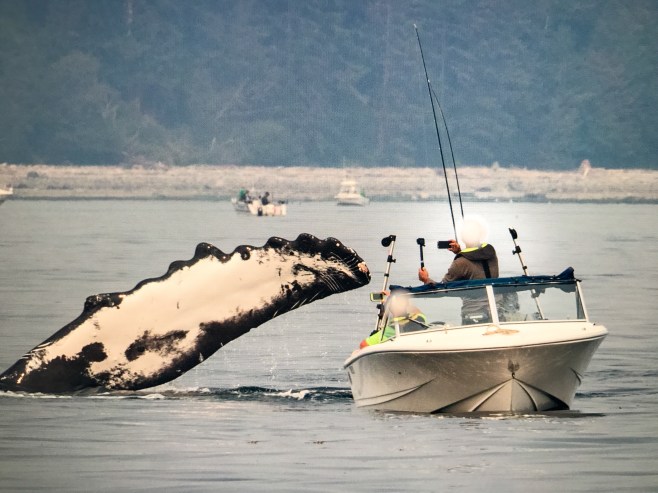
See background on this photo below. On the left is the 5 m pectoral fin of a Humpback Whale. 

In this relatively new human reality, it is so important to consider the “story” behind the photo. What was the cost to wildlife in terms of disturbance, habituation, perpetuating that others too want to get too close for a photo and, thereby, furthering the vortex?
This is what should be considered before the click . . be it clicking a camera button or a like or share on social media.
For consideration is what it being encouraged and perpetuated; the impact; the cumulative effects of others doing the same; the cost of wild animals being habituated to humans. It never ends well. It has led to the death of wildlife. It has led to the death of photographers. Of course it has.

And yes, I do very much try to hold myself to these standards and am absolutely not without impact and mistakes. I flash big lights at life below the surface. My fins sometimes touch the Ocean bottom, disturbing life. There is almost always fossil fuel use and/or Ocean noise invested in my being able to take photographs. Is there a net gain in terms of education / conservation . . . it’s the question we should all be asking.

To think before we click.


Stories behind the photos (I have chosen to blur out faces):


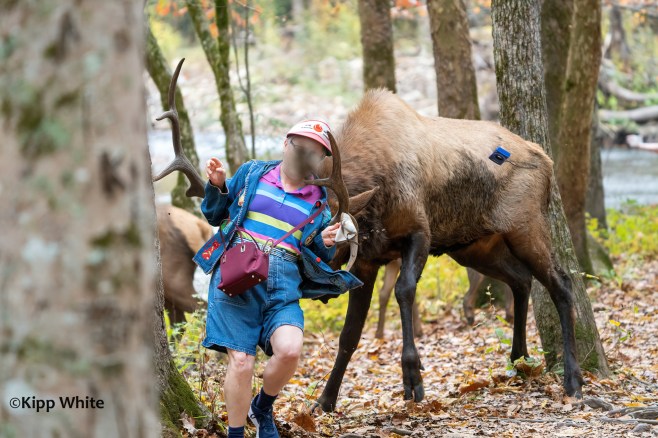
The two photos above are by Kipp White.  Backstory from Kipp: “The herd was resting in the woods behind the Visitors Center in Cherokee [North Carolina]. One of the cows got up and moved to the river. She started calling for the rest of them. Slowly the rest of the herd got up and started moving towards the water. I told everyone they should move back. They were between the herd and the water. No one listened. Then the bull started moving closer to the people and everyone was trying to get a good picture of him. Once again I warned the people saying “He has already charged at two people this morning, y’all might want to back up”. Then I said it one more time. Nobody listened. Next as you can see, he charged this lady. I talked to her afterwards and she said she was OK”

Conservation photographer and journalist Jared Lloyd Photography provided the following comment about these photos: “I’ve seen so many near misses. And have even had to intervene and charge a bull elk once to save someone’s life. This is why we learn behavior. This is why we need to understand what animals are trying to say to us. This is why we use long lenses . . .”


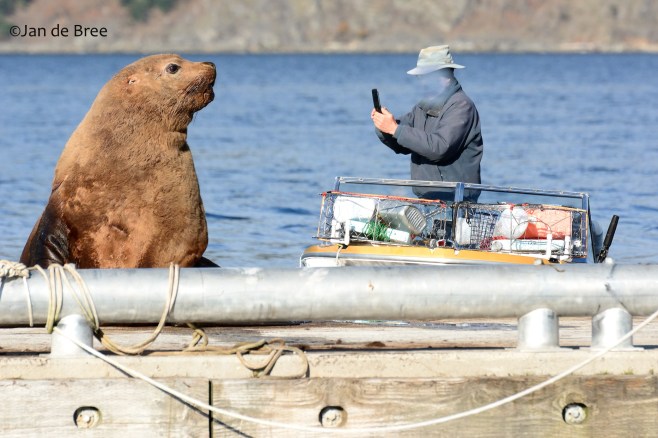
Mature male Steller Sea Lion photo by Jan de Bree. Location was Cowichan Bay. This violation of Marine Mammal Regulations has been reported to Fisheries and Oceans Canada. Yes, the angle from which the photo was taken could influence how distance is perceived. But, by no stretch of any imagination, is this is 100 m.

The two photos above of boaters taking photos with cell phones near an acrobatic Humpback Whale were taken near Campbell River. The photographer wishes to remain anonymous. These are older images where the previous photos are all from October, 2020. Here too the camera angle could influence how close this looks but again, this is NOT 100 m and it IS boater responsibility to know the Marine Mammal Regulations. It is of great value to report violations to increase education, enforcement and legal action. In British Columbia, the DFO Incident Reporting Line is 1-800-465-4336. Video is of even greater value than photographs as evidence of intent, who was driving, etc.

Video below showing a mature male California Sea Lion habituated to being fed who grabbed a girl and pulled her into the water in May 2017 in Steveston, British Columbia. Those striving to sell fish at the dock encouraged feeding the sea lions in order to attract people for fish sales. You’ll note that the sea lion gives warning signs. Feeding marine wildlife is solidly against Canada’s Marine Mammal Regulations.Video ©Michael Fujiwara.


Resources:
  • Canadian Marine Mammal Regulations and best practices re. marine mammal viewing – www.SeeABlowGoSlow.org
  • Associated blog re. considerations in choosing ethical marine wildlife viewing companies, please see “Not Up Close and Personal” at this link 
  • Video of a presentation done by yours truly regarding boaters and marine mammals, addresses Canadian laws. Done in my role with the Marine Education & Research Society. Please request access to “Boaters and Marine Mammals” at this link. We are using a system of having people fill in a form to request access so we have a better idea of how the resource might be of us.

Video below is from January 1st, 2021 in Grant Teton National Park, Wyoming.

For detail and a longer video of this incident, see the article: “Idiots Taking Photos of Fighting Moose Attempt to Win First Darwin Award of the Year”

It’s Their Ocean

It’s their Ocean.

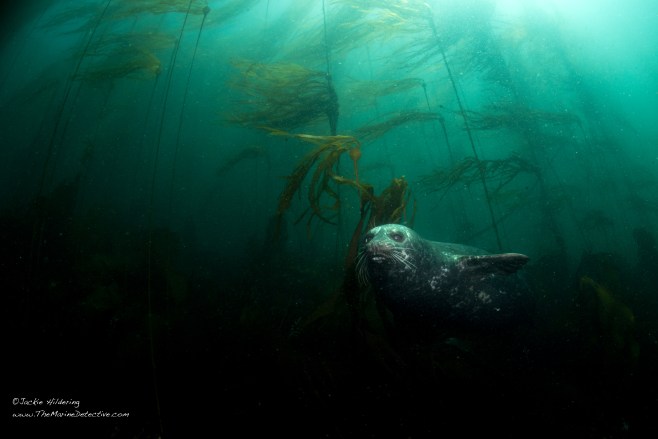
Photo below was taken during a chance encounter with a mature male Steller Sea Lion as he glided by Bull Kelp.

I can’t share this photo without providing the following information because sea lions and seals are caught at the interface of human love / hate in British Columbia. It’s volatile.

Photo: October 4th near Telegraph Cove.

Please know we don’t target seal or sea lion haul outs. We do not want to force an interaction and contribute to habituation.

But, sometimes, they find us. And that is a great gift.

It is in fact against federal law to conduct “swim with” operations where divers and/or swimmers are put in the water with the purpose of having interactions at haul outs. This has been the case since July 2018 when the amended Marine Mammal Regulations went into effect. They explicitly state: “No person shall approach a marine mammal to, or to attempt to .  . . swim with it or interact with it.” 

Habituated wild animals lose their wariness which will not work well for them, or us. Wild animals do not allow you to touch them nor to put your hand in their mouths. Human injury has resulted as a result of seals and sea lions becoming habituated to humans / divers. Of course it has.

Habituation is especially a concern in this time where seals and sea lions are being vilified for interactions with fisheries. Horrific hate language and imagery are being perpetuated on social media. It’s one thing to have an opinion. It’s another to perpetuate hate. 

In my work as a marine educator, I’ve asked for clarity regarding the Marine Mammal Regulations and their enforcement. It’s part of my job with the Marine Education and Research Society to educate about laws involving marine mammals. There is also a personal layer of concern because dear friends are involved with swim-with operations whereby there are implications for their businesses and welfare.

My understanding is that the lag in enforcement regarding “do not swim with” has been due to having to prioritize resources (e.g. enforcement of infractions around endangered whales) and wanting to provide an opportunity for education before enforcement.

This is also the case regarding it being against the law to feed seals and sea lions. This used to be a common practice at some fish processing plants and tourism facilities. Education was provided first. Enforcement of the law will now follow.

I am sharing this information in an effort to educate on the law and what best serves wild animals.

Pacific Harbour Sea emerging from the kelp forest. It’s something I will never forget. We were ending our dive and entering in the shallows for our safety stop. I noticed something moving in the Bull Kelp. Then I realized it was seal playing there, corkscrewing her/himself around the stipe of kelp and then spinning out of it and . . . repeat. I put down my camera. I tried to drink it in, to learn, and to realize I had formed a bias to perceive seals as I saw them on the surface. I had unconsciously undervalued their intelligence and playfulness. I did lift my camera as the seal moved out of the forest. Yep, a gift.


*Canada’s amended Marine Mammal Regulations include:
No person shall approach a marine mammal to, or to attempt to:
(a) feed it;
(b) swim with it or interact with it;
(c) move it or entice or cause it to move from the immediate vicinity in which it is found;
(d) separate it from members of its group or go between it and a calf;
(e) trap it or its group between a vessel and the shore or between a vessel and one or more other vessels; or
(f) tag or mark it.


Regarding the vilification of seals and sea lions, please see our Marine Education and Research Society backgrounder “To Kill Seals and Sea Lions?” at this link.

A Smack of Jellies

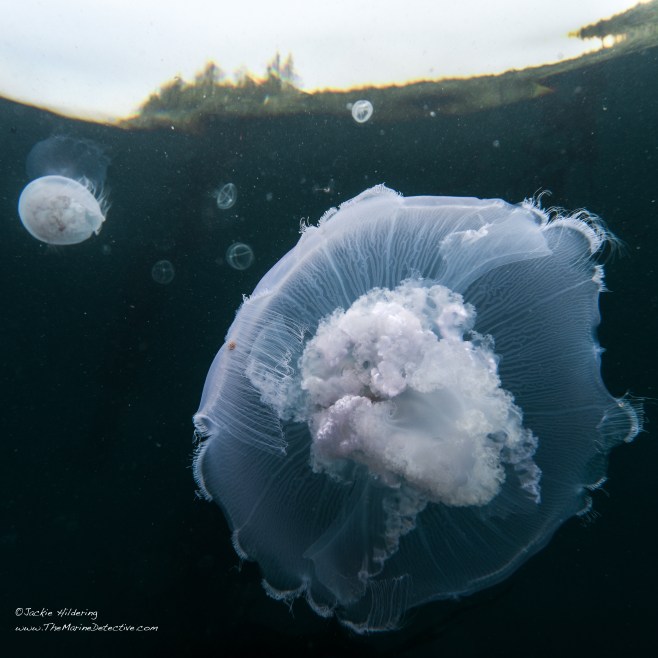
The last little while there have been hundreds, and hundreds, and hundreds of Moon Jellies = a “smack” of them. That truly is the collective noun for jellyfish.

It should also be the collective noun for the number of jellyfish photos I am delivering in this blog.

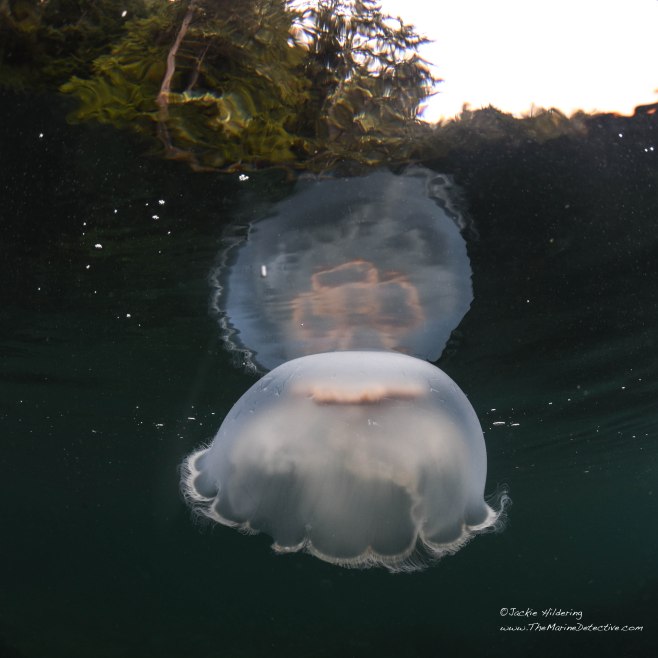
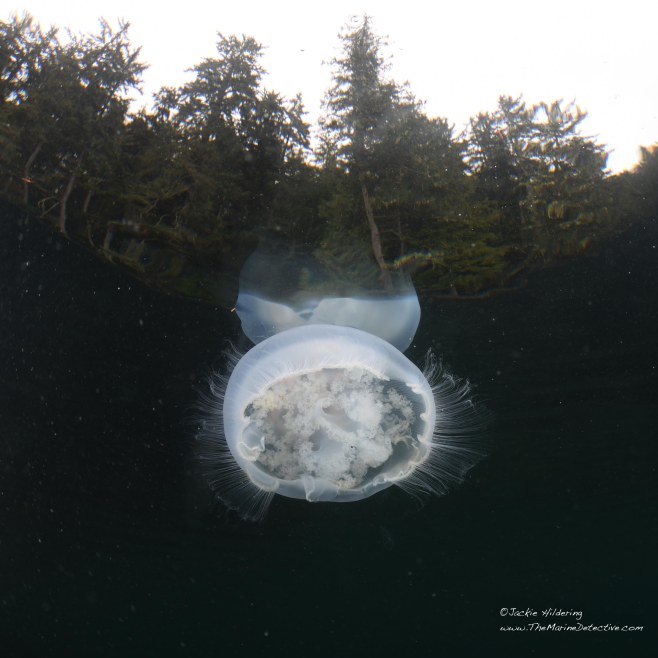
May these photos from my last dives north of Port Hardy offer you a bit of escape. I tried to capture trees in photos of jellies and the reflection of the jellies against the surface of the water. I hope the images communicate interconnectedness of land, sea and sky. May  they also contribute to understanding and connection to our neighbours in the sea.

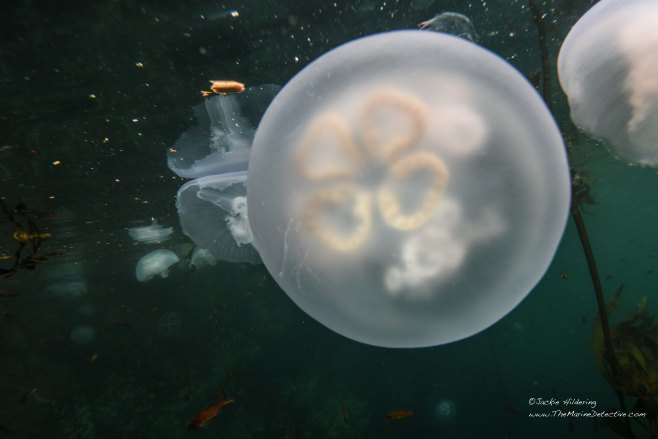
Moon Jellies are easy to discern from other jelly species by having the clover shape which is 4 gonads / sex organs (Aurelia labiata to 40 cm across). 


Most jellies in the class to which Moon Jellies belong (the Scyphozoan) release eggs and sperm into the water column. But in Moon Jellies, when the male releases sperm, the pulsing action of the female Moon Jelly brings the sperm in contact with the eggs under her arms and the are brooded there. The following three photos show females with eggs. The eggs are the less translucent white structures. 


And as if this was not all amazing enough there was also a ” blizzard* of babies . . . just LOOK at how many juvenile Widow Rockfish there are!

It was so extraordinary to see them nipping at the bells of the Moon Jellies, darting about everywhere. There was another phenomenal explosion of young like this in 2016 and, with site fidelity being so strong, those fish may well be the bigger ones we saw at these sites too.

The following facts about Widow Rockfish are from Dr. Milton Love’s brilliant “The Rockfish of the NE Pacific”: The mothers produce one brood of about 95,000 to 1,113,000 eggs/year which hatch as larva from their mothers (rockfish are viviparous). They stay in the plankton for about 5 months feeding on copepods and krill and can grow up to 0.61 mm/day. Then they settle out to be in nearshore areas like you see here and feed on salps and jellies, small fishes, crabs, amphipods and krill.

Why are they named “Widow” Rockfish ? “. From Dr. Love’s book too: Julius Phillips, a great observer of the rockfish fisheries of California during the mid-twentieth century, believed the term widow can about because the “black peritoneum an small effeminate mouth give the impression of lonesomeness to occasional specimens that appear amount the more common bocaccios, chilipepper and yellowtail rock cods” (Phillips, 1939).

Maximum  life expectancy for Widow Rockfish (Sebastes entomelas) is 69 years. Maximum length 60 cm. Females typically bigger than males.

The bounty of babies has been reported by myself and others to those monitoring rockfish health. To my knowledge, nobody knows why there have been these two explosions of young of this species (2016 and 2020).


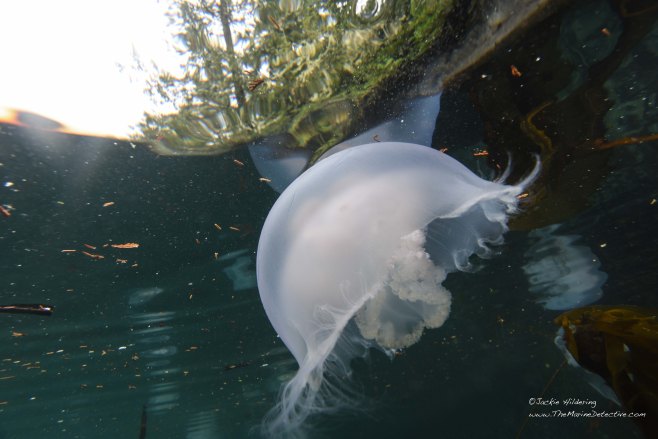
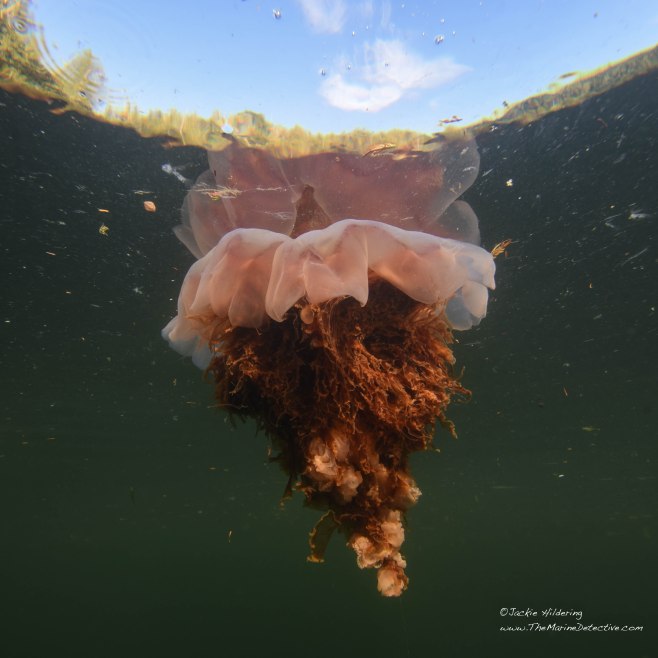
And to conclude, I had hoped that I might also photograph a Lions Mane Jelly with land in the background. On the last dive of nine, the light and life lined up to allow me to take this photograph.

The Lion’s Many Jelly is one of two of the biggest jelly species commonly found off our coast = Cyanea ferruginea (the other is the Egg Yolk Jelly). Maximum size of Lion’s Mane Jellies is to 2.5 m across with 8 clusters of 70 to 150 tentacles which can be . . . 36 m long! This is the largest jelly species in the world. Know that the larger ones tend to be further offshore and that they can retract their tentacles. These two species are also the only two common jelly species in our waters that can create a sting that irritates human skin, even when the jellies are dead or you get a severed tentacle drifting by your face.

A Lion’s Mane Jelly is the murderer in a Sherlock Holmes short story entitled “Adventure of the Lion’s Mane” (I kid you not), BUT the “victim” had a preexisting heart condition. The solution to the irritation is vinegar (acid), meat tenderizer (enzyme) and I know that many fishers swear by Pacific canned milk. Research at this link puts forward that vinegar is the only real solution. Clearly I’ve never been stung badly enough to deter trying to photograph them.


Photo below is of planktonic me after a full dive trying to capture jellies and trees in the same image. Photo by dive buddy Janice Crook.

Holdfast

Have you wondered about what holds down an underwater forest?
It’s the holdfast.

I spent the majority of a recent dive in a sun-soaked Bull Kelp forest. My hope was that the photos I took would communicate the role of the holdfast AND the stunning beauty of being in such forests.

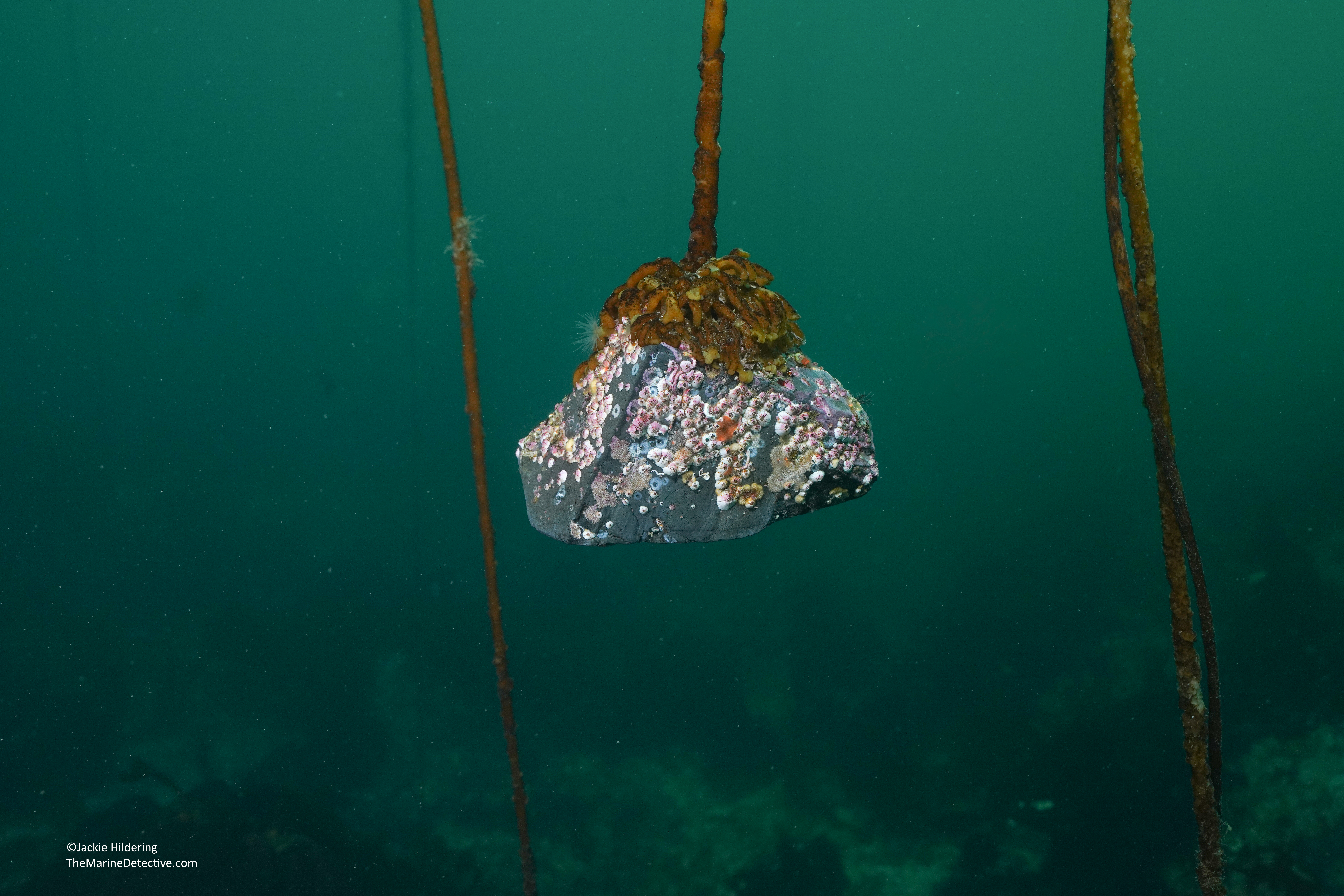
Kelp does not have roots. Rather the algae / kelps get their nutrients through the fronds (leave-like structures) and it is the holdfast that anchors kelp onto rocks.

It’s  a tangle of woody structures that you may have seen washed up on the beach.

Holdfast found on the beach.

You can imagine how strong the holdfast has to be to withstand the buoyancy of the waves, current and the kelp’s floatation (the gas-filled pneumatocysts). The two photos below show how the buoyancy is greater than the mass of the rocks whereby the rock cannot anchor the kelp. 

If rocks are too light to counter the floatation of the pneumatocyst and/or the force of waves and currents, the kelp will change the ocean bottom by carrying away those rocks. You might see these holdfasts, still attached to the rocks, when they wash ashore.  

Friend in the forest – Janice Crook. Second buddy on this dive was John Congdon
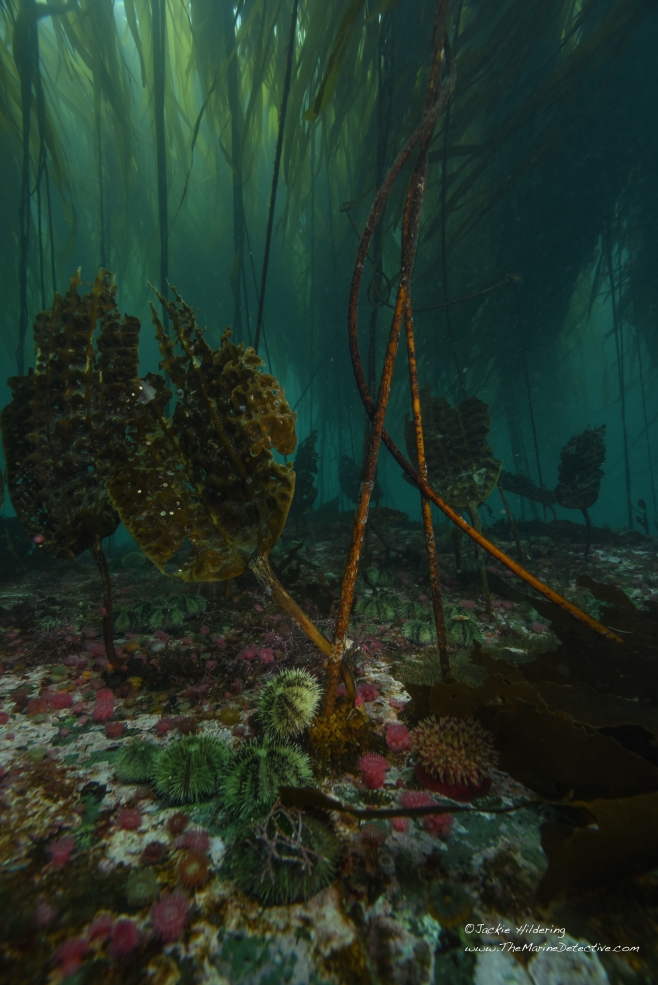
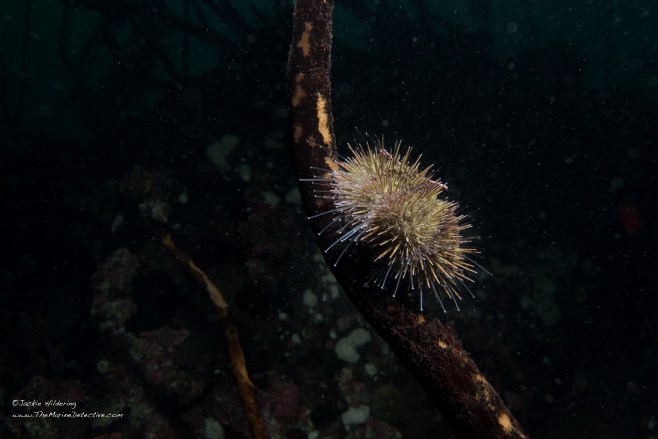
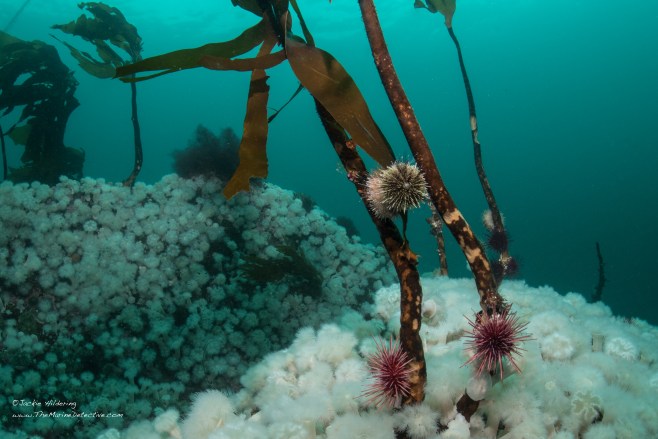
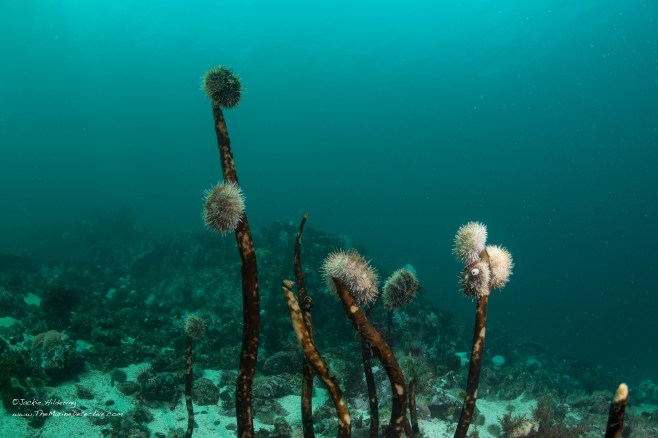
Green Urchins climbing up the stipe of Bull Kelp where they will feed. Not a problem when there are enough of predators like Sunflower Stars and Sea Otters. It’s a big problem is there are not enough predators as then too much kelp is grazed away leading to “urchin barrens”.

There you go – a daily dose of depth for you. 

It may be that knowing about holdfasts and their rocks is of particular value in these stormy times.

Holdfast dear readers. Holdfast.

The canopy of the Bull Kelp forest.

Added January 2024, research into the age of holdfasts.


My additional blog items on kelp include:

Aristotle’s Lantern

What is so thought-provoking that it warrants the name “Aristotle’s Lantern”? It’s what the mouth-parts of urchins are called.

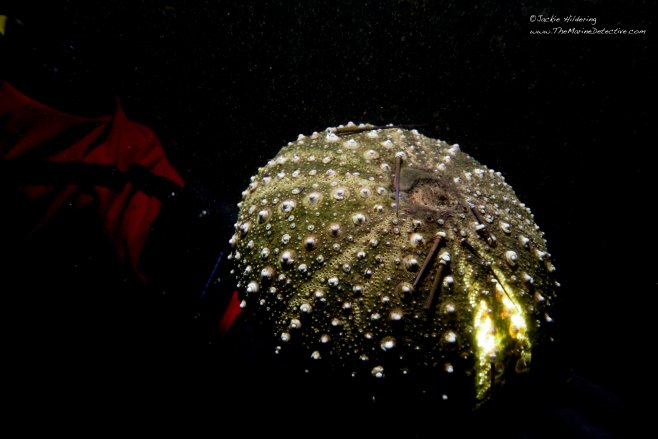
Today while I was submerging, there was a dead Green Urchin floating at the surface, spines rotted off but mouth still intact.

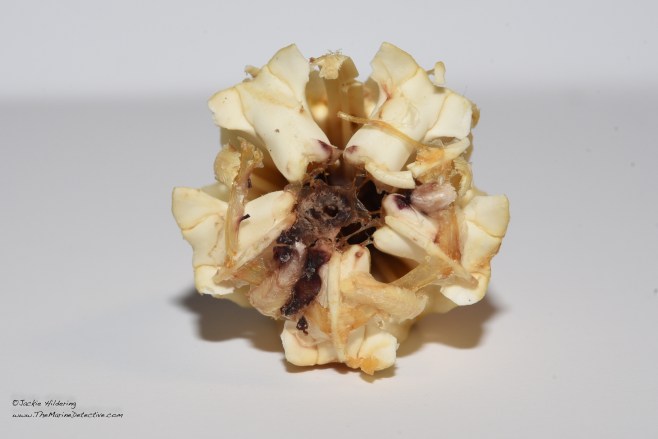
This allowed me to photograph the jaw parts outside the urchin’s shell (test).

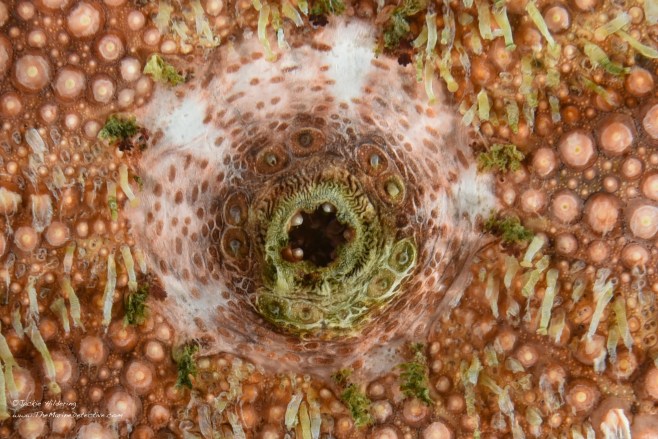
Close-up on the dead Green Urchin’s underside with the mouthparts.


This is something I would not normally be able to photograph because I would have to lift an urchin to do so and I do not want displace the life I see. Also, because most dead urchins I find floating about have been “otterized”. An otterized urchin is where a predator has broken through the bottom of the urchin. Mammalian predators of urchins include River Otters, Sea Otters, Mink and humans. Wolf-Eels and Sunflower Stars are also predators. Another reason the mouth parts are difficult to photograph is because they can retract into the urchin when alive.

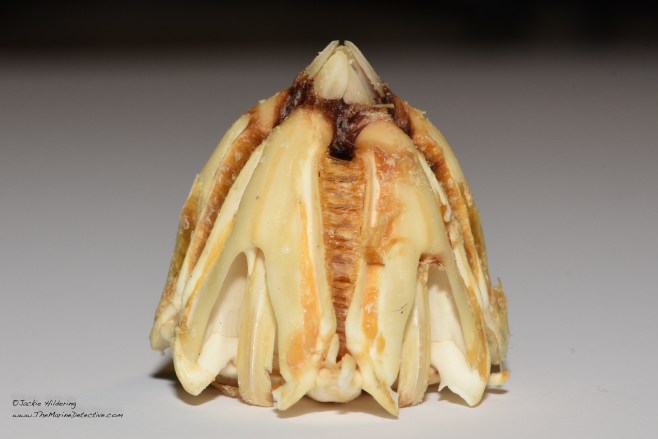
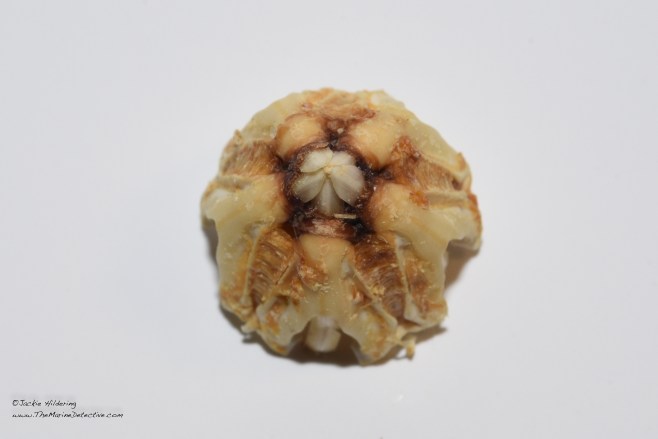
The photos included below of the full mouth structure are from another dead urchin whose “Lantern” I preserved. See how complex it is? There are 5 jaws made from plates of calcium, which are held together by muscle. When wanting to chew away at seaweed / algae, the structure is pushed out whereby the mouth opens and the urchin can chew by moving the structure side-to-side. You can imagine that chewing would wear down the calcium but no worries – the Lantern grows from the tip, reportedly at 1 to 2 mm / week.


Why are an urchin’s mouthparts called “Aristotle’s Lantern”? Because Aristotle is believe to have described them as “lantern-like” in Historia Animalium (The History of Animals) more than 2,340 years ago.

Indeed, the “horn lanterns” used in Aristotle’s time looked like the mouthparts; having 5 panes covered with cow horn that had been boiled and shaped. BUT there are biologists who disagree, believing that there were “historical ambiguities with the original translation” and that Aristotle was referencing the WHOLE urchin’s shell as being lantern-like, rather than just the mouthparts.

Oops – if that be true, Aristotle would not be happy that the mouthparts of urchins’ near relatives, sand dollars, are also referenced as “Aristotle’s Lanterns”.

There don’t you feel better now knowing all of this? I am here striving to lighten and enlighten . . . lanterns and all. 💙☺️💙

Dive buddy Natasha Dickinson having but an urchin test over her dive light. Sure looks like a lantern doesn’t it? 🙂

Here’s a “Shape of Life” video of urchins feeding, narrated to be oh so dramatic:


About regeneration, aging and life expectancy in sea urchins

Like sea stars and other  echinoderms, urchins can regenerate body parts e.g. their spines and tube feet. Research by Bodnar and Coffman (2016) found that this ability to regenerate lost or damaged tissues does not decrease with age in 3 local urchins species: the Variegated Urchin (Lytechinus variegatus), Purple Urchin (Strongylocentrotus purpuratus) and Red Urchin (Mesocentrotus franciscanus).

This is of particular interest since the life expectancy of these three urchin species is very different; respectively 4 years, 50+ years, and 100+ years. Yet, “the fact that all species showed the same consistent ability to regenerate tissue despite age and life expectancy undermines the current evolutionary theories of ageing. It was previously expected that species with shorter lifespans would invest fewer resources in maintenance and repair, perhaps to invest greater energy in reproduction. So this study has shed light on a new, unexpected factor that contradicts the current theory.” Source: Biosphere.

Regarding the life expectancy of Green Urchins (Strongylocentrotus droebachiensis) from Fisheries and Oceans Canada: “Aging techniques for B.C. Green Urchins are currently being developed by the Pacific Biological Station, but Green Urchins on the Atlantic Coast have been known to live from 20 to 25 years of age.”


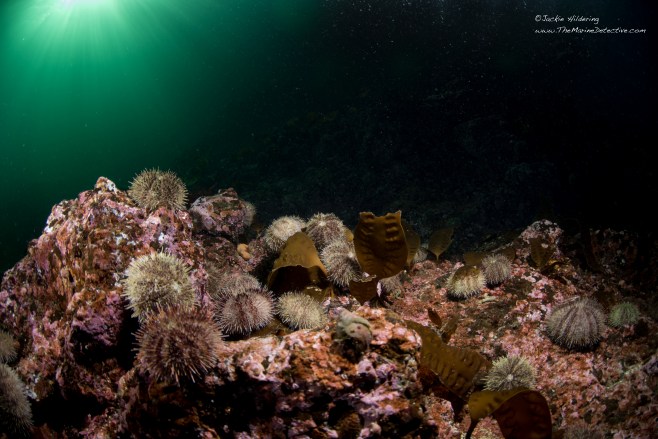
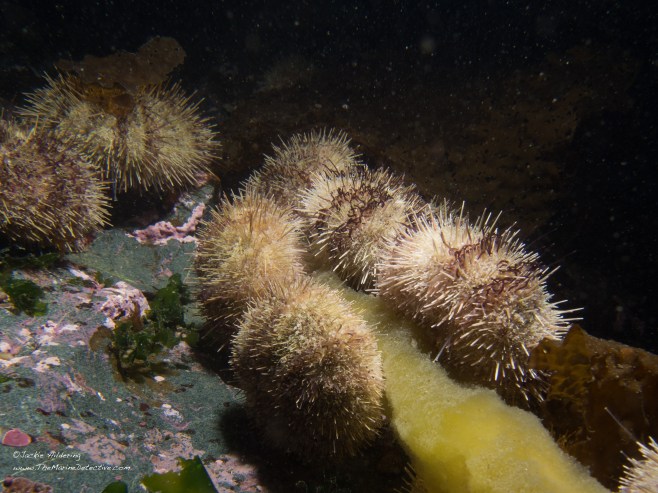
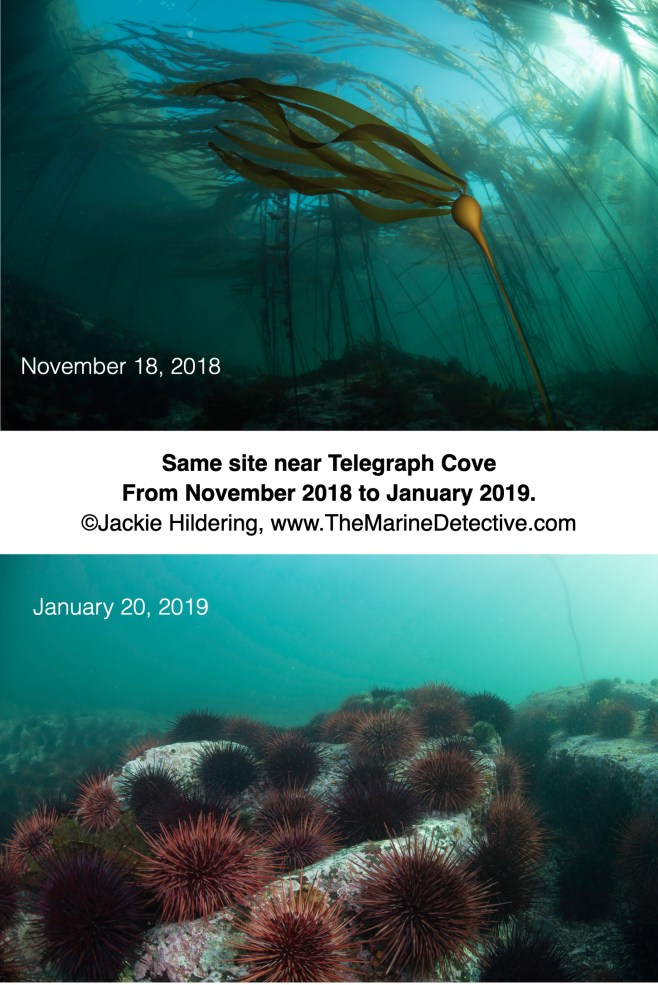
See below for images of urchins feeding and of “urchin barrens” . Urchins are an important part of the marine ecosystem but when we killed off Sea Otters who eat urchins, this led to too much kelp being eaten. The resulting “urchin barrens” are a loss of habitat and food for other organisms and result is less carbon buffering and oxygen production by kelp.

Sea Star Wasting Disease, and specifically the devastation to Sunflower Stars (Pycnopodia helianthoides), has also led to urchin barrens because Sunflower Stars too are predators of urchins. For more information, see my blog “Wasted. What is happening to the sea stars of the NE Pacific Ocean?


Below are images of urchin barrens.

Sources: 

Where?

Daring to do this again. It’s an #OceanVoice blog where it is not science that speaks the strongest.

I need words to find my way.

By sharing, I hope for connection, affirmation, and maybe, that the words help others too.

Photo while on my boat “Fluke” by dear friend and contributor to light in the world, Kendra Parnham-Hall


Where?

Where to find the space
Between denying the darkness
And disappearing into overwhelm?

Inhaling scorching realities in shared air
Masked and isolated against viral spread
Where to find the space?

Refugees on roadsides
Inequalities of skin laid bare
Where to find the space?

Narcissism thriving
Rewarded for lies and lechery
Where to find the space?

Social media frivolity
Verses sleepless sorrow
WHERE to find the space?

It’s there . . .

It’s there in the knowing
Eyes closed, is to contribute to darkness
Wide-eyed in horror, is to contribute to same

It’s there in the feeling
Compass unwavering forward
Recoiling from misspent privilege

It’s there in the tasting
Savouring what is sweet and true
Rejecting the poison of paralysis

It’s there in the doing
Common solutions, common good
Forces joined, together brighter

The space is found
Where we shine our light
So others too, may find their way


View down Johnstone Strait ©Jackie Hildering.


Words by Which to Live . . . and Breathe?

The following photo, taken recently, catalyzed the following words.

How I hope they resound with you, and maybe even that they are of use to you.

Breathe, knowing others breathe too.

It has such importance, to live knowing we share air, share water, share economies, and share fates.

Decisions made by one have the potential to negatively or positively impact those standing within 2 metres, those on the other side of the planet, and/or those who are another species. Impacts rippling on from how we vote, to how we consume, to the words we put into the world. For words carry power as strong as viruses, seeding and spreading hatred, or empowering and healing with compassion and equality.

These are difficult times, but much is being unmasked and called out for what it is re. narcissism and presumed privilege, racism and misogyny, economic disparity and how it rocks the foundations of the systems we all depend on, and in disconnect from Nature and the species we share the planet with.

Power to you all who, step-by-step, word-for-word, put good into the world, working for equality, connection and health (in its full sense – physical / mental / social / environmental).

Words by which to live and . . . breathe. 💙


Photos: Mature male Steller Sea Lion exhaling at the surface.
©Jackie Hildering
August 31, 2020 NE Vancouver Island

#SharedAir
#OceanVoice


Breath-Taking Beauty . . . Orca Resting Lines

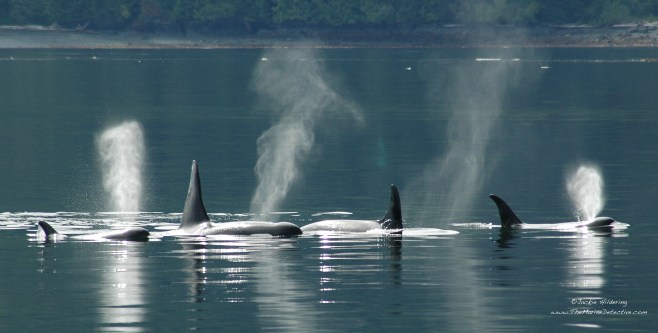
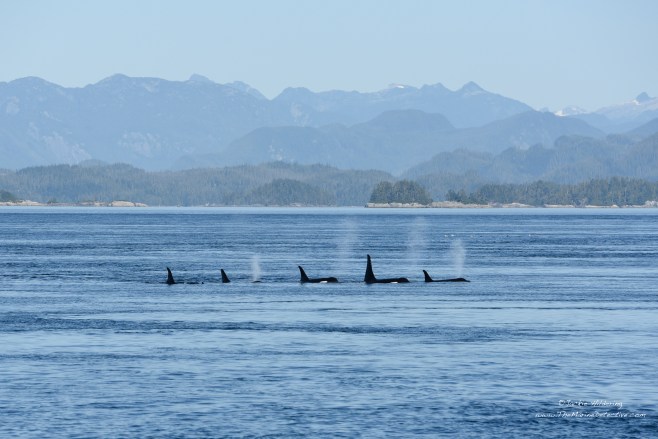
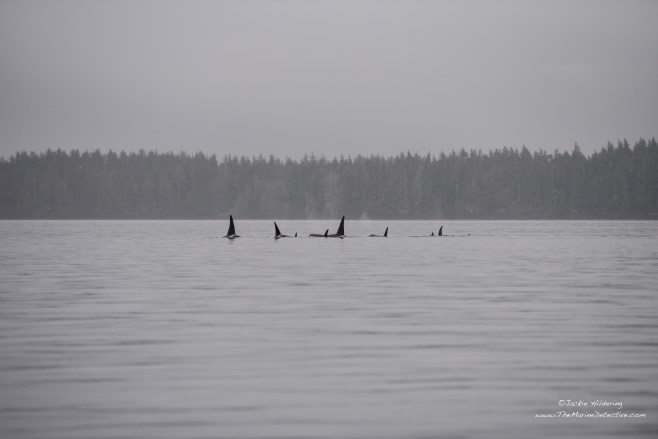
Of all the Orca behaviours I have been privileged to see, it is when they are in “resting lines” that I most transported into awe. It makes so clear how socially bonded the whales are and how coordinated their behaviours can be.

Northern Residents the A12s in a resting line in 2007.

Science has determined that toothed whales like Orca do not sleep but only “rest”, shutting off one half of their brains at a time (scientifically known as “unihemispheric sleep”). They have to maintain this level of brain activity since they are voluntary breathers and must therefore consciously come to the surface to inhale and exhale.

Occasionally, Orca rest alone. They then float on the surface, motionless, blowhole exposed, “logging” for only a few minutes.

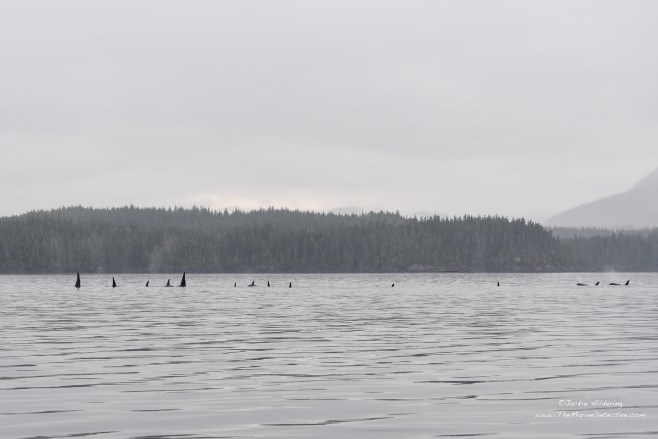
Far more often the Orca rest together, uniting in these very tight groups, fin to fin. This can happen at any time of day and I have witnessed resting line behaviour for up to 8 hours.

Northern Residents the A34s (A12s daughter and offspring) resting in 2017.


Once in resting line formation, the whales are usually silent (although there are a couple of matrilines that do occasionally vocalize) and move slowly forward, undertaking a remarkably synchronous and regular dive pattern. They often take short, shallow dives for around 2 minutes and then they all take a longer dive. When they resurface, their breaths are incredibly coordinated and their dorsal fins often line up perfectly.They are of course particularly susceptible to disturbance by boats when they are resting – both due to sound and proximity. 

“We are one” the behaviour seems to display and I certainly believe that this resting is also of great social and cultural importance to Orca.

At its most simple level though, a resting line of Orca is truly  . . . breath-taking beauty.


Photos below = resting line of members of the D, C, A5 and I15 matrilines in August 2020. All photos taken with a telephoto lens. 


Fish Have Homes!

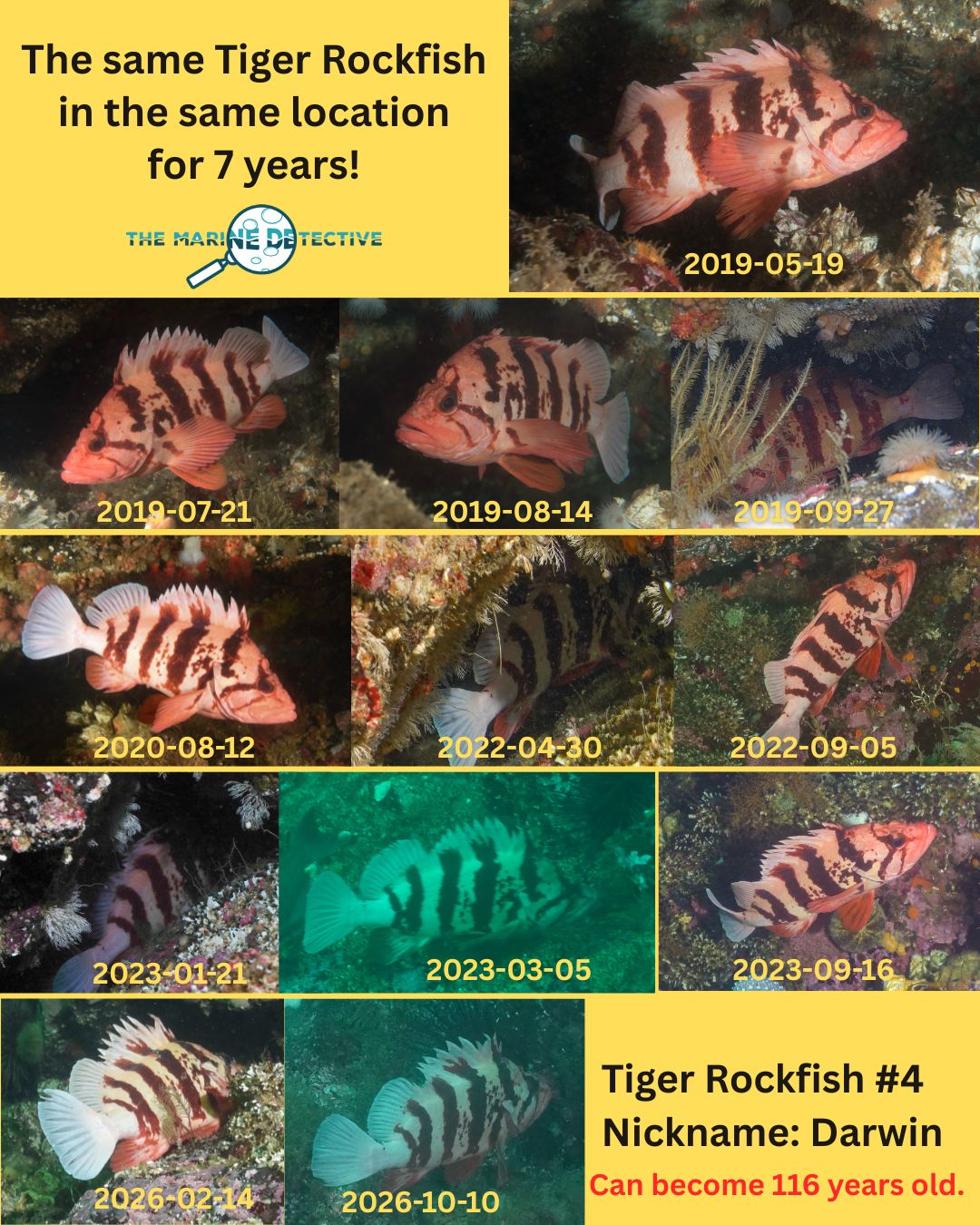
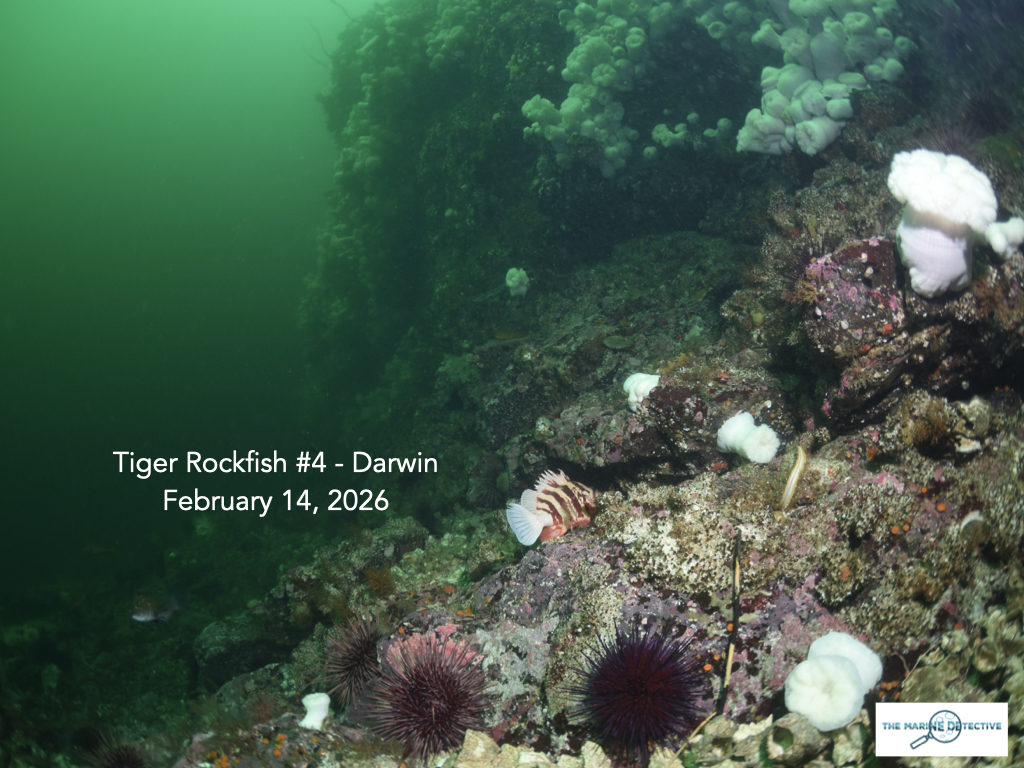
Blog updated on February 15, 2026, with a sighting of Darwin the Tiger Rockfish, now documented in the same location for 7 years!


Yes, in addition to cataloguing Humpback Whales, I attempt to identify and catalogue individual Tiger Rockfish. I can’t stop myself.

There’s so much that may be learned when you can recognize animals as individuals. There is more conservation value too when people realize that even individual fish have homes.

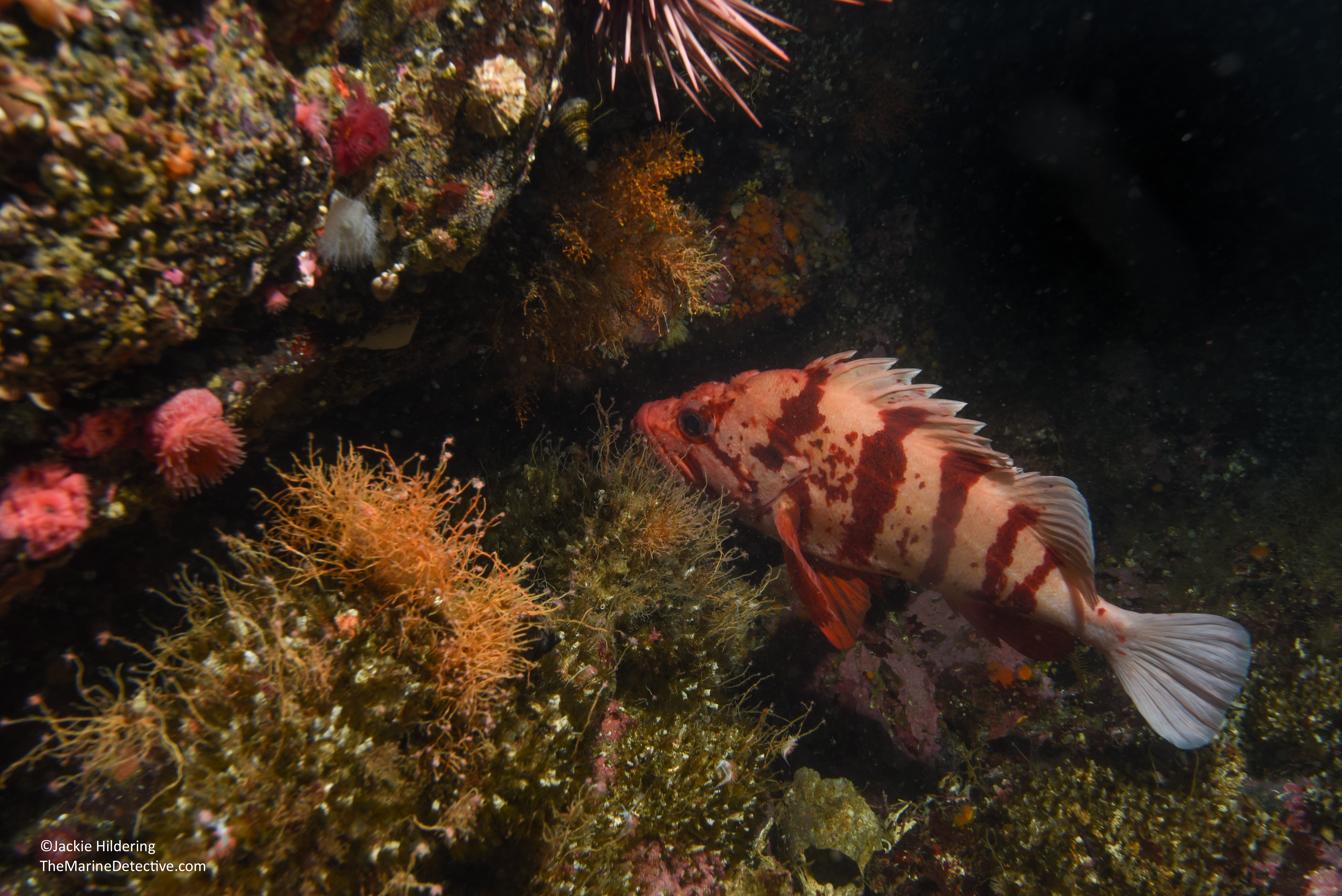
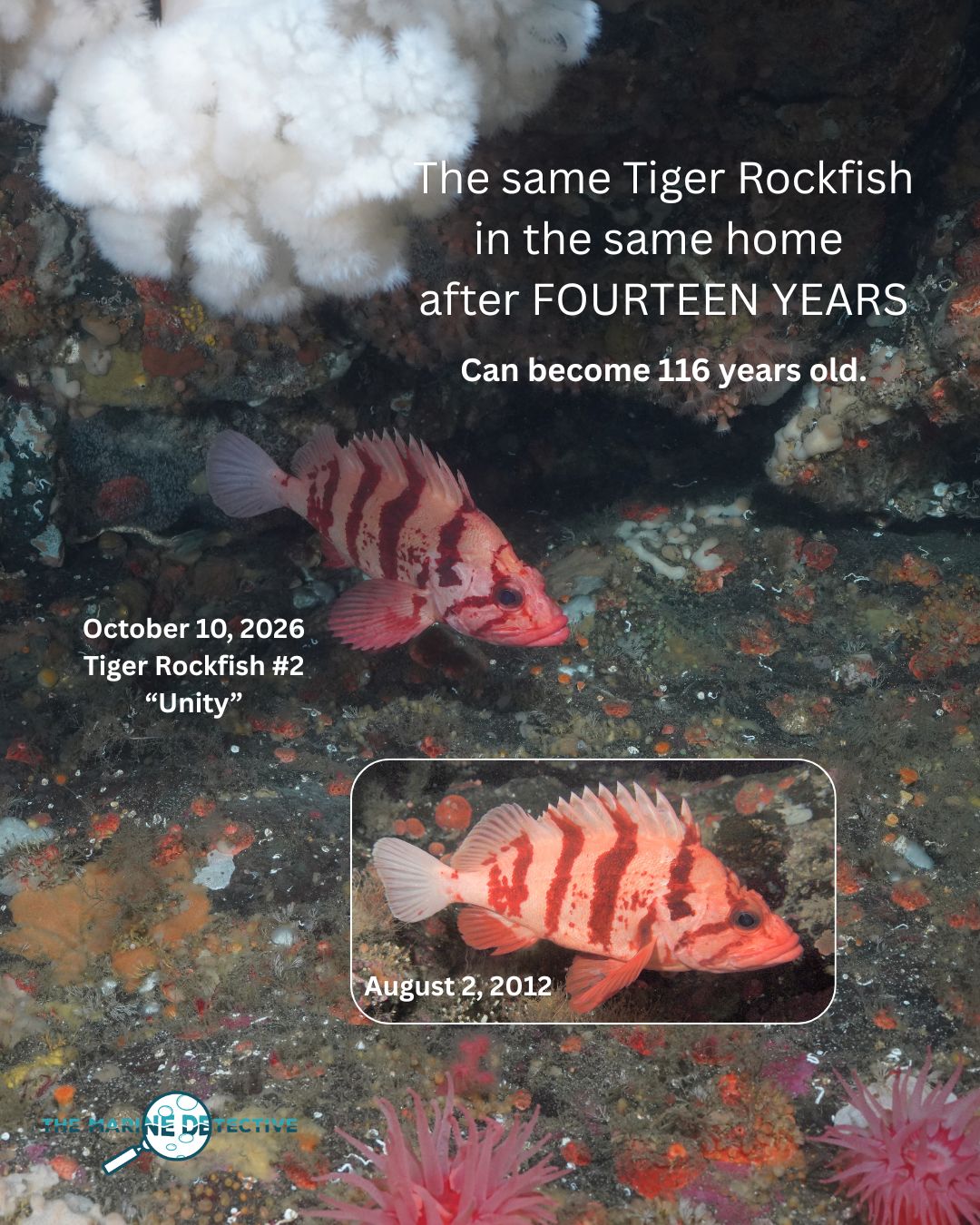
The markings of Tiger Rockfish are so distinct that it is easy to recognize them as individuals IF they are not tucked away deep in a crack, which is often their way. See below for some of the individuals, how long I have been able to document them, and what their homes look like.

To date (2026), the longest I have been able to document any Tiger Rockfish is 8 years. This shows how strong the site fidelity is and why Rockfish Conservation Areas can have such success.

I will clearly have to hand off this cataloguing to a younger biologist since these fish are likely to outlive me. They are known to be able to live to age 116.

Tiger Rockfish =Sebastes nigrocinctus to 61 cm long (35 cm by 17 years of age).

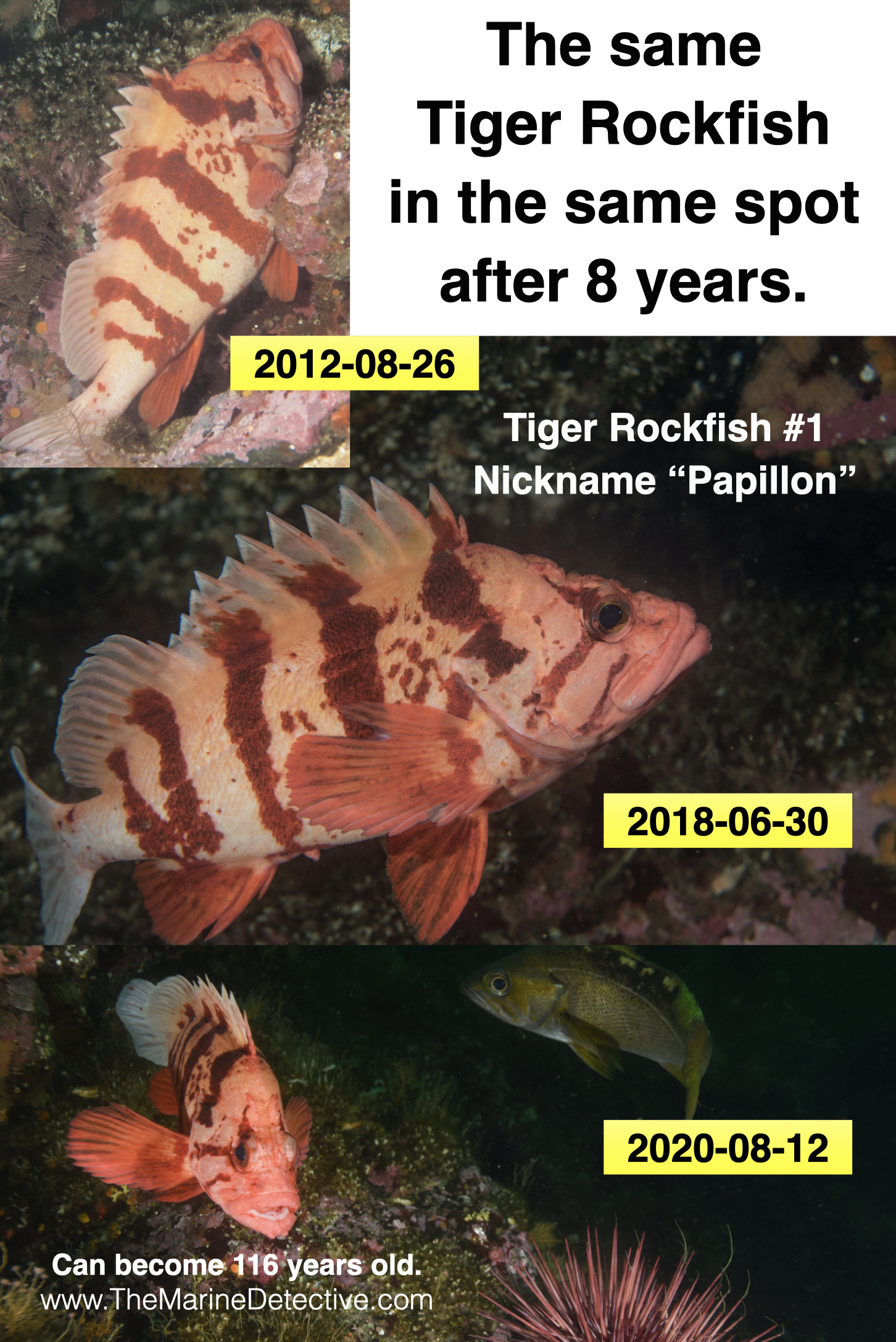
Tiger Rockfish #1

  • Nickname Papillon for the butterfly or bowtie-like marking on the right side of her head.
  • Appeared pregnant/gravid in 2012.
  • Documented in the same location for 8 years.
  • Not seen since August 2020.
Papillon near her home in 2020.


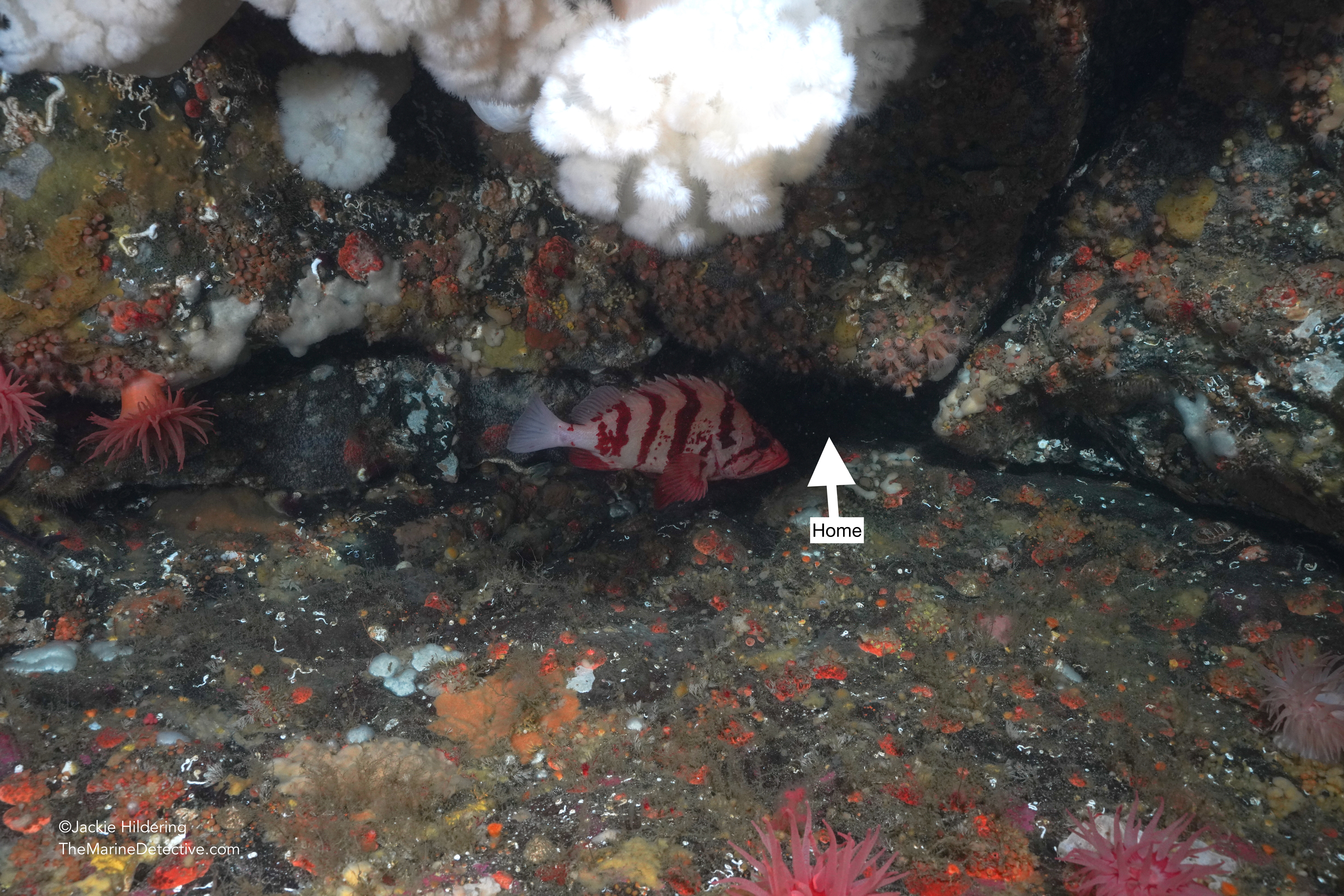
Tiger Rockfish #4

  • Nickname Darwin for the stripes being reminiscent of one of those cartoons showing the progression of evolution to a human-like shape (from tail to head on this fish).
  • Lives very near to where Papillon lives/lived. Documented them both from 2019 to 2020.
  • Documented in the same location for 7 years.
  • Last sighting 2026-02-14. You can maybe imagine the euphoria at having seen him after almost 1.5 years. I feared he might be dead. Why didn’t I see him over that time span? Because he was “out and about”? Because he was safe deep in his home? Because he knew I was there before I did and retreated into his home? Because other divers passed by first, whereby he may have retreated? I don’t know.
    Note that I know to be very slow and quiet when I near his home and to try to document him from afar.

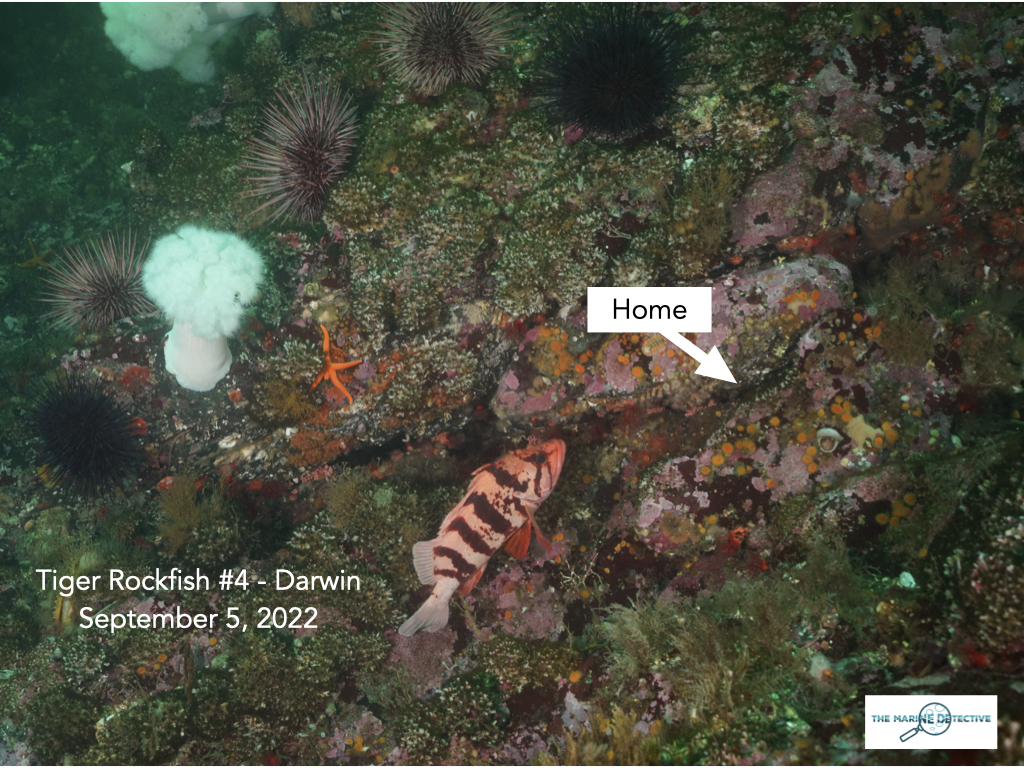
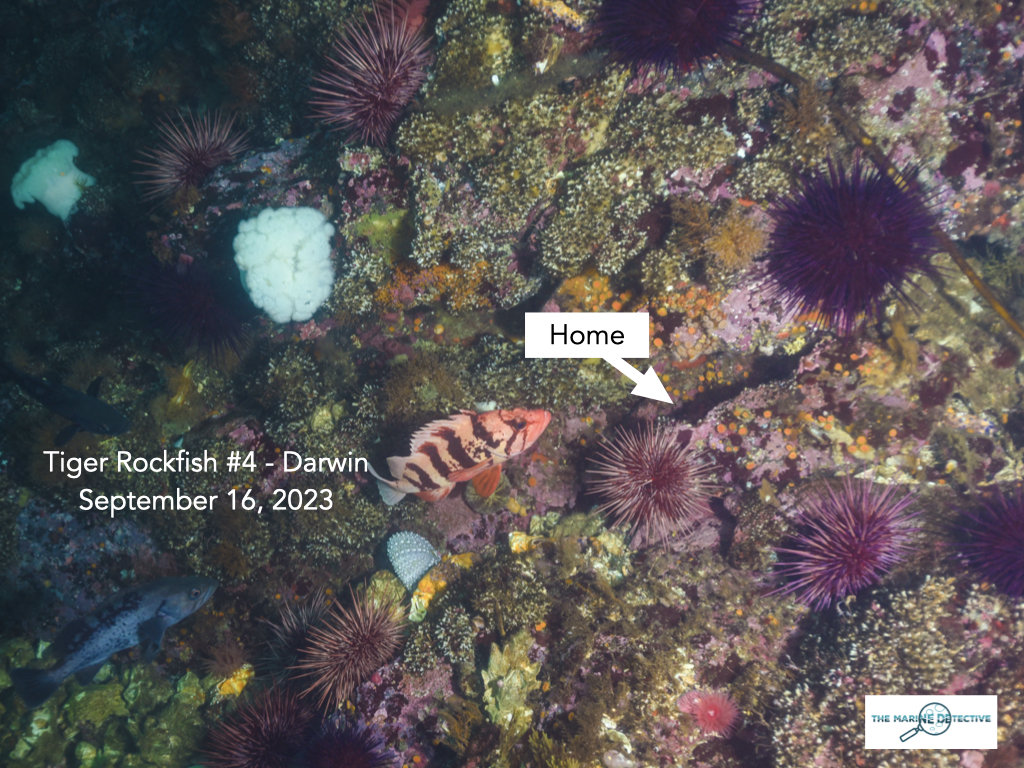
In the 3 photos below, you can see where Darwin lives and get a sense of the ideal habitat for Tiger Rockfish.


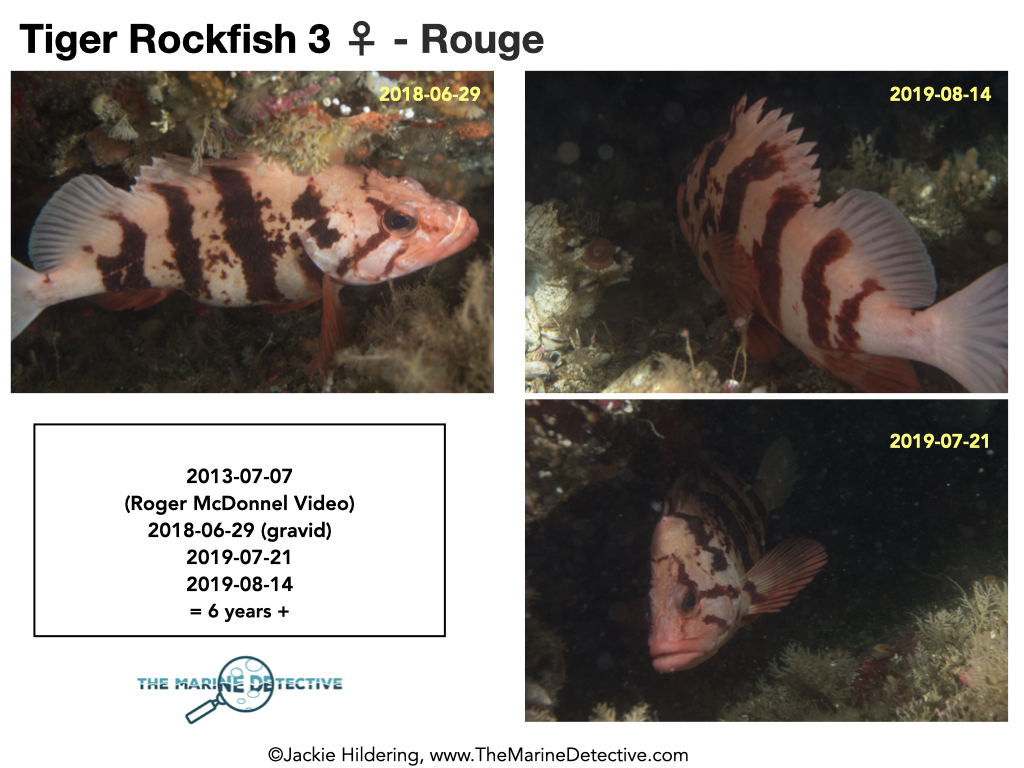
Tiger Rockfish #3

  • Nickname Rouge for the bat-like markings near the right side of her head.
  • Pregnant/gravid in 2018.
  • Documented in the same location for 6 years.
  • Last sighting 2019-08-14

Please read more on Rockfish Conservation Areas, barotrauma, and rockfish reproduction in my previous blog at this link.


Resources:


The A23s – the Story of One Whale Family

Updated February 19, 2022
First published in 2016
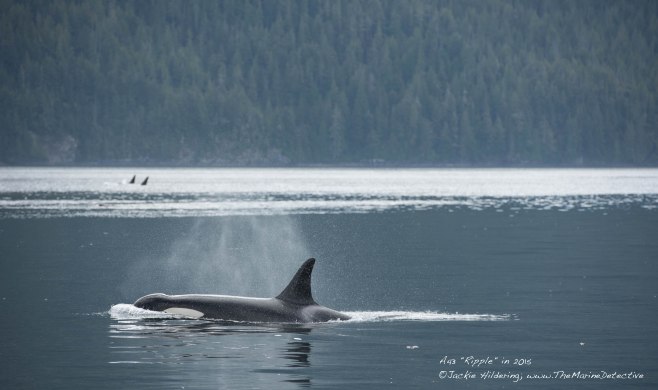
A43 "Ripple" of the A23 matriline. @2015 Jackie Hildering.

A43 “Ripple” of the A23s. @Jackie Hildering.

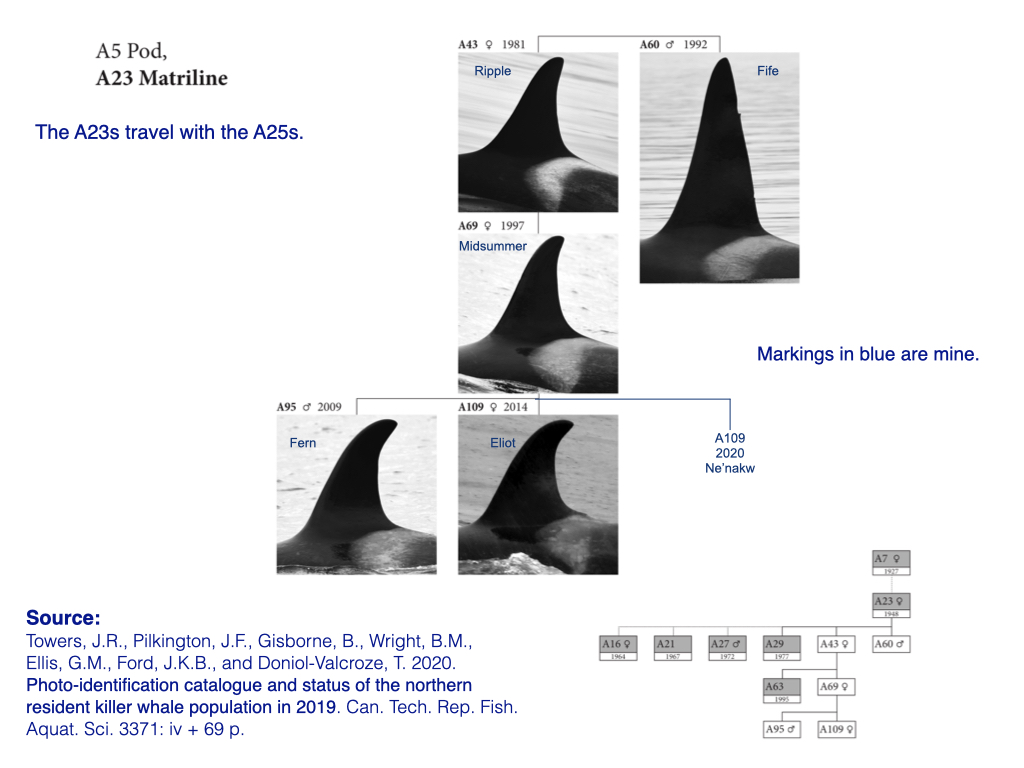
The A23 matriline of Northern Resident Killer Whales / Orca has been seen by thousands and thousands of people.

They are one of the families that most often chase salmon in the Johnstone Strait area (NE Vancouver Island) and therefore, have been observed and photographed by so many whale watchers and have been studied by researchers since the early 1970s.

They are also featured in the documentary “Realm of the Killer Whales” for which the PBS film crew, under special permit in 1997, was able to get remarkable footage of the A23s beach-rubbing in the Robson Bight (Michael Bigg) Ecological Reserve (see this link for underwater footage of beach-rubbing – as of timestamp 48:15).

A23 Matriline Quick Facts
Members of the Northern Resident population; ~310 whales (2019); threatened population.
– “Residents” do not stay in one area; they are inshore fish-eating Killer Whales / Orca. Prefer salmon, especially Chinook. They often share their catches. 
– They stay with mother, siblings and offspring their whole lives.
– Mating can happen when different N. Resident matrilines come together but, ultimately, males leave with their family and females leave with theirs.
– Each matriline sounds different; aiding in determining degree of relatedness and avoiding inbreeding.
– Only the N. Residents (and a few families of resident type Orca in Alaska) have the culture of rubbing on smooth, stone beaches. Click here for more.
– In BC there are also Southern Resident Killer Whales (endangered); and mammal-eating and offshore fish-eating populations (both threatened).
– Only the N. Residents have the culture of rubbing on smooth, stone beaches. Click here for more.
– See this link for more on the kinds of Orca populations in BC.

So many human eyes have been cast upon them, but so few of us are aware of what this family has endured. This is the story of the A23s, and what one Orca family’s history reveals about us.

Knowledge about the A23 matriline goes back to at least 1969 when we did not even know that there are different populations of Orca with distinct culture. We also sure didn’t have knowledge of their intelligence, long-lived family bonds, and limited numbers (all Orca populations in BC are at risk).

Here’s some sample text from around 1969 that gives a sense of who we were at the time:

  • From “Killer Whale!“, the 1963 book by Joseph J. Cook and William J. Wisner:
    • . . . the fiercest, most terrifying animal in all the world  . . . capable of attacking anything that swims, no matter how large. They are afraid of nothing, not even boats or ships.”
    • “The killer whale is well designed for a career of destruction and mayhem”.
    • “How different the orca, which seems to be filled with a burning hatred. Nothing that lives or moves in the water is safe from its assaults. It’s size, power, speed, agility and disposition have made this black monster feared wherever it is known.
  • And from 1973 US Navy diving manuals:
    • Killer Whales are “extremely ferocious” 
and will “attack human beings at every opportunity”.

Extremely ferocious? Terrifying? Monster? Designed for a career of destruction and mayhem?

Please see below for my summary of what the A23s are known to have endured since 1969 (based largely on the longterm population study by DFO’s Cetacean Research Program).
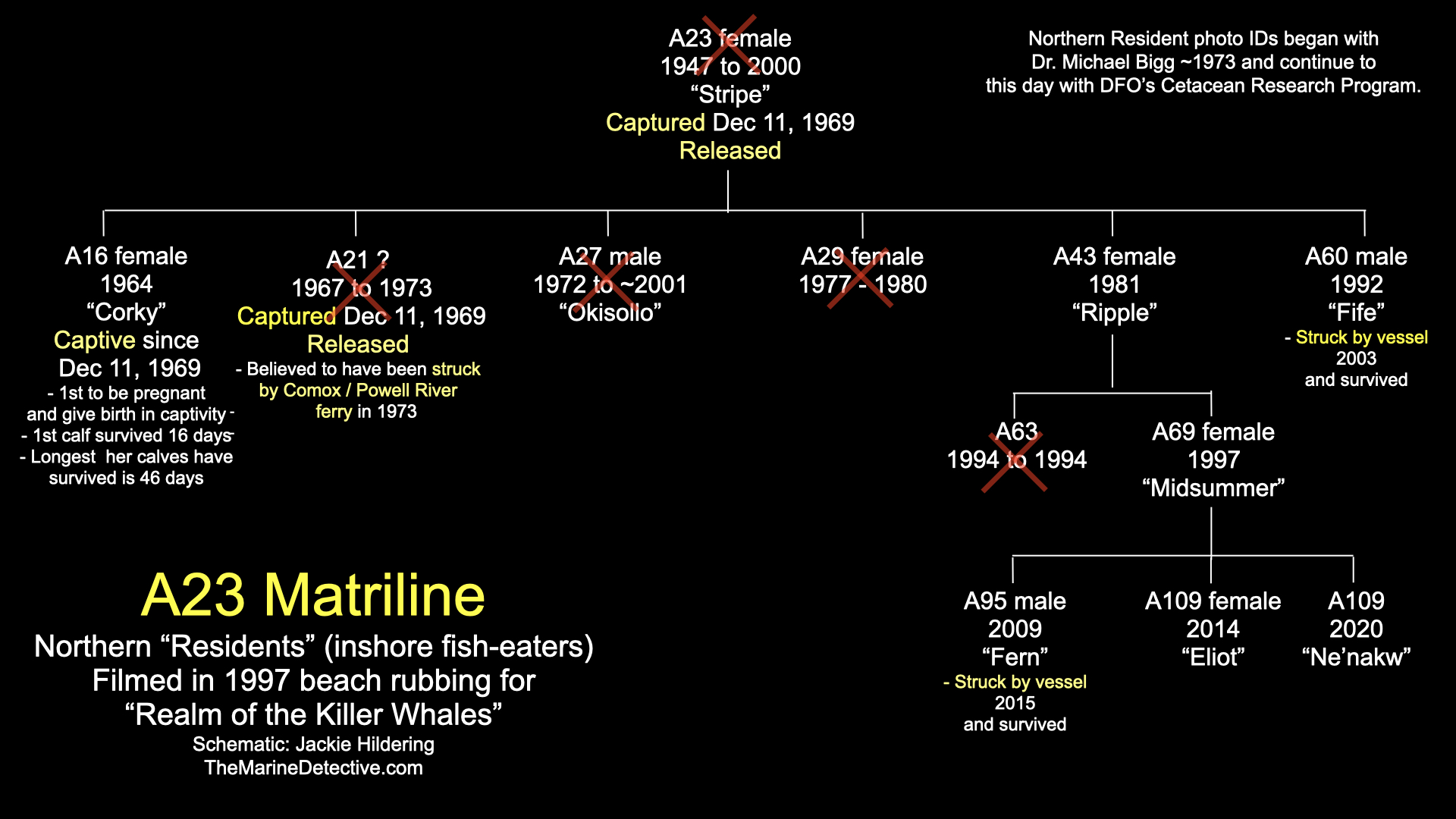
Long horizontal.001

Note that at least three family members were hunted down and captured; one is still in captivity (Corky has been there since December 1969); and two or three have been hit by boats. Further, it is very likely that family members were shot at and possibly killed but that this has not been documented because the late Dr. Michael Bigg only began his revolutionary work to study Orca as individuals in 1973. It is not known how A27, A29 or A63 died.

Oh Corky!
The longest surviving Orca in captivity.

–  On December 11th, 1969 A23 “Stripe” and her calves, A21 and A16 “Corky”, were among 12 whales captured at Pender Harbour, BC. Six were released including A23 and A21 and six were retained to be sold to aquariums – this included “Corky”, desirable as a young female who might give birth in captivity.
– In 1977, she indeed was the first to conceive and give birth in captivity. She has been pregnant 7 times but none of her calves survived beyond 46 days.
– Corky is still in captivity today in San Diego.
– Read more about Corky from OrcaLab at this link (click “Corky Campaign” and then “Corky’s Story”).

There is a firsthand account of the 1973 ferry accident, which most likely involved A21, that provides insight into the bonds between Orca. It is from Killer Whales  – The Natural History & Genealogy of Orcinus orca in British Columbia & Washington State by Dr. John Ford, Graeme Ellis and Kenneth Balcomb (1997): “The following is an account of a collision between a ship and a killer whale that demonstrates the persistence of the whales in helping one of their pod mates. It is drawn from a letter written by Captain D. Manuel of the M/V Comox Queen . . . the ship was en route from Comox to Powell River on 26 December 1973:   . . . .  It was a very sad scene to see. The cow and the bull cradled the injured calf between them to prevent it from turning upside-down. Occasionally the bull would lose its position and the calf would roll over on its side. When this occurred the slashes caused by our propellor were quite visible. The bull, when this happened, would make a tight circle, submerge, and rise slowly beside the calf, righting it . . . While this was going on the other calf stayed right behind the injured one . . . It appears the young whale did live for at least fifteen days. We later received a report from a resident of Powell River, who, on 10 January 1974, observed “two whales supporting a third one, preventing it from turning over.”

In having the great privilege of often seeing Orca in the wild, it is so powerful to recognize a family like the A23s and be aware of what they have endured. Granted, some tragedy was accidental, but so much was the result of our ignorance and vilification.
TMD Memes.001

But the story of the A23s also provides insight into how we have changed, now that knowledge has replaced fear and the fallacy of the “educational value” of Orca being in captivity has been exposed as desire for commercial gain.

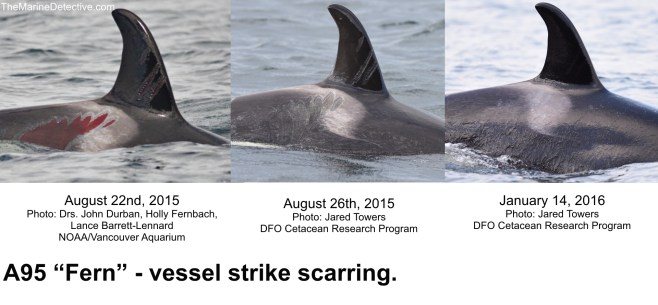
We’ve come a long way. As an indicator of this, on December 11th, 1969, members of the A23 matriline were being pursued and captured for captivity. Forty-six years later (January 14th, 2016), in the wilds of Johnstone Strait, the A23s (and A25s) were being studied by Jared Towers of the DFO Cetacean Research Program. Continuing the work pioneered by Dr. Bigg, he photo-documented them, took note of how the vessel-strike scars were healing (see photos below), and collected prey samples so that winter diet may be better understood.
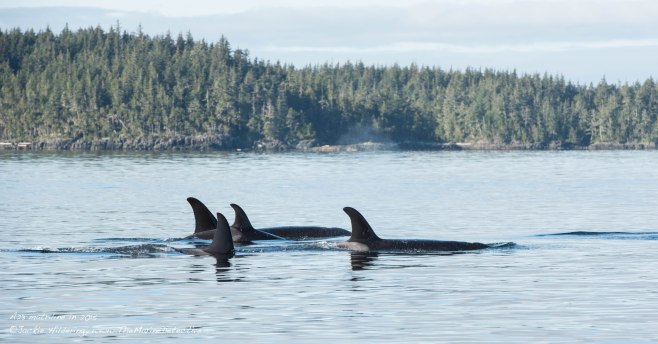
A23s on November 9th, 2015. Photo: Jackie Hildering.

A23s. Photo: Jackie Hildering.

The Orca of British Columbia have been studied as individuals in this way longer than any other marine mammal. The knowledge gained has led to where we are now. For the most part, there is no social license/tolerance for Orca being in captivity. There is federal legislation aimed at the protection of BC’s Orca populations and their habitat. They are not to be disturbed as per the Marine Mammal Regulations and further measures, and there is global interest in them with evidence of this including the contribution whale watching makes to BC’s economy.

Now, the dominant perceptions are that Orca are iconic; powerful symbols of all that is wild and free; and that it is remarkable, considering our complicated history with them, that there has never been a documented attack by a Orca on a human in the wild. Many of us would agree that the descriptors “ferocious”, “terrifying”, “monster” and “designed for a career of destruction and mayhem” are better applied to humans than Orca when we act with ignorance, greed, and disconnect from nature.

What story will the next decades tell – about us, about them?

I am so hopeful that we will better understand how our use of contaminants and fossil fuels impacts them, and the rest the marine ecosystem upon which human health also depends.

Thereby, there will be more positive stories for our future generations – and future generations of the A23 matriline.

Update: January 2021 – The A23s were documented in the Broughton Archipelago for the first time in over 20 years and Midsummer had a new calf. While this matriline is very frequently sighted in the Johnstone Strait area, they had not been documented going into the nearby archipelago since 1995. There were concerns that this may have be due to the “acoustic harassment devices” that had been used at open net-pen salmon farms.

Sources:  
January 8, 2021 – CTV News – Orca pod returns to the Broughton Archipelago for first time in more than 20 years

Alexandra B. Morton, Helena K. Symonds, Displacement of Orcinus orca (L.) by high amplitude sound in British Columbia, Canada , ICES Journal of Marine Science, Volume 59, Issue 1, 2002, Pages 71–80, https://doi.org/10.1006/jmsc.2001.1136
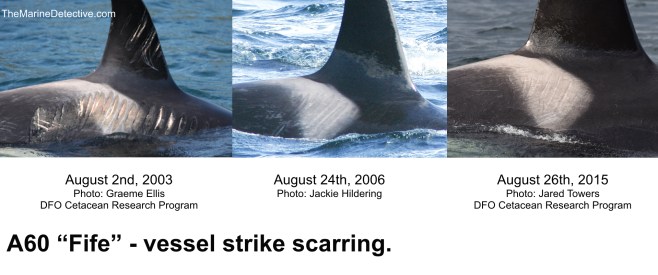
A60 vessel strike scarring

A95 vessel strike scars