Join me in the cold, dark, life-sustaining NE Pacific Ocean to discover the great beauty, mystery and fragility hidden there.

Posts by The Marine Detective

Sharks Among Us #2 – The Bluntnose Sixgill Shark

Update May 1, 2023: Original blog is from 2011. I have added photos of additional, known dead Sixgill Sharks at the end of this blog.

And yes, there is a personal connection to this species. While these huge sharks are often in very deep water, I have seen them while diving in at depths of even less than 10 metres. It’s difficult to express the wonder and connection that results from these privileged experiences. It’s somewhat like seeing a living dinosaur. Bluntnose Sixgill Sharks have been perfected by 200 million years of adaptation.

They are not a threat to us. We are a threat to them.


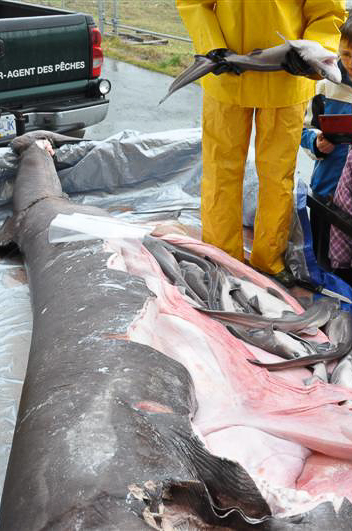
The awe-inspiring images below are of a pregnant female Bluntnose Sixgill Shark (Hexanchu griseus) who was found dead on a beach in Alberni Inlet on low tide in February of 2011. She was necropsied by Department of Fisheries and Oceans staff and there were no obvious indications of how or why she died.

The information below has been generously provided by shark biologist and friend, Romney McPhie. I am sharing in the hopes of increasing respect and understanding for these astounding, huge, deep-dwelling sharks who live off our coast.

4.2 m pregnant female Sixgill Shark – February 2011.

This female Sixgill was 4.2 metres and was estimated to weigh 569 kg (1,254 lbs).  As a viviparous shark species, she carried her embryos through the entire gestation period which is thought to be over 2 years long (species does not lay eggs / egg cases).

She may have given birth to some prior to her death and still had 28 pups inside her. The young hatch inside the female’s body before entering the ocean (these sharks are “yolk-sac viviparous”).

Sixgill Sharks have been reported to be up to 4.8 metres in length with females being larger than males (males to 3.5 metres). Age of sexual maturity is estimated to be between age 11 to 14 for males and between 18 to 35 years for females. It is believed that life expectancy may be up to 80 years of age. 

The Committee on the Status of Endangered Wildlife in Canada (COSEWIC) 2007 assessment report on the Bluntnose Sixgill puts into perspective how rare an opportunity it is to learn about a pregnant Sixgill.  It relates that the number of pups carried by females is known from only three previous credible accounts (ranging from 47 to 108 pups which were 61 to 73 cm in size).

The Bluntnose Sixgill Shark is an extremely cryptic species that can dwell at depts up to 2,500 m.  So little is known about them and (sigh)  they are “near threatened” globally and are a species of “special concern” in Canada.

I have had the incredible privilege of seeing Bluntnose Sixgill Sharks while diving and felt like I was in the presence of greatness. They are living fossils, perfected by 200 million years of adaptation. They are amazingly graceful with large, luminous and intensely green eyes.
They are of absolutely no threat to humans and, like all sharks, have an essential role in marine ecosystems.  As top-level predators, sharks strongly shape food webs and the loss of such predators has proven to have profound effects on the number and diversity of other species.

The unique teeth of Bluntnose Sixgill Sharks. Photo by Romney McPhie.

We, however, are a threat to them.

There were historical fisheries and bycatch remains a concern. From 2006 to 2009 there an estimated 1979 Bluntnose Sixgill Sharks were Commercial Hook and Line catch

There is no information on the survival rates from bycatch nor of the accuracy of bycatch reporting. Population size and reproductive rate are not known for this species.

The primary threats identified for these species are entanglement and bycatch.  Other threats identified include pollution, habitat loss or degradation, climate and oceanographic change, and harassment. Historic threats included directed fisheries and entanglement/bycatch. While these populations are migratory throughout the northeast Pacific, it is unknown whether threats occurring outside of Canadian Pacific waters have an impact on these populations.”

Further from the 2022 Fisheries and Oceans Canada Report on the Progress of the Management Plan for Bluntnose Sixgill Sharks:

“The present population size and abundance trends are not known. The only available abundance index (encounter rates with immature Bluntnose Sixgill Sharks at a shallow site in the Strait of Georgia) has decreased significantly (>90%) in the last five years. This index is not likely representative of the overall abundance trend because only immature Bluntnose Sixgill Sharks are encountered and the site is shallow relative to the preferred depth range. The principal known threat to the species is fishing.

The Bluntnose Sixgill Shark has been the focus of at least three directed fisheries in Canadian waters, most recently in the late 1980s and early 1990s. It continues to be caught as bycatch, but survival of released sharks is unknown. Bluntnose Sixgill Sharks observed by divers sometimes show scars from entanglement in fishing gear.

Because of its late age of maturity (18 to 35 years for females), it is likely susceptible to overfishing even at low levels of mortality. Little is known about the abundance and movement patterns of this species elsewhere in the world, so the potential for a rescue effect is unknown.

Sixgill Shark eye. This one died as a result of longline bycatch and was brought into Alert Bay in July of 2007. It was rumoured to be one of 12 sharks caught by only one local fishing boat. Photo: Jared Towers.

Sources for the biology, threats and conservation of Bluntnose Sixgill Sharks:

Fisheries and Oceans Canada. 2022. Report on the Progress of Management Plan Implementation for the Bluntnose Sixgill Shark (Hexanchus griseus) and Tope Shark (Galeorhinus galeus) in Canada for the Period 2012 to 2017. Species at Risk Act Management Plan Report Series. Fisheries and Oceans Canada, Ottawa. iv + 20pp

Fisheries and Oceans Canada, 2012. Management Plan for the Bluntnose Sixgill Shark (Hexanchus griseus) and Tope Shark (Galeorhinus galeus) in Canada [Final]. Species at Risk Act Management Plan Series. Fisheries and Oceans Canada, Ottawa. iv + 37 pp.

COSEWIC (Committee on the Status of Endangered Wildlife in Canada). 2007a. COSEWIC assessment and status report on the Bluntnose Sixgill Shark (Hexanchus griseus) in Canada. COSEWIC, Ottawa, Canada.

NOAA, 2017. Getting to know Sixgill Sharks.

Photo #1 April 2023 – Dead pregnant Bluntnose Six-gill Shark, Hornby Island.
Photo #2 April 2023 – Dead pregnant Bluntnose Six-gill Shark, Hornby Island.
From the Vashon Nature Center: in Puget Sound – 4 Bluntnose Sixgill Sharks washed between January and March 2023. Two could not be necropsied. One died after longline bycatch and one died by swallowing a crab bait trap Blog article about the first necropsy at this link.
Photo #1 Coles Bay, February 5th, 2019: Dead pregnant Bluntnose Sixgill Shark
©Ron DeVries.
Photo #2 Coles Bay, February 5th, 2019: Dead pregnant Bluntnose Sixgill Shark
©Ron DeVries.

Big Orange Love – The Orange Peel Nudibranch

Update November 2020: The Orange Peel Nudibranch has been reclassified. Now is Tochuina gigantea.


This blog is about Big Orange Love – the reproduction of Orange Peel Nudibranchs.

Two Orange Peel Nudibranchs mating – each about 30 cm long. Both will go on to lay the huge masses of eggs you see below. There is no male, or female.

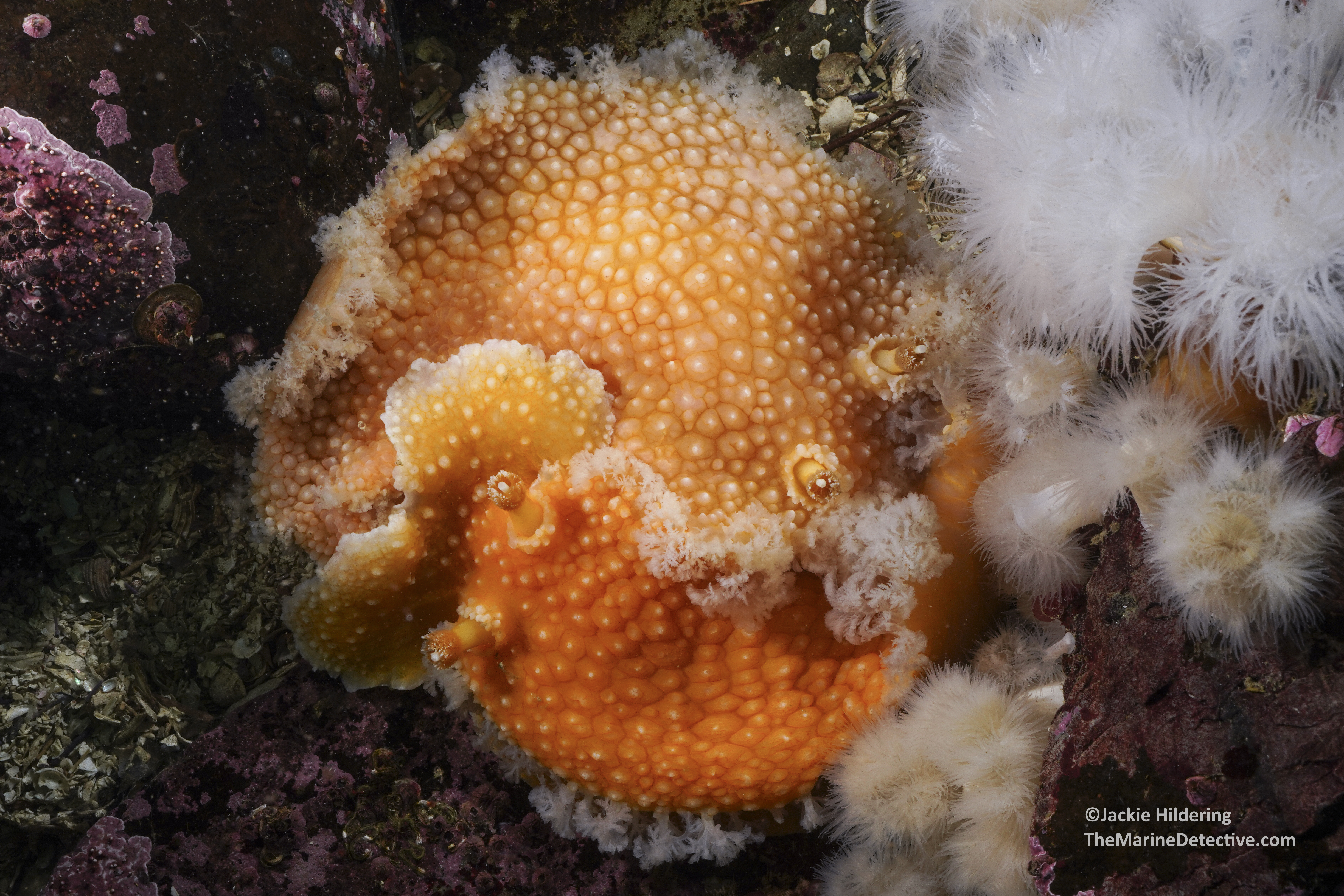
These sea slugs are very aptly named since their skin is reminiscent of both the texture and vibrant colour of an orange. But, the name does nothing to indicate the size to which these giants can grow. They are one of the world’s largest sea slugs with literature reporting them to lengths of up to 30 cm and weight to 1.4 kg. 

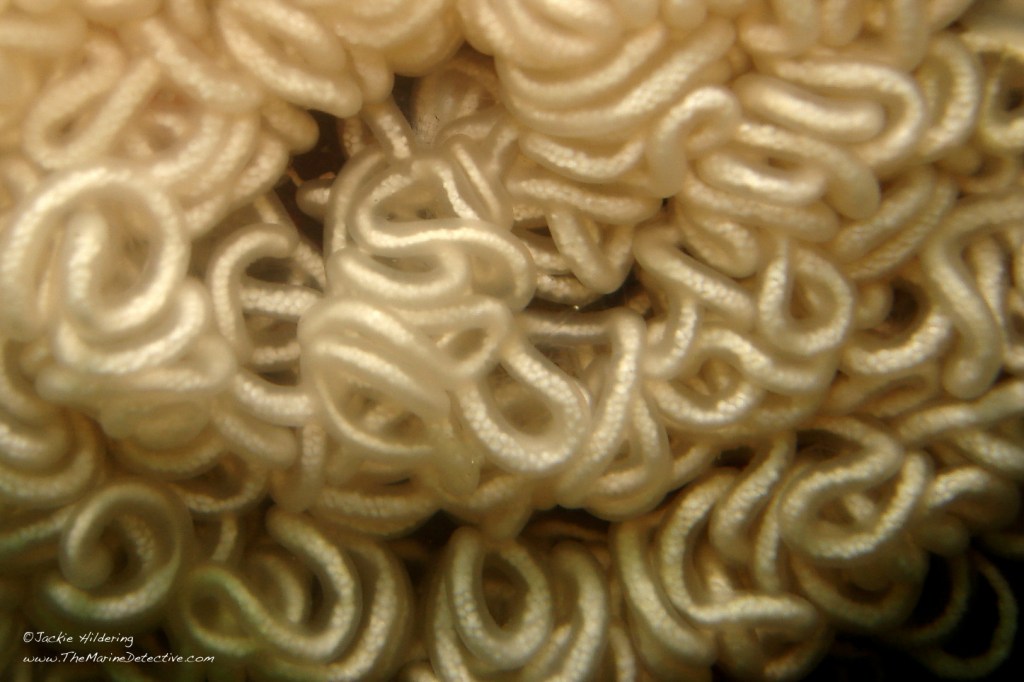
As if this sea slug species’ colour, size and beautifully intricate white gills are not enough to create awe, you should see their eggs! I will never forget the first time I saw the huge tubular mass that looked like udon noodles. I think my brain almost exploded and I was propelled all the more feverishly on my “The Marine Detective” path, wanting to be able to identify the egg masses of all sea slugs in our waters (each species’ eggs look different).

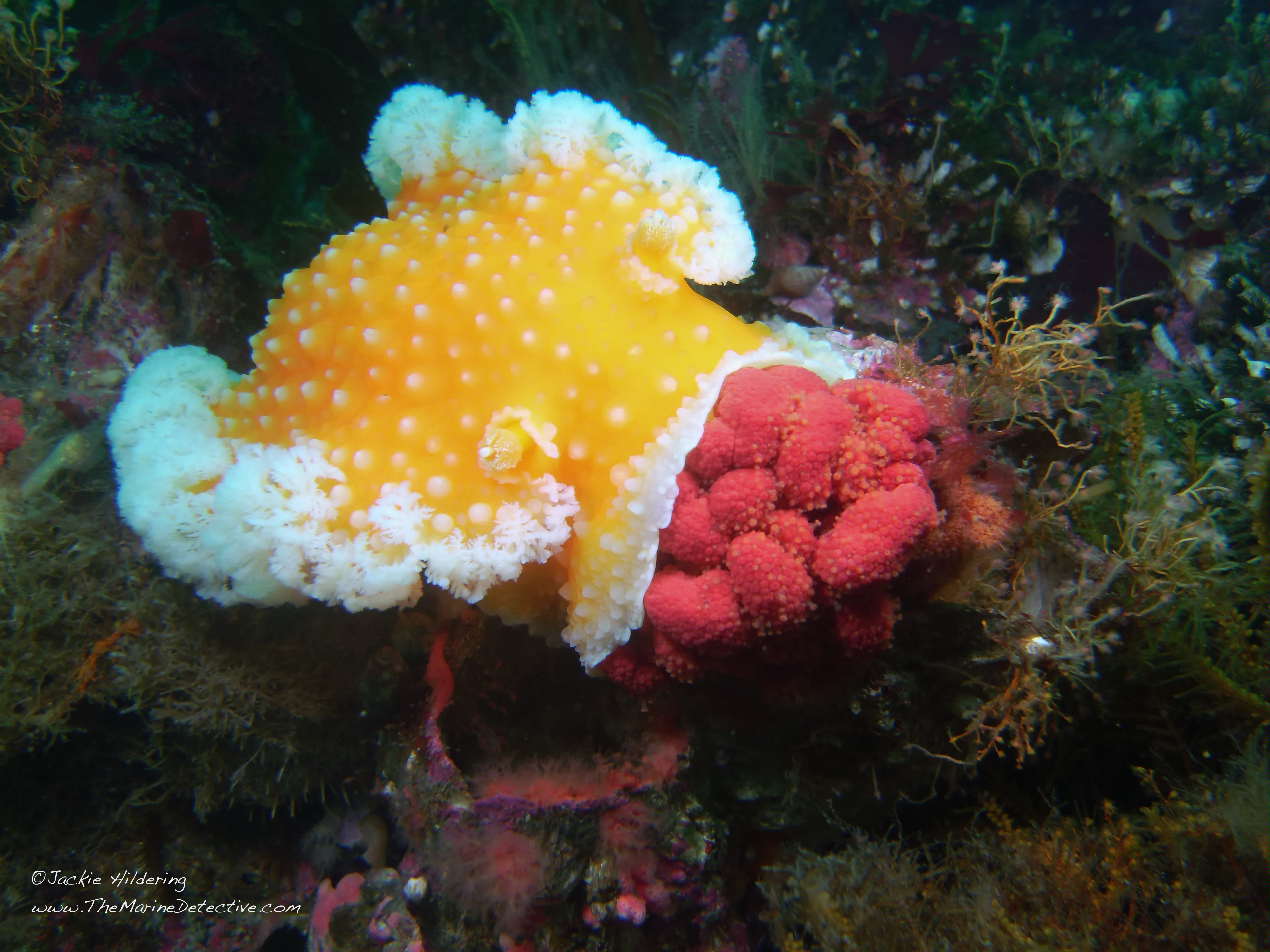
Orange Peel Nudibranch beside egg mass. ©Jackie Hildering.
Close-up on an Orange Peel Nudibranch egg mass. ©Jackie Hildering.
 ©Jackie Hildering.


More photos:

Please note that my slideshow below is from before the species was reclassified to be Tochuina gigantea.

DSC02592
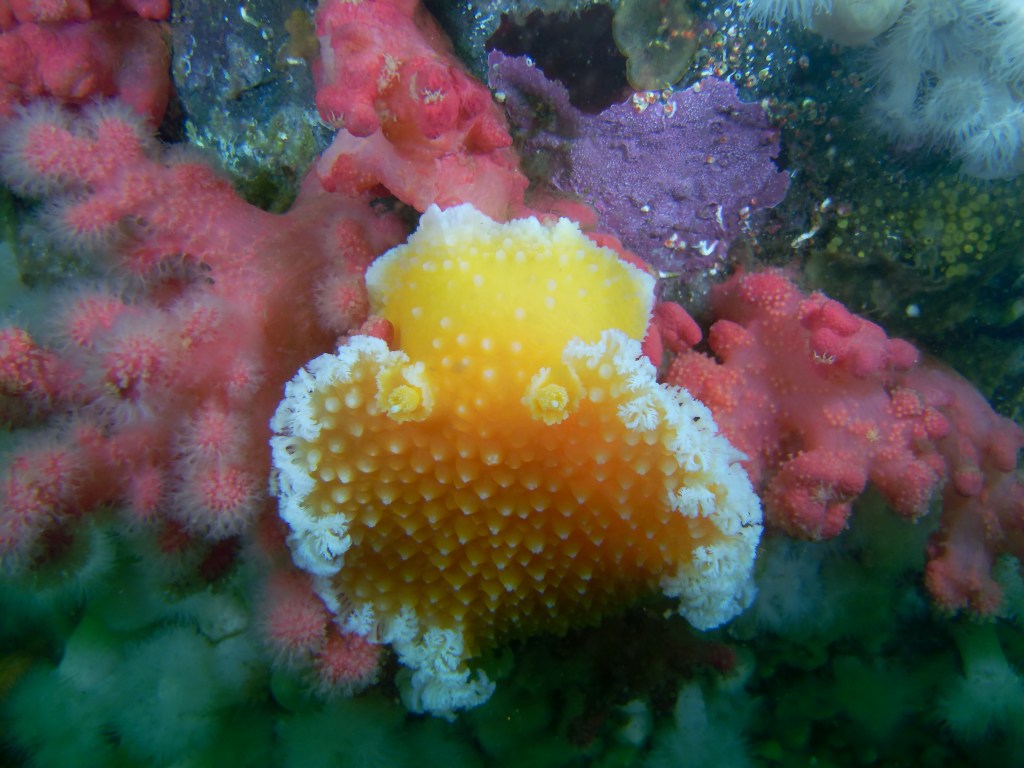
Orange Peel Nudibranch feeding on Red Soft Coral ©Jackie Hildering. 
Orange Peel Nudibranchs moving into position to mate (always right-side-to-right-side) an lock gonophores. Both will become inseminated and lay eggs. ©Jackie Hildering
Sea slug amidst red soft coral.
Orange Peel Nudibranch feeding on Red Soft Coral. Photo: Hildering
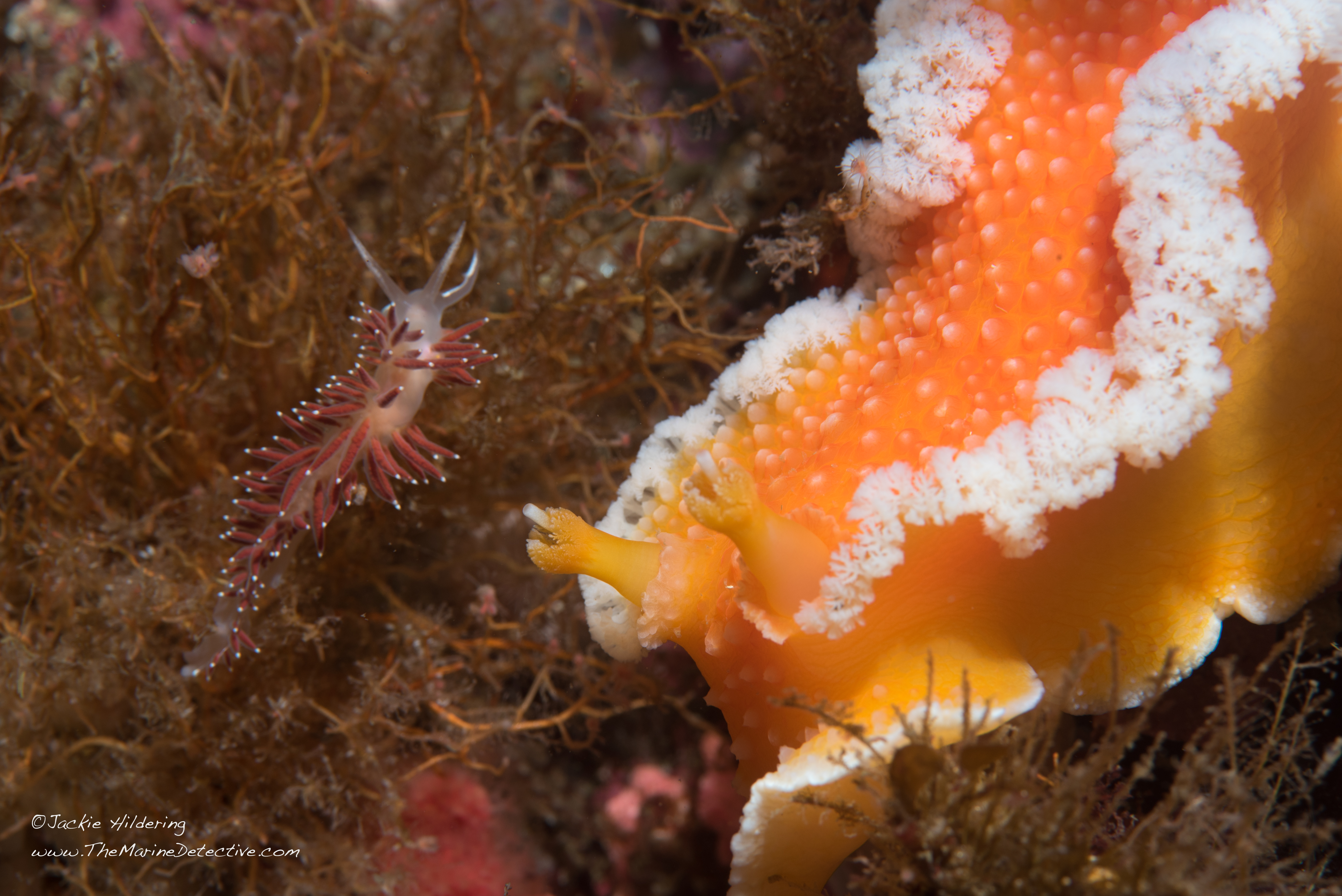
Orange Peel Nuibranch and a Red-gilled Nudibranch. ©Jackie Hildering.
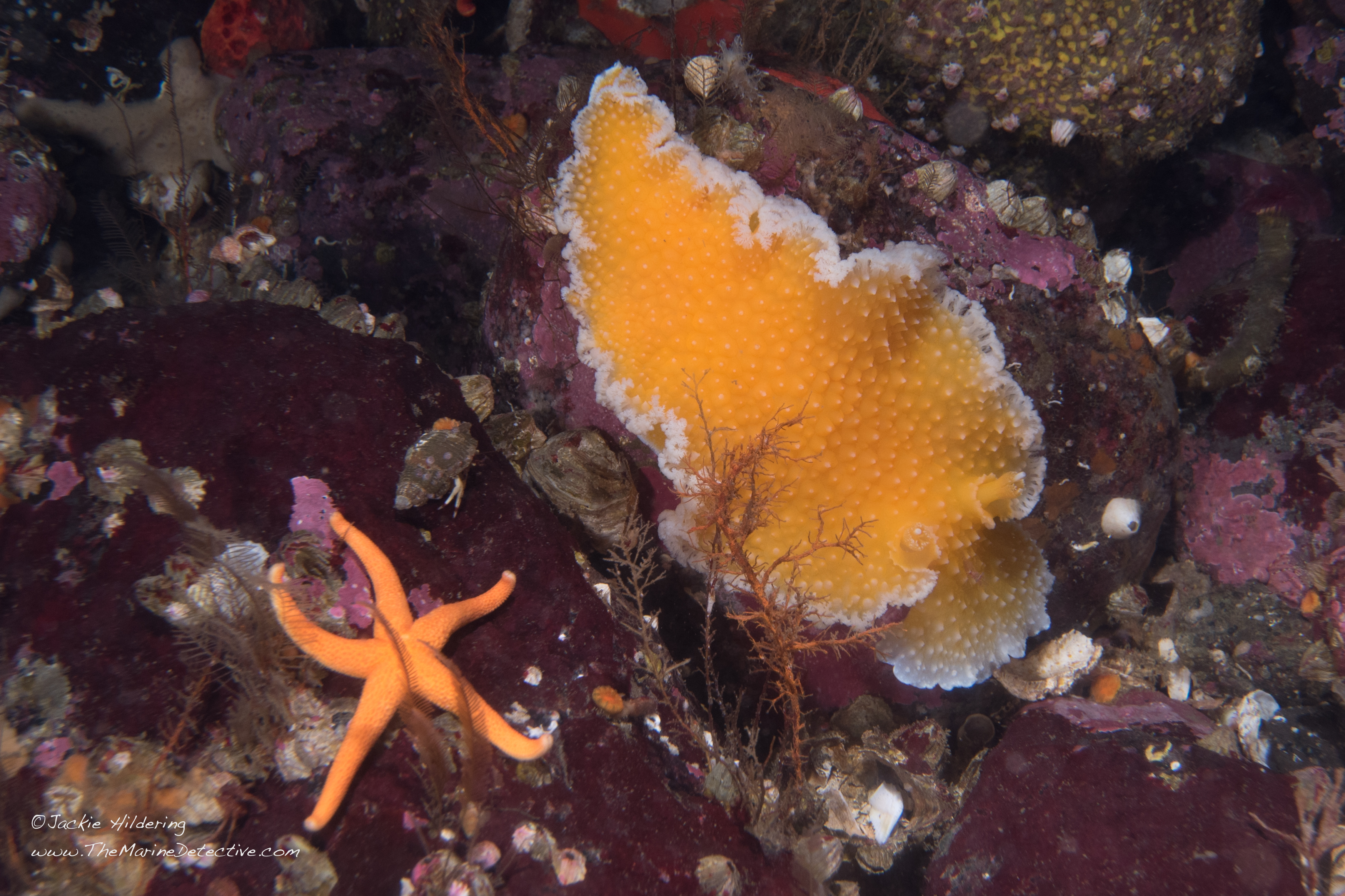
Orange Peel Nudibranch and a Blood Star ©Jackie Hildering.
Orange Peel Nudibranch and Proliferating Anemones (pink and orange) ©Jackie Hildering.
Two Orange Peel Nudibranchs in the kelp forest ©Jackie Hildering.
Orange Peel Nudibranch and Striped Sunstar ©Jackie Hildering.
Orange Peel Nudibranch feeding on Red Soft Coral ©Jackie Hildering.
And another hungry Orange Peel Nudibranch ©Jackie Hildering.

Sources: 

Korshunova T, Martynov A (2020) Consolidated data on the phylogeny and evolution of the family Tritoniidae (Gastropoda: Nudibranchia) contribute to genera reassessment and clarify the taxonomic status of the neuroscience models Tritonia and Tochuina. PLoS ONE 15(11): e0242103. https://doi.org/10.1371/journal.pone.0242103

Steller visits!

Screen grab from Steller encounter 2011-02-12

Screen grab from the video.

While diving yesterday, we had a visitation from two juvenile Steller sea lions.

I’ve put a 1-minute clip of the encounter on-line, in a gallery with other videos of when these magnificent mammals have chosen to do a swim-by.

Note that I do not “target” marine mammals while diving (this is in fact stipulated as being illegal in Canada’s draft marine mammal regulations)  i.e. I do not jump in near sea lion haul-outs as I do not want to put pressure on the animals nor contribute to their becoming habituated to humans.

Therefore, when we see them there is always an element of surprise and, of course, extreme privilege.

See this link for the video clips.

See this link for a previous blog posting that includes the natural history of Steller sea lions.

Note: “Steller” is for the nautralist Georg William Steller who was doctor and naturalist on Vitus Bering’s second Kamchatka Expedition that also sailed to Alaska and the Commander Islands (1740 – 1741?).

You Win! You Lose?

You win some and you lose some . . . or do you?

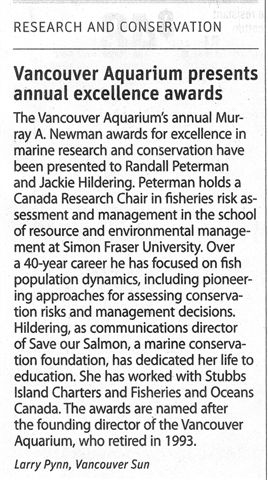
On January 19th, I had the extreme honour of receiving the Vancouver Aquarium’s Murray A. Newman Award for Excellence in Aquatic Conservation. In the thick, wonderful soup of positive emotions associated with this, I delight in the award being known as The MAN Award.  Yeah, I got a MAN award! (For my acceptance speech, see the link at the bottom of this post).

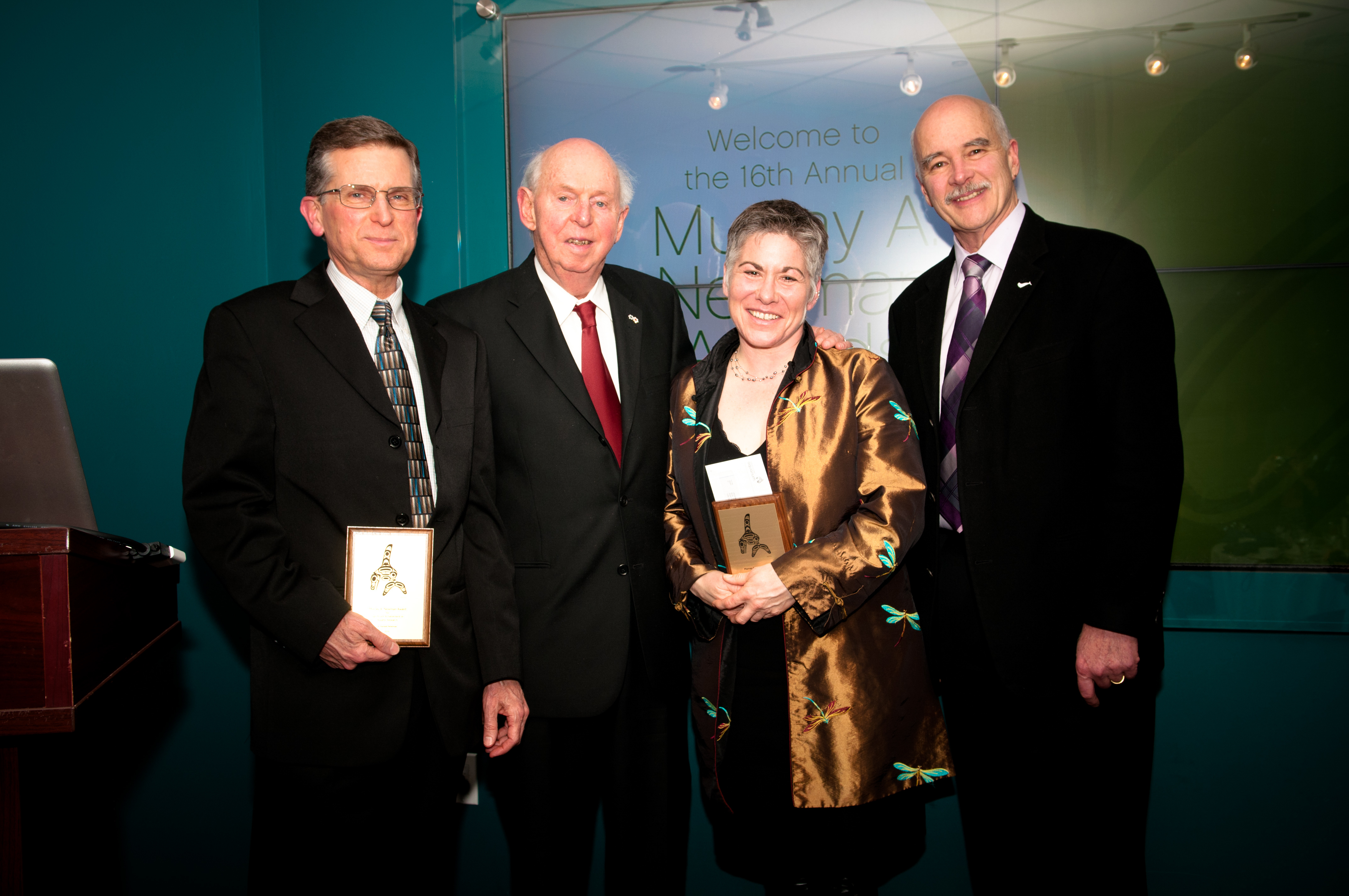
Photo by Vancouver Aquarium’s John Healey. The Marine Detective among Drs. Left to right: Dr. Randall Peterman – winner MAN award for Science; Dr. Murray A. Newman – the award I received is in his honour; founding director of the Vancouver Aquarium; Dr. John Nightengale – President Vancouver Aquarium.
Humpback Comeback Results
The final AVIVA voting results in our funding category (to $25K). Click image for close-up.

On January 25th, it was announced that the Marine Education and Research Society’s Humpback Comeback Project would not receive funding dollars from the AVIVA Community Fund. (I am a cofounder of or MERS and have had the joy of 7 years of volunteer effort in studying local humpbacks.) The competition result was a shock as this small local project succeeded in getting the third highest number of votes out of more than 520 in our category (7,113 votes total, more than 1,100 votes ahead of fourth place).

After the intensive on-line voting, the projects were judged and Humpback Comeback was determined not to best meet the AVIVA criteria/priorities. Observations are that “build ’em” and human-to-human projects such as playgrounds were more successful in meeting the criteria of this generous and PR-savvy insurance company.

It was a shock yes, but there are far more similarities between winning the MAN award and the AVIVA result than just my exclaiming “Oh man!” at the end of both.

I could not have achieved what was recognized by the award without the opportunities and support provided by the people of Northern Vancouver Island.  The astounding community support and encouragement we also received for the Humpback Comeback Project provided an equally potent affirmation of purpose.

Losing?  Every time someone voted for our Humpback Comeback Project or that we had a media opportunity, awareness was created for whales and for the threat of entanglement; positive attention was focused on our area and its remarkable biodiversity; and people responded to an opportunity to create positive change.  There are those that have now even decided to support the Project through donations or by helping to find alternative funding sources (donations made via http://www.mersociety.org).

Sometimes life deals a challenge that only intensifies focus, strengthens resolve, and enhances creativity to achieve what you believe in.  Oh man, I assure you that this is the case with the Humpback Comeback Project!

Great thanks to you all for the support.
______________________________

For my acceptance speech for the Murray A. Newman award, see this link (15 minutes). It is apparently laughter and tear inducing with the ultimate message being – be relentless in creating positive change. Includes lots of my images of the marine biodiversity of Northern Vancouver Island.


Kaouk – The Steller Sea Lion That Flew

Kaouk at the Marine Mammal Rescue Centre. Photo: Hildering

Below, please find a link to a slide show update on Kaouk, the juvenile male Steller sea lion that walked into the Port Alice (BC, Canada) trailer park on December 16th, 2010.


I had the privilege of visiting Kaouk at the Vancouver Aquarium’s Marine Mammal Rescue Centre on January 20th and was amazed at the improvement in his health.  A decision will soon be made about his return to the wild.


See this link for the 3 minute slide show (available in two sizes for ease of viewing).

See this link for a background story in the North Island Gazette.

Wonder Worm

January 9th, 2011

While diving in the Plumper Island Group near Telegraph Cove, British Columbia, I chanced upon a white-ringed ribbon worm (Tubulanus albocinctus) fully out in the open. This is the first time I have been able to see the whole animal and marvelled at it’s length and colour. This “specimen” that I filmed was more than 1 metre long.  Apparently, they can reach 6 metres in length!

White-ringed ribbon worm found at about 30' (10m). Photo: Hildering


Ribbon worms have unsegmented bodies but what sets them apart from all other worm species is that they have a “proboscis”. The proboscis is a part of their gut that can be launched out to wrap around prey and then retract pulling the prey into the ribbon worm’s mouth.  Venom may also be associated with the proboscis. The white-ringed ribbon worm may prey on segmented worms, small crustaceans and maybe even some small fish. The proboscis can also be used for digging.

In the video clip (link below) you will see how the animal moves with powerful waves of muscular contraction (peristalsis). Small hairs called cilia also help it glide along.

In trying to find some basic facts about this species’ natural history, I discovered that very little is known about it even though it quite common in the Pacific Northeast. Although not able to find research to support this, I believe that the animal’s bright colour is a warning to predators that it tastes bad or is toxic.

I assure you I will be on the lookout for this wonder worm to try to learn more (I would love to see the proboscis in action)!

See the short video clip (30 sec) of my white-ringed ribbon worm encounter at this link.

More on ribbon worms at this link (includes a diagram of the internal anatomy).

Update January 12: A neighbour, Graham MacDonald, shared his observations of white-lined ribbon worms preying on rockweed isopods on a local sandy beach. He has repeatedly observed a black structure extending from the worm to the isopod and moving around on the isopod (likely the probosis). He noted that it appeared that the isopod was suffering (due to toxin or digestive juices?) and that it was a prolonged process. I will definitely be going to sandy beaches to see if I can capture this on film. Thank you Graham.

Christmas Wish for the World


As another year draws to a close, many of us reflect on stories ended and lessons learned in 2010 and focus on positive, meaningful change for 2011.

In this spirit, I share the following with you. It was written by one of the remarkable members of my Young Naturalist Club; Adrian Walker-Burroughs when he was in grade 7.


CHRISTMAS WISH FOR THE WORLD

My Christmas wish is too big to fit in Santa’s sleigh – too big to fit in one hundred of Santa’s sleighs.
My wish is for a clean world of happy people, today and tomorrow.
The future is open for people to make good environmental choices.
Green cars, boats and planes have been invented, so let’s use them.
Let’s try to use vehicles that don’t impact so much on the atmosphere.
All of us can take little steps to make a big difference.
Turning off electric lights and household appliances when you’re not using them is a good way to start.
Global warming is a serious issue and the entire planet is affected.
This Christmas let’s all give a gift to our planet.
Each of us can do something to help.
Every little bit counts.
Merry environmental Christmas.


Merry Christmas to you Dear Readers.
Wishing you Oceans of Joy for 2011.

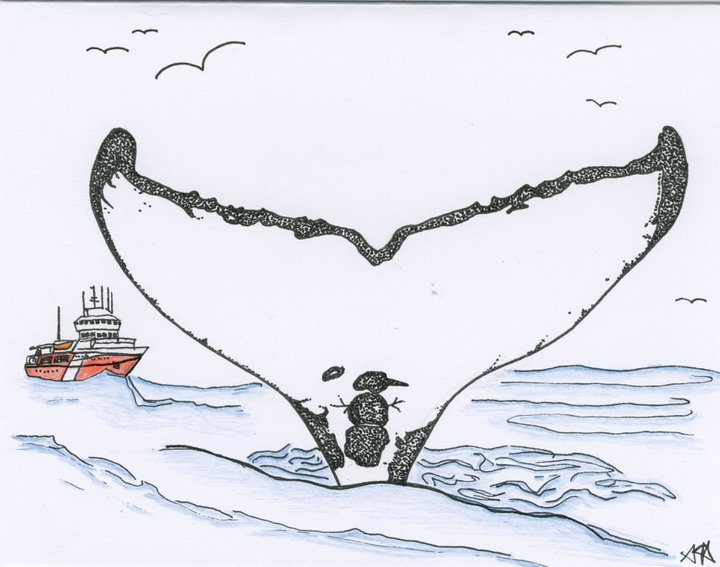
"Frosty the Humpback" by dear friend Stacey Hrushowy. Thanks to all who brought success to the Humpback Comeback Project. On January 25th we will hear if we have indeed won the $25K funding for entanglement research.


The Humans Behind “Humpback Comeback”

Update: See this link for the results of the Humpback Comeback Project in the AVIVA competition.

_______________

With just a few more days left to vote for the “Humpback Comeback” Project in the AVIVA Community Fund’s competition, I feel I need to crack.

I need to crack and respond to the many questions about who “we” are, the humans behind the Humpback Comeback Project.

We haven’t wanted to answer because of course, it isn’t a comfortable thing to put yourself “out there”; it’s been a broad community effort where we can’t mention everybody involved and; we didn’t want to detract from what the Project is about  – the whales and understanding the risk of entanglement.

But with all the remarkable support the Project has received, I feel we owe you.  Maybe too, in revealing the human element, the dedication behind the Project will be even more apparent and you’ll know all the more that your votes have been well invested.

So who are we, the volunteer effort behind the Humpback Comeback Project?  Below I include the biographies provided in our submission to the AVIVA Community Fund competition. Please realize that the information was written with the purpose of relaying our commitment to the Project and to our community. Self-promotion is difficult and awkward but the we did it to help the chance of success in the funding competition.

In complete self-mockery, we also include photos of ourselves so you can see the human faces behind Humpback Comeback. The photos were taken when we were out looking for humpbacks last week, on the cold Northeast Pacific. We recognize that the photos wouldn’t serve us well on Plenty of Fish but that’s not their purpose . .. for us, it’s about plenty of whales!

Please know too that there are so many more who have contributed time, resources and sightings – local whale watching companies (e.g. Stubbs Island Whale Watching began the data collection effort); Dr. Alexandra Morton (shared all the humpback data she had collected since the 1980s); our fellow members of the Marine Education and Research Society (Caitlin Birdsall, Leah Thorpe and Heidi Krajewsky) and many more from Northern Vancouver Island, B.C., Canada.

Thank you so much for caring and for your support.

Vote #5773!

Chrisite McMillan. Vote 5 . . .


Christie McMillan (Alert Bay, B.C.) has spent two years as a Humpback Whale Studies Research Assistant and member of the Atlantic Large Whale Disentanglement Network at the Provincetown Center for Coastal Studies in Cape Cod, Massachusetts.  Working with some of the world’s experts in entanglement research and humpback whale biology, she has gained skills and expertise in both of these fields.  She has also worked as a Cetacean Research Technician for Fisheries and Oceans Canada, and an environmental educator and Naturalist for various non-profit and eco-tourism organizations.  She has played a key role in collecting, processing, and analyzing our humpback whale data since 2005.

Jared Towers. Vote 7, 7 . . .


Jared Towers (Alert Bay, B.C.) is a Cetacean Research Technician with Fisheries and Oceans Canada, and has been operating boats and studying wild whales off the coast of British Columbia for the past 23 years.  He also is the Founder and Past President of the North Island Marine Mammal Stewardship Association, an organization dedicated to finding the balance between sustainable eco-tourism and marine mammal conservation.  He is a skilled researcher, educator, and Captain, having worked in locations all over British Columbia, as well as in Mexico and Antarctica. He has been involved in our humpback whale research for the past 7 years.

Yours truly. Jackie Hildering. Vote 3 . . . Vote #5773!


Jackie Hildering (Port McNeill, B.C.) has been collecting and processing our humpback whale data for 7 years.  She is a highly respected marine educator with a very strong connection to the local community. She has worked as a marine naturalist for 12 years; was Fisheries and Oceans Canada’s Education Coordinator for 7 years; runs a Young Naturalist Club; is President of the local dive club; and works for the SOS Marine Conservation Foundation.

Her role in the community is further evident in the local recognition she has received.  This includes:

  • 2010 winner of the Vancouver Aquarium’s Murray A. Newman Award for Excellence in Aquatic Conservation.
  • Recognition from Fisheries and Oceans Canada’s Director of Oceans, Habitat and Enhancement for “contribution to the preservation and enhancement of the salmonid resource  . . . helping ensure a better future for all Canadians” (June 2010)
  • Professional Merit Award – Port McNeill & District Chamber of Commerce (2009)
  • LiveSmart BC “Community Hero” (Oct 2008)
  • One of the top 3 nominees for the “Free the Children” Society’s “Me to We Awards” in the educator category (2007)


Invasive and Indiscriminate Tagging of Whales?

Update: October 2016 – Confirmed that endangered Southern Resident L95 died due to an infection resulting from limpet tagging. Read news item here.

Update: January 22, 2012 update to the December 10, 2010 blog item below:  Approval granted to limpet tag the endangered southern resident killer whales. See news items at the end of the blog. 

The American “Northwest Fisheries Science Center” (NWFSC) has applied for expansion of their permit to satellite tag endangered and threatened whales with airguns, including the endangered Southern Resident killer whale population and the threatened Northern Residents and Transient populations (the range of all these whales very much includes British Columbian waters).

It is the opinion of many involved in whale research and conservation that the impact of the airgun tagging far out weighs any benefit to the whales. There are other ways to get data on the movement of killer whales e.g. acoustic tracking and collaboration with researchers who have been studying these whales more extensively than NWFSC.

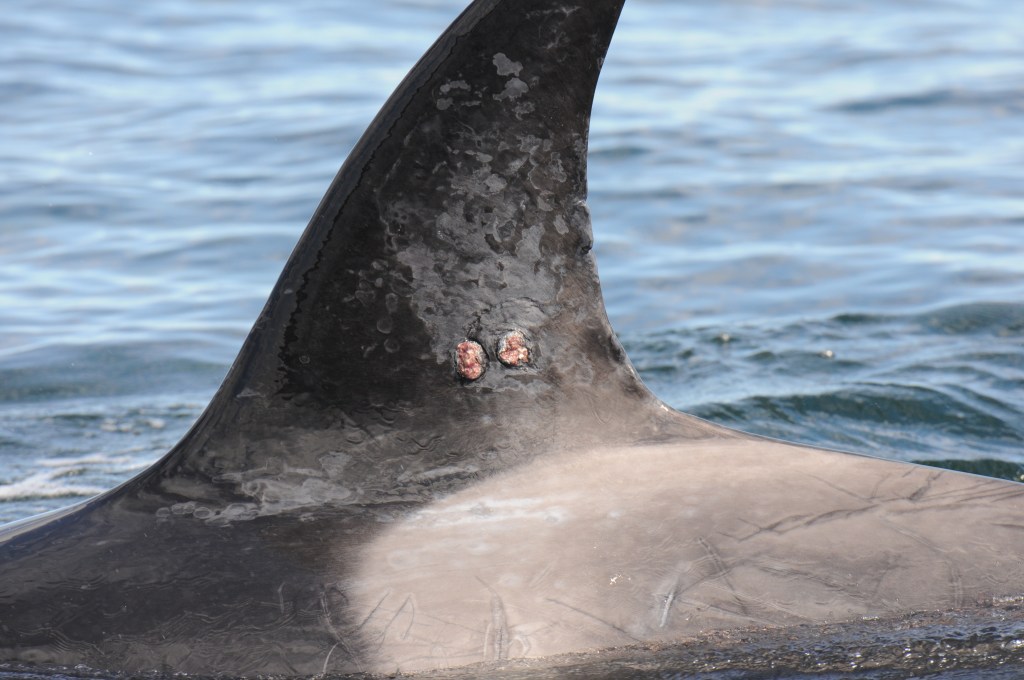
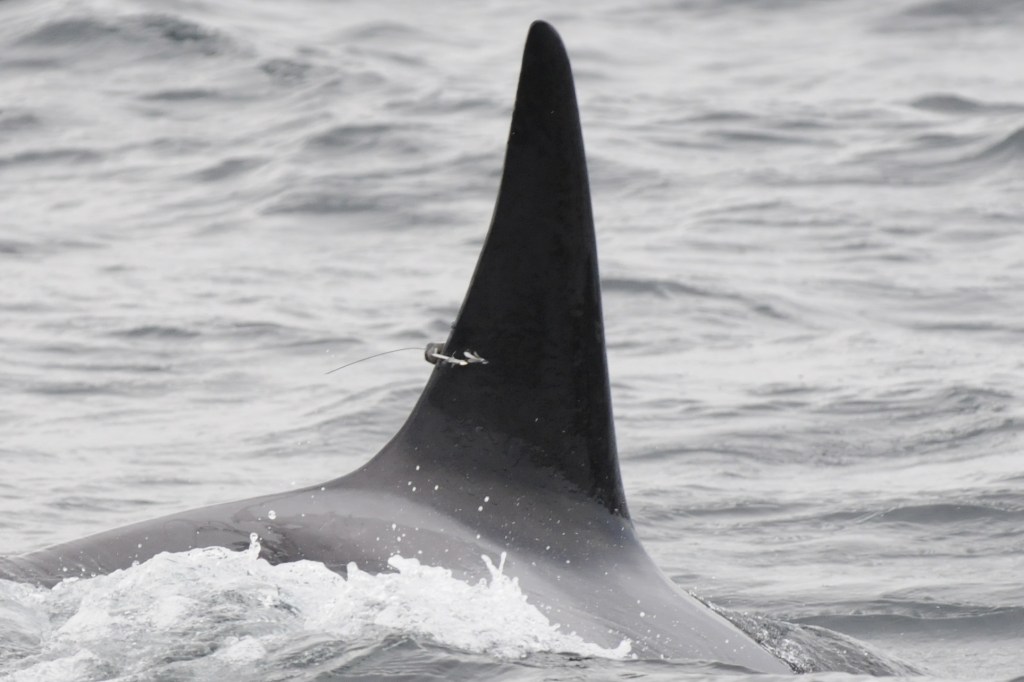
It is my opinion that the tagging cannot provide data that will help reduce the threats of toxin accumulation, prey availability, disturbance or noise so – why do it?  The photos here indicate just how invasive these types of tags are.

Below, I also include a letter from the North Island Marine Mammal Stewardship Association (NIMMSA) in which they powerfully express their concerns about the tagging.

If you too are concerned about the merit of this tagging program, please help in creating awareness. Share this blog on Facebook; do what you want with the images (help them go viral) and provide coment via this link before December 23rd, 2010.

Close up of the tag.

News items and further resources regarding limpet tagging of killer whales:

Humpback Comeback Project – Worth the Vote

Update: See this link for the results of the Humpback Comeback Project in the AVIVA competition.

________________________

In recognition of how important the information was to our Humpback Comeback Project, Jim Borrowman provided us with his photos of a humpback whale entanglement dating back to September 23rd, 1994. This was a time when it was very rare to see humpbacks around N. Vancouver Island (B.C., CANADA) since they had been whaled intensely into the 1950s.

I include one of these images below but be warned that it is very upsetting.  I share it with you as it shows how devastating the threat of getting entangled in fishing gear can be. The photo provides insight into how necessary research into the threat of entanglement is and  . . . how valuable your voting is for the Humpback Comeback Project. (Please click here to place your daily vote so that $25K could be won for humpback entanglement research).

Christie McMillan (colleague in the Project who has expertise in judging the severity of entanglement injuries), concluded that the whale must have been entangled for a considerable time before these images were taken. The evidence of this is that the whale is very thin (emaciated) and its skin condition is very poor, being heavily covered in cyamids (whale lice).

Whale with severe entanglement injuries, 1994. Photo by Jim Borrowman; Stubbs Island Whale Watching; http://www.stubbs-island.com/


Jim Borrowman, Mike Durban and Dave Towers worked together and succeeded in freeing this whale from the lines. This heroic effort served as the inspiration for the children’s book “The Rescue of Nanoose” by Mary Borrowman and Chloe O’Loughlin; illustrated by Jacqueline Wang.

More, larger photos showing the severity of this entanglement at this link.

If you need more background on how to vote for the Humpback Comeback Project , please click here.