Jelly-dwelling Anemone – ingest me and I will eat your gonads
An anemone species that parasitizes the jellyfish that eat them?! Then they move out, drop off and live on the ocean bottom?! And they can also move Spiderman-like from one jelly host to another?!
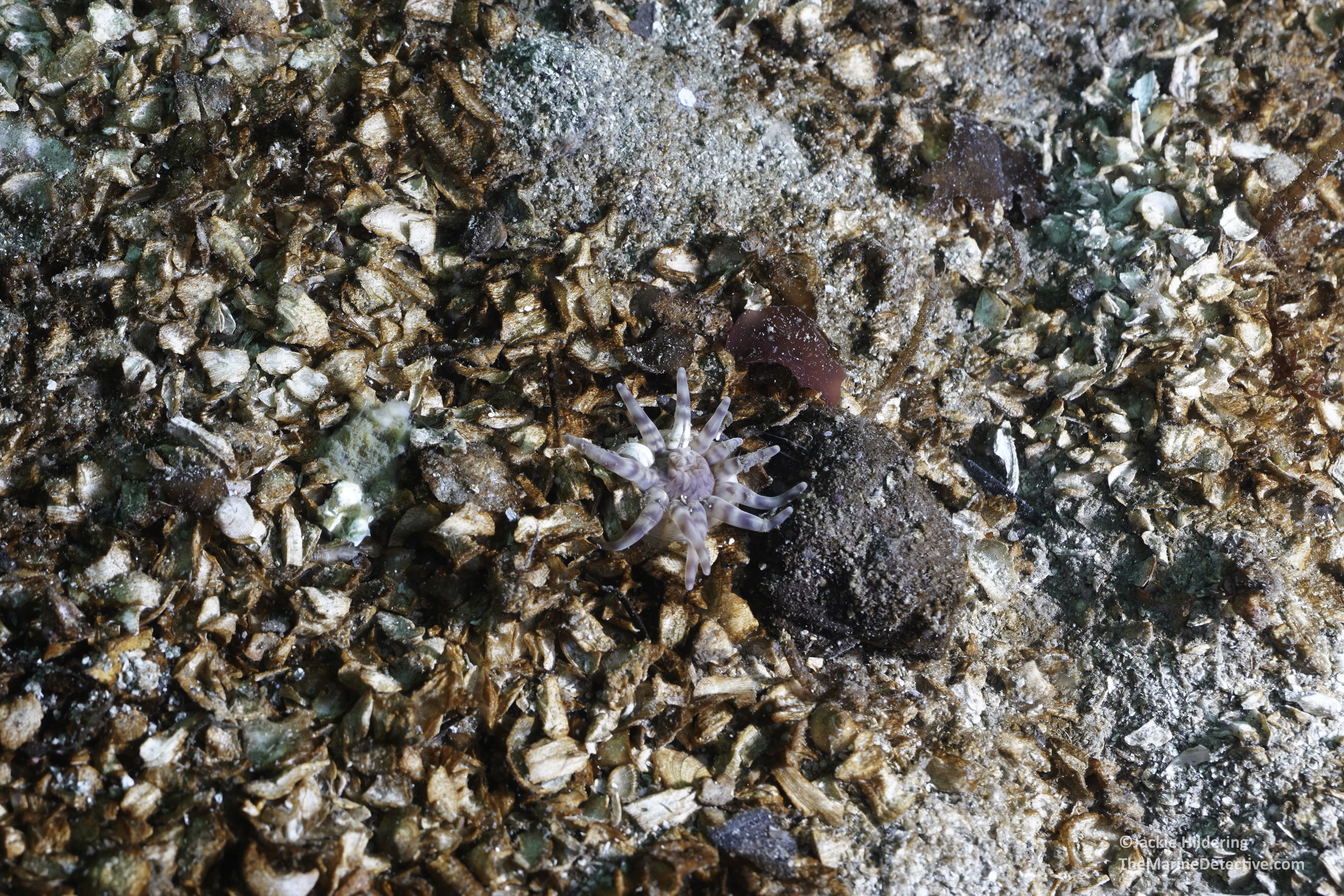
Yes! And in all these years this is the first time I THINK I MAY have photographed a Jelly-dwelling Anemone. They are also known as the Twelve-tentacled Parasitic Anemones and are only up to 2 cm across (Peachia quinquecapitata).
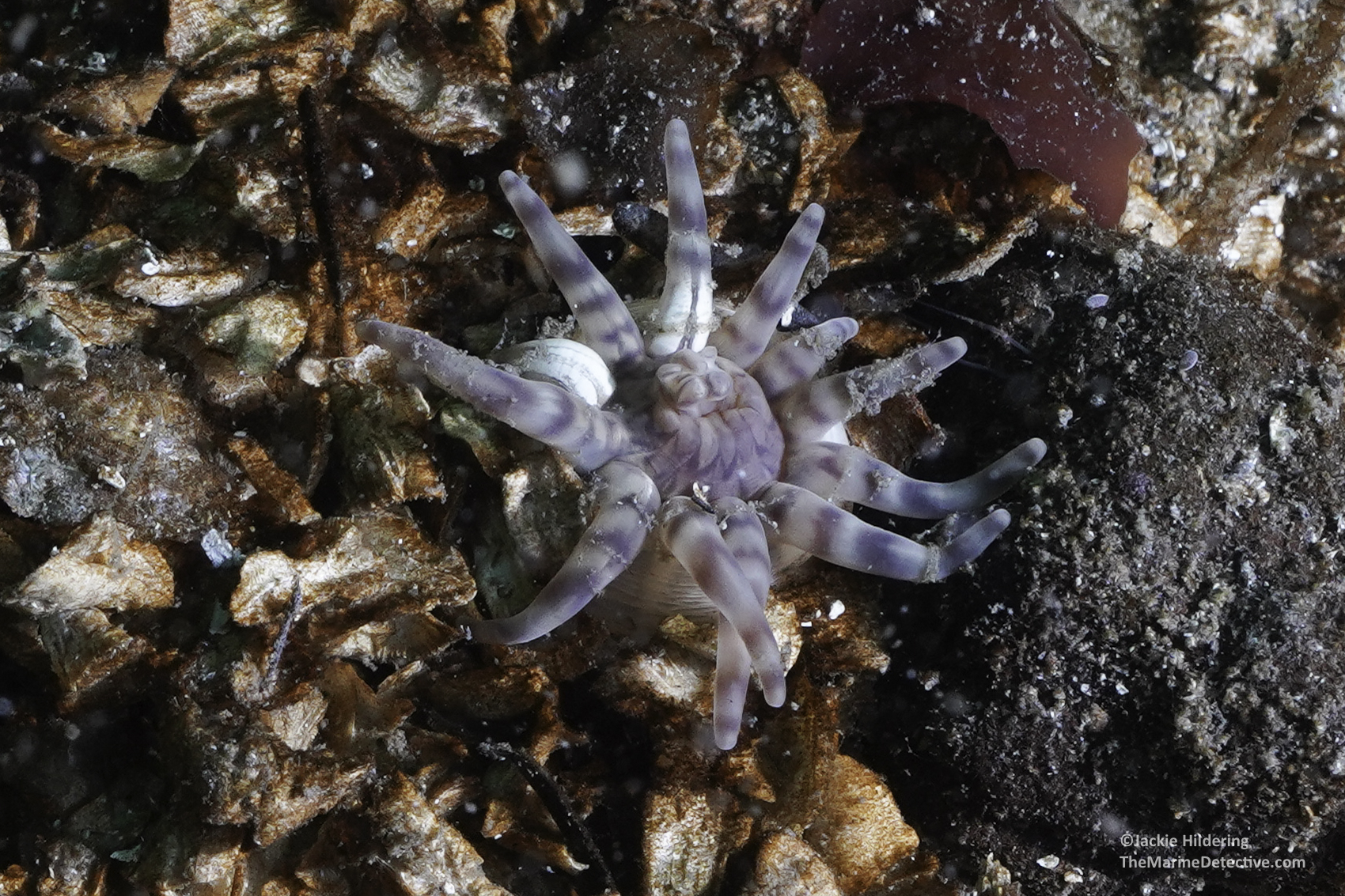
Oh Nature you are so wildly varied and fabulous! Somehow seeing this remarkable little animal with a wicked lifecycle makes me feel better fortified to cope with the human-inflicted wickedness in the world. I hope it does the same for you. 💙
About Jelly-dwelling Anemones from Hanby and Lamb, Marine Life of the Pacific Northwest:
“After the larva of this anemone is ingested by a jelly, the tables are turned as it begins to feed on the host’s internal organs. Eventually, it transforms into an almost transparent anemone that hangs inside the jelly . . . Ultimately the anemone drops off and assumes a bottom-dwelling existence in a mud/sand habitat . . . “


Research by Spaulding published in 1972, reports that in laboratory tests, the larval anemones of this species were endoparasitic for an average of 11 days – feeding on what was in the intestines of the jelly. Then they became ectoparasitic, feeding on the gonads (sex organs) of their host. After an average of 31 days of being ectoparasites they then “had acquired their adult characteristics and dropped off the host medusa to become free-living“.
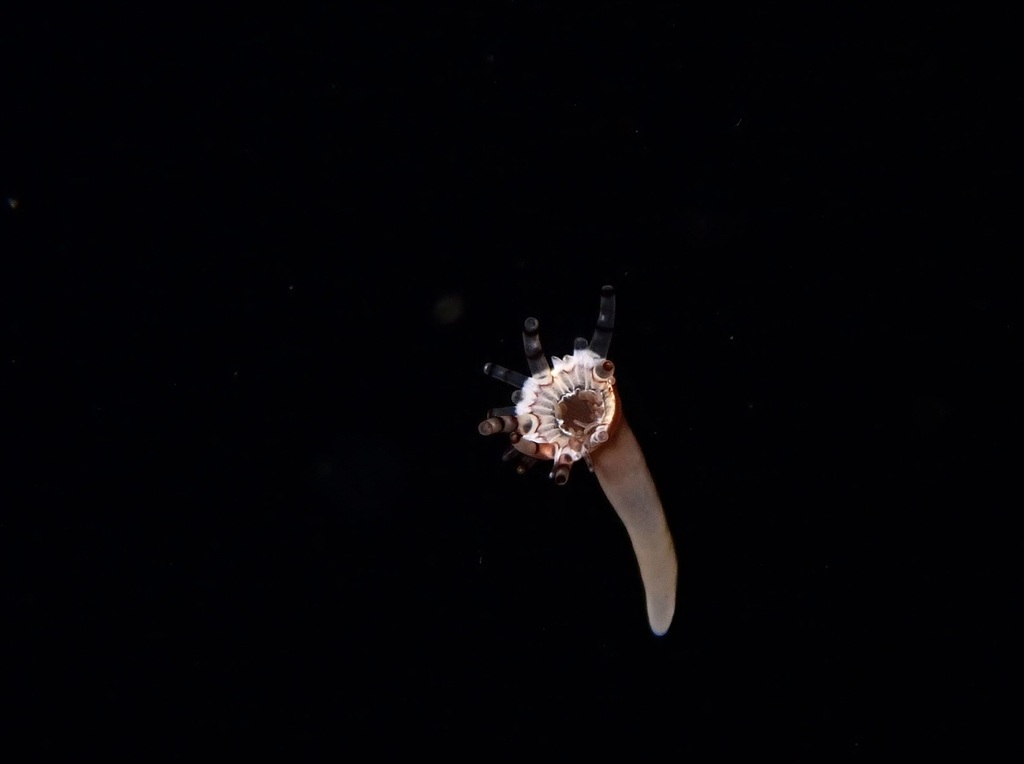
KJ Reed @Leftcoaster via iNaturalist.ca and conditions of the Creative Commons License.
Then there’s this extraordinarily engaging science communication from Dany Burgess for the Washington State Department of Ecology about this species.
Not that I would never say this species, or any other, is a monster 👹. There is nothing for humans to beware when it comes to Jelly-dwelling Anemones. Unless maybe you are living your life on a trajectory where you may get reincarnated as a jellyfish that will have its gonads eaten by this anemone species. If it is possible to sign some humans up for that fate, I currently have a list. You may have the same list.
Beware of cute little monsters:
The jelly-dwelling anemone has a spooky secret . . .
by Dany Burgess
Step aside, Alien. [the northeast Pacific Ocean] has its very own version of this famous parasitic predator, but without the terrifying claws or fangs. Like an eerily adorable child in a horror movie, an innocent-looking exterior hides the sinister intent of this squishy little monster.
Skeletons in the closet
Peachia quinquecapitata sounds like an unassuming name — even charming! But these innocuous anemones have a sordid past, and the road to adulthood is paved with the bodies of those who stood in their way.
Shortly after hatching into the water column, larval Peachia, called planula, are eaten by jellyfish. You’d think this would be the end of the line, but it’s exactly what the baby anemones were hoping for. Instead of getting digested, the planula get comfortable in their hosts’ gastrovascular cavities and help themselves to food particles. Hey, who doesn’t like a safe place to hide, free transportation and a free meal?
Body snatchers
Unfortunately for the hosts, that free meal is just an appetizer. After a few days, the freeloading anemones begin to hunger for the main course — wait for it — the jellyfish’s internal organs. Duhn-duhn-duuuuuuuh! These pint-size parasites start with the reproductive tissue (a single baby Peachia can consume an entire jelly gonad in two days), then move on to other organs for dessert. Yum!
Weird science
This fascinating research on the Peachia life cycle was conducted at Puget Sound’s own Friday Harbor Laboratories, where scientists determined that up to 62% of one host jelly population (Clytia gregaria) was infected with these little leeches each spring. Although the planula may be able to live freely without hosts, when scientists replicated this process in laboratory culture, only the ones that were eaten by jellies survived. An amazing host-swapping behavior was also observed: the anemones were able to fire their stinging cells into new host jellies and make very slow, sticky Spiderman-esque leaps from one bell to the next.
Beg, steal or burrow
After about a month of eating the unlucky jellies from their insides out, the anemones have had their fill. Remember the scene in Alien where the thing bursts out of the guy’s chest? Well, picture something like that, only way less disgusting. Like swollen ticks, the now fat and happy anemones drop off and go on their merry way, settling down on the sea floor and burrowing the long columns of their bodies into the mud.
Not much is known about the fate of the host jellies, but I am guessing that having your organs munched is probably harmful to your health.
Beg, steal or burrow
After about a month of eating the unlucky jellies from their insides out, the anemones have had their fill. Remember the scene in Alien where the thing bursts out of the guy’s chest? Well, picture something like that, only way less disgusting. Like swollen ticks, the now fat and happy anemones drop off and go on their merry way, settling down on the sea floor and burrowing the long columns of their bodies into the mud.
Not much is known about the fate of the host jellies, but I am guessing that having your organs munched is probably harmful to your health.
Homebodies
After spending their childhoods wreaking youthful havoc on other living creatures, Peachia adults assume new peaceful identities as model citizens. Occurring in the shallow subtidal zone of the Pacific Northwest, they spend their time with their 12 tentacles splayed out on the surface, passively waiting for food to drift by. A closer look reveals that their striped pattern is made up of delicate chevrons — very on-trend with the interior decorating crowd.
Living hand to mouth
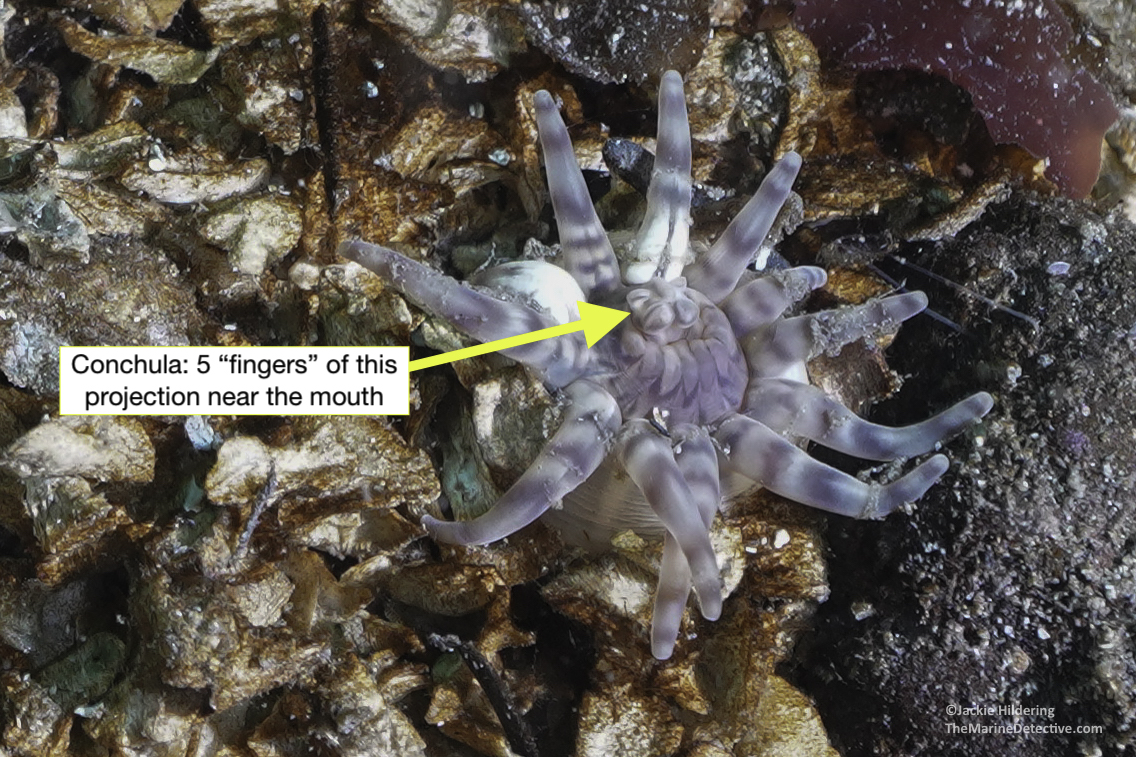
The taxonomy crowd might appreciate Peachia for a different stand-out feature, called the conchula: a projection near the mouth that functions in feeding, and is unique to this genus. In Peachia quinquecapitata, the conchula is divided into five distinct finger-like lobes, almost like a miniature hand. And I have to hand it to these mini moochers…they definitely get away with biting the hand that feeds them!”
Sources:
- Handby and Lamb, Marine Life of the Pacific Northwest
- iNaturalist – Twelve-tentacled Parasitic Anemone
- Spaulding, J.G., 1972. The life cycle of Peachia quinquecapitata, an anemone parasitic on medusae during its larval development. Biol. Bull. 143 2: 440-453.
- Washington Department of Ecology, Beware of cute little monsters: The jelly-dwelling anemone has a spooky secret









 Sources:
 The Marine Detective