Here’s a tale of two octopuses, recounted from a recent dive.
But first a little background:
Giant Pacific Octopuses must see we human divers, far, far, FAR more often than we see them. They are so good at camouflage!
There are sometimes good clues they are near.
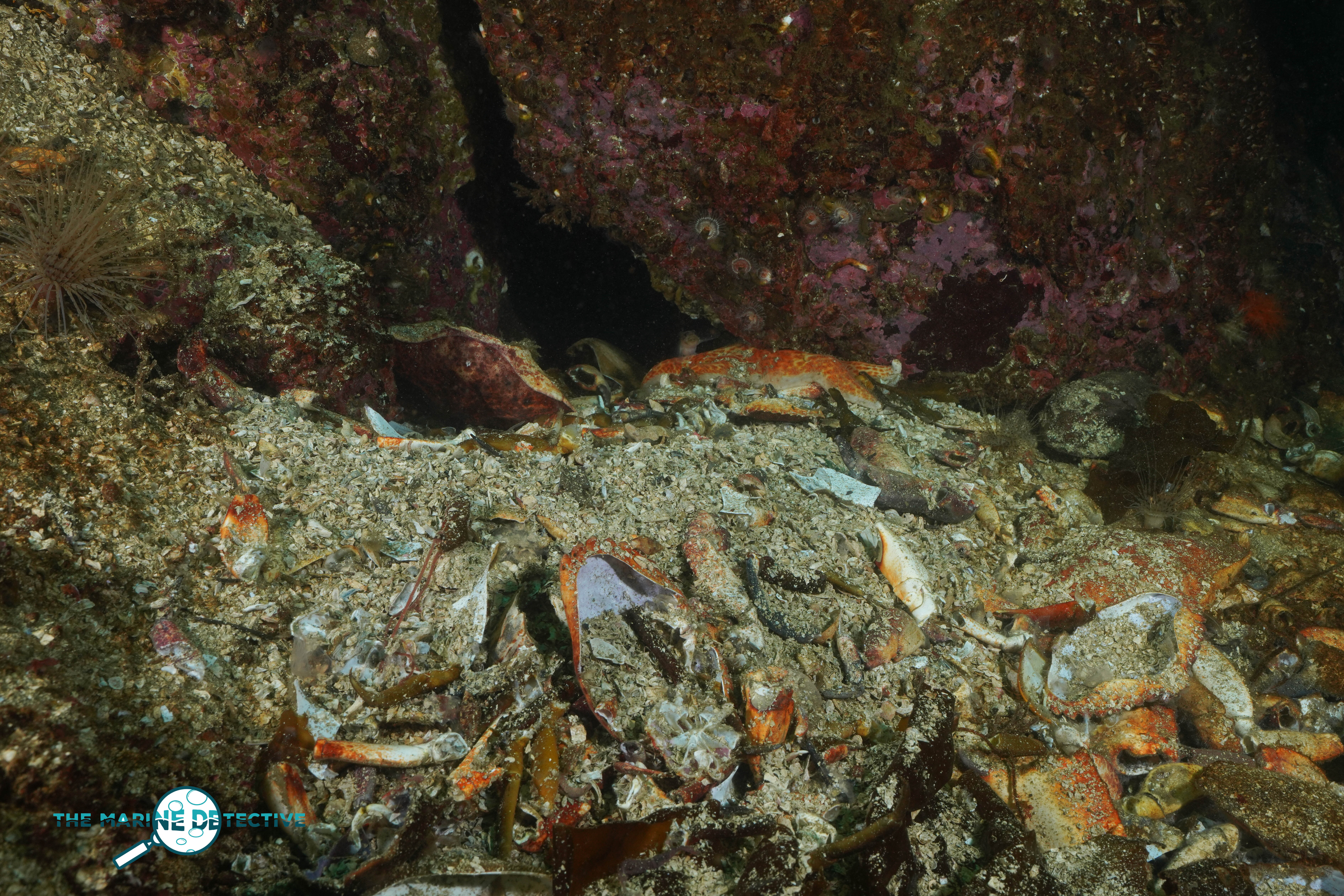
A really helpful clue is that their homes (dens) have the remains of their dinners thrown out in front i.e. middens of shells from crabs and bivalves like scallops.
The area in front of a Giant Pacific Octopus’ den who has clearly been eating a lot of scallops! And the Giant Pacific Octopus who lives in this den has clearly been eating a lot of Red Rock Crab.
If the octopus is shedding their suckers, you will also have the clue of seeing little “flakes” coming from the den. See my blog about that at this link.
They are of course easier to see if on the move. When a Giant Pacific Octopus is hunting, there sometimes is an entourage of rockfish too, hoping to benefit when the octopus flushes out the other fish and shrimp from between rocks.
See the Copper Rockfish on the right? This fish was following this female Giant Pacific Octopus around as she hunted.
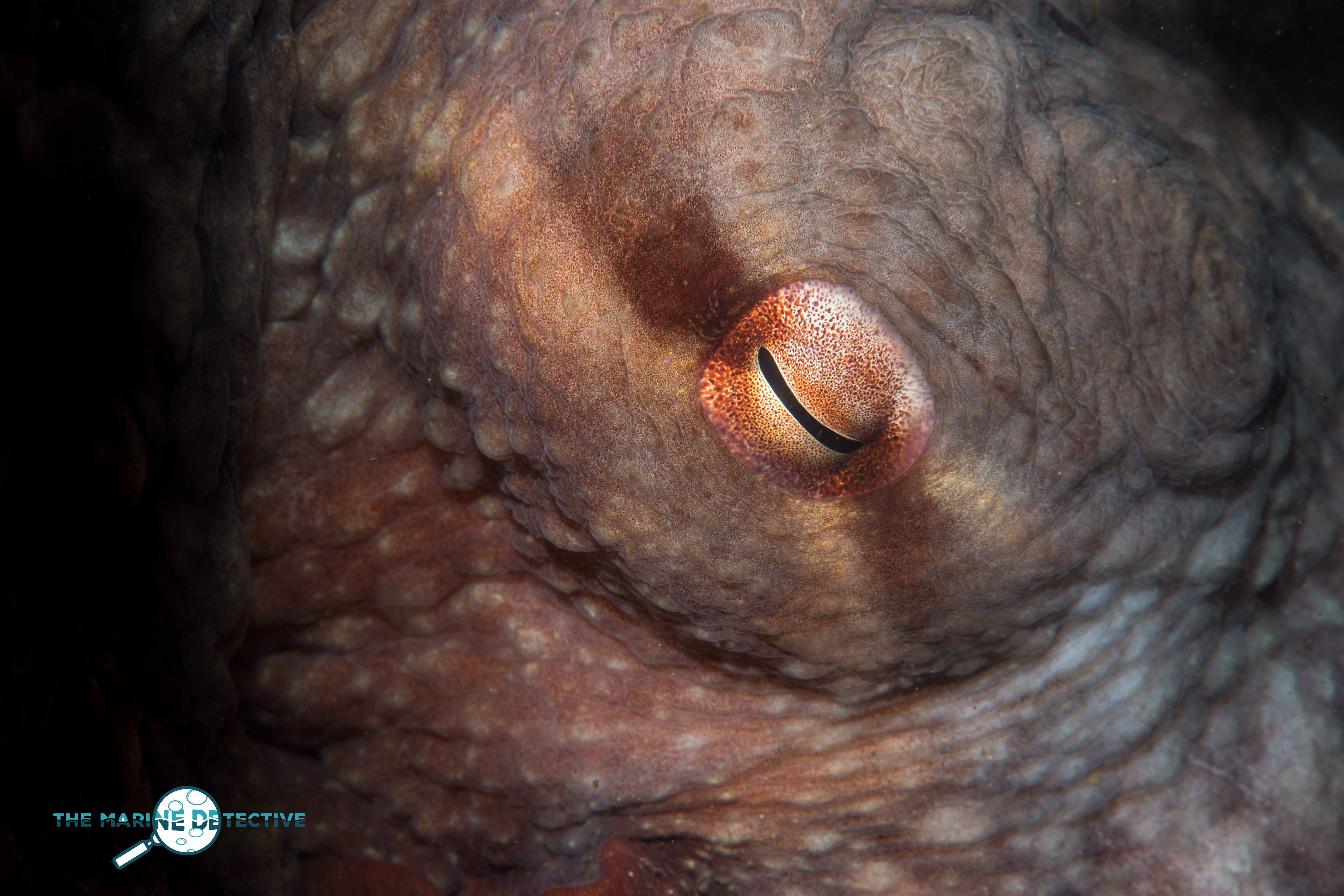
But otherwise, you just have to have the luck to realize the rock you are looking at has eyes with remarkable pupils.
Giant Pacific Octopus eye with the pupil constricted due to my light. I took the photo with a zoom lens when this octopus was in her den.
Now the tale of two octopuses on one dive:
Now that I’ve emphasized how difficult it can be to detect an octopus, let me share the joy of seeing two Giant Pacific Octopus within 5 minutes.
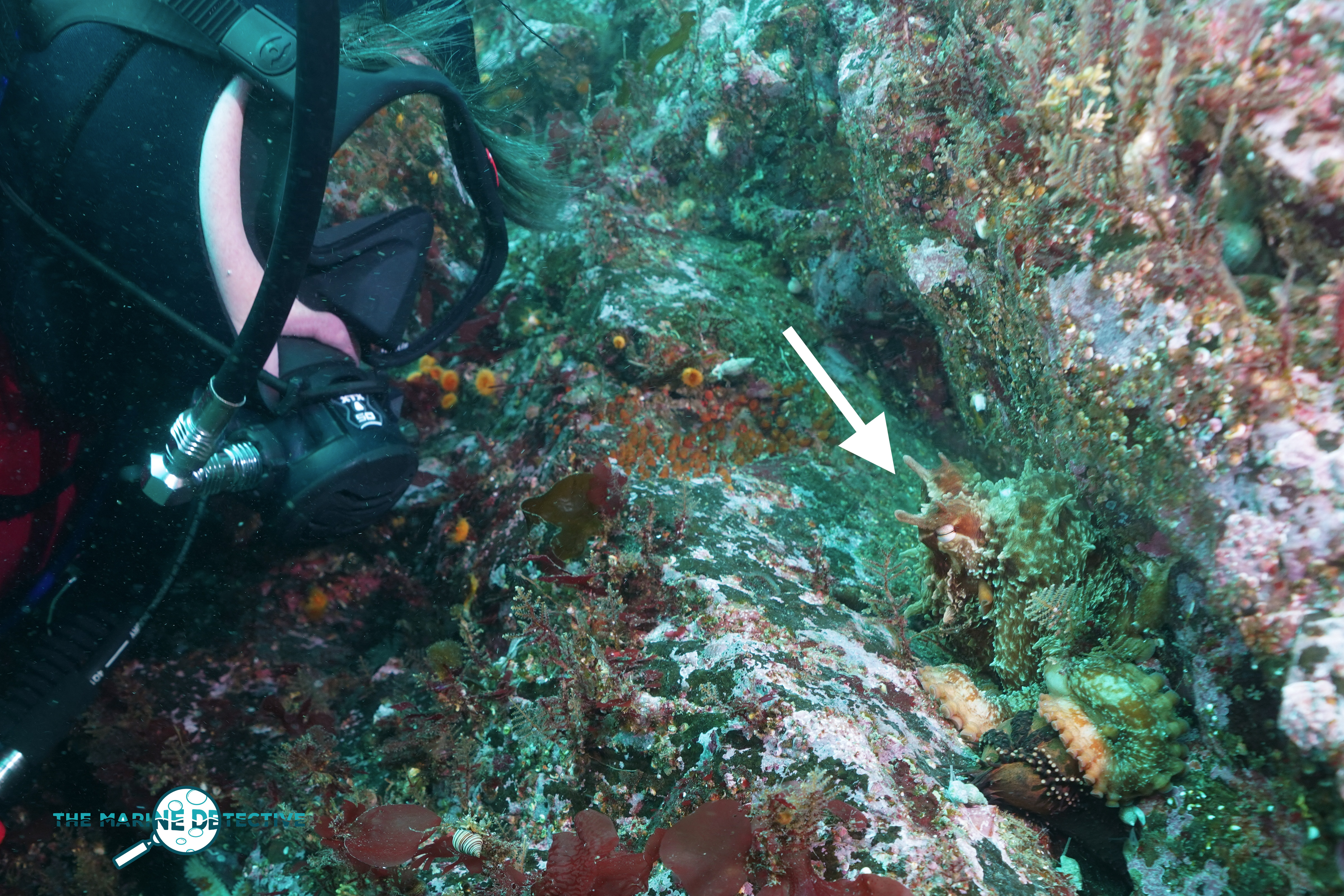
Octopus #1 was out on a ledge. You can see how small this one is from the relative size to my dive buddy, Natasha.
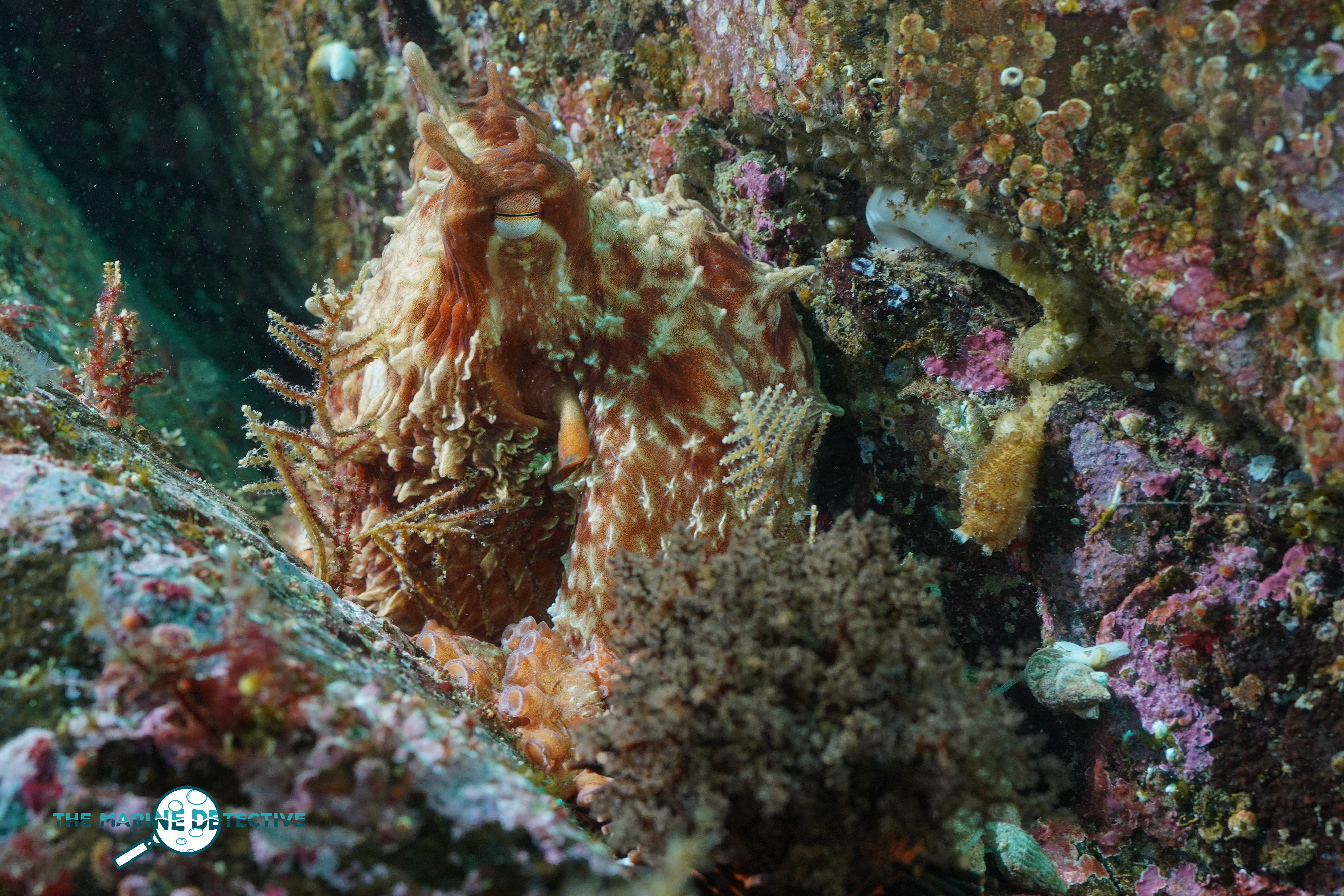
See the small Giant Pacific Octopus? The same little Giant Pacific Octopus.
I saw Octopus #2 about 4 minutes after seeing the first octopus. We were still blissed out from that encounter. Then, I saw a big arm reach for a Kelp Greenling (fish).
I think I may have shouted in surprise. The fish darted away because of my reaction I think. I am truly sorry dear octopus for spoiling your dinner. I didn’t mean to!
This Giant Pacific Octopus remained motionless other than their siphons (vents) opening and closing to breathe, billowing water in and out.
Giant Pacific Octopus #2
I got lost for a little while in trying to capture the beauty of this giant and their environment – Black Rockfish swimming above, the pink crusts of coralline algae, Orange Cup Corals, a hermit crab, Wrinkled Amphissa snails.
Time and air passed a lot faster than I realized, or wanted. To the surface, we needed to go. I left wondering when I would next see a Giant Pacific Octopus out in the open again. The Giant Pacific Octopus was probably left hoping some weirdo-looking creature doesn’t spoil their dinner again.
Octopus #2 tolerating my presence.
About estimated Giant Pacific Octopus growth rate: When they hatch from eggs as plankton, they are about the size of a grain of rice. They have to grow incredibly quickly to become giants, only having a lifespan of about 3 years. From Jim Cosgrove and Neil McDaniel’s great book “Super Suckers”: They start at ~0.03 grams (0.0011 oz) and grow to 20–40 kg (44–88 lb) at adulthood = an increase of around 0.9% per day.
Photos of the two Giant Pacific Octopuses are from a dive on April 11, 2023, Browning Pass when with God’s Pocket Resort. On this dive, I had even more gratitude than usual for my dive buddy Natasha Dickinson. I’ve been having big problems with the strobes of my camera and she helped by providing lighting for these photos.
I’ve wanted to write a blog about chitons for so long because, they are wondrous and . . . we need wonder.
If you are fortunate enough to live near the Ocean, chitons are there, on rocks right in the intertidal zone, descendent from ancestors that date back ~500 million years. Chitons are in fact referenced as living fossils since their body design has not changed significantly for more than 300 million years.
Other members of this class are found at great depth. There are about 1,000 species worldwide with 50 known to live in the range from Baja California, Mexico to the Aleutian Islands, Alaska.
What makes them unique among molluscs (the soft-bodied invertebrates) is that while some molluscs have no shell (octopuses, squid and sea slugs); and some molluscs have one shell (snails, abalone and limpets); and some molluscs have two shells (clams and oysters) . . . chitons went their own way to all have EIGHT shells, known as plates.
This is reflected in the name of the class to which they belong – the “Polyplacophora” which translates into “many plates” in Greek. Oh and “chiton” also reflects that they have multiple shells. Chiton is Greek for “coat of mail”. Chiton is pronounced “ky-ton” by the way.
Chiton anatomy – diagram retrieved from this source.
But all the preceding information about chitons is what you could read in a field book. Let me share the wonder of chitons with you as it has awakened in me, taking my appreciation far beyond the limits of drawings and words in biology textbooks.
Chitons are THIS.
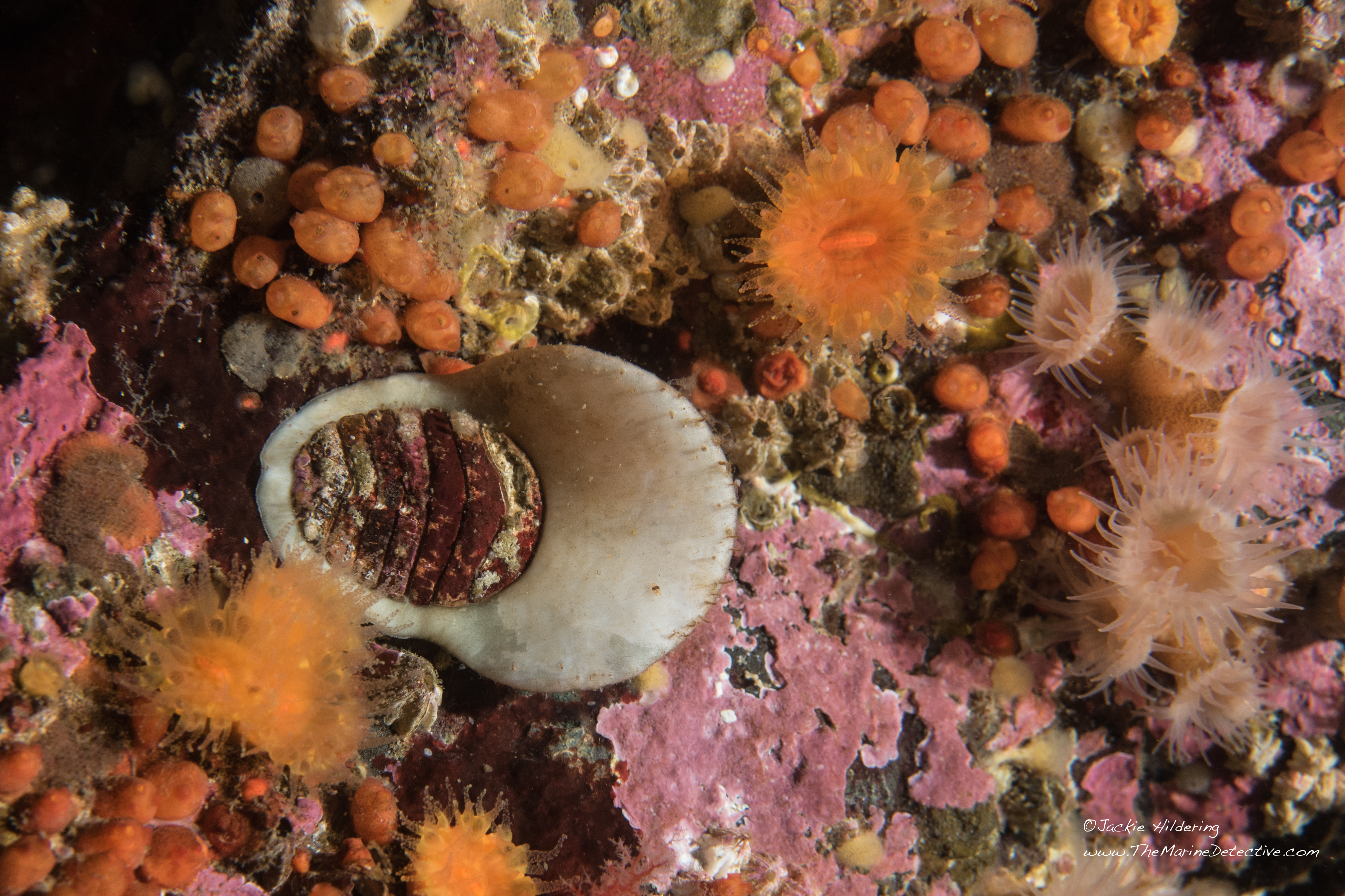
Lined Chiton – Tonicella lineata to 5 cm long. This is also the species in the photo at the top of this blog item. There’s such diversity in the colour of this species!
And THIS
Believe this one is a Blue-line Chiton – Tonicella undocaerulea to 5 cm long.
And THIS
Woody Chiton – Mopalia lignosa to 8 cm long.
And THIS
Black Katy Chiton aka Black Leather Chiton – Katharina tunicata to 15 cm long.
And THIS
Red Veiled-Chiton (Placiphorella rufa to 5 cm long) – unique amongst chitons in how it feeds. Most chitons graze, scraping algae off rocks with their radula (see video at the end of this blog). However, Veiled Chitons are carnivores! When an animal wanders under their veil, this triggers the veil to drop and then . . . lunch. You can see how quickly that happens in the video at the end of this blog.
Veiled Chiton – Placiphorella velata to 6 cm. Soft coral is growing on top of the Chiton.
By having eight plates and a band of muscle (the girdle) chitons are flexible and can secure themselves really well to uneven or curved surfaces. This is very different from molluscs like limpets. With their single shell, they have to be on a very flat surface to be secure, and therefore safe from predators.
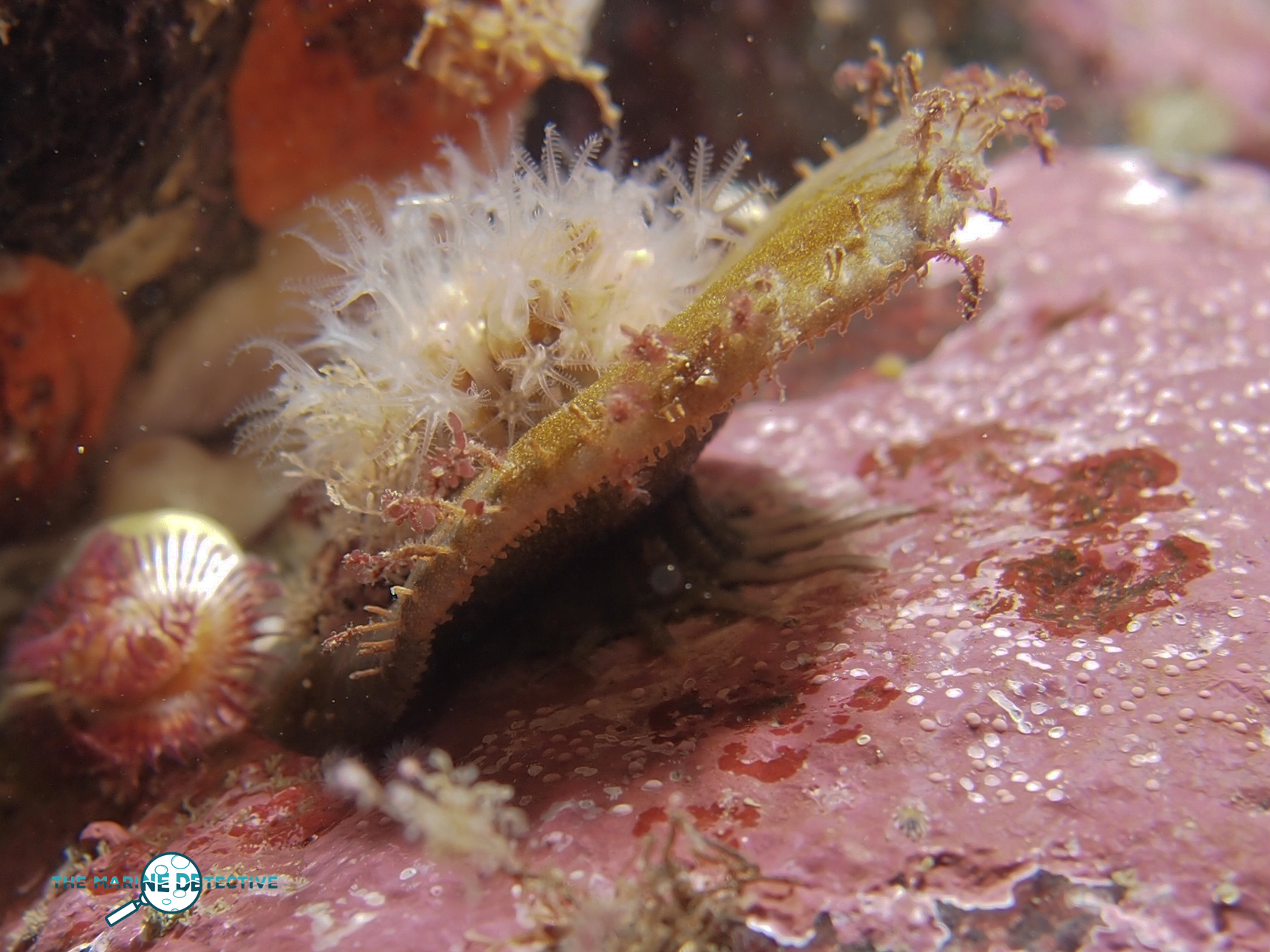
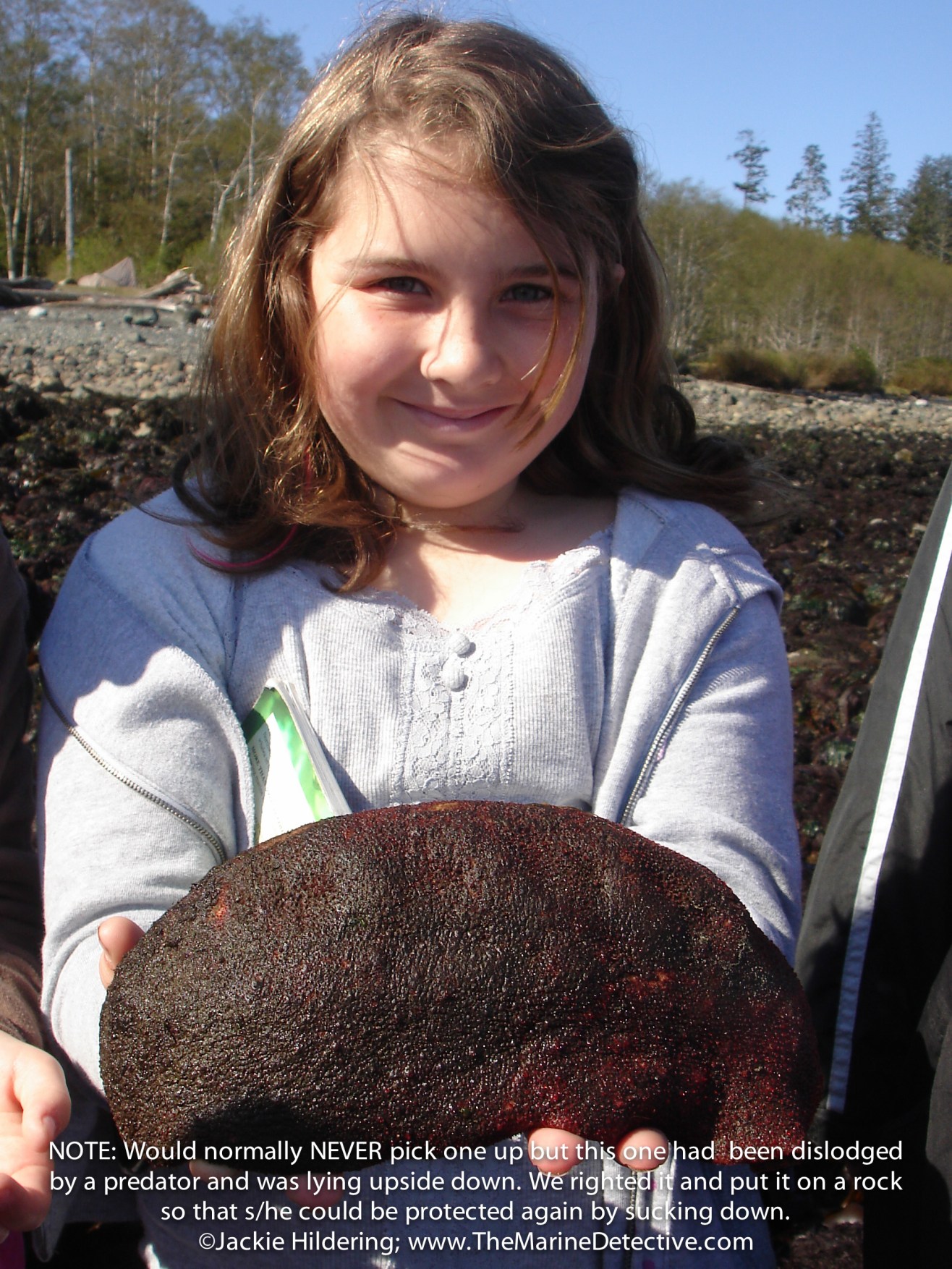
In most species of chiton, you can see the eight plates. The exception is the giant in the group – the Gumboot Chiton aka the Giant Pacific Chiton. In this species, the girdle fully covers the plates.
See the photo below and my blog dedicated to Gumboot Chitons at this link. That blog includes photos of their “butterfly shells” and video of Gumboot Chitons spawning. Yes, you can then discern males from females!
Gumboot Chitons are another species in these rich waters that are the “biggest of their kind in the world”. The maximum size of Cryptochiton stelleri is reported to be 35 cm!
The plates on the right are from a Gumboot Chiton.
Nature once presented me with the following opportunity to take a picture that shows the diversity of molluscs. I did not move the species into the positions you see in my photo below.
Mollusc biodiversity 1. Keyhole Limpet, protected by its single-shelled cap and by sucking down on flat surfaces. This individual is in a precarious position for predation because it is not secured to a flat surface. 2. Wrinkled Amphissa Snail, protected by its single shell and a keratinous “trapdoor” (operculum) that seals the shell. 3. Pomegranate Aeolid (nudibranch species), with no shell but protected by the stinging cells obtained from its prey – the Raspberry Hydroid. 4. Blue-Line Chiton protected by its eight shell plates and a strong band of muscle that lets it solidly adhere to non-flat surfaces.
These extraordinary animals are not jellyfish. In fact, they are more closely related to you than they are to jellyfish.
These are salps. They are planktonic tunicates with an astounding lifecycle and whose importance includes cycling of nutrients and reducing carbon.
Natasha Dickinson and aggregate form of Salpa aspera. Natasha was my dive buddy on the dives I reference here. We were diving with God’s Pocket in Browning Pass. Photo: Jackie Hildering.
When diving this past April, we happened to be in a bloom of the salp species “Salpa aspera“.
It was truly mind-rupturingly, staggeringly astounding to be carried in the current with so many chains of clones snaking by (they are jet propeled). Yes, I had to make up a new adverb just for this experience!
The stomach is the dark, circular organ you see in each individual in the chain (aggregate).
We also saw an individual break from the chain and move independently! More on that below.
Male Kelp Greenling nipping at Salp aspera. We also saw multiple rockfish species feed on them. Seastar species here is a Striped Sun Star. Photo: Jackie Hildering
Which species of salp?
I did not know which species of salp was all around me. Thankfully, I was able to tap into expertise far greater than my own. Moira Galbraith, Zooplankton Taxonomist with the Institute of Ocean Sciences, very generously shared her knowledge when I sent her my photos, euphoric observations, and request for an ID.
Moira’s answer to my ID request: “By the size of the stomach and placement (red/green ball), the shape of the ganglion (the c-shape you can see at opposite end from the stomach) and the short projections along where the individuals are attached to each other; I would say that this is Salpa aspera. These have been washing up on beaches off the west coast of Vancouver Island. . ..
Each individual takes in water through the front and channels it out the back. There are muscles bands along the body which create a pulse or pump. Food is taken from the incoming stream and diverted to the stomach. The water going out the back allows the animal to propel itself through the water. Chains work together making it look like a snake or an eel moving through the water.”
Importance?
Salps can grow and reproduce VERY quickly when conditions are right. They are one of the fastest growing multicellular animal on Earth.
Salps are also big zooplankton.
As a result of their size and number, a whole lot of water gets filtered and the poop that comes out is bigger than the plankton that got consumed. These big “fecal pellets” sink and transport nutrients.
If the fecal pellets make it to the bottom of the ocean, they could carry carbon away from where it will enter the atmosphere. Further, when salps die, their bodies also sink quickly and could thereby remove more carbon from entering the atmosphere.
Source: Nereus Program
Lifecycle:
The chains are the “aggregate” form of the salp lifecycle. They are all female clones.
A male individual fertilizes the aggregate.
The females break-off from the aggregate and release a single embryo. The solitary females then go on to develop testes, become males and fertilize the aggregates.
Whoa! Imagine how astoundingly it was for us to watch an individual break from the aggregate and then move independently. If I understand the lifecycle properly, this would have been a female with an embryo.
Salp lifecycle. – alternation of generations where the asexually reproducing form makes the sexually reproducing form. Source: Henschke et al. Salpa aspera aggregate and the individual in the video (on the bottom left). All the pink animals on the ocean bottom are Great Winged Sea Slugs and their egg masses!
Range: Salpa aspera is “circum-(sub)tropica”l between 45° north and 45° south.
More information:
Madin et al., 2006: “Development of such large populations is presumably made possible by the high rate and efficiency of filter feeding by salps, their rapid growth and their alternation of sexual and asexual reproduction. These characteristics permit a rapid population response by salps to favorable food availability, such as may result from seasonally high phytoplankton productivity in oceanic regions of water mass intrusions and mixing along fronts. In some locations, high population densities of salps can be produced in as little as a few weeks.”
Woods Hole Oceaonographic Institute: “From their clear, blob-like appearance, you’d be forgiven for mistaking the salp for a jellyfish. But it turns out that these gelatinous zooplankton actually are more closely related to humans than to brainless jellyfish. Unlike the jellyfish, salps (and humans) boast complex nervous, circulatory and digestive systems, complete with a brain, heart, and intestines.
Salps use jet propulsion to efficiently glide through the ocean. They’re great at multitasking: while expanding and contracting their muscles to move, they’re also pumping phytoplankton-rich water through their feeding filters, taking in the nutrients they need to survive . . . .
When food is plentiful, they can quickly create more chains, and each salp can increase rapidly in size. This superpower makes them one of the fastest-growing multicellular animals on Earth. Like all good things, the salp bloom comes to an end when all their available food is consumed.
Found throughout the world ocean, salps play an essential role in the ocean’s biological pump. Because they feed on phytoplankton—which grow in the presence of sunlight and carbon dioxide—salp poop is extremely rich in carbon. When these fecal pellets (and dead salps) fall to the seafloor or are snapped up by other twilight zone creatures, it’s like putting carbon into a bank vault.
The carbon remains at the bottom of the ocean for years, if not centuries, helping regulate our climate. Scientists don’t yet have an accurate assessment of how changes in salp numbers and distribution could affect the ocean’s carbon cycle—and impact climate change—but it’s clear that these critters play an important role.”
New York Times article about the research of Sutherland and Welhs (2017).
[Note that this research was on two different species of salp.]
“Meet the salp. It typically lives in deep waters, where its barrel-shaped body glides around the ocean by jet propulsion, sucking in water from a siphon on one end and spitting it back though another. It swims alone for part of its life. But it spends the rest of it with other salps, linked together in chains arranged as wheels, lines or other architectural designs . . .
Over years of watching them swim in chains, she [Dr. Sutherland] made a surprising discovery. They synchronize their strokes when threatened by predators or strong waves and currents. But while linked together in day-to-day life, each salp in the chain swims at its own asynchronous and uncoordinated pace. Counterintuitively, this helps salps that form linear chains make long nightly journeys more efficiently.
The life story of the sea salp is peculiar. Each one starts life as a female, then switches to male . . .
Making chains is part of their life cycle, and if these chains break, they don’t link back together. Each salp lives only a few days or a month in two stages: solitary, and in a colonial chain. A solitary salp gives rise to a colony of genetically identical salps asexually. The salps are connected in a chain that starts as a coil around the solitary salp’s gut. It grows over time and eventually breaks free, the beginning of the colony phase. Each individual within the chain will reproduce sexually. Through spawning, a male’s sperm reaches a female’s egg, forming a baby solitary salp that eventually swims out of its parent. “That solitary will make a chain and so on,” said Dr. Sutherland. It’s a chicken-or-the-egg kind of situation.
Perhaps to enhance a salp’s reproductive success, many salps migrate vertically, from the deep sea toward its top at night and back down during the day. At the surface, they can congregate with a greater chance that the sperm of one hits an egg of the same species.
And salps in linear chains are particularly skilled at this migration, traveling thousands of feet each night, at speeds around 10 body-lengths a second. “That’s like running a marathon every day,” said Dr. Sutherland.
You might think that fast synchronized, coordinated swimming strokes would be the way to make that happen. But each salp in the chain pumps to the rhythm of its own built-in pacemaker.
The resulting swim isn’t as fast, but it’s smooth and sustainable, with less interference from the wakes made by individuals. It’s like the difference between a Porsche and a Prius, said Dr. Sutherland. A Porsche can accelerate quickly to top speeds, but a Prius is more fuel-efficient.”
Sources: Henschke N, Everett JD, Richardson AJ, Suthers IM. Rethinking the Role of Salps in the Ocean. Trends Ecol Evol. 2016 Sep;31(9):720-733. doi: 10.1016/j.tree.2016.06.007. Epub 2016 Jul 18. PMID: 27444105.
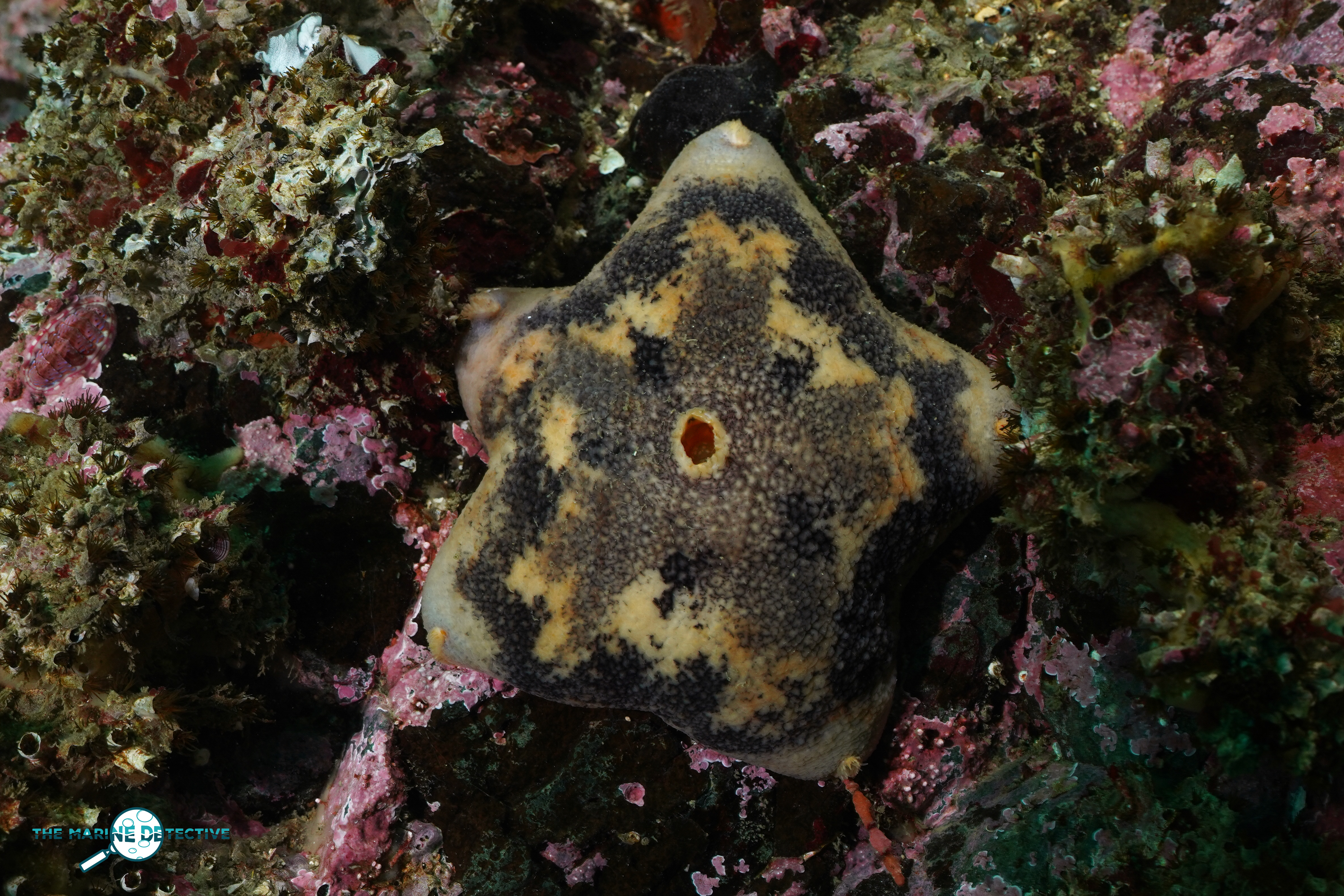
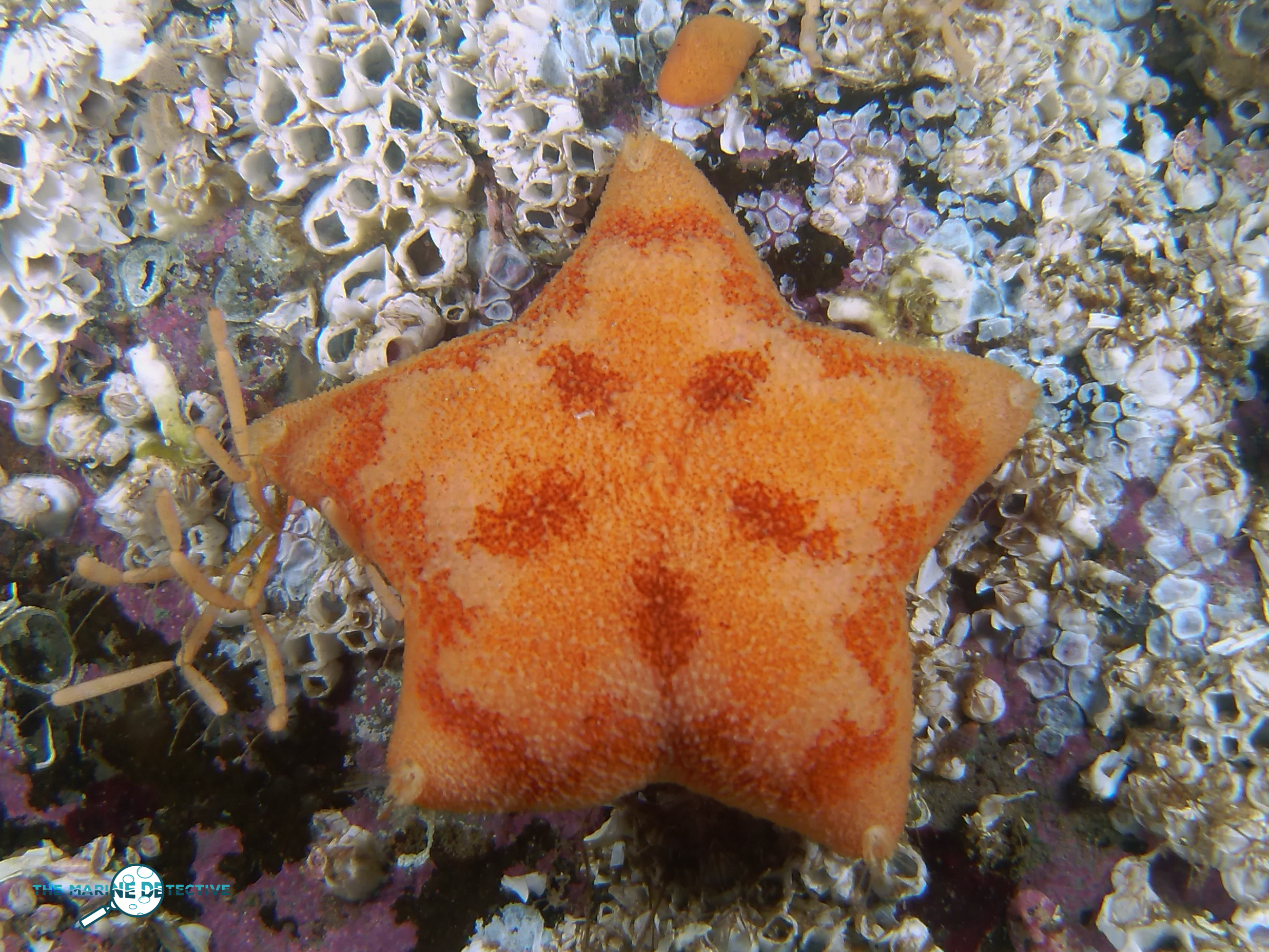
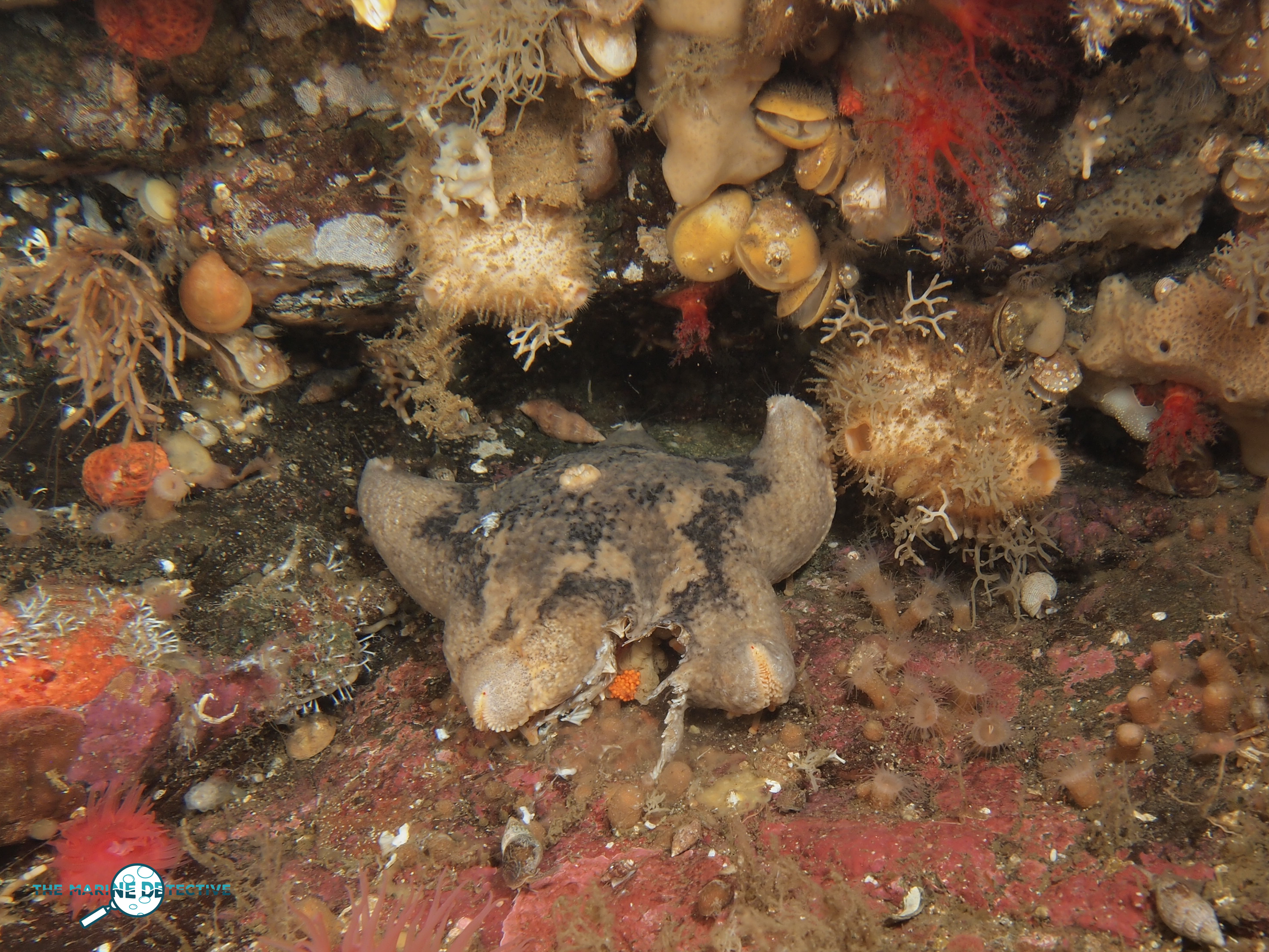
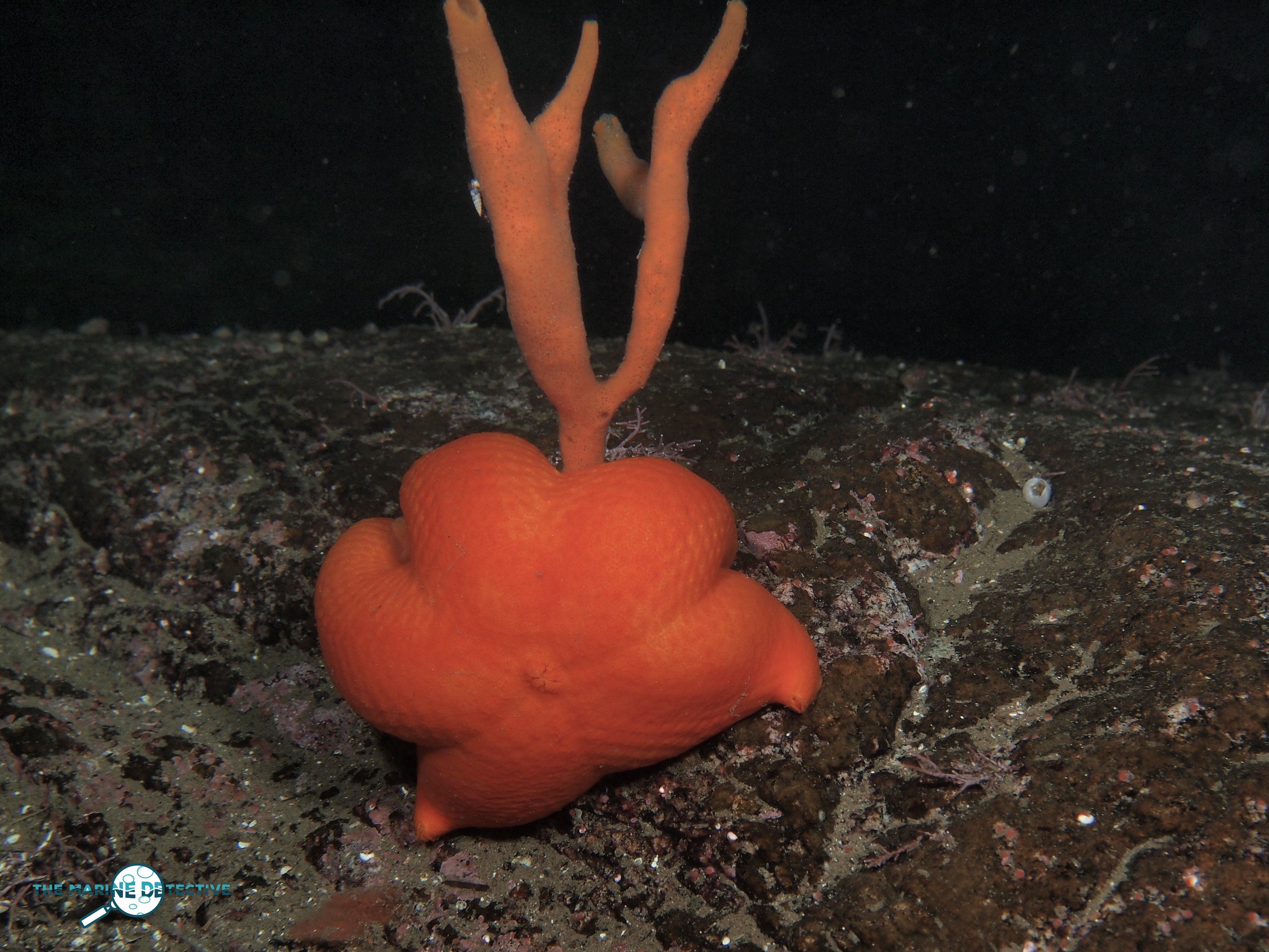
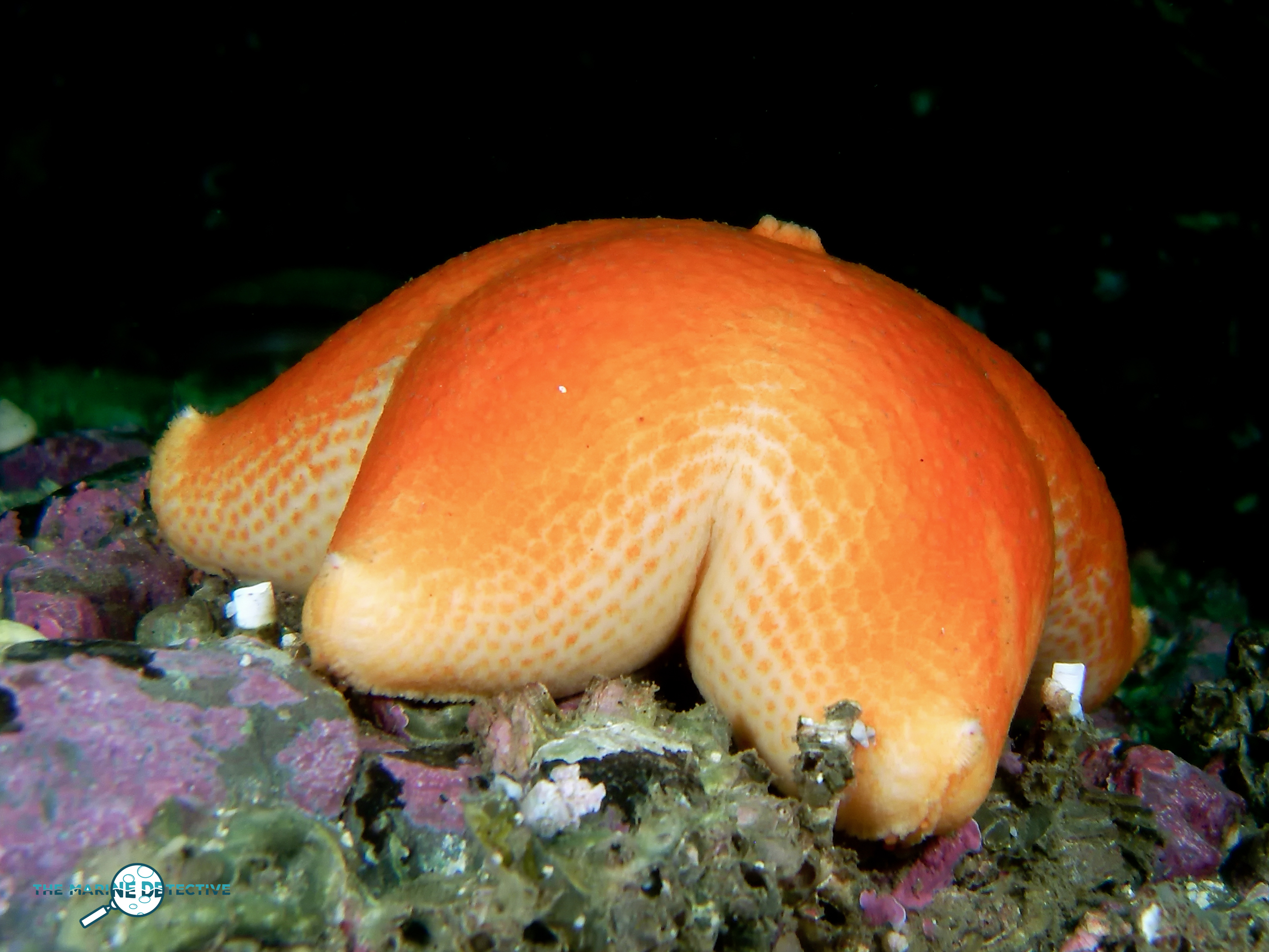
Did you know about the species of sea star in our waters that releases slime to deter predators?
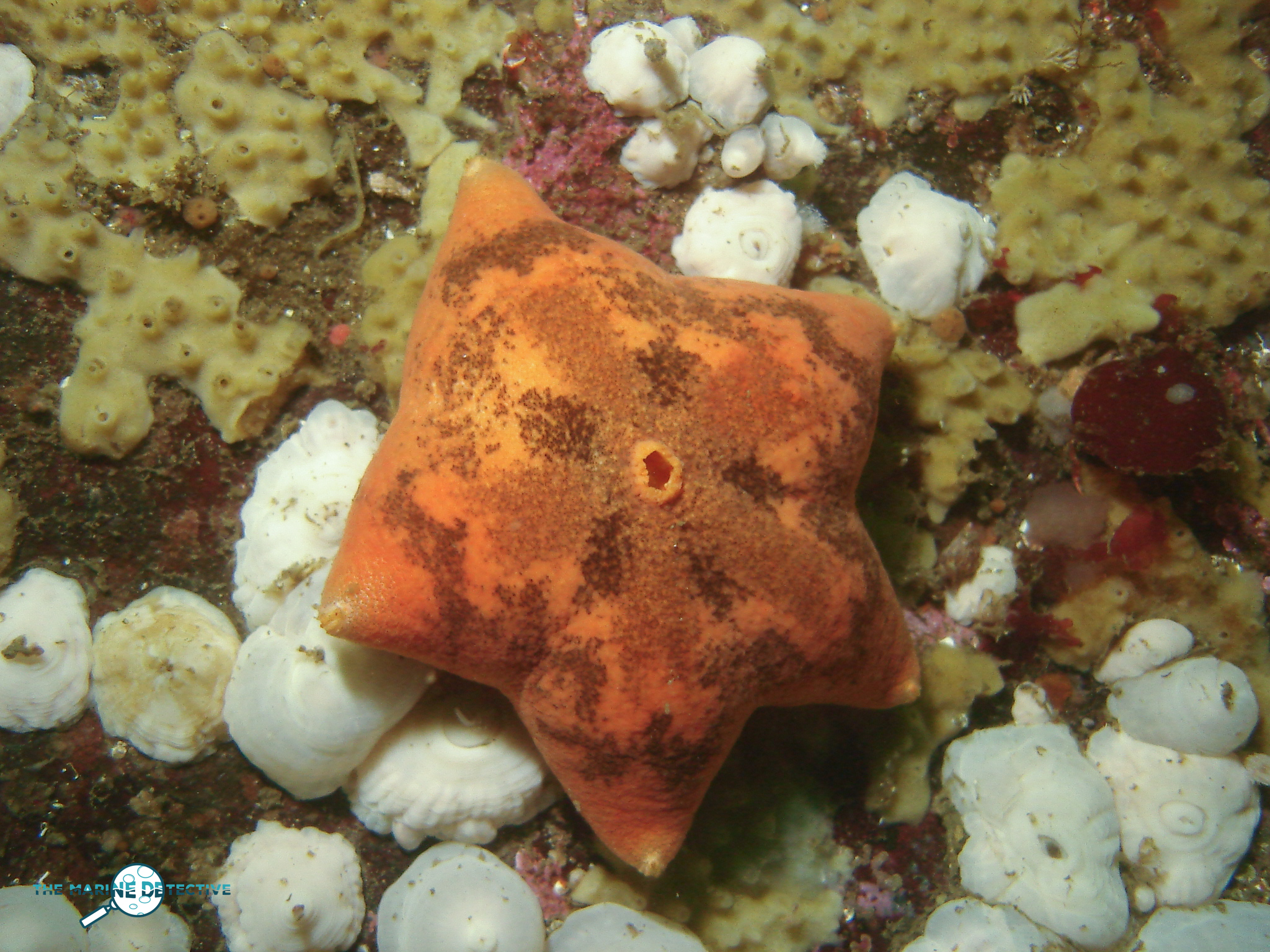
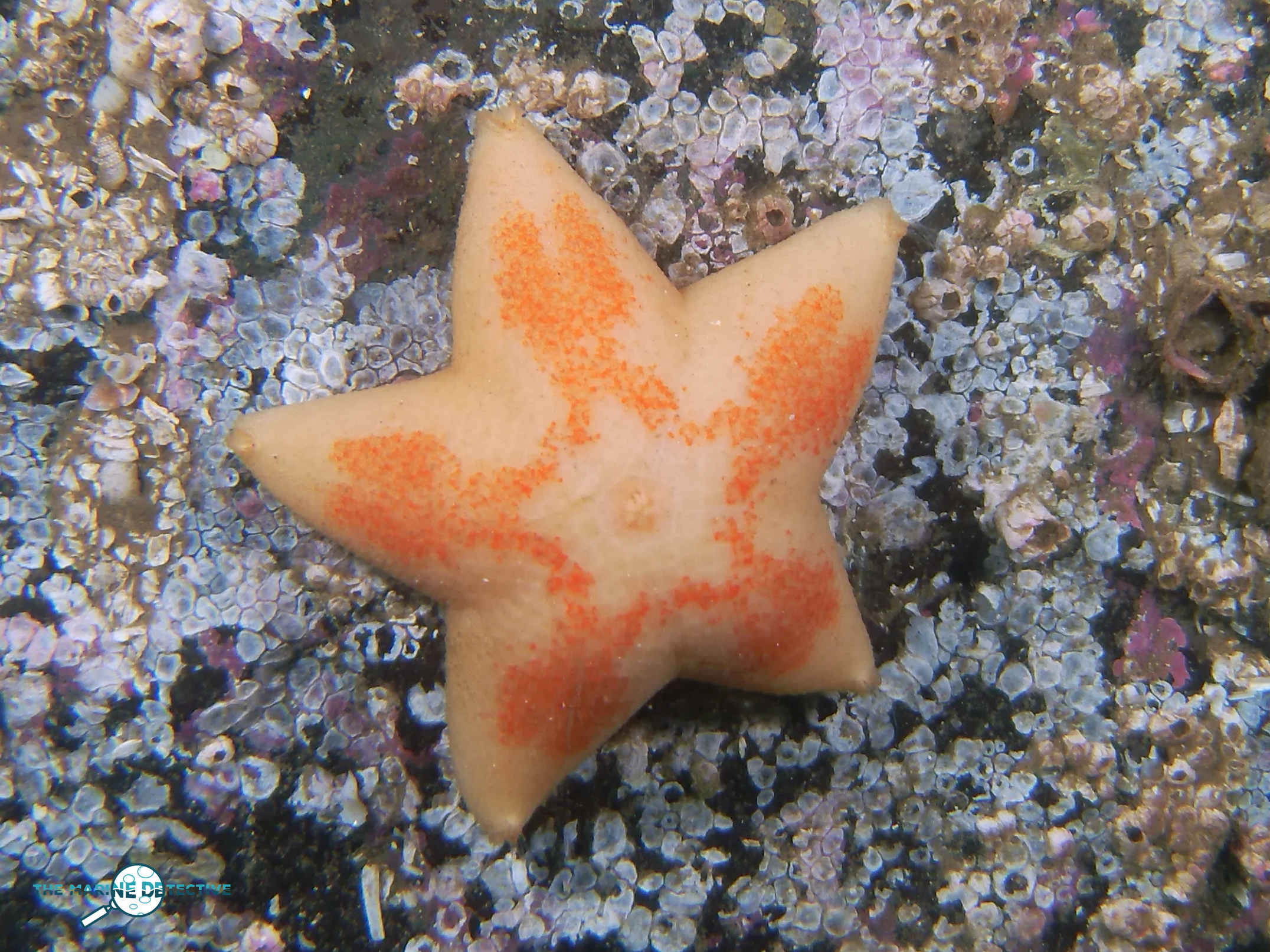
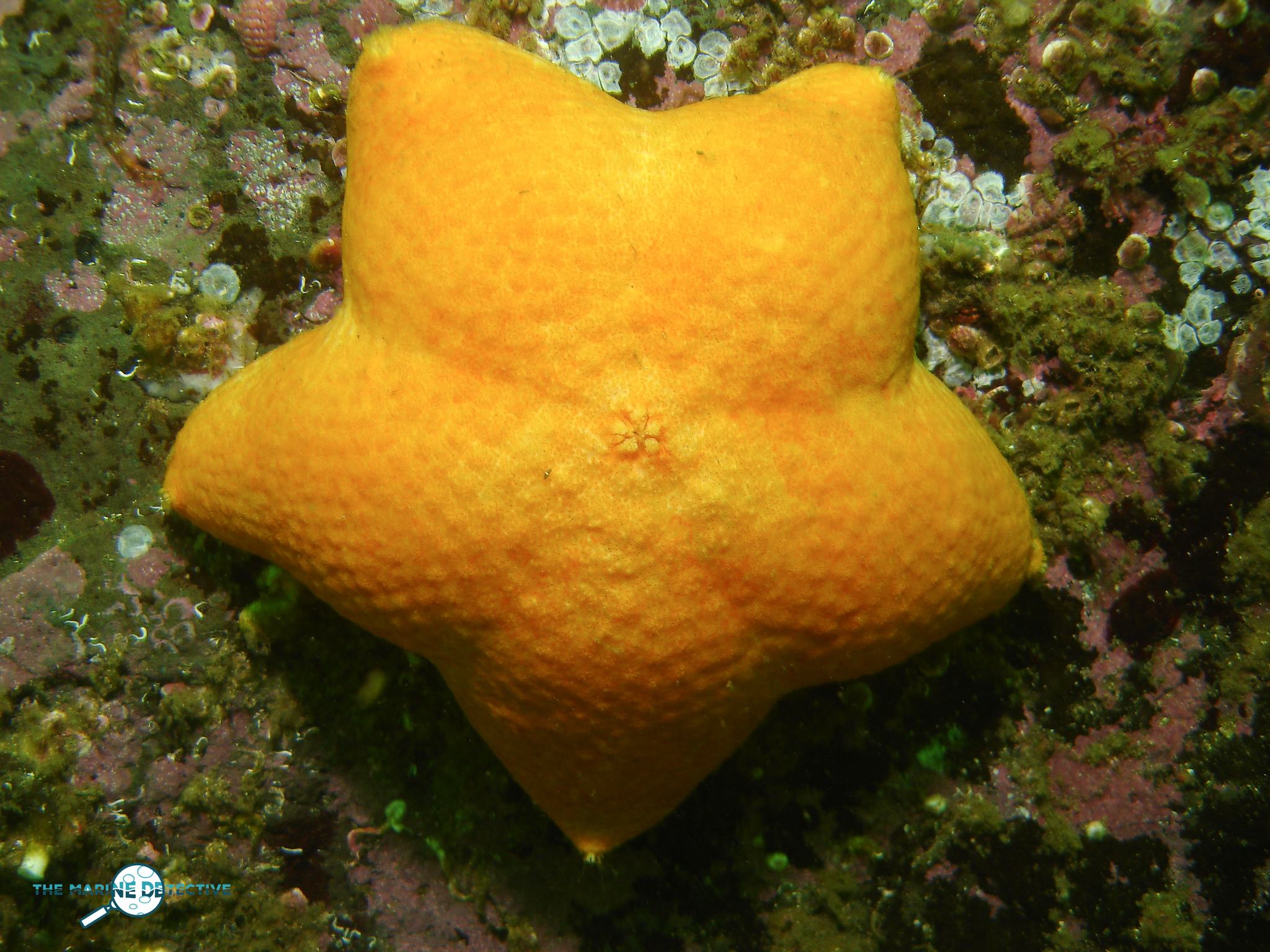
Slime stars are so wickedly adapted! Their distinctive puffy bodies have led to them also being known as Cushion Stars.
They release a LOT of thick, transparent goo from their upper surface when disturbed.
Disturbance constitutes rough handling, temperature shock or when other sea star species try to eat them. Sunflower Stars and Morning Sun Stars are known to trigger the slime production and get a mouthful of goo. The mucus is reported to be toxic to other invertebrates if they are immersed in it for 24 hours.
How much mucus do Slime Stars produce? See the Hakai Institute’s video below.
What is also so unique about Slime Stars is that they “exhale” water through that big pore in their upper surface every few minutes (the osculum). The full “exhalation” of the water takes about 5 seconds. You can see in the photos and video below how wide the hole opens. Water enters the sea star on the underside (through ambulacral grooves).
The tips of the arms / rays of Slime Stars are also distinctive. See how they curl upward? That is believed to be an adaptation to hold the mucus on the upper surface of the sea star.
See how the tips of the rays are curled upward?
As a result of genetic research, it has been put forward that the individuals with dark markings may be a distinct species from the solid-coloured ones. Currently, they are all classified as Pteraster tesselatus.
– Maximum size: 24 cm across. – Known range: Bering Sea to Washington State; from 6 to 436 meters. – Diet: Sponges, tunicates, and bivalves such as the False Jingle.
One of the services I like to provide here on The Marine Detective, is to share words you can try to randomly drop into conversations and annoy your friends. You’re welcome. It’s a task I take very seriously.
Yes, there really is an animal with the scientific name Zyzzyzus rubusidaeus and to me, they look like they have been designed by Dr. Seuss himself. Their common name is the Raspberry Hydroid and they have beautiful predators too.
The common name for Zyzzyzus rubusidaeus is the Raspberry Hydroid. They were only described as a new species in 2013 by northern Vancouver Island’s own Anita Brinckmann-Voss who lived in Sointula. The research paper is at this link.
Their specific nudibranch prey are Pomegranate Aeolids. To my knowledge, the only documentations for both species, to date, are near Telegraph Cove (Weynton Pass) and Quadra Island (Discovery Passage). I can certainly attest to how fortunate we are to see them so predictably near Telegraph Cove.
What you see here, in addition to Raspberry Hydroids and a Pomegranate Aeolid nudibranch, are Mushroom Compound Tunicates, and a feeding Giant Acorn Barnacle.
See below for more information about both species. Oh, and if you ever are able to use the word “Zyzzyzus” in a word game because of this post, I expect a thank you! 😉
Descriptor for the above photo:
Trifecta!
(1) Nudibranch species the Pomegranate Aeolid (Cuthonella punicea to 2.5 cm).
(2)Their only known prey, the stinging celled animals Raspberry Hydroids (Zyzzyzus rubusidaeus to 5 cm tall).
(3) The nudibranchs’ egg masses / strings. As is the way with sea slugs, they most often lay their eggs on their prey. Talk about adding insult to injury. I eat you and I lay my eggs on you so there will be more of my kind to prey on your kind.
More Pomegranate Aeolids feeding on Raspberry Hydroids. The round structures are gonophores reproductive organs that may contain sperm, eggs, or embryos.
More about hydroids:
Almost all hydroid species are colonial. They are carnivores. Hydroids are related to jellies, anemones, and corals (phylum Cnidarian).
The reproduction of hydroids is remarkable. Colonies are male or female. They start by reproducing asexually by budding off hydromedusa – tiny free-swimming, jellyfish-like versions of themselves. These produce either eggs or sperm. Fertilization of the eggs leads to larvae that may settle on the ocean bottom and form colonies.
Hydroids catch drifting prey with their polyps aided by their nematocysts (stinging cells). None of the hydroid species off our coast deliver a sting that we humans can feel (no matter how sensitive you are 😉).
The food gets distributed throughout their single-sex colony.
And who loves to eat species of hydroids? Nudibranchs! Specifically, the aeolid kinds of nudibranchs – they have those bushy structures on their backs (cerata). Many of these nudibranch species not only rely on the hydroids for nutrition but also make use of their prey’s stinging cells! The nematocysts get incorporated into the ends of the cerata.
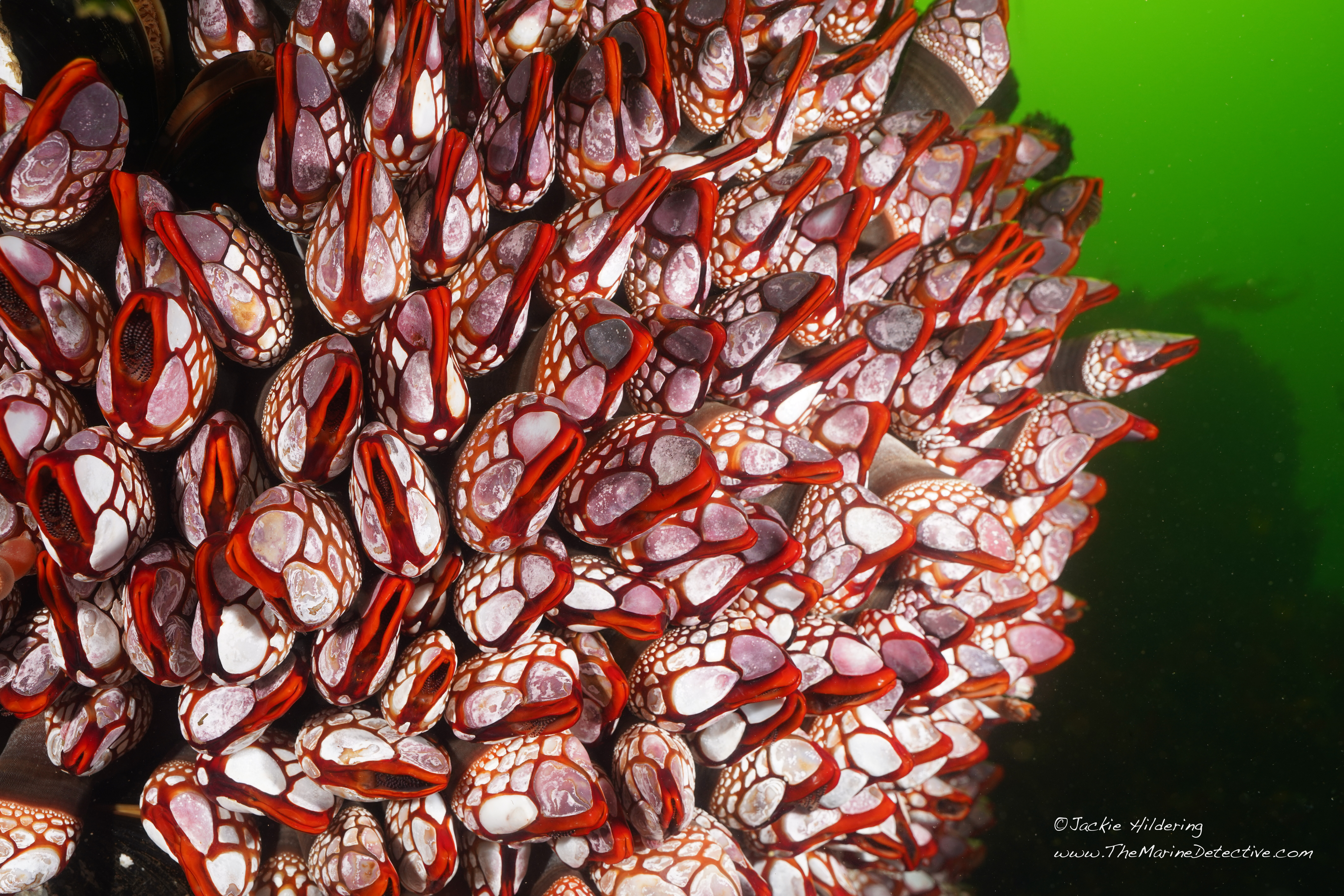
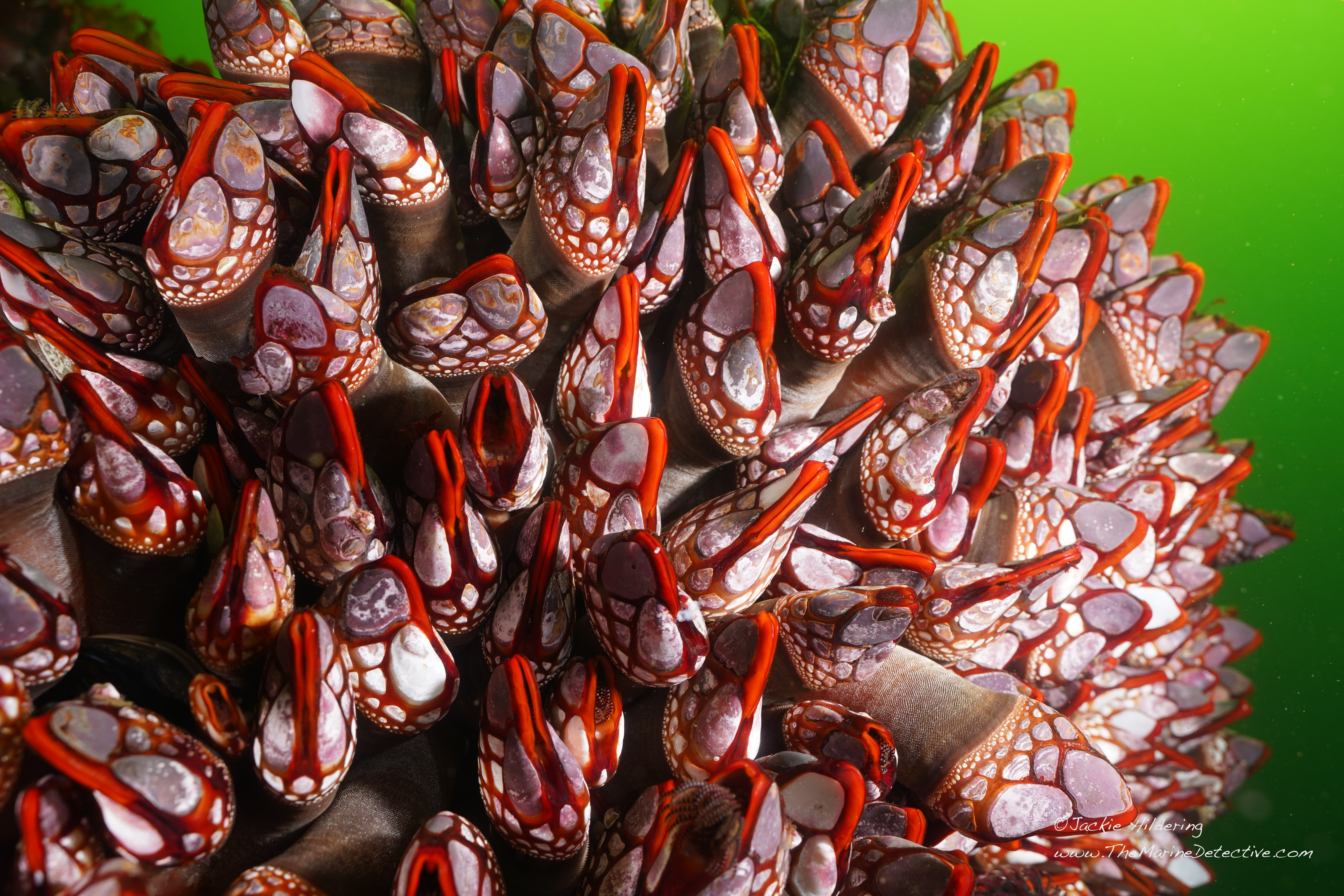
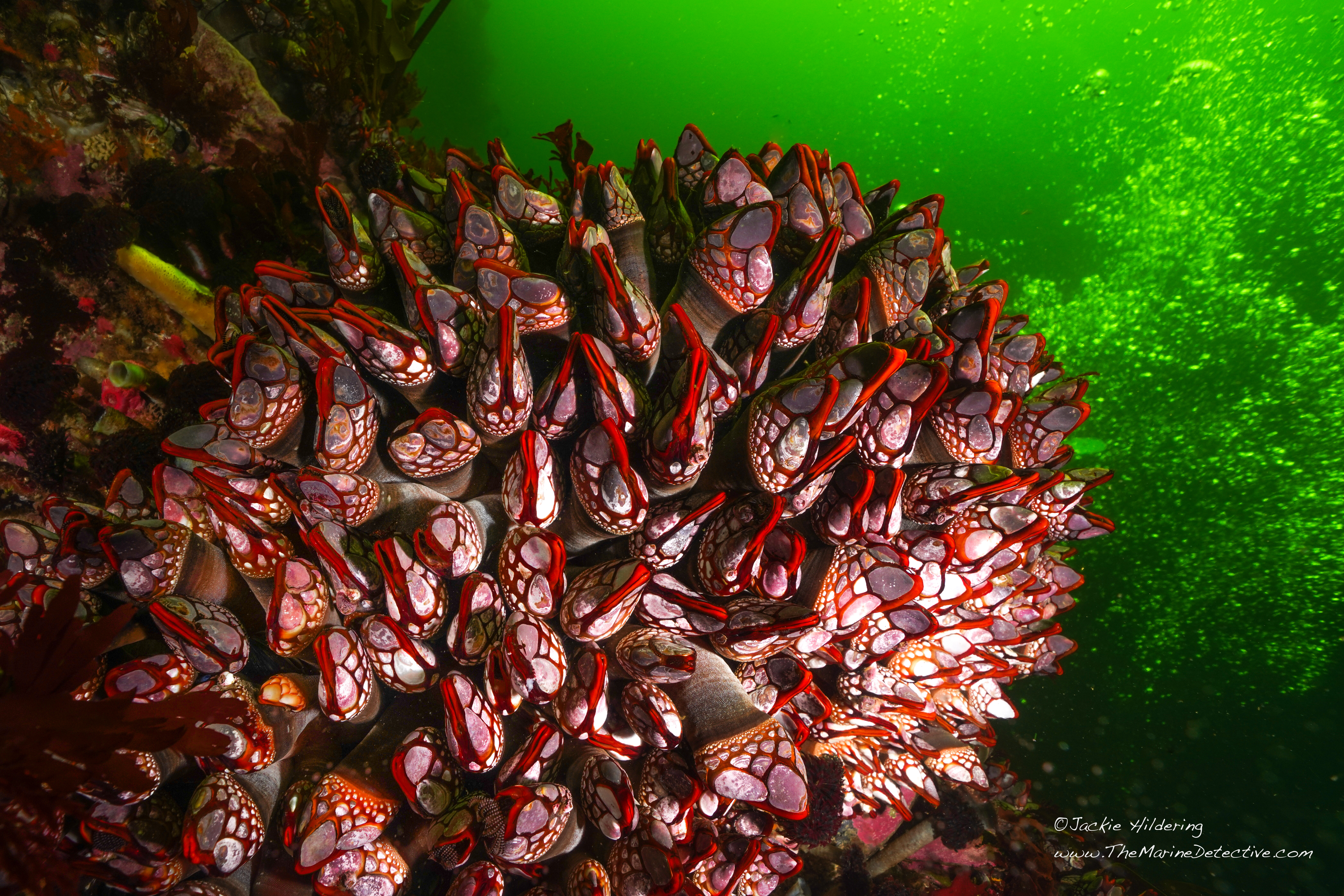
These are barnacles that live in only a very few places on the planet. The most are at Nakwakto Rapids, north of Port Hardy. The red is hemoglobin!
I think these are one of the most achingly and extraordinarily beautiful animals I have ever seen.
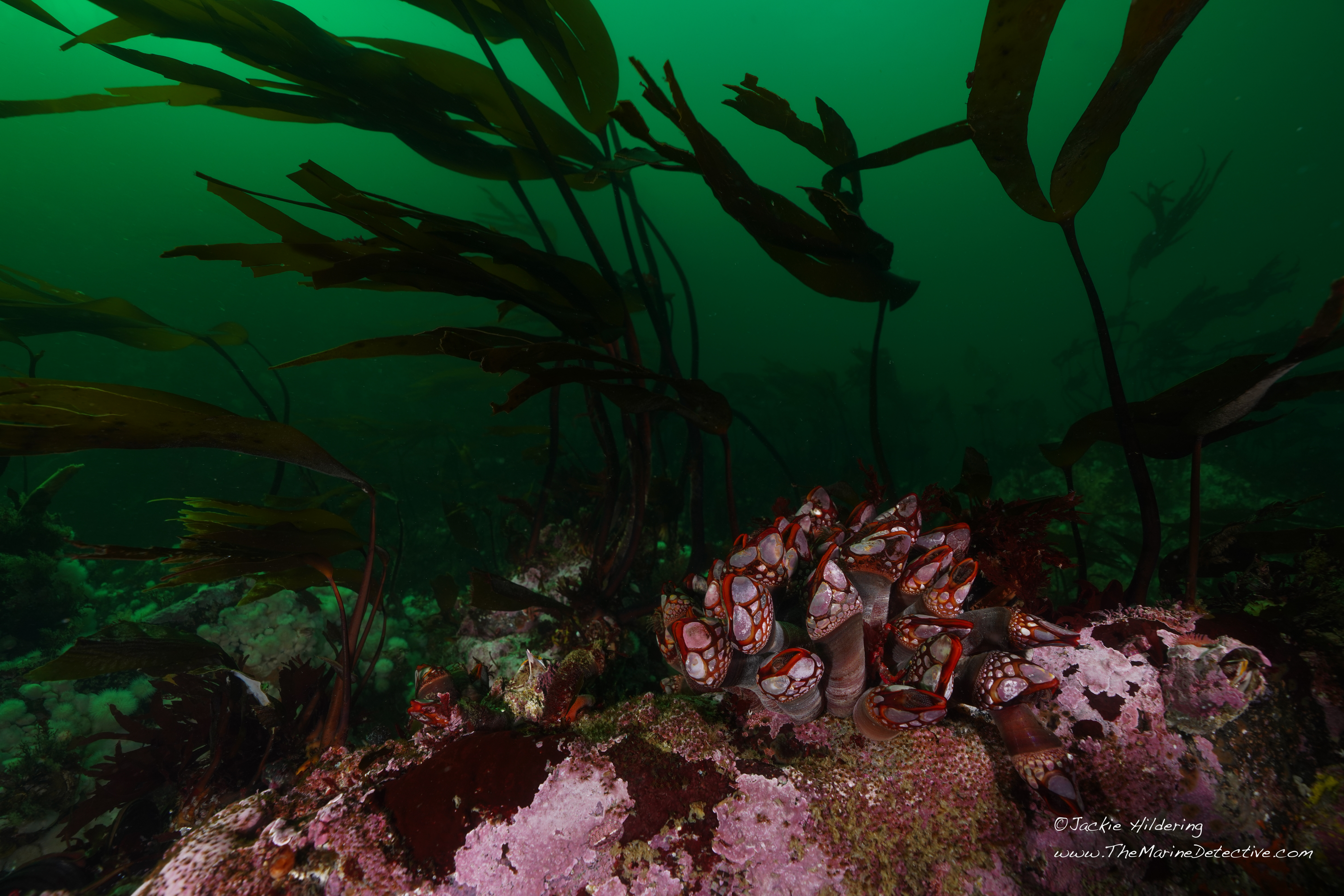
They are Nakwakto Barnacles. They need really strong current and that was very clear during the dive where I photographed these, even on a small tidal exchange). The dive site was Turret Rock, also known as Tremble Island because of the appearance that the island shakes in the tidal exchange (apparently up 39 kilometers per hour during its largest tidal exchanges).
Nakwakto Goose-neck Barnacles with Split Kelp wafting behind.
The next photo shows you the SAME species but in shallow water where you can’t see the hemoglobin because, near the surface, the gooseneck barnacles need a protective black pigment against sun exposure. How’s that as a metaphor for how your environment influences your beauty?
These barnacles are perceived to be a variant of Gooseneck Barnacles with the same species name, which is Pollicipes polymerus.
The barnacles’ stalk can be 15 cm long and body to 4.5 cm long.
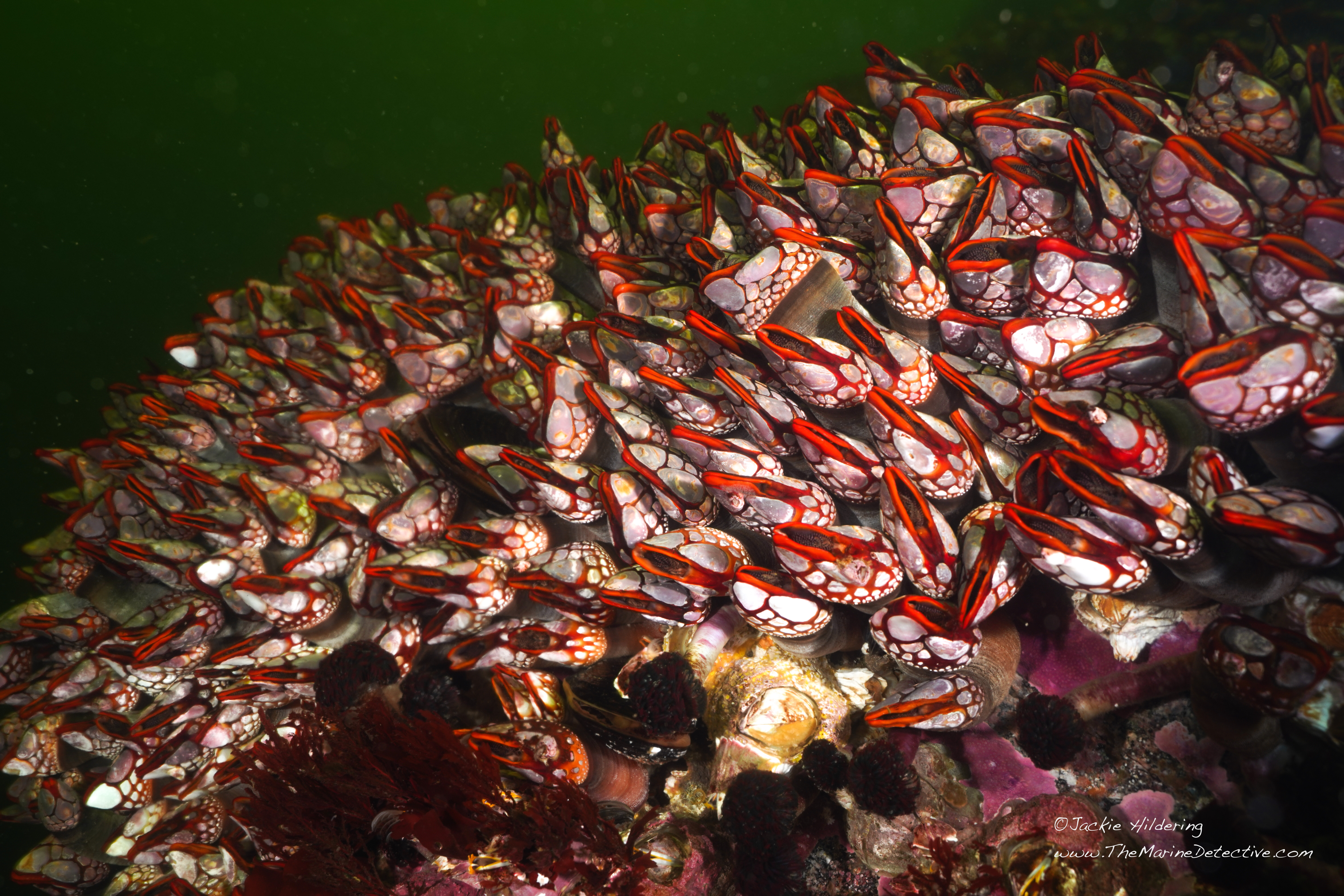
An attempt to show you the density of this species in this extraordinarily high current area.
From Hanby and Lamb’s Marine Life of the Pacific Northwest: ” . . . the spectacular formations of the Nakwakto goose-neck barnacle, a large and colourful variation of the goose-neck barnacle – found in Nakwakto Rapids, Slingsby Channel, c. BC. The glorious red colour is actually the hemoglobin in the barnacle’s blood. The blood is obvious in subtidal specimens like these, which do not have the black pigment that protects the sun-exposed populations inhabiting shallow or intertidal zones . . . this unique and isolated population must be preserved via a No-Take Marine Protected Area.“
From Rubidge et al 2020; “A unique subtidal variety of the Gooseneck Barnacle, Pollicipes polymerus, forms large aggregations at Nakwakto Rapids (Lamb and Hanby 2005). The “Nakwakto variety” of P. polymerus, is bright red as the hemoglobin in the barnacles’ blood is visible. Subtidal populations do not need the black pigment found in the sun-exposed intertidal populations (Lamb and Hanby 2005). The red “Nakwakto variety” of P. polymerus has been recently reported in other subtidal areas including a sea cave on Calvert Island on the central coast and Race Rocks near Victoria. Because of its slow recovery rate after perturbations and its ecological role as a habitat-forming species, P. polymerus was identified as an Ecologically Significant Species and conservation priority for the Marine Protected Area network planning process in the Northern Shelf Bioregion (DFO 2017).“
Information provided by Greg Jensen (pers. comm. 2024-02-01) about gooseneck barnacles’ being in high current areas: “[they are in] high current and wave-exposed areas because they are passive filter feeders relying on water movement (as opposed to active filterers like acorn barnacles). Goosenecks likely survive subtidally in these ultra-high current areas because predators like red rock crabs can’t withstand the current.”
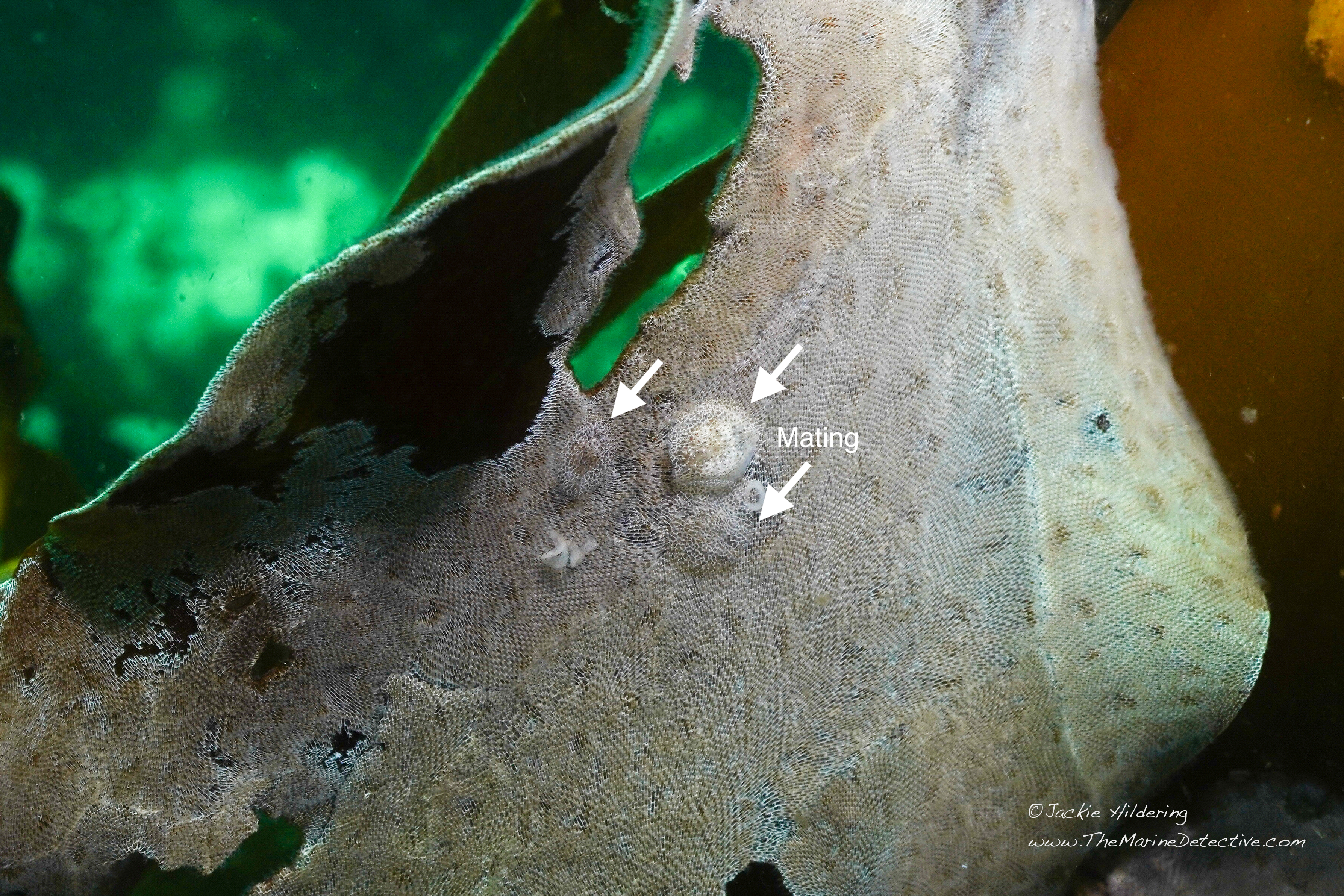
I finally observed some of the most cryptic nudibranchs on our coast!
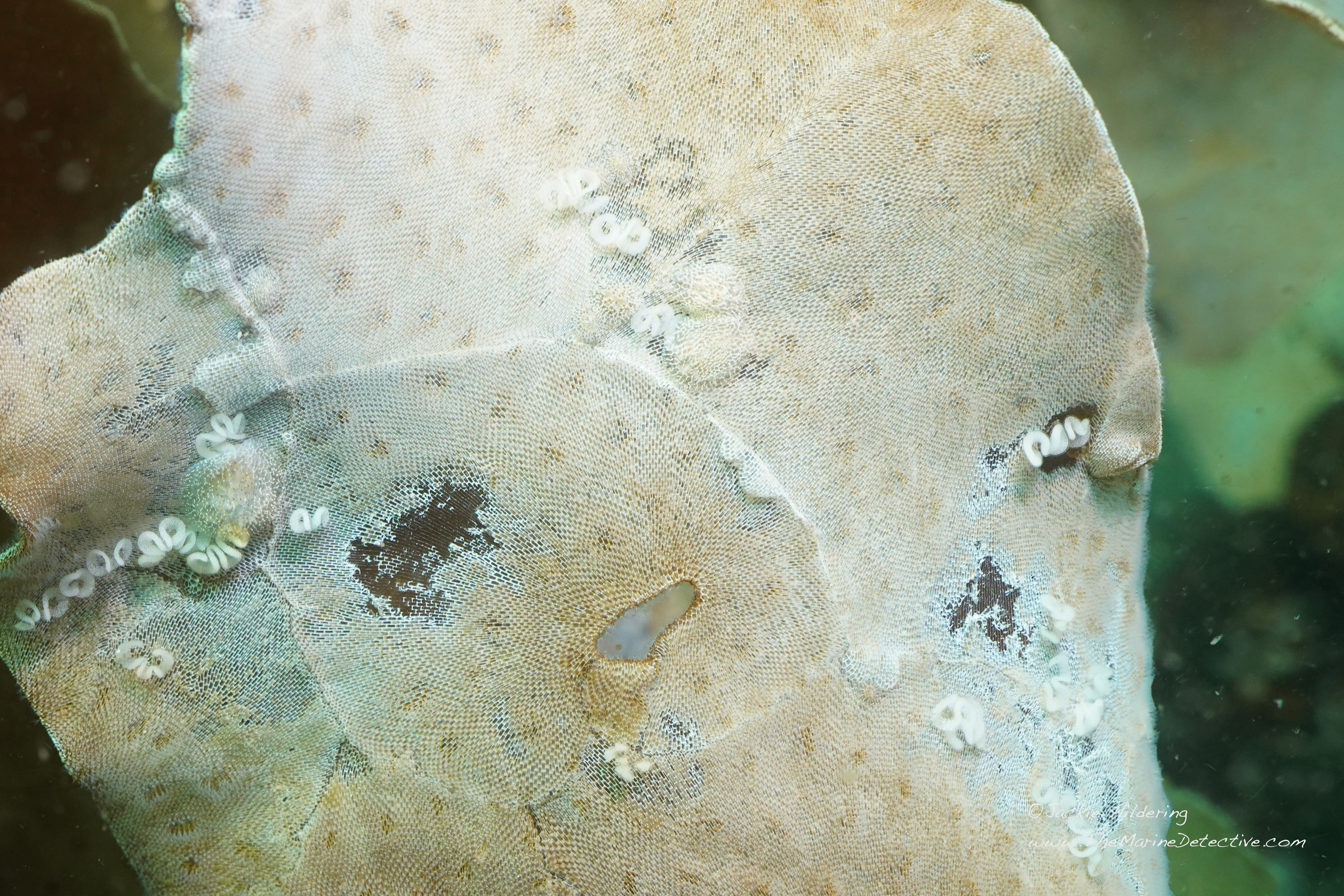
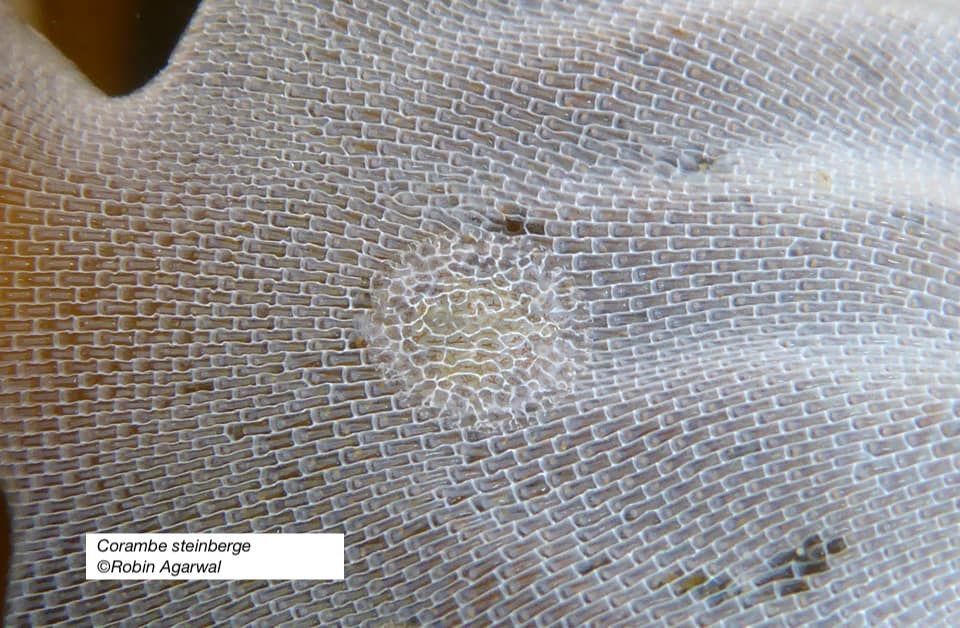
The Cryptic Nudibranchs you see here are only about 1 cm long and look at how astoundingly evolved they are! They are virtually invisible on the Kelp-encrusting Bryozoan which is growing on Bull Kelp at this time of year. This species of nudibranch is also known as Steinberg’s corambe (Corambe stinbergae to 1.7 cm).
You can see in the photos here that we found some of the nudibranchs mating and there were many of their egg ribbons (each of those coils has a lot of eggs that result from both parents becoming inseminated and laying eggs).
You can also see where they have been feeding on the bryozoans (colonies of animals).
I have looked for them for years knowing their range is from Alaska to Baja California, Mexico.
Mating: Right-side-to-right-side attached via the gonophores. Both hermaphrodite parents lay eggs.
What made the difference in now being able to find them:
(1) Getting the clue from Robin Agarwal to look at the kelp fronds that were REALLY tattered with the Kelp-encrusting Bryozoan colonies .
(2) Having a skilled dive buddy willing to join me in burying our heads in old, tattered kelp in the surge for 30 minutes instead of looking at all the big, colourful life at this dive site. Thank you Janice Crook!
(3) Once we knew what the egg ribbons looked like (those s-shaped little masses), we had a really good clue and knew better where to look even more closely for the nudibranchs.
Now on to finding the SECOND really cryptic nudibranch species that feeds on Kelp Encrusting Bryozoans – Corambe pacifica to 1.5 cm long and whose egg masses are tiny, flat coils.
For more photos and my previous blog on what Kelp-encrusting Bryozoans look like, please see my other blog “Kelp Lace? Bryozoans”.
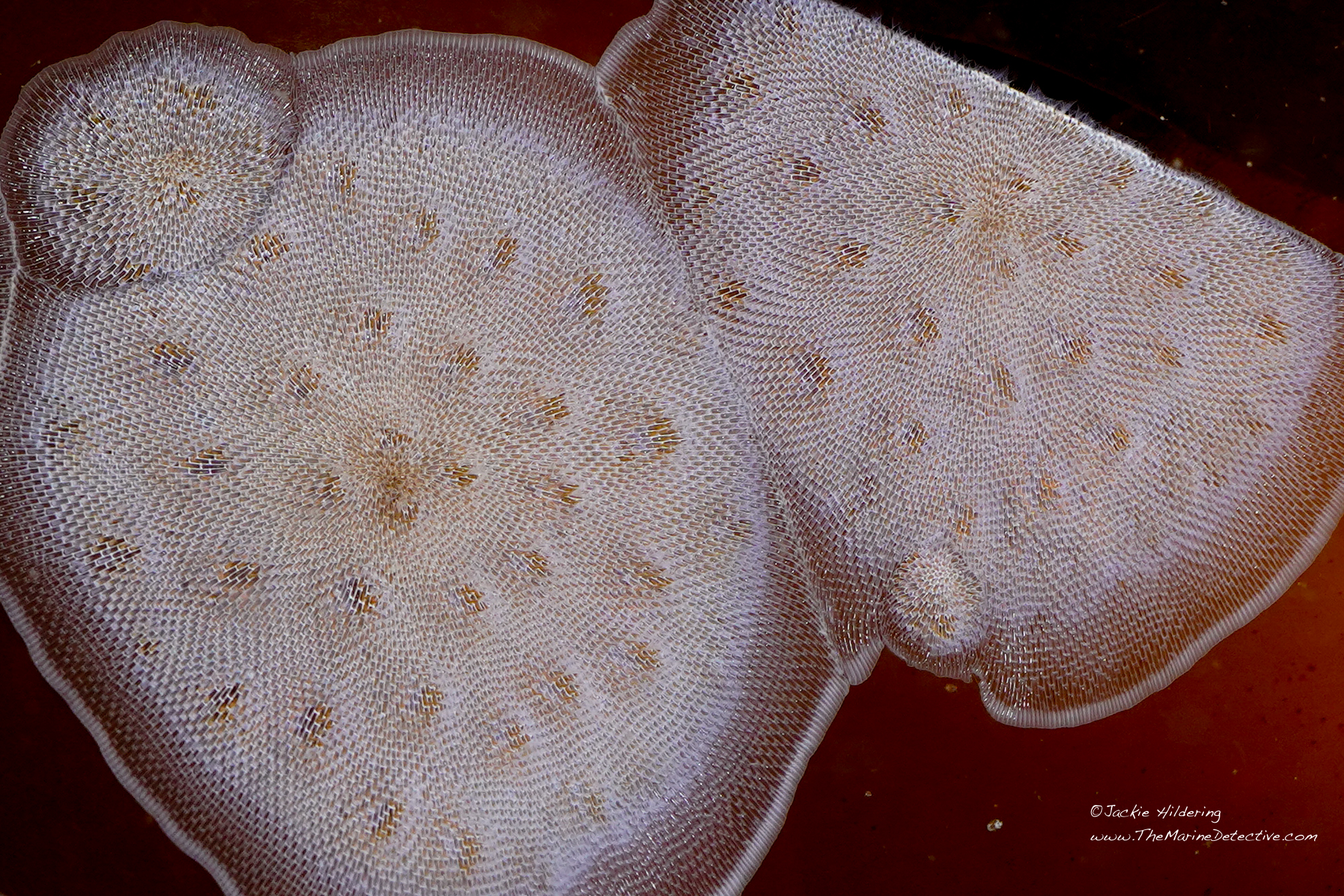
And so it begins. It’s the time of year when the annual kelps like Bull Kelp begin to break down. It’s then that Kelp-encrusting Bryozoans really get a chance to colonize the kelp as you see in these photos.
Every little box is an individual animal. It’s a “zooid”. The oldest member is in the middle and the others all originated from that one by asexual reproduction.
The zooids filter feed on plankton with the tentacles you see in this wonderful video by friend Karen Johnson. These crowns of tentacles are known as lophophores.
“Kelp-encrusting Bryozoan” (Membranipora membranacea) is also known as “Kelp Lace Bryozoan”. It’s no mystery how either common name was inspired. Each circular colony is approximately 20 cm wide.
If you are lucky enough to live near the Ocean, look at the kelp that washes ashore for these colonies. The colonies in these photographs where on Split Kelp (Laminaria setchellii) and Bull Kelp (Nerocystis luetkeana).
What on earth is a “bryozoan”?
From Beachkeepers: “Bryozoans are colonial animals that arrange themselves in circular (radial) fashion, often with the oldest (and first to settle) individual in the middle. . . . The ‘box’ of the zooid is made of either a tough protein (like what you would find in crab shells) called chitin, or what you would find in coral reefs, calcium carbonate. This body box has an opening where the bryozoans extend their feeding apparatus (that looks a lot like a sea anemone) called a lophophore. Yes, they have predators! [Some species of] nudibranch will eat them, though they can reproduce asexually to form the colony back to size after a nudibranch has been grazing on them. Sometimes, when they grow back, they’ll even grow chitonous spines on their body walls to discourage the nudibranchs from coming back. These spines usually form on the individuals on the outside edge of the colony.”
Adalaria nudibranchs feeding on the bryozoan. Blue Turban snail feeding on Kelp-encrusting bryozoan. Opalescent Nudibranch near a colony of Kelp-encrusting Bryozoan.
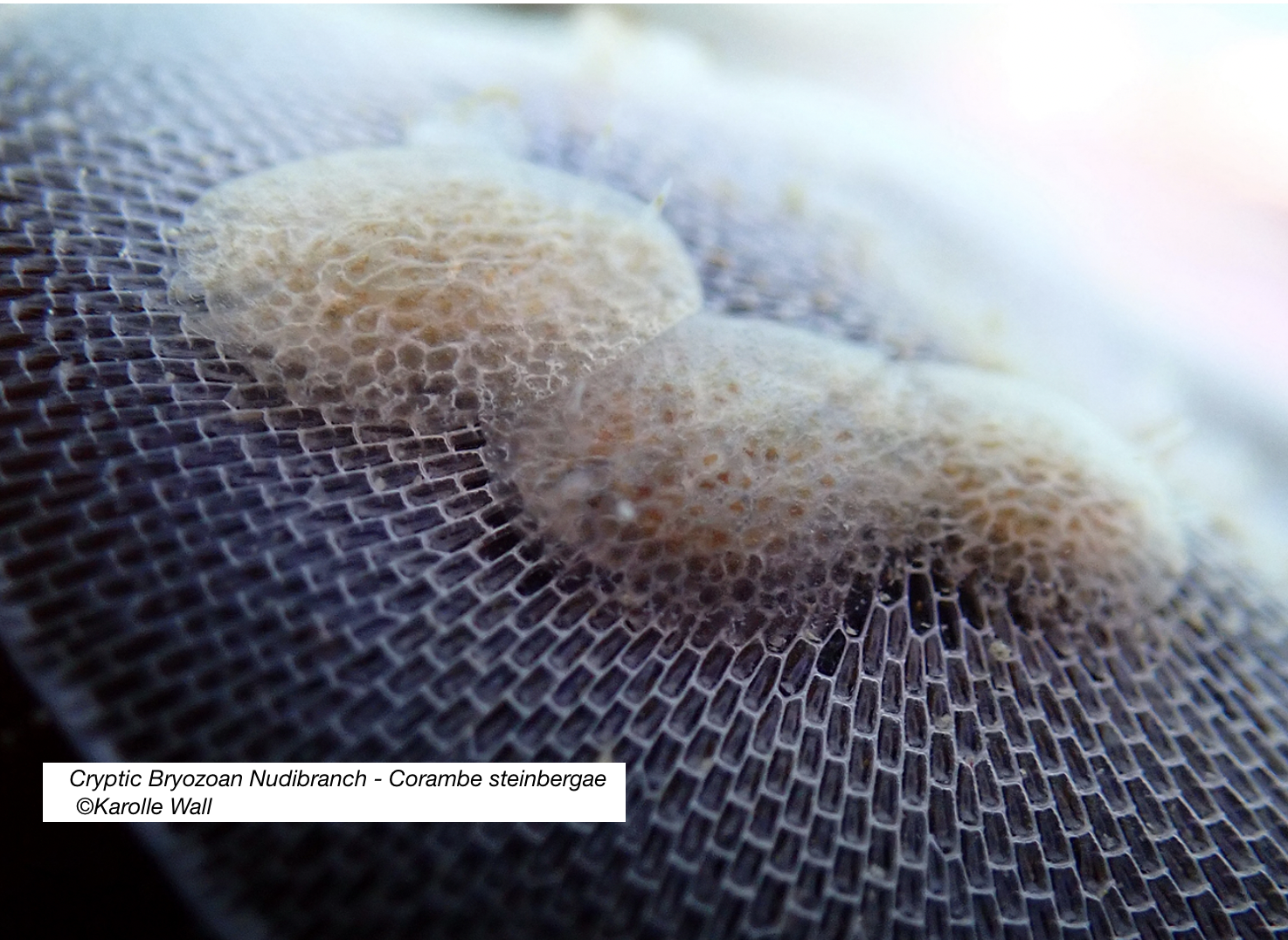
Detail about this bryozoan species – Kelp-encrusting Bryozoan. From Invertebrates of the Salish Sea: “Bryozoans start from a single individual zooid (an ancestrula) which repeatedly reproduces asexually to form a colony. In this species, the oldest individual is in the middle. Colonies of this species usually begin to be noticeable in late spring and grow through summer into fall. By fall they may form extensive crusts on the kelp and many colonies have merged with one another. In many bryozoans there are various types of zooids but in this species there is only one type of zooid which serves for feeding, for reproduction, and for defense. The colony appears to be a simultaneous hermaphrodite, or male zooids may develop first. They do not brood their young. Eggs are fertilized then released, and quickly develop into cyphonautes larvae which may feed and develop as plankton for several months. The larvae settle when they encounter kelp such as Laminaria or water with an excess of potassium ions. The small white nudibranch Doridella steinbergae [reclassified to Corambe steinbergae] may be found living and feeding on these colonies but it blends in so well it is difficult to see . . .” Note there is a second similar looking cryptic nudibranch that can found on these bryozoans and that is Corambe pacifica. Corambe pacificahas a notch at the back. Corambe steinbergae does not. I have never managed to find these cryptic nudibranchs. Grateful to Karolle Wall and Robin Agarwal for their photos below.
What happens to the kelp?
It is the natural cycle of kelp species like Bull Kelp, that at this time of the year, the large version (the sporophyte) begins to break down. Spore packets drop to the bottom of the Ocean which create a different version of the kelp. It’s Alternation of Generations and here is my blog about that wonder. Other kelp species like Giant Kelp are not annuals. They remain year round.
Note: Some report that this species of bryozoan is an invasive in the Atlantic. However, “recent genetic studies indicate that this species is a complex of a number of long-separated clades. The only verified invasion is its introduction from the Northeast Atlantic to the Northwest Atlantic” (Source: Nemesis).
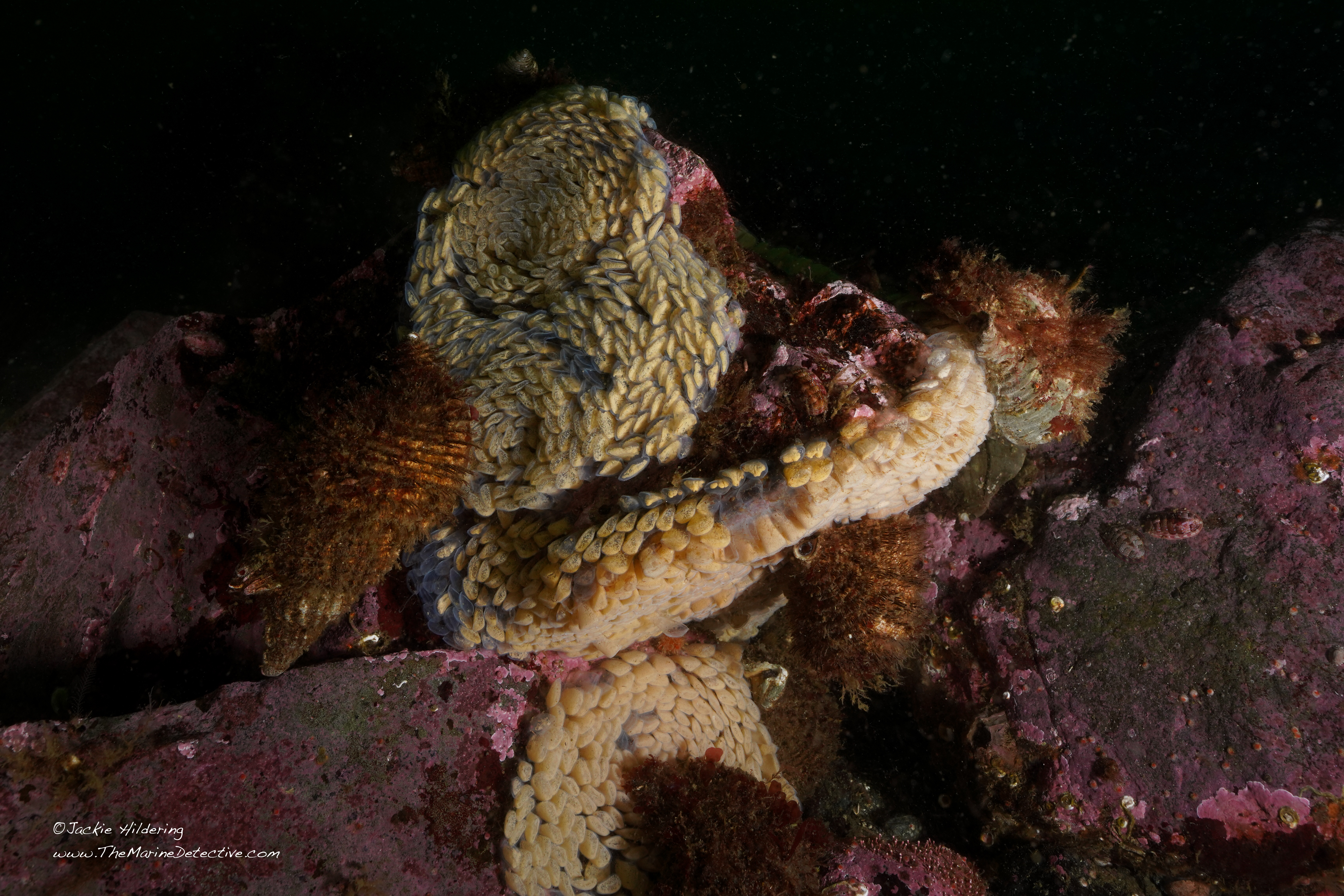
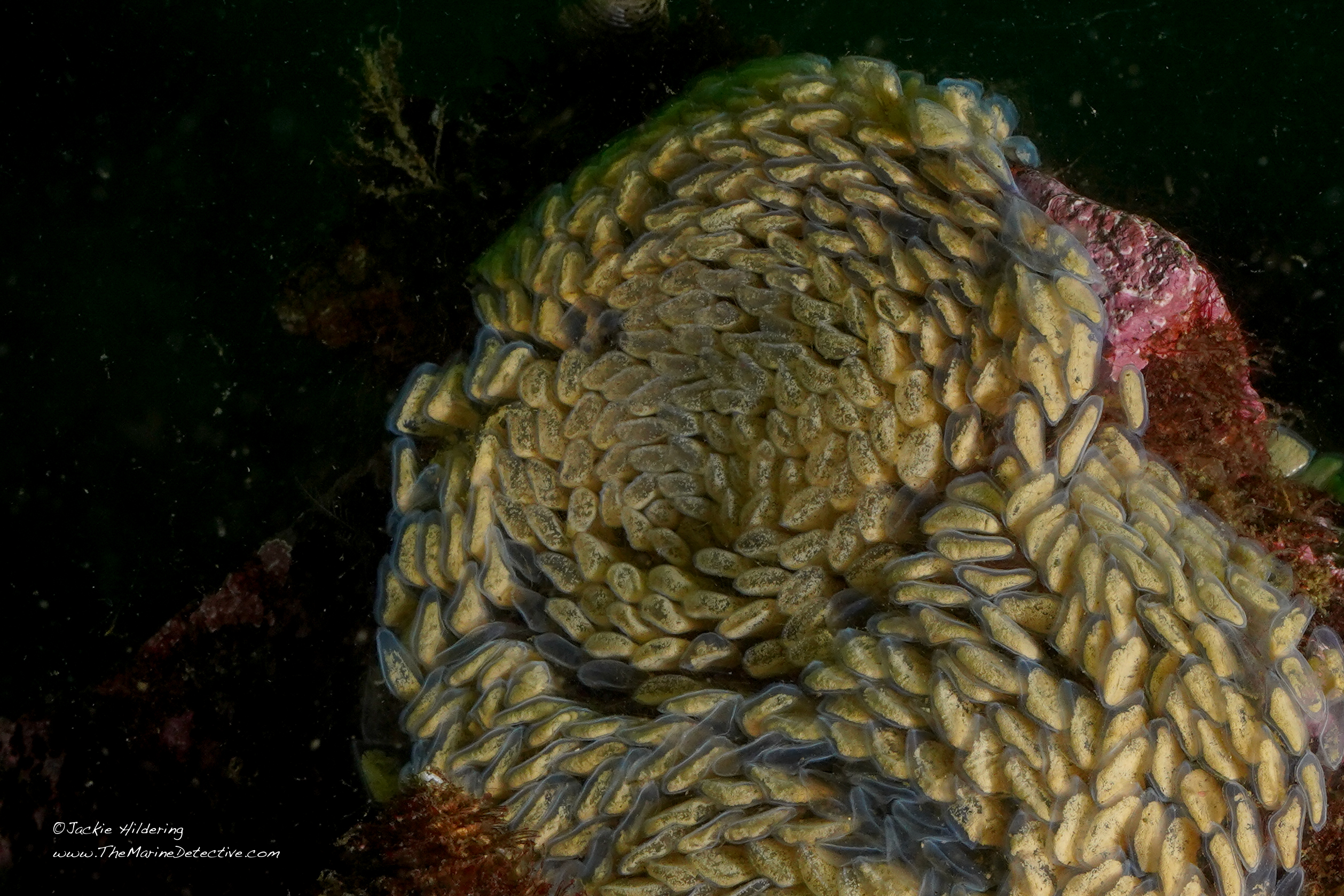
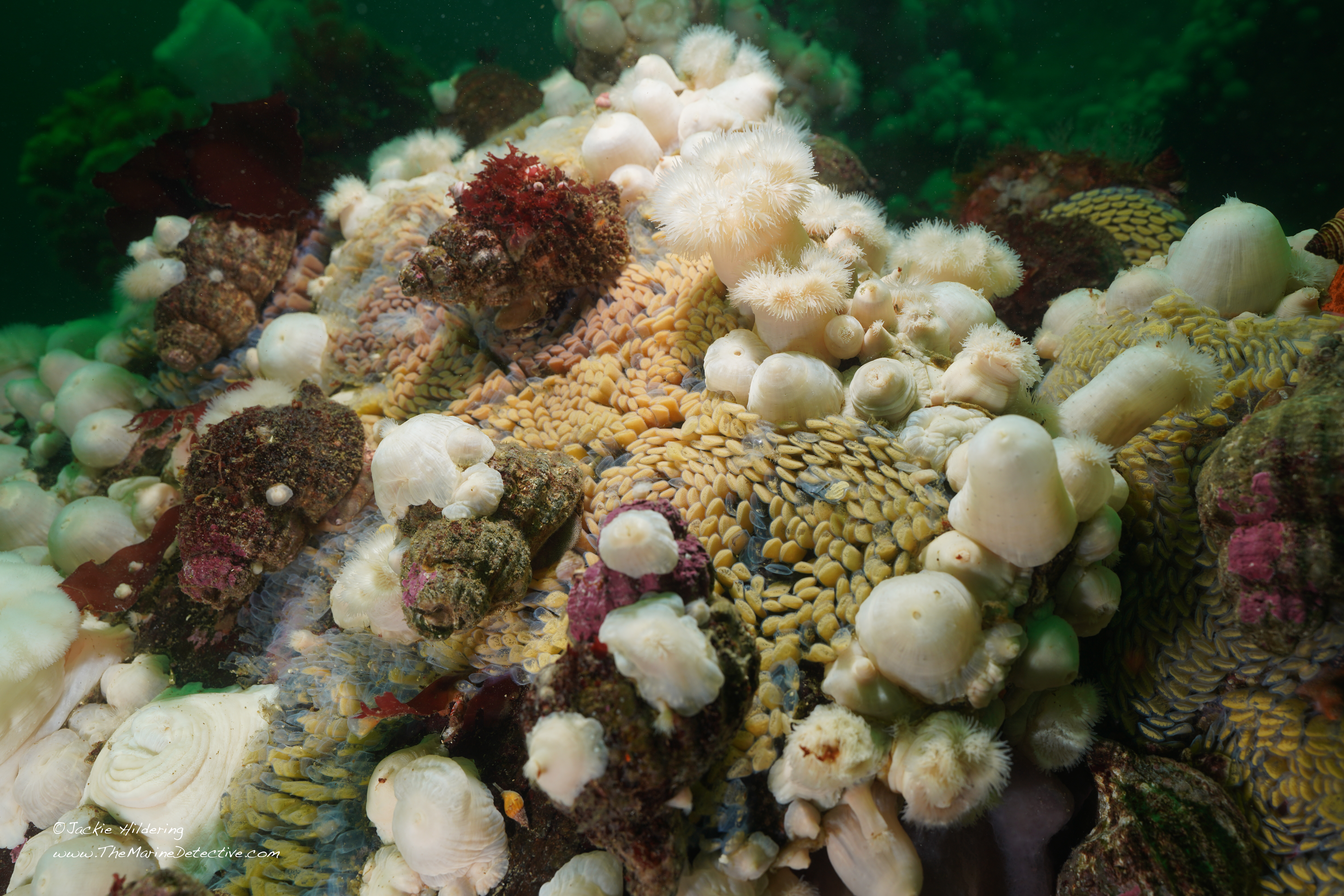
It’s the time of year when female Oregon Tritons are laying their eggs. These are BIG, predatory marine snails at up to 15 cm long.
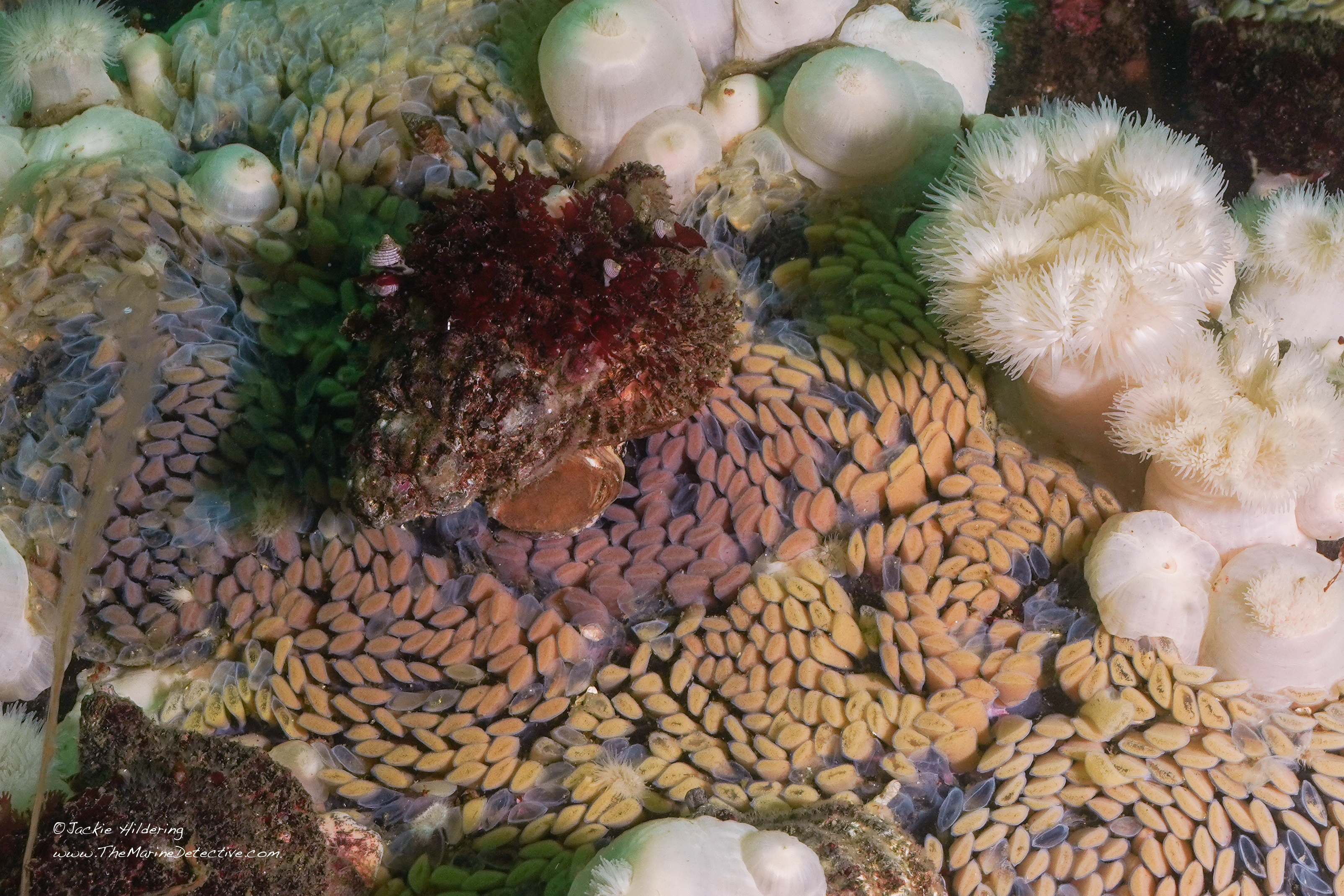
Look at how many fertilized eggs are in each “capsule” and marvel at the shape of the egg mass. These capsules are referenced as “sea corn” for this species. It takes each female about 2 weeks to lay her eggs in this wondrously shaped clutch. A friend referenced the shape of the egg mass as being reminiscent of Van Gogh’s “Starry Night”. Agreed!
See the “blank” egg capsules? They have likely been preyed upon e.g. by shrimp, hermit crabs or other snail species. You can even see hermit crabs and snails in these images feeding on the eggs. Some hermit crabs are even sitting on females as they lay eggs. Oh the cheek!
See the hermit crabs and “blank” egg capsules?I could not resist providing a closeup on this Whiteeknee Hermit from the previous photo. Look at those eyes!Closeup on a Blue Turban snail snacking on eggs (from previous photo).
Almost every time I see Oregon Tritons lay eggs, they are doing so as a group. Reportedly, up to 30 individuals have been found laying eggs together.
Why are there so many eggs? Because chances of survival are so low when there is no parental care (other than the architectural marvel of the egg case) and the young hatch into the soup of the Ocean. Planktonic larvae hatch out of the eggs at about 2 weeks of age. With it taking 2 weeks for the young to hatch, and 2 weeks for Mom to lay the whole mass, the first capsules could be hatching by the time she is finishing her work. I learned from aquarist Casey Cook from her microscopic observations at the Aquarium of the Pacific that, “By hatch time there are significantly less in the egg [capsules] than at the beginning of the lay. We presume the babies eat each other to gain nutrients for creating their first shell layers.”
One study found that, in an aquarium, the larval stage for this species was up to 4.6 years and they only began metamorphosis into their adult form when something was available for them to settle on e.g. rocks (Strathmann and Strathmann, 2007). Further “time from metamorphosis to first reproduction was 3.3 years” (in these conditions in the aquarium).
The scientific name for Oregon Tritons is Fusitriton oregonensis. That’s a whole lot of Oregon in their name and the species is the official seashell of Oregon state (there’s trivia for you). However the range for this species is well beyond Oregon. They are found from northern Alaska to northern Mexico, and Japan. They are common around northeast Vancouver Island. Depth range is reported to be from the intertidal to 180 m. In my experience they are rarely in the intertidal however.
They are also known as the Hairy Triton. “Hairy” for the bristly “periostracum” you see atop the shells which appears to stop attachment of marine organisms. Some loose this bristly covering and, resultantly, can have a lot of settlement and growth on their shells.
The brown structure you see at the opening of the shell is the operculum. This is hard and made of keratin and serves as the door to close the shell. More about that in my “Shut the Door!” blog at this link.
Predatory? Yes! They are among the marine snail species that drill holes into prey, sedate, and slurp. From Invertebrates of the Salish Sea: “Feeds on ascidians, urchins, bivalves, sea stars, brittle stars, chitons, abalones, and polychaetes [worm species] . . . It produces sulfuric acid in its salivary glands, which may help in boring through shells. A gland in the proboscis secretes an anaesthetic used for subduing prey. It feeds with biting jaws as well as a radula . . . Humans should not eat this snail because it carries a pathogen in its salivary glands which can be fatal to humans.”
I have also seen this species scavenge on dead crabs, anemones and fish and eat Lingcod eggs.
Oregon Tritons scavenging on the head of a Lingcod.Oregon Tritons mating. I hope you appreciate the mood lighting.
Big questions often come from little people and there are so many times that I have been asked by children why I reference the limbs of an octopus as “arms” and not “tentacles”.
Here’s why: Arms have suckers down the full length of the appendage. Tentacles only have suckers near the tip. Thereby, all eight octopus appendages are arms while squid have two tentacles and eight arms. Further, the purpose of tentacles is generally limited to feeding where arms have more functions. Octopuses use their limbs for feeding, locomotion, reproduction (if male*), defence, etc!
Oh and why are they called “arms” vs. “legs”? Because octopuses’ appendages have more purposes than just locomotion.
Octopus walking on her arms (and you thought YOU were special 😁). How to know this is a female octopus? See below for the link to my blog* on octopus sex.
There are scientists who have put forward that some octopus species use two of the limbs mostly for locomotion whereby they would have two “legs” and six “arms” but let’s avoid that debate!
While we are on the topic of semantics and cephalopods, and anticipating that there will be those who question my use of the plural form of “octopus”, please note the origin of the word octopus is Greek, not Latin. Thereby “octopuses” or “octopods” is truly more correct than “octopi”. From a strict linguistic perspective, the most correct is “octopods” but I choose not to use that. I think if I were to say “octopods” it would distract what I am trying to communicate that is more important that grammar. I might also come across as pretentious and have fewer human friends 🐙.
There, don’t you feel much better armed to speak for our awe-inspiring eight-legged neighbours? Or, are you up in arms?





























 From a strict linguistic perspective, the most correct is “octopods” but I choose not to use that. I think if I were to say “octopods” it would distract what I am trying to communicate that is more important that grammar. I might also come across as pretentious and have fewer human friends 🐙.
