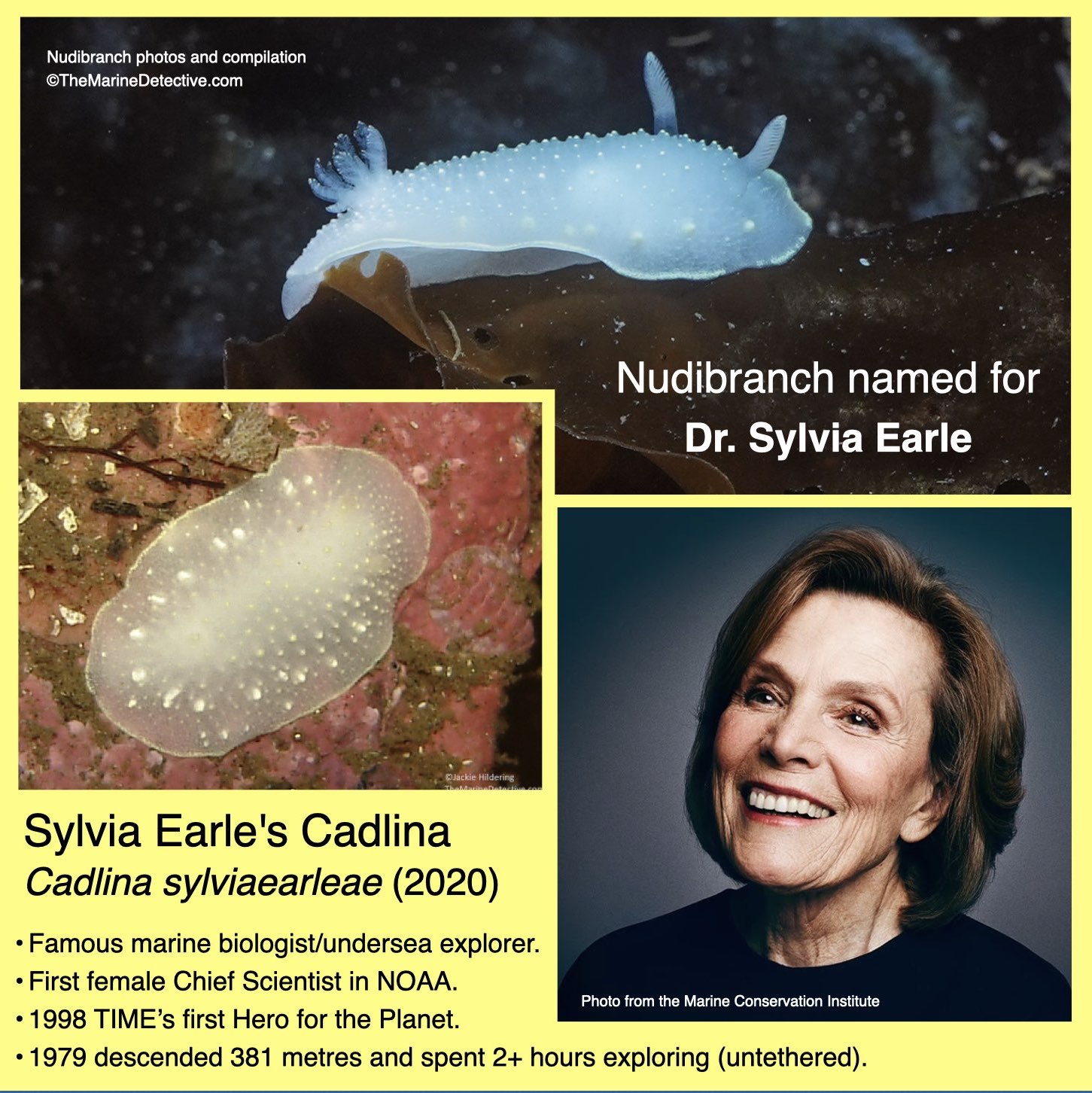

I am very late to this party. Back in 2020, a nudibranch was named in honour of Dr. Sylvia Earle when there was reclassification of the Yellow-margin Dorid and the research was published by Korshunova et al.
There is now Sylvia Earle’s Cadlina (Cadlina sylviaearleae).
Despite my great admiration for Dr. Earle and for sea slugs, I did not realize these two had come together until I recently posted one of the photos you see below. Karolle Wall very kindly let me know that this was no longer a Yellow-margin Dorid (Cadlina luteomarginata).
What follows is focused on the reclassification and how difficult it is to discern these species from external characteristics. If you have an electron microscope, it will be easier. 😉 You would be able to see the differences in the radula (tooth-like structures).
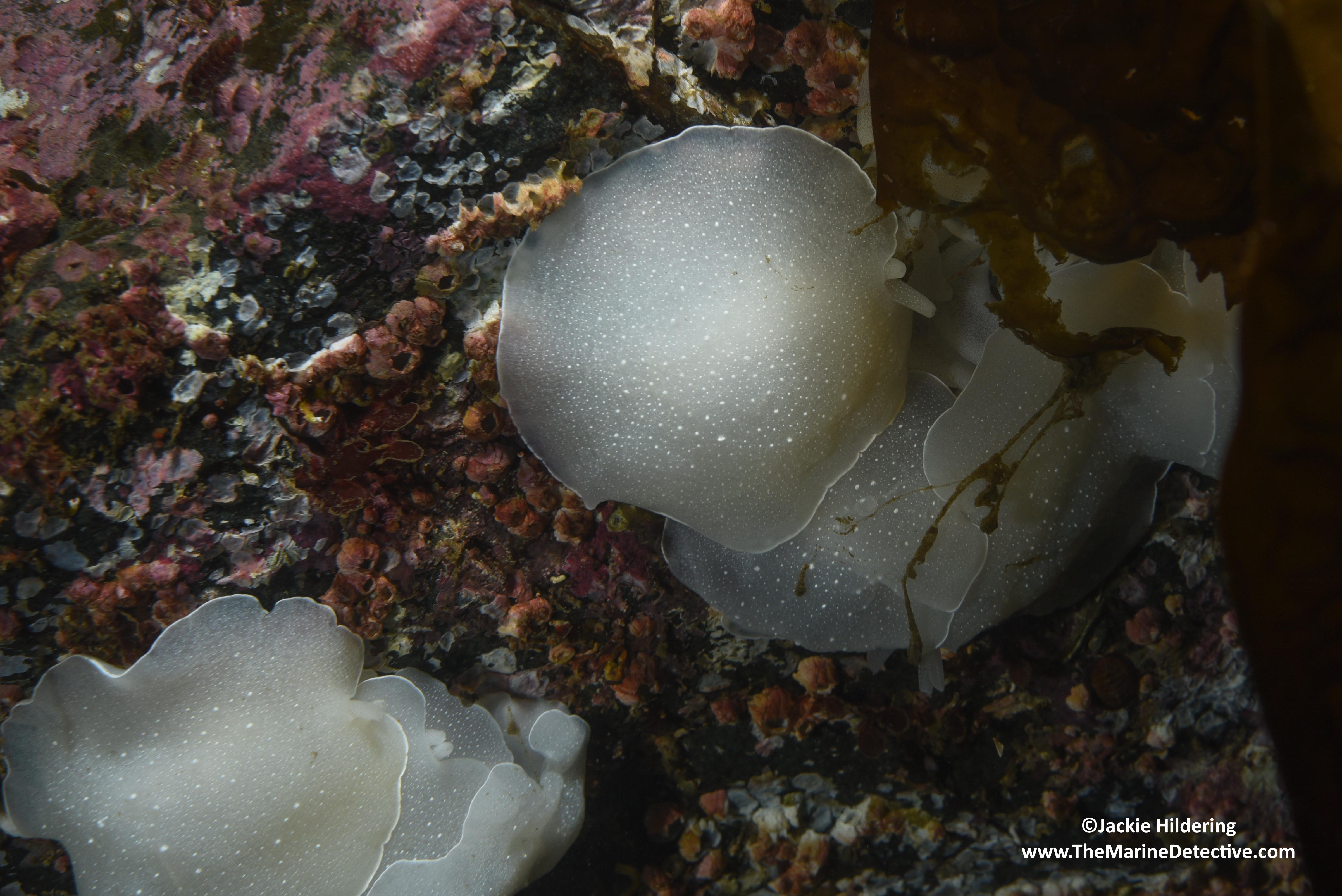
What was historically Cadlina luteomarginata is now at least four described “yellow-margin dorid” species. Sylvia Earle’s Cadalina is described as a sister species to Cadlina luteomarginata. What Karolle pointed out as a helpful discerning characteristic is the space between those distinctive tubercles on the nudibranch’s side.
From Korshunova et al., 2020 “Until recently, C. luteomarginata has been considered a single species with a whitish notum and yellow marginal line with a broad range in the north-eastern Pacific from Alaska to California (e.g. MacFarland, 1966; Behrens, 1991; Behrens & Hermosillo, 2005). Present integrative morphological and molecular analysis reveals that there is considerable hidden diversity among Cadlina from the north-eastern Pacific.”
Sylvia Earle’s Cadalina (Cadlina sylviaearleae) “Opaque whitish, with some small dorsal tubercles tipped with yellow. Rhinophores with slight yellow tint. Gills are semitransparent white, similar to ground colour . . . differs both molecularly and in a number of morphological features from all other described Cadlina species.” (Korshunova et al., 2020).
Size to at least 2,5 cm. “Known from British Columbia to Oregon”. (Behrens et al., 2022)
Differences with the Yellow-margin Dorid (Cadlina luteomarginata) as originally described by MacFarland (1905, 1966) “Considerably less tuberculated notum [upper surface of the body], more weakly developed yellow line around notum and by patterns of the radula”. (Korshunova et al., 2020).
Size up to 8.3 cm. “Species confirmed from British Columbia to Mendocino, California, possibly to Punta Eugenia, Baja California” (Behrens et al., 2022).
More from Nudibranchs and Sea Slugs of the Eastern Pacific, 2022: “Recent molecular analysis work has revealed a number of cryptic species with the genus Cadlina. At least four species have been previously lumped under the name Cadlina luteomarginata and it is unclear at present whether these species can be reliably identified by their external characteristics . . . All are sponge predators.”
Personal note: Reading about these species and writing this blog took me over 3 hours. Why do this? Time evaporates and I get lost for a while in science and the sea. I suppose that’s enough reason. A great bonus would be if this is of use to others too.
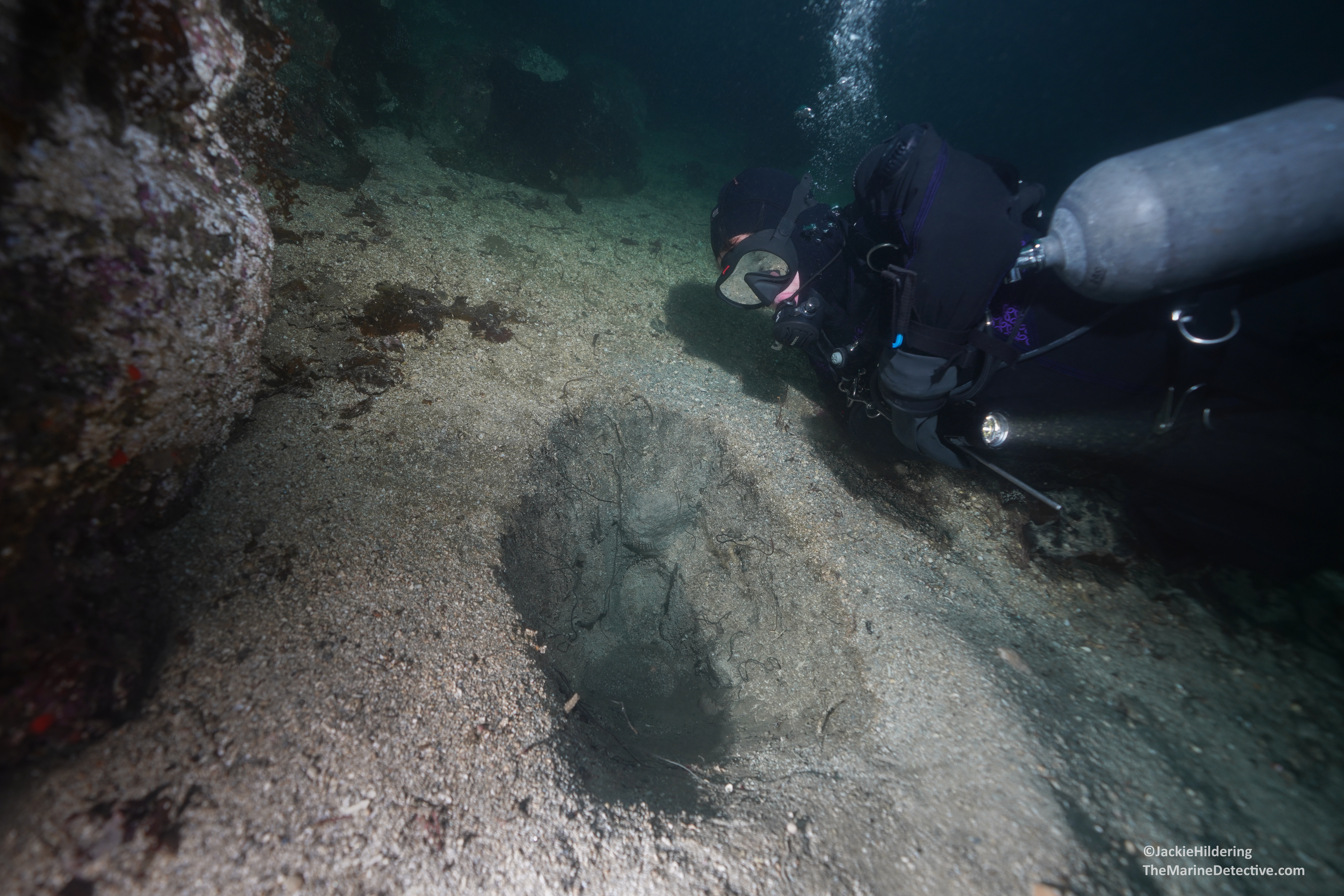
If you see a Sea Otter going up and down in the same location without coming up with prey the first time (and breaking it open on their belly), this is likely what is happening.
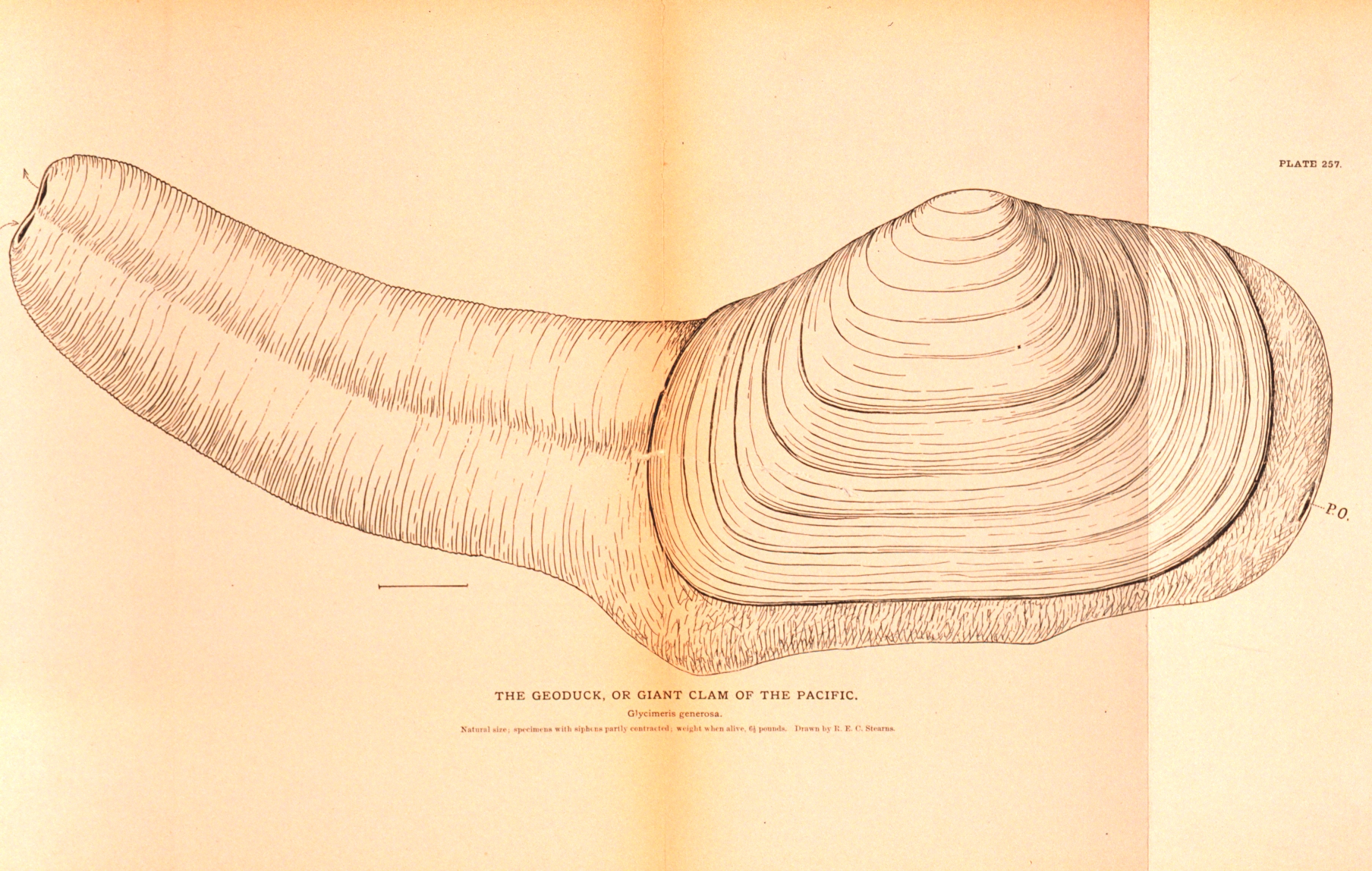
Geoducks have very long siphons (neck or shaft) and can be buried 1 metre below the surface. So it’s quite the endeavour when Sea Otters excavate Geoducks. My photo of the deep pit should aid in understanding why this is the case!
Sea Otters were completely wiped out (extirpated) with the last verified Sea Otter in Canada having been shot in 1929 near Kyuquot (NW Vancouver Island).
There are now over 8,100 Sea Otters off the coast of BC (Nichol et al. 2020). How did that happen? Around 89 Sea Otters were translocated to the outer coast of Vancouver Island from 1969 to 1972 (as a mitigation measure for nuclear testing in Alaska).
The population grew (and spread out) from there. And yes, they eat a lot. Even with their incredibly dense fur (which made them so “desirable” in the fur trade), they need to fuel their furnace by eating up to 1/4 of their body mass daily to survive in the cold ocean.
More Sea Otters = more kelp forests (since they eat the urchins that eat the kelp) = more habitat, more oxygen, more food, and more carbon sequestration.
Sea Otters are recognized as a species of Special Concern in Canada.
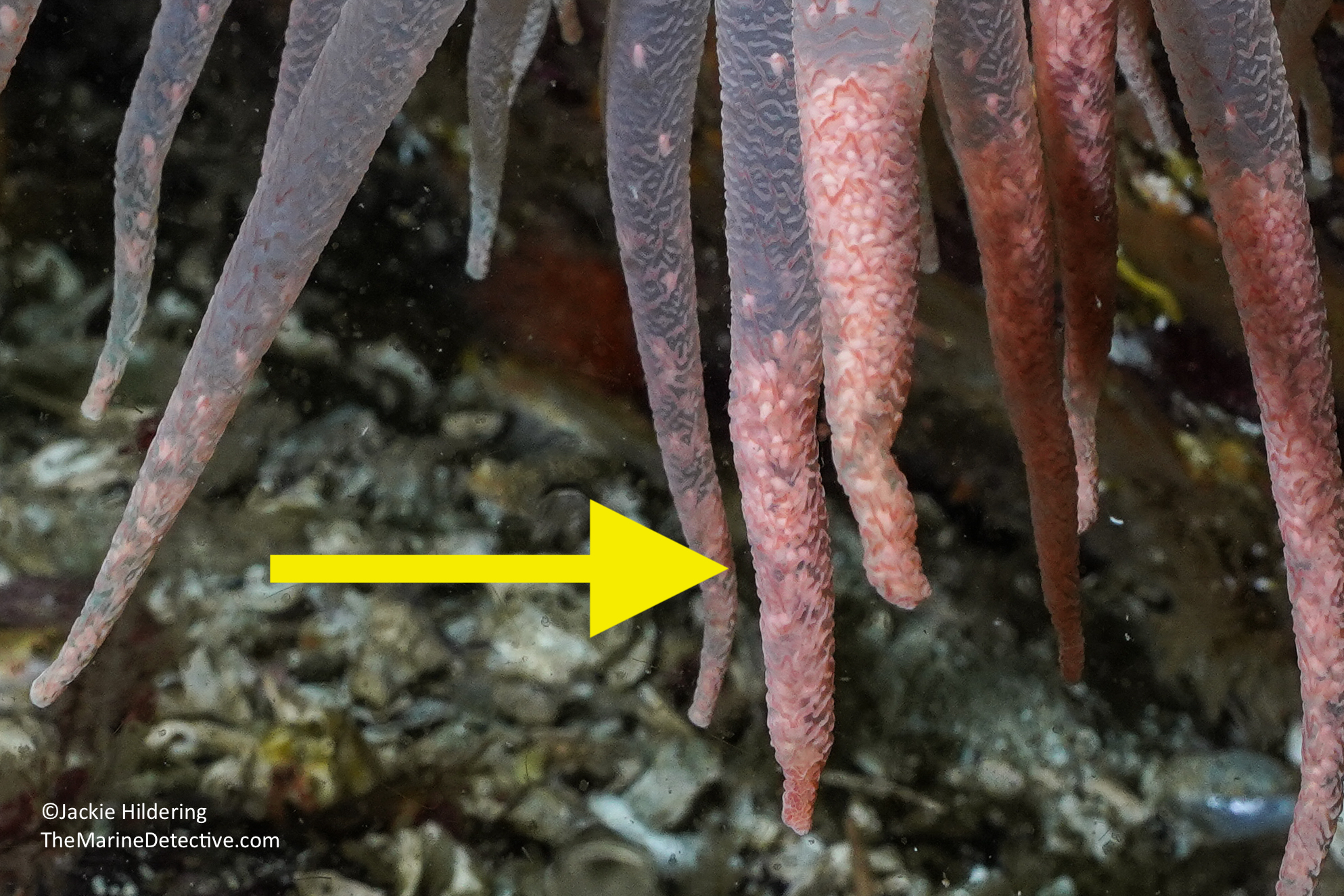
Oh the fabulously diverse ways that anemones reproduce! I recently documented another species where the larvae develop in the mother’s tentacles! I have even seen the babies move.
See them?!
Snakelock Anemone embryos. Another Snakelock Anemone with embryos.
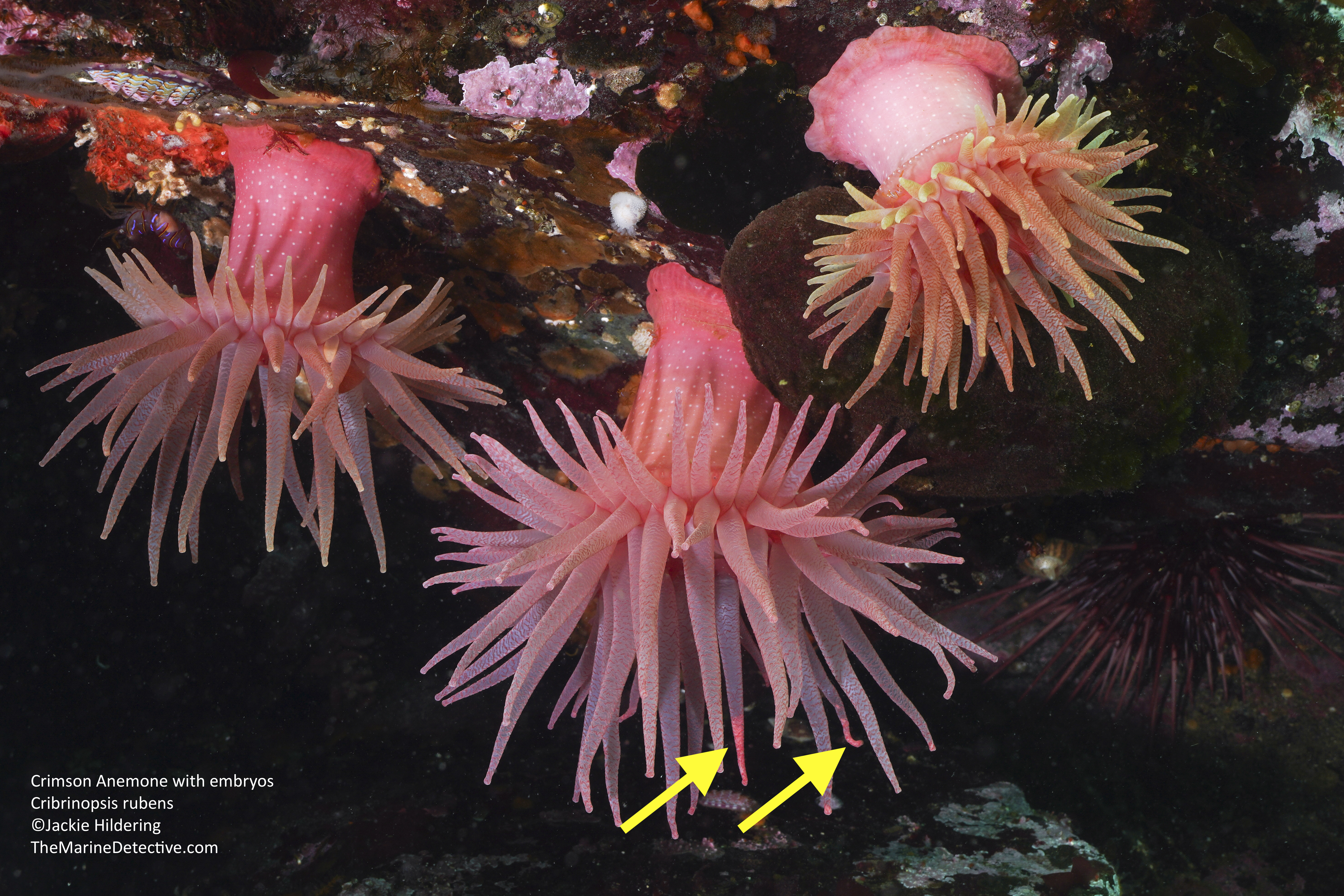
For at least the three anemone species I show here, when the males release sperm into the water column, the females do NOT release their eggs into the water. Instead, fertilization is internal. The embryos are protected as they develop in their mother’s hollow tentacles for around 2 weeks (also in areas known as the pseudospherules). Then, out into the ocean they swim as plankton, via their mother’s mouth.
There are other local anemone species where fertilization is internal too. But the embryos don’t develop in the mother’s tentacles .e.g. Brooding Anemones and Proliferating Anemones. For these species the young are “brooded” in the mother’s digestive cavity and then crawl out of her mouth and are protected under her tentacles.
In many other anemone species, like Plumose Anemones and Painted Anemones, fertilization is external. Both males and females release their gametes into the ocean at around the same time (broadcast spawning). Fertilization happens in the water column and the larvae are plankton until they settle to the ocean bottom.
And then some anemones also have asexual reproductive strategies like budding off offspring; splitting into two; or pedal laceration where a torn piece of the bottom of the anemone can grow into another anemone!
I’ve said it before . . . and you thought human sex lives were interesting. 😉
Snakelock Anemone Cribrinopsis fernaldi Described as a distinct species in 1976. Crown up to 20 cm wide.
There has been considerable reclassification of local anemone species. For this species, the development of the young in the tentacles was described in research from 1976.
“Male Cribrinopsis fernaldi (Fig. 1) in San Juan Islands, Washington release sperm in springtime. The sperm swim or are drawn into the mouths of the females and fertilise the eggs, some of which are still in the gonads, while others are floating freely in the gastrovascular cavity, in the hollow tentacles, and in swellings around the upper outer surface of the body column. Development proceeds within the gastrovascular cavity through gastrulation (3 days) to swimming planula larva (10 days), and then to release of the swimming larvae via the mouth (15 days).” “Some embryos were removed from the tentacles of the adult on day 1 (early cleavage), and day 7, day 13 (planula), and day 34. These continued their development and metamorphosed and settled at the same time as the larvae which remained in the adult until natural release. It is concluded that the brooding behavior is protective rather than nutritive in function.”
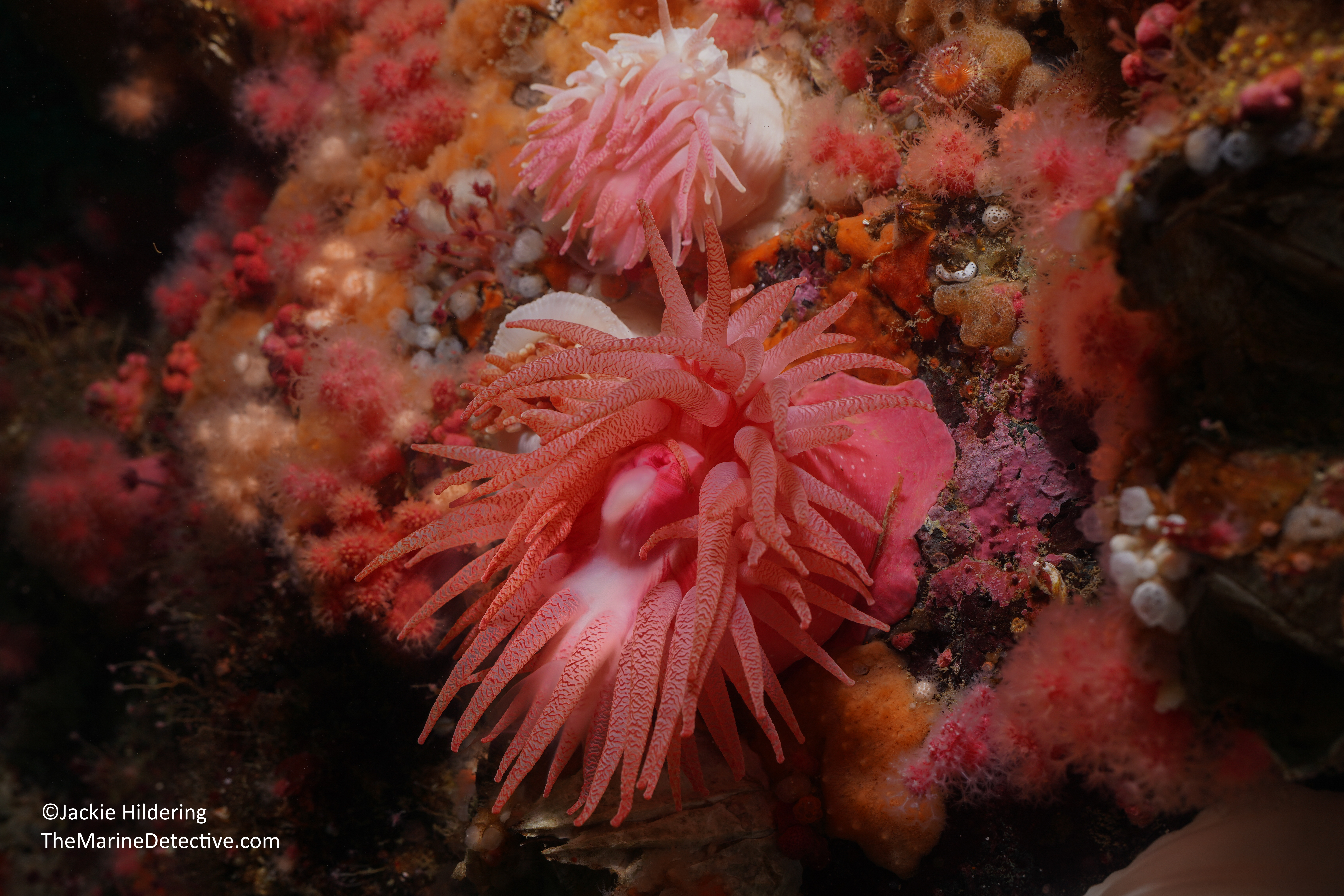
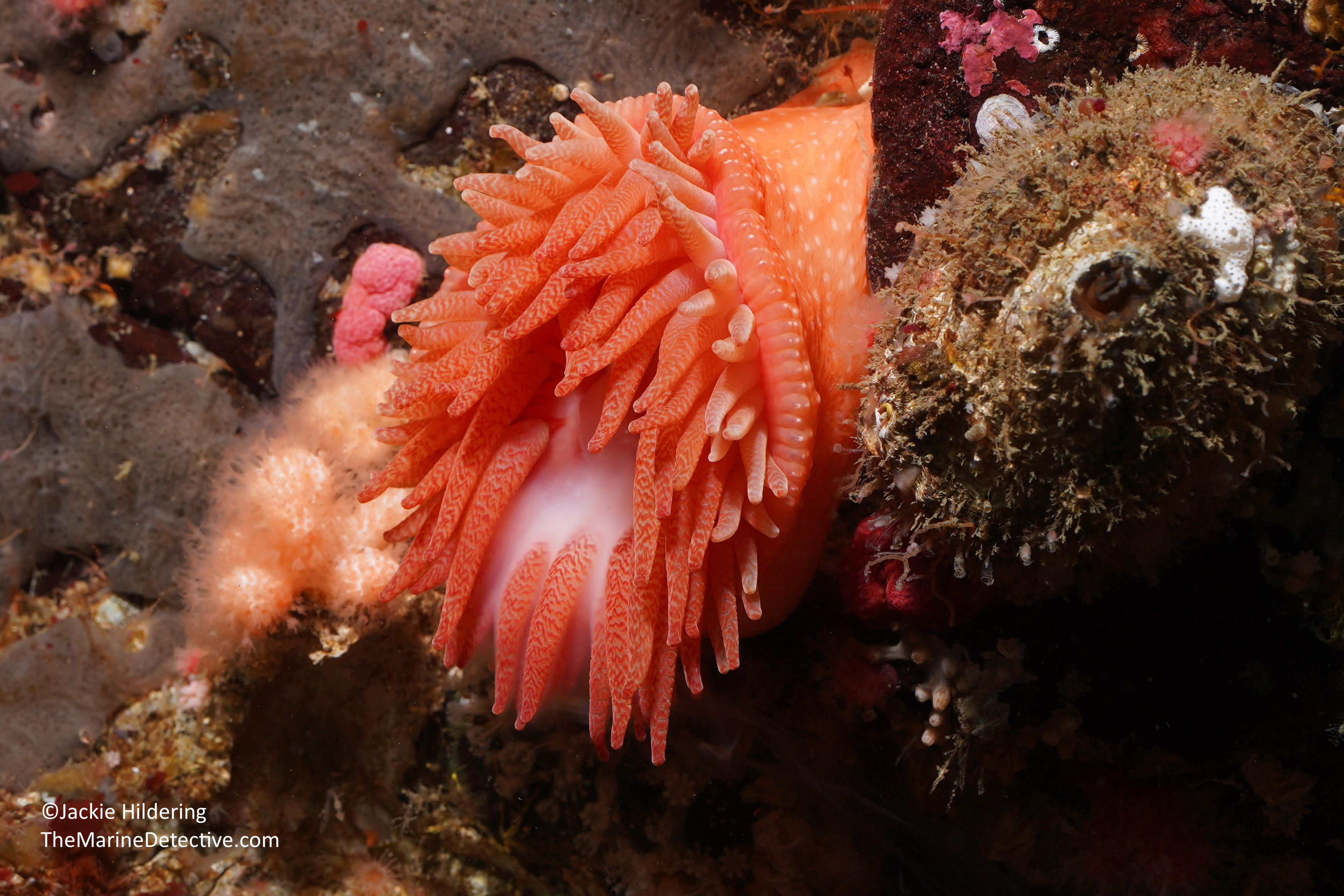
Crimson Anemone Cribrinopsis rubens Described as a distinct species in 2019. Crown up to 10 cm wide.
Before I ever managed to find a member of this species with young developing in the tentacles, I often witnessed the spawning of the males. I realized that it was always only males I saw spawning (I never saw eggs being released).
As referenced above, this species was only described as a new species in 2019 having previously been confused with the Snakelock Anemone. Considering how closely the two species are related, it was expected that they would have similar reproductive strategies.
Crimson Anemone female with embryos.
Below, photos of male Crimson Anemones spawning.
Spotted Pink Anemone Aulactinia vancouverensis Described as a distinct species in 2013. Crown up to 8 cm wide, and as you can see here, not always pink.
Spotted Pink Anemone female with embryos. Male Spotted Pink Anemone spawning.
Last Thursday, I had the joy of teaching “All About Octopuses” to local kindergarten students.
After I had taught them, we were sitting in a circle and the children asked me if I could say hello from them to the next Giant Pacific Octopus I saw while diving.
Of course, I said yes and was really moved. But then they changed their minds.
They said I should not say “hello”. I should say “g̱ilakas’la’”.
Gilakas’la’ means “I share my breath and spirit with yours” in Kwak̓wala.
I’m not crying. You’re crying.
Then, two days later, I was diving and in just 8 metres of water (25′), I chanced upon a Giant Pacific Octopus tucked away in their den. This video is the result. I hope you can hear the joy and earnestness in my voice.
Gilakas’la’ is used to welcome, greet, and give thanks.
For pronunciation listen here. [ǥi] (la) (kas) (‘la)
Thank you dear teachers at Cheslakees Elementary School
Yes, yes I do feel somehow better now that I have compiled the following for you. Thanks for asking.
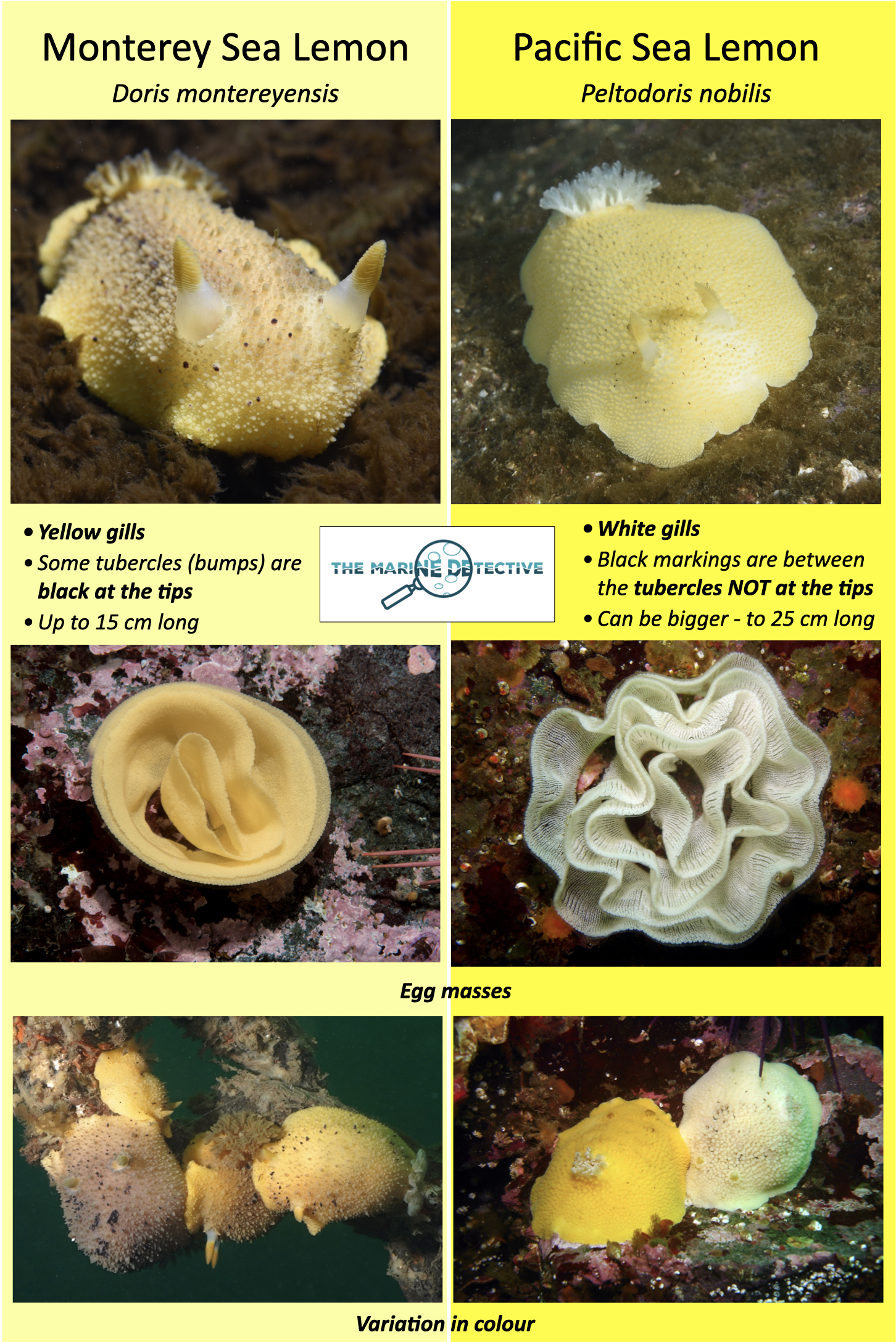
Monterey Sea Lemons and Pacific Sea Lemons are commonly confused with one another (and other yellow dorid-like nudibranchs).
On a recent dive, I was able to get photos of the two species oriented the same way AND when their gills were not retracted! I hoped that by putting these photos side-by-side, it would be useful to others to identify the species.
The easiest differences to discern who is who, are the colour of the gills (yellow or white) and whether the black markings are at the tips of some of the tubercles or not.
I’ve added photos to show (1) their very different egg masses and (2) the variation of colour within the species.
You’re welcome.
The Pacific Sea Lemon is also known as the Noble Sea Lemon.
The name of the Monterey Sea Lemon (aka Monterey Dorid) does not help with clearing up confusion as it is very commonly seen far to the north of Monterey.
[Update! As a result of writing this blog, I learned that the species has been reclassified AGAIN. As of ~February 12, 2024, this is no longer Berthella chacei. It is now Boreoberthella chacei. I’ve updated the text below and will just reference the species as the “White Berthella”.]
There’s a whole lot of mating going on right now with the sea slug species, Boreoberthella chacei also known as “Chace’s Sidegill” and the “White Berthella”.
Two mating White Berthellas and an egg mass.
Not a nudibranch
The Berthella are examples of sea slugs that are NOT nudibranchs. I’ve emphasized previously that “nudibranch” is not synonymous with “sea slug”.
Dive buddy Jacqui Engel and White Berthellas laying egg masses / ribbons.
The nudibranchs are just one of the seven subgroups of sea slugs (the Heterobranchia). Thereby, all nudibranchs are sea slugs. But not all sea slugs are nudibranchs. I realize those two sentences may make your brain feel sluggish. Sorry / not sorry. 😉
Characteristics shared among nudibranchs are that they are sea slugs that all DO have naked gills on their backs (hence “nudi” and “branch”) and adults DON’T have an internal shell.
Berthellas belong in a different group of sea slugs than nudibranchs. They are sidegill sea slugs (the Pleurobranchida order). They DON’T have naked gills and DO have an internal shell. The shell ofWhite Berthellas is thin and white and is at least half the length of their bodies. Their gills, as the name “sidegill” suggests, extend from their side.
Specifically, the gills are on the right side, between the mantle and the foot. See them in the photo above?
Perspectives on the White Berthella that show how the rhinophores extend out from under the mantle. Rhinophores are the structures extending from a sea slug’s head that allow them to smell their way around. Berthella can retract these when there is an annoyance around. Yep, an annoyance like me. You can also see the beautiful “oral veil”.
Mating time
It’s typically in February and March that I see mating and egg masses for White Berthellas near northeast Vancouver Island.
Mating White Berthellas with egg masses.
I find it a marvel that they find one another. Throughout the rest of the year I see them quite spread out from one another. There can be some within a few metres of one another but with other sea slugs species, they are often within centimetres of one another.
With other sea slug species, Nature has ensured they are often very close by the species having VERY specific prey e.g. Pomegranate Aeolids ONLY feed on Raspberry Hydroids. Thereby, there are often others of your kind, nearby on this prey.
White Berthellas are reported to feed on sponges (specifically plakinid sponges like Slime Sponge, Oscarella carmela). They don’t seem to aggregate near these sponges, maybe because they are more diffuse? They must find one another by smell detected by their rhinophores and then crawl to be within proximity (this species does not swim).
When they find one another, they appear to jostle for position in aggregations. Pairing up right-side-to-right side means that they can attach by their “gonopores” and mating can occur. Both partners become inseminated and both will lay eggs. Like other sea slugs, they are simultaneous hermaphrodites. It makes a lot of sense when you are a sea slug to maximize how many eggs are laid, especially if your young hatch out to be part of the planktonic soup of the ocean. I believe that more than one egg mass is laid per parent.
Each dot you see in the photo is an egg capsule that is only ~1.6 mm long and it contains 1 or 2 fertilized eggs. Imagine how many fertilized eggs are in the egg masses in the photos below!
The veliger larvae hatch out at the age of around 18 days in 11 to 14 degrees Celcius (it would take longer around northeastern Vancouver Island where temperatures are colder). These larvae have eyespots and shells and are around 153 micrometer long; that’s 0.153 mm! (Goddard, 1984).
Reclassification
The White Berthellahas only been recognized as being a distinct species since 2020 (Ghanimi et al, 2020). It was thought that it was one of two “morphotypes” of the California Sidegill. As mentioned in the update at the top of this blog, very recently the species has been reclassified AGAIN. it is now Boreoberthella chacei.
The White Berthella (Boreoberthella chacei) is up to 7 cm long. The body is white and has little white bumps (tubercles) randomly distributed all over its body and rhinophores. Known range is Alaska south to San Diego, California and the Sea of Japan (Behrens et al., 2022)
The California Sidegill (now also reclassified as Boreoberthella californica) is bigger on average at up to 12.7 cm. Body is white to tan and is smooth. The little white dots are uniformly spread and are not on the rhinophores. Known range is Ventura County, California to the Pacific Coast of Panama and the Galapagos Islands (Behrens et al., 2022)
The egg masses of each sea slug species are distinct. As you can see below in the compilation from the research paper, this is the case for these two species of Berthella.
Side note: How it made me smile to see that my photo of White Berthella egg masses was referenced in the research paper discerning the two species!
Leather Star and Leafy Hornmouths (marine snails) near mating and egg-laying White Berthellas.
[Positive update November 12: NatGeo has taken the video down from Instagram and Facebook. But, still has it on their YouTube Channel.]
Whoa! Astoundingly and disconcertingly inaccurate!
This video is from National Geographic. The added text is mine. The first time they used the video was 5 years ago for “Alaska’s Deadliest on National Geographic TV”. NatGeo Wild posted the sensationalized and inaccurate video again on November 3, 2023 to their audiences of millions of people.
They are evidently not “encumbered” by the lack of logic and truth, despite the feedback of many. They knew how incorrect it was 5 years ago, chose to use it again, and are not heeding any of the concerns. I have provided feedback on their social media posts and am providing it here too in the hopes of countering the misinformation and holding NatGeo accountable for accuracy. They have the responsibility not to create, and perpetuate, sensationalized nonsense.
Is this worth the effort especially with so much else going on in the world? For me, it’s clearly yes. Putting this kind of illogical, inaccurate information into the world especially when perceived as an educational giant is NOT okay. It feeds the atrophying of truth, science and facts.
Deep, deep sigh.
The feedback I provided NatGeo Wild about the video:
“This content is astoundingly inaccurate. Reflect on the reality that salmon eggs are laid in freshwater, on the bottom. These jelly species do not feed on the bottom and are almost always in the ocean, not freshwater.
The eggs you say are salmon eggs being eaten by the Moon Jelly are her own fertilized eggs! In Moon Jellies, when the male releases sperm, the pulsing action of the female Moon Jelly brings the sperm in contact with the eggs under her oral arms and are brooded there.
My photo below shows a female Moon Jelly with fertilized eggs under their oral arms. The eggs she are brooding are brighter white. See them?
Female Moon Jelly brooding fertilized eggs.
Moon jellies are Aurelia labiata, maximum size is 40 cm across.
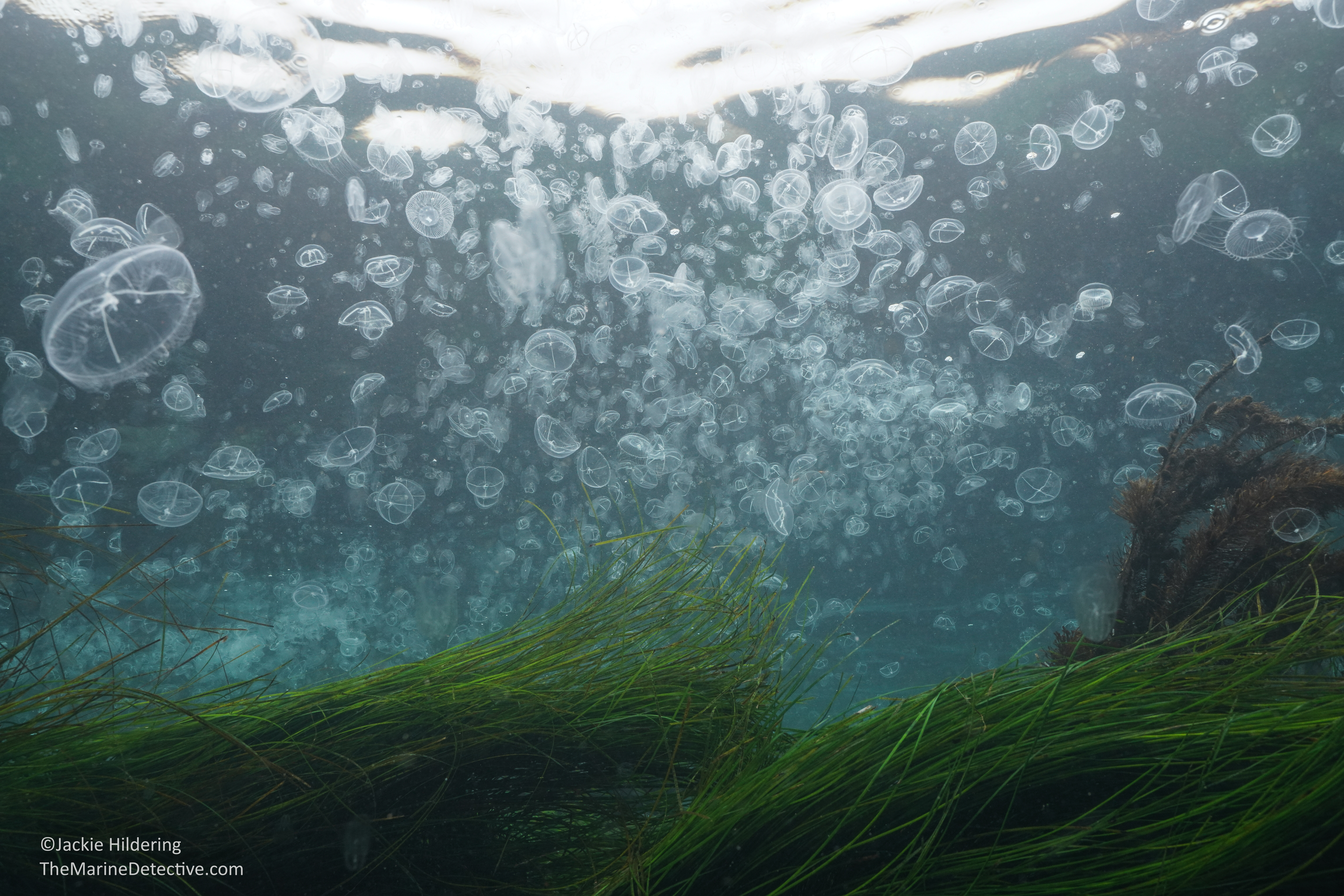
Otherworldly. One-worldly! While on a recent trip to God’s Pocket Resort north of Port Hardy, it happened to be that there was a huge aggregation of jellies. It was truly awe-inspiring to be diving amid this galaxy of jellies.
Black Rockfish, Bull Kelp and a smack of jellies. Aggregating Anemones and jellies.
The collective noun for jellies actually is a “smack”, not a galaxy.
A smack of this magnitude is the result of the jellies’ lifecycle and big tidal exchanges concentrating them. We were certainly gob-smacked by the number and diversity as we watched them cascade past in the current as the plankton they are, pulsing to feed on smaller plankton.
The astounding photo above was taken by dive buddy Melissa Foo. It’s me in the smack, appearing to be in a globe of jellies.
And this photo of me was taken by dive buddy Janice Crook. I am including it anticipating that there will be questions about if we were stung by the jellies. We were not. Only the stinging cells of the large jelly species off our coast lead to human discomfort. Later in this blog, I show photos of those big jelly species.
The majority of the jellies in the smack were Water Jellies and Cross Jellies.
Cross Jellies, as the name suggests, have a cross on their bell. They are Mitrocoma cellularia to 10.5 cm across.
Cross Jellies reflected against the surface, trees above the surface.
Water Jellies are a group of jellies that have little lines all around the outside of the bell that look like the spokes of a wheel. The little white part hanging down from the bell is the mouth (manubrium). Aequorea species are up to 17.5 cm across.
Cross Jelly with manubrium.
There were also Moon Jellies. Moon Jellies are easy to discern because they have a clover shape on their bell which is their 4 gonads / sex organs. Aurelia labiata are up to 40 cm across.
The following photo shows a Moon Jelly female with fertilized eggs. The eggs are the less translucent white structures.
The biggest jelly species I saw were Lion’s Mane Jellies and Egg Yolk Jellies.
The Lion’s Main Jelly is the biggest jelly species in the world. Cyanea ferruginea can be 2.5 m across with 8 clusters of 70 to 150 tentacles which can be up to 36 m long! Know that the larger individuals of this species tend to be further offshore and that they can retract their tentacles.
Lion’s Mane Jelly reflected against the surface. Lion’s Mane Jelly with dive buddies’ bubbles in the background.
The Egg Yolk or Fried Egg Jelly is Phacellophora camtschatica and can be 60 cm across. They have 16 large lobes that alternate with small lobes giving the bell of the jelly as scalloped edge. Each of the 16 lobes has clusters of up to 25 tentacles which can be 6 metres long.
The individuals I saw on these dives happened to be white with light yellow. They part that looks like the yolk of an egg is often darker yellow.
Egg Yolk Jelly – see it’s prey in these two photos? It has caught other jelly species in its tentacles.
Lion’s Mane Jellies and Egg Yolk Jellies. are the only two common jelly species in our waters that can create a sting that irritates human skin, even when the jellies are dead. The stinging cells (nematocysts) work even when the jelly is dead or you get a severed tentacle drifting by your face. The sting from a Lion’s Mane Jelly is reported to be worst than that of an Egg Yolk Jelly.
I’ve been stung by both and clearly it’s not been enough to deter me from striving to get photos of them. But if you have far more skin exposed or are a fisher grabbing nets with many of the tentacles wrapped in them, it is reported to be very uncomfortable.
The solution to the irritation is vinegar (acid), meat tenderizer (enzyme) and I know that many fishers swear by Pacific canned milk as well. Research puts forward that vinegar is the only real solution and that urine does not work at all.
Egg Yolk Jelly and trees.
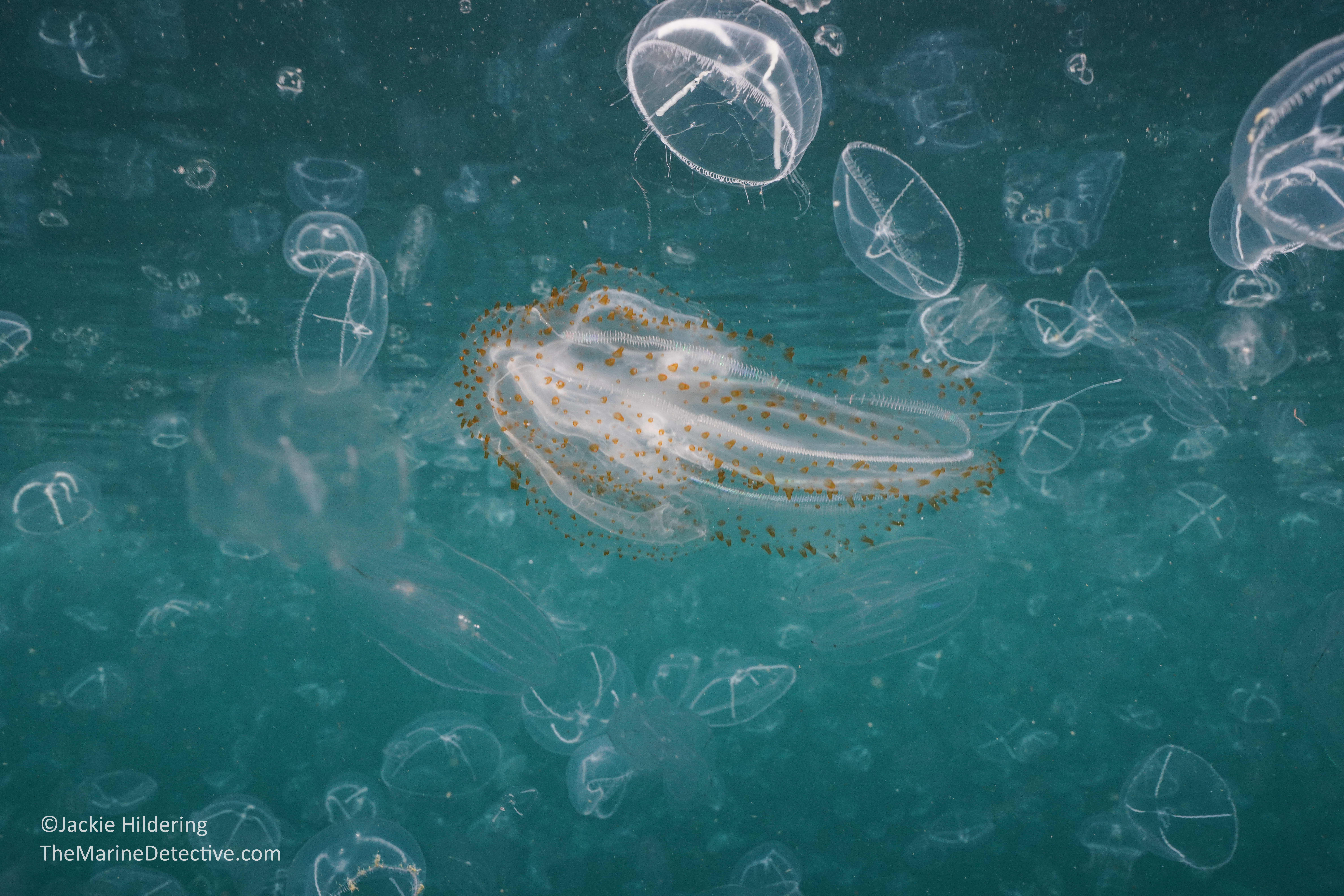
There were also various species of sea gooseberry / comb jellies in the smack. These elongate jellies open up at one end and engulf their prey. Comb jellies move by cilia which are arranged like teeth on a comb. These cilia cause light to scatter whereby you can see rainbow-like flashes over the animals. This is not bioluminescence as the light is not created by the jellies.
Comb Jellies belong to the Ctenophora phylum while the other species referenced on this blog are in the Cnidarian phylum.
Comb Jelly on the bottom right (Beroe species to 10 cm long). Orange-tipped Sea Gooseberry (Leucothea pulchra) – Comb jelly species to 25 cm long.
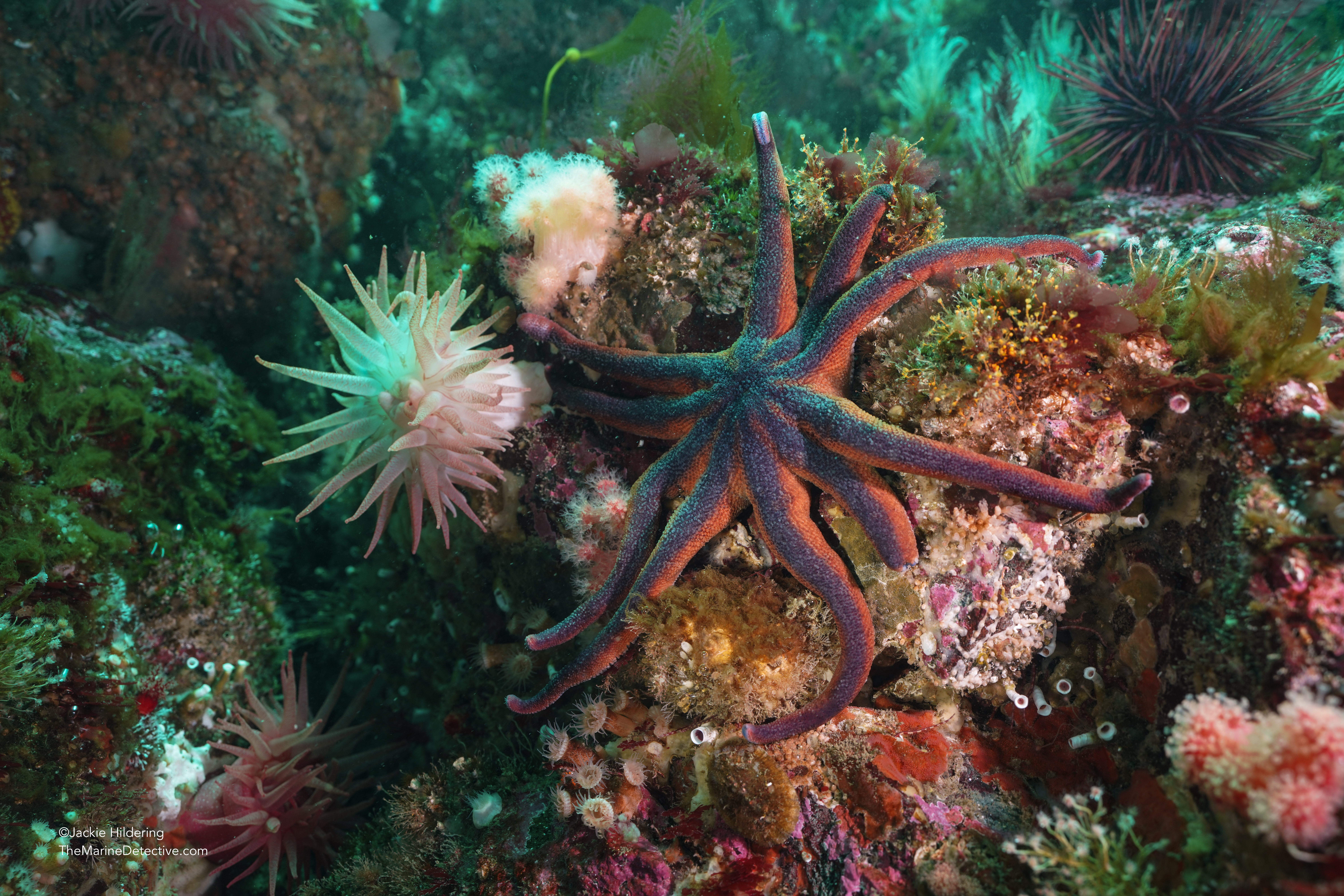
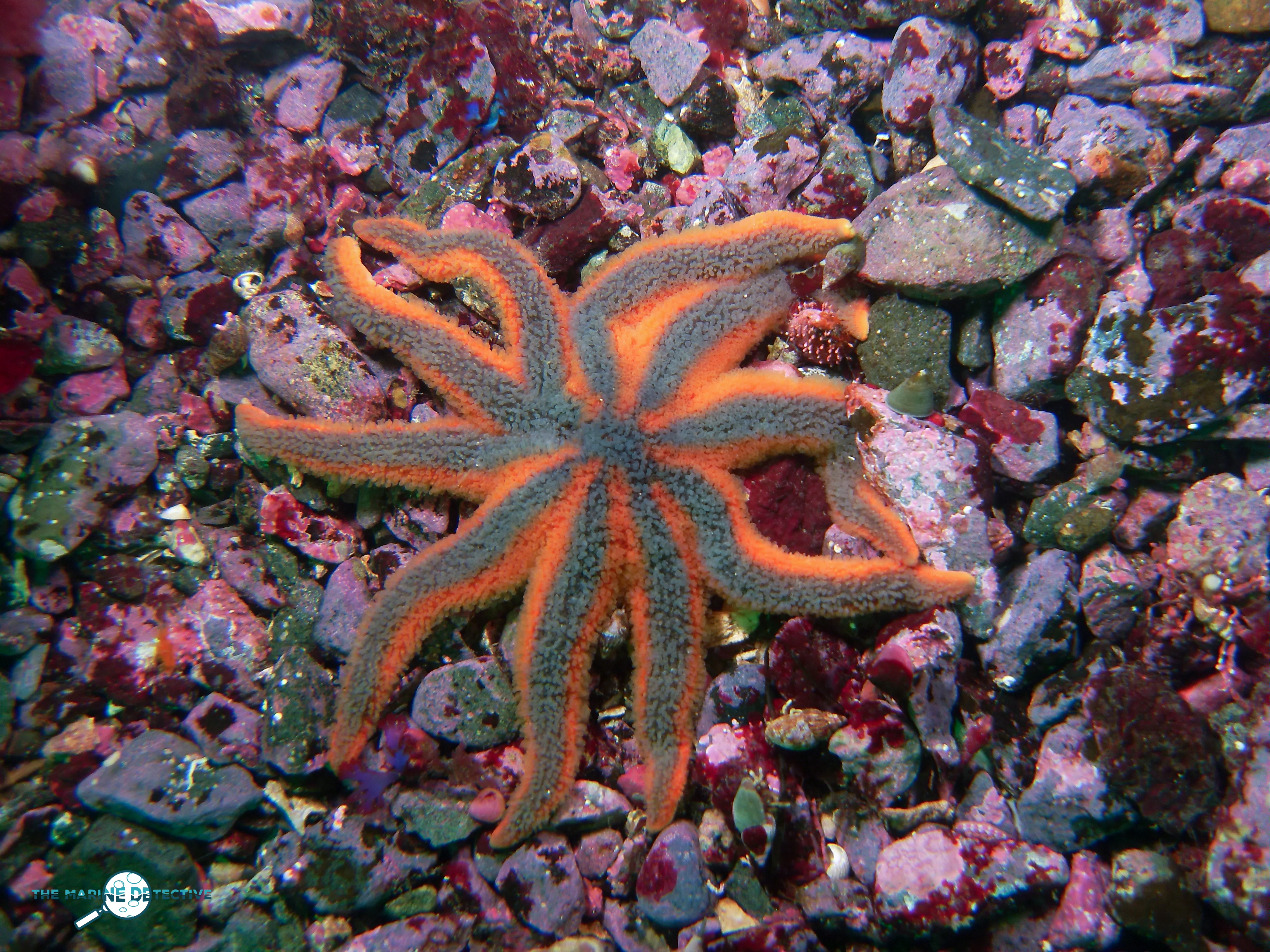
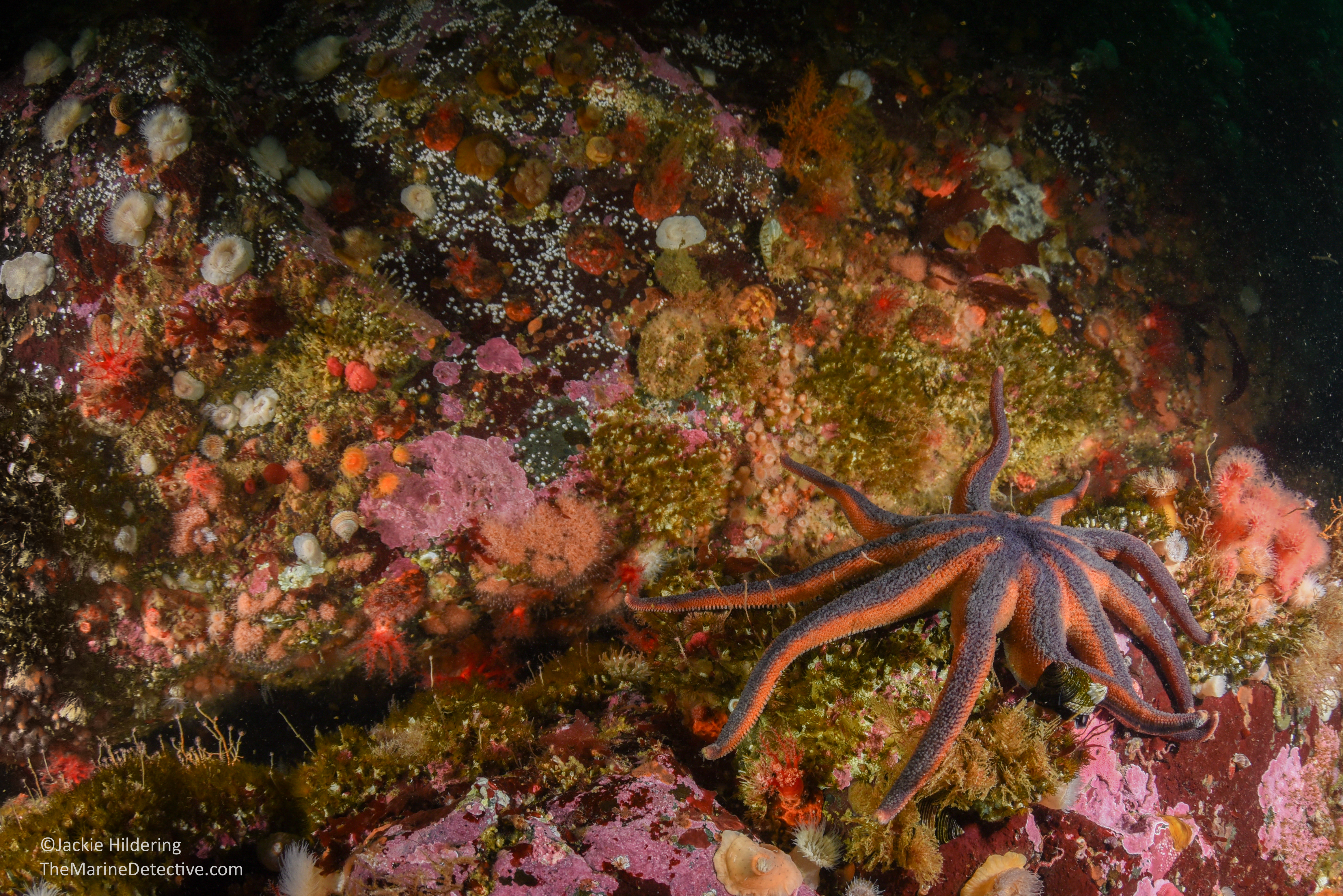
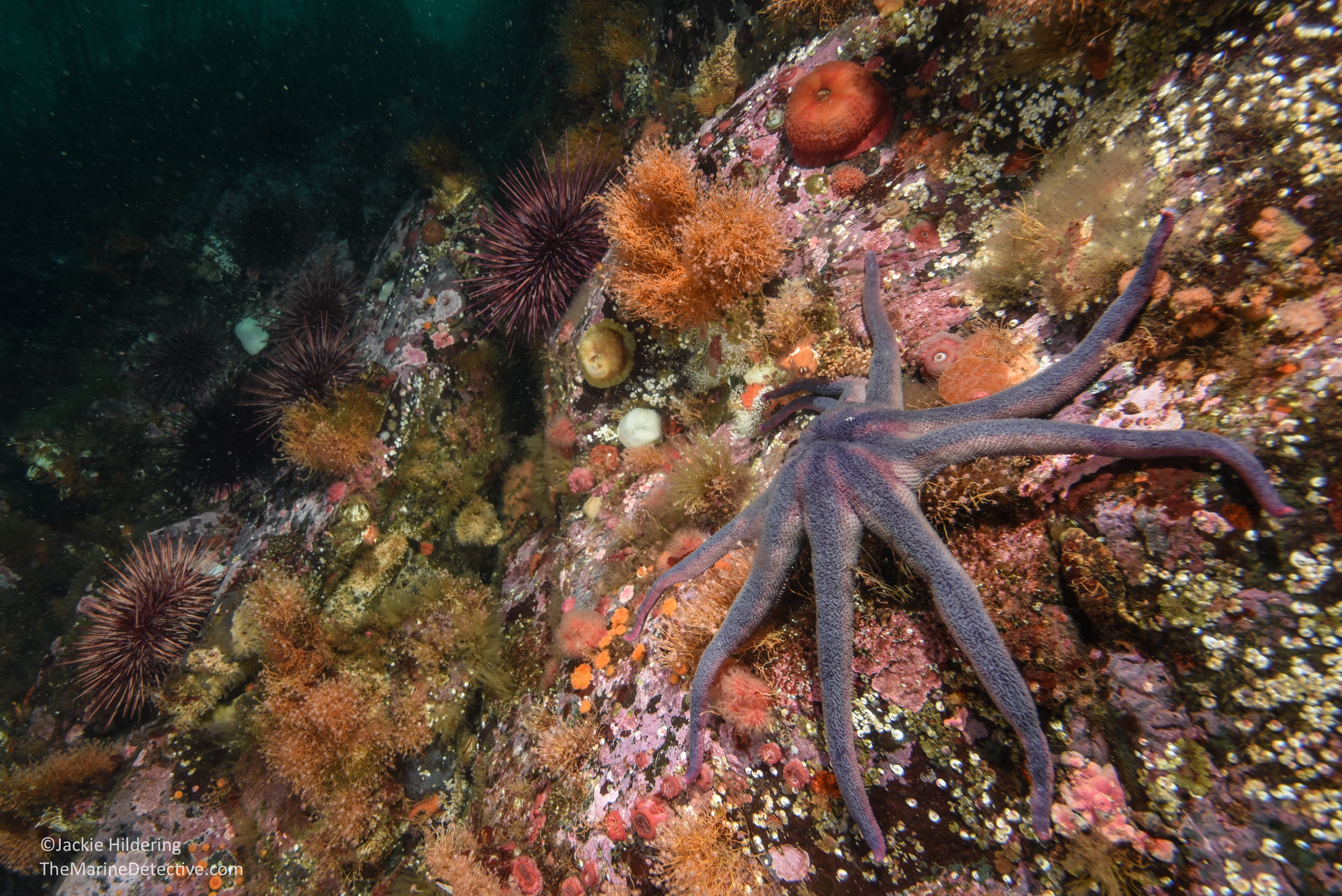
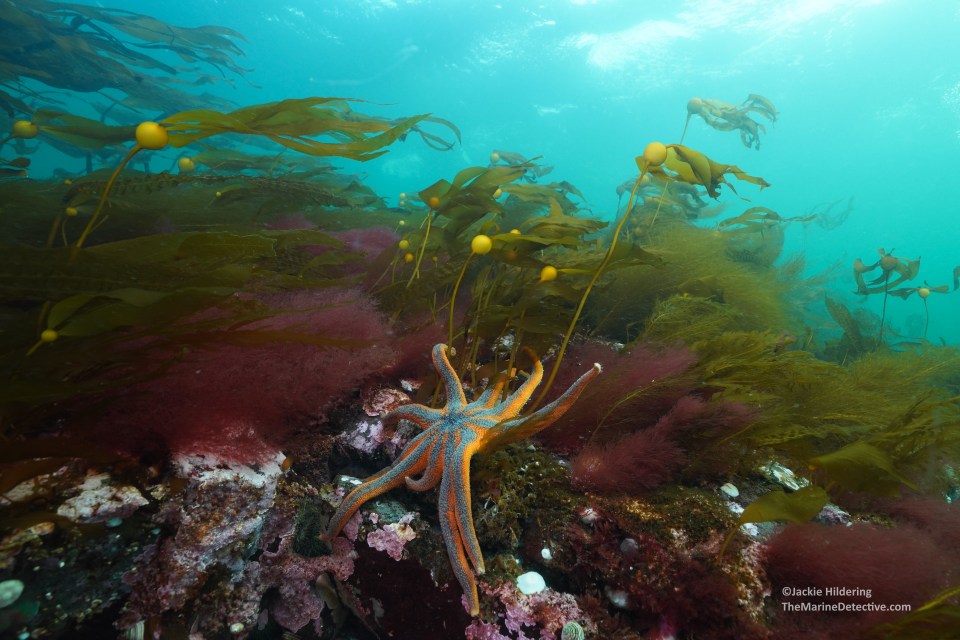
I found distraction from the darkness by compiling these photos of one of the most diversely colourful sea star species off our coast – the gobsmackingly beautiful Striped Sun Star.
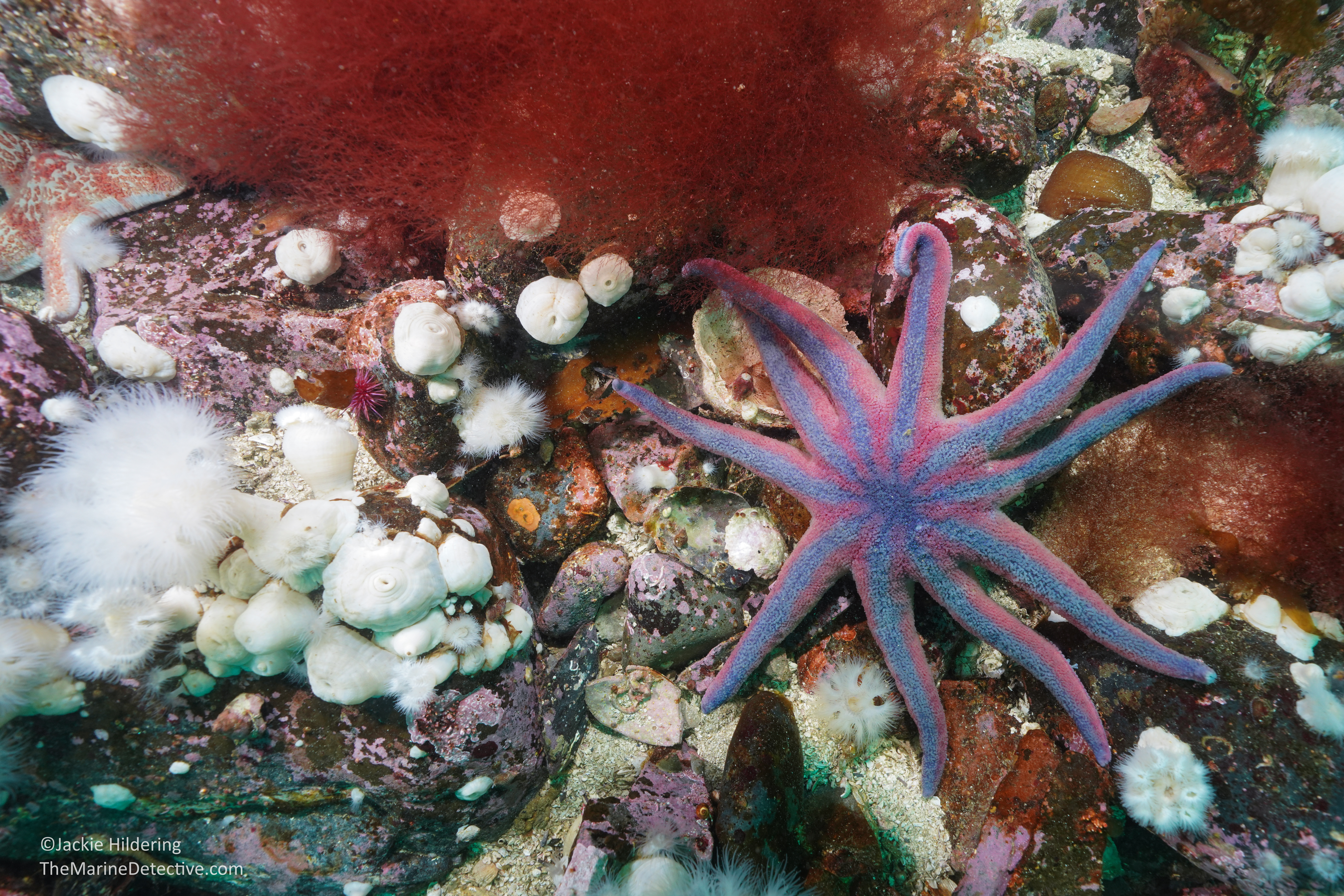
Note how Nature supports diversity. 💙
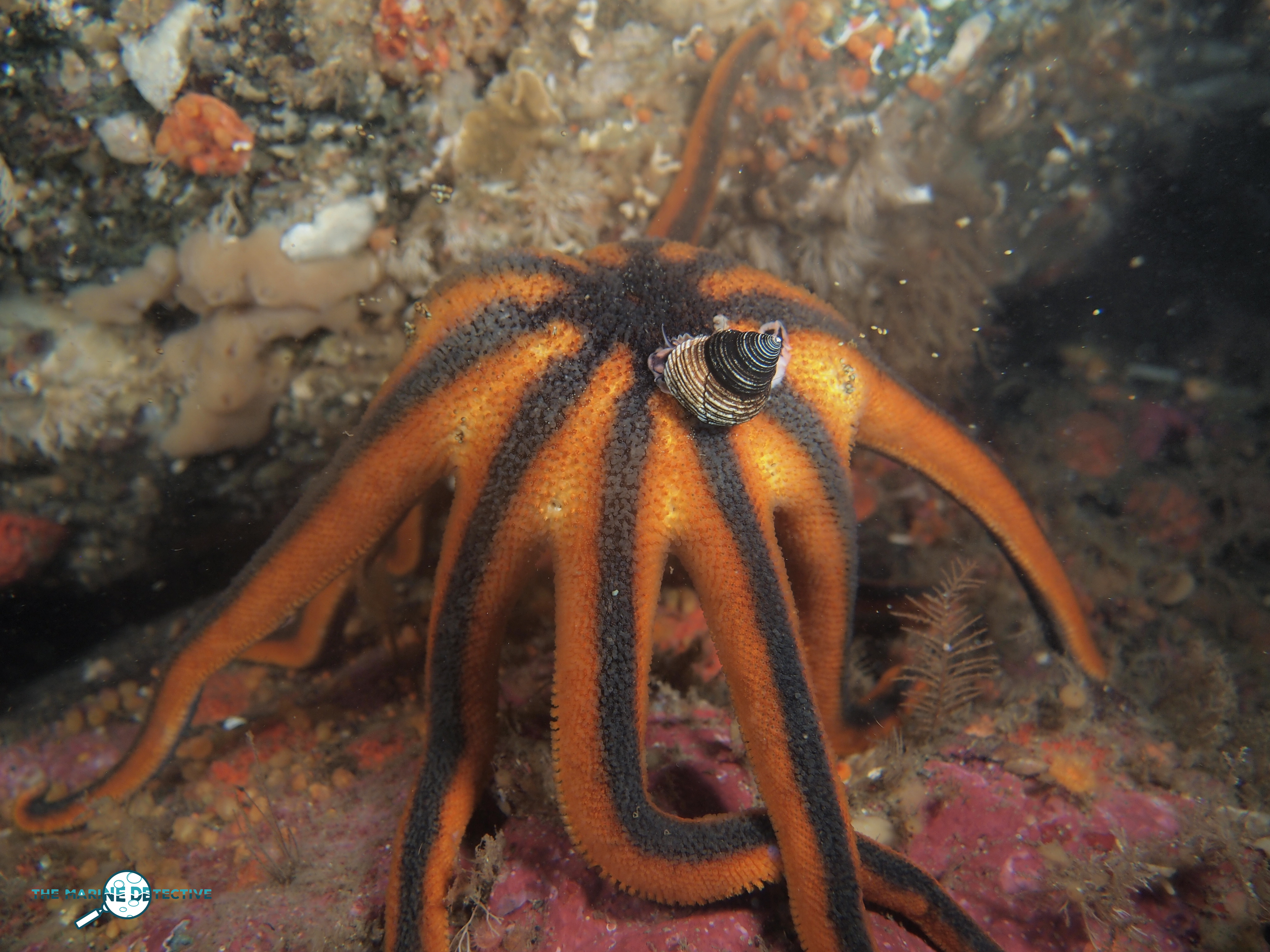
Striped Sun Stars (Solaster stimpsoni) can be up to 58 cm across. They most often have 10 arms with a blue line down the centre of each arm. Some individuals are entirely blue.
Underside of a Striped Sun Star.
Whenever I post photos of this species, they create a bit of a sensation. That’s likely because they are astoundingly colourful and usually live in really colourful neighbourhoods too.
But also, I think there is reduced awareness about the species because Striped Sun Stars are not often in the intertidal zone.
Oh, and then there’s that misunderstanding / underestimation of the colour and diversity of life in this cold ocean.
But LOOK! Look at the diversity in colour of this sea star species and look at the density and colour of the life around them. This is the life off our coast in high current areas.
A completely blue individual. You can still see the blue stripe down each arm. Blue Turban Snail atop a Striped Sun Star.
The diet of Striped Sun Stars includes various species of sea cucumber.
There are 6 species of sea star off our coast that have more than 10 arms. The other 5 many-armed sea star species do not have the blue stripes down the arms. They are Sunflower Stars, Rose Stars, Morning Sun Stars, Northern Sun Stars, Orange Sun Stars. There’s really good information about the diversity of sea stars off our coast on Neil McDaniel’s page at this link.
An individual succumbing to Sea Star Wasting Disease. This species is believed to be heavily impacted.This individual is regrowing one arm which most likely got nipped off by a crab. Echinoderms are astounding in how they can regenerate body parts. In sea stars, as long as part of the central disc is intact, and the individual can avoid predation while handicapped, all arms will grow back even if they have just one left. Reportedly though, regrowth is slow and can take up to a year leaving the handicapped sea star more vulnerable.Juvenile amidst Green Sea Urchins.
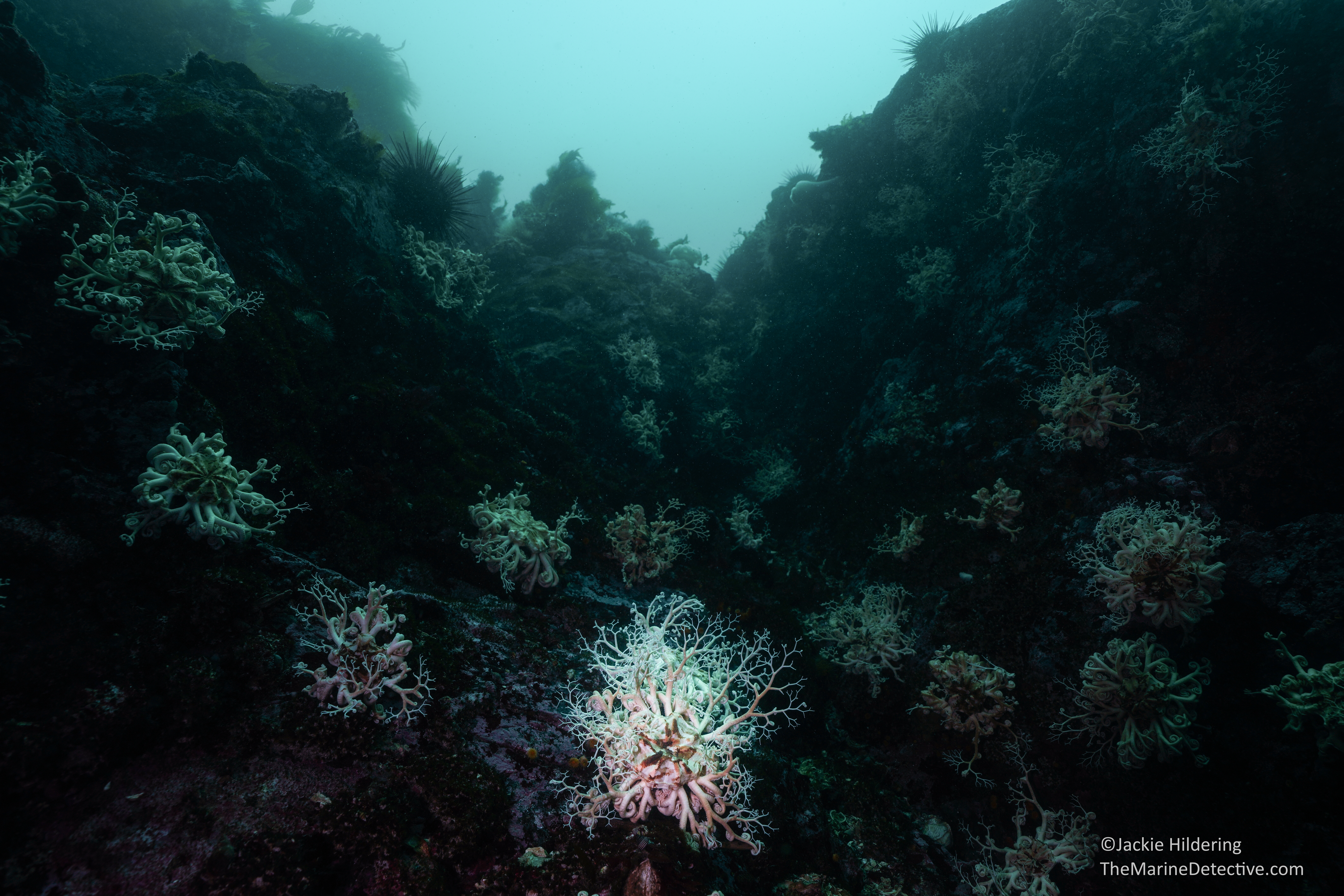
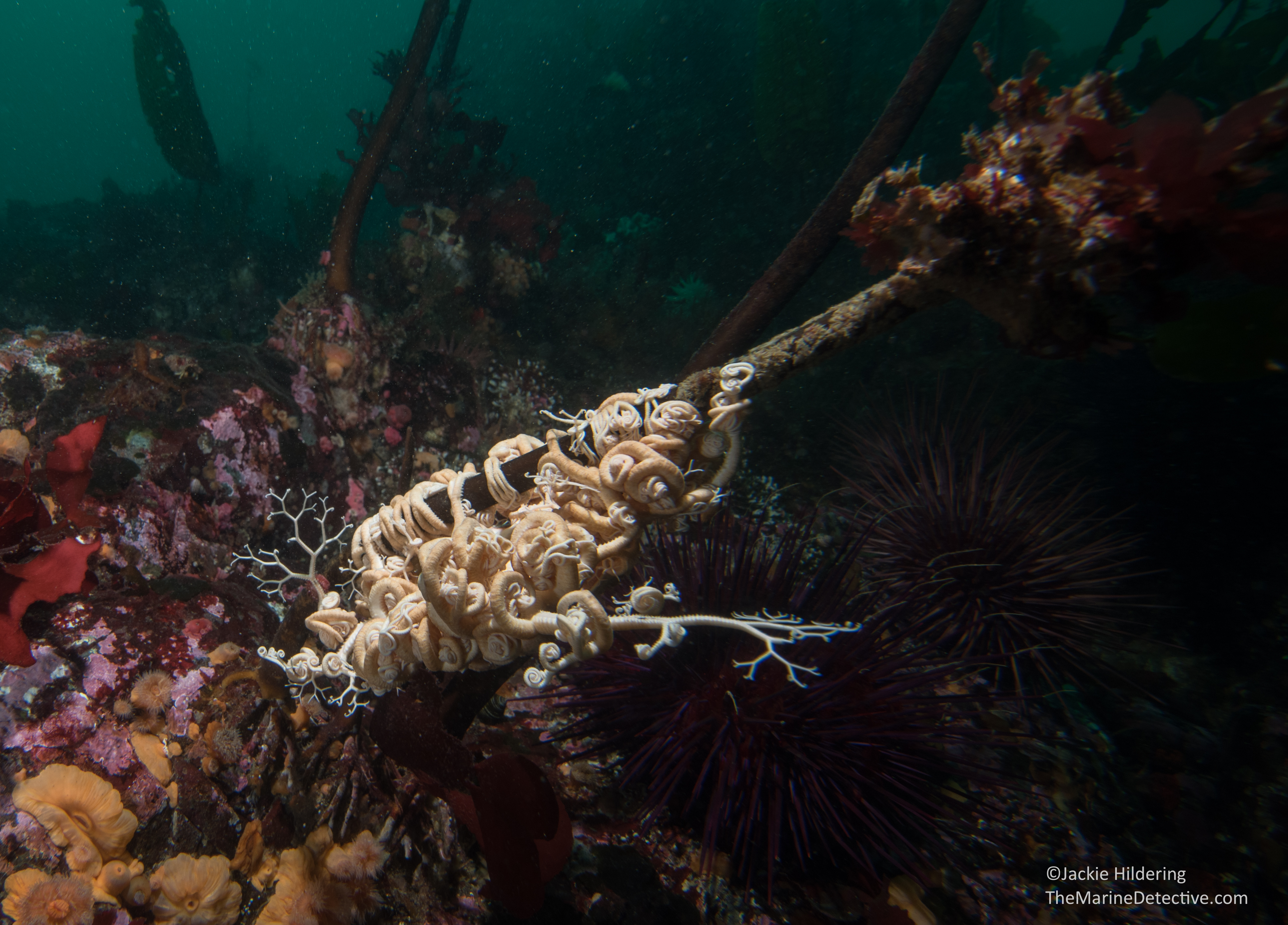
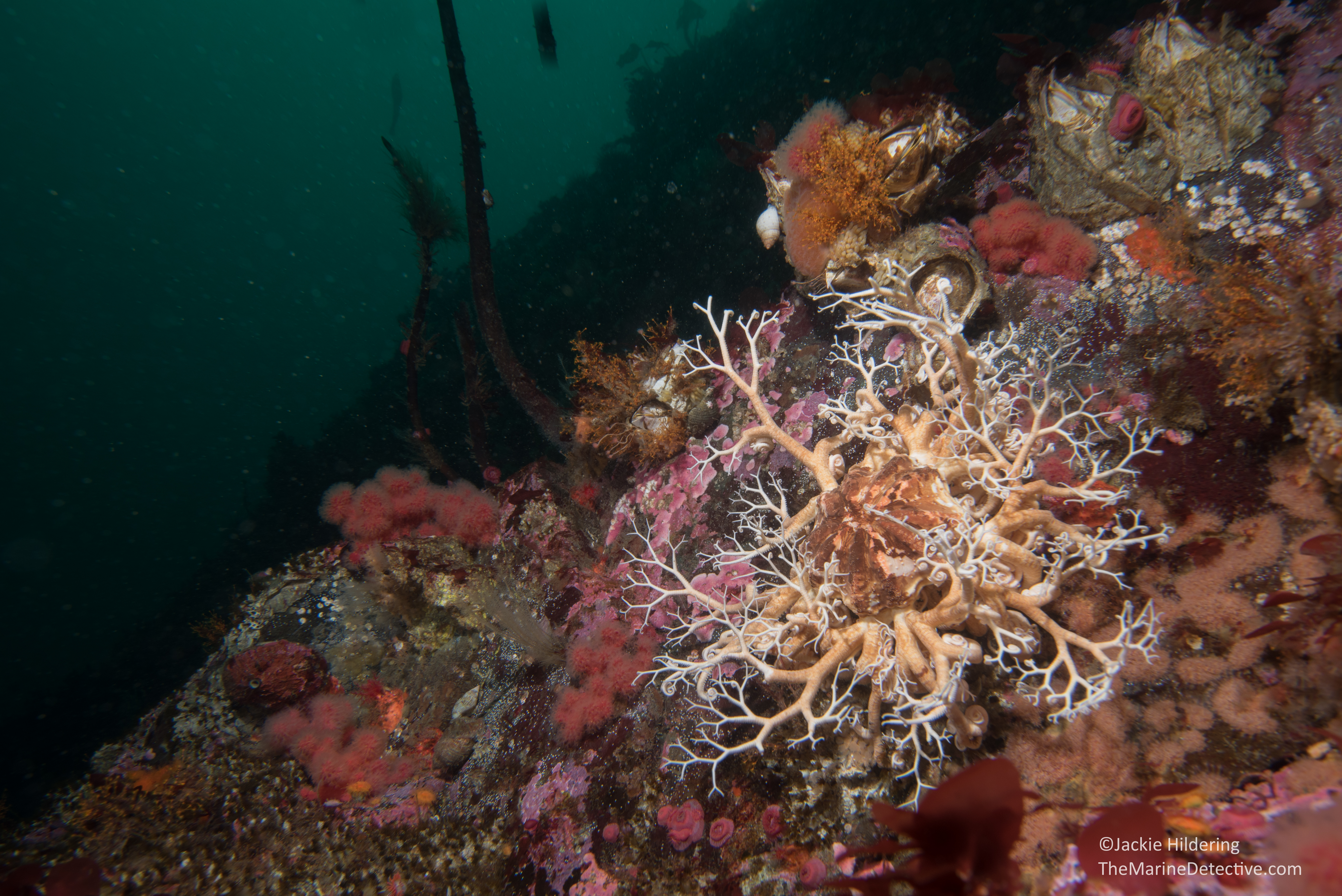
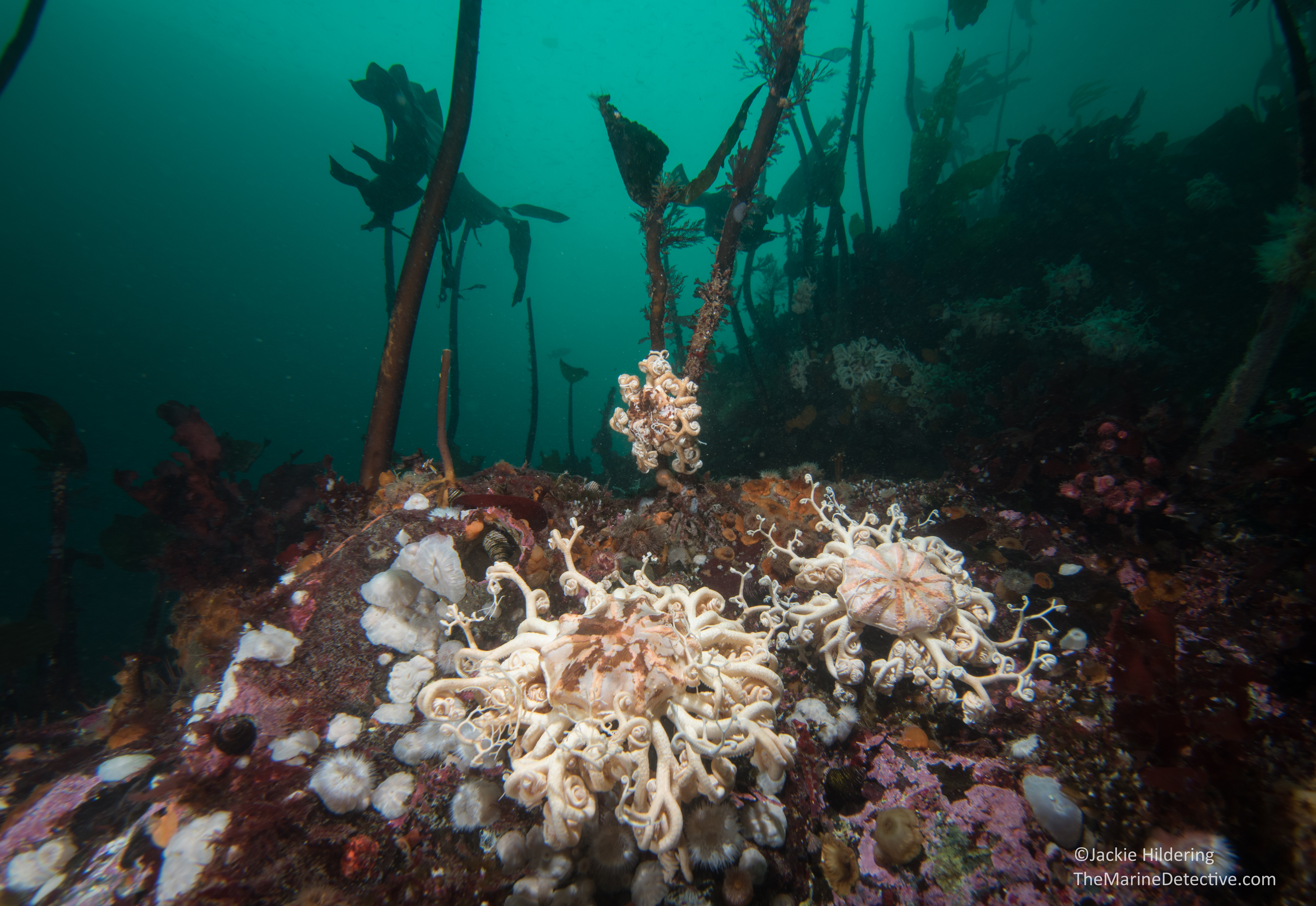
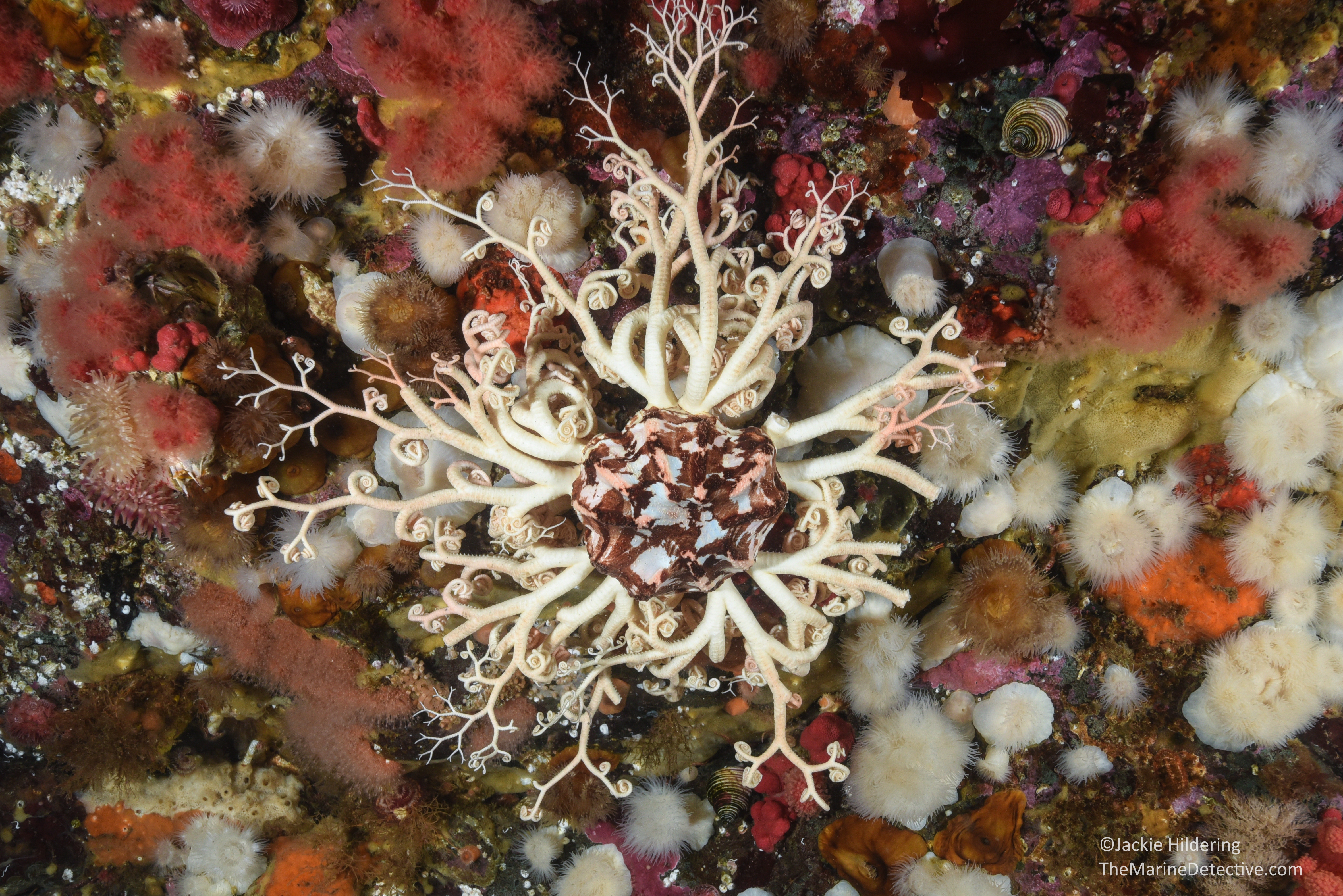
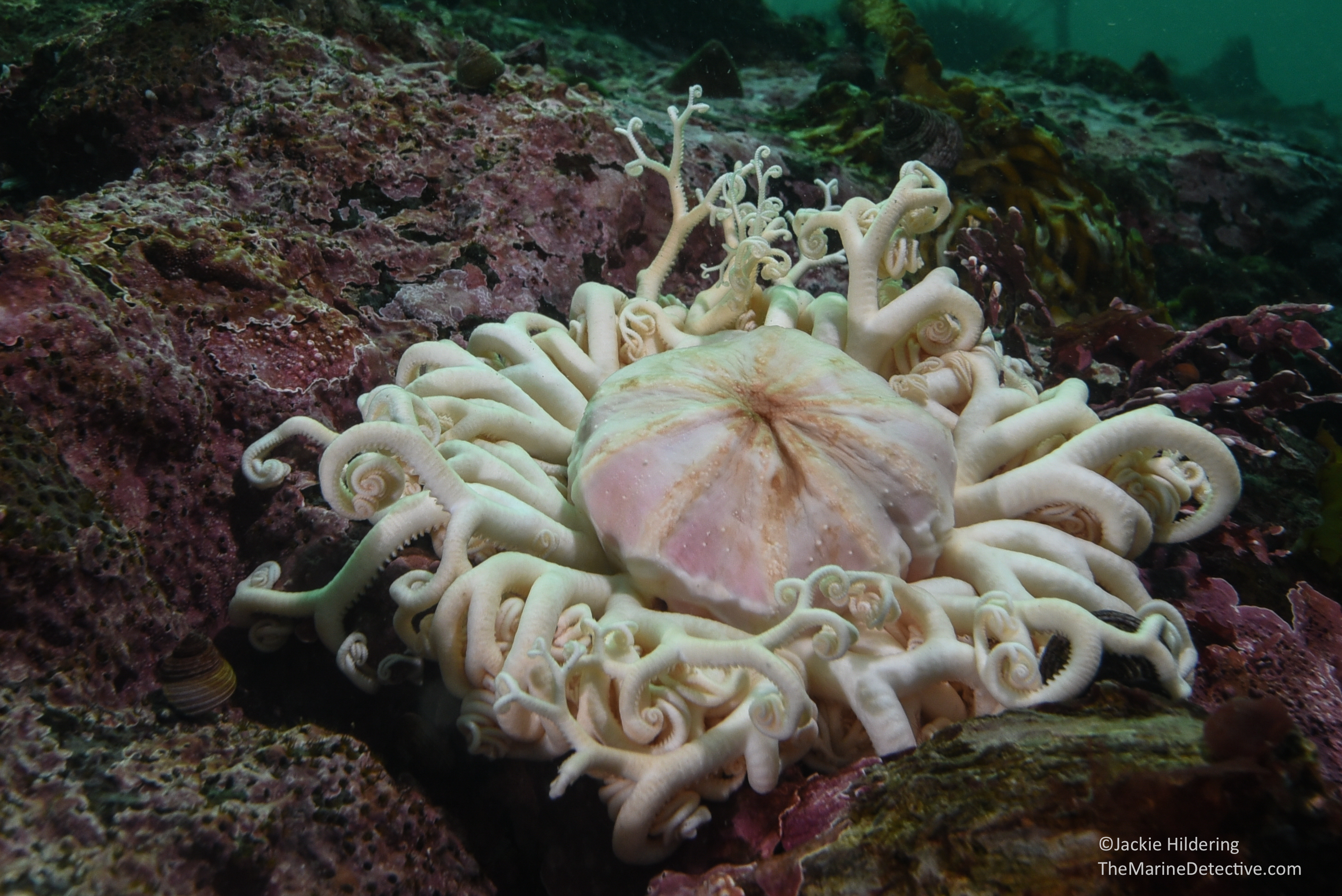
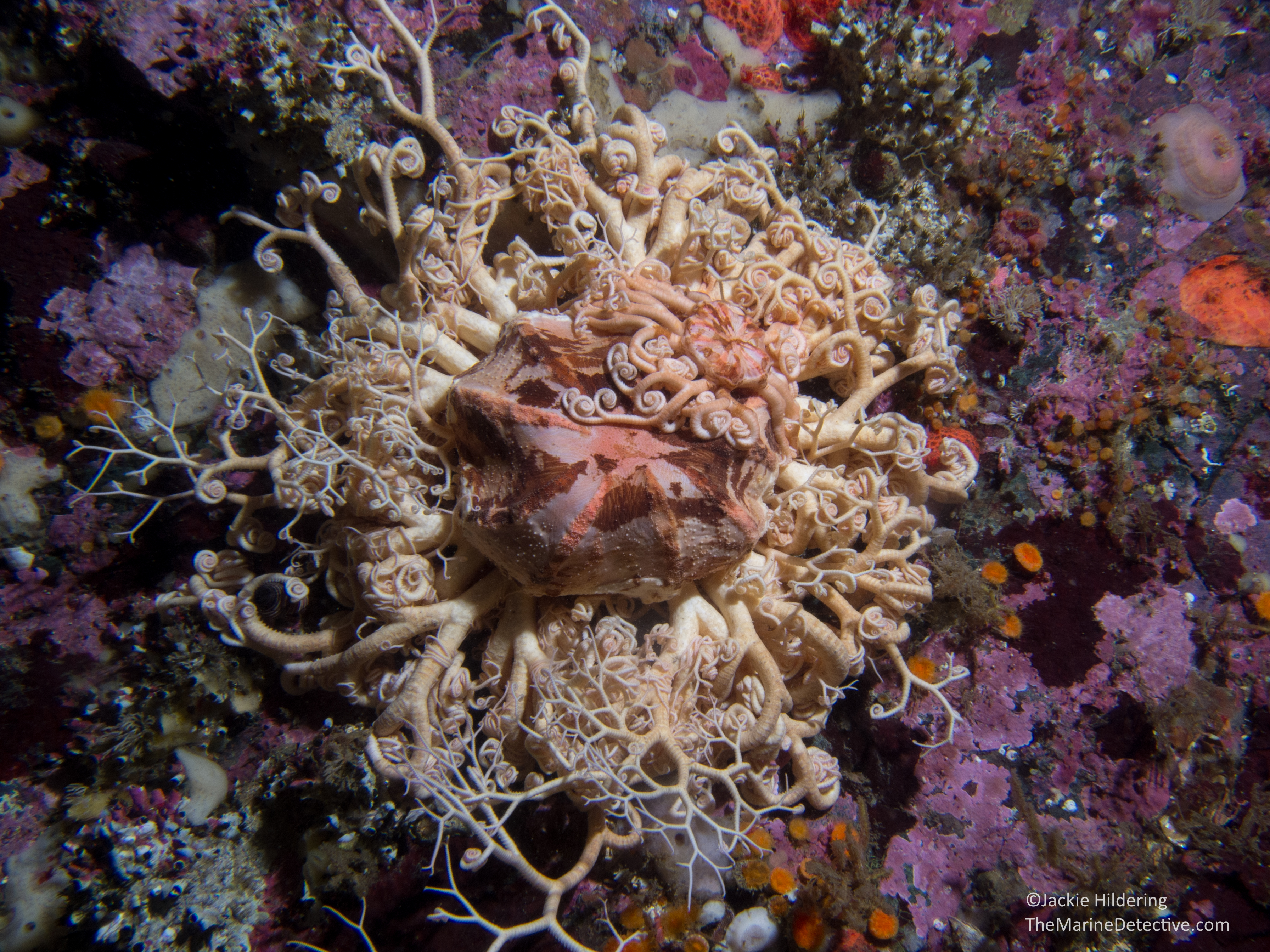
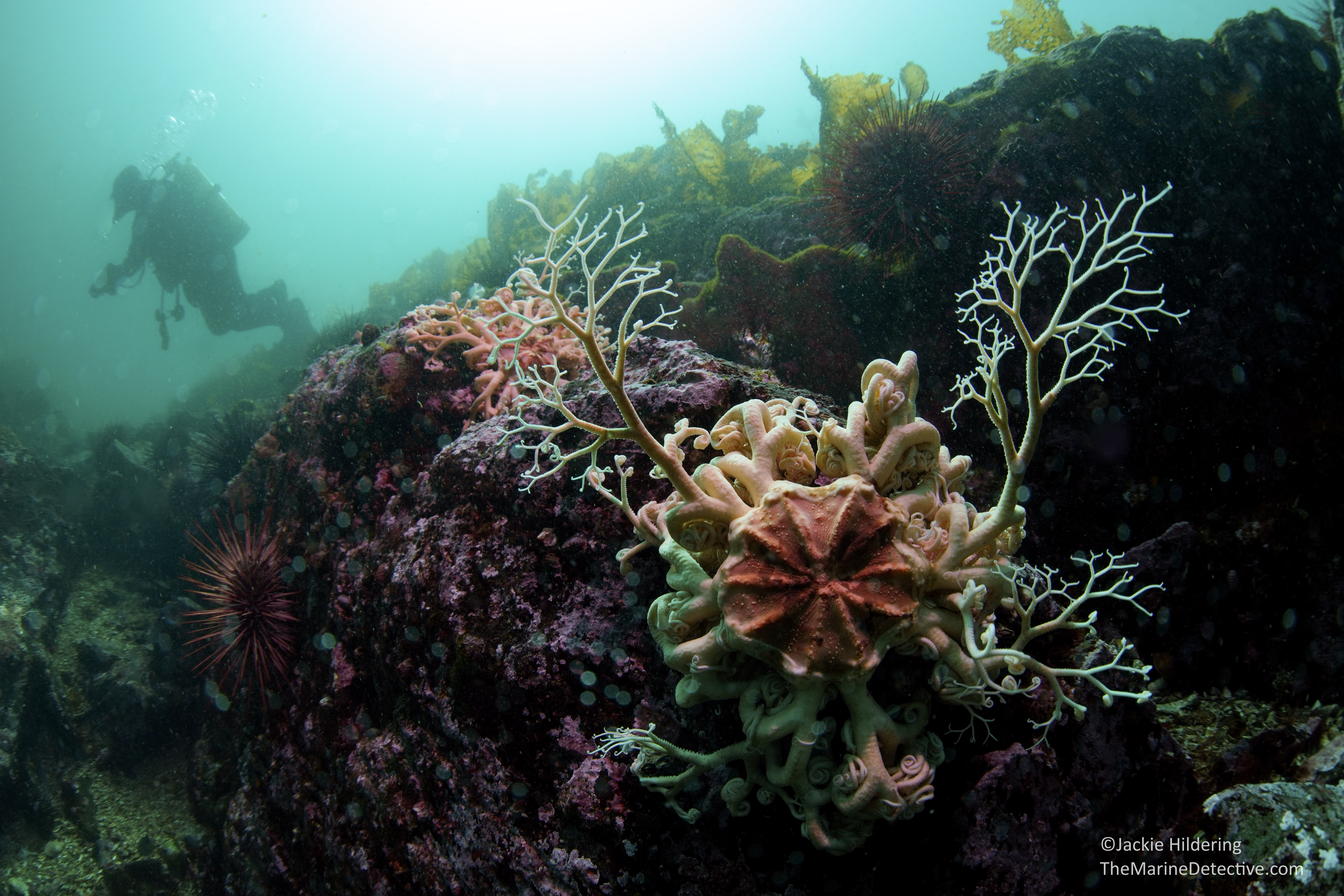
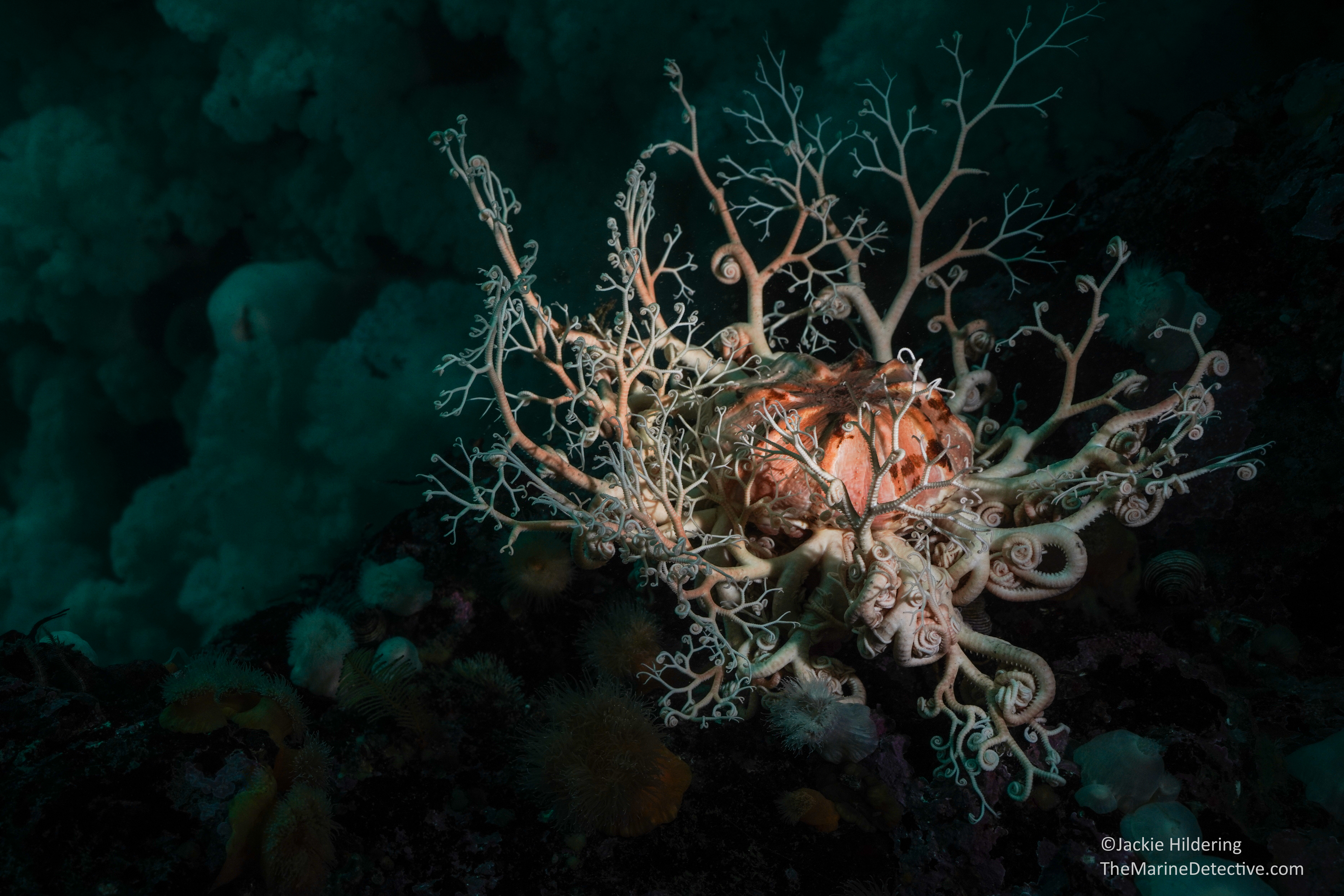
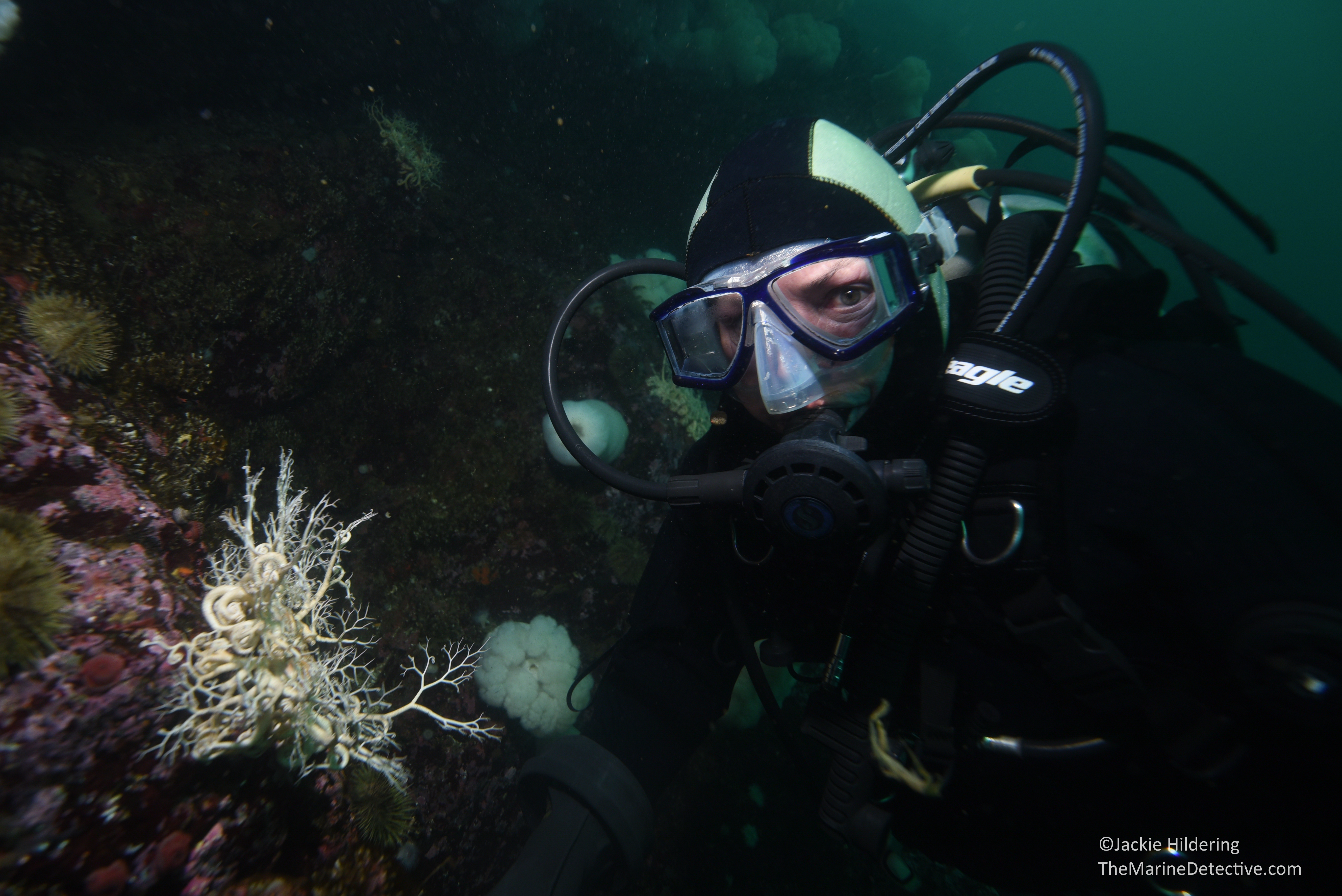

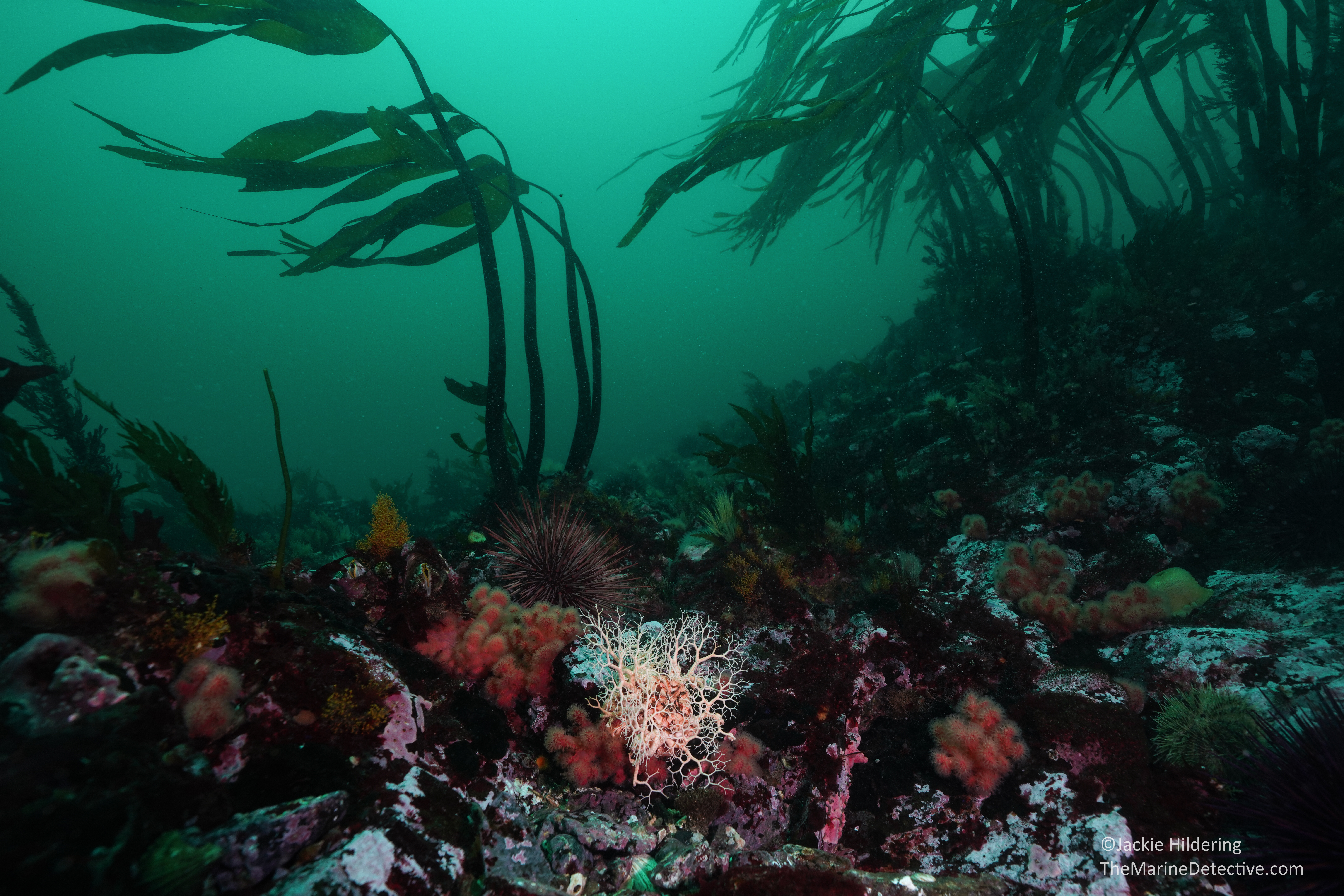
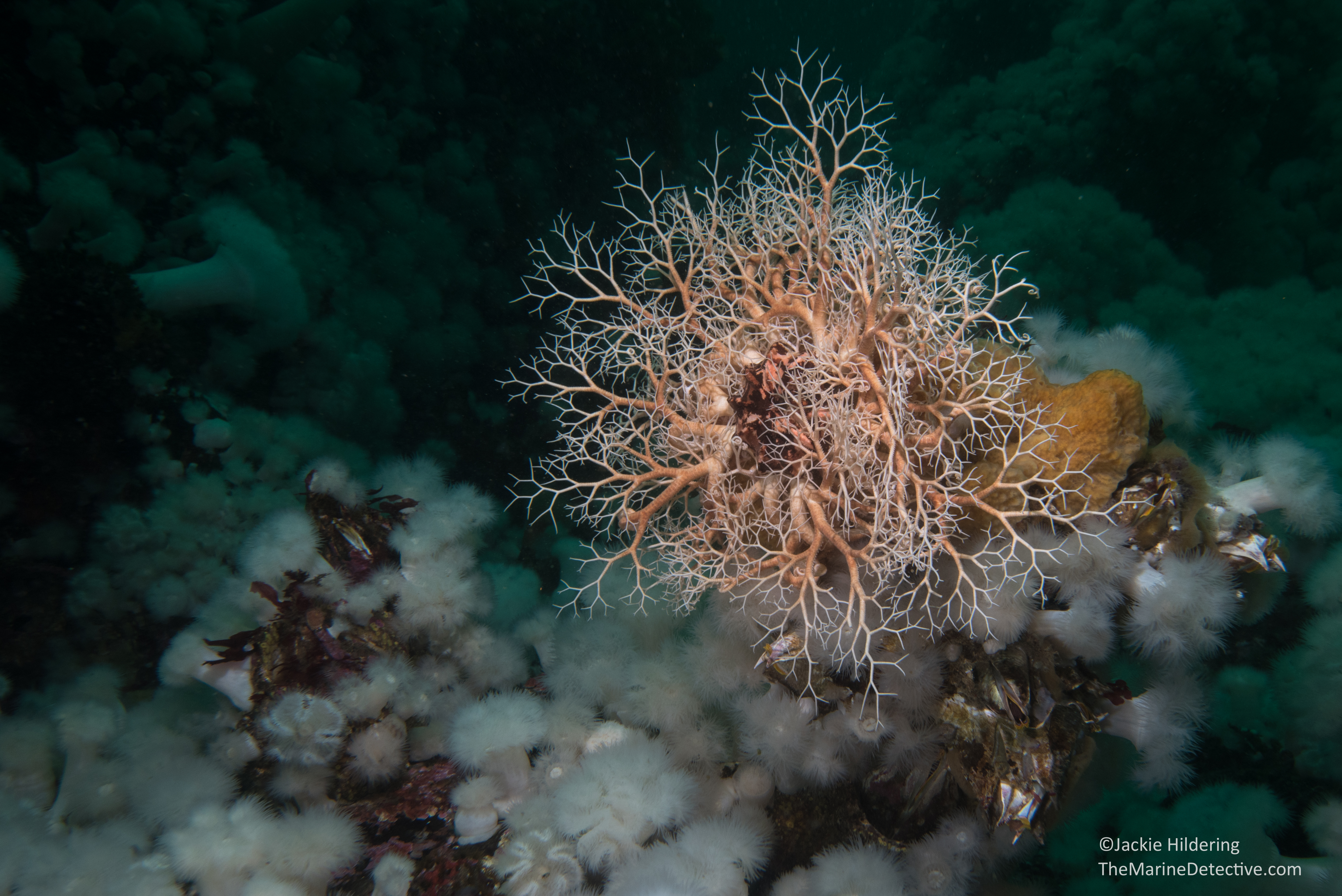
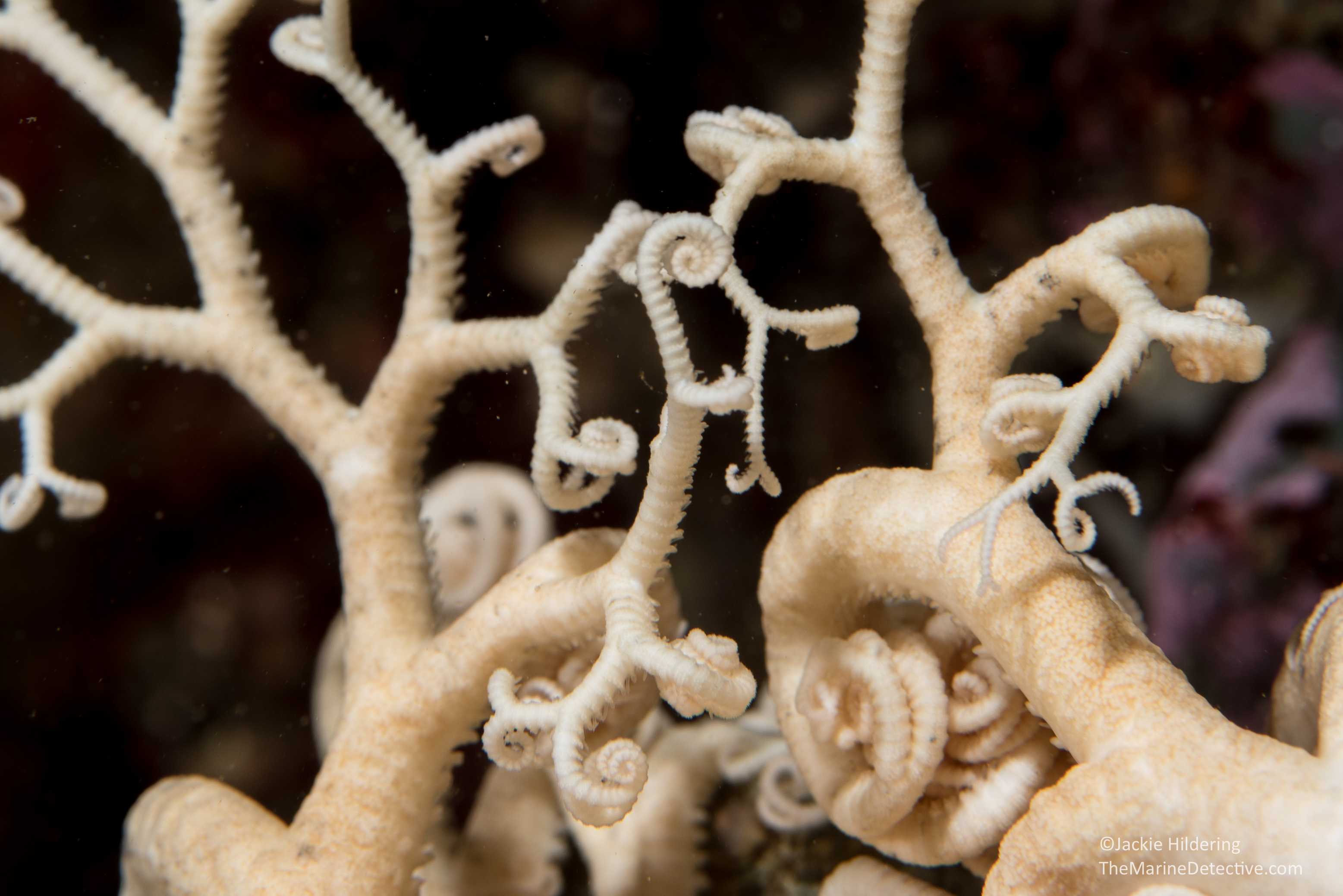
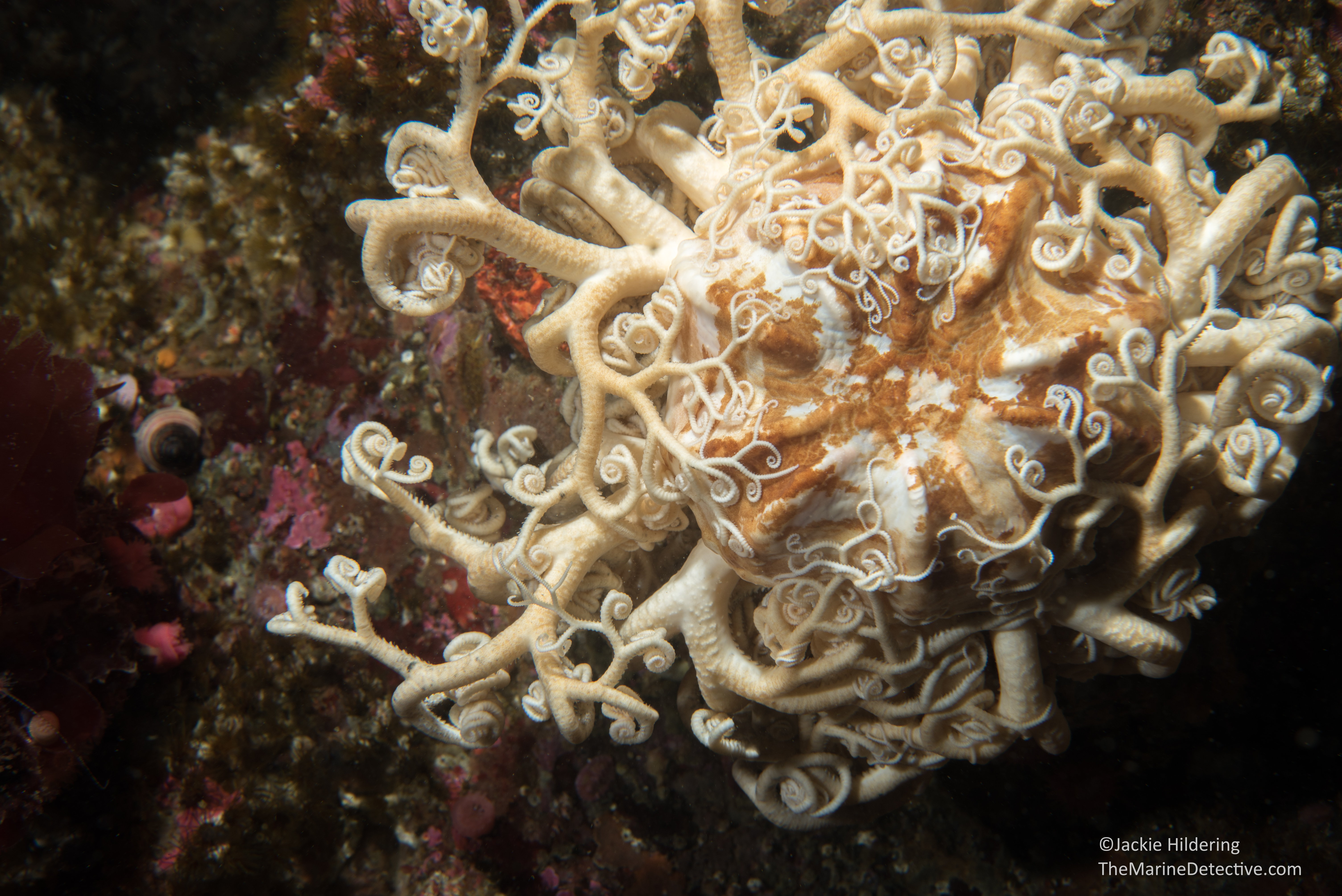
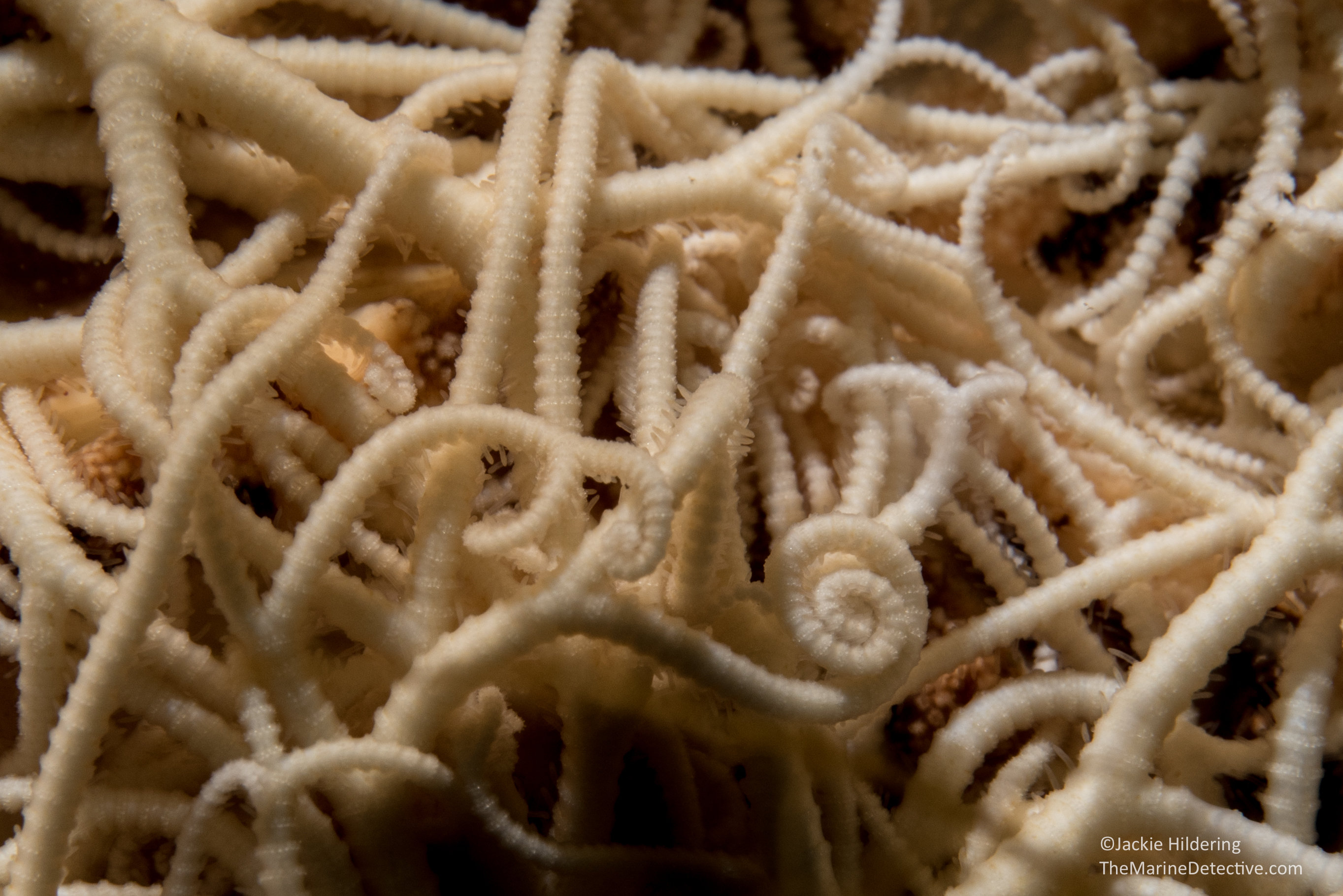
How can it be that I do not yet have a blog about Basket Stars? I am hereby correcting that and including a gallery of photos of this astoundingly beautiful species.
Prepare yourself for abundant superlatives!
They truly are stars of wonder.
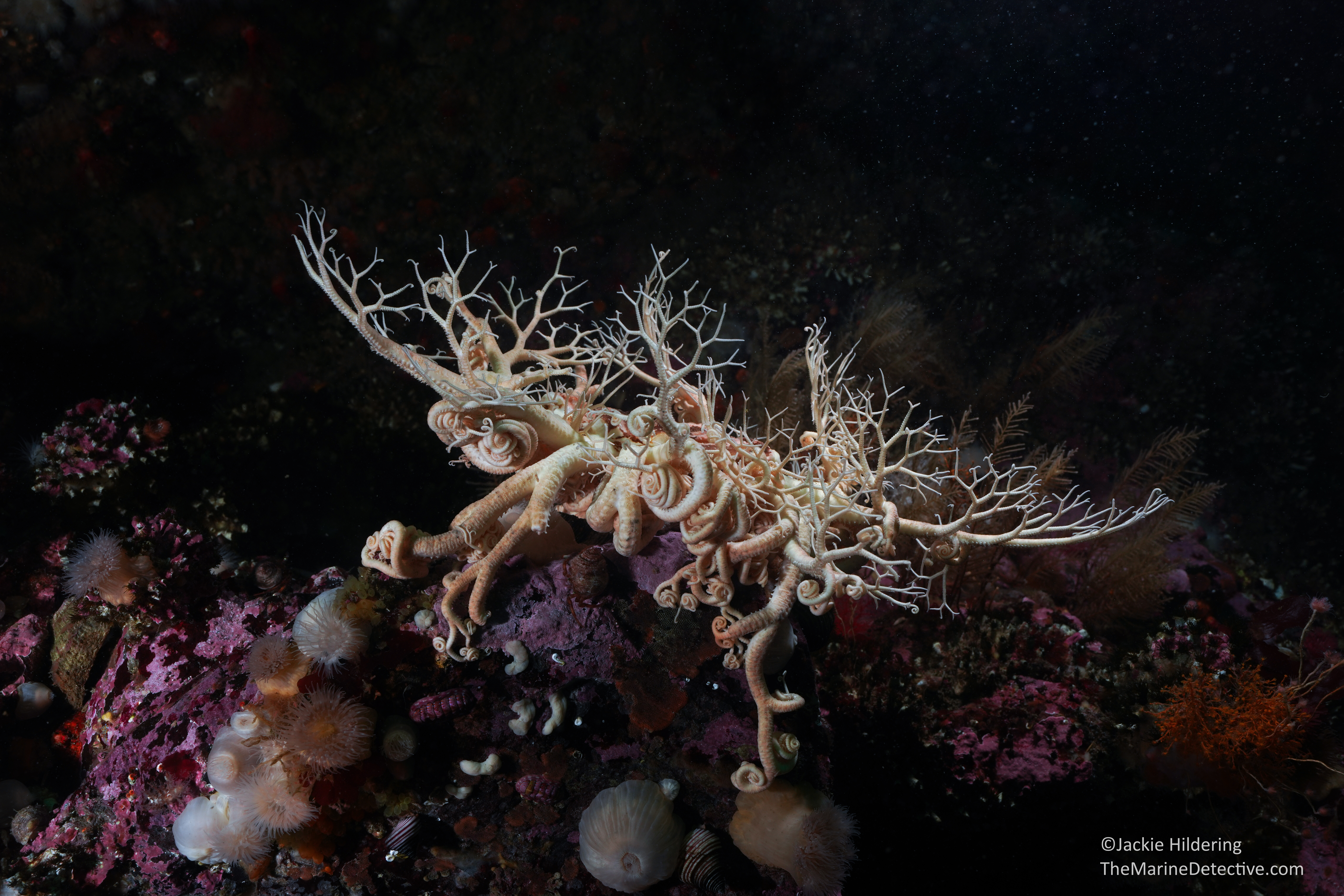
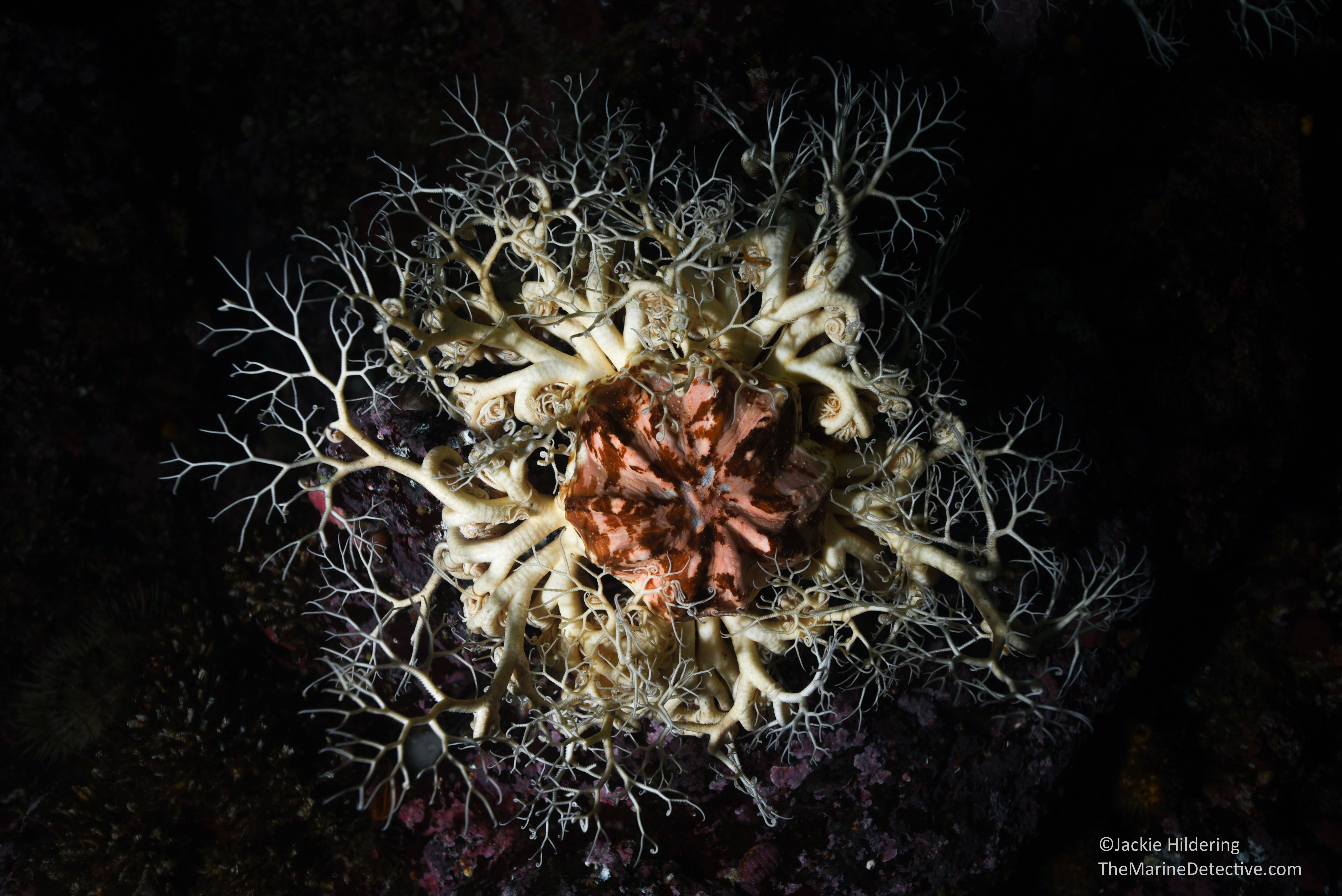
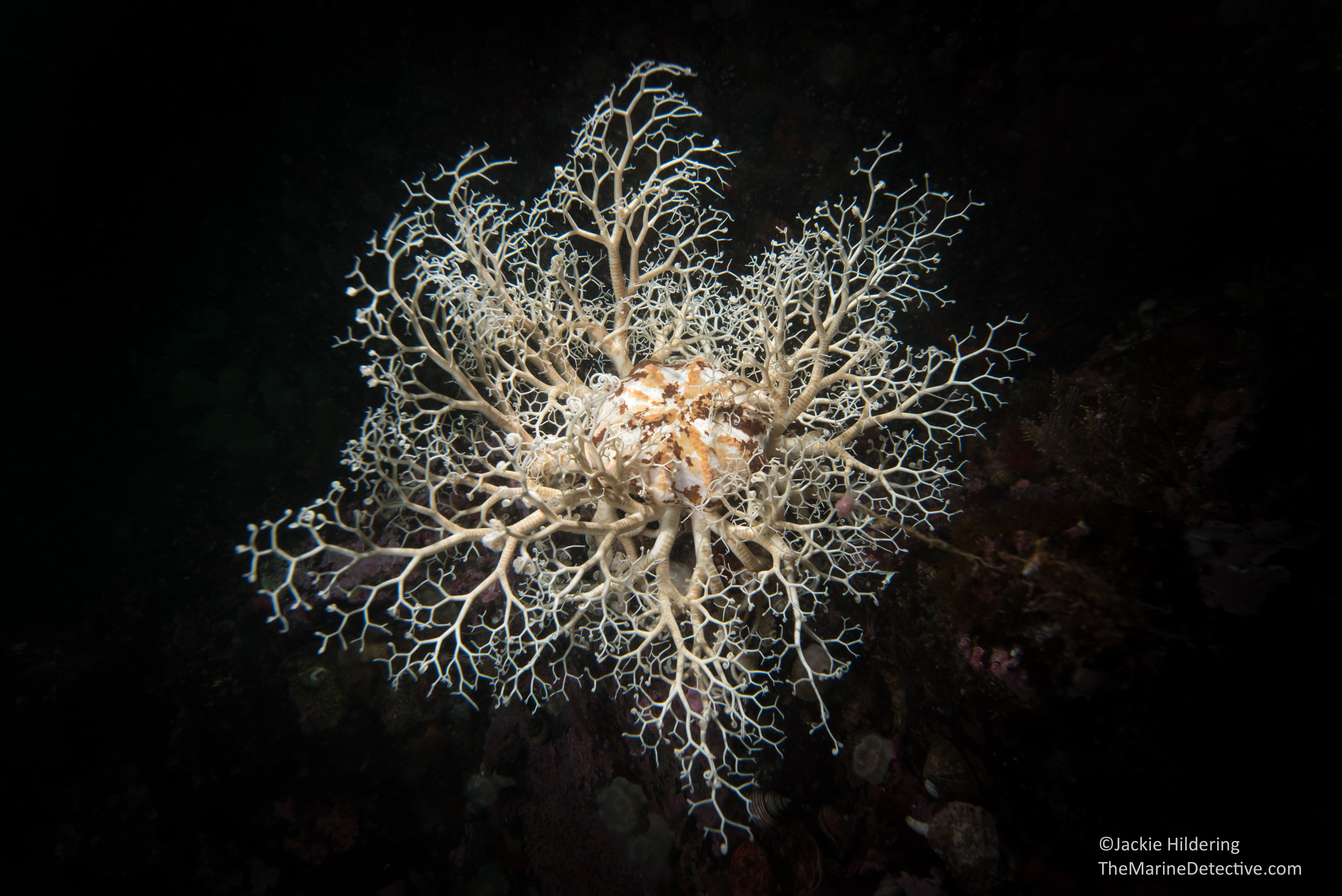
Of all the photos I have taken, it is this one of a Basket Star that is centre stage in my home.
Basket Stars are brilliant ambassadors for the beauty and extraordinary life off this coast. It is my experience that when people learn about them, there’s often a hushed “They live here?”.
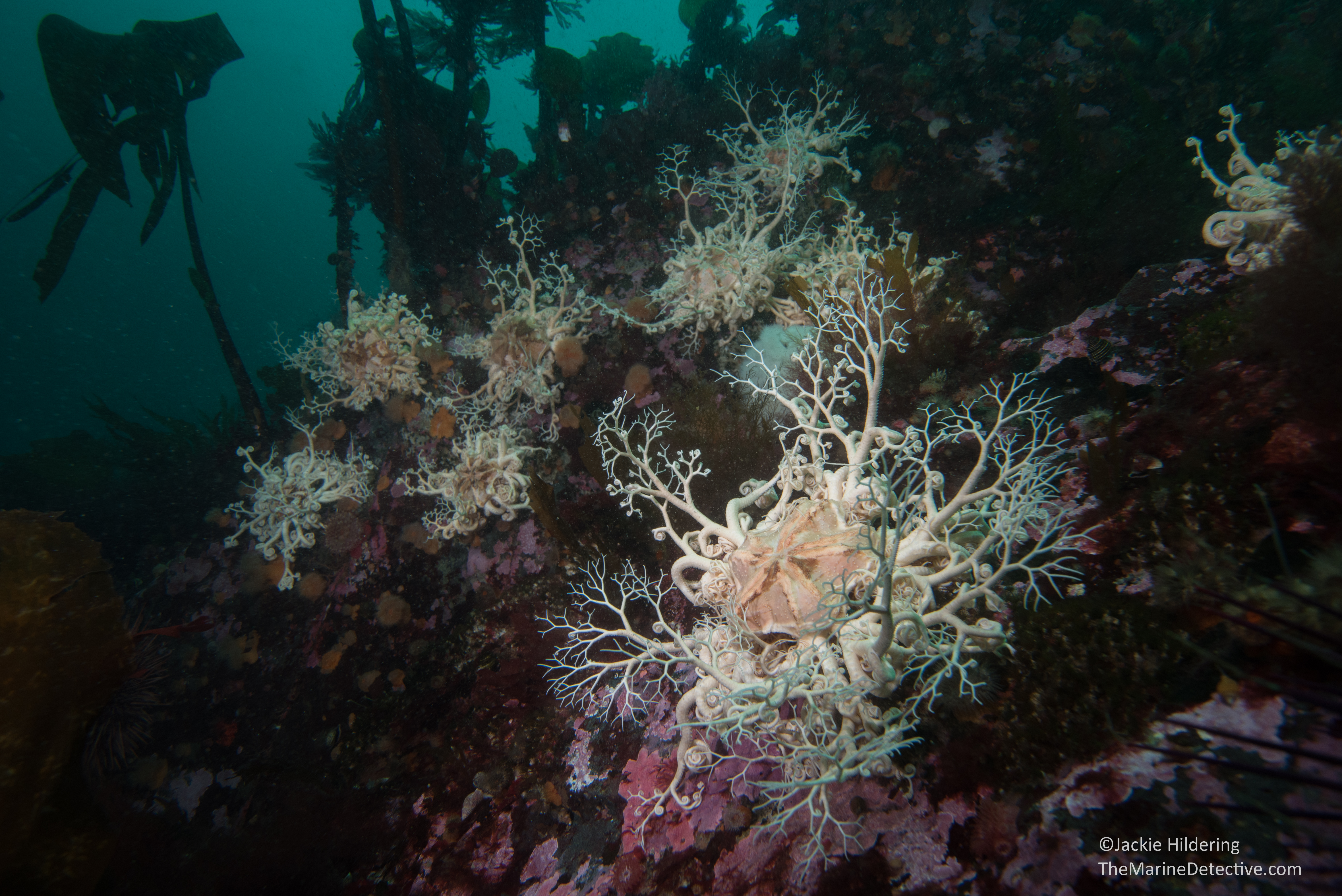
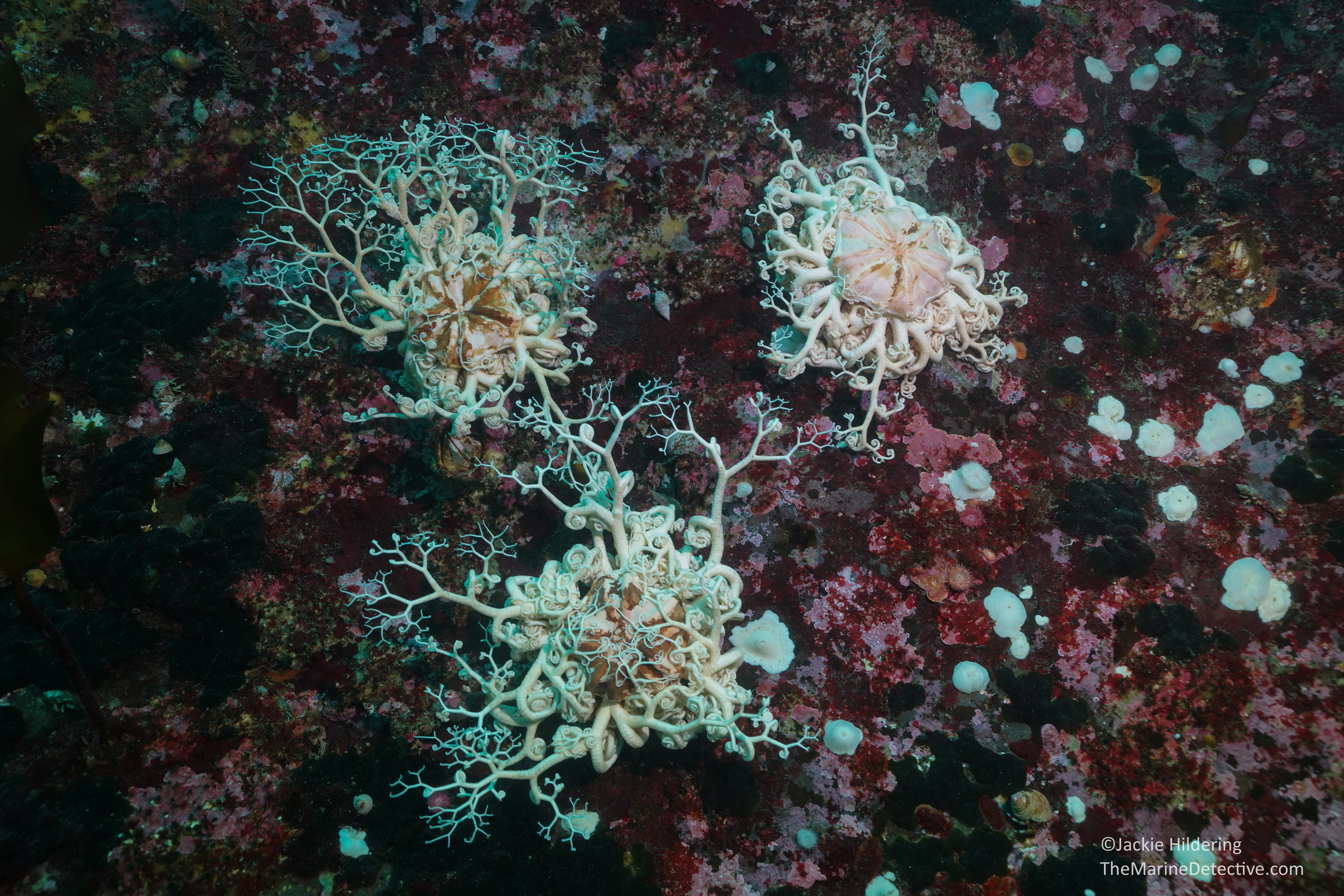
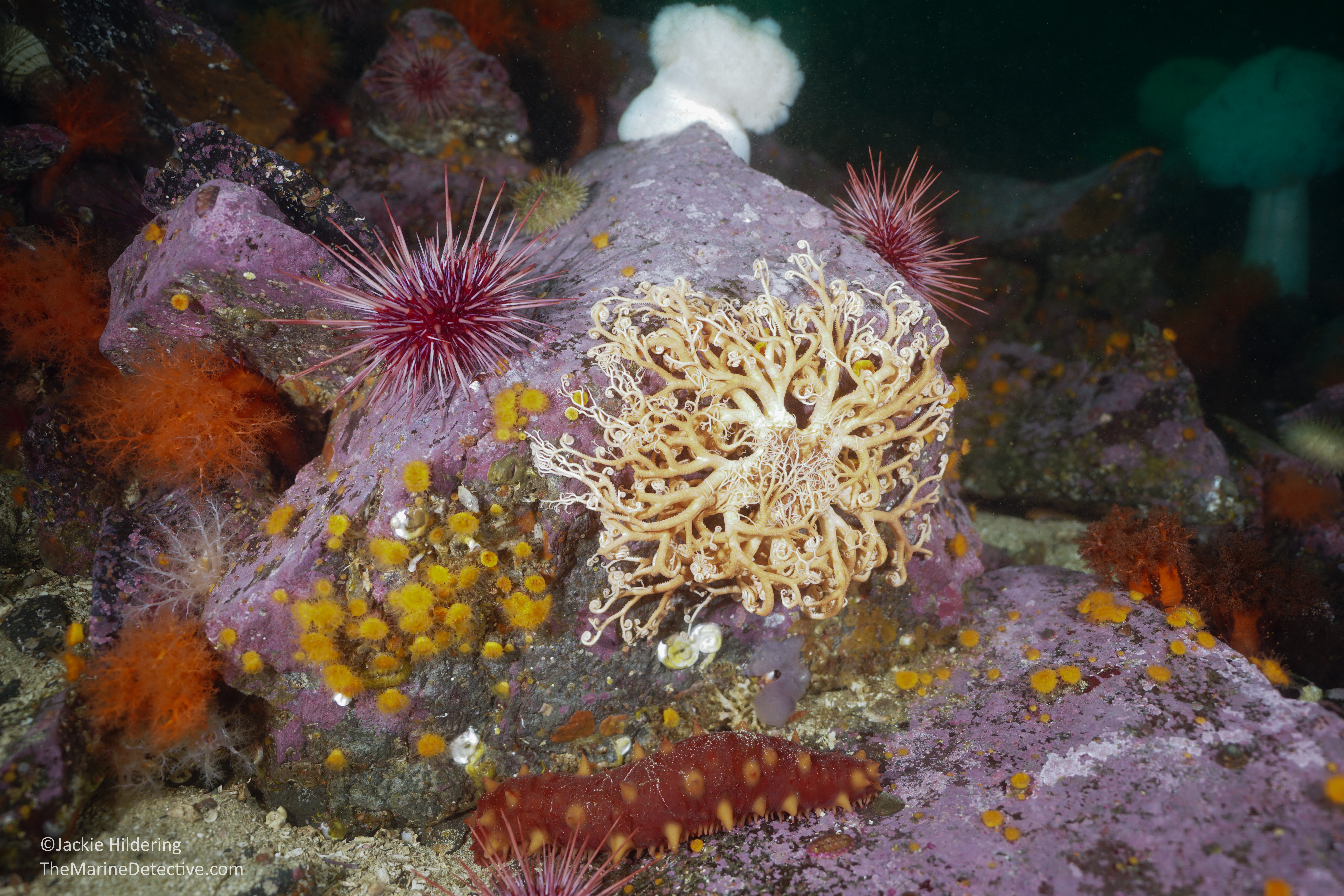
Valley of the Basket Stars. See how many there are?!
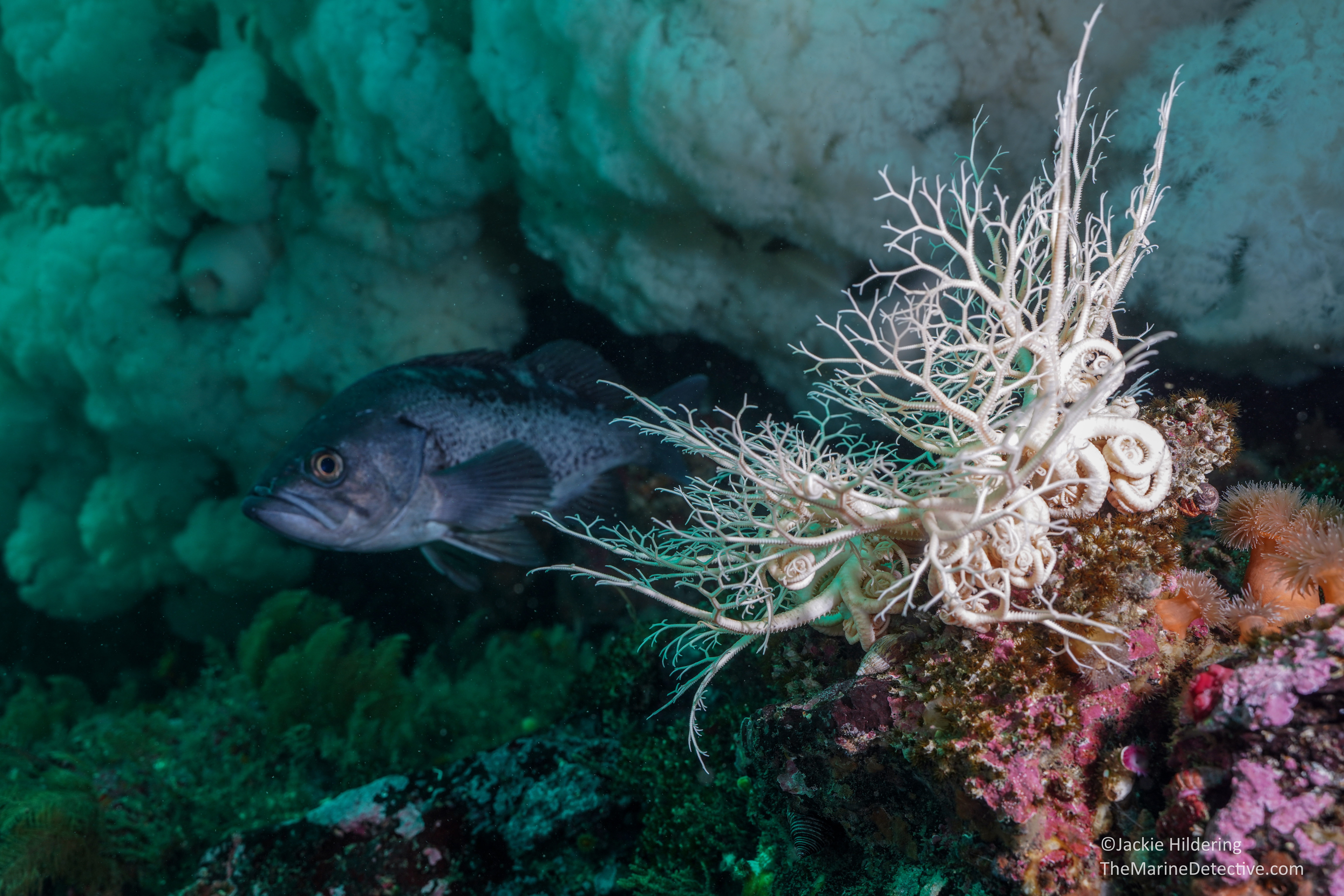
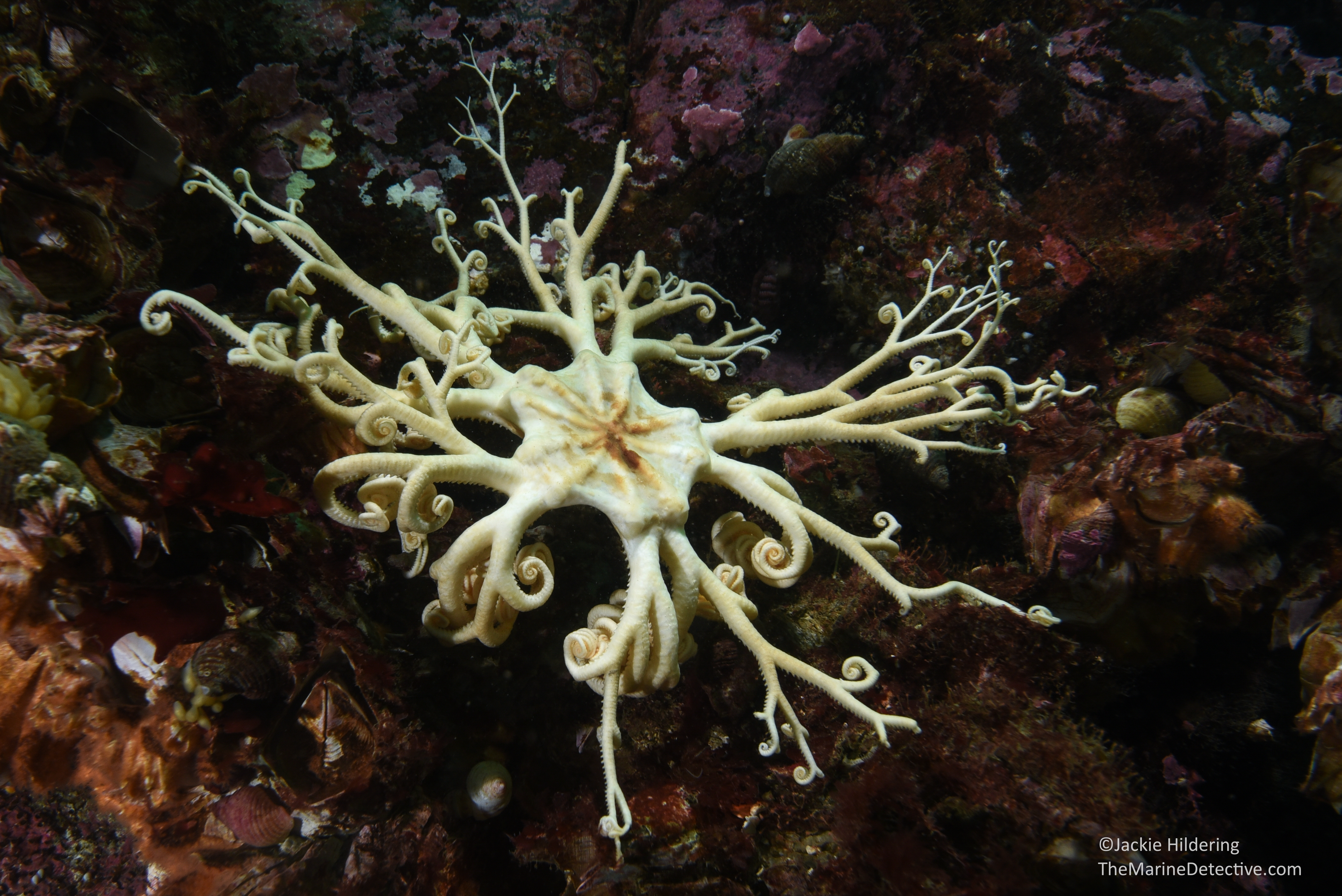
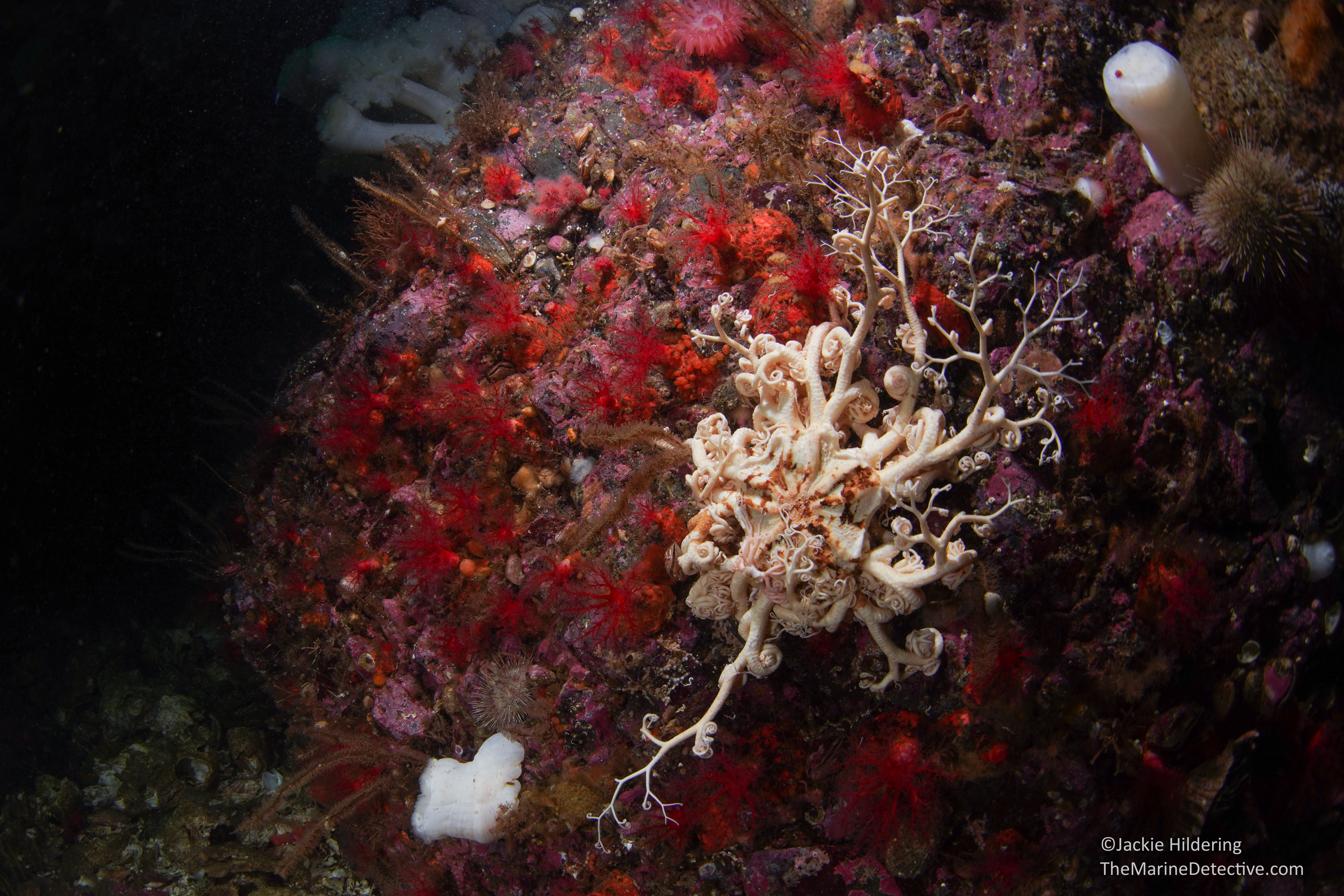
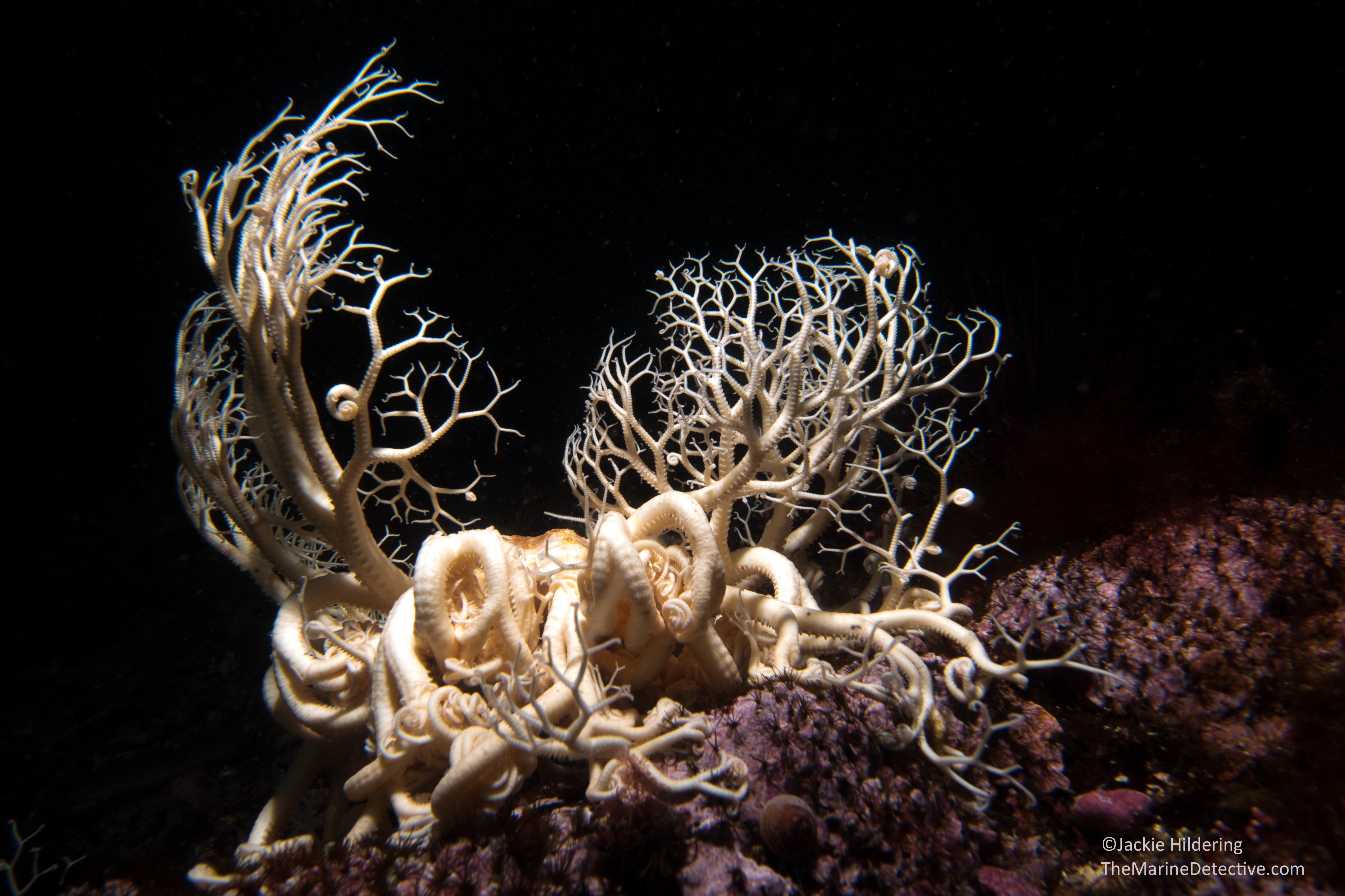
Yes, they are a common species here. They have 5 pairs of arms that seem to branch infinitely and they are big! When the branched arms of Gorgonocephalus eucnemis are fully outstretched, adults can be up to 80 centimetres wide (Source: Hainey).
Basket Star and Black Rockfish.
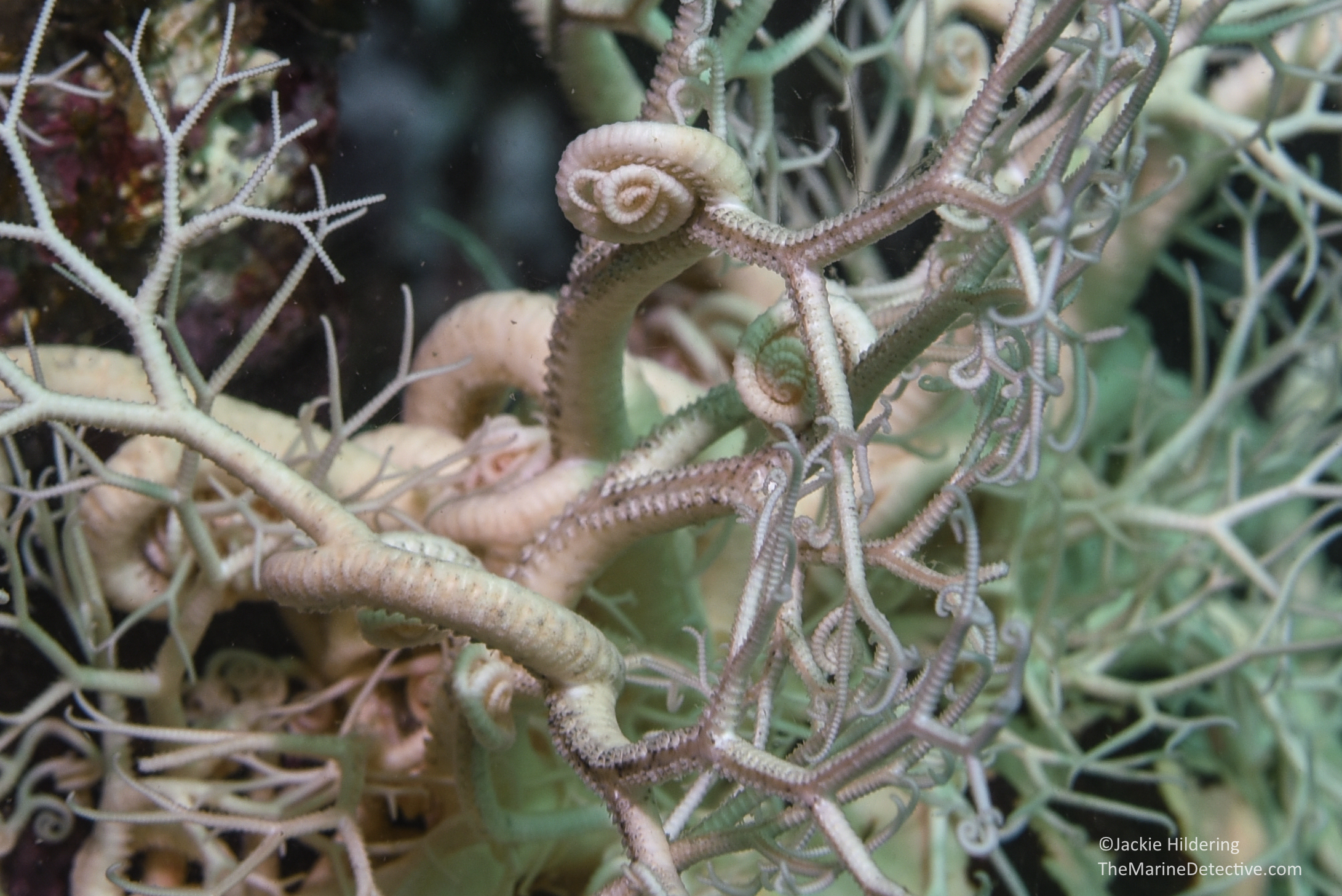
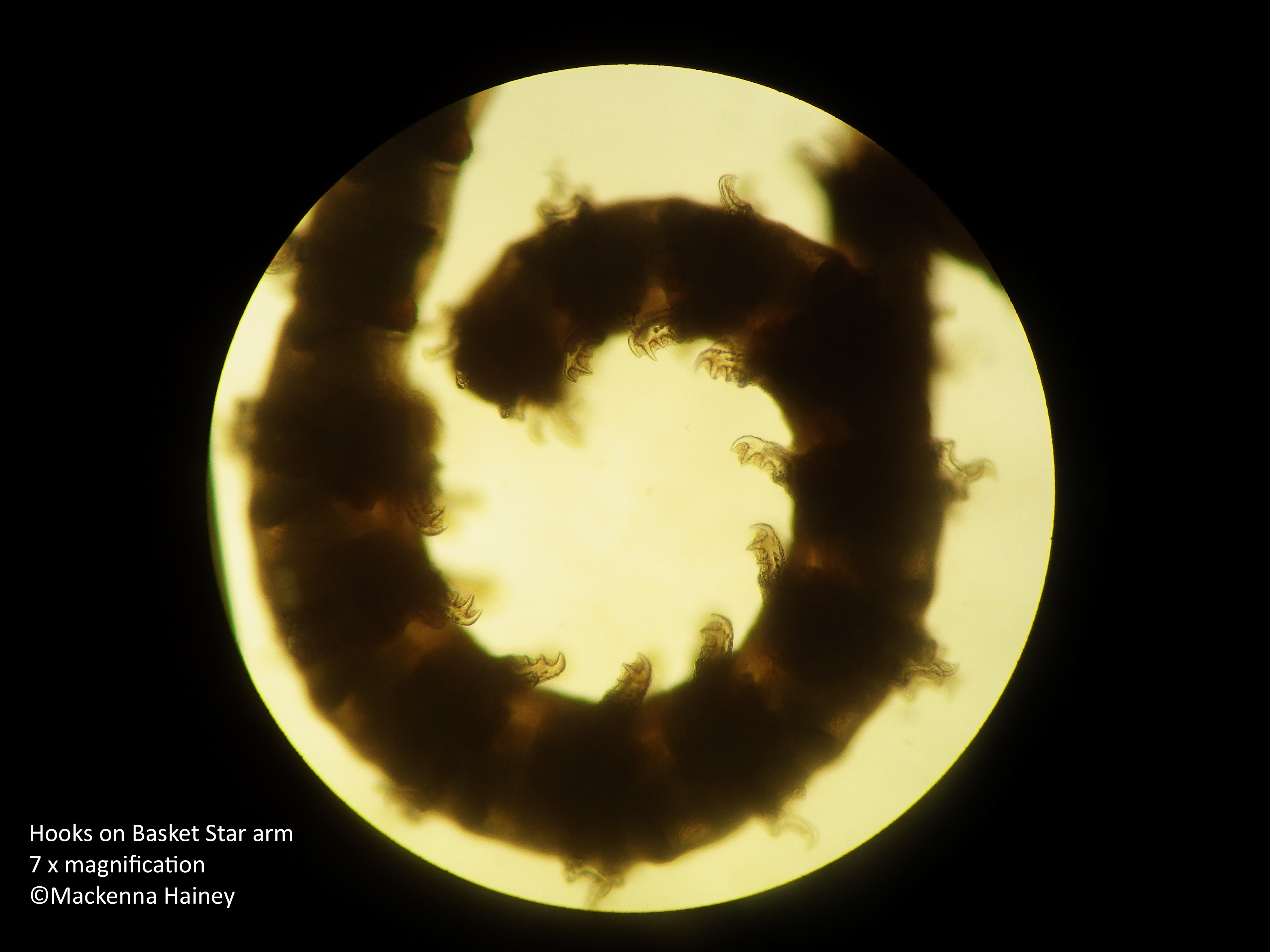
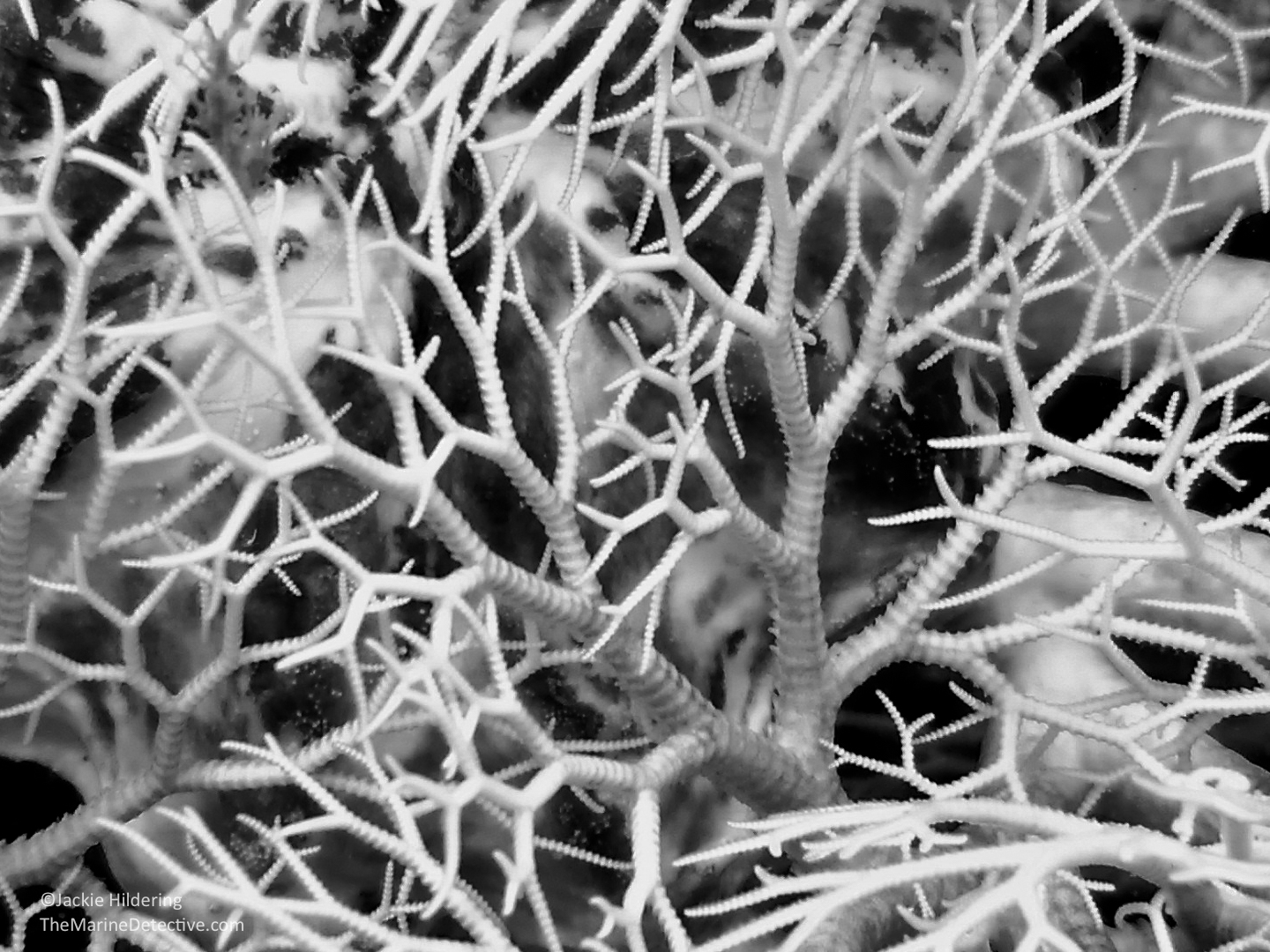
Imagine submerging and watching how, when the current increases, their arms unfurl into a basket to ensnare plankton. Through microscopic hooks and mucus, the snacks are moved to the Basket Star’s mouth which is on the underside of the central disc.
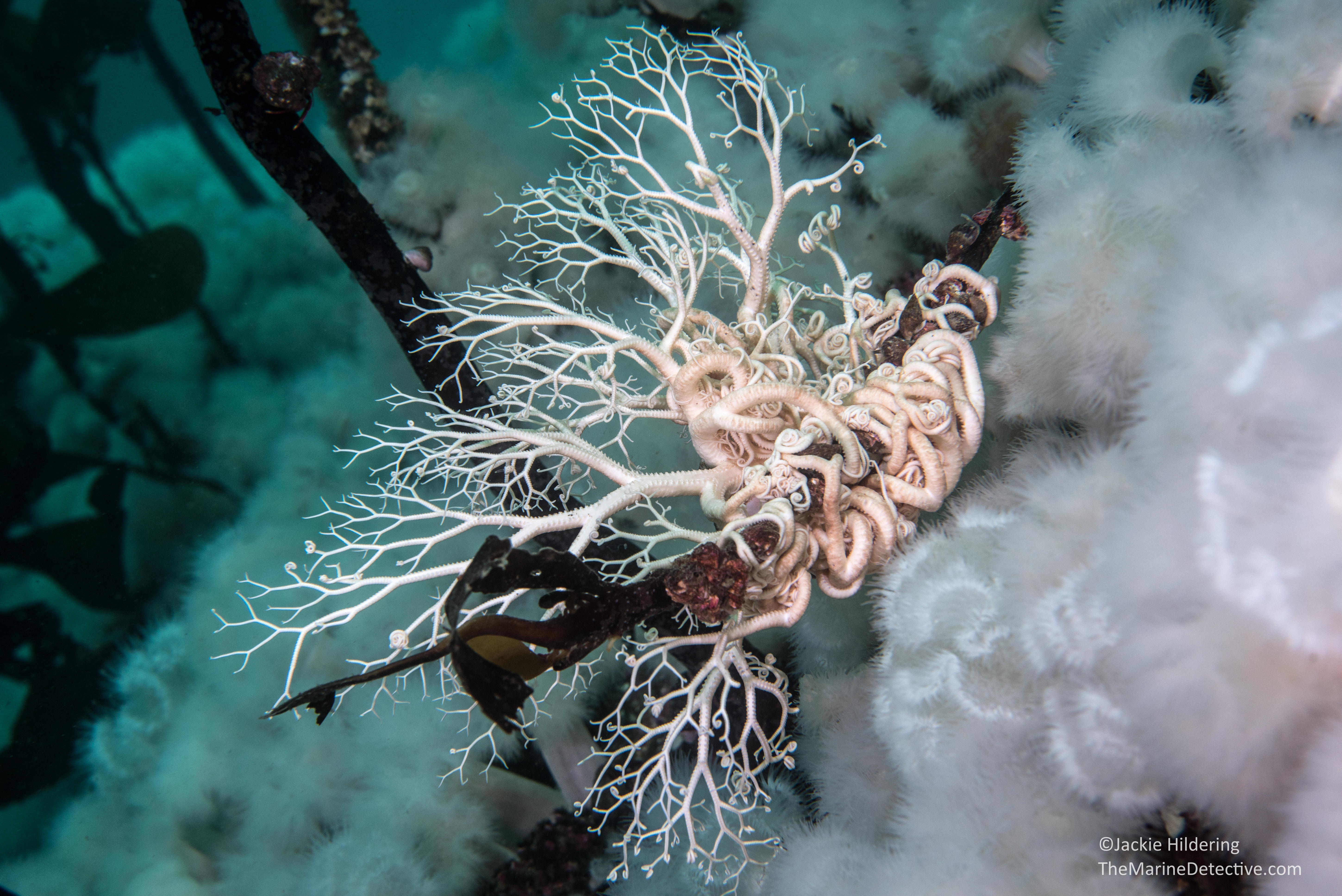
Basket Stars hold on and move about with their arms. They even climb kelp to position for more favourable feeding. They have tube feet, as do all echinoderms, but Basket Star tube feet do not appear to have a role in locomotion.
Basket Star climbing kelp.
This species is reported to be long-lived. Multiple online descriptions state that Basket Stars can live up to 35 years but I could not find the scientific source for this. Regardless, in having the joy of diving the same sites over and over again, I am marvelling at the same ones again and again, trying to capture their surreal beauty.
You’ll note from the photos how colour varies from beige to white and how the oral disc (the centre part) can have distinctive brown markings. Yes, I have thought about trying to identify and catalogue individuals. Please don’t encourage me!
You can see how their oral disc also varies from being very flat to very puffy. Some have hypothesized that this might be related to their reproductive stage but it could be due to food and/or oxygen availability. See the reference to Makenna Hainey’s research below.
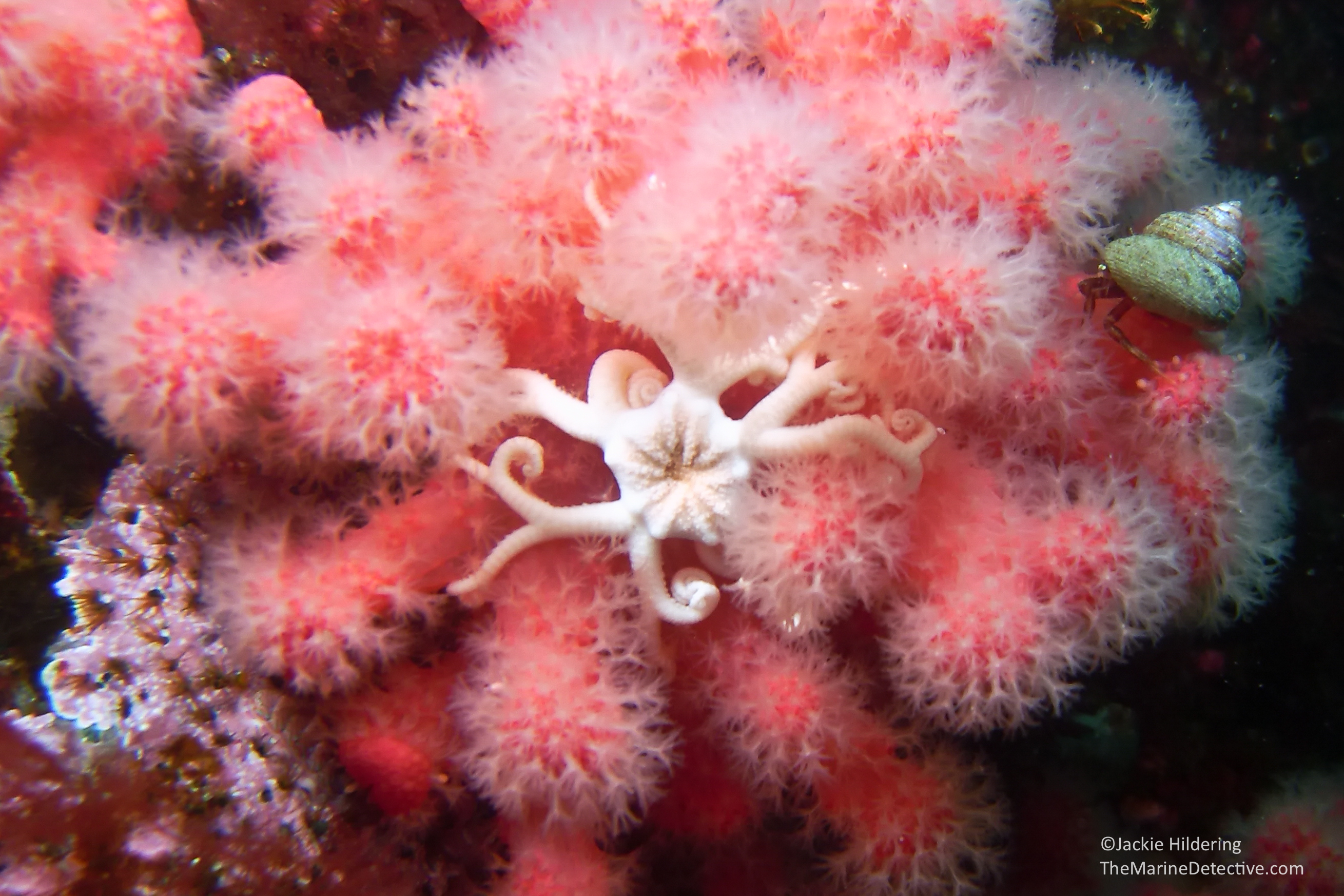
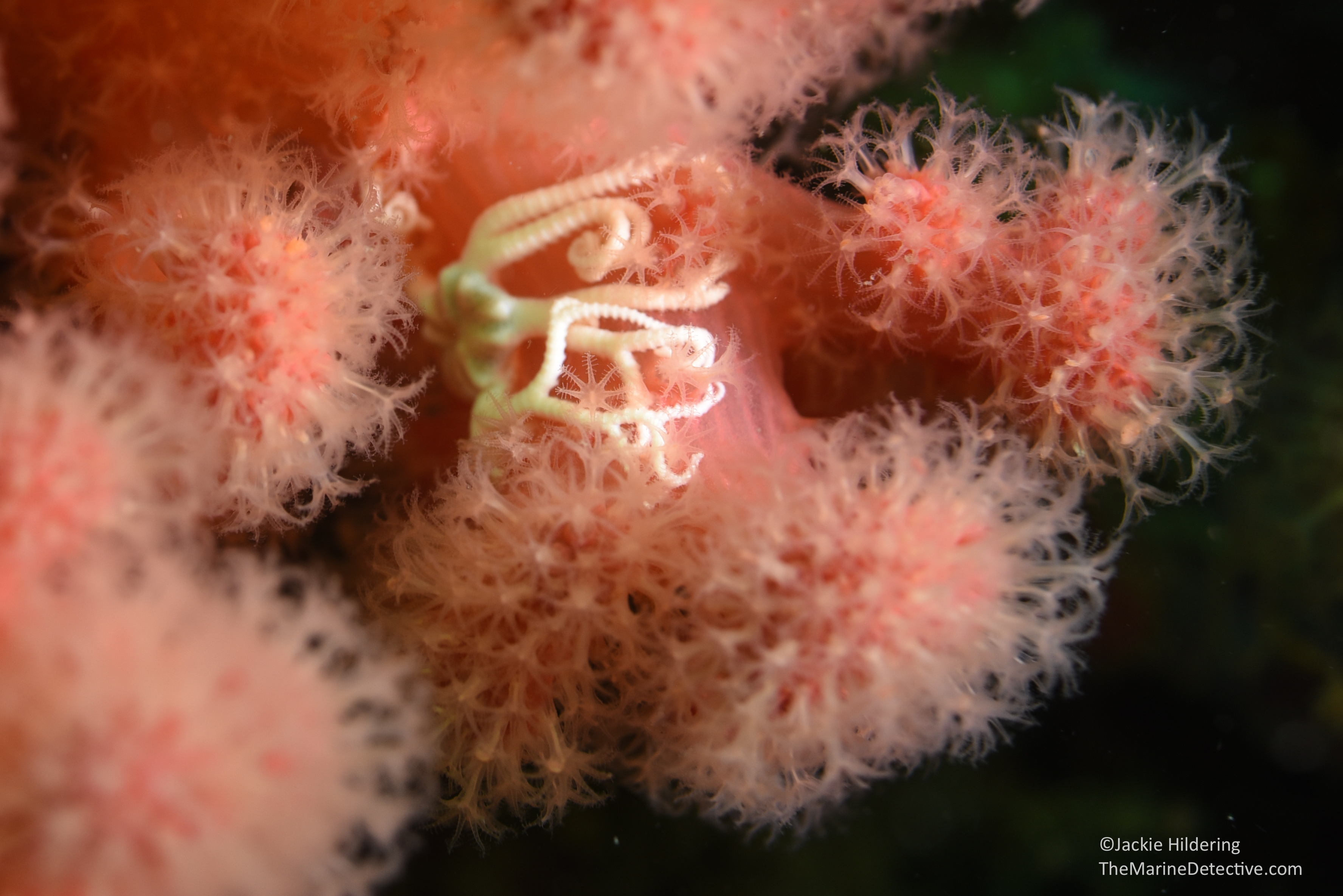
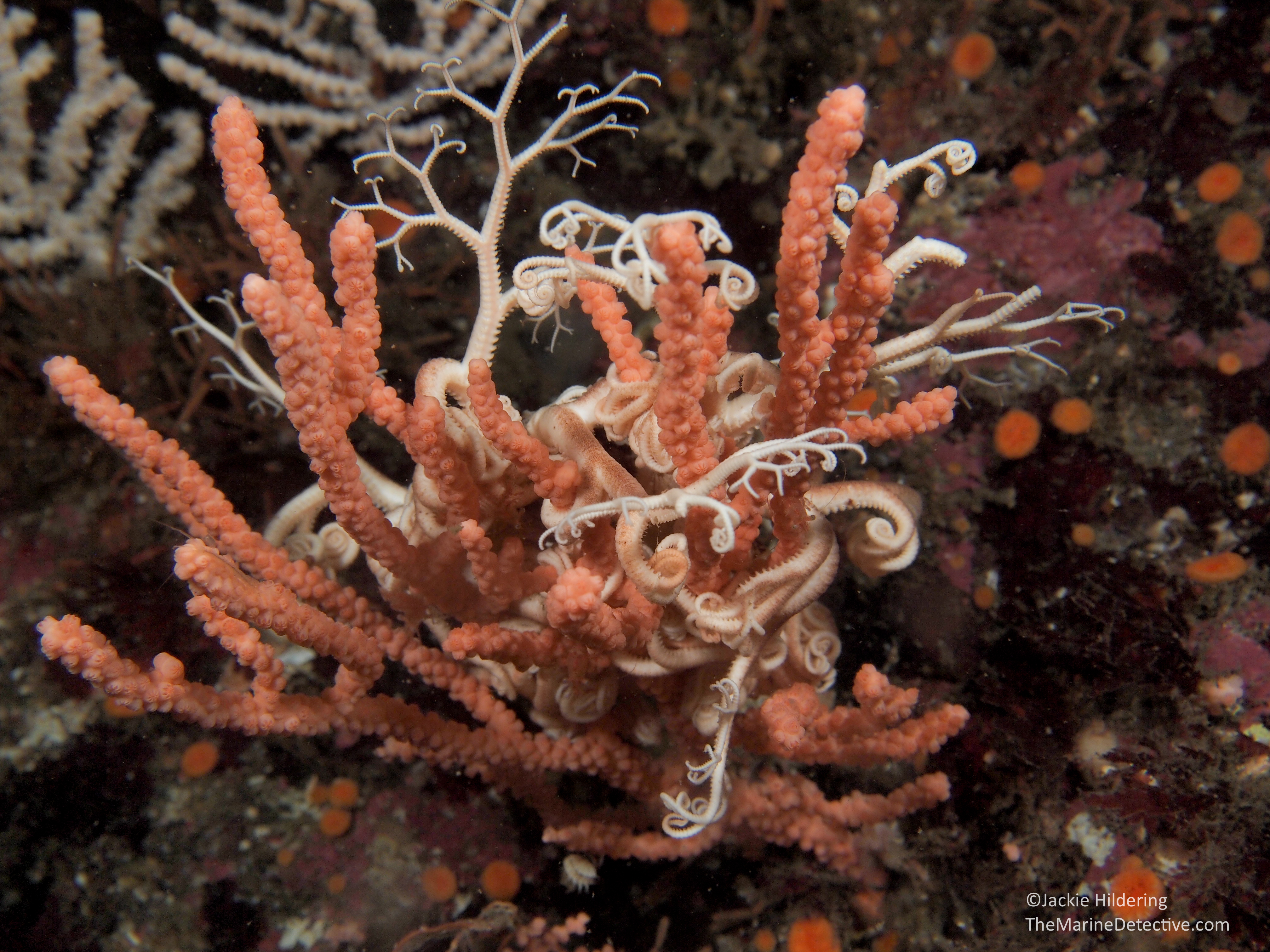
Wickedly wild embryos: Basket Stars reproduce by broadcast spawning. Adult males and females release their gametes into the water. When they settle to the ocean bottom, the embryos are reported to develop INSIDE the polyps of Red Soft Coral. It’s thought the embryos feed on the soft coral’s eggs which brood inside the parent coral. Whoa!
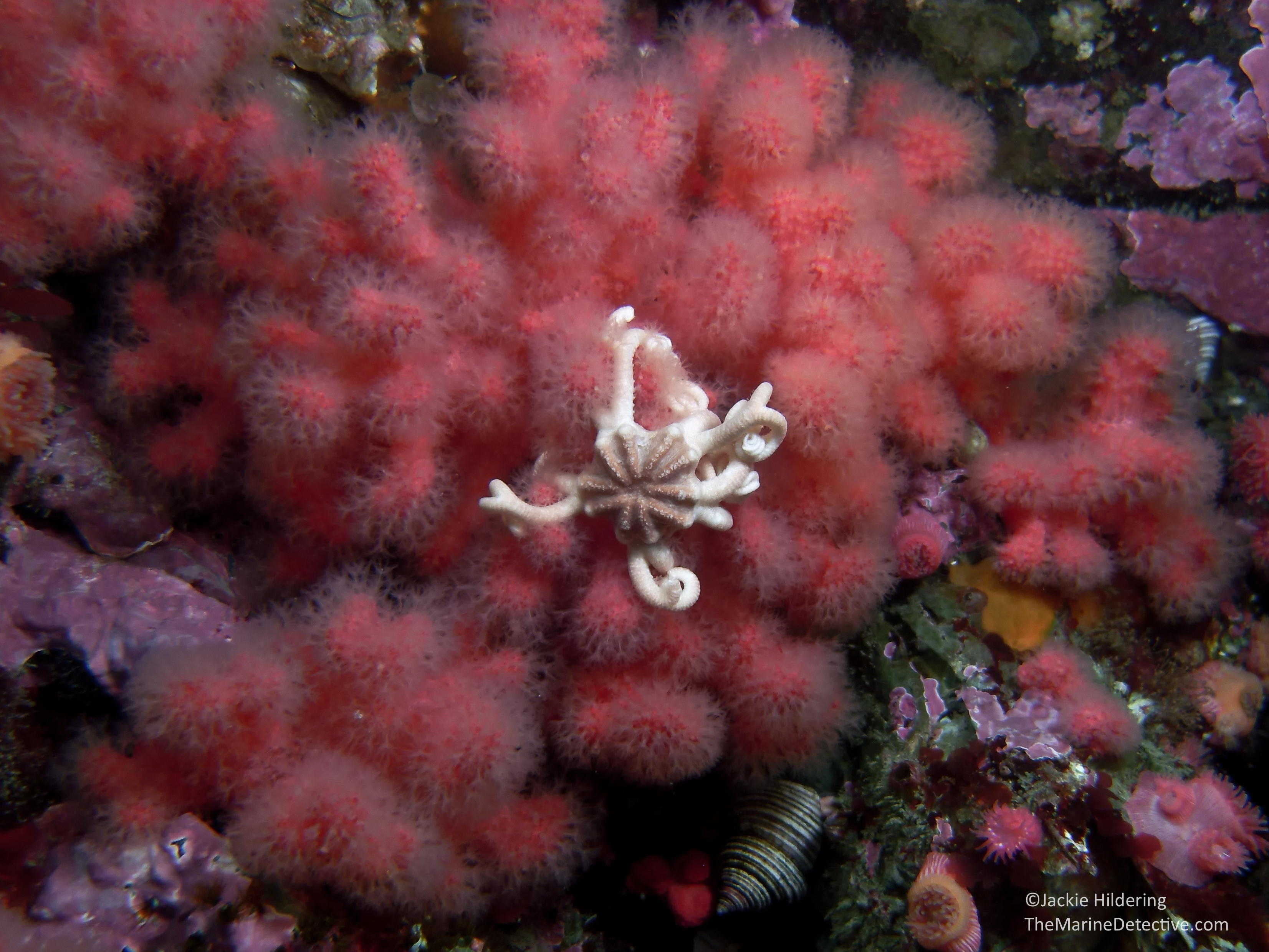
Baby Basket Star holding onto Red Soft Coral (Alcyonium sp.).
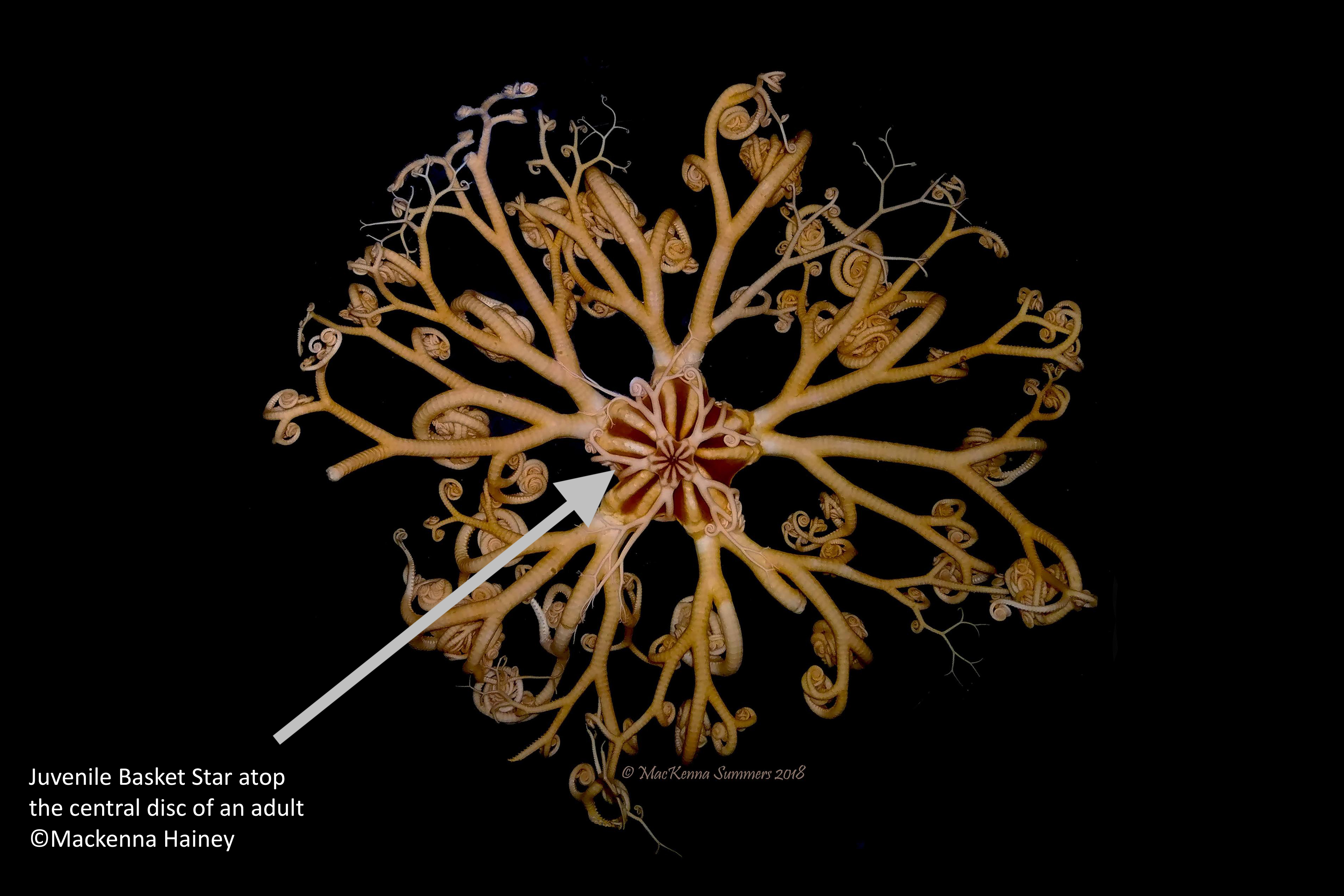
Then, when juvenile Basket Stars emerge from the coral’s polyps, they apparently hang onto the outside of the coral till about 3 millimetres in disk diameter. They shuffle off when approximately 5 centimetres in disk diameter and crawl onto an adult Basket Star.
From Makenna Hainey (personal communication, October 1, 2023): “No one really knows how the juveniles get onto the adults. But the leading theory is that they use Soft Corals as bridges. From there, they will steal food bundles out of the mouths of the parents.”
See the smaller Basket Star atop the adult (top right)?
More on diet and feeding: From Invertebrates of the Salish Sea: ” . . . feeds on suspended particles by spreading rays out like a fan, oriented mostly perpendicular to the current. Macroscopic zooplankton such as copepods, chaetognaths, and jellyfish are caught by microscopic hooks on the rays. The fine branchlet tips then curl around the object and slowly move it toward the mouth (exact method is unclear). The prey of basket star species is said to range up to 3 cm (just over an inch) in size, and most basket stars capture prey mainly at night but may retain their prey until daytime to actually feed on them. Mucus may also help to immobilize prey. This species has also been reported to feed on the small benthic sea pen Stylatula elongata [Spiny White Sea Pen]”.
From Makenna Hainey (personal communication, October 1, 2023): “Basket Stars have tube feet. But, unlike asteroids [sea stars], echinoids , and holothurians [sea cucumbers], they don’t have suction cups on the tube feet. Thy have microscopic hooks that look and operate mechanically like cats’ claws to pin down prey while the tube feet secrete paralyzing mucus. They almost immediately bring food down to the mouth, insert the arm into the mouth, and wipe the food bundles off on the oral spines.”
Basket Star unfurling its arms when on Gorgonian Coral. Basket Star and Creeping Pedal Sea Cucumbers (red) and Orange Social Tunicates.
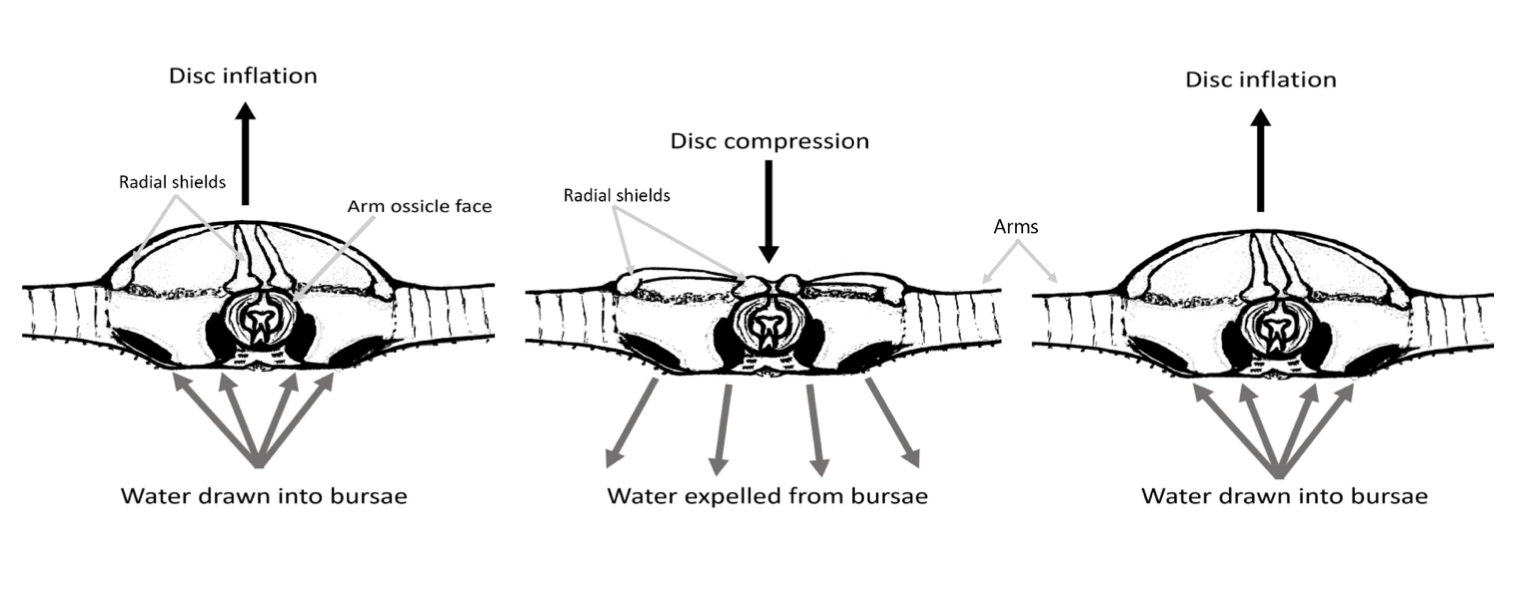
Breathing: Really interesting research has been done by Mackenna Hainey to measure the breathing rate (bursal ventilation) of this species of Basket Star.
Part of her research was to see, in a laboratory setting, how Basket Stars changed their breathing when fed a slurpee of krill. She found their breathing changed from approximately 10 to 30 an hour to 30 to 45 an hour.
Bursal ventilation of a Basket Star before and after food (krill slurpee) was added to the tank.
Mackenna reported: “Basket stars exhibited feeding behavior beginning a few seconds after food was introduced to the aquarium and lasted an average duration of 50 minutes . . . Once the food was detected by a basket star in the test aquarium, it quickly assumed a feeding position (some arms raised in a parabola, creating a basket shape with tendrils unfurled) and began to move 2-3 arms slowly through the water, looping arm tendrils as the arm hooks accumulated particles of krill. The rate of bursal ventilation increased rapidly once this feeding activity began.”
Breathing / ventilation rate also increased when the Basket Stars were exposed to reduced oxygen levels.
Range: Basket Stars have been documented at depths from 8 to 1,850 metres. They are believed to be more common at depths between 15 to 150 metres.
Their range range was thought to be from the Bering Sea to San Diego until research published in 2014 reported that a Basket Star was documented from a submersible at Guadalupe Island, Mexico. That sighting extended their known range by over 400 kilometres.
Relatives: Basket Stars are echinoderms, the phylum to which sea stars, urchins, feather stars, sand dollars, and sea cucumbers also belong. Basket Stars do not belong to the same class as sea stars such as Sunflower Stars, the Asteroidea. Basket Stars are in the Ophiuroidea class comprised of brittle stars and other basket star species. This class dates back 500 million years (give or take a million).
Photo gallery: Because there can never be too many photos of Basket Stars.
Basket Star and Jacqui EngelBasket Star, Red Soft Coral and Red Irish Lord.
Etymology of the scientific name Gorgonocephalus eucnemis: Gorgonocephalus = gorgós is Greek for dreadful and cephalus is Greek for head. “Dreadful head” is in reference to Basket Stars looking like the head of the Gorgon in Greek mythology. Eucnemis = Greek for good or boot. A good dreadful head?! ☺️
Lambert, P. and Austin, W.C. (2007) Brittle stars, sea urchins and feather stars of British Columbia, southeastern Alaska and Puget Sound. Victoria, Canada: Royal British Columbia Museum


























 Look at the diversity in colour of this sea star species and look at the density and colour of the life around them. This is the life off our coast in high current areas.