Join me in the cold, dark, life-sustaining NE Pacific Ocean to discover the great beauty, mystery and fragility hidden there.

Posts from the ‘Sea Slugs / Nudibranchs’ category

Attack of the Sea Slugs!

[Update March 2018 – There has been a reclassification of this species of nudibranch whereby Hermissenda crassicornis  is also being referenced as the “Thick-Horned Nudibranch. Please see my blog at this link for that information.]

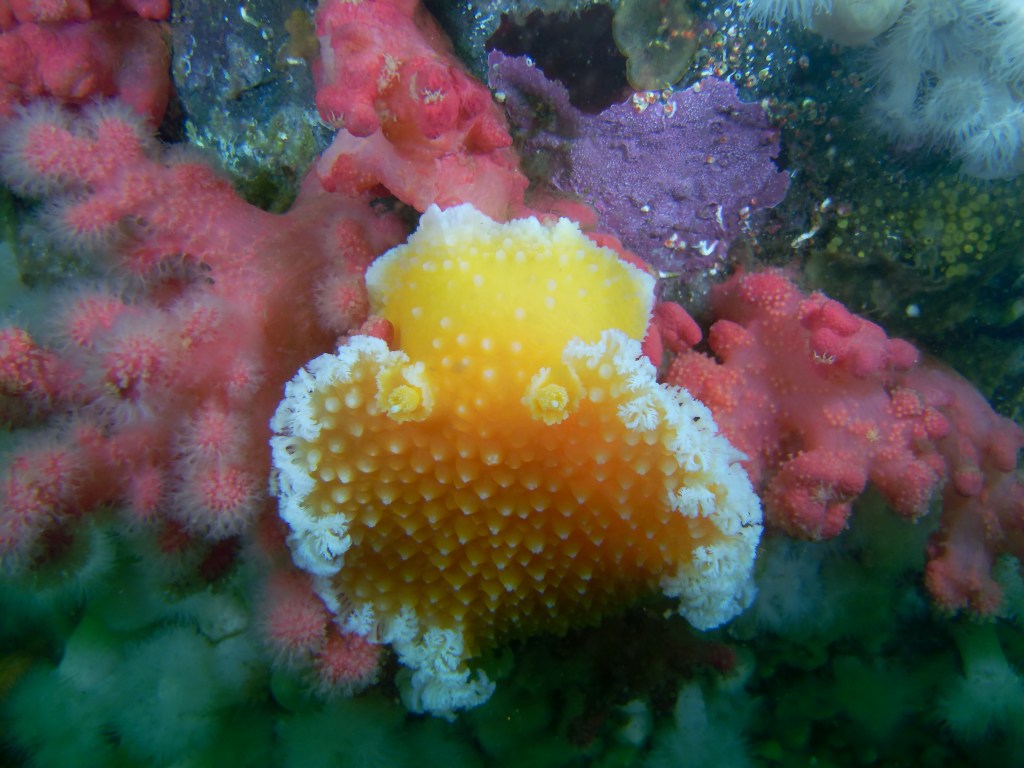
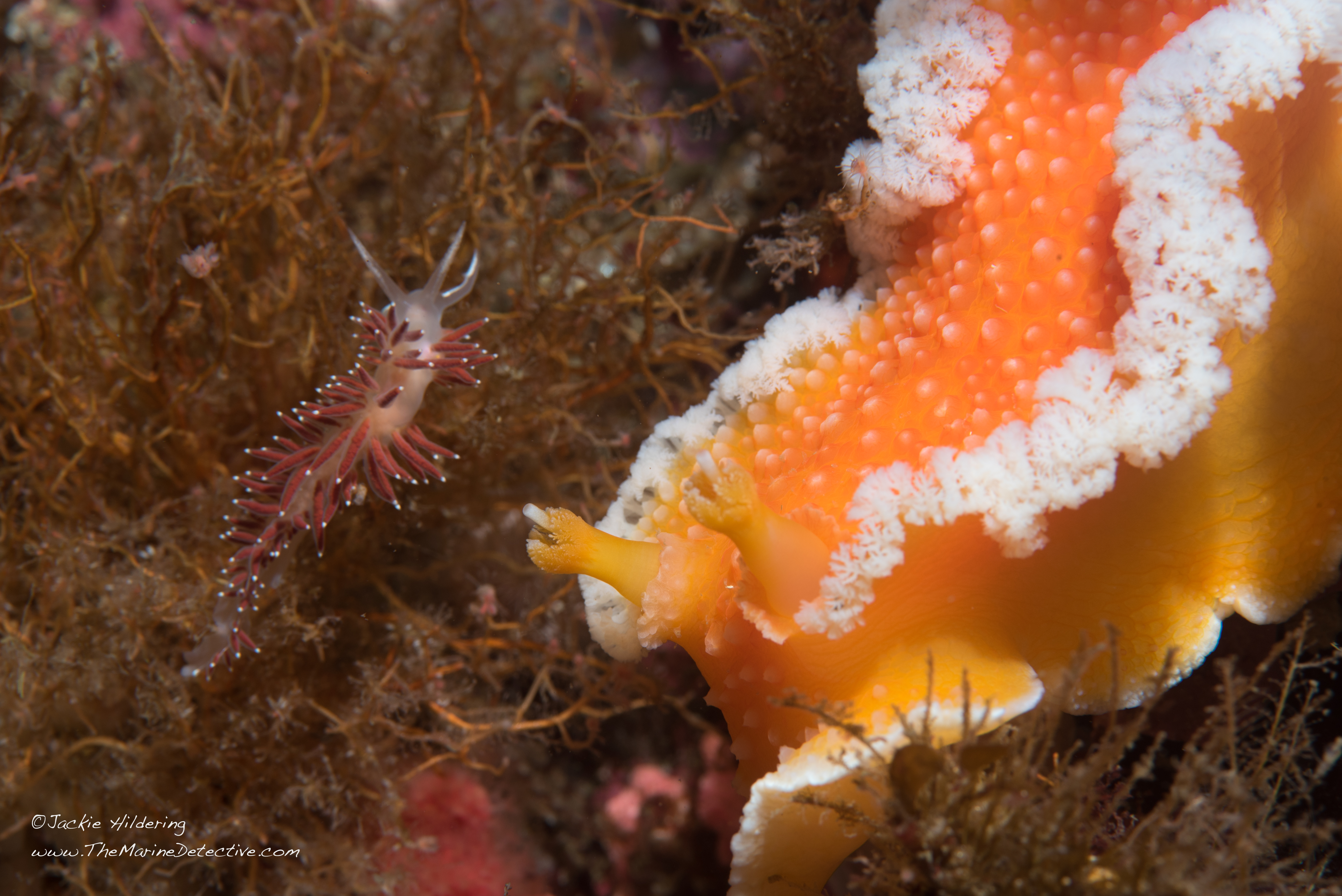
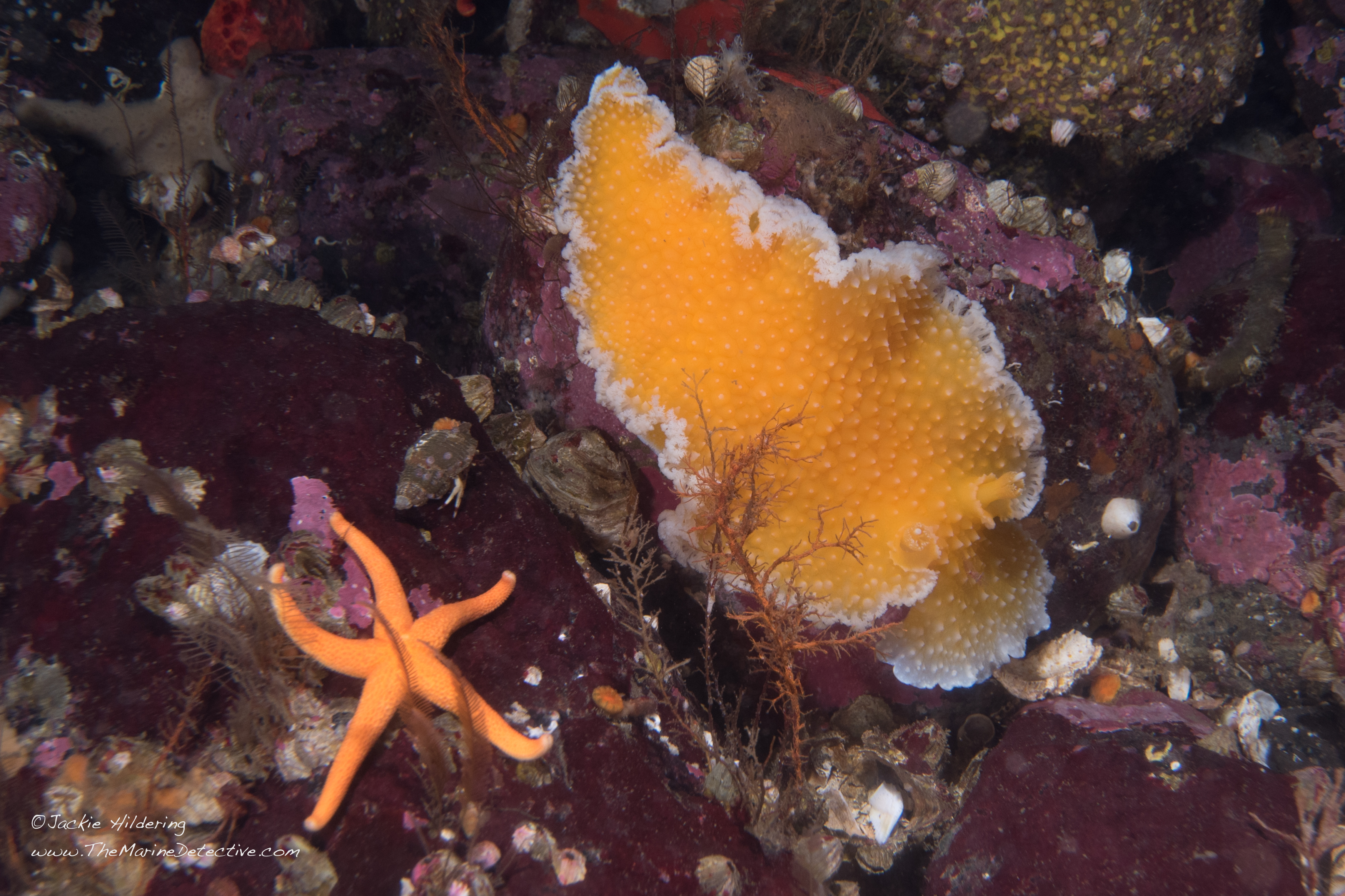
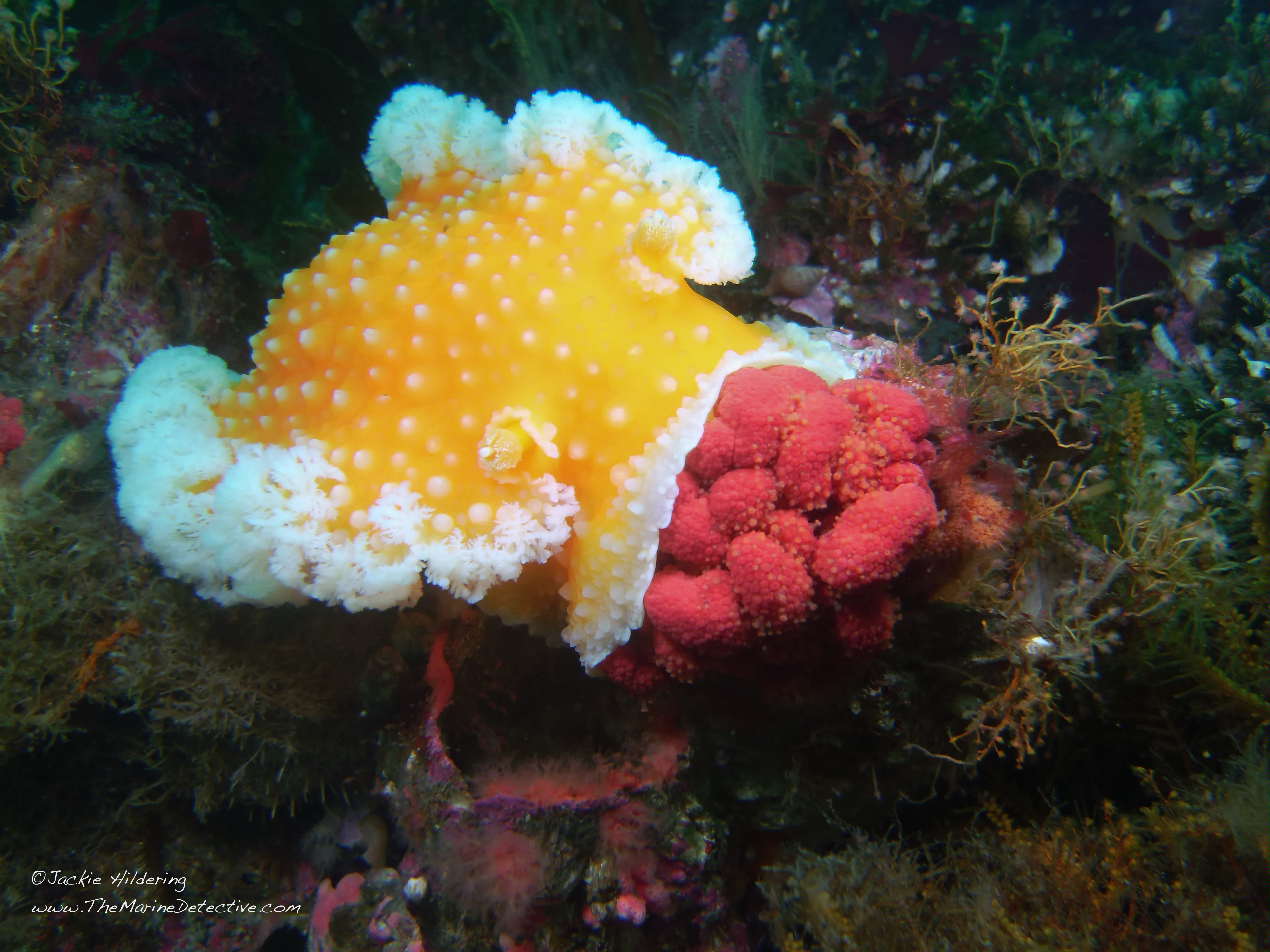
This is an Opalescent Nudibranch (Hermissenda crassicornis).
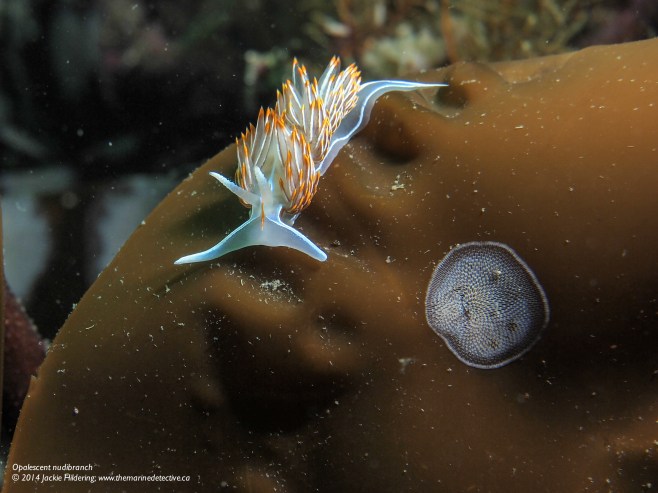
Opalescent nudibranch. The white batch is a colony of animals known as kelp-encrusting bryozoan. © 2014 Jackie Hildering; www.themarinedetective.ca

Opalescent nudibranch – species up to 8 cm long. The white patch on the right is a colony of animals known as “kelp-encrusting bryozoan”. © 2014 Jackie Hildering; http://www.themarinedetective.ca

Here is one climbing giant kelp with hooded nudibranchs in the background.
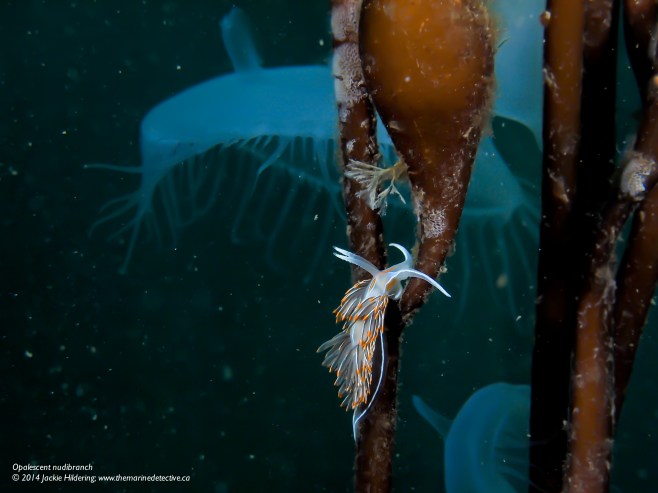
Opalescent nudibranch © 2014 Jackie Hildering; www.themarinedetective.ca

   © 2014 Jackie Hildering; http://www.themarinedetective.ca

I know! Aren’t they astonishingly beautiful? Opalescent Nudibranchs are one of the most powerful ambassadors for shattering the misconception that warm waters are home to more colourful life. They truly help in raising awareness about the incredibly exotic and vibrant life hidden just below the surface in the dark, rich, cold waters of the NE Pacific.

But they help with something else too.

I recently received a video clip of Opalescent Nudibranchs from Tavish Campbell, taken while with Pacific Wild documenting the life that would be at risk if tanker traffic came to Caamano Sound. Tavish, who is a fellow-diver and appreciator of all things marine, asked, “Hey Marine Detective, what’s going on here?!”  What I saw led me to realize how this species is also a very powerful engager for addressing another default notion we humans seem to have.

We tend to bestow judgemental labels on animals depending on our interpretation of their beauty.  We are inclined to think beautiful animals are “nice”, “cute” and “benign”, and foreign looking animals are “mean”, “ugly” and/or “bad”.

While I appreciate that some organisms may be more aesthetically pleasing than others, there is no “ugly” in Nature and there certainly isn’t “bad”.  Organisms look and live as they do because it works. Their appearance and behaviours are the result of expanses of time longer than we humans, as newcomers, can truly appreciate. Organisms’ adaptation allow them to survive and fulfil their niche in Nature’s puzzle so that there is the greatest chance of balance. [Insert “God” instead of “Nature” if this is your preference.]

Therefore, for example, there are no “bad” kinds of orca but rather orca populations whose job in Nature is to eat other marine mammals. There are dolphins that sometimes kill other marine mammals without this being for the purposes of food (no matter how much this conflicts with the “Flipper-like” identities we have imposed on them). Sea otters do things that definitely are NOT cute and .  . . it also means that beautiful sea slugs will also do what they need to in order to survive.

I take such comfort in not needing to judge Nature. It just is. In contrast, human behaviours too often do NOT enhance the potential of balance in Nature or even the chances of our own survival.

So here’s the jaw-dropping video. Ready . . .?

Opalescent Nudibranchs in all their beauty, are extremely voracious predators and, as is evident in the video, will also attack their own kind. Reportedly, fights most often result when the animals come into contact head-to-head. The animal closest to the head or end of the other has the advantage of getting in the first bite and thereby the greater likelihood of killing their opponent and eating them.

But, they are hermaphrodites, they need one another to mate! As hermaphrodites, there is not even male-to-male competition for females! So why, when your chances of finding a mate as a sea slug are already pretty limited, would you kill another of your kind instead of mating with them?

I hypothesize that it would have to do with the balance between needing to eat and needing to mate and/or that there is some sort of genetic competition going on. That’s all I got. Insert rap awe and wonder here. I may not know why they do what they do but I do know, there has to be an advantage to their survival.

What I also know for sure is that this gives a whole new meaning to “slugging it out”!
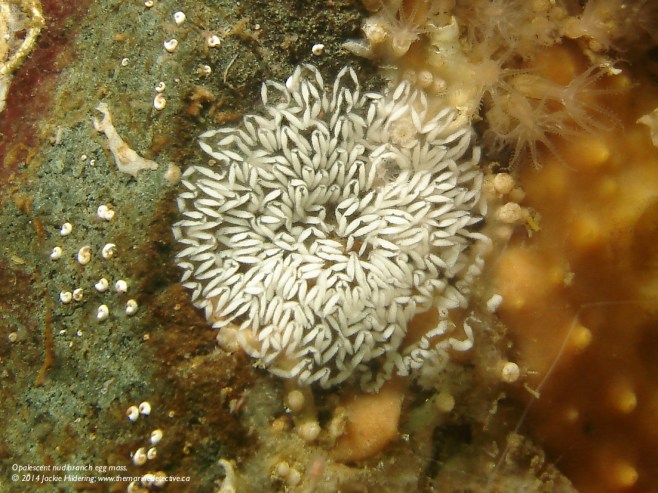
Opalescent nudibranch egg mass. http://jackiehildering.smugmug.com/Underwater/Sea-slugs/

Opalescent Nudibranch egg mass. Every species of nudibranch has distinct egg masses i.e. they are species specific.  2014 Jackie Hildering; http://www.themarinedetective.ca

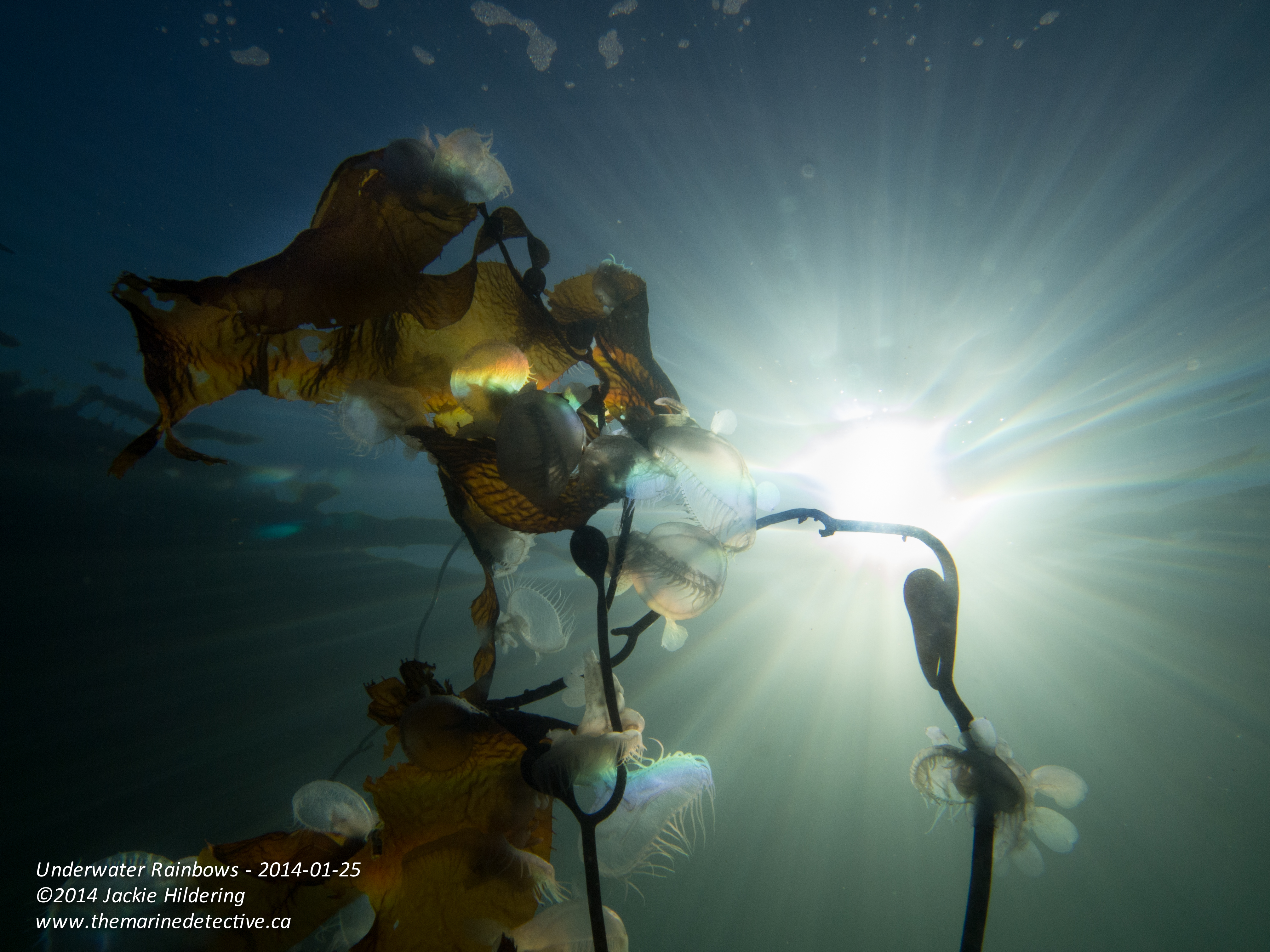
Underwater Rainbows

Do you see them?

The January sun streaming down, the light refracted against the hooded nudibranchs . . . the underwater rainbows?!

Hooded nudibranchs are already such ethereal, other-worldy creatures, to see the rainbows dancing against their translucent bodies made me catch my breath and desperately want to capture the beauty for you.

May you dream of underwater rainbows and – maybe- fall even a little bit deeper in love with the NE Pacific Ocean.
For information on hooded nubibranchs (includes images and video of them swimming and their eggs), please see my previous blogs at this link. 

Hooded nudibranchs on giant kelp at about 3 m. © 2014 Jackie Hildering

Hooded nudibranchs on giant kelp at about 3 m. © 2014 Jackie Hildering

Hooded nudibranchs on giant kelp at about 3 m. © 2014 Jackie Hildering

Hooded nudibranchs on giant kelp at about 3 m. © 2014 Jackie Hildering

Hooded nudibranchs on giant kelp at about 3 m. © 2014 Jackie Hildering

Hooded nudibranchs on giant kelp at about 3 m. © 2014 Jackie Hildering

Hooded nudibranchs on giant kelp at about 3 m. © 2014 Jackie Hildering

Nudibranchs on an Offshore Whale Survey?!

How does studying whale acoustics lead to increased knowledge about the depth range of nudibranchs?

Orange doto.

Just a little more is now known about the orange doto’s depth range. Photo: Hildering.

Let me take you deep and share an experience from my recent time offshore in the eastern North Pacific on a DFO cetacean survey.

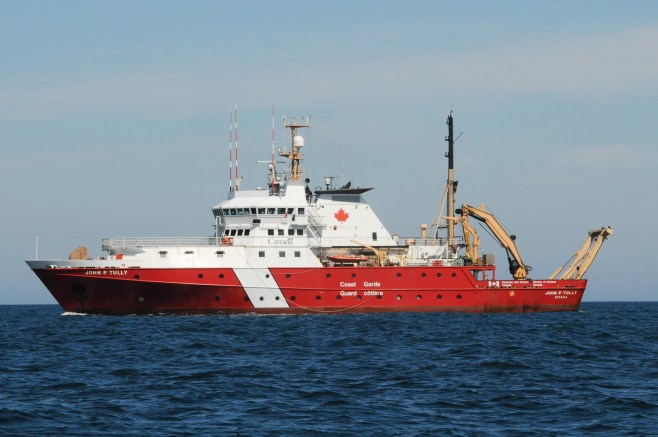
This is the Canadian Coast Guard Ship – the J.P. Tully.

JP Tully.

CCGS J.P. Tully. Photo: Hildering

Among the offshore science expeditions undertaken upon the Tully, are surveys by DFO’s Cetacean Research Program.  These line transect studies provide an estimate of cetacean abundance, as well as an opportunity to ID individual whales and collect feeding and genetic information. The knowledge about abundance and location is of particular importance for the large whales that were hunted so intensely and require protection under Canada’s Species at Risk Act.

These are Autonomous Underwater Recorders for Acoustic Listening (AURAL-M2s).

AURAL-M2s

AURAL-M2s. Photo: Sheila Thornton.

AURALs are hydrophones that can be deployed to 300 m, making time-spaced recordings (e.g. 15 minutes every hour) for up to a year.  Such acoustic monitoring is a very important supplement to the cetacean vessel surveys. The AURALs are of course placed very strategically, in remote, offshore locations. By passively recording whale calls, the AURALs can provide information about the location and seasonality of whale species which may aid in determining critical habitat.

The AURALs are a wonder of technology. It is of course no problem to get something to the bottom of the ocean but, getting it back to the surface so you can retrieve your equipment and data is not so simple. It is achieved with an acoustic release (“D” in the diagram below). Once the vessel is positioned so that there is no chance of the device coming up under it, a sound signal is sent to the device and the AURAL releases from its anchor and floats to the surface thanks to the big yellow buoy.

AURAL- M@

AURAL-M2. Click to see an enlarged, labeled schematic on the Multi-Electronique webpage.

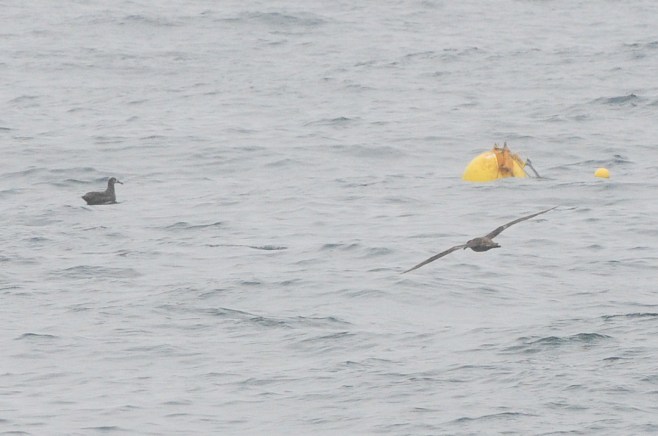
These are two perplexed black-footed albatrosses! A big yellow orb has just popped up to the surface as a result of the acoustic release signal. This AURAL was at 226 m depth at the Bowie Seamount, 180 km west of Haida Gwaii. It had been there for a  year.

AURAL + Albatross

Black-footed albatross just after the buoy with the AURAL recording device came up from 226 m.

Here, the highly skilled Coast Guard crew get the AURAL back aboard the ship so that the data can be retrieved and, ultimately, analyzed for whale vocals.

AURAL retrieval

Coast Guard deck crew expertly retrieves the AURAL. Photo: Hildering

But, there was also a year’s worth of growth on the buoy and who knows what you might find . . .

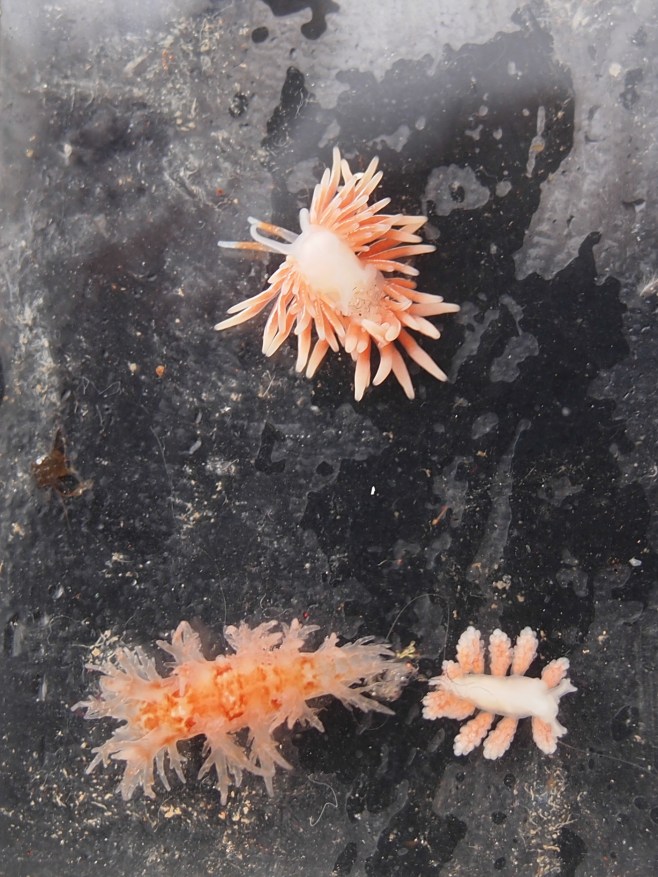
Nudibranchs! Three species found and even one species with eggs!

3 nudibranch species on the aural that had been at 226 m. Photo: Hildering.

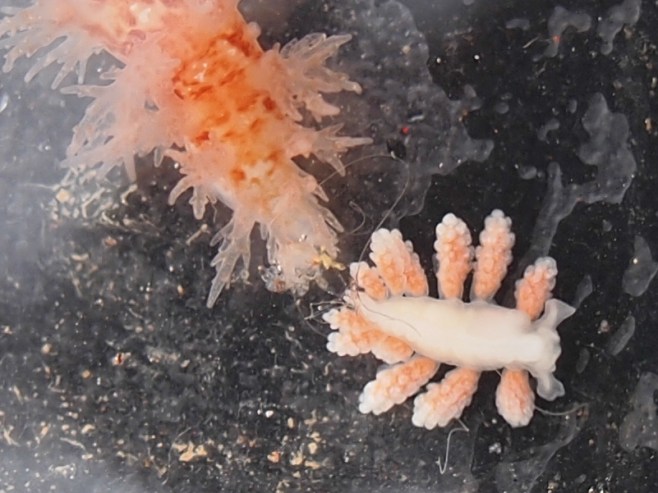
3 nudibranch species on the AURAL that had been at 226 m. BC aeolid; bushy-backed nudibranch and orange doto. Click to enlarge. Photo: Hildering.

  • Top: BC aeolid (Catriona columbiana to 1.5 cm); eggs also found.
  • Left: Bushy-backed nudibranch (Dendronotus venustus to 3 cm; previously Dendronotus frondosus)
  • Right: Orange doto (Doto amyra to 1.4 cm)

By examining the AURAL that had been at 226 m, it confirms that these 3 species of nudibranch have a range to at least that depth.

BC aeolids + egg mass.

Sheila Thornton (marine mammal researcher and fellow nudibranch nut) providing a size comparison for the BC aeolids and their egg masses that were found on the AURAL. Click to enlarge. Photo: Hildering

I shared the find with those who have nudibranch expertise much greater than my own (Dave Behrens via Andy Lamb) and learned that for two of the species, there had been no previous record for them at this depth.

It has long been known that some nudibranch species range to depths of at least 700 m. However, you can imagine what a a challenge it is to get species specific depth information. We camera carrying scuba divers can’t help beyond 40 m depth (deeper if diving with mixed gases).

So it’s not a big scientific discovery.  Compared to the data the AURAL will reveal about endangered whales, it’s just a sea-slug-sized discovery.

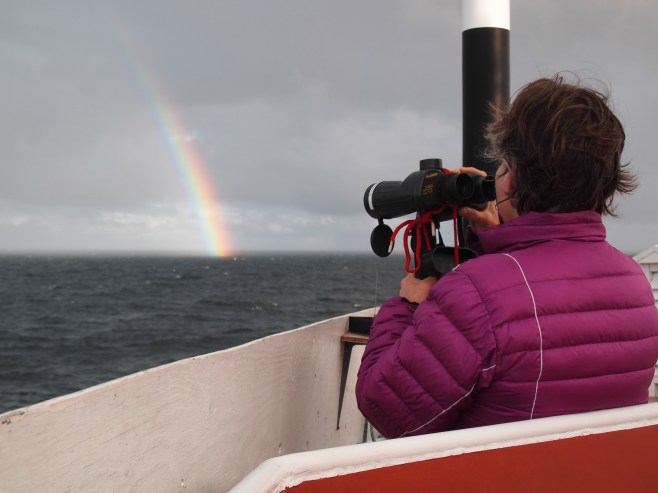
This is me – back on survey duty looking for much bigger organisms but delighting in how collecting data to help save whales, led to learning a bit more about the little guys.

TMD - DFO survey

Spotter duty on the DFO Cetacean Program’s offshore survey. July 2013. Christie McMillan photo.


See the CSAS technical report is by Linda Nichol and Dr. John Ford on the importance of the line transect surveys to the recovery of endangered cetaceans: Information relevant to the assessment of critical habitat for Blue, Fin, Sei and North Pacific Right Whales in British Columbia.

A few more photos from this DFO cetacean survey will soon be posted in this FaceBook album. 

Scroll down at this link to hear samples of marine mammal vocals recorded by AURALs.

Gold Dirona and Alabaster Nudibranch Egg Masses

Updated with photos: 2025-12-18
An egg hunt mystery FINALLY came to an end for me, coincidentally, just before Easter when many of you were involved in egg hunts too.

I dare say however that my hunt involved vastly more beautiful eggs; that the hunt was much more challenging and –  ultimately, much more rewarding!

One of my very, very favourite things to do, satisfying my “The Marine Detective” nature, is to solve the ultimate “whodunit” and match sea slug species with their egg masses / ribbons.

Every sea slug species’ egg mass is distinct, comprising a fascinating diversity of intoxicatingly beautiful shapes and patterns.

It delights me (for reasons I can’t fully explain) that for many sea slugs in the northeast Pacific Ocean, I am able to see an egg mass and immediately know which species laid it.

There are big clues because sea slugs most often lay eggs on their food. So if I know their prey preference I can narrow down which  species laid the eggs.

Easiest of course is to have have the good fortune to find a sea slug in the act of laying their eggs.

But for YEARS, I have been unable to differentiate the egg masses of two of the most beautiful sea slug species in these waters – the Gold Dirona (Dirona pellucida to 12 cm) and the Alabaster Nudibranch (Dirona albolineata to 18 cm and also referenced as the “White-Lined Dirona” or “Frosted Nudibranch”).

You’ll note that they are very closely related (same genus) and it is thereby not surprising that their egg masses would look very similar. Both also often lay their eggs on the same species of Agarum kelp. In all these years, while I have often found both species mating, I have never found either species laying their eggs.

But then, this week . . . just when I was noting the abundance of both species, how many egg masses there were and wishing, WISHING, I could find just one of them laying eggs – my dear dive buddy Jacqui Engel waved me over and pointed out a Gold Dirona laying eggs.

Gold dirona laying eggs.

I was so jubilant, I screamed underwater. Yes, I am The Marine Detective for a reason, such things really do delight me to this degree.

Finally!  Mystery solved, I would be able to differentiate the egg masses of the two species.

But then, Nature was even kinder to me.

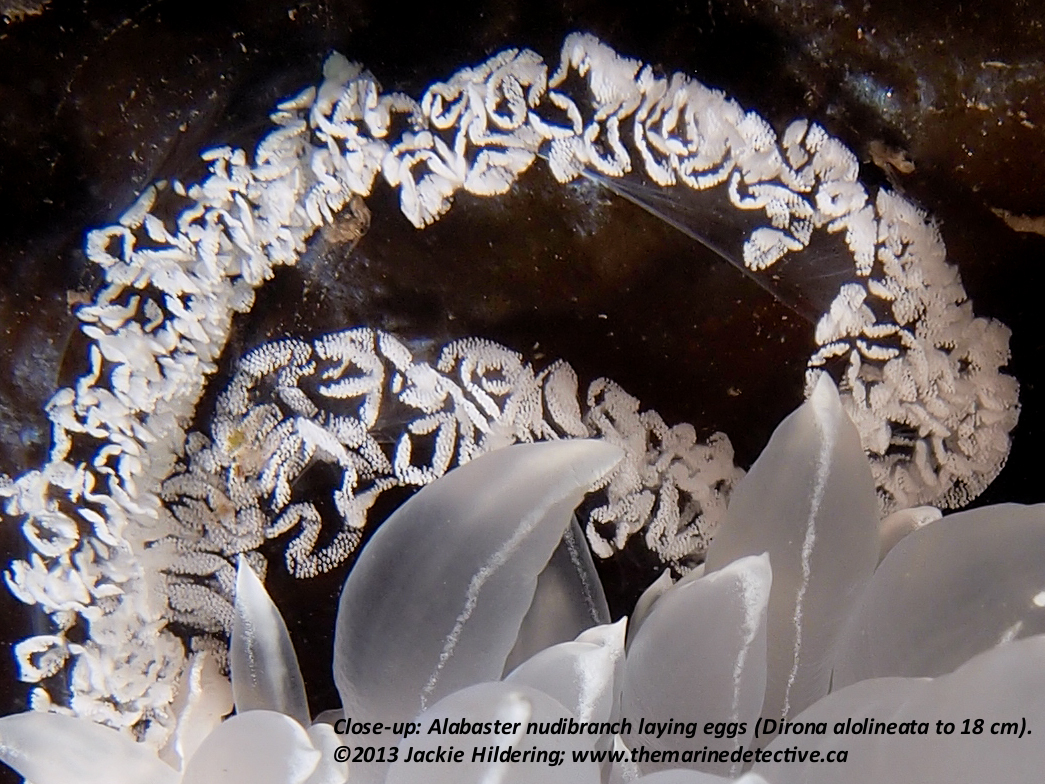
On the very same day on the very same dive, after so many years, I also stumbled across an Alabaster Nudibranch laying eggs!

Alabaster nudibranch laying eggs.

Disbelief! Joy! Manic photo-taking!

I think you may marvel at how very similar the masses are but the difference, at least to me is clear.

The “pieces” of the Gold Dirona’s egg mass are more compact and more like rice kernels.

Gold dirona laying eggs.

The segments of the Alabaster Nudibranch’s egg masses are more scallop-edged and diffuse.

Please know that these differences would not be as clear if the eggs were older.

It’s estimated that there are ~350,000 eggs in one Alabaster Nudibranch egg mass. Source: WallaWallaEd. I do not know if this is the number of egg capsules (the dots you see), or if it includes the number of eggs in each egg capsule.

Sea slugs are reciprocal hermaphrodites which means that both become inseminated and lay eggs. One individual lays more than one egg mass as well. So many eggs are needed to ensure species survival when your young hatch out to become part of the planktonic soup of the Ocean.

Alabaster nudibranch laying eggs.

If you have read to this point – thank you!

Likely we are kindred in our love of marine biodiversity and the beauty that is sea slugs.

For as much as I love chocolate Easter eggs, I would forego them for the rest of my existence if it would allow my appetite for marine mysteries to be further satisfied!


Gold Dironas mating. ©Jackie Hildering.
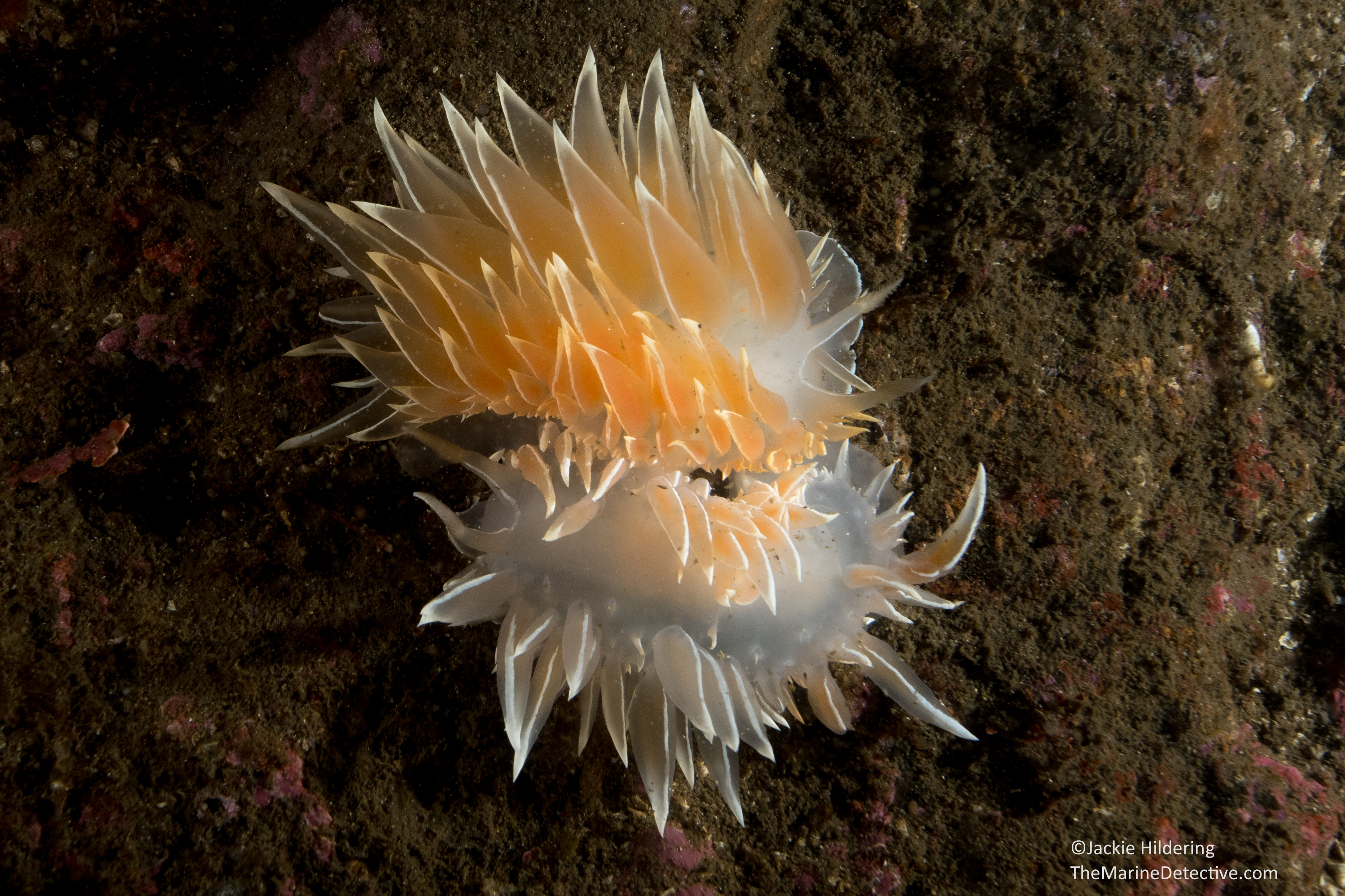
Alabaster Nudibranchs mating ©Jackie Hildering.
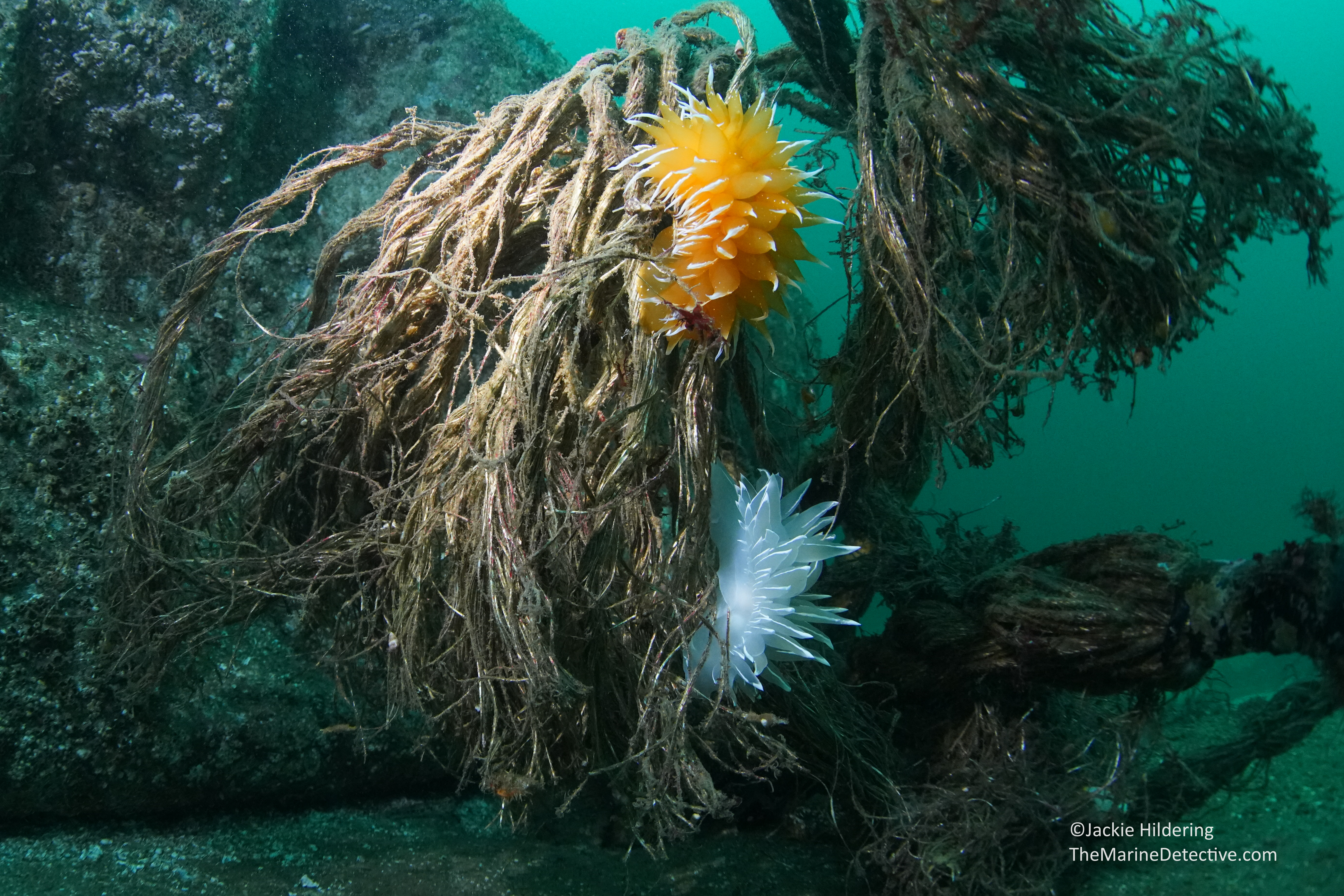
Gold Dirona with Alabaster Nudibranch below on a frayed rope. ©Jackie Hildering.
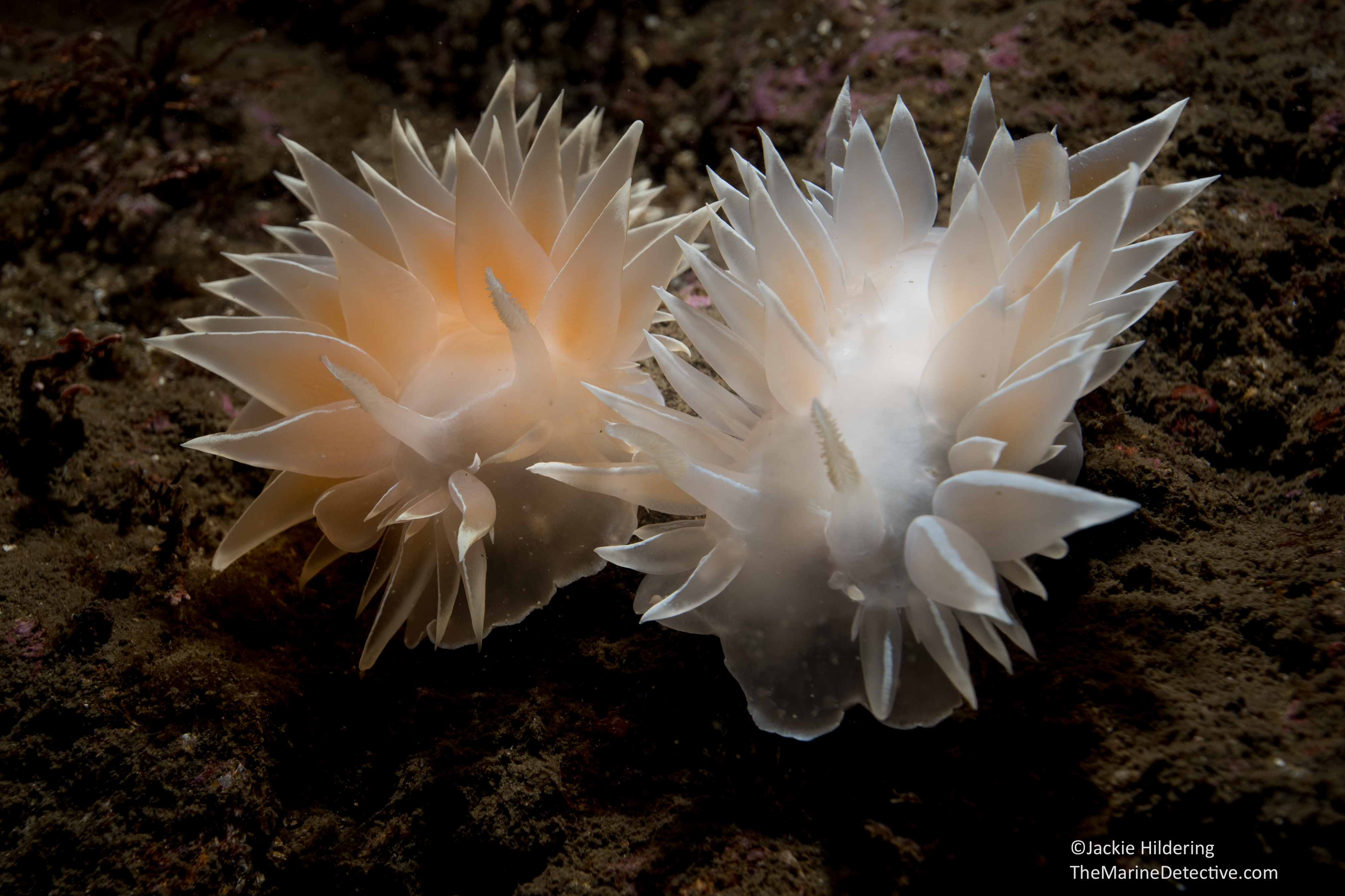
Alabaster Nudibranch left and Gold Dirona right. But see photos below. Alabaster Nudibranchs are not always fully white and this can lead to ID confusion. ©Jackie Hildering.

Colour variation in Alabaster Nudibranchs

Alabaster Nudibranch – colour varies to include orange, yellow, and pink hues. ©Jackie Hildering.
Also an Alabaster Nudibranch. ©Jackie Hildering.
This photo and the next. Alabaster Nudibranchs moving into mating position right-side to right-side. ©Jackie Hildering.

Mistaken identity?
Gold Dirona above and Alabaster Nudibranch below. Discussion about this interaction on the Sea Slug Forum at this link.

Of Sea Whips and Sea Pens

[Last updated November 15, 2023]
This blog is about Sea Whips and Orange Sea Pens, the predators that stalk them, and how they can defend themselves.

These are the most surreal-looking organisms. Both species are octocorals – colonies of 8-tentacled polyp-like animals. The polyps filter feed on plankton.

Sea Whips can reach a height of 2.5 meters (Balticina willemoesi).
Close-up on the feeding polyps of a Sea Whip.
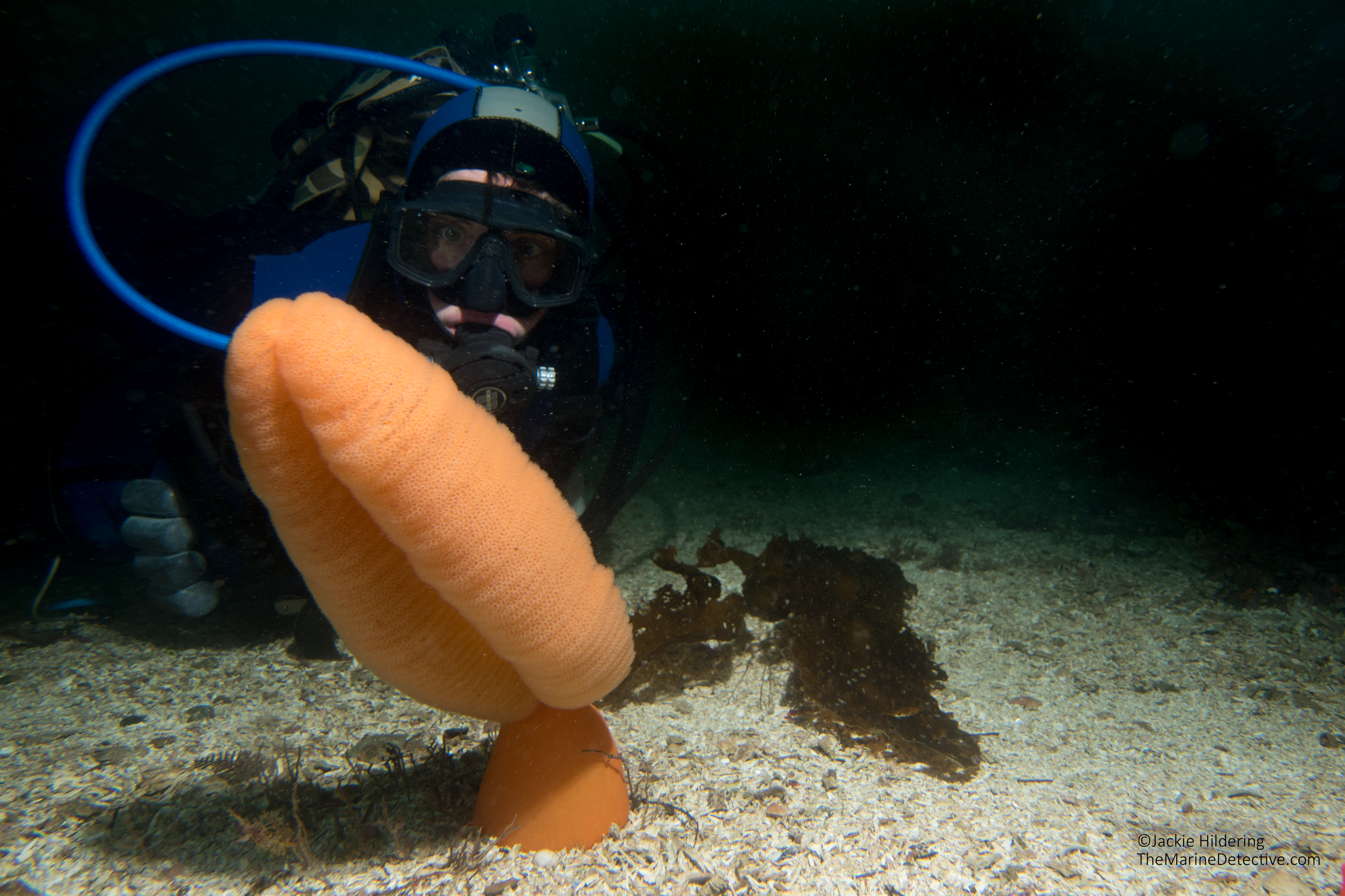
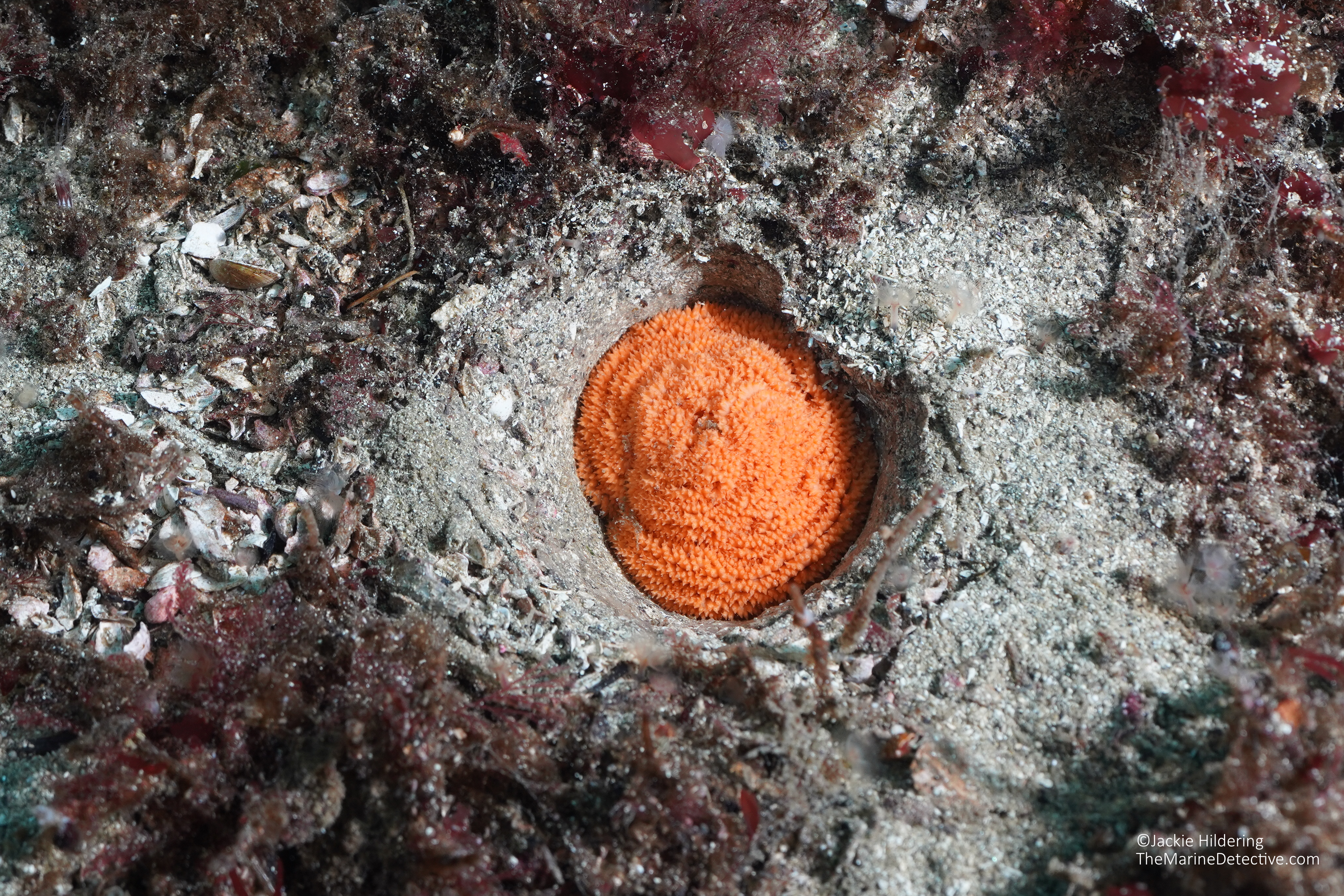
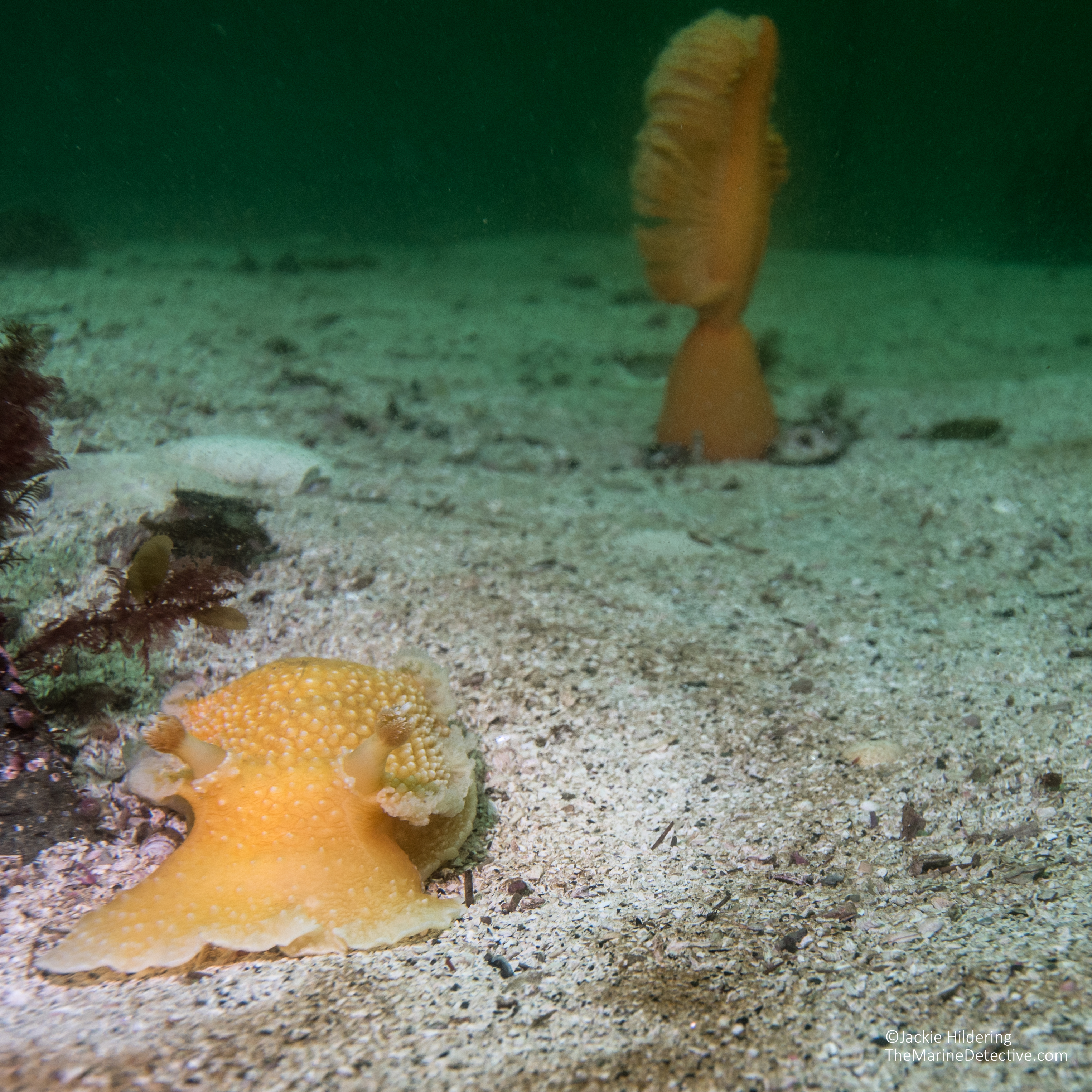
Orange Sea Pens can be up to 48 cm tall (Ptilosarcus gurney).
Close-up on the feeding polyps of an Orange Sea Pen.

Information on Orange Sea Pens from the Monterey Bay AquariumA graceful creature of the seafloor, this sea pen resembles a plump, old-fashioned quill pen. Its colors range from dark orange to yellow to white. Each sea pen is a colony of polyps (small anemonelike individuals) working together for the survival of the whole. The primary polyp loses its tentacles and becomes the stalk of the sea pen, with a bulb at its base—the bulb anchors the sea pen in the muddy or sandy bottom. The various secondary polyps form the sea pen’s “branches” and have specialized functions. Some polyps feed by using nematocysts to catch plankton; some polyps reproduce; and some force water in and out of canals that ventilate the colony.”

Dive buddy Natasha Dickinson with Orange Sea Pen
Remains of an Orange Sea Pen.

Orange Sea Pen Defences

When confronted by sea star and nudibranch predators, Orange Sea Pens can:

1) Deflate, “shrinking” down and into the sand.
2) Inflate, to drift away.
3) Create bioluminescence – making a greenish-blue light that is assumed to somehow deter predators.
4) Produce a toxin but this is poorly understood.

And you thought humans were special! 😉

Deflated and retracted Orange Sea Pen. This can happen within about a minute of first contact from the predator (Wyeth & Willows, 2006 ). From “A Snail’s Odyssey: “A sea pen withdrawn into the sediment does not necessarily mean that it has been attacked or otherwise stimulated.  Studies in Puget Sound, Washington show that sea pens Ptilosarcus gurneyi may inflate and deflate several times a day, and at any given time as few as one-quarter of all individuals are up and feeding.”

From the excellent blog from the Washington State Department of Ecology:

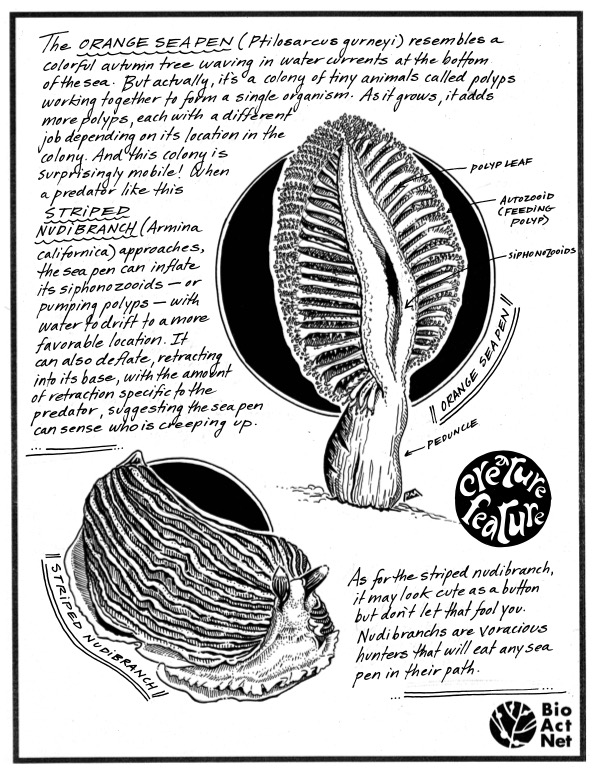
“The orange sea pen is surprisingly mobile, inflating its siphonozooids with water and drifting like a leaf on the wind when it wants to relocate. It can also deflate, partially retracting into its fleshy base when predators come calling. The amount of retraction has been shown to be specific to the approaching predator, which suggests that the pen can actually sense who is creeping up on it . . . Young sea pens are especially vulnerable to predation. They are incredibly slow-growing, taking over a year to reach about an inch tall. Orange Sea Pens increase their chances of survival with sheer numbers — a single pen can produce about a million eggs during its 10-year lifetime.”

Orange Sea Pen having a bad day?  There are 4 predators here and it looks like the Orange Sea Pen was trying to inflate and drift away! But, there was a LOT of current whereby it kept being pushed down. Predators here are a Vermillion Star, two Diamondback Nudibranchs and one Orange Peel Nudibranch.
Orange Sea Pen being attacked by an Orange Peel Nudibranch.
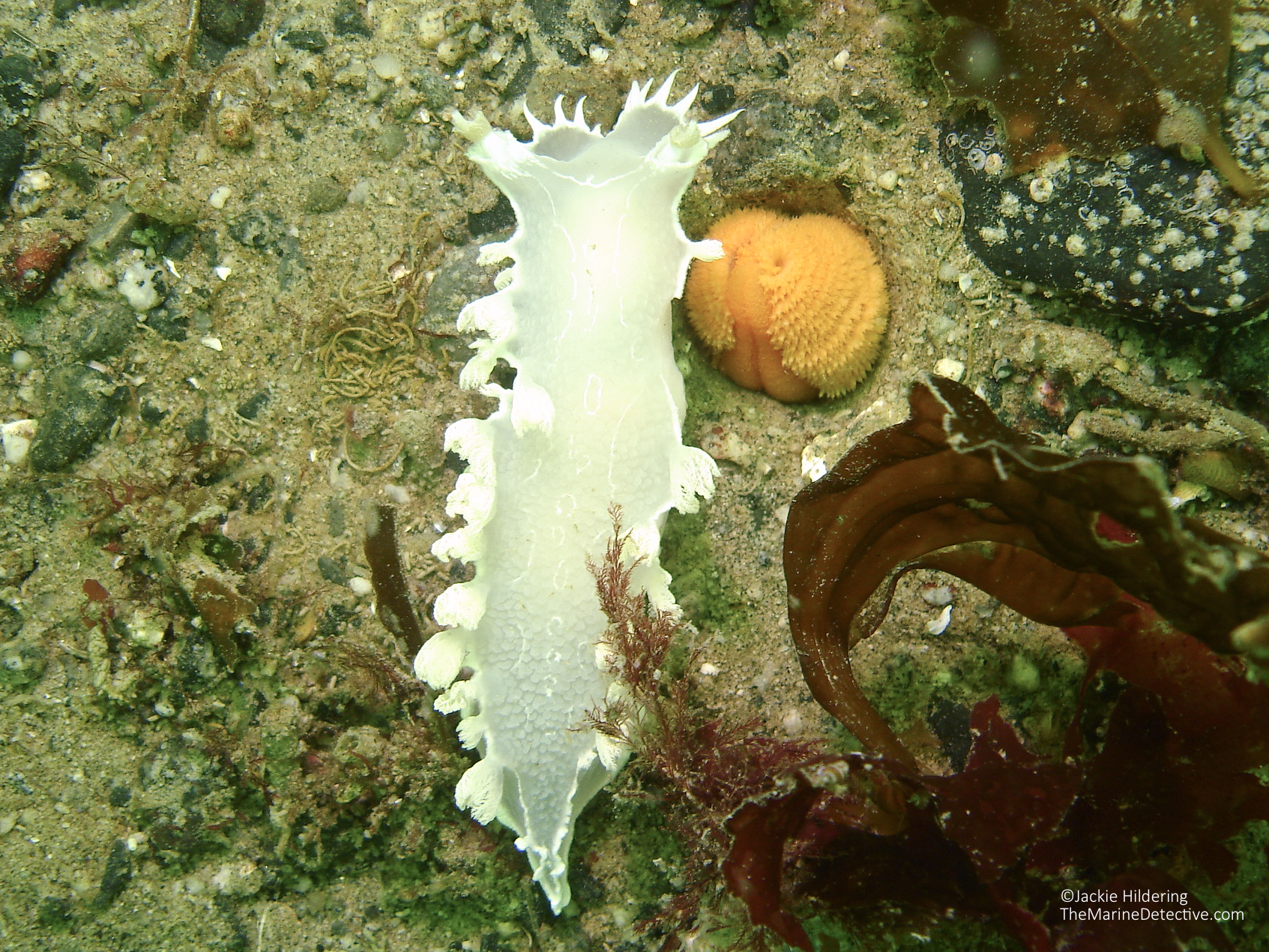
Diamondback Nudibranch (predator) and a partially retracted Orange Sea Pen.
Striped Nudibranch feeding on the “pen” of an Orange Sea Pen. Giant Sea Cucumber on left. 
By Romney McPhie. Click here for the PDF and more colouring sheets!
Orange Sea Pen with inflated base. May have escaped predation this way – inflating and drifting away from the predator.
Retracted Orange Sea Pen and Diamondback Nudibranch.

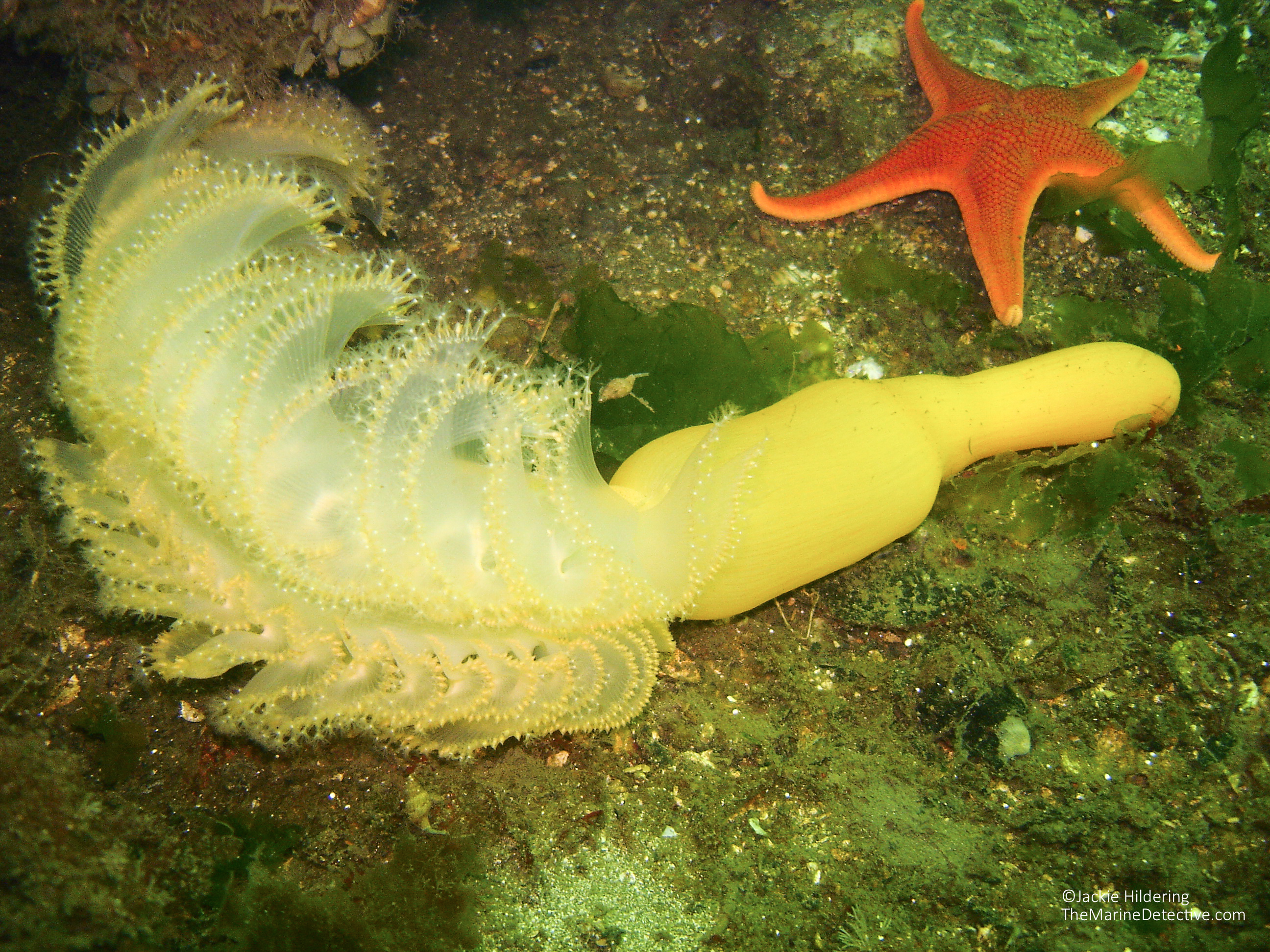
Inflated Orange Sea Pen and Vermillion Star.

Diamondback Nudibranch approaches its prey, the Orange Sea Pen. From the Washington State Department of Ecology: “The rows of feeding polyps on the feather-like structures “wave their 8 tentacles in the water to catch drifting plankton. These polyps [are] also responsible for producing eggs and sperm that get released into the water column. The siphonozooids, or pumping polyps, are found in the orange regions on the sides of the rachis [central stalk]. Their function is to take in or expel water, allowing the colony to inflate or deflate.”

Diamondback Nudibranch crawling away from a retracted Orange Sea Pen.

Orange Peel Nudibranch with Orange Sea Pen in the background.

The 2.5-minute clip below is of Sea Whips and Orange Sea Pens and the predators that stalk them.

Video: 1-minute of an Orange Sea Pen and Graceful Decorator Crab in the current in front of Port McNeill, BC.


The following BBC video below is from southwest Tasmania in Australia. This is not the sea pen species found in British Columbia. However, I have included it as it shows, with time-lapse photography, how sea pens can deflate and retract in response to predation attempts by nudibranchs.


Diamondback Nudibranch approaching and a White Sea Pen (Virgularia sp to 30 cm tall).


Note that I found very little information about the anti-predator responses of Sea Whips. From Malecha and Stone, 2009:

“For those colonies lying on the seafloor, most of the peduncles and the tissues of the rachis below the polyps (approximately 15 cm) were generally not consumed by Tritonia diomedea. Additionally, predation by nudibranchs on erect Halipteris willemoesi [now Balticina willemoesi ] in the abraded and control groups did not occur. The disinclination of T. diomedea to prey on the lower portion of sea whips lying on the seafloor and their inability to prey on erect colonies perhaps suggests that H. willemoesi [Balticina willemoesi ] may have structural and/or chemical defenses on the tissue above their peduncles that deter epibenthic predators. Typically, chemical defenses are concentrated at the distal portions of colonies where polyp density is greatest, whereas structural defenses are often concentrated near the base of colonies (Harvell & Fenical 1989, Wylie & Paul 1989). The distribution of defenses is perhaps an adaptation to various types of predators and their mode of attack. Therefore, if sea whips have evolved defensive structures located at the base of the colony that are specific to epibenthic, non-swimming predators such as nudibranchs and sea stars, the defenses certainly do not provide protection when sea whips are not erect. Disturbed animals, especially those lying on the seafloor, may be more vulnerable to predation from a wider array of predators since the defenses at their polyps may not be adaptively effective against non-swimming predators. Further study could examine the possible chemical and/or structural defenses of sea whips that are common among octocorals.”


For more information:


Big Orange Love – The Orange Peel Nudibranch

Update November 2020: The Orange Peel Nudibranch has been reclassified. Now is Tochuina gigantea.


This blog is about Big Orange Love – the reproduction of Orange Peel Nudibranchs.

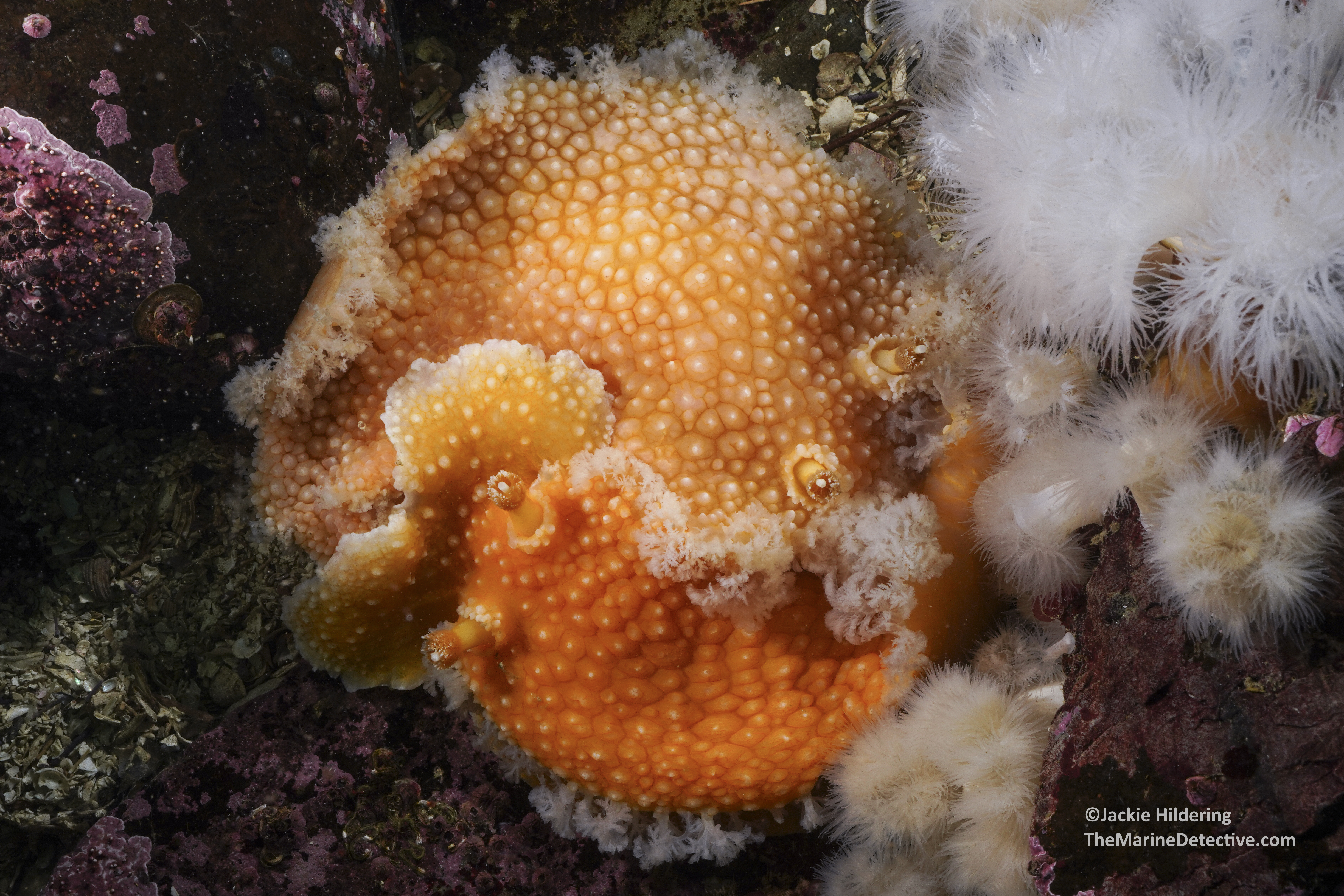
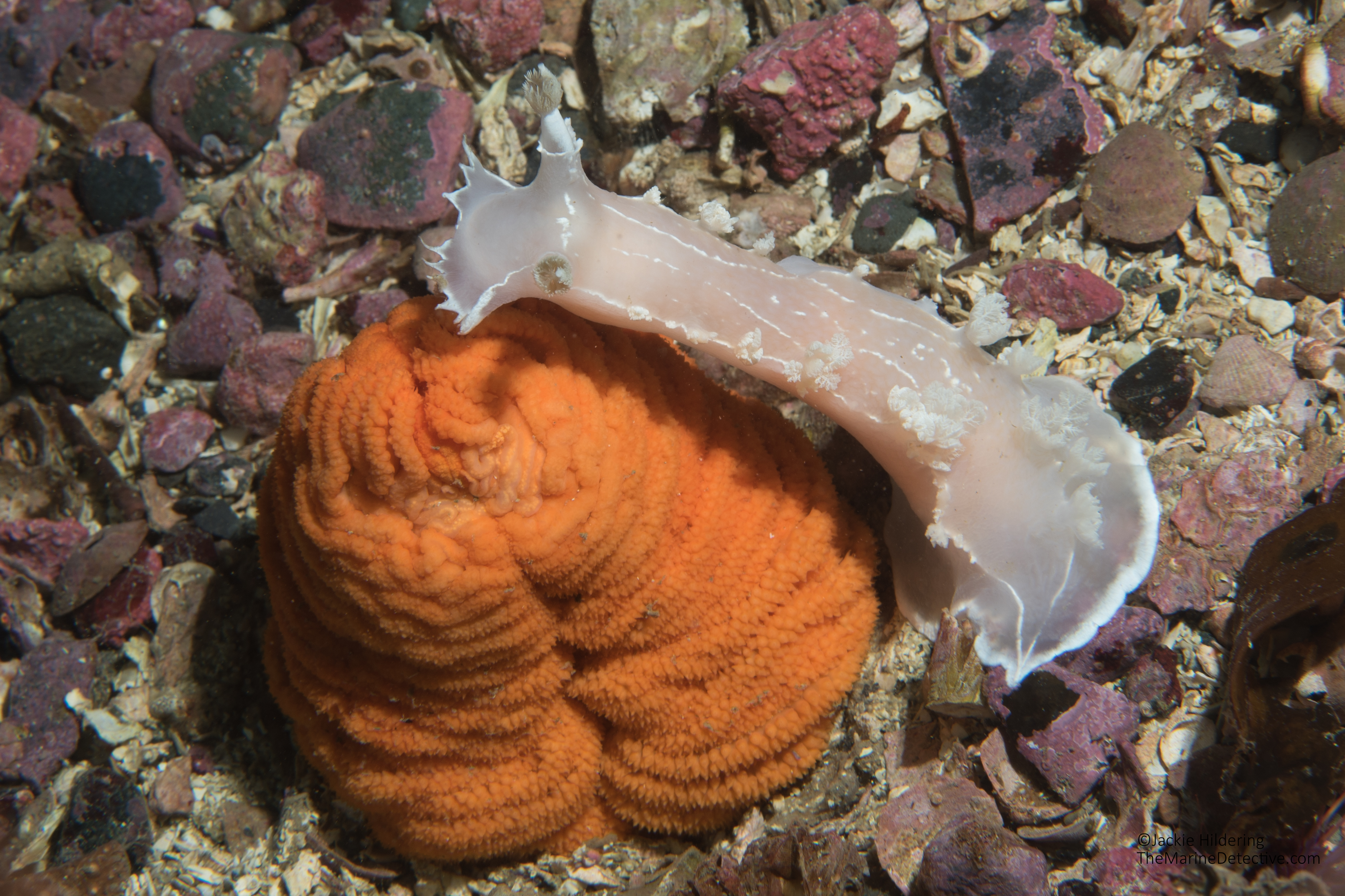
Two Orange Peel Nudibranchs mating – each about 30 cm long. Both will go on to lay the huge masses of eggs you see below. There is no male, or female.

These sea slugs are very aptly named since their skin is reminiscent of both the texture and vibrant colour of an orange. But, the name does nothing to indicate the size to which these giants can grow. They are one of the world’s largest sea slugs with literature reporting them to lengths of up to 30 cm and weight to 1.4 kg. 

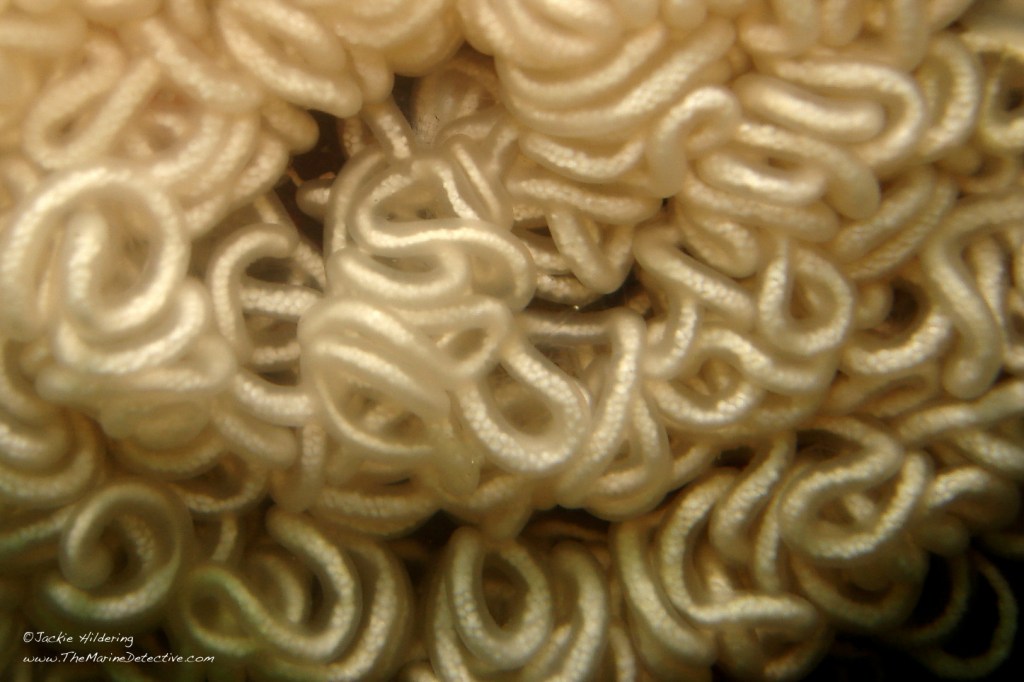
As if this sea slug species’ colour, size and beautifully intricate white gills are not enough to create awe, you should see their eggs! I will never forget the first time I saw the huge tubular mass that looked like udon noodles. I think my brain almost exploded and I was propelled all the more feverishly on my “The Marine Detective” path, wanting to be able to identify the egg masses of all sea slugs in our waters (each species’ eggs look different).

Orange Peel Nudibranch beside egg mass. ©Jackie Hildering.
Close-up on an Orange Peel Nudibranch egg mass. ©Jackie Hildering.
 ©Jackie Hildering.


More photos:

Please note that my slideshow below is from before the species was reclassified to be Tochuina gigantea.

DSC02592
Orange Peel Nudibranch feeding on Red Soft Coral ©Jackie Hildering. 
Orange Peel Nudibranchs moving into position to mate (always right-side-to-right-side) an lock gonophores. Both will become inseminated and lay eggs. ©Jackie Hildering
Sea slug amidst red soft coral.
Orange Peel Nudibranch feeding on Red Soft Coral. Photo: Hildering
Orange Peel Nuibranch and a Red-gilled Nudibranch. ©Jackie Hildering.
Orange Peel Nudibranch and a Blood Star ©Jackie Hildering.
Orange Peel Nudibranch and Proliferating Anemones (pink and orange) ©Jackie Hildering.
Two Orange Peel Nudibranchs in the kelp forest ©Jackie Hildering.
Orange Peel Nudibranch and Striped Sunstar ©Jackie Hildering.
Orange Peel Nudibranch feeding on Red Soft Coral ©Jackie Hildering.
And another hungry Orange Peel Nudibranch ©Jackie Hildering.

Sources: 

Korshunova T, Martynov A (2020) Consolidated data on the phylogeny and evolution of the family Tritoniidae (Gastropoda: Nudibranchia) contribute to genera reassessment and clarify the taxonomic status of the neuroscience models Tritonia and Tochuina. PLoS ONE 15(11): e0242103. https://doi.org/10.1371/journal.pone.0242103

They’re Back . . . Hooded Nudibranchs

In late August, some of my Young Naturalists alerted me that they had already seen hooded nudibranchs (Melibe leonina) around Port Hardy (B.C., CANADA).

[It so wonderful that these local children know and greatly appreciate nudibranchs.]

Late August is earlier than we historically have seen the hooded sea slugs gather in large numbers. Usually this happens in late September / early October with them beginning to lay eggs in the spring.

Hooded nudibranchs back in very large numbers. Late August 2010.

This week, I had the opportunity to check how many are already in the area and, it’s official – the hooded nudibranchs are very much back.

To see the video from today, click here (2-minute video).

For explanations on the natural history of hooded nudibranchs, please see my previous blog postings from April 10th, 2010 and May 2nd, 2010.

Hooded nudibranch egg masses (March 2011). Each mass is about 1 cm high. Each little white dot is an egg.

Hooded nudibranch egg masses (March 2011).


“Exquisite Handiwork” – Sea Slug Eggs

“Some of nature’s most exquisite handiwork is on a miniature scale, as anyone knows who has applied a magnifying glass to a snowflake.

I was reminded of this Rachel Carson quote today when diving but found myself changing the ending to ” . . . as anyone knows who has seen sea slug egg masses.”

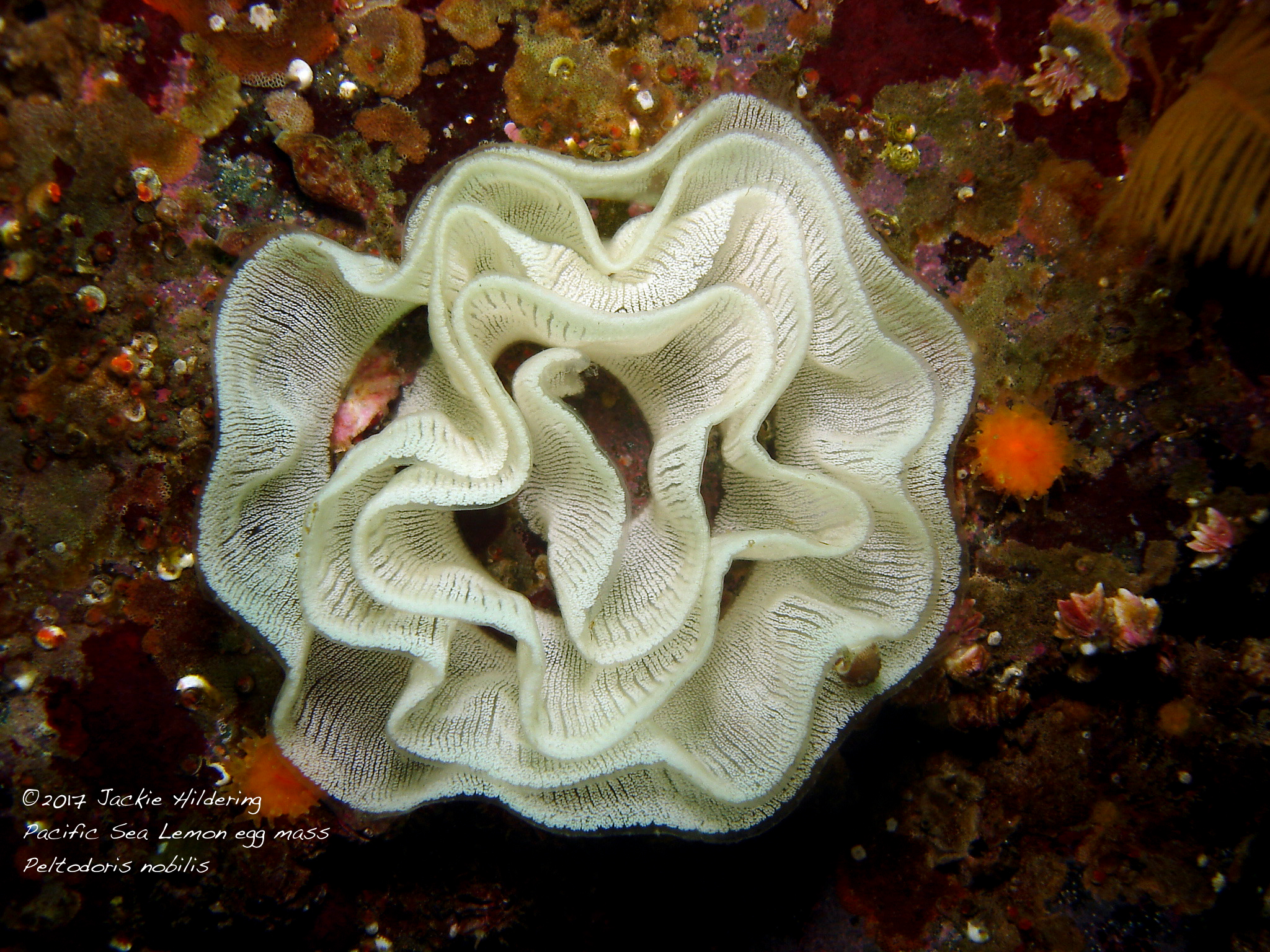
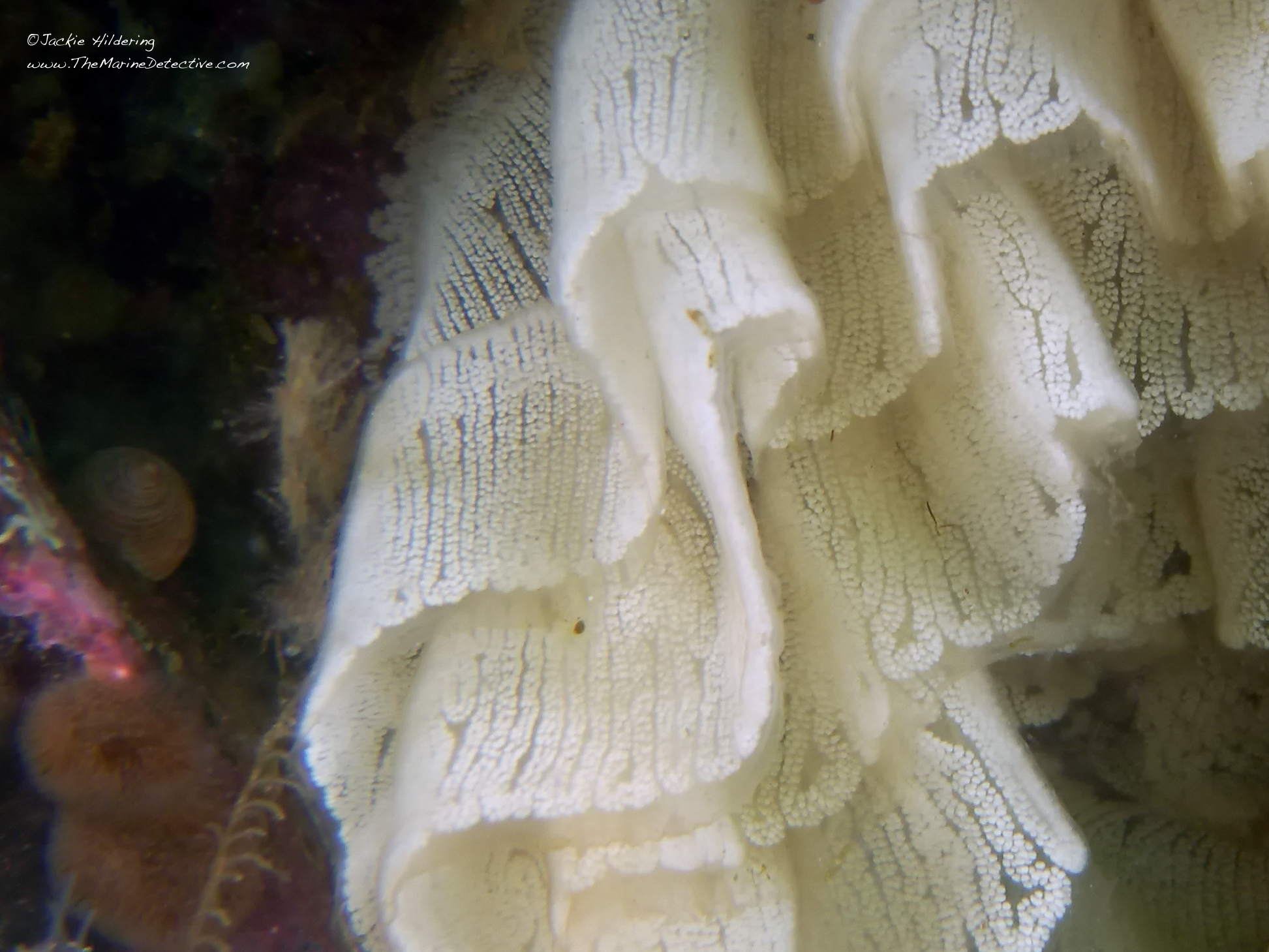
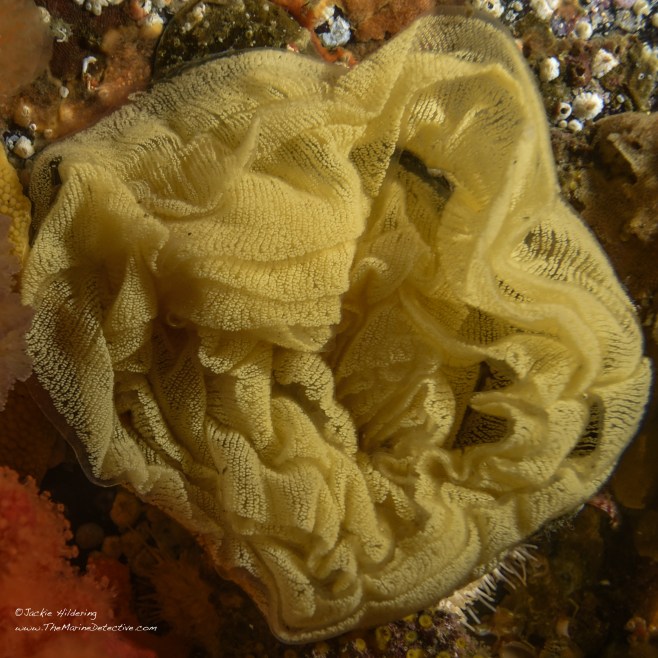
The image here is the egg mass of the Pacific Sea Lemon (Peltodoris nobilis), a sea slug up to 20+ cm. It’s egg mass is up to some 20 cm as well.  Every little dot you see contains up to 20 fertilized eggs. So many eggs are needed when your young are hatched into the planktonic soup of the sea. 

The egg mass is the result of the Sea Lemons lining up right-side-to-right-side and both becoming fertilized. Being a hermaphrodite is of course a good design when you are a slow-moving slug that relies on smell to find its way.  More detailed information about sea slug mating can be found at this previous TMD blog entry.

Looking like rich, textured crocheting, the egg mass is indeed Nature’s exquisite handiwork.  Its intricacy rivals that of any spider’s web and, in my perception, surpasses any human nanotechnology.

Seeing such beauty serves as testimony of Nature’s perfection and complexity. How we humans are newcomers to it all, unable to truly grasp the billions of years of design that proceeded our walking upright on earth. It should further motivate us all to walk with much smaller footprints so that we do not blunder and crush the systems that are Nature’s exquisite handiwork.


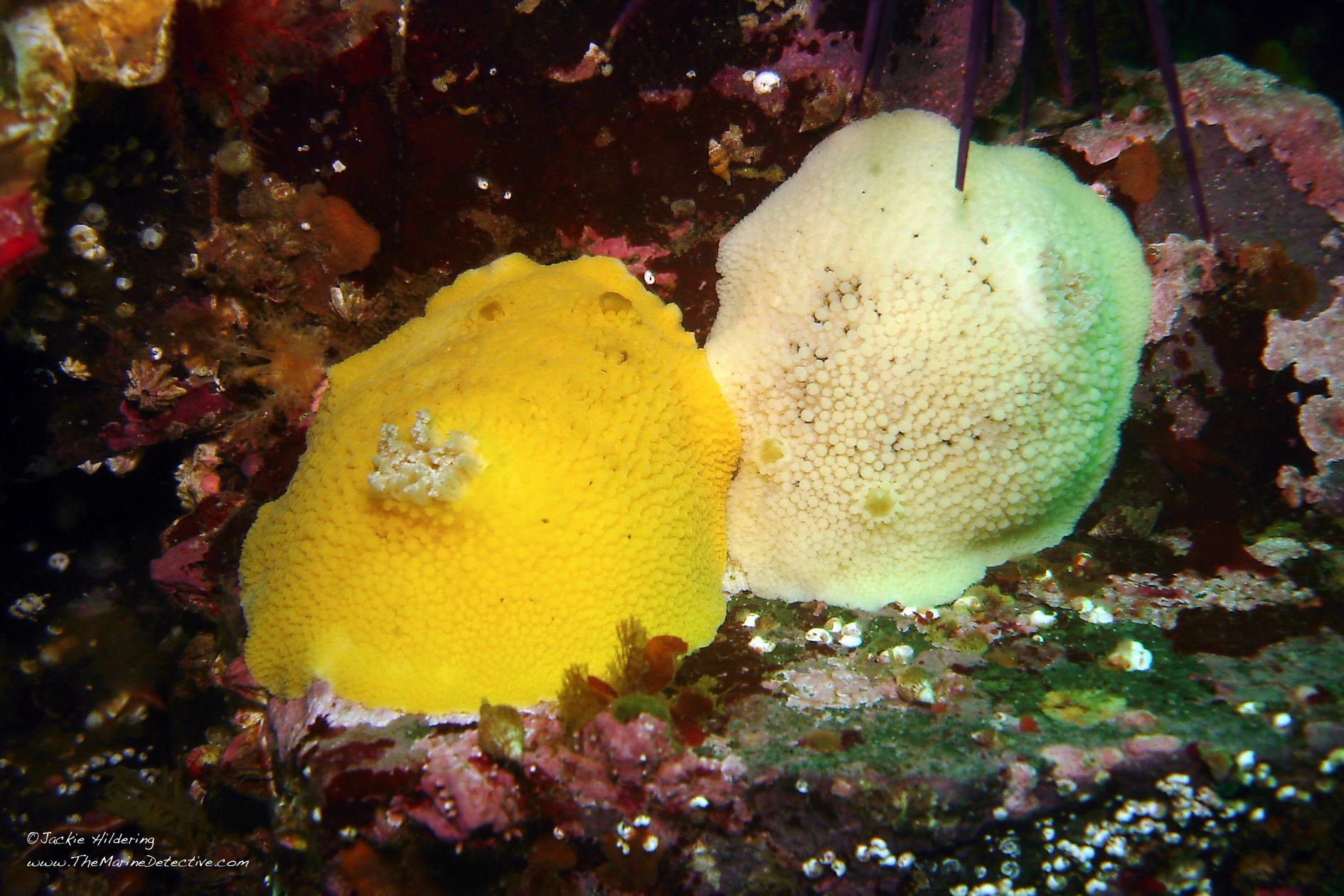
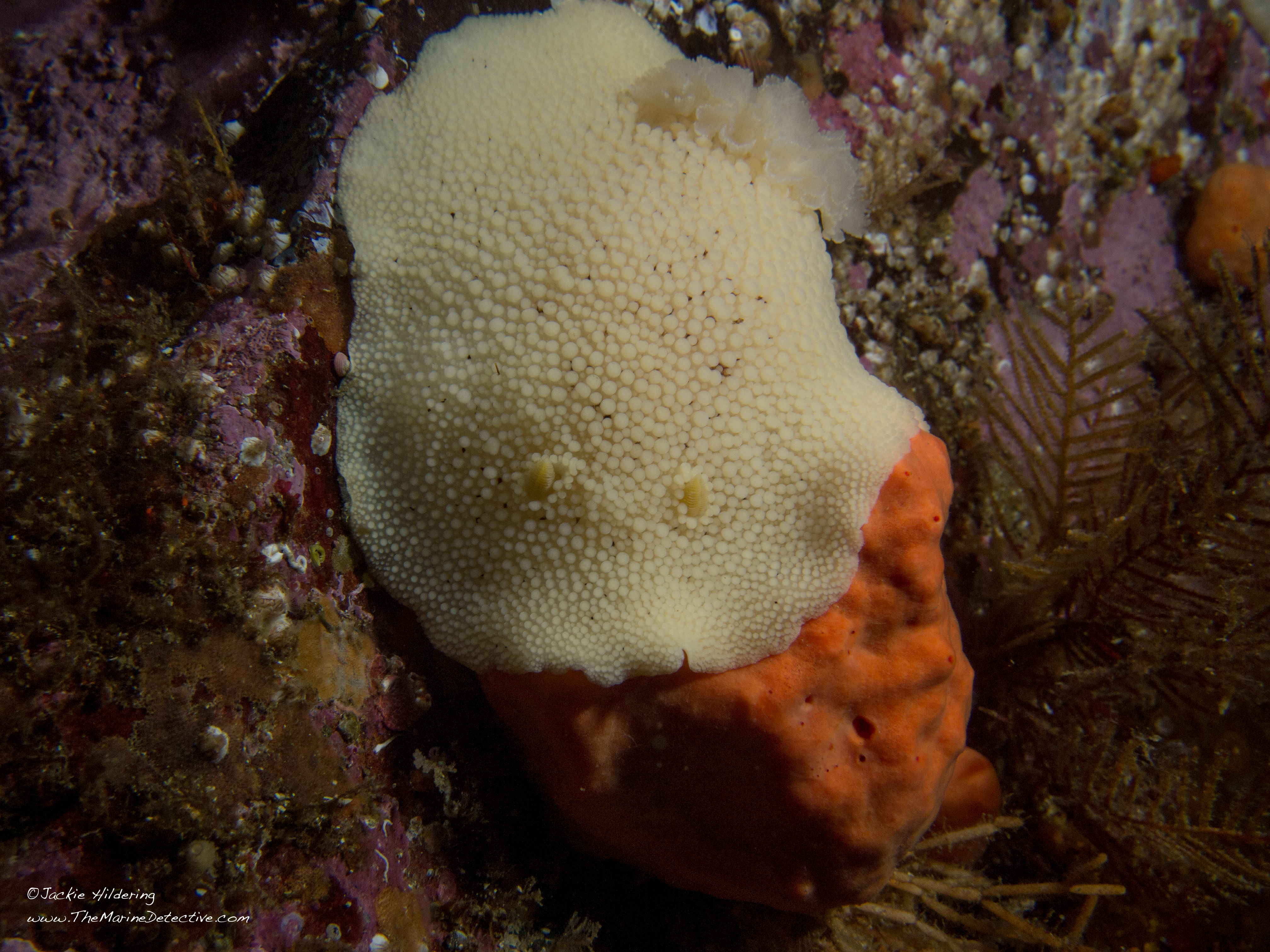
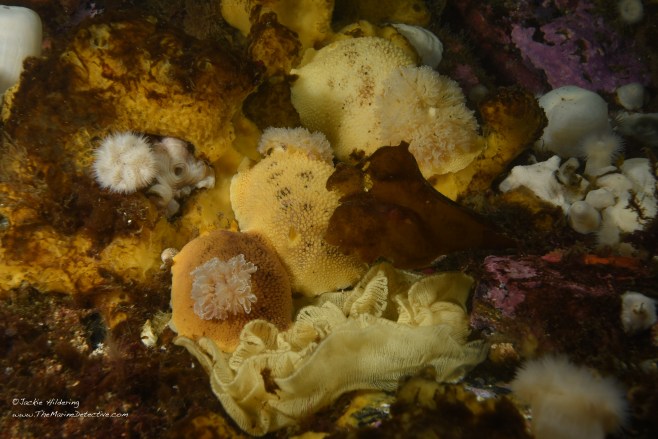
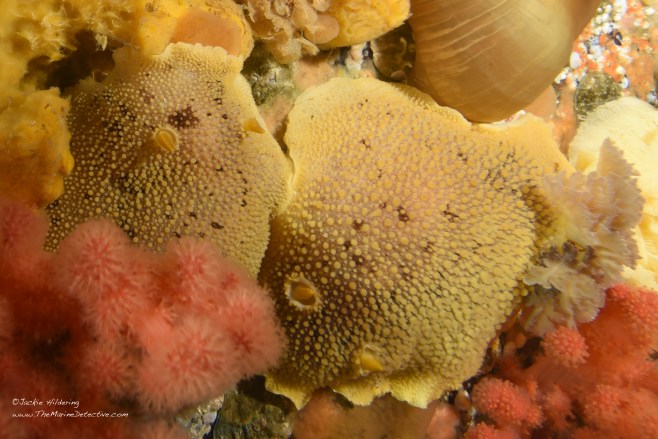
Note: The Sea Lemon is often mistaken for other dorid species such as the Monterey Dorid (Doris montereyensis).  The easiest way to ID them correctly is to know that Pacific Sea Lemons have white gills. See the photos below and note how, although the body colour can be different, the colour of the gills is always white. The gills of the Monterey Dorid are yellow. The other difference, albeit more subtle, is that the little brown bits of colour do not extend to the top of the tubercles in Pacific Sea Lemons and the brown does go to the tips in Monterey Dorids. The tubercles are those bumpy little structures all over the sea slugs. Also, every sea slug species’ egg masses looks different which  provides further ID clues. The egg masses of Monterey Dorids are not quite as intricate. 

[Update 2020: I promise I will provide a blog showing the differences in IDs and egg masses of Pacific Sea Lemons, Monterey Dorids AND two more species which add to the ID confusion – Freckled Sea Lemons and Heath’s Dorids. Just need a bit of time!]

Close up on a Pacific Sea Lemon’s (Peltodoris nobilis) egg mass. Every dot contains up to 20 fertilized eggs.


Peltodoris nobilis egg laying (note the Brittle Star arms coming out of the crack).


Peltodoris nobilis mating – always right side to right side in slugs with gonopores linked so both become inseminated and lay eggs = simultaneous hermaphrodites.


The following photos give more of a sense of the variation in colour in this species.


More mating and eggs masses

3 Pacific Sea Lemons, two mating, one egg mass. Individuals appear to lay multiple egg masses to increase the chances of young surviving to adulthood. Not the white gills. 

Mating. These two were right beside the egg mass in the following photo.

Hooded mystery #2 – Hooded nudibranch swimming

See last week’s post for Part 1 about Hooded Nudibranchs (Melibe leonina).

This week, I share video showing this remarkable sea slug when it is swimming. 

When viewing the clip, try to identify the animal’s “rhinophores”, the structures coming off the animal’s head that allow it to smell its way around. These structures have the shape of mouse ears but they pick up on chemical signals, not sound.  In last week’s posting I shared how the Hooded Nudibranchs come together to mate through being attracted by smell (pheromones).

Video from today of a swimming Hooded Nudibranch. 

The lobed structures on the animal’s back are the naked (nudi) gills (branchs). They can detach if the hooded nudibranch is threatened and are sticky. Maybe this is so that the predator is distracted by the gills sticking to it allowing the hooded nudibranch to have a greater chance of getting away.

Hooded Nudibranchs (up to 17.5 cm) on Giant Kelp.

I have included a second clip this week too, taken on today’s dive. No Hooded Nudibranchs in it, but Bull Kelp forest visions while on my “safety stop”; a 3-minute rest at 15 feet to offload nitrogen before surfacing. Thought you might like to take a dip with me!

Click here for kelp forest video from today’s dive.


Hooded Nudibranchs and their eggs

©Jackie Hildering
Hooded Nudibranchs – oral hood open ©Jackie Hildering

[Last updated on January 2, 2022]

The remarkable-looking animals to the right are Hooded Nudibranchs (Melibe leonina up to 17.5 cm). A nudibranch is subgrouping of sea slugs whose characteristics include having naked (“nudi”) gills (“branchs”).

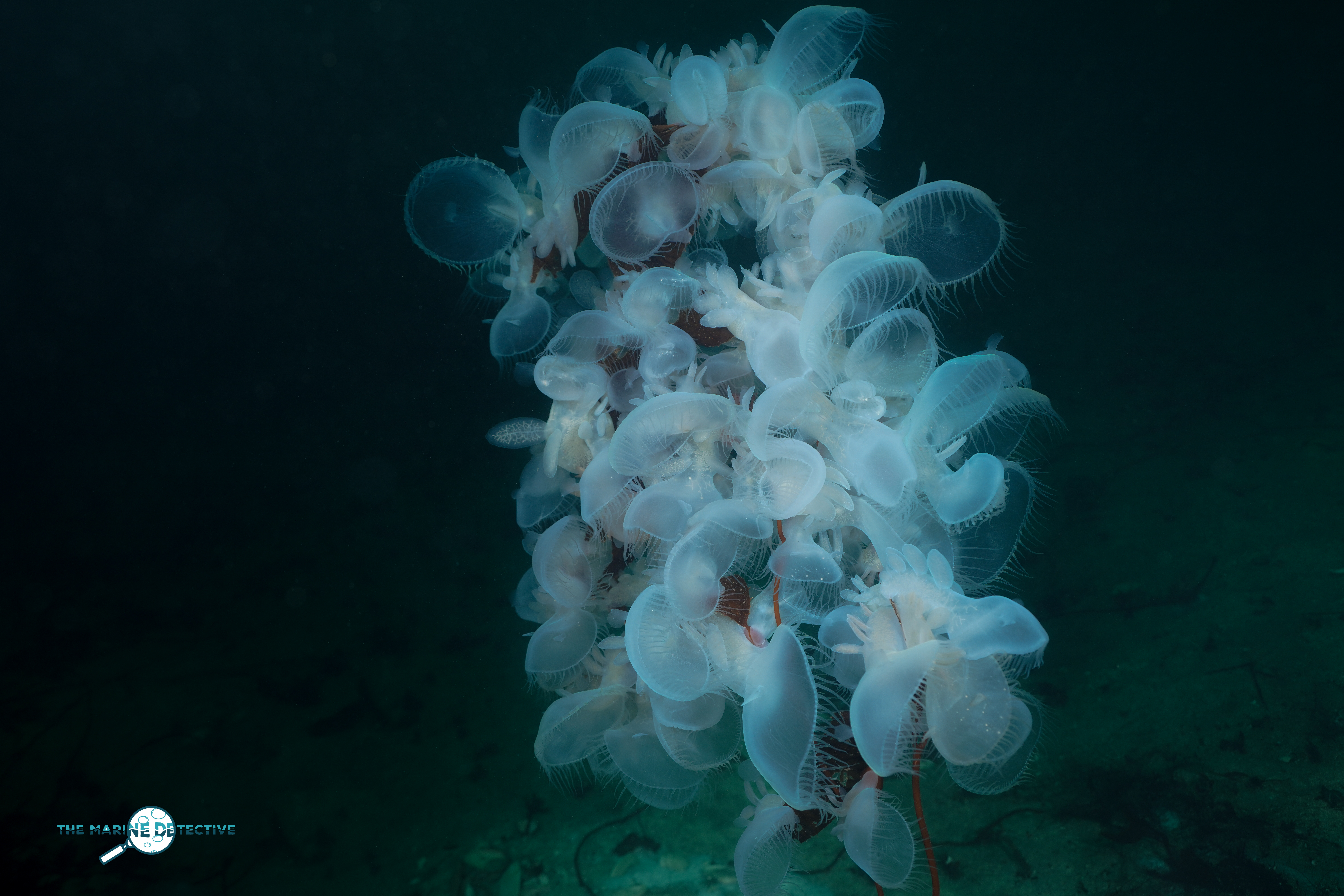
Typically, starting in the fall, around northeast Vancouver Island, Hooded Nudibranchs come together in the hundreds. It is awe-inspiring to see them clustered together just below the surface, delicate and ghost-like, clinging to kelp. Most are translucent white but some individuals are more green or orange.

Often, you can see them swimming on the surface and many people mistake them for jellyfish. But no, they are sea slugs.


The large oral hood (disc-like head) is used to feed on plankton and small crustaceans. The lobed structures on the animals’ backs are the naked gills (cerata). The cerata can pop off if the Hooded Nudibranch is threatened e.g. pinched by a crab. This “ceretal autonomy” and the ability to swim, are believed to be distractors for predator (Bickell-Page, 1989).

The two structures on the Hooded Nudibranch’s oral hood are their rhinophores by which they smell their way around. Hooded Nudibranchs are believed to signal one another by emitting a fruity scent. My personal experience after having picked up a dead Hooded Nudibranch on the beach, is that the smell is something like a mix of watermelon and grapefruit. The scent stayed on my hand for more than an hour.

Hooded nudibranch swimming. ©Jackie Hildering
Hooded nudibranch swimming ©Jackie Hildering.

The secretion is reported to serve as a repellent for predators but does not deter Northern Kelp Crabs.

After mating, as is the way with sea slugs, both individuals lay eggs and then, they die. You can find additional information about sea slugs being reciprocal hermaphrodites in this past blog posting. 

Hooded Nudibranch eggs. ©Jackie Hildering
Hooded Nudibranch egg ribbons. ©Jackie Hildering

In the area around northeast Vancouver Island, I have observed that they lay their egg masses between January and April. Each ribbon of eggs is only about one centimetre wide. Every dot is an egg capsule containing 15 to 25 eggs. After about 10 days, depending on temperature, the eggs will hatch into larvae that will be part of the zooplankton soup of the Ocean.

After 1 to 2 months, they settle to the ocean bottom and change body shape and even digestive tract to become small adult Hooded Nudibranchs

Hooded Nudibranchs do not have the rasping mouth structure of many other sea slugs (the radula). They feed by opening their oral hood to capture prey while standing on kelp or Eelgrass.

Hooded Nudibranch on Eelgrass and yes, those little snails are part of their diet.


From Invertebrates of the Salish Sea: ” . . . diet includes copepods, amphipods, and ostracods, as well as small post-larval mollusks.  The animal stands attached to the substrate and expands the oral hood.  It then sweeps the hood left and right or downward. When the ventral surface of the hood contacts a small animal the hood rapidly closes and the fringing tentacles overlap, holding the prey in.  The whole animal is then forced into the nudibranch’s mouth.”

Hooded Nudibranchs on Giant Kelp. ©Jackie Hildering, 2022

For more information:

Biodiversity of the Central Coast: Hooded Nudibranch

Deep Sea News: “This sea slug is like a cross between a dinosaur, a jellyfish, and a watermelon”

Lawrence, K. A. and Winsor H Watson. “Earth , Oceans , and Space ( EOS ) 10-1-2002 Swimming Behavior of the Nudibranch Melibe leonina.” (2017).

Newcomb, James M., et al. “Homology and Homoplasy of Swimming Behaviors and Neural Circuits in the Nudipleura (Mollusca, Gastropoda, Opisthobranchia).” Proceedings of the National Academy of Sciences of the United States of America, vol. 109, National Academy of Sciences, 2012, pp. 10669–76, http://www.jstor.org/stable/41601654.

100s of Hooded Nudibranchs just below the surface in Telegraph Cove ©Jackie Hildering.

Dive buddy Jacqui Engel with Hooded Nudibranch ©Jackie Hildering.