Join me in the cold, dark, life-sustaining NE Pacific Ocean to discover the great beauty, mystery and fragility hidden there.

Posts from the ‘Killer Whale / Orca’ category

Heart for Whales

Apologies for a longer absence here. It has been a full summer of marine research, education and inspiration.

I will have the joy of sharing much with you in the coming months.

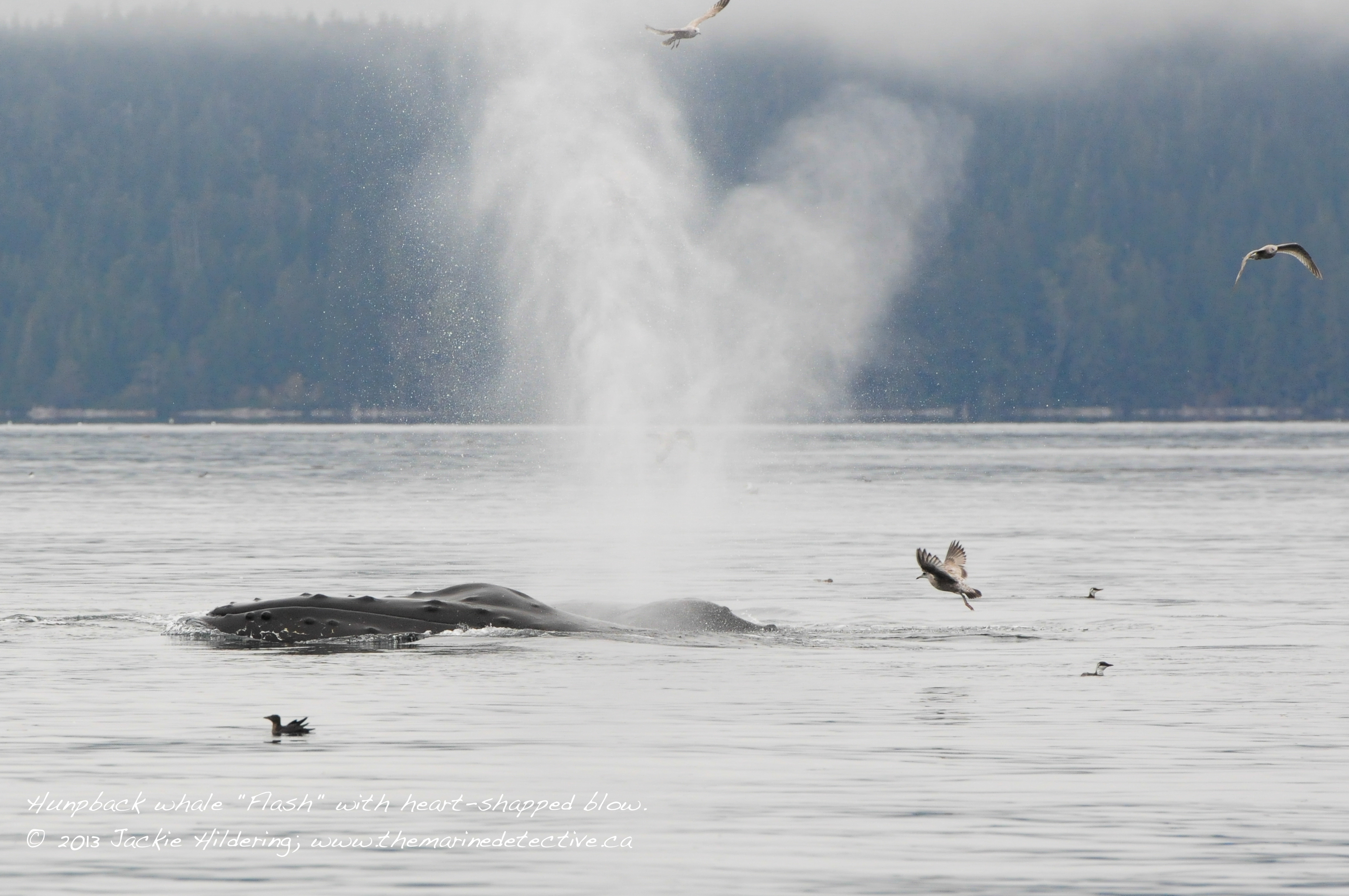
For now – three remarkable images taken in the last months where the whales’ blows are heart-shaped.

With whales being ambassadors for marine ecosystems in so many ways, these images may be particularly engaging – suggesting that we should love the Oceans as if our lives depend on them because  . . . they do!

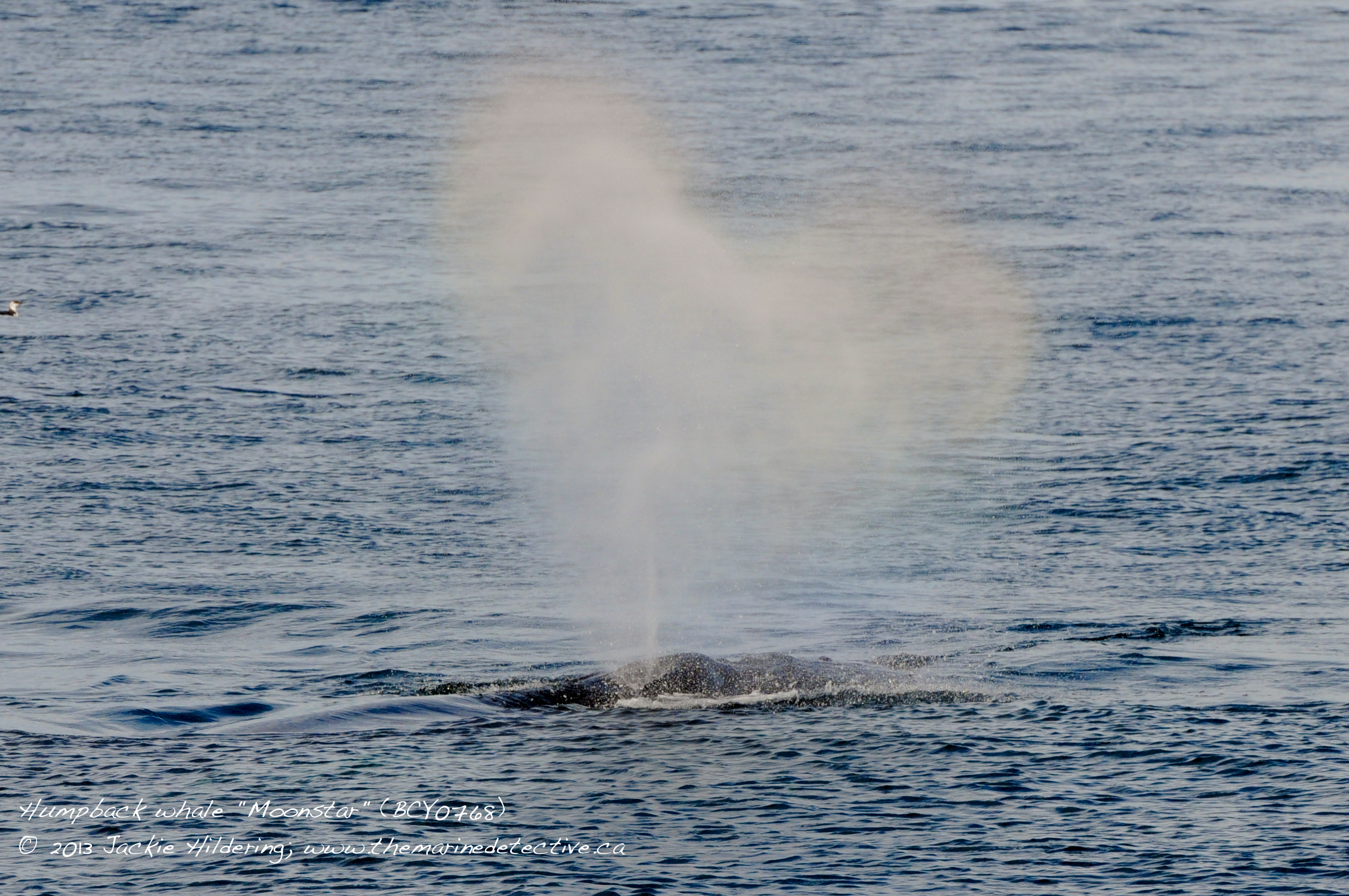
5-year-old humpback whale "Moonstar" (BCY0768) with heart-shaped blow. Threatened population © 2013 Jackie Hildering

September 2013 – 5-year-old humpback whale “Moonstar” (BCY0768) with heart-shaped blow. Threatened population. © 2013 Jackie Hildering

Member of the I15 matriline of "northern resident" (inshore fish-eating) orca with heart-shaped blow. Threatened population. © 2013 Jackie Hildering

September 2013 – Member of the I15 matriline of “northern resident” (inshore fish-eating) orca with heart-shaped blow. Threatened population. © 2013 Jackie Hildering

October 2013 - Heart-shaped blow from humpback "Flash". © 2013 Jackie Hildering

October 2013 – Heart-shaped blow from humpback “Flash”. © 2013 Jackie Hildering

Also to make your heart sing, see the clip below (or access it at this link). I was able to capture the vocals of northern residents AND humpbacks from one of the most mind-blowing days I have ever had the privilege of experiencing on the water. Enjoy!

[These images and video were previously shared on the TMD FaceBook page].

What’s the Bigg’s Deal?!

Dr. Michael Bigg

Super hero – Dr. Michael Bigg. Achieved so much before passing at just age 51 (1939 to 1990). Photo ©Graeme Ellis.

Updated July 2025: Bigg’s Killer Whales now acknowledged as as distinct species (Orcinus orca rectipinnus) as per the Society for Marine Mammology’s List of Marine Mammal Species and Subspecies. 

_____________________
Updated March 27, 2024.
New research paper putting forward the case for Bigg’s and Resident Orca to be recognized as distinct species. See here. 

Morin Phillip A., McCarthy Morgan L., Fung Charissa W., Durban John W., Parsons Kim M., Perrin William F., Taylor Barbara L., Jefferson Thomas A. and Archer Frederick I. 2024 Revised taxonomy of eastern North Pacific killer whales (Orcinus orca): Bigg’s and resident ecotypes deserve species status R. Soc. Open Sci.11231368231368

_____________________
Original post:

What’s the Bigg’s Deal?  I’ve been asked this a lot lately: “Why are the mammal-hunting killer whales being referenced as “Bigg’s Killer Whales” rather than as “Transients” as they were previously known?”

This is because a 2010 study found that the mammal-hunting ecotype of Killer Whales / Orca diverged from the other ecotypes some 700,000 years ago and the researchers (Morin et al) put forward that they be recognized as a distinct species.

If they are to be recognized as such, many in whale-research-world believe it is only appropriate that the species be named in honour of the late and great Dr. Michael Bigg whose pioneering Killer Whale ID research in the eastern North Pacific in the 1970s – 1980s revealed that Killer Whales have distinct populations and that there are very limited numbers within these populations.

Ultimately, his research led to the understanding that Killer Whale populations have distinct cultures.

This knowledge of course had huge conservation implications. It was previously believed that there were abundant Killer Whales in the eastern North Pacific and that they all eat salmon in addition to marine mammals; rather than the reality that there are four at risk populations that are genetically and ecologically distinct:

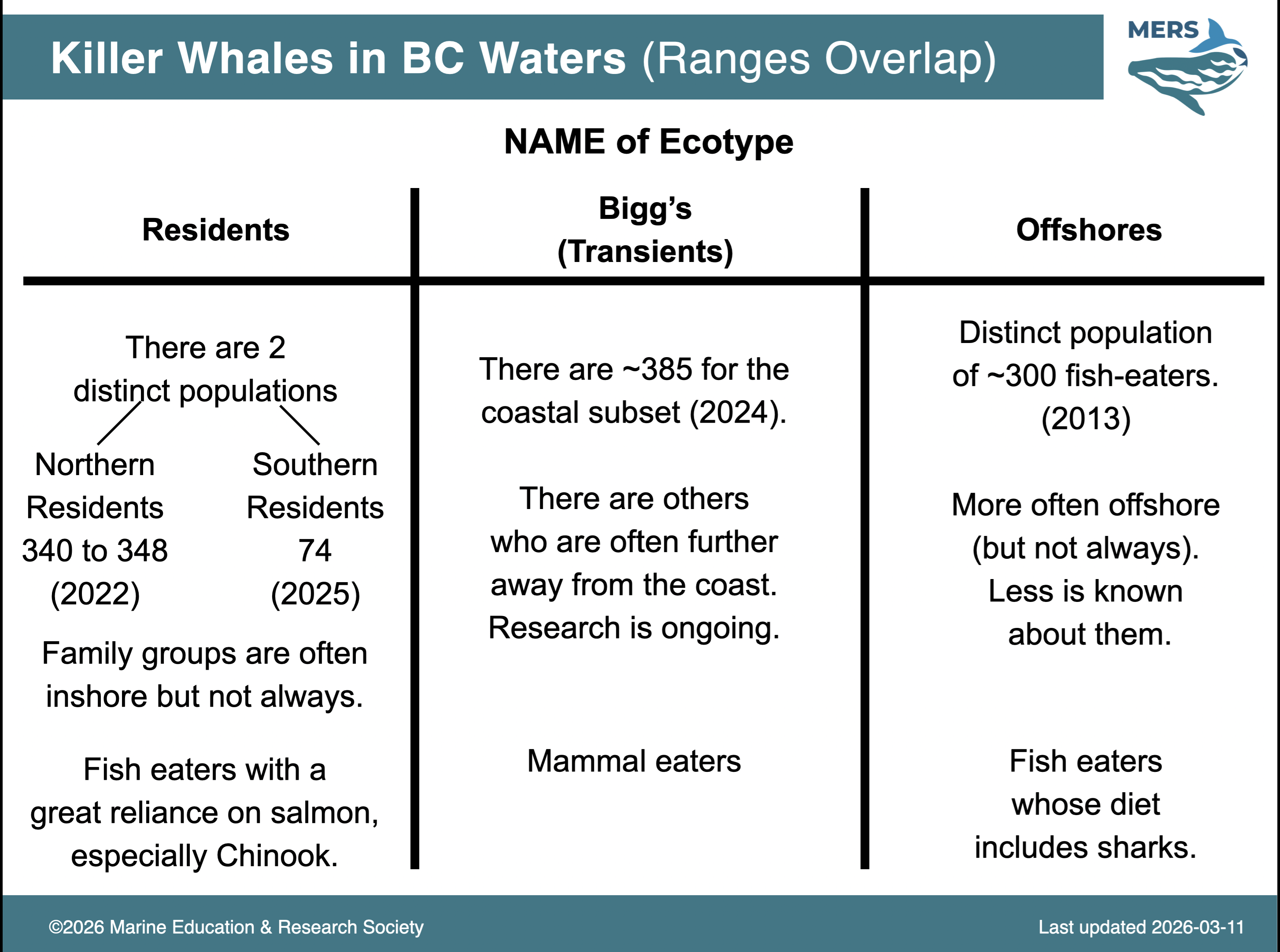
  • 1.  Bigg’s Killer Whales are marine mammal-hunters (they also eat an occasional bird and, very rarely, a terrestrial mammal). When they are hunting marine mammals, they generally have to be stealthy and unpredictable since their prey can hear them. The population estimate for the members of this threatened population that more often feed near the coast of BC is ~349 individuals (end of 2022). Their behaviour has changed in recent years, as reported by colleague researchers at the Marine Education and Research Society.   They are not so “transient” anymore. In some areas they are more commonly sighted than “Residents” and appear to be travelling, socializing and hunting in bigger groups. They also appear to be more vocal, especially after a kill.  This is believed to be due to changes in the location and density of their prey. More seals and sea lions means that they do not have to be as stealthy (65% of the diet of Bigg’s who feed along BC’s coast is seals and sea lions). Status report and further information at this link. Note that there are no documented incidents of Bigg’s Killer Whales in the wild ever injuring a human.
  • “Residents” are inshore fish-eating Killer Whales (ingesting an occasional squid too) and there are two distinct populations. The vast majority of their fish diet is salmon and of the salmon species, their absolute favourite is Chinook. (Their diet is also known to include lingcod, halibut, herring, squid, rockfish, flounder). Because salmon is so predictable (salmon return to the river of their birth to spawn and die) and because fish have very bad hearing, these populations of Killer Whales can afford to be highly vocal and use echolocation a lot. 
    • 2. The Northern “Residents” are a threatened population of some ~332 whales (2021) more often found in northern British Columbia but also in southeastern Alaska and Washington State. Status report and further information here. For the story of one N. Resident Killer Whale family (the A23s) and what their story reveals about us, click here.
    • 3. The Southern “Residents” are most often swimming around southern British Columbia and Washington State but are sometimes also in the waters of northern British Columbia, Oregon and California. At only ~73 individuals (2024), this population is recognized as being endangered. Status report and further information here.
  •  4. Offshore Killer Whales are fish-eaters often found along the continental shelf from the Aleutian Islands to California. To date, published research has confirmed that their diet includes Pacific Sleeper Sharks and Pacific Halibut. The population estimate is 300 individuals (2013) and this too is a threatened population. Status report and further information here.

Through the research of Dr. Bigg, the Killer Whales of British Columbia have been studied as individuals longer than any other marine mammal species on the planet – and not only marine species have benefited from this. We all have.

Due to his work, whereby the age, gender, diet and range is known for almost every Killer Whale in British Columbia, these whales “tell the story” of global chemical pollution. The work of Dr. Peter Ross examines the toxins in the blubber and indeed the Killer Whales of BC are the “canaries in the coal mine” informing the science that should shape international policies and regulations regarding toxins.

However, there is also much that has NOT changed since the days of Dr. Bigg’s pioneering Killer Whale research.

At that time, Killer Whales were the scapegoat for declining salmon populations and the “gold rush” on their being put into captivity was likely perceived as a favourable management tool.  Conservation costs money, not only for science and management, but also by limiting industries whose activities may negatively impact species at risk.

Flash forward some 40 years to 2013. Dr. Peter Ross’ work with Fisheries and Oceans Canada has been terminated as part of what can only be called the demise of Canada’s ocean contaminants research program and prior to his termination he, like so many other government scientists in Canada, has been constrained in being able to communicate about his research. (Update 2014: Dr. Ross now heads the Ocean Pollution Research Program at the Vancouver Aquarium).

The ultimate Bigg’s Deal is that one person can make a profound positive difference – replacing knowledge where fear and misunderstanding once dwelled.

However, to work against government forces that imperil our environment and suppress science in favour of short-term economic gain, it is going to take a very great many of us to make our voices and actions . . . Bigg-er.

What's the Bigg's Deal.001.001

_________________________________________________________

For more information:

Oh Deer! A rare meal for mammal-hunting killer whales?

This is not a tall tale. If anything it is a short tail as in – deer tail.

First an orientation on Killer Whale (Orcinus orca) diet and how prey specialization has shaped distinct cultures over great expanses of time.

There are different “ecotypes” of Killer Whales that do not mate with one another because what works, for example, to chase salmon does not work to stalk seals. They have distinct cultures and distinct languages. [Click here for detail on the different ecotypes of Killer Whales off British Columbia, Canada.]

The fish-eating Killer Whale ecotypes in the NE Pacific Ocean (Northern and Southern “Residents” and “Offshores”) can afford to be extremely vocal because fish species often have poor hearing.

However, the mammal-hunting ecotype (“Bigg’s Killer Whales“, previously know as “Transients”) must generally live a life of stealth and unpredictability in order to successfully hunt their prey. To be vocal or be really surface active, when they are hungry, would have a high cost. It would be like ringing a dinner bell announcing “Hello, we’re here to eat you!”

In fact, recent research supports that the NE Pacific mammal-hunters diverged from the other ecotypes of Killer Whales some 700,000 years ago and puts forward that they should be recognized as a distinct species (Morin et al 2010).

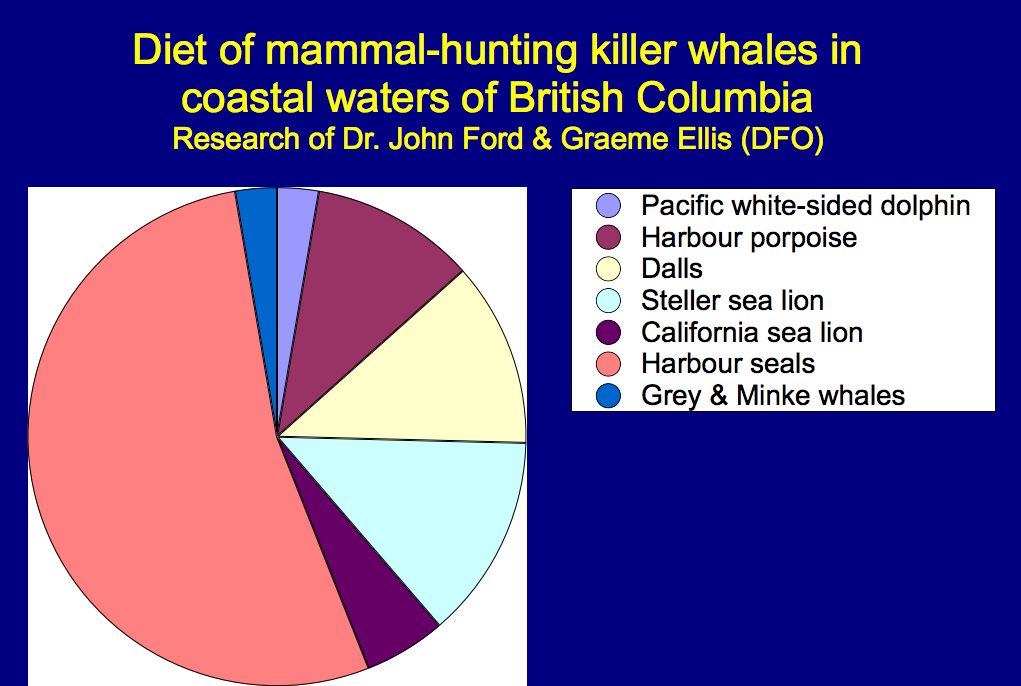
Research of Dr. John Ford and Graeme Ellis on the diet of mammal-hunting killer whales in the Northeast Pacific Ocean. Source: Presentation "The Complicated Predator" by Dr. Lance Barrett-Lennard; October 2005.

Research of Dr. John Ford & Graeme Ellis on the diet of mammal-hunting Killer Whales in the Northeast Pacific Ocean. Source: Presentation “The Complicated Predator” ; Dr. Lance Barrett-Lennard; October 2005.

Pacific Harbour Seals are predictable in where they haul out and they do not have defences like speed and sharp teeth. Therefore, it is not surprising that off the coast of British Columbia, Pacific Harbour Seals are documented to be the prey item of choice for the mammal-hunting Killer Whales (see graph above).

Far less commonly, these Killer Whales have also been documented to feed on River Otters, Northern Elephant Seals, Sea Otters and – VERY, VERY occasionally – a terrestrial mammal like deer.

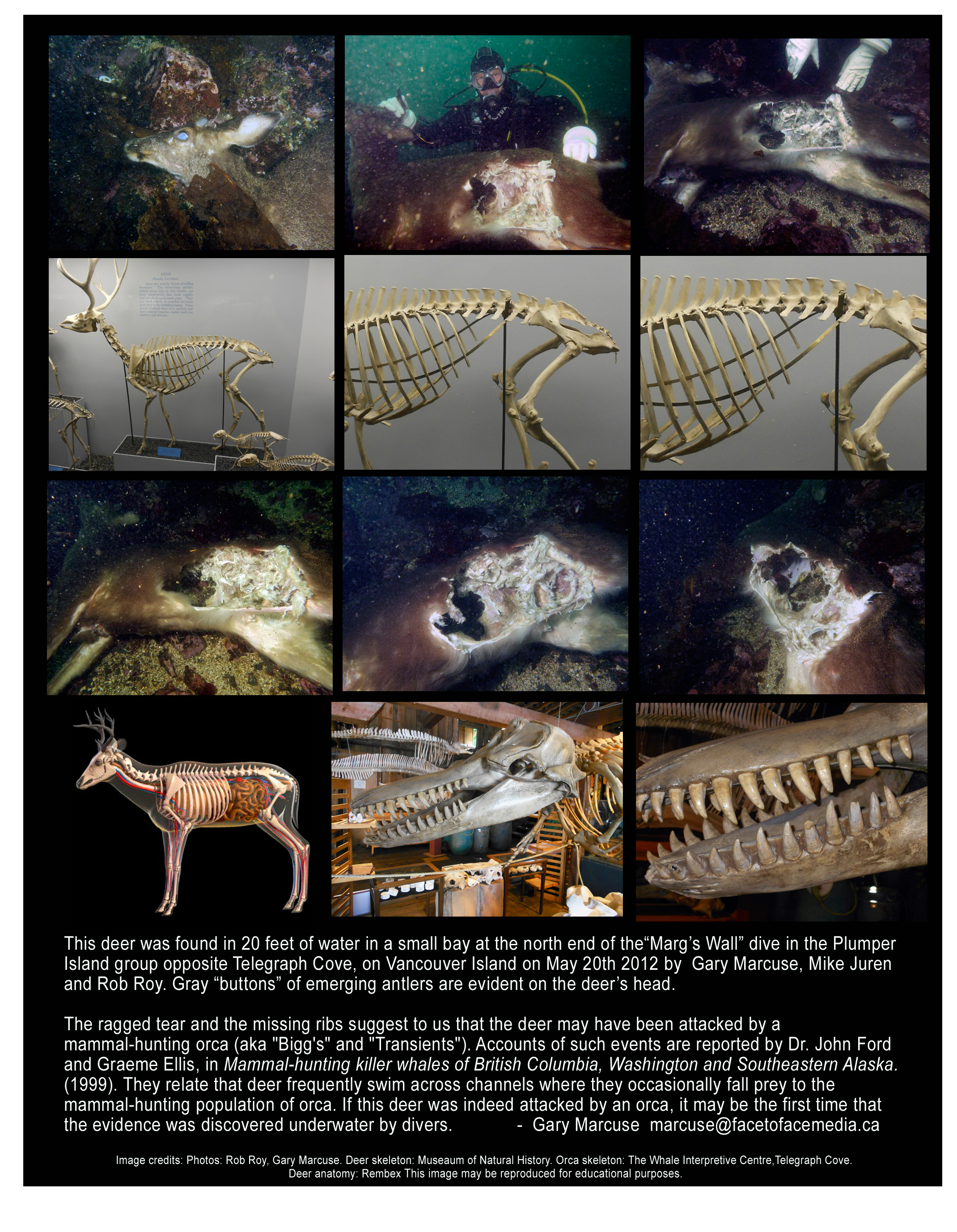
Please see below for images of a deer carcass found underwater by fellow divers Gary Marcuse, Rob Roy and Mike Juren in May of 2012. There is no way of  knowing with certainty if that this deer was attacked by Killer Whales but it is plausible. Deer swim from island to island and are even more defenceless than a seal if they have the bad luck that stealthy mammal-eating Killer Whales find them.

Deer-Underwater

Killer Whales are big dolphins – smart and social and even though they tend to be very conservative, doing what has worked for their kind for 100,000s of years, they also play – learning from interacting with their environment. I have reflected on this previously in my blog where I observed them mouthing and hitting diving birds. (Read “Fins vs. Feathers” by clicking here).

Deer could never make up a significant part of the diet of Bigg’s Killer Whales but they would learn from such an attack. If this deer did indeed meet its end in the mouth of a mammal-hunting Killer Whale, I would not be surprised if it was a juvenile mammal-hunting Killer Whale who undertook the “interaction”.

To share the expertise of Killer Whale researchers supreme, Dr. John Ford ad Graeme Ellis, from their 1999 publication “Transients -Mammal-Hunting Killer Whales” (and note that an attack on a moose has only ever been documented ONCE):  

“Although the primary prey of transient [now Bigg’s] killer whales are marine mammals, the whales’ interest extends to other warm-blooded animals, including marine birds .  . . and even terrestrial mammals. Our first record of land mammal predation dates from June 1961, when Canadian fishery officers observed killer whales feeding on a deer carcass in Jackson Pass on the central coast of British Columbia. Deer frequently swim from island to island along the inside passages, and it is probable that this one fell victim to a foraging group of transients. More recently, off the east coast of Vancouver Island, several killer whales were observed circling a small rock on which two deer had taken refuge. On another occasion, a lighthouse keeper assisted an exhausted deer out of the water as it was being pursued by killer whales. In these case, there has been no photographic confirmation that transients were involved, but it seems almost certainly the case.

Other land mammals are also of interest . .  on occasion . . . a killer whale was observed to surge part way onto shore in an apparent attempt to attack a dog that was barking loudly at the passing group.  . . .

One of the most surprising attacks on a terrestrial mammal took place in 1993 in Icy Strait, south-eastern Alaska. Two fishermen observed a group of three or four killer whales attack and kill one of a pair of moose that were swimming across the channel. The other moose managed to escape the attack but later became entangled in a kelp bed and drowned.”

So am I worried, as a very avid and very mammalian scuba diver, that I have the same chances of being attacked as a deer swimming between islands? Absolutely not. There has never been a case of Killer Whales in the wild killing a human.

To again relate John Ford and Graeme Ellis’ expertise:

“Divers in this region typically wear thick suits made of neoprene rubber, which contains acoustically reflective nitrogen bubbles. Thus, if a transient [Bigg’s killer whale] tries to inspect a diver with echolocation, its unlikely to get a typical mammalian echo. Although scuba divers may not appear appetizing to [them], this may not be the case for swimmers, so it is advisable to leave the water should transients [Bigg’s] appear in the vicinity.” 

I also love the perspective of a fellow diver and friend, Peter Mieras, who states that Killer Whales “are too smart to go after junk food in wrappers.”

Oh deer!


Sources:

Where are the Whales?!

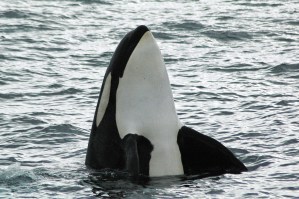
A member of the A12 matriline of Northern Resident Killer Whales spyhops in Johnstone Strait. Likely A55 (aka “Echo”); male born in 1990. Photo by Jackie Hildering.

Where are the whales?!

If I had a dollar for every time I have been asked that question, I could now purchase an E-Tec engine for my little research boat and live with a clearer and cleaner carbon conscience!

It is indeed the question most often asked of marine naturalists and suggests that there are those who believe that there is incredible predictability to viewing wild whales; that there may even be a single location where they will always be found.

I have found that this is particularly true in reference to Killer Whales and that a significant number of people appear to believe that the Michael Bigg (Robson Bight) Ecological Reserve in Johnstone Strait will always have Killer Whales within its boundaries (see here for information on beach-rubbing).

Of course, it does not help comprehension that the inshore fishing-eating populations of British Columbia have been named “Residents”. This leads to Northern Vancouver Island often being promoted as “home” to a population of some 300 [2016 estimate] members of the Northern Resident Population.

In answering “Where are the whales”, I will make the point that you can never quite know where wild whales are and, when I think I can get away with being a little bit cheeky – which thankfully is quite often – I will make this point by with the answer “The whales are underwater”.

But, it is of course true that Northern Vancouver Island is possibly the most predictable place on earth to see Killer Whales and that it is our extraordinary privilege to live in the area that is a mecca for those hoping to see them – and so much more marine wildlife. However, the Killer Whales are not “resident” and they are not in this area in the 100s.

My answer to “Where are the whales” must therefore also explain that Killer Whales have culture; they have evolved into discrete “ecotypes” whose lifestyles have been shaped by what they eat.

BC’s waters have two populations of highly vocal and social in-shore fish-eating killer whales that love to snack on salmon (the northern and southern “Residents”); a population of stealthy marine-mammal-eating killer whales (“Transients” also known as “Bigg’s Killer Whales”); and a fish-eating population that is more often off the continental shelf and whose diet includes sharks (“Offshores”).

In order to preserve the culture that allows them to specialize on different prey, none of these populations mate with one another. The predictability of seeing them is dependent on where their prey is and how stealthy they have to be to successfully hunt.

Johnstone Strait is the only waterway that allows full passage on the inside of Vancouver Island and therefore it is like a funnel for the salmon traveling to natal rivers further south to spawn. This is why, most often, there are some families (“matrilines”) of the Northern Resident Population in our area from July into October/November. This is when the salmon are running and the Killer Whales are especially present when there is the opportunity to pursue fatty Chinook salmon.

Sometimes, presumably when whale bellies are full enough, there will be some 100 madly socializing members of the Northern Resident Killer Whale population around Johnstone Strait. However, this is a rarity since the families have different affinities for areas of BC’s coast.  There are some families, like the A34s and the A30s, that have an extraordinary affinity for fishing in this area, while there are other families like the Hs and Rs that very rarely chase the salmon around Johnstone Strait. Sometimes we even have groups of Southern Residents transiting through the area – this is the endangered population that is more often found near Victoria.

In contrast to Residents, there is less seasonality in the movements of the marine-mammal-eating “Transient” killer whales since seals, sea lions, dolphins, porpoises, etc, can be here year round.  But, but, but . . . this does not mean that if you see a Killer Whale in our area in the winter, it is a Transient!

Resident killer whales can be here in the winter as well, but unlike at other times of the year, it is usually not for more than a day at a time and they likely are here to feed on other fish species like halibut. The OrcaLab on Hanson Island monitors whale vocals year round and, since every northern resident family’s calls are distinct, they can even conclude which families are in the area 

Despite all this knowledge, there is so much we do not know about BC’s Killer Whales and the threats that have necessitated all populations getting protection under Canada’s Species at Risk Act.

For Species at Risk Act “Status Reports” on the Pacific Northeast populations of Killer Whales – click the links below:


Fins Verses Feathers – Bigg’s Killer Whales Harass Rhinoceros Auklets

In the Northeast Pacific, “Bigg’s Killer Whales” (formerly known as “Transients”) are believed to have diverged from the “resident”  (inshore fish-eating) and “offshore” (offshore fish-eating) ecotypes some 700,000 years ago (Morin et al, 2010), to refine a culture of stealth and unpredictability in order to hunt their marine mammal prey.

I would suggest that we humans are the last species that should be judging others for how much they eat. However, often Bigg’s Killer Whales are profiled and misunderstood for interpretations of their feeding behaviour. This includes that they don’t always eat what they kill.

From Kuker and Barrett-Lennard (2010)  “Like many other predators, transient killer whales sometimes demonstrate ‘surplus killing’, killing greater numbers of prey than they consume (DelGiudice 1998, Wobeser 2000, Short et al. 2002). In surplus killing incidents, the whale plays with animals, such as sea birds (Stacey et al. 1990) and harbour seal pups (Gaydos et al. 2005). The whales may breach on the victim or toss and ram it until it dies, but it is not consumed. This behaviour could be part of the process of learning to hunt, in which adults are training young to capture and handle prey, or it could be simply play behaviour (Ford et al. 1998, Gaydos et al. 2005).”  

Below is my account of one such surplus killing events witnessed on August 31st, 2011. It was not a good day for some Rhinoceros Auklets (Cerorhinca monocerata) in Johnstone Strait, British Columbia, Canada.
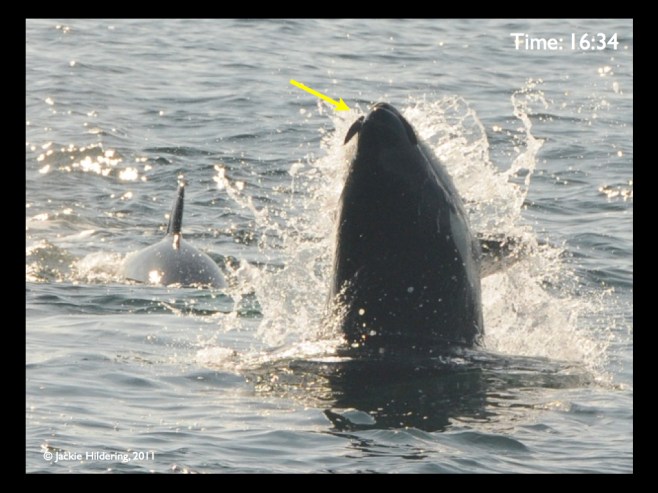
Young Bigg’s Killer Whale grabs Rhinoceros Auklet. Photo: Hildering. All photos taken with telephoto lens and cropped.

That day, I witnessed a very socially active group of Bigg’s Killer Whales repeatedly harassing these birds – mouthing them and slapping them. At least 3  juvenile Rhinoceros Auklets were involved. Since these are diving birds, they cannot “alight” and escape the teeth and fins below them. Yet, I believe they survived.

Bigg’s Killer Whale surfaces right beside a Rhinoceros Auklet. Photo: Hildering.

I personally had never seen such a prolonged display of this play behaviour before. In fact, I had never seen Bigg’s Killer Whales socialize quite so rambunctiously! [Update 2020, now that seals and sea lions are more readily available, members of this population appear to be far less stealthy]. 

Clearly, when their bellies are full and social needs dominate, this type of Orca is anything but stealthy. On August 31st, this incredibly socially active group of 20+ Bigg’s took about 1.5 hours to travel only +/- 4.5 km (2.5 nautical miles) – slapping birds, rolling over one another, tail slapping, vocalizing and breaching along the way. The whales would go on to bound past the community of Alert Bay, Cormorant Island. I have have previously written about this in the blog item “Might As Well Jump.” 

Jared Towers of the Department of Fisheries and Ocean has confirmed the IDs of the Bigg’s Killer Whales in the August 31, 2011 encounter to be:  T010s, T034s, T035s, T037s, T046Bs, and T146s.

Insight into this behaviour is provided by Dr. John Ford and Graeme Ellis. The following interpretation of the behaviour is from the chapter “Seabirds: Playthings and Practice, or Between-Seal Snacks?” in Transients: Mammal-Hunting Killer Whales of British Columbia, Washington, and Southeastern Alaska, 1999. 

“It is not unusual to see transients chasing and harassing seabirds. During most of these incidents, the whales do not seem intent on eating the birds. Rather, they let the bird escape or they abandon it after it has been injured or killed. Seabird harassment appears to be a favourite activity of juvenile transients. The young whales will sometimes swim upside down and on their sides, looking for birds paddling at the surface above. Once a victim is sighted, they will try to slap it with their tail flukes, jump on it, or seize it in their mouth. This interaction may continue for several minutes, before the bird is eaten, incapacitated, or left dead in the whale’s wake. We and others have recorded at least 10 seabird species that have become casualties of transients. Frequent victims are common murres, which are flightless for several weeks during the late summer and are like “sitting ducks” for transients.  Other species include black brant, common loon, white-winged scoter, surf scoter, cormorant (species uncertain), western grebe, marbled murrelet, rhinoceros auklet, and red-breasted merganser.  Seabirds seem to be more important as objects of play or harassment than as a dietary item. Juveniles playing with seabirds no doubt learn useful skills in prey capture and handling that may enhance their success in hunting harbour seals and other wily prey.”  
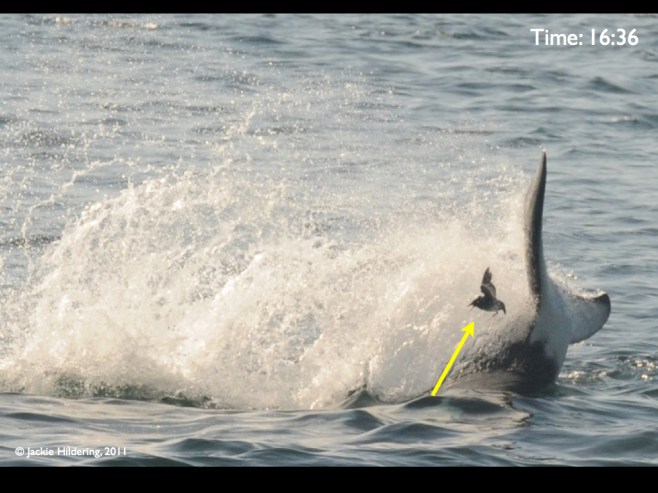
Bigg’s Killer Whale tail-slapping a Rhinoceros Auklet. Photo: Hildering. 


Sources:

Barrett-Lennard, L.G., Heise, K. 2007. The Natural History and Ecology of Killer Whales: Foraging Specialization in a Generalist Predator. In Estes, J.A., Brownell, R.L., DeMaster, D.P., Doak, D.F., Williams, T.M.  Whales, whaling and ocean ecosystems. University of California Press, Berkely, C.A.

Ford, J.K.B., and Ellis, G.M. 1999. Transients: Mammal-Hunting Killer Whales of British Columbia, Washington, and Southeastern Alaska. UBC Press, Vancouver, and U. of Washington Press, Seattle. 96 pp

Kuker, Katie & Barrett-Lennard, Lance. (2010). A re‐evaluation of the role of killer whales Orcinus orca in a population decline of sea otters Enhydra lutris in the Aleutian Islands and a review of alternative hypotheses. Mammal Review. 40. 103 – 124. 10.1111/j.1365-2907.2009.00156.x.
Might As Well Jump

When serving as a marine naturalist, one of the questions I am most often asked about whales is “Why do they jump?”

When whales jump it is called “breaching” and the answer to why they do it is not a simple one. Why whales do something depends on context; there is not just one trigger for breaching. This is no different than interpreting human behaviour. For example, if someone is tapping their foot, it could indicate irritation, having an itch, impatience or hearing a good tune!

The breaching of whales can be related to socializing, feeding, mating, communication and/or defence. Of course, when whale calves breach, it  is often related to “play” behaviour which leads to good brain development and coordination. Ultimately,  I believe that the high energy behaviour of breaching must somehow lead to a gain in food and/or increased success in passing on DNA.

Let me share two very specific and recent “cases” of breaching with you; one of which was witnessed by many residents of Alert Bay.

While out in our area with Orcella Expeditions last week, we saw an adult humpback whale breach some 30 times and also witnessed a mature male mammal-eating killer whale (“transient” or “Biggs killer whale”) breach within 30 meters of Alert Bay’s shoreline.

I have never seen anything quite like these two awe-inspiring events.

Humpback whale, ‘KC” on August 30th, 2011. One of the some 30 times he breached in less than 2 hours. Photo: Hildering

The humpback that breached so often was “KC” (BCY0291) who was born in 2002. Initially, I believe the breaching was triggered by the presence of highly vocal fish-eating killer whales (“residents”). Humpbacks do not have teeth with which to defend themselves  but they do have whale barnacle studded fins and a whole helluva lot of heft to throw around so even the mammal-eating type of killer whales very rarely interact with adult humpbacks.

My interpretation is that KC was not habituated to the killer whale dialect he heard that day (I15 and I31 calls) and was making sure he made clear “do NOT mess with me!”. He was posturing to the killer whales. After his killer whale encounter,  he turned around and came upon another humpback whale and again started breaching and making very forceful exhalations called “trumpeting”. Was this communication to the other whale about the presence of the killer whales?  Was it related to a dominance display that may have to do with mating?  I may never know for sure but it is very interesting that KC’s incredible bout of breaching seemed to lead to other humpbacks breaching as well.

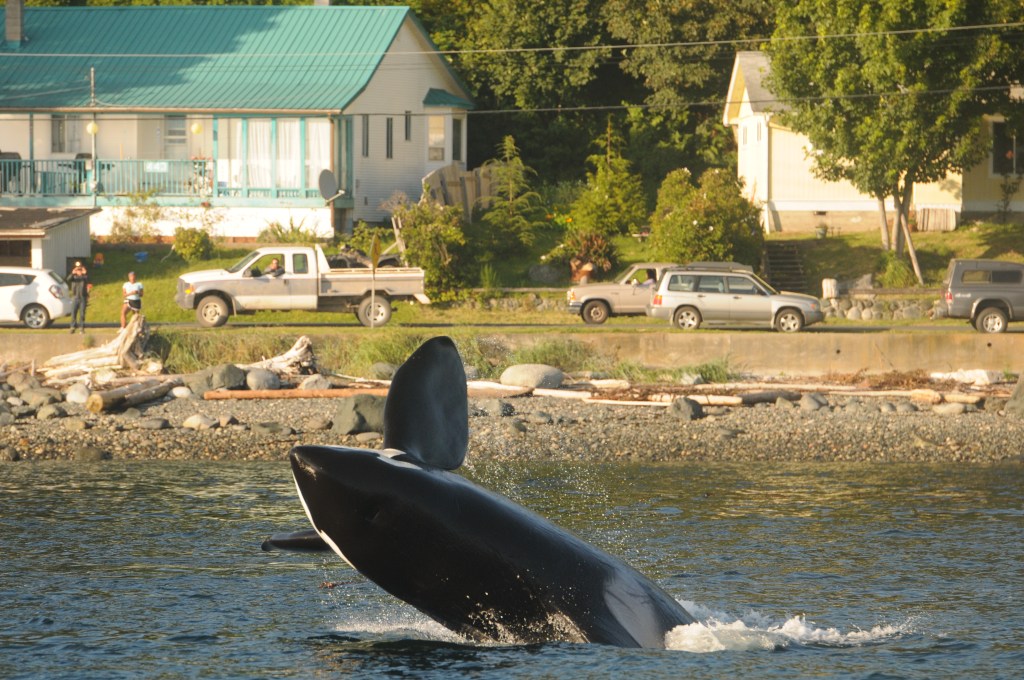
Mature male mammal-eating killer whale “Siwash” breaching in front of Alert Bay on August 31, 2011. Photo: Hildering.

And then . .  there was the mind-blowing, highly witnessed breaching of the 27 year-old killer whale “Siwash” (aka T10B ) in front of Alert Bay. Siwash was travelling with a group of 20+ other mammal-eating killer whales. As mammal-eaters, this type of killer whale has to be stealthy and unpredictable and therefore, they are most often far less vocal and surface active than the fish-eating killer whales. This certainly wasn’t the case as they bounded past Alert Bay last Wednesday evening! They were swimming on their backs; fin slapping and travelling right past the shore; calves were “cat and mousing” small diving birds – whacking them around; and there were even male sex organs to be seen at the surface!

What was going on?  Let me state the obvious – they were socializing. Their bellies must have been full enough to allow them to throw stealth to the wind. These particular whales would most often not travel together so the socializing might even be related to mating.

But ultimately . . . in trying to understand the behaviour of these sentient beings, we have to have the humility to accept that we  may only ever have hypotheses for why they do what they do. It is the stuff of awe and wonder that the mighty Max̱’inux̱ were so visible to the very people that have such a strong cultural connection to them, as they swam by Alert Bay  . . . . “Home of the Killer Whale.” 

Whale Wonders – June 2011

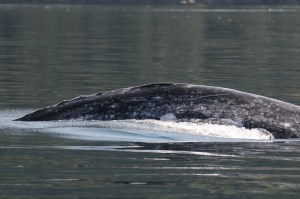
ID photo of “Dusty” the grey whale by Christie McMillan. See the Marine Education and Research Society blog for many more photos and detail on Dusty (link below).

Two more unique whale events have been documented in the ocean corridor between Port McNeill, Sointula and Alert Bay (Northern Vancouver Island, B.C.,Canada).

Following the remarkable “visit” of offshore* killer whales at the end of March, on May 16th what is likely the largest group of marine mammal-eating** killer whales ever documented swam past our communities.

It is possible that there were up to 37 different animals in this group. These killer whales, as hunters of marine mammal prey, need to have a culture of stealth and unpredictability and therefore usually travel in small groups. It should be noted that the work of the Orca Lab documented this extraordinary encounter (both visually and acoustically) and that DFO expertise determined the IDs of the whales. (Click here for OrcaLab’s blog on the encounter). 

Then, this last week, we had frequent sightings of a little grey whale in front of our communities. Grey whales are already a rarity in our specific area but what makes this whale really unique is that s/he is potentially the first grey whale known to become a summer “resident” here.

Jared Towers and Christie McMillan (of the Marine Education and Research Society /MERS) confirmed that this is the same grey whale that they kept an eye on last year. From June to early October 2010, the whale was more often around Cormorant Island and the east end of Malcolm Island and became known as “Dusty” and “LGW” (Little Grey Whale). Dusty is relatively easy to identify as an individual because its tail bears the evidence of having survived an attack by mammal-eating killer whales and because there are distinct markings on its flanks including the larger white spot seen in the image above. 

This May 31st, Christie and Jared confirmed that Dusty had returned to the area and was the whale that many of us in Port McNeill, Sointula and Alert Bay had the great privilege of seeing while it fed near our shores. (Click here for Jared and Christie’s MERS blog with far more detail on Dusty and includes pictures). 

If we are indeed so lucky that Dusty is able to “make a living” by feeding here, we’ll be able to whale watch from land with some predictability.  We will also need to be good marine neighbours, since Dusty has been sighted very near the harbours of our communities and can surface very unexpectedly. 

* Offshore killer whales are most often near the continental shelf and their diet has been confirmed to include sharks. Click here for a previous “The Marine Detective” blog on the offshore killer whales sighted at the end of March, 2011. 

** The mammal-eating killer whales are known as “transients” and “Bigg’s killer whales”. The latter name is a recent move to honour the late Dr. Michael Bigg, father of killer whale research. Recent research has found these to be the most genetically divergent type of killer whale and they may be recognized as a different species.

Record of possible sightings of Dusty as of June 7th. 

  • June 7 – Port McNeill 
  • June 8 – Alert Bay (Source – MERS, confirmed as Dusty)
  • June 9 – Campbell River. (Source – Susan MacKay, confirmed ) 
  • June 11 – Campbell River seen heading north (Source – via Susan MacKay) 
  • June 12 – passing by the Orca Lab, Blackfish Sound (Source Orca Lab; ID photos to come)
  • June 15 – Port McNeill

Mysterious Killer Whales Come Inshore

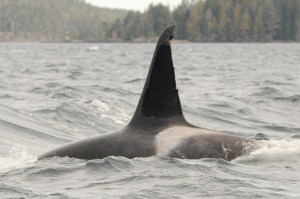
Mature male offshore killer whale photographed on March 27, 2011 for research purposes by J. Hildering (telephoto lens). Note ragged edge to the dorsal fin – damage from sharks?


Many Port McNeill (N. Vancouver Island, BC) residents were whale watching on the evening of March 30th and they didn’t have to leave their homes to do so!

A group of 12 offshore killer whales was extremely active right in front of the community; even repeatedly spyhopping (popping their heads out of the water). To have whales this visible near your home is a great gift but, all the more remarkable is that these were very mysterious, threatened whales.

“Offshores” are a distinct type of killer whale that does not mate with the killer whales that eat marine mammals (“transients”) nor with those that feed on fish, mostly salmon (“residents”).

About 300 individual northeastern Pacific offshores have been photographed but studying them is usually very difficult. As their name suggests, they are most often near the continental shelf and they are very wide-ranging. Offshores weren’t even identified till 1979 and weren’t confirmed to be a distinct population until 1989.

So little is known about them. Only very recently did the research of Dr. John Ford et al illuminate what the whales might be doing around the continental shelf and why their teeth are worn down so much more than the teeth of other killer whales. DNA analysis of prey samples confirmed that the diet of offshores includes Pacific sleeper sharks (4m+), a species with very abrasive skin that are found around the continental shelf.  In some cases the offshore killer whales’ teeth are so worn down by the the sharks’ skin that it is believed they become dependent on the help of other offshore killer whales to catch and eat this prey. The offshores’ scarred bodies served as a further hint that they may do battle with sharks.

Their diet is believed to also include other shark species (e.g. salmon sharks, blue sharks) and halibut.

Inshore sightings of these whales provide a very unique opportunity to learn more about them e.g. what they are eating when inshore and why they are so full of toxins.  It is puzzling that offshores killer whales appear to becoming inshore more often and this may be due to a shift in diet or range in their prey.

Luckily one of the world’s leading killer whale researchers, Graeme Ellis of the Pacific Biological Station, was able to join the offshores in front of Port McNeill for this research opportunity.  He was alerted to their presence by the superstars at the Orca Lab (Leah Robinson and Marie Fournier) who first heard these whales’ unique vocals in the Robson Bight area on March 25th.

I too was extraordinarily privileged to be able to contribute some ID photographs from sightings on March 27th and . . . I don’t think I’ll ever quite be the same after watching these mystery whales surfing in 3’ waves.

It all just goes to show that you never know who you’ll meet on Northern Vancouver Island!

[Great thanks to residents of Port McNeill and Angela Smith of Ocean Rose Adventures for helping get photos of a lone male offshore killer whale in Port McNeill Bay on March 27].

For more information on offshore killer whales see:


Invasive and Indiscriminate Tagging of Whales?

Update: October 2016 – Confirmed that endangered Southern Resident L95 died due to an infection resulting from limpet tagging. Read news item here.

Update: January 22, 2012 update to the December 10, 2010 blog item below:  Approval granted to limpet tag the endangered southern resident killer whales. See news items at the end of the blog. 

The American “Northwest Fisheries Science Center” (NWFSC) has applied for expansion of their permit to satellite tag endangered and threatened whales with airguns, including the endangered Southern Resident killer whale population and the threatened Northern Residents and Transient populations (the range of all these whales very much includes British Columbian waters).

It is the opinion of many involved in whale research and conservation that the impact of the airgun tagging far out weighs any benefit to the whales. There are other ways to get data on the movement of killer whales e.g. acoustic tracking and collaboration with researchers who have been studying these whales more extensively than NWFSC.

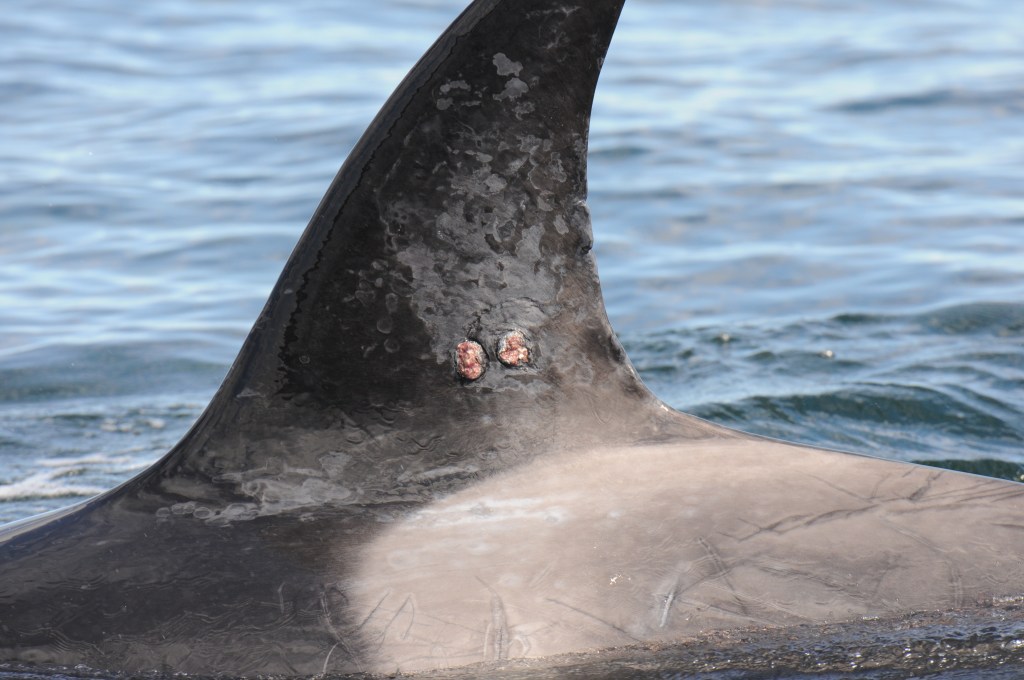
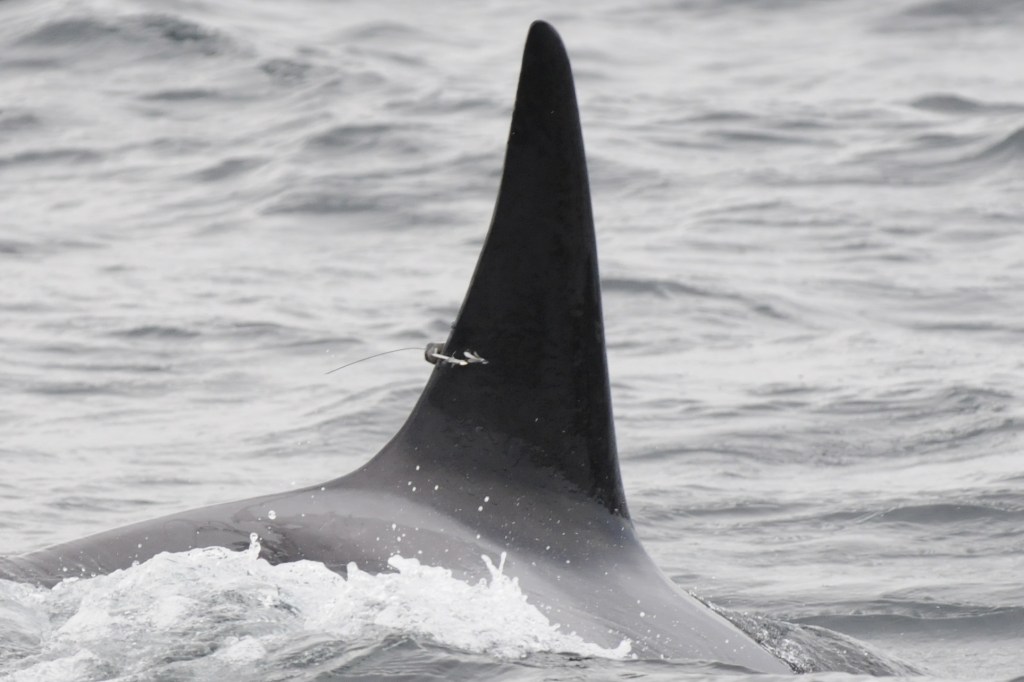
It is my opinion that the tagging cannot provide data that will help reduce the threats of toxin accumulation, prey availability, disturbance or noise so – why do it?  The photos here indicate just how invasive these types of tags are.

Below, I also include a letter from the North Island Marine Mammal Stewardship Association (NIMMSA) in which they powerfully express their concerns about the tagging.

If you too are concerned about the merit of this tagging program, please help in creating awareness. Share this blog on Facebook; do what you want with the images (help them go viral) and provide coment via this link before December 23rd, 2010.

Close up of the tag.

News items and further resources regarding limpet tagging of killer whales:

Brutal, Breath-Taking Beauty – Transient Killer Whales

In our work as the Marine Education and Research Society, Jared Towers, Christie McMillan and I went out on December 4th, 2010 on the waters of Northern Vancouver Island in the hopes of finding a Humpback Whale. We didn’t. Instead Nature gifted us with two sightings of Transient (mammal-eating) Killer Whales; a total of 16 animals (now also known as “Bigg’s Killer Whales“).

First we found the T55s and T19s. The lighting on this December day was so beautiful; when these whales blew, rainbows appeared to erupt around them.

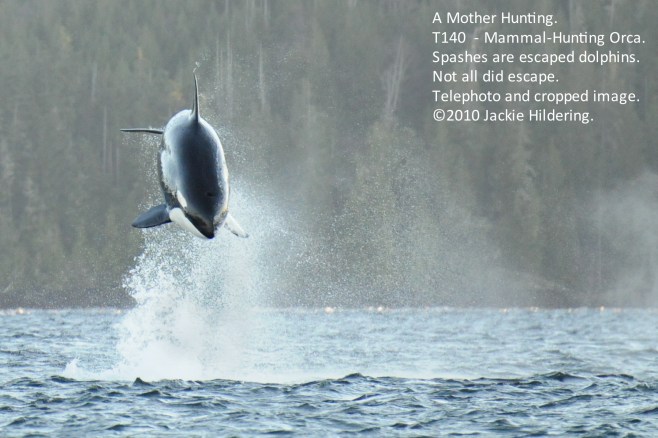
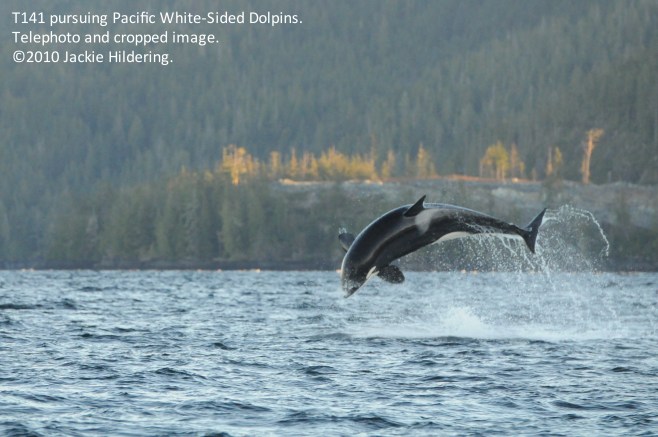
A Mother Hunting: Transient Killer Whale mother T140 and her calf chasing Pacific White-Sided Dolphins. Note Telegraph Cove in the background. Image: ©Jackie Hildering

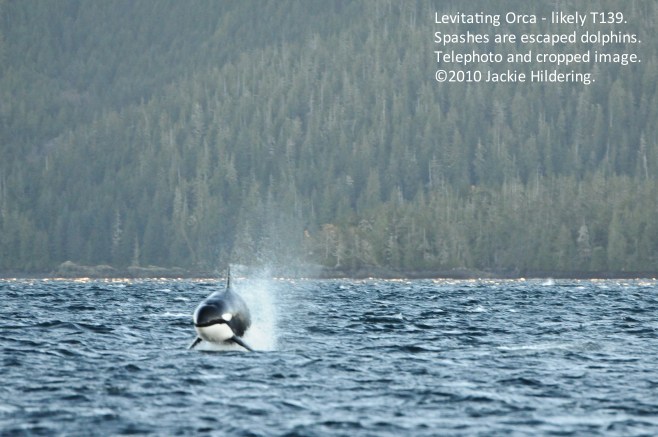
Then, when in transit back to Alert Bay, we found T139, the T140s and T141s.  We had also seen +/-300 Pacific White-Sided Dolphins in the area so knew that there was a possibility that these Killer Whales might choose to have dinner. The display we then witnessed was both brutal and breath-taking.

One of the mature females erupted out of the water higher than I have ever witnessed. She cleared the surface by at least 1.5 body lengths, apparently having rammed the dolphin that was spinning through the air ahead of her. Other spectacular leaps followed, one where mother and calf leapt at the same time – mother high, her calf lower but in almost perfect synchronicity.

Once aware that the Transient Killer Whales were there, the dolphins cascaded away with incredible energy. We could see them still in full flight, several kilometres away, even more than 10 minutes after the initial attack.  But yes, at least one dolphin did not get away. It is the role of Transient Killer Whales to eat other marine mammals; they need to feed their babies too.

I share some of these photos of these encounters at the link below. Realize that the images were taken with a 400 mm lens.

Even after my 12 years on (and under) these waters, I am left stunned at the area’s beauty, biodiversity and the opportunity to learn. 

Click here for more photos from the December 4, 2010 encounter.

two-by-three-ratio-0772

dsc_0779

dsc_0809