Join me in the cold, dark, life-sustaining NE Pacific Ocean to discover the great beauty, mystery and fragility hidden there.

Posts from the ‘REFLECTIONS’ category

NOT “Plenty of Fish”!
“Plenty of Fish”?! Not at my trophic level!

[Note: This blog was published in 2012].

So this may be one of the most daring things I ever do and it is certainly the most uncontrolled experiment I have ever conducted.

This blog item is not about the state of the oceans but about dating sites like “Plenty of Fish” and my reality as a vibrant, single 49-year-old woman.

As any reader of “The Marine Detective” knows, there are NOT plenty of fish in the sea. There are massive conservation and management efforts needed for marine ecosystems before it is too late.

I perceive the metaphor with regard to relationships to be equality untrue. There are not “Plenty of Fish”, at least not at my trophic level in the ecosystem in which I want to continue to live.

I of course respect the utility of such online dating sites and recognize that there are many out there that have met the love of their lives in this way.

It’s not for me though.

I would prefer a site named “Deep Sea Bottom Trawling” where the first thing you do, to increase efficiency in finding those of like intentions, would be to choose your method of “fishing” i.e. catch and release (one night stands); bottom trawling (indiscriminate and destructive); seining (slowly closing a net of no escape); long-lining (many hooks in the water); trolling (more selective due to using appropriate hooks for your target catch) . . . you get the idea AND some flavour of my sense of humour.

By virtue of my unique name and lifestyle, and my on-line presence as “The Marine Detective”, I would have little hope on a dating site of finding balance between revealing anything about myself and preserving some anonymity.  This has led to my thinking, why not take things entirely into my own hands and put my “single, very happy but wanting it all” status out in a world of those who have a sense of what I am about?

I hope the humanity of this has you smiling as a reader and not thinking “Ooooh – this is awkward!”

So here goes:

  • My good traits?  They are revealed in all things related to The Marine Detective – I am passionate, driven to make a positive difference, adventurous, independent, introspective, articulate, funny, creative, strong; honest, hard-working, and accomplished.
  • My negative traits? They are the same as the list above but would be perceived by someone who does not have the same value system; who does not have a strong sense of self; and /or is feeling weakened by middle age as my being: intense, uncompromising, demanding, scattered, blunt, workaholic, and eek  . . . a feminist! (As if equality would be a bad thing for either gender).

So that’s it folks, my hopes are likely no different than many of yours. 

Despite the scarring and lessons-learned of previous relationships, I still have the hope of being able to have it all and that somehow, maybe as a result of my daring to write this blog, that I will end up with a man with whom I have a deep connection, and can build a partnership where we swim in a sea of love, truth, passion, and mutual respect.

I want to share this extraordinary, privileged life with a very rare fish with a rich life of his own.

If you know of one, please throw him a line!
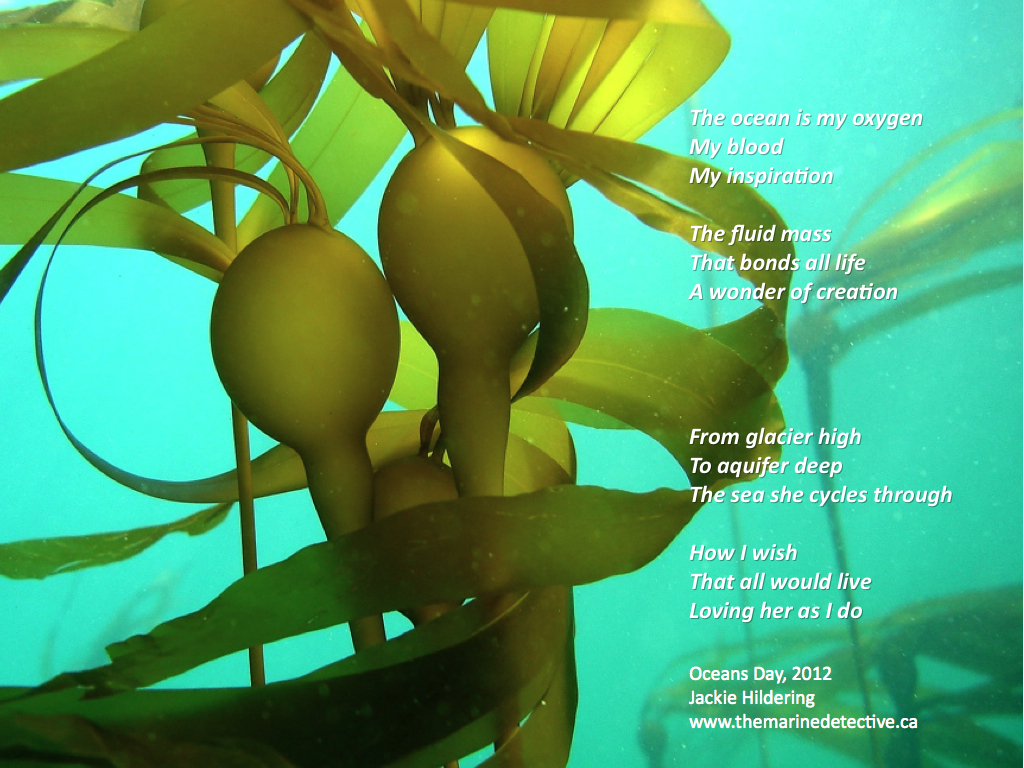
 

For You For Oceans Day – for you love her as I do.

Dear “The Marine Detective” Community,

An Oceans Day reflection for you. 

If you can’t read the text, please click the image to enlarge.

May we continue to work together to raise awareness about the great beauty and importance of our Ocean. For life on land cannot survive without the Ocean. The Ocean is the “circulatory, respiratory, and reproductive organs of our planet” (from “The Fate of the Ocean” by Julia Whitty).

More than 70% of the oxygen in our atmosphere comes from it. The Ocean feeds us and regulates our climate by buffering the greenhouse gas carbon dioxide and absorbing 85% of the Earth’s heat.

We depend on her for transportation, food, water, disposal, recreation, energy, oxygen, climate regulation and … inspiration.

Happy, healthy Oceans Day to you. 

“R” We Getting It? Reflections for Earth Day – April 22nd

Earthling design by Kitty Chan. The "Earthlings" were a school environmental group I had the joy of working with in the 1990s in Rotterdam. Kitty allowed me to use this as the logo for my company "Earthling Entreprises".

Reduce, Reuse, Recycle!

Reduce, Reuse, Recycle!

Like automatons we can chant out this slogan when asked what we can for environmental good, so successfully ingrained is the motto believed to date back to the first Earth Day on April 22nd, 1970. For many of us, the chanting is accompanied by visions of blue boxes and the logo with 3 arrows.

Is this good, or bad?

It is of course good that the solution for reducing waste is so well known. That the solution can be captured in just 3 words also certainly makes the point that it’s pretty simple to live more sustainably.

Except, something got lost along the way.

It is not Reduce, Reuse, Recycle.

It is REDUCE –> Reuse –> Recycle. The 3R slogan was born as the “waste hierarchy”. The 3 actions are not equal. “Reduce” is far, far more important than “Reuse” and the least impactful of the 3Rs is “Recycle”.

To use the case of the plastic water bottle to emphasize this, yes, you can recycle the bloody thing so it is not part of the legacy of plastics drifting and seeping around the planet BUT it shouldn’t even exist in the first place (at least in the developed world.) The tap water on northern Vancouver Island is of very high quality and by using it, you avoid the chemical and energy cost of the bottle being made, transported and . . . recycled.  If you have more urban tap-water, filtering can solve the issue of any taste you may not enjoy. 

Having the great privilege of working with children to help them feel empowered in a world with a lot of environmental gloom, I’ve polled them to find out what they believe to be the most important “R”. Almost always, the answer is “Recycle”.

Oops. This isn’t good. This really isn’t good. The shiny, most powerful, most hope-inspiring gem of environmental change has been misidentified. Striving to “Reduce” consumption of resources is the most powerful tool against all environmental problems; from waste management, to bioaccumulation and climate change. It is also the “R” that will give you the greatest bang for your buck – a buck you can cash in at the bank of happiness. Less misspent cash on disposable, nondurable and frivolous items and less wasted energy and other resources, means greater freedom from the consumer paradigm and a greater sense of hope for the future.

Earthling design by Kitty Chan.

How is that the most powerful “R” has become misidentified and that the whole concept of the 3R hierarchy has become lost? Is it because recycling is something tangible where it is difficult to visualize the action of “reducing”? I would argue that this should not be the case. 

“Reducing” should be the great green common denominator.

To use some examples applicable to teaching: we are leaving half the lights off in the classroom to use LESS energy; please use the paper in the recycling bin so we use LESS paper; close the door so we waste LESS heat; and how wonderful that you are using a reusable container for your lunch so there are LESS baggies bulging from school garbage cans and swirling around school yards. You get the idea.

Is it then because recycling allows us to have our plastic wrapped cake and eat it too? Certainly this is how the oh-so-powerful and oppressive consumer paradigm wishes to manipulate us i.e. “We’ll green-up making you feel less consumer guilt, but you’ve got to keep buying in the volume to which we’ve become accustomed”.

Or, are there many of us that don’t really believe how essential it is to get our act together for future generations and that by recycling we deliver an act of appeasement, just in case?

If you have read this far, thank you, for you are a significant player in creating positive environmental change. That’s the irony of writing an item such as this – it won’t reach the audience that needs to change the most; those who do not even recycle.

You care enough to want to refine what it is you already do.

Know that this is not about being perfect. It is about ensuring that our efforts have the greatest net gain and that we recognize the power that lies in “Reduce”.

Simply stated, less is more – more positive impact; more financial liberty; and more empowered, shiny-eyed, happy and healthy children in a future we cannot see.*

*Inspired by the quote “Children are the living messages we send to a time we will not see”  by John W. Whitehead. 

Earthling design by Kitty Chan.

Earthling design by Kitty Chan.


Of Angels and Argonauts?

T’is the season for reflection. It is the time of year where, the nebulous, undefinable but essential life forces of hope, love and spirituality may burn brightest.

So for you, I share the following story.

I emphasize that this is an atypical blog item for The Marine Detective and I have had to wrestle my left brain into submission to write it. I am very fearful too of feeding the monster of human need to get up close and personal to whales and claim a “piece” of them.

With that preamble and context – I give you this story for Christmas:

In the fall of 2011, while aboard with Orcella Expeditions and talking about my whale research with the Marine Education and Research Society (MERS), I explained how and why we nickname Humpback Whales.

In short, we nickname the whales for a feature on their flukes since the scientific alphanumeric names (e.g. BCZ0297)  are much more difficult to remember. [See my past blog item “What’s in a Name” for a more detailed explanation including photos of nicknamed Humpbacks.]

Where we can, we like to have local school children nickname the whales for reasons I am sure you understand.

BCY0729. Note the marking in the shape of an “A” on the left fluke. Photo: Hildering.

But that day, just after talking about the Humpbacks, I learned of the death of man who loved the sea – a man of depth and creativity who should still walk among us. I heard about Jason from his father Cliff, whose eyes of course told more about the pain, loss and love of his son than words could.  I had only recently met Cliff and never had the privilege of knowing Jason. 

Immediately, I thought of the Humpback Whale BCY0729 who has a marking on his left fluke that looks very much like the letter “A”. 

As an exception to having children name the whales, I decided we could nickname this whale “Argonaut” in honour of Jason. [if unclear about the association between “Jason” and “Argonauts”, please click here].

It was a simple thing to do. We had a good nickname for the whale and Cliff and his family had some comfort in the sentiment and symbolization of a whale being nicknamed for Jason. 

That was September 3rd, 2011. Below, email correspondence to Jason’s father on September 22nd.

“Cliff, I got goosebumps today and had tears in my eyes.
 And – you’re going to get the same.
I saw Argonaut today, for the first time since September 30th, 2010. He was very near Telegraph Cove feeding in the area with another juvenile whale that we have named “Guardian” because there is an angel-like marking on this whale’s tail (rimmed in a yellowish shade). 
You’ll see from the photos that it was a very wet and misty day . . . beautiful. I was on a school trip [for Stubbs Island Whale Watching] with a group of local First Nations school children . . . I shared the story of Argonaut with them and of course, it moved them.”

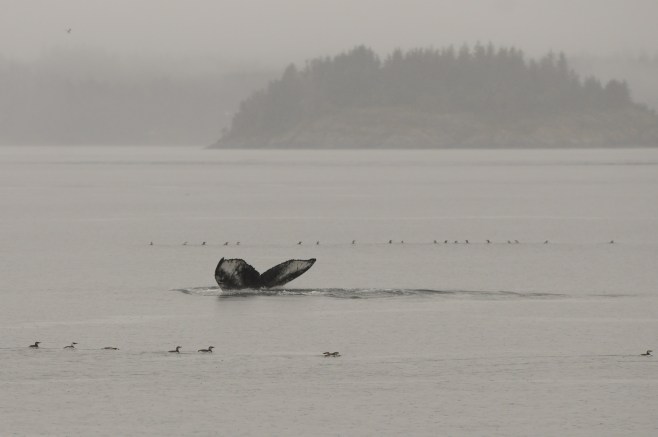
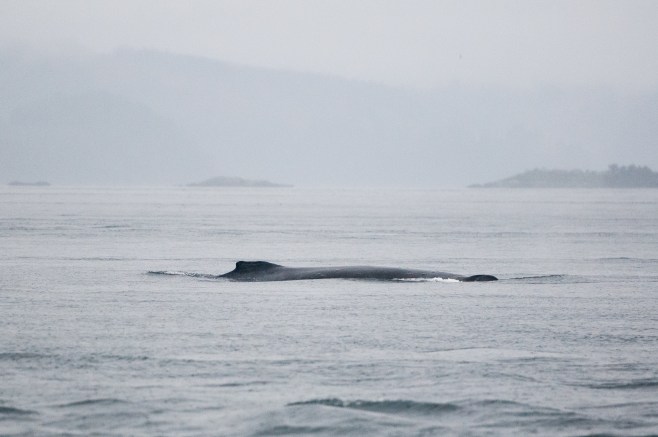
Argonaut on September 22nd, 2011. Photo: Hildering.

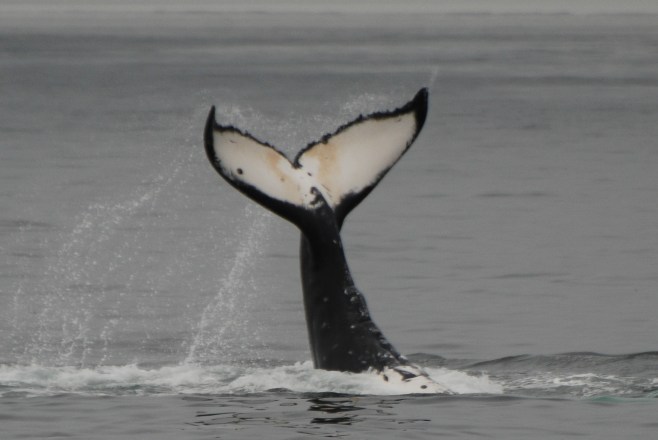
Guardian on September 22nd, 2011. Photo: Hildering.

Guardian on September 9th, 2011. The image shows the yellow angel-like shape around the centre of the fluke. Photo: Leah Thorpe, MERS. Leah also nicknamed Guardian.

I saw Argonaut and Guardian every other day I went out up to October 30th, 2011. They were not always right beside one another but they were within the same general area. 

Does this have any significance beyond two Humpback Whales with distinctly marked tails feeding together?  The beauty is, I’ll never know, no matter how much data I collect.

There is “something” about whales that I use almost daily to try to engage and motivate and frankly, plea with people to get their heads out of their bottoms and realize that their daily frivolous actions (and inactions) collectively cause such needless environmental damage.

Coincidence such as this story of “Angels and Argonauts” is the kind of thing that throws my structured-science-oriented left brain into discussion with my philosophical-reflective right brain about the undefinable and intangible.  But something both sides of my brain agree upon . . .  these giant sentient beings inspire marvel and wonder and hope and comfort and, so often . . . they inspire us gangly bipeds to understand connectedness and the truly important things in life.  

May the greatness we sense from whales inspire us to bigger things that benefit society and the environment. 

Merry Christmas readers.

I leave you with this sound clip of Jason singing “With or Without You” – a small indication of the depth of the man who loved the sea. Click here to listen.

Update December 2014: Since writing this blog in 2011, Argonaut has become one of the most predictably sighted whales in our area. Guardian too is seen very predictably but is rarely with Argonaut. When Cliff came back in 2013 hoping to see the whale named in honour of his son, we spotted Argonaut within minutes of being on the water.

Update July 2016: Argonaut is now part of our Marine Education and Research Society’s Humpback Sponsorship Program as a means of funding research and education to reduce threats to whales like Argonaut. Please see here.

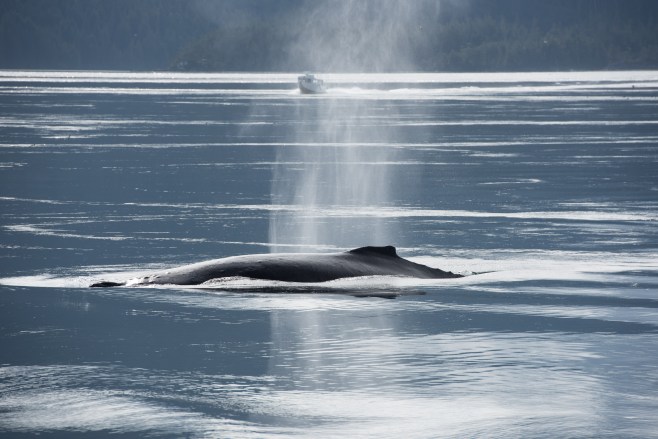
Argonaut lunge feeding on September 28, 2011. Photo: Hildering.

Argonaut at sunset on October 7th, 2011. Photo: Hildering.

Argonaut tail-slapping August 2012. Photo: Hildering.

Argonaut tail-slapping August 2012. Photo: Hildering.

Argonaut breaching October 2013. Photo: Hildering.

Argonaut breaching October 2013. Photo: Hildering

Argonaut October 2014. Photo: Hildering.

Argonaut October 2014. Photo: Hildering.

Argonaut on September 27, 2015. Photo: Hildering.

Argonaut September 27, 2015. Photo: Hildering.

Diving After the Storm – My 600th Dive

Today, despite a powerful storm, I completed my 600th dive (thank you dear buddy, Jacqui Engel).

Vermillion rockfish.

Six hundred dives is not such a big deal if you are a warm water diver. However, the vast majority of my dives were in the cold waters of Northern Vancouver Island and, it does feel like a big deal.

I only started diving when I was 36. Now, at age 47, I have been diving less than 11 years and have thereby averaged a dive per week over this time. It’s the equivalent of about 19 days underwater.

I am not usually boastful (I think) but it seems really significant to acknowledge this milestone and to try to share why diving is so important to me.

In an attempt not to be too earnest though, I try to express “Why Dive?” by way of some bad poetry.

Why Dive?

Opalescent nudibranch.

Constricted by my dry suit,
Thirty pounds bound to my waist,
Hunchbacked by my cylinder,
A mask suctioned to my face,

I leave the world we’ve cultivated,
To attempt to meet our every whim,
To where Nature’s voice can still be heard,
Far above civilization’s din.

No governments, no borders,
Nor economies present.
When down here, I’m reminded,
Of life’s depth and true intent.

I’m an awkward and brief visitor,
In this world of colour and perfection.
I fill with humility, wonder,
Passion and quiet introspection.

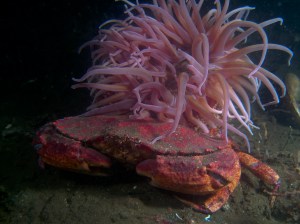
Red rock crab near a sand-rose anemone.

For Mother Ocean is home to life,
Older than mammals can comprehend.
I’m grateful that I may learn from her,
Leaving solid ground when I descend.

Diving brought me greater purpose,
Love, vision and camaraderie.
I think that what some find in a church,
I find  . . .  deep . . . within the sea.

On to the next 600 dives.


Postscript: There was additional “poetry” to today’s dive because it took place after a very powerful storm. Flooding caused the ocean to turn chocolate brown.

This “after the storm” dive further made me reflect on how diving is like a metaphor for life’s greatest challenges. At the risk of the repercussions of exposing you to bad poetry AND “Hallmark-esque” reflections,  I will only share the following:

  • Even in darkness, there is great beauty (as evident by these blog images from today’s dark dive).
  • When you don’t know where you’re going, trust in your compass.
  • And, when in the depths of it  . . . just breathe.


With great thanks to those who have made me the diver I am.