Join me in the cold, dark, life-sustaining NE Pacific Ocean to discover the great beauty, mystery and fragility hidden there.

Posts tagged ‘jellyfish’

Twelve Minutes With a Giant

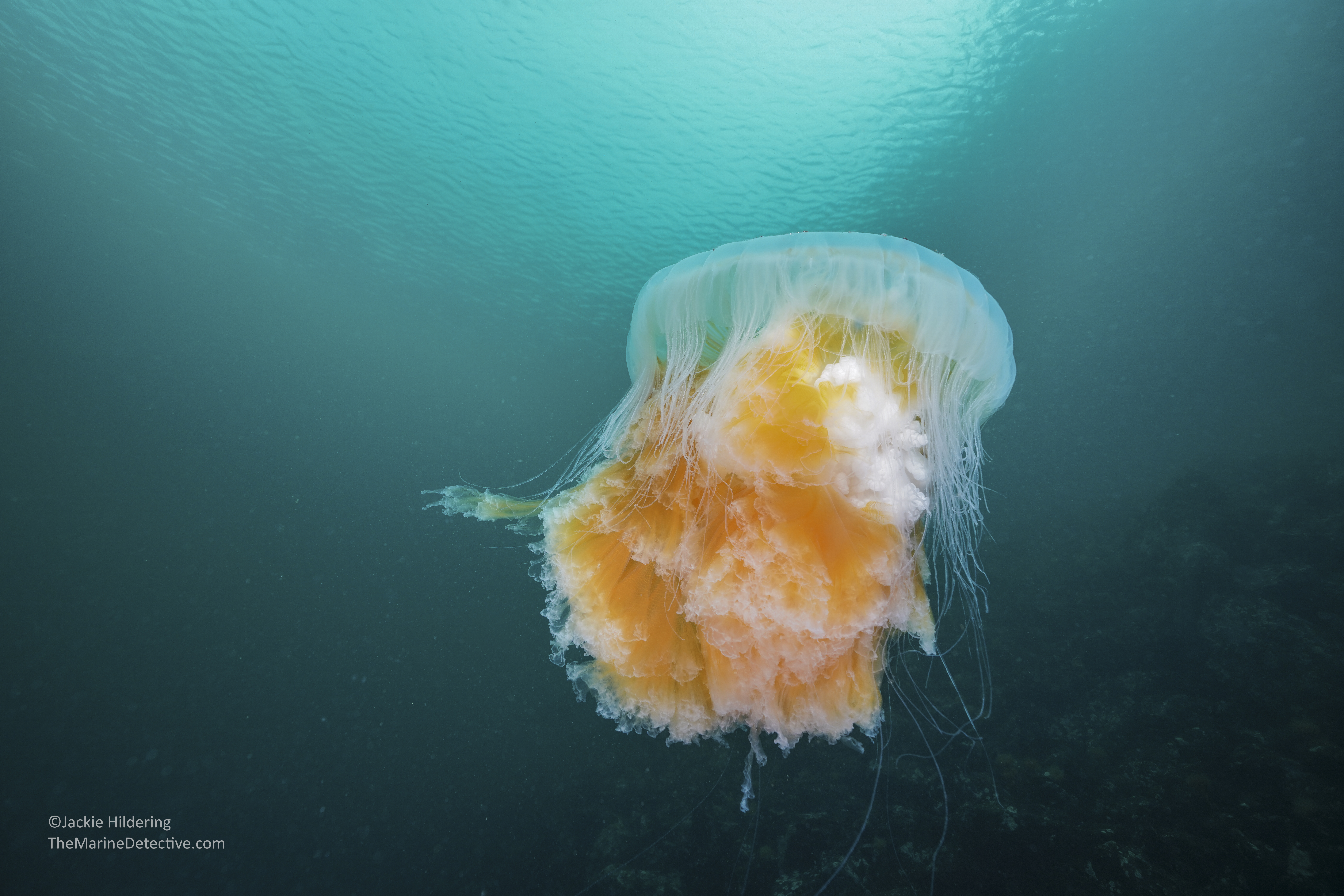
In April, there were quite a few Egg Yolk Jellies around northeast Vancouver Island. I dedicated one dive to trying to find at least one and watch it for a while. You never know what you’ll learn from a species that has survived on Earth for ~500 million years.


Egg Yolk Jellies are also known as Fried Egg Jellies. Gee, I wonder how this species got their common names? 😉 Their scientific name is Phacellophora camtschatica.

They are big at up to 60 cm across the bell. But that’s no where near as big as the other common giant jelly species off our coast, the Lion’s Mane Jelly. They can be 2.5 m across the bell (the bigger Lion’s Mane Jellies are usually not near the coast).

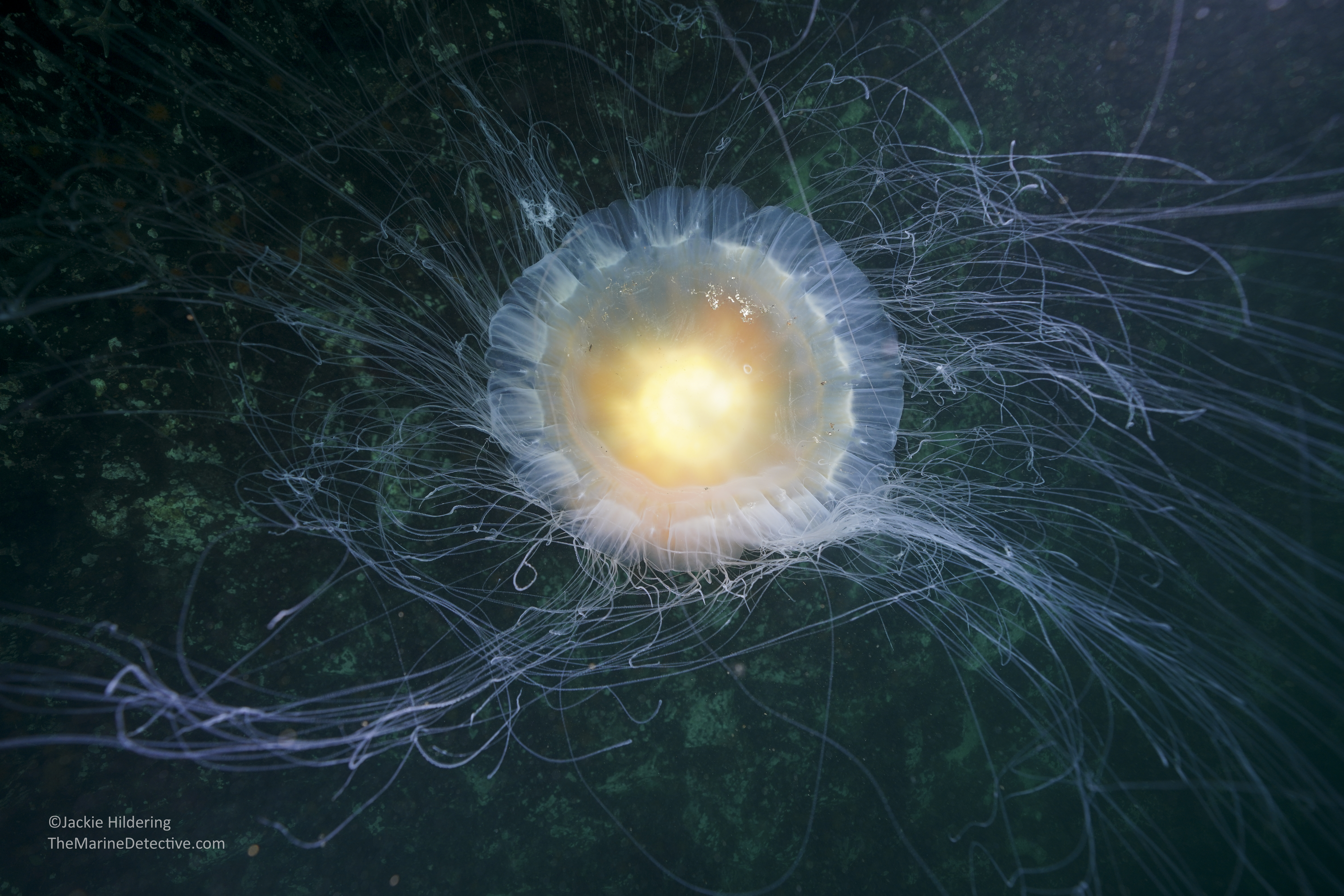
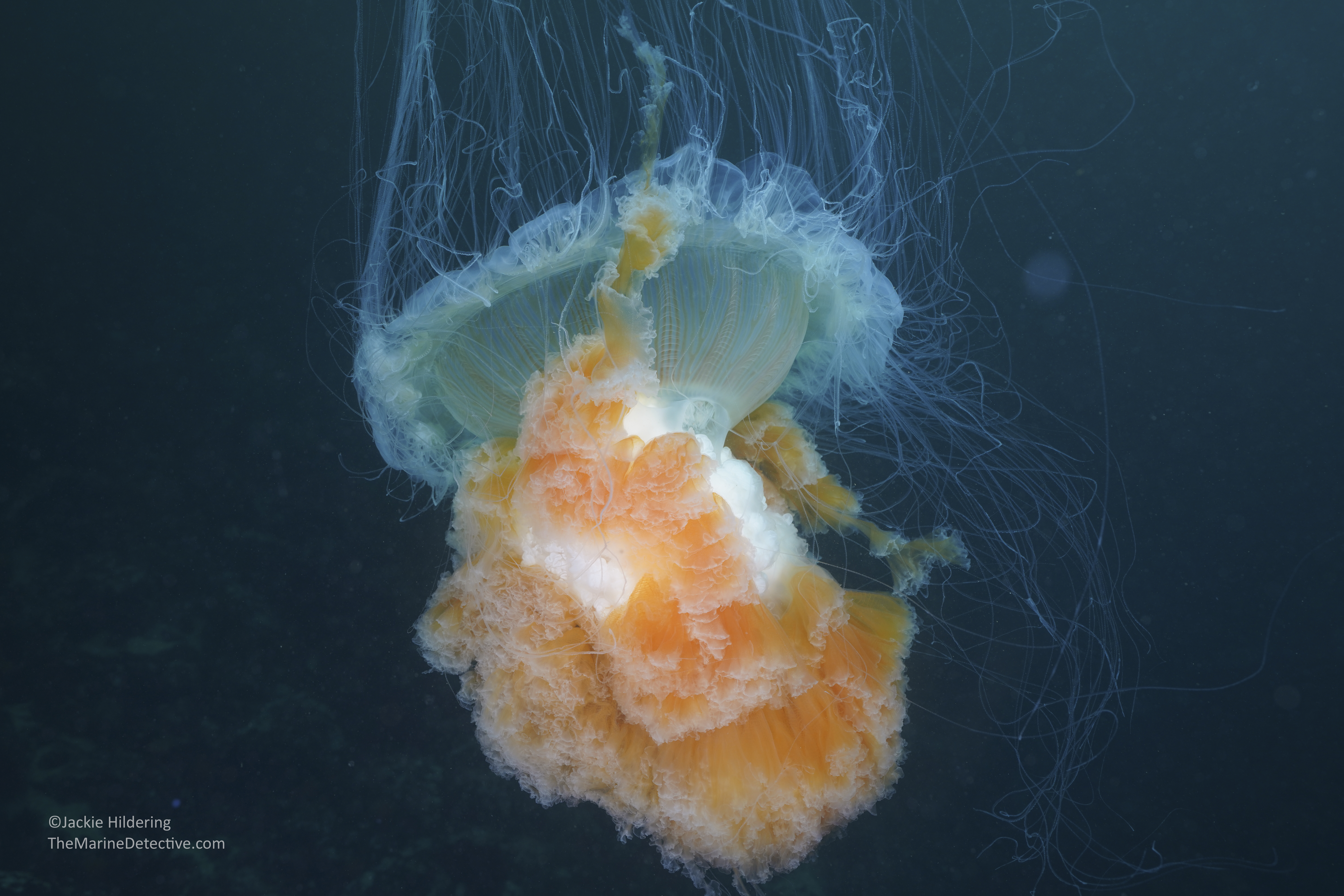
The yellow centres in Egg Yolk Jellies are the gonads. They can be much lighter coloured than the individuals you see here. Egg Yolk Jellies have 16 large lobes that alternate with much smaller lobe-like structures giving the bell a scalloped edge. Each lobe has clusters of up to 25 tentacles making for up to 400 tentacles (25 x 16) and they can be 6 metres long.

Egg Yolk Jelly and dive buddy Linnea Flostrand on a previous dive. ©Jackie Hildering.

I was more than 30 minutes into the dive when I saw the white, slow pulsing through the soup of plankton. The jelly was swimming in my direction. I swam toward the jelly.

For twelve minutes, I watched, photographed, and learned.

I saw how the tentacles became longer and that the jelly stopped pulsing. Motionless in the water column, the tentacles spread out like a net. See that in the series of photos below?

I don’t think there was a “catch” (they feed on zooplankton, including ctenophores and other jellies). Had there been, the tentacles with the prey would have moved toward the jelly’s mouth.

I now have a much better appreciation for how they are not “passively planktonic”. They are active swimmers responding to cues in the environment. Moriarty et al., 2012 used acoustic transmitters to tag them and noted differences in swimming speed and vertical migration dependent on time of day and tidal cycle.

Jellies have sensory structures called rhopalia.

From Rebecca Helm, 2018:
Each ropalium . . . is packed with microscopic crystals at its tip. These crystals help the jelly sense up and down, by bending in the direction of gravity, similar to our inner ear. They also have a small pigment spot, which likely helps the jelly sense basic light and dark. So far, we’ve got an animal that can tell which way it’s pointing in space, and see rough light and shadow. Next we’ve got a few mystery structures, like the little bonnet-like structure surrounding the rhopalium above, which may act like a jelly nose, helping it sense chemicals in the water . . . Each rhopalium also acts like a pacemaker, helping coordinate jelly movement, similar to the way our cerebellum coordinates ours.”

And you thought they were just “going with the flow”. 💙


All photos in the above series are of the same individual.
April 19, 2025 north of Port Hardy in the Traditional Territories of the Kwakwa̱ka̱’wakw (the Kwak̕wala-speaking Peoples). ©Jackie Hildering.


For more information about the diversity of jellies on our coast, see my previous blog post “Gob Smacked” at this link. From that blog:

Lion’s Mane Jellies and Egg Yolk Jellies. are the only two common jelly species in our waters that can create a sting that irritates human skin, even when the jellies are dead. The stinging cells (nematocysts) work even when the jelly is dead or you get a severed tentacle drifting by your face. The sting from a Lion’s Mane Jelly is reported to be worst than that of an Egg Yolk Jelly.

I’ve been stung by both and clearly it’s not been enough to deter me from striving to get photos of them. But if you have far more skin exposed or are a fisher grabbing nets with many of the tentacles wrapped in them, it is reported to be very uncomfortable.

The solution to the irritation is vinegar (acid), meat tenderizer (enzyme) and I know that many fishers swear by Pacific canned milk as well. Research puts forward that vinegar is the only real solution and that urine does not work at all.


Sources:


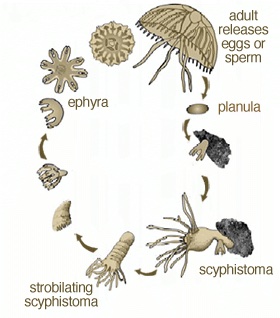
Generalized lifecycle of a jelly from Lucas, 2001 via “A Snail’s Odyssey”.
There is alternation between a polyp with asexual reproduction and a medusa with sexual reproduction.
I have not been able to find specifics about the lifespan of Egg Yolk Jellies other than “species can have a lifespan of several years.” I have questions about why we saw quite a few dead on the ocean bottom around the same time in different locations, and what that may suggest about the lifecycle.
Dead Egg Yolk Jelly in April 2025 with dive buddy, Brenda Irving. ©Jackie Hildering.

A Smack of Jellies

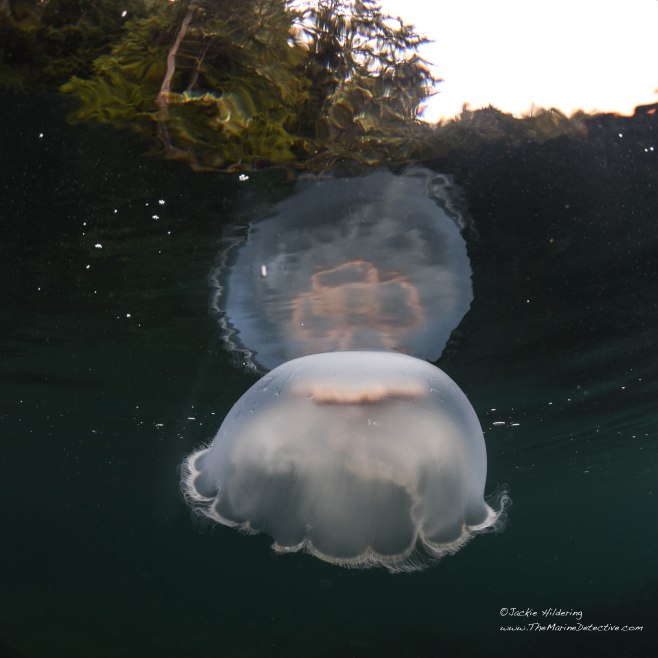
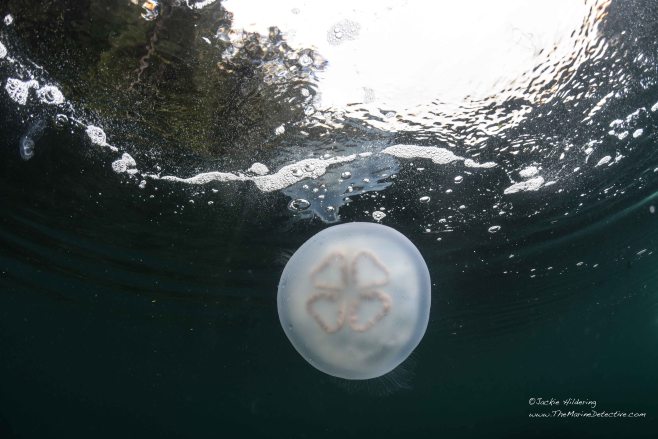
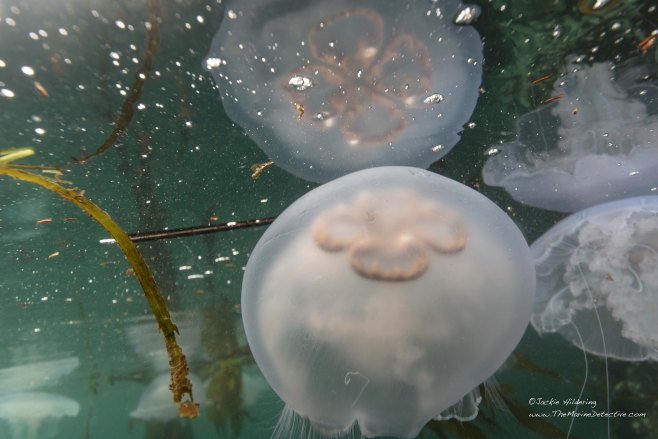
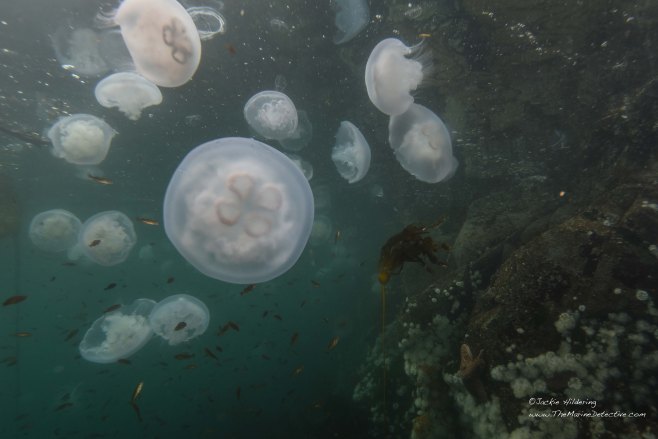
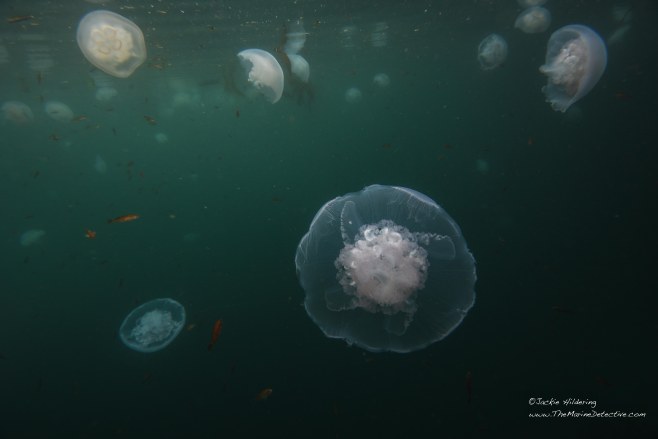
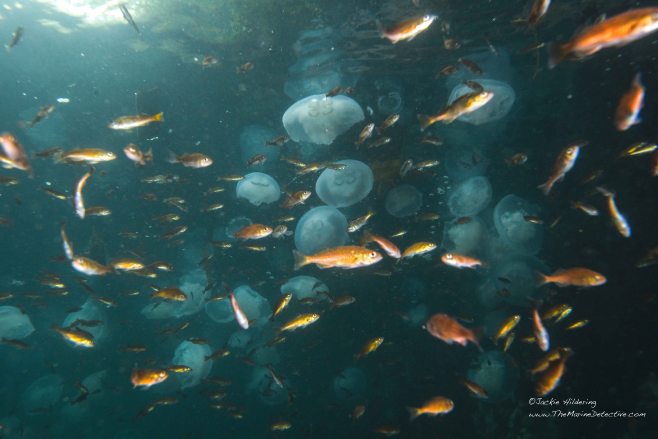
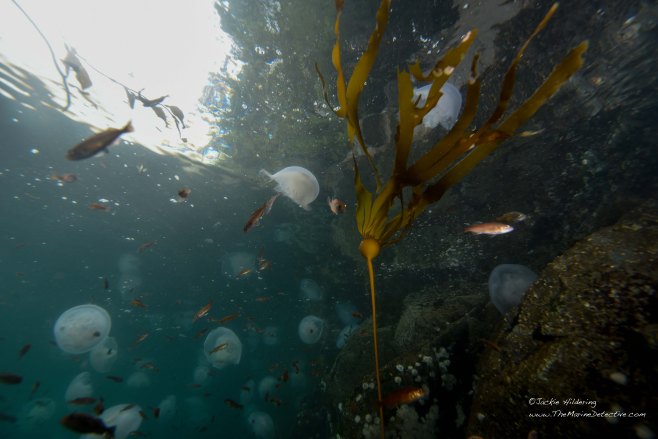
The last little while there have been hundreds, and hundreds, and hundreds of Moon Jellies = a “smack” of them. That truly is the collective noun for jellyfish.

It should also be the collective noun for the number of jellyfish photos I am delivering in this blog.

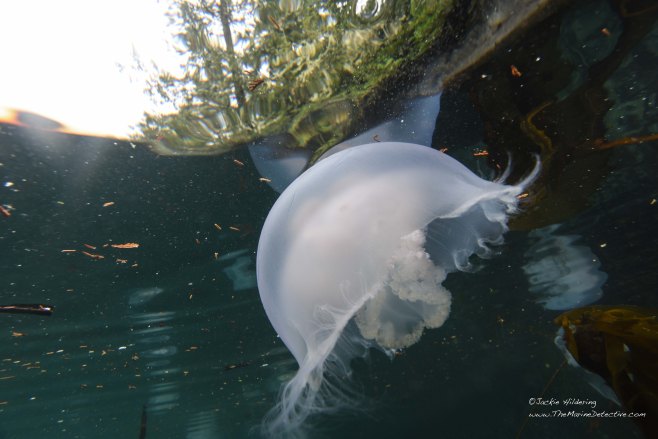
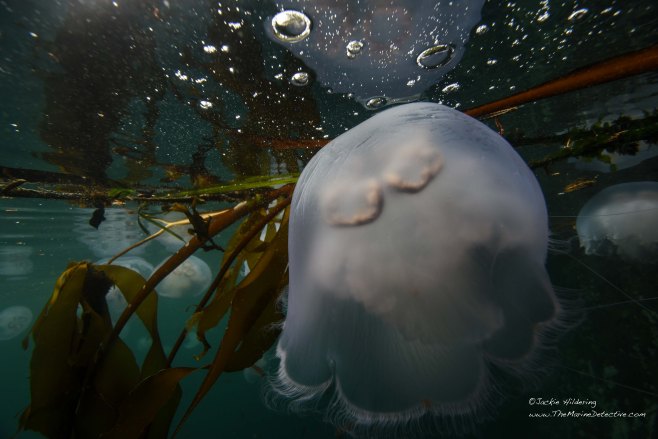
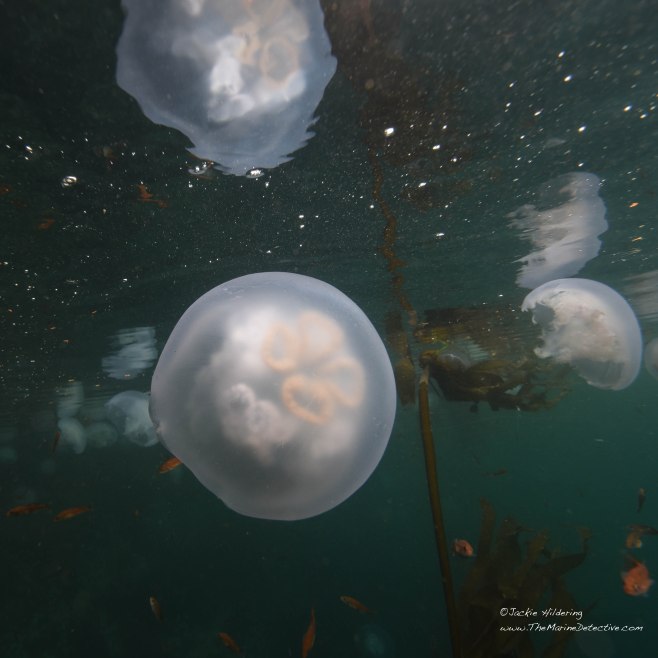
May these photos from my last dives north of Port Hardy offer you a bit of escape. I tried to capture trees in photos of jellies and the reflection of the jellies against the surface of the water. I hope the images communicate interconnectedness of land, sea and sky. May  they also contribute to understanding and connection to our neighbours in the sea.

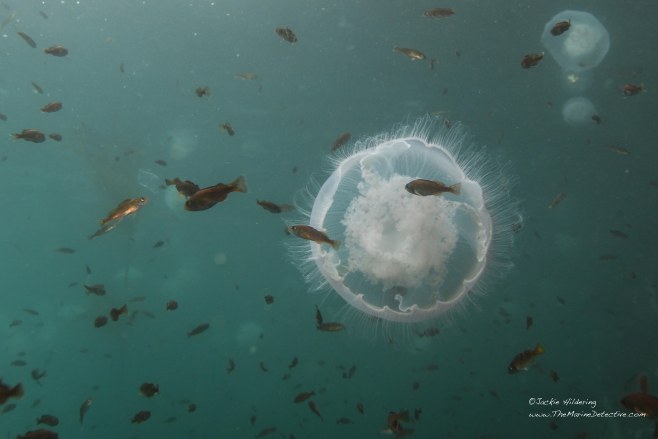
Moon Jellies are easy to discern from other jelly species by having the clover shape which is 4 gonads / sex organs (Aurelia labiata to 40 cm across). 


Most jellies in the class to which Moon Jellies belong (the Scyphozoan) release eggs and sperm into the water column. But in Moon Jellies, when the male releases sperm, the pulsing action of the female Moon Jelly brings the sperm in contact with the eggs under her arms and the are brooded there. The following three photos show females with eggs. The eggs are the less translucent white structures. 


And as if this was not all amazing enough there was also a ” blizzard* of babies . . . just LOOK at how many juvenile Widow Rockfish there are!

It was so extraordinary to see them nipping at the bells of the Moon Jellies, darting about everywhere. There was another phenomenal explosion of young like this in 2016 and, with site fidelity being so strong, those fish may well be the bigger ones we saw at these sites too.

The following facts about Widow Rockfish are from Dr. Milton Love’s brilliant “The Rockfish of the NE Pacific”: The mothers produce one brood of about 95,000 to 1,113,000 eggs/year which hatch as larva from their mothers (rockfish are viviparous). They stay in the plankton for about 5 months feeding on copepods and krill and can grow up to 0.61 mm/day. Then they settle out to be in nearshore areas like you see here and feed on salps and jellies, small fishes, crabs, amphipods and krill.

Why are they named “Widow” Rockfish ? “. From Dr. Love’s book too: Julius Phillips, a great observer of the rockfish fisheries of California during the mid-twentieth century, believed the term widow can about because the “black peritoneum an small effeminate mouth give the impression of lonesomeness to occasional specimens that appear amount the more common bocaccios, chilipepper and yellowtail rock cods” (Phillips, 1939).

Maximum  life expectancy for Widow Rockfish (Sebastes entomelas) is 69 years. Maximum length 60 cm. Females typically bigger than males.

The bounty of babies has been reported by myself and others to those monitoring rockfish health. To my knowledge, nobody knows why there have been these two explosions of young of this species (2016 and 2020).


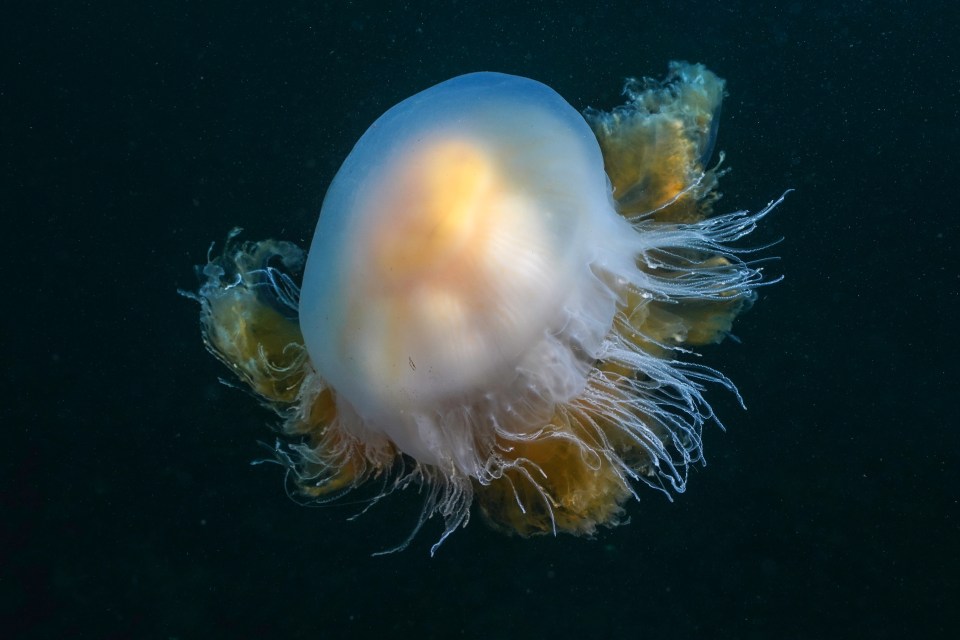
And to conclude, I had hoped that I might also photograph a Lions Mane Jelly with land in the background. On the last dive of nine, the light and life lined up to allow me to take this photograph.

The Lion’s Many Jelly is one of two of the biggest jelly species commonly found off our coast = Cyanea ferruginea (the other is the Egg Yolk Jelly). Maximum size of Lion’s Mane Jellies is to 2.5 m across with 8 clusters of 70 to 150 tentacles which can be . . . 36 m long! This is the largest jelly species in the world. Know that the larger ones tend to be further offshore and that they can retract their tentacles. These two species are also the only two common jelly species in our waters that can create a sting that irritates human skin, even when the jellies are dead or you get a severed tentacle drifting by your face.

A Lion’s Mane Jelly is the murderer in a Sherlock Holmes short story entitled “Adventure of the Lion’s Mane” (I kid you not), BUT the “victim” had a preexisting heart condition. The solution to the irritation is vinegar (acid), meat tenderizer (enzyme) and I know that many fishers swear by Pacific canned milk. Research at this link puts forward that vinegar is the only real solution. Clearly I’ve never been stung badly enough to deter trying to photograph them.


Photo below is of planktonic me after a full dive trying to capture jellies and trees in the same image. Photo by dive buddy Janice Crook.

In a Galaxy Far, Far Away . . .


In a galaxy far, far away . . .

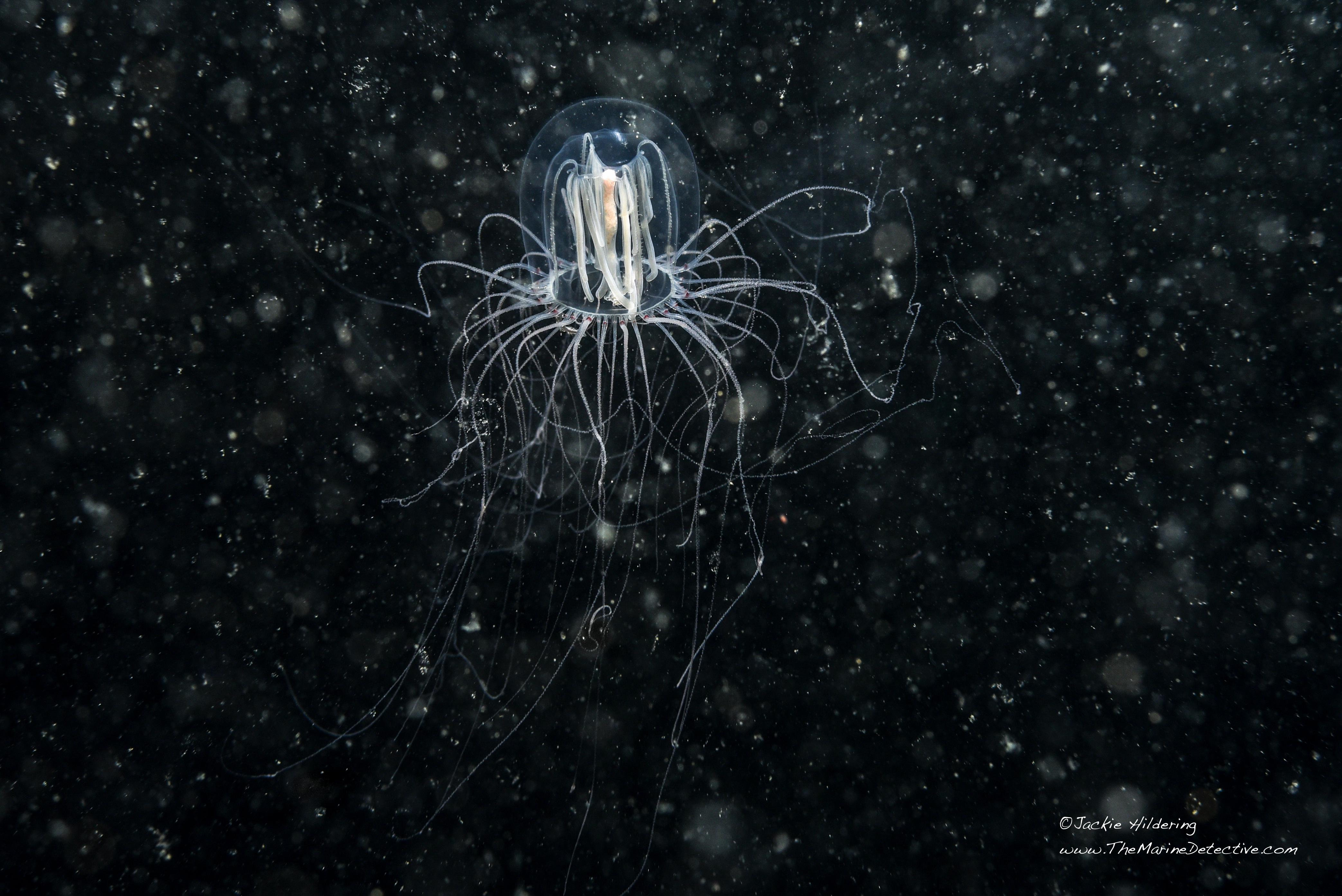
Oh wait no, this was yesterday, diving in a soup of Red Eye-Medusa.

Imagine the water thick with plankton to the extent that it actually feels soupy, and throughout, these jellies are suspended . . . like little, living fairy lights in the dark.

When the visibility is poor like this, it of course limits what else can be seen. But, when you’re in the dark, that’s where you are and that’s where there is still much learning to be done and beauty to be seen.

Yep = life metaphor.


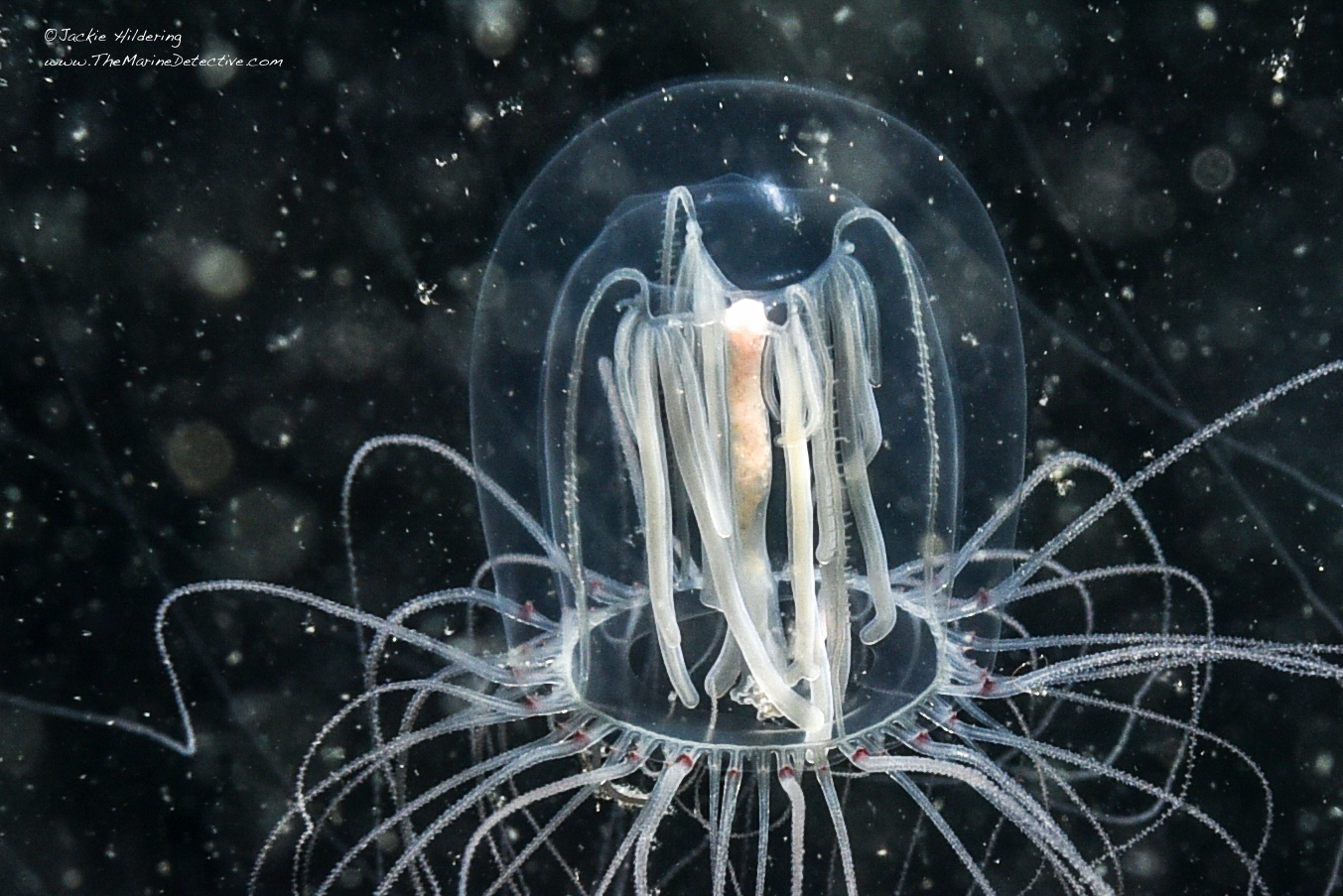
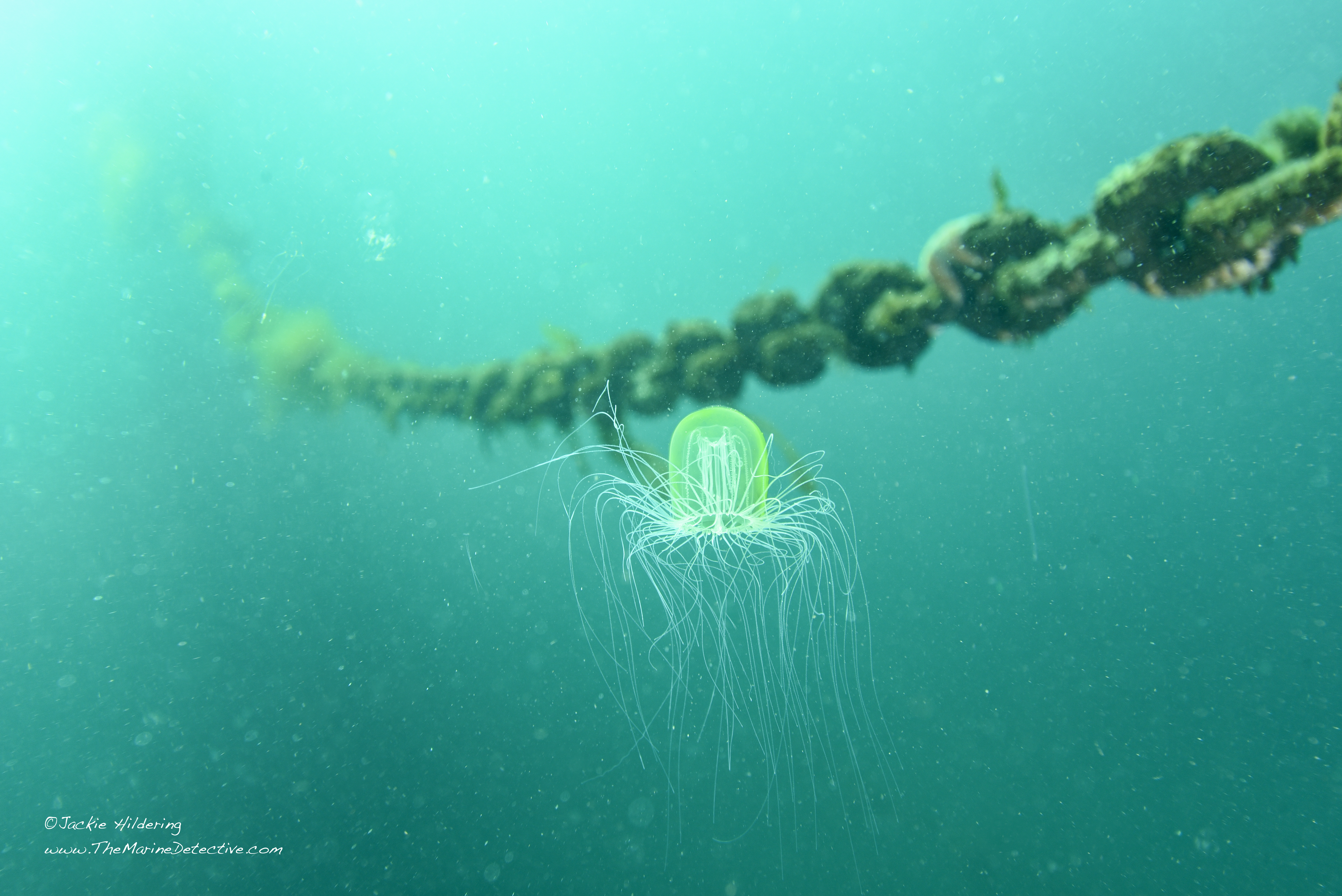
Polyorchis penicillatus are up to 10 cm in size and they are “sink fishing” when hanging like this (detail below).

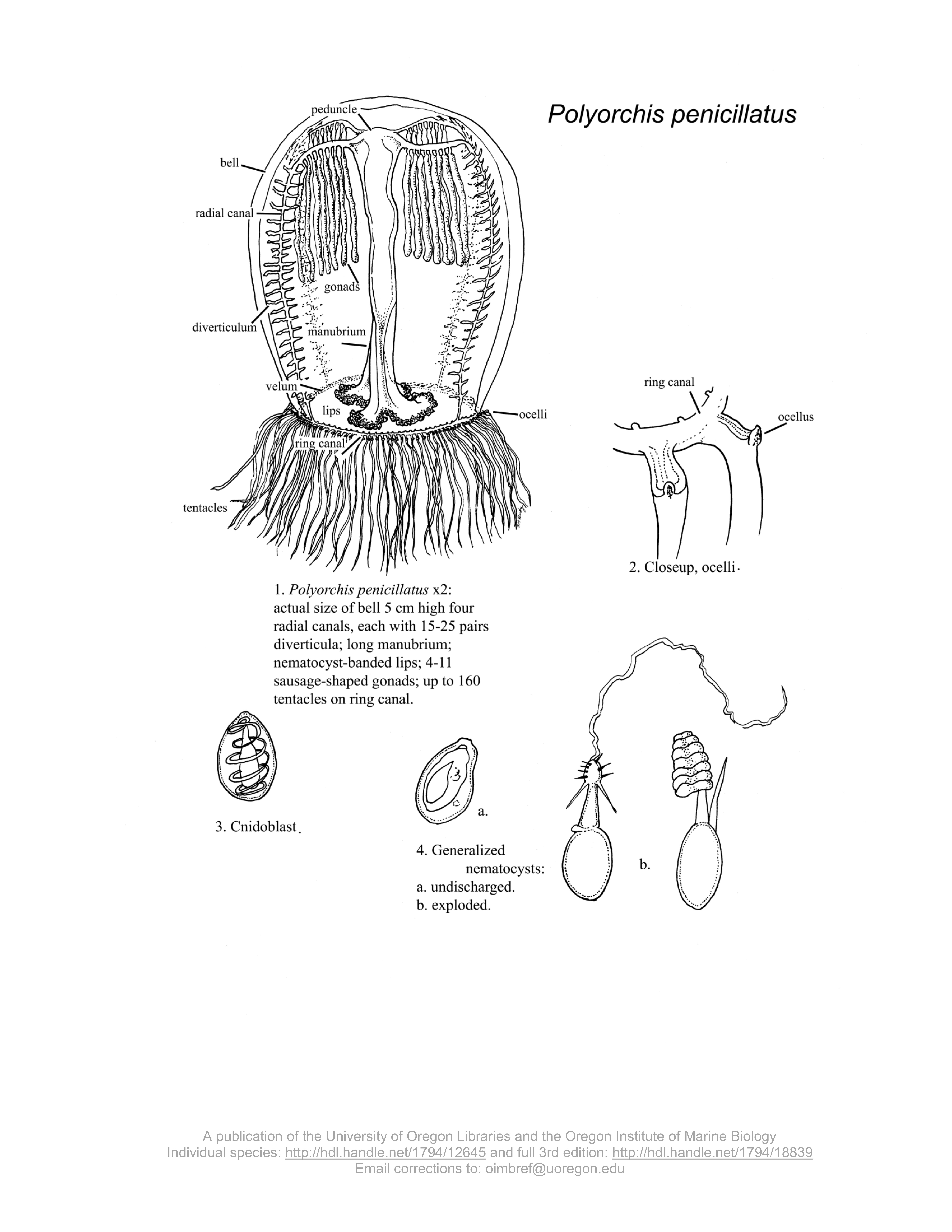
Look at the bottom of the bell for the red “eyes” (eyespots / ocelli). These can sense light intensity, helping the jelly know which way is up.

The stomach is in the middle and the gonads are the elongate organs surrounding that. Species has up to ~160 tentacles (more often around 100). This jelly species makes “hopping” motions. In part, this is believed to help when feeding near the seafloor by stirring up prey (true story).


More detail on feeding from the University of Oregon:
They feed in both the water column and on the bottom, using different methods for each (Mills et al. 2007). On the bottom, they perch on their tentacles and eat benthic organisms by touching the sediment with their manubrium [stomach with mouth at tip]. Sometimes, they will hop on the sediment, likely to stir up possible prey or move to a new location (Mills 1981, 2001). In the water column, they use “sink fishing” to find their prey. During sink fishing, the medusae extend their tentacles out from their bell and let the distal ends sink downward. They either maintain their position in the water column or sink slowly and catch prey with their tentacles. When a prey item touches a tentacle, the medusa will use that tentacle to bring the prey to the manubrium, though large prey sometimes require more tentacles; this process causes cessation in swimming and crumpling (Arkett 1984).”


#YouAreWhereYouAre

Another Red-Eye Medusa at the same site in Port Hardy.
Species of sea star on the anchor chain is a Leather Star.


Source of annotated diagram below and ALL you wish to know about the species:

Polyorchis penicillatus, A publication of the University of Oregon Libraries and the Oregon Institute of Marine Biology Individual species.

Submerge . . .

Come away with me . . . spend 3 minutes submerged in the shallows of the eastern North Pacific, photographing jelly species.

There is no place I’d rather be than here, learning about the richness and wonder of life in these cold waters.

With huge gratitude to Roger McDonell – underwater videographer and dive buddy supreme – for having taken this video.


Video taken during our weekly dive as the Top Island Econauts Dive Club.

Lion’s Mane Jellyfish – Sherlock You Are Wrong!

I had a wonderful opportunity to photograph and film a lion’s mane jellyfish (Cyanea ferruginea) today.


The 1.5 minute annotated video clip below will give context to my “Sherlock – You Are Wrong” statement.  
Enjoy!

Click here to see a short clip of the other big jelly species that can be found in our waters – the egg yolk jelly (Phacellophora camtschatica) at up to “only” 60 cm across. 

Mystery Organism – A Jellyfish With a Stalk?!

Blog updated on June 25, 2024.

This is a Marine Detective case for those of you who appreciate mini-mysteries as much as whale wonders.

Gillian Butler and Erin Paul of found this remarkable invertebrate off their kayak base camp in Johnstone Strait, northeastern Vancouver Island in September of 2010. 

I was thrilled to get the “What’s this?” email from them as this is a type of jelly I know is off our coast but that I had never been able to find! It’s a jelly that is only 3 cm wide and is usually attached to kelp or Eelgrass . . . by its stalk!

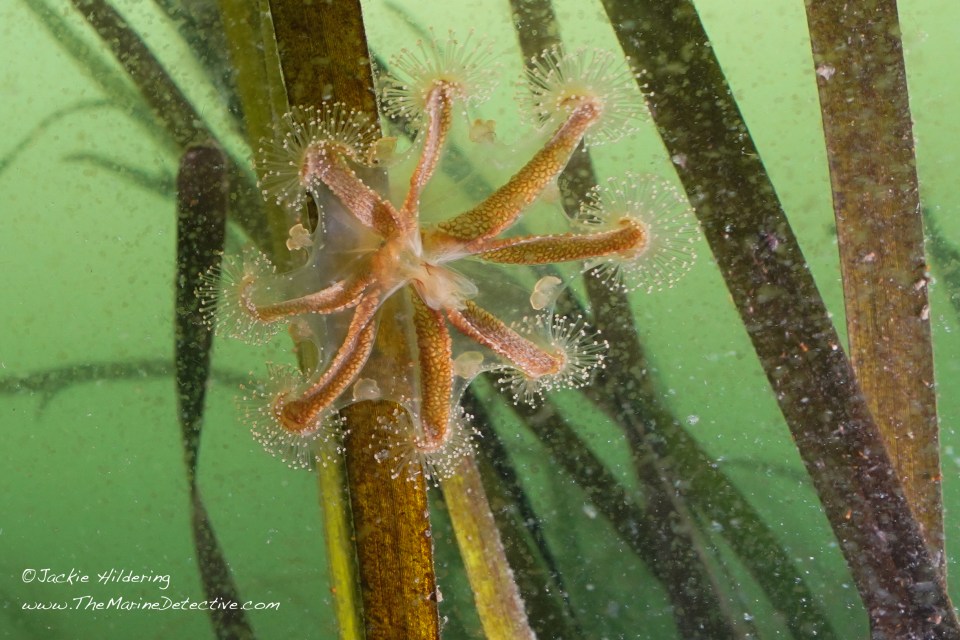
Stalked Jelly – photo by Gillian Butler

Yes, it is species of stalked jellyfish (stauromedusae). The species well documented on our coast is the “Oval-anchored Stalked Jelly” (Haliclystus sanjuanensis). Read below for what is believed to be a new (undescribed) species!

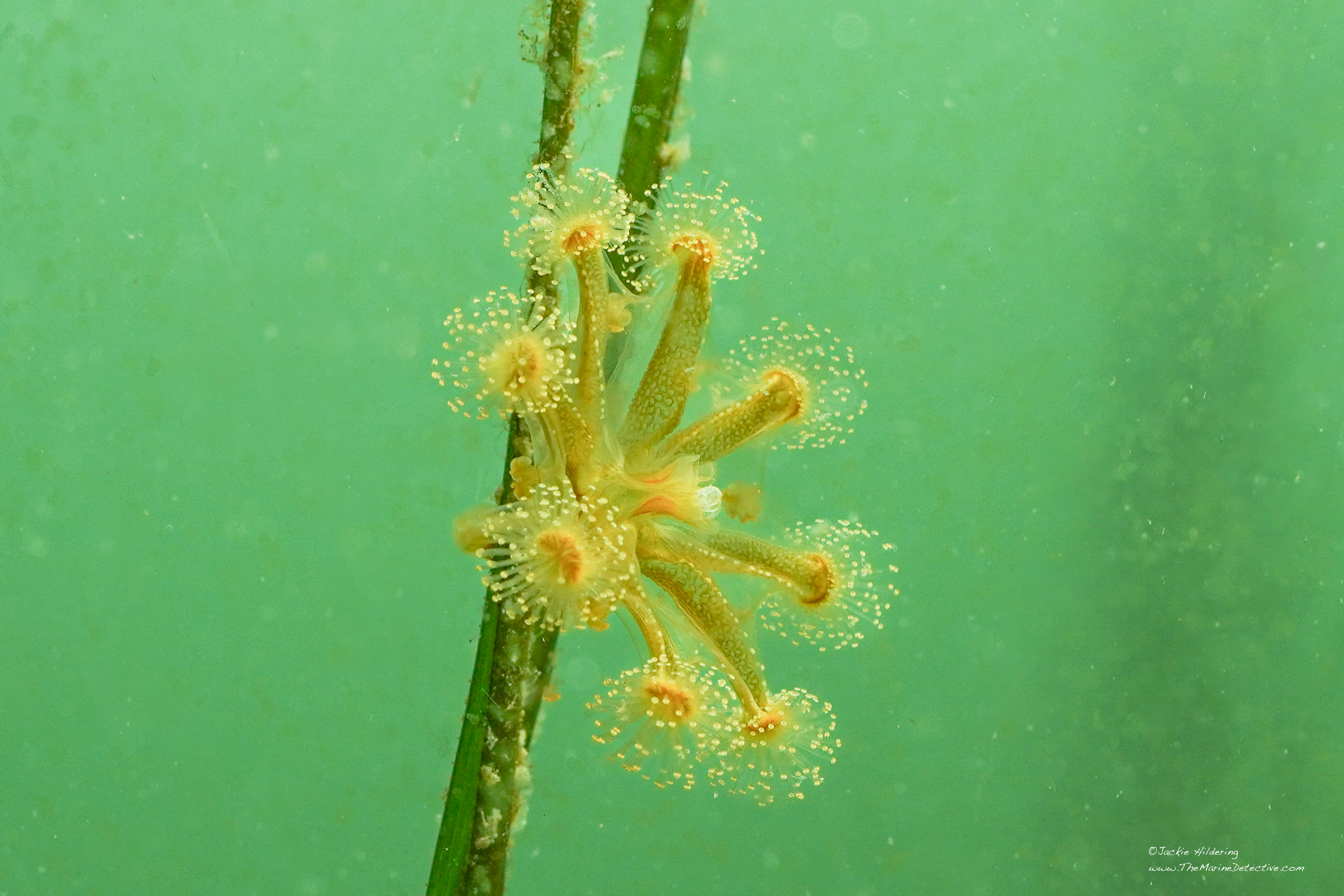
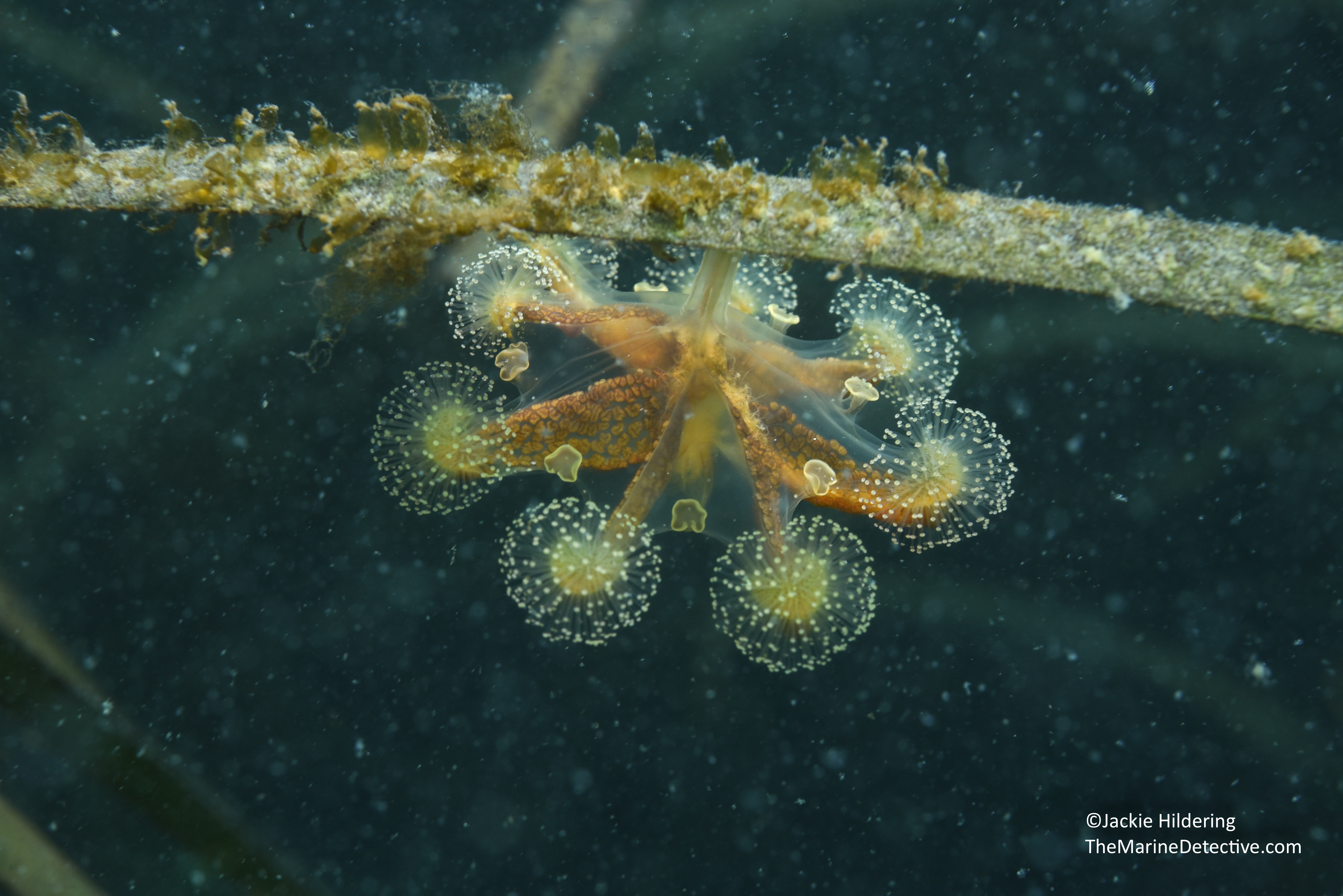
Stalked jellies never become free-swimming, bell-shaped “medusa” like most jellyfish species. Their stalk is sticky allowing them to attach to Eelgrass, seaweed, or rocks in the shallows.  They have 8 “arms” that look like they have pom-poms at their ends.  These clusters of 30-100 tentacles have stinging cells so that the stalked jelly can catch small crustaceans with the pom-poms and bring this food to their mouth (positioned at the centre of the 8 arms).

They are remarkably mobile which you will see in the Lester B. Pearson College video at the end of this blog. If the stalk becomes detached, the animal can hold on with its tentacles till it reattaches its stalk. The student video will also allow you to see the base of the stalk and how the arms can close up.

Only about 50 species of stalked jelly had been discovered worldwide. New extremely deep-dwelling species been discovered around hydrothermal vents AND . . . potentially also in the shallows in front of my community on northeastern Vancouver Island. 

Stalked Jelly found by yours truly on July 1, 2019.

After my photo (above) went into the world in July 2019, it led to contact with researcher Claudia Mills. She let me know this is an undescribed species (also genus Haliclystus). This is such testament to how little we know about the Ocean. Again, this was in the shallows at only approximately 1 metre depth very near to where I live.

Claudia also thought that the stalked jelly that Gillian and Erin found is likely also the undescribed species. Please note that these are NOT the only known sightings of this “new” species. Their range is believed to include the San Juan Islands (Washington) to southeast Alaska and possibly even northern Japan and sightings go back decades. See Neil McDaniel’s photo form the 1970s below.

From Claudia Mills on iNaturalist in 2020: “This undescribed species is easily mistaken for Haliclystus sanjuanensis. It may still be present in some locations in the San Juan Islands, Southern Vancouver Island, or the Canadian Gulf Islands, but we can no longer find it. My internet searches have found this species in quiet bays along northern Vancouver Island and in at least SE Alaska. It might be the same species as is found in the Russian Far East and Northern Japan, but we are trying to figure that out”

I had hoped to find the species again. Finally, I had success on June 27, 2022. See the photos below. These stalked jellies were again at only about 1-metre depth in the same location as the 2019 “find”.

Limitations in finding the species again were:

(1) That I think it is more likely to be found in the summer months when the visibility while diving is limited due to the richness of plankton in the water column; and

(2) Needing a dive buddy who is willing to gear up in thick neoprene in the summer and do a beach dive when it is usually hotter and much more difficult to see around you in the water. Diving from the beach usually involves more exertion than just rolling off a boat into the ocean. Also the visibility tends to be worse for beach dives because these locations often don’t get as much tidal flushing as do dive sites in narrow passes between islands.

YOU could find this species of Oval-Anchored Stalked Jelly too and carefully document it (not touching it and also being really careful in its habitat e.g. avoid stepping on Eelgrass). Your chances are likely best in summer, on a low tide.

You could upload the sighting to iNaturalist where Claudia Mills would ID. On a recent sighting there she shared: “This is the “other” uncommon, species of Haliclystus that we have found in BC and Alaskan waters. It is usually found in (environmentally) undisturbed quiet bays, on kelp or eelgrass in the shallow subtidal.”

For this Oval-anchored Stalked Jelly to be “described” and get a species name, experts like Claudia would write up and publish their research on how the species is physically and genetically different.

Note that this is an older video. I think we would be less inclined to touch the animal directly with current-day understanding and ethics.

Update: May 28, 2023

Found two individuals again in the same location as where I have seen them previously! See the photos below.

Update: June 24, 2024
Found another two individuals again in the same location.

Resources:
Mills CE, Westlake H, Hirano YM, Miranda LS. 2023. Description of a common stauromedusa on the Pacific Coast of the United States and Canada, Haliclystus sanjuanensis new species (Cnidaria: Staurozoa) PeerJ 11:e15944

Inaturalist
www.inaturalist.org/observations/48578263
www.inaturalist.org/observations/85506767